

Submitted:
02 March 2025
Posted:
03 March 2025
You are already at the latest version
Abstract
This study aims to assess the environmental impact of using wood-based biomass as a high-efficiency fuel alternative to fossil fuels for heat production. To achieve this, the life cycle of biomass transformation, utilization, and disposal was analyzed using the Life Cycle Assessment (LCA) methodology with SimaPro 9.5.0.2 PhD software. The system boundaries included extraction, processing, transportation, combustion, and waste management, following a cradle-to-gate approach. A comparative analysis was conducted between natural gas, the most widely used conventional heating fuel, and two biomass-based fuels: wood pellets and wood chips. The results indicate that biomass utilization reduces greenhouse gas emissions and fossil resource depletion while providing environmental benefits across all assessed impact categories, except for land use. However, critical life cycle phases, such as raw material processing and transportation, were found to contribute significantly to human health and ecosystem well-being. To mitigate these effects, optimizing combustion efficiency, improving supply chain logistics, and promoting sustainable forestry practices are recommended. These findings highlight the potential of biomass as a viable renewable energy source and provide insights into strategies for minimizing its environmental footprint.
Keywords:
1. Introduction
2. Materials and Methods
2.1. Goal, Scope and Target
2.2. Boundaries and Functional Unity
2.3. Inventory Analysis
2.3.1. Process Modelling
2.4. Impact Assessment
- Human health (HH), expressed as the number of years of life lost or lived with disability. Units of measurement is DALY.
- Ecosystems, expressed as loss of species in a certain area over a certain period. Units of measurement is species.yr.
- Resource scarcity expressed as the excess cost of future resource production over an infinite period of time (assuming constant annual production). Unit of measurement USD13.
3. Results
3.1. Sensitivity Analysis
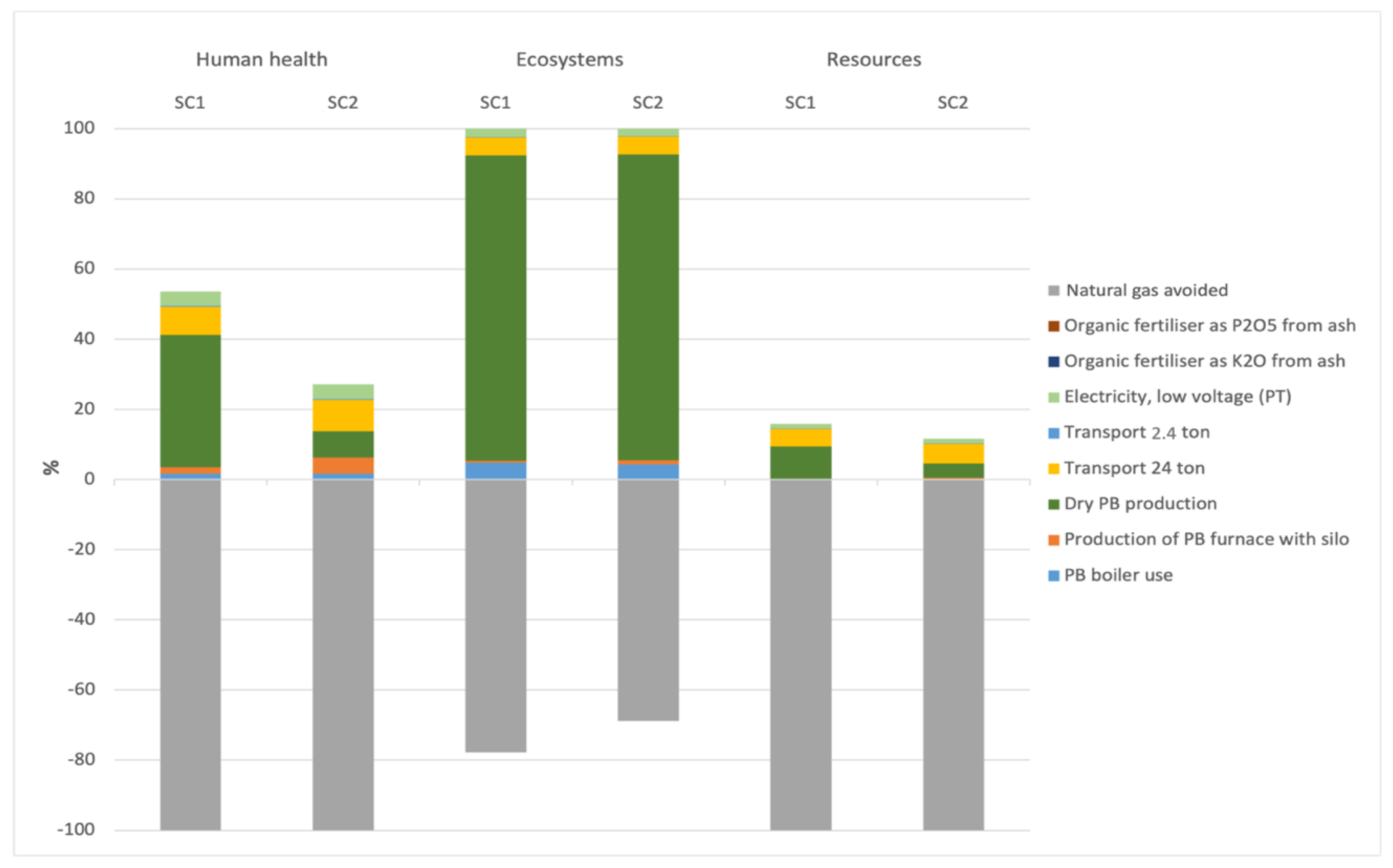
- Scenario variation (SV1): 50% reduction in inbound and outbound km. There is a significant reduction in impact on all endpoint categories analyzed.
- Scenario variation (SV2): No reduction in inbound km and 90% reduction in outbound km. No significant impact reductions are observed, which underscores that the effects are mainly due to inbound transport on heavy vehicles.
4. Discussion and Conclusions
Supplementary Materials
Author Contributions
Conflicts of Interest
References
- K. Richardson et al., ‘Earth beyond six of nine planetary boundaries’, Science Advances, vol. 9, no. 37, p. eadh2458, Sep. 2023. [CrossRef]
- R. Saint-Marc, J. P. Paredes-Sánchez, and J. Xiberta-Bernat, ‘Power Generation from Bioenergy Crops by Technical and Economic Feasibility Assessment’, Proceedings, vol. 2, no. 23, Art. no. 23, 2018. [CrossRef]
- G. Calvo and A. Valero, ‘Strategic mineral resources: Availability and future estimations for the renewable energy sector’, Environmental Development, vol. 41, p. 100640, Mar. 2022. [CrossRef]
- V. V. Klimenko, S. V. Ratner, and A. G. Tereshin, ‘Constraints imposed by key-material resources on renewable energy development’, Renewable and Sustainable Energy Reviews, vol. 144, p. 111011, Jul. 2021. [CrossRef]
- R. S. Dhillon and G. von Wuehlisch, ‘Mitigation of global warming through renewable biomass’, Biomass and Bioenergy, vol. 48, pp. 75–89, Jan. 2013. [CrossRef]
- M. Yan, N. Afxentiou, and P. A. Fokaides, ‘The State of the Art Overview of the Biomass Gasification Technology’, Curr Sustainable Renewable Energy Rep, vol. 8, no. 4, pp. 282–295, Dec. 2021. [CrossRef]
- A. D. Chintagunta et al., ‘Biodiesel Production From Lignocellulosic Biomass Using Oleaginous Microbes: Prospects for Integrated Biofuel Production’, Frontiers in Microbiology, vol. 12, 2021, Accessed: Dec. 30, 2023. [Online]. Available: https://www.frontiersin.org/articles/10.3389/fmicb.2021.658284.
- M. Buffi, M. Prussi, and N. Scarlat, ‘Energy and environmental assessment of hydrogen from biomass sources: Challenges and perspectives’, Biomass and Bioenergy, vol. 165, p. 106556, Oct. 2022. [CrossRef]
- P. Rex, K. R. Mohammed Ismail, N. Meenakshisundaram, P. Barmavatu, and A. V. S. L. Sai Bharadwaj, ‘Agricultural Biomass Waste to Biochar: A Review on Biochar Applications Using Machine Learning Approach and Circular Economy’, ChemEngineering, vol. 7, no. 3, Art. no. 3, Jun. 2023. [CrossRef]
- A. N. Syimir Fizal, M. S. Hossain, M. Zulkifli, N. A. Khalil, H. Abd Hamid, and A. N. Ahmad Yahaya, ‘Implementation of the supercritical CO2 technology for the extraction of candlenut oil as a promising feedstock for biodiesel production: potential and limitations’, International Journal of Green Energy, vol. 19, no. 1, pp. 72–83, Jan. 2022. [CrossRef]
- R. Picchio et al., ‘Pellet Production from Woody and Non-Woody Feedstocks: A Review on Biomass Quality Evaluation’, Energies, vol. 13, no. 11, Art. no. 11, Jan. 2020. [CrossRef]
- European Commission. Joint Research Centre. Institute for Environment and Sustainability., International Reference Life Cycle Data System (ILCD) Handbook :general guide for life cycle assessment : detailed guidance. LU: Publications Office, 2010. Accessed: Jan. 28, 2024. [Online]. Available: https://data.europa.eu/doi/10.2788/38479.
- SimaPro - Help Center, ‘What are infrastructure processes, and how to include or exclude them?’ Accessed: Jan. 25, 2024. [Online]. Available: https://support.simapro.com/s/article/What-are-infrastructure-processes-and-how-to-include-or-exclude-them.
- PRé, ‘SimaPro Tutorial’, 5.3, Jan. 2016. [Online]. Available: https://pre-sustainability.com/legacy/download/SimaPro8Tutorial.pdf.
- European Pellet Council (EPC), ‘ENplus Handbook V 3.0’.
- M. Renzi et al., ‘Acute Effects of Particulate Matter on All-Cause Mortality in Urban, Rural, and Suburban Areas, Italy’, Int J Environ Res Public Health, vol. 18, no. 24, p. 12895, Dec. 2021. [CrossRef]
- Chandrasekaran et all., ‘Characterization of Emissions from Grass Pellet Combustion | Energy & Fuels’. Accessed: Jan. 22, 2024. [Online]. Available: https://pubs.acs.org/doi/abs/10.1021/ef4010169.
- M. Kuokkanen, R. Pöykiö, T. Kuokkanen, and H. Nurmesniemi, ‘Wood ash-A potential forest fertilizer’, Energy Research At the University of Oulu, Jan. 2009.
- International Organization for Standardization, ISO 14044:2006, Aug. 12, 2014. Accessed: Oct. 25, 2023. [Online]. Available: https://www.iso.org/standard/38498.html.
- International Organization for Standardization, ISO 14040:2006, Jul. 01, 2006. Accessed: Oct. 25, 2023. [Online]. Available: https://www.iso.org/standard/37456.html.
- Database & Support team at PRé Sustainability, ‘SimaPro database manual, Methods library’, [Online]. Available: https://simapro.com/wp-content/uploads/2023/07/DatabaseManualMethods.pdf.
- AIEL - Associazione Italiana Energie Agroforestali, ‘Markets end Prices’, Apr. 2022. [Online]. Available: https://www.aielenergia.it/public/pubblicazioni/218_M_P_2-2022.pdf.
- C. S. S. Ferreira, S. Seifollahi-Aghmiuni, G. Destouni, N. Ghajarnia, and Z. Kalantari, ‘Soil degradation in the European Mediterranean region: Processes, status and consequences’, Science of The Total Environment, vol. 805, p. 150106, Jan. 2022. [CrossRef]
- R. Picchio et al., ‘Pellet Production from Woody and Non-Woody Feedstocks: A Review on Biomass Quality Evaluation’, Energies, vol. 13, no. 11, Art. no. 11, Jan. 2020. [CrossRef]
- Brás et al., ‘Valorisation of Forest and Agriculture Residual Biomass—The Application of Life Cycle Assessment to Analyse Composting, Mulching, and Energetic Valorisation Strategies’, Sustainability, vol. 16, no. 2, Art. no. 2, Jan. 2024. [CrossRef]

 |
Disclaimer/Publisher’s Note: The statements, opinions and data contained in all publications are solely those of the individual author(s) and contributor(s) and not of MDPI and/or the editor(s). MDPI and/or the editor(s) disclaim responsibility for any injury to people or property resulting from any ideas, methods, instructions or products referred to in the content. |
© 2025 by the authors. Licensee MDPI, Basel, Switzerland. This article is an open access article distributed under the terms and conditions of the Creative Commons Attribution (CC BY) license (http://creativecommons.org/licenses/by/4.0/).