

Submitted:
26 February 2025
Posted:
27 February 2025
You are already at the latest version
Abstract
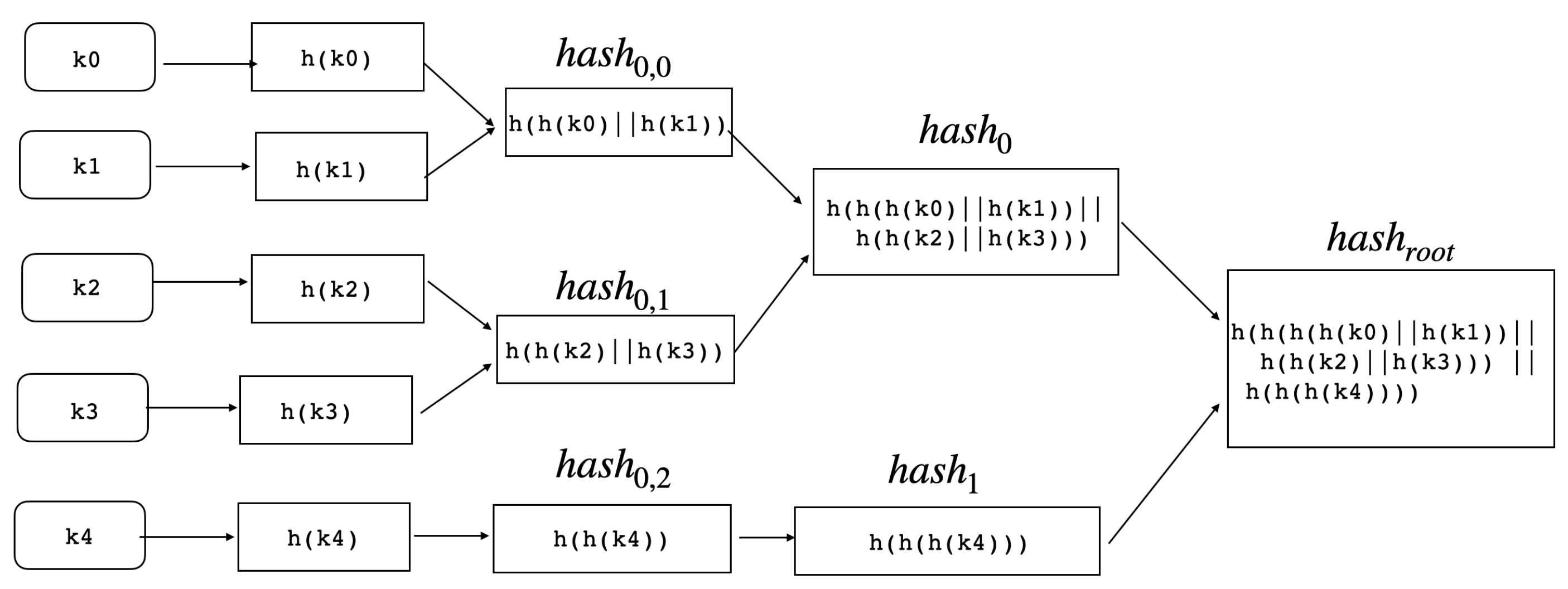
Data integrity and authenticity verification are essential requirements to provide reliability for applications running in a video delivery system. We design a prototype system for handling data integrity as well as encoding sensitive objects in a video frame. This system is composed of two components, a logger and a verifier; The logger operates a cryptography hash function of a feature vector of a video data frame and an XOR encoding scheme used for hiding privacy information of sensitive objects in the video data frame. The XOR encoding scheme is operated at the encoder, as part of the logger. The hash value outputted from the hash function is signed by a private key owned by the logger. It is listed into one of attributes in a metadata of the video frame. In the key distribution phase for the authenticity verification process, the logger maintains the private key and the public key is stored on the verifier by handshaking. In order to reduce the processing load for data integrity verification, a hash tree configured for each stream of sensor data is used to minimize verification time. This paper is mainly focused on the design of a logger for data integrity verification and encoding of sensitive objects; To evaluate performance of the proposed method, we build a prototype in a client-server manner. The designed method operated on the logger uses to mitigate the risk of video data frame tampered and to help significantly in preserving sensitive objects securely.
Keywords:
1. Introduction
1.1. Background
1.2. Motivation
1.3. Contributions
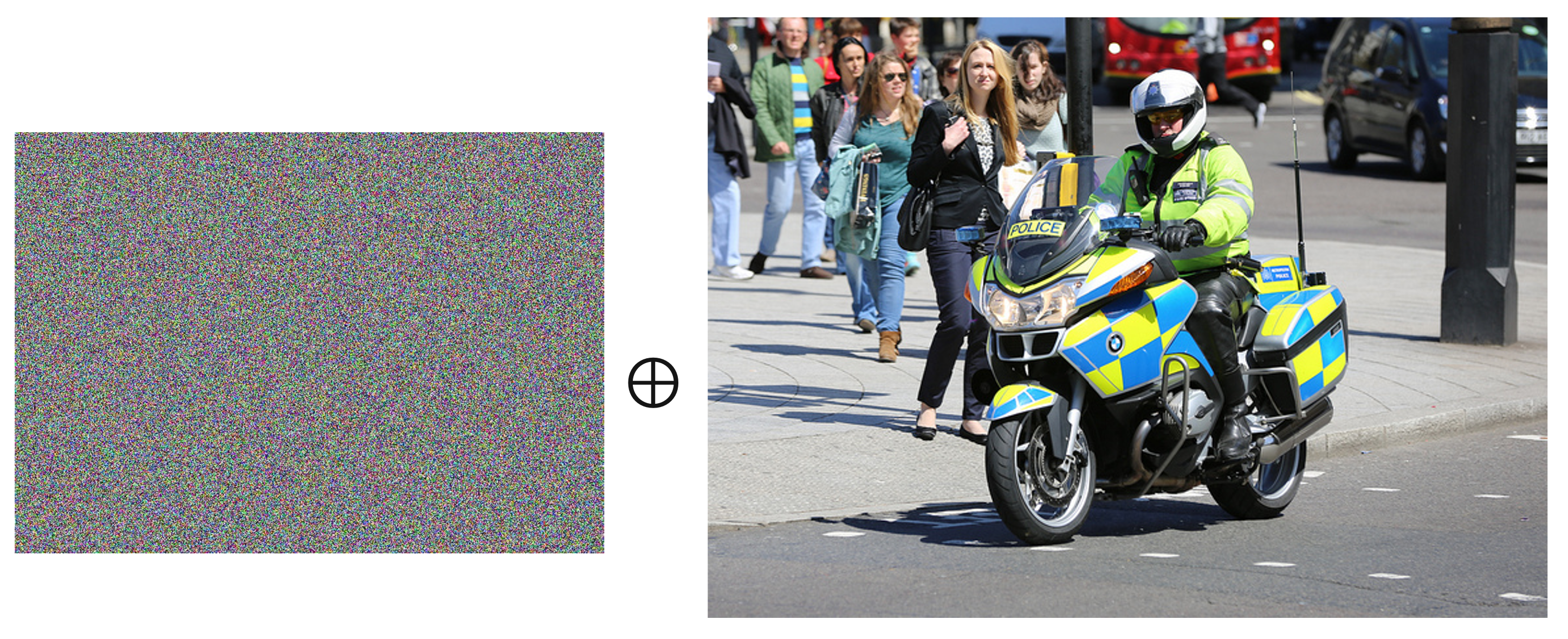
- The designing an XOR encoding scheme with a filter to securely and efficiently handle both encoding and decoding operations within an edge device.
- This scheme is designed to securely and efficiently handle both encoding and decoding operations within an edge device.
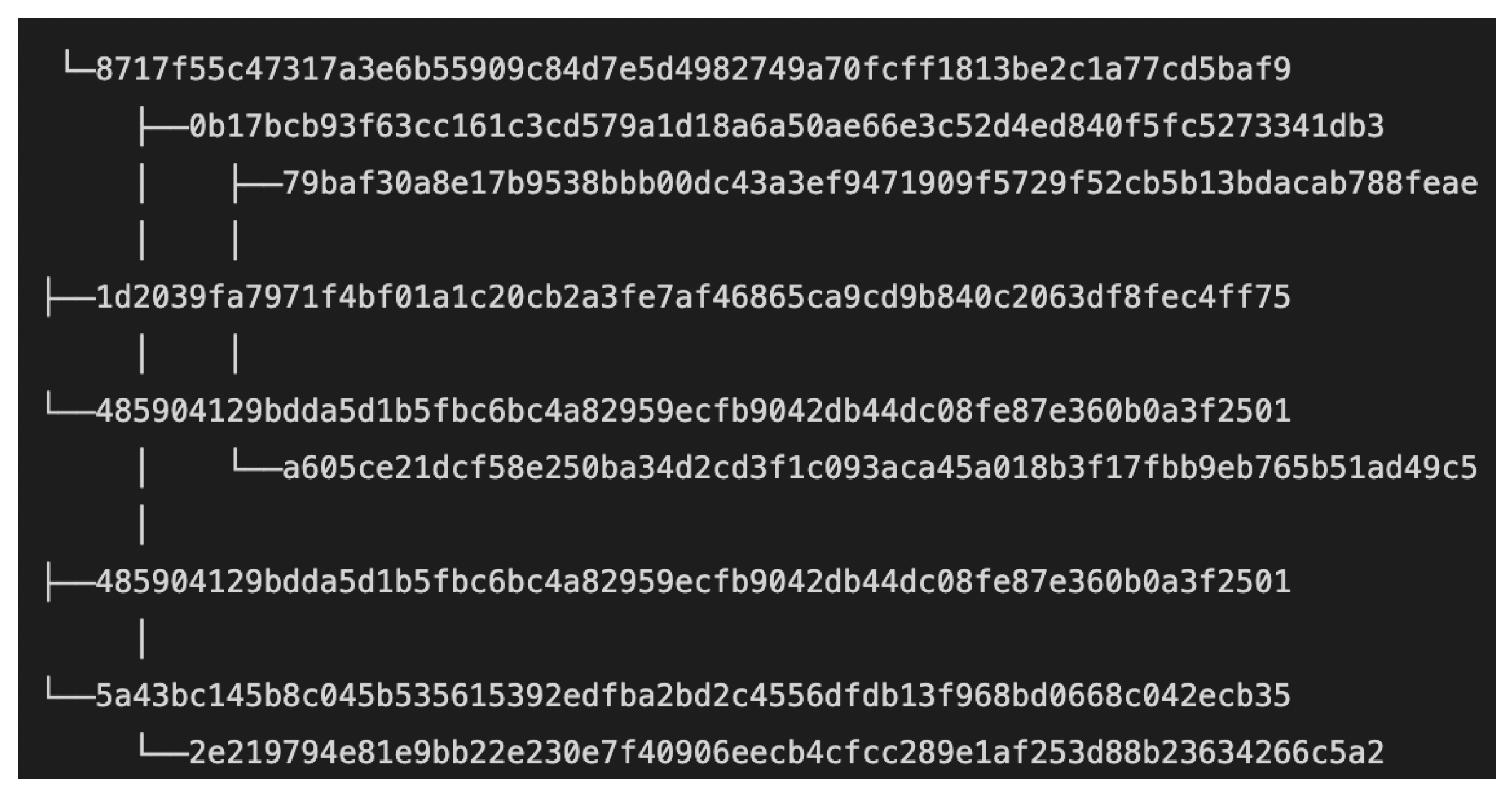
- We apply the fingerprint of an image as the value of a leaf node in the hash tree.
- The evaluatation of the performance of the data delivery method using a prototype based on an edge device.
2. Related Works
2.1. Hash Function
2.2. Hash Tree
2.3. Digital Certificate
3. Methods
3.1. System Structure Design
- The verifier receives video data from the logger, which is the module responsible for acquiring video data, stores it, and performs verification of the video data.
- Communication between the logger and the verifier is based on Representational State Transfer(REST), using a request-response model, and data transmission and processing are carried out by defining message specifications in advance.
- The logger and verifier operate as entities responsible for signing and verification.
3.2. Delivery Scheme
3.3. Construction of Digital Fingerprint
3.4. Multi-Thread Logger
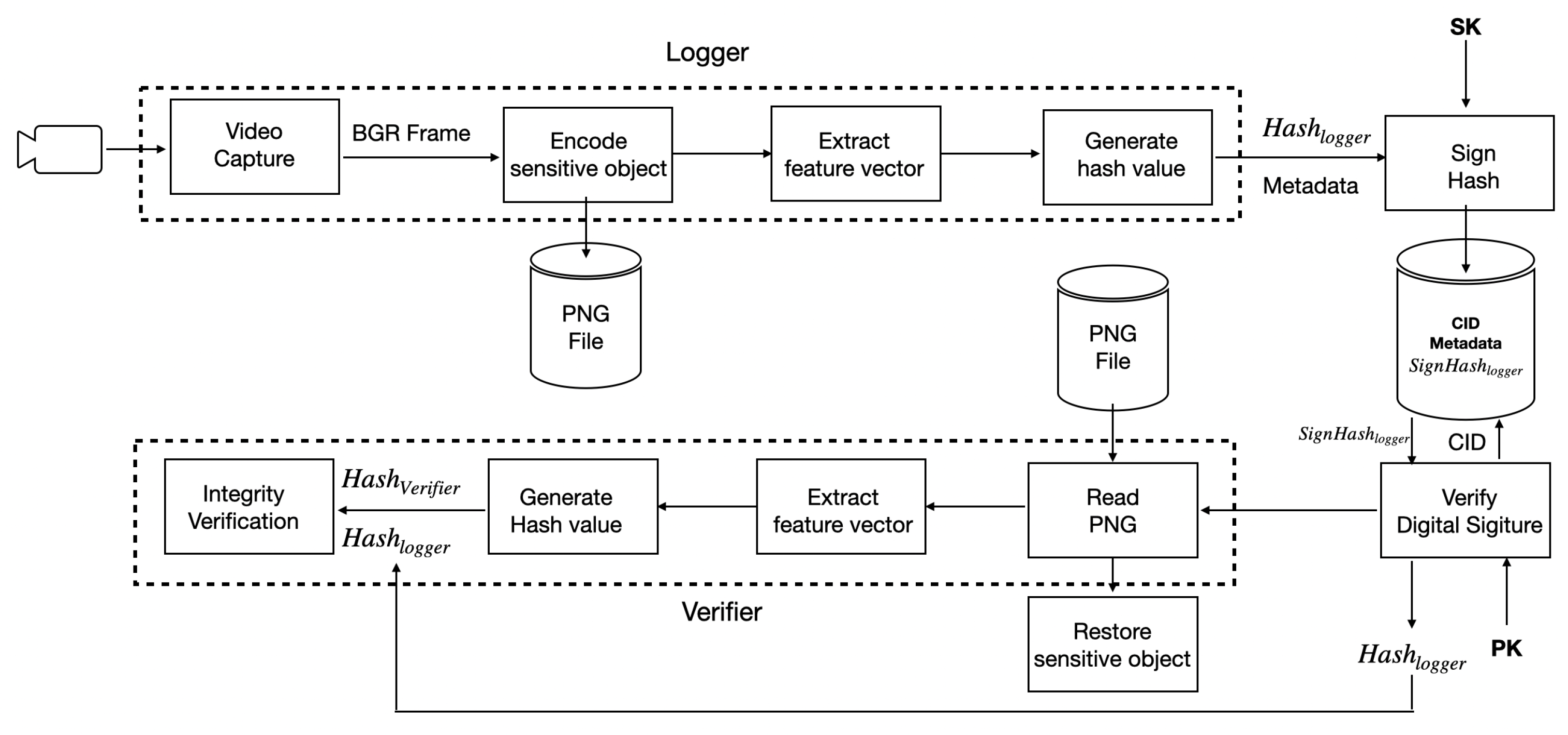
- Captureing an image:Video data is captured through a camera. The camera is connected via USB, and after reading the shape file, video capture is performed according to the shape information. The captured video data in this paper is in BGR format. BGR (Blue, Green, Red) is a color format where the color values are stored in the order of Blue, Green, and Red.
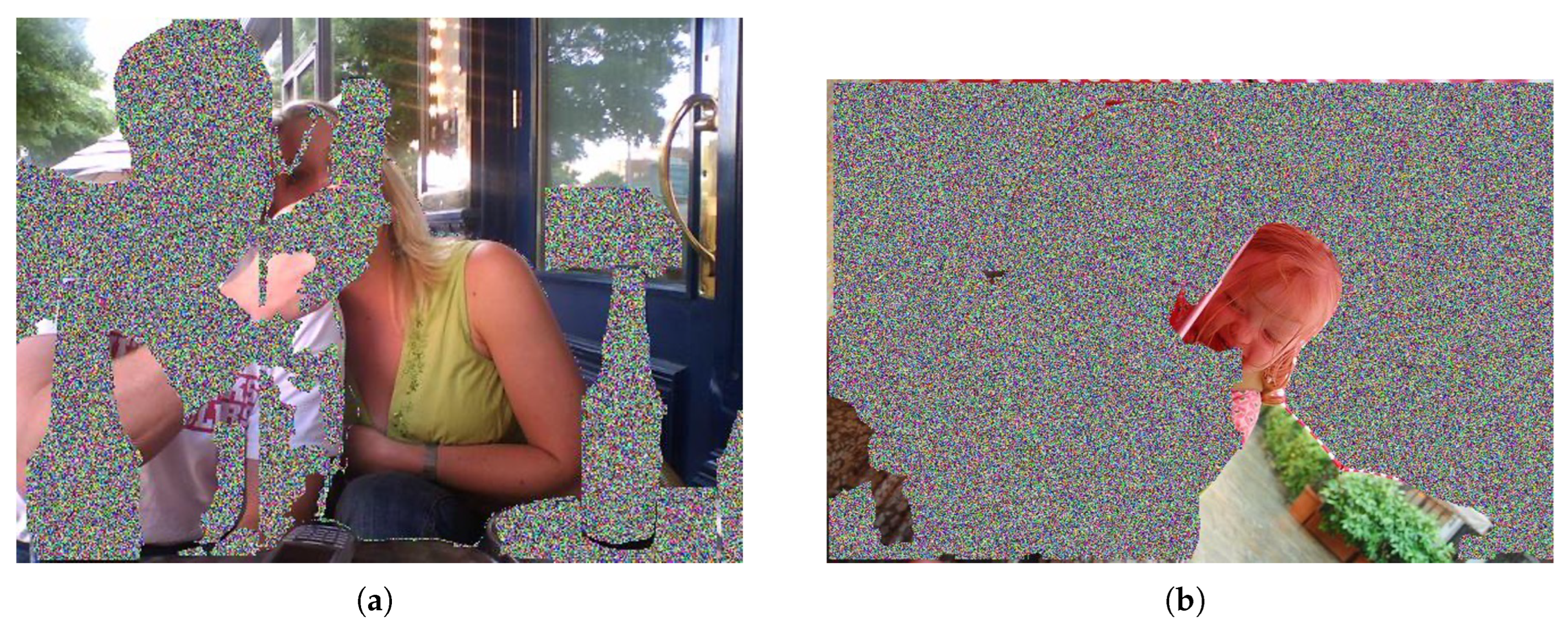
- Encoding sensitive objects: BGR image is passed to the encoder with object detection. Encoded videos are stored in a separate folder. The file name for video storage is assigned a sequential number using the MAC address of the logger as a prefix for logger identification. Since the currently operating edge device of the logger does not have a real-time clock(RTC), sequential numbers representing logical time are used for information to determine the chronological order of file creation.
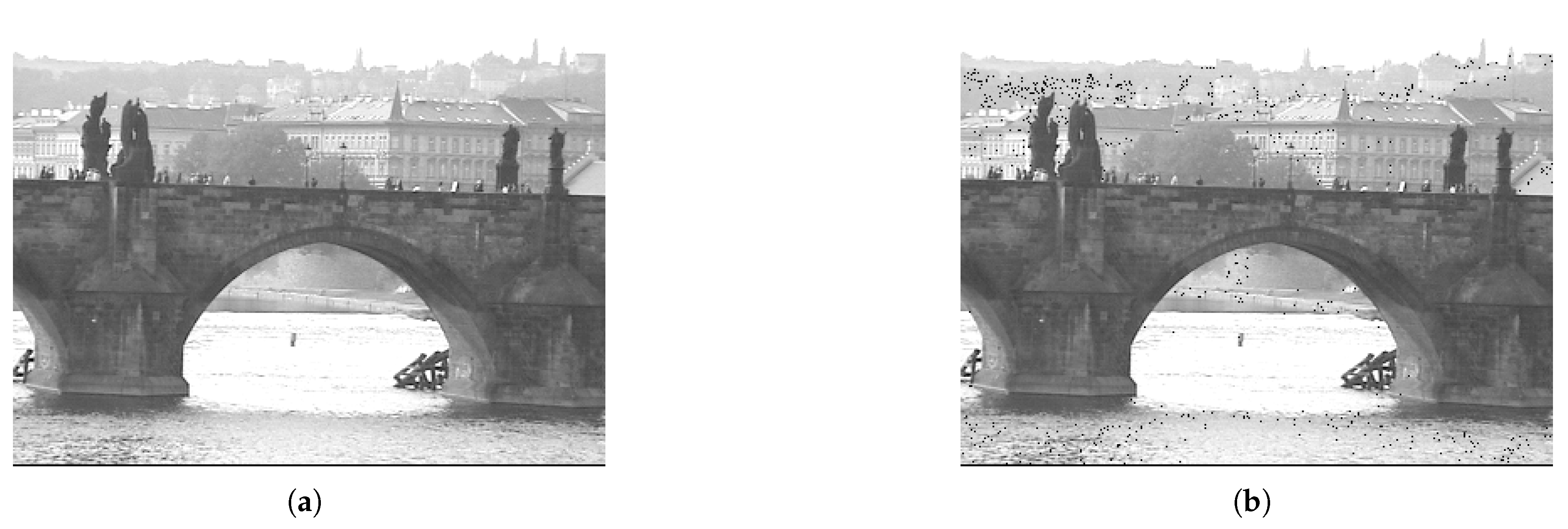
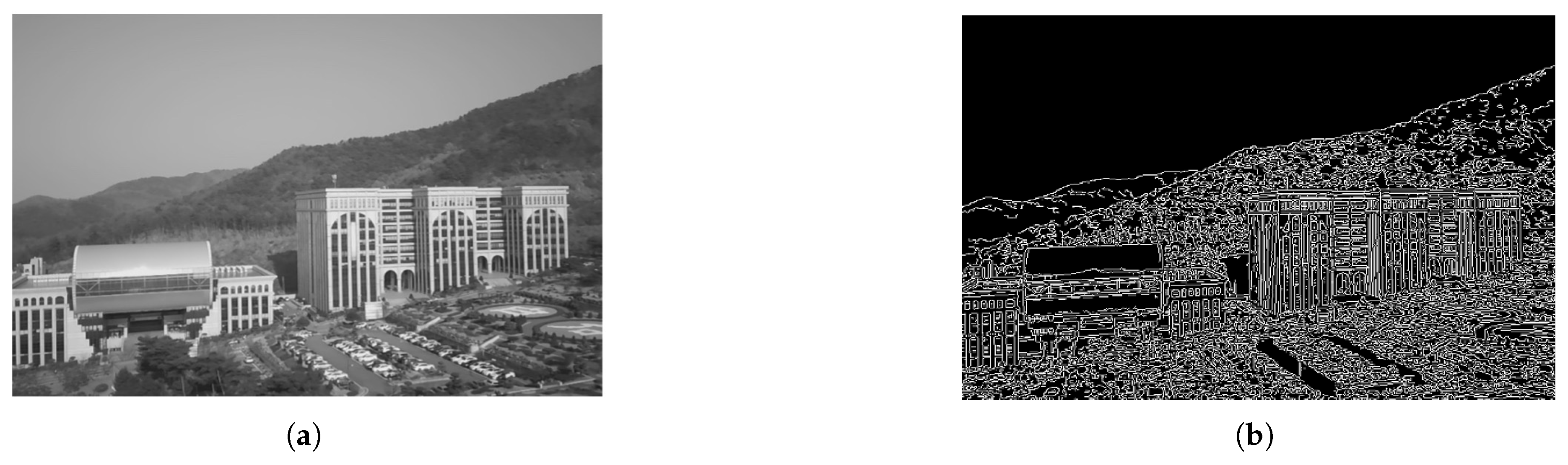
- Extracting a feature vector: The BGR data of the captured video is converted to grayscale. Canny Edge detection is used for constructing the feature vector of the video. A feature vector is a numerical representation of a video frame. The grayscale conversion is performed by calling the OpenCV library.
- Making a hash value: Hashes are generated for the feature vectors. is a cryptographic hash function that generates a fixed-size 256-bit (64-character) unique hexadecimal. The hash value generated by is represented as a digital fingerprint, ensuring the integrity of the data.
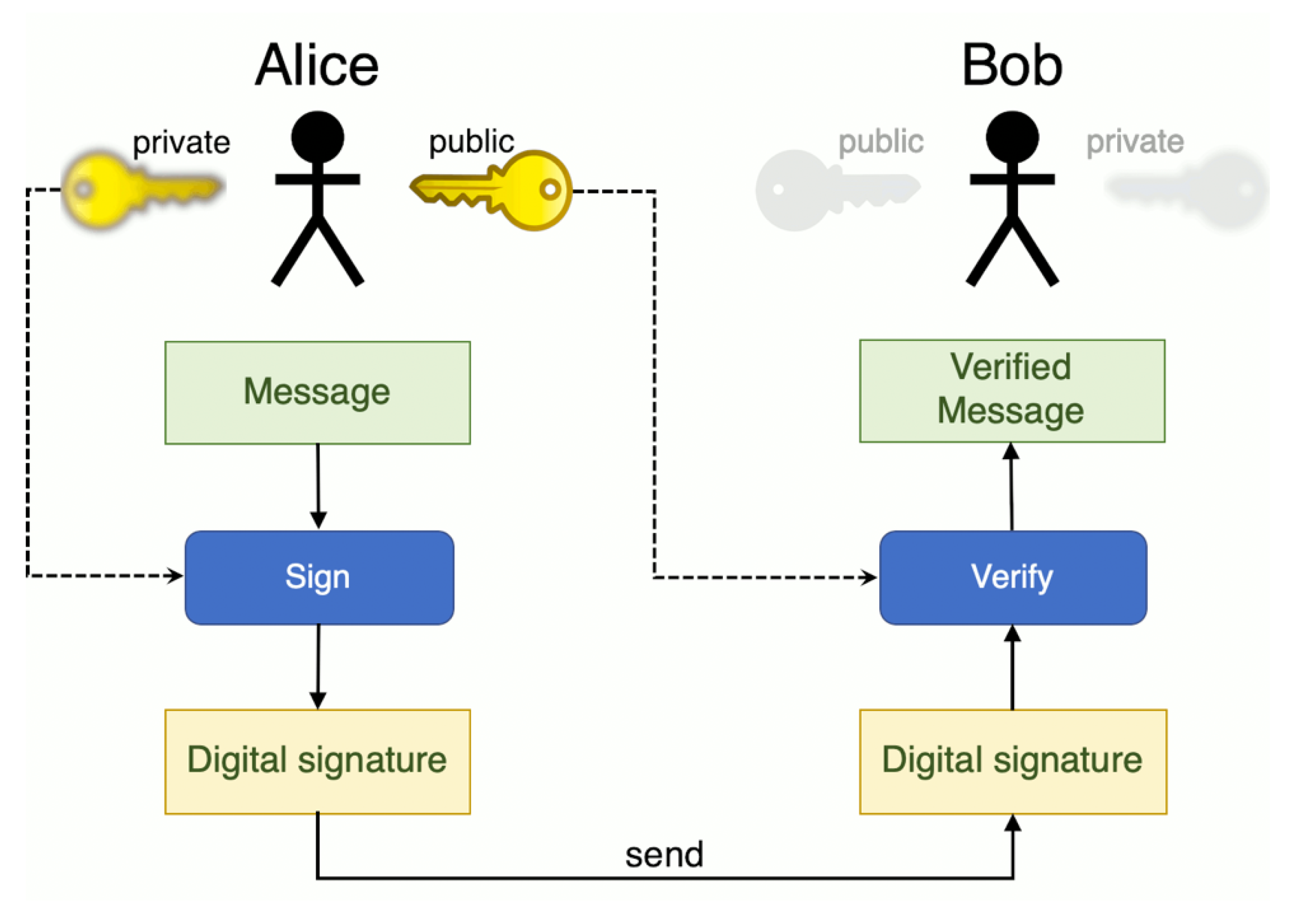
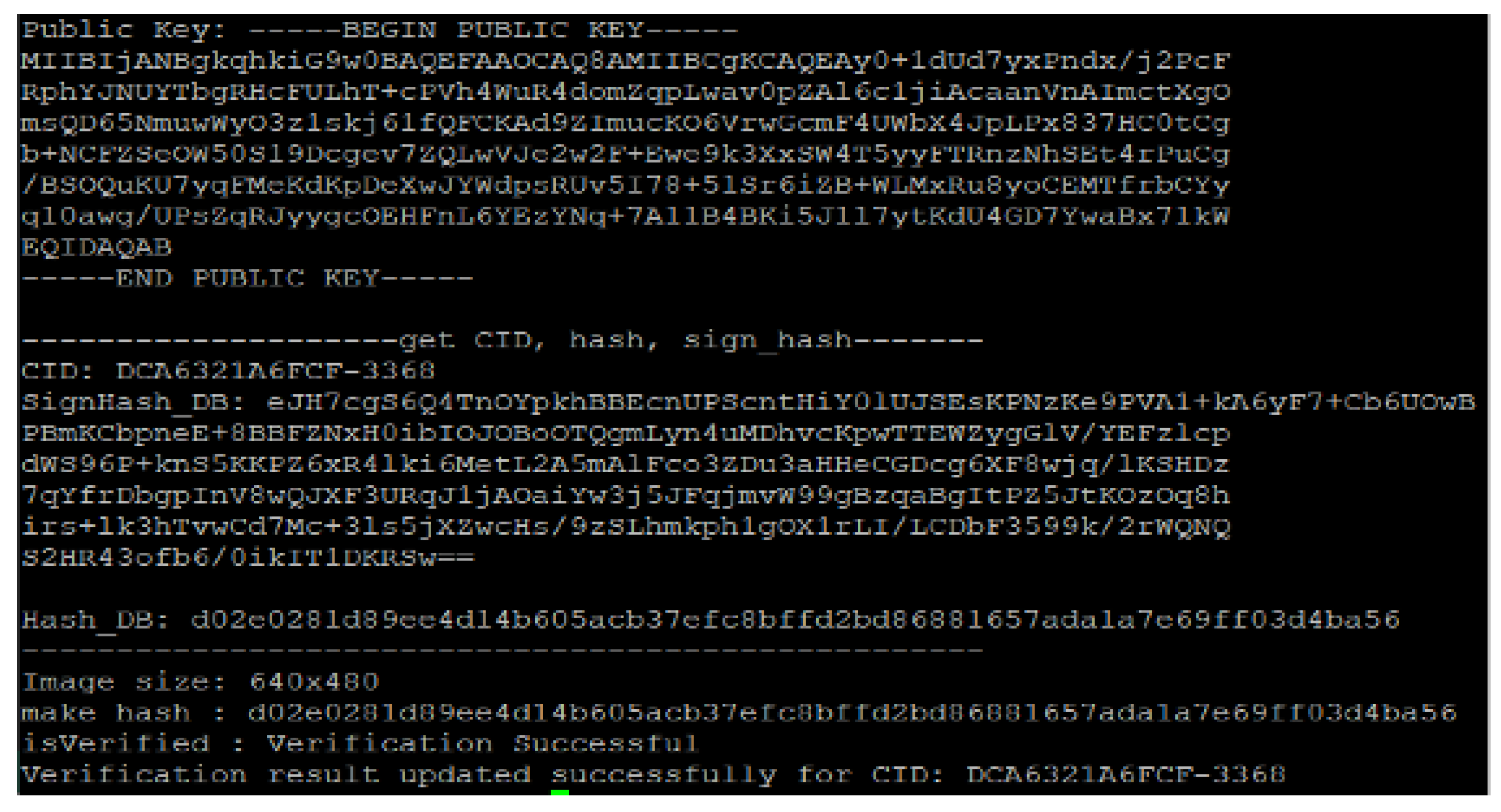
- Signing the hash value:A digital signature, generated by signing the hash with a private key, confirms its origin from a specific logger.
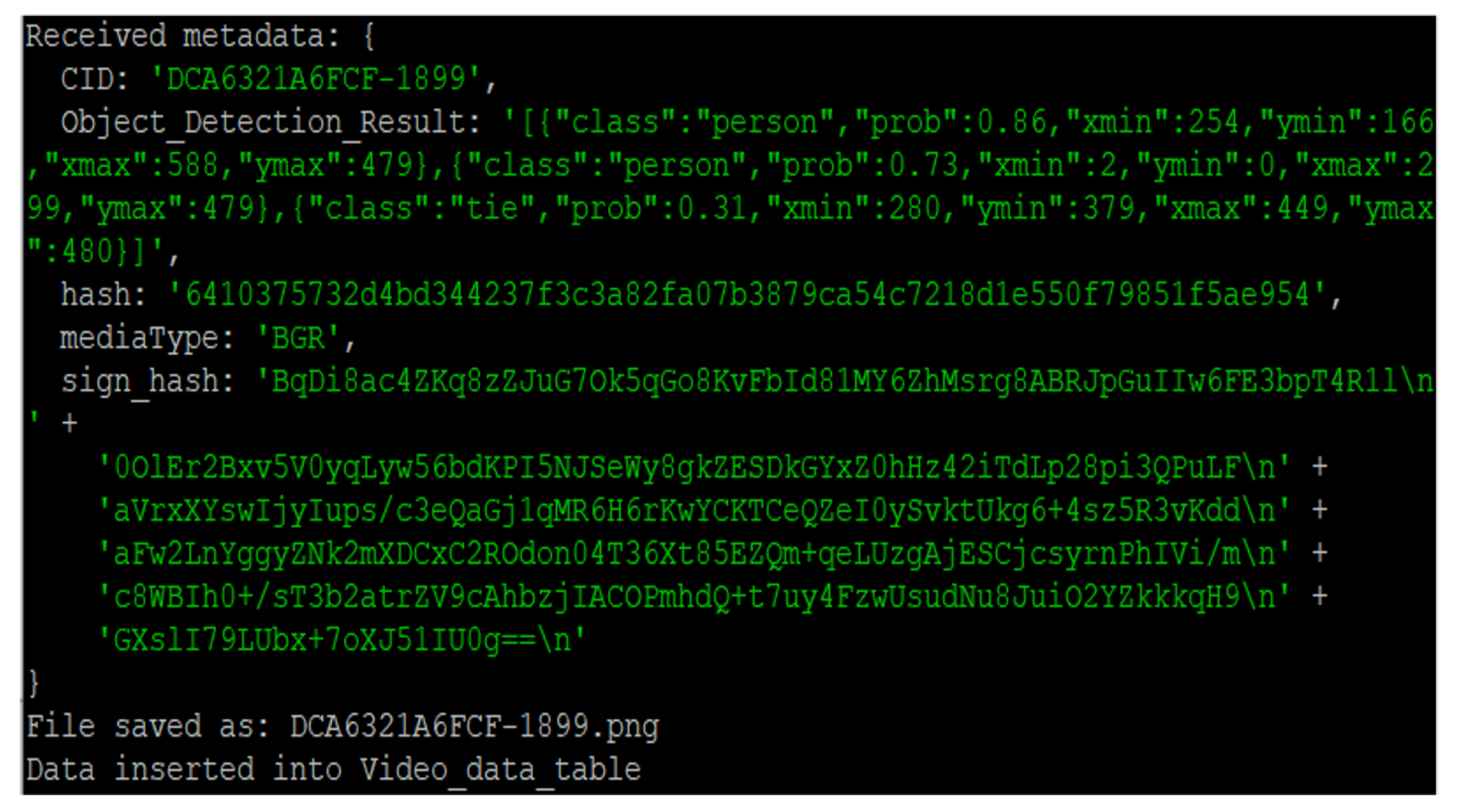
- Sending image and its metadata: Video data and metadata are transmitted to the VMS. The HTTP-based REST((Representational State Transfer) protocol is used for data transmission.
3.5. Scheme for Encoding and Decoding Sensitive Objects
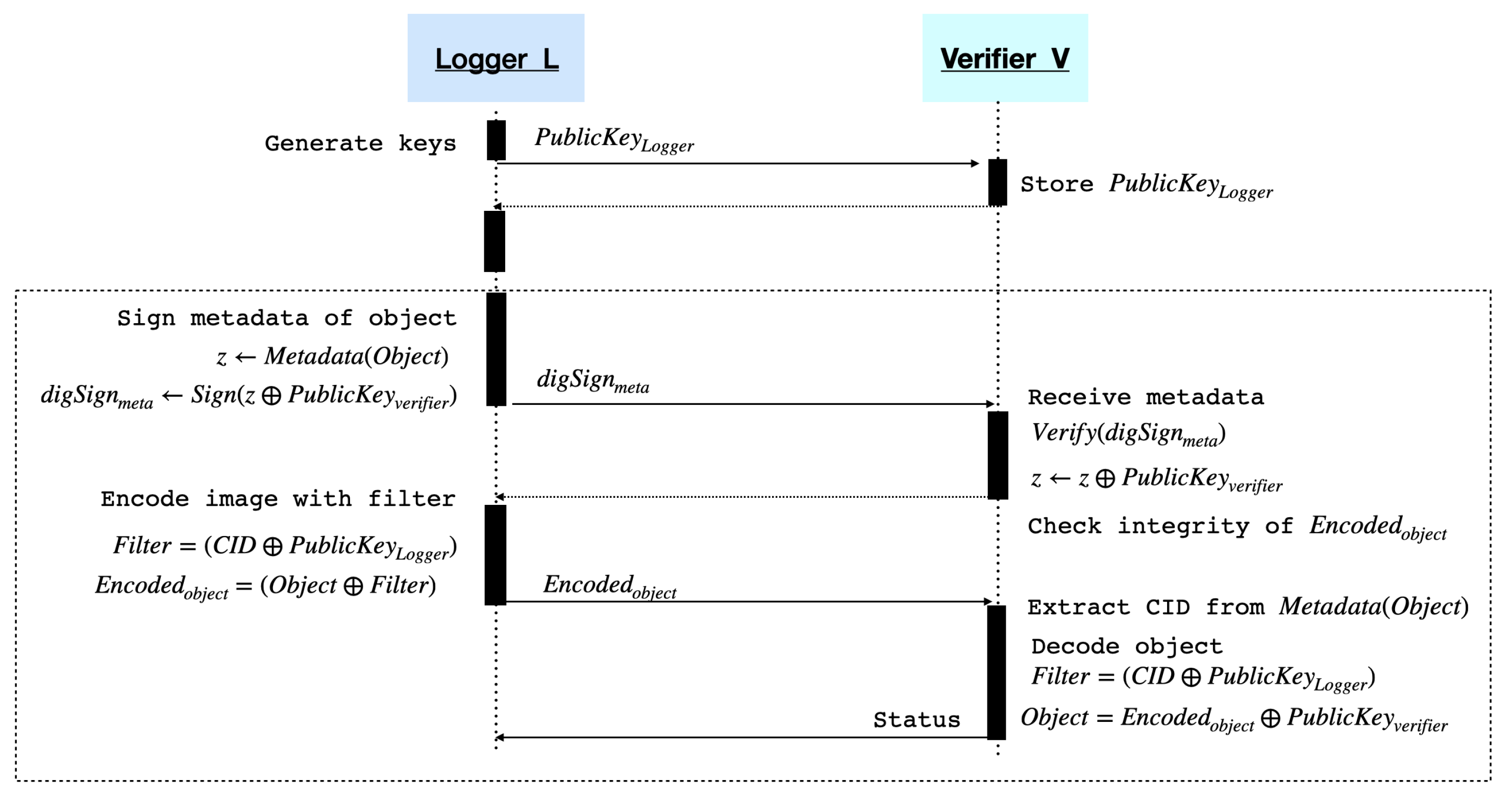
- () The logger sends its digital certificate with a public key, part of a key pair in PKI, to the server. The server verifies the certificate to ensure that it’s valid and issued by a trusted Certificate Authority (CA). If the certificate is valid, the logger sends the logger a filter, which plays a role as a shared secret key.
- () All subsequent communication between the client and server is encrypted using the shared secret key. This encryption ensures that any data transmitted is unreadable to anyone who might intercept it.
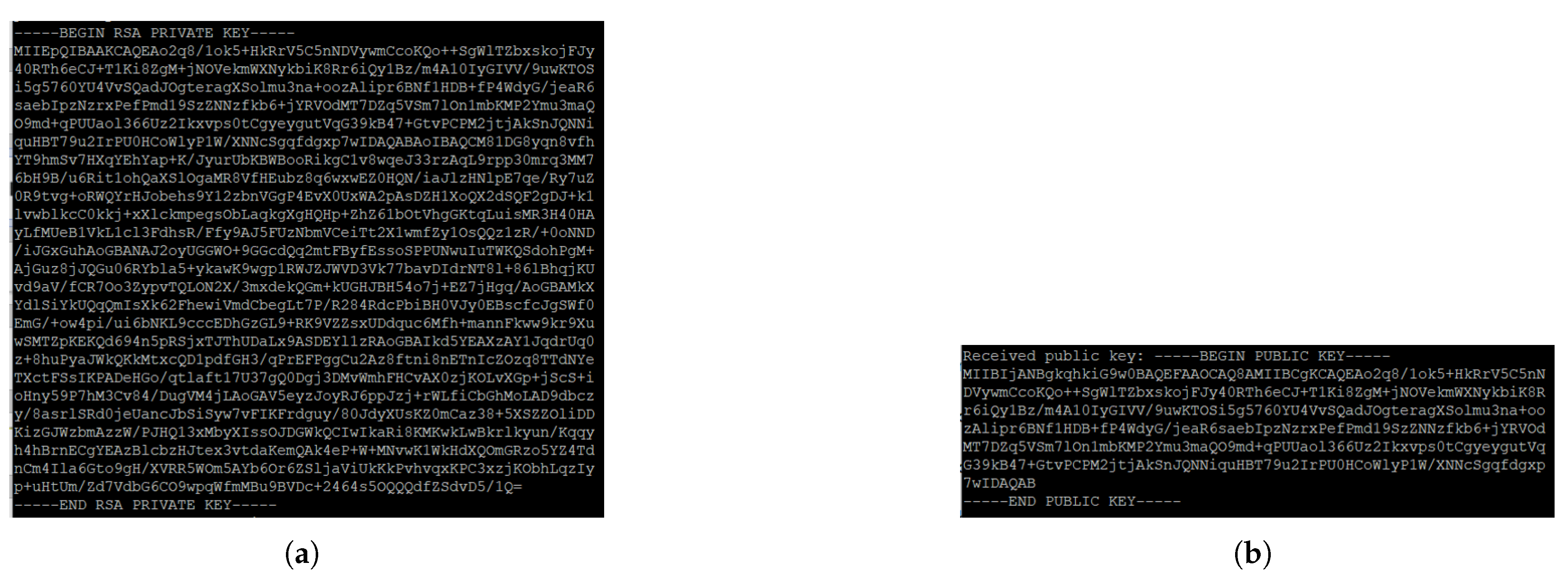
- The logger generates a public-private key pair based on PKI and transmits the public key to the verifier.
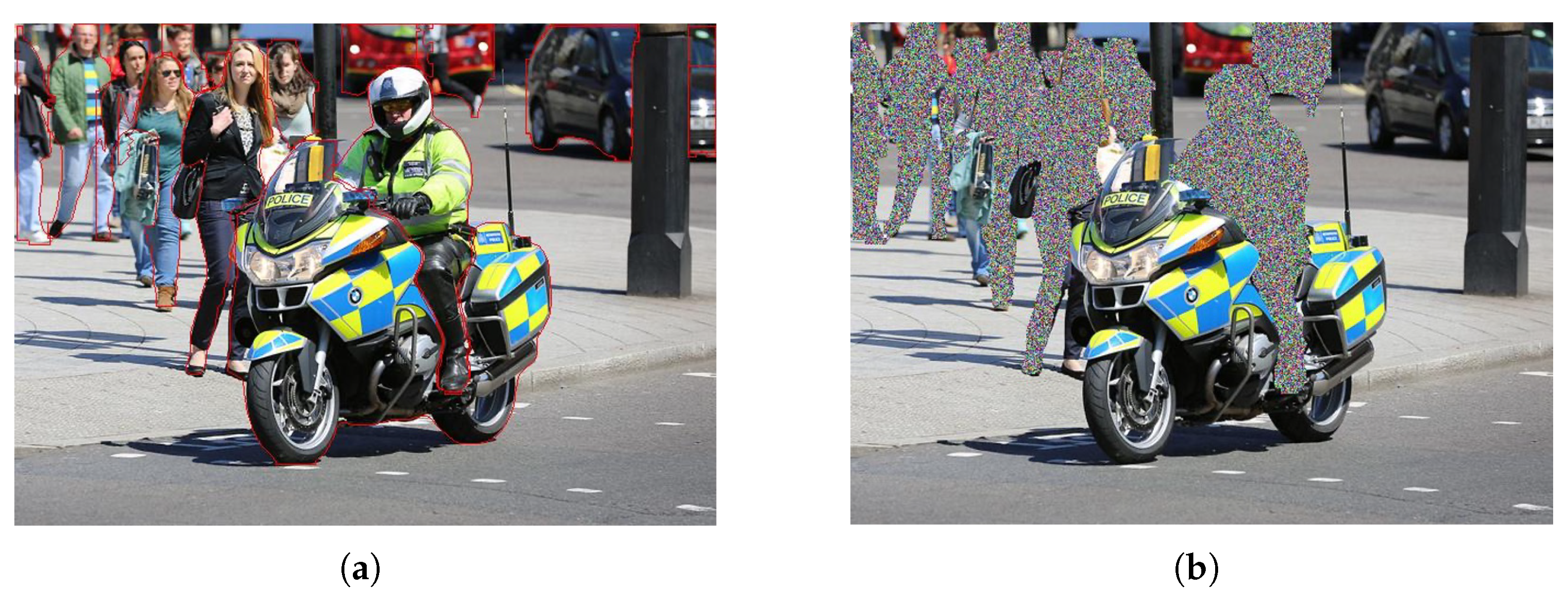
- The logger obtains object information from video data using an object detection model.
- Based on the object information of identified sensitive objects, the logger applies a filter to perform encoding.
4. Results
4.1. Experimental Setup
4.2. Result of a Generated Key Pair
4.3. Result of Preprocessed Image
4.4. Result of Delivering Image and Its Metadata
4.5. Result of Hash Tree and Verification
4.6. Result of Encoding Sensitive Object
5. Performance Evaluation
5.1. Evaluation of logger threads
5.2. Evaluation of Object Detection and Encoding
6. Discussion
7. Conclusions
Author Contributions
Funding
Data Availability Statement
Conflicts of Interest
References
- Zimmermann, A.; Schmidt, R.; Jain, L.C., Eds. Architecting the Digital Transformation - Digital Business, Technology, Decision Support, Management; Vol. 188, Intelligent Systems Reference Library, Springer, 2021. [CrossRef]
- Jaspin, K.; Selvan, S.; Sahana, S.; Thanmai, G. Efficient and Secure File Transfer in Cloud Through Double Encryption Using AES and RSA Algorithm. In Proceedings of the 2021 International Conference on Emerging Smart Computing and Informatics (ESCI), 2021, pp. 791–796. [CrossRef]
- Sivathanu, G.; Wright, C.P.; Zadok, E. Ensuring data integrity in storage: techniques and applications. In Proceedings of the StorageSS; Atluri, V.; Samarati, P.; Yurcik, W.; Brumbaugh, L.; Zhou, Y., Eds. ACM, 2005, pp. 26–36.
- Voigt, P.; Bussche, A.v.d. The EU General Data Protection Regulation (GDPR): A Practical Guide, 1st ed.; Springer Publishing Company, Incorporated, 2017.
- Hjerppe, K.; Ruohonen, J.; Leppanen, V. The General Data Protection Regulation: Requirements, Architectures, and Constraints. In Proceedings of the 2019 IEEE 27th International Requirements Engineering Conference (RE). IEEE, 2019. [CrossRef]
- Fotiou, N.; Xylomenos, G.; Thomas, Y. Data integrity protection for data spaces. In Proceedings of the Proceedings of the 17th European Workshop on Systems Security, New York, NY, USA, 2024; EuroSec ’24, p. 44–50. [CrossRef]
- Wu, C. Data privacy: From transparency to fairness. Technology in Society 2024, 76, 102457. [CrossRef]
- Duranti, L.; Rogers, C. Trust in digital records: An increasingly cloudy legal area. Computer Law & Security Review 2012, 28, 522–531. [CrossRef]
- Geus, J.; Ottmann, J.; Freiling, F. Systematic Evaluation of Forensic Data Acquisition using Smartphone Local Backup, 2024, [arXiv:cs.CR/2404.12808].
- Hansen, T.; 3rd, D.E.E. US Secure Hash Algorithms (SHA and HMAC-SHA). RFC 4634, 2006. [CrossRef]
- Goldwasser, S.; Micali, S.; Rivest, R.L. A Digital Signature Scheme Secure Against Adaptive Chosen-Message Attacks. SIAM Journal on Computing 1988, 17, 281–308.
- Swan, M. Blockchain : blueprint for a new economy; O’Reilly Media: Sebastopol, Calif., 2015.
- Gao, T.; Yao, Z.; Si, X. Data Integrity Verification Scheme for Fair Arbitration Based on Blockchain. In Proceedings of the 2024 4th International Conference on Blockchain Technology and Information Security (ICBCTIS), Aug 2024, pp. 191–197. [CrossRef]
- Cherckesova, L.V.; Safaryan, O.A.; Lyashenko, N.G.; Korochentsev, D.A. Developing a New Collision-Resistant Hashing Algorithm. Mathematics 2022, 10. [CrossRef]
- Rogaway, P.; Shrimpton, T. Cryptographic Hash-Function Basics: Definitions, Implications, and Separations for Preimage Resistance, Second-Preimage Resistance, and Collision Resistance. In Proceedings of the Fast Software Encryption, 11th International Workshop, FSE 2004, Delhi, India, February 5-7, 2004, Revised Papers; Roy, B.K.; Meier, W., Eds. Springer, 2004, Vol. 3017, Lecture Notes in Computer Science, pp. 371–388. [CrossRef]
- Liu, H.; Luo, X.; Liu, H.; Xia, X. Merkle Tree: A Fundamental Component of Blockchains. In Proceedings of the 2021 International Conference on Electronic Information Engineering and Computer Science (EIECS), 2021, pp. 556–561. [CrossRef]
- Belchior, R.; Vasconcelos, A.; Guerreiro, S.; Correia, M. A Survey on Blockchain Interoperability: Past, Present, and Future Trends. ACM Comput. Surv. 2021, 54. [CrossRef]
- Merkle, R.C. A Digital Signature Based on a Conventional Encryption Function. In Proceedings of the A Conference on the Theory and Applications of Cryptographic Techniques on Advances in Cryptology, Berlin, Heidelberg, 1987; CRYPTO ’87, p. 369–378.
- Bashiri, K.; Fluhrer, S.; Gazdag, S.L.; Geest, D.V.; Kousidis, S. Internet X.509 Public Key Infrastructure: Algorithm Identifiers for SLH-DSA. Internet-Draft draft-ietf-lamps-x509-slhdsa-03, Internet Engineering Task Force, 2024. Work in Progress.
- Rivest, R.L.; Shamir, A.; Adleman, L. A method for obtaining digital signatures and public-key cryptosystems. Commun. ACM 1978, 21, 120–126. [CrossRef]
- Redmon, J.; Divvala, S.; Girshick, R.; Farhadi, A. You Only Look Once: Unified, Real-Time Object Detection. In Proceedings of the 2016 IEEE Conference on Computer Vision and Pattern Recognition (CVPR), 2016, pp. 779–788. [CrossRef]
- Varghese, R.; M., S. YOLOv8: A Novel Object Detection Algorithm with Enhanced Performance and Robustness. In Proceedings of the 2024 International Conference on Advances in Data Engineering and Intelligent Computing Systems (ADICS), 2024, pp. 1–6. [CrossRef]

| Phase | Description | Remarks |
|---|---|---|
| 1 | Generate a key pair, and | |
| 2 | Transfer to verifier | |
| 3 | Generate a feature of given image | Canny edge detection |
| 4 | Generate a hash value | SHA-256 |
| 5 | Sign the hash value | |
| 6 | Build a hash tree | Merkle tree |
| Type | Name | Specification | |
|---|---|---|---|
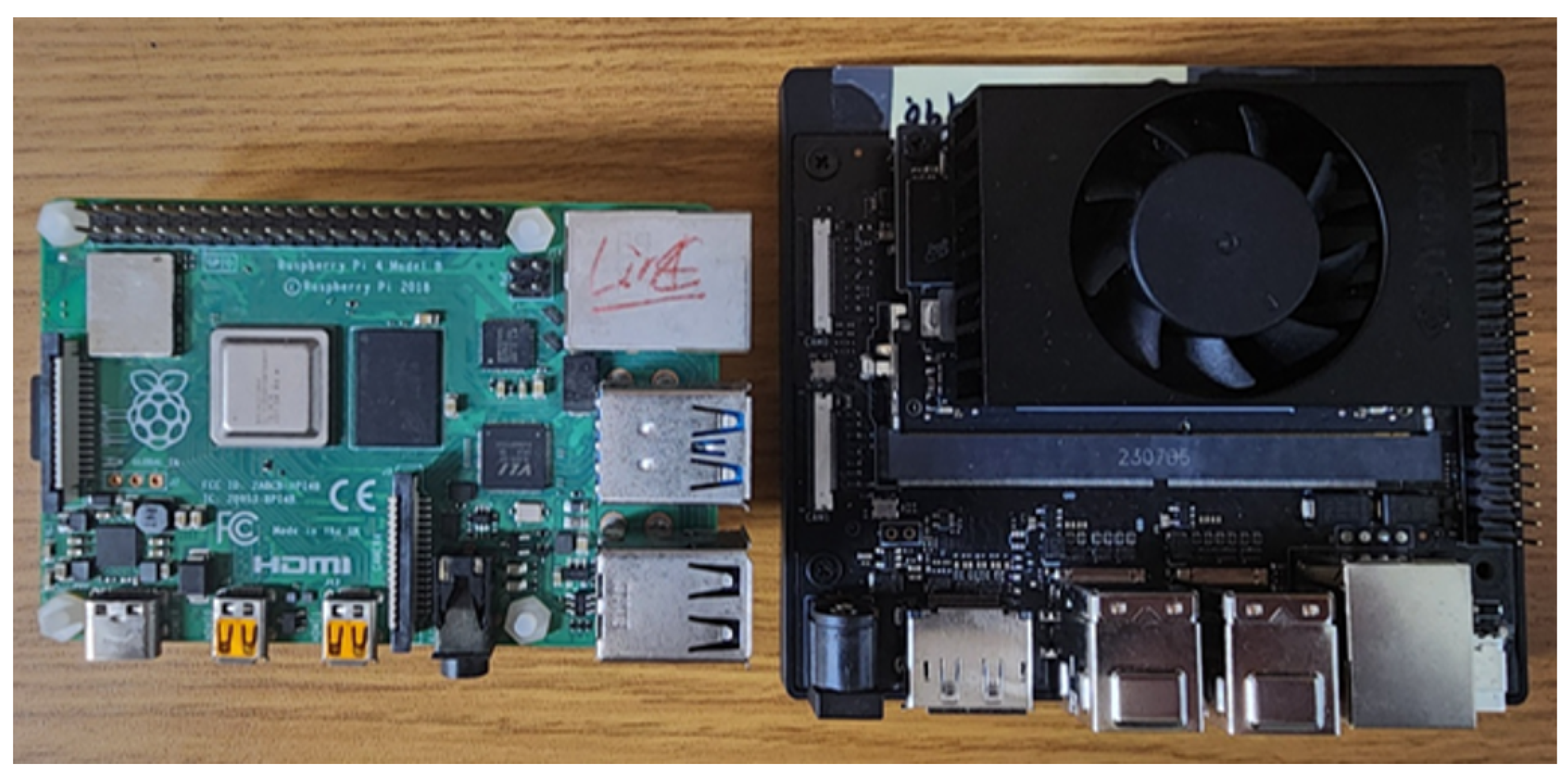
| Object detector | HW | Jetson Nano Orin | 8G byte (Memory) |
| SW | OS | Ubuntu 20.04.6LTS | |
| Language | Python 3.8.10 | ||
| Libraries | PyTorch 2.1.0 | ||
| Torchvision 0.16.1 | |||
| YOLOv8 | |||
| Logger | HW | Raspberry PI 4 | 8G byte (Memory) |
| WebCam | Logitech Webcam c270 | ||
| SW | OS | Raspbian | |
| Language | gcc 12 | ||
| Libraries | OpenCV 4.10.0 | ||
| Curl 7.1 | |||
| OpenSSL 1.1.0 | |||
| Name | Description |
|---|---|
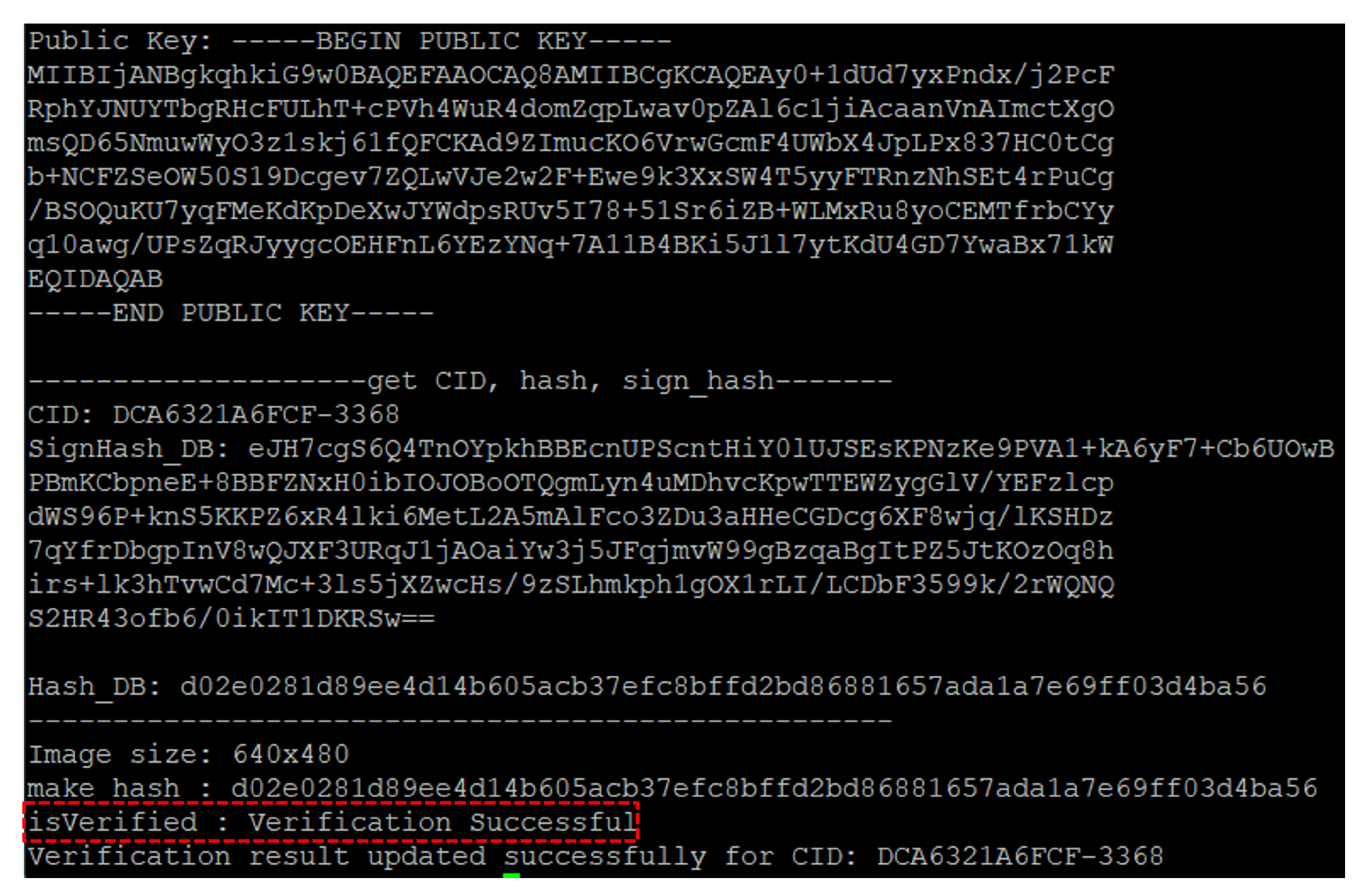
| CID | unique ID of captured image |
| Hash | hash value of a feature vector in character format |
| Sign hash | digital signature of hash value |
| Object detection result | information of object with bounding box |
| Media type | media format like BGR |
| No | Thread | Performance Index | |
|---|---|---|---|
| Mean | Std Dev | ||
| 1 | Capture thread | 31.64 | 6.73 |
| 2 | Image save thread | 19.12 | 13.86 |
| 3 | Convert frame thread | 5.56 | 3.50 |
| 4 | Object detection thread | 76.00 | 2.62 |
| 5 | Feature extraction thread | 4.97 | 2.62 |
| 6 | Make hash thread | 26.10 | 3.99 |
| 7 | Sign hash thread | 9.89 | 1.76 |
| 8 | Image send thread | 11.04 | 2.51 |
| No of Images | CPU | GPU | ||
|---|---|---|---|---|
| Mean | Std Dev | Mean | Std Dev | |
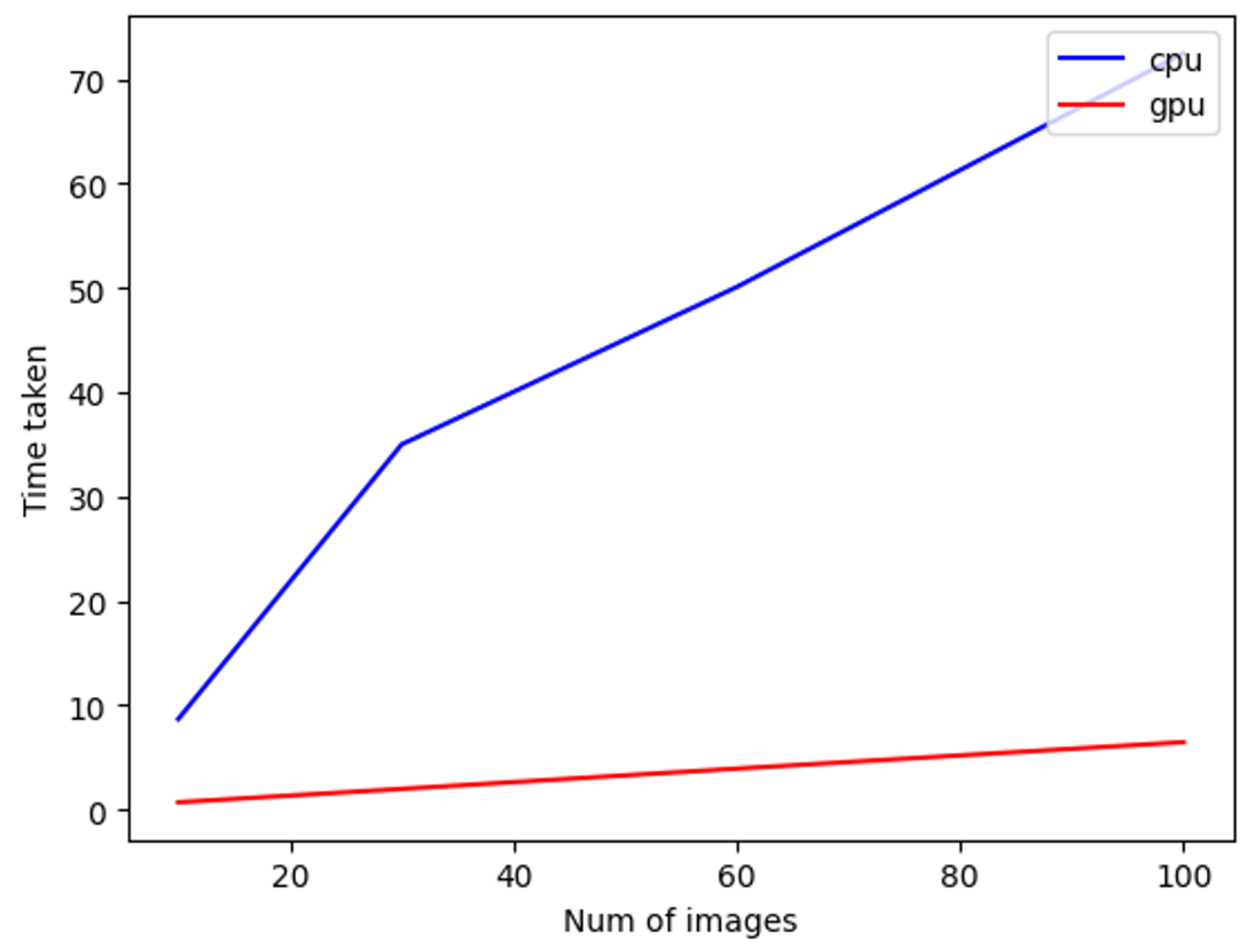
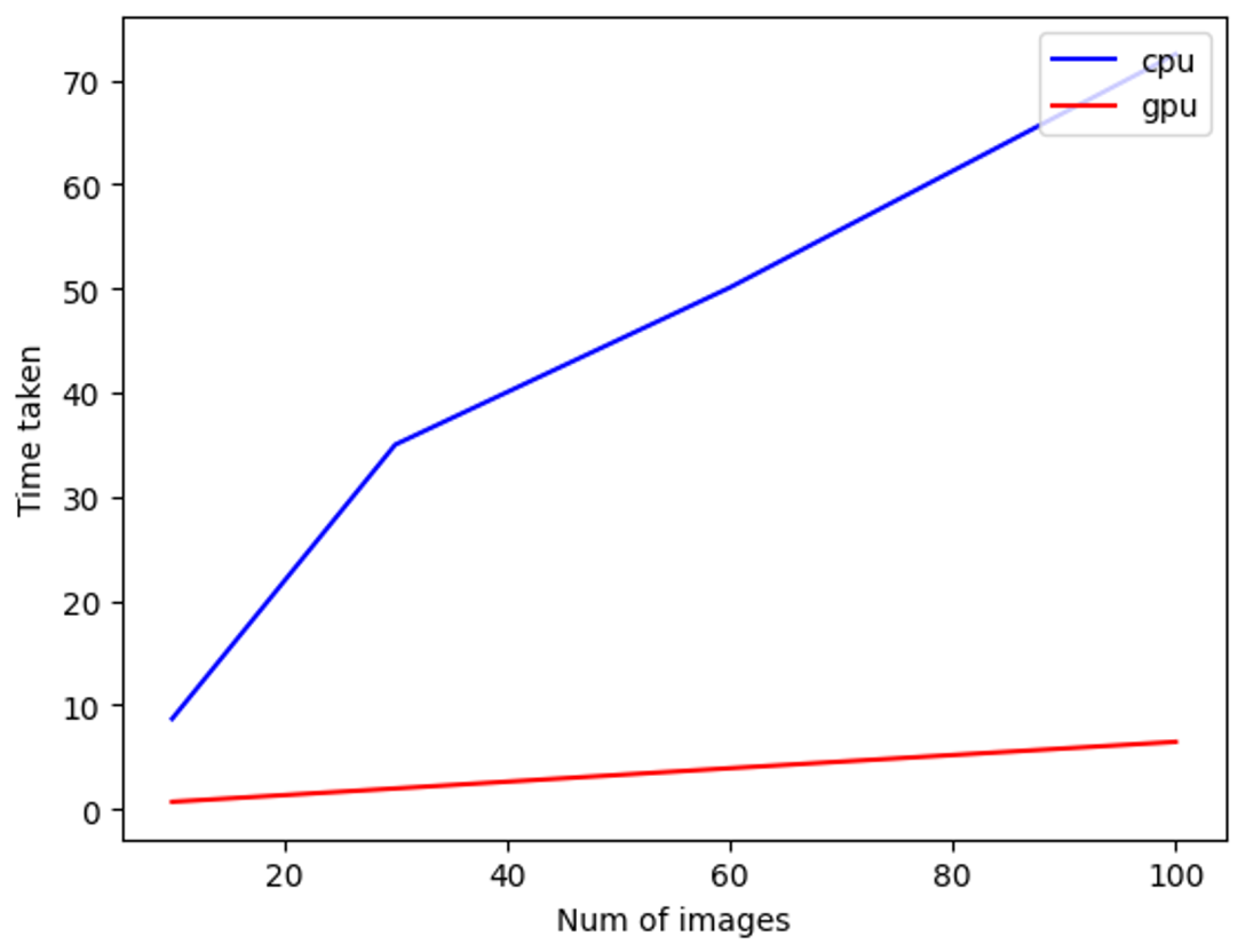
| 10 | 8.67 | 1.09 | 0.69 | 0.04 |
| 30 | 34.99 | 0.10 | 1.97 | 0.05 |
| 60 | 50.07 | 0.12 | 3.91 | 0.06 |
| 100 | 72.49 | 5.24 | 6.45 | 0.05 |
Disclaimer/Publisher’s Note: The statements, opinions and data contained in all publications are solely those of the individual author(s) and contributor(s) and not of MDPI and/or the editor(s). MDPI and/or the editor(s) disclaim responsibility for any injury to people or property resulting from any ideas, methods, instructions or products referred to in the content. |
© 2025 by the authors. Licensee MDPI, Basel, Switzerland. This article is an open access article distributed under the terms and conditions of the Creative Commons Attribution (CC BY) license (http://creativecommons.org/licenses/by/4.0/).