

Submitted:
25 February 2025
Posted:
26 February 2025
You are already at the latest version
Abstract
Aging is associated with gradual mobility decline, often undetected until it affects daily life. This study investigates the potential of smartphone-based accelerometry to detect early age-related changes in gait and stair performance in middle-aged adults. Eighty-eight participants were divided into four age groups: young (20-35 years), early middle-aged (45-54 years), late middle-aged (55-65 years), and older adults (65-80 years). They completed single-task, cognitive, and physical dual-task gait assessments and stair negotiation tests. While single-task walking did not reveal early changes, cognitive dual-task cost (DTC) of stride time variability deteriorated in late middle age. A strong indicator of early mobility changes was movement similarity, measured using dynamic time warping (DTW), which declined from early middle age for both cognitive DTC and stair negotiation. These findings highlight the potential of smartphone-based assessments, particularly movement similarity, to detect subtle mobility changes in midlife, allowing for targeted interventions to promote healthy aging.
Keywords:
1. Introduction
2. Methods
2.1. Participants
2.2. Procedure
2.3. Gait and Stairs Negotiation Measures and Data Processing
2.4. Statistical Analysis
3. Results
3.1. Baseline Characteristics
3.2. Gait and Stair Negotiation
3.3. Gait Velocity
3.4. Gait Variability
3.5. Gait Similarity
3.6. Stairs Ascend and Descend Time
3.7. Muscle Power During Stairs Negotiation
3.8. Stairs-Negotiation Similarity
3.9. The Relationship Between Movement Similarity of Stair Climbing to the Cognitive DTC of Walking and Muscle Power
4. Discussion
5. Conclusions
Author Contributions
Institutional Review Board Statement
Informed Consent Statement
Data Availability Statement
Acknowledgments
Conflicts of Interest
References
- W. A. Satariano, J. M. Guralnik, R. J. Jackson, R. A. Marottoli, E. A. Phelan, and T. R. Prohaska, “Mobility and aging: new directions for public health action,” Am. J. Public Health, vol. 102, no. 8, pp. 1508–1515, Aug. 2012. [CrossRef]
- Rezaei, S. G. Bhat, C.-H. Cheng, R. J. Pignolo, L. Lu, and K. R. Kaufman, “Age-related changes in gait, balance, and strength parameters: A cross-sectional study,” PLOS ONE, vol. 19, no. 10, p. e0310764, 2024. [CrossRef]
- D. R. Seals, J. N. Justice, and T. J. LaRocca, “Physiological geroscience: targeting function to increase healthspan and achieve optimal longevity,” J. Physiol., vol. 594, no. 8, p. 2001, Mar. 2015. [CrossRef]
- X. Shen et al., “Nonlinear dynamics of multi-omics profiles during human aging,” Nat. Aging, vol. 4, no. 11, pp. 1619–1634, Nov. 2024. [CrossRef]
- C. B. Bowling, L. Deng, S. Sakhuja, M. C. Morey, B. C. Jaeger, and P. Muntner, “Prevalence of Activity Limitations and Association with Multimorbidity Among US Adults 50 to 64 Years Old,” J. Gen. Intern. Med., vol. 34, no. 11, pp. 2390–2396, 2019. [CrossRef]
- E. A. Gardener, F. A. Huppert, J. M. Guralnik, and D. Melzer, “Middle-aged and mobility-limited: prevalence of disability and symptom attributions in a national survey,” J. Gen. Intern. Med., vol. 21, no. 10, pp. 1091–1096, Oct. 2006. [CrossRef]
- G. Baranes, R. Hayek, I. Gutman, S. Frenkel-Toledo, and S. Springer, “Use of the Brief-BESTest partially instrumented with accelerometry to detect balance deterioration in middle-age,” Aging Clin. Exp. Res., vol. 36, no. 1, p. 214, Nov. 2024. [CrossRef]
- Y. Cai et al., “Motor and Physical Function Impairments as Contributors to Slow Gait Speed and Mobility Difficulty in Middle-Aged and Older Adults,” J. Gerontol. A. Biol. Sci. Med. Sci., vol. 77, no. 8, pp. 1620–1628, Jan. 2022. [CrossRef]
- G. Peeters, N. M. van Schoor, R. Cooper, L. Tooth, and R. A. Kenny, “Should prevention of falls start earlier? Co-ordinated analyses of harmonised data on falls in middle-aged adults across four population-based cohort studies,” PLOS ONE, vol. 13, no. 8, p. e0201989, Aug. 2018. [CrossRef]
- S. Elliott, J. Painter, and S. Hudson, “Living alone and fall risk factors in community-dwelling middle age and older adults,” J. Community Health, vol. 34, no. 4, pp. 301–310, Aug. 2009. [CrossRef]
- R. Hayek, I. Gutman, G. Baranes, Y. Nudelman, and S. Springer, “Smartphone-Based Sit-to-Stand Analysis for Mobility Assessment in Middle Age,” Innov. Aging, vol. 8, no. 10, p. igae079, Oct. 2024. [CrossRef]
- M. E. Lachman, “Mind the Gap in the Middle: A Call to Study Midlife,” Res. Hum. Dev., vol. 12, no. 3–4, pp. 327–334, 2015. [CrossRef]
- N. Herssens, E. Verbecque, A. Hallemans, L. Vereeck, V. Van Rompaey, and W. Saeys, “Do spatiotemporal parameters and gait variability differ across the lifespan of healthy adults? A systematic review,” Gait Posture, vol. 64, pp. 181–190, Jul. 2018. [CrossRef]
- R. Rössler et al., “Spatiotemporal gait characteristics across the adult lifespan: Reference values from a healthy population – Analysis of the COmPLETE cohort study,” Gait Posture, vol. 109, pp. 101–108, Mar. 2024. [CrossRef]
- D. Niederer, T. Engeroff, J. Fleckenstein, O. Vogel, and L. Vogt, “The age-related decline in spatiotemporal gait characteristics is moderated by concerns of falling, history of falls & diseases, and sociodemographic-anthropometric characteristics in 60-94 years old adults,” Eur. Rev. Aging Phys. Act. Off. J. Eur. Group Res. Elder. Phys. Act., vol. 18, no. 1, p. 19, Oct. 2021. [CrossRef]
- S. Fritz and M. Lusardi, “White paper: ‘walking speed: the sixth vital sign,’” J. Geriatr. Phys. Ther. 2001, vol. 32, no. 2, pp. 46–49, 2009.
- Middleton, S. L. Fritz, and M. Lusardi, “Walking Speed: The Functional Vital Sign,” J. Aging Phys. Act., vol. 23, no. 2, pp. 314–322, Apr. 2015. [CrossRef]
- R. Noce Kirkwood, B. de Souza Moreira, S. A. Mingoti, B. F. Faria, R. F. Sampaio, and R. Alves Resende, “The slowing down phenomenon: What is the age of major gait velocity decline?,” Maturitas, vol. 115, pp. 31–36, Sep. 2018. [CrossRef]
- R. Weston et al., “Turning speed as a more responsive metric of age-related decline in mobility: A comparative study with gait speed,” Clin. Biomech. Bristol Avon, vol. 113, p. 106196, Mar. 2024. [CrossRef]
- L. J. Alapatt, N. M. Peel, N. Reid, L. C. Gray, and R. E. Hubbard, “The Effect of Age on Gait Speed When Texting,” Int. J. Environ. Res. Public. Health, vol. 17, no. 2, p. 599, Jan. 2020. [CrossRef]
- Zhou, Gabriele Cattaneo, Wanting Yu ME, Natalia A Gouskova, and Selma Delgado-Gallén, “The age-related contribution of cognitive function to dual-task gait in middle-aged adults in Spain: observations from a population-based study - PubMed,” Lancet Healthy Longev, Mar. 2023, Accessed: Oct. 30, 2024. [Online]. Available: https://pubmed.ncbi.nlm.nih.gov/36870341/.
- H.-S. Lee, “Application of dynamic time warping algorithm for pattern similarity of gait,” J. Exerc. Rehabil., vol. 15, no. 4, pp. 526–530, Aug. 2019. [CrossRef]
- B. Zhang, S. Jiang, K. Yan, and D. Wei, “Human Walking Analysis, Evaluation and Classification Based on Motion Capture System,” 2011. [CrossRef]
- P. Terrier and F. Reynard, “Effect of age on the variability and stability of gait: A cross-sectional treadmill study in healthy individuals between 20 and 69 years of age,” Gait Posture, vol. 41, no. 1, pp. 170–174, Jan. 2015. [CrossRef]
- M. Job, A. Dottor, A. Viceconti, and M. Testa, “Ecological Gait as a Fall Indicator in Older Adults: A Systematic Review,” The Gerontologist, vol. 60, no. 5, pp. e395–e412, Jul. 2020. [CrossRef]
- J. M. Hausdorff, A. Schweiger, T. Herman, G. Yogev-Seligmann, and N. Giladi, “Dual-task decrements in gait: contributing factors among healthy older adults,” J. Gerontol. A. Biol. Sci. Med. Sci., vol. 63, no. 12, pp. 1335–1343, Dec. 2008. [CrossRef]
- A.-V. Bruyneel and N. C. Duclos, “Effects of the use of mobile phone on postural and locomotor tasks: a scoping review,” Gait Posture, vol. 82, pp. 233–241, Oct. 2020. [CrossRef]
- S. Anwer, H. Li, M. F. Antwi-Afari, W. Umer, I. Mehmood, and A. Y. L. Wong, “Effects of load carrying techniques on gait parameters, dynamic balance, and physiological parameters during a manual material handling task,” Eng. Constr. Archit. Manag., vol. 29, no. 9, pp. 3415–3438, Jan. 2021. [CrossRef]
- T. Demur and S. Demura, “Relationship among Gait Parameters while Walking with Varying Loads,” J. Physiol. Anthropol., vol. 29, no. 1, pp. 29–34, 2010. [CrossRef]
- R. Das, R. Dhume, and S. Iyer, “EFFECT OF CARRYING SYMMETRIC AND ASYMMETRIC WEIGHTS ON GAIT PARAMETERS AND LATERAL SPINAL FLEXION,” Int. J. Eng. Sci. Technol., vol. 4, 2012.
- P. Dasgupta, J. VanSwearingen, A. Godfrey, M. Redfern, M. Montero-Odasso, and E. Sejdic, “Acceleration Gait Measures as Proxies for Motor Skill of Walking: A Narrative Review,” IEEE Trans. Neural Syst. Rehabil. Eng. Publ. IEEE Eng. Med. Biol. Soc., vol. 29, pp. 249–261, 2021. [CrossRef]
- L. C. Benson, A. M. Räisänen, C. A. Clermont, and R. Ferber, “Is This the Real Life, or Is This Just Laboratory? A Scoping Review of IMU-Based Running Gait Analysis,” Sensors, vol. 22, no. 5, Art. no. 5, Jan. 2022. [CrossRef]
- M. Straczkiewicz, P. James, and J.-P. Onnela, “A systematic review of smartphone-based human activity recognition methods for health research,” Npj Digit. Med., vol. 4, no. 1, Art. no. 1, Oct. 2021. [CrossRef]
- P. Silsupadol, K. Teja, and V. Lugade, “Reliability and validity of a smartphone-based assessment of gait parameters across walking speed and smartphone locations: Body, bag, belt, hand, and pocket,” Gait Posture, vol. 58, pp. 516–522, Oct. 2017. [CrossRef]
- V. E. Di Bacco and W. H. Gage, “Monitoring Age-Related Changes in Gait Complexity in the Wild with a Smartphone Accelerometer System,” Sensors, vol. 24, no. 22, p. 7175, Nov. 2024. [CrossRef]
- P. C. Dixon, L. Stirling, X. Xu, C. C. Chang, J. T. Dennerlein, and J. M. Schiffman, “Aging may negatively impact movement smoothness during stair negotiation,” Hum. Mov. Sci., vol. 60, pp. 78–86, Aug. 2018. [CrossRef]
- J. V. Jacobs, “A review of stairway falls and stair negotiation: Lessons learned and future needs to reduce injury,” Gait Posture, vol. 49, pp. 159–167, Sep. 2016. [CrossRef]
- E. Van Roie, S. Van Driessche, B. Huijben, R. Baggen, R. C. van Lummel, and C. Delecluse, “A body-fixed-sensor-based analysis of stair ascent and sit-to-stand to detect age-related differences in leg-extensor power,” PLOS ONE, vol. 14, no. 1, p. e0210653, Jan. 2019. [CrossRef]
- L. Meulemans, J. Seghers, A. Hoorelbeke, T. Van Dijck, C. Delecluse, and E. Van Roie, “Minimal power required to ascend a flight of stairs versus actual power measured with body-fixed sensors in adults aged 19-85 years,” Scand. J. Med. Sci. Sports, vol. 34, no. 3, p. e14601, Mar. 2024. [CrossRef]
- F. Faul, E. Erdfelder, A.-G. Lang, and A. Buchner, “G*Power 3: A flexible statistical power analysis program for the social, behavioral, and biomedical sciences,” Behav. Res. Methods, vol. 39, no. 2, pp. 175–191, May 2007. [CrossRef]
- R. Hayek, U. Gottlieb, I. Gutman, I. Kingma, and S. Springer, “Can stabilization analysis following a single leg drop jump be compared between young and middle-aged adults,” J. Biomech., vol. 143, p. 111269, Oct. 2022. [CrossRef]
- T. Naaman, R. Hayek, I. Gutman, and S. Springer, “Young, but not in the dark—The influence of reduced lighting on gait stability in middle-aged adults,” PLOS ONE, vol. 18, no. 5, p. e0280535, 2023. [CrossRef]
- “Your smartphone is a mobile lab.,” phyphox. Accessed: Jan. 30, 2023. [Online]. Available: https://phyphox.org.
- S. Staacks, S. Hütz, H. Heinke, and C. Stampfer, “Advanced tools for smartphone-based experiments: phyphox,” Phys. Educ., vol. 53, no. 4, p. 045009, May 2018. [CrossRef]
- P. Crowley, P. Madeleine, and N. Vuillerme, “The effects of mobile phone use on walking: a dual task study,” BMC Res. Notes, vol. 12, p. 352, Jun. 2019. [CrossRef]
- J. H. Hollman, F. M. Kovash, J. J. Kubik, and R. A. Linbo, “Age-related differences in spatiotemporal markers of gait stability during dual task walking,” Gait Posture, vol. 26, no. 1, pp. 113–119, 2007. [CrossRef]
- B. Zhang, K. Yan, S. Jiang, and D. Wei, “Walking stability analysis by age based on Dynamic Time Warping,” in 2008 8th IEEE International Conference on Computer and Information Technology, Jul. 2008, pp. 544–548. [CrossRef]
- W. Zijlstra, R. W. Bisseling, S. Schlumbohm, and H. Baldus, “A body-fixed-sensor-based analysis of power during sit-to-stand movements,” Gait Posture, vol. 31, no. 2, pp. 272–278, Feb. 2010. [CrossRef]
- R. Muscillo, S. Conforto, M. Schmid, P. Caselli, and T. D’Alessio, “Classification of Motor Activities through Derivative Dynamic Time Warping applied on Accelerometer Data,” in 2007 29th Annual International Conference of the IEEE Engineering in Medicine and Biology Society, Aug. 2007, pp. 4930–4933. [CrossRef]
- F. Weiske, M. Böhme, J. Jäkel, J. Zentner, and M. Witt, “Stair ascent comparison of lower limb kinematics with differing time normalization techniques,” J. Biomech., vol. 119, p. 110316, Apr. 2021. [CrossRef]
- C. Zhang, W. Sun, Q. Song, H. Gu, and D. Mao, “Performance of older adults under dual task during stair descent,” J. Exerc. Sci. Fit., vol. 16, no. 3, pp. 99–105, Dec. 2018. [CrossRef]
- C. O. Fritz, P. E. Morris, and J. J. Richler, “Effect size estimates: current use, calculations, and interpretation,” J. Exp. Psychol. Gen., vol. 141, no. 1, pp. 2–18, Feb. 2012. [CrossRef]
- E. Al-Yahya, H. Dawes, L. Smith, A. Dennis, K. Howells, and J. Cockburn, “Cognitive motor interference while walking: A systematic review and meta-analysis,” Neurosci. Biobehav. Rev., vol. 35, no. 3, pp. 715–728, Jan. 2011. [CrossRef]
- M. Schimpl et al., “Association between Walking Speed and Age in Healthy, Free-Living Individuals Using Mobile Accelerometry—A Cross-Sectional Study,” PLOS ONE, vol. 6, no. 8, p. e23299, 2011. [CrossRef]
- C. Hennah and M. Doumas, “Dual-task walking on real-world surfaces: Adaptive changes in walking speed, step width and step height in young and older adults,” Exp. Gerontol., vol. 177, p. 112200, Jun. 2023. [CrossRef]
- G. Yogev-Seligmann, Y. Rotem-Galili, A. Mirelman, R. Dickstein, N. Giladi, and J. M. Hausdorff, “How Does Explicit Prioritization Alter Walking During Dual-Task Performance? Effects of Age and Sex on Gait Speed and Variability,” Phys. Ther., vol. 90, no. 2, pp. 177–186, Feb. 2010. [CrossRef]
- M. Yang, L. Y. Leung, Z. Y. Lim, and R. W. Ang, “Reference Values for Habitual and Fast Gait Speed in Singapore Adults Aged 21 to 80.” Accessed: Jan. 06, 2025. [Online]. Available: https://www.mdpi.com/2077-0383/13/12/3507.
- D. Kobsar, C. Olson, R. Paranjape, T. Hadjistavropoulos, and J. M. Barden, “Evaluation of age-related differences in the stride-to-stride fluctuations, regularity and symmetry of gait using a waist-mounted tri-axial accelerometer,” Gait Posture, vol. 39, no. 1, pp. 553–557, Jan. 2014. [CrossRef]
- D. K. Ravi et al., “Revealing the optimal thresholds for movement performance: A systematic review and meta-analysis to benchmark pathological walking behaviour,” Neurosci. Biobehav. Rev., vol. 108, pp. 24–33, Jan. 2020. [CrossRef]
- N. König, W. R. Taylor, C. R. Baumann, N. Wenderoth, and N. B. Singh, “Revealing the quality of movement: A meta-analysis review to quantify the thresholds to pathological variability during standing and walking,” Neurosci. Biobehav. Rev., vol. 68, pp. 111–119, Sep. 2016. [CrossRef]
- L. Morrison et al., “Discrete Relationships between Spatiotemporal Gait Characteristics and Domain-Specific Neuropsychological Performance in Midlife,” Sensors, vol. 24, no. 12, Art. no. 12, Jan. 2024. [CrossRef]
- T. Asai, T. Doi, S. Hirata, and H. Ando, “Dual tasking affects lateral trunk control in healthy younger and older adults,” Gait Posture, vol. 38, no. 4, pp. 830–836, Sep. 2013. [CrossRef]
- S. R. Wurdeman, N. B. Huben, and N. Stergiou, “Variability of gait is dependent on direction of progression: implications for active control,” J. Biomech., vol. 45, no. 4, pp. 653–659, Feb. 2012. [CrossRef]
- R. Tandon, P. Javid, and I. Di Giulio, “Mobile phone use is detrimental for gait stability in young adults,” Gait Posture, vol. 88, pp. 37–41, Jul. 2021. [CrossRef]
- C.-Y. Yang, P.-Y. Chen, T.-J. Wen, and G. E. Jan, “IMU Consensus Exception Detection with Dynamic Time Warping-A Comparative Approach,” Sensors, vol. 19, no. 10, p. 2237, May 2019. [CrossRef]
- C. Strongman and A. Morrison, “A scoping review of non-linear analysis approaches measuring variability in gait due to lower body injury or dysfunction,” Hum. Mov. Sci., vol. 69, p. 102562, Feb. 2020. [CrossRef]
- R. T. Harbourne and N. Stergiou, “Movement variability and the use of nonlinear tools: principles to guide physical therapist practice,” Phys. Ther., vol. 89, no. 3, pp. 267–282, Mar. 2009. [CrossRef]
- H.-S. Lee, “Application of dynamic time warping algorithm for pattern similarity of gait,” J. Exerc. Rehabil., vol. 15, no. 4, pp. 526–530, Aug. 2019. [CrossRef]
- L. Kribus-Shmiel, G. Zeilig, B. Sokolovski, and M. Plotnik, “How many strides are required for a reliable estimation of temporal gait parameters? Implementation of a new algorithm on the phase coordination index,” PLOS ONE, vol. 13, no. 2, p. e0192049, 2018. [CrossRef]
- J. Barth et al., “Subsequence dynamic time warping as a method for robust step segmentation using gyroscope signals of daily life activities,” in 2013 35th Annual International Conference of the IEEE Engineering in Medicine and Biology Society (EMBC), Jul. 2013, pp. 6744–6747. [CrossRef]
- T. M. Bampouras and S. Dewhurst, “Carrying shopping bags does not alter static postural stability and gait parameters in healthy older females,” Gait Posture, vol. 46, pp. 81–85, May 2016. [CrossRef]
- S.-G. Kim, C.-W. Nam, and M.-S. Yong, “The effect of increase in baggage weight on elderly women’s lower extremity muscle activation during gait,” Arch. Gerontol. Geriatr., vol. 59, no. 3, pp. 574–576, Nov. 2014. [CrossRef]
- Zech, S. Steib, D. Sportwiss, E. Freiberger, and K. Pfeifer, “Functional Muscle Power Testing in Young, Middle-Aged, and Community-Dwelling Nonfrail and Prefrail Older Adults,” Arch. Phys. Med. Rehabil., vol. 92, no. 6, pp. 967–971, Jun. 2011. [CrossRef]
- D. J. Psaltos, F. Mamashli, T. Adamusiak, C. Demanuele, M. Santamaria, and M. D. Czech, “Wearable-Based Stair Climb Power Estimation and Activity Classification,” Sensors, vol. 22, no. 17, p. 6600, Sep. 2022. [CrossRef]
- S. Springer, N. Giladi, C. Peretz, G. Yogev, E. S. Simon, and J. M. Hausdorff, “Dual-tasking effects on gait variability: The role of aging, falls, and executive function,” Mov. Disord., vol. 21, no. 7, pp. 950–957, 2006. [CrossRef]
- M. Shapiro, S. Shaki, U. Gottlieb, and S. Springer, “Random walk: Random number generation during backward and forward walking- the role of aging,” Front. Aging Neurosci., vol. 14, Sep. 2022. [CrossRef]

| Young adults (n=22) | Early middle-aged adults (n=21) | Late middle-aged adults (n=22) | Older adults (n=21) | p-value | |
| Age (years) | 24.7±2.9 | 48.5±2.8 | 59.8±3.0 | 71.9±4.6 | <0.001 |
| Female, n (%) | 12 (54%) | 12 (51%) | 10 (45%) | 11 (52%) | 0.884 |
| Height (m) | 1.69±0.1 | 1.65±0.1 | 1.68±0.1 | 1.64±0.1 | 0.372 |
| Weight (kg) | 70.4±14.1 | 72.7±14.0 | 77.7±16.3 | 69.2±12.2 | 0.528 |
| Body mass index (kg/m2) | 25.4±2.7 | 26.5±3.2 | 26.9±3.6 | 25.7±4.4 | 0.129 |
| Variable | Young Adults (Group #1, n=22) | Early Middle-Aged (Group #2, n=21) |
Late Middle-Aged (Group #3, n=22) |
Older Adults (Group #4, n=21) | Kruskal-Wallis H, p-value |
Pairwise Comparisons Compared group, p, ES |
|
| Gait Velocity | Single task (m/sec) | 1.17 (1.14 – 1.18) |
1.12 (1.10 – 1.17) |
1.13 (1.09 – 1.15) |
1.04 (0.91 – 1.16) |
13.589, 0.004 | 1 vs 4: p = 0.002, ES = 0.56 |
| DTC Cognitive (%) | 6.08 (2.83 – 9.11) |
7.65 (3.63 – 14.41) |
3.75 (1.12 – 11.47) |
5.06 (-3.47 – 9.96) |
5.422, 0.143 | None | |
| DTC Physical (%) | 1.90 (-0.00 – 3.24) |
3.05 (0.55 – 5.40) * |
0.25 (-1.20 – 1.51) + |
-3.56 (-8.56 –- 1.14) | 27.332, <0.001 | 1 vs 4: p < 0.001, ES = 0.65; 2 vs 4: p < 0.001, ES = 0.74 | |
| Stride Time Variability | Single task (%) | 2.00 (1.69 – 2.46) |
1.98 (1.74 – 2.45) |
1.55 (1.37–1.92) |
2.65 (2.09 – 4.20) |
25.454, <0.001 | 3 vs 1: p = 0.018, ES = 0.45; 3 vs 2: p = 0.014, ES = 0.46; 3 vs 4: p < 0.001, ES = 0.75 |
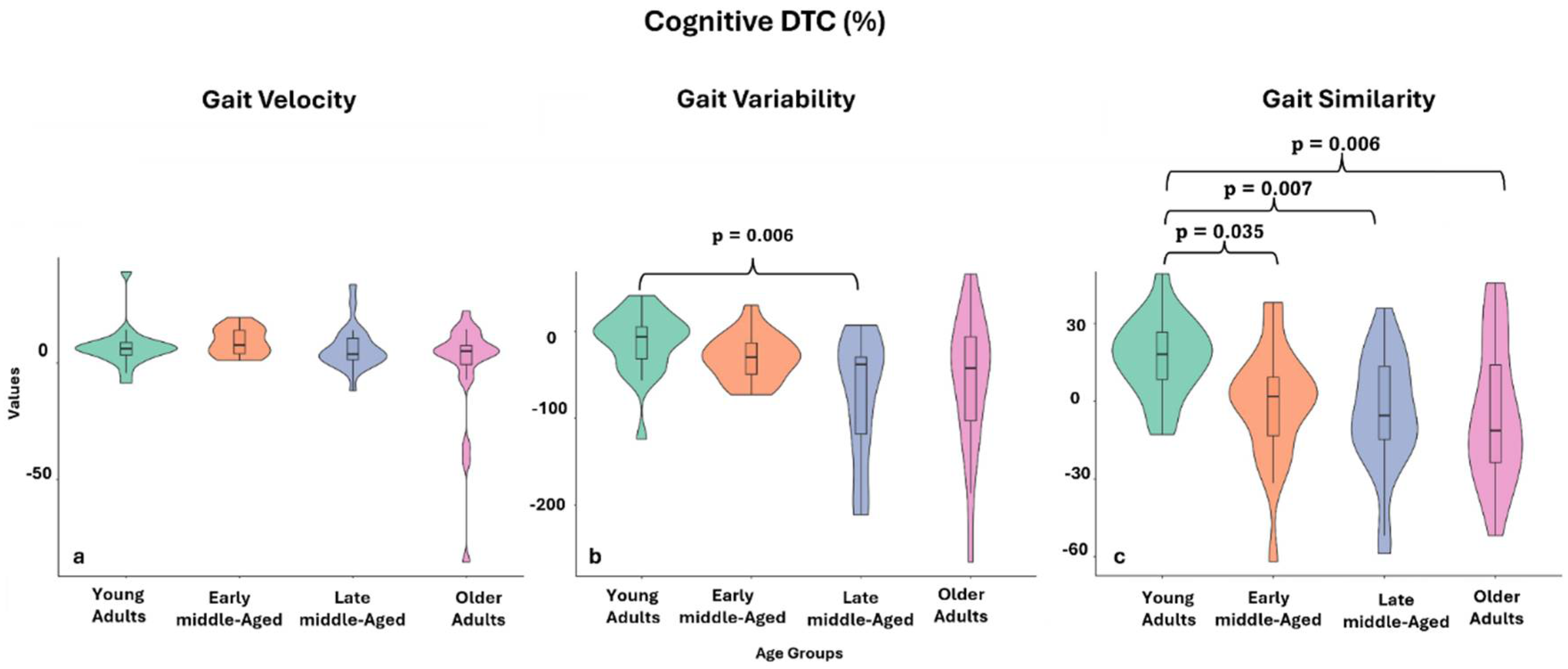
| DTC Cognitive (%) | -5.93 (-34.17 – 6.55) |
-29.45 (-49.65 – -9.58) * |
-37.73 (-120.53 – -22.78)* |
-42.24 (-111.00 – -2.37) * | 11.575, 0.009 | 1 vs 3: p = 0.006, ES = 0.50 | |
| DTC Physical (%) | 17.38 (3.84 – 30.22) |
10.55 (-.12 – 21.19) * |
-8.33 (-19.52 – 15.87) * |
13.10 (-23.61 – 45.20) | 7.412, 0.060 | None | |
| DTW AP | Single task | 9.45 (9.15 – 11.19) |
8.66 (7.59 – 10.12) |
8.46 (7.73 – 10.07) |
9.83 (7.98 – 12.84) * |
7.967, 0.047 | None |
| DTC Cognitive (%) | 16.22 (7.96 – 27.10) |
1.81 (-16.26 – 10.53) |
-5.53 (-15.84 – 15.564) |
-11.30 (-26.22 – 23.28) + | 14.936, 0.002 | 1 vs 2: p = 0.035, ES = 0.42; 1 vs 3: p = 0.007, ES = 0.50; 1 vs 4: p = 0.006, ES = 0.51 | |
| DTC Physical (%) | -4.63 (-18.06 – 10.63) |
-0.40 (-12.70 – 4.71) |
2.37 (-9.53 – 10.73) * |
-8.19 (-35.94 –12.37) + | 1.342, 0.724 | None | |
| DTW ML | Single task | 12.19 (10.32 – 14.74) |
11.64 (9.51 – 13.48) |
11.56 (9.28 – 13.15) * |
13.08 (11.57–15.23) + | 5.560, 0.135 | None |
| DTC Cognitive (%) | 12.59 (-6.24 – 24.39) | -5.98 (-20.51 – 11.43) | -5.63 (-23.06 – 9.67) * |
2.18 (-0.98 – 19.25) + | 7.145, 0.067 | None | |
| DTC Physical (%) | -8.35 (-22.44 – 5.23) | -7.39 (-19.33 – 9.64) | -3.76 (-19.69 – 4.36) * |
9.57 (-19.43 – 17.12) + | 3.730, 0.292 | None |
| Condition | Variable | Young Adults (Group #1, n=22) | Early Middle-Aged (Group #2, n=21) |
Late Middle-Aged (Group #3, n=22) | Older Adults (Group #4, n=21) | Kruskal-Wallis H, p-value | Pairwise Comparisons |
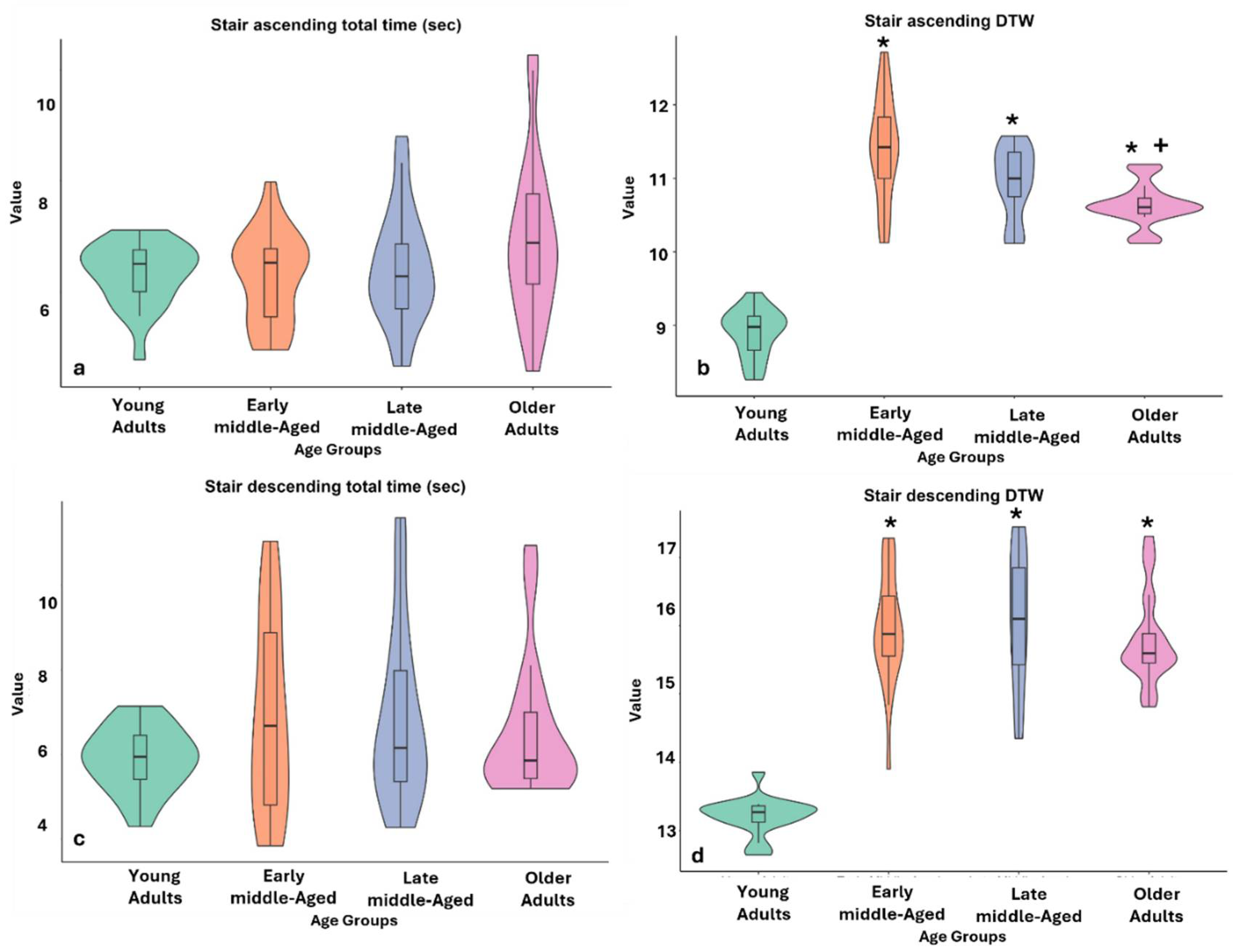
| Ascend | Total time (sec) | 6.50 (5.94–6.77) |
6.52 (5.52 –6.80) |
6.48 (5.69 – 7.00) |
6.98 (5.90 – 7.83) * |
2.260, 0.445 | None |
| Muscle Power normalized to body weight (watts/kg) | 3.32 (3.17 – 3.63) * |
3.47 (3.10 – 3.85) |
3.23 (2.78 – 3.79) |
3.65 (3.13 – 4.05) |
3.713, 0.294 | None | |
| DTW | 8.98 (8.65 – 9.13) |
11.42 (10.97 – 11.92) * |
10.99 (10.63 – 11.36) | 10.61 (10.51 – 10.76) | 57.126, <0.001 | 1 vs 2: p < 0.001, ES = 1.09; 1 vs 3: p < 0.001, ES = 0.87; 1 vs 4: p < 0.001, ES = 0.63; 2 vs 4: p < 0.001, ES = 0.46 |
|
| Descend | Total time (sec) | 5.94 (5.37 – 6.50) |
6.08 (4.74 – 9.07) |
6.15 (5.21 – 8.06) |
6.76 (5.37 – 7.15) * |
1.558, 0.669 | None |
| Muscle Power normalized to body weight (watts/kg) | 2.08 (1.93 – 2.30) |
2.02 (1.80 – 2.35) |
1.81 (1.45 – 2.24) |
1.65 (1.53 – 1.91) + |
17.240, <0.001 | 1 vs 4: p < 0.001, ES = 0.57; 2 vs 4: p = 0.007, ES = 0.51 | |
| DTW | 13.27 (13.11 – 13.36) + | 15.88 (15.48 – 16.44) * | 16.10 (15.40 – 16.93) | 15.59 (15.45 – 16.11) | 44.342, <0.001 | 1 vs 2: p < 0.001, ES = 0.86; 1 vs 3: p < 0.001, ES = 0.92; 1 vs 4: p < 0.001, ES = 0.77 |
Disclaimer/Publisher’s Note: The statements, opinions and data contained in all publications are solely those of the individual author(s) and contributor(s) and not of MDPI and/or the editor(s). MDPI and/or the editor(s) disclaim responsibility for any injury to people or property resulting from any ideas, methods, instructions or products referred to in the content. |
© 2025 by the authors. Licensee MDPI, Basel, Switzerland. This article is an open access article distributed under the terms and conditions of the Creative Commons Attribution (CC BY) license (http://creativecommons.org/licenses/by/4.0/).


