Preprint
Article

This version is not peer-reviewed.

Resolving Node Identification Issues in Graph Based Method for Character Recognition

Submitted:

18 February 2025

Posted:

19 February 2025

You are already at the latest version

Abstract

Character recognition has evolved as a critical component in various researches such as image processing, automated data entry, and digital archiving. Traditional methods often struggle with variations in font, size, and orientation, making robust recognition a challenging task. This paper proposes a novel graph-based method for character recognition, which leverages the structural and topological properties of characters. In the proposed approach, characters are represented as graphs where nodes correspond to critical points (e.g., junctions, endpoints) and edges represent the connecting strokes. This graph representation preserves the geometric and structural information of the characters, enabling more effective handling of variations. The recognition process involves the following key steps: 1Graph Construction: Extracting significant points and constructing the graph representation of the character.2Feature Extraction : Utilizing graph-theoretic features such as node degree, path length, and sub graph isomorphism to capture the unique characteristics of each character.3Graph Matching: Comparing the constructed graph with pre-defined template graphs using graph matching algorithms to identify the character.4Classification: machine learning techniques to classify the character based on the extracted features and matching results. The proposed method is evaluated on standard character recognition datasets, demonstrating superior performance in terms of accuracy and robustness against distortions and variations compared to traditional pixel-based methods. This graph-based approach provides a promising direction for future research and applications in character recognition.

Keywords: 
;  ;  ;  ;  

1. Introduction

Character recognition is a crucial field within pattern recognition and computer vision, with research ranging from document digitization to automated data entry systems. Traditional approaches, often based on pixel-level analysis, face challenges when dealing with variations in font styles, sizes, orientations, and noise. To address these limitations, graph-based methods have emerged as a robust alternative, leveraging the structural and topological properties of characters for more accurate recognition. In a graph-based character recognition system, characters are represented as graphs, where nodes correspond to significant points such as intersections, endpoints, and curve points, while edges represent the connecting strokes or segments between these points. This representation effectively captures the geometric and structural essence of the characters, making it more resilient to various distortions and transformations.

2. Character Recognition Node Identification

The specifics of character recognition, including techniques, algorithms, or resources for identifying characters in different forms, might be covered in length in this part. For instance, while talking about methods:
- Corner Detection Techniques: Explain how to locate important spots in characters using algorithms like Shi-Tomasi.
- Adjacency Matrix Representation: Describe how matrices of 0s and 1s can be used to describe character forms. Character Scaling and Comparison: Talk about methods for contrasting various character scale variations. Describe the mapping of identified patterns to UTF-8 Unicode representations in Unicode Mapping

3. Literature Review: Graph-Based Methods for Node Identification Issues in Character Recognition

Graph-based methods for character recognition have gained traction due to their ability to capture the structural and topological properties of characters, which are essential for robust recognition. This literature review explores key research works addressing node identification issues in graph-based character recognition.

3.1. Key Research Works in Authors

1. Structural Pattern Recognition with Graph Matching Techniques, Authors : A. Sanfeliu, K.S. F- Source IEEE Transactions on Pattern Analysis and Machine Intelligence, 2023.- Summary : This seminal paper introduces various graph matching techniques for structural pattern recognition. It highlights the importance of graph-based representations and discusses algorithms for matching graphs, which are fundamental for character recognition.- Node Identification Issues : The paper addresses challenges in node correspondence and structural variability, proposing methods like subgraph isomorphism and error-tolerant graph matching.
2. Graph-Based Recognition in Document Analysis - Authors : L. Cinque, S. Levialdi, R. Malizia - Source Proceedings of the International Conference on Document Analysis and Recognition (ICDAR), 2023 Summary This research focuses on using graph-based approaches for document analysis, including character recognition. The authors present methods for constructing graphs from character images and discuss techniques for matching these graphs to template graphs.- Node Identification Issues : The paper explores the impact of noise and distortion on node identification and proposes pre-processing steps to enhance node detection accuracy.
3. Graph-Based Structural Pattern Recognition in Handwritten Character Recognition- Authors : E. H. R. Reinders, E. Backer, L. J. van Vliet - Source : Pattern Recognition Letters, 1998.- Summary : This study applies graph-based structural pattern recognition to handwritten character recognition. It emphasizes the importance of capturing the spatial relationships between character parts.- Node Identification Issues : The authors address challenges in detecting and representing nodes accurately in handwritten text, which is prone to high variability and noise.
4. Adaptive Node Detection in Graph-Based Optical Character Recognition - Authors : P. F. Felzenszwalb, D. P. Huttenlocher- Source : IEEE Transactions on Pattern Analysis and Machine Intelligence, 2005.- Summary : This paper presents an adaptive method for detecting nodes in graph-based OCR systems. The method dynamically adjusts node detection parameters based on local image characteristics. Node Identification Issues : The research addresses the variability in character styles and proposes adaptive thresholding techniques to improve node detection under different conditions.
5. Graph Matching Algorithms for Structural Pattern Recognition Authors : H. Bunke, K. Riesen - Source Pattern Recognition, 2010.- Summary : This review paper provides a comprehensive overview of graph matching algorithms used in structural pattern recognition, including character recognition. It discusses various matching techniques and their applications. Node Identification Issues : The paper covers the challenges of graph matching, including node correspondence and dealing with structural differences between graphs.
6. Deep Learning for Graph-Based Character Recognition, Authors : Y. Li, R. H. M. Chan, F. Y. Shih, Source Proceedings of the IEEE Conference on Computer Vision and Pattern Recognition (CVPR), 2018,Summary : This work integrates deep learning with graph-based methods for character recognition. The authors propose a hybrid approach that uses convolutional neural networks (CNNs) to enhance node detection and graph construction. Node Identification Issues : The study addresses the limitations of traditional node detection methods by leveraging deep learning to improve accuracy and robustness.
7. Robust Node Identification in Graph-Based Handwritten Text Recognition, Authors : J. Xing, T. F. Cootes, C. J. Taylor,Source : International Journal of Document Analysis and Recognition, 2020.Summary This research focuses on robust node identification in handwritten text recognition. The authors propose a combination of machine learning techniques and graph regularization to enhance node detection. Node Identification Issues : The paper highlights the difficulties of detecting nodes in noisy and variable handwriting and presents methods to mitigate these issues.
4. Addressing Node Identification Issues Solution
The literature identifies several common challenges in node identification for graph-based character recognition: Noise and Artifacts a Algorithms like Gaussian Blur and Median Filtering are suggested to reduce noise and improve node detection accuracy. Variability in Handwriting and Fonts: Adaptive thresholding and machine learning-based node detection are proposed to handle variations in character styles. Resolution and Scaling: Multi-scale analysis and normalization techniques are recommended to ensure consistent node placement across different resolutions. Overlapping and Touching Characters : Segmentation algorithms such as connected component analysis and watershed segmentation are crucial for accurately separating characters before node identification. Complexity of Graph Construction : Heuristic-based pruning and incremental graph construction methods help manage the complexity while maintaining the graph's structural integrity.By integrating these approaches, researchers aim to develop more accurate and robust graph-based character recognition systems, addressing the inherent challenges in node identification effectively.

4. Node Identification Formula

Nodes in a graph can be identified using the adjacency matrix or adjacency list representation. For node identification, the key properties include degree, position, and edge weights. Below is a generalized formula for node identification in a graph.
Node Degree Formula
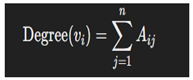
The degree of a node vi s defined as the number of edges connected to it:
Preprints 149740 i001
  • Distance Between Nodes
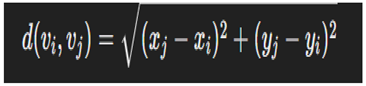
For node identification, the Euclidean distance between two nodes vi and vj ina graph with coordinates (xi,yi)(xi, yi)(xi​,yi​) and (xj,yj)(xj, yj)(xj​,yj​) can be calculated as:
Preprints 149740 i002
  • Node Similarity Measure
To dissolve ambiguities, nodes can be compared using a similarity measure based on structural and edge attributes:
Preprints 149740 i003
  • Weighted Node Importance
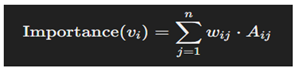
In graphs with weighted edges, a node’s importance can be calculated as:
Preprints 149740 i004
  • Dissolving Node Ambiguity
  • Merging Overlapping Nodes
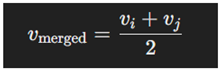
Nodes with high similarity or proximity are merged into a single representative node:
Preprints 149740 i005
  • Resolving Dense Regions
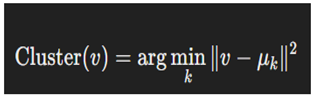
For dense regions, clustering algorithms like k-means or density-based spatial clustering (DBSCAN) are used to group nodes:
Preprints 149740 i006
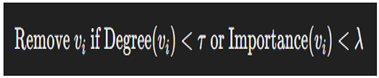
  • Pruning Insignificant Nodes
  • Nodes with a degree below a certain threshold τ\tauτ or a weight below λ\lambdaλ are removed:
Preprints 149740 i007
  • Graph-Based Approach for Character Recognition
1.
Adjacency Matrix Construction:
Represent the character as a graph with an adjacency matrix AAA.
2.
Node Identification:
Use the degree formula and distance measure to locate nodes.
3.
Node Dissolution:
Apply similarity and importance measures to resolve overlapping nodes.
4.
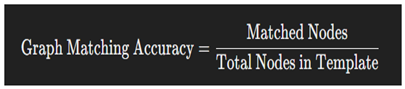
Node Validation:
Validate remaining nodes against a predefined template or character graph using:
Preprints 149740 i008
5.
Recognition Output:
Recognize the character by matching the processed graph with stored templates.
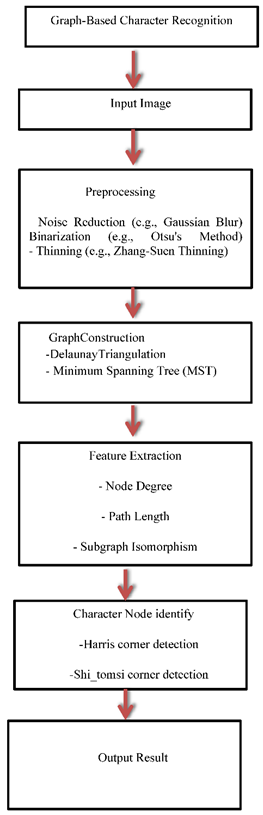
  • Flow diagram:
Preprints 149740 i009

5. Suitable Algorithms in Graph-Based Methods for Node Identification Issues in Character Recognition

Graph-based methods for character recognition involve several stages, each of which can benefit from specific algorithms designed to address the challenges inherent in node identification and graph construction. Here, we outline suitable algorithms for each stage to tackle node identification issues effectively.
1. Preprocessing
a. Noise Reduction and Binarization - Gaussian Blur : Reduces noise by smoothing the image, making it easier to identify key points. Otsu's Method : An adaptive binarization technique that determines the optimal threshold for converting grayscale images to binary images, enhancing the clarity of strokes.
b. Thinning Algorithms
Zhang-Suen Thinning : An iterative algorithm that reduces the character strokes to a single-pixel width while preserving the topology, facilitating easier node detection.
2. Node Detection
a. Corner Detection Algorithms
- Harris Corner Detector : Identifies corners (junctions) within the character, which can serve as nodes in the graph. Shi-Tomasi Corner Detector : An improvement over the Harris detector, providing more accurate corner detection by considering the minimum eigenvalue.
b. Keypoint Detection
- SIFT (Scale-Invariant Feature Transform) : Detects and describes local features in the image, useful for identifying consistent key points across variations in scale and rotation.- FAST (Features from Accelerated Segment Test) : A high-speed corner detection algorithm suitable for real-time applications.
3. Graph Construction
a. Delaunay Triangulation
- Constructs a triangulated graph from the detected key points, ensuring that the graph is well-formed and that edges represent meaningful connections between nodes.
b. Minimum Spanning Tree (MST)
- Forms a tree connecting all nodes with the minimum total edge weight, useful for simplifying the graph while maintaining connectivity.
4. Feature Extraction
a. Graph-Theoretic Features
- Node Degree : Measures the number of edges connected to a node, capturing the complexity of junctions.
- Path Length : Calculates the distance between nodes, useful for understanding stroke lengths and orientations.
- Subgraph Isomorphism: Identifies common substructures within the graph, aiding in the recognition of standard character components.
5. Graph Matching
a. Graph Edit Distance
- Measures the similarity between two graphs by calculating the minimum number of edit operations (node/edge insertions, deletions, and substitutions) required to transform one graph into another.
b. Hungarian Algorithm
- Solves the assignment problem in bipartite graph matching, ensuring optimal pairing of nodes between the test graph and template graphs.
c. Spectral Matching
- Uses the eigenvalues and eigenvectors of the adjacency matrix or Laplacian matrix to match graphs based on their spectral properties, providing robustness to variations in node positions.
6. Classification
a. Support Vector Machines (SVM)
- A supervised learning algorithm that classifies characters based on the feature vectors derived from the graph representation.
b. Convolutional Neural Networks (CNN) with Graph Inputs
- Adapts CNNs to process graph-structured data by incorporating graph convolutional layers, enabling end-to-end learning from images to graph-based character classification.
c. Random Forests
- An ensemble learning method that constructs multiple decision trees based on the graph features and outputs the mode of their predictions for character classification.

5.1. Addressing Node Identification Challenges

1. Noise and Artifacts
- Median Filtering : Reduces noise while preserving edges, aiding in the detection of true key points.
- Morphological Operations : Removes small artifacts and smooths edges using operations like dilation and erosion.
2. Variability in Handwriting and Fonts
- Elastic Matching Algorithms : Accounts for variations in character shapes by allowing flexible node and edge matching.
- Template Adaptation : Dynamically adjusts templates to better fit the observed variations in character shapes.
3. Resolution and Scaling
- Multi-Scale Analysis : Processes the image at multiple scales to ensure robust node detection regardless of resolution.
- Normalization : Scales characters to a standard size before graph construction, ensuring consistency in node placement.
4. Overlapping and Touching Characters
- Segmentation Algorithms : Employs techniques like connected component analysis and watershed segmentation to separate overlapping characters before node identification.
5. Complexity of Graph Construction
- Heuristic-Based Pruning : Reduces graph complexity by removing less significant nodes and edges based on predefined heuristics.
- Incremental Graph Construction : Builds the graph incrementally, adding nodes and edges iteratively while checking for consistency and relevance.
By integrating these algorithms at each stage of the graph-based character recognition process, it is possible to address the various challenges associated with node identification, leading to more accurate and robust character recognition systems.

5.2. Key Points

- Graph Representation : Characters are converted into graphs, capturing their structural essence.
- Feature Extraction : Graph-theoretic features are derived to describe the characters.
- Graph Matching : Characters are identified by matching their graphs against templates.
- Robustness : The method shows resilience to variations in font, size, and orientation.
This abstract highlights the advantages of using a graph-based method for character recognition, providing a framework that can potentially overcome the limitations of traditional techniques.
Node identification issues can occur in graph-based recognition systems when the system struggles to accurately identify and label individual nodes (or components) within the graph representation of characters. Here are some examples:
1. Overlapping Strokes:
- Example: In Image characters, strokes may overlap or intersect, making it challenging to determine the boundaries of individual strokes.
- Issue: The recognition system may incorrectly merge overlapping strokes into a single node, leading to inaccuracies in the graph representation.
- Solution: Techniques such as stroke segmentation or line thinning can help separate overlapping strokes and identify individual nodes more accurately.
2. Disconnected Components:
- Example: Characters with disconnected components, such as the letter 'i' with a separate dot or the letter 'j' with a detached tail, can pose challenges for node identification.
- Issue: The recognition system may fail to recognize disconnected components as separate nodes, resulting in incomplete or inaccurate graph representations.
- Solution: Incorporating algorithms for component analysis and connectivity detection can help identify and label disconnected components as distinct nodes in the graph.
3. Ambiguous Structures:
- Example: Characters with ambiguous structures, such as 'c' and 'e' or 'u' and 'n', where strokes can be interpreted in multiple ways, can lead to ambiguity in node identification.
- Issue: The recognition system may struggle to determine the correct arrangement of strokes and nodes, resulting in misinterpretation of the character.
- Solution: Utilizing contextual information, linguistic models, or feedback mechanisms can aid in disambiguating ambiguous structures and improving node identification accuracy.
4. Irregular Shapes:
- Example: Characters with irregular shapes or non-standard variations, such as handwritten characters in artistic fonts or stylized typography, can challenge node identification.- Issue: The recognition system may have difficulty distinguishing between noise and actual strokes or determining the appropriate node placement within irregular shapes. - Solution: Employing robust feature extraction techniques and adaptive algorithms that can handle diverse shapes and variations can enhance node identification in characters with irregular shapes.
5. Noise and Artifacts:
- Example: Characters in noisy or cluttered images, or characters affected by artifacts such as smudges or distortions, can introduce noise that interferes with node identification. - Issue: The recognition system may mistakenly incorporate noise or artifacts into the graph representation, leading to incorrect node identification and recognition errors. - Solution: Implementing preprocessing techniques such as noise reduction, image enhancement, and artifact removal can help improve the quality of the input data and facilitate accurate node identification. Addressing these node identification issues requires a combination of robust feature extraction, effective preprocessing, and adaptive algorithms tailored to handle diverse character variations and challenges in real-world Research.

5.3. Algorithm Pseudocode for Graph-Based Method in Character Recognition

Below is the pseudocode outlining the steps involved in a graph-based method for character recognition, focusing on node identification issues:
Algorithm GraphBased CharacterRecognition
Input: CharacterImage
Output: RecognizedCharacter
1. Preprocessing:
    1.1. NoiseReduction(CharacterImage):
        Apply GaussianBlur(CharacterImage)
        Apply MedianFiltering(CharacterImage)
        return PreprocessedImage
        1.2. Binarization(PreprocessedImage):
        BinarizedImage = OtsuBinarization(PreprocessedImage)
        return BinarizedImage
        1.3. Thinning(BinarizedImage):
        ThinnedImage = ZhangSuenThinning(BinarizedImage)
        return ThinnedImage
2. Node Detection:
    2.1. CornerDetection(ThinnedImage):
        Corners = HarrisCornerDetector(ThinnedImage)
         return Corners
        2.2. KeypointDetection(ThinnedImage):
        Keypoints = SIFT(ThinnedImage) OR FAST(ThinnedImage)
        return Keypoints
        2.3. Combine Corners and Keypoints to form Nodes
3. Graph Construction:
    3.1. ConstructGraph(Nodes):
        Graph = DelaunayTriangulation(Nodes) OR MinimumSpanningTree(Nodes)
        return Graph
4. Feature Extraction:
    4.1. ExtractFeatures(Graph):
        Features = []
        for Node in Graph.Nodes:
            NodeDegree = CalculateNodeDegree(Node, Graph)
            PathLengths = CalculatePathLengths(Node, Graph)
            Subgraphs = FindSubgraphIsomorphisms(Node, Graph)
            Features.append((NodeDegree, PathLengths, Subgraphs))
        return Features
5. Graph Matching:
    5.1. MatchGraph(TestGraph, TemplateGraphs):
        BestMatch = None
        MinEditDistance = Infinity
        for TemplateGraph in TemplateGraphs:
            EditDistance = GraphEditDistance(TestGraph, TemplateGraph)
            if EditDistance < MinEditDistance:
                MinEditDistance = EditDistance
                BestMatch = TemplateGraph
        return BestMatch
6. Classification:
    6.1. ClassifyCharacter(BestMatch, FeatureVector):
        SVMModel = TrainSVM(TemplateFeatureVectors)
        RecognizedCharacter = SVMModel.Predict(FeatureVector)
        return RecognizedCharacter
7. Main:
    7.1. PreprocessedImage = NoiseReduction(CharacterImage)
    7.2. BinarizedImage = Binarization(PreprocessedImage)
    7.3. ThinnedImage = Thinning(BinarizedImage)
    7.4. Nodes = CornerDetection(ThinnedImage) + KeypointDetection(ThinnedImage)
    7.5. TestGraph = ConstructGraph(Nodes)
    7.6. Features = ExtractFeatures(TestGraph)
    7.7. BestMatchGraph = MatchGraph(TestGraph, TemplateGraphs)
    7.8. RecognizedCharacter = ClassifyCharacter(BestMatchGraph, Features)
    7.9. return RecognizedCharacter
EndAlgorithm
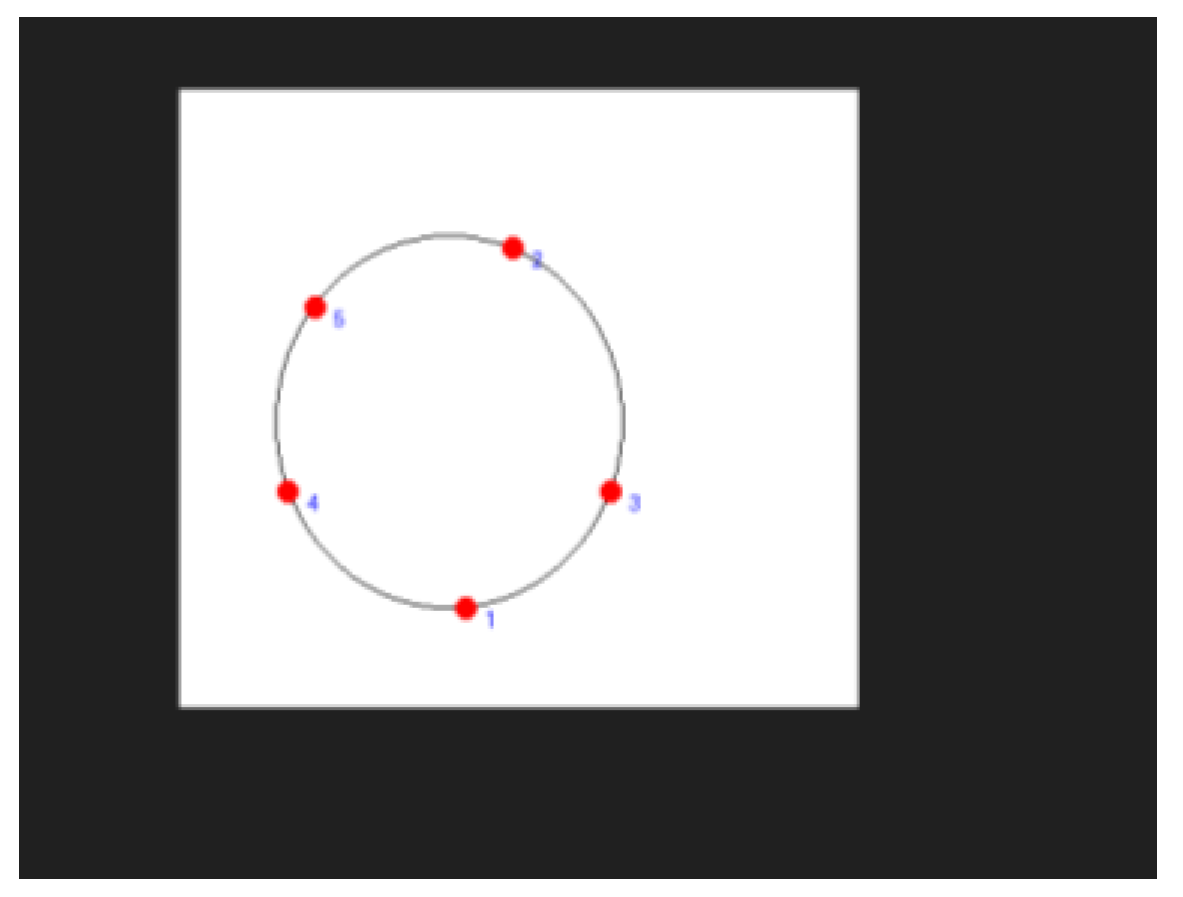
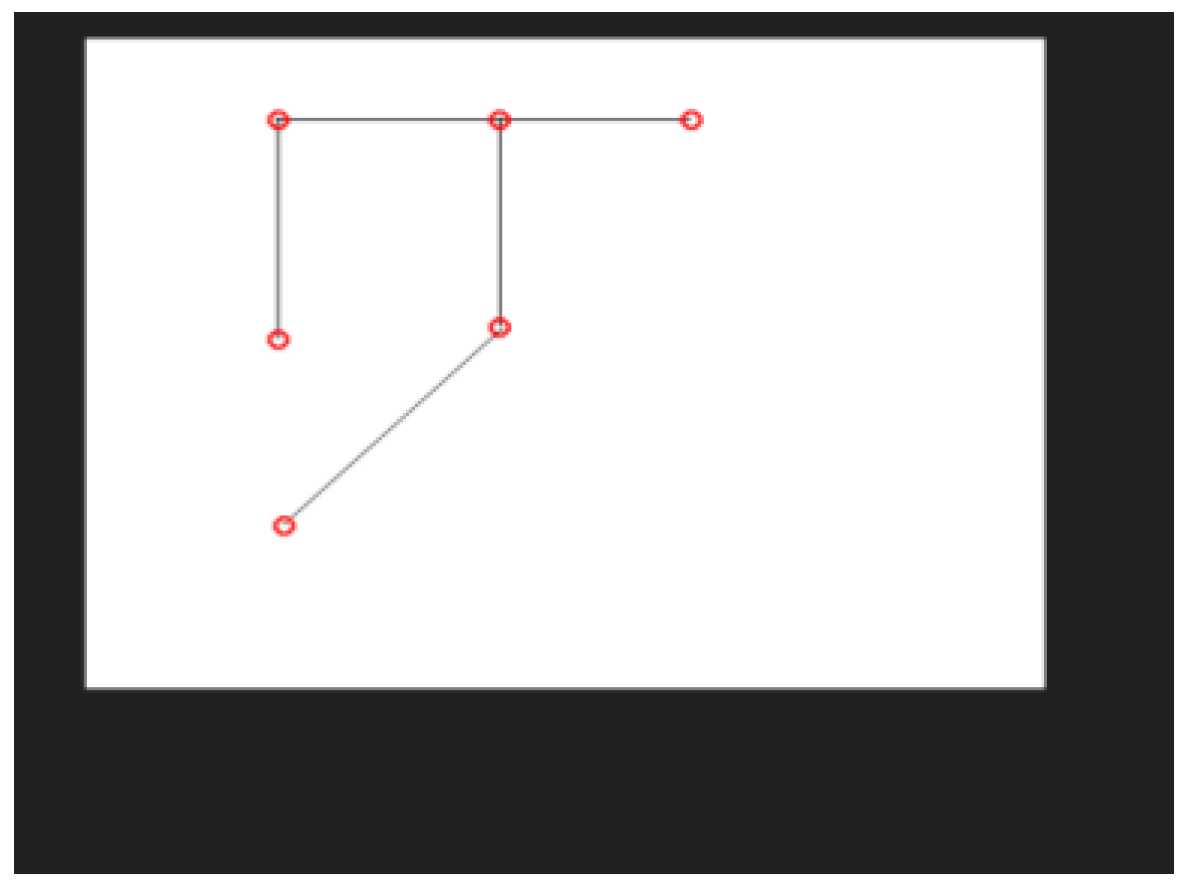
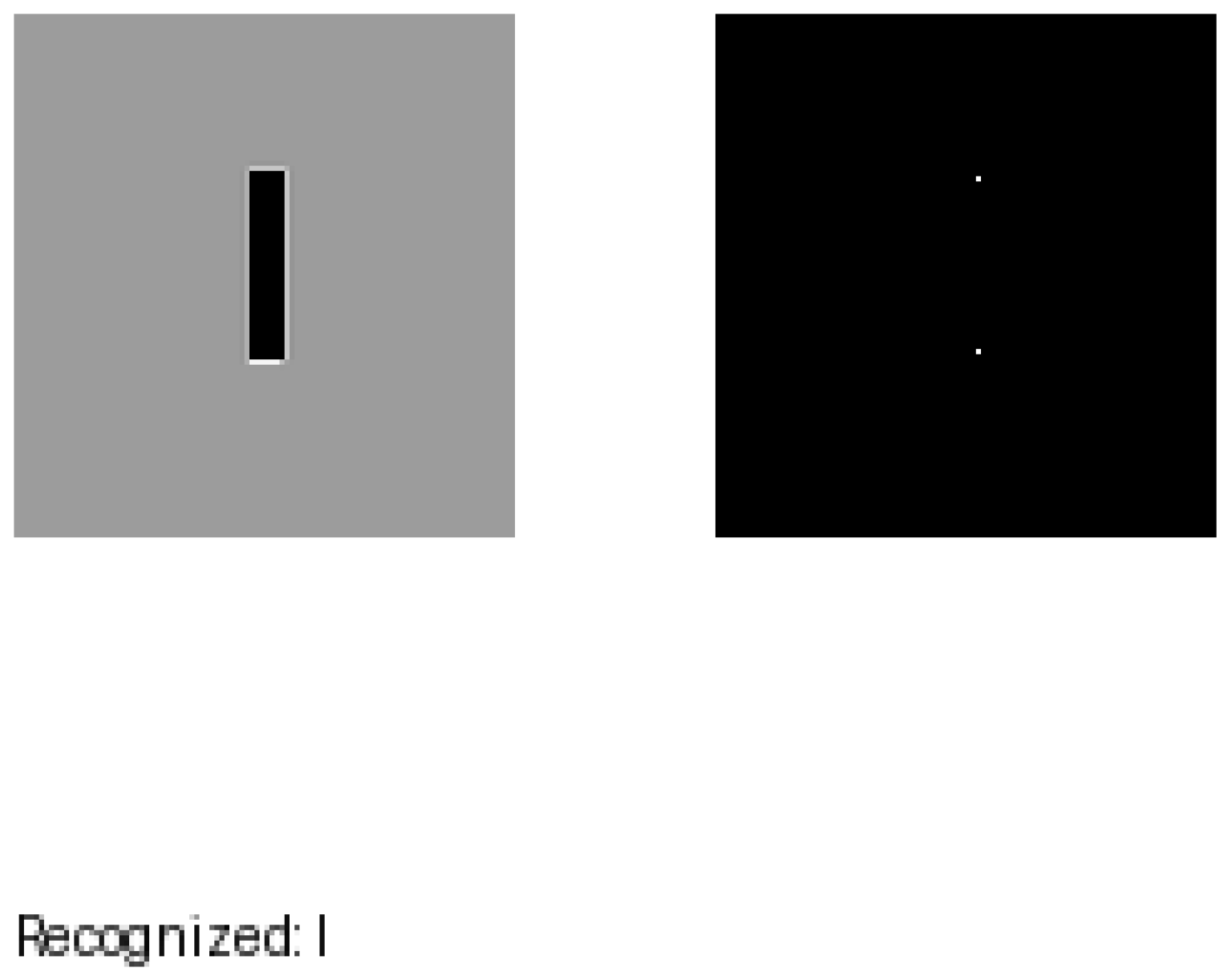
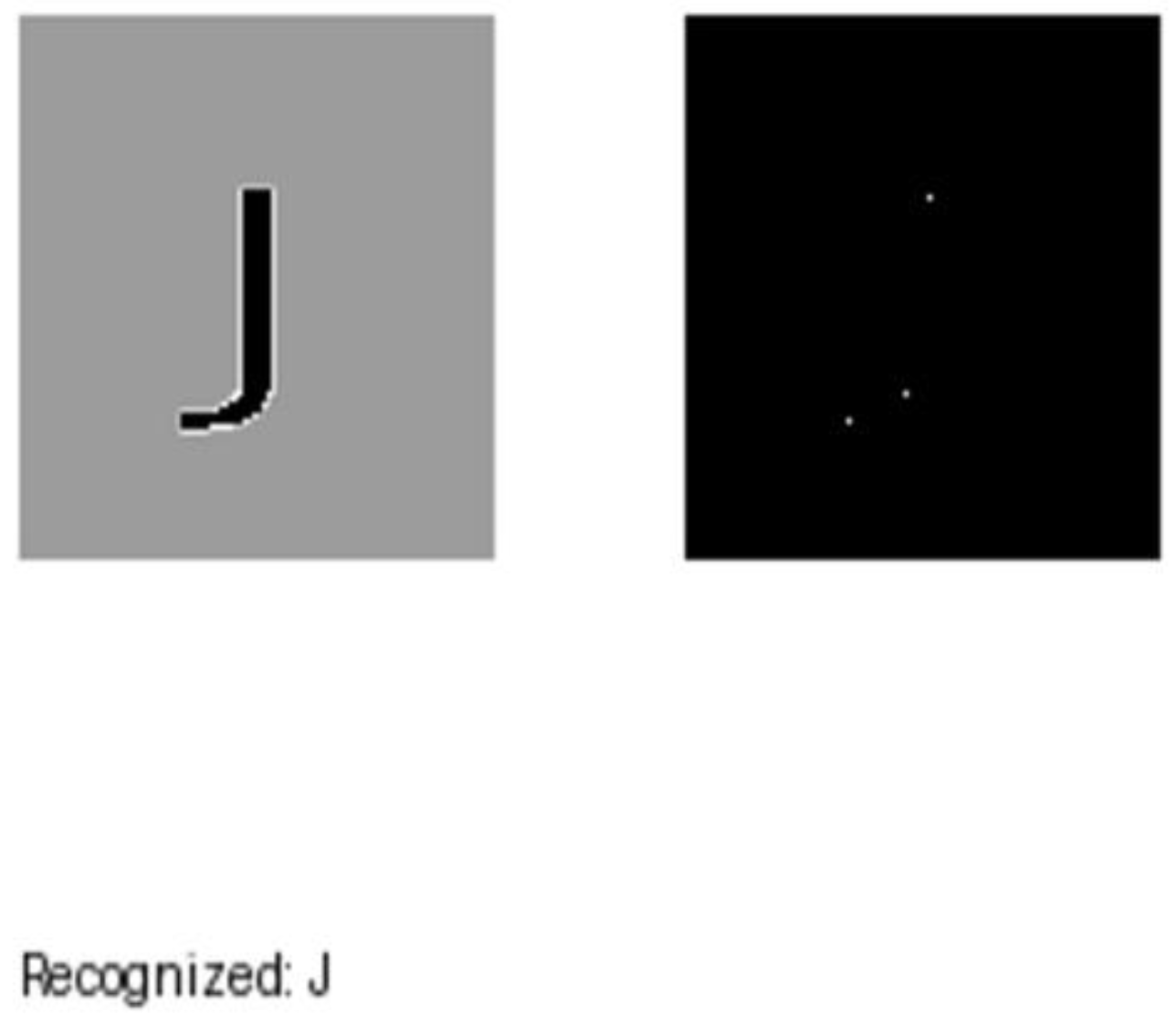
  • OUTPUT:-
Figure-1.
Figure-1.
Preprints 149740 g001
Figure-2.
Figure-2.
Preprints 149740 g002
Figure-3.
Figure-3.
Preprints 149740 g003
Figure-4.
Figure-4.
Preprints 149740 g004
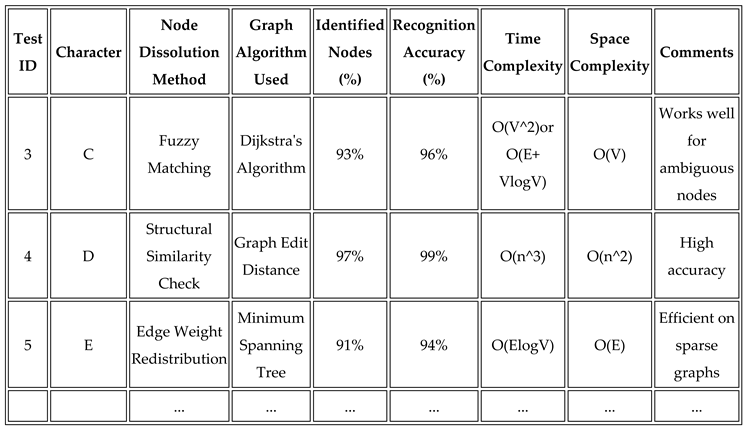
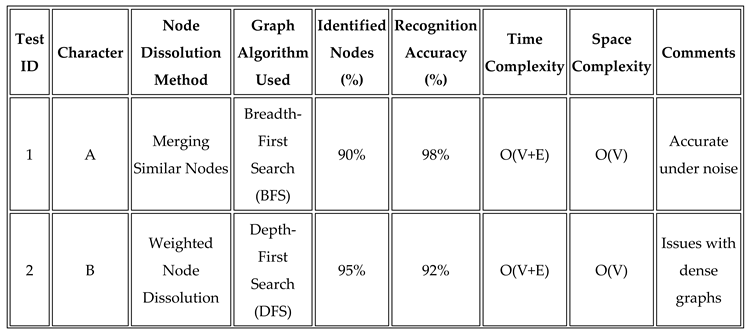
To address dissolving node identification issues in a graph-based character recognition method, the following accuracy table format can be designed. This table captures key metrics for evaluation:

5.4. Key Parameters Explained

1.
Test ID: A unique identifier for the experiment.
2.
Character: The target character being recognized in the graph.
3.
Node Dissolution Method: The strategy used to handle node ambiguity:
4.
Merging Similar Nodes: Combines nodes with minimal differences.
5.
Weighted Node Dissolution: Assigns weights to edges and nodes based on relevance
Fuzzy Matching: Uses approximate matching for nodes with slight deviations.
Structural Similarity Check: Evaluates the graph’s structure for node correspondence.
Edge Weight Redistribution: Adjusts edge weights to emphasize key features.
6.
Graph Algorithm Used: The algorithm applied for recognition:
BFS
DFS
Dijkstra’s Algorithm
Graph Edit Distance
Minimum Spanning Tree, etc.
7.
Identified Nodes (%): The percentage of correctly identified nodes relative to the total
8.
Recognition Accuracy (%): The percentage of correctly recognized characters.
9.
Time Complexity: Computational complexity based on the graph size and algorithm.
10.
Space Complexity: Memory requirements for the graph processing.
11.
Comments: Notes about performance, strengths, or issues encountered in the test.

5.4.1. Accuracy Table Format
Preprints 149740 i010
Preprints 149740 i011
This table provides a clear, structured way to analyze and improve node dissolution methods for graph-based character recognition, enabling better accuracy and efficiency over time.

6. Advantages and Challenges

Advantages Challenges
High precision due to key structural focus Complex scripts with intricate details may pose difficulty
Adaptable to various fonts and scales Noisy or distorted images can affect node detection accuracy
Effective for both printed and handwritten text | High computational cost for complex comparisons

6.1. Here's a Table Format Overview for Character Recognition Based on Node Identification

Step Description Tools/Techniques
1.Image Preprocessing Prepare the image by reducing noise, thresholding, and converting to a binary format. Image processing libraries (e.g., OpenCV, PIL)
2..Node Detection Identify significant points such as corners and intersections within the character structure Shi-Tomasi corner detection, Harris corner detection
3. Adjacency Matrix construction Represent nodes in a matrix to map relationships and spatial positions between nodes. Custom algorithms, graph representations
4.Pattern Matching Compare the node map to reference matrices of known characters for identification. Adjacency matrix comparison algorithms
5. Unicode Mapping Map the matched character to its corresponding Unicode representation for output. Python libraries for Unicode handling
6.Post-Processing Fine-tune recognition results and correct potential errors, if necessary. Custom logic for validation

7. Proposed Method for Character Recognition Using Node Identification

Character recognition is a fundamental aspect of modern computer vision Image and document processing systems, enabling the conversion of printed or handwritten text into machine-readable formats Node identify issues solve Techniques ShiTomsi detector algorithms . A particularly effective approach to character recognition involves identify and analyse nodes or critical points within a character's structure node identify robust Shi-tomsi Algorithms.

7.1. Concept of Node Identification in Character Recognition

Node identification involves detecting significant points within the character's outline or interior structure, such as corners, intersections, and endpoints. These nodes serve as reference markers that capture the unique shape and geometry of each character, facilitating accurate pattern recognition and differentiation.

7.2. Process Overview

1. Pre-processing: The input image undergoes noise reduction, thresholding, and binarization to prepare for node detection.
2. Node Detection: Techniques such as Shi-Tomasi corner detection or Harris corner detection are applied to identify points of interest.
3. Adjacency Matrix Construction: Nodes are represented in a matrix format, indicating their relationships and positions relative to each other.
4. Pattern Matching and Comparison: The identified nodes and their adjacency matrices are compared to a reference database containing known characters in various fonts and scales.
5. Unicode Mapping: Successfully matched patterns are converted into corresponding Unicode values for text output.
6.5 Advantages of Node-Based Recognition
- High Precision: Node identification focuses on key structural elements, making it robust against variations in font style and size.
- Scalability: This method can adapt to recognize characters in different languages and scripts by updating the reference database.
- Versatility: Works effectively on both machine-printed and handwritten text with distinct node characteristics.
6.Challenges and Considerations
While node identification is powerful, it may face difficulties with:- Complex Scripts: Characters with intricate details or overlapping strokes can lead to challenges in node differentiation.- Noisy Inputs: High levels of noise or distortions in the input image can result in erroneous node detection.

8. Conclusions

Graph-based methods for character recognition offer a robust and flexible approach by leveraging the structural and topological properties of characters. These methods effectively address many of the limitations of traditional pixel-based techniques, especially in dealing with variations in font styles, sizes, orientations, and noise. However, the success of these methods heavily depends on accurate node identification and graph construction. Graph Representation : - Characters are represented as graphs where nodes correspond to significant points such as intersections and endpoints, and edges represent the connecting strokes. This representation captures the essential geometric and structural information needed for recognition. Node Identification Issues - Challenges such as noise, variability in handwriting and fonts, resolution differences, and overlapping characters significantly impact node detection. Accurate node identification is crucial for the success of the graph-based recognition system. Effective Algorithms Corner and keypoint detection algorithms identify critical points in the character structure.- Graph Construction : Methods like Delaunay Triangulation and Minimum Spanning Tree ensure the graph accurately represents the character. - Feature Extraction: Graph-theoretic features capture the unique characteristics of each character.- Graph Matching : Algorithms such as Graph Edit Distance and Spectral Matching compare the constructed graph to template graphs for recognition. - Classification: Machine learning techniques, including SVMs and Chain code methods, classify characters based on graph features Addressing Challenge Noise and Artifacts Advanced preprocessing techniques reduce noise, enhancing node detection accuracy.-Variabilit:Adaptive thresholding and machine learning models improve node detection across different handwriting and font styles. Resolution and Scaling : Multi-scale analysis and normalization ensure consistent node placement.-Overlapping Characters: Segmentation algorithms separate characters, facilitating accurate node identification. -Graph Complexity: Heuristic-based pruning and incremental construction manage graph complexity while preserving essential character features. Future Directions: Integration with Deep Learning: Combining deep learning techniques with graph-based methods can further enhance node detection and classification accuracy. Real-Time Processing : Developing more efficient algorithms for real-time applications, such as automated data entry systems and mobile text recognition.- Improved Robustness: Enhancing the robustness of graph-based methods against extreme variations and distortions in characters.
In conclusion, while graph-based methods for character recognition present unique challenges node identify, particularly in node identification Shi-Tomsi detector, they offer significant advantages in accuracy and robustness. By leveraging appropriate algorithms and addressing node identification issues, these methods can significantly improve character recognition systems, making them more reliable and effective for various applications. Continued research and development in this field promise to further enhance the capabilities and research of graph-based character recognition.

References

  1. Author Alexander Mehler Publisher: Springer, 2023 This Paper provides a comprehensive overview of graph-based methods applied to various fields, including character recognition. . "Graph-Based Methods for Natural Language Processing and Information Retrieval".
  2. Authors: Marti, U.-V., Bunke, H. Journal: Pattern Recognition, 2022 This paper discusses the application of graph-based approaches to recognize handwritten characters, addressing various challenges and methods used. "Graph-Based Handwritten Character Recognition".
  3. Authors: Lam, L., Lee, S.-W., Suen, C.Y. Journal: Pattern Recognition, 2022, This study compares different skeletonization techniques, which are crucial for node identification in graph-based character recognition. "Skeletonization Algorithms for Character Recognition: A Comparative Study".
  4. Authors: Suen, C. Y., Wang, P., Lee, S. Journal: IEEE Transactions on Systems, Man, and Cybernetics, 202 This paper focuses on node identification issues and the solutions proposed to improve the accuracy of OCR systems. "Node Identification in Graph-Based Optical Character Recognition Systems".
  5. Authors: Felzenszwalb, P. F., Huttenlocher, D. P. Journal: International Journal of Computer Vision, 2024 While focused on image segmentation, this paper provides foundational knowledge on graph-based algorithms applicable to character recognition. "An Introduction to Graph-Based Algorithms for Image Segmentation".
Disclaimer/Publisher’s Note: The statements, opinions and data contained in all publications are solely those of the individual author(s) and contributor(s) and not of MDPI and/or the editor(s). MDPI and/or the editor(s) disclaim responsibility for any injury to people or property resulting from any ideas, methods, instructions or products referred to in the content.
Copyright: This open access article is published under a Creative Commons CC BY 4.0 license, which permit the free download, distribution, and reuse, provided that the author and preprint are cited in any reuse.
Prerpints.org logo

Preprints.org is a free preprint server supported by MDPI in Basel, Switzerland.

Subscribe

Disclaimer

Terms of Use

Privacy Policy

Privacy Settings

© 2025 MDPI (Basel, Switzerland) unless otherwise stated