
Submitted:
08 February 2025
Posted:
10 February 2025
You are already at the latest version
Abstract
Magnetotelluric (MT) forward modeling is a key technique in magnetotelluric sounding, and deep learning has been widely applied to MT forward modeling. In three-dimensional (3D) problems, although existing methods can predict forward modeling results with high accuracy, they often use multiple networks to simulate multiple forward modeling parameters, resulting in low efficiency. We apply multi-task learning (MTL) to 3D MT forward modeling to achieve simultaneous inference of apparent resistivity and impedance phase, effectively improving overall efficiency.Furthermore, through comparative analysis of feature map differences in various decoder layers of the network, we identify the optimal branching point for multi-task learning decoders. This enhances the feature extraction capabilities of the network and improves the prediction accuracy of forward modeling parameters. Additionally, we introduce an uncertainty-based loss function to dynamically balance the learning weights between tasks, addressing the shortcomings of traditional loss functions.Experiments demonstrate that compared to single-task networks and existing multi-task networks, the proposed network (MT-FeatureNet) achieves the best results in terms of SSIM, MAE, and MRE metrics. The proposed multi-task learning model not only improves the efficiency and accuracy of 3D MT forward modeling but also provides a novel approach to the design of multi-task learning network structures.
Keywords:
1. Introduction
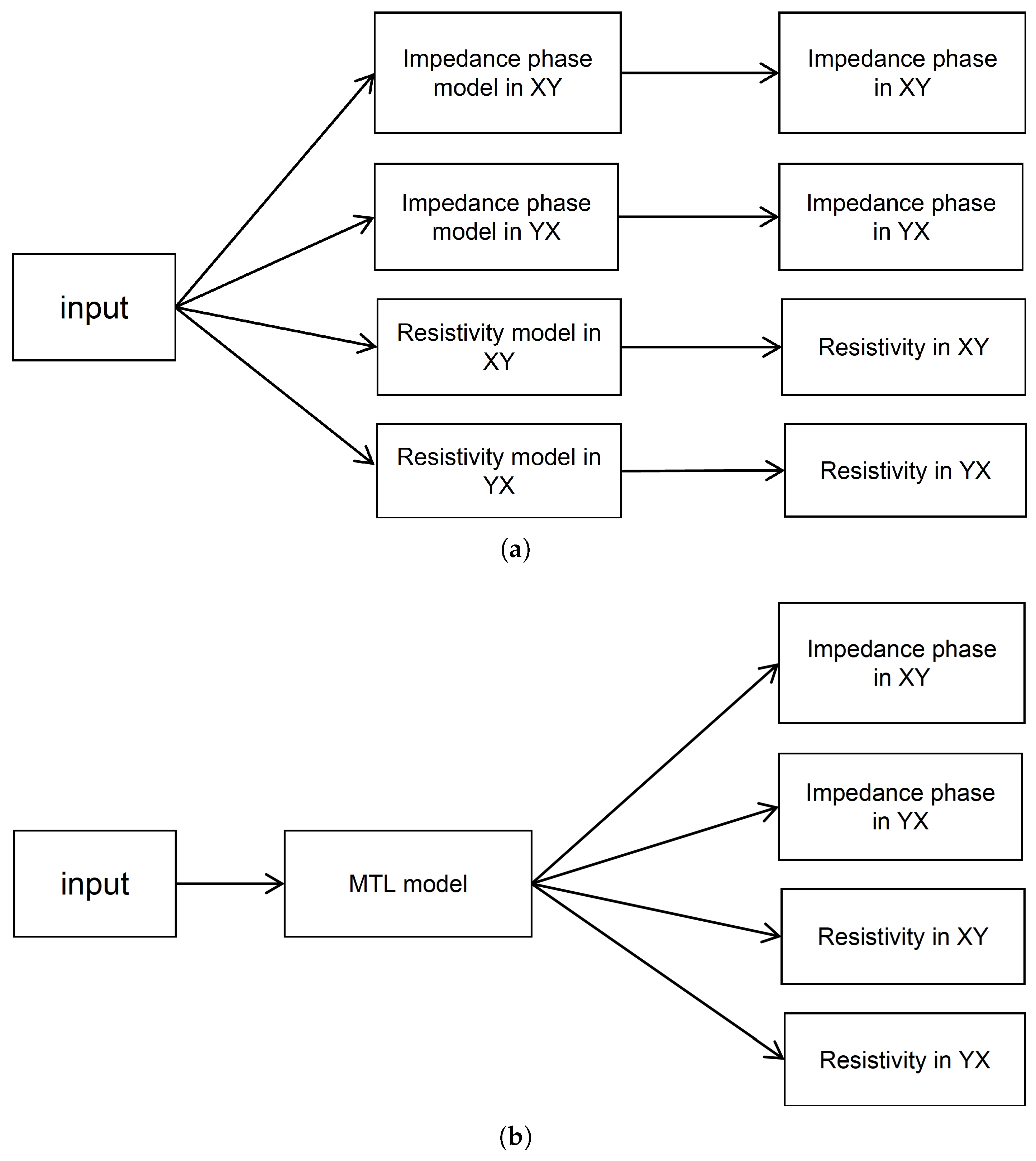
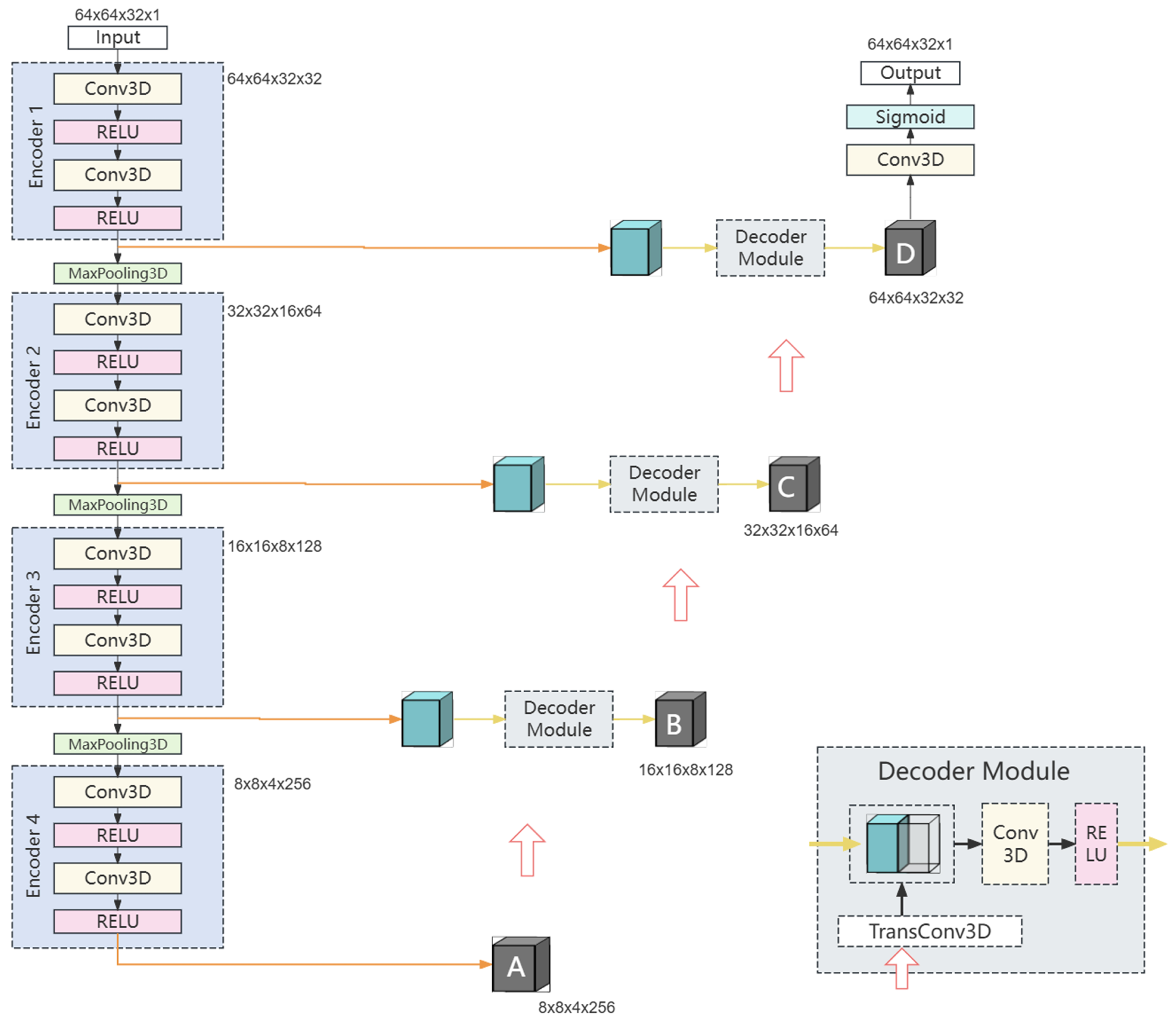
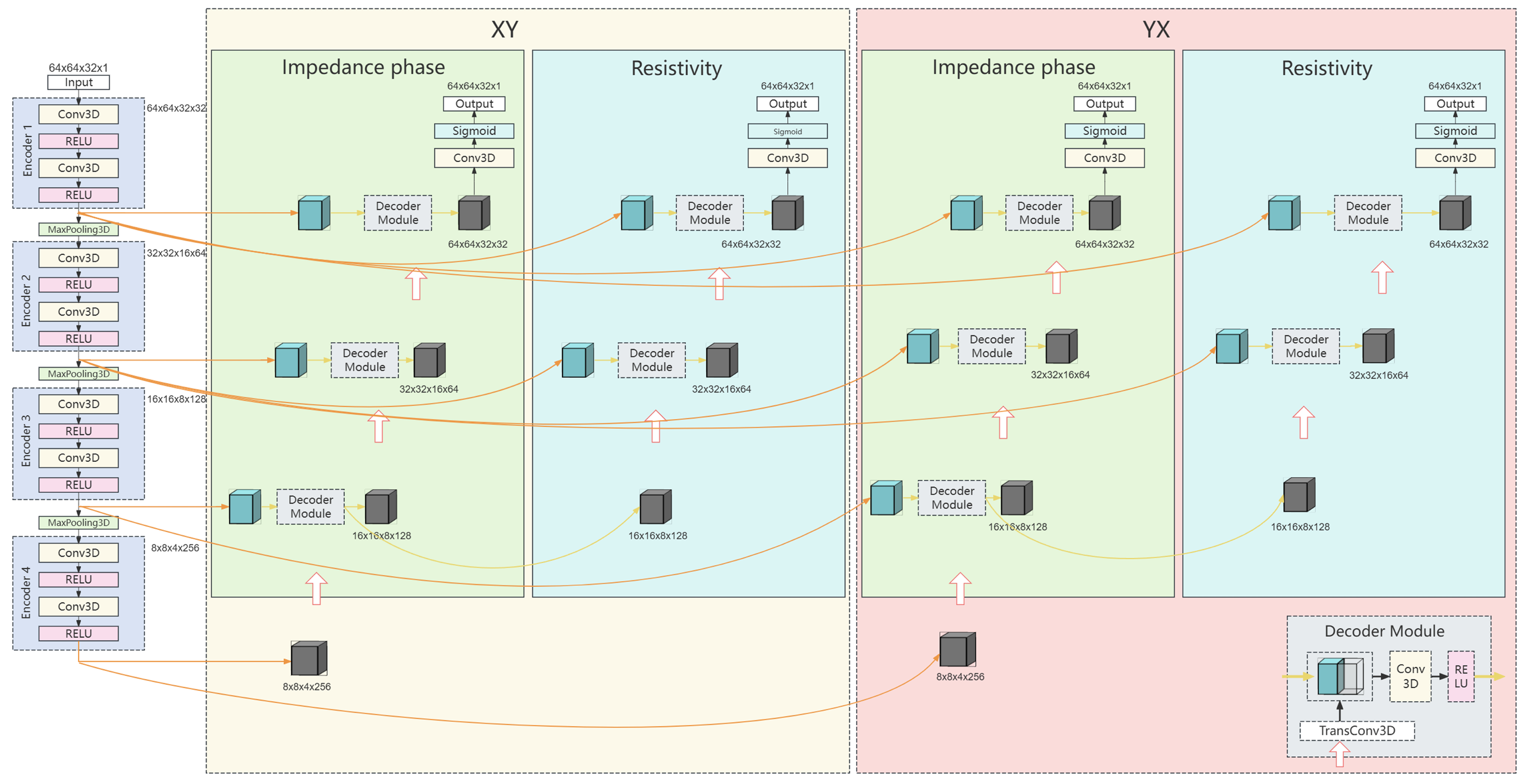
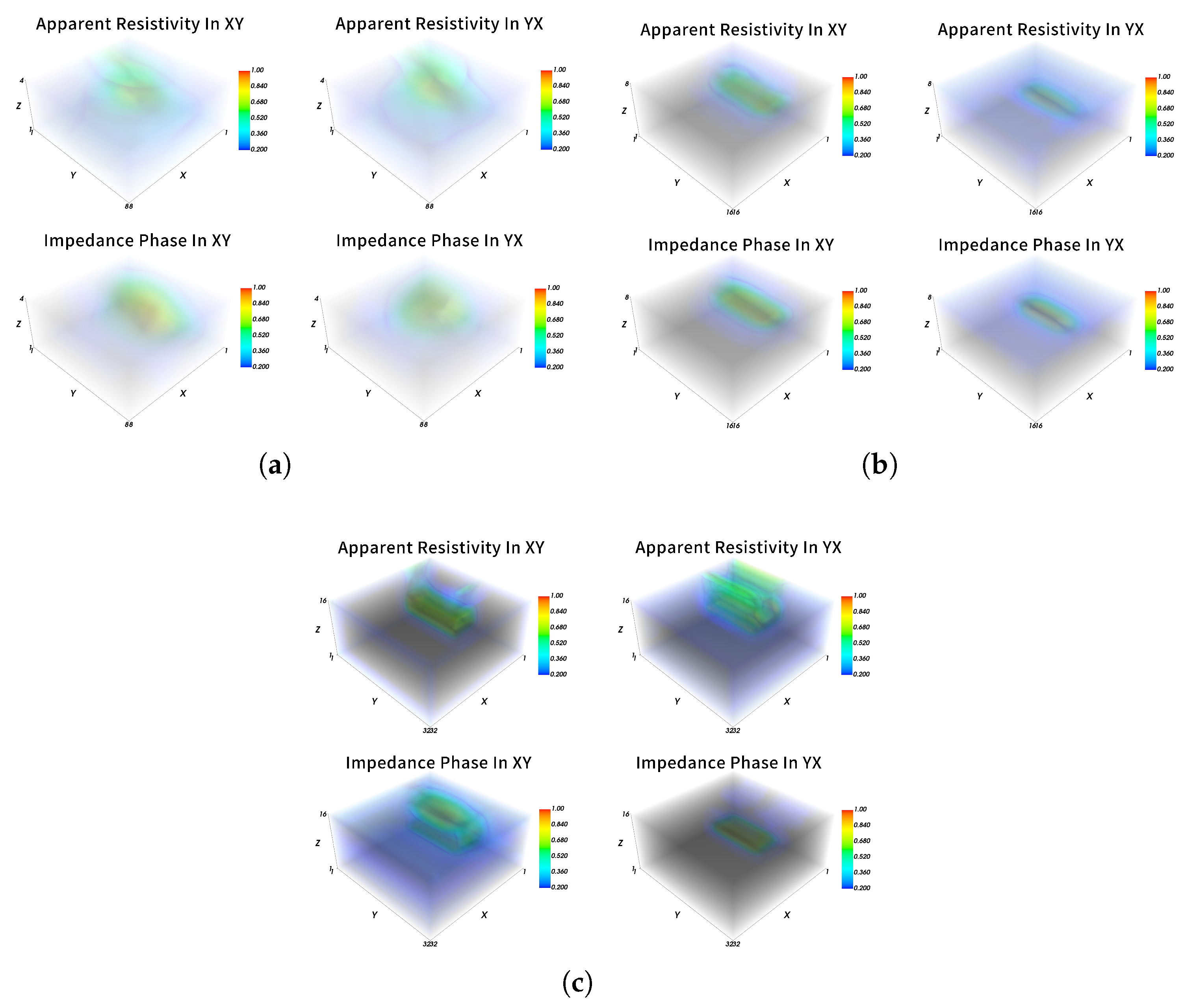
- Achieved Synchronous Inference of 3-D MT Apparent Resistivity and Impedance Phase: We introduced multi-task learning into 3-D MT deep learning forward modeling, constructing a 3-D neural network with multiple branch decoders targeting the multi-apparent parameters of 3-D MT forward responses. First, we analyzed the characteristics of apparent parameters in different polarization directions of MT. Second, we explored the feature extraction capability and forward modeling effect when different depths of the decoder layers were used as multi-branch nodes. Finally, considering both network size and forward modeling effectiveness, we selected an appropriate branch point for training. The proposed network model reduced the loss value compared to traditional single-task networks, significantly improving all evaluation metrics and achieving faster convergence.
- Proposed a Method for Selecting Optimal Multi-task Branch Points through Feature Map Comparison: We constructed a multi-task learning network model. On the branch nodes of the decoder, we compared and analyzed the feature maps at each layer in single-task network models to reduce the number of training parameters and increase the shared representation layer to enhance model generalization. Based on this, we selected the appropriate network layer for multi-task branching. Compared to traditional multi-task networks, the proposed network model further reduced the loss value, achieved faster convergence, and decreased the consumption of computational resources and time.
- Introduced a Loss Function Suitable for 3-D MT Multi-branch Decoding (Multi-task Learning): We integrated a loss function based on heteroscedastic uncertainty to balance the learning weights between tasks, avoiding the potential issue of negative loss values found in traditional uncertainty-based loss functions, thereby improving the training accuracy for each task.
2. Related Research(3-D Magnetotelluric Single-Task Forward Modeling Based on Deep Learning)
3. Three-Dimensional Magnetotelluric Multi-Task Forward Modelling
3.1. Overall Concept
3.2. Network Structure
3.3. Loss Function of Multi-Task Learning
4. Results and Analysis
4.1. Dataset
4.2. Data Preprocessing
4.3. Experimental Environment and Parameter Settings
4.4. Evaluation Indicators
4.5. Comparative Results of Branch Point Selection Strategies
4.6. Comparative Results of Multi-Task and Single-Task Learning
4.7. Comparative Results of Loss Function Performance
4.8. Time Consumption Comparison
5. Discussion
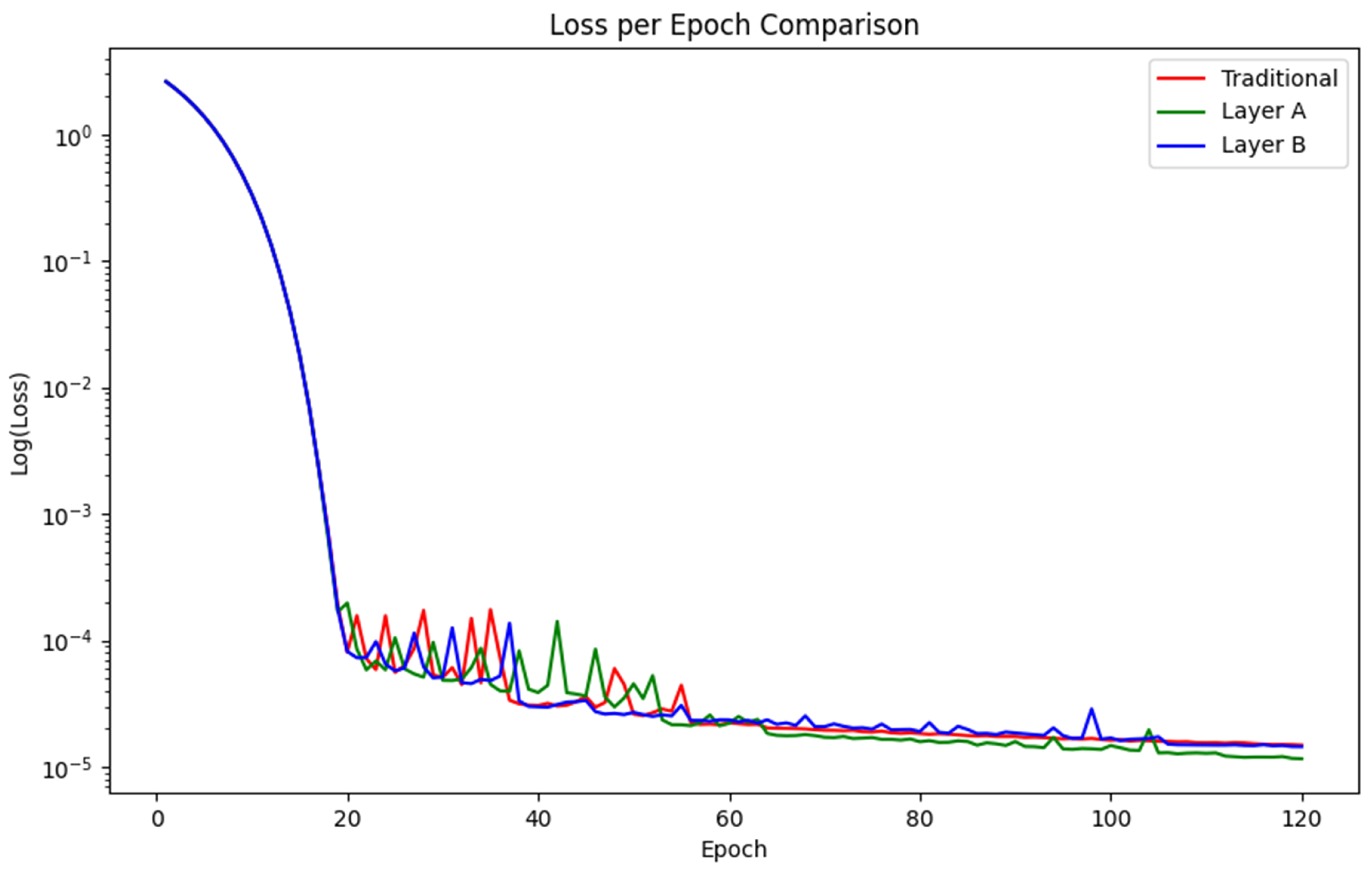
- For our feature map-based branch point selection strategy, it has been very effective and significantly improved the prediction accuracy. In Figure 4, we conducted a comparison of network feature outputs, and ultimately chose to split from layer A in both XY and YX directions, then further divided each direction into apparent resistivity and impedance phase branches. Table 1, Table 2, and Table 3 present comparisons of different branch selection strategies across various metrics (SSIM, MAE, MRE), where our branch point selection strategy achieved the best performance in all three metrics with notable improvements. Furthermore, in Figure 5, we analyzed the loss per epoch for three experiments and found that our strategy maximizes resource utilization and reduces training loss. However, we observed that when using networks with a large number of complex layers, due to the increased number of potential branch points, selecting the optimal multi-task branch point from feature maps becomes complicated and challenging. Therefore, a method capable of dynamically selecting multi-task learning network branch points is a future development trend.
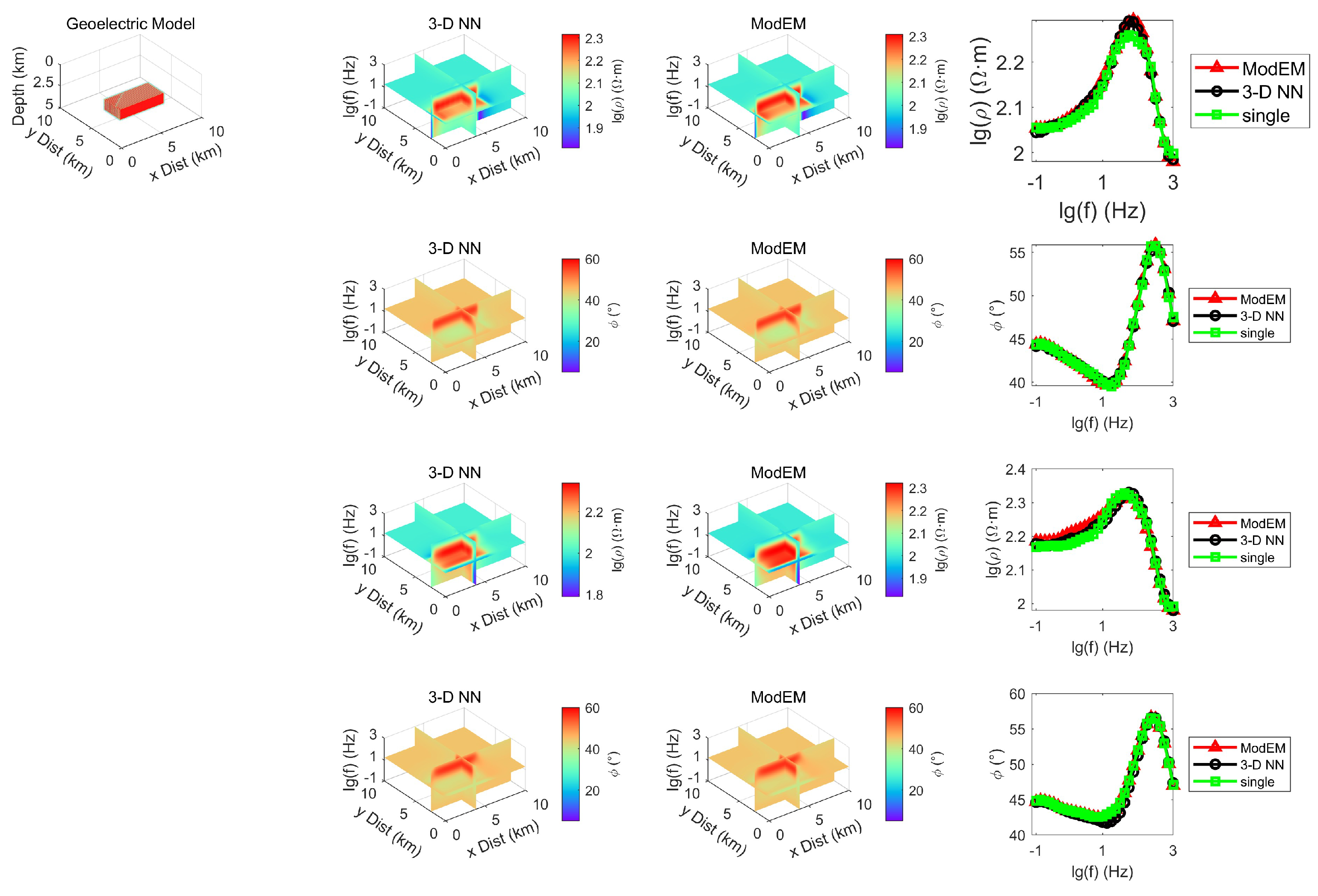
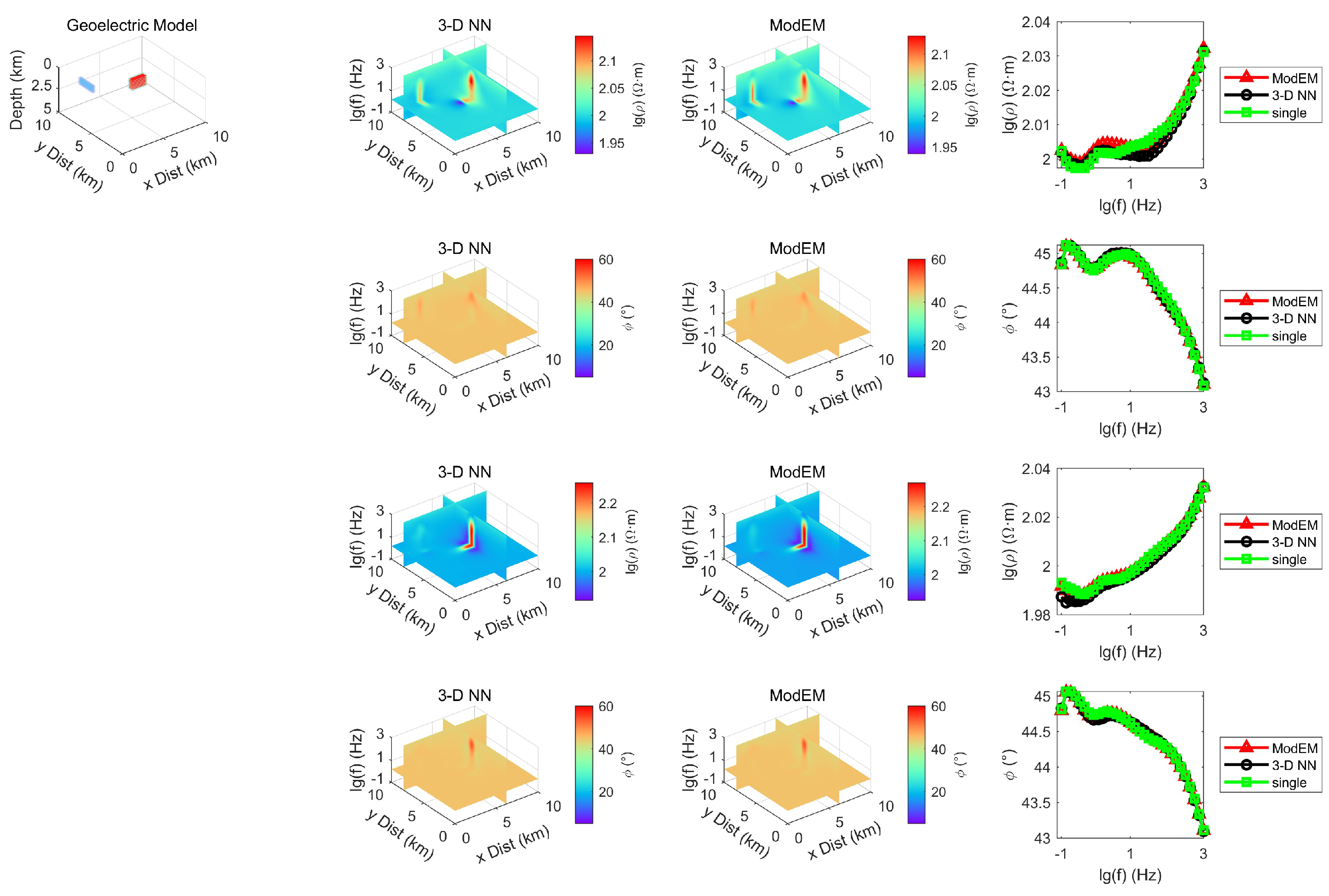
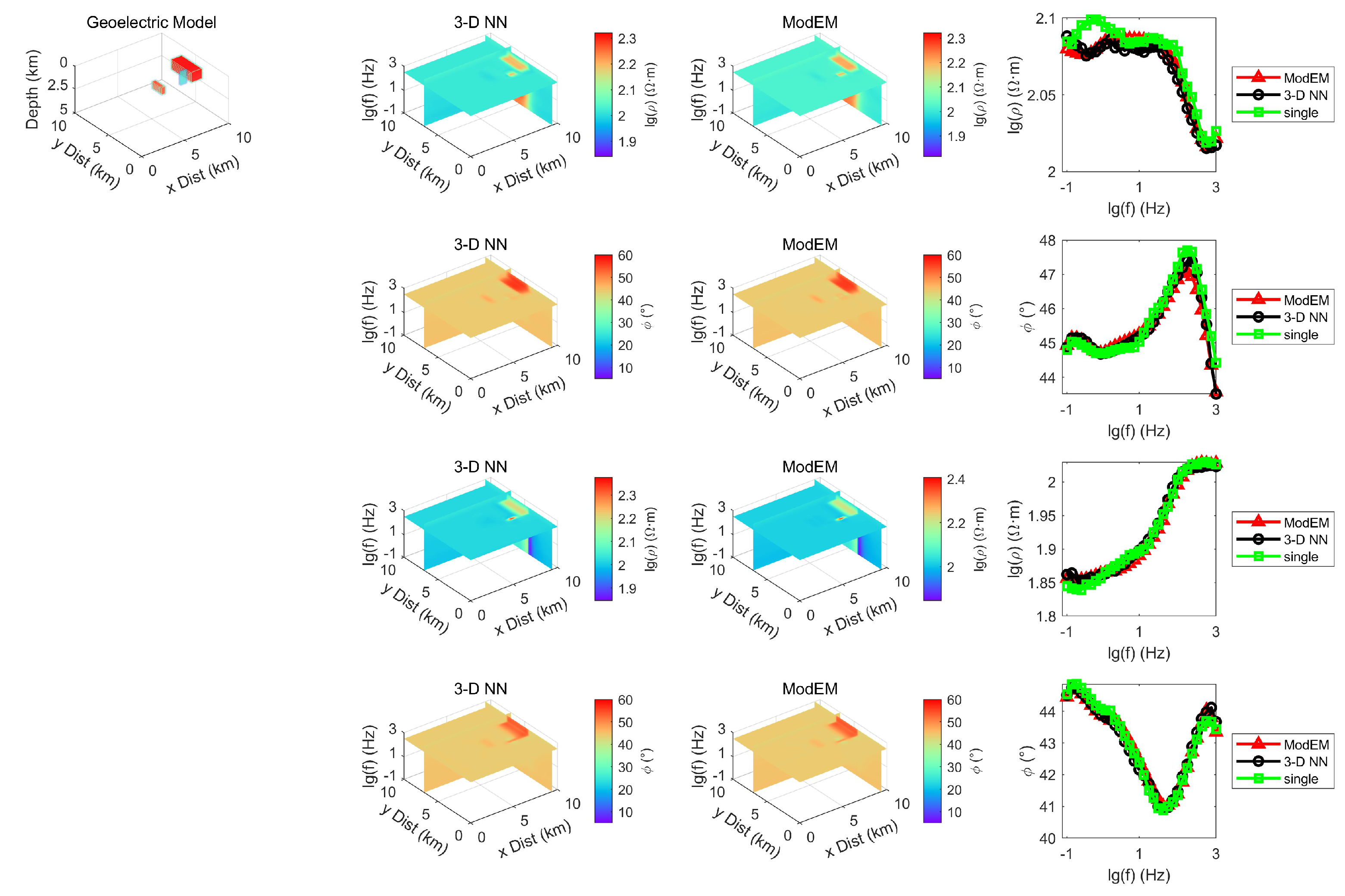
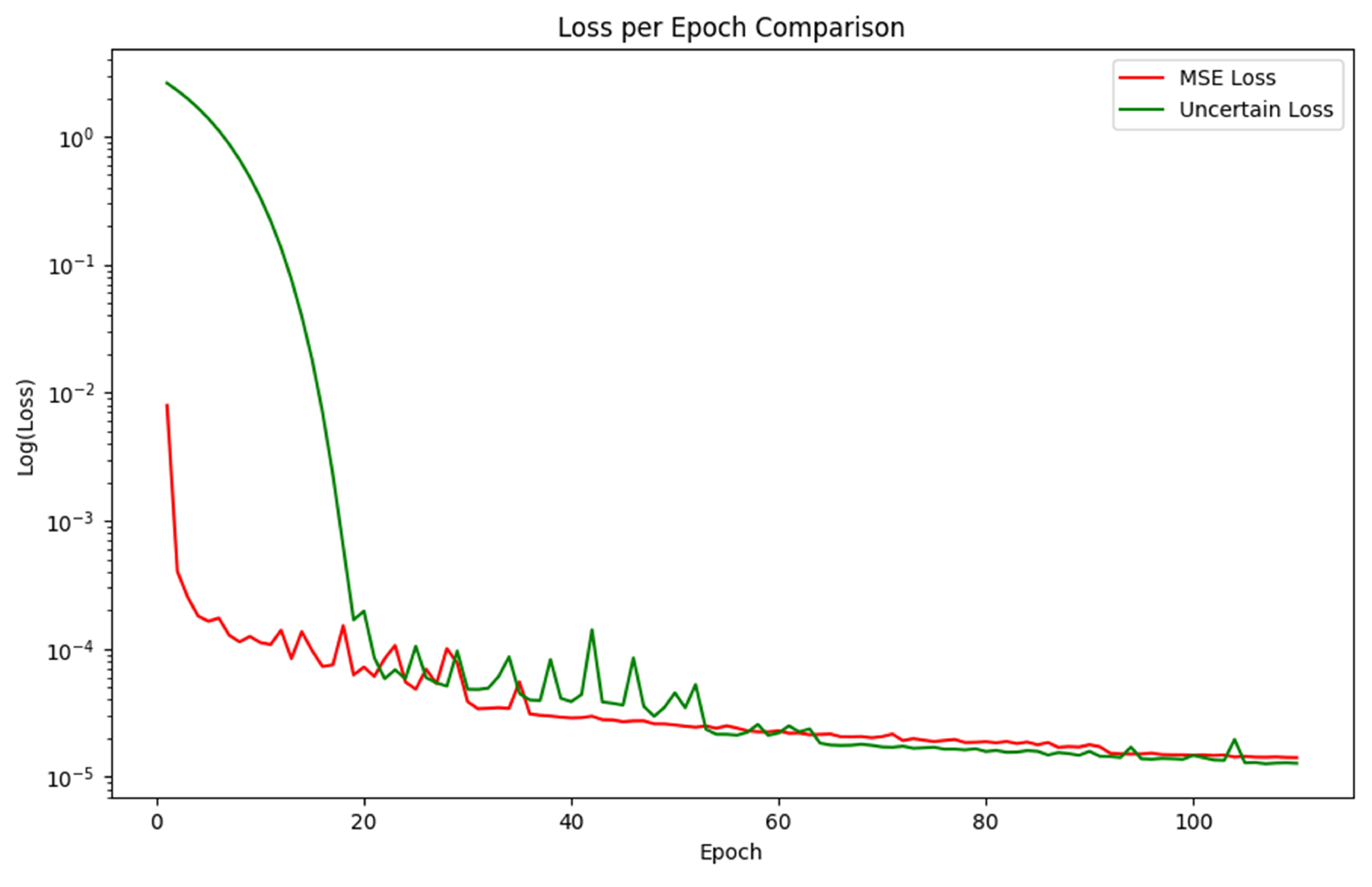
- By using the proposed strategy in this paper, the trained network was compared item-wise with traditional single-task networks, and it can be observed that the network proposed in this paper achieved significant improvements across all three metrics. Furthermore, based on the experimental results using an improved uncertainty-based loss function combined with the MSE loss function, Table 7, Table 8, and Table 9 show that the uncertainty-based loss function can better adjust the learning weights for each task in multi-task learning, thereby further improving the prediction accuracy, as shown in Figure 9, which also reduces the training loss. Table 10 indicates that the proposed multi-task network consumes less time than the total time of four single-task networks. This reduces the time cost and maintenance cost for practical tasks, making it more efficient.
6. Conclusion
Author Contributions
Funding
Data Availability Statement
Conflicts of Interest
References
- Vozoff, K. The magnetotelluric method 1991.
- Chen, L.; Booker, J.R.; Jones, A.G.; Wu, N.; Unsworth, M.J.; Wei, W.; Tan, H. Electrically conductive crust in southern Tibet from INDEPTH magnetotelluric surveying. Science 1996, 274, 1694–1696. [Google Scholar] [CrossRef] [PubMed]
- Bai, D.; Unsworth, M.J.; Meju, M.A.; Ma, X.; Teng, J.; Kong, X.; Sun, Y.; Sun, J.; Wang, L.; Jiang, C.; et al. Crustal deformation of the eastern Tibetan plateau revealed by magnetotelluric imaging. Nature geoscience 2010, 3, 358–362. [Google Scholar] [CrossRef]
- Kana, J.D.; Djongyang, N.; Raïdandi, D.; Nouck, P.N.; Dadjé, A. A review of geophysical methods for geothermal exploration. Renewable and Sustainable Energy Reviews 2015, 44, 87–95. [Google Scholar] [CrossRef]
- Cheng, Y.; Pang, Z.; Kong, Y.; Chen, X.; Wang, G. Imaging the heat source of the Kangding high-temperature geothermal system on the Xianshuihe fault by magnetotelluric survey. Geothermics 2022, 102, 102386. [Google Scholar] [CrossRef]
- Jiang, W.; Duan, J.; Doublier, M.; Clark, A.; Schofield, A.; Brodie, R.C.; Goodwin, J. Application of multiscale magnetotelluric data to mineral exploration: an example from the east Tennant region, Northern Australia. Geophysical Journal International 2022, 229, 1628–1645. [Google Scholar] [CrossRef]
- Tikhonov, A. On determining electrical characteristics of the deep layers of the earth’s crust. Magnetotelluric methods.
- Cagniard, L. Basic theory of the magneto-telluric method of geophysical prospecting. Geophysics 1953, 18, 605–635. [Google Scholar] [CrossRef]
- Yu, N.; Wu, X.; Liu, X.; Li, R.; Zhang, H.; Gao, L. Hybrid mesh for magnetotelluric forward modeling based on the finite element method. Scientific Reports 2023, 13, 532. [Google Scholar] [CrossRef]
- Zhang, J.; Liu, J.; Feng, B.; Guan, J.; Liu, Z.; et al. Three-dimensional magnetotelluric modeling using the finite element model reduction algorithm. Computers & Geosciences 2021, 151, 104750. [Google Scholar]
- Zhu, X.; Liu, J.; Cui, Y.; Gong, C. A scalable parallel algorithm for 3-D magnetotelluric finite element modeling in anisotropic media. IEEE Transactions on Geoscience and Remote Sensing 2021, 60, 1–14. [Google Scholar] [CrossRef]
- Madden, T.M.; Mackie, R.L. Three-dimensional magnetotelluric modelling and inversion. Proceedings of the IEEE 1989, 77, 318–333. [Google Scholar] [CrossRef]
- Tezkan, B.; Hördt, A.; Gobashy, M. Two-dimensional radiomagnetotelluric investigation of industrial and domestic waste sites in Germany. Journal of Applied Geophysics 2000, 44, 237–256. [Google Scholar] [CrossRef]
- Varilsuha, D.; Candansayar, M.E. 3D magnetotelluric modeling by using finite-difference method: Comparison study of different forward modeling approaches. Geophysics 2018, 83, WB51–WB60. [Google Scholar] [CrossRef]
- Mackie, R.L.; Smith, J.T.; Madden, T.R. Three-dimensional electromagnetic modeling using finite difference equations: The magnetotelluric example. Radio Science 1994, 29, 923–935. [Google Scholar] [CrossRef]
- DONG, H.; WEI, W.B.; YE, G.F.; JIN, S.; JING, J.E. Study of three-dimensional magnetotelluric inversion including surface topography based on finite-difference method. Chinese Journal of Geophysics 2014, 57, 939–952. [Google Scholar]
- Guo, Z.; Egbert, G.; Dong, H.; Wei, W. Modular finite volume approach for 3D magnetotelluric modeling of the Earth medium with general anisotropy. Physics of the Earth and Planetary Interiors 2020, 309, 106585. [Google Scholar] [CrossRef]
- Kruglyakov, M.; Geraskin, A.; Kuvshinov, A. Novel accurate and scalable 3-D MT forward solver based on a contracting integral equation method. Computers & Geosciences 2016, 96, 208–217. [Google Scholar]
- Yu, G.; Han, J. Divergence correction for three-dimensional magnetotelluric forward modelling with arbitrary electrical anisotropy. Frontiers in Earth Science 2025, 12, 1511153. [Google Scholar] [CrossRef]
- Conway, D.; Alexander, B.; King, M.; Heinson, G.; Kee, Y. Inverting magnetotelluric responses in a three-dimensional earth using fast forward approximations based on artificial neural networks. Computers & geosciences 2019, 127, 44–52. [Google Scholar]
- Deng, F.; Hu, J.; Wang, X.; Yu, S.; Zhang, B.; Li, S.; Li, X. Magnetotelluric deep learning forward modeling and its application in inversion. Remote Sensing 2023, 15, 3667. [Google Scholar] [CrossRef]
- Jiang, P.; Wang, X. Fast forward modeling of 3D magnetotelluric via neural networks. In Proceedings of the International Workshop on Gravity, Electrical & Magnetic Methods and Their Applications, Shenzhen, China, 2024. Society of Exploration Geophysicists and Chinese Geophysical Society, 2024, May 19–22; pp. 283–286.
- Liao, W.; Peng, R.; Hu, X.; Zhang, Y.; Zhou, W.; Fu, X.; Lin, H. Fast forward modeling of magnetotelluric data in complex continuous media using an extended Fourier DeepONet architecture. Geophysics 2024, 90, 1–62. [Google Scholar] [CrossRef]
- Yang, S.; Guo, R. Two dimensional forward simulation of magnetotelluric waves based on fourier neural network. In Proceedings of the Journal of Physics: Conference Series. IOP Publishing, Vol. 2895; 2024; p. 012060. [Google Scholar]
- Deng, F.; Yu, S.; Wang, X.; Guo, Z. Accelerating magnetotelluric forward modeling with deep learning: Conv-BiLSTM and D-LinkNet. Geophysics 2023, 88, E69–E77. [Google Scholar] [CrossRef]
- Wang, X.; Jiang, P.; Deng, F.; Wang, S.; Yang, R.; Yuan, C. Three Dimensional Magnetotelluric Forward Modeling Through Deep Learning. IEEE Transactions on Geoscience and Remote Sensing 2024. [Google Scholar] [CrossRef]
- Zhang, C.; Tu, L.; Yang, Z.; Du, B.; Zhou, Z.; Wu, J.; Chen, L. A CMMOG-based lithium-battery SOH estimation method using multi-task learning framework. Journal of Energy Storage 2025, 107, 114884. [Google Scholar] [CrossRef]
- Bensoltane, R.; Zaki, T. Neural multi-task learning for end-to-end Arabic aspect-based sentiment analysis. Computer Speech & Language 2025, 89, 101683. [Google Scholar]
- Caruana, R. Multitask learning. Machine learning 1997, 28, 41–75. [Google Scholar] [CrossRef]
- Crawshaw, M. Multi-task learning with deep neural networks: A survey. arXiv preprint arXiv:2009.09796, arXiv:2009.09796 2020.
- Zhang, K.; Zhang, L.; Pan, H. UoloNet: based on multi-tasking enhanced small target medical segmentation model. Artificial Intelligence Review 2024, 57, 31. [Google Scholar] [CrossRef]
- Shan, T.; Guo, R.; Li, M.; Yang, F.; Xu, S.; Liang, L. Application of multitask learning for 2-D modeling of magnetotelluric surveys: TE case. IEEE Transactions on Geoscience and Remote Sensing 2021, 60, 1–9. [Google Scholar] [CrossRef]
- Lu, Y.; Kumar, A.; Zhai, S.; Cheng, Y.; Javidi, T.; Feris, R. Fully-adaptive feature sharing in multi-task networks with applications in person attribute classification. In Proceedings of the Proceedings of the IEEE conference on computer vision and pattern recognition, 2017, pp. 5334–5343.
- Colombo, D.; Turkoglu, E.; Li, W.; Sandoval-Curiel, E.; Rovetta, D. Physics-driven deep-learning inversion with application to transient electromagnetics. Geophysics 2021, 86, E209–E224. [Google Scholar] [CrossRef]
- Jupp, D.L.; Vozoff, K. Two-dimensional magnetotelluric inversion. Geophysical Journal International 1977, 50, 333–352. [Google Scholar] [CrossRef]
- Newman, G.A.; Alumbaugh, D.L. Three-dimensional magnetotelluric inversion using non-linear conjugate gradients. Geophysical journal international 2000, 140, 410–424. [Google Scholar] [CrossRef]
- Tai, X.C.; Liu, H.; Chan, R.H.; Li, L. A mathematical explanation of UNet. arXiv preprint arXiv:2410.04434, arXiv:2410.04434 2024.
- Wang, Y.; Gu, L.; Jiang, T.; Gao, F. MDE-UNet: A multitask deformable UNet combined enhancement network for farmland boundary segmentation. IEEE Geoscience and Remote Sensing Letters 2023, 20, 1–5. [Google Scholar] [CrossRef]
- Ullah, Z.; Usman, M.; Latif, S.; Khan, A.; Gwak, J. SSMD-UNet: semi-supervised multi-task decoders network for diabetic retinopathy segmentation. Scientific Reports 2023, 13, 9087. [Google Scholar] [CrossRef]
- Zhang, W.; Li, X.; Shi, G.; Chen, X.; Qiao, Y.; Zhang, X.; Wu, X.M.; Dong, C. Real-world image super-resolution as multi-task learning. Advances in Neural Information Processing Systems 2024, 36. [Google Scholar]
- Zhang, Y.; Wang, J.; Liu, Y.; Rong, L.; Zheng, Q.; Song, D.; Tiwari, P.; Qin, J. A multitask learning model for multimodal sarcasm, sentiment and emotion recognition in conversations. Information Fusion 2023, 93, 282–301. [Google Scholar] [CrossRef]
- Yuan, H.; He, Y.; Du, P.; Song, L. Multi-Task Learning Using Uncertainty to Weigh Losses for Heterogeneous Face Attribute Estimation. arXiv preprint arXiv:2403.00561, arXiv:2403.00561 2024.

| Layer | Apparent Resistivity (XY) | Apparent Resistivity (YX) | Impedance Phase (XY) | Impedance Phase (YX) |
|---|---|---|---|---|
| Traditional1 | 0.997805 | 0.997989 | 0.993811 | 0.994720 |
| Layer A2 | 0.998151 | 0.998209 | 0.994181 | 0.995059 |
| Layer B3 | 0.998036 | 0.998116 | 0.993977 | 0.994839 |
| Layer | Apparent Resistivity (XY) | Apparent Resistivity (YX) | Impedance Phase (XY) | Impedance Phase (YX) |
|---|---|---|---|---|
| Traditional | 0.003175 | 0.003138 | 0.993811 | 0.104520 |
| Layer A | 0.002655 | 0.002613 | 0.096827 | 0.097633 |
| Layer B | 0.003030 | 0.003305 | 0.101614 | 0.103892 |
| Layer | Apparent Resistivity (XY) | Apparent Resistivity (YX) | Impedance Phase (XY) | Impedance Phase (YX) |
|---|---|---|---|---|
| Traditional | 0.202176 | 0.200977 | 0.268507 | 0.261238 |
| Layer A | 0.177209 | 0.179783 | 0.250335 | 0.249586 |
| Layer B | 0.185538 | 0.198683 | 0.261273 | 0.263758 |
| Network | Apparent Resistivity (XY) | Apparent Resistivity (YX) | Impedance Phase (XY) | Impedance Phase (YX) |
|---|---|---|---|---|
| Single-task Network | 0.997623 | 0.997839 | 0.993672 | 0.994265 |
| MT-FeatureNet | 0.998087 | 0.998195 | 0.994550 | 0.994992 |
| Network | Apparent Resistivity (XY) | Apparent Resistivity (YX) | Impedance Phase (XY) | Impedance Phase (YX) |
|---|---|---|---|---|
| Single-task Network | 0.003651 | 0.003658 | 0.105076 | 0.105228 |
| MT-FeatureNet | 0.002693 | 0.002756 | 0.093059 | 0.094927 |
| Network | Apparent Resistivity (XY) | Apparent Resistivity (YX) | Impedance Phase (XY) | Impedance Phase (YX) |
|---|---|---|---|---|
| Single-task Network | 0.206002 | 0.205111 | 0.253654 | 0.254650 |
| MT-FeatureNet | 0.156140 | 0.161471 | 0.224213 | 0.229300 |
| Network | Apparent Resistivity Model(XY) | Apparent Resistivity Model(YX) | Impedance Phase Model(XY) | Impedance Phase Model(YX) |
|---|---|---|---|---|
| MSE | 0.998074 | 0.998161 | 0.994043 | 0.994920 |
| Uncertainty | 0.998151 | 0.998209 | 0.994181 | 0.995059 |
| Network | Apparent Resistivity Model(XY) | Apparent Resistivity Model(YX) | Impedance Phase Model(XY) | Impedance Phase Model(YX) |
|---|---|---|---|---|
| MSE | 0.003103 | 0.003578 | 0.100823 | 0.100932 |
| Uncertainty | 0.002655 | 0.002613 | 0.096827 | 0.097633 |
| Network | Apparent Resistivity Model(XY) | Apparent Resistivity Model(YX) | Impedance Phase Model(XY) | Impedance Phase Model(YX) |
|---|---|---|---|---|
| MSE | 0.197392 | 0.211879 | 0.259670 | 0.256665 |
| Uncertainty | 0.177209 | 0.179783 | 0.250335 | 0.249586 |
| Model | Apparent Resistivity Model(XY) | Apparent Resistivity Model(YX) | Impedance Phase Model(XY) | Impedance Phase Model(YX) | MT-FeatureNet |
|---|---|---|---|---|---|
| Time(second) | 222 | 161 | 148 | 151 | 466 |
Disclaimer/Publisher’s Note: The statements, opinions and data contained in all publications are solely those of the individual author(s) and contributor(s) and not of MDPI and/or the editor(s). MDPI and/or the editor(s) disclaim responsibility for any injury to people or property resulting from any ideas, methods, instructions or products referred to in the content. |
© 2025 by the authors. Licensee MDPI, Basel, Switzerland. This article is an open access article distributed under the terms and conditions of the Creative Commons Attribution (CC BY) license (http://creativecommons.org/licenses/by/4.0/).