Preprint
Article

This version is not peer-reviewed.

Usefulness of Detective Flow Imaging EUS in Intra-Abdominal Hypervascular Tumors

Submitted:

23 January 2025

Posted:

24 January 2025

You are already at the latest version

Abstract

Background/Objectives: Although contrast-enhanced endoscopic ultrasound (CH-EUS) plays an important role in the ultrasound imaging-based diagnosis of intra-abdominal hypervascular tumors, detective flow imaging EUS (DFI-EUS), which can detect micro-blood flow without using a contrast agent, has recently emerged. In this study, we investigated the usefulness of DFI-EUS for detecting intra-abdominal hypervascular tumors. Methods: Thirteen patients with intra-abdominal hypervascular tumors detected on contrast-enhanced computed tomography who underwent DFI-EUS and CH-EUS were included. The lesions were classified into non-enhancement, hypo-enhancement, iso-enhancement, and hyper-enhancement patterns. Vascular structural patterns were classified as non-enhancement, homogeneous or heterogeneous enhancement. On DFI-EUS, patients who showed heterogeneous enhancement were evaluated for the presence or absence of dendritic and peritumoral capsule-like structures. Contrast patterns, vascular structure patterns, and detection capabilities of DFI-EUS and CH-EUS were examined. Results: The final diagnoses were pancreatic neuroendocrine neoplasm in 10 patients (76.9%), gastrointestinal neuroendocrine neoplasm in one patient (7.6%), gastrointestinal stromal tumor in one patient (7.6%), and metastatic pancreatic tumor in one patient (7.6%). The contrast patterns (DFI-EUS vs. CH-EUS) were non-enhancement in 7.7% vs. 0%, iso-enhancement in 15.3% vs. 23.0%, and hyper-enhancement in 76.9% vs. 76.9%. The vascular structure patterns (DFI-EUS vs. CH-EUS) showed a homogeneous enhancement of 0% vs. 100% and a heterogeneous enhancement of 92% vs. 0%. Patients with heterogeneous enhancement on DFI-EUS showed a dendritic structure in 91.6% and capsule-like structures in 75.0% of patients. Conclusions: DFI-EUS and CH-EUS showed comparable iso-enhancement or hyper-enhancement patterns. In contrast, DFI-EUS revealed the characteristic heterogeneous patterns of dendritic and capsular-like vascular structures.

Keywords: 
;  ;  

1. Introduction

Intra-abdominal tumors include hypovascular tumors such as pancreatic cancer, but neuroendocrine neoplasms (NEN), metastatic pancreatic tumors, and submucosal tumors of the digestive tract are generally considered to be more likely to be hypervascular tumors [1]. These neuroendocrine tumors, metastatic pancreatic tumors, and submucosal tumors of the digestive tract are often identified as hypervascular tumors on CT scans. Endoscopic ultrasound (EUS) is also considered useful for hypervascular tumors. EUS has excellent spatial resolution and is widely used for the localized diagnosis of intra-abdominal lesions [2,3,4]. EUS is useful for the accurate diagnosis of small lesions and multiple lesions due to its excellent spatial resolution. However, most lesions are depicted as hypoechoic on B-mode EUS, making differential diagnosis difficult. The evaluation of blood flow in lesions is a useful approach for differential diagnosis. To date, Doppler imaging methods such as color Doppler EUS, power Doppler EUS, and e-flow EUS have been developed and are excellent for real-time vascular evaluation [5]; however, these methods cannot depict microcirculation within lesions [6]. Contrast-enhanced EUS (CH-EUS) has a high detection rate for blood vessels, and many studies have reported its usefulness in diagnosing intra-abdominal tumors[7,8,9,10,11,12,13]. In particular, neuroendocrine tumors and metastatic pancreatic tumors are often useful for diagnosis because CH-EUS often provides a strong contrast effect. However, there are also known problems with the use of contrast media, such as allergic reactions and high cost of contrast media [14]. In recent years, a new technique called detective flow imaging EUS (DFI-EUS) has emerged that can detect minute blood flow without using contrast media. DFI-EUS was developed to overcome the problems associated with conventional Doppler EUS without the use of contrast media. DFI-EUS minimizes the occurrence of motion artifacts to enable the visualization of microvessels, and its usefulness has been reported[15,16].  Specifically, it has been reported to be useful in the evaluation of biliary and pancreatic tumors [14] and in the evaluation of pancreatic solid tumors [16] .
However, no studies have examined the usefulness of DFI-EUS for detecting intra-abdominal hypervascular tumors. In this study, we examined the usefulness of DFI-EUS for detecting intra-abdominal hypervascular tumors.

2. Methods

We retrospectively registered 13 patients who underwent DFI-EUS and CH-EUS at the Yokohama City University Hospital between March 2022 and October 2023. The criteria for inclusion in this study were as follows: patients aged 20 years or older, diagnosed with a hypervascular tumor of the abdomen on contrast-enhanced CT, DFI-EUS and CH-EUS imaging performed on the same day, and a pathological diagnosis. The final diagnosis was determined by pathological examination of the resected specimen in surgical cases and by endoscopic ultrasound-guided fine needle aspiration (EUS-FNA) in non-surgical cases. This study was approved by the Institutional Review Board of Yokohama City University Hospital (F231100001) and was conducted in accordance with the latest version of the Declaration of Helsinki and ethical standards established by the Yokohama City University Clinical Research Review Committee. In this retrospective study, only medical data were used and the privacy of the participants was not violated. An opt-out form was distributed to all participants. Patients who did not provide informed consent were excluded from the study.

2.1. Imaging Equipment

EUS was performed using an ultrasonic endoscope (GF-UCT260; Olympus, Tokyo, Japan) and an ultrasonic observation device (ARIETTA850; FUJIFILM Healthcare, Tokyo, Japan). Patients were intravenously administered midazolam, pentazocine, and diazepam for conscious sedation. The dose was adjusted according to the patient's physique and age. DFI-EUS was performed after evaluating the lesion using B-mode EUS. For DFI-EUS, the dynamic range was adjusted to 85 Hz, transmission frequency to 65 Hz, and color gain to 65 Hz. Finally, we performed CH-EUS using perfluorobutane (Sonazoid® GE Healthcare Pharm, Daiichi Sankyo, Tokyo, Japan), a second-generation contrast agent. Perfluorobutane is a second-generation contrast agent composed of perfluorobutane microbubbles with a diameter of 2-3 μm. The suspension was administered at a dose of 0.025 mL/kg through peripheral veins. After injection, the lesion was imaged in real-time for at least 90 s. EUS images were recorded for vascular assessment. CH-EUS was performed at the end of the examination, as it affected the DFI-EUS images.

2.2. Image Analysis

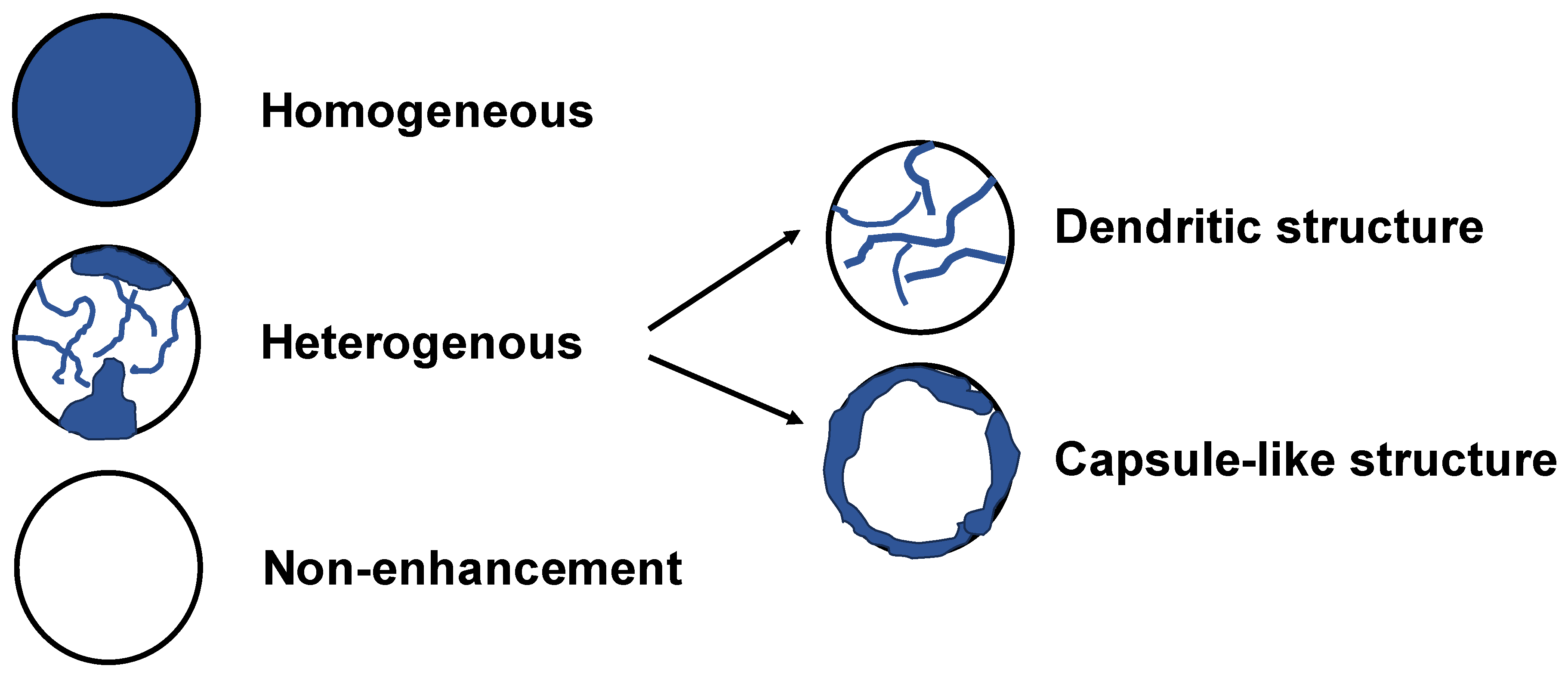
Two gastroenterologists evaluated all EUS images. Based on previous reports [7], the lesions were classified into contrast and vascular structure patterns. The enhancement patterns were classified as non-enhancement, hypo-enhancement, iso-enhancement, or hyper-enhancement compared to the surrounding pancreatic tissue (Figure 1). Vascular structure patterns were classified as non-enhancement, homogeneous enhancement and heterogeneous enhancement (Figure 2). Furthermore, heterogeneous enhancements were classified into dendritic and capsule-like structures in this study.

2.3. Endpoints

The primary endpoint of this study was the contrast-enhanced findings of hypervascular tumors on DFI-EUS and CH-EUS. The contrast enhancement patterns of lesions were evaluated using DFI-EUS and CH-EUS, and the results were compared for non-enhancement, hypo-enhancement, iso-enhancement, and hyper-enhancement. The secondary endpoints were contrast and vascular structural patterns on DFI-EUS and CH-EUS. The vascular structure patterns were investigated as non-enhancement, homogeneous enhancement or heterogeneous enhancement patterns. Heterogeneous enhancements were classified as having dendritic structures or capsule-like structures and evaluated. The detection rates of iso-enhancement and hyper-enhancement in DFI-EUS and CH-EUS were compared.

2.4. Statistical Analyses

Statistical analyses were performed using JMP Pro version 13 (SAS Institute Inc., Cary, NC, USA). Vascular detection by DFI-EUS and CH-EUS was compared using McNemar’s test. Statistical significance was set than 0.05 is statistically significant.

3. Results

Patient characteristics are shown in Table 1. Of the 13 patients included in this study, the median age was 72 (range: 30-80), and 4 cases (30.7%) were female. Ten (76.9%) had pancreatic neuroendocrine neoplasms (PNENs), one (7.6%) had a gastrointestinal neuroendocrine neoplasm (GINEN), one (7.6%) had a gastrointestinal stromal tumor (GIST), and one (7.6%) had a metastatic pancreatic tumor. The histological grade of malignancy for PNEN was Grade 1 in 7 cases and Grade 2 in 3 cases. PNEN was found in 8 cases of non-functional NEN and 2 cases of insulinoma. The histological grade of malignancy for GINEN was Grade 1 in 1 case. EUS-FNA was performed in all patients, leading to a pathological diagnosis. The median lesion size was 26.0 mm (range: 7-37 mm).
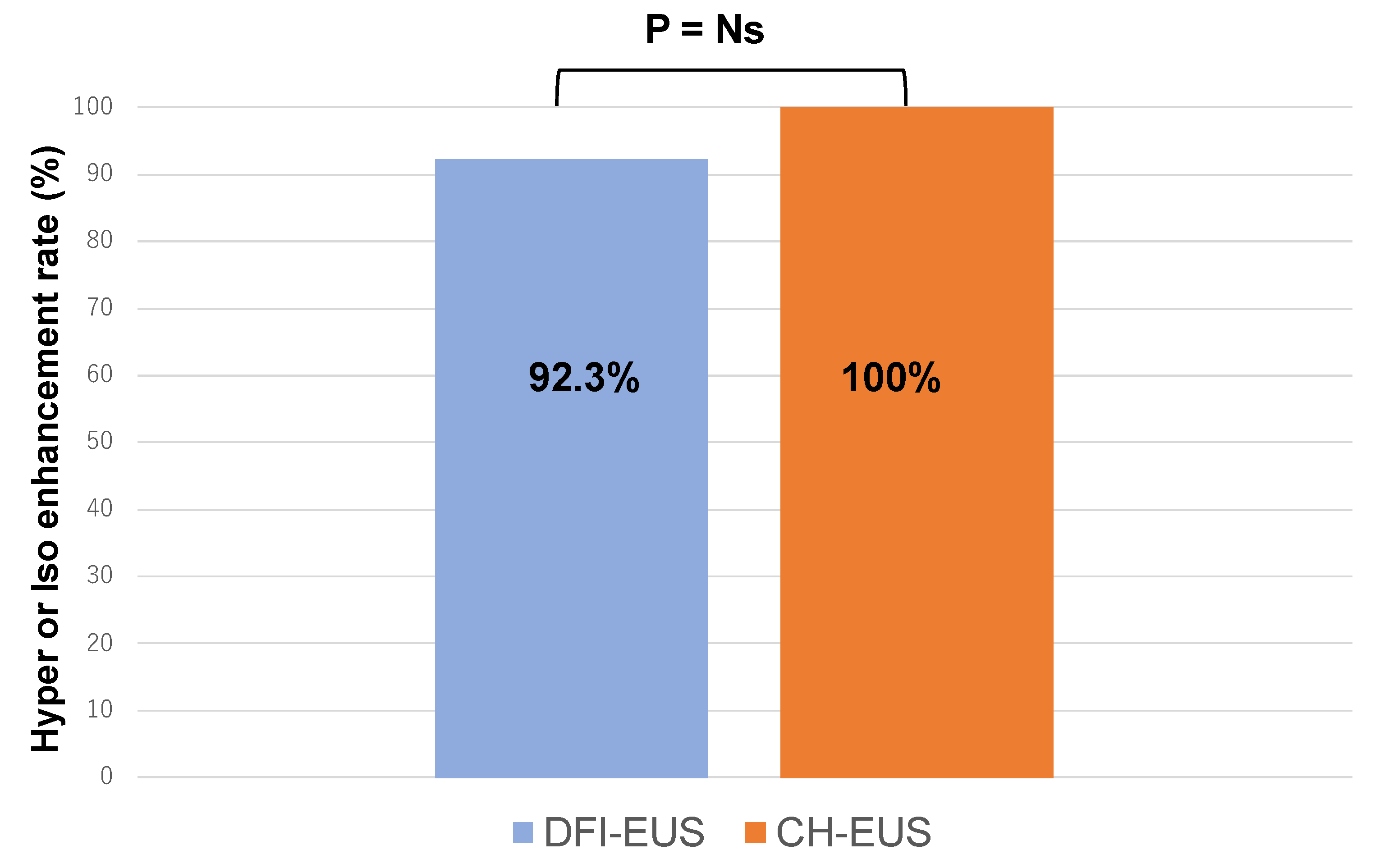
Table 2 shows the four enhancement patterns on DFI-EUS and CH-EUS. On DFI-EUS, 10 patients (76.9%) showed a hyper-enhancement pattern. These included seven patients with PNEN, one with GI-NEN, one with GIST, and one with a metastatic pancreatic tumor. Two patients (15.3%) showed iso-enhancement patterns, and on CH-EUS, 10 patients (76.9%) showed a hyper-enhancement pattern. The remaining three patients exhibited an iso-enhancement pattern. We also examined the ratio of iso-enhancement or hyper-enhancement in DFI-EUS and CH-EUS (Figure 3). The ratio of iso-enhancement or hyper-enhancement in DFI-EUS was 92.3%, and the ratio of iso-enhancement or hyper-enhancement in CH-EUS was 100%. There was no significant difference in the frequencies of hyper-enhancement and iso-enhancement amplification between DFI-EUS and CH-EUS (P = Ns).
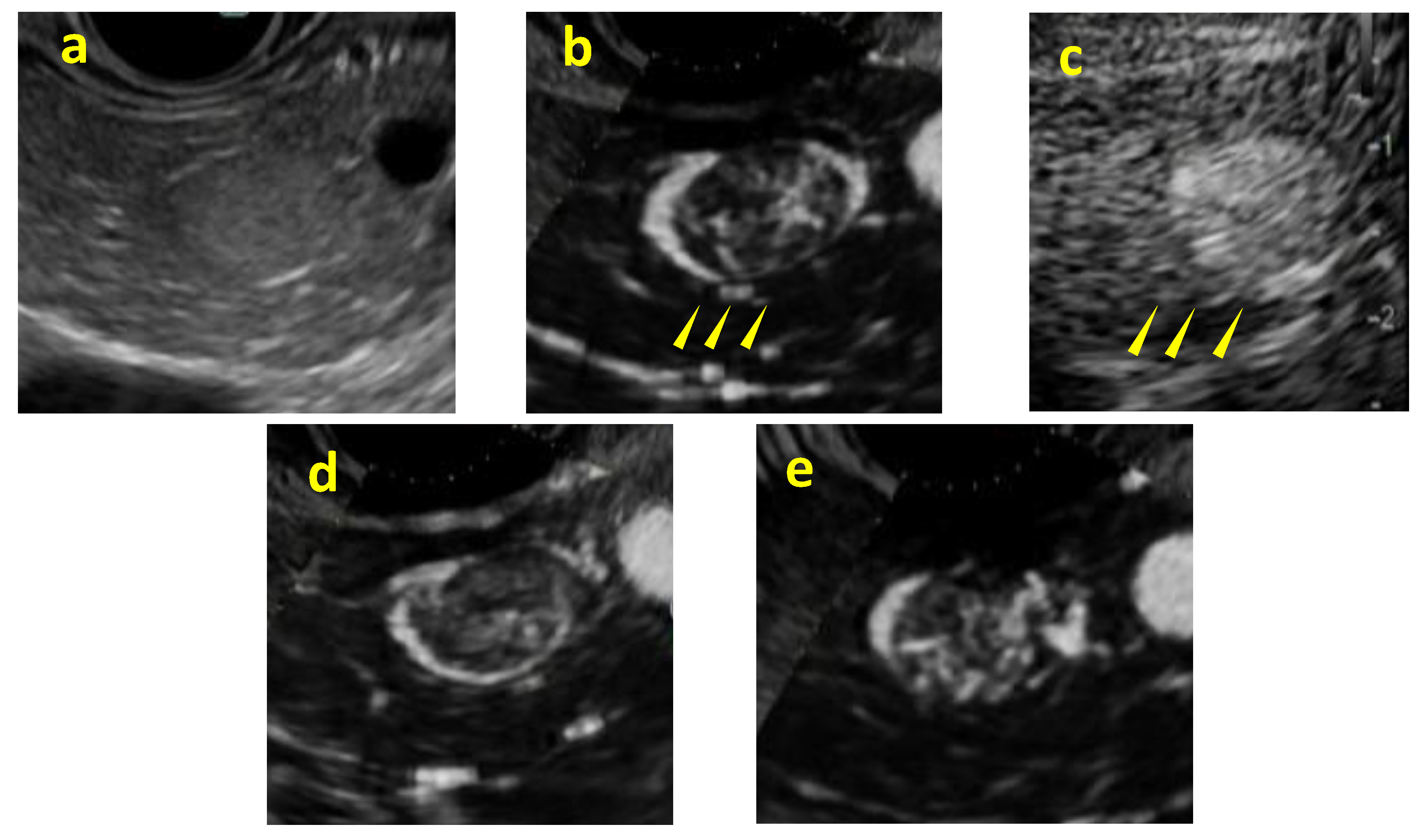
Table 3 shows the vascular structure patterns on the DFI-EUS and CH-EUS images. On DFI-EUS, 12 (92.3%) patients showed a heterogeneous enhancement pattern, and non-enhancement was observed in a patient with PNEN. A homogeneous enhancement pattern was observed in all patients who underwent CH-EUS. The number of patients who presented two vascular structures is shown among the 12 lesions that showed heterogeneous enhancement patterns on DFI-EUS. Dendritic structures were observed in 11 patients (91.6%), and capsule-like structures were observed in nine patients (75.0%), all of whom were observed to have capsule-like structures. In addition, one patient with PNEN and one with GI-NEN, who did not exhibit capsule-like structures, presented a dendritic structure. Figure 4 shows a specific example of the contrast effect in DFI-EUS.
Vascular pattern (%)
None Heterogeneous [dendritic structure / capsule-like structure] Homogeneous
DFI-EUS
CH-EUS
1 (7.7)
0 (0)
12 (92.3) [11 (91.6) / 9 (75.0)]
0 (0) [0 / 0]
0 (0)
13 (100)
DFI-EUS, Detective flow imaging endoscopic ultrasonography; CH-EUS, Contrast-enhanced harmonic endoscopic ultrasonography

4. Discussion

In this study, we investigated the detection of hypervascular tumor lesions in the abdominal cavity using DFI-EUS and CH-EUS. The ratio of iso-enhancement or hyper-enhancement in DFI-EUS was 92.3%, and the ratio of iso-enhancement or hyper-enhancement in CH-EUS was 100%. There was no significant difference in the frequencies of hyper-enhancement and iso-enhancement amplification between DFI-EUS and CH-EUS. This study found that DFI-EUS was able to detect hypervascular tumors to the same extent as CH-EUS. The hypervascular tumors in CH-EUS were homogeneous, but in DFI-EUS, they were heterogeneous displayed as hypervascular tumors. DFI-EUS revealed characteristic heterogeneous patterns of dendritic and capsular-like vascular structures. DFI-EUS has the potential to be used as a substitute for CH-EUS, as it can be used to evaluate tumors without contrast agents in hypervascular tumors such as NEN and GIST.
CH-EUS often causes homogeneity in hypervascular tumors [7]; however, in this study, CH-EUS produced a uniform contrast effect with similar results to DFI-EUS. However, the effect of DFI-EUS on microcirculation was heterogeneous, with no tumors showing homogeneous staining. In many patients, the tumors showed dendritic or capsule-like structures, which may be an important finding for DFI-EUS in hypervascular tumors. In a study that included all tumors, blood vessels exhibit linear or speckled patterns[16,17]. The finding of dendritic or capsule-like structures in a hyper vascular tumor is considered to be a new finding, as far as we have investigated. If a dendritic or capsule-like structure is strongly depicted, it may be useful for the diagnosis of hypervascular tumors.
Advances in multi-detector CT technology have enabled rapid optimization of scanning protocols, reduced motion artifacts, and accurate tracking of contrast boluses. This has enabled optimal scanning timing, superior arterial phase images, thinner slice image reconstruction, and improved image resolution [18]. In this study, tumors as small as 7 mm were able to be detected using DFI-EUS. Even in hypervascularized tumors, small tumors are difficult to detect. Small tumors, including pancreatic neuroendocrine tumors, often present difficulties in localization diagnosis [19]. Small tumors of 1 cm or less are often not detectable by CT. EUS has superior spatial resolution compared to CT, so it is possible to detect small tumors of around 5 mm cm or smaller, around 5 mm in size, can also be detected [20]. EUS can detect small tumors that cannot be detected by CT in real time, and if a small tumor is identified, DFI-EUS can be used for additional examination. Therefore, in addition to CH-EUS, DFI-EUS may also be useful for diagnosing small, hypervascularized tumors that are difficult to confirm using CT. Accurate lesion location and diagnosis are necessary before determining the surgical method. EUS is cost-effective if used early in the preoperative localization strategy, reducing the need for additional invasive examinations and avoiding unnecessary complications and resource consumption [21]. Therefore, EUS, which has the highest tumor detection rate, should be performed before treatment begins. However, EUS is more operator-dependent than CT. Therefore, EUS examinations before treatment for NEN and GIST should be performed by endoscopists with sufficient experience.
In this study, insulinomas are considered to be more difficult to detect using EUS and CT than non-functioning NENs [19,20]. In general, CT does not have optimal sensitivity for the diagnosis of small-sized PNENs. In particular, since most insulinomas are small-sized and low-grade tumors (over 6 mm to 1 cm) [22], the detection rate of insulinomas by CT is low (14-30%) [23,24]. Furthermore, some tumors are isoechoic with the pancreas, making them difficult to distinguish by EUS [25,26]. Factors associated with false-negative EUS results in insulinomas include female sex, young age, and low BMI [25]. The authors suggest that this may be due to the low contrast between the tumor and healthy pancreatic parenchyma. The pancreatic parenchyma has a low fat content, and in slim young women it often has a lower echo than normal. Cases that cannot be diagnosed by EUS and CT are diagnosed by selective arterial calcium injection. However, while selective arterial calcium injection can identify the location to some extent, it does not provide an accurate localization. In this study, two cases of insulinoma were included, and contrast effects were confirmed not only by CH-EUS but also by DFI-EUS. If DFI-EUS can be used to accurately diagnose insulinoma, which is difficult to localize, it may be useful for surgical treatment.
By pressing the switch on the ultrasound observation device, it is possible to display the DFI image on the screen, and there is no additional invasion to the patient by performing the examination. DFI-EUS does not require the administration of drugs or contrast media; therefore, the risk of adverse events is lower than that with CH-EUS. In the case of Sonazoid, there were a small number of adverse events, such as allergies. Another advantage of DFI-EUS is that it does not incur the cost of contrast media. Therefore, DFI-EUS has the advantage of not having the risk of adverse drug reactions or additional medical costs compared to CH-EUS.
CH-EUS also allows observation over a limited time and area, although changes in the contrast medium can be observed over time after administration. However, DFI-EUS does not use contrast agents, and it is possible to observe all areas that can be imaged using EUS in real time, as many times as necessary. For example, DFI-EUS can be used to observe all areas of the pancreas in pancreatic tumors, whereas CH-EUS can only be used to observe a fixed imaging site. This difference may be useful in patients with multiple PNENs. In cases where it is necessary to observe the entire area of the pancreas using contrast-enhanced ultrasound, DFI-EUS may be more useful.
The usefulness of micro-blood flow measurements using conventional transabdominal ultrasound has been reported in many studies [27,28,29,30]. Compared with superb microvascular imaging (SMI) using transabdominal ultrasound, DFI-EUS has several advantages. In particular, DFI-EUS has advantages in obese patients, where the depth of subcutaneous fat affects the clarity of the image, and in areas and organs that are difficult to visualize using transabdominal ultrasound, since it is difficult to perform microvascular imaging using this modality. In particular, DFI observation using EUS may be more useful than transabdominal observation for organs where an EUS can be inserted and observed, such as the esophagus, stomach, duodenum, pancreas, and biliary tract. DFI evaluation using EUS may also be useful for evaluating the kidneys, liver, and lower digestive tract, depending on the location of the lesion. Therefore, microvascular imaging using EUS may be superior to microvascular imaging using transabdominal ultrasound.
This study has several limitations that should be noted when interpreting our findings. First, this was a small, retrospective study conducted at a single institution. In the future, it would be desirable to conduct a prospective study with a larger and more diverse cohort of patients. Second, this study examined only hypervascular tumors; and therefore, future studies should examine hypovascular tumors, such as pancreatic cancer.
In conclusion, DFI-EUS and CH-EUS showed comparable iso-enhancement and hyper-enhancement patterns in hypervascular tumors. DFI-EUS revealed characteristic heterogeneous patterns of dendritic and capsular-like vascular structures. DFI-EUS has the potential to be used as a substitute for CH-EUS in hypervascular tumors because it can be used to evaluate tumors without contrast agents, such as NEN and GIST.

Author Contributions

For research articles with several authors, a short paragraph specifying their individual contributions must be provided. The following statements should be used “Conceptualization, methodology, validation, writing—original draft preparation, writing—review and editing, S.N. and Y.K ; investigation, resources, data curation, and supervision, Y.H, Y.Y, T.I, S.H, K.H, D.U, N.K, K.K, Y.I, I.E, A.N. All authors have read and agreed to the published version of the manuscript.

Funding

Please add: This research received no external funding

Institutional Review Board Statement

The study was conducted in accordance with the Declaration of Helsinki and approved by the Institutional Review Board of Yokohama City University Hospital (F231100001). In this retro-spective study, only medical data were used, and the privacy of the participants was upheld.

Informed Consent Statement

Not applicable.

Data Availability Statement

Correspondence and requests for materials should be addressed to Shinichi Nihei

Acknowledgments

I thank the Yokohama City University for providing the necessary resources.

Conflicts of Interest

The authors declare no conflicts of interest.

Abbreviations

CH-EUS contrast-enhanced endoscopic ultrasound
DFI-EUS detective flow imaging endoscopic ultrasound
EUS endoscopic ultrasound
EUS-FNA endoscopic ultrasound-guided fine needle aspiration
GINEN gastrointestinal neuroendocrine neoplasm
GIST gastrointestinal stromal tumor
PNENSMI pancreatic neuroendocrine neoplasmsuperb microvascular imaging

References

  1. Shah, M.H.; Goldner, W.S.; Halfdanarson, T.R.; Bergsland, E.; Berlin, J.D.; Halperin, D.; Chan, J.; Kulke, M.H.; Benson, A.B.; Blaszkowsky, L.S.; et al. NCCN Guidelines Insights: Neuroendocrine and Adrenal Tumors, Version 2.2018. J Natl Compr Canc Netw 2018, 16, 693-702. [CrossRef]
  2. Sawhney, M.S.; Debold, S.M.; Kratzke, R.A.; Lederle, F.A.; Nelson, D.B.; Kelly, R.F. Central intranodal blood vessel: a new EUS sign described in mediastinal lymph nodes. Gastrointest Endosc 2007, 65, 602-608. [CrossRef]
  3. Eloubeidi, M.A.; Wallace, M.B.; Reed, C.E.; Hadzijahic, N.; Lewin, D.N.; Van Velse, A.; Leveen, M.B.; Etemad, B.; Matsuda, K.; Patel, R.S.; et al. The utility of EUS and EUS-guided fine needle aspiration in detecting celiac lymph node metastasis in patients with esophageal cancer: a single-center experience. Gastrointest Endosc 2001, 54, 714-719. [CrossRef]
  4. Bhutani, M.S.; Hawes, R.H.; Hoffman, B.J. A comparison of the accuracy of echo features during endoscopic ultrasound (EUS) and EUS-guided fine-needle aspiration for diagnosis of malignant lymph node invasion. Gastrointest Endosc 1997, 45, 474-479. [CrossRef]
  5. Das, K.; Kudo, M.; Kitano, M.; Sakamoto, H.; Komaki, T.; Takagi, T.; Yamao, K. Diagnostic value of endoscopic ultrasound-guided directional eFLOW in solid pancreatic lesions. J Med Ultrason (2001) 2013, 40, 211-218. [CrossRef]
  6. Kobayashi, G.; Fujita, N.; Noda, Y.; Ito, K.; Horaguchi, J.; Koshida, S.; Kanno, Y.; Ogawa, T.; Masu, K.; Michikawa, Y. Vascular image in autoimmune pancreatitis by contrast-enhanced color-Doppler endoscopic ultrasonography: Comparison with pancreatic cancer. Endosc Ultrasound 2014, 3, S13.
  7. Xia, Y.; Kitano, M.; Kudo, M.; Imai, H.; Kamata, K.; Sakamoto, H.; Komaki, T. Characterization of intra-abdominal lesions of undetermined origin by contrast-enhanced harmonic EUS (with videos). Gastrointest Endosc 2010, 72, 637-642. [CrossRef]
  8. Yamashita, Y.; Kato, J.; Ueda, K.; Nakamura, Y.; Kawaji, Y.; Abe, H.; Nuta, J.; Tamura, T.; Itonaga, M.; Yoshida, T.; et al. Contrast-Enhanced Endoscopic Ultrasonography for Pancreatic Tumors. Biomed Res Int 2015, 2015, 491782. [CrossRef]
  9. Omoto, S.; Takenaka, M.; Kitano, M.; Miyata, T.; Kamata, K.; Minaga, K.; Arizumi, T.; Yamao, K.; Imai, H.; Sakamoto, H.; et al. Characterization of Pancreatic Tumors with Quantitative Perfusion Analysis in Contrast-Enhanced Harmonic Endoscopic Ultrasonography. Oncology 2017, 93 Suppl 1, 55-60. [CrossRef]
  10. Yamamoto, N.; Kato, H.; Tomoda, T.; Matsumoto, K.; Sakakihara, I.; Noma, Y.; Horiguchi, S.; Harada, R.; Tsutsumi, K.; Hori, K.; et al. Contrast-enhanced harmonic endoscopic ultrasonography with time-intensity curve analysis for intraductal papillary mucinous neoplasms of the pancreas. Endoscopy 2016, 48, 26-34. [CrossRef]
  11. Kamata, K.; Kitano, M.; Omoto, S.; Kadosaka, K.; Miyata, T.; Yamao, K.; Imai, H.; Sakamoto, H.; Harwani, Y.; Chikugo, T.; et al. Contrast-enhanced harmonic endoscopic ultrasonography for differential diagnosis of pancreatic cysts. Endoscopy 2016, 48, 35-41. [CrossRef]
  12. Fujita, M.; Itoi, T.; Ikeuchi, N.; Sofuni, A.; Tsuchiya, T.; Ishii, K.; Kamada, K.; Umeda, J.; Tanaka, R.; Tonozuka, R.; et al. Effectiveness of contrast-enhanced endoscopic ultrasound for detecting mural nodules in intraductal papillary mucinous neoplasm of the pancreas and for making therapeutic decisions. Endosc Ultrasound 2016, 5, 377-383. [CrossRef]
  13. Harima, H.; Kaino, S.; Shinoda, S.; Kawano, M.; Suenaga, S.; Sakaida, I. Differential diagnosis of benign and malignant branch duct intraductal papillary mucinous neoplasm using contrast-enhanced endoscopic ultrasonography. World J Gastroenterol 2015, 21, 6252-6260. [CrossRef]
  14. Yamashita, Y.; Yoshikawa, T.; Yamazaki, H.; Kawaji, Y.; Tamura, T.; Hatamaru, K.; Itonaga, M.; Ashida, R.; Ida, Y.; Maekita, T.; et al. A Novel Endoscopic Ultrasonography Imaging Technique for Depicting Microcirculation in Pancreatobiliary Lesions without the Need for Contrast-Enhancement: A Prospective Exploratory Study. Diagnostics (Basel) 2021, 11. [CrossRef]
  15. Nihei, S.; Kurita, Y.; Hasegawa, S.; Hosono, K.; Kobayashi, N.; Kubota, K.; Nakajima, A. Detective flow imaging endoscopic ultrasound for localizing pancreatic insulinomas that are undetectable with other imaging modalities. Endoscopy 2024, 56, E342-e343. [CrossRef]
  16. Miwa, H.; Sugimori, K.; Yonei, S.; Yoshimura, H.; Endo, K.; Oishi, R.; Funaoka, A.; Tsuchiya, H.; Kaneko, T.; Numata, K.; et al. Differential Diagnosis of Solid Pancreatic Lesions Using Detective Flow Imaging Endoscopic Ultrasonography. Diagnostics (Basel) 2024, 14. [CrossRef]
  17. Mulqui, M.V.; Caillol, F.; Ratone, J.P.; Hoibian, S.; Dahel, Y.; Meunier, É.; Archimbaud, C.; Giovannini, M. Detective flow imaging versus contrast-enhanced EUS in solid pancreatic lesions. Endosc Ultrasound 2024, 13, 248-252. [CrossRef]
  18. Rockall, A.G.; Reznek, R.H. Imaging of neuroendocrine tumours (CT/MR/US). Best Pract Res Clin Endocrinol Metab 2007, 21, 43-68. [CrossRef]
  19. Khashab, M.A.; Yong, E.; Lennon, A.M.; Shin, E.J.; Amateau, S.; Hruban, R.H.; Olino, K.; Giday, S.; Fishman, E.K.; Wolfgang, C.L.; et al. EUS is still superior to multidetector computerized tomography for detection of pancreatic neuroendocrine tumors. Gastrointest Endosc 2011, 73, 691-696. [CrossRef]
  20. Kurita, Y.; Hara, K.; Kobayashi, N.; Kuwahara, T.; Mizuno, N.; Okuno, N.; Haba, S.; Yagi, S.; Hasegawa, S.; Sato, T.; et al. Detection rate of endoscopic ultrasound and computed tomography in diagnosing pancreatic neuroendocrine neoplasms including small lesions: A multicenter study. J Hepatobiliary Pancreat Sci 2022, 29, 950-959. [CrossRef]
  21. Bansal, R.; Tierney, W.; Carpenter, S.; Thompson, N.; Scheiman, J.M. Cost effectiveness of EUS for preoperative localization of pancreatic endocrine tumors. Gastrointest Endosc 1999, 49, 19-25. [CrossRef]
  22. Akerström, G.; Hellman, P. Surgery on neuroendocrine tumours. Best Pract Res Clin Endocrinol Metab 2007, 21, 87-109. [CrossRef]
  23. Zimmer, T.; Stölzel, U.; Bäder, M.; Koppenhagen, K.; Hamm, B.; Buhr, H.; Riecken, E.O.; Wiedenmann, B. Endoscopic ultrasonography and somatostatin receptor scintigraphy in the preoperative localisation of insulinomas and gastrinomas. Gut 1996, 39, 562-568. [CrossRef]
  24. Ginès, A.; Vazquez-Sequeiros, E.; Soria, M.T.; Clain, J.E.; Wiersema, M.J. Usefulness of EUS-guided fine needle aspiration (EUS-FNA) in the diagnosis of functioning neuroendocrine tumors. Gastrointest Endosc 2002, 56, 291-296. [CrossRef]
  25. Kann, P.H.; Ivan, D.; Pfützner, A.; Forst, T.; Langer, P.; Schaefer, S. Preoperative diagnosis of insulinoma: low body mass index, young age, and female gender are associated with negative imaging by endoscopic ultrasound. Eur J Endocrinol 2007, 157, 209-213. [CrossRef]
  26. Patel, K.K.; Kim, M.K. Neuroendocrine tumors of the pancreas: endoscopic diagnosis. Curr Opin Gastroenterol 2008, 24, 638-642. [CrossRef]
  27. Lu, R.; Meng, Y.; Zhang, Y.; Zhao, W.; Wang, X.; Jin, M.; Guo, R. Superb microvascular imaging (SMI) compared with conventional ultrasound for evaluating thyroid nodules. BMC Med Imaging 2017, 17, 65. [CrossRef]
  28. Bakdik, S.; Arslan, S.; Oncu, F.; Durmaz, M.S.; Altunkeser, A.; Eryilmaz, M.A.; Unlu, Y. Effectiveness of Superb Microvascular Imaging for the differentiation of intraductal breast lesions. Med Ultrason 2018, 20, 306-312. [CrossRef]
  29. Mao, Y.; Mu, J.; Zhao, J.; Zhao, L.; Xin, X. The value of superb microvascular imaging in differentiating benign renal mass from malignant renal tumor: a retrospective study. Br J Radiol 2018, 91, 20170601. [CrossRef]
  30. Feng, J.; Lu, J.; Jin, C.; Chen, Y.; Chen, S.; Guo, G.; Gong, X. Diagnostic Value of Superb Microvascular Imaging in Differentiating Benign and Malignant Breast Tumors: A Systematic Review and Meta-Analysis. Diagnostics (Basel) 2022, 12. [CrossRef]
  31. Lee, S.; Lee, J.Y.; Yoon, R.G.; Kim, J.H.; Hong, H.S. The Value of Microvascular Imaging for Triaging Indeterminate Cervical Lymph Nodes in Patients with Papillary Thyroid Carcinoma. Cancers (Basel) 2020, 12. [CrossRef]
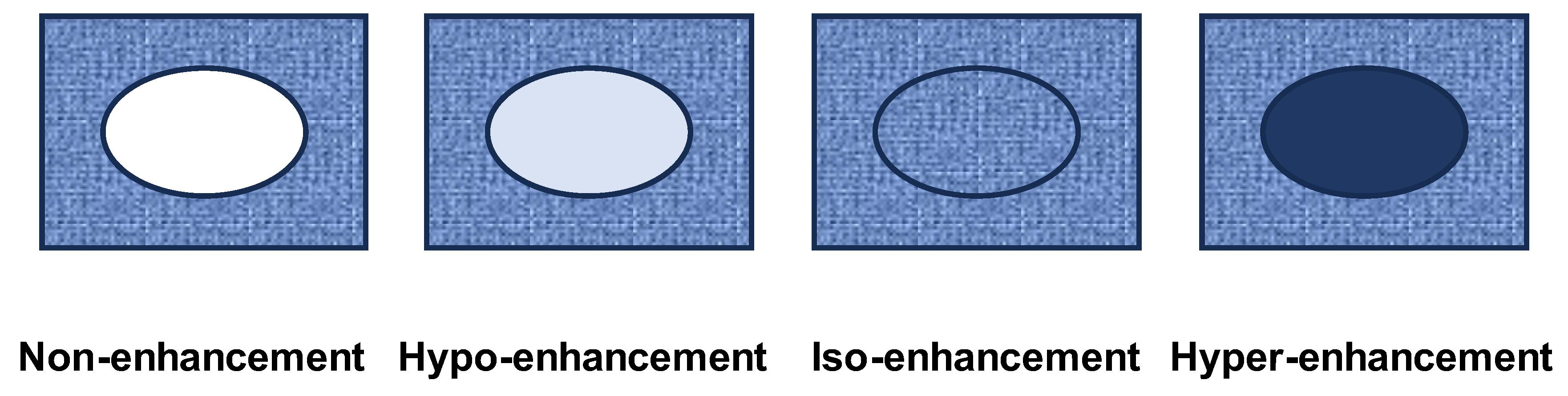
Figure 1. The lesions were classified into contrast and vascular structural patterns. The enhancement patterns were classified as non-enhancement, hypo-enhancement, iso-enhancement and hyper-enhancement, compared to the surrounding pancreatic tissue.
Preprints 147067 g001
Figure 2. The vascular structure patterns were classified as non-enhancement, homogeneous enhancement or heterogeneous enhancement patterns. Heterogeneous enhancements were classified as having dendritic structures or capsule-like structures.
Preprints 147067 g002
Figure 3. The rate of detection by iso-enhancement or hyper-enhancement in DFI-EUS and CH-EUS.
Preprints 147067 g003
Figure 4. A specific patient with a hypervascular pancreatic neuroendocrine neoplasm is shown. a: Plain EUS image. A hypoechoic-to-isoechoic tumor is depicted. b: DFI-EUS image. A strong contrast effect was observed in the surrounding capsules. A linear contrast effect was observed inside the tumor. c: CH-EUS image. A uniform contrast effect was seen. d: DFI-EUS image. A capsule-like structure was observed around the tumor. e: DFI-EUS image. A dendritic structure was observed inside the tumor.
Preprints 147067 g004
Table 1. Clinical characteristic.
Characteristic n= 13
Median age, years (range) 72 (30-80)
Sex, male (%) 4 (30.7)
Tumor size (mm) (%)
 Median (range)
    5-10 mm
    10-20 mm
    >20 mm

26.0 (7-37)
 3 (23.0)
 7 (53.8)
 3 (23.0)
Pathological diagnosis (%)
 PNEN
    (Grade1 / Grade2)
    (Non-function/ insulinoma)
 GINEN (Grade1, non-function)
 GIST
 Metastasis

10 (76.9)
 7 (53.8) / 3 (23.0)
 8 (61.5) / 2 (15.4pp)
1 (7.6)
1 (7.6)
1 (7.6)
GINEN, gastrointestinal neuroendocrine neoplasm; GIST, Gastrointestinal stromal tumor;. PNEN, pancreatic neuroendocrine neoplasm
Table 2. Number with enhancement pattern.
Enhancement pattern (%)
Non-enhancement Hypo-enhancement Iso-enhancement Hyper-enhancement
DFI-EUS
CH-EUS
1 (7.7)
0 (0)
0 (0)
0 (0)
2 (15.3)
3 (23.0)
10 (76.9)
10 (76.9)
DFI-EUS, Detective flow imaging endoscopic ultrasound; CH-EUS, Contrast-enhanced harmonic endoscopic ultrasonography
Table 3. Number with vascular pattern.
Vascular pattern (%)
None Heterogeneous [dendritic structure / capsule-like structure] Homogeneous
DFI-EUS
CH-EUS
1 (7.7)
0 (0)
12 (92.3) [11 (91.6) / 9 (75.0)]
0 (0) [0 / 0]
0 (0)
13 (100)
DFI-EUS, Detective flow imaging endoscopic ultrasonography; CH-EUS, Contrast-enhanced harmonic endoscopic ultrasonography
Disclaimer/Publisher’s Note: The statements, opinions and data contained in all publications are solely those of the individual author(s) and contributor(s) and not of MDPI and/or the editor(s). MDPI and/or the editor(s) disclaim responsibility for any injury to people or property resulting from any ideas, methods, instructions or products referred to in the content.
Copyright: This open access article is published under a Creative Commons CC BY 4.0 license, which permit the free download, distribution, and reuse, provided that the author and preprint are cited in any reuse.
Prerpints.org logo

Preprints.org is a free preprint server supported by MDPI in Basel, Switzerland.

Subscribe

Disclaimer

Terms of Use

Privacy Policy

Privacy Settings

© 2026 MDPI (Basel, Switzerland) unless otherwise stated