

Submitted:
21 January 2025
Posted:
22 January 2025
You are already at the latest version
Abstract
The existence of hotspot defects in photovoltaic (PV) modules significantly affects the energy generation efficiency and operational safety. Detecting PV arrays is essential for the rapid localization of hotspot defects. This study tackles the complexities of detecting PV array regions and diverse hotspot defects in infrared imaging, particularly under conditions of complex backgrounds, varied rotation angles, and the small scale of defects. To address these challenges, we propose a dual-branch detection network that integrates PV array detection with hotspot defect detection. The array branch employs a diffusion-based anchor-free mechanism with rotated bounding box regression, enabling robust detection of arrays with diverse rotational angles and irregular layouts. The defect branch incorporates a novel inside-awareness loss function designed to enhance the detection of small-scale objects. By explicitly modeling the dependency distribution between arrays and defects, this loss function effectively reduces false positives in hotspot detection. Experimental validation on a comprehensive PV dataset demonstrates that the proposed method outperforms baseline models in precision, recall, and mean average precision (mAP) metrics across various defect types and PV arrays.
Keywords:
1. Introduction
1.1. Related Works
1.2. Motivations and Novelties
1.2.1. Motivations
1.2.2. Novelties
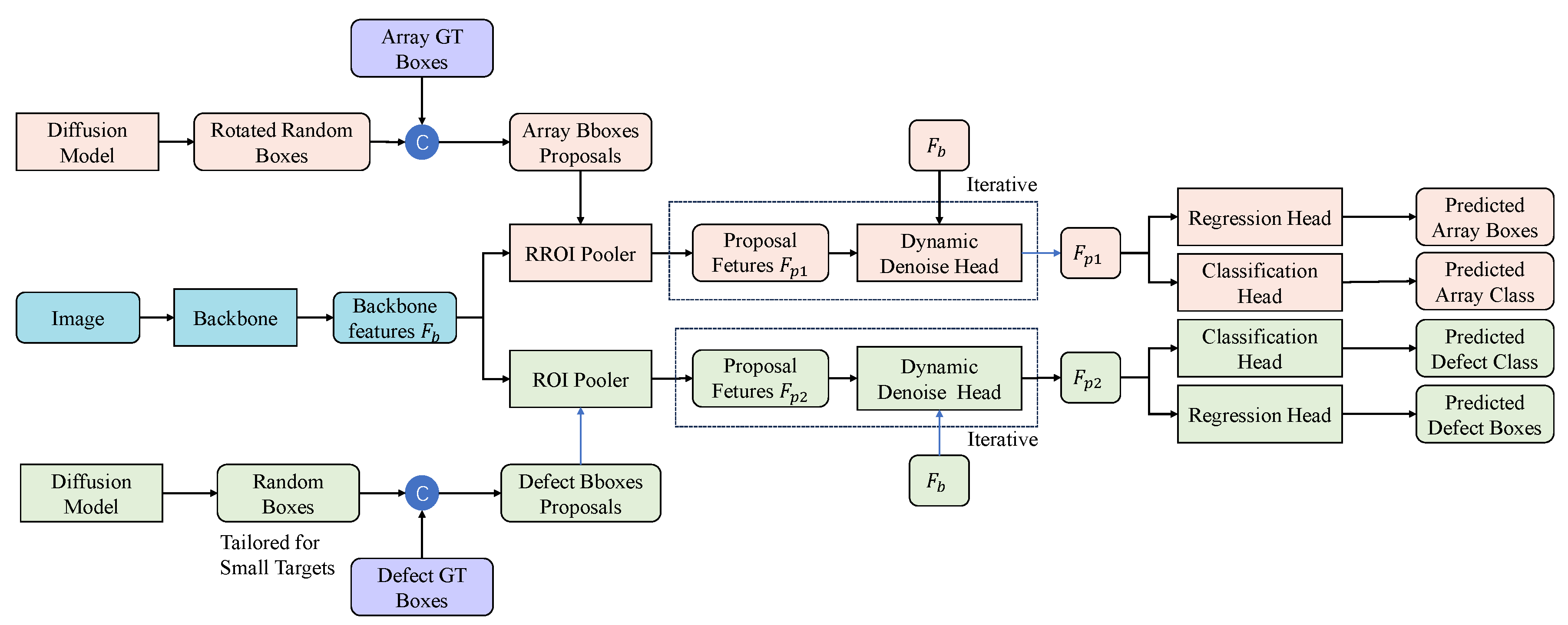
- A dual-branch detection network architecture is proposed. The proposed network includes two branches—one for PV arrays and the other for hotspot defects. The branches share low-level image features to model their correlations, while possess independent detection heads to learn high-level semantic features. This separable architecture enhances the flexibility of the network, alleviating the class imbalance and scale disparity issues between arrays and hotspots.
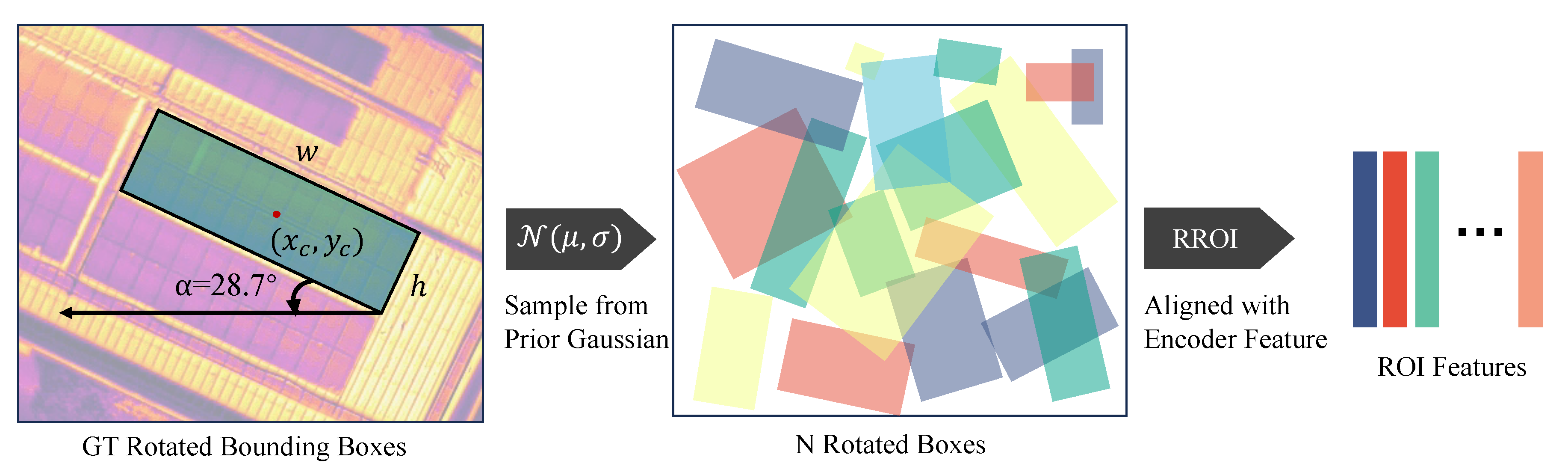
- A diffusion-based rotated bounding box detection branch is introduced for photovoltaic arrays, alongside a small-object detection branch for hotspot defects. The anchor-free nature of the diffusion-based approach improves sensitivity to rotation angles and adaptability to varying target scales.
- The inside-awareness loss function is developed for the dual-branch model to explicitly models the dependency distribution between arrays and defects. This loss function penalizes deviation in their internal and external relationships, guiding the model to learn bounding boxes for hotspot defects located within arrays. The inside-awareness loss comprises two components: Inside IoU and Union-over-Convex-Hull loss. These terms guide the model to generate bounding boxes with compact scales and consistent scale ratios. Experimental results demonstrate that this loss significantly enhances the robustness of the detection model.
2. Preliminaries
2.1. Diffusion Theory
2.2. Tailored Diffusion in Object Detection
3. Dual-Branch Photovoltaic Diagnose Network
3.1. Dual-Branch Architecture
3.2. The Array Branch
3.3. The Defect Branch
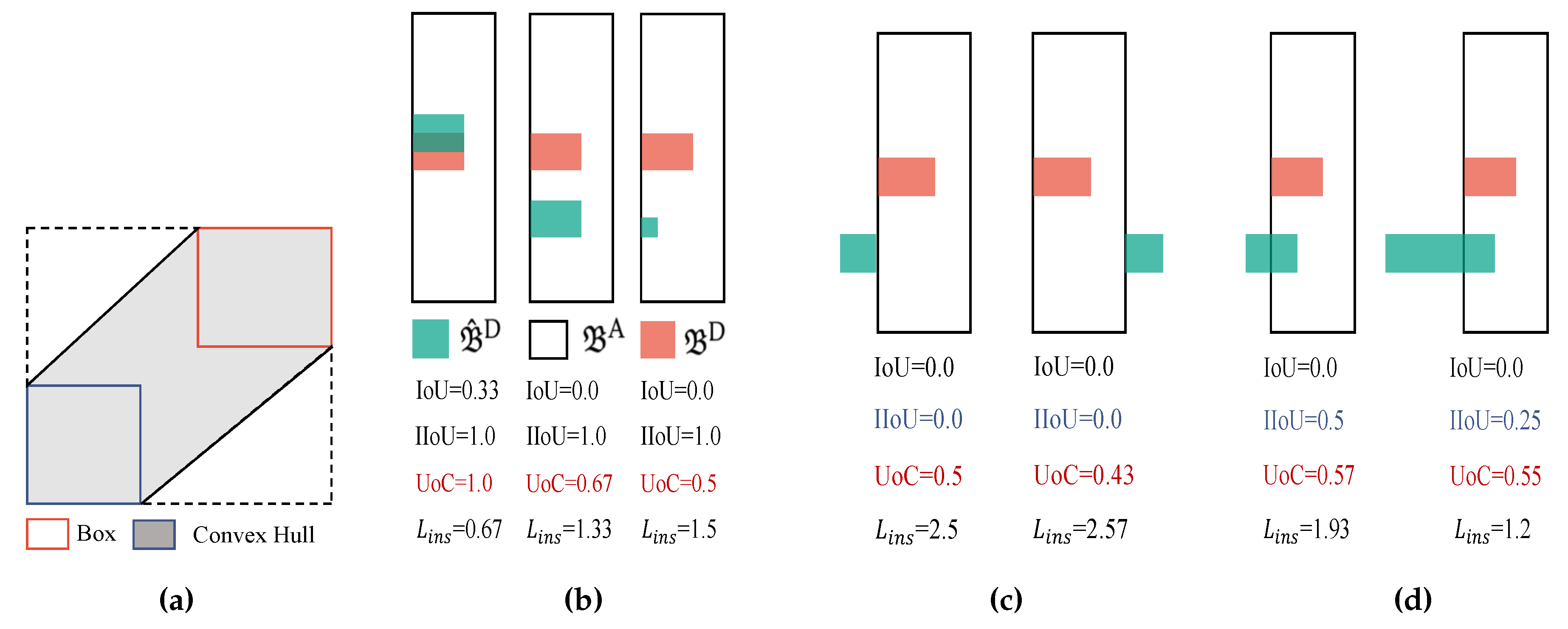
- Emphasizing internal inclusion. Unlike standard IoU, IIoU explicitly emphasizes whether is located inside , enhancing the model’s understanding of the internal layout of the bounding box.
- Focusing on small target boxes. By using as the denominator, IIoU inherently guides the model to prioritize learning small target boxes. This aligns with the nature of defect detection, where defects are generally small targets.
- Suppressing external expansion: UoC penalizes excessive outward expansion of the defect box, guiding the model to suppress such behavior. As shown in Figure 3b and Figure 3c, UoC decreases as the predicted box (green solid box) deviates farther from the ground truth (orange solid box). This, in turn, causes to increase, strengthening the penalization effect.
- Encouraging scale consistency: Leveraging the properties of the convex hull, UoC guides the model to predict boxes that are consistent in scale with the ground truth. For example, in Figure 3b, under the same outside position, the middle case whose with a scale matching () outperforms the right case with smaller predicted box (). Similarly, in Figure 3d, the left case with scale consistency () is preferred over the right case().
4. Experimental Results and Analysis
4.1. Experimental Settings
4.1.1. Dataset
4.1.2. Evaluation Metrics
4.1.3. Implementation Details
4.2. Qualitative Analysis
4.3. Quantitative Analysis
4.4. Comparative Analysis
4.4.1. Qualitative Comparison
4.4.2. Quantitative Comparison
5. Discussion
6. Conclusions
Author Contributions
Funding
Data Availability Statement
Acknowledgments
Conflicts of Interest
References
- Čabo, F.G.; Marinić-Kragić, I.; Garma, T.; Nižetić, S. Development of thermo-electrical model of photovoltaic panel under hot-spot conditions with experimental validation. Energy 2021, 230, 120785. [CrossRef]
- Du, B.; Yang, R.; He, Y.; Wang, F.; Huang, S. Nondestructive inspection, testing and evaluation for Si-based, thin film and multi-junction solar cells: An overview. Renewable and Sustainable Energy Reviews 2017, 78, 1117–1151. [CrossRef]
- Shengxue, T.; Yue, X.; Li, C.; Xiao, S.; Fang, Y. STUDY ON SUPPRESSING STRATEGY OF HOT SPOT IN SOLAR CELL SERIES. Acta Energiae Solaris Sinica 2022, 43, 226.
- Michail, A.; Livera, A.; Tziolis, G.; Candás, J.L.C.; Fernandez, A.; Yudego, E.A.; Martínez, D.F.; Antonopoulos, A.; Tripolitsiotis, A.; Partsinevelos, P.; et al. A comprehensive review of unmanned aerial vehicle-based approaches to support photovoltaic plant diagnosis. Heliyon 2024. [CrossRef]
- Lofstad-Lie, V.; Marstein, E.S.; Simonsen, A.; Skauli, T. Cost-Effective Flight Strategy for Aerial Thermography Inspection of Photovoltaic Power Plants. IEEE Journal of Photovoltaics 2022, 12, 1543–1549. [CrossRef]
- de Oliveira, A.K.V.; Aghaei, M.; Rüther, R. Automatic Inspection of Photovoltaic Power Plants Using Aerial Infrared Thermography: A Review. Energies 2022, 15. [CrossRef]
- Dotenco, S.; Dalsass, M.; Winkler, L.; Würzner, T.; Brabec, C.; Maier, A.; Gallwitz, F. Automatic detection and analysis of photovoltaic modules in aerial infrared imagery. In Proceedings of the 2016 IEEE Winter Conference on Applications of Computer Vision (WACV), 2016, pp. 1–9. [CrossRef]
- Jiang, L.; Su, J.; Li, X. Hot spots detection of operating PV arrays through IR thermal image using method based on curve fitting of gray histogram. In Proceedings of the Matec web of conferences. EDP Sciences, 2016, Vol. 61, p. 06017.
- Ren, S.; He, K.; Girshick, R.; Sun, J. Faster R-CNN: Towards Real-Time Object Detection with Region Proposal Networks. IEEE Transactions on Pattern Analysis and Machine Intelligence 2017, 39, 1137–1149. [CrossRef]
- Liu, W.; Anguelov, D.; Erhan, D.; Szegedy, C.; Reed, S.; Fu, C.Y.; Berg, A.C. SSD: Single Shot MultiBox Detector. In Proceedings of the Computer Vision – ECCV 2016; Leibe, B.; Matas, J.; Sebe, N.; Welling, M., Eds., Cham, 2016; pp. 21–37.
- Terven, J.; Córdova-Esparza, D.M.; Romero-González, J.A. A Comprehensive Review of YOLO Architectures in Computer Vision: From YOLOv1 to YOLOv8 and YOLO-NAS. Machine Learning and Knowledge Extraction 2023, 5, 1680–1716. [CrossRef]
- Jocher, G.; Stoken, A.; Borovec, J.; Changyu, L.; Hogan, A.; Diaconu, L.; Ingham, F.; Poznanski, J.; Fang, J.; Yu, L.; et al. ultralytics/yolov5: v3. 1-bug fixes and performance improvements. Zenodo 2020.
- Wu, X.; Hao, X. SK-FRCNN: A Fault Detection Method for Hot Spots on Photovoltaic Panels. IEEE Access 2023, 11, 121379–121386. [CrossRef]
- Hao, S.; Li, J.; Ma, X.; Sun, S.; Tian, Z.; Li, T.; Hou, Y. A Photovoltaic Hot-Spot Fault Detection Network for Aerial Images Based on Progressive Transfer Learning and Multiscale Feature Fusion. IEEE Transactions on Geoscience and Remote Sensing 2024, 62, 1–13. [CrossRef]
- Qian, H.; Shen, W.; Xu, W.S. Hotspot defect detection for photovoltaic modules under complex backgrounds. Multimedia systems 2023, 29, 3245–3258. [CrossRef]
- Lei, Y.; Wang, X.; Guan, A.H. Deeplab-YOLO: a method for detecting hot-spot defects in infrared image PV panels by combining segmentation and detection. Journal of Real-Time Image Processing 2024, 21, 52.1–52.11. [CrossRef]
- He, T.; Hao, S.; Zhang, X.; Ma, X.; Sun, S.; Yang, C. APM²Det: A Photovoltaic Hot-Spot Fault Detection Network Based on Angle Perception and Model Migration. IEEE Transactions on Dielectrics and Electrical Insulation 2024, 31, 2938–2946. [CrossRef]
- Wang, D.; Yan, P.; Yao, C.; Xiao, B.; Zhao, W.; Zhu, R. A lightweight joint metric detection approach on YOLO for hot spots in photovoltaic modules. Journal of Renewable and Sustainable Energy 2024, 16, 053503, [https://pubs.aip.org/aip/jrse/article-pdf/doi/10.1063/5.0232136/20217699/053503_1_5.0232136.pdf]. [CrossRef]
- Tan, H.; Guo, Z.; Zhang, H.; Chen, Q.; Lin, Z.; Chen, Y.; Yan, J. Enhancing PV panel segmentation in remote sensing images with constraint refinement modules. Applied Energy 2023, 350, 121757. [CrossRef]
- Guo, Z.; Zhuang, Z.; Tan, H.; Liu, Z.; Li, P.; Lin, Z.; Shang, W.L.; Zhang, H.; Yan, J. Accurate and generalizable photovoltaic panel segmentation using deep learning for imbalanced datasets. Renewable Energy 2023, 219, 119471. [CrossRef]
- Chen, S.; Sun, P.; Song, Y.; Luo, P. DiffusionDet: Diffusion Model for Object Detection. In Proceedings of the Proceedings of the IEEE/CVF International Conference on Computer Vision (ICCV), October 2023, pp. 19830–19843.
- Ho, J.; Jain, A.; Abbeel, P. Denoising Diffusion Probabilistic Models. In Proceedings of the Advances in Neural Information Processing Systems; Larochelle, H.; Ranzato, M.; Hadsell, R.; Balcan, M.; Lin, H., Eds. Curran Associates, Inc., 2020, Vol. 33, pp. 6840–6851.
- Song, J.; Meng, C.; Ermon, S. Denoising Diffusion Implicit Models, 2022, [arXiv:cs.LG/2010.02502].
- Rombach, R.; Blattmann, A.; Lorenz, D.; Esser, P.; Ommer, B. High-Resolution Image Synthesis With Latent Diffusion Models. In Proceedings of the Proceedings of the IEEE/CVF Conference on Computer Vision and Pattern Recognition (CVPR), June 2022, pp. 10684–10695.
- Karras, T.; Aittala, M.; Aila, T.; Laine, S. Elucidating the Design Space of Diffusion-Based Generative Models. In Proceedings of the Advances in Neural Information Processing Systems; Koyejo, S.; Mohamed, S.; Agarwal, A.; Belgrave, D.; Cho, K.; Oh, A., Eds. Curran Associates, Inc., 2022, Vol. 35, pp. 26565–26577.
- Ding, X.; Wang, Y.; Zhang, K.; Wang, Z.J. CCDM: Continuous Conditional Diffusion Models for Image Generation, 2024, [arXiv:cs.CV/2405.03546].
- Wyatt, J.; Leach, A.; Schmon, S.M.; Willcocks, C.G. AnoDDPM: Anomaly Detection With Denoising Diffusion Probabilistic Models Using Simplex Noise. In Proceedings of the Proceedings of the IEEE/CVF Conference on Computer Vision and Pattern Recognition (CVPR) Workshops, June 2022, pp. 650–656.
- Nag, S.; Zhu, X.; Deng, J.; Song, Y.Z.; Xiang, T. DiffTAD: Temporal Action Detection with Proposal Denoising Diffusion. In Proceedings of the Proceedings of the IEEE/CVF International Conference on Computer Vision (ICCV), October 2023, pp. 10362–10374.
- Shi, Y.; Lin, Y.; Wei, P.; Xian, X.; Chen, T.; Lin, L. Diff-Mosaic: Augmenting Realistic Representations in Infrared Small Target Detection via Diffusion Prior. IEEE Transactions on Geoscience and Remote Sensing 2024, 62, 1–11. [CrossRef]
- Zhou, X.; Hou, J.; Yao, T.; Liang, D.; Liu, Z.; Zou, Z.; Ye, X.; Cheng, J.; Bai, X. Diffusion-Based 3D Object Detection with Random Boxes. In Proceedings of the Pattern Recognition and Computer Vision; Liu, Q.; Wang, H.; Ma, Z.; Zheng, W.; Zha, H.; Chen, X.; Wang, L.; Ji, R., Eds., Singapore, 2024; pp. 28–40.
- Rezatofighi, H.; Tsoi, N.; Gwak, J.; Sadeghian, A.; Reid, I.; Savarese, S. Generalized Intersection Over Union: A Metric and a Loss for Bounding Box Regression. In Proceedings of the Proceedings of the IEEE/CVF Conference on Computer Vision and Pattern Recognition (CVPR), June 2019.
- Russell, B.C.; Torralba, A.; Murphy, K.P.; Freeman, W.T. LabelMe: A Database and Web-Based Tool for Image Annotation. International Journal of Computer Vision 2008, 77. [CrossRef]

| Category | Description | #Instances | Size | Rotation* |
|---|---|---|---|---|
| Line | Hotspot caused by PV module shielding, bubble, delamination, dirt, gate line fracture. | 2283 | Small target within or | - |
| Flocculant | Hotspot caused by PV module occlusion, dirt, rupture | 3310 | Small target within | - |
| Strip | Hotspot caused by PV module occlusion, dirt, diode failure, bracket deformation | 3377 | Small target within or | - |
| Facet | Hotspot caused by PV module fragmentation, module failure, module disconnected | 168 | Small target within or | - |
| Array | A complete power-generating unit, consisting of any number of PV modules and panels | 32960 | Rotated rectangles with various sizes |
| Categories | Precision@0.1 | Precision@0.5 | Recall@0.1 | Recall@0.5 | AP@0.1:0.5 | AP@0.5:0.9 |
|---|---|---|---|---|---|---|
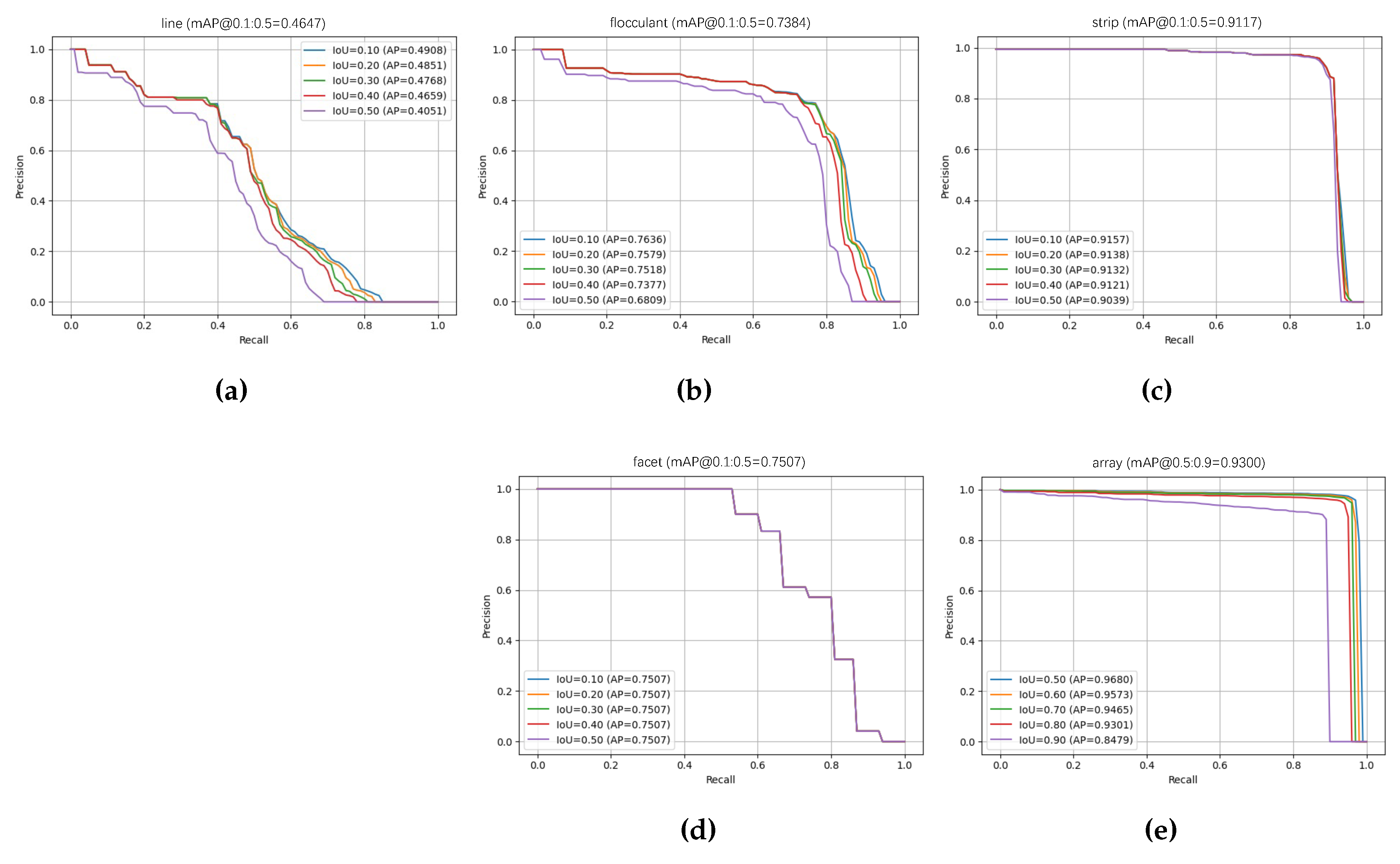
| Line Hotspot | 0.6091 | 0.5556 | 0.4900 | 0.4400 | 0.4647 | 0.1650 |
| Flo Hotspot | 0.7873 | 0.7302 | 0.7700 | 0.7200 | 0.7384 | 0.3697 |
| Strip Hotspot | 0.9219 | 0.9325 | 0.9000 | 0.8900 | 0.9117 | 0.5665 |
| Facet Hotspot | 0.8333 | 0.8333 | 0.6600 | 0.6600 | 0.7507 | 0.4930 |
| Average | 0.7879 | 0.7050 | 0.7629 | 0.6775 | 0.7164 | 0.3986 |
| PV Array | 0.9754 | 0.9671 | 0.9700 | 0.9600 | 0.9773 | 0.9300 |
| Categories | Models | AP@0.1:0.5 | AP@0.5:0.9 |
|---|---|---|---|
| Faster RCNN with RRPN | 0.1069 | 0.0114 | |
| Line Hotspot | DiffusionDet with RRPN | 0.3843 | 0.1242 |
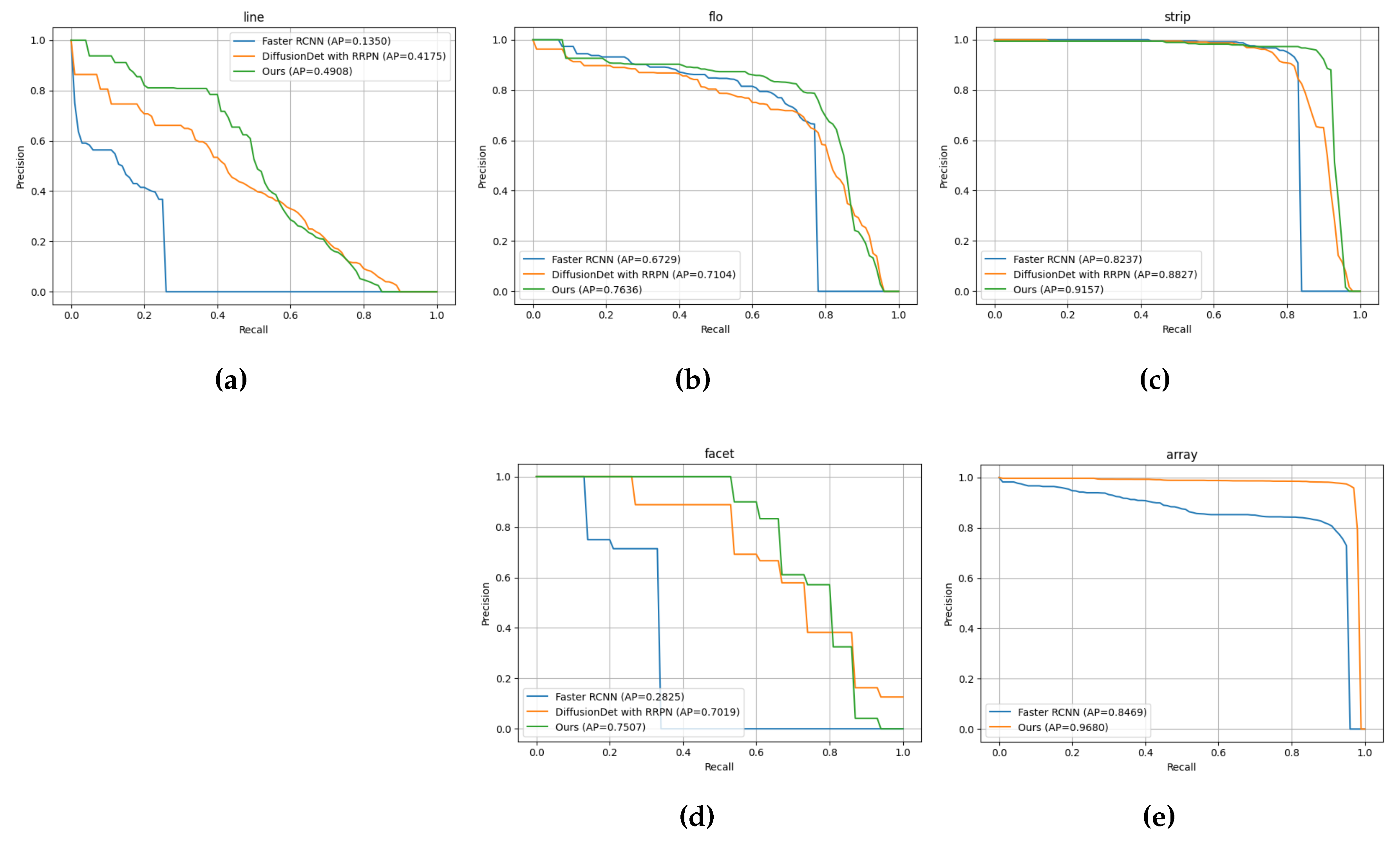
| Ours | 0.4647 | 0.1650 | |
| Faster RCNN with RRPN | 0.6456 | 0.3091 | |
| Flo Hotspot | DiffusionDet with RRPN | 0.6851 | 0.3336 |
| Ours | 0.7384 | 0.3697 | |
| Faster RCNN with RRPN | 0.8733 | 0.5360 | |
| Strip Hotspot | DiffusionDet with RRPN | 0.8120 | 0.4921 |
| Ours | 0.9117 | 0.5665 | |
| Faster RCNN with RRPN | 0.2825 | 0.1495 | |
| Facet Hotspot | DiffusionDet with RRPN | 0.6663 | 0.3365 |
| Ours | 0.7507 | 0.4930 | |
| Faster RCNN with RRPN | 0.4618 | 0.2402 | |
| Average | DiffusionDet with RRPN | 0.6523 | 0.3447 |
| Ours | 0.7164 | 0.3986 | |
| Faster RCNN with RRPN | 0.8581 | 0.7782 | |
| PV Array | DiffusionDet with RRPN | / | / |
| Ours | 0.9773 | 0.9300 |
| Models | Parameters (M) | Time (s) | FPS |
|---|---|---|---|
| Faster RCNN with RRPN | 85.817 | 0.0833 | 12 |
| DiffusionDet with RRPN | 70.0398 | 0.0513 | 19 |
| Ours | 111.8674 | 0.0571 | 18 |
Disclaimer/Publisher’s Note: The statements, opinions and data contained in all publications are solely those of the individual author(s) and contributor(s) and not of MDPI and/or the editor(s). MDPI and/or the editor(s) disclaim responsibility for any injury to people or property resulting from any ideas, methods, instructions or products referred to in the content. |
© 2025 by the authors. Licensee MDPI, Basel, Switzerland. This article is an open access article distributed under the terms and conditions of the Creative Commons Attribution (CC BY) license (http://creativecommons.org/licenses/by/4.0/).