

Submitted:
16 January 2025
Posted:
17 January 2025
You are already at the latest version
Abstract
The systematic redesign of business processes is a cornerstone for organizations seeking to optimize performance, reduce costs, and enhance adaptability in dynamic environments. This study conducts a systematic literature review (SLR) of 57 Business Process Redesign (BPR) methodologies, employing a rigorous eight-step process to assess their systematicity, generalizability, and core design principles. The analysis reveals that while most methodologies incorporate systematic and structured approaches, significant limitations exist in their flexibility and applicability across diverse industries and organizational contexts. Specifically, many methodologies lack the capacity to address varied business processes, multiple redesign objectives, and diverse modeling notations, thereby restricting their utility in practice. The findings highlight a critical gap in literature: the absence of methodologies that simultaneously ensure systematic rigor and broad generalizability. In response, this paper proposes a roadmap for developing integrated BPR frameworks that address these shortcomings. Such frameworks should balance structured, phase-based application with the flexibility to adapt to varied domains, objectives, and process complexities. The study also emphasizes the importance of integrating emerging technologies such as artificial intelligence and machine learning to enhance the effectiveness and innovation potential of BPR methodologies. This research provides valuable insights for practitioners seeking reliable and adaptable BPR frameworks and for scholars aiming to advance the theoretical foundation of the discipline. It calls for future research to prioritize empirical validation of proposed methodologies and to explore hybrid approaches that merge established frameworks with novel concepts. By bridging the gap between systematicity and versatility, this study contributes to the development of universally applicable BPR methodologies, equipping organizations to navigate the complexities of modern business landscapes.
Keywords:
Business Process Redesign
; Redesign Methodologies
; Literature Review
; Systematicity
; Generalizability
1. Introduction
As a comprehensive approach, Business process management (BPM) has emerged as a necessity for every organization that adopts the Business Process (BP) outlook [1], resulting to a variety of approaches inspired by other management disciplines [2,3]. BPM has also evolved as a critical discipline in the public sector, towards improving efficiency, effectiveness, and service delivery in an environment characterized by increasing demands, limited resources, and growing expectations from citizens and stakeholders. Thus, both public and private sector have a common far-reaching aim to accomplish through BPM, which is to organize and implement their BPs effectively, to complete them on time and within the specified resource constraints [4].
This viewpoint led to the emergence of Business Process Redesign (BPR), a discipline that stems from the need to be adaptable to the evolving organizational change by applying various techniques and approaches [5] for the process redesign, depending on the feedback of the process run-time, and/or the performance attributes [6]. The prospect of continuously modifying and improving the different operations within organizations, played a vital role in the adoption of BPs as a conceptual entity and is incorporated in the majority of BPM lifecycles (e.g. in [7,8]).
Despite the fact that the BP analysis provides ground for the conception of ideas and schemes for redesign, it is usually considered a creative activity and is administered in a disorganized and unsystematic way [9]. In this sense, parts of the wide-ranging spectrum of potential redesign options could be omitted, as in the majority of creative techniques [10]. Moreover, in the contemporary landscape, BPR is increasingly recognized as an activity that is tailored to the specific domain and industry context [11]. The application of BPR is in many cases constrained by the available methodologies and tools, which may not always align perfectly with the organization's particular objectives [12]. Therefore, while BPR aims to optimize operations and drive strategic goals, its execution is often influenced by the interplay of industry dynamics, organizational objectives, and the limitations of available methods [13].
To sum up, it is uncertain whether redesign approaches in literature are methodologically supported and applied in a systematic manner, towards reducing the uncertainty between the AS-IS to the TO-BE process [14]. Moreover, there is an unclear status regarding the capability of the proposed BPR methodologies in literature to be generalized, which is an important indication of potential reusability by similar practitioners. Towards reviewing literature and identifying the research gap, the remainder of the paper is structured as follows: the next section presents the proposed aim, and the adopted research methodology of this paper based on an eight-step methodology for conducting the Systematic Literature Review (SLR). Section 3 presents the literature review results and the selected papers, while Section 4 and Section 5 provide the synthesis of information regarding the systematicity and generalizability of the approaches. In Section 6 the authors present a roadmap for systematic and generalizable methods and Section 7, a discussion on the research findings and further research opportunities and the conclusions on the research work conducted.
2. Research Aim & Methodology
The aim of this work is to investigate the existing BPR methodologies in literature, identify which of them apply BPR in a systematic manner, analyze their degree of generalizability, and explore the key elements necessary to design methodologies that ensure both systematic application and broad generalizability. This aims to give prominence to a potential research gap related to systematic, reusable, and broadly applicable BPR methodologies. The specific research questions (RQs) -that this work seeks to address- are the following:
RQ1:
Do BPR methodologies generally describe a systematic set of methods and principles for process redesign? Are these methodologies themselves developed through systematic approaches?
RQ2:
Are the identified BPR methodologies generalizable across diverse industries, contexts, and process types, and to what extent do they fulfill the criteria for broad applicability?
RQ3:
How should a BPR methodology be designed to ensure both systematic application and broad generalizability across different contexts?
To answer RQ1 and RQ2 the authors conducted an SLR on BPR application frameworks and methodologies. According to Fink [15] a SLR is “a systematic, explicit, and reproducible method for identifying, evaluating, and synthesizing the existing body of completed and recorded work produced by researchers, scholars, and practitioners”. An SLR present a solid evaluation of a research topic by using a valid and meticulous methodology that can be reproduced [16]. In literature there is a plethora of guides to conducting SLRs in different research fields.
This research refers to the methodology proposed by Okoli and Schabram [17], that emphasizes on SLRs conducted within the Information Systems (IS) domain. Even though the latter includes a broad range of domains and issues of generalization may emerge, the authors consider it also suitable to get a credible evaluation of the research works under the topic of BPR. According to Okoli and Schabram [17], conducting a SLR is based on eight steps that are included in four consecutive phases: Planning, Selection, Extraction and Execution. Figure 1 presents the eight-step guide, and each step is elaborated for this research.
In the Planning phase, a protocol was necessary to be developed in advance of conducting the study to describe the review and detail the specific steps and procedures to be followed [18]. Initially the authors introduced RQ1 and RQ2 and determined the following review details:
- The sources and search strings for searching literature.
- The practical screen criteria (content, language, year range, etc).
- The quality appraisal criteria (methodological quality, argumentation analysis).
- The data extraction method for storing details of the final list of articles.
- The method for the analysis of findings.
- The process of writing the SLR, using the synthesis of extracted information.
In the Selection phase, the strategy employed is to find as many scientific publications as possible and, subsequently, narrow down the results by applying predefined criteria. The authors initially provide a set of search strings for RQ1 and RQ2 and then present the selected search sources that were employed to conduct the search. The main search string is:
(“business process" AND ("redesign framework” OR “improvement framework” OR “optimization framework” OR "redesign methodology" OR "improvement methodology" OR "optimization methodology") ~systematic)
Table 1 presents the databases that were considered in the SLR search strategy. After searching through the literature, the authors retrieved large sets of related research works. Most of these studies seem to be irrelevant to the corresponding research question, a fact that led to the introduction of clearly defined practical screening criteria (Table 2) to narrow down the list of papers to a more manageable and related subset:
In the extraction phase, the authors examine the eligible studies more closely to characterize them according to the extent to which they meet basic standards of quality. The quality appraisal criteria are presented in Table 3.
The extraction of the final list of studies was performed by excluding duplicate ones and orderly applying the inclusion criteria of the practical screening and quality appraisal sub-phases. At this point, critical information was systematically extracted from each paper to serve as the raw material for the synthesis stage.
The execution phase involves combining the extracted data to produce knowledge out of a large number of studies through a polished synthesis of information and writing the review. In this research the synthesized studies are qualitative and the synthesis stage follows the methodology proposed by Webster and Watson [19]. Thus, the synthesis has a clear concept-centric focus, the extracted information is effectively mapped to optimally evaluate the data, and they are incorporated within the theory of the authors’ review. The process of conducting the SLR has been intricately documented for it to be reproducible by other researchers. Lastly, the review concludes by highlighting the findings that indicate a research gap in literature for artefacts pertaining to the defined RQs.
3. SLR Basics
Towards answering RQ1 and RQ2, the authors conducted searches on the literature databases and narrowed down the results based on the defined selection and quality appraisal criteria. The results are presented in detail.
3.1. Practical Screening
For the review to be as comprehensive as possible and given the fact that the search engines and capabilities are different in each database source, the search strings were personalized to produce as many relevant results as possible (Table 4). Apart from the different search strings, the authors further selected to include the term “business process” to eliminate studies related to software process optimization. Regarding the ACM Digital Library database, the authors excluded the term "Software process" reducing the resulting studies from 262 to 221 and from 104 to 85, respectively.
As a result of the initial search the authors retrieved 9,168 papers. Consequently, the inclusion criteria IC-A1, IC-P1, IC-P2, IC-P3 were applied, and 521 studies were good candidates for the next round of reviews. Regarding the criterion IC-C1 the authors identified the relevant studies by reading the title and abstract of the retrieved papers. To determine the relevancy of each paper, the title and abstract should indicate that the study introduces or applies an artefact, methodology or set of activities, for applying BPR or related disciplines to BPs. This process and the exclusion of duplicate papers resulted in 107 studies.
3.2. Quality Appraisal
In this review step, the quality appraisal criteria IC-A2, IC-M and IC-P4 are applied. The authors included studies that (a) propose an artefact for BPR, (b) the artefact is based on a clearly defined methodology, and (c) the proposed artefact is the primary approach. The final numbers of included studies after each criterion are presented in Table 5.
Initially, the authors applied the IC-A2 criterion by reviewing each of the 107 studies. This step resulted in excluding twenty-four studies as in these cases an artefact or concrete methodology was not introduced or applied. The data set of eighty-three studies is presented in detail in the Appendix, where in section 1 each study is enumerated, and basic information (year of publication, authors, title, and source) is presented. In section 2, further demographic statistics are presented pertaining to the year of publication, number of publications per author, type, outlet, and discipline. What is evident is that there has been a fluctuation in the number of publications related to BPR artefacts between 2000 and 2022. A steady increase on the research topic can be observed after 2004 and a substantial increase is evident in the years 2009 and 2011. In the following years (2012 to 2018) there is an increasing rate of published papers, until 2019 where one can observe a decreasing rate for the last three years (2019 to 2021). Moreover, Kostas Vergidis and Hajo A. Reijers are the authors most frequently introducing BPR artefacts (eight and seven studies respectively). The publication type is most frequently in scientific journals (57%) and the publication outlet that most frequently appeared is the Business Process Management Journal (twelve studies). Lastly, the analysis of publications per discipline resulted in BP improvement (thirty-one) as the most frequent discipline and BP reengineering (eleven) as the least one, which is nowadays considered obsolete due to its extended level of change.
The next quality appraisal criterion (IC-M) involved further reviewing the studies to exclude the ones that are not based on a concrete methodology, either pre-existing in literature or new. This analysis resulted in excluding the studies numbered 9, 25, 33 and 34. It is important to mention that since each of the eighty-three studies was meticulously reviewed, the authors also excluded eleven more artefacts from the initial set of eighty-three studies (i.e., the studies in papers 5, 31, 35, 39, 43, 50, 54, 60, 72, 77 and 82), since they proved irrelevant to the RQs. This fact resulted after a thorough study of the papers and is contrary to the initial relevance that the authors concluded after studying their title and abstract for the IC-C1 criterion. The last quality appraisal criterion (IC-P4) involved examining whether the implemented artefact in each study is the primary approach in literature, or it is reused in studies of the list. This analysis resulted in excluding papers 7, 16, 30, 59, 14, 33, 44, 57, 68, 38, 56, 58, 67, 73 and 74 since they reuse the previously introduced artefacts in papers 6, 10, 13, 37, 52, 53 and 62.
The final list following practical screening and quality appraisal includes fifty-seven studies that propose primary artefacts for BPR and are methodologically sound, i.e., they are based on a pre-existing or new methodology. The fifty-seven studies were stored using Zotero software and in .pdf format for data extraction and further study. Table 6 presents an enumeration of each artefact, the reference, the artefact title or brief description and the type of BPC they pertain to.
4. Identification of Systematic BPR Methodologies
This section examines whether each of the fifty-seven identified artefacts can be considered systematic and to which extent. Initially, the authors define the word systematic and then examine whether each of the identified methodologies falls under the definition and thus considered systematic. According to Merriam-Webster [75] systematic is defined as “relating to or consisting of a system”. As a concept, the term ‘system’ is defined in a multitude of IEEE standards and glossaries depending on the context. The authors reviewed twenty-nine definitions in IEEE Xplore and opted for two definitions that are considered relevant to this research:
- According to the IEEE Std 1362-1998 [76], a system is defined as “a collection of interacting components organized to accomplish a specific function or set of functions within a specific environment”.
- According to the IEEE Std 1232-2002 [77], a system is defined as “a collection of interacting, interrelated, or interdependent elements forming a collective, functioning entity”.
Based on the above, we consider a BPR application artefact as systematic, when it consists of interacting, interrelated, or interdependent components explicitly organized to accomplish process redesign within a specific environment. A systematic business process redesign methodology ensures consistency, efficiency, and effectiveness in identifying, analyzing, and implementing improvements. It provides a structured approach to tackling complex challenges, minimizes errors, and facilitates clear communication among stakeholders. Ultimately, it helps businesses achieve their goals with precision and clarity.
The review process described in section 3 showed that in most cases (thirty-three out of fifty-seven), researchers propose new BPR methodologies instead of adopting existing ones. The remaining twenty-four artefacts have adopted established process redesign methodologies. Four of them (AP MDs 27, 55, 56 and 57) adopt the established design science methodology, introduced in [78], while AP MDs 6, and 23 both adopt the Analytical Hierarchy Process (AHP) [79]. The AP MDs 8 and 24 adopt the Model-Based and Integrated Process Improvement (MIPI) methodology in [80], while the AP MD 5 is a synthesis of the WCA framework [81], the MOBILE workflow model [82], the CIMOSA enterprise modeling views [83] and the process description classes of [84]. AP MD 10 adopts the Capability Maturity Model Integration (CMMI) [85], AP MD 12 is grounded on Karl Popper’s theory of knowledge as extended by Critical Scientific Realism [86] and AP MD 15 adopts the weak point analysis and improvement model (WABPI), based on [87]. AP MD 22 is an adaptation of the methodology in [88], AP MD 33 adopts the objectives-based process redesign [45], and AP MD 30 inherits from the stage-activity framework for BP reengineering introduced in [89].
AP MD 37 is aligned with the basic requirements described in [90] and applies process improvement patterns (PIPs) that constitute goal-bound artificial constructs in the sense of the design science paradigm [91]. AP MD 39 combines different methodologies for a particular intervention into a single BPR structure, based on [92]. AP MD 44 has been derived using the PattCaR method [93] and alternatives are typically identified and modelled through brainstorming and creativity-boosting techniques based on process design principles [94]. AP MD 46 is framed within the concept of KIE developed in [95], while AP MD 50 combines the features of the MOEA framework [96] for multi-objective optimization meta-heuristics with the RMOABC algorithm presented in [97]. AP MD 51 is based on the four-layer methodology proposed in [98], and AP MD 53 is the integration of data-driven process reengineering (DDPR) and process interdependence algorithm (PIA) [99,100]. Lastly AP MD 54 adopts the BPTrends process redesign methodology introduced in [101].
Table 7 presents the phases of each BPR methodology and our assessment of whether it is considered systematic. What is evident is that most of the identified approaches (fifty-two of fifty-seven) are considered as systematic towards applying BPR. They are comprised of phases that are interconnected and form an entity (i.e. artefact) for applying BPR. This can be attributed to the SLR methodology that filtered artefacts with a concrete methodology (IC-A2 and IC-M criteria of quality appraisal).
In five out of fifty-seven cases the artefacts appeared to be non-systematic. In more detail, the AP MD 9 describes a methodology for applying redesign best practices in call center processes. The artefact is not visualized and the interrelation between the phases is not adequately described, hence it is not considered systematic in nature. The AP MD 22 does not convey the BPO phases in a concrete manner, and what is primarily highlighted is the connection between process optimization, automation, and integration. Samaranayake [41] separates the basic optimization functions from the additional functions: e.g., finite loading of resources, forward planning, and simultaneous planning. This lack of connection between the elements within the optimization phase renders the approach as non-systematic regarding BPR application. The AP MD 25 is comprised of a set of coordinated knowledge-management processes, following the analysis, modeling, and optimization phases. The artefact is not considered systematic since a clear interrelation between the phases is missing. The AP MD 34 presents a BPR method that investigates both qualitative and quantitative aspect of BPR strategy. The interaction between the different steps to be followed is not clearly defined. In AP MD 42, the model for selecting BP Improvement (BPI) methodology is comprised of four selection criteria, which are not interrelated with each other: (a) Companies attitude toward change, (b) Process Performance, (c) Process Characteristics and IT, (d) Impact of Stakeholders. This entails that these constructs are not consequent or dependent elements, and the artefact is not considered systematic.
In summary, the analysis reveals that while most BPR methodologies are systematic in nature, significant variation exists in their adherence to established principles and consistency across applications, addressing RQ1 in broad terms.
5. Examination of Generalizability
A generalizable business process redesign methodology ensures that it can be adapted to various industries, contexts, and organizational structures, making it applicable across different scenarios. This versatility enhances its effectiveness and relevance, enabling businesses to address diverse challenges and opportunities with greater agility and efficiency. Also, a generalizable BPR methodology can provide a standard placeholder and benchmark for existing and new approaches. We propose the following five queries for identifying the degree of generalizability of a BPR methodology:
Domain: Can it be applied to generic or only domain-specific business processes?
- 7.
- Type: Does it implement different Business Process Change (BPC) types (e.g. BPR, BPI, BPO) or focuses on particular ones?
- 8.
- Notation: Is it applicable to various process modelling notations or limited to a specific/custom representation method?
- 9.
- Objectives: Is there versatility and flexibility in the definition of improvement / optimisation objectives? Are they predefined or can they be customized?
- 10.
- Heuristics: Are different redesign heuristics considered?
The authors focused on critical redesign components and the analysis aims to draw a conclusion on whether the artefacts can be used in a more general context to a broad range of scenarios. Table 8 presents critical for the redesign information regarding the generalizability of each artefact. Nine methodologies focus on specific BP models to serve as artefact inputs. AP MDs 1 and 2 focus on Industry (Manufacturing) BPs, AP MD 4 on certain industry clusters, AP MD 7 on BPs from the Health Care and AP MD 9 on call center BPs. AP MD 16 focuses on BPs of Small & Medium Enterprises (SMEs), AP MD 39 on Supply Chain, AP MD 40 on transport company BPs and AP MD 48 on web services. Hence, it is questionable whether the methodologies can be generalized and be applied to BPs from other domains.
The second criterion to be considered is whether each artefact supports the application of different BPC types. What is evident is that for most studies, the assessment artefacts were implemented for a particular BPC type. In the AP MDs 4, 14, 17, 26, 42 and 55 the application of different BPR methods is either explicitly or implicitly supported. Specifically, the AP MD 4 supports BP Reengineering or BPI methods, while AP MD 14 regards BP Reengineering in the broader context, encompassing the process management structural concept that includes process redesign, improvement, etc. AP MD 17 provides the capability of selecting the appropriate tools and BPI approaches (from gradual and continuous to drastic and discrete improvement) for achieving the specified goals and desired outcomes. In AP MD 26 the redesign team performs brainstorming and considers different innovative options of BPR (like TRIZ) for selecting and implementing in the framework. The AP MD 42 proposes a model for selecting different BPI methodology (Reengineering, Redesign or Continuous Process Improvement), while in AP MD 55 the BPI methods to select from are Lean, Six Sigma and the duplicate systems. It is important to mention that in some cases, different BPC disciplines are used interchangeably to denote the same type of change, and the capability of these methodologies is nonfactual. For instance, in AP MD 17 the BPI methods to select vary significantly from what is considered in literature, while in AP MDs 14 and 42 BP Reengineering and BPI respectively are also regarded differently.
The third criterion refers to the capability of each artefact to use input models in different process model notations. In most cases (fifty-five out of fifty-seven), there is no discussion related to the selection of varying model types for the candidate input models. In the AP MD 25 the implemented methodology has the initial objective of developing an “as-is” model in the modeling phase, which implicitly denotes that varying notation can be applied. Similarly, in the AP MD 44 the “Design to-be situation” stage in the redesign phase involves developing process design alternatives based on process design principles. The alternatives are typically identified and modelled through brainstorming and creativity-boosting techniques [62], using fitting – in each case – notation. In both cases the capability of the practitioner to select different modeling notations is implicitly stated and further demonstration of each methodology should be presented to prove this practical implication.
The next generalizability criterion examines whether the artefacts explicitly support the selection of different improvement objectives. The eighteen out of fifty-seven artefacts (AP MDs 5, 6, 8, 9, 13, 19, 21, 23, 26, 29, 32, 33, 34, 39, 42, 44, 45 and 56) focus on the improvement of different objectives. The artefacts are differentiated based on their scope, forming two categories: (a) one that refers to more applied disciplines where the objectives are specific and mostly focus on process performance, and (b) one that refers to management-oriented disciplines like TQM, Six Sigma and CPI and the objectives are defined at a strategic level, e.g., through constructive discussion and benchmark analysis, being more qualitative in nature. Following the authors conduct the analysis of the artefacts in each category, for the fourth criterion.
Regarding the first category, the AP MDs 5, 6, 23, 29, 34, provide the capability of selecting among the performance objectives of time, cost, quality and flexibility [102]. The AP MD 9 includes the definition of the following performance characteristics to be selected in the artefact: (a) Service level, i.e., the number of answered calls divided by the number of answered and lost calls, (b) Speed of answer, i.e., the average time before a call acceptance, (c) Throughput time, meaning the overall time of a call, including both service time and waiting time, and (d) Labor costs, i.e. resource allocation times salary. In the AP MD 33, BP evaluation prior to BPR is focused on the time necessary to perform all process tasks and the quality of the process, i.e., the data output. The AP MD 45 involves the selection of process measurement indicators for each case. For instance, and regarding the case study of accounts payable process, efficiency measurements were conducted for Inputs, Time, People and Output Cost to drive decision making around improving the process. Lastly in AP MD 56 the Goal Models phase represents the specific business strategies of the company, while during the Design Evaluation, scales of measurement are proposed (time, cost, quality, flexibility, transparency, exception, and handling) to facilitate the decision-making of what output processes to pick.
In the second category, the AP MD 8 involves identifying the performance criteria during redesign process and the focus of redesign activity in general, nevertheless, the authors do not state the specific criteria to be selected. In AP MD 13, the objectives are defined in a more generic way by developing performance priorities (e.g., through performance matrix and criteria testing) and analyzing the performance shortcomings of a BP. This is accomplished by applying different techniques to try to comprehend the true nature of the problem causing this lack of performance. The AP MD 19 involves defining metrics for redesign, identifying alternate tools and processes, and evaluating the alternatives through those metrics. These metrics – through the Pugh matrix - facilitate practitioners for tool selection and include change management challenges, business reengineering alternatives, usability considerations, etc. In AP MD 21, the performance evaluation technique involves the selection of the following fundamental attributes to businesses’ survival and development: Time to market (T), quality (Q), cost (C), service (S), and environment (E). The AP MD 26 involves reviewing the AS-IS process and the improvement goals and identifying specific opportunities for BPR. This is accomplished through AS-IS process analysis and improvement worksheet and specific activity analysis and cost worksheets for determining the performance objectives that the BPR will focus on. In the AP MD 32 the fulfillment of the enterprise's goal is measured by metrics that evaluate the performance of a BP and its involved elements. At a strategic level, executives define goals and objectives of the enterprise and are concerned with overall output, profits, new acquisitions, and mergers. In AP MD 39 the definition of objectives for improvement, is performed by conducting a benchmark analysis to identify gaps between current performance and industry benchmarks (for the identification of SCOR metrics). This procedure will highlight the gaps and the corresponding objectives leading to a constructive discussion for selecting the BPR method. In the AP MD 42, processes are evaluated according to the sixteen criteria grouped into four factors. The factors “Companies attitude toward changes” and “Impact of stakeholders” are about the whole company, while factors “Process performance” and “Process characteristics and IT” are about individual process. The evaluation of each criterion in the methodology indicates process improvement practices. Lastly, in the AP MD 44, the second stage includes the establishment of objectives, scope, and mode of BPR. Measurable business goals, the metrics and the means are defined for assessing their satisfaction.
The last criterion is the degree to which the applicable BPC type in each artefact supports the application of different heuristics (i.e., practices). This criterion is fulfilled in the case of artefacts that either explicitly support Heuristic Process Redesign or the BPC type resembles the application of different redesign heuristics from [24]. What is concluded from the analysis of studies is that most methodologies (forty-three out of fifty-seven) do not explicitly refer to the application of redesign heuristics. The AP MDs 5, 6, 7 and 23 explicitly support the application of the full set of 29 redesign heuristics in [24], while in the AP MD 25 the authors aim to identify and document the issues, strategies and redesign practices related to process knowledge. The AP MD 4 is based on business strategies related to the economic view, process view, organization view and function view that also refer to sets of redesign practices (i.e., heuristics). The AP MD 9 extends the redesign best practices encountered in literature, in a wider set of solutions and finally incorporates other fruitful best practices for the redesign of call center processes. In the AP MD 29 BPO is applied by detecting and applying optimization patterns from a pattern catalogue, i.e., a catalogue that includes BPR heuristics. In the AP MDs 31 and 49 a subset of refactoring operators that are based on the 7PMG guidelines in [103] are applied to optimize BP models. These refactoring operators are a combination of the redesign heuristics in [24]. Similarly, the AP MD 34 defines and categorizes redesign strategies related to customer, firm and third party, as subsets of BPR practices that are based on the set of heuristics in [24]. In the AP MD 36, fifteen best strategic practices are prioritized to be adopted for strategic BPR. These practices are selected because they resolve strategic process issues and are previously defined in [104]. The AP MD 37 involves the application of process improvement patterns (PIPs) as abstract concepts to enhance aspects of processes. PIPs are industry-specific best practices that are similar in nature to the heuristics in [24]. Lastly, AP MD 57 further extends the list of applicable heuristics to 49 by merging the best practices in [24] with the rules in [105,106].
The overall degree of generalizability is different among the artefacts. Five of the artefacts (AP MDs 1, 2, 16, 40 and 48) did not fulfill any of the five pre-defined generalizability criteria, while twenty-three artefacts only fulfilled the first criterion, meaning that they are not tailored to BPs. In two more cases (AP MDs 7 and 39) only one criterion is fulfilled (five and four respectively) but the artefacts are focusing on BPR of Health Care and Supply Chain processes. In the twenty-two artefacts, two out of five criteria are fulfilled, where in most cases the one fulfilled criterion is the one referring to the applicability of the approach for all BPs. Lastly six artefacts (AP MDs 5, 6, 23, 29, 34 and 42) had the highest scoring fulfilling three out of five generalizability criteria. In five out of six cases the fulfilled criteria were the ones that refer to the applicability of the approach to varying BPs, the support of objective selection and the support of different redesign heuristics.
In conclusion, the evaluation shows that the generalizability of existing BPR methodologies is limited, with only a minority demonstrating applicability across diverse contexts, broadly addressing RQ2.
6. A Roadmap for systematic and generalizable methods
The previous sections concluded that none of the fifty-seven artefacts introduces or applies a methodology that cumulatively: (a) applies systematic BPR and (b) bears the generalizability to be readily used in a more general context. The contribution of this review lies in the identification of this considerable gap in literature regarding contemporary approaches for applying BPR. This deduction can serve as a direction for future research in the BPM community, since it highlights the necessity for an inclusive BPR methodology that is generalizable and systematic by nature.
The authors are already pursuing to address this gap by introducing the BPR Application Framework, initial work of which can be found in [107,108]. The framework (figure 3) incorporates four critical redesign components (Objectives, Method, Heuristics, Input Model) that are construed in four consecutive phases (Problem Formulation, Transformation, Redesign and Assessment) to systematically apply a selected BPR method. It is also considered generalizable in the sense that it fulfills the five generalizability criteria set in this paper. Lastly it is supplemented by the BPR Assessment Framework, a methodology for evaluating the redesign capacity of BPs through investigating the suitability of BP models.
Figure 1.
The BPR: Application Framework [108].
Figure 1.
The BPR: Application Framework [108].
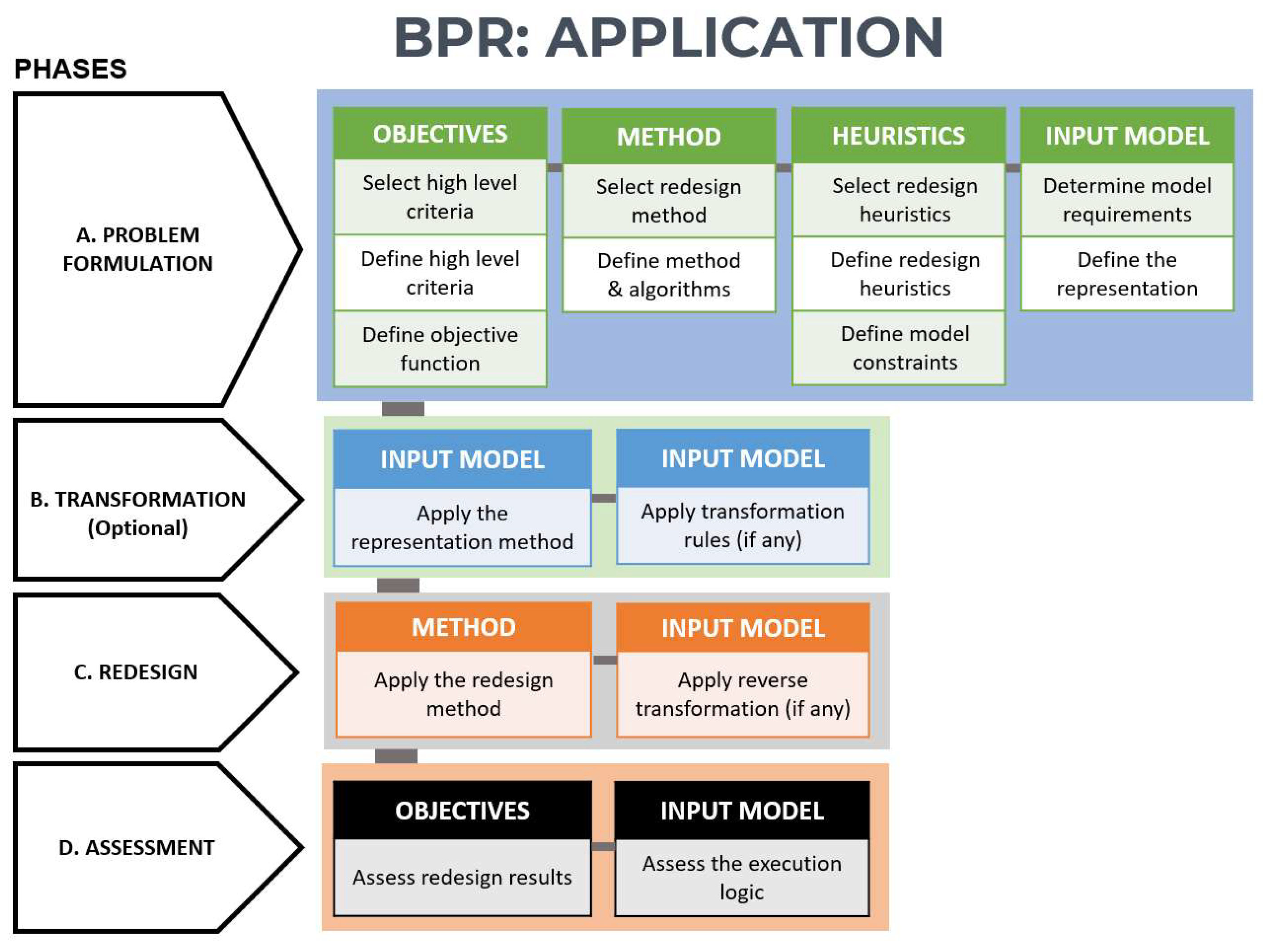
These frameworks are currently under development, testing and validation and are intended to constitute a comprehensive methodology that: (a) initially evaluates the redesign capacity of models by implementing the BPR Assessment framework, and (b) applies BPR to feasible models through the BPR Application framework. The overall methodology shares common components and phases between the frameworks, providing an important advantage to practitioners that plan to use any of the two frameworks or both for feasible BP cases. The contribution of this unified methodology is also related to its interoperability with the two proposed frameworks and its generalizability.
The BPR Application Framework is increasingly recognized in literature as a representative methodology for systematic BPR application. For instance, the work by Ong et al. [109] highlights its utility as a roadmap for business model development in the clothing industry and business process redesign. Similarly, Novita et al. [110] emphasize its value in applying systematic methodologies that assess current processes to identify key elements for change. Additionally, Popoola et al. [111] position the framework as a conceptual model that underpins and guides BPR initiatives. Nair and Nathiya [112] further explore its adaptability, showcasing how frameworks like the BPR Application Framework can integrate AI to deliver unparalleled efficiency and innovation.
The BPR Application Framework effectively combines a systematic approach with broad applicability. It offers a structured methodology that ensures consistency in implementation while being versatile enough to adapt to various industries and contexts. By bridging the gap between theoretical design and practical use, it provides a meaningful response to the challenges outlined in RQ3.
7. Discussion and Conclusions
This paper addresses the systematic nature and generalizability of existing Business Process Redesign (BPR) methodologies through an extensive systematic literature review (SLR). The study thoroughly evaluates 57 identified artefacts, critically examining their adherence to systematic principles and their ability to be generalized across various industries and contexts. By investigating these artefacts, the research aims to fill a significant gap in literature, offering insights that can guide the development of more robust and versatile BPR methodologies.
The study is structured around three primary research questions (RQs). The first focuses on whether current BPR methodologies are systematically developed and applied. The second examines the extent to which these methodologies are generalizable. Finally, the third explores the key elements required to design a BPR methodology that ensures both systematic application and broad applicability. The findings for each RQ are detailed below.
Regarding RQ1 “Do BPR methodologies generally describe a systematic set of methods and principles for process redesign? Are these methodologies themselves developed through systematic approaches?”, the analysis reveals that the majority of BPR methodologies reviewed exhibit systematic characteristics. Specifically, 52 out of the 57 artefacts include interconnected and interdependent phases or constructs that provide a structured framework for implementing BPR. This structured nature ensures a degree of methodological rigor, making these artefacts more effective in guiding redesign efforts. However, it is noteworthy that a large proportion of these methodologies are newly proposed rather than adaptations of established frameworks. This reliance on novel approaches often reflects a lack of validation through broader empirical application, raising concerns about their reliability and reproducibility. While systematicity is a common feature, the varying degrees of adherence to established principles highlight the need for further refinement and standardization in the field.
The findings related to RQ2 “Are the identified BPR methodologies generalizable across diverse industries, contexts, and process types, and to what extent do they fulfill the criteria for broad applicability?”, indicate significant limitations in the existing methodologies. Most of the artefacts examined are tailored to specific industries or business contexts, which restricts their broader applicability. For example, several methodologies focus exclusively on domains such as healthcare, manufacturing, or supply chain processes. This domain-specific orientation limits their utility in addressing diverse process types and organizational contexts. Additionally, many methodologies lack flexibility in accommodating various process modeling notations or redesign heuristics, further reducing their adaptability. Out of the 57 artefacts, only a minority demonstrate the versatility needed to support multiple industries and contexts effectively. These results underscore a critical need for methodologies that can balance systematic design with the flexibility to adapt to diverse and evolving business landscapes.
In relation to RQ3 “How should a BPR methodology be designed to ensure both systematic application and broad generalizability across different contexts?”, the BPR Application Framework emerges as a robust response to the challenges identified. This framework integrates systematic rigor with broad generalizability by incorporating four key redesign components: objectives, methods, heuristics, and input models. Organized into four phases — Problem Formulation, Transformation, Redesign, and Assessment — the framework provides a comprehensive methodology for systematic BPR application. Its design ensures consistency and methodological rigor while maintaining the adaptability required to address varying industry needs and process complexities. By fulfilling the criteria for both systematicity and generalizability, this framework addresses the core requirements of RQ3, offering a practical and theoretically grounded solution to the limitations identified in existing approaches.
While this study provides meaningful insights, some limitations should be acknowledged. First, the evaluation relies predominantly on the existing literature, which may inherently reflect biases or gaps in the current research landscape. Some methodologies that are effective in practice but lack extensive documentation or theoretical underpinning may have been excluded. Additionally, the predefined criteria for systematicity and generalizability, while rigorous, may not capture all dimensions of effectiveness and applicability.
Future research should prioritize the empirical validation of proposed frameworks, including the BPR Application Framework that is mentioned in this study. Case studies and real-world applications across diverse industries could provide valuable evidence of their effectiveness and adaptability. Furthermore, exploring the integration of emerging technologies, such as artificial intelligence and machine learning, into BPR methodologies presents a promising avenue for enhancing their efficiency and innovation potential. Hybrid approaches that combine elements of established and novel methodologies may also offer a pathway to achieving greater balance between theoretical robustness and practical utility. Lastly, a deeper investigation into methodologies that successfully navigate the trade-offs between domain-specificity and generalizability could provide additional insights into designing adaptable yet specialized frameworks.
By addressing these limitations and proposing directions for future exploration, this research contributes to advancing the field of business process management. It emphasizes the importance of methodologies that are not only systematic and methodologically sound but also capable of adapting to the complexities and dynamics of diverse organizational contexts.
Funding
This research received no external funding.
Conflicts of Interest
The authors declare no conflicts of interest.
References
- Becker, J.; Kugeler, M.; Rosemann, M. Process Management: A Guide for the Design of Business Processes; Springer Science & Business Media, 2013; ISBN 978-3-540-24798-2.
- Jennings, N.R.; Faratin, P.; Johnson, M.J.; Norman, T.J.; O’brien, P.; Wiegand, M.E. Agent-Based Business Process Management. International Journal of Cooperative Information Systems 1996, 5, 105–130. [Google Scholar] [CrossRef]
- Weske, M. Business Process Management: Concepts, Languages, Architectures; 2nd ed. 2012. [Google Scholar]
- Smith, H.; Fingar, P. Business Process Management: The Third Wave; Meghan-Kiffer Press Tampa, 2003; Vol. 1;
- Tsakalidis, G.; Vergidis, K. Towards a Comprehensive Business Process Optimization Framework.; IEEE: Thessaloniki, Greece, 2017; Vol. 1, pp. 129–134. [Google Scholar]
- Mendling, J.; Decker, G.; Hull, R.; Reijers, H.A.; Weber, I. How Do Machine Learning, Robotic Process Automation, and Blockchains Affect the Human Factor in Business Process Management? Communications of the Association for Information Systems 2018, 43, 19. [Google Scholar] [CrossRef]
- Mendling, J.; Weber, I.; Aalst, W.V.D.; Brocke, J.V.; Cabanillas, C.; Daniel, F.; Debois, S.; Ciccio, C.D.; Dumas, M.; Dustdar, S. Blockchains for Business Process Management-Challenges and Opportunities. ACM Transactions on Management Information Systems (TMIS) 2018, 9, 1–16. [Google Scholar] [CrossRef]
- Szelągowski, M. Evolution of the BPM Lifecycle. In Proceedings of the Federated Conference on Computer Science and Information Systems; 2018; pp. 205–211. [Google Scholar]
- Tsakalidis, G.; Vergidis, K.; Kougka, G.; Gounaris, A. Eligibility of BPMN Models for Business Process Redesign. Information 2019, 10, 225. [Google Scholar] [CrossRef]
- Dumas, M.; Rosa, M.L.; Mendling, J.; Reijers, H.A. Fundamentals of Business Process Management; 2013th edition; Springer: Berlin, 2013; ISBN 978-3-642-43473-0. [Google Scholar]
- Seethamraju, R.; Marjanovic, O. Role of Process Knowledge in Business Process Improvement Methodology: A Case Study. Business Process Management Journal 2009. [Google Scholar] [CrossRef]
- Law, C.C.; Ngai, E.W. IT Infrastructure Capabilities and Business Process Improvements: Association with IT Governance Characteristics. Information Resources Management Journal (IRMJ) 2007, 20, 25–47. [Google Scholar] [CrossRef]
- Vizzon, J.S.; Carmo, L.F.R.R.S. do; Ceryno, P.S.; Fiorencio, L. Business Process Redesign: An Action Research. Gest. Prod. 2020, 27, e4305. [Google Scholar] [CrossRef]
- Zellner, G. A Structured Evaluation of Business Process Improvement Approaches. Business Process Management Journal 2011. [Google Scholar] [CrossRef]
- Fink, A. Conducting Research Literature Reviews: From the Internet to Paper; Sage publications, 2019. [Google Scholar]
- Cognini, R.; Corradini, F.; Gnesi, S.; Polini, A.; Re, B. Business Process Flexibility-a Systematic Literature Review with a Software Systems Perspective. Information Systems Frontiers 2018, 20, 343–371. [Google Scholar] [CrossRef]
- Okoli, C.; Schabram, K. A Guide to Conducting a Systematic Literature Review of Information Systems Research. Sprouts Work. Pap. Inf. Syst 2010, 10, 26. [Google Scholar] [CrossRef]
- Kitchenham, B.; Charters, S. Guidelines for Performing Systematic Literature Reviews in Software Engineering. 2007.
- Webster, J.; Watson, R.T. Analyzing the Past to Prepare for the Future: Writing a Literature Review; JSTOR, 2002. [Google Scholar]
- Lee, K.T.; Chuah, K.B. A SUPER Methodology for Business Process Improvement-An Industrial Case Study in Hong Kong/China. International Journal of Operations & Production Management 2001. [Google Scholar]
- Chan, K.K.; Spedding, T.A. An Integrated Multidimensional Process Improvement Methodology for Manufacturing Systems. Computers & Industrial Engineering 2003, 44, 673–693. [Google Scholar]
- Harmon, P. Business Process Change: A Manager’s Guide to Improving, Redesigning, and Automating Processes; Morgan Kaufmann, 2003. [Google Scholar]
- Zhou, Y.; Chen, Y. The Methodology for Business Process Optimized Design. In Proceedings of the IECON’03. 29th Annual Conference of the IEEE Industrial Electronics Society (IEEE Cat. No. 03CH37468); IEEE, 2003; Vol. 2; pp. 1819–1824. [Google Scholar]
- Reijers, H.A.; Mansar, S.L. Best Practices in Business Process Redesign: An Overview and Qualitative Evaluation of Successful Redesign Heuristics. Omega 2005, 33, 283–306. [Google Scholar] [CrossRef]
- Mansar, S.L.; Reijers, H.A.; Ounnar, F. BPR Implementation: A Decision-Making Strategy. In Proceedings of the International Conference on Business Process Management; Springer; 2005; pp. 421–431. [Google Scholar]
- Jansen-Vullers, M.; Reijers, H. Business Process Redesign in Healthcare: Towards a Structured Approach. INFOR: Information Systems and Operational Research 2005, 43, 321–339. [Google Scholar] [CrossRef]
- Adesola, S.; Baines, T. Developing and Evaluating a Methodology for Business Process Improvement. Business Process Management Journal 2005. [Google Scholar] [CrossRef]
- Jansen-Vullers, M.H.; Netjes, M.; Reijers, H.A.; Stegeman, M.J. A Redesign Framework for Call Centers. In Proceedings of the International Conference on Business Process Management; Springer; 2006; pp. 306–321. [Google Scholar]
- Gu, H.-Z.; Lu, H.-Y. Applying Cmmi Approach to Business Process Improvement. Electronic Commerce Studies 2006, 4, 97–116. [Google Scholar]
- Vergidis, K.; Tiwari, A.; Majeed, B. Business Process Improvement Using Multi-Objective Optimisation. BT Technology Journal 2006, 24, 229–235. [Google Scholar] [CrossRef]
- Dalmaris, P.; Tsui, E.; Hall, B.; Smith, B. A Framework for the Improvement of Knowledge-Intensive Business Processes. Business Process Management Journal 2007. [Google Scholar] [CrossRef]
- Andersen, B. Business Process Improvement Toolbox; Quality Press, 2007. [Google Scholar]
- Abdolvand, N.; Ferdowsi, Z.; Albadvi, A. Towards a Unified Perspective of Business Process Reengineering Methodologies. International journal of technology transfer and commercialisation 2007, 6, 100–111. [Google Scholar] [CrossRef]
- Coskun, S.; Basligil, H.; Baracli, H. A Weakness Determination and Analysis Model for Business Process Improvement. Business Process Management Journal 2008. [Google Scholar] [CrossRef]
- Khan, Z.; Bali, R.K.; Wickramasinghe, N. A Business Process Improvement Framework to Facilitate Superior SME Operations. International journal of networking and virtual organisations 2008, 5, 155–165. [Google Scholar] [CrossRef]
- Siha, S.M.; Saad, G.H. Business Process Improvement: Empirical Assessment and Extensions. Business Process Management Journal 2008. [Google Scholar] [CrossRef]
- Enabling Simulation – Simulation and Process Improvement Methodology. In Enabling a Simulation Capability in the Organisation; Greasley, A., Ed.; Springer: London, 2008; pp. 59–87. ISBN 978-1-84800-169-5.
- Goel, S.; Chen, V. Integrating the Global Enterprise Using Six Sigma: Business Process Reengineering at General Electric Wind Energy. International Journal of Production Economics 2008, 113, 914–927. [Google Scholar] [CrossRef]
- Zhao, T.; Su, Q.; Zhao, C.; Chang, L. A Four-Dimensional Framework for Broad Band Business Process Improvement in HT Company. In Proceedings of the 2009 International Conference on Computers & Industrial Engineering; IEEE; 2009; pp. 1160–1164. [Google Scholar]
- Chen, L.; Xue, T.; Yang, A. Business Process Continuous Improvement System Based on Workflow Mining Technology. In Proceedings of the 2009 WRI World Congress on Computer Science and Information Engineering; IEEE, 2009; Vol. 5; pp. 414–418. [Google Scholar]
- Samaranayake, P. Business Process Integration, Automation, and Optimization in ERP: Integrated Approach Using Enhanced Process Models. Business Process Management Journal 2009, 15, 504–526. [Google Scholar] [CrossRef]
- Limam Mansar, S.; Reijers, H.A.; Ounnar, F. Development of a Decision-Making Strategy to Improve the Efficiency of BPR. Expert Systems with Applications 2009, 36, 3248–3262. [Google Scholar] [CrossRef]
- Zagloel, T.Y.; Dachyar, M.; Arfiyanto, F.N. Quality Improvement Using Model-Based and Integrated Process Improvement (MIPI) Methodology. In Proceedings of the Proceeding of the 11th International Conference on QiR (Quality in Research); 2009; pp. 3–6. [Google Scholar]
- Harmon, P. Business Process Change: A Guide for Business Managers and BPM and Six Sigma Professionals, Elsevier. 2010.
- Martin, J.; Conte, T.; Knapper, R. Towards Objectives-Based Process Redesign. Available at SSRN 1805503 2010. [Google Scholar] [CrossRef]
- Kurniawan, T.A.; Ghose, A.K.; Lê, L.-S. A Framework for Optimizing Inter-Operating Business Process Portfolio. In Information Systems Development; Springer, 2011; pp. 383–396.
- Niedermann, F.; Radeschütz, S.; Mitschang, B. Business Process Optimization Using Formalized Optimization Patterns. In Proceedings of the Business Information Systems; Abramowicz, W., Ed.; Springer Berlin Heidelberg; 2011; pp. 123–135. [Google Scholar]
- Martin, J.; Betz, S.; Conte, T.; Gerhardt, C.; Weinhardt, C. Objectives-Based Business Process Redesign in Financial Planning – A Case Study. In Proceedings of the ECIS 2011 Proceedings; Helsinki, Finland; 11/06 2011. [Google Scholar]
- Sánchez-González, L.; Ruiz, F.; García, F.; Piattini, M. Improving Quality of Business Process Models. In Proceedings of the International Conference on Evaluation of Novel Approaches to Software Engineering; Springer; 2011; pp. 130–144. [Google Scholar]
- Lodhi, A.; Köppen, V.; Saake, G. Business Process Improvement Framework and Representational Support. In Proceedings of the Proceedings of the Third International Conference on Intelligent Human Computer Interaction (IHCI 2011), Prague, Czech Republic, August, 2011; Springer, 2013; pp. 155–167.
- Martin, J.; Conte, T.; Mazarakis, A. Process Redesign for Liquidity Planning in Practice: An Empirical Assessment. In Proceedings of the International Conference on Advanced Information Systems Engineering; Springer; 2012; pp. 581–596. [Google Scholar]
- Mazz, M.; Kumar, M. Structured Method for Business Process Improvement. In Proceedings of the 2012 Third International Conference on Services in Emerging Markets; IEEE; 2012; pp. 183–188. [Google Scholar]
- Ghosh, S.; Heching, A.R.; Squillante, M.S. A Two-Phase Approach for Stochastic Optimization of Complex Business Processes. In Proceedings of the 2013 Winter Simulations Conference (WSC); IEEE; 2013; pp. 1856–1868. [Google Scholar]
- Darmani, A.; Hanafizadeh, P. Business Process Portfolio Selection in Re-Engineering Projects. Business Process Management Journal 2013, 19, 892–916. [Google Scholar] [CrossRef]
- Lohrmann, M.; Reichert, M. Demonstrating the Effectiveness of Process Improvement Patterns. In Enterprise, Business-Process and Information Systems Modeling; Springer, 2013; pp. 230–245.
- Riemann, U. Value-Chain Oriented Identification of Indicators to Establish a Comprehensive Process Improvement Framework. arXiv preprint, arXiv:1310.3230 2013.
- Palma-Mendoza, J.A.; Neailey, K.; Roy, R. Business Process Re-Design Methodology to Support Supply Chain Integration. International Journal of Information Management 2014, 34, 167–176. [Google Scholar] [CrossRef]
- Brzostowski, K.; Gąsior, D.; Grzech, A.; Juszczyszyn, K.; Ko\laczek, G.; Kozik, A.; Rudek, R.; S\lawek, A.; Szczurowski, L.; Świątek, P.R. Business Process Optimization Platform for Integrated Information Systems. Information systems architecture and technology, eds. Jerzy Świątek [i in.]. Wroc\law: Oficyna Wydawnicza Politechniki Wroc\lawskiej 2014, 13–22.
- Vera-Baquero, A.; Colomo-Palacios, R.; Molloy, O. Towards a Process to Guide Big Data Based Decision Support Systems for Business Processes. Procedia Technology 2014, 16, 11–21. [Google Scholar] [CrossRef]
- Stojanović, D.; Slović, D.; Tomašević, I.; Simeunović, B. Model for Selection of Business Process Improvement Methodologies. In Proceedings of the Paper presented at19th International Toulon-Verona Conference on Excellence in Services, Huelva, Spain; 2016; Vol. 5; pp. 453–467. [Google Scholar]
- Mahammed, N.; Benslimane, S.M. Toward Multi Criteria Optimization of Business Processes Design. In Proceedings of the Model and Data Engineering; Bellatreche, L., Pastor, Ó., Almendros Jiménez, J.M., Aït-Ameur, Y., Eds.; Springer International Publishing: Cham, 2016; pp. 98–107. [Google Scholar]
- Ghanadbashi, S.; Ramsin, R. Towards a Method Engineering Approach for Business Process Reengineering. IET Software 2016, 10, 27–44. [Google Scholar] [CrossRef]
- Attong, M.; Metz, T. Change or Die: The Business Process Improvement Manual; 1st edition. Productivity Press, 2016. [Google Scholar]
- Sallos, M.P.; Yoruk, E.; García-Pérez, A. A Business Process Improvement Framework for Knowledge-Intensive Entrepreneurial Ventures. The Journal of Technology Transfer 2017, 42, 354–373. [Google Scholar] [CrossRef]
- Avci, M.G.; Selim, H. A Multi-Objective, Simulation-Based Optimization Framework for Supply Chains with Premium Freights. Expert Systems with Applications 2017, 67, 95–106. [Google Scholar] [CrossRef]
- Sánchez-González, L.; García, F.; Ruiz, F.; Piattini, M. A Case Study about the Improvement of Business Process Models Driven by Indicators. Software & Systems Modeling 2017, 16, 759–788. [Google Scholar]
- Huo, J.; Liu, L. An Optimization Framework of Multiobjective Artificial Bee Colony Algorithm Based on the MOEA Framework. Computational Intelligence and Neuroscience 2018, 2018. [Google Scholar] [CrossRef]
- Torkhani, R.; Laval, J.; Malek, H.; Moalla, N. Intelligent Framework for Business Process Automation and Re-Engineering. In Proceedings of the 2018 International Conference on Intelligent Systems (IS); IEEE; 2018; pp. 624–629. [Google Scholar]
- AbdEllatif, M.; Farhan, M.S.; Shehata, N.S. Overcoming Business Process Reengineering Obstacles Using Ontology-Based Knowledge Map Methodology. Future Computing and Informatics Journal 2018, 3, 7–28. [Google Scholar] [CrossRef]
- Khan, M.A.A.; Butt, J.; Mebrahtu, H.; Shirvani, H. Analyzing the Effects of Tactical Dependence for Business Process Reengineering and Optimization. Designs 2020, 4, 23. [Google Scholar] [CrossRef]
- Ratnasari, A.; Fitrianah, D.; Haji, W.H. BPTrends Redesign Methodology (BPRM) for the Development Disaster Management Prevention Information System. In Proceedings of the Proceedings of the 2020 2nd Asia Pacific Information Technology Conference; 2020; pp. 113–117.
- Skoglund, B.; Perjons, E. Towards a Goal and Problem Based Business Process Improvement Framework–an Experience Report. In Proceedings of the Practice of Enterprise Modelling 2019 Conference Forum. POEM 2019.; Feltus, C., Johannesson, P., Proper, HA; 2020; pp. 64–77. [Google Scholar]
- Truong, T.-M.; Lê, L.-S.; Paja, E.; Giorgini, P. A Data-Driven, Goal-Oriented Framework for Process-Focused Enterprise Re-Engineering. Information Systems and e-Business Management 2021, 19, 683–747. [Google Scholar] [CrossRef]
- Mukherjee, K.K.; Reka, L.; Mullahi, R.; Jani, K.; Taraj, J. Public Services: A Standard Process Model Following a Structured Process Redesign. Business Process Management Journal 2021, 27, 796–835. [Google Scholar] [CrossRef]
- Merriam-Webster Systematic. Merriam-Webster.com Dictionary.
- IEEE Guide for Information Technology - System Definition - Concept of Operations (ConOps) Document; 1998; pp. 1–24;
- (Replaced) IEEE Standard for Artificial Intelligence Exchange and Service Tie to All Test Environments (AI- ESTATE); 2002; pp. 1–124;
- Hevner, A.; March, S.T.; Park, J.; Ram, S. Design Science Research in Information Systems. MIS quarterly 2004, 28, 75–105. [Google Scholar] [CrossRef]
- Saaty, T. The Analytic Hierarchy Process (AHP) for Decision Making. In Proceedings of the Kobe, Japan; 1980; pp. 1–69. [Google Scholar]
- Adesola, S.; Baines, T.S. Developing a Methodology for Business Process Improvement. In Proceedings of the 4th international conference on managing innovative manufacturing; MCB University Press; 2000; pp. 28–35. [Google Scholar]
- Alter, S. Information Systems: A Management Perspective. 1999.
- Jablonski, S.; Bussler, C. Workflow Management: Modeling, Concepts, Architecture and Implementation; Cengage Learning, 1996.
- Berio, G.; Vernadat, F. Enterprise Modelling with CIMOSA: Functional and Organizational Aspects. Production planning & control 2001, 12, 128–136. [Google Scholar]
- Seidmann, A.; Sundararajan, A. The Effects of Task and Information Asymmetry on Business Process Redesign. International Journal of Production Economics 1997, 50, 117–128. [Google Scholar] [CrossRef]
- Team, C.P. Capability Maturity Model® Integration (CMMI SM), Version 1.1. CMMI for systems engineering, software engineering, integrated product and process development, and supplier sourcing (CMMI-SE/SW/IPPD/SS, V1. 1) 2002, 2.
- Niiniluoto, I. Critical Scientific Realism; OUP Oxford, 1999.
- Dooner, M.; Ellis, T.; Swift, K. A Technique for Revealing and Agreeing an Agenda for Process Improvement. Journal of materials processing technology 2001, 118, 216–218. [Google Scholar] [CrossRef]
- Aguilar, M.; Rautert, T.; Pater, A.J. Business Process Simulation: A Fundamental Step Supporting Process Centered Management. In Proceedings of the Proceedings of the 31st conference on Winter simulation: Simulation—a bridge to the future-Volume 2; 1999; pp. 1383–1392.
- Kettinger, W.J.; Teng, J.T.; Guha, S. Business Process Change: A Study of Methodologies, Techniques, and Tools. MIS quarterly 1997, 55–80. [Google Scholar] [CrossRef]
- Wieringa, R.; Heerkens, H.; Regnell, B. How to Write and Read a Scientific Evaluation Paper. In Proceedings of the 2009 17th IEEE International Requirements Engineering Conference; IEEE; 2009; pp. 361–364. [Google Scholar]
- Simon, H.A. The Sciences of the Artificial. 3rd 1996.
- Mingers, J.; Brocklesby, J. Multimethodology: Towards a Framework for Mixing Methodologies. Omega 1997, 25, 489–509. [Google Scholar] [CrossRef]
- Seruca, I.; Loucopoulos, P. Towards a Systematic Approach to the Capture of Patterns within a Business Domain. Journal of Systems and Software 2003, 67, 1–18. [Google Scholar] [CrossRef]
- Muthu, S.; Whitman, L.; Cheraghi, S.H. Business Process Reengineering: A Consolidated Methodology. In Proceedings of the Proceedings of the 4 th Annual International Conference on Industrial Engineering Theory, Applications, and Practice, 1999 US Department of the Interior-Enterprise Architecture; Citeseer, 2006.
- Malerba, F.; Caloghirou, Y.; McKelvey, M.; Radoševic, S. Conceptualizing Knowledge Intensive Entrepreneurship: Definition and Model. In Dynamics of Knowledge Intensive Entrepreneurship; Routledge, 2015; pp. 43–71.
- Hadka, D. MOEA Framework - A Free and Open Source Java Framework for Multiobjective Optimization, Version 2.13. Available online: http://moeaframework.org/ (accessed on 6 August 2022).
- Huo, J.; Liu, L. An Improved Multi-Objective Artificial Bee Colony Optimization Algorithm with Regulation Operators. Information 2017, 8, 18. [Google Scholar] [CrossRef]
- Hammer, M.; Champy, J. Reengineering the Corporation: A Manifesto for Business Revolution. Business Horizons 1993, 36, 90–91. [Google Scholar] [CrossRef]
- Khan, M.A.A.; Butt, J.; Mebrahtu, H.; Shirvani, H.; Alam, M.N. Data-Driven Process Reengineering and Optimization Using a Simulation and Verification Technique. Designs 2018, 2, 42. [Google Scholar] [CrossRef]
- Khan, M.A.A.; Butt, J.; Mebrahtu, H.; Shirvani, H.; Sanaei, A.; Alam, M.N. Integration of Data-Driven Process Re-Engineering and Process Interdependence for Manufacturing Optimization Supported by Smart Structured Data. Designs 2019, 3, 44. [Google Scholar] [CrossRef]
- Harmon, P. Chapter 13 - The BPTrends Process Redesign Methodology. In Business Process Change (Second Edition); Harmon, P., Ed.; The MK/OMG Press; Morgan Kaufmann: Burlington, 2007; pp. 353–383. ISBN 978-0-12-374152-3.
- Limam Mansar, S.; Reijers, H.A. Best Practices in Business Process Redesign: Use and Impact. Business Process Management Journal 2007, 13, 193–213. [Google Scholar] [CrossRef]
- Mendling, J.; Reijers, H.A.; van der Aalst, W.M. Seven Process Modeling Guidelines (7PMG). Information and Software Technology 2010, 52, 127–136. [Google Scholar] [CrossRef]
- Hanafizadeh, P.; Moosakhani, M.; Bakhshi, J. Selecting the Best Strategic Practices for Business Process Redesign. Business Process Management Journal 2009. [Google Scholar] [CrossRef]
- Vanwersch, R.J.B.; Pufahl, L.; Vanderfeesten, I.; Mendling, J.; Reijers, H.A. How Suitable Is the RePro Technique for Rethinking Care Processes. BETA publicatie: working papers 2015, 468. [Google Scholar]
- Yoo, K.; Suh, E.; Kim, K.-Y. Knowledge Flow-Based Business Process Redesign: Applying a Knowledge Map to Redesign a Business Process. Journal of knowledge management 2007, 11, 104–125. [Google Scholar] [CrossRef]
- Tsakalidis, G.; Nousias, N.; Vergidis, K. BPR Assessment Framework: Staging Business Processes for Redesign Using Cluster Analysis. In Proceedings of the Decision Support Systems XIII. Decision Support Systems in An Uncertain World: The Contribution of Digital Twins; Liu, S., Zaraté, P., Kamissoko, D., Linden, I., Papathanasiou, J., Eds.; Springer Nature Switzerland: Cham, 2023; pp. 97–110. [Google Scholar]
- Tsakalidis, G.; Nousias, N.; Madas, M.; Vergidis, K. Systematizing Business Process Redesign Initiatives with the BPR:Assessment Framework.; IEEE: Amsterdam, The Netherlands, 17/06 2022. [Google Scholar]
- Ong, A.K.S.; Cleofas, M.A.; Prasetyo, Y.T.; Chuenyindee, T.; Young, M.N.; Diaz, J.F.T.; Nadlifatin, R.; Redi, A.A.N.P. Consumer Behavior in Clothing Industry and Its Relationship with Open Innovation Dynamics during the COVID-19 Pandemic. Journal of Open Innovation: Technology, Market, and Complexity 2021, 7, 211. [Google Scholar] [CrossRef]
- Novita, N.; Percunda, A.D.; Chalidyanto, D. Outpatient Service Business Development in an Effort to Reduce Service Time. Jurnal Kesehatan Masyarakat 2023, 19, 76–86. [Google Scholar] [CrossRef]
- Popoola, O.A.; Adama, H.E.; Okeke, C.D.; Akinoso, A.E. Cross-Industry Frameworks for Business Process Reengineering: Conceptual Models and Practical Executions. World Journal of Advanced Research and Reviews 2024, 22, 1198–1208. [Google Scholar] [CrossRef]
- Nair, S.S.; Nathiya, R. AI-Powered Business Revolution: Elevating Efficiency and Boosting Sales through Cutting-Edge Process Re-Engineering with Machine Learning. In Proceedings of the 2024 Second International Conference on Data Science and Information System (ICDSIS); February 2024; pp. 1–7. [Google Scholar]
Figure 1.
Eight-step SLR guide [17]
Figure 1.
Eight-step SLR guide [17]
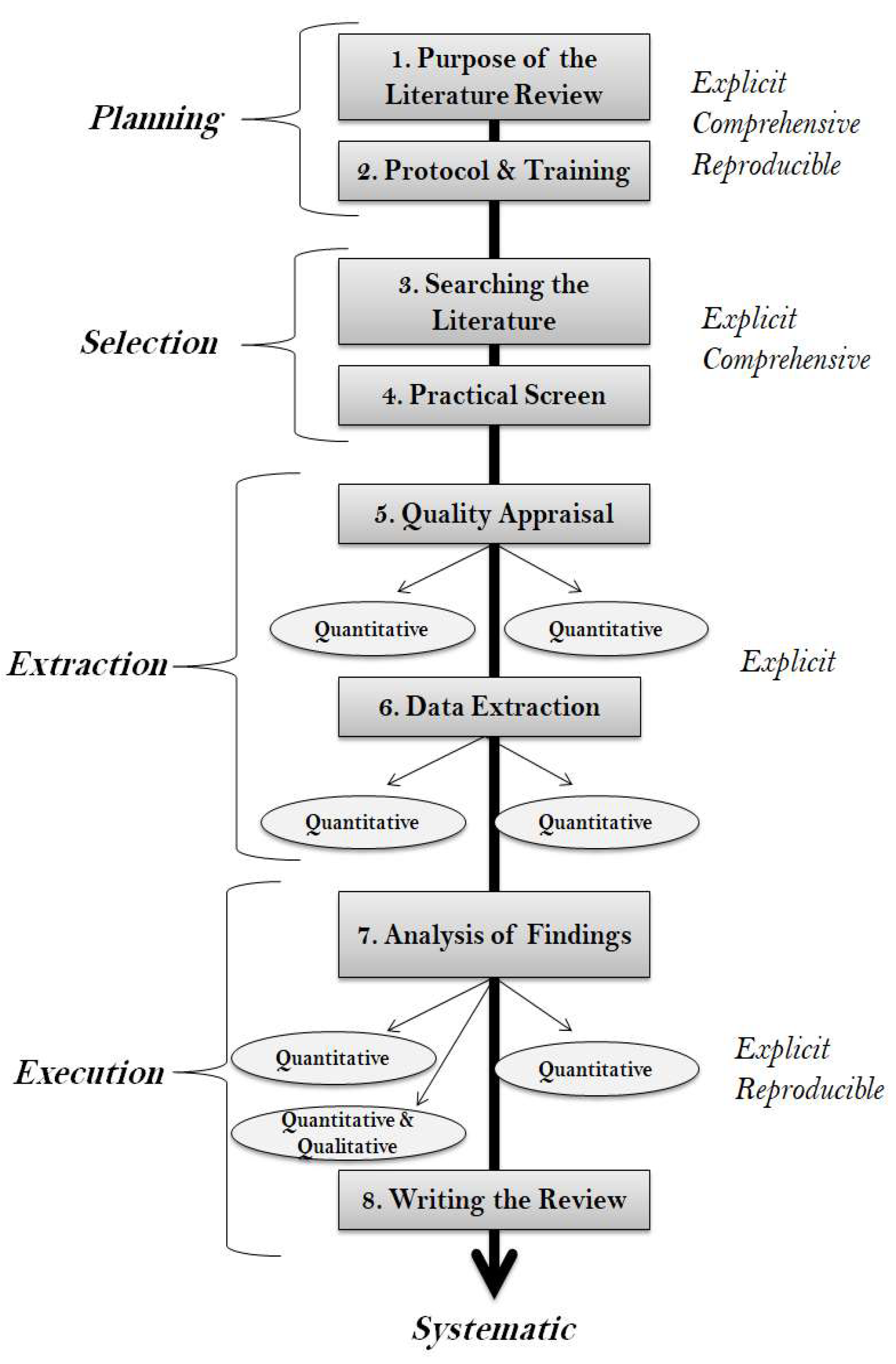
Figure 2.
Examination of the overall degree of generalizability
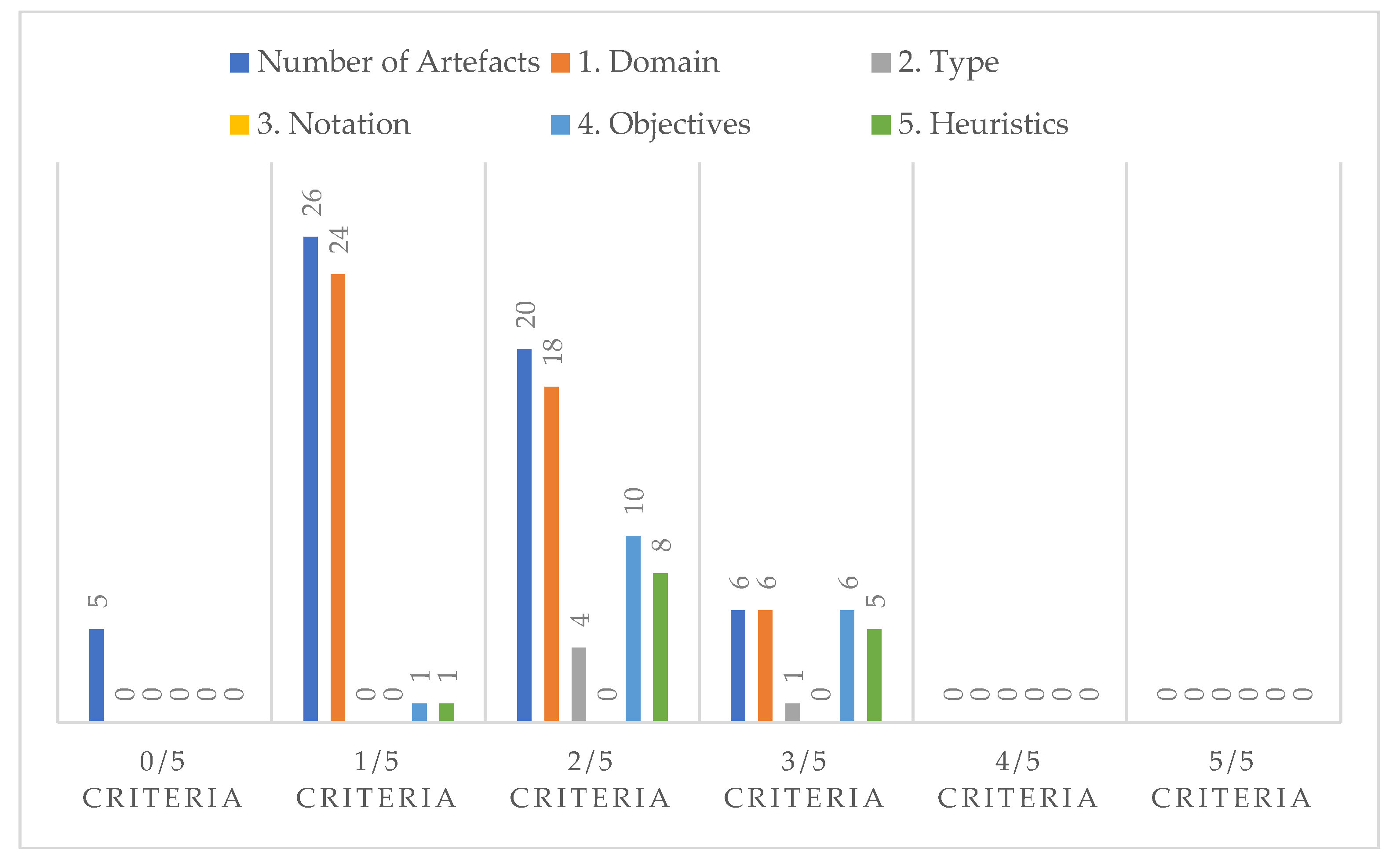

Table 1.
Literature Databases
| Database | Institution | Abbr. |
|---|---|---|
| Google Scholar | GS | |
| ACM Digital Library | ACM | ACM |
| IEEE Xplore | IEEE | IEEE |
| ScienceDirect | Elsevier | ELSV |
| SpringerLink | Springer | SPRG |
Table 2.
Practical Screening Criteria
| Criteria | Description | |
|---|---|---|
| Accessibility | IC-A1 | The full text of study is digitally accessible. |
| Content | IC-C1 | The study is relevant to the specific RQs. |
| Publication Language | IC-P1 | The study is written in English. |
| Date of Publication | IC-P2 | The study is restricted to date ranges from 2000 to 2022. |
| Publication Type | IC-P3 | The study is book, book chapter, journal article, already published literature review or conference paper. |
Table 3.
Quality appraisal Criteria
| Criteria | Description | |
|---|---|---|
| Artefact Proposal | IC-A2 | Has the study proposed an artefact for the purpose of the RQs? |
| Methodological support | IC-M | Is the proposed artefact based on a defined methodology? |
| Primary Artefact | IC-P4 | Is the proposed artefact the primary approach in literature? |
Table 4.
Search results after practical screening and duplicates removal
| Source | Search String | Initial Results | After Practical Screening | |
|---|---|---|---|---|
| IC-A1, IC-P1, IC-P2, IC-P3 | IC-C1 | |||
| GS | “business process" AND ("redesign framework” OR “improvement framework” OR “optimization framework” OR "redesign methodology" OR "improvement methodology" OR "optimization methodology") | 6290 | 212 | 107 |
| “business process" AND ("redesign framework” OR “improvement framework” OR “optimization framework” OR "redesign methodology" OR "improvement methodology" OR "optimization methodology") ~systematic -software process | 1130 | 84 | ||
| “business process" AND "redesign framework” | 225 | 37 | ||
| IEEE | "business process" AND ("redesign framework” OR “improvement framework” OR “optimization framework” OR "redesign methodology" OR "improvement methodology" OR "optimization methodology") | 211 | 50 | |
| ACM | "business process" AND ("process redesign" or "process improvement" OR "process optimization") AND ("framework" OR "methodology")-software process | 221 | 39 | |
| “business process" AND ("redesign framework” OR “improvement framework” OR “optimization framework” OR "redesign methodology" OR "improvement methodology" OR "optimization methodology") -software process | 85 | 13 | ||
| ELSV | “business process" AND ("redesign framework” OR “improvement framework” OR “optimization framework” OR "redesign methodology" OR "improvement methodology" OR "optimization methodology") | 404 | 52 | |
| SPRG | business process AND (“redesign framework” OR “improvement framework” OR “optimization framework” OR “redesign methodology” OR “improvement methodology” OR “optimization methodology”) AND NOT “software process” | 604 | 34 | |
| Number of research items: | 9168 | 521 | 107 | |
Table 5.
Number of included Studies after each criterion
| Practical Screening | IC-A2 | IC-M (& IC-C1) | IC-P4 | |
|---|---|---|---|---|
| Number of Included Studies | 107 | 83 | 72 | 57 |
Table 6.
Artefact References, Title and Type
| No | Reference | Artefact title or short description | Type |
|---|---|---|---|
| AP MD 1 | [20] | SUPER methodology | BPI, Reengineering, Benchmarking |
| AP MD 2 | [21] | Integrated multidimensional process improvement methodology (IMPIM) | Improvement, Reengineering |
| AP MD 3 | [22] | BPR Framework | Redesign |
| AP MD 4 | [23] | The Framework of BP Optimized Design | Optimization |
| AP MD 5 | [24] | BPR Framework | Redesign |
| AP MD 6 | [25] | BPR Implementation Strategy | Redesign |
| AP MD 7 | [26] | BPR Methodology | Redesign |
| AP MD 8 | [27] | BPI Methodology | Improvement |
| AP MD 9 | [28] | Redesign Framework for call centers | Redesign |
| AP MD 10 | [29] | CMMI framework | Improvement |
| AP MD 11 | [30] | BPO framework (bpoF) | Optimization |
| AP MD 12 | [31] | KBPI Framework | Improvement |
| AP MD 13 | [32] | A process for conducting Reengineering – BPI Roadmap | Improvement |
| AP MD 14 | [33] | BP Reengineering Methodology | Reengineering |
| AP MD 15 | [34] | Process Improvement methodology | Improvement |
| AP MD 16 | [35] | BPI Framework | Improvement |
| AP MD 17 | [36] | A conceptual framework for guiding BPI practice | Improvement |
| AP MD 18 | [37] | Process Improvement Methodology through Simulation | Improvement |
| AP MD 19 | [38] | Framework for BP Reengineering | Reengineering |
| AP MD 20 | [39] | Four-dimensional Framework for Enterprise BPI | Improvement |
| AP MD 21 | [40] | BP Continuous Improvement Framework | Improvement |
| AP MD 22 | [41] | Framework: Process Integration, Automation, and Optimization | Optimization |
| AP MD 23 | [42] | BPR Methodology using a decision-making method based on AHP | Redesign |
| AP MD 24 | [43] | Model-Based, Integrated Process Improvement MIPI Methodology | Improvement |
| AP MD 25 | [11] | A knowledge co-creation process that uses collaborative exploration of different scenarios and contexts | Improvement |
| AP MD 26 | [44] | The BPTrends Redesign Methodology | Redesign |
| AP MD 27 | [45] | The Redesign Model | Redesign |
| AP MD 28 | [46] | Framework for Process Portfolio Optimization | Optimization |
| AP MD 29 | [47] | Deep Business Optimization Platform | Optimization |
| AP MD 30 | [48] | Stage-activity BP Reengineering Framework | Reengineering |
| AP MD 31 | [49] | Conceptual Model for BPI | Improvement |
| AP MD 32 | [50] | Framework for BPI and analysis | Improvement |
| AP MD 33 | [51] | Redesign Framework with prior Financial Planning | Redesign |
| AP MD 34 | [52] | Framework for selecting suitable improvement patterns | Improvement |
| AP MD 35 | [53] | Two-stage BPO framework | Optimization |
| AP MD 36 | [54] | Model for selection of appropriate reengineering scenarios | Reengineering |
| AP MD 37 | [55] | Extended Conceptual Framework for Process improvement | Improvement |
| AP MD 38 | [56] | A Comprehensive Process Improvement Framework | Improvement |
| AP MD 39 | [57] | BPR methodological framework for supply chain integration (SCI) | Redesign |
| AP MD 40 | [58] | BPO Methodology (BPOM) | Optimization |
| AP MD 41 | [59] | a BPI methodology | Improvement |
| AP MD 42 | [60] | Model for selecting BPI methodology | Improvement |
| AP MD 43 | [61] | BPO Framework | Optimization |
| AP MD 44 | [62] | BP Reengineering Process (BPRP) Framework | Reengineering |
| AP MD 45 | [63] | BPI Method | Improvement |
| AP MD 46 | [64] | A conceptual framework for BPI in knowledge-intensive entrepreneurial ventures | Improvement |
| AP MD 47 | [65] | A multi-objective simulation-based optimization framework | Optimization |
| AP MD 48 | [5] | A comprehensive BPO framework | Optimization |
| AP MD 49 | [66] | BPMIMA framework for BP model improvement | Improvement |
| AP MD 50 | [67] | Unified Optimization Framework, MOABC Algorithm | Optimization |
| AP MD 51 | [68] | A Framework for BPI and automation | Improvement |
| AP MD 52 | [69] | Process Reengineering Ontology-based knowledge Map (PROM) | Reengineering |
| AP MD 53 | [70] | The Khan–Hassan–Butt (KHB) methodology | Reengineering |
| AP MD 54 | [71] | BPTrends Redesign Methodology (BPRM) | Redesign |
| AP MD 55 | [72] | The BPI framework | Improvement |
| AP MD 56 | [73] | A framework for redesigning BPes | Redesign |
| AP MD 57 | [74] | Process redesign framework (PRF) | Redesign |
Table 7.
Artefact Stages/Phases and whether they are considered Systematic
| No | AP MD Phases / Stages | Systematic |
|---|---|---|
| AP MD 1 | Select Process, Understand Process, Process Measurement, Process Improvement, Review Process. | X |
| AP MD 2 | Conventional Simulation Study (Productivity), Statistical Process Control (Quality), Activity-Based Costing (Cost), Decision Support Model, BP Reengineering or Improvement (TQM). | X |
| AP MD 3 | Planning, Analysis, Design, Development, Managing | X |
| AP MD 4 | Forming business strategy, BP diagnosis, and determining alternative reengineering blueprints, Forming BPR objectives, BP structurized design and structural optimization, BP assignment optimization, BP evaluation and decision-making, BP implementation. | X |
| AP MD 5 | Customers, Products, BP Operation and Behavioural Views, Organization (Structure, Population), Information and Technology. | X |
| AP MD 6 | The multi-criteria method uses Analytical Hierarchy Process (AHP) and includes the indicators of the following criteria: Component, Popularity, Impact, Goal, Risk. | X |
| AP MD 7 | Process modeling, Assessment of benefits of redesign heuristics, Selection of redesign heuristic, Creation of the TO-BE model, Selection of scenarios. | X |
| AP MD 8 | Understand business needs, Understand the process, Model & Analyze Process, Redesign Process, Implement New Process, Assess New Process & Methodology, Review Process. | X |
| AP MD 9 | - | |
| AP MD 10 | Customized model tailoring, IDEAL implementation methodology, Evidence assessment principles and suggestions. Maturity levels: Initial, Managed, Defined, Quantitatively Managed, Optimizing. | X |
| AP MD 11 | Framework Input, Optimization with EMOAs, Framework Output. | X |
| AP MD 12 | A foundational theory of knowledge, an ontology for dissecting, describing and discussing BPs, A method for the evaluating and improving of BP performance. | X |
| AP MD 13 | Planning, Reengineering, Transformation, Implementation. | X |
| AP MD 14 | BPR Plan, Supportive Environment, Improvement approaches, Process Management, Change Management, Information and Communication Technology. | X |
| AP MD 15 | Start-up, Self-analysis, Making changes, Feedback. | X |
| AP MD 16 | Vision, Collate and measure, Define and plan BPI, Management awareness, (Management commitment/support and Management education), Training and education in kaizen, (Shop-floor awareness, support and commitment), Check the process. | X |
| AP MD 17 | Specify, Analyze, Monitor. | X |
| AP MD 18 | Build and Communicate Process Map, Measure and Analyse Process Performance, Develop Future Process Design, Enable and Implement Future Process Design. | X |
| AP MD 19 | Process Redesign, Tool Selection, Security Analysis. | X |
| AP MD 20 | Four dimensions: green dimension makes sure the BP green service-oriented and environment-centered; layers dimension ensures the structure optimization; Logic dimension reflects the right route for BPI; Process dimension is used for looking for the root cause of the problems and proposing targeted suggestions. | X |
| AP MD 21 | (1) Info Acquisition, (2) Performance Evaluation, (3) Defects Identification, (4) Model Generation. | X |
| AP MD 22 | BP integration, automation, and optimization. | |
| AP MD 23 | Creative, Structured and Proposed approach. | X |
| AP MD 24 | Understand business needs, Understand the process, Model and analyze the process, Redesign process, Implement new process, Assess new process and methodology, Review new process. | X |
| AP MD 25 | Set of knowledge-management processes (Phases: Analysis, Modeling and Optimization). | |
| AP MD 26 | Understand Project, Analyze BP, Redesign, Implement Redesigned BP, Roll-out. | X |
| AP MD 27 | Envision, Initiate, Diagnose, Redesign, Reconstruct. | X |
| AP MD 28 | Rearranging Tasks within a Process, Restructuring Inter-operating Processes, Checking the Pre-defined Compliance, Calculating the Minimal Change Measures, Calculating the Resulting Optimization Value, Obtaining the Solution. | X |
| AP MD 29 | Data Integration, Process Analytics, Process Optimization. | X |
| AP MD 30 | Envision, Initiate, Diagnose, Redesign, Reconstruct, Evaluation. | X |
| AP MD 31 | Measurement, Evaluation, Redesign. | X |
| AP MD 32 | Data collection, Computation, Representation in BP models, Steps for improvement, and Mechanism to carry out the changes. | X |
| AP MD 33 | Financial Planning Process Prior to Redesign, Key Performance Indicators, Redesign Realization | X |
| AP MD 34 | - | |
| AP MD 35 | Analytical Approach, Simulation-based Optimization Approach. | X |
| AP MD 36 | Selection of strategic processes, Determining best practices for selected strategic processes, Definition of risk and return and measuring degree of change, BPPS. | X |
| AP MD 37 | Organizational objectives, Process improvement objectives (PIOs), Process improvement measures (PIMs). | X |
| AP MD 38 | As-Is evaluation of already existing KPIs / PPIs, Identification of corporate strategic topics, Evaluation of the corporate Value Chain, Selection of the corporate End-to-End processes, Selection of functional KPIs / PPIs, Benchmarking, Development of Root-Cause Analysis. | X |
| AP MD 39 | Top management commitment and vision, Business understanding, Identification of relevant supply chain processes and selection of target for redesign, Definition of objectives for improvement, Understanding the process AS IS, design of process TO BE, Implementation of changes, Evaluation of changes. | X |
| AP MD 40 | Business Analysis, Ontologies, Platform (Software tools). | X |
| AP MD 41 | Define, Configuration, Execution, Control, Diagnosis. | X |
| AP MD 42 | Companies attitude toward change, Process Performance, Process Characteristics and IT, Impact of Stakeholders. | |
| AP MD 43 | Generate random population, Check the constraints, Evaluate the solution, XNSGAII. | X |
| AP MD 44 | Envision, Initiate, Diagnose, Redesign, Implement redesigned processes, roll out the redesigned processes. | X |
| AP MD 45 | Executive Summary, The Process, Vision, Goals, and Objectives, SWOT (strengths, weaknesses, opportunities, threats) Analysis, Project Team, Risks and Opportunities, Resources, Next Steps, Conclusion. | X |
| AP MD 46 | Understand the Business Needs, Understand the Process, Model and Analyze the Process, Redesign the Process, Implement New Process, Assess the Improvement Methodology, Review the process. | X |
| AP MD 47 | Initial Solution, Optimization, Simulation, Pareto-optimal solutions | X |
| AP MD 48 | Representing BPs in a quantitative way, Composing BP designs with the use of algorithms, Identifying the optimal processes utilizing the EMOAs, Incorporating pre-processing stages during execution, Testing the application of the developed framework on BPs composed of web services. | X |
| AP MD 49 | Measurement, Evaluation, Redesign. | X |
| AP MD 50 | Problem Formulation, Algorithm Selection, Optimization process, Results Assessment. | X |
| AP MD 51 | Preparing for re-engineering, Analysis of the AS-IS processes and criticality identification, Data Engineering, Design the TO-BE process model. | X |
| AP MD 52 | Preparation and readiness for the organization, Building ontology, Identifying and prioritizing processes, Construction of knowledge structure and source maps, Analyze the maps, Modify the BPs and evaluate the results, Update the ontology. | X |
| AP MD 53 | Process Identification, Process Mapping, Data Collection, and Analysis, Process Verification, Reengineering Phase, Implementation. | X |
| AP MD 54 | Review project plan, Document as-is process, Agree on process name, sub-processes, inputs, outputs, and activities, Identify flaws, Create a chart of relationships, Determine the required characteristics of each activity, Interview people, Document cost and time, Re-focus on objectives, Recommend changes, Summarize in redesign plan, Present and maintain a redesign plan. | X |
| AP MD 55 | A goal model, A problem model, BPI methods, BPI tasks, The relationship model, The action unit pattern. | X |
| AP MD 56 | Problem Relevance, Research Rigor, Design as an Artifact, Design Evaluation, Research contributions, Communication of Research. | X |
| AP MD 57 | Relocate, Regulate, Delegate, Educate/Allocate, Eliminate, Automate. | X |
Table 8.
Generalizability of Artefacts
| No | 1. Can the artefact be applied to generic BPs? | 2. Does the artefact implement different BPC types? | 3. Is the artefact applicable to various process modelling notations? | 4. Does the artefact support the selection of different objectives? | 5. Does the artefact support different redesign heuristics? |
|---|---|---|---|---|---|
| AP MD 1 | X | X | X | X | X |
| AP MD 2 | X | X | X | X | X |
| AP MD 3 | ✔ | X | X | X | X |
| AP MD 4 | X | ✔ | X | X | ✔ |
| AP MD 5 | ✔ | X | X | ✔ | ✔ |
| AP MD 6 | ✔ | X | X | ✔ | ✔ |
| AP MD 7 | X | X | X | X | ✔ |
| AP MD 8 | ✔ | X | X | ✔ | X |
| AP MD 9 | X | X | X | ✔ | ✔ |
| AP MD 10 | ✔ | X | X | X | X |
| AP MD 11 | ✔ | X | X | X | X |
| AP MD 12 | ✔ | X | X | X | X |
| AP MD 13 | ✔ | X | X | — | X |
| AP MD 14 | ✔ | ✔ | X | X | X |
| AP MD 15 | ✔ | X | X | X | X |
| AP MD 16 | X | X | X | X | X |
| AP MD 17 | ✔ | ✔ | X | X | X |
| AP MD 18 | ✔ | X | X | X | X |
| AP MD 19 | ✔ | X | X | ✔ | X |
| AP MD 20 | ✔ | X | X | X | X |
| AP MD 21 | ✔ | X | X | ✔ | X |
| AP MD 22 | ✔ | X | X | X | X |
| AP MD 23 | ✔ | X | X | ✔ | ✔ |
| AP MD 24 | ✔ | X | X | X | X |
| AP MD 25 | ✔ | X | — | X | ✔ |
| AP MD 26 | ✔ | — | X | ✔ | X |
| AP MD 27 | ✔ | X | X | X | X |
| AP MD 28 | ✔ | X | X | X | X |
| AP MD 29 | ✔ | X | X | ✔ | ✔ |
| AP MD 30 | ✔ | X | X | X | X |
| AP MD 31 | ✔ | X | X | X | ✔ |
| AP MD 32 | ✔ | X | X | ✔ | X |
| AP MD 33 | ✔ | X | X | ✔ | X |
| AP MD 34 | ✔ | X | X | ✔ | ✔ |
| AP MD 35 | ✔ | X | X | X | X |
| AP MD 36 | ✔ | X | X | X | ✔ |
| AP MD 37 | ✔ | X | X | X | ✔ |
| AP MD 38 | ✔ | X | X | X | X |
| AP MD 39 | X | X | X | ✔ | X |
| AP MD 40 | X | X | X | X | X |
| AP MD 41 | ✔ | X | X | X | X |
| AP MD 42 | ✔ | ✔ | X | ✔ | X |
| AP MD 43 | ✔ | X | X | X | X |
| AP MD 44 | ✔ | X | — | ✔ | X |
| AP MD 45 | ✔ | X | X | ✔ | X |
| AP MD 46 | ✔ | X | X | X | X |
| AP MD 47 | ✔ | X | X | X | X |
| AP MD 48 | X | X | X | X | X |
| AP MD 49 | ✔ | X | X | X | ✔ |
| AP MD 50 | ✔ | X | X | X | X |
| AP MD 51 | ✔ | X | X | X | X |
| AP MD 52 | ✔ | X | X | X | X |
| AP MD 53 | ✔ | X | X | X | X |
| AP MD 54 | ✔ | X | X | X | X |
| AP MD 55 | ✔ | ✔ | X | X | X |
| AP MD 56 | ✔ | X | X | ✔ | X |
| AP MD 57 | ✔ | X | X | X | ✔ |
Each query is addressed for each artefact in the following table (Yes✔ / No X / Not explicit reference —).
Disclaimer/Publisher’s Note: The statements, opinions and data contained in all publications are solely those of the individual author(s) and contributor(s) and not of MDPI and/or the editor(s). MDPI and/or the editor(s) disclaim responsibility for any injury to people or property resulting from any ideas, methods, instructions or products referred to in the content. |
© 2025 by the authors. Licensee MDPI, Basel, Switzerland. This article is an open access article distributed under the terms and conditions of the Creative Commons Attribution (CC BY) license (http://creativecommons.org/licenses/by/4.0/).
Copyright: This open access article is published under a Creative Commons CC BY 4.0 license, which permit the free download, distribution, and reuse, provided that the author and preprint are cited in any reuse.