

Submitted:
08 January 2025
Posted:
08 January 2025
You are already at the latest version
Abstract
Adversarial attacks on Natural Language Processing (NLP) models expose vulnerabilities by introducing subtle perturbations to input text, often leading to misclassification while maintaining human readability. Existing methods typically focus on word-level or local text segment alterations, overlooking the broader context, which results in detectable or semantically inconsistent perturbations. We propose a novel adversarial text attack scheme named Dynamic Contextual Perturbation (DCP). DCP dynamically generates context-aware perturbations across sentences, paragraphs, and documents, ensuring semantic fidelity and fluency. Leveraging the capabilities of pre-trained language models, DCP iteratively refines perturbations through an adversarial objective function that balances the dual objectives of inducing model misclassification and preserving the naturalness of the text. This comprehensive approach allows DCP to produce more sophisticated and effective adversarial examples that better mimic natural language patterns. Our experimental results, conducted on various NLP models and datasets, demonstrate the efficacy of DCP in challenging the robustness of state-of-the-art NLP systems. By integrating dynamic contextual analysis, DCP significantly enhances the subtlety and impact of adversarial attacks. This study highlights the critical role of context in adversarial attacks and lays the groundwork for creating more robust NLP systems capable of withstanding sophisticated adversarial strategies.
Keywords:
adversarial attacks
; natural language processing
; contextual perturbation
; robustness
; pre-trained language models
; semantic fidelity
; misclassification
; text generation
1. Introduction
The rapid advancement of Natural Language Processing (NLP) has enabled the development of sophisticated models capable of understanding and generating human language with remarkable accuracy. These models, powered by deep learning techniques and vast amounts of data, are now integral to various applications, including sentiment analysis, machine translation, and conversational agents. However, the increasing reliance on these models also raises significant concerns regarding their robustness and security. Adversarial attacks, which involve deliberately crafting input data to deceive machine learning models, have emerged as a critical area of study in ensuring the reliability of NLP systems [1-2].
Adversarial text attacks target NLP models by introducing subtle perturbations to input text, aiming to mislead the model while keeping the changes imperceptible to human readers [3]. These attacks exploit vulnerabilities in the model's understanding and processing of language, revealing potential weaknesses that could be exploited in malicious scenarios. Traditional adversarial attack techniques in NLP often focus on word-level perturbations, such as synonym replacement or character-level alterations. While these methods can be effective, they frequently fail to consider the broader contextual coherence of the text, resulting in perturbations that are either easily detectable or disrupt the overall meaning.
In response to these limitations, we propose a novel adversarial text attack scheme named Dynamic Contextual Perturbation (DCP). The DCP scheme is designed to generate perturbations that are dynamically informed by the contextual environment of the target text. This approach ensures that the adversarial examples not only deceive the NLP model but also maintain semantic fidelity and fluency, making them challenging to detect through traditional defense mechanisms. By leveraging the power of pre-trained language models, DCP intelligently modifies text at various levels, including words, phrases, and sentences, to produce coherent and contextually appropriate adversarial inputs.
Contributions: The key contributions of the current work are as follows. First, the proposed scheme DCP has contextual sensitivity unlike many existing methods for adversarial text generation that focus solely on word-level perturbation without considering the context of the text. This enables DCP to dynamically generate perturbations based on the context of the target text allowing more nuanced and contextually relevant alterations. Second, DCP incorporates techniques like synonym replacement, homophone substitution, and paraphrasing to subtly alter the text's meaning while preserving its core semantic content, unlike traditional text attacks that result in perturbed text that lacks semantic coherence. Third, unlike adversarial text generated by existing methods that suffer from poor readability and fluency, DCP produces perturbed text that is indistinguishable from natural language, ensuring that it remains readable and fluent. Finally, DCP employs an adversarial objective function that balances misclassification likelihood with text fluency. By optimizing this objective function through iterative refinement using optimization algorithms, DCP ensures that the generated adversarial samples are effective in fooling NLP models while remaining human-like in their presentation.
This work aims to contribute to the ongoing efforts in enhancing the security and robustness of NLP systems. By exploring the intersection of context and adversarial perturbations, the DCP scheme not only offers a novel perspective on adversarial text attacks but also sets a foundation for developing more resilient models capable of withstanding sophisticated adversarial strategies.
The structure of this paper is as follows: In Section II, we review related work in the field of adversarial text attacks, highlighting the strengths and limitations of current approaches. Section III details the methodology of the DCP scheme, including the theoretical underpinnings and the algorithmic steps involved in generating adversarial examples. In Section IV, we describe the implementation details, providing insights into the practical aspects of deploying DCP. Section V presents the datasets used in our experiments and discusses the performance results, demonstrating the effectiveness of DCP in various scenarios. Finally, Section VI concludes the paper, summarizing the key findings and outlining potential directions for future research.
2. Related Work
Chiang & Lee scrutinize the effectiveness and legitimacy of synonym substitution analyses in NLP, providing valuable perspectives on their capabilities and ;imitations [4]. By questioning the conventional view of these attacks, the authors contribute to a deeper comprehension of NLP security vulnerabilities. The work also highlights the limitations and complexities involved in relying solely on synonym substitution as an adversarial strategy.
Asl et al. propose a framework called SSCAE that is capable of crafting sophisticated adversarial examples in natural language processing [5]. It integrates semantic, syntactic, and contextual factors to create adversarial examples that effectively deceive NLP models. However, the complexity of incorporating diverse linguistic features may pose challenges in scalability and efficiency.
Vitorino et al. evaluate the efficiency of adversarial evasion attacks against large language models [6]. Their study provides valuable insights into the susceptibility of these models to manipulation and evasion tactics. However, the proposition may face limitations in replicating real-world scenarios and assessing the long-term effectiveness of proposed countermeasures.
Zhao et al. introduce a method for generating adversarial alterations at the word level utilizing the differential evolution algorithm [7]. Their approach aims to generate adversarial examples that deceive natural language processing models while preserving human readability. However, potential weaknesses may arise in the method's ability to generate diverse and robust adversarial examples across different datasets and model architectures, warranting further investigation and validation.
Li et al. explore query-limited adversarial attacks targeting graph neural networks (GNNs) [8]. Their research aims to develop adversarial attacks that can effectively manipulate GNNs using a restricted number of model queries. However, potential weaknesses may arise in the generalization and robustness of the proposed attack method across different GNN architectures and datasets, necessitating further evaluation and validation.
Hu et al. propose FastTextDodger, a decision-based adversarial attack tailored for black-box NLP models [9]. The method enables effective manipulation of NLP models with limited access to their internal mechanisms. However, potential limitations may arise in scenarios where the attack's effectiveness depends heavily on the target model’s decision boundary complexity, necessitating further investigation into its generalization across diverse NLP tasks and datasets.
Parry et al. discuss various intricacies of adversarial attacks specifically tailored for sequence-to-sequence relevance models [10]. Through meticulous analysis and experimentation, the authors probe the susceptibility of these models to adversarial manipulation, examining how subtle alterations in input sequences can lead to erroneous outputs. However, addressing these vulnerabilities effectively requires a nuanced understanding of the underlying model dynamics and the development of tailored defense mechanisms, posing ongoing challenges in the field of adversarial robustness.
Waghela et al. introduce a novel scheme, MWSAA that enhances traditional word saliency-based attacks by incorporating modifications to optimize adversarial perturbations [11]. The authors illustrate how well their method works in creating adversarial samples that deceive text classification models while maintaining semantic coherence. However, further exploration is needed to evaluate the method’s performance across diverse datasets, as well as its scalability to real-world applications. The same authors also designed another enhanced adversarial attack, SASSP, integrating saliency, attention, and semantic similarity [12]. Empirical evaluations demonstrate SASSP’s efficacy in generating adversarial samples with high semantic fidelity and superior attack success rates.
Despite advancements in adversarial text generation, existing methods still face challenges in producing examples that are both effective and imperceptible. Many approaches focus solely on maximizing the model's prediction error without considering contextual relevance or semantic consistency, resulting in nonsensical or linguistically unnatural outputs that limit practical utility. DCP addresses these shortcomings by dynamically adapting perturbations based on the context of the text and optimizing for both misclassification likelihood and text fluency.
3. Methodology
The DCP scheme aims to generate sophisticated adversarial text examples that challenge the robustness of state-of-the-art NLP systems. This section outlines the methodology of DCP in detail, providing a comprehensive explanation of each step involved in the process. Figure 1 depicts a flow diagram to visualize the workflow of DCP.
Step 1: Input Text Acquisition - The initial step is acquiring the input text. For text classification tasks the datasets chosen for this study include IMDB and Yelp for sentiment analysis, AG News for topic classification, and Fake News for classifying news articles as fake or genuine. For natural language inference tasks, MNLI and SNLI datasets are used. These datasets are publicly available.
Step 2: Preprocessing - Once the input text is collected, it undergoes preprocessing. Tokenization splits the text into individual tokens, making it easier to analyze. Lowercasing ensures uniformity, while stop-word removal eliminates common words that do not significantly affect the meaning. Stemming or lemmatization reduces words to their root forms, helping to standardize different variations of the same word. Noise removal clears out any non-alphabetic elements, ensuring a clean text input for subsequent steps.
Step 3: Contextual embedding generation - Pre-trained language models like BERT are used to generate contextual embeddings for the preprocessed text. These embeddings capture the semantic and syntactic nuances of words within their specific contexts, providing a rich representation that is essential for identifying meaningful perturbations.
Step 4: Perturbation identification - Identifying perturbation candidates involves calculating the gradient of the loss function concerning the input text. This helps pinpoint words that have the most influence on the model's output. Saliency maps are used to visualize and identify keywords and phrases that contribute significantly to the classification decision.
Step 5: Perturbation generation - Generating context-aware perturbations is the next step. Synonym substitution replaces words with contextually appropriate synonyms using resources like WordNet or predictions from masked language models. This step leverages various NLP techniques to ensure that the generated perturbations are natural and coherent.
Step 6: Dynamic refinement - Dynamic refinement is an iterative process that balances the objectives of causing misclassification and maintaining readability. An adversarial objective function is defined to incorporate both these aspects. Optimization techniques are used to iteratively refine the perturbations based on feedback from this function.
Step 7: Adversarial example generation - After refining the perturbations, the final adversarial examples are generated. These examples are validated to ensure they meet the criteria for misclassification and semantic consistency.
Step 8: Evaluation - The effectiveness of the generated adversarial examples is evaluated using metrics such as attack success rate (ASR), perturbation magnitude, and readability. The ASR measures the percentage of adversarial examples that successfully cause misclassification. Perturbation magnitude evaluates the extent of changes made to the original text, while readability assesses the readability of the adversarial examples using indices like the Flesch-Kincaid score.
4. Implementation
This section provides the details of the implementation of the DCP scheme in the Python programming language.
Step 1: Setup and preprocessing - This step involves the following tasks: (a) installing libraries, (b) initializing NLTK, (c) designing the setup and preprocessing function. The installed libraries include nltk, transformers, datasets, and torch. The nltk library provides various tools and resources for NLP tasks such as tokenization, stemming, tagging, parsing, and semantic reasoning. The transformers library provided by Hugging Face offers an easy-to-use interface for working with pre-trained transformer models like BERT, GPT, and others. The datasets library of Hugging Face facilitates easy access to various datasets for NLP tasks. The torch library is used for building and training neural networks, particularly in deep learning applications.
Step 2: Generate Contextual Embeddings – The contextual embeddings for the input text are generated using a pre-trained BERT model. Before generating embeddings, the pre-trained BERT model and tokenizer from the Hugging Face’s Transformers library are loaded. The statement tokenizer = BertTokenizer.from_pretrained(‘bert-base-uncased’) loads the BERT tokenizer The tokenizer is used to convert text into a format that the BERT model can understand, typically by splitting the text into tokens and mapping them to their corresponding token IDs. The pre-trained BERT model is loaded using model = BertModel.from_pretrained(‘bert-base-uncased’). The BERT model will generate embeddings for the input tokens. The function get_embeddings takes a text input, tokenizes it, and generates contextual embeddings.
Step 3: Perturbation identification – This involves identifying which words in the text should be perturbed based on their importance. The step in perturbation identification is to calculate the gradients of the input text concerning the model's output. The function calculate_gradient performs this task as follows. The input text is tokenized and prepared for the model. Gradient computation is enabled for the input tokens. A forward pass is performed through the model to compute the outputs. The loss is computed, and backpropagation is performed to calculate the gradients. The gradients of the input tokens are finally retrieved. The next step is to identify which words should be perturbed based on the gradients. The function identify_perturbation is used for this purpose. The absolute values of the gradients are summed across the embedding dimensions to get a single importance score for each token. The indices of the tokens with the highest gradient magnitudes are identified. These indices correspond to the words in the text that are most important for prediction.
Step 4: Perturbation generation – The first step in perturbation generation involves finding synonyms for the words that have been identified for perturbation. The function get_synonym performs the task by executing task.wordnet.synsets(word), and retrieving all synsets (sets of synonyms) for the given word. For each synset, the function get_synonym iterates through the lemmas (individual word forms) and adds them to the synonyms set. Once the synonyms are available, the perturbed versions of the input text is generated by perturbing the identified important words with their synonyms by the function generate_perturbations.
Step 5: Dynamic refinement – This focuses on refining the perturbations to balance the objectives of misclassification and readability. It iteratively generates perturbed text until the adversarial objective is achieved. The adversarial_objective function evaluates whether the perturbed text achieves the adversarial objective, i.e., misclassification. It uses a pre-trained classifier to classify the perturbed text and compares the predicted label with the original label. The dynamic_refinement function iterates over a loop where it repeatedly generates perturbed text until the adversarial objective is achieved. Inside the loop, the function checks whether the current perturbed text achieves misclassification using adversarial_objective function. If misclassification is not achieved, the function generates a new perturbed text using the generate_perturbation function. The loop continues until misclassification is achieved.
Step 6: Evaluation - This computes various metrics to evaluate the success of the perturbations and their impact on the original text. The evaluation metrics include (a) attack success, (b) perturbation rate, and (c) semantic similarity. Attack success indicates whether the attack successfully caused misclassification. The perturbation rate measures the percentage of words changed in the original text. The function evaluate_adversarial_examples is used for evaluation.
5. Performance Results
The effectiveness of the DCP attack scheme is evaluated and contrasted with the PWWS attack [13] and the BERT-on-BERT attack [14]. In line with BERT-Attack [14], we evaluate PGD-BERT using 1000 test examples randomly chosen from the respective task’s test data set, consistent with partitions used in [3]. The comparative study with PWWS includes the following pre-trained models: (i) Word-CNN [15], (ii) Bi-LSTM, and (iii) Char-CNN [17]. The datasets used in this study include AG News [18], IMDB [19], Yelp [20], Fake News [21], MNLI [22], and SNLI [23]. For comparing the performance of DCP with BERT-on-BERT, Word-LSTM [24], BERT-Large [25], and ESIM [26] are also used.
It is observed from Table 1 and Table 2 and Figure 2 that CNN and LSTM models generally maintain high accuracy in the absence of attacks for AG News and IMDB datasets on the fine-tuned BERT victim model. However, the accuracy significantly drops in the presence of attacks. The adverse effect of DCP is even more as it leads to lower accuracy. Moreover, DCP results in lower perturbation rates compared to PWWS, implying it can generate more semantically similar adversarial examples with fewer modifications.
Table 3 and Figure 3 depict the accuracies and perturbation rates of BERT-on-BERT and DCP attacks on a fine-tuned BERT model for several datasets for text classification tasks. While BERT-on-BERT and DCP both significantly lower the model’s accuracy across all datasets, the effect of DCP is more severe. Moreover, DCP achieves this with consistently lower perturbation rates, making the attack more subtle and potentially more dangerous.
Table 4 and Figure 4 show that DCP requires fewer queries to generate adversarial examples while consistently maintaining higher semantic similarity in the perturbed texts compared to BERT-on-BERT for text classification tasks.
Table 5 and Figure 5 present the performance results of BERT-on-BERT and DCP attacks on several datasets for natural language inference tasks. The attack results for hypotheses (H) and premises (P) are shown separately. DCP is found to consistently outperform BERT-on-BERT in reducing model accuracy and maintaining lower perturbation rates.
Table 6 and Figure 6 depict the impact of BERT-on-BERT and DCP attacks on different models other than fine-tuned BERT models. The results demonstrate the effectiveness of these attacks across different datasets and model architectures. However, DCP demonstrates a superior capability to compromise the models in comparison to BERT-on-BERT.
6. Conclusion
This paper introduced DCP, a novel adversarial attack scheme for NLP models. DCP generates context-aware perturbations that maintain semantic fidelity and fluency, leveraging pre-trained language models. Experimental results show DCP's effectiveness across multiple NLP models and datasets, achieving higher attack success rates with minimal perturbations than other methods. This study highlights the importance of context in adversarial text generation. Future work will enhance defense mechanisms, explore broader NLP applications, and address the ethical implications of adversarial attacks.
References
- Szegedy, C.; Zaremba, W.; Sutskever, I.; Bruma, J.; Erhan, D.; Goodfellow, I.J.; Fergus, R. Intriguing properties of neural networks. Proc. of ICLR Poster Track. 2014. [Google Scholar]
- Goodfellow, I.J.; Shlens, J.; Szegedy, C. Explaining and harnessing adversarial examples. Proc. of ICLR Poster Track. 2015. [Google Scholar]
- Alzantot, M.; Sharma, Y.; Elgohary, A.; Ho, B.-J.; Srivastava, M.; Chang, K.W. Generating natural language adversarial examples. Proc. of EMNLP 2018, 2890–2896. [Google Scholar]
- Chiang, C.-H.; Lee, H.-y. Are synonym substitution attacks really synonym substitution attacks? Findings of the ACL’23 2023, 1853–1878. [Google Scholar]
- Asl, J.R.; Rafiei, M.H.; Alohaly, M.; Takabi, D. A semantic, syntactic, and context-aware natural language adversarial example generator. IEEE Trans on Dep and Sec Comp 2024, 1–17. [Google Scholar]
- Vitorino, J.; Maia, E.; Praca, I. Adversarial evasion attack efficiency against large language models. 2024. arXiv:2406.08050. [Google Scholar]
- Zhao, J.; Chen, Y.; Li, X. Word-level textual adversarial attack method based on differential evolution algorithm. Proc. of Int Conf on Cloud Comp, Big Data and IoT, Wuhan, China 2022, 29–34. [Google Scholar]
- Li, H.; Zhang, J.; Gao, S.; Wu, L.; Zhou, W.; Wang, R. Towards query-limited adversarial attacks on graph neural networks. Proc. of the 34th Int. Conf on Tools with Art Intel (ICTAI) 2022, 516–521. [Google Scholar]
- Hu, X.; Liu, G.; Zheng, B.; Zhao, L.; Wang, Q.; Zhang, Y.; Du, M. FastTextDodger: Decision-based adversarial attack against black-box NLP models with extremely high efficiency. IEEE Trans. on Information Forensics and Security 2024, 19, 2398–2411. [Google Scholar]
- Parry, A.; Fröbe, M.; MacAvaney, S.; Potthast, M.; Hagen, M.; Parry, A.; Jia, M.R.; Liang, P. Analyzing adversarial attacks on sequence-to-sequence relevance models. 2024. arXiv:2403.07654. [Google Scholar]
- Waghela, H.; Rakshit, S.; Sen, J. A modified word saliency-based adversarial attack on text classification models. Proc. of ICCIDA, Hyderabad, India, 28–29 June 2024.
- Waghela, H.; Sen, J.; Rakshit, S. Saliency attention and semantic similarity-driven adversarial perturbation. Proc. of the 5th ICDSA, Jaipur, India, 17–19 July 2024.
- Ren, S.; Deng, Y.; He, K.; Che, W. Generating natural language adversarial examples through probability weighted word saliency. Proc. of the 57th Annual Meeting of the ACL 2019, 1085–1097. [Google Scholar]
- Li, L.; Ma, R.; Guo, Q.; Xue, X.; Qiu, X. BERT-Attack: Adversarial attack against BERT using BERT. Proc. of the Conf on EMNLP 2020, 6193–6202. [Google Scholar]
- Kim, Y. Convolutional neural networks for sentence classification. Proc. of EMNLP’14 2014, 1746–1751. [Google Scholar]
- Schuster, M.; Paliwal, K.K. Bidirectional recurrent neural networks. IEEE Trans on Sig Proc 1997, 45, 2673–2681. [Google Scholar]
- Zhang, X.; Zhao, J.; LeCun, Y. Character-level Convolutional Networks for Text Classification. Proc. of Advances in Neural Information Processing Systems 2015. [Google Scholar]
- Zhang, X.; LeCun, Y. Text understanding from scratch. Proc. of Advances in Neural Information Processing Systems 2015. arXiv:1502.01710. [Google Scholar]
- IMDB dataset: http://datasets.imdbws.com/.
- IMDB dataset: http://datasets.imdbws.com/.
- Lifferth, W. Fake news: https://kaggle.com/competitions/fake-news. 2019. [Google Scholar]
- Williams, A.; Nangia, N.; Bowman, S.R. A broad-coverage challenge corpus for sentence understanding through inference. 2018. arXiv:1704.05426v4. [Google Scholar]
- SNLI dataset: https://huggingface.co/datasets/stanfordnlp/snli.
- Hochreiter , S.; Schmidhuber, J. Long short-term memory. Neural Computing 1997, 9, 1735–1780. [Google Scholar]
- BERT-Large: ttps://huggingface.co/google-bert/bert-large-uncased.
- Chen, Q.; Zhu, X.; Ling, Z.; Wie, S.; Jiang, H.; Inkpen, D. Enhanced LSTM for natural language inference. 2016. arXiv: 1609.06038. [Google Scholar]
Figure 1.
The flow diagram of the steps involved in the design of DCP .
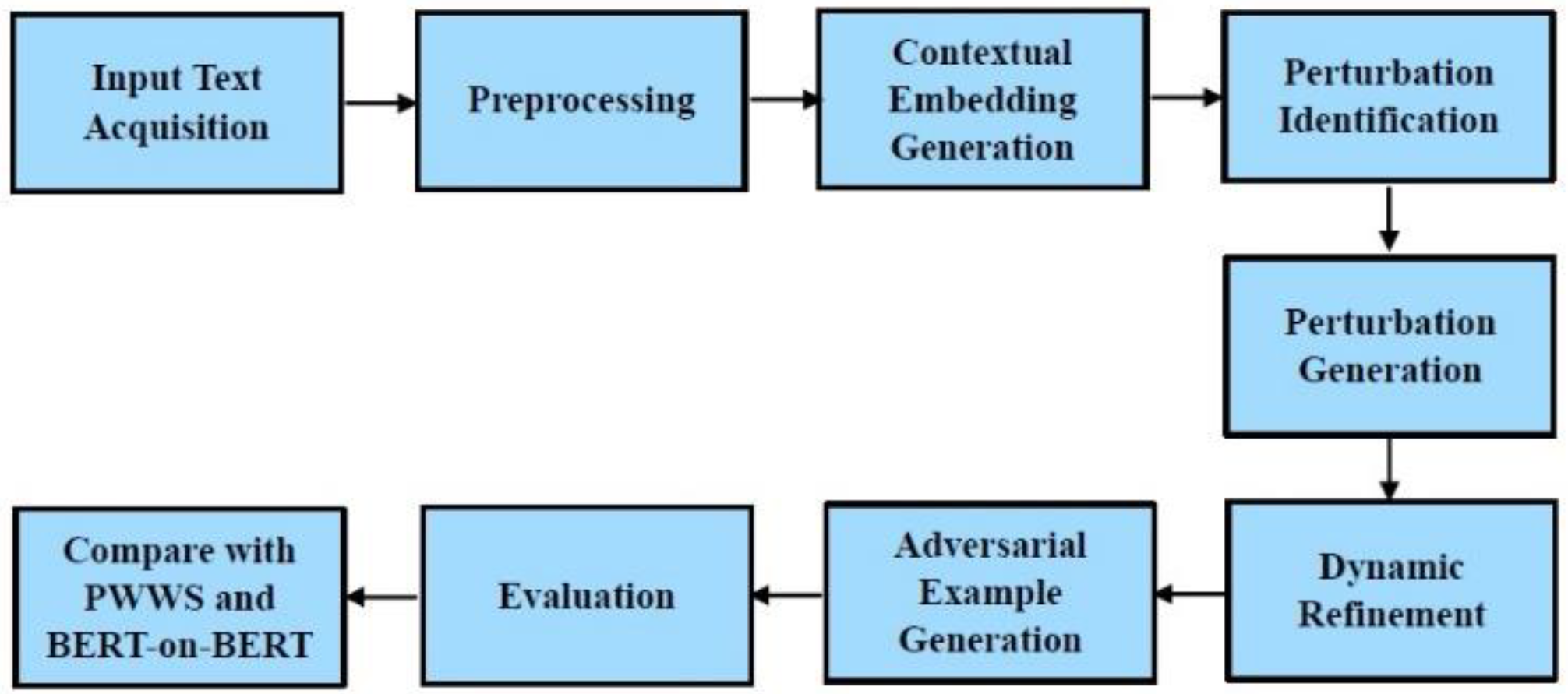
Figure 2.
The classification accuracies and perturbation rates for PWWS and DCP attacks for different models on AG News and IMDB datasets .
Figure 2.
The classification accuracies and perturbation rates for PWWS and DCP attacks for different models on AG News and IMDB datasets .
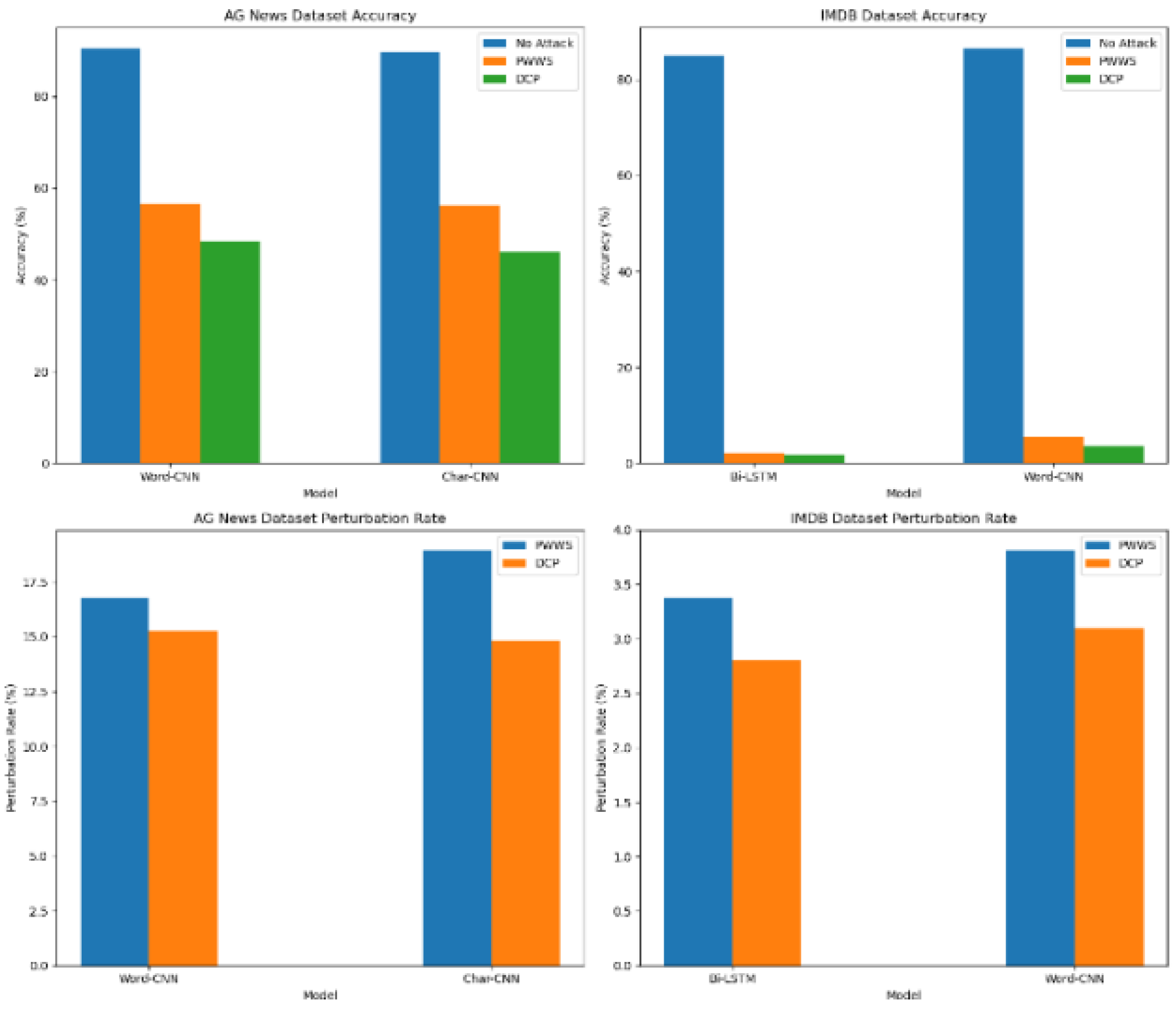
Figure 3.
Classification accuracy and perturbation rate for BERT-on-BERT attack and DCP attack for various datasets for text classification .
Figure 3.
Classification accuracy and perturbation rate for BERT-on-BERT attack and DCP attack for various datasets for text classification .
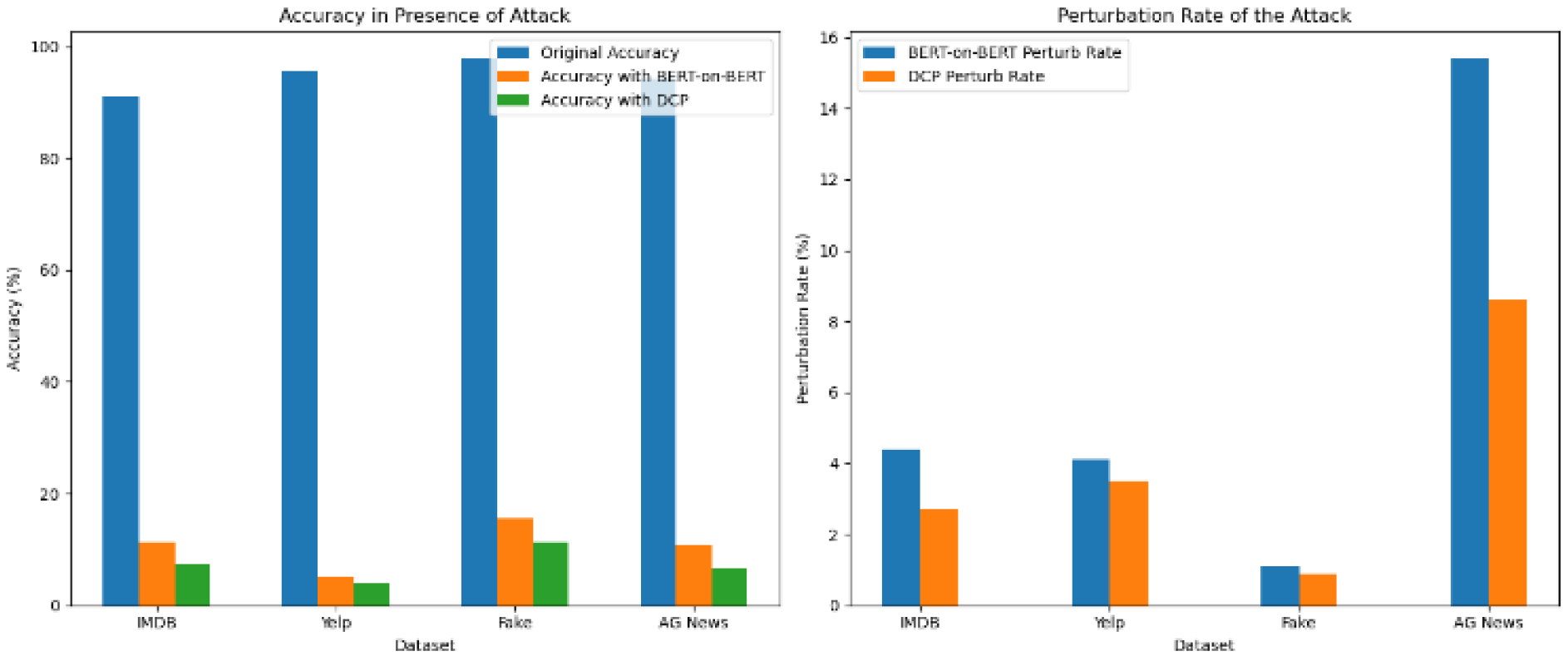
Figure 4.
Number of queries generated and semantic similarity in the texts for BERT-on-BERT and DCP attacks on text classification datasets .
Figure 4.
Number of queries generated and semantic similarity in the texts for BERT-on-BERT and DCP attacks on text classification datasets .
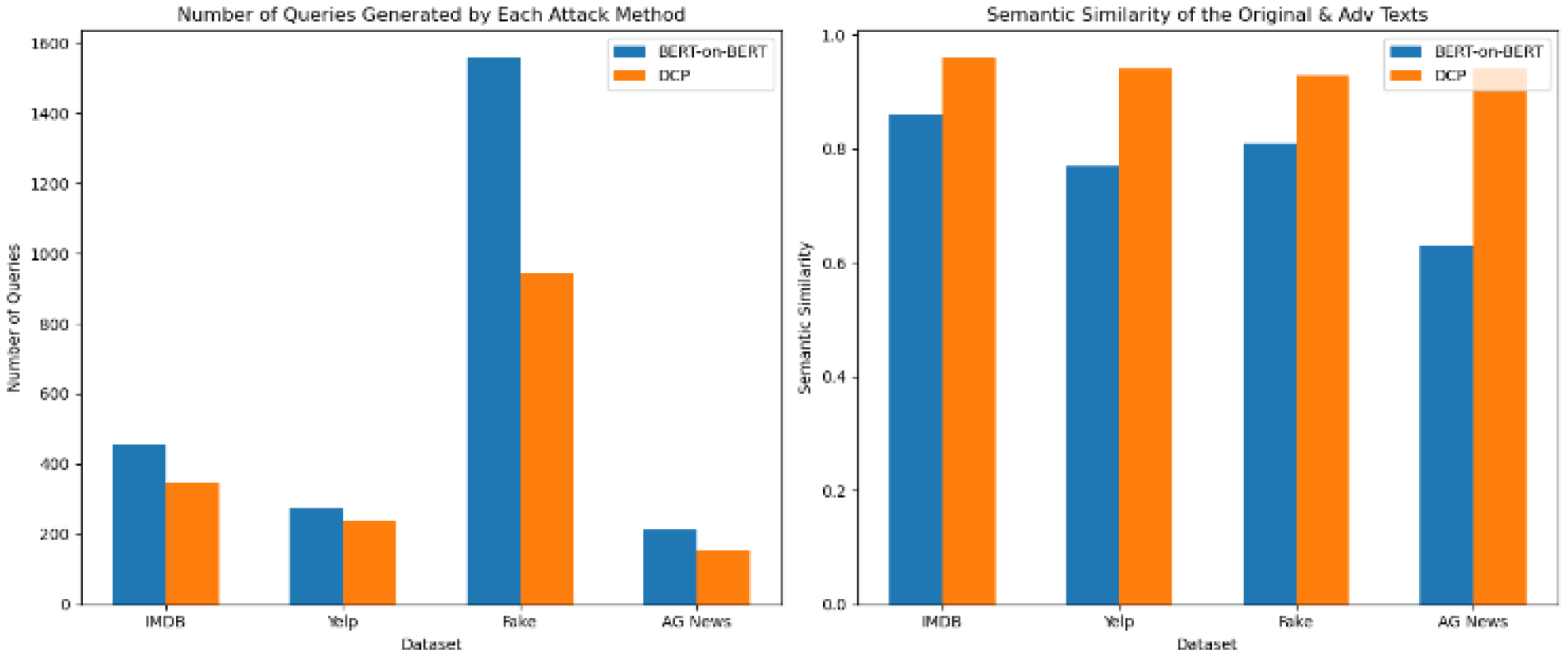
Figure 5.
Accuracy and perturbation rate for BERT-on-BERT and DCP attacks on natural language inference-related datasets.
Figure 5.
Accuracy and perturbation rate for BERT-on-BERT and DCP attacks on natural language inference-related datasets.
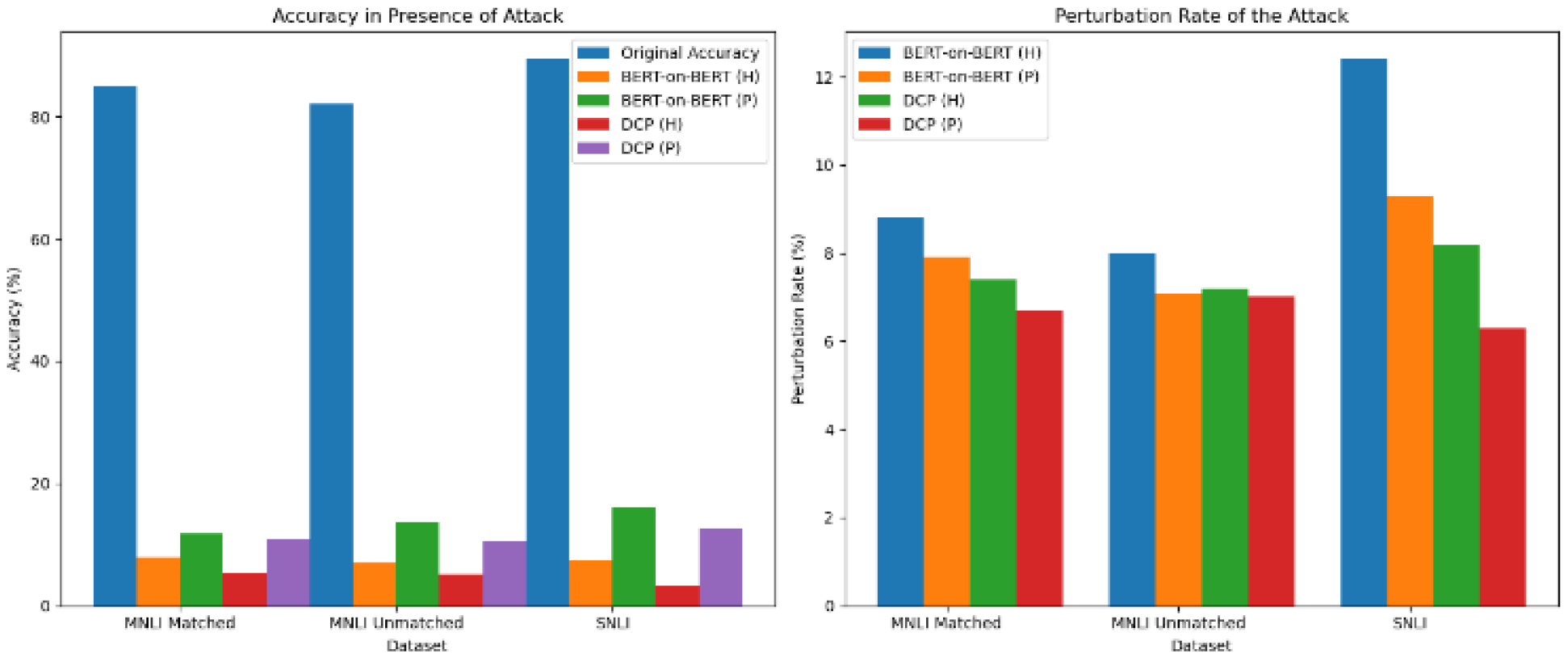
Figure 6.
Attack transferability performance – Accuracy of BERT-on-BERT and DCP attacks on different models.
Figure 6.
Attack transferability performance – Accuracy of BERT-on-BERT and DCP attacks on different models.
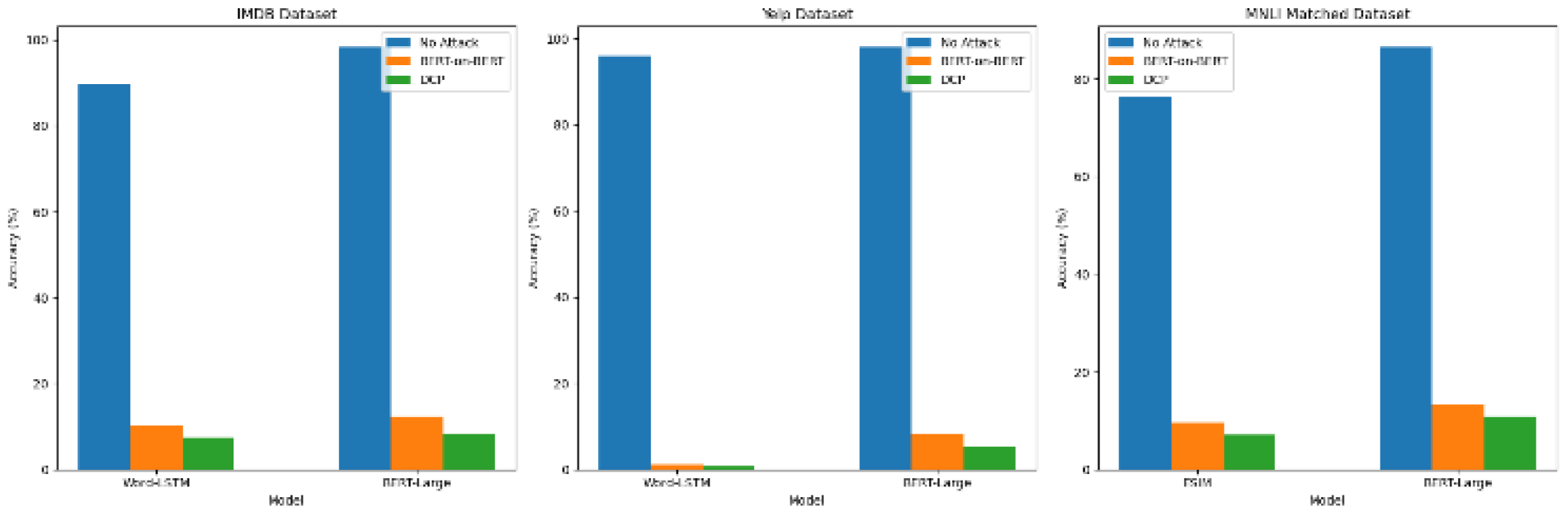

Table 1.
Classification Accuracy in Absence of any Attack and in Presence of PWWS and DCP Attacks for AG News and IMDB.
Table 1.
Classification Accuracy in Absence of any Attack and in Presence of PWWS and DCP Attacks for AG News and IMDB.
| Dataset | Model | Acc in abs of Attack (%) | Acc. under PWWS (%) | Acc. under DCP (%) |
|---|---|---|---|---|
| AG News | Word-CNN | 90.56 | 56.72 | 48.25 |
| Char-CNN | 89.70 | 56.20 | 46.20 | |
| IMDB | Bi-LSTM | 84.86 | 2.20 | 1.75 |
| Word-CNN | 86.55 | 5.50 | 3.60 |
Table 2.
Perturbation Rate of PWWS and DCP Attacks for AG News and IMDB.
| Dataset | Model | Perturb Rate with PWWS (%) | Perturb Rate with DCP (%) |
|---|---|---|---|
| AG News | Word-CNN | 16.76 | 15.25 |
| Char-CNN | 18.93 | 14.80 | |
| IMDB | Bi-LSTM | 3.38 | 2.80 |
| Word-CNN | 3.81 | 3.10 |
Table 3.
Accuracy and Perturbation Rate for BERT-on-BERT and DCP Attacks on Different Datasets for Text Classification.
Table 3.
Accuracy and Perturbation Rate for BERT-on-BERT and DCP Attacks on Different Datasets for Text Classification.
| Dataset | Attack Method | Original Accuracy | Accuracy in Presence of Attack | Perturb Rate of the Attack |
|---|---|---|---|---|
| IMDB | BERT-on-BERT | 90.90 | 11.40 | 4.40 |
| DCP | 7.40 | 2.70 | ||
| Yelp | BERT-on-BERT | 95.60 | 5.10 | 4.10 |
| DCP | 4.05 | 3.50 | ||
| Fake | BERT-on-BERT | 97.80 | 15.50 | 1.10 |
| DCP | 11.4 | 0.90 | ||
| AG News | BERT-on-BERT | 94.20 | 10.60 | 15.40 |
| DCP | 6.70 | 8.60 |
Table 4.
Number of Queries Generated and Semantic Similarity for BERT-on-BERT and DCP attacks on Text Classification Data.
Table 4.
Number of Queries Generated and Semantic Similarity for BERT-on-BERT and DCP attacks on Text Classification Data.
| Dataset | Attack Method | No of Queries | Semantic Similarity |
|---|---|---|---|
| IMDB | BERT-on-BERT | 454 | 0.86 |
| DCP | 347 | 0.96 | |
| Yelp | BERT-on-BERT | 273 | 0.77 |
| DCP | 238 | 0.94 | |
| Fake | BERT-on-BERT | 1558 | 0.81 |
| DCP | 943 | 0.93 | |
| AG News | BERT-on-BERT | 213 | 0.63 |
| DCP | 154 | 0.94 |
Table 5.
Accuracy and Perturbation Rate for BERT-on-BERT and DCP Attacks on Natural Language Inference Datasets.
Table 5.
Accuracy and Perturbation Rate for BERT-on-BERT and DCP Attacks on Natural Language Inference Datasets.
| Dataset | Attack Method | Original Accuracy | Accuracy in Presence of Attack | Perturb Rate of the Attack |
|---|---|---|---|---|
| MNLI Matched | BERT-on-BERT | 85.10 (H/P) | 7.90/11.90 | 8.80/7.90 |
| DCP | 5.30/10.80 | 7.40/6.70 | ||
| MNLI Unmatched | BERT-on-BERT | 82.10(H/P) | 7.00/13.70 | 8.00/7.10 |
| DCP | 5.10/10.60 | 7.20/7.00 | ||
| SNLI | BERT-on-BERT | 89.40 (H/P) | 7.40/16.10 | 12.40/9.30 |
| DCP | 3.20/12.60 | 8.20/6.30 |
Table 6.
Attack Transferability Performance – Accuracy of BERT-on-BERT and DCP Attacks on Different Models.
Table 6.
Attack Transferability Performance – Accuracy of BERT-on-BERT and DCP Attacks on Different Models.
| Dataset | Model | Acc in Absence of Attack | Acc in Presence of BERT-on-BERT | Acc in Presence of DCP |
|---|---|---|---|---|
| IMDB | Word-LSTM | 89.80 | 10.20 | 7.40 |
| BERT-Large | 98.20 | 12.40 | 8.30 | |
| Yelp | Word-LSTM | 96.00 | 1.10 | 0.70 |
| BERT-Large | 97.90 | 8.20 | 5.40 | |
| MNLI Matched | ESIM | 76.20 | 9.60 | 7.20 |
| BERT-Large | 86.40 | 13.20 | 10.80 |
Disclaimer/Publisher’s Note: The statements, opinions and data contained in all publications are solely those of the individual author(s) and contributor(s) and not of MDPI and/or the editor(s). MDPI and/or the editor(s) disclaim responsibility for any injury to people or property resulting from any ideas, methods, instructions or products referred to in the content. |
© 2025 by the authors. Licensee MDPI, Basel, Switzerland. This article is an open access article distributed under the terms and conditions of the Creative Commons Attribution (CC BY) license (http://creativecommons.org/licenses/by/4.0/).
Copyright: This open access article is published under a Creative Commons CC BY 4.0 license, which permit the free download, distribution, and reuse, provided that the author and preprint are cited in any reuse.


