

Submitted:
06 January 2025
Posted:
08 January 2025
You are already at the latest version
Abstract
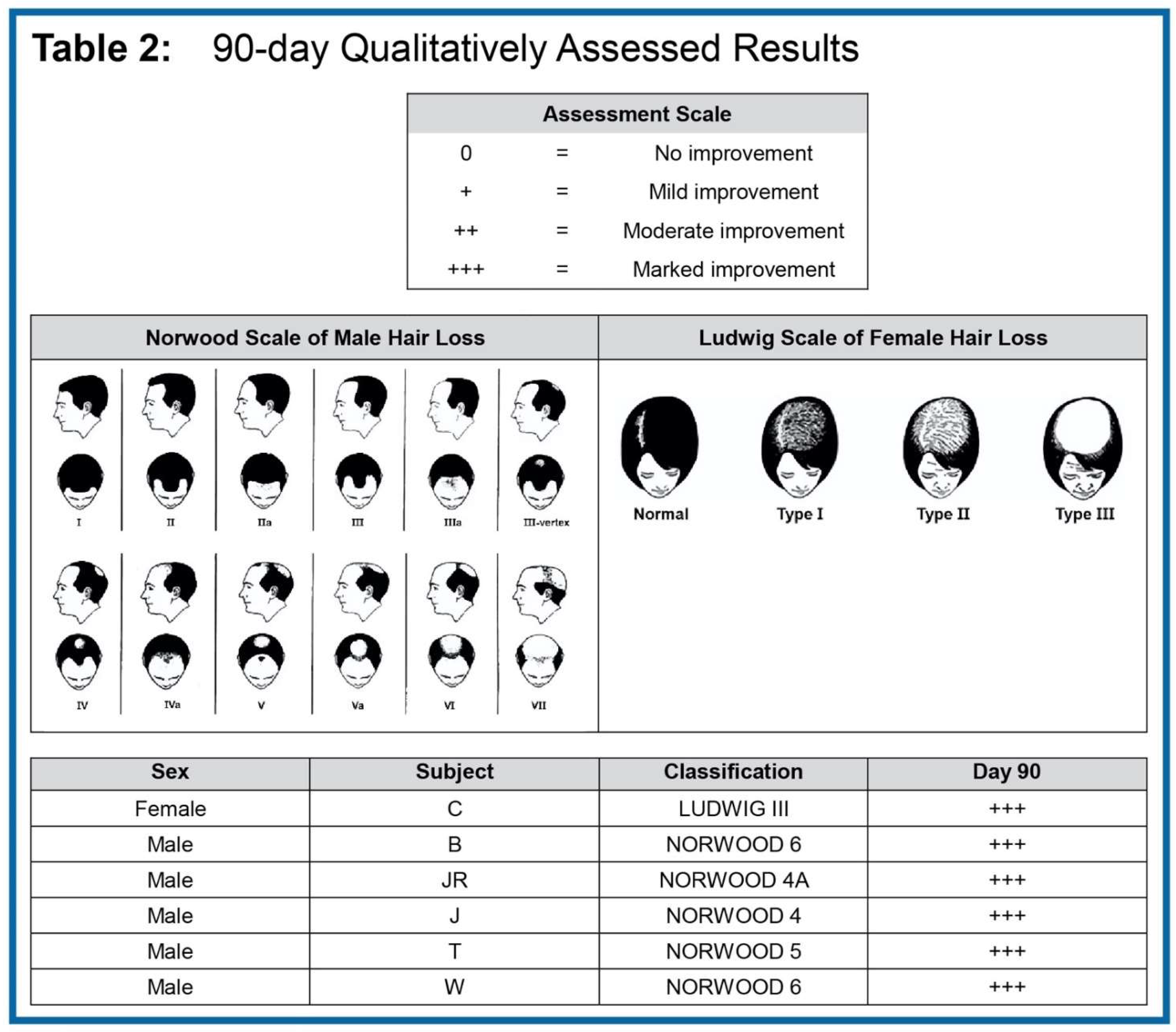
Androgenetic alopecia (AGA) constitutes a progressive, polygenic, heterogenous disorder diagnosed in more than ninety percent of male and female adults presenting with scalp hair loss. While a number of treatment approaches offer limited benefit, a safe, pain free, consistently efficacious regimen remains an elusive goal. In 2020, we reported positive findings arising from a 270-day, clinical study trialing a nano-enabled, botanically-based, oral and topical concomitant regimen dosed in two male subjects with advanced-stage AGA. As follow on to that work, this Case Series report describes unforeseen, highly positive response to therapy observed in five AGA-affected male volunteers and one female AGA-affected volunteer tested with a cryo-carboxy dispensing device. Conceived as an innovative modification, this point-of-service tool delivered a hydrogel solubilized iteration of the previously tested botanical formula topically to the balding scalp of enrolled volunteers, once-weekly. To limit variables, daily use oral and topical iterations of the previously trialed formula were incorporated as concomitants. Originally conceived as a nine-month (270-day) evaluation, quite unexpectedly, by day-90 a profoundly accelerated response to therapy was observed in all subjects involved, most strikingly in those initially presenting with advanced stage phenotype. Eclipsing predicted, best-case scenario endpoint outcomes, results at day-90 were judged sufficiently positive to conclude the experiment 180 days earlier than planned. As the primary hypothesis focused upon the tested device as the critical differentiator, this paper explores the history of cryo and carboxy and considers whether their incorporation into a therapeutic regimen may perhaps introduce novel, value-added utility.
Keywords:
1. Introduction
1.1. Background & Significance
1.2. Botanical Therapy
1.3. Cryo-Carboxy
2. Study Design, Materials and Methods
2.1. Study Participants
2.2. Formulations
2.3. The Test Protocol
2.4. Cryo / Carboxy Device Preparation & Treatment Application
2.5. Measurement of Results
3. Results
3.1. Open Label Clinical Study Patient Experience
3.2. Rapid Clinical Improvement led to Early Study Conclusion
3.3. Qualitative Assessment of Hair Growth
4. Discussion
Supplementary Materials
Author Contributions
Funding
Ethics Statement
Informed Consent Statement
Data Availability Statement
Acknowledgments
Conflicts of Interest
References
- Treatment options for androgenetic alopecia: Efficacy, side effects, compliance, financial considerations, and ethics. M. Nestor, et al. J Cosmet Dermatol. 2021 Dec;20(12):3759-3781.
- Application of nanoparticles in percutaneous delivery of active ingredients in cosmetic preparations. K. Khezri, et al. Biomed Pharmacother. 2018 Oct:106:1499-1505.
- Plant-derived natural products for drug discovery: current approaches and prospects. N. Nasim, et al. Nucleus (Calcutta). 2022 Oct 18;65(3):399–411.
- Inhibition of inflammatory gene expression in keratinocytes using a composition containing carnitine, thioctic acid and saw palmetto extract. S. Chittur, et al. Evid Based Complement Alternat Med. 2011:2011:985345.
- Blockade of Androgen Markers Using a Novel Betasitosterol, Thioctic Acid and Carnitine-containing Compound in Prostate and Hair Follicle Cell-based Assays. L. Chen, et al. Phytother Res. 2016 Jun;30(6):1016-20.
- An Uncontrolled Case Series Using a Botanically Derived, β-Cyclodextrin Inclusion Complex in Two Androgenetic Alopcia- Affected Male Subjects. G. Marcovici & A. Bauman. Cosmetics 2020, 7(3), 65.
- Effect of emotional stress, anesthesia, and death on body temperature of mice exposed to cold. R. G. Bartlett, et al. Proc Soc Exp Biol Med. 1953 May;83(1):4-5.
- Carbon dioxide therapy in the treatment of localized adiposities: clinical study and histopathological correlations. C. Brandi, et al. Aesthetic Plast Surg. 2001 May-Jun;25(3):170-4.
- The Effect of Repeated Whole-Body Cryotherapy on Sirt1 and Sirt3 Concentrations and Oxidative Status in Older and Young Men Performing Different Levels of Physical Activity. G. Wojciak, et al. Antioxidants (Basel). 2020 Dec 31;10(1):37. [CrossRef]
- Tolerability of Six Months Indirect Cold (Physical) Plasma Treatment of the Scalp for Hair Loss. A. Kahn, et al. J Drugs Dmatol. 2020 Dec 1;19(12):1177-1180.
- Study of the efficacy of carboxytherapy in alopecia. N. N. Dogheim, et al. J Cos Derm. Dec. 2018. Vol 17, (6) 945-1294.
- Review of Superficial Cryotherapy for the Treatment of Alopecia Areata. M. Kaiser, et al. JDD. 2023 Aug 1; 22(8) 802.
- An Uncontrolled Case Series Using a Botanically Derived, β-Cyclodextrin Inclusion Complex in Two Androgenetic Alopcia- Affected Male Subjects. G. Marcovici & A. Bauman. Cosmetics 2020, 7(3), 65. [CrossRef]
- https://imagej.net/software/fiji/.
- https://imagej.net/plugins/excel-functions.
- Medication Adherence Measures: An Overview. W. Yin Lam & P. Fresco. Biomed Res Int. 2015 Oct 11;2015:217047.
- Exosomes: The Good, The Bad, and The Ugly. A. Hanyu-Deutmeyer, et al. ASRA Pain Medicine News 2023;48.
- https://www.fda.gov/vaccines-blood-biologics/consumers-biologics/consumer-alert-regenerative-medicine-products- incling- stem-cells-and-exosomes.
- An Uncontrolled Case Series Using a Botanically Derived, β-Cyclodextrin Inclusion Complex in Two Androgenetic Alopcia- Affected Male Subjects. G. Marcovici & A. Bauman. Cosmetics 2020, 7(3), 65. [CrossRef]
- https://imagej.net/learn/.
- Skin Structure, Physiology, and Pathology in Topical and Transdermal Drug Delivery. S. Brito, et al. Pharmaceutics. 2024 Oct 31;16(11).
- Revolutionizing Cosmetic Ingredients: Harnessing the Power of Antioxidants, Probiotics, Plant Extracts, and Peptides in Personal and Skin Care Products. H. Yung Choi, et al. Cosmetics 2024, 11(5), 157. [CrossRef]
- Possible Combinatorial Utilization of Phytochemicals and Extracellular Vesicles for Wound Healing and Regeneration. S Koyama, et al. Int J Mol Sci. 2024 Sep 26;25(19):10353.
- Bioavailability of phytochemicals and its enhancement by drug delivery systems. F. Aqil, et al. Cancer Lett. 2013 Feb 19;334(1):133–141.
- An Uncontrolled Case Series Using a Botanically Derived, β-Cyclodextrin Inclusion Complex in Two Androgenetic Alopcia- Affected Male Subjects. G. Marcovici & A. Bauman. Cosmetics 2020, 7(3), 65. [CrossRef]

 |
 |
Disclaimer/Publisher’s Note: The statements, opinions and data contained in all publications are solely those of the individual author(s) and contributor(s) and not of MDPI and/or the editor(s). MDPI and/or the editor(s) disclaim responsibility for any injury to people or property resulting from any ideas, methods, instructions or products referred to in the content. |
© 2025 by the authors. Licensee MDPI, Basel, Switzerland. This article is an open access article distributed under the terms and conditions of the Creative Commons Attribution (CC BY) license (http://creativecommons.org/licenses/by/4.0/).