

Submitted:
09 December 2024
Posted:
10 December 2024
You are already at the latest version
Abstract
The work is devoted to solving the problem of the tectonic evolution of the Late Paleozoic Altai accretion-collision system (AACS) on the basis of the reconstruction of the thermal history of the granitoids of the Kalba-Narym batholith in connection with the Chechek granite-gneiss structure. Traditionally, it is believed that Late Paleozoic strike-slips played an important role at all stages of the development of the AACS. They were supposed to control tectonic deformations, metamorphism, magmatism and metallogeny. Having collected the new geological and geochronological data, we have established the sequence of formation of the Kalba-Narym granitoid batholith and the Irtysh shear zone (ISZ), which are one of the main geological objects of the Altai accretion-collision system in Eastern Kazakhstan. It was revealed that in the Late Carboniferous–Early Permian (312–289 Ma), within the NE–SW compression, the Irtysh shear zone formed as a gentle thrust structure into which hot gabbroids of the Surov massif intruded. The combined overlaying of magmatic and tectonic processes caused the formation of tectonic melange with cataclastic gabbroids and metamorphic rocks of the Chechen granite-gneiss structure, framed by zones of green shales. Compression caused the formation of a cover-thrust structure. Melting of the thickened heated crust caused the formation of the Early Permian Kalba–Narym batholith (297–284 Ma) and subsequent denudation of the orogen to the Early Triassic (279–229 Ma). The sequence of formation of the Kalba-Narym granitoid batholith and the ISZ is consistent with the concepts of the stages of plume-lithospheric interaction within the AACS under the influence of the Late Carboniferous–Early Permian Tarim igneous province, but in the regime of cover-thrust tectonics.
Keywords:
Eastern Kazakhstan
; Altai accretion-collision system
; thermochronology
; 40Ar/39Ar isotope age
; Kalba-Narym granite batholith
; Irtysh shear zone
; cover-thrust tectonics
1. Introduction
The Late Paleozoic AACS is traditionally distinguished on the territory of Eastern Kazakhstan [1,2,3,4,5,6], which is part of the northern part of the world's largest Central Asian fold belt (CAFB). In many publications, the formation of CAFB is considered as a result of accretion-collision interactions of the Paleo-Asian Ocean plate with the Siberian and Kazakh paleocontinents [1,5,7,8,9,10,11,12,13,14,15,16,17]. The belt contains fold zones of different ages, formed during the Vendian–Paleozoic by successive accretion and collision of island arcs, microcontinents and oceanic uplifts to the Siberian continent. According to another point of view [18,19,20,21,22,23,24,25] in the history of the Paleo-Asian Ocean, there was a single Vendian Paleozoic subduction boundary over which the Kipchak arc formed. During the Paleozoic, due to the drift and rotation of the Siberian and East European continents, deformations of the arc occurred, manifested in the formation of oroclinal bends and large-amplitude strike-slips, which caused numerous repetitions of its fragments. The most important episodes in the formation of the accretion collage are considered to be the dextral Late Carboniferous, and then the lateral Late Permian strike-slips of shear terranes. According to this model, fragments of the Kipchak arc, originally framing the Siberian and East European continents, were combined in the CAFB (Altaids, according to [18]) by the Late Paleozoic.
Recently, the Late Precambrian–Paleozoic collisional and accretionary orogenes have been distinguished in the geodynamic zoning of the CAFB [26,27,28,29,30]. A characteristic feature of collisional orogens is the presence of Precambrian microcontinents of the Gondwana group, when they are absent as part of accretionary orogens. It is believed that they were formed on the southeastern and southwestern convergent boundaries of the Siberian craton, respectively, with the plate of the Paleo-Asian and Paleopacific Oceans. If the listed orogens have been relatively preserved near craton (Altai-Sayan region, Tuva, Mongolia, Transbaikalia), then in the rest of the CAFB their position and relationship are greatly disrupted by Late Paleozoic thrusts and strike-slips. Especially complex structural and material complexes are created by fault tectonics in the AACS.
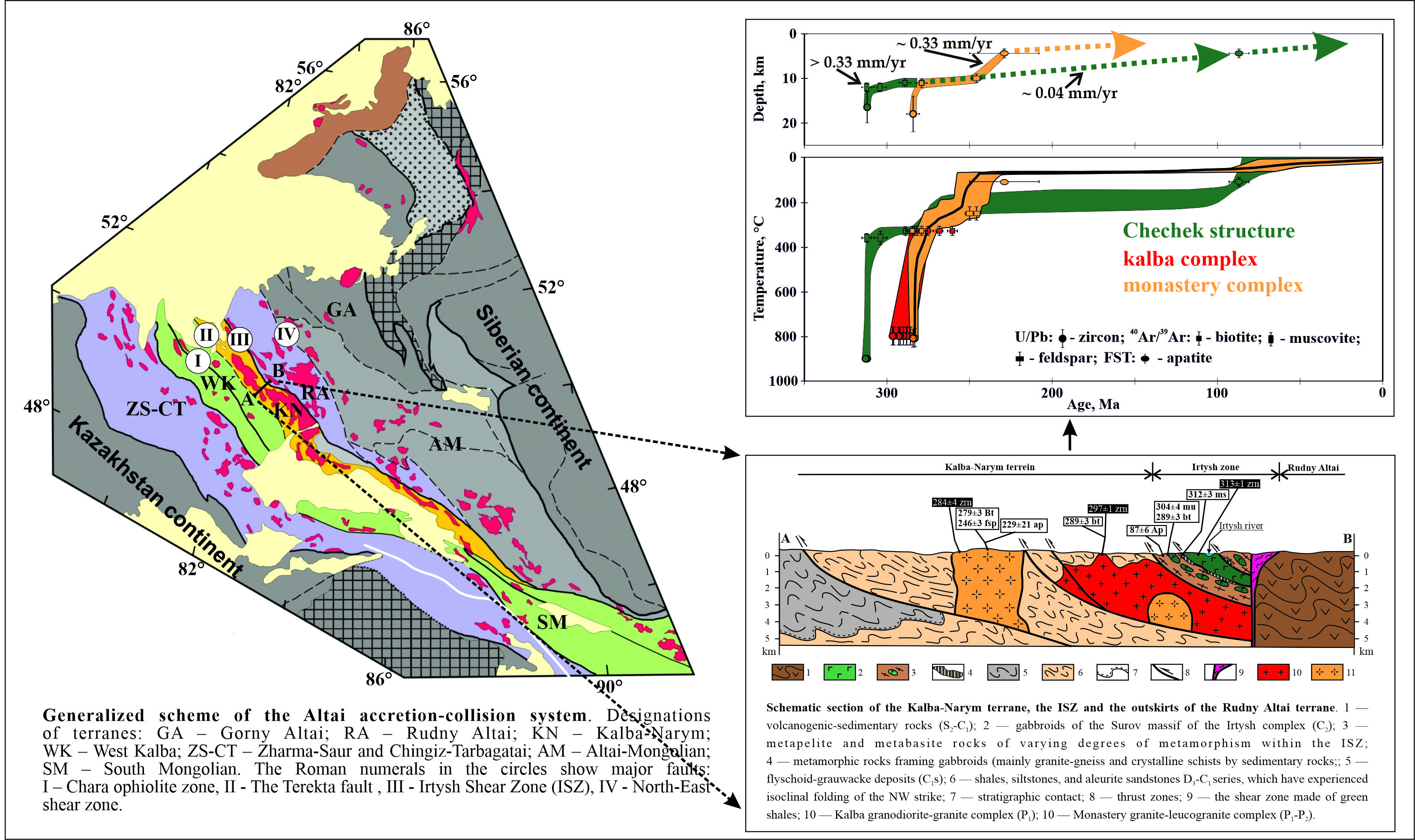
Several large fault zones (shear zones) of the northwestern strike are manifested in the AACS: Chara, Terektinskaya, Irtysh, Northeastern and others, separating relatively large (with a width of many tens to hundreds of km) structural zones (terranes), such as Chingiz-Tarbagatai, Zharma-Saur, Zapadno-Kalbin, Kalba-Narym, Rudny-Altai and Gorny-Altai (Figure 1).
It is believed [1,2,4,5,15,16,17,31,32,33,34,35,36,37,38] that at all stages of the AACS formation, these fault zones manifested mainly in the form of faults that controlled tectonic deformations, metamorphism, magmatism and metallogeny. According to [15,17] the Altai region in the Late Paleozoic–Early Mesozoic was a "hot“ fault system, the formation of which is associated with the interaction of plate and plume tectonic factors. Accretion-collision processes were a structure-forming factor, and the Tarim and Siberian plumes played the role of energy sources that determined the duration and variety of manifestations of mantle and crustal magmatism, the intensity of fault deformations and the specifics of continental crust rocks metamorphism.
If the large Late Paleozoic strike-slips of the northern part of the Central Asian Basin are well studied and characterized [4,27,28,29,32,33,39,40,41,42,43], then the accompanying and (or) preceding covering structures have still been poorly identified [26,41,44]. With a deep erosion section, vertical root zones of both cover and strike-slip structures are usually preserved. This makes it difficult to decipher the structure of the region, especially if faults of different kinematics and age are superimposed on each other. In this case, in addition to detailed structural and material studies of fault zones, thermochronological analysis, especially of igneous and metamorphic rocks, which are usually formed in the root parts of these orogenes, becomes important.
Thermochronological analysis is based on the use of a set of dating methods for minerals characterized by different closing temperatures [45]. Comparing the recorded values of the age of isotope systems with their closing temperatures enables to consistently estimate the depth of rocks (taking into account the average temperature gradient of 25–30°/km) at various time intervals, from their formation and to their output to the Earth's surface as a result of tectonic events.
A comparison of U/Pb dating of zircon, 40Ar/39Ar dating of minerals with different closing temperatures of the K/Ar isotope system (amphibole, mica, feldspar) and Fssion track dating of apatite enables to deduce the thermal history of rocks [46,47,48], which differs in the case of manifestations of thrust and strike-slip structures. The cover structures caused by thrust processes are characterized by a large vertical component of the formation of mountain structures and, as a result, a large gradient on the thermal curve reconstructed based on the closure of the sequence of isotope systems and minerals. For strike-slip structures, this gradient will be much lower, since the vertical component of rock movement will not be high. In other words, the destruction of rock systems of the cover and strike-slip type proceeds at different speeds. Based on this, it can be confidently stated that the thermal history of rocks, for example, granitoid batholiths, containing the largest number of minerals of various closing temperatures of isotope systems, can serve as an independent source of information about the tectonic evolution of fold regions.
Figure 1.
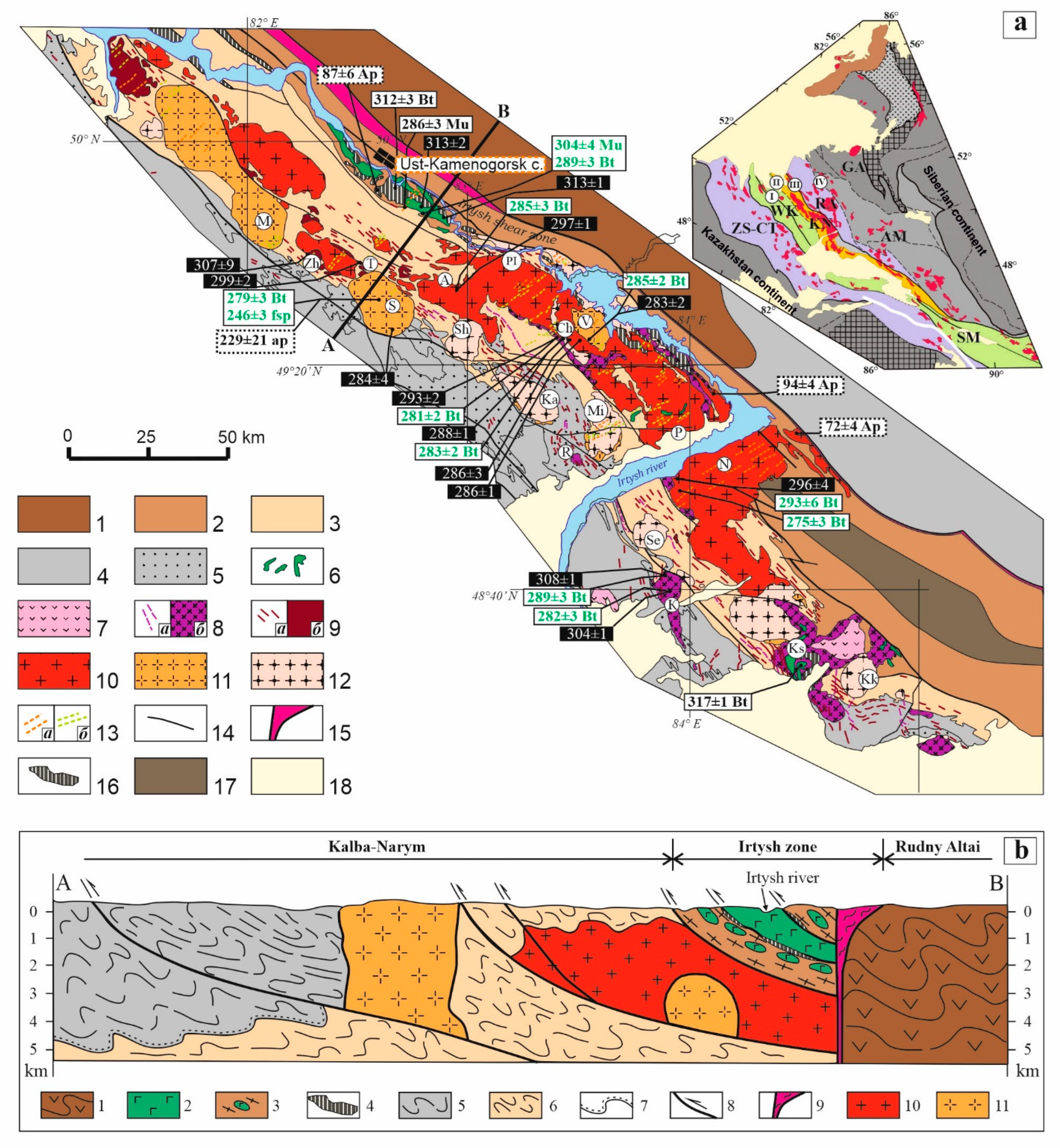
(a) Scheme of the geological structure of the Irtysh shear zone and the Kalba-Narym batholith according to [49]. 1 — volcanogenic-sedimentary rocks of the Rudny Altai terrane (S2-C1); 2 — greenstone rhythmically layered sandstones, siltstones and siliceous rocks of the Kystav-Kurchum suite, D2gv; 3 — rhythmically layered rocks (sandstones, siltstones, clayey carbonaceous shales and rarely siliceous rocks) of the Takyr series, D3-C1; 4 — flyschoid-graywacke deposits of the Dalankara suite, C1s; 5 — polymictic sandstones and siltstones of the molass formation of the Bukon suite, C2; 6 — gabbroids of the Irtysh and Zhanatai complexes; 7 — dacites, rhyodacites, rhyolites of the Saldyrma series, making up the Aktobe and Kalgutin troughs; 8-12 — granitoid rocks of the Early Permian complex of the Kalba-Narym batholith: 8 — Kalgutin granodiorite-granite complex (a — dikes, b — massifs), 9 — Kunush plagiogranite complex (a — dikes, b — massifs), 10 — Kalbinsk granodiorite-granite complex, 11 — Monastery granite-leucogranite complex, 12 — Kainda granite complex; 13 — post-batholith dikes of the Mirolyubov complex (a — granitoid, b — basic); 14 — faults; 15 - zone of the main shear, filled with green schists; 16 - metamorphic rocks around gabbroids (mainly granite-gneisses and crystalline schists on sedimentary rocks); 17 - Paleozoic Kurchum metamorphic complex: crystalline schists, amphibolites; 18 - Quaternary deposits. The numbers in the rectangles are geochronological data (Ma); the black rectangles are U/Pb zircon dating data, white — 40Ar/39Ar mineral dating data (indicated by a solid line) and apatite Fission track dating data (shown by a dashed line). Letters in circles are massifs of the Kalba-Narym batholith: М — Monastery, Zh — Zhilandinsk, T — Tochka, S — Sebinsk, A — Asubulaksk, PI — PriIrtyshsk, Sh — Shibendinsk, Ch — Chernovinsk, V — Voylochevsk, Ka — Kaindinsk, Mi — Mirolyubovsk, R — Razdolnensk, P — Peschansk, N — Narymsk, Se — Sergeevsk, K — Kurchumsk, Ks — Kysylsoransk, Kk — Kemirkainsk. The inset shows a generalized scheme of the Altai accretion-collision system [5 - Vladimirov et al., 2003]. Designations of terranes: GA – Gorny Altai; RA – Rudny Altai; KN – Kalba-Narym; WK – West Kalba; ZS-CT – Zharma-Saur and Chingis-Tarbagatai; AM – Altai-Mongolian; SM – South Mongolian. The Roman numerals in the circles show major faults: I – Char shear zone, II - The Terekta fault , III - Irtysh Shear Zone, IV - North-East Fault. (b) Schematic section of the Kalba-Narym terrane, the Irtysh shear zone and the outskirts of the Rudny Altai terrane. 1 — vol canogenic sedimentary rocks of the Rudny Altai terrane (S2-C1); 2 — gabbroids of the Surov massif of the Irtysh complex (C2); 3 — metamorphic rocks framing gabbroids (mainly granite-gneiss and crystalline schists by sedimentary rocks; 4 —metapelite and metabasite rocks of varying degrees of metamorphism within the ISZ; 5 — flyschoid-grauwacke deposits of the Dalankara formation C1s; 6 — shales, siltstones, and aleurite sandstones of the Takyr D3-C1 series, which have experienced isoclinal folding of the northwestern strike; 7 — stratigraphic contact; 8 — thrust zones; 9 — the shear zone made of green shales; 10 — Kalbinsky granodiorite-granite complex; 10 — Monastery granite-leucogranite complex.
Figure 1.
(a) Scheme of the geological structure of the Irtysh shear zone and the Kalba-Narym batholith according to [49]. 1 — volcanogenic-sedimentary rocks of the Rudny Altai terrane (S2-C1); 2 — greenstone rhythmically layered sandstones, siltstones and siliceous rocks of the Kystav-Kurchum suite, D2gv; 3 — rhythmically layered rocks (sandstones, siltstones, clayey carbonaceous shales and rarely siliceous rocks) of the Takyr series, D3-C1; 4 — flyschoid-graywacke deposits of the Dalankara suite, C1s; 5 — polymictic sandstones and siltstones of the molass formation of the Bukon suite, C2; 6 — gabbroids of the Irtysh and Zhanatai complexes; 7 — dacites, rhyodacites, rhyolites of the Saldyrma series, making up the Aktobe and Kalgutin troughs; 8-12 — granitoid rocks of the Early Permian complex of the Kalba-Narym batholith: 8 — Kalgutin granodiorite-granite complex (a — dikes, b — massifs), 9 — Kunush plagiogranite complex (a — dikes, b — massifs), 10 — Kalbinsk granodiorite-granite complex, 11 — Monastery granite-leucogranite complex, 12 — Kainda granite complex; 13 — post-batholith dikes of the Mirolyubov complex (a — granitoid, b — basic); 14 — faults; 15 - zone of the main shear, filled with green schists; 16 - metamorphic rocks around gabbroids (mainly granite-gneisses and crystalline schists on sedimentary rocks); 17 - Paleozoic Kurchum metamorphic complex: crystalline schists, amphibolites; 18 - Quaternary deposits. The numbers in the rectangles are geochronological data (Ma); the black rectangles are U/Pb zircon dating data, white — 40Ar/39Ar mineral dating data (indicated by a solid line) and apatite Fission track dating data (shown by a dashed line). Letters in circles are massifs of the Kalba-Narym batholith: М — Monastery, Zh — Zhilandinsk, T — Tochka, S — Sebinsk, A — Asubulaksk, PI — PriIrtyshsk, Sh — Shibendinsk, Ch — Chernovinsk, V — Voylochevsk, Ka — Kaindinsk, Mi — Mirolyubovsk, R — Razdolnensk, P — Peschansk, N — Narymsk, Se — Sergeevsk, K — Kurchumsk, Ks — Kysylsoransk, Kk — Kemirkainsk. The inset shows a generalized scheme of the Altai accretion-collision system [5 - Vladimirov et al., 2003]. Designations of terranes: GA – Gorny Altai; RA – Rudny Altai; KN – Kalba-Narym; WK – West Kalba; ZS-CT – Zharma-Saur and Chingis-Tarbagatai; AM – Altai-Mongolian; SM – South Mongolian. The Roman numerals in the circles show major faults: I – Char shear zone, II - The Terekta fault , III - Irtysh Shear Zone, IV - North-East Fault. (b) Schematic section of the Kalba-Narym terrane, the Irtysh shear zone and the outskirts of the Rudny Altai terrane. 1 — vol canogenic sedimentary rocks of the Rudny Altai terrane (S2-C1); 2 — gabbroids of the Surov massif of the Irtysh complex (C2); 3 — metamorphic rocks framing gabbroids (mainly granite-gneiss and crystalline schists by sedimentary rocks; 4 —metapelite and metabasite rocks of varying degrees of metamorphism within the ISZ; 5 — flyschoid-grauwacke deposits of the Dalankara formation C1s; 6 — shales, siltstones, and aleurite sandstones of the Takyr D3-C1 series, which have experienced isoclinal folding of the northwestern strike; 7 — stratigraphic contact; 8 — thrust zones; 9 — the shear zone made of green shales; 10 — Kalbinsky granodiorite-granite complex; 10 — Monastery granite-leucogranite complex.
This article is devoted to the reconstruction of the thermal history of the Late Paleozoic Kalba-Narym batholith, in relation to the manifestation of the Surov gabbroid massif and the Chechek metamorphic complex (granite-gneiss structure), as well as the evolution of the fault tectonics of the ISZ. To solve this problem, the results of U/Pb isotope dating of zircon, 40Ar/39Ar dating of amphibole, biotite and feldspar, and Fission track dating of apatite of the listed geological formations are used. According to the authors of the article, the obtained results can make a significant contribution to solving the global problem of tectonic evolution of the AACS in particular, and global tectonic evolution the CAFB in general.
2. Tectonic setting and geological framework
According to many researchers [1,2,5,6,11,12,15,17] AACS is formed between Siberian and Kazakh paleocontinents. The evolution of the collision system began with the closure in the Early Carboniferous of the Ob-Zaisan Paleo-Oceanic basin with the formation of a scaly cover system. The final formation of the fold structure occurred at the end of the Early Carboniferous (Serpukhov), which is recorded by the appearance of continental molasses deposits of the Bashkir stage with basal conglomerates in separate intermountain depressions. The Late Paleozoic active margin of the Siberian continent corresponds to the Rudny–Altai island-arc system, characterized by Late Silurian–Early Carboniferous volcanogenic sedimentary and granitoid complexes. From the northeast, it is separated by the northeastern shear zone from the Caledonian Gorny–Altai terrane, and from the southwest, through the Irtysh shear zone, it is adjacent to the Kalba-Narym pre-arc turbidite terrane. It is characterized by powerful up to many km of Middle Devonian–Early Carboniferous rhythmically layered rocks (from sandstones to siliceous rocks) of Middle Devonian Kystav-Kurchum Fms. and Late Devonian–Early Carboniferous Takyr Fms., probably of the Rudny–Altai island-arc system [3,11].
The processes of collision interaction between the Siberian and Kazakh continents caused the deformation of volcanogenic sedimentary and sedimentary rocks of the AACS and their compression, close to isoclinal folds of the northwestern strike of the axial planes, inclined generally to the northeast [2,12]. In the Early Permian, granitoids of the Kalba batholith were formed within the Kalba-Narym terrane, and in its marginal part – the ISZ, including the Surov gabbroid massif and the Chechen metamorphic complex (Figure 1). The sequence of development of the Late Paleozoic magmatism of Eastern Kazakhstan, the Kalba batholith, and the Surov massif is consistent with the ideas about the stages of plume-lithospheric interaction during the influence of the Tarim large igneous province to the northwest [17,49,50,51,52,53,54,55,56].
It is believed that large-amplitude strike-slip displacements played an important structural role at all stages of AACS development [4,5,14,15,17,18,20,21,49,57,58] caused by the regime of continental collision. They formed the Chara, Terekta, Irtysh and Northeastern shear zones (Figure 1 and inset Figure 1a). The strike-slips were accompanied, among other things, by less amplitude thrust movements along the feathering faults of the sublatitudinal orientation.
Although the main stages of the geodynamic evolution of the Kalba-Narym, Rudny-Altai terrane and the ISZ zone considered in this article have been generally identified, a number of controversial issues remain. Thus, the role of the ISZ in the formation of the Kalba-Narym granitoid batholith, as well as in its further postmagmatic history, has not been fully clarified. There are still different points of view on the evolution over time of the kinematics of deformations of the ISZ, the relationship between strike-slip and thrust components [4,5,14,15,20,21,57,59,60,61,62,63,64]. There was practically no systematic reconstruction of the cooling history of the granitoid massifs of the Kalba-Narym batholith and the mechanisms of its denudation were not discussed.
3. Geological description of the research area and the Kalba-Narym granitoid batholith
The granitoids of the Kalba-Narym zone, forming one of the largest batholiths in the western Central Asian fold belt, occupy a significant part of the area of the Kalba-Narym terrane (> 10,000 km2). According to geophysical data, the thickness of granitoid massifs ranges from 2 to 12 km with a predominance of 7–10 km [68]. Systematic geological exploration of the Kalba-Narym batholith was conducted until the end of the 80s of the last century due to the development of rare metal deposits (Li-Rb-Cs, Ta-Nb, Sn-W, Au). The result was the creation of several detailed magmatism correlation schemes [2,68,69,70].
In recent years, a large volume of geochemical, isotopic, and geochronological data has been obtained using modern methods for magmatic and metamorphic complexes of the Kalba-Narym terrane [17,49,52,54,65,66].
The granitoid Kalba-Narym batholith includes the Kalgutin granodiorite-granite complex, the Kunush plagiogranite complex, the Kalbа granodiorite-granite complex, the Monastery granite-leucogranite complex. The batholith is broken through by "post-batholith" dikes of the Mirolyubov complex. Also within the Kalba-Narym terrane near Ust-Kamenogorsk are gabbroids of the Surovsk massif of the Priirtysh complex and metaphoric rocks of the Chechek granite-gneiss structure, distinguished as part of the ISZ (Figure 1).
3.1. The Kalguty complex
A few late carboniferous granitoid massifs of the high-Na Kalgutin and high-K Kunush complexes (U/Pb age of zircon formation is 308–300 Ma) are located within the terrane, which are the result of the equilibrium partial melting of crustal substrates of metapelite and metabasite composition under the thermal action of basal magmas [17]. The rocks of the Kalgutin complex are represented by dyke belts of the northwestern strike and separate intrusive massifs concentrated mainly in the southern part of the Kalba-Narym batholith (Figure 1). It includes three phases of intrusions: 1) fine- and medium-grained garnet-biotite and biotite-hornblende granodiorites; 2) fine- and medium-grained biotite-hornblende granites; 3) dyke granite-porphyry granodiorite.
The formation age was determined by the U/Pb method using zircon (303 ± 1 and 308 ± 2 Ma, respectively [17]) for two samples of granodiorites (X-1047 and X-1052) located in the southwestern part of the Kurchum massif terrane (Figure 1a). We determined the 40Ar/39Ar age of biotite at 282 ± 3 and 289 ± 3 Ma, respectively (Table 1 and Table A1, Figure 1 and Figure 5).
3.2. The Kalba complex
The granitoids of the Kalba complex (U-Pb, the age of zircon formation is 297–286 Ma, [49,71]) are the most common among the rocks of the Kalba-Narym batholith (Figure 1). They form large formation-like intrusions with a capacity of up to 4–5 km. The complex consists of three phases: 1) biotite medium- and coarse-grained porphyritic granodiorites and melanocratic granites; 2) biotite medium-grained granites, alternating with biotite and muscovite-biotite fine-grained granites; 3) vein granites, aplites, granite-aplites, granite pegmatites. The vast majority of massifs lack medium or basic intrusive rocks, and the petrogeochemical composition of granitoids corresponds to partial melting of meta-sedimentary substrates [71].
The synchronous manifestation of age-related basite associations clearly indicates the role of mantle magmas in the petrogenesis of granitoids. Rare-metal granite pegmatites are associated with the granitoids of the Kalba complex, forming the largest deposits of rare metals (Ta, Nb, Li, Be, Cs) [72,73,74] and dyke belts of ongonites [67,75].
The biotite age of 40Ar/39Ar was determined in the range of values 288–268 Ma (Table 1 and Table A1, Figure 1 and Figure 5) from granite of the Asubulak massif (Sample X-1056, U/Pb age of zircon formation: 297 ± 1 Ma), granodiorites of the Chernovin massif (sample X-1045, U/Pb age of zircon formation: 297 ± 1 Ma) and granites of Chernovin massif (sample X-1042, U/Pb age of zircon formation: 286 ± 3 Ma; sample X-1044 - 288 ± 1 Ma), granites of the Narym massif (samples 2458, 2463, U/Pb age of zircon formation: 296 ± 4 Ma).
3.3. The Monastery complex
The rocks of the Monastyr complex (U/Pb age of zircon formation is 284–276 Ma) form a chain of large (up to 100 km2) isolated multiphase subisometric intrusions with a concentric-zonal structure, mainly in the southwestern part of the batholith. The scheme of formation of the complex includes: 1) leucocratic double-mica coarse and coarse-grained granites, often porphyritic; 2) leucocratic medium-grained and leucocratic fine-grained double-mica granites; 3) vein granites, aplites, chamber quartz-feldspar pegmatites. The composition of the granitoids of the Monastery complex, unlike the Kalba complex, could be influenced by components brought with juvenile fluids to melting foci, and the source of deep fluids could be a sublithospheric reservoir of magmas of mantle origin [71].
A 40Ar/39Ar biotite age of 285 ± 2 Ma was determined from a sample of leucogranite of the Voylochev massif (X-1041, U/Pb, the age of zircon formation is 283 ± 2 Ma). A 40Ar/39Ar age of biotite (280 ± 2 Ma) and K-feldspar (243 ± 3 Ma) were determined from a sample of leucogranite (KA-14-18) taken in the central part of the Sebin massif (U/Pb age of zircon formation 284 ± 4 Ma) (Table 1 and Table A1, Figure 1 and Figure 5). A detailed petrographic and geochemical study of the samples is given in [49,52].
Apatite tracking dating was performed for three samples of leukogranites of the Sebin massif. The weighted average of the three dates was 229 ± 21 Ma. Based on the distribution of the lengths of the fission tracks in apatite, taking into account the available dating of the rocks of the massif, modeling of the thermal history of the massif was performed using other methods [76].
3.4. The Mirolubov complex
The endogenous activity is completed by intermittent belts of "postbatholith" dykes (U/Pb the age of zircon formation is 286–267 Ma), controlled by the northeastern system of discontinuous faults, attributed to the Mirolyubov complex (Figure 1) [6,68,75]. The complex includes groups of dykes of basic (dolerite), medium (diorite and lamprophyre) and felsic (granodiorite and granite) compositions.
3.5. Gabbroids of the Surov massif and metamorphic rocks of the Chechek granite-gneiss structure
In the marginal part of the Kalba-Narym terrane, within the ISZ, outcrops of gabbroids of the Surov massif are widespread (U/Pb age according to zircon is 313 ± 1 Ma) [54]) and close in age (40Ar/39Ar muscovite age of 312 ± 3 Ma) the complex of deeply metamorphosed rocks of the Chechek granite-gneiss structure [14,65,66]. The joint finding, the close age of the gabbroids of the Surov massif and the metamorphic rocks of the Chechek structure, as well as the features of the structural and material characteristics of granite-gneisses, suggested [54,65,66] that metamorphism manifested itself under the influence of gabbroids introduced during activation of movements within the ISZ. The origin of metamorphic rocks is directly related to the episode of the introduction and formation of the Surov gabbro lopolith, which provided the necessary heating and melting of the overlying strata, and after consolidation (312 ± 3 Ma ago) – reservation and "protection" from late (~280 and ~260 Ma) large-scale shear deformations along the ISZ [65,66].
Based on petrological and geochemical data, it is assumed that the formation of gabbro occurred as a result of partial melting of the depleted mantle under the collisional orogen as a result of the arrival of hot matter from the opened asthenospheric window [54]. The authors suggest that large-scale shear deformations of the Irtysh shear zone played a special role in the occurrence of the asthenospheric window.
The Surov massif is included in the Early Carboniferous Irtish gabbro complex rocks [78,79] intrude Middle Devonian sedimentary rocks (Kystav-Kurchum Fms.). Their contacts are intrusive in large bodies and mainly tectonic in small bodies and on the border with Late Devonian-Early Carboniferous sedimentary rocks (Takyr Fms). The wallrocks along the margins of the largest intrusions are often transformed to high-temperature pyroxene-spinel hornfels. The small bodies gabbro are most often rootless tectonic sheets or boudin-like bodies among metamorphic rocks. Near Ust'-Kamenogorsk city, the Surov gabbro coexist with gneiss and diatectite of the Chechek metamorphic block of epidote-amphibolite to amphibolite facies [65]. The core of the Checheck block consists mainly of granite gneiss and numerous synmetamorphic veins of autochthonous granite. The presence of garnet, sillimanite, and cordierite in granite gneiss, as well as granoblastic and coronite textures, record a prolonged heating effect. Minerals in the center of the Checheck block formed at T = 665–720°С and P = 4–6 kbar, in the upper amphibolite facies conditions. Thus, metamorphism was apparently a consequence of the thermal effect from gabbro [65].
As a result of the expedition work in recent years, we have revealed that in the area of Ust-Kamenogorsk city, the boundary of the Irtysh gabbro complex and the metamorphic rocks of the Chechek complex is represented by a thrust (Figure 2). At its base, there is a zone with a thickness of up to many meters, in which biotite-muscovite shales include lenticular wells of cataclastyc gabbro (Figure 3). Structurally, blastomylonites, crystalline schists and gneisses of metapelite composition (biotite, garnet-biotite, biotite-garnet-sillimanite) and granite-gneisses of the Chechek metamorphic complex are located below. The complex is deformed into dome-shaped folds and pushed over sedimentary rocks of the Takyr formation. In the upper part of the metamorphic complex there are spherical gabbro blocks with a diameter of up to the first meters, in the lower part there are tectonic lenses of sedimentary rocks Kystav–Kurchum Fms, often deformed into folds, including recumbent ones. The thickness of the tectonic lenses reaches 1-2 meters, the length is several meters (Figure 4). The lenses and axial planes of the recumbent folds sink gently to the northeast. The metamorphic rocks of the Chechek complex, taking into account the superimposed dome-shaped folding, are also characterized by a gentle northeastern immersion of the axial planes of the drawing folds and mineral linearity in metamorphic rocks. In general, the metamorphic rocks of the Chechek complex and Surov gabbro should be considered as a tectonic melange formed by the framing of a large hot gabbro body intruded in the thrust structure. The southern cataclased gabbro contact with metamorphic rocks sinks to the north at angles of 40-50°, and the eastern and western contacts are gently sloping to the northeast-east. In places, hot contacts of gabbro and metamorphic rocks have been preserved [54,65,78,79].
Tectonically, above the massive gabbro on the right bank of the Irtysh River, there are also metamorphic rocks (mainly blastomylonites in crystalline shales and granite-gneisses), including low-power bodies of cataclastic gabbro up to the first meters. Even higher are the metamorphic rocks of the green shale facies of metamorphism, formed by Middle Devonian sedimentary rocks (Kystav-Kurchum Fms.). They are characterized by frequent interlayers of low-power siliceous rocks and the mineral linearity of muscovite, manifested along the planes of axial cleavage. The layers are often crumpled into shallow recumbent folds with axial planes and mineral linearity sinking to the northeast and east with angles of 35-10°.
Signs of late left-lateral dislocations are also widely manifested along the ISZ. First of all, they often manifest themselves in Z-shaped folds with vertically plunging hinges. The folds are formed in narrow fault zones represented by green shales, mylonites and blastomylonites from the rocks of the Irtysh metamorphic complex of the epidote amphibolite facies of metamorphism.
The metamorphic shear rocks are most fully represented along the northeastern border of the ISZ on the border with the Rudny Altai terrane (Figure 1, section). In the frontal part of the thrust, the granitoids of the Kalba-Narym batholith are located, embedded in the Middle Devonian sedimentary rocks (Kystav-Kurchum Fms.) (Figure 1).
To substantiate the cover-thrust structure of the Kalba-Narym terrane and, in general, the AACS, we reconstructed the thermal history of the granitoid complexes of the Kalba-Narym batholith using 40Ar/39Ar dating by minerals from granitoids. 11 samples of granitoids of various complexes of the Kalba-Narym batholith were used, which were previously characterized in detail using petrological and geochemical data and for which the age of zircon was determined by the U/Pb method [17,49]. A summary of the dates obtained by us, as well as those obtained earlier by other methods, is shown in Figure 1, in Table 1.
In order to compare the thermal history of the Surov gabbroid massif and the Chechek metamorphic complex with the granitoids of the Kalba-Narym batholith, a zone of tectonic melange near Ust-Kamenogorsk was studied. Monofractions of biotite and muscovite were selected from a sample of cataclased gabbro (sample B-23-146) (Table 1 and Table A1, Figure 1, Figure 3a and Figure 5).

Table 1.
Summary of thermochronological data for granitoids of the Kalba-Narym batholith and the Chechek granite-gneiss structure.
Table 1.
Summary of thermochronological data for granitoids of the Kalba-Narym batholith and the Chechek granite-gneiss structure.
| Sample/Massif | Complex/Rock/Mineral* | Metod** | Age (Ma) | Closure/Formation T (°C)*** | Reference |
| X-1052/Kurchum | Kalguta/granodiorite/zrn | U/PbL | 308±2 | ~850f | [17] |
| Kalguta/granodiorite/bt | 40Ar/39Ar | 289±3 | 330c | This work | |
| X-1047Kurchum | Kalguta/granodiorite/zrn | U/PbL | 303±1 | ~850f | [17] |
| Kalguta/granodiorite/bt | 40Ar/39Ar | 282±3 | 330c | This work | |
| X-1056/Asubulak | Kalba/granite/zrn | U/PbL | 297±1 | ~806f | [49] |
| Kalba/granite/bt | 40Ar/39Ar | 285±2 | 330c | This work | |
| X-1045/Chernovin | Kalba/granodiorite/zrn | U/PbL | 297±1 | ~806f | [49] |
| 40Ar/39Ar | 281±2 | 330c | This work | ||
| X-1042/Chernovin | Kalba/granite/zrn | U/PbL | 286±3 | ~806f | [49] |
| Kalba/granite/bt | 40Ar/39Ar | 268±2 | 330c | This work | |
| Narym | Kalba/granite/zrn | U/PbL | 296±4 | ~806f | [6] |
| 2458 | Kalba/granite/bt | 40Ar/39Ar | 275±3 | 330c | This work |
| 2463 | Kalba/granite/bt | 40Ar/39Ar | 283±3 | 330c | This work |
| X-1044/Chernovin | Kalba/granite/zrn | U/PbL | 288±1 | ~806f | [49] |
| Kalba/granite/bt | 40Ar/39Ar | 282±2 | 330c | This work | |
| X-1041/Voylochev | Monastery/leucogranite/zrn | U/PbL | 283±2 | ~810f | [49] |
| Monastery/leucogranite/bt | 40Ar/39Ar | 285±2 | 330c | This work | |
| 8-03-10/Sebin | Monastery/leucogranite/zrn | U/PbL | 284±4 | ~810f | [49] |
| KA-14-18/Sebin | Monastery/leucogranite/bt | 40Ar/39Ar | 280±2 | 330c | This work |
| Monastery/leucogranite/fsp | 40Ar/39Ar | 243±3 | 250c | This work | |
| KA-21-345KA-21-346KA-21-347/Sebin | Monastery/leucogranite/ap | FST | 229±21 | 110c | [76] |
| X-1414/Surov intrusion | Priirtysh/gabbronorite/ zrn | U/PbL | 313±1 | >900f | [54] |
| X-1207/Surov intrusion | Priirtysh/gabbrodiorite/ zrn | U/PbL | 313±1 | >900f | [54] |
| E-32/Chechek | Chechek/granite-gneiss/ ms | 40Ar/39Ar | 312±3 | 360c | [65] |
| KZ-06/Chechek | Chechek/granite-gneiss/ ap | FST | 87±6 | 110c | [20] |
| B-23-146/Surov intrusion | Chechek/gabbro tectonite/ ms | 40Ar/39Ar | 304±4 | 360c | This work |
| Chechek/gabbro tectonite/ bt | 40Ar/39Ar | 289±3 | 330c | This work |
* The following designations are used in the table: zrn – zircon, ms – muscovite, bt – biotite, fsp – feldspar, ap – apatite. ** U/Pb zircon dating was performed using the ISP laser ablation mass spectrometry method (U/PbL). ***Tc is the closing temperature of the corresponding isotope system; Tf is the temperature of formation of the corresponding mineral phase.
4. Materials and Methods
Minerals for 40Ar/39Ar dating (biotite, muscovite, feldspar) were extracted by the conventional techniques of magnetic and density separation at the V.S. Sobolev Institute of Geology and Mineralogy (Novosibirsk).
40Ar/39Ar dating of monomineral fractions was carried out at the Analytical Center for Multi-element and Isotope Studies (Novosibirsk) as in [46]. Samples were wrapped in aluminum foil together with biotite MCA-11 and OCO 129-88 standard monitor samples, placed in quartz capsules, vacuumed, and sealed. The capsules were irradiated by fast neutrons in a Cd-lined tube of the IRT-T nuclear reactor at the Tomsk Polytechnical University, with a neutron flux gradient no more than 0.5% of the sample size. The samples were exposed to external stepwise heating in a quartz tube. The 40Ar and 36Ar blank runs (10 min at 1200 °С) did not exceed 3 × 10⁻¹⁰ and 0.003 × 10⁻¹⁰ ncm3, respectively. Argon cleaning was performed using ZrAl-SAES getters. The argon isotope composition was measured on a Micromass Noble Gas 5400 mass spectrometer (UK), to an accuracy of ± 1σ. The contribution of interfering Ar isotopes formed together with 39Ca and 40K was estimated using the coefficients of (39Ar/37Ar)Ca = 0.001279 ± 0.000061, (36Ar/37Ar)Ca = 0.000613 ± 0.000084 and (40Ar/39Ar)K = 0.0191 ± 0.0018. The plateau ages were calculated in Isoplot-3 [80], as weighted average values over at least three successive temperature steps. The results were interpreted with reference to the conventional criteria [81].
5. Results
5.1. 40. Ar/39Ar dating
In the 40Ar/39Ar spectra of almost all analyzed mineral fractions (Table 1A, Figure 5), an age plateau corresponding to the accepted criteria is observed [81].
In the high-temperature part of the spectra of biotites X-1041 (leucogranite of the Voylochev massif), X-1042 (granite of the Chernovin massif), X-1047 (granodiorite of the Kurchum massif), a plateau of three or more successive stages is observed, the proportion of which is less than the accepted value of 60% of the 39Ar released. We believe that in such cases, the value of the high-temperature plateau corresponds to the age of closure of the isotope system of the mineral, and the presence of a plateau in the low-temperature part indicates a complex thermal history of the rock. This may be due to prolonged cooling, or superimposed heating.
Figure 5.
40Ar/39Ar age spectra.
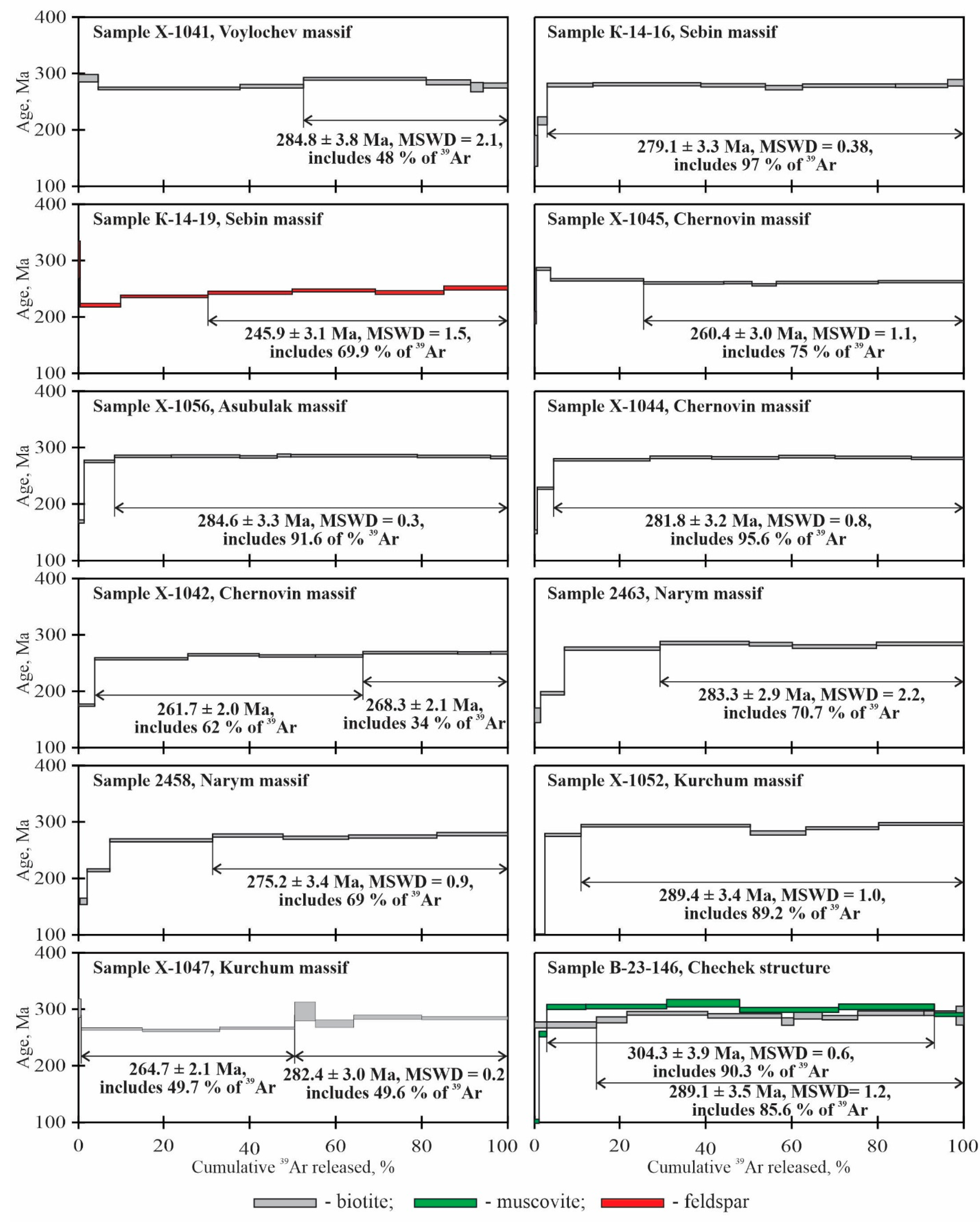
The reason for this heating could be the belts of "postbatolite" dikes (age 286-267 Ma) attributed to the Mirolyubov complex (Figure 1) [6].
When comparing the obtained and published age data for the granitoid complexes of the Kalba-Narym batholith and the Chechek metamorphic complex, it can be noted (Table 1, Figure 1) that for each of the studied objects, the measured age correlates with the stability of isotope systems, decreasing in the series U/Pb for zircon => 40Ar/39Ar for muscovite => 40Ar/39Ar for biotite => 40Ar/39Ar for feldspar => fission track age for apatite. This sequence is an independent confirmation of the assumption that the 40Ar/39Ar datings obtained correspond to the closing time of their K/Ar isotope system [45].
5.2. Thermochronology
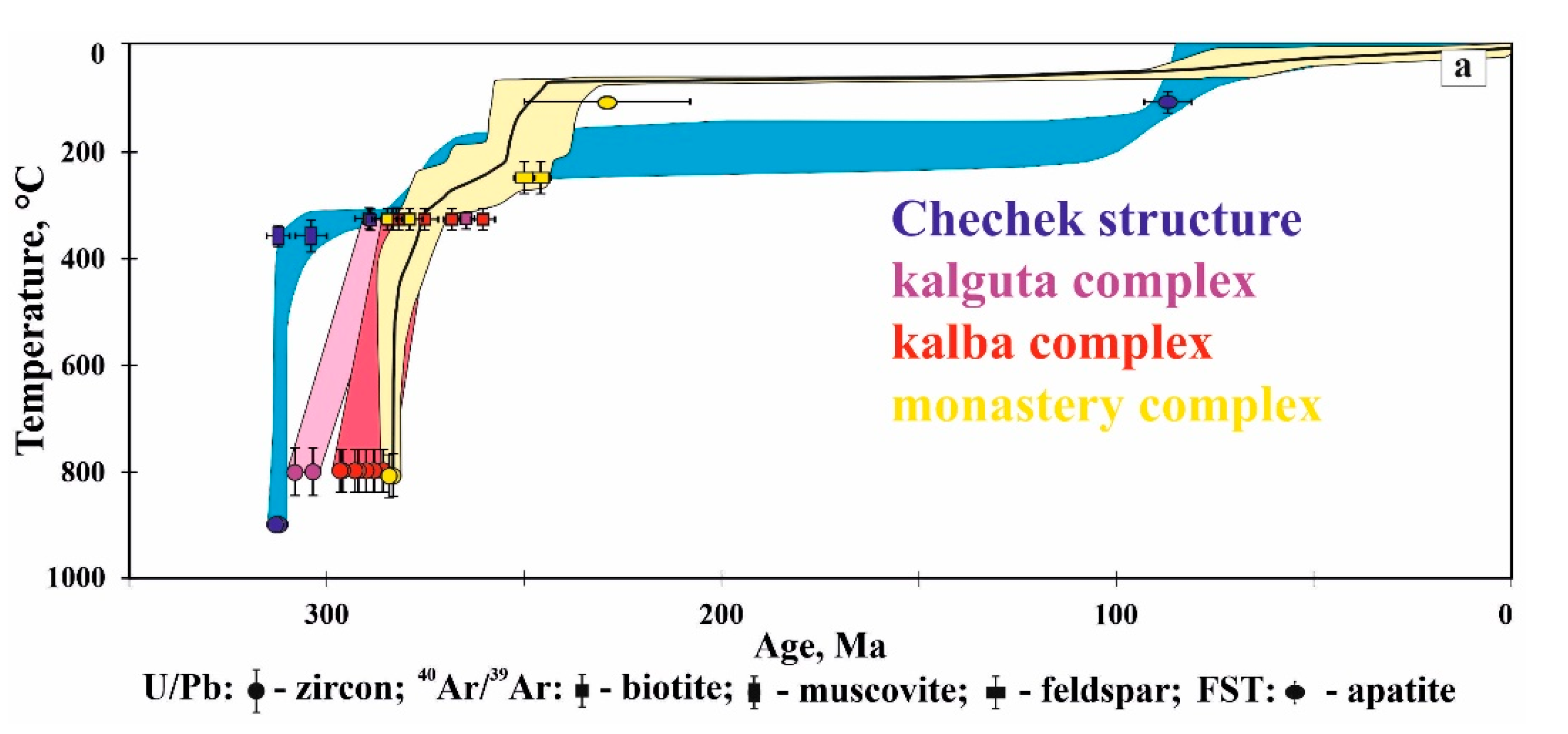
Summary information on the dating of the granitoid complexes of the Kalba-Narym batholith and the Chechek metamorphic complex (Table 1) is shown in the thermochronological diagram (Figure 6a). Each dating corresponds to the value of the closing temperature of the isotope system (Tc) or the formation (Tf) of the corresponding mineral phase, and in the case of U/Pb dating by zircon, the rocks as a whole.
Let's consider the thermal history of the studied objects in the order of their formation.
5.2.1. The Chechek granite-gneiss structure and the Surov gabbro
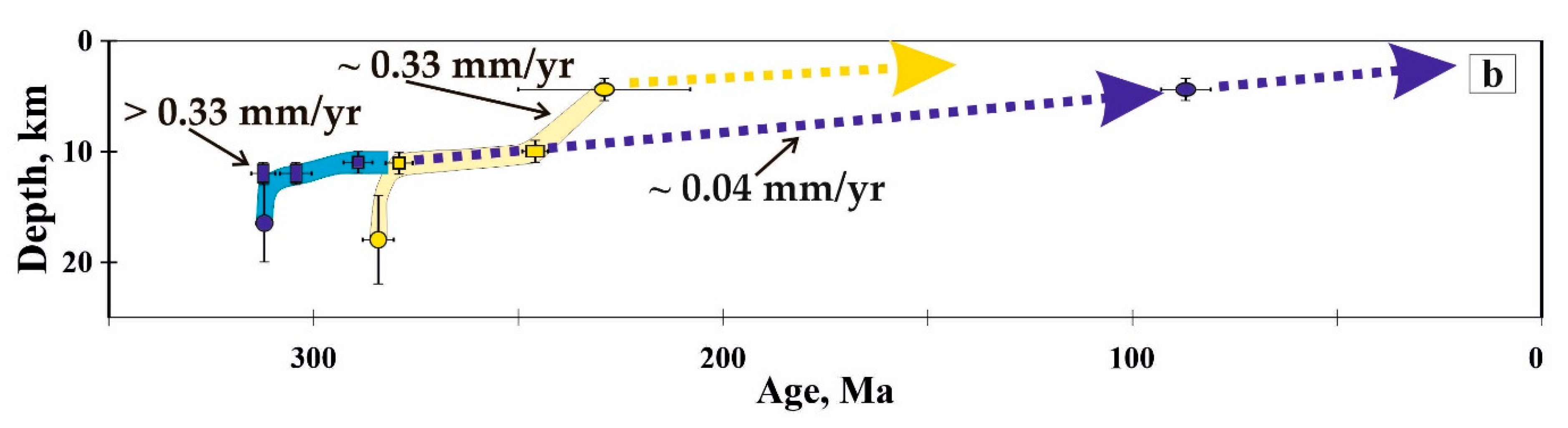
The formation of the Chechek metamorphic rocks based on U/Pb zircon dating data occurred 313 ± 1 Ma ago simultaneously with the introduction of the Gabbro Surov massif [54]. At the same time, estimates of the conditions of metamorphism of samples taken at various sites of the structure are T = 665-720 ° C, P = 4-6 kbar [65]. This corresponds to depths of 13-20 km, with an average of 16 km (Figure 6b).
Considering that for muscovite from the Chechek metamorphic complex an age of 312 ± 3 Ma was obtained by the 40Ar/39Ar method [65], consistent with the age of gabbro (313 ± 1 Ma [54]), it should be assumed that the rocks were jointly located at this time at the closure depth of the muscovite isotope system (Tc~ 330 °C) [45]. At a thermal gradient of 30-25°/km, this corresponds to a depth of 11-13 km (Figure 6b). A close age (304 ± 4 Ma) was obtained by us from muscovite from the zone of tectonic melange at the southwestern contact of rocks of the Surov gabbroid massif (Figure 3a). The closure of the biotite isotope system from the same sample at 289 ± 3 Ma, corresponding to depths of 10-11 km, occurred 15 Ma later. Thus, the maximum vertical amplitude of 5-6 km over a period of 15 Ma is characterized by the rise of rocks of the Chechek metamorphic complex immediately after formation.
A fairly rapid rise with an erosion rate significantly exceeding 0.33 mm/year could be caused by intense tectonic processes, as we assume, associated with the formation of a cover-thrust structure. For example, a study of the denudation rate of the Longmen Shan Ridge [82], located on the eastern edge of the Tibetan Plateau and characterized by steep terrain and a rate of horizontal contraction of up to 3 mm/year, derived denudation rates from 0.15 to 0.5 mm/year. The highest rates of exhumation and denudation are localized in the hanging walls of large thrusts, emphasizing the role of tectonic structures in regulating the nature of denudation and topography throughout the Longmen Shan range.
Figure 6.
(a) Thermochronological history of the Kalba-Narym Batholith granitoids and Chechek structure. The points corresponding to the Chechek structure (blue), the Kalguty complex (cherry), the Kalba complex (red) and the Monastery (yellow) granitoid complexes are highlighted in color. The sources of the dates are given in the Table. 1. (b) Reconstruction of the depth history for rocks of the Chechek metamorphic complex and the Sebin leucogranite massif. The comments are given in the text.
Figure 6.
(a) Thermochronological history of the Kalba-Narym Batholith granitoids and Chechek structure. The points corresponding to the Chechek structure (blue), the Kalguty complex (cherry), the Kalba complex (red) and the Monastery (yellow) granitoid complexes are highlighted in color. The sources of the dates are given in the Table. 1. (b) Reconstruction of the depth history for rocks of the Chechek metamorphic complex and the Sebin leucogranite massif. The comments are given in the text.
5.2.2. Granitoid massifs of the Kalguta and Kalba complexes.
The granitoid massifs of the Kalguta and Kalba complexes were formed in the early Permian (U/Pb zircon age - 297-286 Ma). Closure of the biotite isotope system in them (Chernovin, Asubulak, Narym massifs, Figure 1a) occurred in a narrow age range of 275-289 Ma. For individual samples, an intermediate plateau with an age of 261-265 Ma is recorded in the low-temperature part of the spectrum. As noted above, this can be explained by the thermal effect of the dikes of the mirolyubov complex on the isotope system of biotite. The close ages of zircon and biotite formation in the range of 297-286 Ma indicate that granitoid massifs were formed at depths of no more than 11-13 km, at which their cooling led to the closure of the biotite isotope system (Tc~ 330 °C) [45].
5.2.3. Granitoid massifs of the Monastery complex.
The most complete set of dates obtained by various methods characterizes the leucogranites of the Sebin massif. 40Ar/39Ar biotite dating from a leucogranite sample (279 ± 3 Ma) taken in the central part of the massif (Figure 1a) is consistent with the age of formation (284 ± 4 Ma) within the error. It follows that 279 Ma ago, the rocks of the Sebin massif turned out to be at a depth of 10-13 km, approximately at the same level with the rocks of the early granitoid complexes and the Chechek metamorphic rocks.
Dating by feldspar (246 ± 3 Ma) from leucogranite in the central part of the massif is 33 Ma younger, and apatite (229 ± 21 Ma [76]) is 50 Ma younger. Taking into account the closing temperatures of the isotope systems of feldspar and apatite [45], it can be assumed that in the period 243-229 Ma the rocks of the Sebin massif experienced a rise from 10-11 km to 4 km at a rate of about 0.3 mm/year. Such a speed could only be provided by high denudation, probably associated with cover-thrust tectonic processes.
6. Discussion
The evolution of the CAFB, the largest fold belt in the world, includes a long history of the formation of Late Neoproterozoic–Paleozoic orogens along the border of the Siberian continent. In the Late Paleozoic, the closure of oceanic basins and the collision of the Eastern European and Siberian continents occurred. The process of tectonic transition from subduction to collision in this vast territory, characterized by the formation of cover-thrust and shear structures, is still poorly understood, with the exception, perhaps, of the Chinese Altai Orogen.
The Chinese Altai orogen, on the border of which the southeastern extension of the ISZ is located with the East-West Junggarian terrane, is a continuation to the south of the Gorny-Altai terrane. The East-West Junggarian terrane is a continuation to the south of the Kalba-Narym terrane (Figure 1). In the Chinese Altai orogen, a variety of publications [60,63,83] prove the Late Paleozoic transition from subduction to Late Carboniferous collisional high-temperature metamorphism and Early Permian granite magmatism [84,85]. It was revealed [63] that in the Late Carboniferous (322-295 Ma) there was a thickening of the orogen, the formation of thrust and high-temperature collision metamorphism, including the ISZ, associated with the collision of the Chinese Altai orogen with the East Junggarian terrane within the NE-SW compression. Then there was a stretching of the orogen (295–283 Ma), which could be responsible for the high thermal gradient and the development of widespread Early Permian magmatism. It was followed by a transpression event (folding and lateral strike-slip) (283–253 Ma) associated with the oblique convergence of the Chinese Altai orogen with the Eastern Junggarian terrane through the ISZ. It is recorded by 40Ar/39Ar dating of syn-strike-slip hornblende and biotite [61,86].
For the AACS, we have obtained new geological and geochronological data that well substantiate the manifestation of Late Carboniferous–Early Permian cover-thrust tectonics and related manifestations of magmatism (Kalba-Narym batholith) and metamorphism within the ISZ. It is shown that in the area of Ust’-Kamenogorsk, the Late Carboniferous Surov gabbro complex and Checheck metamorphic rocks are located in a cover-thrust structure deformed into dome-shaped folds. It was formed as a result of the general NE-SW compression, which is also characteristic of the Chinese Altai. Metamorphic rocks form a tectonic melange by the framing of a large hot gabbro body embedded in the thrust structure. Tectonically higher are the metamorphic rocks of the green shale facies of metamorphism, formed by Middle Devonian sedimentary rocks (Kystav-Kurchum Fms.). They are characterized by shallow recumbent folds with axial planes and mineral linearity sinking to the northeast and east at angles of 35–10°, which also indicates a regional NE–SW compression of the region. As a result of the formation of the cover-thrust structure, volcanogenic sedimentary and sedimentary rocks of the AACS are everywhere compressed, close to isoclinal, folds of the northwestern strike of axial planes inclined also to the northeast and east [2,12].
The ISZ is located between the Late Silurian–Early Carboniferous formations of the Altai active margin (Rudny-Altai terrane) and the Middle Devonian–Early Carboniferous turbidites of the pre-arc trough (Kalba-Narym terrane) and probably represents a fragment of the transition zone from subduction to collision, limited by strike-slips. Lateral strike-slip displacements within the studied region are manifested in Z-shaped folds with vertically sinking hinges formed in narrow fault zones represented by green shales, mylonites and blastomylonites from rocks of the Checheck metamorphic complex of the epidote-amphibolite facies of metamorphism. Lateral strike-slip displacements are most fully developed on the border of the ISZ with the Rudny–Altai terrane and are an object for further detailed study.
The thermochronological reconstruction (Figure 6a) carried out by us for the Checheck metamorphic rocks and the Kalba-Narym batholith indicates the manifestation of a large Late Carboniferous–Middle Triassic (312–229 Ma) tectonic stage, as a result of which the rocks were eroded and brought to the surface. Thus, the Checheck metamorphic rocks characterizing the zone of complete tectonic melange in the Late Carboniferous–Early Permian (312–289 Ma) were brought to the surface at a denudation rate of about 0.33 mm/year. The most complete set of dates obtained by various methods characterizes the leucogranites of the Sebin massif of the monastery complex of the Kalba-Narym batholith. It was found that during the Middle Permian-Middle Triassic (279-229 Ma), the leucogranites of the massif experienced a rise from depths of 10-11 km to 4 km with an average velocity of about 0.1 mm/year. At the same time, if based on the results of 40Ar/39Ar dating of feldspar and Fission track dating of apatite, in the range of 250-230 Ma years ago, the rate of ascent was about 0.3 mm/year. Such high denudation rates (0.1–0.33 mm/year) may be associated with the cover-thrust processes forming the high-altitude relief.
7. Conclusions
The ISZ is located between the Late Silurian–Early Carboniferous formations of the Altai active margin (Rudny-Altai terrane) and the Middle Devonian–Early Carboniferous turbidites of the pre-arc trough (Kalba-Narym terrane) and is probably a fragment of the transition zone from subduction to collision, limited by strike-slips. As a result of new geological and geochronological data, the sequence of the AACS formation in the Kalba-Narym terrane has been established. In the Carboniferous–Early Permian (312–289 Ma), within the NE–SW compression, the ISZ was formed as a gentle thrust structure, into which hot gabbroids of the Irtysh complex (Surov massif and others) intruded. The combined manifestation of magmatic and tectonic processes caused the formation of tectonic melange with cataclastic gabbroids and metamorphic rocks, framed by zones of green shales. As a result of compression, a cover-thrust structure was formed with the participation of Middle Devonian–Early Carboniferous turbidites, the melting of the thickened crust of which caused the formation of the Early Permian Kalba-Narym batholith (297–284 Ma) and subsequent denudation of the created orogen to the Early Triassic (279–229 Ma). The sequence of AACS formation in the Kalba-Narym terrane is consistent with the concepts of plume-lithospheric interaction under the influence of the Late Carboniferous–Early Permian Tarim igneous province.
Author Contributions
writing an article, preparation of drawings, literary review, study of the Chechek granite-gneiss structure and sampling - A.V. Travin and M.M. Buslov; study of magmatic complexes of the Kalba-Narym terrane and the Checek granite-gneiss structure, sampling, participation in the writing of the article – S.V. Khromykh, P.D. Kotler; the study of the Sebin massif of the monastery complex, sampling, 40Ar/39Ar dating, thermochronological interpretation of the data obtained, participation in the writing of the article – N.G. Murzintsev; study of the Chechek granite-gneiss structure, selection, study of samples and preparation for 40Ar/39Ar dating, participation in the preparation of the article – V.D. Zindobriy.
Funding
The study was supported by the Russian Science Foundation (grant No. 22-17-00038, thermochronology) and was carried out on government assignment to the V.S. Sobolev Institute of Geology and Mineralogy (Projects No 122041400057-2 and No 122041400071-5).
Conflicts of Interest
The authors declare no conflict of interest.
Appendix A
Table A1.
40Ar/39Ar data for minerals from the samples of the Kalba-Narym batholith and the Chechek granite-gneiss structure.
Table A1.
40Ar/39Ar data for minerals from the samples of the Kalba-Narym batholith and the Chechek granite-gneiss structure.
| T0C |
40Ar (cm3 STP) |
40Ar/39Ar ± 1σ | 38Ar/39Ar ± 1σ | 37Ar/39Ar ± 1σ | 36Ar/39Ar ± 1σ | Ca/K |
∑39Ar (%) |
Age (Ma) ±1σ |
40Ar* (%) |
| SampleX-1041 biotite, weight 4.95 mg, J = 0.004528± 0.000054*,plateau age (850-1100ºС) = 284.8 ± 3.8 Ma (1σ) | |||||||||
| 500 | 390.5 | 57.3 ± 0.3 | 0.01922 ± 0.00520 | 0.00002 ± 0.00002 | 0.00021 ± 0.00436 | 0.0001 | 4.6 | 291.7 ± 6.6 | 99.9 |
| 650 | 2617.0 | 53.4 ± 0.1 | 0.00770 ± 0.00035 | 0.00008 ± 0.00003 | 0.00001 ± 0.00083 | 0.0003 | 37.6 | 273.5 ± 2.4 | 100.0 |
| 750 | 1191.1 | 54.2 ± 0.1 | 0.01199 ± 0.00168 | 0.04209 ± 0.00460 | 0.00001 ± 0.00169 | 0.1515 | 52.4 | 277.6 ± 3.2 | 100.0 |
| 850 | 2415.3 | 57.0 ± 0.1 | 0.00001 ± 0.00035 | 0.00026 ± 0.00250 | 0.00001 ± 0.00069 | 0.0009 | 81.0 | 290.6 ± 2.4 | 100.0 |
| 950 | 853.8 | 55.7 ± 0.2 | 0.00523 ± 0.00211 | 0.00009 ± 0.00007 | 0.00014 ± 0.00272 | 0.0003 | 91.3 | 284.2 ± 4.4 | 99.9 |
| 1025 | 234.8 | 54.0 ± 0.3 | 0.00049 ± 0.00007 | 0.00027 ± 0.00031 | 0.00044 ± 0.00554 | 0.0010 | 94.3 | 275.8 ± 8.2 | 99.8 |
| 1100 | 461.2 | 54.3 ± 0.1 | 0.00826 ± 0.00263 | 0.00107 ± 0.00002 | 0.00033 ± 0.00149 | 0.0039 | 100.0 | 277.4 ± 3.0 | 99.8 |
| SampleKA-14-16 biotite, weight 52.01 mg, J = 0.004528± 0.000054*,plateau age (720-1130ºС) = 279.1 ± 3.3 Ma (1σ) | |||||||||
| 500 | 22.5 | 43.8 ± 0.7 | 0.05938 ± 0.02329 | 16.63285 ± 7.78847 | 0.06168 ± 0.01523 | 59.9 | 0.7 | 162.8 ± 27.5 | 58.4 |
| 610 | 97.2 | 59.8 ± 0.3 | 0.05926 ± 0.00630 | 3.99485 ± 2.93448 | 0.08588 ± 0.00393 | 14.4 | 3.0 | 216.0 ± 7.2 | 57.6 |
| 720 | 371.4 | 48.0 ± 0.1 | 0.01561 ± 0.00161 | 1.73254 ± 0.60034 | 0.00884 ± 0.00130 | 6.3 | 13.6 | 279.6 ± 3.4 | 94.6 |
| 800 | 844.9 | 46.4 ± 0.1 | 0.01708 ± 0.00025 | 0.01537 ± 0.15000 | 0.00280 ± 0.00051 | 0.1 | 38.8 | 280.9 ± 2.7 | 98.2 |
| 850 | 509.1 | 46.7 ± 0.1 | 0.01585 ± 0.00100 | 0.14254 ± 0.38051 | 0.00485 ± 0.00090 | 0.5 | 53.8 | 279.1 ± 3.0 | 96.9 |
| 920 | 296.8 | 47.4 ± 0.1 | 0.02001 ± 0.00191 | 1.82078 ± 1.74010 | 0.00974 ± 0.00179 | 6.5 | 62.4 | 274.9 ± 3.9 | 93.9 |
| 1020 | 730.9 | 46.6 ± 0.1 | 0.01493 ± 0.00108 | 0.02376 ± 0.30843 | 0.00487 ± 0.00091 | 0.1 | 84.1 | 278.5 ± 3.0 | 96.9 |
| 1080 | 416.8 | 47.3 ± 0.1 | 0.01827 ± 0.00208 | 2.03645 ± 0.75456 | 0.00751 ± 0.00130 | 7.3 | 96.2 | 278.2 ± 3.4 | 95.3 |
| 1130 | 131.2 | 48.0 ± 0.1 | 0.01356 ± 0.00322 | 3.15342 ± 1.56345 | 0.00651 ± 0.00311 | 11.3 | 100.0 | 283.6 ± 5.9 | 96.0 |
| SampleKA-14-19 feldspar, weight 125.67 mg, J = 0.004528± 0.000054*,plateau age (825-1130ºС) = 245.9 ± 3.1 Ma (1σ) | |||||||||
| 500 | 16.9 | 65.7 ± 1.7 | 0.02802 ± 0.02545 | 1.26424 ± 3.96484 | 0.05341 ± 0.01919 | 4.5 | 0.4 | 301.8 ± 32.4 | 76.0 |
| 625 | 240.2 | 40.0 ± 0.1 | 0.01436 ± 0.00227 | 0.56055 ± 0.24672 | 0.01465 ± 0.00147 | 2.0 | 9.8 | 220.7 ± 3.2 | 89.2 |
| 725 | 524.4 | 40.4 ± 0.1 | 0.01805 ± 0.00072 | 0.40446 ± 0.24077 | 0.00672 ± 0.00034 | 1.5 | 30.1 | 236.5 ± 2.2 | 95.1 |
| 825 | 517.4 | 41.2 ± 0.1 | 0.01845 ± 0.00062 | 0.35746 ± 0.18756 | 0.00590 ± 0.00109 | 1.3 | 49.8 | 243.0 ± 2.9 | 95.8 |
| 925 | 515.0 | 41.7 ± 0.1 | 0.01629 ± 0.00125 | 0.31492 ± 0.28741 | 0.00517 ± 0.00078 | 1.1 | 69.1 | 246.9 ± 2.6 | 96.3 |
| 1025 | 429.3 | 42.0 ± 0.1 | 0.01733 ± 0.00101 | 0.69472 ± 0.04437 | 0.00849 ± 0.00136 | 2.5 | 85.1 | 243.2 ± 3.2 | 94.0 |
| 1130 | 405.6 | 42.7 ± 0.1 | 0.01868 ± 0.00158 | 1.80304 ± 0.54957 | 0.00575 ± 0.00157 | 6.5 | 100.0 | 251.4 ± 3.5 | 96.0 |
| SampleX-1045 biotite, weight 9.86 mg, J = 0.004528± 0.000054*,plateau age (750-1100ºС) = 260.4 ± 3.0 Ma (1σ) | |||||||||
| 500 | 91.0 | 45.9 ± 0.3 | 0.06044 ± 0.01423 | 3.80707 ± 0.18499 | 0.02491 ± 0.00748 | 13.70 | 0.4 | 198.8 ± 11.0 | 84.0 |
| 600 | 965.2 | 55.2 ± 0.1 | 0.02026 ± 0.00145 | 0.25325 ± 0.02180 | 0.00471 ± 0.00109 | 0.91 | 3.7 | 285.2 ± 2.6 | 97.5 |
| 700 | 6005.1 | 53.1 ± 0.1 | 0.01943 ± 0.00024 | 0.03393 ± 0.00338 | 0.00196 ± 0.00053 | 0.12 | 25.4 | 266.0 ± 2.1 | 98.9 |
| 750 | 5037.7 | 51.8 ± 0.1 | 0.01511 ± 0.00008 | 0.01110 ± 0.00074 | 0.00174 ± 0.00058 | 0.04 | 44.1 | 260.3 ± 2.1 | 99.0 |
| 800 | 1765.3 | 51.7 ± 0.1 | 0.01582 ± 0.00033 | 0.00828 ± 0.00220 | 0.00083 ± 0.00035 | 0.03 | 50.6 | 260.9 ± 2.0 | 99.5 |
| 900 | 1522.2 | 51.4 ± 0.1 | 0.01543 ± 0.00024 | 0.02381 ± 0.00194 | 0.00268 ± 0.00046 | 0.09 | 56.3 | 257.1 ± 2.0 | 98.5 |
| 1025 | 6418.3 | 51.9 ± 0.1 | 0.01449 ± 0.00008 | 0.00698 ± 0.00046 | 0.00123 ± 0.00054 | 0.02 | 80.1 | 261.2 ± 2.1 | 99.3 |
| 1100 | 5418.4 | 52.1 ± 0.1 | 0.01400 ± 0.00009 | 0.00207 ± 0.00067 | 0.00106 ± 0.00031 | 0.01 | 100.0 | 262.6 ± 2.0 | 99.4 |
| SampleX-1056 biotite, weight 71.5 mg, J = 0.004528± 0.000054*,plateau age (650-1130ºС) = 284.6 ± 3.3 Ma (1σ) | |||||||||
| 500 | 71.2 | 42.3 ± 0.1 | 0.02143 ± 0.00369 | 0.14170 ± 0.01263 | 0.03549 ± 0.00165 | 0.51 | 1.3 | 169.0 ± 2.8 | 75.2 |
| 600 | 531.1 | 58.4 ± 0.1 | 0.01791 ± 0.00040 | 0.02686 ± 0.00165 | 0.01668 ± 0.00036 | 0.10 | 8.4 | 275.7 ± 2.1 | 91.6 |
| 650 | 961.7 | 56.8 ± 0.1 | 0.01561 ± 0.00020 | 0.00895 ± 0.00096 | 0.00504 ± 0.00026 | 0.03 | 21.6 | 284.7 ± 2.2 | 97.4 |
| 700 | 1151.4 | 56.1 ± 0.1 | 0.01555 ± 0.00018 | 0.00523 ± 0.00080 | 0.00246 ± 0.00023 | 0.02 | 37.6 | 285.1 ± 2.2 | 98.7 |
| 750 | 623.5 | 55.7 ± 0.1 | 0.01624 ± 0.00013 | 0.01362 ± 0.00144 | 0.00220 ± 0.00056 | 0.05 | 46.3 | 283.5 ± 2.3 | 98.8 |
| 850 | 229.2 | 55.9 ± 0.1 | 0.01740 ± 0.00110 | 0.02538 ± 0.00314 | 0.00093 ± 0.00096 | 0.09 | 49.5 | 286.1 ± 2.5 | 99.5 |
| 975 | 2125.4 | 56.2 ± 0.1 | 0.01544 ± 0.00008 | 0.01527 ± 0.00029 | 0.00235 ± 0.00025 | 0.05 | 78.9 | 285.7 ± 2.2 | 98.8 |
| 1050 | 1223.3 | 55.9 ± 0.1 | 0.01539 ± 0.00019 | 0.03660 ± 0.00062 | 0.00218 ± 0.00032 | 0.13 | 96.0 | 284.4 ± 2.2 | 98.9 |
| 1130 | 288.9 | 56.0 ± 0.1 | 0.01608 ± 0.00041 | 0.15098 ± 0.00084 | 0.00354 ± 0.00061 | 0.54 | 100.0 | 282.7 ± 2.3 | 98.1 |
| SampleX-1044 biotite, weight 71.5 mg, J = 0.004528± 0.000054*,plateau age (650-1130ºС) = 284.6 ± 3.3 Ma (1σ) | |||||||||
| 500 | 19.0 | 39.2 ± 0.2 | 0.02941 ± 0.00265 | 0.40784 ± 0.01722 | 0.03673 ± 0.00212 | 1.47 | 0.6 | 150.7 ± 3.5 | 72.3 |
| 600 | 140.4 | 49.1 ± 0.1 | 0.01934 ± 0.00098 | 0.09718 ± 0.00144 | 0.01826 ± 0.00049 | 0.35 | 4.4 | 227.9 ± 1.9 | 89.0 |
| 700 | 934.6 | 55.3 ± 0.1 | 0.01565 ± 0.00017 | 0.02390 ± 0.00042 | 0.00370 ± 0.00018 | 0.09 | 26.9 | 278.5 ± 2.1 | 98.0 |
| 775 | 599.7 | 55.7 ± 0.1 | 0.01575 ± 0.00028 | 0.01383 ± 0.00187 | 0.00173 ± 0.00053 | 0.05 | 41.2 | 282.9 ± 2.3 | 99.1 |
| 875 | 658.0 | 56.0 ± 0.1 | 0.01646 ± 0.00041 | 0.03710 ± 0.00134 | 0.00374 ± 0.00039 | 0.13 | 56.9 | 281.6 ± 2.2 | 98.0 |
| 975 | 554.3 | 56.2 ± 0.1 | 0.01502 ± 0.00032 | 0.04986 ± 0.00169 | 0.00263 ± 0.00030 | 0.18 | 70.0 | 284.0 ± 2.2 | 98.6 |
| 1050 | 749.2 | 55.9 ± 0.1 | 0.01536 ± 0.00033 | 0.07133 ± 0.00117 | 0.00257 ± 0.00016 | 0.26 | 87.8 | 282.8 ± 2.1 | 98.6 |
| 1130 | 512.0 | 56.0 ± 0.1 | 0.01504 ± 0.00023 | 0.19017 ± 0.00162 | 0.00416 ± 0.00035 | 0.68 | 100.0 | 281.0 ± 2.2 | 97.8 |
| SampleX-1042 biotite, weight 5.81 mg, J = 0.004528± 0.000054*,plateau age (900-1100ºС) = 268.3 ± 2.1 Ma (1σ) | |||||||||
| 500 | 500.0 | 40.8 ± 0.1 | 0.02330 ± 0.00072 | 0.03415 ± 0.00579 | 0.02496 ± 0.00101 | 0.12 | 3.8 | 175.4 ± 2.0 | 81.9 |
| 600 | 3636.3 | 51.4 ± 0.1 | 0.01567 ± 0.00013 | 0.00354 ± 0.00103 | 0.00405 ± 0.00027 | 0.01 | 25.5 | 257.6 ± 2.0 | 97.7 |
| 675 | 2827.7 | 52.2 ± 0.1 | 0.01543 ± 0.00016 | 0.00801 ± 0.00123 | 0.00160 ± 0.00049 | 0.03 | 42.1 | 264.6 ± 2.1 | 99.1 |
| 800 | 2231.2 | 52.3 ± 0.1 | 0.01390 ± 0.00019 | 0.01403 ± 0.00131 | 0.00352 ± 0.00030 | 0.05 | 55.2 | 262.6 ± 2.0 | 98.0 |
| 900 | 1910.8 | 53.0 ± 0.1 | 0.01665 ± 0.00019 | 0.01726 ± 0.00161 | 0.00566 ± 0.00048 | 0.06 | 66.3 | 262.6 ± 2.1 | 96.8 |
| 1000 | 3810.1 | 53.0 ± 0.1 | 0.01522 ± 0.00012 | 0.01699 ± 0.00119 | 0.00161 ± 0.00053 | 0.06 | 88.3 | 268.5 ± 2.2 | 99.1 |
| 1050 | 1336.5 | 53.3 ± 0.1 | 0.01608 ± 0.00029 | 0.04024 ± 0.00315 | 0.00296 ± 0.00036 | 0.14 | 96.0 | 268.2 ± 2.1 | 98.4 |
| 1100 | 698.2 | 53.8 ± 0.1 | 0.02001 ± 0.00074 | 0.20121 ± 0.00596 | 0.00454 ± 0.00075 | 0.72 | 100.0 | 268.4 ± 2.3 | 97.5 |
| Sample2463 biotite, weight 21.75mg, J = 0.004528± 0.000054*,plateau age (900-1130ºС) = 283.3 ± 2.9 Ma (1σ) | |||||||||
| 500 | 30.0 | 33.3 ± 0.2 | 0.02120 ± 0.02120 | 0.08281 ± 0.01910 | 0.03934 ± 0.00628 | 0.2981 | 1.4 | 157.4 ± 13.0 | 65.2 |
| 600 | 124.5 | 35.0 ± 0.1 | 0.02333 ± 0.02333 | 0.02432 ± 0.00227 | 0.02595 ± 0.00105 | 0.0876 | 7.0 | 196.5 ± 2.9 | 78.2 |
| 700 | 603.9 | 42.3 ± 0.1 | 0.02018 ± 0.02018 | 0.01386 ± 0.00076 | 0.01009 ± 0.00041 | 0.0499 | 29.3 | 275.7 ± 2.9 | 93.0 |
| 800 | 578.4 | 43.5 ± 0.1 | 0.02021 ± 0.02021 | 0.01265 ± 0.00103 | 0.00903 ± 0.00053 | 0.0455 | 50.0 | 285.7 ± 3.1 | 93.9 |
| 900 | 278.7 | 43.2 ± 0.1 | 0.02146 ± 0.02146 | 0.02131 ± 0.00300 | 0.00928 ± 0.00077 | 0.0767 | 60.1 | 283.5 ± 3.2 | 93.7 |
| 1000 | 542.6 | 43.3 ± 0.1 | 0.02125 ± 0.02125 | 0.02368 ± 0.00146 | 0.01160 ± 0.00082 | 0.0852 | 79.6 | 279.2 ± 3.3 | 92.1 |
| 1130 | 564.7 | 43.3 ± 0.1 | 0.01970 ± 0.01970 | 0.07923 ± 0.00085 | 0.00912 ± 0.00028 | 0.2852 | 100.0 | 284.2 ± 2.9 | 93.8 |
| Sample2458 biotite, weight 39.8 mg, J = 0.004528± 0.000054*,plateau age (800-1130ºС) = 275.2 ± 3.4 Ma (1σ) | |||||||||
| 500 | 72.6 | 33.2 ± 0.1 | 0.02810 ± 0.00232 | 0.06164 ± 0.00328 | 0.03617 ± 0.00272 | 0.22 | 1.7 | 159.5 ± 5.7 | 67.8 |
| 600 | 257.9 | 37.1 ± 0.1 | 0.02130 ± 0.00044 | 0.02316 ± 0.00169 | 0.02176 ± 0.00069 | 0.08 | 7.0 | 214.4 ± 2.6 | 82.7 |
| 700 | 1329.7 | 42.3 ± 0.1 | 0.01945 ± 0.00012 | 0.01324 ± 0.00040 | 0.01173 ± 0.00020 | 0.05 | 31.0 | 267.5 ± 2.7 | 91.8 |
| 800 | 939.7 | 43.7 ± 0.1 | 0.01900 ± 0.00022 | 0.01347 ± 0.00059 | 0.01176 ± 0.00020 | 0.05 | 47.5 | 276.0 ± 2.8 | 92.1 |
| 900 | 863.0 | 43.1 ± 0.1 | 0.01906 ± 0.00018 | 0.01866 ± 0.00060 | 0.01204 ± 0.00031 | 0.07 | 62.8 | 272.1 ± 2.8 | 91.8 |
| 1000 | 1175.2 | 43.5 ± 0.1 | 0.01941 ± 0.00014 | 0.01991 ± 0.00042 | 0.01220 ± 0.00009 | 0.07 | 83.4 | 274.2 ± 2.7 | 91.7 |
| 1130 | 954.1 | 44.1 ± 0.1 | 0.01902 ± 0.00023 | 0.11439 ± 0.00069 | 0.01178 ± 0.00026 | 0.41 | 100.0 | 278.5 ± 2.8 | 92.1 |
| SampleX-1052 biotite, weight 3.3 mg, J = 0.004528± 0.000054*,plateau age (850-1100ºС) = 289.4 ± 3.4 Ma (1σ) | |||||||||
| 500 | 20.9 | 62.2 ± 1.3 | 0.05037 ± 0.02094 | 0.87014 ± 0.18577 | 0.19526 ± 0.02100 | 3.132 | 0.6 | 24.4 ± 32.6 | 7.4 |
| 600 | 57.1 | 50.7 ± 0.2 | 0.03431 ± 0.00644 | 0.14209 ± 0.06394 | 0.11289 ± 0.00382 | 0.511 | 2.4 | 91.7 ± 5.8 | 34.3 |
| 700 | 294.1 | 58.4 ± 0.1 | 0.02949 ± 0.00139 | 0.05529 ± 0.01259 | 0.01127 ± 0.00136 | 0.199 | 10.8 | 276.5 ± 2.8 | 94.3 |
| 850 | 1430.0 | 60.3 ± 0.1 | 0.01715 ± 0.00023 | 0.02236 ± 0.00224 | 0.00558 ± 0.00032 | 0.080 | 50.3 | 293.0 ± 2.2 | 97.3 |
| 950 | 469.1 | 60.4 ± 0.1 | 0.01869 ± 0.00086 | 0.10875 ± 0.00882 | 0.01643 ± 0.00098 | 0.391 | 63.2 | 278.5 ± 2.5 | 92.0 |
| 950 | 469.1 | 60.4 ± 0.1 | 0.01869 ± 0.00086 | 0.10875 ± 0.00882 | 0.01643 ± 0.00098 | 0.391 | 63.2 | 278.5 ± 2.5 | 92.0 |
| 1025 | 614.1 | 60.2 ± 0.1 | 0.02091 ± 0.00062 | 0.00100 ± 0.00719 | 0.00849 ± 0.00087 | 0.004 | 80.2 | 288.5 ± 2.4 | 95.8 |
| 1100 | 719.8 | 60.4 ± 0.1 | 0.01887 ± 0.00070 | 0.02122 ± 0.00600 | 0.00381 ± 0.00065 | 0.076 | 100.0 | 296.0 ± 2.4 | 98.1 |
| SampleX-1047 biotite, weight 5.24 mg, J = 0.004528± 0.000054*,plateau age (800-1100ºС) = 282.4 ± 3.0 Ma (1σ) | |||||||||
| 500 | 61.3 | 61.8 ± 0.5 | 0.03026 ± 0.00880 | 0.20401 ± 0.03479 | 0.00451 ± 0.01198 | 0.734 | 0.6 | 302.0 ± 16.6 | 97.8 |
| 650 | 1270.7 | 55.0 ± 0.1 | 0.00836 ± 0.00019 | 0.00036 ± 0.00135 | 0.00853 ± 0.00066 | 0.001 | 14.9 | 265.1 ± 2.2 | 95.4 |
| 700 | 1563.9 | 53.6 ± 0.1 | 0.01071 ± 0.00037 | 0.01784 ± 0.00141 | 0.00561 ± 0.00054 | 0.064 | 32.9 | 262.5 ± 2.1 | 96.9 |
| 750 | 1522.4 | 53.7 ± 0.1 | 0.01059 ± 0.00047 | 0.01534 ± 0.00308 | 0.00284 ± 0.00074 | 0.055 | 50.4 | 266.8 ± 2.2 | 98.4 |
| 800 | 501.3 | 63.8 ± 0.4 | 0.09076 ± 0.01452 | 0.00591 ± 0.02531 | 0.01590 ± 0.01223 | 0.021 | 55.2 | 295.9 ± 16.9 | 92.7 |
| 925 | 850.6 | 58.8 ± 0.1 | 0.00911 ± 0.00225 | 0.00423 ± 0.00551 | 0.01633 ± 0.00282 | 0.015 | 64.1 | 272.2 ± 4.4 | 91.8 |
| 1025 | 1485.6 | 58.0 ± 0.2 | 0.00832 ± 0.00177 | 0.00721 ± 0.00663 | 0.00321 ± 0.00213 | 0.026 | 79.9 | 286.1 ± 3.7 | 98.4 |
| 1100 | 1942.4 | 59.8 ± 0.1 | 0.01366 ± 0.00172 | 0.00397 ± 0.00436 | 0.01070 ± 0.00154 | 0.014 | 100.0 | 284.2 ± 3.0 | 94.7 |
| SampleB-23-146 biotite, weight 56.52 mg, J = 0.004528± 0.000054*,plateau age (540-1130ºС) = 289.1 ± 3.5 Ma (1σ) | |||||||||
| 500 | 1475.3 | 45.5 ± 0.1 | 0.05481 ± 0.00154 | 0.08531 ± 0.00183 | 0.02000 ± 0.00236 | 0.307 | 14.4 | 272.2 ± 5.3 | 87.0 |
| 540 | 739.0 | 46.4 ± 0.1 | 0.05862 ± 0.00128 | 0.08216 ± 0.00440 | 0.01834 ± 0.00234 | 0.296 | 21.5 | 281.2 ± 5.2 | 88.3 |
| 580 | 2019.2 | 47.7 ± 0.1 | 0.03036 ± 0.00164 | 0.05464 ± 0.00293 | 0.01642 ± 0.00079 | 0.197 | 40.3 | 292.9 ± 3.3 | 89.8 |
| 680 | 1897.9 | 49.0 ± 0.1 | 0.03041 ± 0.00095 | 0.04899 ± 0.00194 | 0.02329 ± 0.00145 | 0.176 | 57.6 | 288.4 ± 4.0 | 86.0 |
| 750 | 329.6 | 51.9 ± 0.2 | 0.06585 ± 0.00199 | 0.14083 ± 0.00598 | 0.03874 ± 0.00306 | 0.507 | 60.4 | 278.3 ± 6.4 | 78.0 |
| 850 | 726.2 | 48.7 ± 0.2 | 0.05198 ± 0.00154 | 0.08909 ± 0.00517 | 0.02158 ± 0.00330 | 0.322 | 67.0 | 289.7 ± 6.9 | 86.9 |
| 950 | 898.5 | 48.3 ± 0.1 | 0.04831 ± 0.00068 | 0.07979 ± 0.00307 | 0.02287 ± 0.00132 | 0.287 | 75.3 | 285.2 ± 3.8 | 86.0 |
| 1050 | 1654.5 | 47.6 ± 0.1 | 0.02852 ± 0.00071 | 0.04228 ± 0.00164 | 0.01602 ± 0.00143 | 0.152 | 90.7 | 293.2 ± 4.0 | 90.1 |
| 1090 | 804.4 | 47.7 ± 0.1 | 0.04002 ± 0.00127 | 0.06076 ± 0.00257 | 0.01650 ± 0.00153 | 0.219 | 98.2 | 293.1 ± 4.1 | 89.8 |
| 1130 | 194.5 | 48.5 ± 0.4 | 0.13083 ± 0.00451 | 0.16040 ± 0.01004 | 0.02136 ± 0.00868 | 0.577 | 100.0 | 288.8 ± 16.6 | 87.0 |
| SampleB-23-146 muscovite, weight 56.52 mg, J = 0.004528± 0.000054*,plateau age (540-1130ºС) = 289.1 ± 3.5 Ma (1σ) | |||||||||
| 550 | 58.1 | 70.4 ± 1.0 | 0.07549 ± 0.01069 | 5.97844 ± 0.15611 | 0.19980 ± 0.01286 | 21.522 | 1.0 | 81.0 ± 26.2 | 16.3 |
| 650 | 152.0 | 106.8 ± 0.5 | 0.02627 ± 0.00522 | 0.67446 ± 0.03905 | 0.23315 ± 0.00191 | 2.428 | 2.8 | 256.8 ± 5.0 | 35.6 |
| 750 | 478.5 | 66.7 ± 0.1 | 0.01776 ± 0.00310 | 0.06931 ± 0.03274 | 0.07116 ± 0.00179 | 0.249 | 11.9 | 304.7 ± 4.4 | 68.5 |
| 825 | 906.9 | 60.9 ± 0.1 | 0.01377 ± 0.00175 | 0.05460 ± 0.01719 | 0.05143 ± 0.00134 | 0.197 | 30.8 | 305.3 ± 3.9 | 75.1 |
| 910 | 745.1 | 55.6 ± 0.2 | 0.01799 ± 0.00339 | 0.00549 ± 0.01820 | 0.03006 ± 0.00323 | 0.020 | 47.8 | 311.3 ± 6.7 | 84.0 |
| 985 | 1011.3 | 55.5 ± 0.1 | 0.01475 ± 0.00121 | 0.00360 ± 0.01646 | 0.03622 ± 0.00167 | 0.013 | 70.8 | 299.5 ± 4.3 | 80.7 |
| 1055 | 1123.9 | 63.8 ± 0.1 | 0.01787 ± 0.00388 | 0.00461 ± 0.02962 | 0.06130 ± 0.00205 | 0.017 | 93.2 | 304.8 ± 4.8 | 71.6 |
| 1130 | 377.1 | 69.8 ± 0.1 | 0.02801 ± 0.00591 | 0.02533 ± 0.02013 | 0.08913 ± 0.00095 | 0.091 | 100.0 | 291.2 ± 3.4 | 62.3 |
*J – characteristic of the neutron flux during irradiation of samples.
References
- Zonenshain, L.P., Kuz’min, M.I., Natapov, L.M., 1990. Geology of the USSR: A Plate Tectonic Synthesis, Geodyn. Ser. 21, Ed. by B.M. Page. AGU, Washington, D.C.
- Shcherba, G.N., Diyachkov, B.A., Stuchevsky, N.I., Nakhtigal, G.P., Antonenko, A.N., Lubetsky, V.N., 1998. Great Altai: Geology and Metallogeny. Book 1. Geological Construction. Gylym, Almaty (304 pр., in Russian).
- Yelkin, E.A., Sennikov, N.V., Buslov, M.M., Yazikov, A.Yu., R.T. Grazianova, Bakharev, N.L. Paleogeographic reconstructions of the western part of the Altai-Sayan region in the Ordovician, Silurian and Devonian and their geodynamic interpretation, Geologiya i Geofizika (Russian Geology and Geophysics), 1994, 35 (7-8), 118-145.
- Buslov, M.M., Watanabe, T., Smirnova, L.V., Fujiwara, Y., Iwata, K., De Grave, J., Semakov, N.N., Travin, A.V., Kir’ynova, A.P., Kokh, D.A. Role of strike-slip faulting in Late Paleozoic–Early Mesozoic tectonics and geodynamics of the Altai–Sayan and East Kazakhstan regions, Geologiya i Geofizika (Russian Geology and Geophysics) 2003, 44 (1–2), 49–75 (47–71).
- Vladimirov, A.G., Kruk, N.N., Rudnev, S.N., Khromykh, S.V. Geodynamics and granitoid magmatism of collision orogens, Russ. Geol. Geophys. 2003, 44 (12), 1321–1338.
- Khromykh, S.V. Basic and Associated Granitoid Magmatism and Geodynamic Evolution of the Altai Accretion–Collision System (Eastern Kazakhstan), Russian Geology and Geophysics 2022, 63 (3), 279–299. [CrossRef]
- Berzin, N.A., Dobretsov, N.L. 1993. Geodynamic evolution of Southern Siberia in Late Precambrian–Early Paleozoic time, in: Reconstruction of the Paleoasian Ocean. VSP Int. Sci. Publishers, Netherlands, pp. 45–62.
- Dobretsov, N.L., Berzin, N.A., Buslov, M.M. Opening and tectonic evolution of the paleo-Asian Ocean. Int. Geol. Rev. 1995, 37, 335–360. [CrossRef]
- Mossakovsky, A.A., Ruzhentsev, S.V., Samygin, S.G., Kheraskova, T.N. The Central Asian orogen: geodynamic evolution and formation history. Geotektonika, 1993, 6, 3–33.
- Didenko, A.N., Mossakovsky, A.A., Pechersky, D.M., Ruzhentsev, S.V., Samygin, S.G., Kheraskova, T.N. Geodynamics of the Paleozoic Oceans of Central Asia, Geologiya i Geofizika (Russian Geology and Geophysics), 1994, vol. 35 (7-8), pp. 59-75.
- Berzin, N.A., Coleman, R.G., Dobretsov, N.L., Zonenshain, L.P., Xuchang, X., Chang, E.Z. Geodynamic map of the western part of the Paleoasian Ocean. Geologiya i Geofizika (Russian Geology and Geophysics) 1994, 35, 8–28 (5–22).
- Berzin, N.A., Kungurtsev, L.V. Geodynamic interpretation of Altai– Sayan geological complexes, Geologiya i Geofizika (Russian Geology and Geophysics) 1996, 37 (1), 63–81 (56–73).
- Dobretsov, N.L. Evolution of structures of the Urals, Kazakhstan, Tien Shan, and Altai–Sayan region within the Ural–Mongolian fold belt (Paleoasian ocean), Geologiya i Geofizika (Russian Geology and Geophysics) 2003, 44 (1–2), 5–28 (3–26).
- Ermolov, P.V. Actual Problems of Isotopic Geology and Metallogeny of Kazakhstan. Publishing and Printing Center of the Kazakh-Russian University, Karaganda, 2013, pp. 206 (in Russian).
- Vladimirov, V.G., Travin, A.V., Babin, G.A., Kuibida, M.L., Khomyakov, V.D. Permian magmatism and lithospheric deformation in the Altai caused by crustal and mantle thermal processes. Russ. Geol. Geophys. 2008, 49, 468–479. [CrossRef]
- Khromykh, S.V., Kotler, P.D., Sokolova, E.N. Mantle-crust interaction at the late stage of evolution of Hercynian Altai collision system, Western part of CAOB, Geodyn. & Tectonophys. 2017, 8 (3), 489–493. [CrossRef]
- Kuibida M.L., Dyachkov A.G. ,Vladimirova A.G., Kruka N.N., Khromykh S.V. ,Kotler P.D. , Rudneva S.N., Kruk E.A. , Kuibida Y.V., Oitsev T. Contrasting granitic magmatism of the Kalba fold belt (East Kazakhstan): Evidence for Late Paleozoic post-orogenic events, Journal of Asian Earth Sciences 2019, 175, 178–198.
- Sengör, A.M.C., Natal’in, B.A., Burtman, V.S. Evolution of the Altaid tectonic collage and Paleozoic crustal growth in Eurasia, Nature 1993, 36, 299–307.
- Windley, B.F., Alexeiev, D., Xiao, W., Kröner, A., Badarch, G. Tectonic models for accretion of the Central Asian Orogenic Belt. J. Geol. Soc. Lond. 2007, 164, 31–47. [CrossRef]
- Glorie, S., De Grave, J., Delvaux, D., Buslov, M.M., Zhimulev, F.I., Vanhaecke, F., Elburg, M.A., Van den haute, P. Tectonic history of the Irtysh shear zone (NE Kazakhstan): new constraints from zircon U/Pb dating, apatite fission track dating and palaeostress analysis, J. Asian Earth Sci. 2012, 45, 138–149. [CrossRef]
- Zhang, C.L., Santosh, M., Zou, H.B., Xu, Y.G., Zhou, G., Dong, Y.G., Ding, R.F., Wang, H.Y. Revisiting the “Irtish tectonic belt”: implications for the Paleozoic tectonic evolution of the Altai orogen. J. Asian Earth Sci. 2012, 52, 117–133. [CrossRef]
- Kröner, A., Kovach, V., Belousova, E., Hegner, E., Armstrong, R., Dolgopolova, A., Seltmann, R., Alexeiev, D.V., Hoffmann, J.E., Wong, J., Sun, M., Cai, K., Wang, T., Tong, Y., Wilde, S.A., Degtyarev, K.E., Rytsk, E. Reassessment of continental growth during the accretionary history of the Central Asian Orogenic Belt, Gondwana Res. 2014, 25, 103–125.
- Xiao, W.J., Huang, B., Han, Ch., Sun, Sh., Li, J. A review of the western part of the Altaids: a key to understanding the architecture of accretionary orogens, Gondwana Res. 2010, 18 (2–3), 253–273.
- Xiao, W., Windley, B., Sun, S., Li J., Huang, B., Han, C., Yuan, C., Sun, M., Chen, H. A tale of amalgamation of three collage systems in the Permian–Middle Triassic in Central-East Asia: Oroclines, sutures, and terminal accretion. Annual Review of Earth and Planetary Sciences, 2015, 43 (1), 850 477–507.
- Li, P., Sun, M., Rosenbaum, G., Jourdan, F., Li, S., Cai, K. Late Paleozoic closure of the Ob-Zaisan Ocean along the Irtysh shear zone (NW China): Implications for arc amalgamation and oroclinal bending in the Central Asian orogenic belt.Geological Society of America Bulletin, 2017, 770 129(5), B31541.
- Buslov, M.M. Tectonics and geodynamics of the Central Asian Foldbelt: the role of Late Paleozoic large-amplitude strike-slip faults, Russian Geology and Geophysics (Geologiya i Geofizika), 2011, 52 (1), 52–71 (66–90).
- Dobretsov, N.L., Buslov, M.M. Late Cambrian–Ordovician tectonics and geodynamics of Central Asia, Russian Geology and Geophysics (Geologiya i Geofizika), 2007, 48 (1), 71–82 (93–108). [CrossRef]
- Dobretsov, N.L., Buslov, M.M. Problems of geodynamics, tectonics, and metallogeny of orogens, Russian Geology and Geophysics (Geologiya i Geofizika), 2011, 52 (12), 1505–1515 (1911–1926).
- Buslov M.M., Cai, K. Tectonics and geodynamics of the Altai-Junggar orogen in the Vendian-Paleozoic: Implications for the continental evolution and growth of the Central Asian fold belt, Geodynamics & Tectonophysics, 2017, 8 (3), 421-427. doi.org/10.5800/ GT-2017-8-3-0252.
- Buslov M.M., Shcerbanenko T.A., Kulikova A.V., Sennikov N.V. Palaeotectonic reconstructions of the Central Asian folded belt in the Silurian Tuvaella and Retziella brachiopod fauna locations, Lethaia, 2022, 55(1), 1–15.
- Ermolov, P.V., Vladimirov, A.G., Izokh, A.E., Polyansky, N.V., Revyakin, P.S., Bortsov, V.D. Orogenic Magmatism of Ophiolite Belts. Nauka, Novosibirsk, 1983, p. 206 (in Russian).
- Buslov, M.M., Fujiwara, Y., Safonova, I.Yu., Okada, Sh., Semakov, N.N. The junction zone of the Gorny Altai and Rudny Altai terranes: structure and evolution, Geologiya i Geofizika (Russian Geology and Geophysics) 2000, 41 (3), 383–397 (377–390).
- Buslov, M.M., Watanabe, T., Fujiwara, Y., Iwata, K., Smirnova, L.V., Safonova, I.Y., Semakov, N.N., Kiryanova, A.P. Late Paleozoic faults of the Altai region, Central Asia: tectonic pattern and model of formation. J. Asian Earth Sci. 2004, 23, 655–671.
- Kruk, N.N., Shokal'skii, S.P., Khromykh, S.V., Nikolaeva, I.V. Magmatism of early stages in collision between the Siberian and Kazakhstan continents, Dokl. Earth Sci. 2009, 428 (7), 1109–1113.
- Kuibida, M., Kruk, N., Murzin, O., Shokal'skii, S., Gusev, N., Kirnozova, T., Travin, A. Geologic position, age, and petrogenesis of plagiogranites in northern Rudny Altai. Russ. Geol. Geophys. 2013, 54, 1305–1318.
- Kuibida, M.L., Safonova, I.Yu., Yermolov, P.V., Vladimirov, A.G., Kruk, N.N., Yamamoto, S. Tonalites and plagiogranites of the char suture-shear zone in East Kazakhstan: implications for the Kazakhstan-Siberia collision. Geosci. Front. 2016, 7 (1), 141–150.
- Pirajno F. Intracontinental strike-slip faults, associated magmatism, mineral systems and mantle dynamics: examples from NW China and Altay-Sayan (Siberia), Journal of Geodynamics 2010, 50, 325–346.
- Dyachkov, B.A., Bissatova, A.Y., Mizernaya, M.A., Zimanovskaya, N.A. Specific features of geotectonic development and ore potential in Southern Altai (Eastern Kazakhstan), Geology of Ore Deposits 2021, 63, 383-408.
- Smirnova, L.V., Theunissen, K., Buslov, M.M. Formation of the Late Paleozoic structure of the Teletsk region: kinematics and dynamics (Gorny Altai–West Sayan junction), Geologiya i Geofizika (Russian Geology and Geophysics) 2002, 43 (2), 115–127 (100–114).
- Buslov, M.M., Ryabinin, A.B., Zhimulev, F.I., Travin, A.V. Manifestations of the Late Carboniferous and early Permian stages of formation of nappe-fold structures in the southern framework of the Siberian Platform (East Sayany, South Siberia), Dokl. Earth Sci. 2009, 428 (7), 1105– 1108.
- Buslov M.M., Geng H., Travin A.V., Otgonbaatar D., Kulikova A.V., Chen M., Stijn G., Semakov N.N., Rubanova E.S., Abildaeva M.A., Voitishek E.E., Trofimova D.A. Tectonics and geodynamics of Gorny Altai and adjacent structures of the Altai-Sayan folded area, Russian Geology and Geophysics 2013, 54 (10), 1250–1271.
- Briggs, S.M., Yin, A., Manning, C.E., Chen, Z.L., Wang, X.F., Grove, M. Late Paleozoic tectonic history of the Ertix Fault in the Chinese Altai and its implications for the development of the Central Asian Orogenic System. Geol. Soc. Am. Bull. 2007, 119, 944–960.
- Zhimulev, F.I., Buslov, M.M., Glorie, S., De Grave, J., Fidler, M.A., Izmer, A. Relationship between the Ordovician and Carboniferous– Permian collisional events in the southeastern Tunka bald mountains, East Sayan (southwestern framing of the Siberian Platform), Russian Geology and Geophysics (Geologiya i Geofizika) 2011, 52 (12), 1634–1642 (2075–2086).
- Zinov’ev, S.V., Travin, A.V. The problem of dynamometamorphic transformations of rocks and ores of the upper part of the Ridder Sokol’noye deposit (Rudnyi Altai). Dokl. Earth Sci. 2012, 444 (2), 738–742.
- Hodges K.V. Geochronology and Thermochronology in Orogenic Systems. In: H.D. Holland, K.K. Turekian (Eds), Treatise on Geochemistry, 2004, 3, 263–292.
- Travin, A.V. Thermochronology of Early Paleozoic collisional and subductioncollisional structures of Central Asia. Russ. Geol. Geophys. 2016, 57 (3), 434–450.
- Travin, A.V., Yudin, D.S., Vladimirov, A.G., Khromykh, S.V., Volkova, N.I., Mekhonoshin, A.S., Kolotilina, T.B. Thermochronology of the chernorud granulite zone, Ol'khon Region, Western Baikal area. Geochem. Int. 2009, 47 (11), 1107–1124.
- Travin, A.V., Buslov, M.M., Bishaev, Yu.A., Tsygankov, A.A., Mikheev, E.I. Late Paleozoic–Cenozoic Tectonothermal Evolution of Transbaikalia: Thermochronology of the Angara–Vitim Granitoid Batholith, Russian Geology and Geophysics, 2023, 64 (9), 1086–1097.
- Khromykh, S.V., Tsygankov, A.A., Kotler, P.D., Navozov, O.V., Kruk, N.N., Vladimirov, A.G., Travin, A.V., Yudin, D.S., Burmakina, G.N., Khubanov, V.B., Buyantuev, M.D., Antsiferova, T.N., Karavaeva, G.S. Late paleozoic granitoid magmatism of Eastern Kazakhstan and Western Transbaikalia: plume model test. Russ. Geol.Geophys. 2016, 57 (5), 773–789.
- Dobretsov, N.L., Borisenko, A.S., Izokh, A.E., Zhmodik, S.M. Thermochemical model of Permian mantle plumes of Eurasia as a basis for identifying patterns of formation and prediction of copper-nickel, noble and rare metal deposits, Geology and geophysics, 2010, 51 (9), 1159-1187.
- Dobretsov, N.L. Early Paleozoic tectonics and geodynamics of Central Asia: role of mantle plumes. Russian Geology and Geophysics (Geologiya i Geofizika) 2011, 52 (12), 1539–1552 (1957–1973).
- Kotler, P.D., Khromykh, S.V., Vladimirov, A.G., Navozov, O.V., Travin, A.V., Karavaeva, G.S., Murzintsev, N.G. New data on the age and geodynamic interpretation of the Kalba-Narym granitic batholith, eastern Kazakhstan, Dokl. Earth Sci. 2015, 462, 565–569.
- Khromykh, S.V., Vladimirov, A.G., Izokh, A.E., Travin, A.V., Prokop'ev, I.R., Azimbaev, E., Lobanov, S.S. Petrology and geochemistry of gabbro and picrites from the Altai collisional system of Hercynides: evidence for the activity of the Tarim plume. Russ. Geol. Geophys., 2013, 54 (10), 1288–1304.
- Khromykh, S.V., Kotler, P.D., Izokh, A.E., Kruk, N.N. A review of early Permian (300–270 Ma) magmatism in Eastern Kazakhstan and implications for plate tectonics and plume interplay. Geodyn. Tectonophy. 2019, 10 (1), 79–99.
- Xu, Y.-G., Wei, X., Luo, Z.-Y., Liu, H.-Q., Cao, J. The early permian tarim large Igneous Province: main characteristics and a plume incubation model, Lithos 2014, 204, 20–35.
- Zhang, C.L., Zou, H.B., Yao, C.Y., Dong, Y.G. Origin of permian gabbroic intrusions in the southern margin of the Altai Orogenic belt: a possible link to the permian tarim mantle plume? Lithos 2014, 204, 112–124.
- Travin, A.V. 40Ar/39Ar Dating of ductile deformations in the Irtysh Shear Zone, Eastern Kazakhstan, Geochemistry International 2001, 39 (12), 1237-1241.
- Li, P., Sun, M., Rosenbaum, G., Cai, K., Chen, M., He, Yu. Transpressional deformation, strain partitioning and fold superimposition in the southern Chinese Altai, Central Asian Orogenic Belt, Journal of Structural Geology 2016, 87, 64-80.
- Xiao, W.J., Han, C.M., Yuan, C., Sun, M., Lin, S.F., et al. Middle Cambrian to Permian subduction-related accretionary orogenesis of North Xinjiang, NW China: implications for the tectonic evolution of Central Asia. J. Asian Earth Sci. 2008, 32, 102–17.
- Li, P., Sun, M., Rosenbaum, G., Cai, K., Yu, Y. Structural evolution of the Irtysh Shear Zone (northwestern China) and implications for the amalgamation of arc systems in the Central Asian Orogenic Belt. J. Struct. Geol. 2015, 80, 142–156.
- Li, P., Sun, M., Rosenbaum, G., Jourdan, F., Li, S., and Cai, K. Late Paleozoic closure of the Ob-Zaisan Ocean along the Irtysh shear zone (NW China): Implications for arc amalgamation and oroclinal bending in the Central Asian orogenic belt, GSA Bulletin, 2017, 129 (5–6), 547 – 569. [CrossRef]
- Li, P., Sun, M., Rosenbaum, G., Yuan, C., Safonova, I., Cai, K., Jiang, Y., Zhang, Y. Geometry, kinematics and tectonic models of the Kazakhstan Orocline, Central Asian Orogenic Belt. J. Asian Earth Sci. 2018, 153, 42–56.
- Li P., Sun M., Yuan Ch., Jourdan F., Hu W, Jiang Y. Late Paleozoic tectonic transition from subduction to collision in the Chinese Altai and Tianshan (Central Asia): new geochronological constraints// American Journal of Science, 2021, V/321, p. 178-205.
- Buslov, M.M., Shcerbanenko, T.A., Kulikova, A.V., Sennikov, N.V. PALAEOTECTONIC RECONSTRUCTIONS OF THE CENTRAL ASIAN FOLDED BELT IN THE SILURIAN TUVAELLA AND RETZIELLA BRACHIOPOD FAUNA LOCATIONS, Lethaia 2022, 55 (1), 1.
- Savinskiy, I.A., Vladimirov, V.G., Sukhorukov, V.P., 2015. Chechek granite-gneiss structure (Irtysh shear zone). Geologiya i Pol. Iskop. Sibiri 1, 15–22 (in Russian with English abstract).
- Savinskiy I.A. Composition and isotopic characteristic of gneyss-granit of the Chechek Dome structure (Irtysh Shear Zone, East Kazakhstan). LITHOSPHERE (Russia). 2016; (5):81-90. (In Russ.).
- Sokolova, E. N., Smirnov, S.Z., and Khromykh, S. V. Conditions of Crystallization, Composition, and Sources of RareMetal Magmas Forming Ongonites in the Kalba–Narym Zone, Eastern Kazakhstan, Petrology 2016, 24 (2), 153-177.
- Lopatnikov, V.V., Izokh, E.P., Ermolov, P.V., Ponomareva, A.P., Stepanov, A.S. Magmatism and Metallogeny of the Kalba-Narym Zone, Eastern Kazakhstan. Nauka, Moscow, 1982, p. 248 (in Russian).
- Dyachkov, B.A., Mayorova, N.P., Shcherba, G.N., Abdrakhmanov, K.A. Granitoid and ore formations of the Kalba-Narym belt: Ore Altai. Almaty, Kazakhstan, 1994, 208 p.
- Navozov, O.V., Solyanik, V.P., Klepikov, N.A., Karavaeva, G.S., 2011. Unsolved problems concerning the spatial and genetic relationship between some types of mineral resources and the intrusions of the Kalba–Narym and West Kalba zones of the Great Altai, in: Geology and Conservation of Mineral Resources [in Russian]. KazGeo, Almaty, No. 4, pp. 66–72.
- Kotler P.D., Khromykh S.V., Kruk N.N., Sun M., Li P., Khubanov V.B., Semenova D.V., Vladimirov A.G. Granitoids of the Kalba batholith, Eastern Kazakhstan: U–Pb zircon age, petroge nesis and tectonic implications, Lithos, 2021, v. 388–389.
- Oitseva, T.A.; D’yachkov, B.A.; Vladimirov, A.G.; Kuzmina, O.N.; Ageeva, O.V. New data on the substantial composition of Kalba rare metal deposits. In IOP Conference Series: Earth and Environmental Science; IOP Publishing: Bristol, UK, 2017; Volume 110, p. 012018.
- Khromykh, S.V., Oitseva, T.A., Kotler, P.D., D’yachkov, B.A., Smirnov, S.Z., Travin, A.V., Vladimirov, A.G., Sokolova, E.N., Kuzmina, O.N., Mizernaya, M.A., Agaliyeva, B.B. Rare-Metal Pegmatite Deposits of the Kalba Region, Eastern Kazakhstan: Age, Composition and Petrogenetic Implications, Minerals 2020, 10, 1017.
- Zimanovskaya N.A., Oitseva Т.А., Khromykh S.V., Travin A.V., Bissatova A.Y., Annikova I.Yu., Aitbayeva S.S. GEOLOGY, MINERALOGY, AND AGE OF LI-BEARING PEGMATITES: CASE STUDY OF TOCHKA DEPOSIT (EAST KAZAKHSTAN), Minerals 2022, 12, 1478.
- Khromykh, S.V., Sokolova, E.N., Smirnov, S.Z., Travin, A.V., Annikova, I. Yu. Geochemistry and Age of Rare Metal Dyke Belts in Eastern Kazakhstan, Dokl. Earth Sci. 2014, 459 (2), 1587– 1591.
- Saetgaleeva, Ya.Ya., Kotler, P.D., Kulikova, A.V. THERMAL HISTORY OF THE SIBINSKY GRANITOID MASSIF (EAST KAZAKHSTAN) ACCORDING TO TRACK DATING DATA APATITE. In Proceedings of the XXX All-Russian Youth Conference "Structure of the Lithosphere and geodynamics", Institute of the Earth's Crust SB RAS, Irkutsk, Russia, May 16-21, 2023.
- Ermolov, P.V., Polyansky, N.V. Metamorphic complexes of the junction zone of the Rudny Altai and the rare-metal Kalba, Geology and Geophysics (in Russian) 1980, 3, 49-57.
- Mar'in, A.M., Nazarov, G.V., Tkachenko, G.G., Shulikov, E.S., 1966. Geological position and age of gabbro intrusions in the Irtysh fold zone. Magmatism, Ggeochemistry and Metallogeny of Rudny Altai. Nauka, Alma-Ata, pp. 32–45 (in Russian).
- Kuzebny, V.S., Vladimirov, A.G., Ermolov, P.V., Mar'in, A.M., 1979. Main types of gabbro intrusions in zaisan folded system. Mafic-Ultramafic Complexes of Siberia. Nauka, Novosibirsk, pp. 166–196 (in Russian).
- Ludwig k.r. Isoplot 3.00: A geochronological toolkit for Microsoft Excel. Berkeley Geochronol. Center, Berkeley, 2003, p. 70.
- Fleck, R.J., Sutter, J.F., Elliot D.H. Interpretation of discordant 40Ar/39Ar age-spectra of Mesozoic tholeiites from Antarctica, Geoch. Cosm. Acta. 1977, 41, 15–32.
- Wang W., Godard V., Liu-Zeng J., Zhang J., Li Zh., et al.. Tectonic controls on surface erosion rates in the Longmen Shan, Eastern Tibet. Tectonics, 2021, 40 (3), ff10.1029/2020TC006445ff. ffhal-03172550f.
- Wang, B., Cluzel, D., Jahn, B.-M., Shu, L., Chen, Y., Zhai, Y., Branquet, Y., Barbanson, L., Sizaret, S. Late paleozoic pre- and syn-kinematic plutons of the Kangguer– Huangshan Shear zone: inference on the tectonic evolution of the eastern Chinese north Tianshan. Am. J. Sci. 2014, 314, 43–79.
- Tong, Y., Wang, T., Jahn, B. M., Sun, M., Hong, D. W., and Gao, J. F. Post-accretionary permian granitoids in the Chinese Altai orogen: Geochronology, petrogenesis and tectonic implications: American Journal of Science 2014, v. 314, n. 1, p. 80–109.
- Tang, G. J., Chung, S. L., Hawkesworth, C. J., Cawood, P. A., Wang, Q., Wyman, D. A., Xu, Y. G., and Zhao, Z. H. Short episodes of crust generation during protracted accretionary processes: Evidence from Central Asian Orogenic Belt, NW China, Earth and Planetary Science Letters, 2017, 464, 142–154.
- Hu, W., Li, P., Rosenbaum, G., Liu, J., Jourdan, F., Jiang, Y., Wu, D., Zhang, J., Yuan, C., Sun, M. Structural evolution of the eastern segment of the Irtysh shear zone: Implications for the collision between the east Junggar Terrane and the Chinese Altai orogen (northwestern China). Journal of Structural Geology, 2020, 139, 104126. [CrossRef]
- Dyachkov, B.A., Oitseva, T.A. Kalba rare metal mineralization, East Kazakhstan Technical University (EKTU): Ust-Kamenogorsk, Republic of Kazakhstan, 2021; 208 p.
Figure 2.
The scheme of the geological structure of the Irtysh shear zone in the area of Ust-Kamenogorsk. 1 — volcanogenic sedimentary rocks of the Rudny Altai terrane (S2-C1); 2 — rhythmically layered sandstones, siltstones and siliceous rocks of the Kystav-Kurchum formation, D2gv; 3 — rhythmically layered rocks (sandstones, siltstones, clayey carbonaceous shales and rarely siliceous rocks) of the Takyr series, D3-C1; 4— gabbroids of the Surov massif of the Irtysh complex (C2); 5 — the zone of tectonic melange, represented by crystalline shales and granite-gneisses, blastomylonites along them with blocks and dikes of cataclastic gabbro, greenstone, rhythmically layered sandstones, siltstones and siliceous rocks of the Kystav-Kurchum formation ( D2gv); 6 — green shales by rocks of the Kystav-Kurchum formation; 7 — the zone of the main strike slip shift, made of green shales; 8-- zone of the main shear, filled with green schists; 9 — Quaternary deposits; 10 — section line A-B; 11 — Irtysh river, 12 — main roads, 13 — the boundaries of the Ust-Kamenogorsk city.
Figure 2.
The scheme of the geological structure of the Irtysh shear zone in the area of Ust-Kamenogorsk. 1 — volcanogenic sedimentary rocks of the Rudny Altai terrane (S2-C1); 2 — rhythmically layered sandstones, siltstones and siliceous rocks of the Kystav-Kurchum formation, D2gv; 3 — rhythmically layered rocks (sandstones, siltstones, clayey carbonaceous shales and rarely siliceous rocks) of the Takyr series, D3-C1; 4— gabbroids of the Surov massif of the Irtysh complex (C2); 5 — the zone of tectonic melange, represented by crystalline shales and granite-gneisses, blastomylonites along them with blocks and dikes of cataclastic gabbro, greenstone, rhythmically layered sandstones, siltstones and siliceous rocks of the Kystav-Kurchum formation ( D2gv); 6 — green shales by rocks of the Kystav-Kurchum formation; 7 — the zone of the main strike slip shift, made of green shales; 8-- zone of the main shear, filled with green schists; 9 — Quaternary deposits; 10 — section line A-B; 11 — Irtysh river, 12 — main roads, 13 — the boundaries of the Ust-Kamenogorsk city.
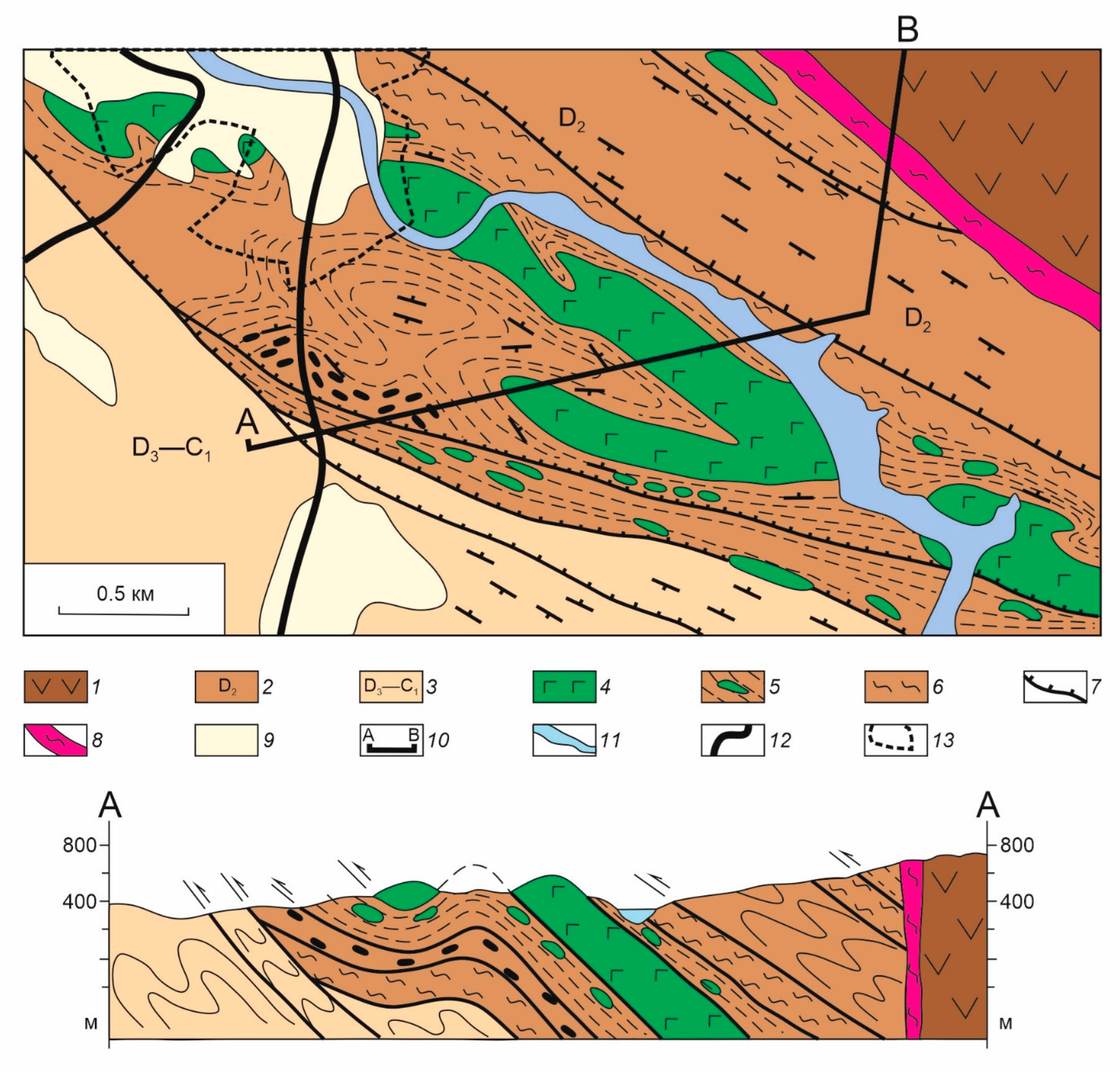
Figure 3.
Photographs of the cataclased Surov gabbro in the thrust zone. a - general view of the thrust, the black rectangle shows the sampling location of B-23-146 (S 49° 50’58.46’’, N 82°46' 44.09''); b - alternation of unaltered and cataclased gabbro; c - alternation of unaltered and cataclased gabbro crumpled into a recumbent fold; d - cataclased gabbro crumpled into a fold.
Figure 3.
Photographs of the cataclased Surov gabbro in the thrust zone. a - general view of the thrust, the black rectangle shows the sampling location of B-23-146 (S 49° 50’58.46’’, N 82°46' 44.09''); b - alternation of unaltered and cataclased gabbro; c - alternation of unaltered and cataclased gabbro crumpled into a recumbent fold; d - cataclased gabbro crumpled into a fold.
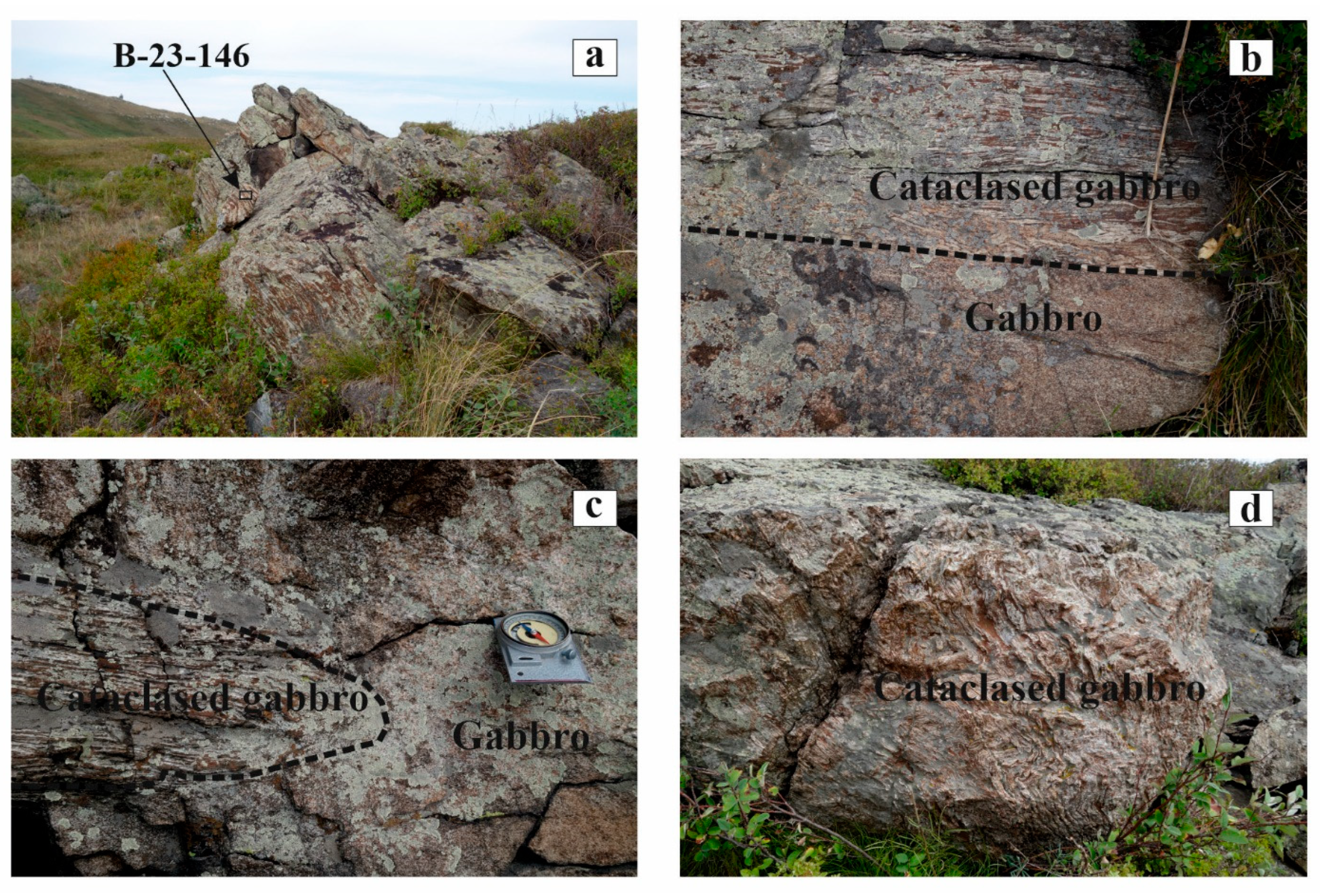
Figure 4.
Photographs of the base of a tectonic mélange with blocks of sedimentary rocks: a-general view, b- block of rhythmically layered rocks, length and height about 1 meter, c- block of rhythmically layered rocks, crumpled into a recumbent fold (length two meters, height 80 centimeters), c- block of rhythmically layered rocks, crumpled into a recumbent fold (length three meters, height one meter).
Figure 4.
Photographs of the base of a tectonic mélange with blocks of sedimentary rocks: a-general view, b- block of rhythmically layered rocks, length and height about 1 meter, c- block of rhythmically layered rocks, crumpled into a recumbent fold (length two meters, height 80 centimeters), c- block of rhythmically layered rocks, crumpled into a recumbent fold (length three meters, height one meter).
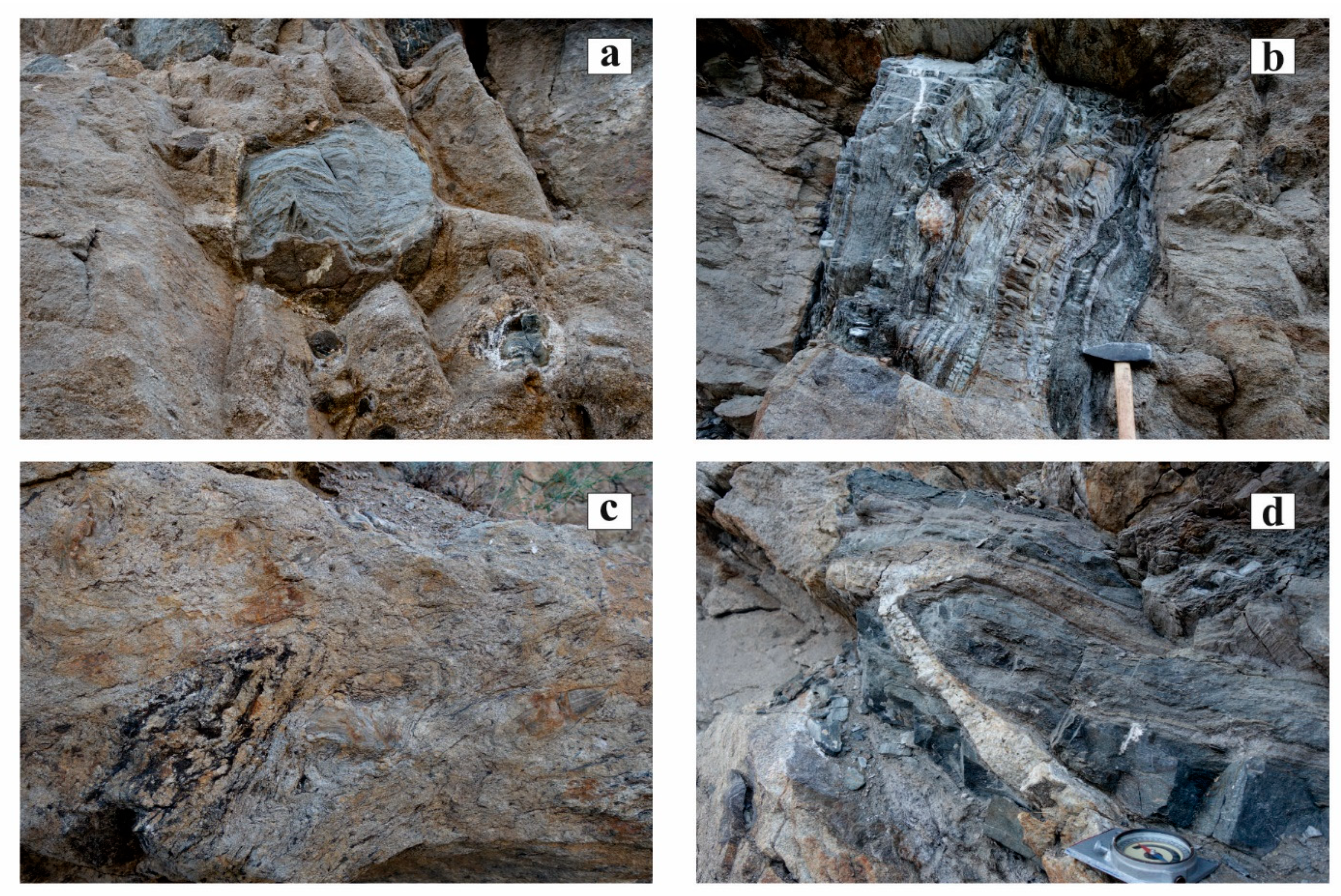
Disclaimer/Publisher’s Note: The statements, opinions and data contained in all publications are solely those of the individual author(s) and contributor(s) and not of MDPI and/or the editor(s). MDPI and/or the editor(s) disclaim responsibility for any injury to people or property resulting from any ideas, methods, instructions or products referred to in the content. |
© 2024 by the authors. Licensee MDPI, Basel, Switzerland. This article is an open access article distributed under the terms and conditions of the Creative Commons Attribution (CC BY) license (http://creativecommons.org/licenses/by/4.0/).
Copyright: This open access article is published under a Creative Commons CC BY 4.0 license, which permit the free download, distribution, and reuse, provided that the author and preprint are cited in any reuse.


