

Submitted:
09 December 2024
Posted:
09 December 2024
You are already at the latest version
Abstract
The growing interest in Vespa velutina venom stems primarily from its impact on human health due to stings and its potential pharmacological applications. Traditionally, venom extraction methods have relied on capturing individual hornets or removing and euthanizing entire nests, followed by dissection of venom sacs—a labor-intensive and disruptive process. In this work, we present a novel, non-invasive approach to venom harvesting. Using a portable electrostimulation device, venom was extracted directly from active Vespa velutina nests in their natural habitat. This method eliminates the need for nest manipulation, significantly reducing disturbance and improving efficiency. These visuals highlight the practicality and potential of this groundbreaking technique, opening new avenues for sustainable and scalable venom collection.
Keywords:
Vespa velutina
; venom extraction
; electrostimulation
; non-invasive techniques
; invasive species
; One Health
; allergy
; field research
; Asian hornet
The yellow-legged Asian hornet (Vespa velutina Lepeletier 1836) (Hymenoptera: Vespidae), an invasive species in South Korea, Europe, Japan, and recently established in the United States; has significant ecological, economic, and public health impacts [1]. In addition to these concerns, it has also attracted scientific attention due to the properties of its venom, which is of interest for its toxicity [2], allergenic potential [3], and pharmacological applications [4].
Unlike honey bees, where electrostimulation is a widely utilized and established method for venom extraction, its application in wasps or hornets has been limited. In vespids, traditional venom collection often involves capturing individual insects or euthanizing entire nests to manually extract venom sacs [2,5]. While effective, these approaches are labor-intensive, invasive, and frequently result in the destruction of the colony, raising ecological and ethical concerns. Moreover, the manual dissection process can introduce contaminants from glandular or tissue components, potentially altering the venom's biochemical composition and reducing its purity. In our earlier work [6], we demonstrated that electrostimulation could be effectively applied to individual hornets and to relocated nests, offering an alternative to manual venom sac extraction. However, these techniques required substantial handling, and relocating nests posed risks to both the operators and the colony itself. To address these limitations, we propose a novel, non-invasive approach: field-based electrostimulation directly at the nest site.
The hornet nest, discovered on November 26, 2024, at coordinates 42°19'58.0"N, 8°28'01.4"W, was located in Fornelos de Montes, a municipality in eastern Pontevedra, Galicia, Spain. Figure 1 provides an overview of the general environment where the nest was found. This region is characterized by an Atlantic European climate at lower elevations and a Central European climate at higher altitudes, supporting a diverse range of vegetation.The landscape is dominated by extensive patches of gorse (Ulex europaeus), Erica arborea, and Cytisus species, interspersed with grasses and a sparse herbaceous layer. Alongside the Xesta-Oitavén and Parada-Val do Home rivers, the area supports riverine flora such as Fraxinus excelsior, Salix atrocinerea, and Quercus robur. While native oak forests (Quercus robur) remain the predominant woodland type, their distribution is limited to small areas, primarily near river valleys. Reforestation efforts have further diversified the landscape, incorporating Eucalyptus globulus and Pinus pinaster, which contribute to the region's mixed forest composition. This ecological backdrop highlights the adaptability of V. velutina, as the nest was skillfully concealed within the dense shrubland, blending seamlessly into its surroundings.
Studies have shown that V. velutina nests occur in a wide range of habitats, from artificial and agricultural surroundings to natural areas, with the majority positioned within vegetation at varying heights [7]. This adaptability enables the hornet to exploit both natural and human-altered landscapes effectively. Additionally, the species’ ability to nest close to the ground, as seen in the present study, contrasts with the higher-altitude nesting typical in many regions and emphasizes the influence of local environmental and climatic factors. The availability of food, nesting resources, and the need for thermoregulation are critical determinants shaping nest site selection and architecture. A closer view of the nest, camouflaged among dense shrubs, exemplifies V. velutina’s capacity to integrate seamlessly into its surroundings while maintaining colony development [8]. The nest entrance, located laterally, allowed for the precise positioning of the electrostimulation device (Figure 2).
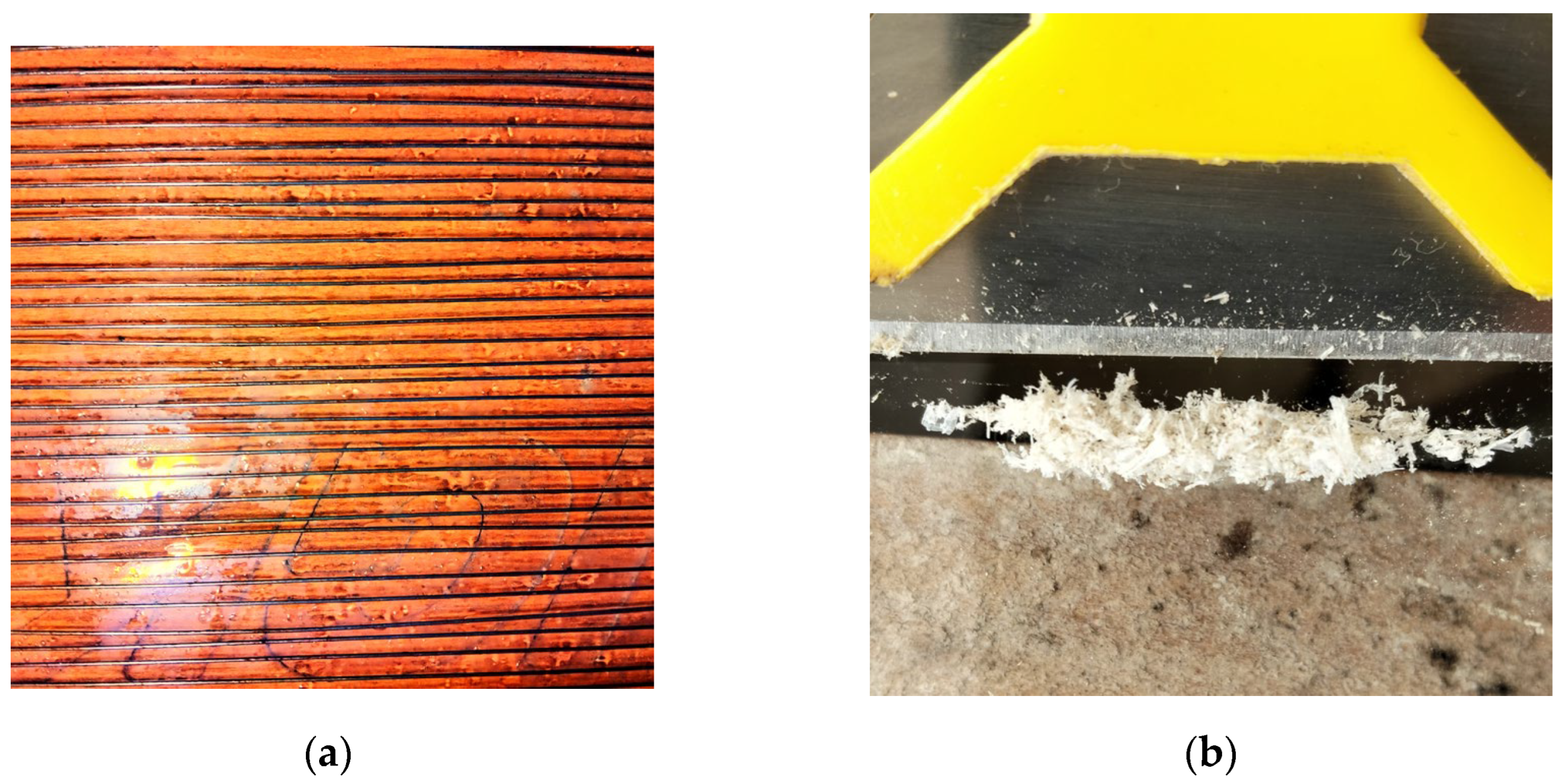
The device (IGK Electronics, Varna, Bulgaria) was set below the nest entrance, delivering mild electrical impulses to stimulate venom release from female hornets. While the current protocol involves direct application at the nest, the operational cycle of the device—including impulse duration and pauses—remains consistent with our previously described methodology [6]. Figure 2b illustrates the process, where hornets can be observed depositing liquid venom drops on a glass plate beneath the wires. The collected venom drops retained their liquid state, as shown in Figure 3a. After evaporation, the venom was carefully scraped off the glass surface, resulting in a white venom sample (Figure 3b). This high level of purity contrasts with the yellowish color often observed in honey bee venom, which may contain traces of regurgitated honey or nectar due to the bees' feeding habits.
Our group has extensive experience studying the effects of V. velutina stings, particularly their capacity to provoke severe allergic reactions, including anaphylaxis, which is linked to sensitization to specific venom allergens [9,10]. The sensitization patterns associated with V. velutina venom are increasingly recognized as an emerging concern in Western countries, warranting further clinical and immunological investigation [11]. Immunotherapy with vespid venom has shown promise in mitigating anaphylactic reactions, with preliminary findings highlighting its potential efficacy [12,13]. Additionally, studies on nest architecture and colony composition have provided valuable insights into V. velutina's adaptive behaviors within its introduced habitats [7].
Epidemiological analyses of sting-related fatalities underscore the significant health risks posed by V. velutina, emphasizing the need for greater attention from public health authorities [14,15]. Guided by the One Health framework, which integrates human, animal, and environmental health perspectives, our research addresses both the ecological and health-related challenges associated with this invasive species. Effective management of V. velutina requires a dual approach: mitigating its ecological impacts while addressing the growing prevalence of sensitization to its venom, as evidenced in European cases [16].
Aligned with our broader goals of sustainable management and the biomedical application of natural resources, this focus extends beyond the species' well-documented threats to honey bee populations [1,17]. The public health challenge presented by V. velutina stings—amplified by its habits, abundance, and widespread distribution [15]—has transitioned from an underestimated risk to a pressing concern. This shift demands targeted interventions by authorities to minimize both ecological disruption and health-related consequences.
The supplementary material includes four videos that provide a comprehensive view of the study site and experimental setup. The first video offers a panoramic perspective of the surrounding landscape in Fornelos de Montes, highlighting the diverse vegetation and environmental conditions characteristic of the area. The second video focuses on the nest’s location, emphasizing its concealment within dense shrubs and the adaptability of V. velutina to integrate seamlessly into natural surroundings. The third video showcases the electrostimulation device in action, positioned directly at the nest entrance to facilitate the collection of specimens. Lastly, the fourth video provides a close-up view of V. velutina individuals engaging with the device, capturing their behavior and interaction with the experimental equipment. These videos aim to complement the written data, offering visual context for the ecological and methodological aspects of the study. The footage provides valuable insights into the method's practicality, reproducibility, and potential for broader application in field research.
Supplementary Materials
The following supporting information can be downloaded at: Preprints.org, Video S1: General view of the landscape in Fornelos de Montes, highlighting the vegetation and environment; Video S2: Location of the Vespa velutina nest within dense vegetation; Video S3: Use of the electrostimulation device at the nest entrance for venom extraction; Video S4: Close-up of Vespa velutina individuals interacting with the electrostimulation device.
Author Contributions
Conceptualization, X.F.; methodology, X.F. and D.J.C..; software, X.F.; validation, X.F., D.J.C. and C.V.; formal analysis, X.F. and D.J.C.; investigation, X.F.; resources, C.V.; data curation, X.F.; writing—original draft preparation, X.F.; writing—review and editing, X.F. and C.V.; visualization, X.F.; supervision, X.F. and C.V.; project administration, C.V.; funding acquisition, C.V. All authors have read and agreed to the published version of the manuscript.
Funding
This research was funded by Instituto de Salud Carlos III (ISCIII), project number PI23/00543, co-funded by the European Union.
Institutional Review Board Statement
Vespa velutina Lepeletier, 1836 (Hym.: Vespidae) is not a regulated invertebrate. Therefore, no ethical use approval is necessary.
Data Availability Statement
The original data supporting this study are fully presented within the article. For additional information or specific inquiries, readers are encouraged to contact the corresponding author. Furthermore, the authors express their willingness to provide Vespa velutina venom samples to support future research endeavors or applications, fostering collaborative advancements in this field.
Conflicts of Interest
The authors declare no conflicts of interest. The funders had no role in the design of the study; in the collection, analyses, or interpretation of data; in the writing of the manuscript; or in the decision to publish the results.
References
- Lioy, S.; Bergamino, C.; Porporato, M. The invasive hornet Vespa velutina: Distribution, impacts and management options. CABI Rev. 2022, 1, 1–14.
- Alonso-Sampedro, M.; Feás, X.; Bravo, S.B.; Chantada-Vázquez, M.P.; Vidal, C. Proteomics of Vespa velutina nigrithorax Venom Sac Queens and Workers: A Quantitative SWATH-MS Analysis. Toxins 2023, 15, 266. [CrossRef]
- Vidal, C. The Asian wasp Vespa velutina nigrithorax: Entomological and allergological characteristics. Clin. Exp. Allergy 2022, 52 (4), 489-498. [CrossRef]
- Le, T.N.; Da Silva, D.; Colas, C.; Darrouzet, E.; Baril, P.; Leseurre, L.; Maunit, B. Asian hornet Vespa velutina nigrithorax venom: Evaluation and identification of the bioactive compound responsible for human keratinocyte protection against oxidative stress. Toxicon 2020, 176, 1–9. [CrossRef]
- Feás, X.; Alonso-Sampedro, M.; Bravo, S.B.; Vidal, C. Peeking into the Stingers: A Comprehensive SWATH-MS Study of the European Hornet Vespa crabro (Linnaeus, 1758) (Hymenoptera: Vespidae) Venom Sac Extracts. Int. J. Mol. Sci. 2024, 25, 3798.
- Feás, X.; Vidal, C.; Vázquez-Tato, M. P.; Seijas, J. A. Asian Hornet, Vespa velutina Lepeletier 1836 (Hym.: Vespidae), Venom Obtention Based on an Electric Stimulation Protocol. Molecules 2021, 27 (1). [CrossRef]
- Feás Sánchez, X.; Charles, R.J. Notes on the nest architecture and colony composition in winter of the yellow-legged Asian Hornet, Vespa velutina Lepeletier 1836 (Hym.: Vespidae), in its introduced habitat in Galicia (NW Spain). Insects 2019, 10, 237. [CrossRef]
- Detoni, M.; Féas, X.; Jeanne, R.L.; Loope, K.J.; O’Donnell, S.; Santoro, D.; Sumner, S.; Jandt, J.M. Evolutionary and ecological pressures shaping social wasps collective defenses. Ann. Entomol. Soc. Am. 2020, 113, 407–424. [CrossRef]
- Vidal, C.; Armisén, M.; Monsalve, R.; Gómez-Rial, J.; González-Fernández, T.; Carballada, F.; Lombardero, M.; González-Quintela, A. Vesp v 5 and glycosylated Vesp v 1 are relevant allergens in Vespa velutina nigrithorax anaphylaxis. Clin. Exp. Allergy 2020, 50 (12), 1424-1427. [CrossRef]
- Monsalve, R.I.; Lombardero, M.; Christensen, L.H.; Núñez-Acevedo, B.; González-de-Olano, D.; Sobrino-García, M.; Castillo-Loja, R.M.; Bravo, S.B.; Alonso-Sampedro, M.; Vidal, C. Structural Similarities, in Relation with the Cross-Reactivity, of Hymenoptera Allergenic Dipeptidyl Peptidases IV—An Overall Comparison Including a New Dipeptidyl Peptidase IV Sequence from Vespa velutina. Toxins 2023, 15, 656.
- Vidal, C.; Armisén, M.; Monsalve, R.; González-Vidal, T.; Lojo, S.; López-Freire, S.; Méndez, P.; Rodríguez, V.; Romero, L.; Galán, A.; et al. Anaphylaxis to Vespa velutina nigrithorax: Pattern of Sensitization for an Emerging Problem in Western Countries. J. Investig. Allergol. Clin. Immunol. 2021, 31 (3), 228-235. [CrossRef]
- Rodríguez-Vázquez, V.; Armisén, M.; Gómez-Rial, J.; Lamas-Vázquez, B.; Vidal, C. Immunotherapy with Vespula venom for Vespa velutina nigrithorax anaphylaxis: Preliminary clinical and immunological results. Clin. Exp. Allergy 2022, 52 (2), 345-347. [CrossRef]
- Rodríguez-Vázquez, V.; Gómez-Rial, J.; Monsalve, R. I.; Vidal, C. Consistency of Determination of sIgE and the Basophil Activation Test in Vespa velutina nigrithorax Allergy. J. Investig. Allergol. Clin. Immunol. 2022, 32 (2), 143-145. [CrossRef]
- Feás, X.; Vidal, C.; Remesar, S. What We Know about Sting-Related Deaths? Human Fatalities Caused by Hornet, Wasp and Bee Stings in Europe (1994-2016). Biology (Basel) 2022, 11 (2). [CrossRef]
- Feás, X. Human Fatalities Caused by Hornet, Wasp and Bee Stings in Spain: Epidemiology at State and Sub-State Level from 1999 to 2018. Biology (Basel) 2021, 10 (2). [CrossRef]
- Ruiz-Leon, B.; Serrano, P.; Vidal, C.; Moreno-Aguilar, C. Management of Double Sensitization to Vespids in Europe. Toxins 2022, 14, 126. [CrossRef]
- Feás, X.; Vázquez-Tato, M. P.; Seijas, J. A.; Pratima G Nikalje, A.; Fraga-López, F. Extraction and Physicochemical Characterization of Chitin Derived from the Asian Hornet. Molecules 2020, 25 (2). [CrossRef]
Figure 1.
(a) General view of the mountainous area where the Vespa velutina nest was located, dominated by Ulex and Cytisus vegetation. A black line indicates the precise location of the nest, highlighting its effective camouflage within the dense shrubland. (b) Close-up view of the nest positioned approximately 50 cm above the ground, supported by the surrounding vegetation and blending seamlessly with its natural environment.
Figure 1.
(a) General view of the mountainous area where the Vespa velutina nest was located, dominated by Ulex and Cytisus vegetation. A black line indicates the precise location of the nest, highlighting its effective camouflage within the dense shrubland. (b) Close-up view of the nest positioned approximately 50 cm above the ground, supported by the surrounding vegetation and blending seamlessly with its natural environment.
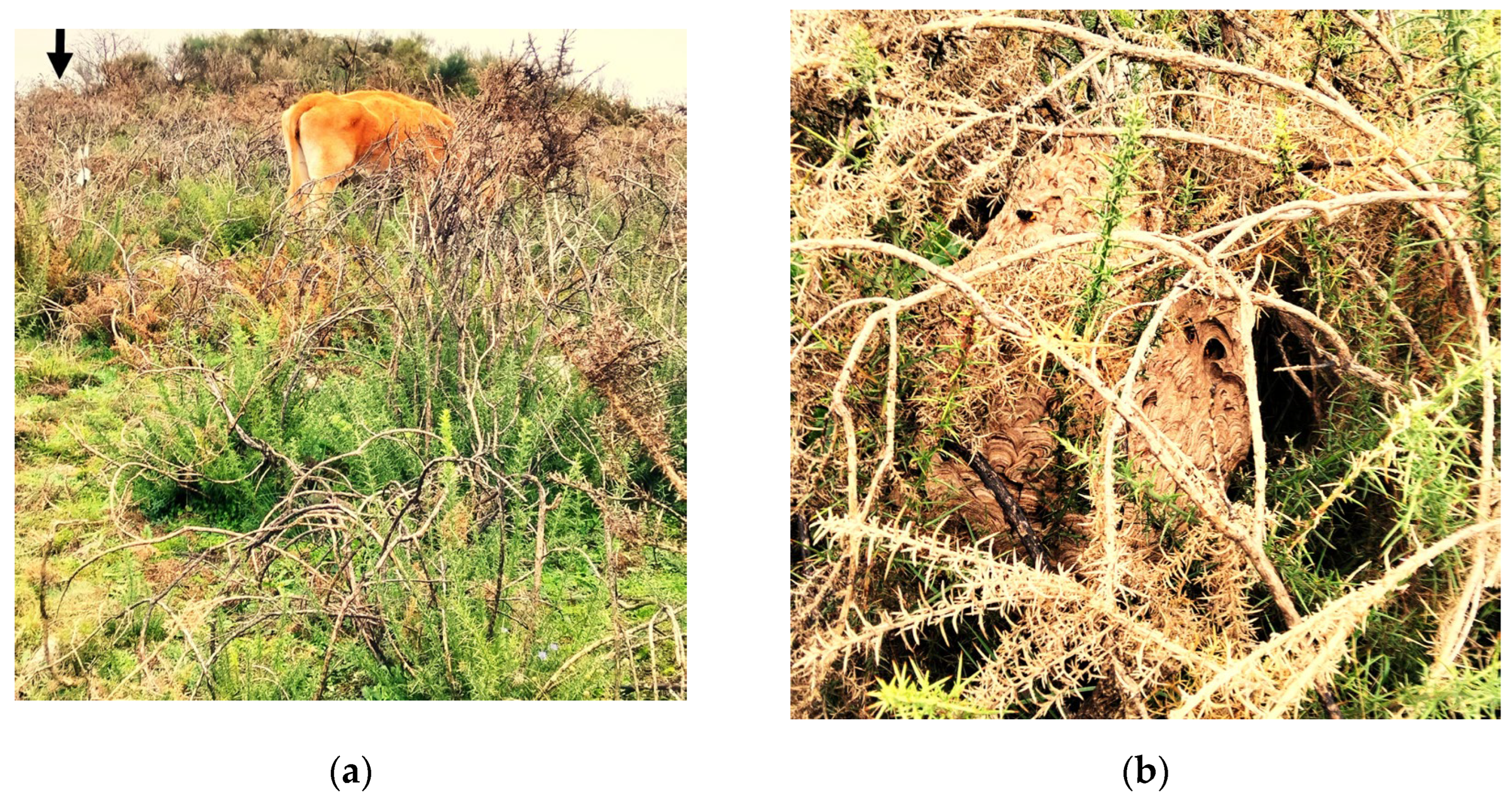
Figure 2.
(a) Electro-stimulation device activated and positioned below the lateral entrance of the Vespa velutina nest. This strategic placement facilitates efficient stimulation and venom collection without direct handling, as it interacts with both worker hornets exiting the nest and those returning from foraging. (b) Close-up view highlighting the lateral entrance of the nest, indicated by a black arrow, through which hornets actively engage with the electro-stimulation setup.
Figure 2.
(a) Electro-stimulation device activated and positioned below the lateral entrance of the Vespa velutina nest. This strategic placement facilitates efficient stimulation and venom collection without direct handling, as it interacts with both worker hornets exiting the nest and those returning from foraging. (b) Close-up view highlighting the lateral entrance of the nest, indicated by a black arrow, through which hornets actively engage with the electro-stimulation setup.
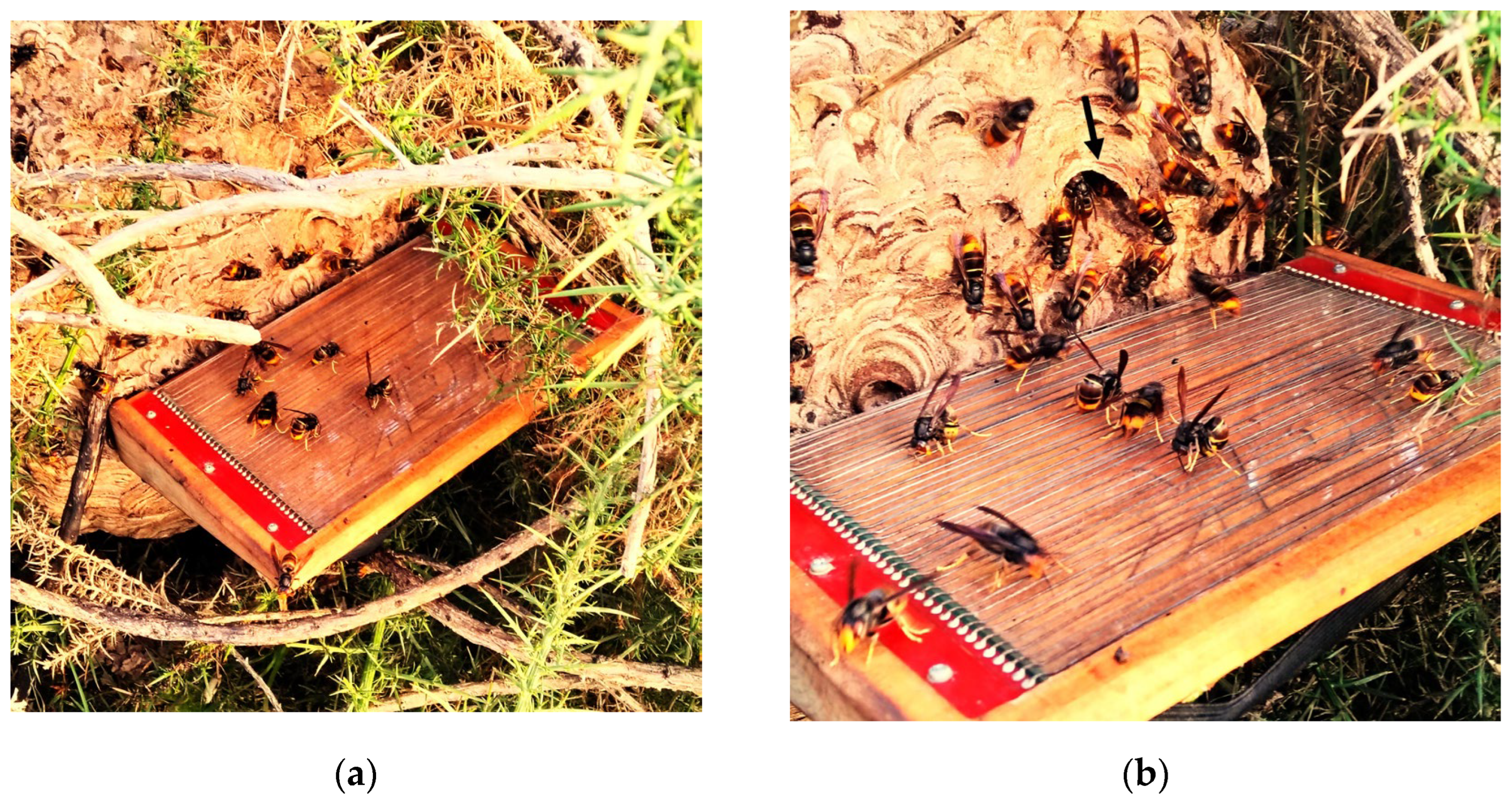
Figure 3.
(a) Collected Vespa velutina venom droplets on the glass plate during the nest field extraction process. The liquid form of the venom illustrates the device's efficiency in stimulating secretion. (b) Final scraped venom sample, characterized by its white and pure appearance.
Figure 3.
(a) Collected Vespa velutina venom droplets on the glass plate during the nest field extraction process. The liquid form of the venom illustrates the device's efficiency in stimulating secretion. (b) Final scraped venom sample, characterized by its white and pure appearance.
Disclaimer/Publisher’s Note: The statements, opinions and data contained in all publications are solely those of the individual author(s) and contributor(s) and not of MDPI and/or the editor(s). MDPI and/or the editor(s) disclaim responsibility for any injury to people or property resulting from any ideas, methods, instructions or products referred to in the content. |
© 2024 by the authors. Licensee MDPI, Basel, Switzerland. This article is an open access article distributed under the terms and conditions of the Creative Commons Attribution (CC BY) license (http://creativecommons.org/licenses/by/4.0/).
Copyright: This open access article is published under a Creative Commons CC BY 4.0 license, which permit the free download, distribution, and reuse, provided that the author and preprint are cited in any reuse.


