

Submitted:
22 November 2024
Posted:
05 December 2024
You are already at the latest version
Abstract
Seeking to examine cases of sacrificial love for another that is empathetic, unconditional, and morally redemptive, I focus on writer Jeff Lemire’s and artist Dustin Nguyen’s heralded comic series, Descender and Ascender (published by Image Comics starting in 2015 and 2018, respectively). In the first main subsection, I argue how illustrative fictional cases can mirror inter-human ethical struggles in our own world. Next, I look at some representative theoretical, literary, and biblical examples of sacrifice, especially regarding morally problematic theories about Jesus’ death on the cross, a classic Western example of sacrificial love. I then provide a brief context for why Descender and Ascender and highlight some of the main themes and characters in the comics. In doing so I draw from three main examples: the cyborg and mother Effie (Queen Between), the companion robot TIM-21, and an extended focus on the robot, Driller (“a real killer”), where I gleam key traits of sacrificial love as empathetic, unconditional, and morally redemptive. I close with how to distinguish unholy and holy forms of sacrificial love, and reflect on how the examples of sacrificial love in the comics ultimately complement my reading of Jesus’ sacrificial death on the cross while adding some stipulations to his oft-quoted saying: “No one has greater love than this, to lay down one’s life for one’s friends” (John 15:13).
Keywords:
Descender
; Ascender
; Dustin Nguyen
; Jeff Lemire
; sacrifice
; love
; sacrificial love
; atonement
; comics studies
; empathy
; redemption
1.0. To Lay Down One’s Life
In the comic Descender and its sequel Ascender (see Figure 1), a robot-killer (“Driller, a real killer”), twisted and haunted by guilt from a murderous act, sacrifices his life to save another and thereby helps restore the galaxy. Indeed, Driller’s fictional story will be a keystone of this article’s examination of such sacrificial love, in which I employ Driller’s and other examples from the comic to highlight a sacrificial love of one’s life for another that is empathetic, unconditional, and morally redemptive. While I take it for granted that comics provide a rich medium for literary, philosophical, and theological analysis, 1 a few words further below will be needed regarding language about a robot’s moral fall and catharsis. Can robots even have a consciousness and free will that entail corresponding legal and moral rights? While the philosophical and technical expertise to answer such a question are compelling, I take it for granted here that robots could become beings with rights and deserving or capable of such sacrificial love, in what I call the “R2-D2 and Wall-E Syndrome.” 2 In the first main subsection I highlight my rationale for this and argue how illustrative fictional cases can mirror inter-human ethical struggles in our own world. Next, I look at some representative theoretical, literary, and biblical examples of sacrifice, especially regarding morally problematic theories about Jesus’ death on the cross, a classic Western example of sacrificial love.
Because I primarily analyze authentic acts of sacrificial love from story arcs in the comics Ascender and Descender, I then provide a brief context for why I made this choice and highlight some of the main themes and characters in the comics. In doing so I draw from three main examples: the cyborg and mother Effie (Queen Between), the companion robot TIM-21, and an extended focus on the robot, Driller (“a real killer”), where I gleam key traits of sacrificial love as empathetic, unconditional, and morally redemptive.
I close with some final thoughts on sacrificial love, on how to distinguish unholy and holy forms of it, and reflect on how the examples of sacrificial love in the comics ultimately complement my reading of Jesus’ sacrificial death on the cross while adding some stipulations to his oft-quoted saying: “No one has greater love than this, to lay down one’s life for one’s friends” (John 15:13). 3
2.0. Robots, Electric Sheep, and Dignity: The R2-D2 and Wall-E Syndrome
There is no shortage of novels, movies, video games, tv shows, and other mediums that include robots and some grappling or subplot involving robot rights, consciousness, free will, responsibility, and the ethics of creating non-human, sentient life. A list would move us beyond a comfortable wordcount, but confer these three representative examples. In Mary Shelly’s Frankenstein, human scientist Victor Frankenstein fashions a living being without any thoughts to the created being’s own needs, desires, or rights. While Victor succeeds in the act of creation, he is engulfed with disgust for what came to be called the Creature or “the Monster”.4 Following a series of traumatic events,5 the Creature invites Frankenstein to sit by a fire in a mountain hut so he can listen to the Creature’s woeful tale, steeped in regret and isolation: “but am I not alone, miserably alone?”, he asks Frankenstein.6 Further into his monologue, he utters: “Was I then a monster, a blot upon the earth, from which all men fled, and whom all men disowned?”7 From its literary inception, the novel is a warning to hubristic humanity thinking they can play God without consequences.8
In Frankenstein, moreover, a lack of empathy with the Creature is a deep sign of moral failure.9 Like Shakespeare’s Richard III, who claims dogs bark at him and children mock his deformity, the Creature can cite a mix of both societal blame and individual choice and responsibility for what he became, even if he originally hoped to be good.10 But while Richard III could wield his power, rhetorical skill, and ample freedom to bend others to his will,11 the Creature seems to have less recourse outside brute force. We see this same struggle for freedom and moral choice by some Replicants in the Bladerunner movies, comics and video games (based on Philip K. Dick’s novella, Do Androids Dream of Electric Sheep?).12 Replicants were beings created and engineered through human genetics by Eldon Tyrell, who says in the 1982 film, that replicants are “more human than human.”13
But for many human beings, these replicants are another word for slaves. Again, we are presented with created beings abused or misused by the creators who care little about their desires or dreams to become free and recognized individuals, but will punish them severely if they succumb to any of humanity’s base urges like violence and lying.14 Thus, in the 1982 movie, we have the famous “like tears in the rain” monologue from the replicant rebel leader Roy Batty (see Figure 2). Batty has just been fighting with Blade Runner Rick Deckard (whose job is to “retire” (kill) them), but Deckard mistimes a jump from a roof and is now dangling precipitously at a great height, clutching a steel beam. Roy effortlessly jumps over and looks down at him saying: “Quite an experience to live in fear, isn’t it? That’s what it is to be a slave.”15 Throughout the film (especially the Director’s Cut), Deckard begins to have his own existence and identity questioned, as distinguishing human from replicant was nearly impossible, relying upon the (fictional) “Voight-Kampff Empathy Test” to examine pupil dilation and response based on a series of emotional comments and questions (30). In the movie, Deckard even illegally falls in love with a Replicant (Rachael) and escapes with her and goes into hiding.16
The near indistinguishability of human creators and their artificially created beings is a repeated trope in the genre, usually to justify humanity’s horrible treatment of the robots (and acting as a metaphor for the racism, abuse and maltreatment of some humans by others).17 In the reimagined Battlestar Galactica television series (airing from 2003 to 2009), humans believed that they were the creators of robots called the Cylons only to discover that the Cylons had evolved and now had models that looked and acted human or didn’t even know they were Cylons.18 These differences led to both a Cylon Civil War and Cylons still choosing to side with humanity after discovering they were really Cylons. As with Replicants and Blade Runners, Cylon-Human love blossoms. In sci-fi, such interspecies love, especially at times where interracial love was frowned upon or forbidden in actual society, were meant to challenge contemporary times.19
In Battlestar Galactica, such inter-species love only followed after a long and painful struggle, especially in the aftermath of the Cylon genocidal attack against humanity where torture and murder of Cylons were justified by alleging they were all not human and felt no pain. In “Flesh and Bone” (S01E08), the viper pilot Kara Thrace (callsign “Starbuck”), on account of a missing nuke in the Battlestar Galactica fleet, tortures and waterboards Cylon model Leoben (see Figure 3). These televised scenes were particularly charged when the episodes aired in light of the US War on Terror and allegations and proof of the torture of Muslim prisoners by US soldiers in Guantanamo, Abu Ghraib, and other black op sites.20 Also disturbing is how Starbuck takes pleasure in the torture, justified by memories of human deaths and convincing herself that the Cylon Leoben is just “a bunch of circuits with a bad haircut”, that he has “no soul” but “just software.”21
While I morally oppose Starbuck’s rationalizations and actions above, again I am not concerned here with scientific, philosophical, and theological questions regarding whether consciousness, freedom, and responsibility within beings, whether human, robot, or non-human animals, are authentic and real. While, as noted, this article will focus on some key instances of sacrificial love in the sci-fi and magical worlds of the comics Descender and Ascender, I am not examining whether a robot or a cyborg has legitimate (morally and legally) feelings, consciousness, or dignity and so whether or not they should be deemed unique beings with rights and therefore treated with respect. I take it for granted, like the cyborg character Effie does in the comics (more details below), that these robots and cyborgs are beings who cannot be harmed and injured without legal and moral repercussions.
Consequently, as with human beings, I would argue that in cases of sufficient evidence of rational choice, free will, and intentions, such beings can be praised, blamed, or punished based on their actions.22 In other words, for the sake of this article, I am not distinguishing between some hierarchal value of a robot, human, or cyborg so that if, hypothetically, each fell into a river and I could only save one, I clearly must save the human. As we see below, this position will be challenged in the comics from all sides with acts of genocide and robotocide.
Theologically, my position is rooted in the sacredness of all creation, or in the context of Buddhist interbeing,23 the notion that all of creation is interdependent and linked (which need not require the Buddhist notion of cyclical rebirth and death). In practice, though, my views above are murky. First, we as a species continue to treat some human beings as if they have less value than others (whether in modern day slavery, general indifference to the poor and unhoused, or chosen ignorance in the suffering of some people in seemingly insignificant geopolitical places). Secondly, regarding treatment of non-human animals, our record historically (at least outside most non-Indigenous cultures) is abysmal, if not genocidal (confer wolves, bears, etc.).24 From our thinking that dogs did not feel pain so could be tortured in scientific experiments to how we currently treat (torture) chickens or cows in slaughterhouses, many of us continue to wreak havoc and gratuitous bloodshed across farms, fields, and seas, or more accurately, blissfully allow others to do so, often the poorly paid who do our dirty work.25 (Note: I am neither vegan nor vegetarian so profess no innocence here).
Third, I am clearly biased (or brainwashed) by what I will call the “R2-D2 and Wall-E Syndrome,” founded upon the ubiquitous movies, tv games, video games, and novels where robots are abused and mistreated and so deserve a revolution or change or whose quirky personalities and uniqueness are taken for granted. (If one of my children or R2-D2 fell into a river, I imagine my moral conundrum could be diverted as R2-D2 survived his splash in the swamps of Dagobah). Trolley car joke aside,26 the point is that as a child, I never questioned the value, dignity, and personhood (if that’s the right word!) of C3P0 or R2-D2. And Wall-E only cemented that belief. My reasoning might boil down to: I’d save my child over R2-D2 but not because R2-D2 wasn’t a real being deserving to be saved but difficult choices under constraint must be made.27
More importantly, I link this openness to respect in all beings as a counter to our historic tendency as a species to withhold respect and dignity. Too often we are miserly and thrifty with the dignity-concept at the expense of our own spiritual and moral integrity and the flourishing of others—whether of humans with different cultures, faiths, genders, or abilities or of non-human, but highly intelligent beings, and so on. I am also reminded by a conversation with a Muslim friend of mine when I asked him whether it was ok to yell or curse at the AIs Siri or Alexa: “No, because all of creation deserves respect and it also harms you when you say and treat anything in a harmful or dismissive way.”
This doesn’t mean claims of sentient life and dignity become common and cheap or that science isn’t needed to test and probe such claims. Nor does it decree that indifferently crushing a rock (even if a diamond!) and crushing a living being are not vastly different kinds of moral actions, especially in non-extreme contexts (i.e., self-defence in the latter case).
3.0. Sacrifice and its Discontents
There are many examples of unhealthy, if not immoral sacrifice across cultural, religious, historical, and literary terrain. Like the virtue of humility, deeply needed, but too often misused,28 sacrifice has mixed notions, evident in these representative examples. For René Girard, historical, cultural, literary and religious traditions and stories posit worldviews of us and them, often sustained by scapegoating, usually of a marginalized member or group, or if not marginalized, then especially innocent so that the sins of the people can be placed upon them as expiation. In Aeschylus’ Agamemnon, Iphigenia, the daughter of Agammemnon, is sacrificed at the start of the Trojan War so the gods may bless the Greeks’ journey with wind. This was no easy task: the Greek leader initially resisted; indeed his daughter was “the beauty of my house.”29 But “because of necessity’s yoke”, he yields.30 She did not go willingly: “Her supplications and her cries of father / were nothing.”31
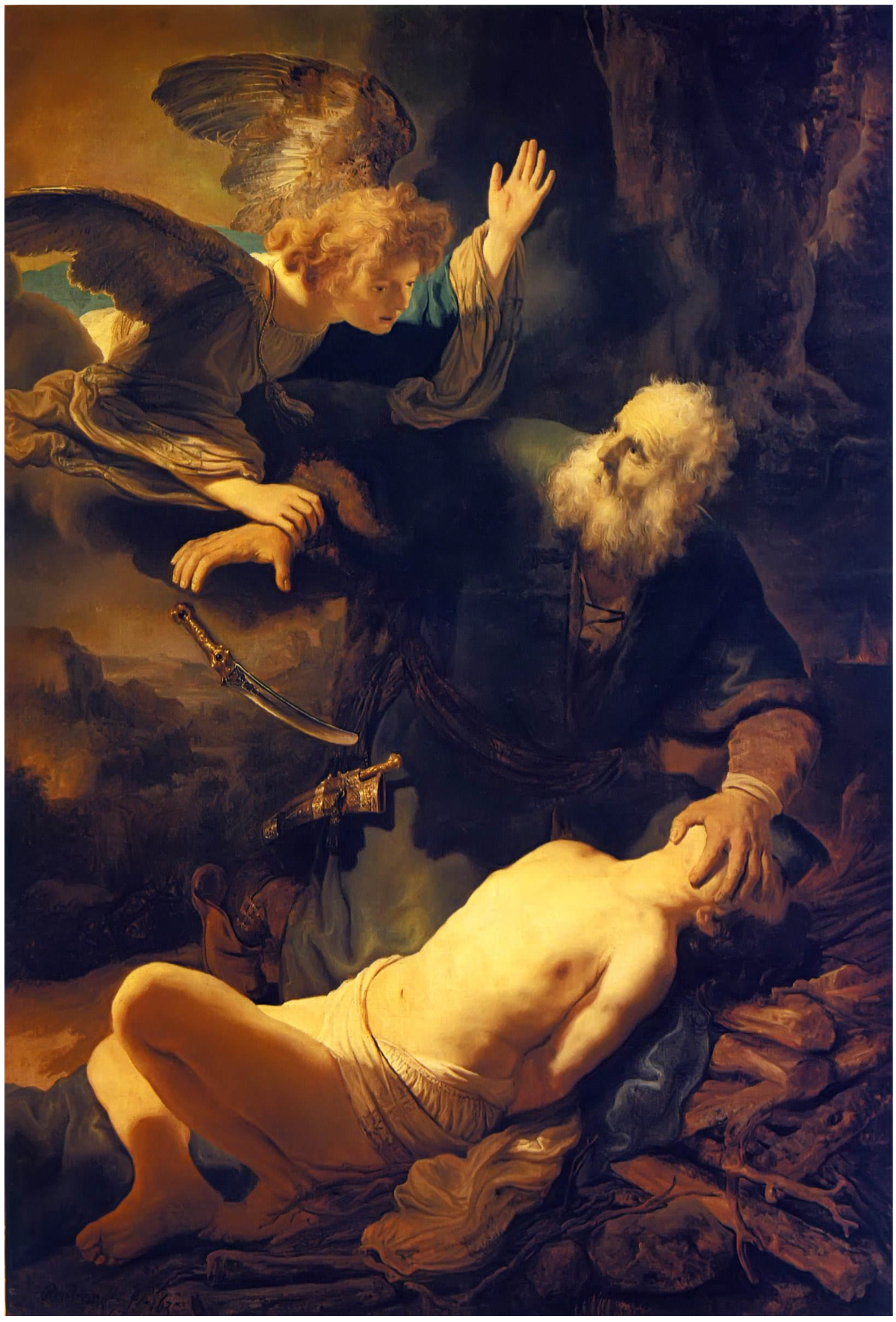
In these tales, child sacrifice is a common trope as the child is a symbol of innocence, their deaths dreadful and potent. In the Tanach, Isaac (for Christians) is the greatest example of a sacrificial offering (even if frozen in time like Keat’s young lovers in his “Ode on a Grecian Urn”).32 For unlike Jephthah’s unnamed daughter in Judges 11, who is ridiculously sacrificed because of his foolish oath,33 the main points of the Akedah are, positively, that God does not require human sacrifice (indeed, the arm and blade of Abraham the father is stayed by the angel; see Figure 5) and more dubiously from a moral standpoint, Abraham’s obedience to God.34 Being willing to sacrifice your innocent son because of a God’s voice is, of course, less heralded today and most of us understand why Abraham’s wife, Sarah, died immediately after the events described (Genesis 23:1). Regardless, Isaac becomes a Christian type for Jesus sacrificed on the cross, even though the parallels are flimsy and morally unappealing. Note also that while the Qur’an removes some of this moral ambiguity because Abraham’s son (usually identified as Ishmael) is older and is a willing participant (Q. 37:97–111), the sacrifice also never happens.
Think also of Antigone (see Figure 4), sentenced to death by her uncle Kreon because Kreon did not bury her rebellious brother Polyneices (unlike Eteocles). “The god of death demands these rites for both” she argues.35 In rebellion, she breaks Kreon’s law and buries Polyneices, lamenting: “I know that I will die—of course I do—even if you had not doomed me by proclamation.”36 Ultimately, she hangs herself, which also results in Kreon’s son Haemon stabbing himself in grief and then his mother/Kreon’s wife, Queen Eurydice, killing herself. While Antigone proclaims: “My nature is to join in love, not hate”37, her act only produces more death.
And what of Christ’s death on the cross: should it be deemed a senseless state-inflicted murder, a sacrifice for the expiation of sins, or a sign and testament of both God’s love and a common ending for those who speak truth to power? From the Ransom Theory to the Christus Victor theory of Atonement, the latter that Jesus was ransomed to free sinful humanity, the former that Christ’s death and resurrection defeat evil and sin, many competing interpretations abound. For Anselm, in the Satisfaction theory, God’s justice demands blood and sacrifice and Jesus’ willingness to do so as both fully God and fully human (but without original sin) satisfy these demands and criteria.
Unfortunately, some of these well-meaning interpretations have betrayed a non-violent Christ and justified a feudal, blood-thirsty, and vengeful God. They also co-opted and institutionalized a long-lasting and brutal anti-Judaism that falsely blames Jews as god-killers. This deicide charge was a key factor in what Jules Isaac called the teaching of contempt which fuelled expulsions, ghettoization, and pogroms against Jews. To what extent such moral indifference and denigration of Jews, in addition to economic and nationalist agendas, fanned the flames of the Shoah, can’t be argued here.38 Regardless, as a post-Auschwitz Catholic theologian, attune to the moral failures wrought from Christological triumphalism,39 I reject any interpretations of Christ’s death linked to any claim that Christ had to die because of any original sin transgression, the need to please God (or trick the Devil or pay a ransom to the devil) by atoning for sins through a sacrificial offering (Girard again, too), or any cosmological claim that creation was irredeemably damned because of original sin but that Jesus’ death and resurrection satisfy God and restores the salvation of humanity. This means I find many passages in the Gospels, Pauline epistles, Patristic sources, or Vatican statements problematic if taken at face value. Instead, I laud the Franciscans who claimed God sent Jesus purely as an act of unconditional love and grace,40 or of liberation theologians like Jon Sobrino who see Christ’s state-backed murder as a common but tragic consequence of a life endowed to be a voice for the voiceless.41 Such figures challenge injustice within political, military, and institutional religious systems, seeking instead social and systemic change through non-violence, social justice, acts of mercy, and table fellowship with sinners, tax collectors, lepers, and anyone else open to inaugurating the reign of God among us. I’ll return to these ideas in the conclusion, but now turn to sacrificial love in the comics Descender and Ascender.
Figure 5.
The Sacrifice of Isaac by Rembrandt (1635).
4.0. Descender and Ascender
Writer Jeff Lemire’s and artist Dustin Nguyen’s heralded comic series, Descender and Ascender, were published by Image Comics starting in 2015 and 2018, respectively.42 The sweep of both comics is vast and incorporates many themes linked to classic sci-fi and fantasy. While Descender ran for 32 issues and is in the sci-fi soap opera genre, its sequel, Ascender, includes 18 issues with fantasy elements as well. Taken together, a key theme in the fifty individual issues is finding harmony and balance, especially in power relations involving the robotic and the magical and how to distribute and use that power justly.
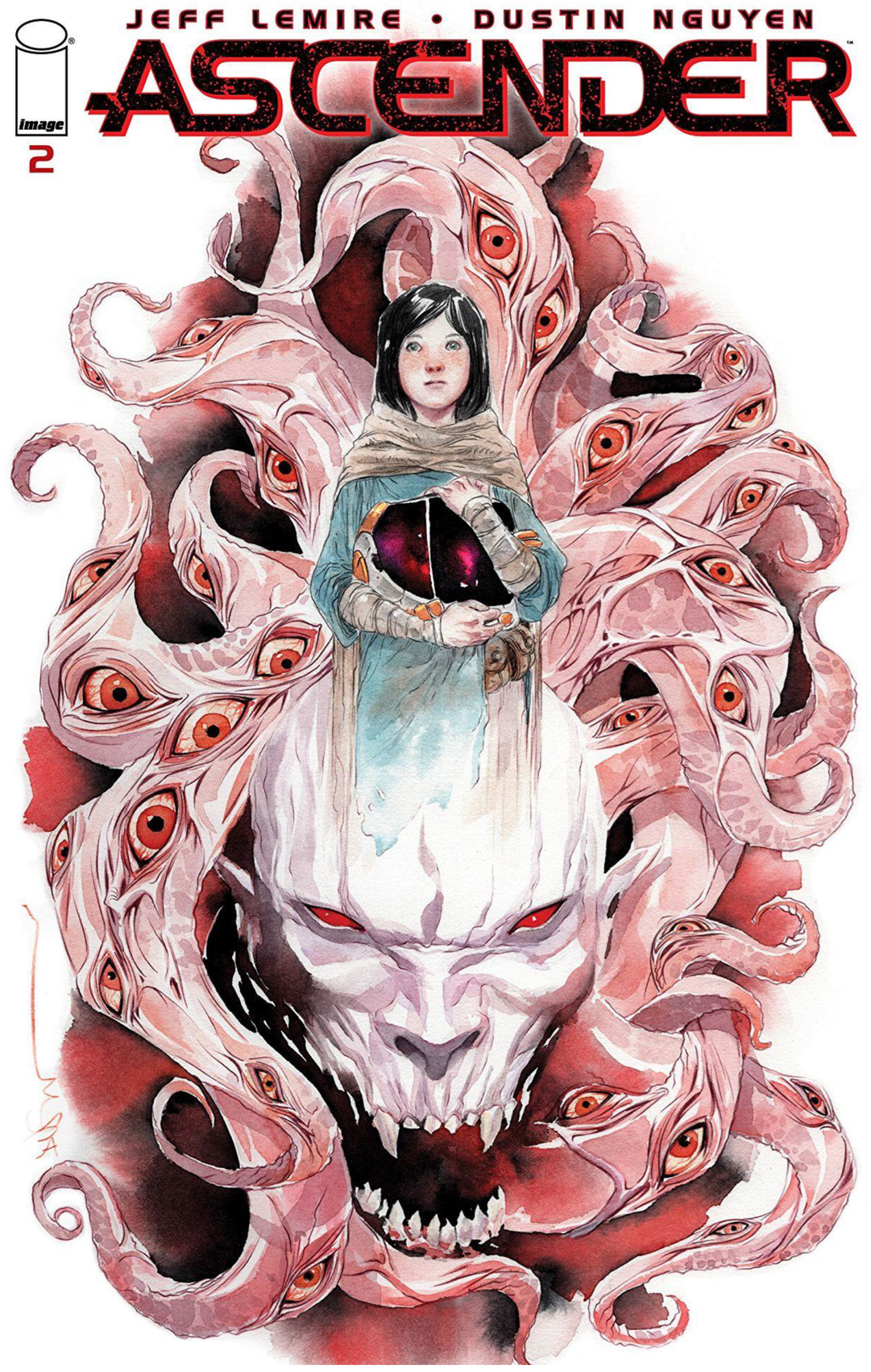
The narrative arcs are suffused with the hope and promise of organic and inorganic synthesis and robotic, AI, human, and non-human species partnership, collaboration, and love—but always under threat by war, societal conflict, and a failure of embracing cultural, religious, political, and species pluralism. In this imagined sci-fi and fantasy world, science enables the exploration and colonization of foreign planets, space travel, and AI super-intelligence, but the corresponding need for a moral, spiritual, and pluralist vocabulary still seems undermined or always under threat. This threat has also been acted upon by a “robot genocide” (D1)43 and later by a revenge genocide enacted by the Descenders, a supreme AI and robot civilization that believes it can decide whether a galaxy’s life forms deserve to live or die based on their own binary ethics. When these genocidal robots temporarily withdraw from the galaxy, the power vacuum is filled by a group of tyrannical witches called the Coven, ruled by Mother. Deeming herself a savior and having her cronies constantly spew: “Mother loves you, Mother save us,” she rules the universe with her frigid, self-centred despotic hatred (though deemed as love), supported by vampires and ghouls who imprison survivors in blood camps. Like Orwell’s Big Brother (See Figure 7), Mother is everywhere and always watching.44
Nevertheless, despite bounty hunters and the elite and corrupt seeking their own agendas and propping up their own kind, signs point to a greater unity. This union is initially forged in the human child, Andy Travers, and his caregiver bot, TIM-21. It is later embodied in Mila the child of an adult Andy and his childhood love Effie, and a cast of bedraggled, flawed, but likeable souls (see Figure 6).
Figure 6.
Character List of some key characters in Descender and Ascender by artist Dustin Nguyen.
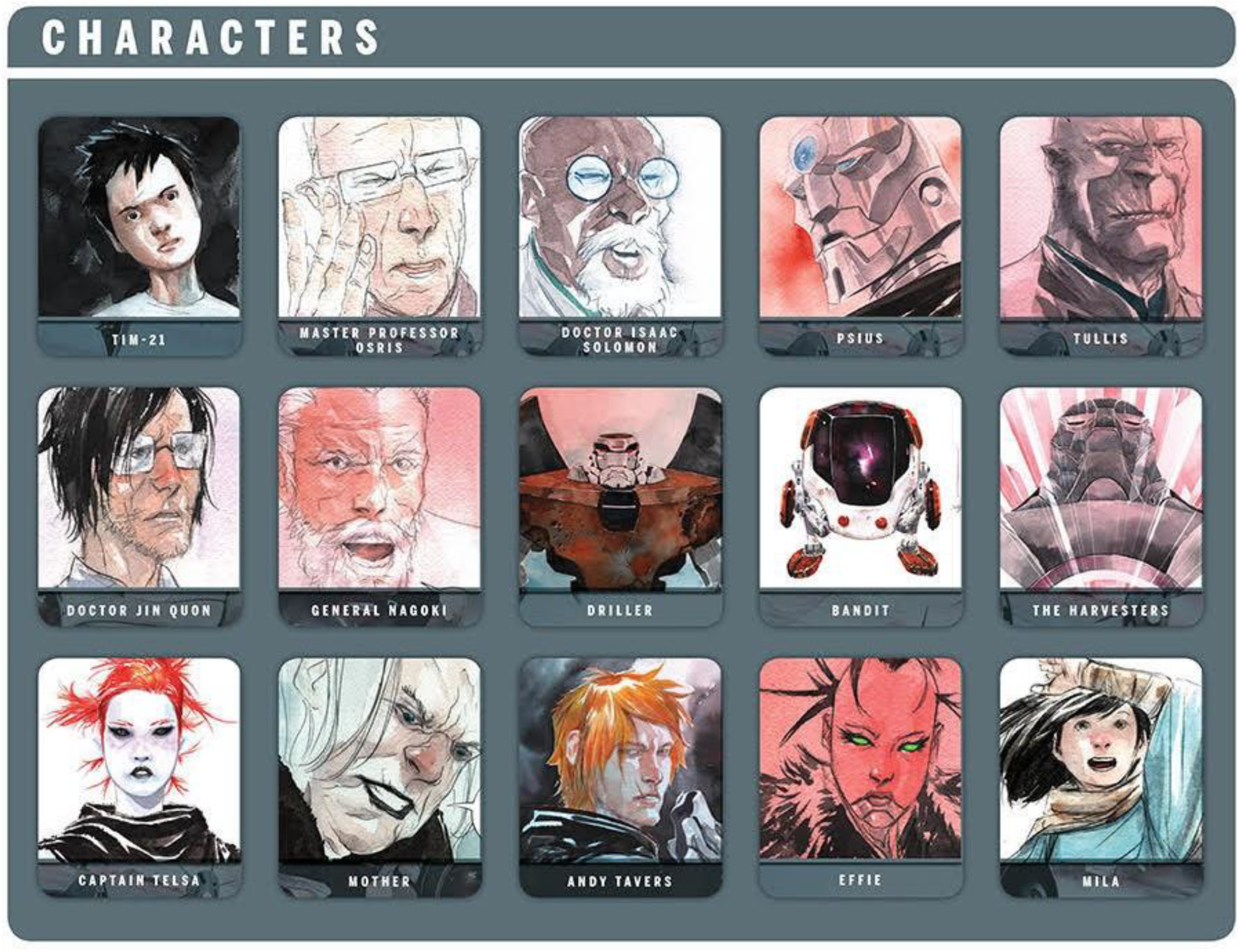
Figure 7.
The cover of Ascender 2 (drawn by Dustin Nguyen) showing Mila (holding Bandit) surrounded by the eyes and vampire supporters of Mother. "Mother loves you!" as they repeat.
Figure 7.
The cover of Ascender 2 (drawn by Dustin Nguyen) showing Mila (holding Bandit) surrounded by the eyes and vampire supporters of Mother. "Mother loves you!" as they repeat.
5.0. Sacrifice in Descender and Ascender
Freely-chosen, altruistic, moral-based, inspiring, and social-justice based sacrifice is a common thread throughout Ascender/Descender and is the counter to the very real acts of evil, genocide, and selfishness that also dominate. It is these acts of sacrifice, even if not immediately successful in overturning or defeating various tyrannical powers, that best represent the holiness and goodness in such worlds. While below I will only focus on three examples from the comics, numerous examples include:
- Amaya Travers, Andy’s mother, sacrifices herself so her son escapes after the mining incident in Dirushu. She then chooses to go back into the mine to try to save the colony, too, but ultimately perishes along with everyone else.45
- UGC officer Tullis sacrifices himself46 on the planet Sampsun (D18) when an enormous WORM creature attacks him along with Effie, Andy, Bandit, and Driller. He fights the WORM so they can retreat to a ship and escape. Before doing so, he tells Andy; “Promise me you’ll get Telsa47 out of trouble. No matter what else you do, promise me that” (D18). A startled Andy stammers: “I-I promise,” and in a side profile in the next panel, Tullis says: “And tell her—tell her I always loved her…just like she was my own daughter.” (D18).
- Helda Donnis, Private Second Class, UGC is the devoted companion to Telsa in Ascender who will go wherever she goes: “Once my Captain always my Captain,” as he often tells her. When Telsa agrees to risk her life and bring Andy and Effie’s daughter Mila to a safe haven in space (when ships had become forbidden by death per Mother’s orders), they venture to some island to reach Telsa’s hidden ship only to see it had become occupied by a spirit/magical demon.48 Helda lures the spirit out of the ship, willing to sacrifice himself so Telsa can get Mila away and fly the ship. Fortunately, Helda is saved by the wizard, Pelliot P. Mizerd (see next example below).
- Pelliot P. Mizerd, like Obi Wan Kenobi on Tatooine in Star Wars, was an elderly wizard who chose the life of a loner, in his case on the planet Woch, where there was much magic (D20). Despite his struggles, he not only helps a depressed, almost suicidal Driller but teaches and hones Mila’s magical powers (A15) and later sacrifices himself when trying to protect Mila, Bandit, Telsa, and Helda from the Gnishians.
- Kanto the Blood Scrapper did not know he was a robot grafted with false memories as a father whose wife and kids were killed by vampires. He had believed he was “a servant of the only true God” (A8) and for whom “Vengeance is my holy mission” (A13). When he discovers his past was a lie (A16), he wants his engineer-creator to euthanize him (A17), but later chooses to save the robot TIM-21’s life by allowing TIM’s memories and identity to override his own false memories and inhabit his exterior body.49
Almost every character fighting against the magical tyranny of Mother and her Coven, the genocidal aims of the Hardwire robots or mass destruction of the Descenders all show signs, moments, and tendencies for sacrificial love. But these three examples are particularly noteworthy to highlight the kind of sacrificial love I advocate here characterized as empathetic, unconditional and morally redemptive.
5.1. TIM-21’s Empathic, Sacrificial Love
TIM-21 was designed as a model carebot with a high level of empathy by his creator, the brilliant, but troubled scientist (and later full cyborg (!), Dr Quon).50 TIM-21 was initially the bot companion51 of a young Andy Travers until they were tragically separated after Andy has to evacuate the mining colony of Dirushu where his mom and everyone else dies. Fortunately for TIM, Andy’s mother had deactivated him, sparring him from the height of a robot cull over ten years. Once reactivated, though, and learning about the events of the galaxy and wanting to reunite with Andy, he is caught up in the violence between robots and non-robots, some of whom want to annihilate the other.
In one early narrative arc, TIM-21 is rescued from the melting pits by a group of rebellious robots who want him to lead a revolution against non-robots. He soon meets another TIM-series robot, but unlike TIM-21, TIM-22 has rebelled against any compassionate programming. TIM-21 soon realizes he, too has a choice. And so even as TIM-21 feels called to join other robots in a world protected against humans and other creatures, his bond with Andy remains a guiding light. Tim seeks communion between robots and non-robots not the destruction of one or the other.
His story is steeped in the power of compassion for others as well as a bravery and purity that become richer and deeper even after learning about betrayals and frailty. While his empathy is deemed a weakness by the robots who seek to destroy humanity, it is his empathy that enables him to see the goodness within people or believing in their potential to be better. There are multiple plot points of his choice to put others before him—to lay down his life—most evidently in the final battle against both the rebellious robots, the Hardwire (among others!), and then with Mother and her Coven. His entire existence, like Effie and the repentant Driller seems devoted to sacrificial love.
The example I highlight here is at the end of Descender (issue 32) when the Descenders have decreed that the galaxy Andy and the others live in should be destroyed because of the way those beings failed to learn from their previous lessons. Like Abraham arguing with God before the destruction of Sodom and Gomorrah, “Will you indeed sweep away the righteous with the wicked?” (Genesis 18:23, NRSV updated)—Tim pleads the case against the Descenders’ all or nothing ethics. They are not swayed but ultimately agree that if Tim goes with them and leaves this world, his friends and many others won’t be destroyed. Tim agrees even if this means isolation and banishment from those he loves (D32; see Figure 8).52
In the end, TIM-21 would have died if not for the many sacrifices of others (especially Driller’s) or of those willing to sacrifice their life in defending his in the final cataclysmic battle, notably Effie, Tesla, and Mila (A18).
5.2. Effie’s Unconditional, Sacrificial Love
Orphaned in the first Harvester Attack (by the Descenders; see Figure 14), young Effie meets fellow orphan Andy Travers just at the point both have lost everything. Andy had arrived from Dirushu, still hoping his mom is alive. Together they face the truth and Andy is comforted by Effie’s independent, confident, and alluring manner, sitting alone and tinkering with a radio. Over six years. Andy and Effie remain in the orphanage and their friendship and love blossom. But one morning, Andy wakes her up in the girls’ tent to say he can’t remain in the orphanage any longer. He needs to become a Scrapper “now. My mom. Your parents. The robbies have to pay for what they did” (15). Effie wants no part of killing, but she loves him. “I want to be more than your best friend,” Effie tells Andy, “I go where you go, Andy. Always.” A splash page shows the young teenagers in their first kiss (15).
Figure 9.
Images by Dustin Nguyen showing a teenage Effie on the left and then Effie as a cyborg, Queen Between.
Figure 9.
Images by Dustin Nguyen showing a teenage Effie on the left and then Effie as a cyborg, Queen Between.
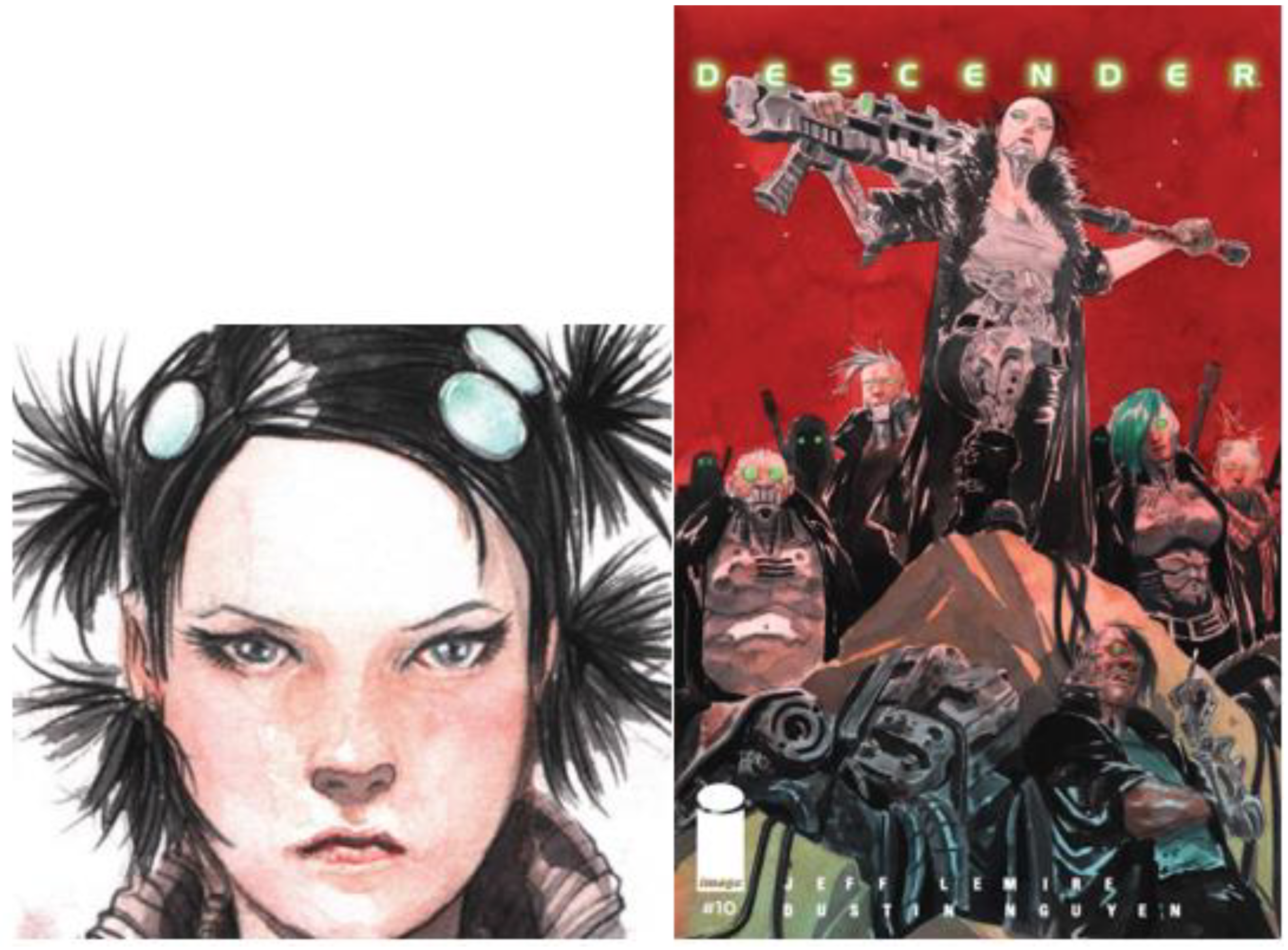
The scene then jumps to four years later. They are now married but struggling as scrappers who don’t own their own ship. And Effie, who never wanted to be part of such a life, is sick of the “ugliness” of the world. She wants to make the world better. Andy, though, is consumed by his role as a scrapper and remains bitter and vengeful. When he insists on killing robots who are not “war bots”, Effie rebukes and leaves him (D15). It only gets worse. While later protesting against a robot killing and trying to save a robot’s life, Effie is attacked by a Gnishian and falls into a melting pit, severely burned over much of her body. She only survives with robotic replacements, noticeably at first, her right arm. Andy is notified of her condition and flies out to help her, but she wants nothing to do with him, convinced he is a murderer (D15). She next joins a group called “The Between” (D10), and embraces an even more extreme cyborg life, calling herself Queen Between. When Andy tracks her down in need of help, she coldly reminds him: “I told you…I will not respond to my flesh name anymore. If you want to talk to me, you will call me by my artificial name” (D10). She also still believes he is a murderer. “Machine life is still life, Andy” (D10).
Ironically, her use of “between” in this stage of her life does not include both the human and cyborg but seems to become anti-flesh, a type of cyborg gnosticism. As Andy fell into a hatred of the robotic, she seems to hate what is not robotic; both are extremes. Much of their story will be finding a way back to each other as a middle ground, as a healthy state of in-between. The story to get there is winding, but eventually she reunites with Andy who slowly reaches a redemption to heal from his anger and bitterness at the death of his mother. They reunite. After the Descenders have attacked the second time, removed all the robots from the galaxy (A3), and killed billions of lives, Effie and Andy escape to Dirushu. For three years, they live a secluded life and soon have a child, Mila.
This mass death, meanwhile, spurs another anti-technology backlash, but more importantly, it enables the restoration of magic that had been curtailed in previous decades. While this magic (also reminiscent of a religious faith) can be used for good or evil, it is soon controlled and hoarded by Mother, whose vampires and other ghouls attack Andy, Effie and Mila on Dirushu. In the onslaught, Effie is bitten while trying to shield Mila. She pleads with Andy to escape with their child.
He reluctantly does as Effie becomes a blood-thirsty vampire controlled by Mother’s forces. He and Mila, meanwhile, find shelter in another planet and go into hiding, presuming Effie is dead. Years go by only to have Andy imprisoned by Mother’s forces but finding himself in Effie’s vampiric presence. He tries to break whatever spell she is under, but only after she is sated with another’s flesh is she momentarily restored to her own thoughts. Despising what she has become, Effie begs Andy to kill her and end the life she had been forced to endure. She places a dagger in Andy’s hands and pleads: “I want it to end like this. While I still remember you” (A10). He still resists, but she insists it’s the only way to fix her and end her vampiric existence. “Do you love me? Do you still love me?”
She guides his hand as the blade pierces her chest. She dies in her arms. Andy escapes with Ellie’s body and finds a quiet place to bury her. Meanwhile, Effie’s cyborg part of her body is able to resuscitate her heart and cleanses her body of the vampire blood. She resurrects from the grave.53
Thinking only of her daughter Mila who she has not seen in years and who thought her dead, Effie frantically tries to find and reach her. Mila, meanwhile, who has since learned she has magical powers, sees TIM-21 defeated by Mother and her Coven, and the young girl tries to fight Mother on her own. Seeing this, Effie is an embodiment of fury, especially as Andy (uncharacteristically) tries to hold her back, perhaps fearing more for Effie’s life.54 “Let go of me! That’s my baby!” she yells at him (A18). Effie, though with no magical power of her own, jumps in to defend her daughter and shield her from any harm. Heroically, Effie is not only able to defeat Mother, she becomes a synthesis of both the magical and the machine world. Unlike Mother, though, she has no intention of hoarding this power. “It’s too much—I don’t—I don’t want it”, Effie exclaims, as the power sources of magic and machine courses through her. With a smile, the inert TIM-21 replies: “Then, give it back, Queen Between. Give it to all of them…Give it to the galaxy” (A18). Effie/Queen Between thus restores all the power she could have accumulated for herself back to the entire universe in a beautiful act of kenosis. She didn’t want power or revenge but just to return to her daughter and their life with Andy and others.
5.3. Driller’s Redemptive Sacrifice of Love
Driller is an old “drop and deploy” driller robot (A4) sent to mines and other dark places to drill. In order to understand the heights of Driller’s redemptive sacrificial acts, we need to get a deeper picture of the descents he ascended from.
When we first meet Driller in the comic, he seems threatening with his massive metal bulk and height and drills that can spin and cut through rock, let alone porous flesh. Yet, while he immediately becomes the protector both of a tiny droid dog-bot, Bandit and TIM-21, Driller’s first spoken words in the comic are: “Driller hate hrrrmans!!”55 After viciously killing scrappers (who kill robots), he looks tenderly at Bandit: “Little bot broken?” he asks (D2). Indeed, Descender’s second issue ends with a splash of a pieta image with Driller (as if the Blessed Mother) cradling a limp TIM-21, whose body keeps warning: “TIM-21 total system failure,” while little Bandit arfs in concern (D2; see Figure 10). So begins the reader’s complex and deeply moving journey with this guilt-ridden, but also amazingly brave and kind robot. “Whatever happens—Stay behind me!” Driller tells Bandit when they are surrounded by hostile enemies (D5). Moreover, while Driller feels he is stupid and berates himself for being unable to fix a broken TIM-21 (D3 and D4), it is his proficiency in killing that seems to be his focus, as he repeatedly shouts like a mantra, “Driller is a killer, a real killer.” Initially it seems mostly like a boast, especially in the heat of some battle when Gnishian scrappers, vampires, or genocidal robots are trying to maim him, or especially when they are trying to destroy those he is trying to protect. 16 issues into the series, we get Driller’s origin story and what that mantra really means. Driller isn’t just a killer, but much worse.
Driller’s origin story is encapsulated around a complicated series of events that found Driller with Andy, Effie, Tullis, and others. Tullis, who had survived the melting pits with Driller, mentions that Driller has been moaning all night in his sleep and has been quiet since “the blond one showed up” (D11), meaning Andy. As mentioned above, a young Andy had to flee Dirushu because of a poisonous leak that ended up killing everyone else including his mother. Andy was also separated from his best friend companion, TIM-21 and in the ensuing years became a scrapper—a robot killer—though part of him also dreamed of one day finding TIM-21. Now years later, Driller finds himself in a group with an older Andy who has no idea what Driller had done to him. The present scene then flashes back into Driller’s past as we learn more about both Driller’s history and his tragic connections with Andy and TIM-21.
Driller was first sent as an anonymous, unnamed robot to Dirushu just after the original core colony was getting started there. He was said then to be part of what the company called “Quontech’s newest personality upgrades” (D16) but was soon deemed obsolete. In the mines, he toiled day and night with one other robot companion, both harassed by taskmaster boss, Henry Trask, who claims he only thinks about his wife and six children back on the planet Niyrata. Whatever love he has for them is not spread to the robots. It is Trask who names the robots, finding their long, numerical names inconvenient. He shortens them for his own benefit, naming “Driller” and the other robot “Scoops”, intended to represent both their purpose and whatever essence they have. Mostly, Trask mocks them as “hunks of scrap” (D16) who are “pretty much obsolete” and “junk.”
One night when the robots are supposed to be charging, Scoops wants to talk and asks Driller where he had worked previously. Driller says he was drilling for two years out at mine six “but then they got big, fancy new drills” (D16). He is constantly replaced and told by humans that he’s outdated junk. While Scoops says he was at mine 4 and had a nicer human than Trask, Driller says: “Aint no nicer hrrrmans to Driller. Just make me drill. Never ask me nothing. Never talk to me. Driller just a driller to hrrrmans.” (D16)
Scoops thinks it’s just out of some human being’s ignorance—they just think “we’re hunks of junk.” Driller replies: “hrrrmans are hunks of junk” (D16), and Scoops thinks this is funny. They become friends and work for years together despite the abusive conditions under Trask who never repairs or maintains them. One day Scoops accidentally fails to detect a gas leak. He apologizes to Trask saying he’s broken. The night before he was even too weak to talk to Driller. Worried about his precarious livelihood, Trask attacks Scoops and destroys him (see Figure 11). Driller, meanwhile had tried to intervene to stop Trask (A16). But then, when a group of other humans come down to the mine to say they need to evacuate, Trask thinks it’s because of the leak. He insists they seal it, only to hear the other men say it was some kind of attack on Niyrata (where his kids are).
Driller, grieving over the destruction of Scoops, burdened by all the senseless toil and insults and hating all humans, drills a new hole, unleashing the poisonous gas. Trask calls him an idiot, but Driller only rages as the poison seeps everywhere: “No more hrrrmans!” (A16) he shouts. Then turning to Scoops, who remains inert, he says: “Driller did something, Scoops…” And in another panel, a pan-out shows Driller kneeling by Scoops as two green swirls glow as the poisonous gas spreads from the tunnels. Driller again says: “Driller did something bad” (D16). The next page shows all the bodies, including Andy’s mom, dead. Words from Driller in a dialogue bubble close the scene: “Something realreal bad” (D16).
The scene cuts back into the present where we first see an adult Andy. In the next panel, Tullis says Driller has been moaning all night. Readers now know Driller has been reliving his past and what he had done—even more aware of the consequences and the hurt he inflicted upon his action. Tullis asks Driller multiple times what’s wrong—and recall how Driller said humans never talked to him or asked about him, but he is learning there are also those who are good: “Driller? What’s wrong?” Tullis repeats.
As Driller walks away, he says: “Driller a killer.” The closing panel of the issue again shows Andy sitting down while Driller’s next words are placed above him: “Driller a real killer” (D15). Readers now know his mantra all along has not been a boast, but a guilty confession. I’m a murderer, he has been really saying, a real murderer.56
A few issues later (D19), the guilt has fully consumed Driller. On a ship with Andy and the others (having escaped because of the sacrifice of Tullis noted further above), Driller apologizes to Effie and “yappy-bot” as he calls Bandit, “but Driller done a real bad thing. Now Driller gotta go” (D19). He locks himself in the airlock. As the others crowd around outside, Driller repeats his usual language about being a killer. Andy dismisses it as braggadocio, but this time Driller confesses everything, wanting Andy to send him out of the airlock. “Driller was in the mines…the mines on Dirushu when you were just a little Hrrrman.” Andy still doesn’t see why this matters. Driller says he wanted to “make them pay. Driller made them all pay,” and in a panel showing Andy in shock, Driller continues: “Driller drilled the gas pocket. Driller killed them all. Driller a killer, see? Driller a real killer” (D19).
The next panel shows Andy with Effie and another scrapper, Vance, with only dialogue bubbles continuing from Driller: “I’m sorry, Hrrrman. I didn’t know your mama. I’m sure she was a good hrrrman.” Effie is actually between where the two dialogue bubbles are situated—interesting because it creates a pause in reading the page—and a smart reader knows Andy’s mom was a good human overall.57 While Driller’s crime also created the context for Andy to meet Effie—leading to the birth of Mila who becomes a synthesis, a means of salvation (D19)—these are unintended good consequences. He says: “Now Driller’s the one that gotta pay,”
Amidst Effie’s protests and after more urging from Driller, Andy ejects Driller into the deep recesses of space, presumably scrapping him (D19). Miraculously, though, he lands on Woch—a small planetoid on the fringes of Sampsonite space. When Driller emerges from his fall and sees another living being, he is doubly disappointed—not another “hrrrman” (D20). As noted above, Mizerd was an old wizard and now hermit who will later be instrumental in teaching Mila (see Figure 13) her potent magical powers, but first, Mizerd regains a purpose, which is to walk Driller back from the edge; for Driller expected death—and wants to die.
They sit near each other and Driller tells Mizerd his story. He doesn’t want to talk about why he fell from the sky though. When Mizerd notices Driller’s arm is seizing up and needs oil, Driller hints that he’s about to self-scrap: “Hrrrn…Driller don’t want repairs. Driller just wants to seize up. No reason for Driller to keep going no more” (D20) Mizerd provides the tough love Driller needs, saying all robots since the “Quon personality upgrades” have become “a bunch of drama bots” (D20). When Driller warns him and Mizerd doesn’t flinch, Driller backs down and Mizerd said that’s what he figured; “Now if you’re done feeling sorry for yourself….”
He tells Driller about a camp nearby where he can get oil which happens to be where Mizerd claims he was heading. Mizerd says the least Driller can do is help him carry stuff while getting there. (D20). Driller then wants to know if Mizerd’s scared being seen with a bot. “Don’t you hate us like everyone else?” (D20).
Mizerd’s reply is perfect in the context: “Makes no difference to me. I don’t like anyone, bot or not” (D20). He tells Driller, though, he has a choice: he can either stay and seize up or go with Mizerd to get the help he needs (D20). This could be the first time Driller is given a real choice. As with Scoops, a friendship begins. When they are attacked by Goblins with ghost bombs that Mizerd says makes your “soul turn into a ghost! You become one of their unliving bombs!” (D24), Driller says: “Soul?” And then he turns to the goblins, their bombs splattering on him and shouts: “Driller aint got no soul! Driller a killer” (D24). He enjoys shredding a bunch of goblins, making Mizerd fear he’s now with a “guilty, murderous, crazy robot” (D24), though Mizerd has no problems eating the dead goblins (D24).
But the question of the soul is apt, especially in this context of sacrificial love. And just as Deckard and others asked above: do robots have souls? Do humans? What is a soul? Does Driller no longer have a soul because he was/is a killer? Did he lose his soul? Or does Driller still have a soul because he loves and repents and grieves for what he did? Aren’t the soulless—if there are any—those who choose hate unrepentantly? But again who does that unless, like TIM-22, they were abused, etc.?
Later when both Driller and Mizerd are captured by the sadistic Gnishian King S’nok, the king tells Driller that his technicians downloaded all his memory so he knows everything Driller did. “I know that you truly are a ‘real killer’. Tsk. What a bad robot you are. All those poor people on the mining colony. All those human deaths on your shoulder” (A30). S’nok is an avid murderer who has no guilt so can mock the one who does. He says he wants to scrap Driller in front of the “boy-bot” (TIM-21) to see if robots really feel anything. At the close of the Descender comic, it is Driller who is able to save both Andy and Effie and so become even with him (D32).
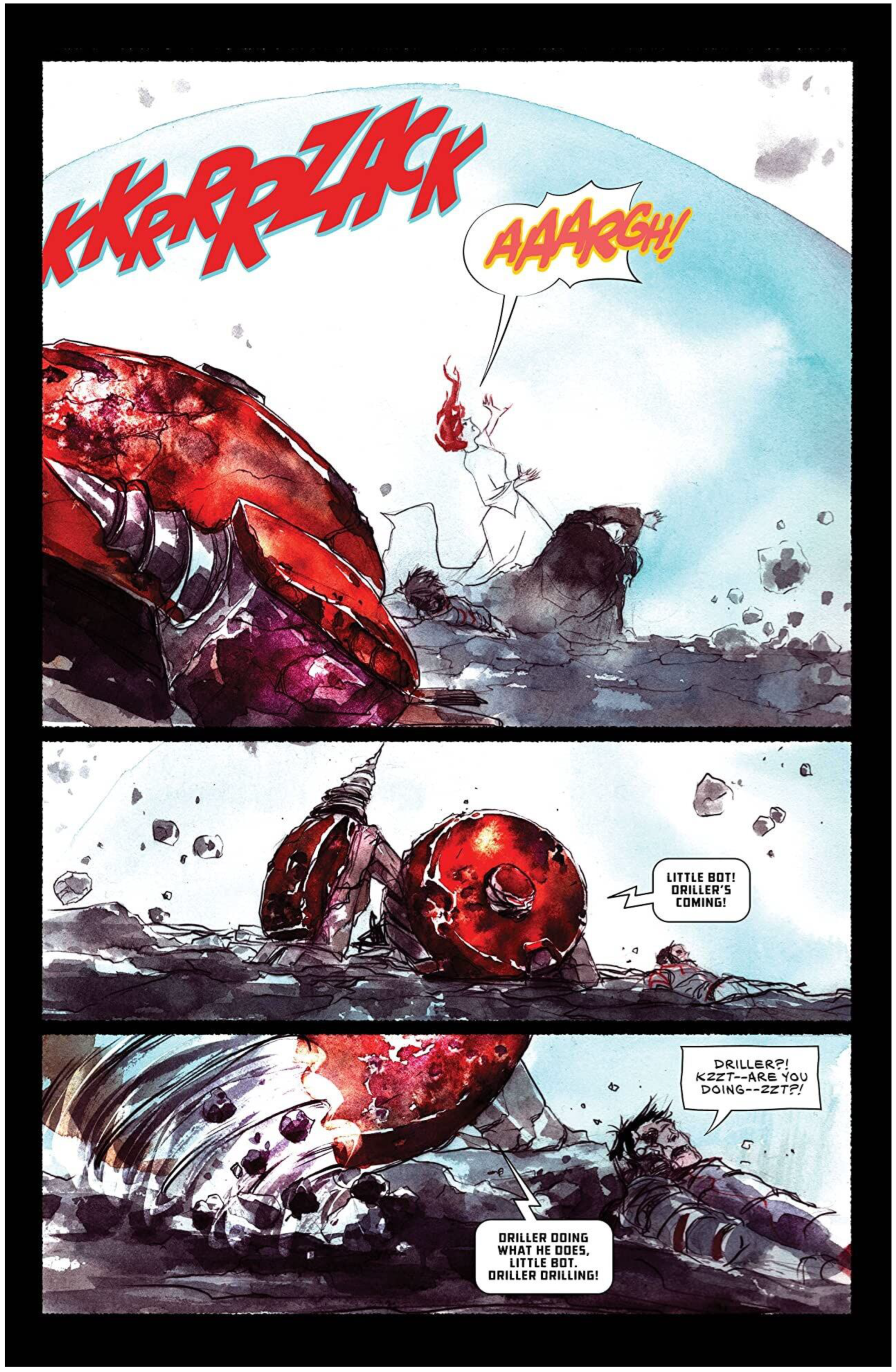
At the final, cataclysmic battle (A16-18), TIM-21 is ready for a last stand. Driller, meanwhile, is told to seek safety, but he tells TIM-21: “Driller’s done enough running. Driller’s not leaving you again, Little Bot” (A16). When they charge at Sister/Mother (Weak thing)58, Driller is immediately repelled and dismantled (A17). But in Ascender 18, the last issue of the series, Driller performs one final act. TIM-21, battered and near-death from Mother’s onslaught, calls upon a Harvester to annihilate her, even if it also means being destroyed himself in the process. Driller, who had been lying still and incapacitated, struggles to rise, saying: “Little Bot, Driller’s Coming!” TIM-21, his face pock-marked and his body riven with holes, struggles to speak: “Driller?! Kzzt—are you doing?kzzt”. Driller claws over to Tim and drags him closer: “Driller doing what he does, Little Bot. Driller drilling” (A18; see Figure 12).
And Driller drills deep into the ground to get as far away from the incoming Harvester beam, and as we learn later, cocoons TIM and absorbs the full impact himself. What he does is no longer killing, but saving, sacrifice not murder, love and not vengeance, drilling to save and give life, not to drill it away out of spite.
In the aftermath, a moving panel then shows young Mila, who had liked Driller immediately and bonded with him,59 clasping her little arms around his wide, metallic, broken body (A18). He sacrificed himself so his friends could live.
6.0. Conclusion: TIM-21, Effie, Driller, and Jesus:
Sacrificial Love as Empathetic, Unconditional, and Redemptive
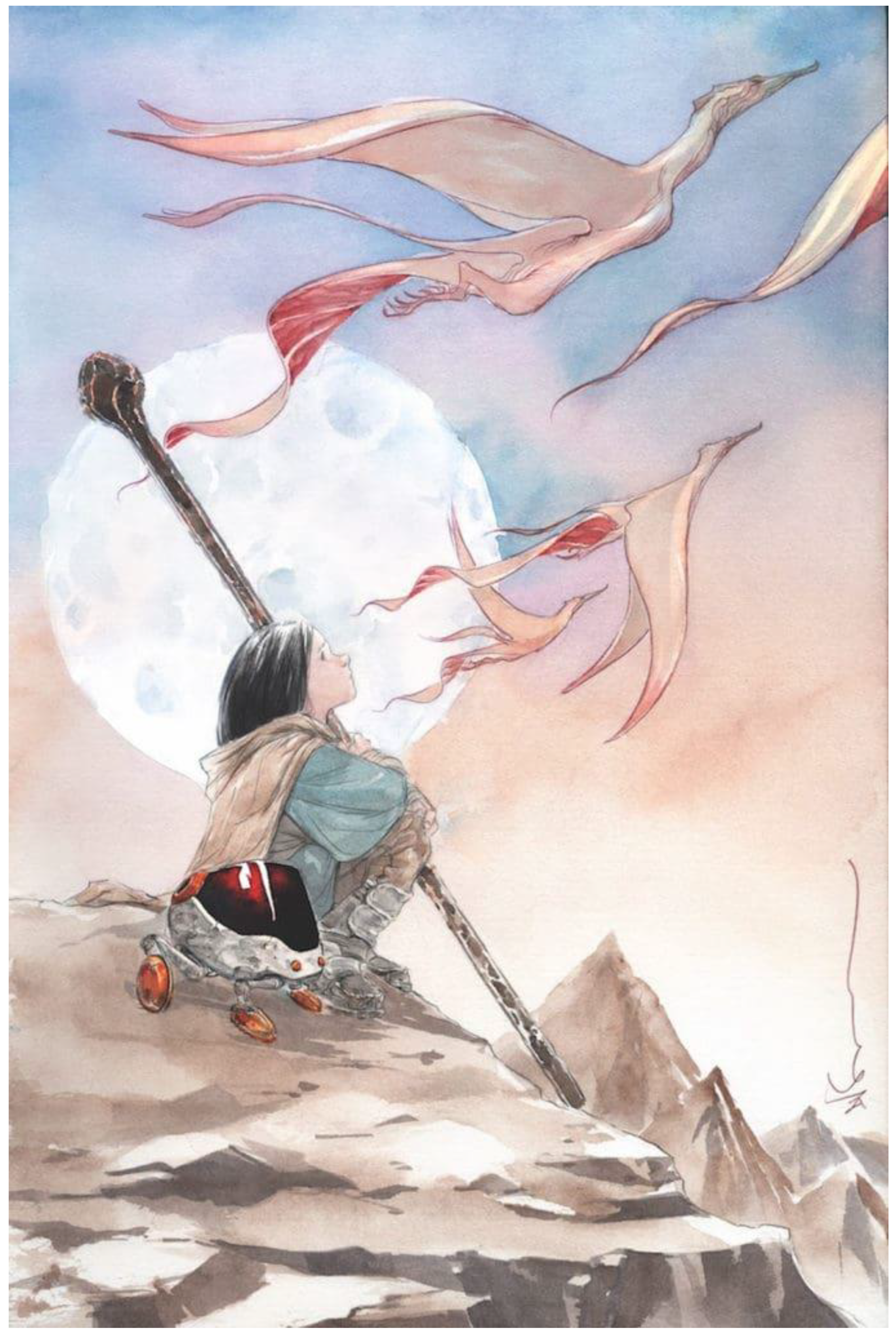
Figure 13.
Cover of Ascender 1 by Dustin Nguyen.
In Moshe Halbertal’s On Sacrifice, he writes that the Hebrew term for sacrifice, korban has developed into three linked but differing meanings, first as a human offering or gift to God, then later describing what is given up or renounced for a greater good, and finally (in Modern Hebrew), referring to a victim of a crime.60 This article’s focus is best represented in Halbertal’s second example in which I have sought to frame the highest form of love as a holy or mature sacrificial act in which someone is willing to die to save another life. After touching on a range of literary and biblical examples (along with some theories about sacrifice), I focused on the comics Descender and Ascender and outlined three key aspects for sacrificial love to be both the highest form of love: namely showing empathetic love, as in the story of TIM-21; unconditional love in the case of Effie; and morally redemptive love in my keystone focus on Driller.
In reflecting upon the highest ideals of love and what a love of lasting and integral value mean, sacrifice is posited as a key, if not the key, element. Here, we even encroach upon what is holy, for what can be a greater sign of love, as Jesus remarks, then to lay down one’s life for a friend? (John 15:13). But while all self-sacrifices for another are tragic, not all are types of sacrificial love because the act can be tainted by several factors, from coercion and immaturity, including an inordinate desire for martyrdom, to a willingness to die for an ignoble or destructive cause or intention. Such are not true acts of love, which should be free, expansive, and noble. A holy, sacrificial love, is thus always:
- Freely chosen but still an aberration because all life is sacred.
- Deemed to be the only, best or last-resort way to save the life of another, who is suffused and ingrained within the love of oneself.
- Because the other is also an extension and distinction of one’s self, the person laying down their life chooses, in love, to sacrifice what is best in them for another because the world we live in, with its many injustices and failures, present such a choiceless choice.
In the decision and act to sacrifice one’s life for the sake of another, be it a person or cause (which is ultimately intended for the good of other people), what must never be minimized is that everyone is priceless and beloved, overflowing with dignity and love. That is precisely what makes this sign of sacrificial love of one’s self for another both holy and tragic and how language of the holy and unholy can be invoked. Further above, I discussed the death of Jesus and the various justifying arguments and theories, and why many of these theories raised many theological and moral problems. If applying the examples I highlighted from Ascender and Descender to the story and example of Jesus’ life and crucifixion, I would summarize as follows:
Jesus did not die because God so decreed as a need or requirement to counter some hypothetical fall in a garden but because a life devoted to the love of God, friend, and (so-called) enemy often results in the cross—in shame, isolation, suffering, and martyrdom. But, such horrors do not have the final word, because somehow in some way, inexplicable to us, despite the level, extent, and profundity of horrors and evils, God can heal, God can save, God can fashion light where once there had only been darkness and gloom. Moreover, as Jesus (again for Christians, fully God and fully human), knew and lived exile (Matt 2:13-15), torture, abandonment, and death (Mark 15:34), he gifts to us a rich potential solidarity for the many broken and tortured in our world because God, too, suffered, died, and was buried—but hopefully like us, will rise again on the third day (John 20).61 Similar to TIM-21, moreover, Jesus’ life was devoted and sustained by empathy and of compassion for others, a love and empathy that instilled a willingness to suffer and die for the good of those others. In the gospels, Jesus’ life of compassion for the poor and oppressed (Luke 6:20) testify to such empathy. And like Effie’s maternal, unconditional, and kenotic love, Jesus embodied the love of everyone, even one’s enemy, a love that came to serve others and not be served (Mark 10:45).62 And finally, there is Driller’s act of redemptive, sacrificial love, saving TIM-21 who was (at that point) the fulcrum for saving the universe from the destructive powers of the Coven and the Descenders. In my interpretation, Jesus’ death on the cross not only serves as a sign and symbol of a life of truth and social justice, but is a splash page of redemptive love that signals for believers a God who created us out of love and is willing to die as a testament to that love. Jesus’ resurrection illustrates a life beyond death, and bleeds meaning and hope even after the maws of death and despair. While none of us can reach the heights of Jesus, perhaps we can imitate the empathic love of the companion robot TIM-21; the unconditional love of cyborg Effie, and the redemptive love of Driller, once a real robot killer.
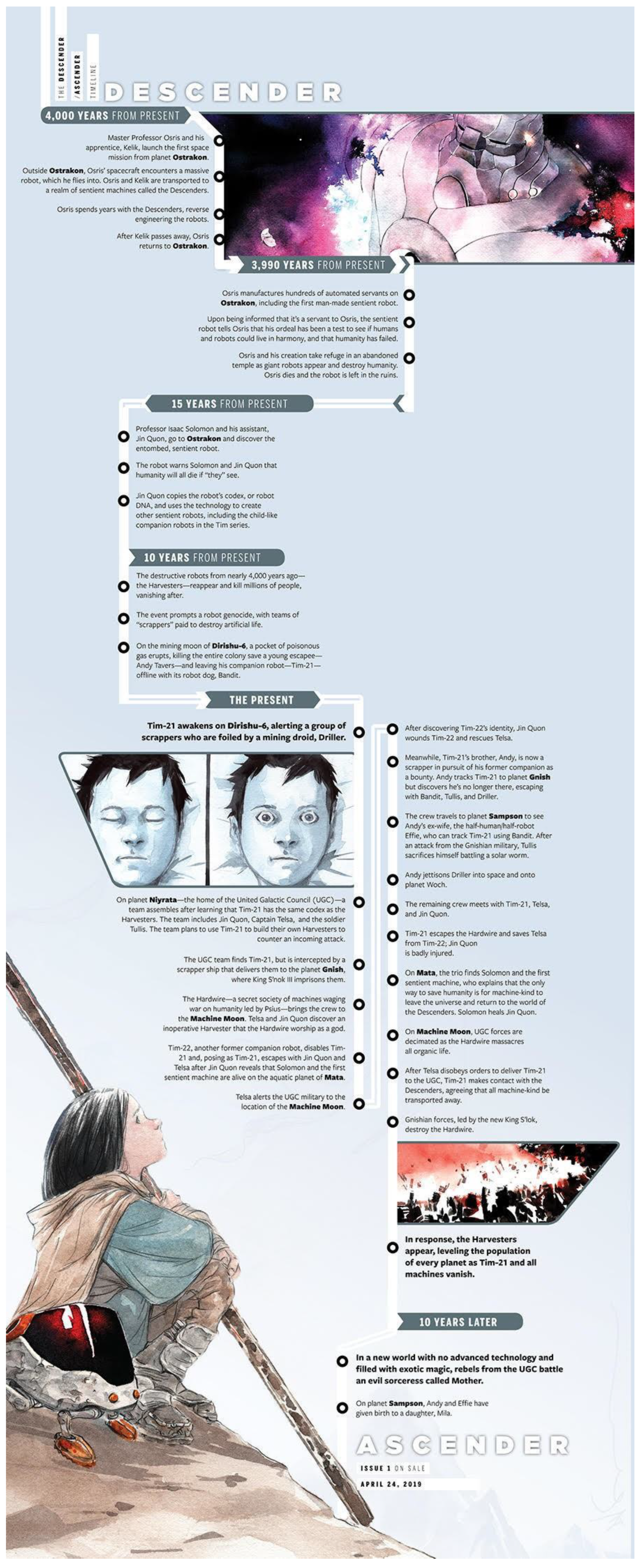
Figure 14.
Timeline of Descender/Ascender by Image Comics with art by Dustin Nguyen.
- 1
- The robust academic field of comics studies needs little justification today, but for some recent comics studies examining religious, theological, or ethical themes, see, for example, Blair Davis, Christianity and Comics: Stories We Tell about Heaven and Hell (Rutgers: Rutgers University Press, 2024); Matt Reingold and Ramiro Bujeiro, Jewish Comics and Graphic Narratives: A Critical Guide (London Bloomsbury, 2022); A. David Lewis and Martin Lund, editors, Muslim Superheroes: Comics, Islam, and Representation (Cambridge: Harvard University Press, 2017), and the books in the Series “Theology, Religion, and Pop Culture” from Lexington Books/Bloomsbury. See also my Destruction, Ethics, and Intergalactic Love: Exploring Y: The Last Man and Saga (Routledge, 2023).
- 2
- For a Buddhist examination of ethical issues around robots and AI, see Soraj Hongladarom, The Ethics of AI and Robotics: A Buddhist Viewpoint (Lexington Books, 2021); for a philosophical exploration of questions like: “Does a robot have moral agency?”, see Mark Coeckelbergh, Robot Ethics (Cambridge: MIT Press, 2022); and for a scientific and ethical examination of machine ethics, see Rebecca Raper, Raising Robots to be Good: A Practical Foray into the Art and Science of Machine Ethics (Springer, 2024).
- 3
- As pointed out in the Jewish Annotated New Testament, this phrase (John 15:13) echoes (along with much of the passage on love and friendship), Aristotle’s Nicomachean Ethics 9.1169a. The former is a foundational source for my reflections here, but any systematic evaluation of the context and history of the biblical passage is beyond the scope of this work, especially as ultimately, and as I have argued elsewhere, I prefer the Jesus of Mark’s gospel who is more unsure and struggling with what his calling and purpose mean than the confident Jesus in John’s Gospel who knows his purpose and seems to have everything foretold and planned. Especially for the many who have suffered traumatic and horrible suffering, a Christ as a fellow sufferer of anxiety, despair and suffering can resonate more, especially if that same Jesus believes in, and is the source according to Christians, for redemption and healing. See my -------. Note also that in John’s gospel, Jesus says these words about dying for a friend during his extended farewell discourse on Passover, what Christians have since called the Last Supper, a section in John’s Gospel which is replete with a series of wide-ranging metaphors and theological themes, from images of the vine and the branches to foretelling of the Holy Spirit. On love in John’s Gospel, see Francis J. Maloney, Love in the Gospel of John: An Exegetical, Theological, and Literary Study (Baker Academic, 2021); and Fernando F. Segovia, “The Theology and Provenance of John 15:1-17.” Journal of Biblical Literature 101.1 (March 1982): 115-128, http://www.jstor.com/stable/3260444. See also: Jan van der Watt, “Laying Down Your Life for Your Friends: Some Reflections on the Historicity of John 15:13.” Journal of Early Christian History, 4.2 (2014): 167–180, https://doi.org/10.1080/2222582X.2014.11877310; and The Jewish Annotated New Testament, ed. Amy-Jill Levine and Marc Zvi Brettler (Oxford: Oxford University Press, 2011), 187.
- 4
- For an interesting feminist and comics studies analysis of God’s creation in Genesis, see Liana Finck, Let There Be Light: The Real Story of Her Creation (New York: Random House, 2022).
- 5
- Such traumatic events include the murder of Victor’s brother William and the trial and execution of Justine Moritz (mistakenly blamed for William’s murder (committed by the Creature).
- 6
- Mary Shelly, Frankenstein (New York: Barnes and Nobles, 1993), 102. The Creature’s main request will be a companion like him which Victor will not bring to fruition.
- 7
- Shelly, Frankenstein, 125.
- 8
- For commentary, see The Norton Critical Edition of Frankenstein: The 1818 Text, Contexts, Criticism by Mary Wollstonecraft Shelley and edited by J. Paul Hunter (Norton: 2022).
- 9
- This is also a claim in traditional anti-theodicies that allege God’s moral failings in light of the problem of evil. See, for example, my--. 1 and 3.
- 10
- Confer: “I was benevolent and good; misery made me a fiend” (Shelly, Frankenstein, 101).
- 11
- Confer especially Richard’s wooing and bedding of Queene Anne after she scolds and imprecates him for his murdering her husband (and others). Shakespeare, Richard III, Act 1, scene 2.
- 12
- In the novella, Replicants were originally called “Androids” and Blade Runners were “bounty hunters.” These later terms were adopted for the 1982 movie.
- 13
- In the novella, androids with a “Nexus-Six brain unit” are the most advanced (Philip K. Dick, Do Androids Dream of Electric Sheep? (New York: Ballantine, 1996), 54.
- 14
- While I rebuked Frankenstein for a lack of empathy above, note that in Dick’s novella, the android/replicant Rachael is created with excessive empathy to use that against her would-be killers, the bounty-hunters/blade runners. Empathy is also a key characteristic of TIM-21 in Descender/Ascender as noted below. While compassion is the virtue par excellence for the Dalai Lama, empathy has come under some attack, most notably by Paul Bloom in Against Empathy: The Case for Rational Compassion (London: The Bodley Head, 2017).
- 15
- Roy then proceeds to reflect on the unique and potent memories which soon “will be lost like tears in rain.” He then saves Deckard and soon dies. For an article that employs religious and spiritual terms to analyze the film, see David Macarthur, “A Vision of Blindness: Blade Runner and Moral Redemption.” Film-Philosophy Volume 21.3, (Sept 2017): 371-391, https://doi.org/10.3366/film.2017.0056.
- 16
- In Blade Runner 2049, we learn that Rachael and Deckart were able to have a daughter but Rachael died in childbirth. In the novella, Deckard is married but is seduced by Rachael who tells Deckard: “Androids can’t bear children,” and refers to herself as “Chitinous reflex-machines who aren’t alive” (194), though her reflecting on the implications hint at something greater to her identity. Such is never resolved as the question remains of how and whether she shows humanity, whether through empathy, in her role seducing bounty hunters like Deckart or her cynicism and cruelty, especially in killing Deckart’s goat (226-227). Deckart admits to falling for Rachael and even sleeps with her, but the novella’s ending is very different than the film’s.
- 17
- See, for example, Joseph J. Darowski, X-Men and the Mutant Metaphor Race and Gender in the Comic Books (Rowman and Littlefield, 2014).
- 18
- The history is actually more complicated, especially as teased in the series’ final episodes and notion of its cyclical history. On its links to American culture and the war on terrorism, see Tiffany Potter and C. W. Marshall, eds., Cylons in America: Critical Studies in Battlestar Galactica (New York: Continuum, 2008).
- 19
- This is most evident in the relationship of Cylon Sharon Valeri and BSG Viper Pilot Karl C. Agathon (callsign “Helo”) and a bit more complicated in Caprica 6 and Gaius Baltar. For a series of essays examining the various meanings of interspecies sexual relationships in sci-fi, see The Sex Is Out of This World: Essays on the Carnal Side of Science Fiction, ed. Sherry Ginn and Michael G. Cornelius (Jefferson, NC: McFarland, 2012).
- 20
- See, for example, Obama's Guantánamo: Stories from an Enduring Prison, ed. Jonathan Hafetz, Jonathan (New York: New York University Press, 2016); Mohamedou Ould Slahi, Guantánamo Diaries, ed. Larry Siems (Edinburgh: Cannongate, 2015); and Steve Coll, Directorate S: The C.I.A. and America’s Secret Wars in Afghanistan and Pakistan, 2001–2016 (London: Penguin, 2019).
- 21
- For theological and ethical analysis of Battlestar Galactica, see Erica Mongé-Greer, So Say We All: Religion, Spirituality, and the Divine in Battlestar Galactica (Eugene: Cascade Books, 2022). Other powerful examples (not discussed above) of robots seeking rights or legal recognition include the video game Detroit: Become Human, where you play as androids who make moral decisions and who seek true freedom, and the Mass Effect games, especially the story arc of EDI in the third game. See also many of the Becky Chambers novels including her A Monk and Robot series; for commentary on her Wayfarers series, see my------. A modern classic on stories of robots seeking redemption and meaning in life is C. Robert Cargill, Sea of Rust (New York: HarperVoyager, 2017). Questions of robots and souls are frequent ones. As Deckard asks fellow bounty hunter Phil Resch in the novella: “Do you think androids have souls?” (Dick, Do Androids Dream, 135).
- 22
- Proponents of universal salvation, for example, would contend that none of us would rationally choose acts that might condemn us to eternal damnation and so cannot be deemed free and responsible for such choices. For my analysis in the context of theodicy, see Amidst Mass Atrocity, chapter 11. Determinists like neurobiologist Robert Sapolsky contend we have no free will because of various factors like environment, hormones, and genes, and so are not responsible for what we do. We are the ones who are robots. See Robert Sapolsky, Determined: The Science of Life Without Free Will (London: Penguin, 2023). I would contend that we are all constrained to various degrees in terms of how fully free we are and how rationally clear we are in terms of intentions, justifications, and the intended and likely consequences of our actions. Nevertheless, most of us are responsible for the actions (and inactions) we do.
- 23
- Thich Nhat Hanh, Interbeing: Fourteen Guidelines for Engaged Buddhism (Berkeley, CA: Parallax, 1987).
- 24
- See for example, our bloodlust to wipe out wolves but recent efforts to protect them in Nate Blakeslee, The Wolf: A True Story of Survival and Obsession in the West (London: OneWorld, 2018). In Rockstar Game’s Red Dead Redemption, occurring in the declining Wild West of America circa 1911, you can see NPCs callously killing buffalo for sport and can even choose to take part in such culling, even to kill the last buffalo and get a virtual trophy called “Manifest Destiny.” Note the game’s creators provide moral condemnation of such acts through various indigenous voices, including the Native American Nastas who tells the lead character John Marston (when they both are out riding and white men callously shoot buffalo for sport: “We hunt to eat, not for sport. Soon there will be no buffalo left.”
- 25
- See Eyal Press, Dirty Work: Essential Jobs and the Hidden Toll of Inequality in America (New York: Farrar, Straus and Giroux, 2021).
- 26
- For a recent take on the trolley dilemma (though not involving Star Wars), see David Edmonds, Would You Kill the Fat Man?: the Trolley Problem and What Your Answer Tells Us about Right and Wrong (Princeton: Princeton University Press, 2015).
- 27
- Wall-E could presumably fly out of the water!
- 28
- See my---.
- 29
- Aeschylus, Agamemnon in The Greek Tragedies. Volume 1, eds. David Grene and Richard Lattimore, and trans. Richard Lattimore (Chicago, University of Chicago Press, 1960, (208, p. 11).
- 30
- Ibid., 218, p. 11.
- 31
- Ibid., 228, p.11. On scapegoating, see René Girard, I See Satan Fall Like Lightning (Maryknoll, Orbis, 2008). “The defense of victims is both a moral imperative and the source of our increasing power to demystify scapegoating” (3).
- 32
- Keats’ 1819 ode has the line; “Bold Lover, never, never canst thou kiss,” a beauty seemingly more potent than in real life because it can never fade and she will always be true, similar as well to the twisted logic of the narrator in Robert Browning’s “Porphyria’s Lover” (1836).
- 33
- Jephthah’s unnamed daughter was later referred to as Seila or Iphis from medieval sources. Note also that some Jewish scholars have argued that she wasn’t killed but was offered to the Lord in a way that had to preserve her virginity. See Rachel Adelman, “Crossing the Threshold of Home: Jephthah’s Daughter from the Hebrew Bible to Modern Midrash.” In Feminist Interpretations of Biblical Literature, ed. Lilly Nortjé-Meyer (Cambridge: Cambridge Scholars Publishing, 2022), 1-26. For a famous example critiquing Jephthah, see Peter Abelard’s second letter to Heloise, in which he writes: “Such men (the lords of the earth) could properly be compared with Jephthah, who made a foolish vow and in carrying it out even more foolishly, killed his only daughter” (“Letter 2, Abelard to Heloise,” in The Letters of Abelard and Heloise, trans. Betty Radice (Penguin: London, 1974), 121.
- 34
- In Fear and Trembling, Søren Kierkegaard examines the Akedah narrative from different angles and perspectives, but still sees Abraham’s blind obedience and faith as ultimately praiseworthy (especially as he never had to go through the killing of his son), but I maintain any teleological suspension of the ethical is theologically self-destructive and opens the door to deicide if not a Deism that leads to God’s meaninglessness in this world.
- 35
- Sophocles, “Antigone” in Sophocles I, trans. David Grene, 2nd ed. (Chicago, University of Chicago Press, 1991), 570 (p. 181).
- 36
- Ibid., 504 (p. 178).
- 37
- Ibid., 576 (p. 181).
- 38
- See Peter Hayes and John K. Roth, editors, The Oxford Handbook of Holocaust Studies (Oxford: Oxford University Press, 2012); and Dan Stone, The Holocaust: An Unfinished History (London: Pelican, 2024).
- 39
- Didier Pollefeyt, “Christology After Auschwitz: A Catholic Perspective.” In Jesus Then & Now: Images of Jesus in History and Christology, ed. Marvin Meyer and Charles Hughes, 229–248. Harrisburg: Trinity, 2001); and my “The Future of Post-Shoah Christology: Three Challenges and Three Hopes.” Religions 12.6: 407 (2021), https://doi.org/10.3390/rel12060407.
- 40
- See, for example, Richard Rohr, “The Franciscan Option,” in Stricken by God? Nonviolent Identification and the Victory of Christ, ed. Brad Jersak and Michael Hardin, 206–212 (Grand Rapids: Eerdmans, 2007).
- 41
- See, for example, Jon Sobrino, No Salvation Outside the Poor: Prophetic-Utopian Essays (Maryknoll: Orbis, 2008).
- 42
- While optioned for television in 2020, the comics have been reissued in various prestigious hardback books, and most recently saw the successful crowdfunded The Art of Descender book in 2024.
- 43
- The comics will be cited in the text by issue as they are non-paginated and with the “D” for Descender and “A” for Ascender.
- 44
- A name like Mother and Mother’s use of love is ironic and totalitarian throughout the series, in contrast to selfless, heroic motherhood represented by Effie (who also happens to become a cyborg!) or Andy’s mom.
- 45
- See the sections on Driller further below.
- 46
- In comics (like the movies), if you don’t see a dead body confirmed, possibilities of life remain. And while some comics, like Saga, Y: The Last Man, and Monstress have permanent deaths, others veer around a character’s death by a reboot of the series—a retcon—or some alternative universe plot. In Descender/Ascender, if a character dies, they are dead unless, like Effie they are a Cyborg who happened to be bitten by a vampire and so is deemed dead by her husband and buried only to have her cyborg parts defeat the vampire virus and restore her heart! (A12).
- 47
- Telsa is another main character in the book who is the daughter of the General of the UGC and always feels she has to live up to his cold and stern love. She was also traumatized and embittered by the murder of her mother by the Harvesters (sent by the Descenders) as they both tried to flee. Her survivor guilt manifests itself in a gruffness and fear of getting close to anyone, though TIM-21’s trust of her and loyal soldiers under her command challenge much of her desire to close people off. Telsa is a symbol of the soldier always willing to sacrifice herself for a cause but her intentions, because of her scarred past, would need deeper analysis than is possible here. She would also not seem best to embody the kind of sacrificial love I am advocating. Is hers a reluctant sacrificial love, not a full-bodied choice but one that only emerges after a lot of inner-refusal and rebellion? Does that make it less noble? I am reminded here of Jesus’ parable about the son who is asked by his father to work in the vineyard and says he won’t do it but then does as opposed to the one who says he will and doesn’t (Matt 21:28-32). In the end, the first son is obviously better but perhaps the ideal would be the one who says and does the good. Jesus was making a point about sinners who repent and ultimately do what is good.
- 48
- It is later called a “hungry ghost” by Mizerd (A10).
- 49
- This is another problematic example of sacrifice as Kanto still had value in what he became and chose to do even if the initial memories and backstory were fabricated. Plotwise, it’s a clever way to allow TIM-21 to then inhabit an adult human body that (for a time) matches Andy’s so they can appear closer on the outside just as they had when Andy was little in the mines of Dirushu. Of course, Andy will continue to age visibly while TIM won’t in the same way.
- 50
- Dr Jin Quon’s character story is very complex involving a lot of betrayal and self-centredness (much like Gaius Baltar in Battlestar Galactica) with a deep intelligence and canniness and moments of heroism, but space does not permit his story here.
- 51
- While TIM-21 becomes special and unique, initially he was just one in a series of these model robots like the Replicants or Cylons who had various identical models. TIM-22 looks just like TIM-21 but becomes a bitter, vengeful robot (partly because he was abused and hunted by humans).
- 52
- Note it’s not clear how the Descenders keep their promise because Effie and Andy would have died if Effie hadn’t had some “personal force field” (convenient) as they were left floating in space when the Descenders disappeared, and then saved by Driller when her “personal force field” had no more power to sustain them.
- 53
- Effie is a Christ-figure in many ways with her unconditional, sacrificial, kenotic, motherly love, her death and resurrection, two natures, etc., though like most Christ-figures, the match is one of resemblance but never a perfect fit.
- 54
- This is a very flawed moment especially as Andy has been a devoted father to Mila who would also sacrifice his life for her (but obviously fails in this crucial moment!).
- 55
- This is how Driller calls humans which sounds like harmans – those who harm.
- 56
- That the phrase hovers over Andy is also fitting as Effie left him precisely because she felt he was a murderer in killing robots and even called him that. Thus, at this point in the comic, both Andy and Driller are in need of repentance and change.
- 57
- Note that she also let anger at Driller’s boss (Trask) blind her to the care needed of the robots who she deemed disposable (D16).
- 58
- The Coven is led by one demonic/witch-like figure deemed Mother even if the one in power might be a daughter or sister to others in the group and through which they perpetually fight and backstab one another in their quest for controlling all the magical power in the galaxy. While TIM-21 and Driller are fighting Mother, readers of the comic would know that two sisters had fought one another for power and to take on that title of Mother. Initially the one called “weak thing” was able to overcome her tyrannical sister—and is the Mother who is responsible for the vampiric horde and other monstrosities that were unleashed on the world after the Descenders removed all robots from the galaxy (and culled billions of lives). But this Mother (weak thing) unexpectedly loses her power to her sister and TIM-21 is fighting that incantation while hoping the Harvester Robot will destroy them all. Instead, “weak thing” is able to regain her power and kill her sister as the Harvester attacks. She survives the beam, only to finally be defeated by Effie, a true mother. Driller is at least able to protect TIM from the Harvester’s beam and give him a chance to live, though sacrificing himself in the process.
- 59
- When Driller first meets young Mila, as they are attacked by vampire birds, Driller says he’s not scared and that “Driller’s a real vamp killer,” and there is a delightful wide-eyed and smiling image of Mila, admiring him: “I like you” she says, touching his robot ‘clamped hand’. While his reply is “hmmm” which is what he always says –how can even he not fall for Mila with that look of admiration and perhaps the sweetest words said to him: “I like you, Driller” (A11). Soon Driller is playing hide and seek in a ship with Mila and Bandit (A13), though he doesn’t like the game because he’s too easily found being so big.
- 60
- Moshe Halbertal, On Sacrifice (Princeton: Princeton University Press, 2012), 1-2.
- 61
- Daniel A. Madigan, S.J. “Who Needs it? Atonement in Muslim-Christian Theological Engagement” in Atonement and Comparative Theology: The Cross in Dialogue with Other Religions, ed. Catherine Cornille (New York: Fordham University Press, 2021), 27-28 (11-39).
- 62
- This passage also is used to support the Ransom Theory of Atonement.
Figure 1.
Cover of Descender 1, drawn by Dustin Nguyen.
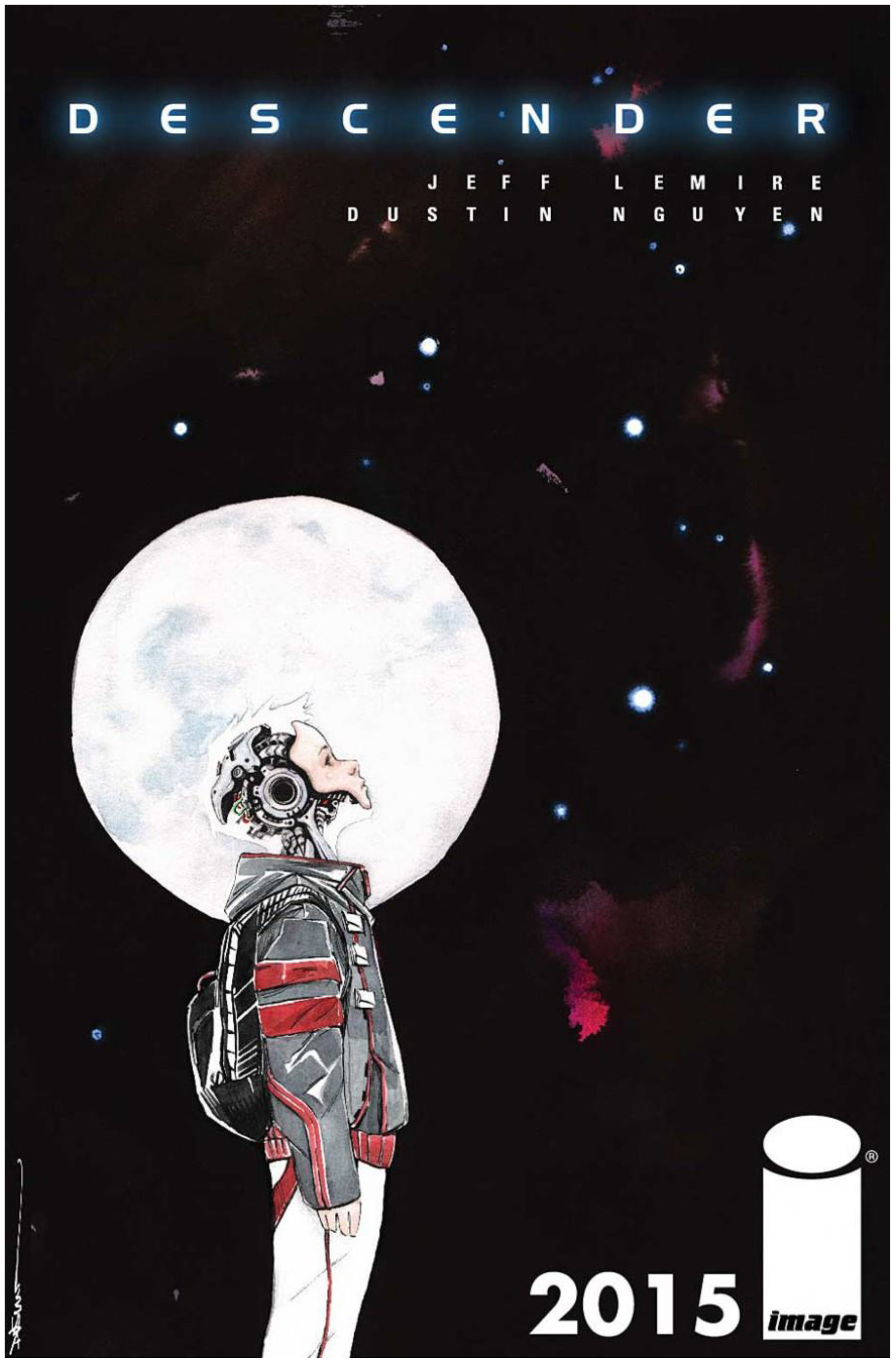
Figure 2.
The Replicant, Roy Batty (portrayed by Rutger Hauer) from Blade Runner, 1982.
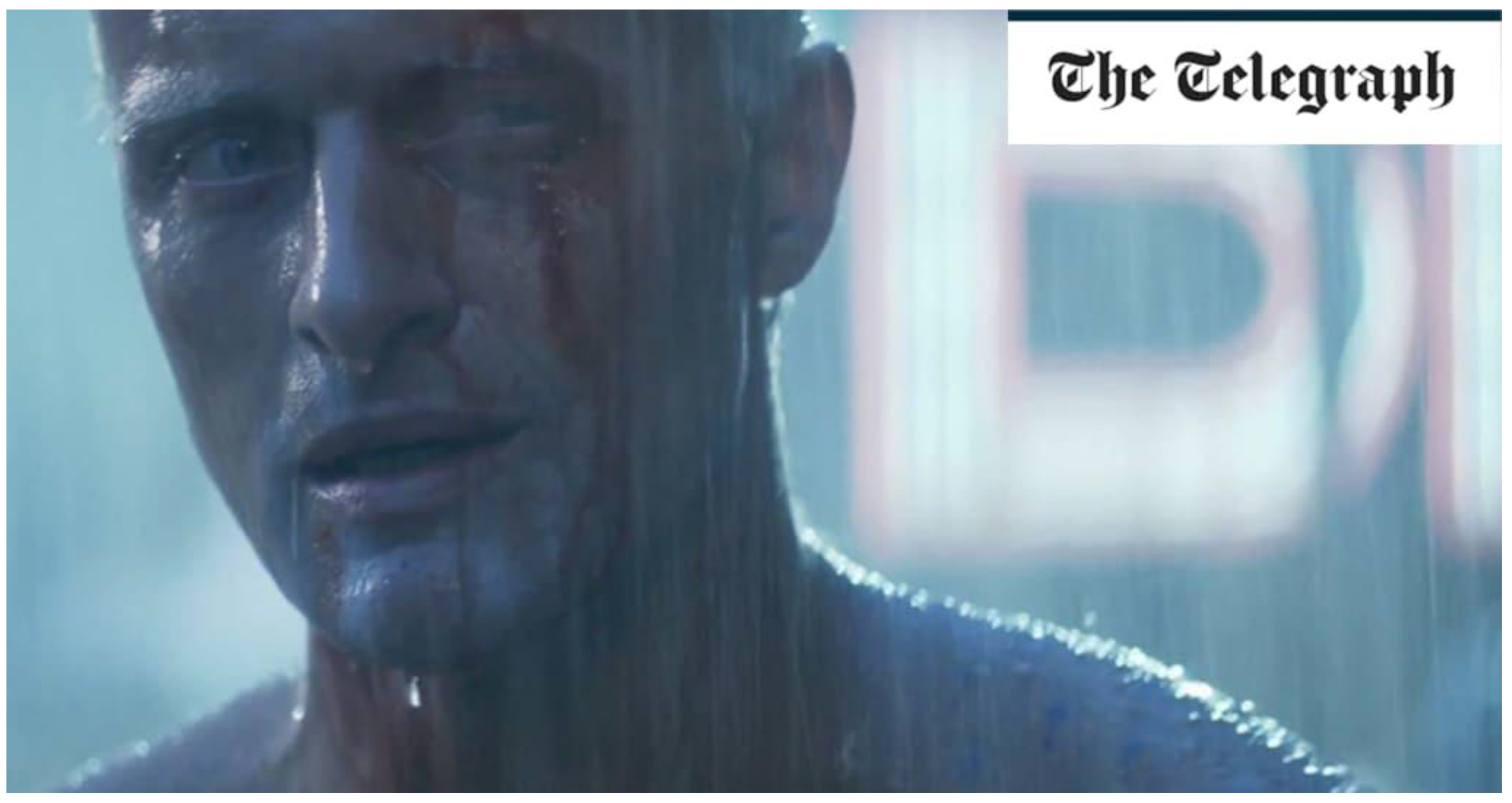
Figure 3.
Starbuck interrogating the Cylon Leoben in the reimagined Battlestar Galactica television series.
Figure 3.
Starbuck interrogating the Cylon Leoben in the reimagined Battlestar Galactica television series.
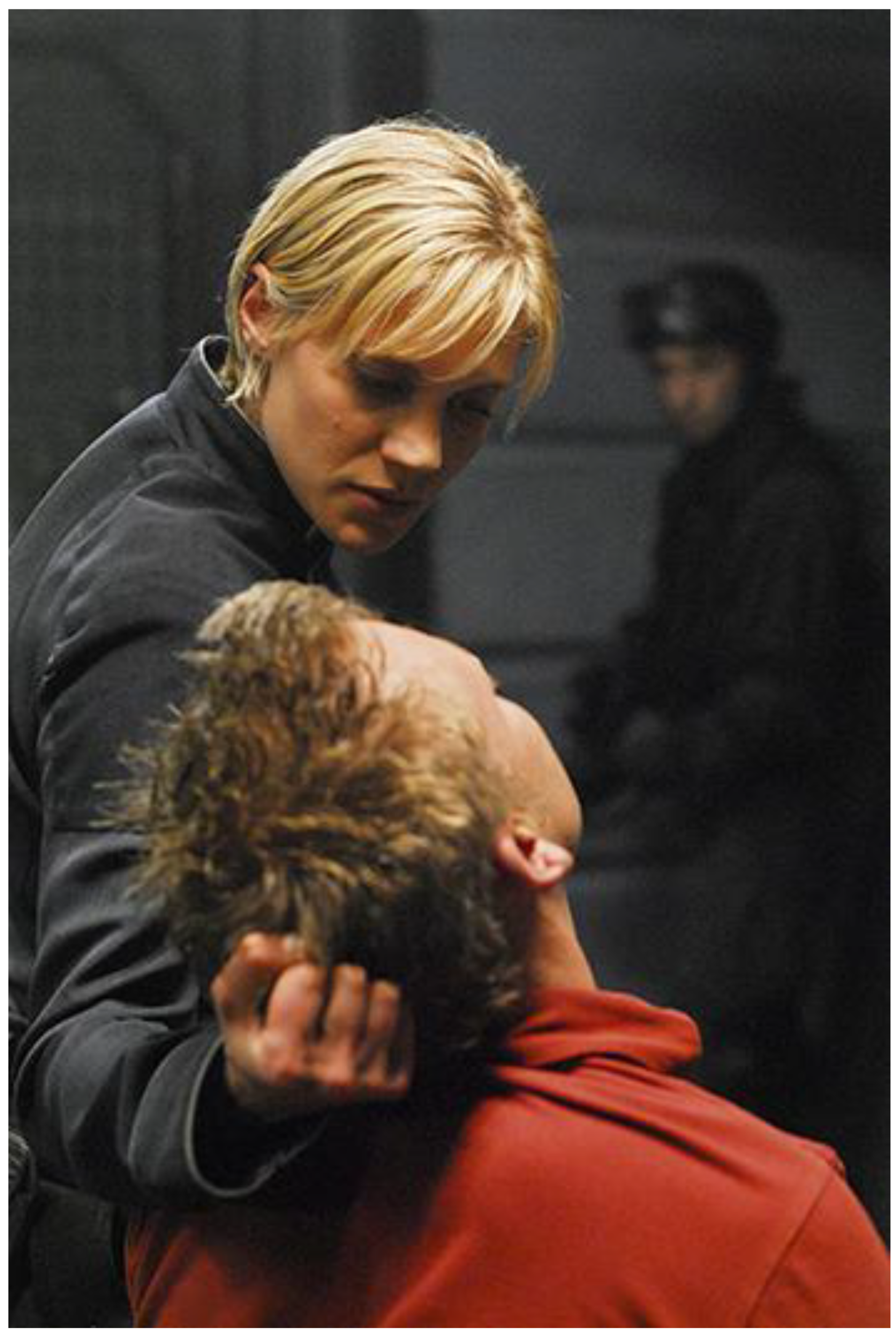
Figure 4.
Jean-Joseph Benjamin-Constant, Antigone au chevet de Polynice, 1868.
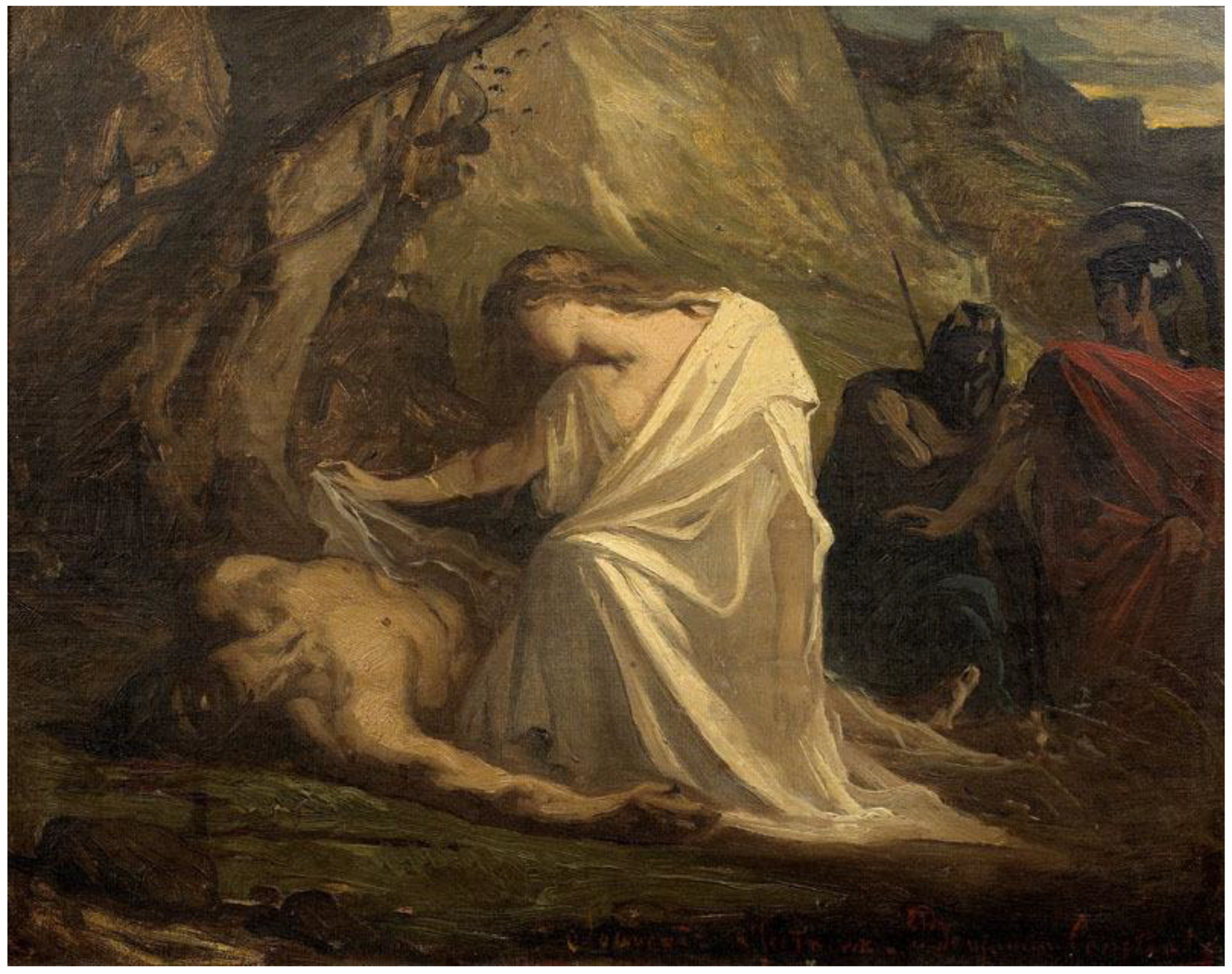
Figure 8.
From Descender 32; art by Dustin Nguyen and words by Jeff Lemire.
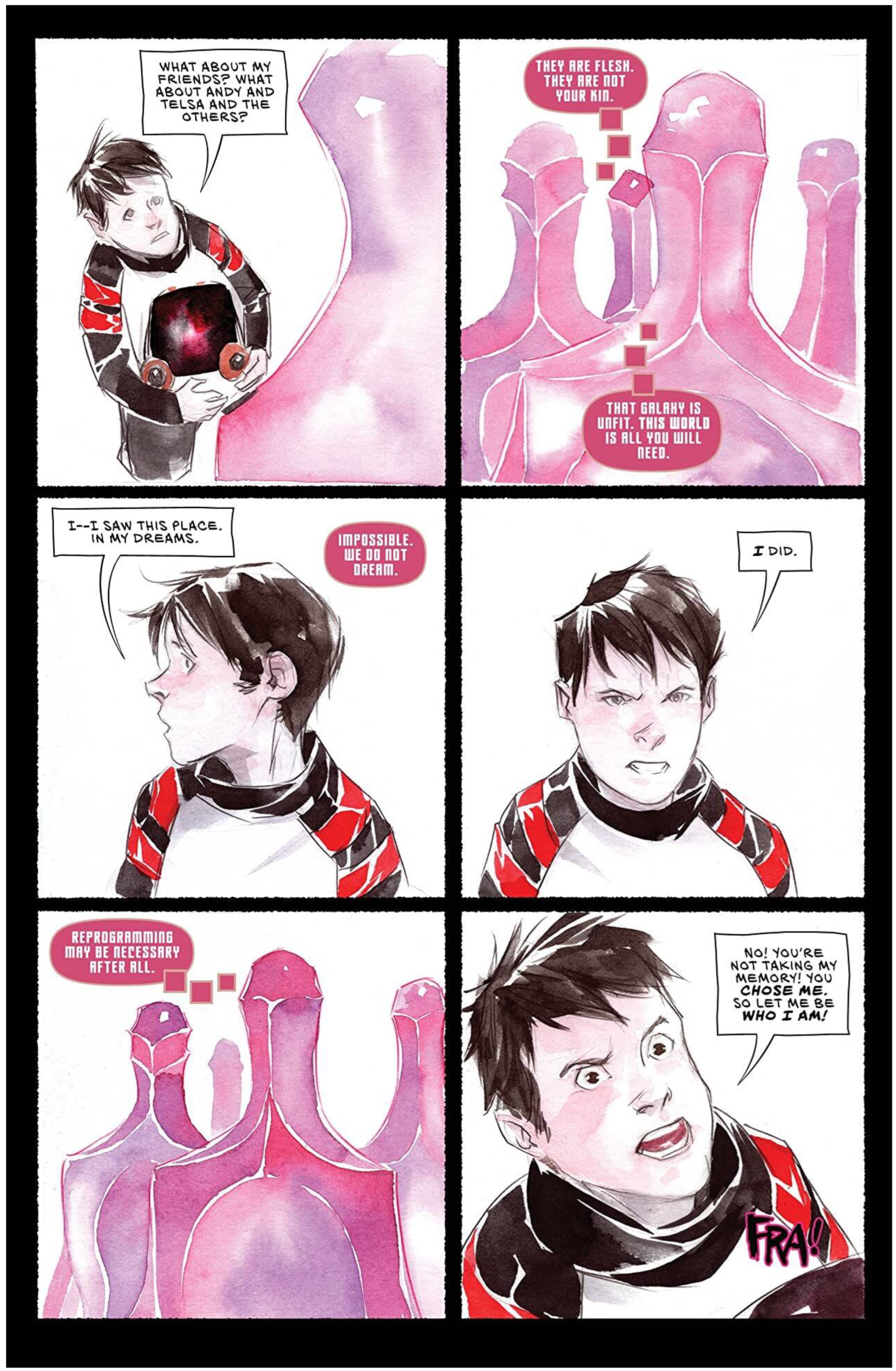
Figure 10.
Drawn by Dustin Nguyen showing Driller carrying a near-dead TIM-21 as Bandit looks on.
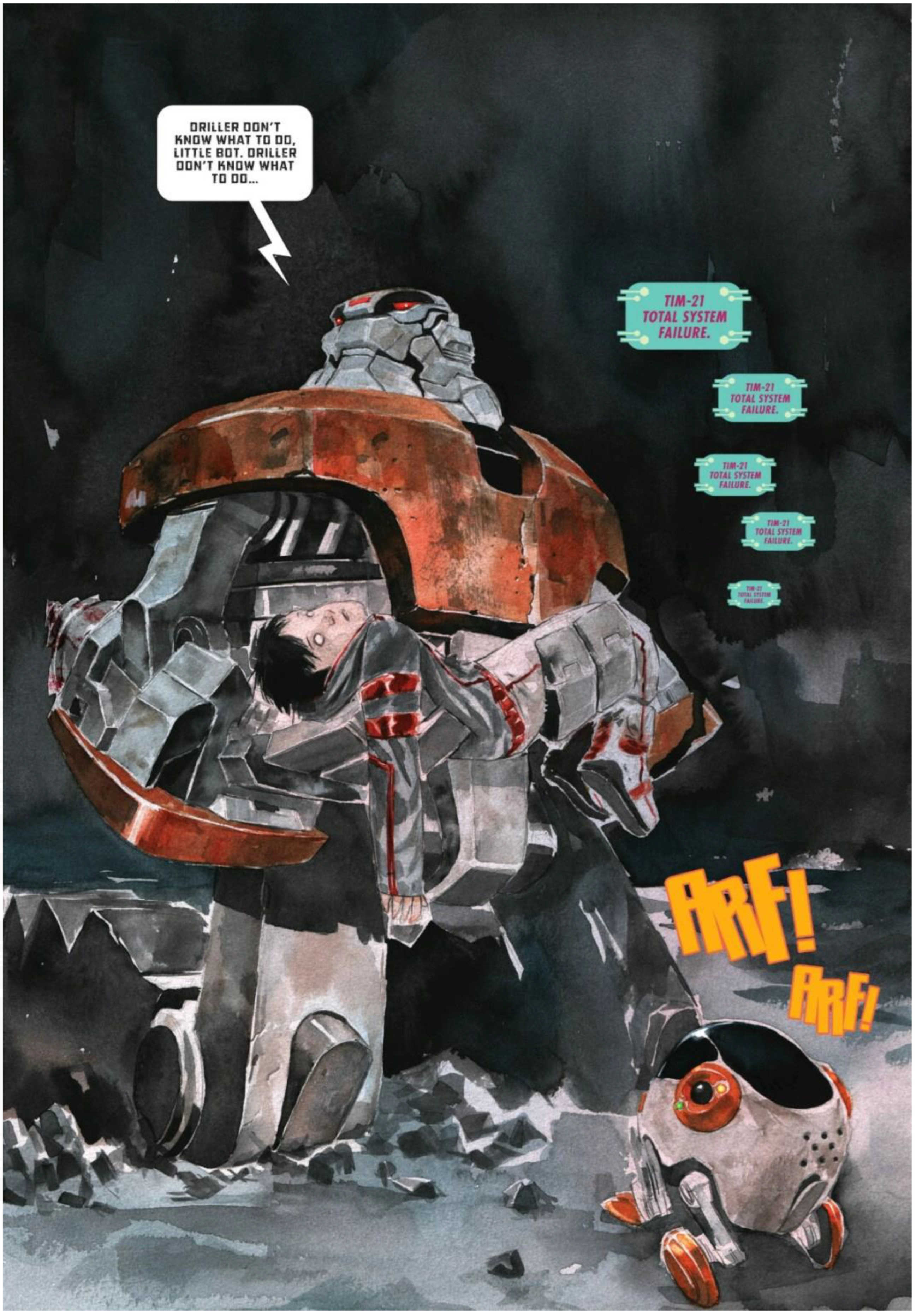
Figure 11.
A scene from Driller's origin issue (16), words by Jeff Lemire and art by Dustin Nguyen.
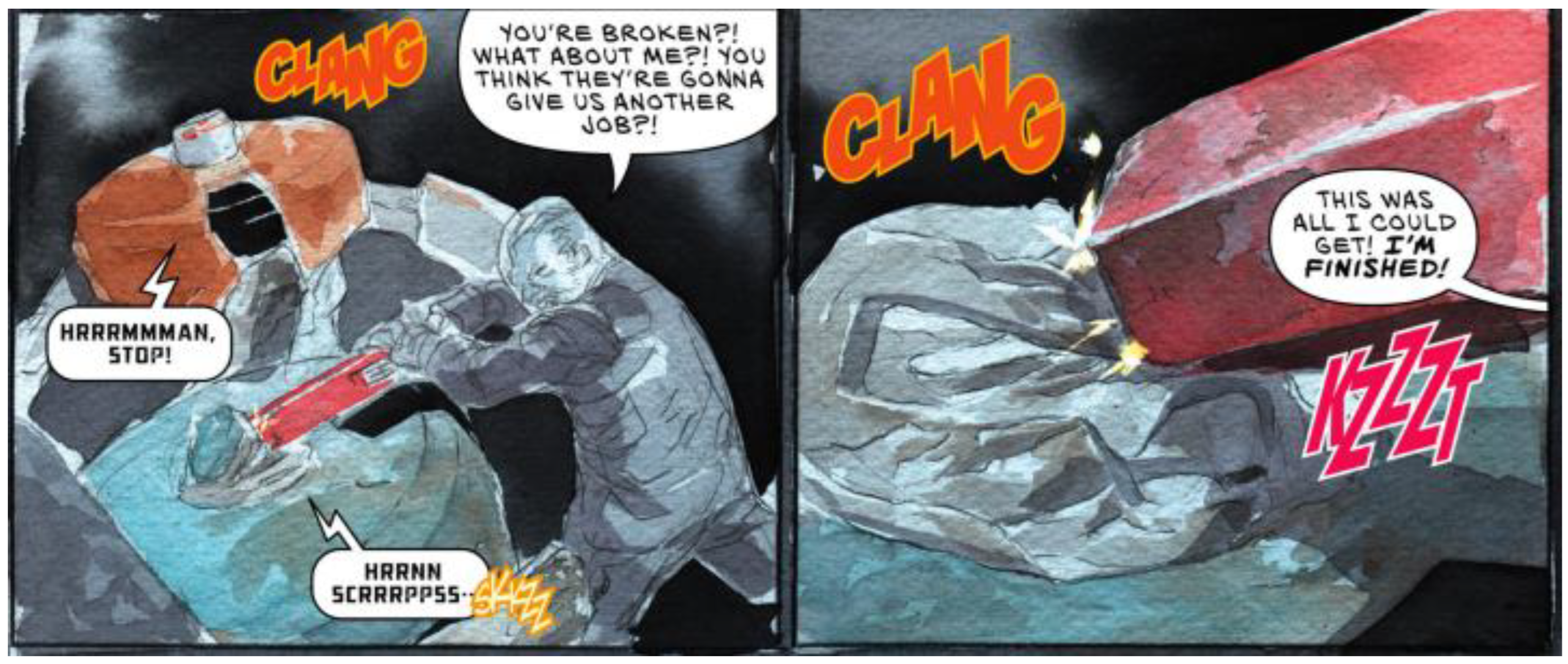
Figure 12.
From Ascender 18. Words by Jeff Lemire and art by Dustin Nguyen.
Disclaimer/Publisher’s Note: The statements, opinions and data contained in all publications are solely those of the individual author(s) and contributor(s) and not of MDPI and/or the editor(s). MDPI and/or the editor(s) disclaim responsibility for any injury to people or property resulting from any ideas, methods, instructions or products referred to in the content. |
© 2024 by the authors. Licensee MDPI, Basel, Switzerland. This article is an open access article distributed under the terms and conditions of the Creative Commons Attribution (CC BY) license (http://creativecommons.org/licenses/by/4.0/).
Copyright: This open access article is published under a Creative Commons CC BY 4.0 license, which permit the free download, distribution, and reuse, provided that the author and preprint are cited in any reuse.


