

Submitted:
24 November 2024
Posted:
25 November 2024
You are already at the latest version
Abstract
Objectives: This study aimed to evaluate the efficacy of a novel hybrid aligner system, Geniova Technologies™ (GT), for arch expansion and to compare the predictability of its virtual setup measurements with a conventional clear aligner system (CA) after the first treatment phase.Materials and Methods: Adult patients with maxillary dentoalveolar compression and anterior crowding >3 mm were enrolled and assigned to GT and CA groups. Transverse changes for canines and premolars were measured at the cusp and cervical levels after the first set of aligners.Results: No significant baseline differences in transverse dimensions were found between groups. Treatment duration (4.25 months for GT vs. 9.75 months for CA) and the number of aligners (4.25 in GT vs. 28.25 in CA) significantly differed (p<0.001). However, effectiveness comparisons revealed no significant differences in expansion outcomes, with both groups showing similar accuracy.Conclusions: The GT group achieved comparable dentoalveolar expansion of canines and premolars in significantly less time and with fewer aligners than the CA group. The predictability of virtual setup measurements was similar for both systems, confirming their comparable performance in achieving planned expansion.
Keywords:
1. Introduction
2. Materials and Methods
Sample Selection
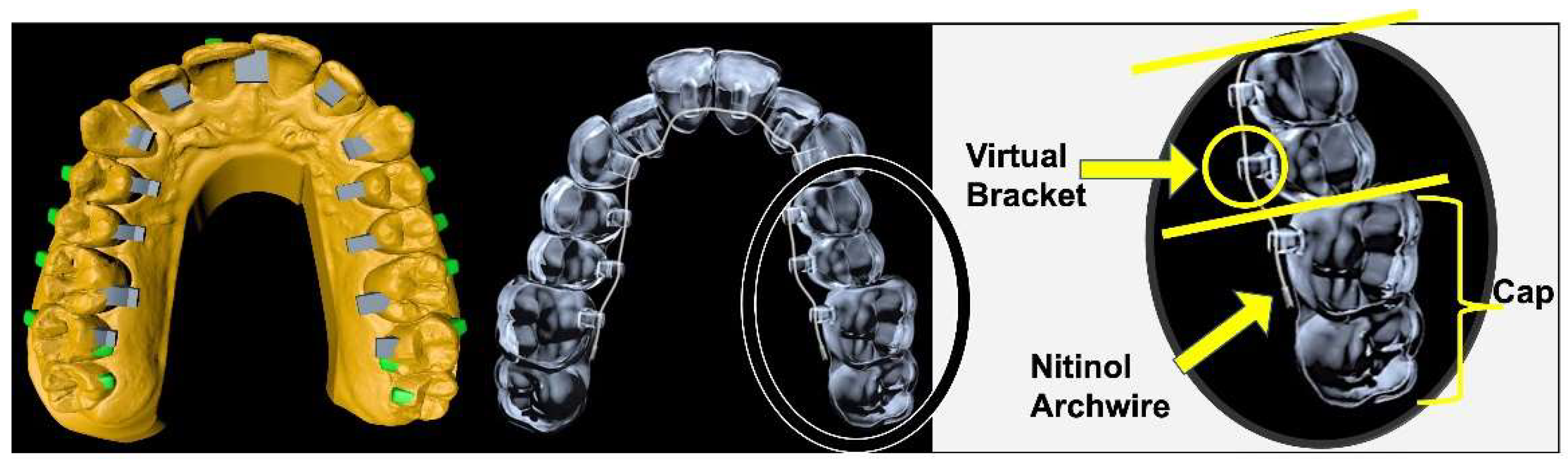
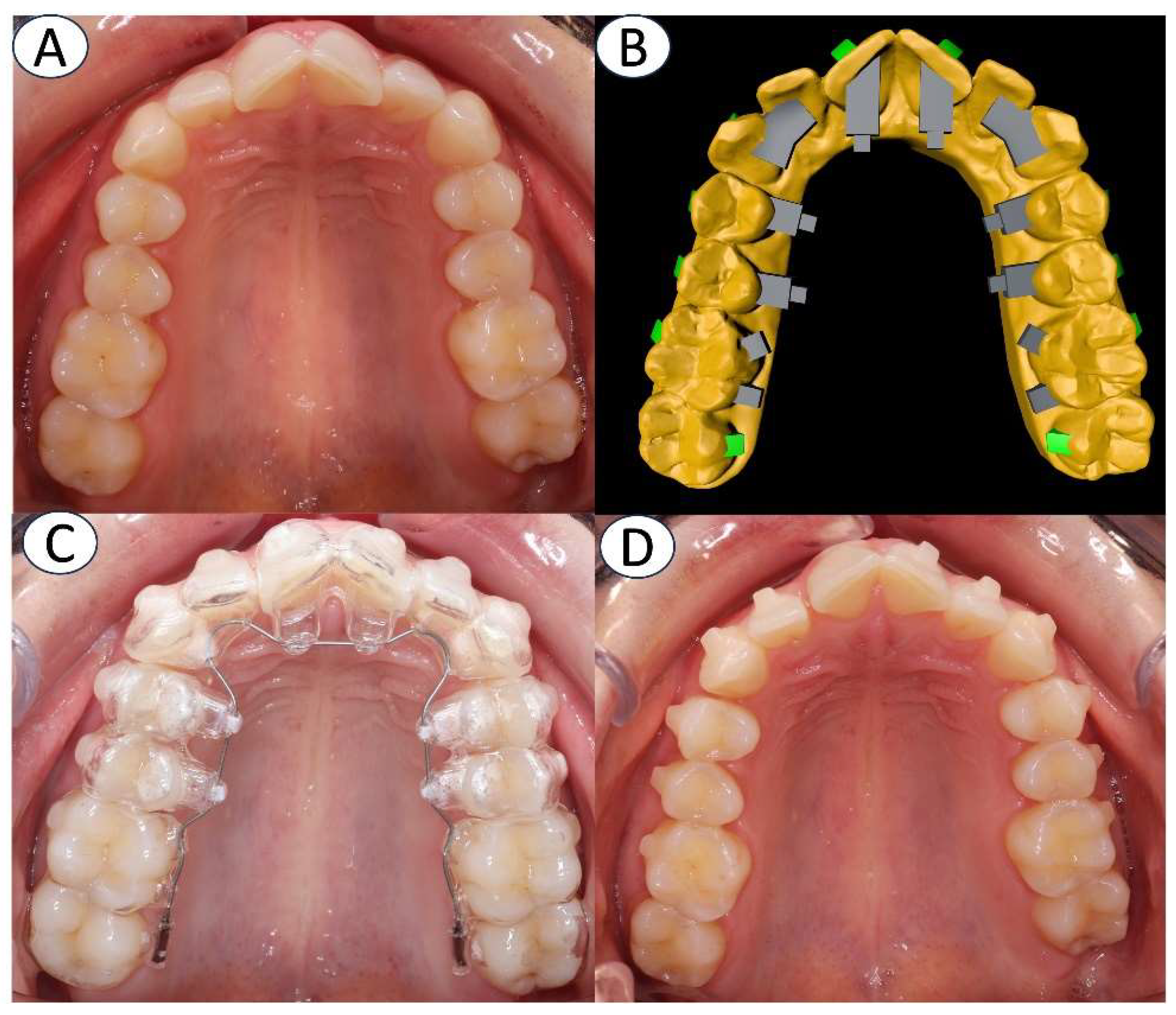
GT Group
Clear Aligner Group
Measurements
Statistical Analysis
3. Results
3.1. Patient Characteristics (Table 1)

| GT | CA | 95%CI | ||||||
| Outcome | Mean GT | SD GT | Mean CA | SD CA | Mean Diff | Upper | Lower | p (sig) |
| AGE (Years) | 31.30 | 5.51 | 38.45 | 8.77 | 7.15 | 11.84 | 2.46 | 0.000 |
| Tx Duration (months) | 4.25 | 0.72 | 9.42 | 2.17 | 5.16 | 6.56 | 4.44 | 0.000 |
| Number Aligners | 4.25 | 0.72 | 28.25 | 10.20 | 24.00 | 28.78 | 19.22 | 0.000 |
| T0_13_23_cusp (mm) | 33.10 | 2.98 | 31.77 | 2.01 | -1.33 | 0.29 | -2.96 | 0.105 |
| T0_14_24_cusp (mm) | 38.74 | 2.69 | 37.60 | 2.70 | -1.14 | 0.61 | -2.90 | 0.194 |
| T0_15_25_cusp (mm) | 43.73 | 3.01 | 42.97 | 3.11 | -0.76 | 1.22 | -2.75 | 0.440 |
| T0_13_23_cerv (mm) | 23.27 | 2.01 | 2.01 | 2.01 | -0.87 | 0.39 | -2.13 | 0.169 |
| T0_14_24_cerv (mm) | 25.42 | 1.95 | 24.69 | 2.09 | -0.73 | 0.58 | -2.04 | 0.266 |
| T0_15_25_cerv (mm) | 30.44 | 2.36 | 29.79 | 2.50 | -0.66 | 0.92 | -2.23 | 0.405 |
| T0_33_43_cusp (mm) | 23.55 | 6.76 | 25.21 | 1.49 | 1.76 | 4.81 | -1.50 | 0.293 |
| T0_34_44_cusp (mm) | 32.25 | 3.07 | 30.97 | 2.47 | -1.28 | 0.63 | -3.18 | 0.182 |
| T0_35_45_cusp (mm) | 36.85 | 2.93 | 36.14 | 3.49 | -0.71 | 1.56 | -2.98 | 0.531 |
| T0_33_43_cerv (mm) | 18.98 | 2.26 | 18.34 | 1.58 | -0.64 | 0.77 | -2.05 | 0.358 |
| T0_34_44_cerv (mm) | 24.32 | 2.00 | 23.48 | 1.75 | -0.84 | 0.45 | -2.13 | 0.196 |
| T0_35_45_cerv (mm) | 27.93 | 2.09 | 27.48 | 2.78 | -0.45 | 1.29 | -2.20 | 0.601 |
3.2. Comparison of Dental Changes Between the Two Groups
| GT | CA | Mean Dif | 95%CI | p (sig) | ||||
| Outcome | Mean GT | SD GT | Mean CA | SD CA | Upper | Lower | ||
| Real_13_23_cusp | 1.60 | 2.20 | 1.02 | 1.09 | -0.58 | 0.54 | -1.70 | 0.298 |
| Real_14_24_cusp | 2.78 | 2.03 | 2.44 | 1.40 | -0.35 | 0.77 | -1.46 | 0.533 |
| Real_15_25_cusp | 2.45 | 1.71 | 2.42 | 1.81 | -0.03 | 1.09 | -1.16 | 0.950 |
| Real_13_23_cerv | 0.88 | 1.25 | 0.96 | 0.82 | 0.08 | 0.75 | -0.60 | 0.820 |
| Real_14_24_cerv | 1.66 | 1.28 | 1.67 | 0.91 | 0.01 | 0.73 | -0.70 | 0.966 |
| Real_15_25_cerv | 1.37 | 1.13 | 1.50 | 1.34 | 0.13 | 0.92 | -0.66 | 0.740 |
| Real_33_43_cusp | 0.81 | 1.41 | 0.18 | 1.33 | -0.64 | 0.24 | -1.52 | 0.150 |
| Real_34_44_cusp | 1.26 | 1.88 | 2.34 | 1.64 | 1.07 | 2.20 | -0.06 | 0.062 |
| Real_35_45_cusp | 1.44 | 1.60 | 2.94 | 2.14 | 1.50 | 2.71 | 0.29 | 0.016 |
| Real_33_43_cerv | 0.28 | 0.79 | 0.62 | 0.99 | 0.34 | 0.91 | -0.23 | 0.235 |
| Real_34_44_cerv | 0.83 | 1.09 | 1.83 | 1.17 | 1.00 | 1.72 | 0.27 | 0.008 |
| Real_35_45_cerv | 0.80 | 0.99 | 1.93 | 1.59 | 1.13 | 1.98 | 0.28 | 0.010 |
3.3. Comparison of Percentage Increase in Initial Width at Cusps and Cervical Points Between GT and CA Groups
3.4. Comparison of Predicted and Achieved Expansion Accuracy Between GT and CA Groups
| GT | CA | 95%CI | ||||||
| Outcome | Mean CA | SD CA | Mean GT | SD GT | Mean Dif | Lower | Upper | p (sig) |
| PredicAccur%_13_23_cusp | 82.02 | 15.28 | 60.59 | 15.95 | 21.43 | -23.28 | 66.14 | 0.338 |
| PredicAccur%_14_24_cusp | 84.13 | 14.57 | 58.04 | 5.72 | 26.10 | -6.17 | 58.37 | 0.108 |
| PredicAccur%_15_25_cusp | 91.08 | 23.12 | 55.89 | 7.92 | 35.19 | -15.32 | 85.71 | 0.163 |
| PredicAccur%_13_23_cerv | 95.99 | 32.36 | 43.43 | 5.63 | 52.55 | -15.92 | 121.02 | 0.125 |
| PredicAccur%_14_24_cerv | 74.91 | 13.40 | 58.27 | 9.85 | 16.64 | -17.34 | 50.63 | 0.327 |
| PredicAccur%_15_25_cerv | 77.49 | 21.06 | 49.29 | 6.91 | 28.20 | -17.65 | 74.05 | 0.216 |
| PredicAccur%_33_43_cusp | 49.19 | 35.36 | 61.32 | 10.10 | -12.14 | -89.97 | 65.70 | 0.746 |
| PredicAccur%_34_44_cusp | 61.26 | 17.80 | 78.05 | 8.67 | -16.78 | -54.10 | 20.53 | 0.367 |
| PredicAccur%_35_45_cusp | 85.64 | 28.37 | 76.75 | 9.11 | 8.89 | -54.37 | 72.15 | 0.735 |
| PredicAccur%_33_43_cerv | 42.41 | 26.49 | 46.87 | 12.85 | -4.46 | -60.50 | 51.59 | 0.872 |
| PredicAccur%_34_44_cerv | 77.41 | 11.95 | 83.64 | 9.07 | -6.23 | -36.25 | 23.80 | 0.676 |
| PredicAccur%_35_45_cerv | 56.58 | 24.14 | 78.33 | 23.73 | -21.75 | -91.90 | 48.40 | 0.533 |
4. Discussion
5. Conclusions
Author Contributions
Funding
Institutional Review Board Statement
Informed Consent Statement
Data Availability Statement
Conflicts of Interest
References
- Weir T. Clear aligners in orthodontic treatment. Aust Dent J. 2017;62 Suppl 1:58-62. [CrossRef]
- Buschang PH, Shaw SG, Ross M, Crosby D, Campbell PM. Comparative time efficiency of aligner therapy and conventional edgewise braces. Angle Orthod. 2014;84:391-396.
- Mei L, Chieng J, Wong C, Benic G, Farella M. Factors affecting dental biofilm in patients wearing fixed orthodontic appliances. Prog Orthod. 2017;18:4. [CrossRef]
- Nemec M, Bartholomaeus HM, M HB, et al. Behaviour of Human Oral Epithelial Cells Grown on Invisalign((R)) SmartTrack((R)) Material. Materials (Basel). 2020;13.
- Azaripour A, Weusmann J, Mahmoodi B, et al. Braces versus Invisalign(R): gingival parameters and patients’ satisfaction during treatment: a cross-sectional study. BMC Oral Health. 2015;15:69.
- Shalish M, Cooper-Kazaz R, Ivgi I, et al. Adult patients’ adjustability to orthodontic appliances. Part I: a comparison between Labial, Lingual, and Invisalign. Eur J Orthod. 2012;34:724-730.
- Papadimitriou A, Mousoulea S, Gkantidis N, Kloukos D. Clinical effectiveness of Invisalign(R) orthodontic treatment: a systematic review. Prog Orthod. 2018;19:37.
- Muro MP, Caracciolo ACA, Patel MP, Feres MFN, Roscoe MG. Effectiveness and predictability of treatment with clear orthodontic aligners: A scoping review. Int Orthod. 2023;21:100755. [CrossRef]
- Haouili N, Kravitz ND, Vaid NR, Ferguson DJ, Makki L. Has Invisalign improved? A prospective follow-up study on the efficacy of tooth movement with Invisalign. Am J Orthod Dentofacial Orthop. 2020;158:420-425. [CrossRef]
- Morales-Burruezo I, Gandia-Franco JL, Cobo J, Vela-Hernandez A, Bellot-Arcis C. Arch expansion with the Invisalign system: Efficacy and predictability. PLoS One. 2020;15:e0242979. [CrossRef]
- Zhou N, Guo J. Efficiency of upper arch expansion with the Invisalign system. Angle Orthod. 2020;90:23-30. [CrossRef]
- Houle JP, Piedade L, Todescan R, Jr., Pinheiro FH. The predictability of transverse changes with Invisalign. Angle Orthod. 2017;87:19-24. [CrossRef]
- Nogal-Coloma A, Yeste-Ojeda F, Rivero-Lesmes JC, Martin C. Predictability of Maxillary Dentoalveolar Expansion Using Clear Aligners in Different Types of Crossbites. Applied Sciences. 2023;13:2963. [CrossRef]
- Galluccio G, De Stefano AA, Horodynski M, et al. Efficacy and Accuracy of Maxillary Arch Expansion with Clear Aligner Treatment. Int J Environ Res Public Health. 2023;20. [CrossRef]
- Lione R, Paoloni V, Bartolommei L, et al. Maxillary arch development with Invisalign system. Angle Orthod. 2021;91:433-440. [CrossRef]
- Solano-Mendoza B, Sonnemberg B, Solano-Reina E, Iglesias-Linares A. How effective is the Invisalign(R) system in expansion movement with Ex30’ aligners? Clin Oral Investig. 2017;21:1475-1484.
- Krishnan V, Daniel ST, Lazar D, Asok A. Characterization of posed smile by using visual analog scale, smile arc, buccal corridor measures, and modified smile index. Am J Orthod Dentofacial Orthop. 2008;133:515-523. [CrossRef]
- Womack WR, Ahn JH, Ammari Z, Castillo A. A new approach to correction of crowding. Am J Orthod Dentofacial Orthop. 2002;122:310-316. [CrossRef]
- Giancotti A, Mampieri G. Unilateral canine crossbite correction in adults using the Invisalign method: a case report. Orthodontics (Chic.). 2012;13:122-127.
- Malik OH, McMullin A, Waring DT. Invisible orthodontics part 1: invisalign. Dent Update. 2013;40:203-204, 207-210, 213-205. [CrossRef]
- Ma S, Wang Y. Clinical outcomes of arch expansion with Invisalign: a systematic review. BMC Oral Health. 2023;23:587. [CrossRef]
- Rossini G, Parrini S, Castroflorio T, Deregibus A, Debernardi CL. Efficacy of clear aligners in controlling orthodontic tooth movement: a systematic review. Angle Orthod. 2015;85:881-889. [CrossRef]
- Pavoni C, Lione R, Lagana G, Cozza P. Self-ligating versus Invisalign: analysis of dento-alveolar effects. Ann Stomatol (Roma). 2011;2:23-27.
- Ke Y, Zhu Y, Zhu M. A comparison of treatment effectiveness between clear aligner and fixed appliance therapies. BMC Oral Health. 2019;19:24. [CrossRef]
- Kassam SK, Stoops FR. Are clear aligners as effective as conventional fixed appliances? Evid Based Dent. 2020;21:30-31.
- Jabs DA. Improving the reporting of clinical case series. Am J Ophthalmol. 2005;139:900-905. [CrossRef]
- Choi DS, Jeong YM, Jang I, Jost-Brinkmann PG, Cha BK. Accuracy and reliability of palatal superimposition of three-dimensional digital models. Angle Orthod. 2010;80:497-503. [CrossRef]
- Cha BK, Lee JY, Jost-Brinkmann PG, Yoshida N. Analysis of tooth movement in extraction cases using three-dimensional reverse engineering technology. Eur J Orthod. 2007;29:325-331. [CrossRef]
- Tien R, Patel V, Chen T, et al. The predictability of expansion with Invisalign: A retrospective cohort study. Am J Orthod Dentofacial Orthop. 2023;163:47-53. [CrossRef]
- Bouchant M, Saade A, El Helou M. Is maxillary arch expansion with Invisalign(R) efficient and predictable? A systematic review. Int Orthod. 2023;21:100750.
- D’Anto V, Valletta R, Di Mauro L, Riccitiello F, Kirlis R, Rongo R. The Predictability of Transverse Changes in Patients Treated with Clear Aligners. Materials (Basel). 2023;16. [CrossRef]
- Vidal-Bernardez ML, Vilches-Arenas A, Sonnemberg B, Solano-Reina E, Solano-Mendoza B. Efficacy and predictability of maxillary and mandibular expansion with the Invisalign(R) system. J Clin Exp Dent. 2021;13:e669-e677.
- Riede U, Wai S, Neururer S, et al. Maxillary expansion or contraction and occlusal contact adjustment: effectiveness of current aligner treatment. Clin Oral Investig. 2021;25:4671-4679. [CrossRef]
- Deregibus A, Tallone L, Rossini G, Parrini S, Piancino M, Castroflorio T. Morphometric analysis of dental arch form changes in class II patients treated with clear aligners. J Orofac Orthop. 2020;81:229-238. [CrossRef]
| GT | CA | Mean Diff | 95%CI | p (sig) | ||||
| Outcome | Mean GT | SD GT | Mean CA | SD CA | Upper | Lower | ||
| T0%_13_23_cusp | 5.19 | 7.34 | 3.32 | 3.54 | -1.88 | 1.86 | -5.61 | 0.312 |
| T0%_14_24_cusp | 7.39 | 5.64 | 6.93 | 3.72 | -0.46 | 2.66 | -3.58 | 0.766 |
| T0%_15_25_cusp | 5.79 | 4.23 | 6.07 | 4.27 | 0.28 | 3.04 | -2.48 | 0.839 |
| T0%_13_23_cerv | 4.05 | 5.80 | 4.45 | 3.84 | 0.40 | 3.55 | -2.75 | 0.801 |
| T0%_14_24_cerv | 6.68 | 5.38 | 7.30 | 3.76 | 0.62 | 3.64 | -2.41 | 0.682 |
| T0%_15_25_cerv | 4.63 | 3.92 | 5.44 | 4.49 | 0.81 | 3.54 | -1.92 | 0.553 |
| T0%_33_43_cusp | 4.81 | 6.63 | 0.87 | 5.29 | -3.93 | 0.16 | -8.03 | 0.059 |
| T0%_34_44_cusp | 5.79 | 7.38 | 7.83 | 5.95 | 2.04 | 6.62 | -2.54 | 0.372 |
| T0%_35_45_cusp | 5.44 | 4.81 | 8.56 | 6.65 | 3.12 | 7.25 | -1.01 | 0.133 |
| T0%_33_43_cerv | 2.45 | 5.26 | 3.63 | 5.61 | 1.18 | 4.98 | -2.61 | 0.530 |
| T0%_34_44_cerv | 4.94 | 5.47 | 7.93 | 5.31 | 2.99 | 6.73 | -0.75 | 0.113 |
| T0%_35_45_cerv | 4.02 | 4.10 | 7.43 | 6.53 | 3.41 | 7.32 | -0.50 | 0.085 |
Disclaimer/Publisher’s Note: The statements, opinions and data contained in all publications are solely those of the individual author(s) and contributor(s) and not of MDPI and/or the editor(s). MDPI and/or the editor(s) disclaim responsibility for any injury to people or property resulting from any ideas, methods, instructions or products referred to in the content. |
© 2024 by the authors. Licensee MDPI, Basel, Switzerland. This article is an open access article distributed under the terms and conditions of the Creative Commons Attribution (CC BY) license (http://creativecommons.org/licenses/by/4.0/).