

Submitted:
17 November 2024
Posted:
19 November 2024
You are already at the latest version
Abstract
The human amniotic membrane has (hAM) been used as implants to enhance the regenerative process and control inflammation in different disease given their structure, biocompatibility, presence of stem cells and multiple growth factors. The objective of this study was to generate a standardized protocol for obtaining, processing, and storing hAMs that guarantees the conservation of structural and cellular characteristics as well as its mechanical properties, ensuring its ease of handling, sterility, and quality that allows its implementation for therapeutic purposes in the field of regenerative medicine. The hAMs were obtained from mothers with healthy, full-term, controlled pregnancies and by cesarean section. The hAMs were processed under sterile conditions, manually separated from the placenta and subsequently, they were frozen in a solution of culture medium plus 50% v/v glycerol. The protocol allows obtaining sterile hAMs composed of both epithelium and stroma with adequate preservation of the amniotic cells. The glycerol's impact on the mechanical properties may enhance the membrane's adaptability and conformability to diverse wound surfaces, potentially improving the healing process. It´s necessary to repeat the microbiological, cell viability and mechanical studies at 6 and 12 months to ensure that long-term frozen conditions do not affect the quality of the hAMs.
Keywords:
1. Introduction
2. Materials and Methods
2.1. Obtaining and Transporting of Placentas
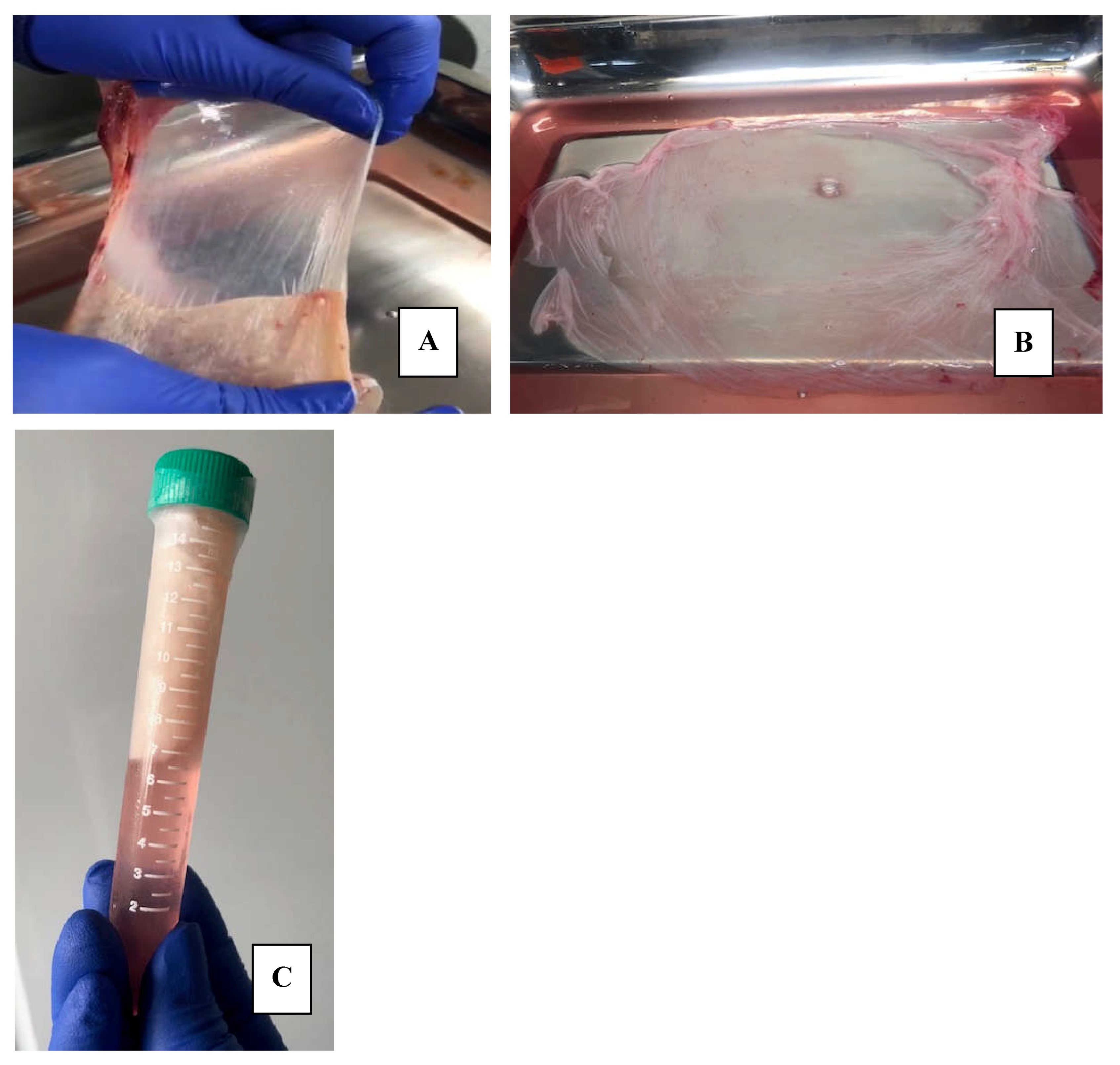
2.2. Processing of Amniotic Membranes
2.3. Storage of Human Amniotic Membranes
2.4. Histological Characterization of the hAMssFragments of Fresh hAMs Were Fixed in a 10% Buffered Formalin Solution (OneLab®) for 24 Hours. At the End of this Period, Processing Was Carried out Using Conventional Histotechnique and Two Slides Were Stained: One with Hematoxylin Eosin (H&E) (ACROS ORGANICS®) and the Second, with Trypan Blue (TB) (Sigma®). This Process of Fixation, Histological Processing and Staining Were Repeated with Fragments of Frozen hAMs at -20°C
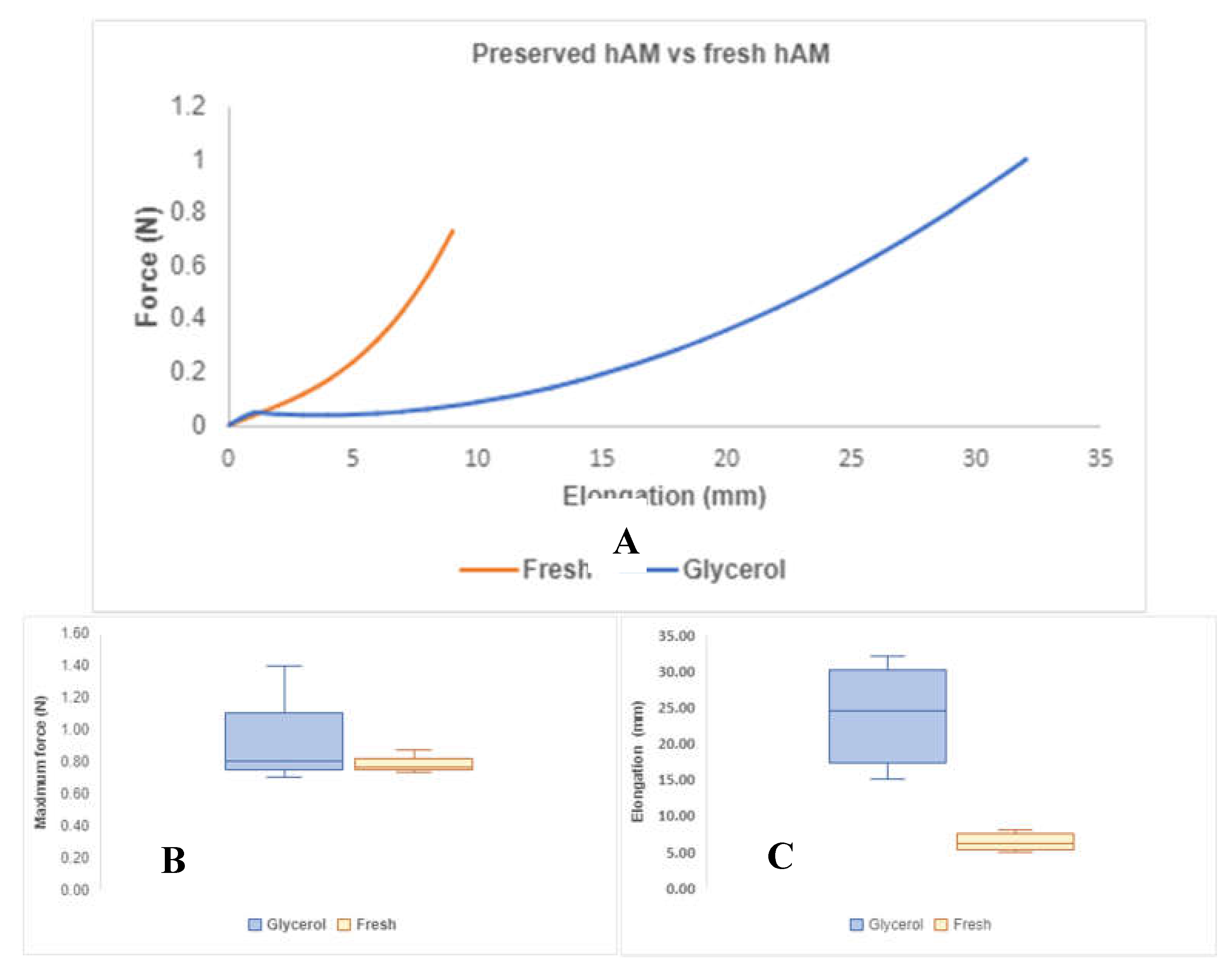
2.5. Mechanical Properties of hAMs
3. Results
4. Discussion
5. Conclusions
Author Contributions
Funding
Institutional Review Board Statement
Informed Consent Statement
Conflicts of Interest
References
- Bartels, H.; Wang, T. Intercellular junctions in the human fetal membranes. Anat. Embryol. 1983, 166, 103–120. [Google Scholar] [CrossRef] [PubMed]
- Polishuk, W.Z.; Kohane, S.; Hadar, A. Fetal weight and membrane tensile strength. Am J Obstet Gynecol. 1964, 88, 247–250. [Google Scholar] [CrossRef] [PubMed]
- Ilancheran, S.; Michalska, A.; Peh, G.; Wallace, E.M.; Pera, M.; Manuelpillai, U. Stem cells derived from human fetal membranes display multilineage differentiation potential. Biol Reprod. 2007, 77, 577–588. [Google Scholar] [CrossRef] [PubMed]
- Hill, D.J.; Clemmons, D.R.; Riley, S.C.; Bassett, N.; Challis, J.R.G. Immunohistochemical localization of insulin-like growth factors (IGFs) and IGF binding proteins-1, -2 and -3 in human placenta and fetal membranes. Placenta. 1993, 14, 1–12. [Google Scholar] [CrossRef] [PubMed]
- Pandansari, P.; Tantin, R.D.; Abbas, B.; Hilmy, N. Biological Properties and Functions of Amnion. In: Human Amniotic Membrane: Basic Science and Clinical Application. 2017.
- Malhotra, C.; Jain, A.K. Human amniotic membrane transplantation: Different modalities of its use in ophthalmology. World J. Transplant. 2014, 4, 111–121. [Google Scholar] [CrossRef]
- King, A.E.; Paltoo, A.; Kelly, R.W.; Sallenave, J.M.; Bocking, A.D.; Challis, J.R.G. Expression of Natural Antimicrobials by Human Placenta and Fetal Membranes. Placenta 2007, 28, 161–169. [Google Scholar] [CrossRef]
- Sharma, N.; Kaur, M.; Agarwal, T.; Sangwan, V.S.; Vajpayee, R.B. Treatment of acute ocular chemical burns. Surv. Ophthalmol. 2018, 63, 214–235. [Google Scholar] [CrossRef] [PubMed]
- Rodríguez Martín, J.; Bonis Redeondo, E.; Rodríguez Santana, A.; González de la Rosa, M. Transplante de membrana amniótica en patología de la superficie ocular. Archivos de la Sociedad Canaria de Oftalmología. 2001.
- Lacorzana-Rodríguez, J.; García-Serrano, J.L.; Gálvez Prieto-Moreno, C.; Castillo-Rodríguez, S.; Lucena-Martín, J.A.; Pozo-Jiménez, I. Membrana amniótica, revisión de su uso oftalmológico y resultados en los últimos cinco años (2013-2017) en Granada. Estudio preliminar. Actual Medica 2018, 103. [Google Scholar] [CrossRef]
- Zelen, C.M.; Snyder, R.J.; Serena, T.E.; Li, W.W. The Use of Human Amnion/Chorion Membrane in the Clinical Setting for Lower Extremity Repair: A Review. Clin. Podiatr. Med. Surg. 2015, 32. [Google Scholar] [CrossRef]
- Eser, T.; Kavalci, C.; Aydogan, C.; Kayipmaz, A.E. Epidemiological and cost analysis of burn injuries admitted to the emergency department of a tertiary burn center. SpringerPlus 2016, 5, 1411–1411. [Google Scholar] [CrossRef]
- Cazzell, S.; Stewart, J.; Agnew, P.S.; Senatore, J.; Walters, J.; Murdoch, D.; et al. Randomized Controlled Trial of Micronized Dehydrated Human Amnion/Chorion Membrane (dHACM) Injection Compared to Placebo for the Treatment of Plantar Fasciitis. Foot Ankle Int. 2018, 39, 1151–1161. [Google Scholar] [CrossRef] [PubMed]
- Penfield, W.; Chao, Y.C.; Humphreys, S. A New Method Of Preventing Adhesions the Use of Amnioplastin After Craniotomy. Br Med J. 1940, 1, 517–538. [Google Scholar] [CrossRef]
- Berhane, C.C.; Brantley, K.; Williams, S.; Sutton, E.; Kappy, C. An evaluation of dehydrated human amnion/chorion membrane allografts for pressure ulcer treatment: A case series. J. Wound Care 2019, 28, S4–S10. [Google Scholar] [CrossRef]
- Dehghani, M.A.N.K.V.M.H.E.E. Grafting with Cryopreserved Amniotic Membrane versus Conservative Wound Care in Treatment of Pressure Ulcers: A Randomized Clinical Trial. Bull Emerg Trauma. 2017, 5, 249–258. [Google Scholar] [CrossRef]
- Anzola Marín, D.H.P.J.S.P.K.G.S.K.G.R.L. Membranas amnióticas y su aplicación en el tratamiento de quemaduras: Una revisión sistemática exploratoria. Rev Cir. 2023, 75. [Google Scholar] [CrossRef]
- Mohammadi, A.A.; Johari, H.G.; Eskandari, S. Effect of amniotic membrane on graft take in extremity burns. Burns 2013, 39, 1137–1141. [Google Scholar] [CrossRef]
- Puyana, S.E.A.; Ruiz, S.B.E.; McKenney, M.L.R. The Use of Dehydrated Human Amniotic/Chorionic Membrane Skin Substitute in the Treatment of Pediatric Facial Burn. J. Craniofacial Surg. 2019, 30, 2551–2554. [Google Scholar] [CrossRef]
- Puyana, S.; Elkbuli, A.; Ruiz, S.; Bernal, E.; McKenney, M.; Lim, R.; et al. The Use of Dehydrated Human Amniotic/Chorionic Membrane Skin Substitute in the Treatment of Pediatric Facial Burn. Journal of Craniofacial Surgery. 2019, 30, 2551–2554. [Google Scholar] [CrossRef]
- Vaheb, M.; Kohestani, B.M.; Karrabi, M.; Khosrojerdi, M.; Khajeh, M.; Shahrestanaki, E.; et al. Evaluation of Dried Amniotic Membrane on Wound Healing at Split-Thickness Skin Graft Donor Sites: A Randomized, Placebo-Controlled, Double-blind Trial. Adv. Ski. Wound Care 2020, 33, 636–641. [Google Scholar] [CrossRef]
- Jung, Y.M.; Park, C.W.; Park, J.S.; Jun, J.K.; Lee, S.M. Application of Tissue Engineering and Regenerative Medicine in Prelabor Rupture of Membranes: A Review of the Current Evidence. Reprod. Sci. 2021, 28, 1774–1784. [Google Scholar] [CrossRef]
- Nisolle, M.; Donnez, J. Vaginoplasty using Amniotic Membranes in Cases of Vaginal Agenesis or after Vaginectomy. J. Gynecol. Surg. 1992, 8, 25–30. [Google Scholar] [CrossRef] [PubMed]
- MINISTERIODEPROTECCIÓNSOCIAL Manual de Buenas Prácticas para Bancos de Tejidos y de Médula Osea y se dictan otras disposiciones. RESOLUCIÓN 5108 COLOMBIA: MINISTERIO DE PROTECCIÓN SOCIAL; Jan 17, 2005.
- Kasi, N.; Durrani, K.M.; Siddiqui, M.A. Human amniotic membrane as a versatile biological dressing--a preliminary report. J Pak Med Assoc. 1987, 37. [Google Scholar]
- Tseng, S.C.G.; Prabhasawat, P.; Lee, S.H. Amniotic membrane transplantation for conjunctival surface reconstruction. Am J Ophthalmol. 1997, 124, 765–774. [Google Scholar] [CrossRef] [PubMed]
- Wagner, M.; Walter, P.; Salla, S.; Johnen, S.; Plange, N.; Rütten, S.; et al. Cryopreservation of amniotic membrane with and without glycerol additive. Graefe’s Archive for Clinical and Experimental Ophthalmology. 2018, 256, 1117–1126. [Google Scholar] [CrossRef]
- Ingraldi, A.L.; Audet, R.G.; Tabor, A.J. The Preparation and Clinical Efficacy of Amnion-Derived Membranes: A Review. J. Funct. Biomater. 2023, 14, 531. [Google Scholar] [CrossRef]
- Title 21-Food and Drugs Chapter I-Food and Drug Administration, Department of Health and Human Services Subchapter L-Regulations Under Certain Other Acts Administered by the Food and Drug Administration.
- De, M.; Social, L.P. Hoja 1 de 23 EL PRESIDENTE DE LA REPÚBLICA DE COLOMBIA.
- Gholipourmalekabadi, M.; Farhadihosseinabadi, B.; Faraji, M.; Nourani, M.R. How preparation and preservation procedures affect the properties of amniotic membrane? How safe are the procedures? Burns 2020, 46. [Google Scholar] [CrossRef]
- Leal-Marin, S.; Kern, T.; Hofmann, N.; Pogozhykh, O.; Framme, C.; Börgel, M.; et al. Human Amniotic Membrane: A review on tissue engineering, application, and storage. Journal of Biomedical Materials Research—Part B Applied Biomaterials 2021, 109. [Google Scholar] [CrossRef]
- Pogozhykh, O.; Hofmann, N.; Gryshkov, O.; von Kaisenberg, C.; Mueller, M.; Glasmacher, B.; et al. Repeated freezing procedures preserve structural and functional properties of amniotic membrane for application in ophthalmology. Int J Mol Sci. 2020, 21, 4029. [Google Scholar] [CrossRef]
- Horvath, V.; Svobodova, A.; Cabral, J.V.; Stadler, P.; Lindner, J.; Mrstinova, M.B.; et al. Cryopreserved amniotic membrane in chronic nonhealing wounds: A series of case reports. Cell Tissue Bank 2023, 25, 325–337. [Google Scholar] [CrossRef]
- Ravishanker, R.; Bath, A.S.; Roy, R. “Amnion Bank”—The use of long term glycerol preserved amniotic membranes in the management of superficial and superficial partial thickness burns. Burns 2003, 29, 369–374. [Google Scholar] [CrossRef]
- Rodrigues, E.B.; Costa, E.F.; Penha, F.M.; Melo, G.B.; Bottós, J.; Dib, E.; et al. The Use of Vital Dyes in Ocular Surgery. Surv Ophthalmol. 2009, 54, 576–617. [Google Scholar] [CrossRef] [PubMed]
- Laurent, R.; Nallet, A.; Obert, L.; Nicod, L.; Gindraux, F. Storage and qualification of viable intact human amniotic graft and technology transfer to a tissue bank. Cell Tissue Bank. 2014, 15, 267–275. [Google Scholar] [CrossRef] [PubMed]
- Maral, T.; Borman, H.; Arslan, H.; Demirhan, B.; Akinbingol, G.; Haberal, M. Effectiveness of human amnion preserved long-term in glycerol as a temporary biological dressing. Burns 1999, 25, 625–635. [Google Scholar] [CrossRef] [PubMed]
- Muñetón Gómez, C.A.; Ortiz, J.A. Preparación en glicerina: Una técnica para la conservación prolongada de cuerpos en anatomía veterinaria. Rev Med Vet 2013. [Google Scholar] [CrossRef]
- Mazur, P. Freezing of living cells: Mechanisms and implications. The American journal of physiology 1984, 247, C125–C142. [Google Scholar] [CrossRef]
- Jahanafrooz, Z.; Bakhshandeh, B.; Behnam Abdollahi, S.; Seyedjafari, E. Human amniotic membrane as a multifunctional biomaterial: Recent advances and applications. Journal of Biomaterials Applications. 2023, 37, 1341–1354. [Google Scholar] [CrossRef]
- Arrizabalaga, J.H.; Nollert, M.U. Human Amniotic Membrane: A Versatile Scaffold for Tissue Engineering. ACS Biomater. Sci. Eng. 2018, 4, 2226–2236. [Google Scholar] [CrossRef]
- Friel, N.A.; de Girolamo, L.; Gomoll, A.H.; Mowry, K.C.; Vines, J.B.; Farr, J. Amniotic Fluid, Cells, and Membrane Application. Oper Tech Sports Med. 2017, 25. [Google Scholar] [CrossRef]
- Glat, P.; Orgill, D.P.; Galiano, R.; Armstrong, D.; Serena, T.; DiDomenico, L.A.; et al. Placental Membrane Provides Improved Healing Efficacy and Lower Cost Versus a Tissue-Engineered Human Skin in the Treatment of Diabetic Foot Ulcerations. Plast Reconstr Surg Glob Open. 2019, 7, e2371. [Google Scholar] [CrossRef]
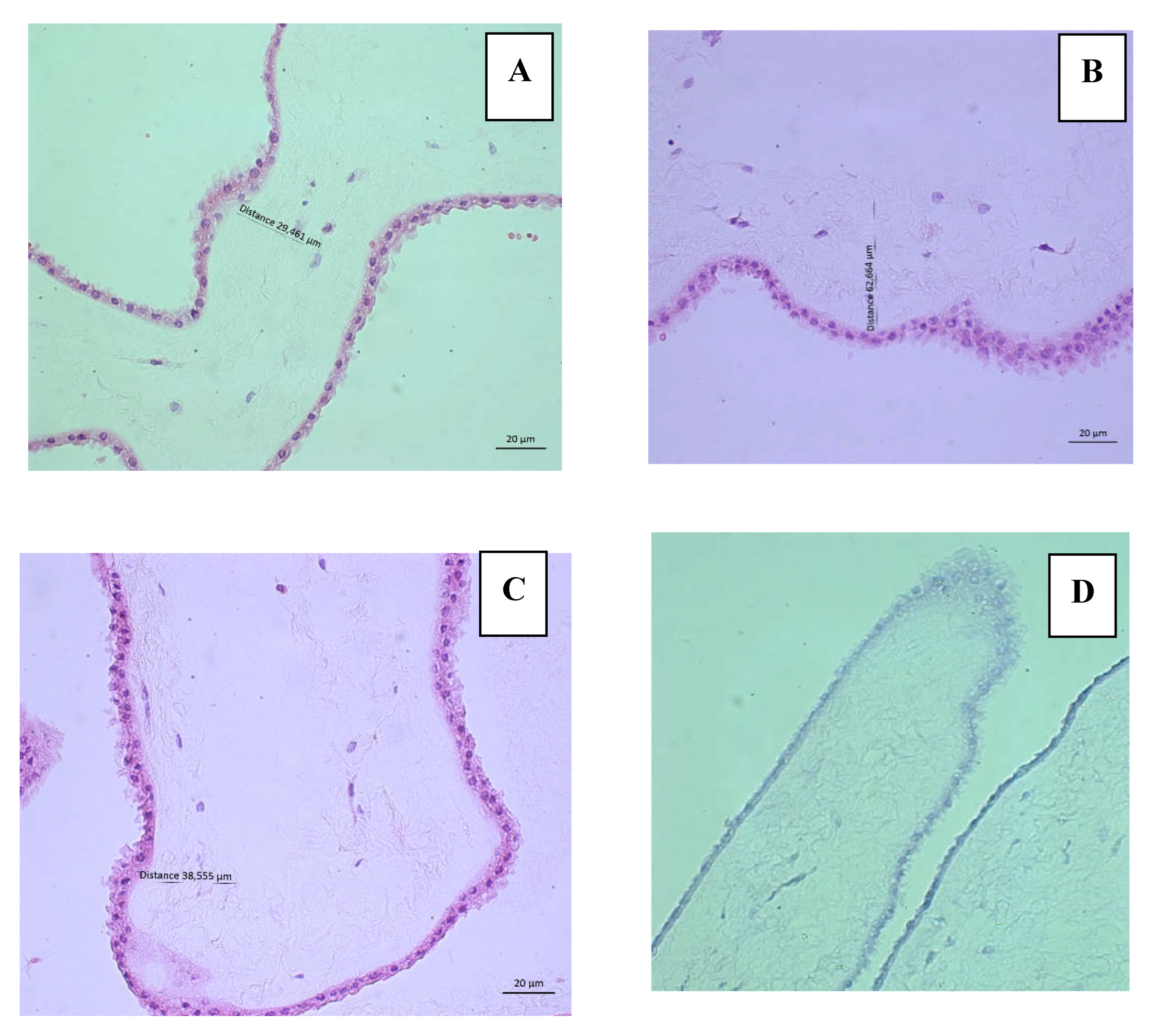
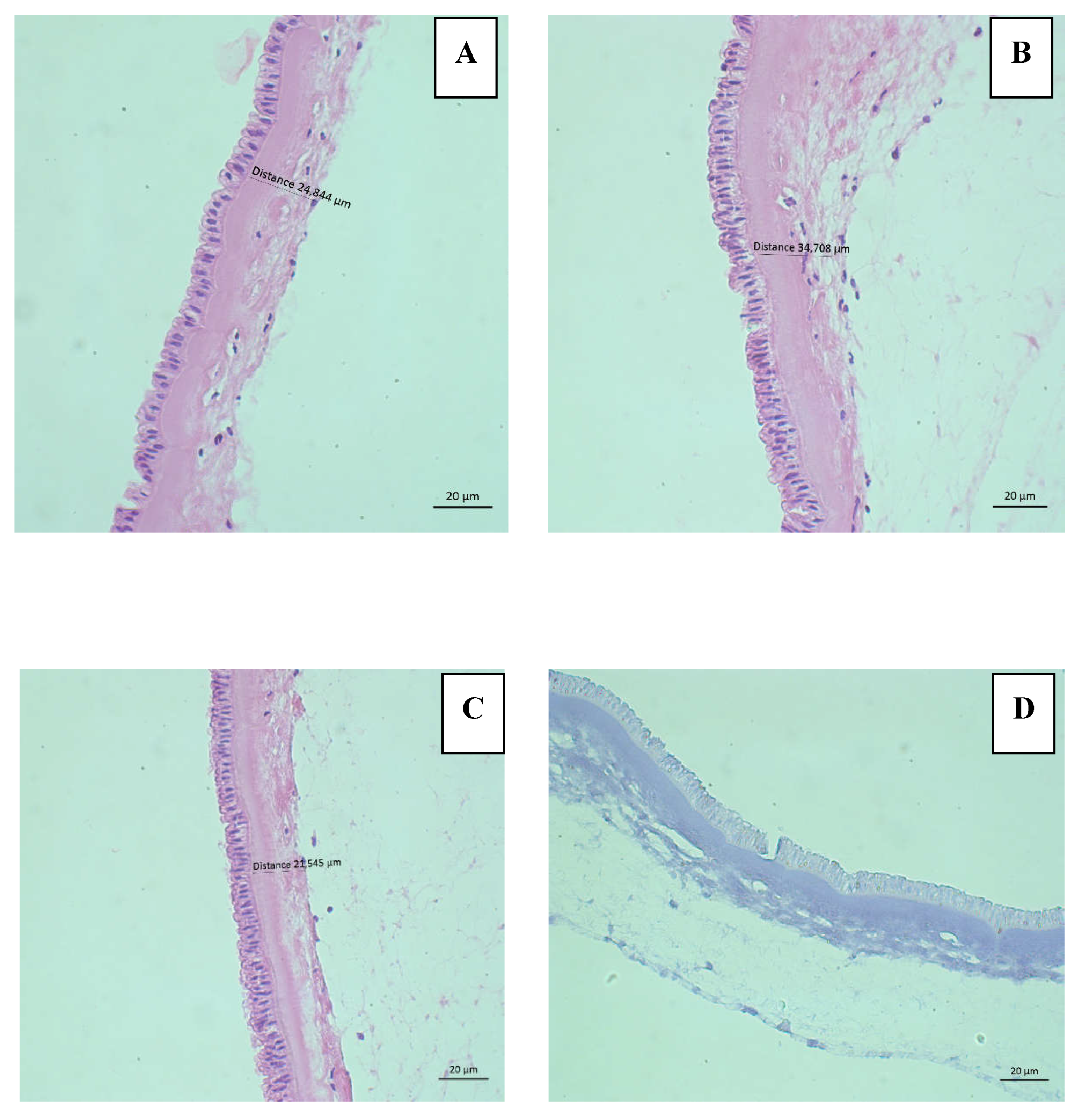

| Human Amniotic Membranes* | Integrity score | Integrity score | |||
| Epithelium | stroma | Average epithelium | Average stroma |
||
| 1 | Field 1 | 1 | 0 | 0,67 | 0,33 |
| Field 2 | 1 | 0 | |||
| Field 3 | 0 | 1 | |||
| 2 | Field 1 | 1 | 0 | 0,33 | 0,00 |
| Field 2 | 0 | 0 | |||
| Field 3 | 0 | 0 | |||
| 3 | Field 1 | 0 | 0 | 0,00 | 0,00 |
| Field 2 | 0 | 0 | |||
| Field 3 | 0 | 0 | |||
| 4 | Field 1 | 1 | 0 | 0,67 | 0,33 |
| Field 2 | 0 | 1 | |||
| Field 3 | 1 | 0 | |||
| 5 | Field 1 | 0 | 1 | 0,00 | 1,00 |
| Field 2 | 0 | 1 | |||
| Field 3 | 0 | 1 | |||
| 6 | Field 1 | 0 | 0 | 0,67 | 0,67 |
| Field 2 | 1 | 1 | |||
| Field 3 | 1 | 1 | |||
| Human Amniotic Membranes | Viable cells | Average viable cells | Cell count injury/death | Average cells count injury/death | |
|---|---|---|---|---|---|
| 1 | Field 1 | 82 | 74 | 18 | 26 |
| Field 2 | 65 | 35 | |||
| Field 3 | 74 | 26 | |||
| 2 | Field 1 | 80 | 83 | 20 | 17 |
| Field 2 | 78 | 22 | |||
| Field 3 | 90 | 10 | |||
| 3 | Field 1 | 85 | 83 | 15 | 17 |
| Field 2 | 80 | 20 | |||
| Field 3 | 85 | 15 | |||
| 1 | Field 1 | 89 | 88 | 11 | 12 |
| Field 2 | 86 | 14 | |||
| Field 3 | 88 | 12 | |||
| 2 | Field 1 | 87 | 87 | 13 | 13 |
| Field 2 | 90 | 10 | |||
| Field 3 | 85 | 15 | |||
| 3 | Field 1 | 88 | 90 | 12 | 10 |
| Field 2 | 90 | 10 | |||
| Field 3 | 92 | 8 | |||
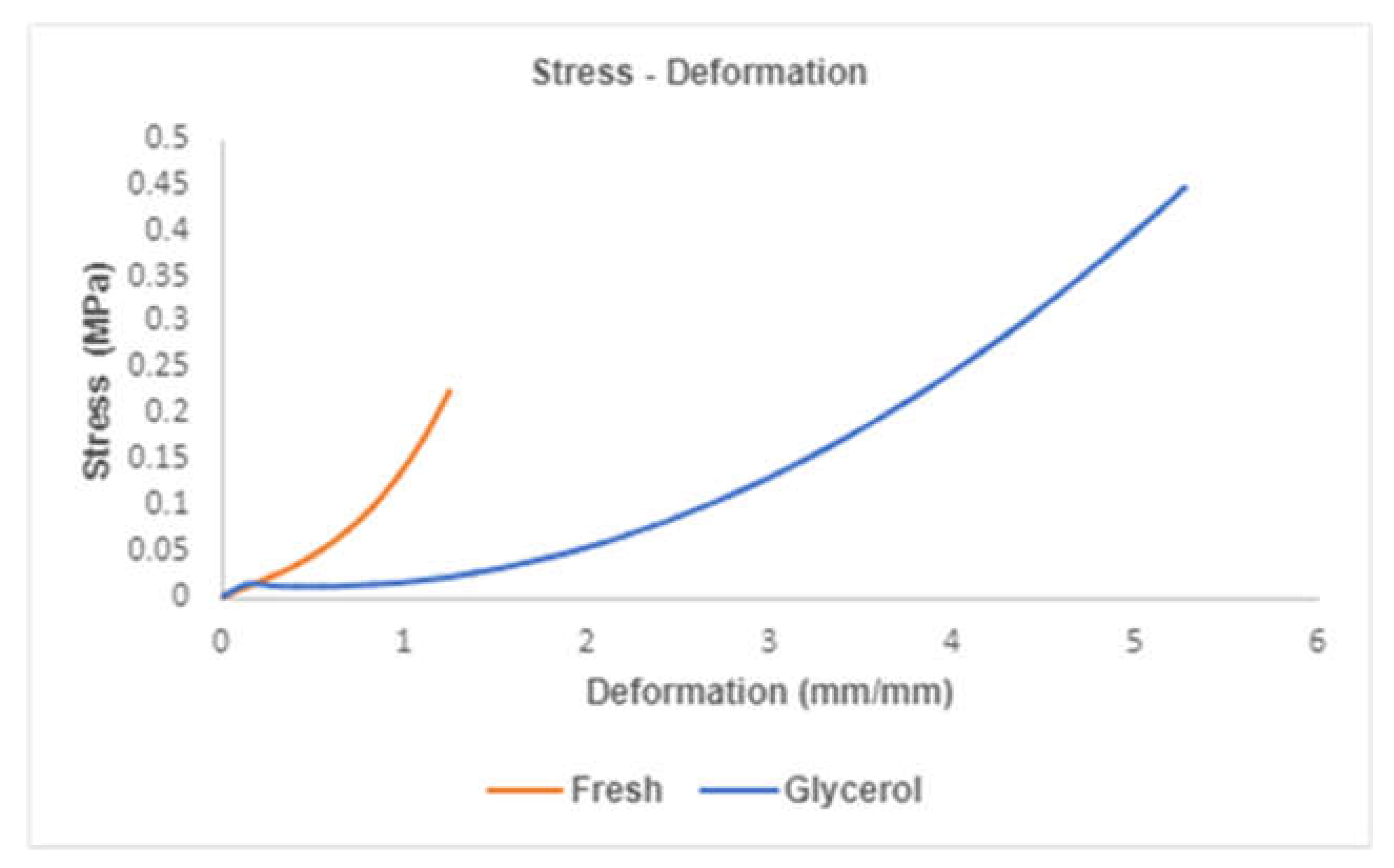
| ANOVA ANALYSIS (p=0.05) | |||
| Glicerol | Fresh | Probability | |
| Stress (Mpa) | 0.779 | 0.665 | 0.563 |
| Deformation (mm/mm) | 0.63 | 2.4 | 0.024 |
| Elastic modulus (Pa) | 2.3 | 120.2 | 0.0031 |
Disclaimer/Publisher’s Note: The statements, opinions and data contained in all publications are solely those of the individual author(s) and contributor(s) and not of MDPI and/or the editor(s). MDPI and/or the editor(s) disclaim responsibility for any injury to people or property resulting from any ideas, methods, instructions or products referred to in the content. |
© 2024 by the authors. Licensee MDPI, Basel, Switzerland. This article is an open access article distributed under the terms and conditions of the Creative Commons Attribution (CC BY) license (http://creativecommons.org/licenses/by/4.0/).


