Preprint
Review

This version is not peer-reviewed.

Molecular Sentinels: Unveiling the Role of Sirtuins in Prostate Cancer Progression

Submitted:

14 November 2024

Posted:

15 November 2024

You are already at the latest version

Abstract

Prostate cancer (PCa) remains a critical global health challenge, with high mortality rates and significant heterogeneity, particularly in advanced stages. While early-stage PCa is often manageable with conventional treatments, metastatic PCa is notoriously resistant, highlighting an urgent need for precise biomarkers and innovative therapeutic strategies. This review focuses on the dualistic roles of sirtuins, a family of NAD+ dependent histone deacetylases, in PCa pathogenesis, dissecting how each sirtuin contributes uniquely to either tumor suppression or progression depending on the cellular context. By exploring each sirtuin’s influence on pathways such as metabolic regulation, chromosomal stability, inflammation and cellular survival, we reveal their multifaceted impact on cancer processes like oxidative stress responses, gene expression and apoptosis. For instance, SIRT1 and SIRT7 often demonstrate oncogenic behavior in PCa, promoting tumor growth and survival, while SIRT3 and SIRT4 are more frequently associated with tumor-suppressive functions, countering cellular proliferation and maintaining metabolic stability. By examining the specific mechanisms through which sirtuins impact PCa, this review emphasizes the potential of sirtuin modulation to bridge existing gaps in managing advanced disease. Ultimately, insights into sirtuins’ regulatory effects could redefine therapeutic paradigms in PCa, fostering precision-based strategies that enhance treatment efficacy and improve clinical outcomes for patients with aggressive PCa.

Keywords: 
;  ;  ;  ;  ;  ;  ;  ;  

1. Introduction

Prostate cancer (PCa) stands as a major global health challenge, ranking as the fifth leading cause of cancer-associated death worldwide [1,2]. As a highly heterogeneous tumor, PCa progresses through a sequence of well-defined stages, including prostate intraepithelial neoplasia (PIN), invasive carcinoma and ultimately, hormone-dependent or independent metastasis [3]. While early-stage PCa is treatable through surgical and radiation interventions, metastatic PCa remains largely incurable, highlighting the importance of identifying markers of aggressiveness to better predict disease progression [4]. At the molecular level, mutations, epigenetic modifications, metabolic alterations and dysregulation of signaling pathways drive the transformation of normal prostate cells into cancerous ones, promoting uncontrolled proliferation, survival and metastasis, thereby mirroring the fundamental mechanisms of oncogenesis observed in other cancers [5,6,7,8,9,10,11]. Among various types of epigenetic alterations, histone acetylation plays a pivotal role in PCa reprogramming. Histone acetyltransferases (HATs) and deacetylases (HDACs) are central regulators of these modifications, modulating protein acetylation patterns that drive cancer progression [12,13]. Sirtuins, a family of NAD+ dependent deacetylases (SIRT1-7), play complex roles in cancer by modulating cellular processes such as apoptosis, metabolism, and DNA repair. Their activity influences tumor progression, with some isoforms acting as tumor suppressors and others promoting tumorigenesis, making them potential targets for cancer therapy. Accumulating evidence suggests that sirtuins are emerging as critical upstream modulators within PCa signaling cascades, influencing tumor growth, metabolic regulation, genomic stability and treatment resistance [14].
Each sirtuin possesses distinct subcellular localizations and substrates [15], leading to diverse effects across various cancer types [16] . It is now widely acknowledged that certain sirtuins function as tumor suppressors, whereas others demonstrate oncogenic characteristics, with their roles dynamically modulated by the cellular context and the stage of cancer progression [17]. SIRT1 is one of the most widely studied sirtuins across cancers. While it functions as a tumor suppressor in glioblastoma and bladder carcinoma [18], SIRT1 exhibits oncogenic traits in PCa, squamous cell carcinoma and basal cell carcinoma [19], where it promotes unchecked cellular proliferation. Through epigenetic regulation, sirtuins like SIRT1 and SIRT6 influence gene expression by modifying histones, thereby orchestrating critical pathways related to cell cycle control, apoptosis and DNA repair [20]. SIRT6 further enhances genomic stability and counteracts metabolic reprogramming [21,22,23,24]. Conversely, SIRT2, known for its essential role in cell cycle regulation via deacetylation of structural proteins like tubulin and histones [25,26], acts as a protective factor against tumorigenesis in some cancers [27]. However, SIRT2 inhibition has been also linked to increased cell proliferation and promotes tumor aggressiveness [28,29,30], including PCa. Mitochondrial sirtuins, SIRT3, SIRT4 and SIRT5, are pivotal in metabolic regulation, often exploited by cancer cells to fuel proliferation via altered pathways, such as the Warburg effect [16,31,32,33]. SIRT3, widely considered a tumor suppressor, helps regulate mitochondrial homeostasis and counter oxidative stress, thereby restraining cancer cell growth [34,35,36]. SIRT4 is widely recognized as a tumor suppressor due to its multifaceted role in regulating cellular processes [37,38]. It is involved in the maintenance of genomic stability by modulating DNA damage response pathways and plays a critical role in both glycolytic and mitochondrial metabolism [39,40]. Additionally, SIRT4 influences autophagy, supporting cellular homeostasis under stress conditions and contributes to tumor suppression by upregulating p53 activity [40]. In contrast, SIRT5 has a more ambiguous role, impacting metabolic enzymes and requiring further investigation to clarify its role in PCa [14]. SIRT7, often regarded as a tumor promoter, bolsters cancer cell survival and proliferation by modulating RNA polymerase I activity and driving ribosomal RNA synthesis [41]. Overexpression of SIRT7 correlates with poor prognosis in cancers such as breast and liver malignancies [42]. Additionally, sirtuins regulate oxidative stress responses by controlling antioxidant enzymes, a dual function that supports both cancer prevention and the survival of established tumors [43,44,45]. Beyond oxidative stress, sirtuins also modulate inflammatory and immune responses, such as through NF-κB regulation, intricately linking inflammation with cancer progression [16,46,47,48,49,50]. Collectively, sirtuins govern critical processes, including cellular metabolism, chromosomal stability, and gene expression, highlighting their complex, context-dependent roles in cancers. By modulating sirtuin activity to target their regulatory effects on cancers progression, we can address key biological mechanisms underlying metastasis, such as angiogenesis, cell migration, and invasion. Thus, gaining a deeper understanding of sirtuins in cancers, specifically in PCa is essential.
This review aims to elucidate the multifaceted roles of sirtuins in PCa, emphasizing their dualistic functions as both oncogenic drivers and tumor suppressors. Specifically, SIRT1, SIRT2, SIRT6, and SIRT7 are implicated in promoting PCa progression, while SIRT5 displays a paradoxical role, simultaneously aiding DNA repair and inhibiting apoptosis, yet fostering tumor growth through androgen receptor (AR) interactions. In contrast, SIRT3 and SIRT4 primarily function as tumor suppressors by regulating cellular metabolism, cell cycle progression and chromosomal stability, thereby counteracting tumorigenesis. By clarifying these intricate and often opposing roles, this review highlights an urgent need to deepen our understanding of how individual sirtuins contribute to PCa pathogenesis. Such insights are crucial for developing precision therapeutic strategies that leverage the complex nature of sirtuins, ultimately enabling more effective modulation of their activity to improve outcomes for patients with PCa.

2. Structural Variations Among Sirtuins and Their Functional Implications

The structural architecture of sirtuins, though unified by a conserved NAD⁺-binding catalytic core, exhibits notable diversity that underpins their distinct functional roles in cellular processes [51]. At the heart of all sirtuins lies the Rossmann fold, a universal feature essential for NAD⁺ binding and enzymatic catalysis [52]. This fold is anchored by critical histidine residues such as His363 in SIRT1 and His187 in SIRT2 that orchestrate their NAD⁺-dependent deacetylase or mono-ADP-ribosyltransferase activities [53]. An additional layer of structural stability is conferred by a zinc-binding motif, comprising conserved cysteines [54]. For instance, In SIRT1, the zinc-binding cysteines are located at positions Cys370, Cys373, Cys396 and Cys399; in SIRT2, they are found at Cys195, Cys200, Cys221 and Cys224. For SIRT3, these residues are positioned at Cys255, Cys258, Cys280 and Cys283, while in SIRT4, they reside at Cys159, Cys162, Cys220 and Cys223. In SIRT5, the cysteines involved in zinc binding are Cys166, Cys169, Cys207 and Cys212, whereas in SIRT6, they occur at Cys139, Cys142, Cys166 and Cys177 [55]. Finally, in SIRT7, the zinc-binding cysteines are located at Cys194, Cys197, Cys225 and Cys228, indicating conservation of function across the family. These zinc-binding motifs not only provide structural integrity but also serve as a scaffold, allowing the catalytic domain to maintain its precise conformation required for enzymatic activity [56,57]. However, despite these conserved features, variations in the N- and C-terminus significantly affect their interactions with different substrates, cellular localization and their functional diversity.
The N-terminal and C-terminal domains of sirtuins vary extensively in both sequence and length, contributing to the specificity of their substrate interactions and cellular roles [58,59,60,61,62]. Nuclear sirtuins like SIRT1, SIRT6 and SIRT7 are distinguished by longer terminal regions that enable them to interact with chromatin and DNA repair proteins, facilitating their roles in gene expression and genomic stability [50,63]. SIRT6, for instance, is known for its involvement in chromatin remodeling, where its longer termini enhance interactions with histones and other chromatin-modifying enzymes. Conversely, mitochondrial sirtuins such as SIRT3, SIRT4 and SIRT5 have more truncated termini, reflecting their specialized roles in mitochondrial metabolism [64,65,66]. These shortened extensions allow them to more effectively regulate mitochondrial proteins involved in oxidative phosphorylation, fatty acid oxidation and other metabolic processes. This structural divergence across the N- and C-terminal domains, combined with variations in substrate-binding pockets, grants each sirtuin a unique functional niche [67,68,69,70]. For example, SIRT1 has a wide range of substrates, including histones and non-histone proteins such as p53, enabling it to control diverse cellular pathways like apoptosis and metabolism [71,72]. In contrast, SIRT6 shows a pronounced specificity toward certain histone substrates, which directly aligns with its role in chromatin remodeling and genomic maintenance[71].
Structural variations among sirtuins also extend to their localization signals, which dictate their specific subcellular destinations and thus their functional roles. Nuclear localization signals (NLS) in sirtuins such as SIRT1, SIRT2[73,74,75] and SIRT6 ensure their presence in the nucleus, where they engage in transcriptional regulation and DNA repair [61]. In SIRT6, the NLS directs its activity toward chromatin, particularly in heterochromatic regions, where it influences processes like telomere maintenance and DNA double-strand break repair [76]. In contrast, mitochondrial targeting sequences (MTS), as seen in SIRT3,4 and 5 enable their localization within mitochondria, an organelle critical for energy metabolism and aging [73,77,78]. SIRT3, in particular, exerts its effects by deacetylating enzymes involved in mitochondrial metabolism, such as components of the tricarboxylic acid cycle and oxidative phosphorylation pathways [64,79]. This localization-driven functional specialization underscores the significance of structural variability in sirtuins, as even minor alterations in their sequence or domain architecture can drastically affect their role in cellular metabolism.
The variability in substrate-binding sites among sirtuins is another key factor driving their functional diversity [80]. While all sirtuins share the catalytic core responsible for NAD⁺ binding, subtle differences in the residues lining their substrate-binding pockets confer specificity for different substrates [81,82]. SIRT1, for instance, interacts with a broad array of substrates due to its more expansive binding site, which accommodates both histone and non-histone proteins [83]. This structural feature allows SIRT1 to modulate a wide range of processes, from cell cycle regulation to stress responses. In contrast, SIRT6 has a more restrictive substrate-binding pocket, particularly favoring certain histone modifications, which aligns with its more specialized role in chromatin dynamics and transcriptional regulation [84]. Such substrate selectivity is crucial for the functional differentiation of sirtuins, ensuring that each member of the family is tailored to specific cellular demands.
Despite their structural and functional diversity, sirtuins converge on a common theme of maintaining cellular homeostasis, especially in processes related to metabolism, gene expression and longevity [43,85]. However, the functional implications of this diversity become evident when considering their roles in aging [86,87,88]. This divergence in functional specificity and aging-related outcomes highlights the complexity of sirtuin regulation in higher eukaryotes. While all seven human sirtuins contribute to cellular homeostasis, their individual contributions to longevity and metabolic regulation vary, with each sirtuin occupying a specialized functional niche shaped by its structural characteristics. This underscores the need for continued investigation into the structural variations among sirtuins, as these differences are critical for understanding their diverse roles across tissues and in response to metabolic and environmental stressors. The individual domains of sirtuins and their structural variations are outlined in detail in Figure 1.

3. Sirtuins and Prostate Carcinogenesis
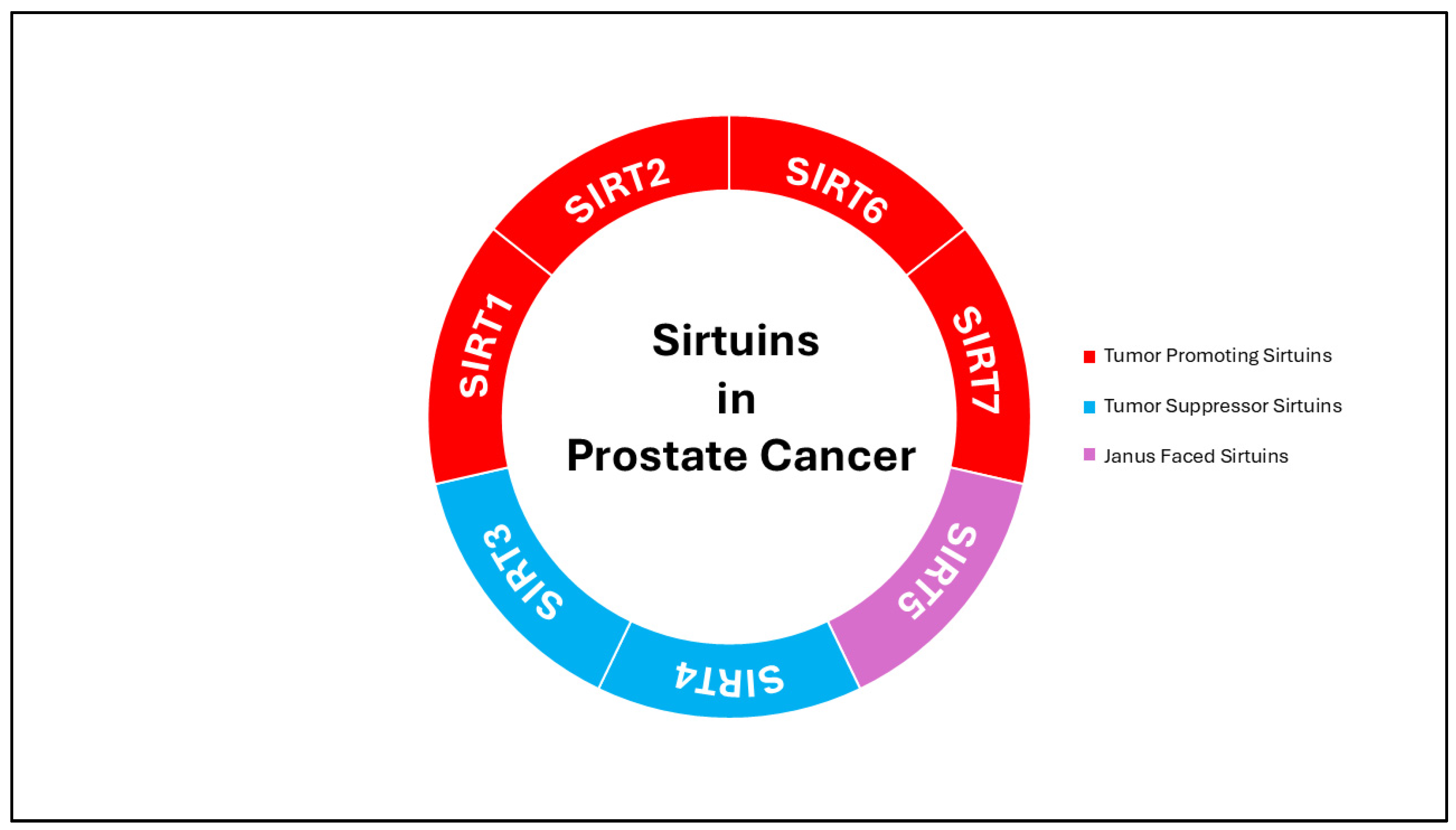
Accumulating evidence suggests that the sirtuin family exerts a significant impact on PCa by modulating a broad range of cellular processes, including autophagy, oxidative stress response, epigenetic regulation and metabolic adaptation. SIRT1, frequently associated with mitochondrial health and oxidative stress reduction, aids in maintaining cellular homeostasis and contributes to chemoresistance through pathways involving antioxidant genes and key transcriptional regulators [89,90]. It also plays a critical role in therapeutic resistance in castration-resistant prostate cancer (CRPC) by modulating AR signaling and DNA repair pathways [19]. SIRT2 and SIRT3 have distinct roles in PCa progression. SIRT2, via its histone deacetylase activity, affects AR sensitivity and influences tumor aggressiveness [91,92], while SIRT3 regulates mitochondrial acetylation, represses oncogenic signaling, and acts as a potential tumor suppressor by modulating metabolic pathways and preventing epithelial-mesenchymal transition (EMT) [93]. SIRT4 also displays tumor-suppressive functions, notably by inhibiting cancer cell metabolism and invasion. It reduces cell proliferation and migration by targeting glutamine metabolism and promoting cell cycle arrest through the AKT-p21 axis [94], although its specific contributions to PCa remain less defined than those of other sirtuins. SIRT5 exhibits a Janus-faced role in PCa. It modulates the succinylation of key metabolic enzymes, such as lactate dehydrogenase A (LDHA) [95], and disrupts oncogenic signaling pathways, including [96] and PI3K/AKT [97], thereby limiting cell proliferation and immune evasion. In advanced PCa, SIRT6, which is often overexpressed, enhances cancer cell survival and chemotherapy resistance by modulating Wnt/β-catenin signaling, fostering cell migration and invasion [98]. Lastly, SIRT7, through its role in nucleolar and chromatin regulatory pathways, appears to support cancer cell proliferation and adaptation to metabolic stress [99]. Given their diverse roles in PCa, sirtuins may act as tumor suppressors, tumor promoters, or display a dualistic, Janus-faced nature (Figure 1). Each of these classifications will be explored in depth in the following sections.
Figure 2. Categorization of sirtuins in prostate cancer based on their tumor-modulating roles. Sirtuins that promote prostate tumor progression include SIRT1, SIRT2, SIRT6 and SIRT7 (highlighted in red). Those with tumor-suppressive functions are SIRT3 and SIRT4 (highlighted in blue). SIRT5 exhibits a Janus-faced role, acting as both a tumor suppressor and promoter (highlighted in purple).
Preprints 139668 g002

3.1. Tumor Promoter Sirtuins

3.1.1. SIRT1

SIRT1’s tumor-promoting role in PCa reveals its function in driving tumor progression, especially in the advanced stages of the disease. Earliest investigations employing the TRAMP mouse model have shown that, while SIRT1 expression remains stable in the dorsolateral prostate DLP of calorie-restricted mice during early carcinogenesis, it is significantly elevated in poorly differentiated adenocarcinomas [100]. This increase in SIRT1 correlates with a notable reduction in hypermethylated in cancer-1 (HIC-1), a recognized regulator of SIRT1, suggesting that diminished levels of HIC-1 may underlie the enhanced SIRT1 expression observed in prostatic adenocarcinomas. Also, immunohistochemical analyses of human prostate tumors corroborate these findings, revealing heightened SIRT1 expression in malignant cells relative to adjacent normal tissue. Interestingly, the homozygous deletion of the Sirt1 gene in mice resulted in the development of PINs, a pathology strongly linked to impaired autophagy [101]. The study further suggests that SIRT1's impact on autophagy is most prominent during the crucial stages of autophagosome maturation and completion, highlighting its pivotal role in sustaining cellular homeostasis. Another study along similar lines suggests that the deletion of SIRT1 induces histological characteristics of PINs and enhances cellular proliferation and mitophagy, thereby highlighting its role in maintaining cellular homeostasis [102]. Lower SIRT1 expression in the luminal epithelium correlates with poor prognostic outcomes, facilitating cancer progression through increased acetylation of superoxide dismutase 2 (SOD2), which elevates reactive oxygen species (ROS) production. Restoration of SIRT1 mitigates ROS levels and PARK2 (Parkin protein) translocation, underscoring its critical function in regulating mitochondrial integrity and influencing the signaling cascades associated with PCa [103]. Additionally, the presence of ERG gene fusion in PINs is crucial for PCa progression, influencing androgen metabolism, proliferation and metastasis. SIRT1 facilitates the interaction between PGC1α and ERG, enhancing the expression of antioxidant genes like SOD2 and TXN, which promote cell survival under metabolic stress [104]. SIRT1 promotes neuroendocrine differentiation in PCa, particularly under androgen deprivation therapy (ADT) conditions, where ADT-generated ROS activate SIRT1, leading to neuroendocrine differentiation via the Akt signaling pathway, independent of N-Myc [105]. Moreover, in an effort to identify biomarkers of recurrence, a global RNA sequencing analysis was conducted on 106 formalin-fixed, paraffin-embedded prostatectomy samples from 100 patients across three independent sites, leading to the definition of a novel 24-gene signature panel [106]. Among the various biomarkers identified, SIRT1 emerged as a significant component of this panel, underscoring its association with critical pathways, including cell-cycle progression and apoptosis, thereby enhancing its potential as a biomarker for predicting aggressive PCa.
SIRT1 also influences the effects of metabolic dysregulation on PCa outcomes [107]. One study in this context reveals that hyperglycemia significantly reduces docetaxel-induced apoptosis in PCa cell lines which is intricately linked to the glucose-induced upregulation of IGFBP2, which is further regulated by SIRT1 through histone acetylation at the IGFBP2 promoter [108]. Interestingly, adipokines such as leptin and resistin play a significant role in cancer by influencing tumor growth, angiogenesis, inflammation and metastasis, often linking obesity with increased cancer risk and progression [109,110,111,112]. The SIRT1/leptin axis elucidated the similar intricate interplay between metabolic signaling and tumor progression. In vitro investigations reveal that leptin treatment upregulates hypoxia-inducible factor 1-alpha (HIF-1α), enhancing the adhesion and invasive capabilities of PCa cells irrespective of their glycolytic phenotype, a process accompanied by mitochondrial biogenesis and stabilization of mitochondrial membrane potential through the upregulation of uncoupling protein 2. Notably, leptin also counteracts the hypoxia-induced downregulation of SIRT1, thereby maintaining elevated SIRT1 levels that contribute to HIF-1α stabilization [113]. SIRT1 also regulates the symbiosis between cancer-associated fibroblasts (CAFs) and cancer cells, significantly influencing oncogenic signaling cascades. Lactate uptake from CAFs shifts the NAD+/NADH ratio in PCa cells, leading to SIRT1-mediated activation of PGC-1α, which drives mitochondrial biogenesis and metabolic activity [114]. This mitochondrial exploitation promotes deregulation of the tricarboxylic acid cycle, accumulation of oncometabolites and altered expression of mitochondrial complexes, further exacerbating superoxide generation. Additionally, PCa cells appropriate functional mitochondria from CAFs via intercellular mitochondrial transfer, reinforcing their metabolic advantage. Thus, SIRT1 not only orchestrates mitochondrial dynamics but also integrates CAF-derived metabolic cues, amplifying cancer cell proliferation and survival through the modulation of key energy-sensing and redox signaling pathways. SIRT1 plays an important role in the neuroendocrine differentiation (NED) of PCa cells, particularly in the context of interleukin (IL)-6 stimulation, which drives the progression of aggressive androgen-independent PCa. Recent investigations reveal that IL-6-mediated activation of the AMPK-SIRT1 axis not only fosters the expression of neuroendocrine markers such as βIII tubulin, neuron-specific enolase and chromogranin A but also orchestrates downstream signaling cascades, including p38MAPK, crucial for advancing NED in LNCaP cells [115]. Another intriguing report in this context indicates that lactate secreted by glycolytic CAFs acts on CD4+ T cells, prompting a SIRT1-dependent deacetylation and degradation of the transcription factor T-bet, thereby diminishing the antitumor Th1 response [116]. Simultaneously, SIRT1 facilitates the polarization of naive T cells into immunosuppressive Tregs via NF-κB activation and FoxP3 expression, further promoting an immune-tolerant microenvironment. This CAF-induced immunomodulation through the SIRT1 axis not only subverts immune surveillance but also enhances PCa cell invasiveness by activating the miR21/TLR8 signaling pathway, underscoring SIRT1’s multifaceted influence on tumor progression and immune evasion. SIRT1 modulates the cellular response to oxidative stress, a crucial defense mechanism against oxidative damage and cancer progression. Notably, the loss of NKX3.1 has been shown to impair antioxidant defense mechanisms, leading to heightened DNA damage characterized by increased phosphorylation of H2AX, alongside degradation of key regulatory proteins such as the AR and p53 [117]. Furthermore, while conditioned medium from activated macrophages enhances both the expression and stability of SIRT1, H2O2 treatment does not yield the same effect, indicating that the inflammatory microenvironment significantly influences SIRT1’s regulatory capacity and contributes to the genetic heterogeneity observed during prostate tumor progression.
Multiple earlier studies suggest that SIRT1’s influence in prostate carcinomas is primarily mediated through interactions with chromatin-modifying complexes and transcriptional regulators. One notable mechanism involves the formation of the PRC4 complex, which incorporates SIRT1 and isoform 2 of Eed (Ezh2), a histone-lysine methyltransferase, typically minutest in normal cells but present in cancerous and undifferentiated cells [118]. This complex exhibit distinct histone substrate specificities, contributing to the reprogramming of gene expression patterns through epigenetic modifications. SIRT1's NAD+-dependent histone deacetylase activity within PRC4 facilitates chromatin remodeling, leading to the suppression or activation of oncogenic genes. This histone deacetylation function of SIRT1, particularly when coupled with the aberrant expression of Ezh2, is believed to play a pivotal role in PCa progression by resetting epigenetic landscapes that favor tumorigenesis. Another study reports that SIRT1 downregulation and H2A.Z upregulation create a reciprocal relationship that influences epigenetic regulation in PCa [119]. Overexpression of SIRT1 leads to the degradation of H2A.Z via the proteasome mediated degradation, while epigenetic modifying drug such as trichostatin A modulate both SIRT1 and H2A.Z expression. SIRT1 also mediates lysine delactylation on CNPY3, influencing its cellular localization and promoting lysosomal rupture, thereby triggering pyroptosis [120].
Sirtuin deacetylases, particularly SIRT1 and SIRT2, modulate the function of Forkhead box class O (FOXO) transcription factors, playing critical roles in cancer progression through the regulation of ubiquitination and subsequent proteasomal degradation of FOXO3. One of the study indicate that deacetylation of FOXO3 by these sirtuins promotes its poly-ubiquitination via the E3 ubiquitin ligase Skp2, ultimately leading to reduced FOXO3 protein levels, particularly in malignant PCa cells where elevated SIRT1 and Skp2 expressions are observed [121]. Interestingly, the overexpression of SIRT1 in PCa cells and tissues promote tumorigenesis by inhibiting the activation of FOXO [122]. Also, SIRT1 directly binds to and deacetylates FOXO1, resulting in the inhibition of its transcriptional activity. This deacetylation process is enhanced by FHL2, which not only promotes SIRT1-FOXO1 interaction but also inhibits FOXO1-mediated apoptosis [123]. Consequently, this SIRT1-mediated suppression of FOXO1 plays a significant role in the evasion of programmed cell death, thereby contributing to the survival and proliferation of PCa cells. Furthermore, another study reports that the SIRT1/FOXO3a axis in PCa is influenced by the overexpression of nicotinamide phosphoribosyltransferase (NAMPT), which plays a crucial role in regulating SIRT1 activity through the regeneration of NAD⁺ [124]. Elevated NAMPT levels not only enhance SIRT1-mediated deacetylation but also promote the expression of FOXO3a, thereby conferring a protective mechanism against oxidative stress, which is critical for tumor resilience. Conversely, the inhibition of NAMPT disrupts this axis, leading to diminished FOXO3a expression and compromised antioxidant defenses, highlighting the essential interplay between SIRT1, FOXO and NAMPT in the signaling cascades that underlie prostate carcinogenesis. Recent investigations have elucidated role of SIRT1 interactions with nicotinamide N-methyltransferase (NNMT) and the mechanisms underlying therapy-induced senescence. Elevated NNMT expression in PCa tissues correlates with enhanced viability, invasion and migration of PC-3 cells, predominantly mediated by the upregulation of SIRT1. Notably, the suppression of SIRT1 expression by nicotinamide treatment significantly diminishes the invasive potential of these cancer cells, implicating NNMT as a critical modulator of SIRT1 in promoting PCa aggressiveness [125]. Another investigations have unveiled the role of NAMPT in sustaining de novo lipogenesis in PCa cells, where its inhibition leads to significant reductions in the synthesis of fatty acids and phosphatidylcholine, thereby disrupting the metabolic processes essential for tumor growth. These effects are mirrored by blocking sirtuins or by knocking down SIRT1, highlighting the complex regulatory mechanisms that control lipid metabolism in PCa [126]. Additionally, the induction of senescence through low doses of Abrus agglutinin further underscores SIRT1's influence, as AGG treatment not only enhances SIRT1 expression but also activates autophagy and lipophagy processes, leading to an accumulation of free fatty acids and increased reactive oxygen species [127]. This autophagic flux, mediated by a novel SIRT1/LAMP1/lipophagy axis, facilitates the senescent phenotype in PCa cells, thereby inhibiting tumor proliferation. Collectively, these findings position SIRT1 as a crucial player in the regulatory networks of PCa, influencing both metabolic adaptations and therapeutic responses through intricate signaling cascades.
The AR is a steroid receptor transcription factor for testosterone and dihydrotestosterone, composed of four main domains (N-terminal, DNA-binding, hinge and ligand-binding) and plays a critical role in PCa, particularly in CRPC [128]. SIRT1 is also involved in modulating AR signaling by functioning as a corepressor of AR, which is pivotal for transcriptional repression and growth suppression mediated by androgen antagonists. SIRT1 facilitates the recruitment of nuclear receptor corepressors to AR-responsive promoters, thereby enhancing the transcriptional repression of androgen-responsive genes and ultimately contributing to the development of hormone refractory PCa [129]. Androgen ablation in LNCaP cells enhances VEGF-C transcription while downregulating the IGF-IR pathway, with SIRT1-activated FOXO1 identified as a key downstream factor. VEGF-C also induces Bag-IL expression, contributing to androgen-independent reactivation of the AR and PCa growth [130]. Another investigation in PCa cells reveals that, SIRT1-mediated deacetylation of MYST1 modulates its ability to coactivate both AR and NF-κB, driving aggressive tumor behavior and therapeutic resistance. This regulation extends to histone H4 acetylation at lysine 16, which impacts chromatin structure and gene expression, crucial for tumor progression. In AR-depleted PCa cells, the loss of MYST1 leads to apoptosis, while in AR-expressing cells, its depletion induces cell cycle arrest, underscoring SIRT1's role in orchestrating divergent signaling cascades that support PCa's adaptability and growth [131]. Additionally, SIRT1 antagonists promote endogenous and DHT-mediated AR expression, while SIRT1 deacetylates AR at a conserved lysine, inhibiting coactivator interactions and DHT-induced PCa growth [132] indicating a direct link between AR signaling and SIRT1's regulatory role in PCa progression. The SIRT1/FOXO1 axis is further elucidated in another study, which highlights that SIRT1 overexpression fosters tumorigenesis, whereas its inhibition triggers divergent responses in cell viability and growth, mediated by the activation of FOXO1 and influenced by the p53 status of the cells [133]. Inhibition of SIRT1 leads to increased senescence in p53-active PC3-p53 cells and enhanced apoptosis in p53-inactive PC3 cells. The interaction between SIRT1 and p53 reported to get modulate epigenetic silencing of the tumor suppressor HIC1 results in the upregulation of SIRT1, thereby disrupting the p53-dependent signaling cascades that modulate cellular stress responses and survival [134] thereby, fostering tumorigenesis. The interplay between the SIRT1/AR axis in PCa becomes increasingly intricate, revealing a nuanced role for SIRT1; its silencing in hormone-responsive LNCaP cells not only results in smaller tumor formation but also mimics the effects of AR inhibition [135]. The findings indicate that SIRT1 suppression significantly downregulates gene signatures associated with E2F, MYC targets and mTORC1 signaling, particularly in AR-null PC-3 and castrate-resistant ARv7 positive 22Rv1 cells.
Another accumulating evidence suggests that SIRT1 modulates mesenchymal stem cells (MSCs), which are increasingly recognized as potential antitumor agents despite their immunosuppressive properties. In one study, MSCs engineered to overexpress SIRT1 (MSCs-Sirt1) exhibited a remarkable ability to inhibit prostate tumor growth, contrasting sharply with the tumor-promoting effects of unmodified MSCs. The antitumor efficacy of MSCs-Sirt1 is intricately linked to the recruitment and activation of natural killer (NK) cells and macrophages, with elevated levels of interferon-gamma (IFN-γ) and C-X-C motif chemokine ligand 10 (CXCL10) observed in the tumor microenvironment of MSCs-Sirt1 mice [136]. Notably, the suppression of tumor growth is significantly attenuated when the signaling pathways involving CXCL10 and IFN-γ are inhibited, underscoring the critical role of SIRT1 in orchestrating a pro-inflammatory tumor microenvironment that enhances the immune response against PCa. Additionally, the role of TNF receptor-associated factor 2 (TRAF2) in regulating tumor development and progression has emerged as a significant area of interest, particularly regarding its effects on androgen-refractory PCa in response to TNF-related apoptosis-inducing ligand (TRAIL). One study in this context reveal that revealed that TRAF2 expression is significantly elevated in PCa patients with high Gleason scores, correlating with poorer recurrence-free survival and TRAF2 knockdown enhances apoptosis and downregulates SIRT1 expression in TRAIL-treated DU-145 cells, indicating that TRAF2 influences the in vitro growth of these cells at least partially through the regulation of SIRT1 [137]. SIRT1 has also been implicated in the promotion of BCR-ABL mutations through its association with KU70-mediated non-homologous end joining, enhancing the cancer cells' ability to repair DNA damage and subsequently acquire resistance to tyrosine kinase inhibitors. This interaction is intricately regulated by lysine-specific demethylase 1 (LSD1), which functions oppositely to SIRT1 by competing for binding to KU70 at DNA damage foci. The recruitment of either SIRT1 or LSD1 significantly alters chromatin structure; SIRT1 facilitates the maintenance of histone H4K16 acetylation, thereby promoting an open chromatin configuration conducive to DNA repair [138].
SIRT1 has been implicated in the regulation of EMT and is abnormally expressed in PCa cells, suggesting its role in modulating invasion and metastatic capabilities. The silencing of the SIRT1 gene in the PCa cell line PC-3, achieved through small interfering RNA (siRNA) transfection, resulted in decreased migration and invasion, concomitant with a significant upregulation of E-cadherin and downregulation of mesenchymal markers such as N-cadherin and vimentin [139]. Also, by deacetylating metalloproteinase 2 (MMP2), SIRT1 controls its stability via the proteasomal pathway, directly promoting invasiveness [140]. Furthermore, SIRT1 modulates EMT by interacting with the transcription factor ZEB1, suppressing E-cadherin expression through histone H3 deacetylation, thus facilitating the loss of cell adhesion and increased mobility of PCa cells [141]. Interestingly, SIRT1 is engaging in a reciprocal relationship with the epigenetic regulator MPP8, which is critical for EMT and malignant progression. This interaction facilitates the deacetylation of histones, thereby promoting E-cadherin gene silencing through H3K9 methylation and subsequent recruitment of SIRT1 to target promoters [142]. Disruption of either SIRT1 or MPP8 not only de-represses E-cadherin expression but also diminishes the EMT phenotype, underscoring the integral role of the SIRT1/MPP8 axis in orchestrating the epigenetic landscape that governs cancer cell migration and invasion.
In the context of PCa, Retinoic Acid Receptor Responder 1 (RARRES1), a candidate tumor suppressor gene, exhibits significant regulatory effects by repressing mitogen-activated protein kinase (MAPK) activation and inducing autophagy-related genes, thereby potentially counteracting tumor progression. The overexpression of RARRES1 correlates with an upregulation of SIRT1 suggesting a mechanistic interplay that may enhance cellular antioxidant defenses through elevated levels of catalase and mTOR inhibition [143]. Furthermore, RARRES1's capacity to inhibit angiogenesis in endothelial cells underscores its multifaceted role as a molecular player in the tumor suppressor network, warranting further exploration into its therapeutic potential in both cancer treatment and angiogenesis-related disorders. One of the important signaling pathways in cancers in including PCa is mTOR, with mTORC1 signaling playing a pivotal role in cancer progression by promoting cellular growth, proliferation and survival [144,145]. Dysregulation of mTORC1 contributes to oncogenic processes through enhanced protein synthesis, nutrient metabolism, and inhibition of autophagy. In PCa cells, SIRT1 has been reported to interact with the mTOR complex 1 (mTORC1) and S6K, thereby influencing autophagy and cellular proliferation. [146]. Both in in vivo and cell line-based models PCa it was found that intervention with resveratrol in the PTEN knockout mouse model resulted in a notable decrease in prostatic mTORC1 activity alongside an upregulation of SIRT1 expression. While SIRT1 activation may confer protective effects against the early development of high-grade PIN lesions, its role becomes increasingly nuanced as the disease progresses; specifically, SIRT1 inhibition under androgen deprivation conditions can induce cellular senescence, thereby enhancing the efficacy of AR blockade and radiation therapy [147]. Melatonin exerts significant antitumor effects in PCa by targeting SIRT1-mediated pathways, particularly through transdermal delivery methods like cryopass-laser treatment. This approach impairs tumor growth by modulating redox balance and influencing key SIRT1-regulated proteins such as PGC-1α, PPARγ and NFκB, thereby altering the tumor microenvironment and enhancing collagen structure around the tumor [148]. Another similar study corroborates melatonin as antiproliferative agent against PCa cells without affecting normal cells, while in vivo studies further demonstrate that oral melatonin administration reduces tumorigenesis in PCa models, underscoring its potential as a therapeutic agent through SIRT1 modulation [149].In CRPC, melatonin further mitigates tumor progression by restoring CES1 expression, reducing lipid droplet accumulation and reversing resistance to ADT through epigenetic modifications [150]. The interplay between melatonin and SIRT1 underscores its unique potential as a therapeutic agent in advanced PCa. Recent studies highlight the orphan nuclear receptor TLX as a key promoter of tumorigenesis in PCa by inhibiting the senescence response to oncogenic stimuli, with its elevated expression in high-grade tumors linked to enhanced malignant cell growth, facilitated by the repression of CDKN1A and activation of SIRT1, thereby creating a favorable environment for proliferation [151]. Another study reports that targeting SIRT1 via. brassinin, a phytoalexin in PCa disrupts its interaction with β-catenin, resulting in the downregulation of key glycolytic proteins like PKM2 and GLUT1, while promoting ROS mediated apoptosis via reduced pro-PARP and pro-caspase 3 [152].
An increasing number of studies highlight recent advancements showing that microRNAs and SIRT1, as key regulators of gene expression, exhibit dual roles in cancer development by either suppressing or promoting tumorigenesis through the modulation of diverse oncogenic pathways, with the microRNA/SIRT1 axis playing a crucial role in regulating cancer signaling cascades [153]. A study suggests that the tumor suppressor p53 regulates microRNA-34a, which is often lost in various cancers, including PCa, where its expression is significantly reduced in p53-null and p53-mutated cell lines compared to those with wild-type p53 [103]. Ectopic expression of miR-34a in PC3 cells results in reduced SIRT1 levels, triggers cell cycle arrest and increases sensitivity to the chemotherapeutic agent camptothecin by facilitating apoptosis. In hormone-refractory PCa, SIRT1 upregulation correlates with diminished levels of the tumor-suppressive miR-34a [154,155]. This regulatory dynamic highlights SIRT1’s influence on critical signaling cascades involving HuR and Bcl2, thereby directly involve in drug resistance. In similar context another study reveals an intricate interplay between SIRT1 and therapeutic modalities in PCa is exemplified by the co-delivery of doxorubicin and microRNA-34a (miR-34a) via a self-assembling micellar system, which significantly downregulates SIRT1 expression, thereby inhibiting the proliferation of androgen-independent PCa cell lines DU145 and PC3 [156]. This novel approach not only enhances the cellular uptake and nuclear release of the hydrophobic chemotherapeutic agent but also exploits the synergistic effects of miR-34a to amplify the therapeutic efficacy against tumor cells. Another study suggests interaction of SIRT1 with miR-221 and miR-222, which are highly expressed in androgen-independent PCa. Inhibition of miR-221/222 upregulates SIRT1, leading to reduced cell proliferation and migration, while enhancing apoptosis, indicating that SIRT1 may counterbalance the oncogenic effects of these microRNAs [157]. MiR-34a-5p has been shown to modulate the SIRT1/TP53 axis, with overexpression of miR-34a-5p inhibiting apoptosis and promoting cell cycle progression in PCa cells [158]. Interestingly, the combination therapy of paclitaxel and rubone effectively upregulates miR-34a, thereby enhancing chemosensitivity in resistant cancer cells by modulating the expression of SIRT1 and downstream targets, ultimately inhibiting tumor growth and migration [159]. This synergistic approach demonstrates the potential of miR-34a as a therapeutic target, offering a promising strategy to combat the challenges of chemoresistance in PCa treatment.
Conversely, miR-204 targets SIRT1 to enhance the chemosensitivity of PCa cells to doxorubicin by promoting p53 acetylation, which in turn activates pro-apoptotic proteins NOXA and PUMA [160]. Additionally, the mechanism of SIRT1 regulation was further elucidated by revealing that upregulation of UCA1 correlates with a marked downregulation of miR-204, leading to increased SIRT1 expression and significantly impacting the sensitivity of PCa cells to docetaxel [161]. Similarly, the downregulation of miR-212 correlates with enhanced SIRT1 activity, thereby facilitating starvation-induced autophagy and promoting angiogenesis and cellular senescence in cancer cells [162]. Attenuation of miR-449a significantly suppressed in ERG-positive PCa tissues, facilitates the invasive phenotype by directly upregulating SIRT1 expression, thereby creating a feedback regulatory loop between ERG, miR-449a and SIRT1 [163] and SIRT1 suppression results in decreased ERG expression and is linked to the modulation of p53 acetylation. One study report that SIRT1 interacts with small extracellular vesicle-associated microRNAs such as miR-6068. Elevated levels of miR-6068 have been observed in PC-3 and CWR-R1ca cell lines, where it promotes aggressive cellular phenotypes by inhibiting the hypermethylated in cancer 2 (HIC2)/SIRT1 axis [164]. The suppression of miR-6068 correlates with reduced proliferation, colony formation and migration in CWR-R1ca cells, highlighting its pivotal role in modulating the tumor microenvironment. Conversely, the upregulation of HIC2 is significantly associated with cytoplasmic localization in PCa tissues compared to benign prostatic hyperplasia, implicating a potential feedback mechanism that enhances SIRT1 expression. Furthermore, the interaction of SIRT1 with other microRNAs, such as miR-217 in non-small cell lung cancer (NSCLC), underscores its broader influence on signaling cascades, as miR-217 targets SIRT1 to inhibit cell proliferation and invasion while concurrently downregulating the AMPK/mTOR signaling pathways [165].
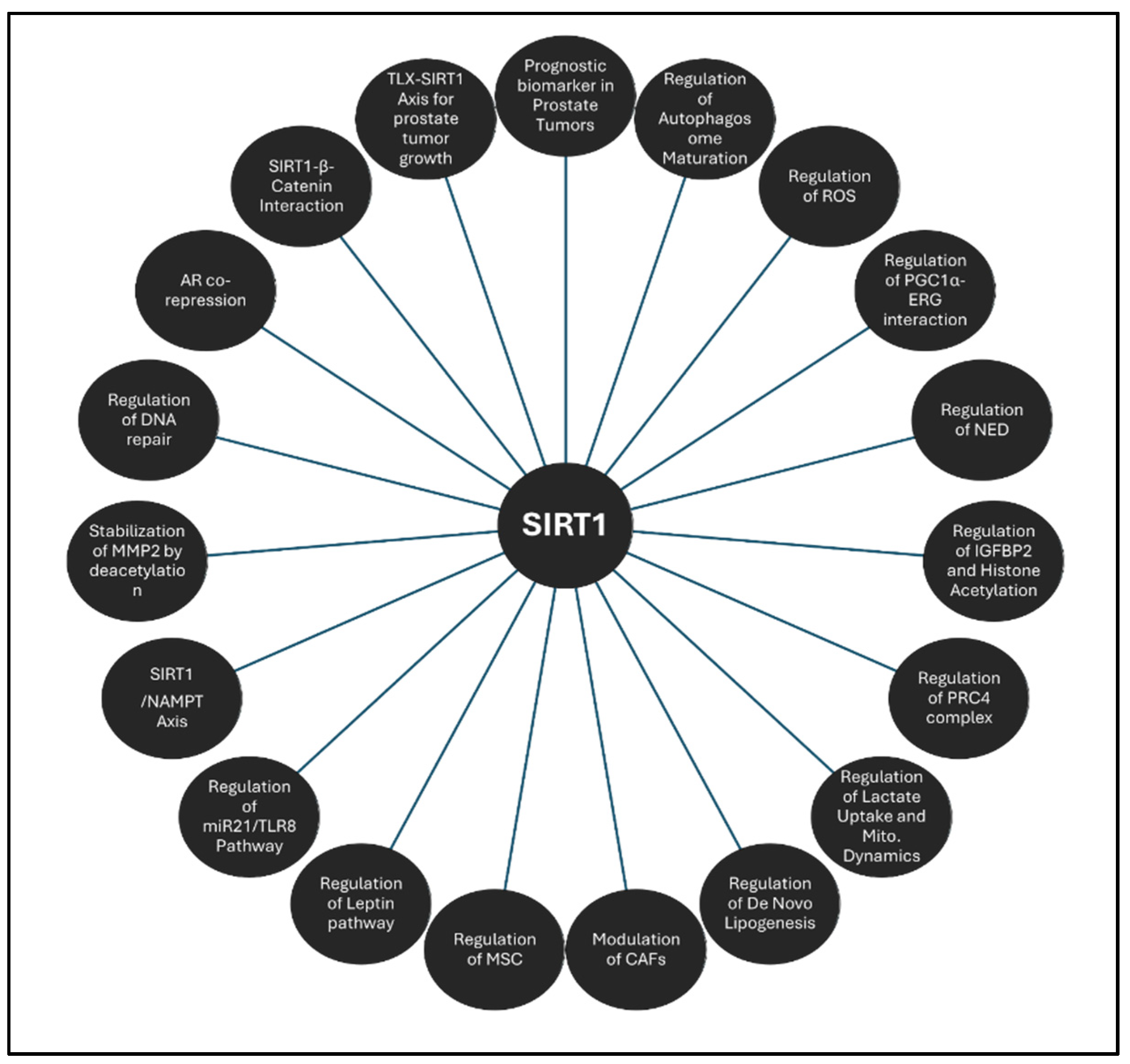
Thus, SIRT1 assumes a multifaceted role in PCa, functioning simultaneously as a tumor promoter and a modulator of critical signaling pathways that contribute to disease progression (Summarized in Figure 3). These insights underscore SIRT1's potential as a therapeutic target, as its inhibition could not only reverse drug resistance but also disrupt essential oncogenic signaling pathways, thereby presenting promising avenues for the treatment of advanced PCa.

3.1.2. SIRT2

In PCa, the expression and functional status of SIRT2 exhibit nuanced dynamics that underscore its potential role in disease progression and therapeutic targeting. SIRT2 is known for its regulatory effects on histone acetylation, particularly at sites such as H3K18, which shows differential expression between hormone-sensitive and CRPC. While SIRT2 expression is relatively stable in normal prostate tissue and primary PCa tissues, a marked reduction is observed in CRPC, correlating with increased histone acetylation at key lysine residues (H3K9, H3K14 and H3K18) and elevated p300 autoacetylation [166]. This diminished SIRT2 activity in CRPC contributes to aberrant hyperacetylation, particularly at H3K18, which has been linked to aggressive tumor phenotypes. Furthermore, tissue microarray analysis and xenograft models reveal that this reduction in SIRT2 is a recurrent feature in CRPC, present in 66% of cases, indicating its role in the epigenetic reprogramming associated with AR signaling and resistance [167]. Despite this, SIRT2 expression in primary PCa appears to confer a protective effect, as multivariate analysis identifies it as a factor associated with a lower incidence of PCa, highlighting its dualistic role depending on cancer stage and context.
SIRT2 plays a critical role in epigenetic modulation within PCa through its regulation of histone acetylation, specifically countering the activity of the acetyltransferase p300. SIRT2, a NAD+-dependent deacetylase, targets key lysine residues on histone H3, particularly H3K18, a site that is hyperacetylated during PCa progression, especially in CRPC. This hyperacetylation is driven by increased p300 activity, which opposes the deacetylating function of SIRT2 [92]. As SIRT2 expression diminishes during the transition from primary PCa to CRPC, the unchecked activity of p300 leads to elevated acetylation of histone sites like H3K9, H3K14 and H3K18, promoting transcriptional programs associated with tumor aggression and resistance to androgen receptor signaling inhibitors (ARSIs). Tissue microarray and circulating tumor cell analyses have demonstrated a negative correlation between SIRT2 expression and histone acetylation levels, with reduced SIRT2 correlating with higher-grade cancers, shorter PSA recurrence-free survival and poorer responses to ARSIs [168]. This loss of SIRT2 disrupts the balance of histone modifications and contributes to the epigenetic reprogramming that underpins PCa progression, marking SIRT2 as a potential therapeutic target, particularly in tumors characterized by heightened p300 activity and histone hyperacetylation.
Sirt2 is also involved in regulating posttranslational modifications that drive PCa progression, specifically through its influence on the acetylation of key signaling molecules such as the leukemia inhibitory factor receptor (LIFR). In PCa cells, SIRT2 mediates the deacetylation of LIFR at lysine 620 (K620), a modification that governs LIFR homodimerization and subsequent activation of downstream signaling pathways, including the PDPK1-AKT axis [169]. By reversing the acetylation induced by the histone acetyltransferase GCN5, SIRT2 inhibits LIFR-driven oncogenic signaling, which is critical for sustaining PCa progression. Loss of K620 acetylation disrupts LIFR's ability to homodimerize, leading to reduced phosphorylation at S1044, impaired activation of PDPK1 and diminished AKT signaling. This cascade further destabilizes GCN5, thereby attenuating the positive feedback loop required for tumor growth. The dynamic regulation of LIFR-K620 acetylation by SIRT2 thus not only serves as a vital modulator of PCa progression but also emerges as a potential biomarker for monitoring disease progression and therapeutic target
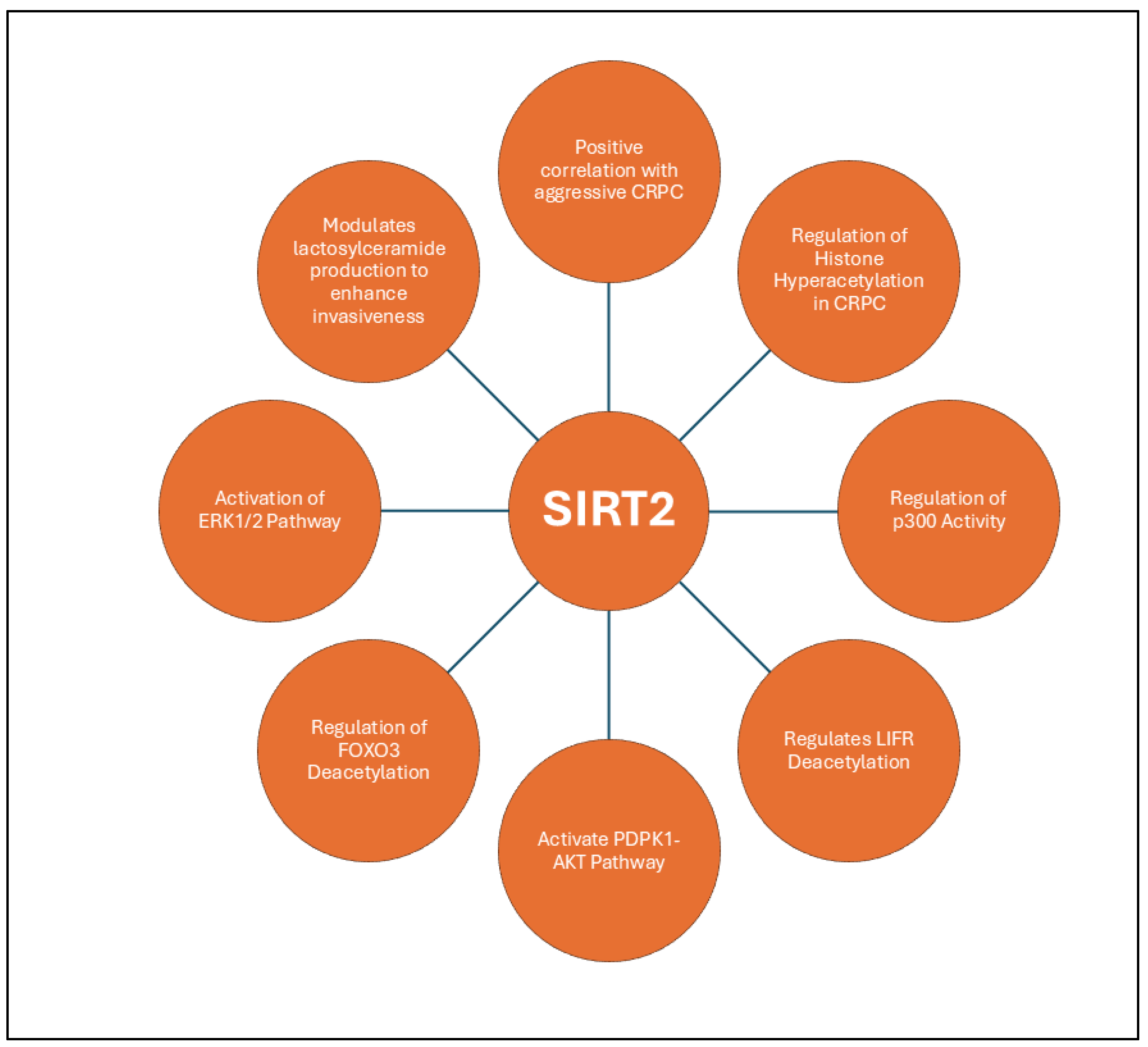
SIRT2 have pivotal role in PCa progression, particularly in its more aggressive forms, such as CRPC and neuroendocrine PCa (NEPC). As a NAD+-dependent deacetylase, SIRT2 not only modulates histone acetylation but also exerts regulatory control over key transcription factors like FOXO3 [121]. SIRT2 promotes the deacetylation of FOXO3, facilitating its poly-ubiquitination by the E3 ubiquitin ligase Skp2, which accelerates its proteasomal degradation. This downregulation of FOXO3, a tumor suppressor with roles in cell cycle arrest and apoptosis, contributes to the unchecked proliferation and survival of malignant prostate cells. In CRPC and NEPC, SIRT2 expression is notably upregulated through activation of the ERK1/2 signaling pathway [91], which is often associated with chemoresistance in cancer by enhancing cellular survival mechanisms, promoting proliferation and inhibiting apoptosis [170,171]. Furthermore, SIRT2 influences the metabolic profile of cancer cells by inducing the production of lactosylceramide through upregulation of B4GALT5, which enhances the invasive potential of PCa cells. These findings underscore SIRT2’s critical involvement in both the epigenetic modulation of oncogenic pathways and the metabolic adaptation of PCa, positioning it as a promising target for therapeutic intervention in advanced and treatment-resistant forms of the disease. Figure 4 summarizes diverse functions of SIRT2 in PCa.

3.1.3. SIRT6

SIRT6 plays a significant role in regulating DNA repair, telomere maintenance, energy metabolism and gene expression and recent investigations have identified it as a potential tumor suppressor. Notably, while SIRT6 is downregulated in various cancers, it has been found to be overexpressed in prostate tumors compared to normal or para-tumor tissues, as confirmed by gene profiling and tissue microarray studies. Knockdown experiments reveal that silencing SIRT6 in human PCa cells induces sub-G1 phase cell cycle arrest, heightened apoptosis and increased DNA damage, accompanied by a reduction in BCL2 expression [172]. Furthermore, SIRT6 deficiency leads to decreased cell viability and enhanced sensitivity to chemotherapeutics. Another comprehensive study have indicated that SIRT6 is upregulated in PCa cell lines and tissue specimens, suggesting its potential role in the disease's progression. Quantitative analyses, including RT-PCR, have demonstrated elevated expression levels of SIRT6 correlating with aggressive disease characteristics, including higher Gleason scores and increased nodal metastasis [98]. Loss-of-function assays further elucidate SIRT6's role in promoting cell proliferation, migration and invasion, confirming that silencing SIRT6 significantly impairs these vital cancer processes. Thus, the upregulation of SIRT6 in PCa patients may serve as a marker for disease advancement, emphasizing its potential as a therapeutic target. Mechanistically, SIRT6 operates through the modulation of key signaling pathways, particularly the Wnt/β-catenin pathway. Alterations in the Wnt/β-catenin pathway are common in cancers and play an integral role in promoting EMT and tumor metastasis [173,174,175]. Inhibition of SIRT6 has been shown to disrupt this pathway, leading to decreased β-catenin activity and attenuating EMT progression in PCa cells. This finding elucidates how SIRT6 facilitates tumor progression by maintaining Wnt signaling and underscores the importance of SIRT6 in the regulatory networks that govern cellular plasticity and metastatic behavior in PCa. By highlighting the interactions between SIRT6 and these pivotal signaling cascades, researchers can better understand its oncogenic functions and potential for therapeutic intervention. Additionally, the interplay between SIRT6 and the innate immune response further complicates its role in PCa. Studies indicate that SIRT6, along with SIRT3, modulates necroptosis, a form of regulated cell death, by inhibiting RIPK3-mediated pathways [176]. This regulation not only influences tumor cell survival but also impacts the recruitment of immune cells such as macrophages and neutrophils. The activation of necroptosis through the knockdown of SIRT6 has been shown to enhance inflammatory responses within the tumor microenvironment, revealing a dualistic role for SIRT6 in both tumor promotion and immune modulation. These insights present SIRT6 as a crucial component of the cancer-immune interface, emphasizing its significance in the development of targeted therapies that could manipulate immune responses in conjunction with tumor dynamics.
Moreover, SIRT6's involvement in the plasticity of cancer cell lineages, particularly in the context of neuroendocrine differentiation, represents another dimension of its regulatory capabilities. Research has identified the G protein-coupled receptor ADORA2A as a key factor that drives lineage plasticity through the activation of SIRT6-mediated deacetylation processes [177]. This signaling pathway rewires proline metabolism, which subsequently affects histone modifications and transcriptional outputs that favor neuroendocrine characteristics. The elucidation of these molecular mechanisms not only enhances the understanding of lineage plasticity in PCa but also highlights SIRT6 as a potential target for therapeutic strategies aimed at preventing or reversing undesirable phenotypic transitions that complicate treatment. The intricate interactions involving SIRT6 extend into broader metabolic contexts, as illustrated by studies demonstrating that the transcription factor E2F1 negatively regulates SIRT6, thereby promoting glycolytic activity in PCa cells. The mechanistic insight into this relationship, where E2F1 binds to the SIRT6 promoter and suppresses its expression, unveils a critical link between metabolic reprogramming and SIRT6 activity [178]. This finding underscores the potential for therapeutic strategies that target E2F1 or related metabolic pathways to restore SIRT6 function and curb the enhanced glycolytic rates that characterize aggressive PCa.
Finally, the identification of protein interaction networks involving SIRT6, particularly within the PIN7 network, emphasizes its role in age-related diseases and cancer. The interactions between SIRT6 and various proteins implicated in tumor suppression, such as p53 and MYBBP1A, delineate pathways that may regulate crucial processes such as the cell cycle and apoptosis [179]. Given the significant deletions observed on chromosome 15 in various cancers, including PCa, further investigation into these interactions could unveil novel therapeutic strategies aimed at reinstating SIRT6 function and exploiting its regulatory capabilities to combat tumor growth and metastasis.
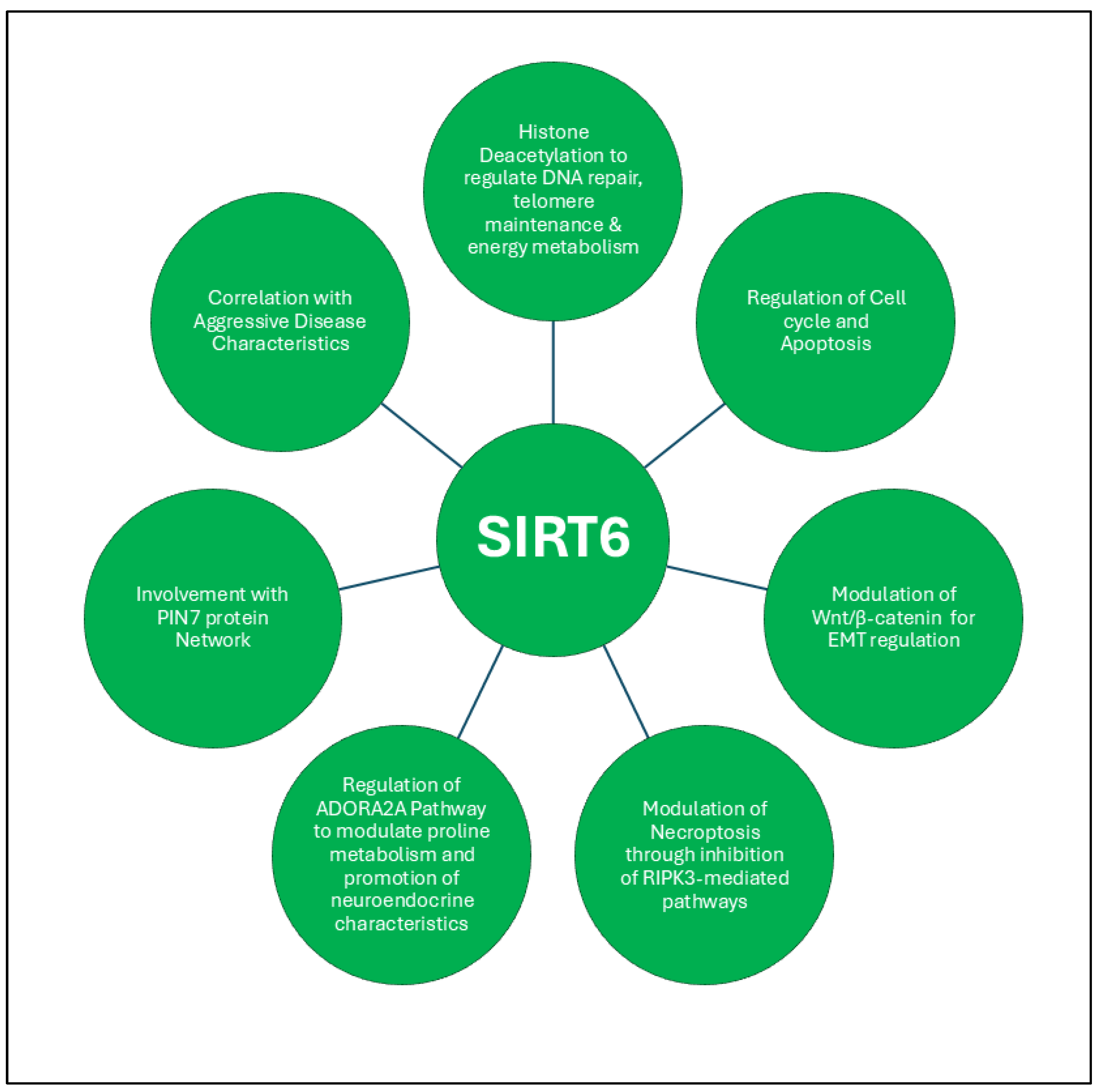
Collectively, these insights into SIRT6's multifaceted roles in PCa establish a compelling case for its consideration as a central target in developing innovative treatment modalities for this prevalent malignancy (Also outlined in Figure 5).

3.1.4. SIRT7

The investigation of SIRT7 reveals its potential role as a predictive biomarker for aggressive PCa, a malignancy characterized by a dearth of reliable prognostic indicators [180]. While SIRT7 has been implicated in tumorigenesis, its specific contributions to PCa remain inadequately characterized. In a study involving immunohistochemical analysis of 57 patients, SIRT7 expression was significantly elevated in tumor tissues compared to adjacent healthy tissues and its levels correlated positively with cancer grade [99]. Further mechanistic studies demonstrated that silencing SIRT7 led to a marked reduction in the migration of androgen-independent PCa cell lines DU145 and PC3. Conversely, overexpression of the wild-type SIRT7 increased migration and invasion in the less aggressive LNCaP cell line. Notably, SIRT7 overexpression also conferred resistance to docetaxel, a commonly used chemotherapeutic agent, highlighting its role in enhancing both the aggressiveness and treatment resistance of PCa cells. Exploration of SIRT7's involvement in metastatic processes reveals a critical function in the epigenetic reprogramming associated with EMT in prostate carcinomas. High levels of SIRT7 have been linked to aggressive cancer phenotypes and poor patient prognoses, positioning SIRT7 as a key player in the maintenance of metastatic potential across various cancer types. In both epithelial and mesenchymal cancer cells, depletion of SIRT7 was found to reverse aggressive traits, underscoring its role as a regulator of metastatic behavior [42]. Notably, SIRT7's influence extends beyond PCa, as its inactivation significantly suppresses metastasis in non-epithelial sarcoma cells as well. These findings elucidate SIRT7's broad role in cancer metastasis, suggesting that its targeting could yield significant therapeutic benefits. The interconnectivity of SIRT7 with other cellular pathways, particularly the p53 signaling pathway, further illuminates its importance in cancer biology. The protein-protein interaction network PIN7, which includes SIRT7 alongside TPPII, CDK2, MYBBP1A, p53 and SIRT6, has been implicated in age-related diseases, including cancer [179]. Pathway enrichment analyses reveal that p53 signaling serves as a predominant mediator of PIN7's effects, with SIRT7 influencing various oncogenic processes through its interaction with this pathway. This network underscores the intricate molecular mechanisms underpinning the functions of SIRT7, particularly its involvement in regulating key cancer-related signaling pathways such as PTK2 and NFκB. The insights gained from these analyses may pave the way for developing multitarget therapeutic strategies that could better address the complexity of PCa. Efforts to establish reliable biomarkers for PCa diagnosis and progression have led researchers to investigate serum-based markers, including SIRT7. In a comparative study of patients with PCa and those with benign prostatic hyperplasia, the serum levels of SIRT7 were evaluated alongside other biomarkers such as Pentraxin-3 and Fetuin-A [181]. Although SIRT7 levels did not exhibit significant differences between the two groups, the study highlighted its potential utility in conjunction with other biochemical markers. These findings underscore the ongoing need for larger-scale studies to further elucidate the diagnostic value of SIRT7 and its integration into a comprehensive biomarker panel for PCa.
The role of SIRT7 in regulating androgen-induced cellular processes also warrants attention, particularly regarding its effects on autophagy and tumor growth. Studies utilizing the LNCap and 22Rv1 PCa cell lines have demonstrated that SIRT7 depletion leads to decreased cell proliferation and invasion, alongside heightened sensitivity to radiation therapy [182]. Mechanistically, SIRT7 appears to modulate the AR signaling pathway, where its knockdown upregulates SMAD4, further implicating SIRT7 in the regulation of critical oncogenic pathways. The complex interplay between SIRT7 and AR not only positions SIRT7 as a potential prognostic marker but also suggests that targeting SIRT7 could enhance therapeutic responses in PCa, particularly in cases resistant to conventional therapies.
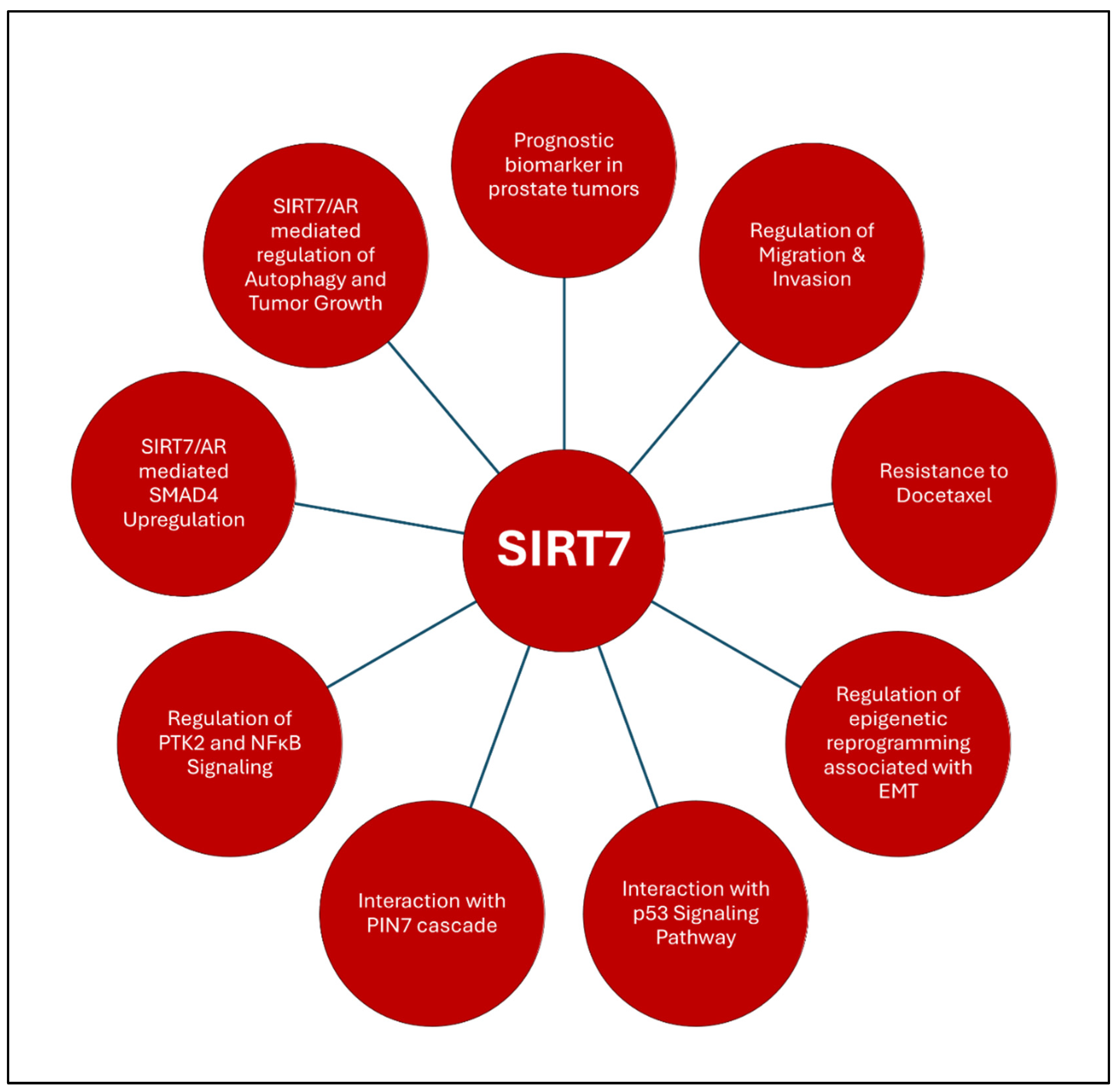
Figure 6 summarizes the diverse roles of SIRT7 in influencing various aspects of prostate carcinogenesis. By elucidating the multifaceted roles of SIRT7, targeted therapies can be developed that effectively tackle the specific challenges associated with aggressive PCa, thereby enhancing patient outcomes in this widespread malignancy.

3.2. Tumor Suppressor Sirtuins

3.2.1. SIRT3

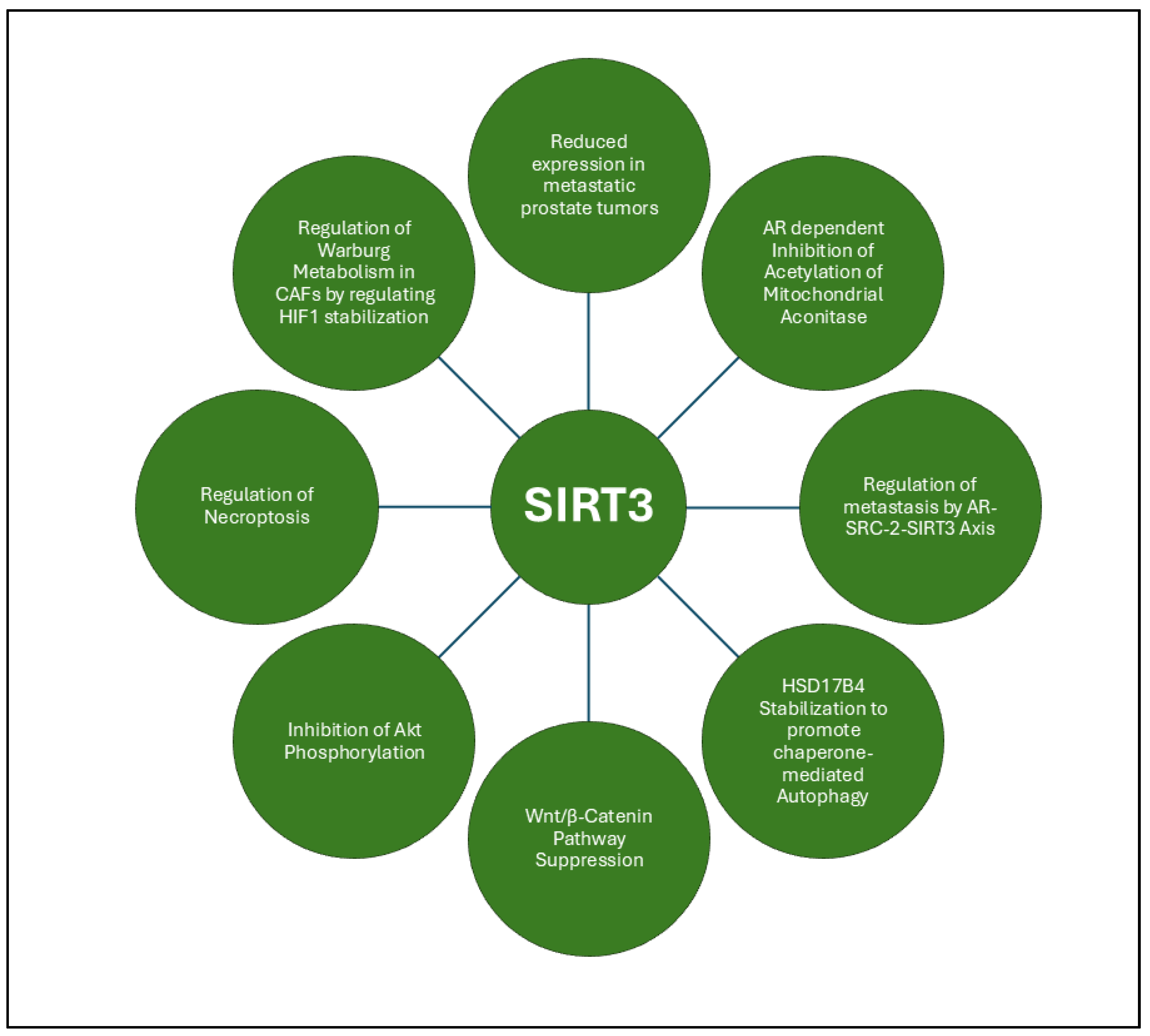
SIRT3, a mitochondrial sirtuin, exerts a multifaceted role in the regulation of PCa progression by modulating key metabolic and oncogenic processes. One of its primary functions is to inhibit the acetylation of mitochondrial aconitase (ACO2), a key enzyme involved in mitochondrial metabolism and de novo lipogenesis [183]. In PCa cells, suppression of SIRT3 by the AR and its coregulator SRC-2 enhances ACO2 activity, promoting citrate synthesis and favoring aggressive cancer phenotypes. Interestingly, acetylation at lysine 258 on ACO2 modulates its function and SIRT3 reverses this acetylation to suppress tumor progression. SRC-2 depletion, which elevates SIRT3 levels, markedly reduces metastasis, particularly in bone, underscoring the therapeutic potential of targeting this AR-SRC-2-SIRT3 axis in PCa treatment. Beyond its role in ACO2 regulation, SIRT3 also interacts with the steroidogenic enzyme 17β-Hydroxysteroid dehydrogenase type 4 (HSD17B4) [184]. Although HSD17B4 lacks a catalytic function in androgen metabolism, its overexpression in PCa tissues enhances cell proliferation, migration and invasion. Mechanistically, SIRT3 directly interacts with HSD17B4, inhibiting its acetylation at lysine 669 (K669), a modification that promotes HSD17B4 degradation via chaperone-mediated autophagy. By preventing this acetylation, SIRT3 stabilizes HSD17B4, supporting its oncogenic activity. The acetylation of HSD17B4 is regulated by CREBBP and DHT treatment exacerbates its acetylation and degradation. The inverse correlation between HSD17B4 levels and its acetylation in PCa tissues highlights a critical regulatory axis where SIRT3 suppresses degradation pathways, thus promoting tumor progression and positions SIRT3 and HSD17B4 as potential therapeutic targets.
Furthermore, SIRT3 plays a pivotal role in the inhibition of EMT in PCa. Mechanistic studies revealed that SIRT3 suppresses the Wnt/β-catenin signaling pathway, thereby promoting FOXO3A expression, which in turn inhibits EMT and migration of PCa cells [93]. Decreased SIRT3 expression correlates with higher Gleason scores and metastatic potential, suggesting that SIRT3 acts as a tumor suppressor by restraining cell migration and invasion. Modulating SIRT3 expression or targeting the Wnt/β-catenin/FOXO3A pathway may provide new avenues for therapeutic interventions in advanced PCa.
SIRT3 also modulates key oncogenic signaling pathways, including the PI3K/Akt pathway, to suppress PCa growth. Overexpression of SIRT3 inhibits Akt phosphorylation, leading to the degradation of the oncoprotein c-MYC via ubiquitination, which is crucial for tumor suppression [94]. In contrast, SIRT3 knockdown enhances the growth of PCa cells by maintaining high Akt activity. This interplay between SIRT3 and the PI3K/Akt pathway highlights the multifaceted tumor-suppressive role of SIRT3 in PCa and suggests that strategies aimed at restoring or mimicking SIRT3 activity could be beneficial in combating this malignancy.
Moreover, SIRT3's involvement in necroptosis and the innate immune response further underscores its complex role in PCa progression. Both SIRT3 and SIRT6, another mitochondrial sirtuin, inhibit RIPK3-mediated necroptosis, thereby evading immune surveillance [176]. Elevated levels of SIRT3 and SIRT6 are associated with worse overall survival in PCa patients, suggesting that while SIRT3 suppresses certain oncogenic processes, it also promotes cancer cell survival by dampening necroptosis. Targeting SIRT3 to re-enable necroptosis could potentially enhance immune responses and improve therapeutic outcomes for PCa patients. Finally, SIRT3 is deeply involved in the metabolic crosstalk between CAFs and PCa cells. CAFs undergo Warburg metabolism under the influence of PCa cells, leading to lactate production and its subsequent uptake by cancer cells via monocarboxylate transporter-1 (MCT1). This metabolic symbiosis is driven by hypoxia-inducible factor 1 (HIF1), whose stabilization is regulated by SIRT3. By controlling HIF1, SIRT3 influences the metabolic reprogramming of both CAFs and PCa cells, promoting cancer cell growth in glucose-deprived environments [185]. Pharmacological inhibition of MCT1 disrupts this symbiotic relationship, pointing to another therapeutic target where SIRT3's role in metabolic regulation could be exploited.
Collectively, SIRT3 act as tumor suppressor in PCa by regulating key metabolic and oncogenic pathways, including the inhibition of ACO2 acetylation and suppression of the Wnt/β-catenin signaling pathway. Its interactions with the AR and steroidogenic enzyme HSD17B4 enhance aggressive cancer phenotypes and cell survival. Targeting SIRT3 may provide promising therapeutic strategies by restoring its tumor-suppressive functions and improving treatment responses. The collective functions of SIRT3 in PCa are summarized in Figure 7.

3.2.2. SIRT4

SIRT4 has garnered attention for its involvement in tumorigenesis, although its specific role in PCa remains underexplored. Recent investigations into the protein's activity reveal a dual functionality, whereby SIRT4 exerts both tumor-suppressive and oncogenic effects. In PCa tissues, SIRT4 expression was significantly diminished compared to non-cancerous tissues, with lower levels strongly correlating with more aggressive tumor phenotypes as reflected by higher Gleason scores. Functional assays further demonstrated that SIRT4 attenuates the migration, invasion and proliferation of PCa cells while promoting apoptosis, suggesting that SIRT4 could serve as a potent tumor suppressor in prostate malignancies [40]. This suppression appears to be mechanistically linked to the inhibition of glutamine metabolism, a critical pathway for sustaining tumor cell growth and invasiveness.
SIRT4’s tumor-suppressive role in PCa is further supported by its capacity to modulate posttranslational modifications, particularly through ADP-ribosylation. In PCa models, SIRT4's inhibition of glutamate dehydrogenase 1 (GDH1), a key enzyme in glutamine metabolism, was observed to curb metabolic pathways essential for tumor proliferation. Beyond this metabolic control, SIRT4 appears to regulate cell cycle progression through its effect on the AKT-p21 axis [186]. By impeding AKT phosphorylation, SIRT4 promotes the nuclear retention of the cell cycle inhibitor p21, thereby enforcing cell cycle arrest and stifling tumor cell division. These findings suggest that SIRT4 not only mediates metabolic rewiring in PCa cells but also exerts direct influence over cell cycle control, marking it as a multifaceted regulator of tumor progression. Intriguingly, SIRT4’s regulatory activity within the mitochondria extends to its interaction with P21-activated kinase 6 (PAK6) and adenine nucleotide translocase 2 (ANT2), creating a complex interplay between these proteins that governs apoptosis in PCa cells [187]. PAK6, primarily located in the mitochondrial inner membrane, modulates SIRT4 stability through ubiquitin-mediated proteolysis, effectively decreasing its tumor-suppressive activity. In turn, SIRT4 deacetylates ANT2 at K105, promoting its degradation via ubiquitination. This dynamic between phosphorylation and deacetylation of ANT2 highlights a finely tuned regulatory axis controlled by SIRT4 and PAK6, which together modulate apoptotic pathways critical for maintaining mitochondrial integrity. The PAK6-SIRT4-ANT2 complex, therefore, not only regulates metabolic pathways but also directly influences cell survival and apoptosis in PCa, presenting new avenues for therapeutic intervention. The mutual regulation of SIRT4 and PAK6 underscores a delicate balance in the modulation of mitochondrial function and apoptotic control in PCa. As PAK6 enhances ANT2 phosphorylation to inhibit apoptosis, it simultaneously destabilizes SIRT4, further tipping the balance toward tumor survival. Clinically, this interplay is reflected in the inverse correlation between PAK6 and SIRT4 expression in PCa tissues, positioning SIRT4 as a critical brake in a system otherwise inclined toward malignancy.
Collectively, these findings position SIRT4 as a key mitochondrial mediator with potential therapeutic relevance, offering novel insights into its function as a metabolic and apoptotic regulator in PCa. Figure 8 illustrates the tumor suppressor role of SIRT4 in PCa.

3.3. Janus-Faced/Dual Acting Sirtuin

3.3.1. SIRT5

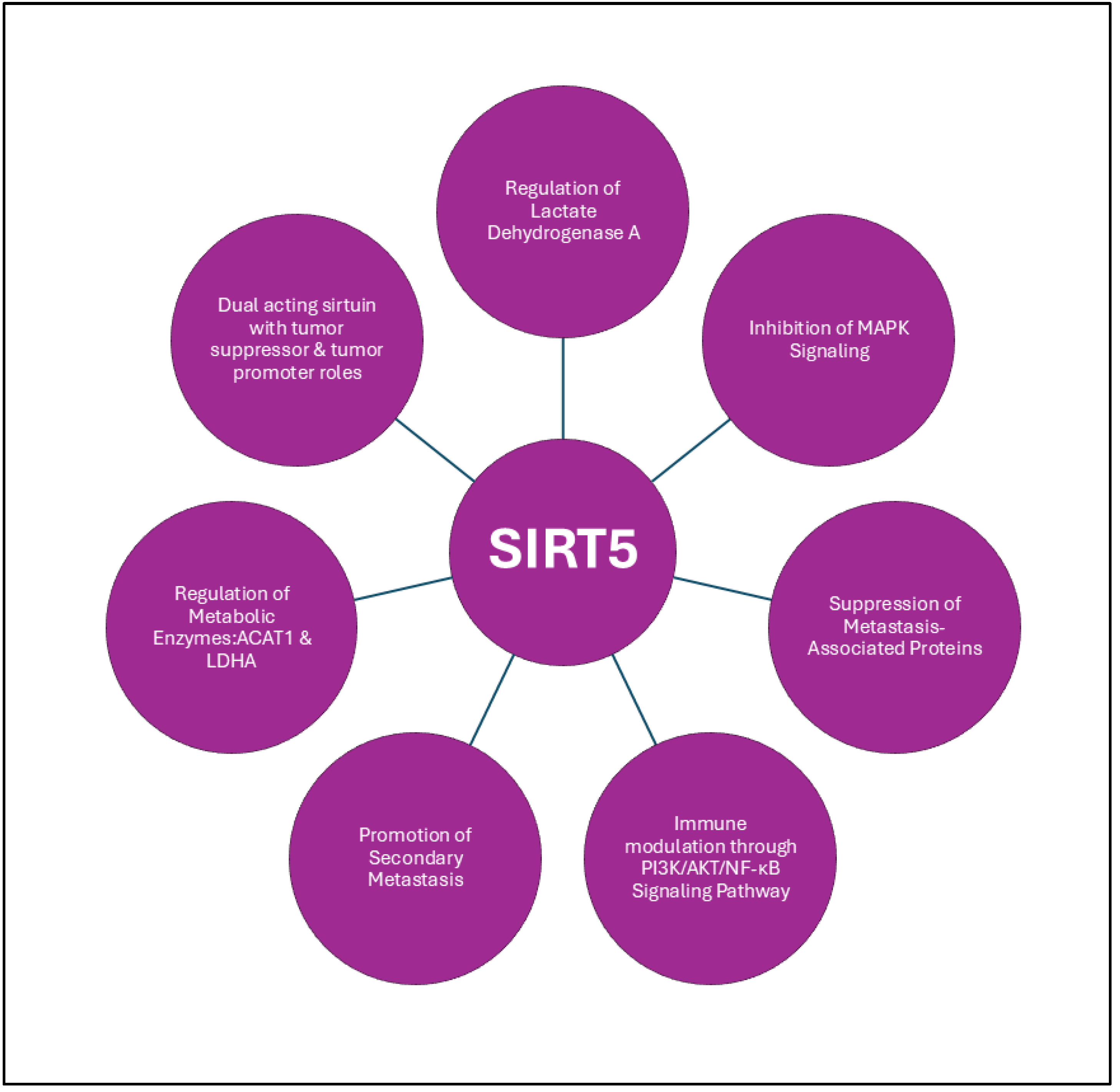
SIRT5 has gained attention in cancer biology due to its involvement in multiple metabolic processes, yet its role in PCa remains insufficiently elucidated. PCa, the most prevalent genital cancer in men, often advances to castration-resistant PCa, leading to bone metastasis and a sharp decline in patient survival rates. In recent studies, significantly decreased levels of SIRT5 were identified in more aggressive stages of PCa, with a corresponding reduction in patient survival. SIRT5’s desuccinylation activity is particularly relevant, as it targets proteins like LDHA, which influences tumor progression. The succinylation of LDHA at lysine 118 (K118su), when unchecked by SIRT5, elevates LDH activity and promotes migration and invasion of PCa cells, suggesting that the loss of SIRT5 contributes directly to the progression and aggressiveness of the disease [95]. The involvement of SIRT5 in PCa progression is further linked to its regulation of the MAPK pathway, a key signaling cascade that modulates cellular proliferation, migration and invasion. Immunohistochemical analyses have revealed that patients with higher Gleason scores exhibited significantly lower SIRT5 expression and functional assays demonstrated that SIRT5 regulates the activity of the MAPK pathway through the deacylation of acetyl-CoA acetyltransferase 1 (ACAT1), a key metabolic enzyme [96]. By promoting the desuccinylation of ACAT1, SIRT5 effectively suppresses the downstream activation of MAPK-related proteins, such as matrix metalloproteinase 9 (MMP9) and cyclin D1, which are critical for the metastatic potential of PCa cells. This regulatory axis underscores the crucial role SIRT5 plays in restraining PCa progression, offering a potential target for therapeutic intervention aimed at modulating MAPK-driven oncogenic signaling.
Further analysis of SIRT5's role in PCa metastasis has revealed its impact on the PI3K/AKT/NF-ĸB signaling pathway, a critical pathway in tumor growth and immune evasion. Proteomic studies using knockout models of SIRT5 in PC-3 cells, a bone-metastasized PCa cell line, demonstrated a significant increase in pro-inflammatory cytokines such as interleukin-1β (IL-1β) and an upregulation of the PI3K/AKT/NF-ĸB axis [97]. This elevation contributes to enhanced migration, invasion and tumor cell survival, thereby promoting secondary metastasis to distant organs beyond the bone. The PI3K/AKT pathway’s interaction with immune-modulatory responses also points to SIRT5’s broader involvement in not only cancer metabolism but also in the tumor microenvironment, making it a crucial player in metastatic PCa dynamics.
These findings underscore the pivotal role of SIRT5 in the intricate regulatory networks driving PCa progression and metastasis, positioning it as a potential therapeutic target for advanced and castration-resistant PCa (As depicted in Figure 9). Acting as both a metabolic regulator and a suppressor of tumor growth and spread, SIRT5 plays a crucial role in modulating key oncogenic signaling pathways, making it a vital player in the metabolic and molecular landscape of PCa.

4. Sirtuin-Based Interventions in Prostate Cancer Management

Targeting sirtuins represents a promising strategy in the treatment of PCa, given their multifaceted roles in regulating cellular processes that are often dysregulated in malignancy. Sirtuins, particularly SIRT1, SIRT2 and SIRT6, influence critical oncogenic signaling pathways that govern proliferation, apoptosis and metastasis. For instance, SIRT1 modulates key regulators of the cell cycle and apoptosis and its inhibition can enhance chemosensitivity in resistant cancer cells. Meanwhile, SIRT2 has been implicated in the progression of bone metastasis through its regulation of osteoblast activity, making it a crucial target for preventing the aggressive spread of PCa. Additionally, SIRT6 plays a pivotal role in cancer progression by activating the Notch signaling pathway, thus promoting tumor growth and metastasis. Given the association of altered sirtuin expression with PCa aggressiveness and therapeutic resistance, modulating their activity holds significant potential for improving treatment outcomes, enhancing the efficacy of conventional therapies and overcoming the challenges posed by advanced stages of the disease.
Specifically, targeting SIRT1 in PCa presents a particularly compelling avenue for therapeutic intervention, owing to its intricate role in modulating critical signaling cascades that influence tumorigenesis. SIRT1's involvement in regulating the cell cycle, apoptosis and oncogenic pathways underscores its potential as a druggable target, with its inhibition showing promise in enhancing the sensitivity of resistant cancer cells to chemotherapy. Notably, the deacetylase core of SIRT1 lacks intrinsic catalytic activity on its own; instead, the 25 amino acid (ESA) region in the C-terminal domain of SIRT1 serves as an "on switch" for its deacetylase activity. This is significant because the inhibition of the ESA region, whether by the endogenous inhibitor DBC1 or through the application of mutant peptides, has been shown to enhance chemosensitivity in androgen-refractory PCa cells [188]. Another study has reported the synthesis of a novel library of indole-triazole derivatives, with one compound, IT-14, demonstrating significant inhibition of SIRT1's deacetylation activity, thereby enhancing its potential as druggable target [189]. In vivo analyses revealed that IT-14 effectively mitigated prostatic hyperplasia, as evidenced by a favorable alteration in the prostate weight-to-body weight ratio and preservation of tissue histoarchitecture. Furthermore, SIRT1's involvement in the regulation of oncogenic pathways is exemplified by its suppression of the E3 ubiquitin ligase Skp2, which is pivotal in targeting key signaling effectors for ubiquitination. By modulating the COP9 signalosome and facilitating feedback mechanisms involving β-transducin repeat-containing protein and Sp1, SIRT1 orchestrates a complex interplay that enhances the destabilization of Skp2, thereby reinforcing the potential of targeting SIRT1 to disrupt oncogenic signaling in PCa [190]. Another study reveals that raloxifene treatment not only reduces cellular viability and migration potential but also alters the phosphorylation states of key signaling proteins, such as pAKT and pERK, thereby indicating an intricate interplay between SIRT1 and GPER1-mediated pathways that may potentiate antiproliferative and apoptotic responses [191]. The SIRT1 inhibitor Tenovin-1, combined with the polo-like kinase 1 (Plk1) inhibitor BI2536, has demonstrated an ability to augment the anti-neoplastic efficacy of metformin, a recognized inhibitor of oxidative phosphorylation, in a manner contingent upon the presence of wild-type p53 [192]. This combination therapy not only rescues glycolytic activity diminished by metformin but also amplifies the drug's capacity to inhibit oxidative phosphorylation, thereby impacting energy metabolism pathways that are often dysregulated in cancer. Importantly, the pronounced responsiveness of CRPC C4-2 cells to this therapeutic regimen, as compared to parental androgen-dependent LNCaP cells, underscores the potential of leveraging SIRT1 inhibition alongside metabolic modulators to devise effective treatment strategies for advanced PCa harboring wild-type p53. Inhibition of SIRT1 via sodium butyrate induces cellular senescence in PCa cells, manifesting through elevated markers such as SA-β-Gal and SAHF [193]. This effect is coupled with the downregulation of proto-oncogenes such as c-Myc and Cyclin D1, alongside a robust upregulation of p21, while p16 expression remains unchanged; additionally, the sodium butyrate -mediated increase ROS underscores the epigenetic interplay between HDAC inhibition and senescence, highlighting a potent avenue for tumor suppression in PCa.
Resveratrol has been identified as a direct ligand for SIRT1, as well as for phosphodiesterases, leading to the discovery of several novel binding partners, including DEAD box helicase 5 (DDX5). The interaction of resveratrol with DDX5 facilitates its degradation within PCa cells, ultimately triggering apoptosis through the downregulation of mTORC1 signaling pathway [194]. Furthermore, the knockdown of DDX5 not only diminishes resveratrol's capacity to inhibit mTORC1 activity but also attenuates its anti-proliferative effects on cancer cells. Another report suggests that the compound Lead 17 has demonstrated promising efficacy, exhibiting an IC50 of 4.34 μM in suppressing the proliferation of LnCAP cells, alongside significant reductions in reactive oxygen species and pro-inflammatory cytokines [195]. Furthermore, radiotherapy induced oxidative damage, characterized by reduced SIRT1 expression and impaired nitric oxide and SOD activity, can be counteracted by resveratrol, which restores SIRT1 levels. This restoration attenuates oxidative stress, reduces apoptosis via caspase-3 inhibition and enhances the expression of endothelial and neuronal nitric oxide synthase, thereby supporting PCa cell survival and function [196]. Interesting, downregulation of SIRT1 in response to radiation is reversed through pharmacological inhibition of autophagy, elucidating a complex interplay between these pathways [197]. Moreover, the overexpression of SIRT1 markedly alleviates radiation-induced apoptosis, emphasizing its radioprotective effect and underscoring the potential of autophagy-mediated SIRT1 regulation as a promising therapeutic target to enhance the efficacy of PCa treatment. Concurrently, radiation-induced CD105/BMP signaling elevates SIRT1, stabilizing p53 and activating PGC-1α, which facilitates DNA repair and mitochondrial biogenesis. Inhibition of the CD105-SIRT1 axis depletes ATP stores, induces G2 cell cycle arrest and enhances radio sensitivity, presenting a promising therapeutic approach for p53-functional PCa [198].
In the quest to develop effective therapeutic strategies against PCa, targeting SIRT1 has emerged as a compelling approach, especially for overcoming drug resistance. For instance, the downregulation of phosphatidylcholine biosynthesis and the upregulation of SIRT1 in 2-hydroxy-flutamide-resistant LNCaP cells underscore a metabolic shift toward a stem-like phenotype, which confers drug resistance [199]. This reprogramming not only facilitates survival under therapeutic pressure but also indicates a possible avenue for intervention by targeting SIRT1, which may disrupt the cancer stem cell-like characteristics and restore sensitivity to antiandrogen therapies. Moreover, the exploration of epigenetic mechanisms in PCa has unveiled SIRT1 as a critical player in taxane resistance. In a study examining the efficacy of taxanes in CRPC, targeting SIRT1 alongside BRPF reader proteins demonstrated significant potential in resensitizing resistant cells to docetaxel and cabazitaxel [200]. The inhibition of SIRT1, combined with other epigenetic interventions, has been shown to reduce the activity of the drug efflux transporter ABCB1, thereby enhancing the intracellular accumulation of chemotherapeutics and promoting apoptosis. This multifaceted approach indicates that SIRT1 modulation, in conjunction with other epigenetic targets, can effectively reverse chemoresistance, presenting a promising strategy for improving therapeutic outcomes in advanced PCa. The differential regulation of SIRT1 by environmental factors, such as exposure to estrogenic compounds, also points to the importance of SIRT1 in PCa pathology. The interplay between SIRT1 and histone modifying enzymes, as elucidated through studies on estradiol and bisphenol A, suggests that SIRT1’s activity is not only influenced by genetic factors but also by external hormonal signals [201]. The presence of estrogen receptors in conjunction with androgens necessitates a nuanced understanding of SIRT1’s role, which could be exploited for therapeutic gain. By manipulating SIRT1 levels in response to hormonal therapies, clinicians may be able to enhance the effectiveness of existing treatment regimens, particularly in patients with hormone-sensitive PCa. Another study explores the role of selective inhibitor 12n has emerged as a promising candidate, exhibiting a potent inhibitory profile against SIRT1 with an IC50 of 460 nM and remarkable selectivity over other sirtuins [202]. Its mechanism of action, characterized by competitive inhibition against acetyl peptide substrates and noncompetitive inhibition towards NAD+, underscores its potential to modulate critical deacetylation pathways involved in oncogenesis. Furthermore, through molecular docking studies and structure-activity relationship analyses, the intricate interactions of 12n with SIRT1 have been elucidated, demonstrating its efficacy in enhancing p53 acetylation levels, thereby potentially restoring the tumor suppressive functions of this pivotal protein in PCa cells.
In addition to pharmacological approaches, natural compounds such as ellagic acid have shown promise in modulating SIRT1 activity and promoting apoptotic pathways in PCa cells. The ability of ellagic acid to downregulate SIRT1, while simultaneously inducing oxidative stress and enhancing pro-apoptotic signals, offers a dual mechanism of action that could be harnessed to combat tumor progression [203]. This natural compound, alongside others that target SIRT1, may serve as effective adjunct therapies, potentially leading to improved patient responses and survival rates. Furthermore, the exploration of dietary phytochemicals, such as lovastatin in combination with Antrodia camphorata extract, has revealed synergistic effects in androgen-refractory PCa cells through the inhibition of SIRT1 and other stemness-related markers [204]. One interesting study reveal that Astragalus polysaccharides (APS) significantly reduces SIRT1 expression, impairing lipid metabolism by modulating the AMPK/SREBP1 axis, thereby curbing prostate tumor growth and invasion [205]. APS acts through miR-138-5p to suppress SIRT1, further inhibiting carcinogenesis. Additionally, saffron extract has been shown to downregulate SIRT1 deacetylase activity, contributing to the apoptosis of PCa cells by interfering with DNA repair mechanisms [206]. This innovative approach highlights the potential of leveraging natural products to inhibit SIRT1 and associated pathways, paving the way for novel therapeutic strategies aimed at mitigating the challenges posed by advanced PCa. Lastly, the emerging data regarding the involvement of SIRT1 in cellular senescence and the aging process presents a compelling narrative for targeting this enzyme in the context of age-related PCa. A study reveals that SIRT1 have intricate relationship with metabolic regulation and circadian rhythms, as evidenced by the modulation of key proteins such as AMPK and PGC-1α in the context of aging and physical exercise [207]. The study illustrates that combined physical training induces an elevation in Bmal1 levels while concurrently reducing REV-ERBα expression, resulting in a concomitant downregulation of the AMPK/SIRT1 pathway and an enhancement of apoptotic signaling through the p53/PTEN/caspase-3 axis. Consequently, these findings delineate a potential therapeutic avenue where the targeting of SIRT1, in conjunction with lifestyle interventions such as exercise, may mitigate age-related preneoplastic changes within the prostatic microenvironment.
Inhibition of SIRT2 presents a promising therapeutic strategy for PCa, particularly in targeting metastatic and treatment-resistant forms of the disease. SIRT2, a NAD+-dependent lysine deacetylase, modulates various oncogenic pathways, including those governing cellular proliferation, migration and survival. In PCa, cancer-derived exosomal microRNA-1275 has been shown to promote osteoblast activity by downregulating SIRT2, leading to enhanced expression of RUNX2, a key regulator of osteogenesis [208]. This crosstalk between PCa cells and osteoblasts through the SIRT2/Runx2 axis plays a crucial role in the progression of bone metastasis, a common and lethal complication of advanced PCa. Novel SIRT2 inhibitors, such as Sirtuin-Rearranging Ligands (SirReals), have demonstrated potent suppression of both deacetylation and defatty-acylation, leading to a marked reduction in levels of the oncoprotein c-Myc and impaired cancer cell migration, both critical drivers of PCa progression [209]. These inhibitors have been refined through strategies targeting prostate-specific membrane antigen (PSMA), enhancing their selective binding and efficacy in PCa cells. Notably, compounds like the PSMA-targeted inhibitor 17 exhibit superior antiproliferative effects and heightened specificity for PCa, overcoming previous limitations in targeting precision. The development of NanoBRET-based assays has further facilitated the quantification of SIRT2 inhibition within cellular contexts, reinforcing the correlation between target engagement and the anticancer efficacy of these inhibitors [210]. Moreover, pharmacological inhibition of SIRT2, utilizing small molecules such as oxadiazole-based analogues, has demonstrated efficacy in reducing PCa cell viability and migration, likely by disrupting the deacetylation activity of SIRT2. Docking studies have further elucidated that these inhibitors engage in substrate-competitive and cofactor-noncompetitive interactions with SIRT2, confirming their potential for therapeutic development [211]. Inhibition of SIRT2 not only disrupts tumor cell growth but also impedes metastatic processes, positioning SIRT2 inhibitors as valuable candidates for combating the aggressive progression of PCa.
The therapeutic potential of targeting SIRT6 in metastatic castration-resistant PCa has emerged as a promising area of exploration, particularly given the persistent challenges associated with treating this aggressive disease. Immunohistochemical analyses of PCa tissue microarrays reveal a positive correlation between SIRT6 expression and cancer progression and subsequent studies demonstrate that silencing SIRT6 through engineered exosomes loaded with small interfering RNA significantly impedes both the proliferation and metastasis of PCa cell lines, both in vitro and in vivo [212]. The SIRT6-driven signaling landscape, particularly its activation of the Notch pathway, underscores its role as a driver of PCa progression. Innovative strategies to inhibit SIRT6 have emerged as promising avenues for diminishing tumor growth and metastasis, establishing SIRT6 as a vital target for the development of new anticancer agents that can complement existing therapies like chemotherapy and radiotherapy. Recent research has identified novel quinazolinedione compounds that effectively inhibit SIRT6, leading to increased acetylation of histone H3 at lysine 9, reduced production of TNF-α and enhanced glucose uptake in cultured cells [213]. These inhibitors not only exacerbate DNA damage and cell death in BRCA2-deficient Capan-1 cells when combined with the PARP inhibitor olaparib but also work synergistically with gemcitabine to enhance the lethality of pancreatic cancer cells. Consequently, these quinazolinedione-based SIRT6 inhibitors present significant potential for application in cancer treatment.
Emerging therapeutic strategies involving SIRT7 inhibition present promising avenues for the treatment of PCa. Recent studies have explored the efficacy of combinations of existing chemotherapeutics, such as norcantharidin (NCTD) and paclitaxel (PTX), in modulating SIRT7 expression and enhancing anticancer effects [214]. Findings indicate that the NCTD-PTX combination effectively reduces cell viability and induces apoptosis in PCa cells by downregulating SIRT7. This suggests that targeting SIRT7 could synergistically enhance the effectiveness of established chemotherapeutic regimens, providing a viable strategy for addressing the challenges posed by treatment-resistant PCa. Finally, the intricate relationship between SIRT7 and various molecular pathways underscores its potential as both a therapeutic target and a biomarker in PCa. The emerging evidence suggests that SIRT7 not only promotes tumorigenesis and metastasis but also participates in the modulation of essential cellular processes such as autophagy and the DNA damage response [215].
In summary, targeting sirtuins, particularly SIRT1, SIRT2, SIRT6 and SIRT7, presents a multifaceted and promising approach for advancing therapeutic strategies against PCa. SIRT1 inhibition has been shown to enhance chemosensitivity, disrupt oncogenic signaling pathways and promote apoptosis through various mechanisms, including modulation of the mTORC1 signaling pathway and interactions with key proteins such as DDX5. Similarly, SIRT2 inhibitors exhibit potential by impairing cancer cell migration and proliferation, thereby countering metastatic processes. The burgeoning evidence linking SIRT6 and SIRT7 to cancer progression and treatment resistance highlights their roles as critical players in oncogenesis, suggesting that their inhibition may improve the efficacy of existing treatments. Furthermore, the exploration of natural compounds and novel synthetic inhibitors targeting these sirtuins underscores their potential for developing effective adjunct therapies. By integrating sirtuin modulation into therapeutic regimens, there is a significant opportunity to overcome drug resistance and enhance patient outcomes in advanced PCa, particularly in cases characterized by aggressive disease phenotypes. Table 1: summarizes the specific inhibitors of sirtuins in PCa.

5. Conclusion and Perspectives

In conclusion, the sirtuin family demonstrates a profound influence on PCa by regulating vital cellular processes, from metabolic adaptation to epigenetic modulation and oxidative stress response. Each sirtuin has a distinct role, like SIRT1 and SIRT6, supporting cancer progression through mechanisms linked to cellular homeostasis, chemoresistance, and AR modulation, particularly in CRPC. Conversely, others, such as SIRT3 and SIRT4 function as tumor suppressors by regulating mitochondrial function, inhibiting oncogenic signaling, and promoting apoptosis, collectively slowing tumor proliferation and invasion. SIRT5 stands out for its dual role as both a promoter and suppressor in PCa. These findings underscore the multifaceted nature of sirtuins and their potential as either tumor-promoting or tumor-suppressing entities in PCa.
Future research should prioritize unraveling the complex interactions between sirtuins and the PCa tumor microenvironment. Understanding how SIRT1, SIRT3, and SIRT6 influence metabolic pathways and immune evasion mechanisms could shed light on combination therapies that simultaneously target cancer metabolism and immune responses. Additionally, exploring SIRT4 and SIRT5’s roles in suppressing metabolic pathways linked to cell proliferation and immune evasion may reveal promising strategies for reducing aggressive tumor growth and improving responses to ADT. Precision medicine approaches, such as selective inhibition of SIRT6 in cases of overexpression-related aggressiveness, hold potential for tailoring treatments based on individual sirtuin profiles, thereby enhancing therapeutic efficacy.
As the field of PCa therapy advances, integrating sirtuin modulation into standard care could transform treatment outcomes, especially in advanced or drug-resistant PCa patients. Investigating natural compounds and synthetic agents that selectively target sirtuin pathways could create novel adjunct therapies, potentially increasing sensitivity to chemotherapy and overcoming drug resistance. Ultimately, a deeper understanding of sirtuin-mediated pathways in PCa’s signaling landscape may enable the development of personalized, sirtuin-targeting therapies that address the unique molecular profiles of aggressive PCa, thereby improving both prognosis and quality of life for affected patients.

Author Contributions

S.C.: literature review, manuscript preparation and wrote original draft. A.K: review and editing. All authors have read and agreed to the present version of the manuscript.

Funding information

This article did not receive external funding

Institutional Review Board Statement

Not applicable.

Informed Consent Statement

Not applicable.

Data Availability Statement

Not applicable.

Conflicts of Interest

The authors declare no conflicts of interest.

References

  1. Rawla, P., Epidemiology of Prostate Cancer. World J Oncol 2019, 10, (2), 63-89. [CrossRef] [PubMed]
  2. Bray, F.; Laversanne, M.; Sung, H.; Ferlay, J.; Siegel, R. L.; Soerjomataram, I.; Jemal, A., Global cancer statistics 2022: GLOBOCAN estimates of incidence and mortality worldwide for 36 cancers in 185 countries. CA Cancer J Clin 2024, 74, (3), 229-263. [CrossRef] [PubMed]
  3. Humphrey, P. A., Histopathology of Prostate Cancer. Cold Spring Harb Perspect Med 2017, 7, (10).
  4. Pascale, M.; Azinwi, C. N.; Marongiu, B.; Pesce, G.; Stoffel, F.; Roggero, E., The outcome of prostate cancer patients treated with curative intent strongly depends on survival after metastatic progression. BMC Cancer 2017, 17, (1), 651. [CrossRef] [PubMed]
  5. Chouhan, S.; Sridaran, D.; Weimholt, C.; Luo, J.; Li, T.; Hodgson, M. C.; Santos, L. N.; Le Sommer, S.; Fang, B.; Koomen, J. M.; Seeliger, M.; Qu, C. K.; Yart, A.; Kontaridis, M. I.; Mahajan, K.; Mahajan, N. P., SHP2 as a primordial epigenetic enzyme expunges histone H3 pTyr-54 to amend androgen receptor homeostasis. Nat Commun 2024, 15, (1), 5629. [CrossRef]
  6. Chouhan, S.; Sawant, M.; Weimholt, C.; Luo, J.; Sprung, R. W.; Terrado, M.; Mueller, D. M.; Earp, H. S.; Mahajan, N. P., TNK2/ACK1-mediated phosphorylation of ATP5F1A (ATP synthase F1 subunit alpha) selectively augments survival of prostate cancer while engendering mitochondrial vulnerability. Autophagy 2023, 19, (3), 1000-1025. [CrossRef]
  7. Nguyen, T.; Sridaran, D.; Chouhan, S.; Weimholt, C.; Wilson, A.; Luo, J.; Li, T.; Koomen, J.; Fang, B.; Putluri, N.; Sreekumar, A.; Feng, F. Y.; Mahajan, K.; Mahajan, N. P., Histone H2A Lys130 acetylation epigenetically regulates androgen production in prostate cancer. Nat Commun 2023, 14, (1), 3357. [CrossRef]
  8. Sridaran, D.; Chouhan, S.; Mahajan, K.; Renganathan, A.; Weimholt, C.; Bhagwat, S.; Reimers, M.; Kim, E. H.; Thakur, M. K.; Saeed, M. A.; Pachynski, R. K.; Seeliger, M. A.; Miller, W. T.; Feng, F. Y.; Mahajan, N. P., Inhibiting ACK1-mediated phosphorylation of C-terminal Src kinase counteracts prostate cancer immune checkpoint blockade resistance. Nat Commun 2022, 13, (1), 6929. [CrossRef]
  9. Armenia, J.; Wankowicz, S. A. M.; Liu, D.; Gao, J.; Kundra, R.; Reznik, E.; Chatila, W. K.; Chakravarty, D.; Han, G. C.; Coleman, I.; Montgomery, B.; Pritchard, C.; Morrissey, C.; Barbieri, C. E.; Beltran, H.; Sboner, A.; Zafeiriou, Z.; Miranda, S.; Bielski, C. M.; Penson, A. V.; Tolonen, C.; Huang, F. W.; Robinson, D.; Wu, Y. M.; Lonigro, R.; Garraway, L. A.; Demichelis, F.; Kantoff, P. W.; Taplin, M. E.; Abida, W.; Taylor, B. S.; Scher, H. I.; Nelson, P. S.; de Bono, J. S.; Rubin, M. A.; Sawyers, C. L.; Chinnaiyan, A. M.; Team, P. S. C. I. P. C. D.; Schultz, N.; Van Allen, E. M., The long tail of oncogenic drivers in prostate cancer. Nat Genet 2018, 50, (5), 645-651. [CrossRef]
  10. Athavale, D.; Chouhan, S.; Pandey, V.; Mayengbam, S. S.; Singh, S.; Bhat, M. K., Hepatocellular carcinoma-associated hypercholesterolemia: involvement of proprotein-convertase-subtilisin-kexin type-9 (PCSK9). Cancer Metab 2018, 6, 16. [CrossRef]
  11. Hanahan, D., Hallmarks of Cancer: New Dimensions. Cancer Discov 2022, 12, (1), 31-46. [CrossRef]
  12. Rasool, R. U.; Natesan, R.; Asangani, I. A., Toppling the HAT to Treat Lethal Prostate Cancer. Cancer Discov 2021, 11, (5), 1011-1013. [CrossRef] [PubMed]
  13. Abbas, A.; Gupta, S., The role of histone deacetylases in prostate cancer. Epigenetics 2008, 3, (6), 300-9. [CrossRef] [PubMed]
  14. Onyiba, C. I.; Scarlett, C. J.; Weidenhofer, J., The Mechanistic Roles of Sirtuins in Breast and Prostate Cancer. Cancers (Basel) 2022, 14, (20).
  15. Herskovits, A. Z.; Guarente, L., Sirtuin deacetylases in neurodegenerative diseases of aging. Cell Res 2013, 23, (6), 746-58. [CrossRef] [PubMed]
  16. Hamaidi, I.; Kim, S., Sirtuins are crucial regulators of T cell metabolism and functions. Exp Mol Med 2022, 54, (3), 207-215. [CrossRef]
  17. Carafa, V.; Altucci, L.; Nebbioso, A., Dual Tumor Suppressor and Tumor Promoter Action of Sirtuins in Determining Malignant Phenotype. Front Pharmacol 2019, 10, 38. [CrossRef]
  18. Wang, R. H.; Sengupta, K.; Li, C.; Kim, H. S.; Cao, L.; Xiao, C.; Kim, S.; Xu, X.; Zheng, Y.; Chilton, B.; Jia, R.; Zheng, Z. M.; Appella, E.; Wang, X. W.; Ried, T.; Deng, C. X., Impaired DNA damage response, genome instability, and tumorigenesis in SIRT1 mutant mice. Cancer Cell 2008, 14, (4), 312-23. [CrossRef]
  19. Alves-Fernandes, D. K.; Jasiulionis, M. G., The Role of SIRT1 on DNA Damage Response and Epigenetic Alterations in Cancer. Int J Mol Sci 2019, 20, (13).
  20. Meng, F.; Qian, M.; Peng, B.; Peng, L.; Wang, X.; Zheng, K.; Liu, Z.; Tang, X.; Zhang, S.; Sun, S.; Cao, X.; Pang, Q.; Zhao, B.; Ma, W.; Songyang, Z.; Xu, B.; Zhu, W. G.; Xu, X.; Liu, B., Synergy between SIRT1 and SIRT6 helps recognize DNA breaks and potentiates the DNA damage response and repair in humans and mice. Elife 2020, 9. [CrossRef]
  21. Smirnov, D.; Eremenko, E.; Stein, D.; Kaluski, S.; Jasinska, W.; Cosentino, C.; Martinez-Pastor, B.; Brotman, Y.; Mostoslavsky, R.; Khrameeva, E.; Toiber, D., SIRT6 is a key regulator of mitochondrial function in the brain. Cell Death Dis 2023, 14, (1), 35. [CrossRef]
  22. Lombard, D. B.; Schwer, B.; Alt, F. W.; Mostoslavsky, R., SIRT6 in DNA repair, metabolism and ageing. J Intern Med 2008, 263, (2), 128-41. [CrossRef]
  23. Kuang, J.; Chen, L.; Tang, Q.; Zhang, J.; Li, Y.; He, J., The Role of Sirt6 in Obesity and Diabetes. Front Physiol 2018, 9, 135. [CrossRef]
  24. Roichman, A.; Elhanati, S.; Aon, M. A.; Abramovich, I.; Di Francesco, A.; Shahar, Y.; Avivi, M. Y.; Shurgi, M.; Rubinstein, A.; Wiesner, Y.; Shuchami, A.; Petrover, Z.; Lebenthal-Loinger, I.; Yaron, O.; Lyashkov, A.; Ubaida-Mohien, C.; Kanfi, Y.; Lerrer, B.; Fernandez-Marcos, P. J.; Serrano, M.; Gottlieb, E.; de Cabo, R.; Cohen, H. Y., Restoration of energy homeostasis by SIRT6 extends healthy lifespan. Nat Commun 2021, 12, (1), 3208. [CrossRef] [PubMed]
  25. Dryden, S. C.; Nahhas, F. A.; Nowak, J. E.; Goustin, A. S.; Tainsky, M. A., Role for human SIRT2 NAD-dependent deacetylase activity in control of mitotic exit in the cell cycle. Mol Cell Biol 2003, 23, (9), 3173-85. [CrossRef] [PubMed]
  26. Serrano, L.; Martinez-Redondo, P.; Marazuela-Duque, A.; Vazquez, B. N.; Dooley, S. J.; Voigt, P.; Beck, D. B.; Kane-Goldsmith, N.; Tong, Q.; Rabanal, R. M.; Fondevila, D.; Munoz, P.; Kruger, M.; Tischfield, J. A.; Vaquero, A., The tumor suppressor SirT2 regulates cell cycle progression and genome stability by modulating the mitotic deposition of H4K20 methylation. Genes Dev 2013, 27, (6), 639-53. [CrossRef] [PubMed]
  27. Park, S. H.; Zhu, Y.; Ozden, O.; Kim, H. S.; Jiang, H.; Deng, C. X.; Gius, D.; Vassilopoulos, A., SIRT2 is a tumor suppressor that connects aging, acetylome, cell cycle signaling, and carcinogenesis. Transl Cancer Res 2012, 1, (1), 15-21. [PubMed]
  28. Wang, Y.; Yang, J.; Hong, T.; Chen, X.; Cui, L., SIRT2: Controversy and multiple roles in disease and physiology. Ageing Res Rev 2019, 55, 100961. [CrossRef]
  29. Zhu, C.; Dong, X.; Wang, X.; Zheng, Y.; Qiu, J.; Peng, Y.; Xu, J.; Chai, Z.; Liu, C., Multiple Roles of SIRT2 in Regulating Physiological and Pathological Signal Transduction. Genet Res (Camb) 2022, 2022, 9282484. [CrossRef]
  30. Zhang, L.; Kim, S.; Ren, X., The Clinical Significance of SIRT2 in Malignancies: A Tumor Suppressor or an Oncogene? Front Oncol 2020, 10, 1721. [CrossRef]
  31. Lee, H.; Yoon, H., Mitochondrial sirtuins: Energy dynamics and cancer metabolism. Mol Cells 2024, 47, (2), 100029. [CrossRef]
  32. Shen, H.; Ma, W.; Hu, Y.; Liu, Y.; Song, Y.; Fu, L.; Qin, Z., Mitochondrial Sirtuins in Cancer: A Revisited Review from Molecular Mechanisms to Therapeutic Strategies. Theranostics 2024, 14, (7), 2993-3013. [CrossRef]
  33. Kumar, S.; Lombard, D. B., Mitochondrial sirtuins and their relationships with metabolic disease and cancer. Antioxid Redox Signal 2015, 22, (12), 1060-77. [CrossRef]
  34. Haigis, M. C.; Deng, C. X.; Finley, L. W.; Kim, H. S.; Gius, D., SIRT3 is a mitochondrial tumor suppressor: a scientific tale that connects aberrant cellular ROS, the Warburg effect, and carcinogenesis. Cancer Res 2012, 72, (10), 2468-72. [CrossRef] [PubMed]
  35. Kim, H. S.; Patel, K.; Muldoon-Jacobs, K.; Bisht, K. S.; Aykin-Burns, N.; Pennington, J. D.; van der Meer, R.; Nguyen, P.; Savage, J.; Owens, K. M.; Vassilopoulos, A.; Ozden, O.; Park, S. H.; Singh, K. K.; Abdulkadir, S. A.; Spitz, D. R.; Deng, C. X.; Gius, D., SIRT3 is a mitochondria-localized tumor suppressor required for maintenance of mitochondrial integrity and metabolism during stress. Cancer Cell 2010, 17, (1), 41-52. [CrossRef] [PubMed]
  36. Chen, Y.; Fu, L. L.; Wen, X.; Wang, X. Y.; Liu, J.; Cheng, Y.; Huang, J., Sirtuin-3 (SIRT3), a therapeutic target with oncogenic and tumor-suppressive function in cancer. Cell Death Dis 2014, 5, (2), e1047. [CrossRef] [PubMed]
  37. Sun, H.; Huang, D.; Liu, G.; Jian, F.; Zhu, J.; Zhang, L., SIRT4 acts as a tumor suppressor in gastric cancer by inhibiting cell proliferation, migration, and invasion. Onco Targets Ther 2018, 11, 3959-3968. [CrossRef] [PubMed]
  38. Tomaselli, D.; Steegborn, C.; Mai, A.; Rotili, D., Sirt4: A Multifaceted Enzyme at the Crossroads of Mitochondrial Metabolism and Cancer. Front Oncol 2020, 10, 474. [CrossRef]
  39. Jeong, S. M.; Xiao, C.; Finley, L. W.; Lahusen, T.; Souza, A. L.; Pierce, K.; Li, Y. H.; Wang, X.; Laurent, G.; German, N. J.; Xu, X.; Li, C.; Wang, R. H.; Lee, J.; Csibi, A.; Cerione, R.; Blenis, J.; Clish, C. B.; Kimmelman, A.; Deng, C. X.; Haigis, M. C., SIRT4 has tumor-suppressive activity and regulates the cellular metabolic response to DNA damage by inhibiting mitochondrial glutamine metabolism. Cancer Cell 2013, 23, (4), 450-63. [CrossRef]
  40. Cai, G.; Ge, Z.; Xu, Y.; Cai, L.; Sun, P.; Huang, G., SIRT4 functions as a tumor suppressor during prostate cancer by inducing apoptosis and inhibiting glutamine metabolism. Sci Rep 2022, 12, (1), 12208. [CrossRef]
  41. Blank, M. F.; Chen, S.; Poetz, F.; Schnolzer, M.; Voit, R.; Grummt, I., SIRT7-dependent deacetylation of CDK9 activates RNA polymerase II transcription. Nucleic Acids Res 2017, 45, (5), 2675-2686. [CrossRef]
  42. Malik, S.; Villanova, L.; Tanaka, S.; Aonuma, M.; Roy, N.; Berber, E.; Pollack, J. R.; Michishita-Kioi, E.; Chua, K. F., SIRT7 inactivation reverses metastatic phenotypes in epithelial and mesenchymal tumors. Sci Rep 2015, 5, 9841. [CrossRef]
  43. Wu, Q. J.; Zhang, T. N.; Chen, H. H.; Yu, X. F.; Lv, J. L.; Liu, Y. Y.; Liu, Y. S.; Zheng, G.; Zhao, J. Q.; Wei, Y. F.; Guo, J. Y.; Liu, F. H.; Chang, Q.; Zhang, Y. X.; Liu, C. G.; Zhao, Y. H., The sirtuin family in health and disease. Signal Transduct Target Ther 2022, 7, (1), 402.
  44. Chen, J.; Wang, Q.; Li, R.; Li, Z.; Jiang, Q.; Yan, F.; Ye, J., The role of sirtuins in the regulatin of oxidative stress during the progress and therapy of type 2 diabetes mellitus. Life Sci 2023, 333, 122187. [CrossRef] [PubMed]
  45. Merksamer, P. I.; Liu, Y.; He, W.; Hirschey, M. D.; Chen, D.; Verdin, E., The sirtuins, oxidative stress and aging: an emerging link. Aging (Albany NY) 2013, 5, (3), 144-50.
  46. Fortuny, L.; Sebastian, C., Sirtuins as Metabolic Regulators of Immune Cells Phenotype and Function. Genes (Basel) 2021, 12, (11).
  47. Tao, Z.; Jin, Z.; Wu, J.; Cai, G.; Yu, X., Sirtuin family in autoimmune diseases. Front Immunol 2023, 14, 1186231. [CrossRef] [PubMed]
  48. Xu, C. Q.; Li, J.; Liang, Z. Q.; Zhong, Y. L.; Zhang, Z. H.; Hu, X. Q.; Cao, Y. B.; Chen, J., Sirtuins in macrophage immune metabolism: A novel target for cardiovascular disorders. Int J Biol Macromol 2024, 256, (Pt 1), 128270. [CrossRef]
  49. Vachharajani, V. T.; Liu, T.; Wang, X.; Hoth, J. J.; Yoza, B. K.; McCall, C. E., Sirtuins Link Inflammation and Metabolism. J Immunol Res 2016, 2016, 8167273. [CrossRef] [PubMed]
  50. Mendes, K. L.; Lelis, D. F.; Santos, S. H. S., Nuclear sirtuins and inflammatory signaling pathways. Cytokine Growth Factor Rev 2017, 38, 98-105. [CrossRef]
  51. Min, J.; Landry, J.; Sternglanz, R.; Xu, R. M., Crystal structure of a SIR2 homolog-NAD complex. Cell 2001, 105, (2), 269-79. [CrossRef]
  52. Finnin, M. S.; Donigian, J. R.; Pavletich, N. P., Structure of the histone deacetylase SIRT2. Nat Struct Biol 2001, 8, (7), 621-5. [CrossRef]
  53. Chang, J. H.; Kim, H. C.; Hwang, K. Y.; Lee, J. W.; Jackson, S. P.; Bell, S. D.; Cho, Y., Structural basis for the NAD-dependent deacetylase mechanism of Sir2. J Biol Chem 2002, 277, (37), 34489-98. [CrossRef] [PubMed]
  54. Zhao, K.; Chai, X.; Marmorstein, R., Structure of the yeast Hst2 protein deacetylase in ternary complex with 2'-O-acetyl ADP ribose and histone peptide. Structure 2003, 11, (11), 1403-11. [CrossRef]
  55. Klein, M. A.; Denu, J. M., Biological and catalytic functions of sirtuin 6 as targets for small-molecule modulators. J Biol Chem 2020, 295, (32), 11021-11041. [CrossRef]
  56. Sanders, B. D.; Jackson, B.; Marmorstein, R., Structural basis for sirtuin function: what we know and what we don't. Biochim Biophys Acta 2010, 1804, (8), 1604-16. [CrossRef] [PubMed]
  57. Avalos, J. L.; Boeke, J. D.; Wolberger, C., Structural basis for the mechanism and regulation of Sir2 enzymes. Mol Cell 2004, 13, (5), 639-48. [CrossRef]
  58. Pan, M.; Yuan, H.; Brent, M.; Ding, E. C.; Marmorstein, R., SIRT1 contains N- and C-terminal regions that potentiate deacetylase activity. J Biol Chem 2012, 287, (4), 2468-76. [CrossRef] [PubMed]
  59. Cao, D.; Wang, M.; Qiu, X.; Liu, D.; Jiang, H.; Yang, N.; Xu, R. M., Structural basis for allosteric, substrate-dependent stimulation of SIRT1 activity by resveratrol. Genes Dev 2015, 29, (12), 1316-25. [CrossRef] [PubMed]
  60. Carafa, V.; Rotili, D.; Forgione, M.; Cuomo, F.; Serretiello, E.; Hailu, G. S.; Jarho, E.; Lahtela-Kakkonen, M.; Mai, A.; Altucci, L., Sirtuin functions and modulation: from chemistry to the clinic. Clin Epigenetics 2016, 8, 61. [CrossRef]
  61. Eldridge, M. J. G.; Pereira, J. M.; Impens, F.; Hamon, M. A., Active nuclear import of the deacetylase Sirtuin-2 is controlled by its C-terminus and importins. Sci Rep 2020, 10, (1), 2034. [CrossRef]
  62. Abeywardana, M. Y.; Whedon, S. D.; Lee, K.; Nam, E.; Dovarganes, R.; DuBois-Coyne, S.; Haque, I. A.; Wang, Z. A.; Cole, P. A., Multifaceted regulation of sirtuin 2 (Sirt2) deacetylase activity. J Biol Chem 2024, 300, (9), 107722. [CrossRef]
  63. Zietara, P.; Dziewiecka, M.; Augustyniak, M., Why Is Longevity Still a Scientific Mystery? Sirtuins-Past, Present and Future. Int J Mol Sci 2022, 24, (1).
  64. Zhang, J.; Xiang, H.; Liu, J.; Chen, Y.; He, R. R.; Liu, B., Mitochondrial Sirtuin 3: New emerging biological function and therapeutic target. Theranostics 2020, 10, (18), 8315-8342. [CrossRef]
  65. Huang, J. Y.; Hirschey, M. D.; Shimazu, T.; Ho, L.; Verdin, E., Mitochondrial sirtuins. Biochim Biophys Acta 2010, 1804, (8), 1645-51. [CrossRef]
  66. Sack, M. N.; Finkel, T., Mitochondrial metabolism, sirtuins, and aging. Cold Spring Harb Perspect Biol 2012, 4, (12).
  67. Greiss, S.; Gartner, A., Sirtuin/Sir2 phylogeny, evolutionary considerations and structural conservation. Mol Cells 2009, 28, (5), 407-15. [CrossRef]
  68. Vassilopoulos, A.; Fritz, K. S.; Petersen, D. R.; Gius, D., The human sirtuin family: evolutionary divergences and functions. Hum Genomics 2011, 5, (5), 485-96. [CrossRef] [PubMed]
  69. Costantini, S.; Sharma, A.; Raucci, R.; Costantini, M.; Autiero, I.; Colonna, G., Genealogy of an ancient protein family: the Sirtuins, a family of disordered members. BMC Evol Biol 2013, 13, 60. [CrossRef] [PubMed]
  70. Yang, Y.; Zou, S.; Cai, K.; Li, N.; Li, Z.; Tan, W.; Lin, W.; Zhao, G. P.; Zhao, W., Zymograph profiling reveals a divergent evolution of sirtuin that may originate from class III enzymes. J Biol Chem 2023, 299, (11), 105339. [CrossRef] [PubMed]
  71. Martinez-Redondo, P.; Vaquero, A., The diversity of histone versus nonhistone sirtuin substrates. Genes Cancer 2013, 4, (3-4), 148-63.
  72. Majeed, Y.; Halabi, N.; Madani, A. Y.; Engelke, R.; Bhagwat, A. M.; Abdesselem, H.; Agha, M. V.; Vakayil, M.; Courjaret, R.; Goswami, N.; Hamidane, H. B.; Elrayess, M. A.; Rafii, A.; Graumann, J.; Schmidt, F.; Mazloum, N. A., SIRT1 promotes lipid metabolism and mitochondrial biogenesis in adipocytes and coordinates adipogenesis by targeting key enzymatic pathways. Sci Rep 2021, 11, (1), 8177. [CrossRef]
  73. Zhang, X.; Ameer, F. S.; Azhar, G.; Wei, J. Y., Alternative Splicing Increases Sirtuin Gene Family Diversity and Modulates Their Subcellular Localization and Function. Int J Mol Sci 2021, 22, (2).
  74. Bai, W.; Zhang, X., Nucleus or cytoplasm? The mysterious case of SIRT1's subcellular localization. Cell Cycle 2016, 15, (24), 3337-3338. [CrossRef]
  75. Tanno, M.; Sakamoto, J.; Miura, T.; Shimamoto, K.; Horio, Y., Nucleocytoplasmic shuttling of the NAD+-dependent histone deacetylase SIRT1. J Biol Chem 2007, 282, (9), 6823-32. [CrossRef]
  76. Ardestani, P. M.; Liang, F., Sub-cellular localization, expression and functions of Sirt6 during the cell cycle in HeLa cells. Nucleus 2012, 3, (5), 442-51. [CrossRef]
  77. Di Emidio, G.; Falone, S.; Artini, P. G.; Amicarelli, F.; D'Alessandro, A. M.; Tatone, C., Mitochondrial Sirtuins in Reproduction. Antioxidants (Basel) 2021, 10, (7).
  78. Ramadani-Muja, J.; Gottschalk, B.; Pfeil, K.; Burgstaller, S.; Rauter, T.; Bischof, H.; Waldeck-Weiermair, M.; Bugger, H.; Graier, W. F.; Malli, R., Visualization of Sirtuin 4 Distribution between Mitochondria and the Nucleus, Based on Bimolecular Fluorescence Self-Complementation. Cells 2019, 8, (12).
  79. Zhang, Y.; Wen, P.; Luo, J.; Ding, H.; Cao, H.; He, W.; Zen, K.; Zhou, Y.; Yang, J.; Jiang, L., Sirtuin 3 regulates mitochondrial protein acetylation and metabolism in tubular epithelial cells during renal fibrosis. Cell Death Dis 2021, 12, (9), 847. [CrossRef]
  80. Teixeira, C. S. S.; Cerqueira, N.; Gomes, P.; Sousa, S. F., A Molecular Perspective on Sirtuin Activity. Int J Mol Sci 2020, 21, (22).
  81. Moniot, S.; Weyand, M.; Steegborn, C., Structures, substrates, and regulators of Mammalian sirtuins - opportunities and challenges for drug development. Front Pharmacol 2012, 3, 16. [CrossRef]
  82. Smith, B. C.; Hallows, W. C.; Denu, J. M., Mechanisms and molecular probes of sirtuins. Chem Biol 2008, 15, (10), 1002-13. [CrossRef]
  83. Davenport, A. M.; Huber, F. M.; Hoelz, A., Structural and functional analysis of human SIRT1. J Mol Biol 2014, 426, (3), 526-41. [CrossRef] [PubMed]
  84. Pan, P. W.; Feldman, J. L.; Devries, M. K.; Dong, A.; Edwards, A. M.; Denu, J. M., Structure and biochemical functions of SIRT6. J Biol Chem 2011, 286, (16), 14575-87. [CrossRef] [PubMed]
  85. Carafa, V.; Nebbioso, A.; Altucci, L., Sirtuins and disease: the road ahead. Front Pharmacol 2012, 3, 4. [CrossRef] [PubMed]
  86. Zhao, L.; Cao, J.; Hu, K.; He, X.; Yun, D.; Tong, T.; Han, L., Sirtuins and their Biological Relevance in Aging and Age-Related Diseases. Aging Dis 2020, 11, (4), 927-945. [CrossRef] [PubMed]
  87. Grabowska, W.; Sikora, E.; Bielak-Zmijewska, A., Sirtuins, a promising target in slowing down the ageing process. Biogerontology 2017, 18, (4), 447-476. [CrossRef]
  88. Satoh, A.; Imai, S. I.; Guarente, L., The brain, sirtuins, and ageing. Nat Rev Neurosci 2017, 18, (6), 362-374. [CrossRef]
  89. Fajardo-Orduna, G. R.; Ledesma-Martinez, E.; Aguiniga-Sanchez, I.; Weiss-Steider, B.; Santiago-Osorio, E., Role of SIRT1 in Chemoresistant Leukemia. Int J Mol Sci 2023, 24, (19).
  90. Hain, B. A.; Kimball, S. R.; Waning, D. L., Preventing loss of sirt1 lowers mitochondrial oxidative stress and preserves C2C12 myotube diameter in an in vitro model of cancer cachexia. Physiol Rep 2024, 12, (13), e16103. [CrossRef]
  91. Lin, R.; Yang, Y.; Wu, E.; Zhou, M.; Wang, S.; Zhang, Q., SIRT2 promotes cell proliferation and migration through mediating ERK1/2 activation and lactosylceramide accumulation in prostate cancer. Prostate 2023, 83, (1), 71-81. [CrossRef]
  92. Damodaran, S.; Damaschke, N.; Gawdzik, J.; Yang, B.; Shi, C.; Allen, G. O.; Huang, W.; Denu, J.; Jarrard, D., Dysregulation of Sirtuin 2 (SIRT2) and histone H3K18 acetylation pathways associates with adverse prostate cancer outcomes. BMC Cancer 2017, 17, (1), 874. [CrossRef]
  93. Li, R.; Quan, Y.; Xia, W., SIRT3 inhibits prostate cancer metastasis through regulation of FOXO3A by suppressing Wnt/beta-catenin pathway. Exp Cell Res 2018, 364, (2), 143-151. [CrossRef]
  94. Quan, Y.; Wang, N.; Chen, Q.; Xu, J.; Cheng, W.; Di, M.; Xia, W.; Gao, W. Q., SIRT3 inhibits prostate cancer by destabilizing oncoprotein c-MYC through regulation of the PI3K/Akt pathway. Oncotarget 2015, 6, (28), 26494-507. [CrossRef] [PubMed]
  95. Kwon, O. K.; Bang, I. H.; Choi, S. Y.; Jeon, J. M.; Na, A. Y.; Gao, Y.; Cho, S. S.; Ki, S. H.; Choe, Y.; Lee, J. N.; Ha, Y. S.; Bae, E. J.; Kwon, T. G.; Park, B. H.; Lee, S., LDHA Desuccinylase Sirtuin 5 as A Novel Cancer Metastatic Stimulator in Aggressive Prostate Cancer. Genomics Proteomics Bioinformatics 2023, 21, (1), 177-189. [CrossRef] [PubMed]
  96. Guan, J.; Jiang, X.; Gai, J.; Sun, X.; Zhao, J.; Li, J.; Li, Y.; Cheng, M.; Du, T.; Fu, L.; Li, Q., Sirtuin 5 regulates the proliferation, invasion and migration of prostate cancer cells through acetyl-CoA acetyltransferase 1. J Cell Mol Med 2020, 24, (23), 14039-14049. [CrossRef] [PubMed]
  97. Choi, S. Y.; Jeon, J. M.; Na, A. Y.; Kwon, O. K.; Bang, I. H.; Ha, Y. S.; Bae, E. J.; Park, B. H.; Lee, E. H.; Kwon, T. G.; Lee, J. N.; Lee, S., SIRT5 Directly Inhibits the PI3K/AKT Pathway in Prostate Cancer Cell Lines. Cancer Genomics Proteomics 2022, 19, (1), 50-59. [CrossRef] [PubMed]
  98. Zhang, X.; Chen, R.; Song, L. D.; Zhu, L. F.; Zhan, J. F., SIRT6 Promotes the Progression of Prostate Cancer via Regulating the Wnt/beta-Catenin Signaling Pathway. J Oncol 2022, 2022, 2174758.
  99. Haider, R.; Massa, F.; Kaminski, L.; Clavel, S.; Djabari, Z.; Robert, G.; Laurent, K.; Michiels, J. F.; Durand, M.; Ricci, J. E.; Tanti, J. F.; Bost, F.; Ambrosetti, D., Sirtuin 7: a new marker of aggressiveness in prostate cancer. Oncotarget 2017, 8, (44), 77309-77316. [CrossRef]
  100. Huffman, D. M.; Grizzle, W. E.; Bamman, M. M.; Kim, J. S.; Eltoum, I. A.; Elgavish, A.; Nagy, T. R., SIRT1 is significantly elevated in mouse and human prostate cancer. Cancer Res 2007, 67, (14), 6612-8. [CrossRef]
  101. Powell, M. J.; Casimiro, M. C.; Cordon-Cardo, C.; He, X.; Yeow, W. S.; Wang, C.; McCue, P. A.; McBurney, M. W.; Pestell, R. G., Disruption of a Sirt1-dependent autophagy checkpoint in the prostate results in prostatic intraepithelial neoplasia lesion formation. Cancer Res 2011, 71, (3), 964-75. [CrossRef]
  102. Di Sante, G.; Pestell, T. G.; Casimiro, M. C.; Bisetto, S.; Powell, M. J.; Lisanti, M. P.; Cordon-Cardo, C.; Castillo-Martin, M.; Bonal, D. M.; Debattisti, V.; Chen, K.; Wang, L.; He, X.; McBurney, M. W.; Pestell, R. G., Loss of Sirt1 promotes prostatic intraepithelial neoplasia, reduces mitophagy, and delays PARK2 translocation to mitochondria. Am J Pathol 2015, 185, (1), 266-79. [CrossRef]
  103. Kojima, K.; Ohhashi, R.; Fujita, Y.; Hamada, N.; Akao, Y.; Nozawa, Y.; Deguchi, T.; Ito, M., A role for SIRT1 in cell growth and chemoresistance in prostate cancer PC3 and DU145 cells. Biochem Biophys Res Commun 2008, 373, (3), 423-8. [CrossRef]
  104. Dhara, A.; Aier, I.; Paladhi, A.; Varadwaj, P. K.; Hira, S. K.; Sen, N., PGC1 alpha coactivates ERG fusion to drive antioxidant target genes under metabolic stress. Commun Biol 2022, 5, (1), 416. [CrossRef] [PubMed]
  105. Ruan, L.; Wang, L.; Wang, X.; He, M.; Yao, X., SIRT1 contributes to neuroendocrine differentiation of prostate cancer. Oncotarget 2018, 9, (2), 2002-2016. [CrossRef] [PubMed]
  106. Long, Q.; Xu, J.; Osunkoya, A. O.; Sannigrahi, S.; Johnson, B. A.; Zhou, W.; Gillespie, T.; Park, J. Y.; Nam, R. K.; Sugar, L.; Stanimirovic, A.; Seth, A. K.; Petros, J. A.; Moreno, C. S., Global transcriptome analysis of formalin-fixed prostate cancer specimens identifies biomarkers of disease recurrence. Cancer Res 2014, 74, (12), 3228-37. [CrossRef] [PubMed]
  107. Wawryka, J.; Barg, E., [Impact of SIRT1 gene expression on the development and treatment of the metabolic syndrome in oncological patients]. Pediatr Endocrinol Diabetes Metab 2016, 22, (2), 60-65. [CrossRef] [PubMed]
  108. Biernacka, K. M.; Uzoh, C. C.; Zeng, L.; Persad, R. A.; Bahl, A.; Gillatt, D.; Perks, C. M.; Holly, J. M., Hyperglycaemia-induced chemoresistance of prostate cancer cells due to IGFBP2. Endocr Relat Cancer 2013, 20, (5), 741-51. [CrossRef]
  109. Singh, S.; Mayengbam, S. S.; Chouhan, S.; Deshmukh, B.; Ramteke, P.; Athavale, D.; Bhat, M. K., Role of TNFalpha and leptin signaling in colon cancer incidence and tumor growth under obese phenotype. Biochim Biophys Acta Mol Basis Dis 2020, 1866, (5), 165660.
  110. Malvi, P.; Chaube, B.; Singh, S. V.; Mohammad, N.; Vijayakumar, M. V.; Singh, S.; Chouhan, S.; Bhat, M. K., Elevated circulatory levels of leptin and resistin impair therapeutic efficacy of dacarbazine in melanoma under obese state. Cancer Metab 2018, 6, 2. [CrossRef]
  111. Lin, T. C.; Hsiao, M., Leptin and Cancer: Updated Functional Roles in Carcinogenesis, Therapeutic Niches, and Developments. Int J Mol Sci 2021, 22, (6).
  112. Singh, S.; Chouhan, S.; Mohammad, N.; Bhat, M. K., Resistin causes G1 arrest in colon cancer cells through upregulation of SOCS3. FEBS Lett 2017, 591, (10), 1371-1382. [CrossRef]
  113. Calgani, A.; Delle Monache, S.; Cesare, P.; Vicentini, C.; Bologna, M.; Angelucci, A., Leptin contributes to long-term stabilization of HIF-1alpha in cancer cells subjected to oxygen limiting conditions. Cancer Lett 2016, 376, (1), 1-9. [CrossRef]
  114. Ippolito, L.; Morandi, A.; Taddei, M. L.; Parri, M.; Comito, G.; Iscaro, A.; Raspollini, M. R.; Magherini, F.; Rapizzi, E.; Masquelier, J.; Muccioli, G. G.; Sonveaux, P.; Chiarugi, P.; Giannoni, E., Cancer-associated fibroblasts promote prostate cancer malignancy via metabolic rewiring and mitochondrial transfer. Oncogene 2019, 38, (27), 5339-5355. [CrossRef]
  115. Natani, S.; Dhople, V. M.; Parveen, A.; Sruthi, K. K.; Khilar, P.; Bhukya, S.; Ummanni, R., AMPK/SIRT1 signaling through p38MAPK mediates Interleukin-6 induced neuroendocrine differentiation of LNCaP prostate cancer cells. Biochim Biophys Acta Mol Cell Res 2021, 1868, (10), 119085. [CrossRef] [PubMed]
  116. Comito, G.; Iscaro, A.; Bacci, M.; Morandi, A.; Ippolito, L.; Parri, M.; Montagnani, I.; Raspollini, M. R.; Serni, S.; Simeoni, L.; Giannoni, E.; Chiarugi, P., Lactate modulates CD4(+) T-cell polarization and induces an immunosuppressive environment, which sustains prostate carcinoma progression via TLR8/miR21 axis. Oncogene 2019, 38, (19), 3681-3695. [CrossRef] [PubMed]
  117. Debelec-Butuner, B.; Ertunc, N.; Korkmaz, K. S., Inflammation contributes to NKX3.1 loss and augments DNA damage but does not alter the DNA damage response via increased SIRT1 expression. J Inflamm (Lond) 2015, 12, 12. [CrossRef] [PubMed]
  118. Kuzmichev, A.; Margueron, R.; Vaquero, A.; Preissner, T. S.; Scher, M.; Kirmizis, A.; Ouyang, X.; Brockdorff, N.; Abate-Shen, C.; Farnham, P.; Reinberg, D., Composition and histone substrates of polycomb repressive group complexes change during cellular differentiation. Proc Natl Acad Sci U S A 2005, 102, (6), 1859-64. [CrossRef] [PubMed]
  119. Baptista, T.; Graca, I.; Sousa, E. J.; Oliveira, A. I.; Costa, N. R.; Costa-Pinheiro, P.; Amado, F.; Henrique, R.; Jeronimo, C., Regulation of histone H2A.Z expression is mediated by sirtuin 1 in prostate cancer. Oncotarget 2013, 4, (10), 1673-85. [CrossRef]
  120. Park, Y.; Lee, H. J.; Sim, D. Y.; Park, J. E.; Ahn, C. H.; Park, S. Y.; Lee, Y. C.; Shim, B. S.; Kim, B.; Kim, S. H., Inhibition of glycolysis and SIRT1/GLUT1 signaling ameliorates the apoptotic effect of Leptosidin in prostate cancer cells. Phytother Res 2024, 38, (3), 1235-1244. [CrossRef]
  121. Wang, F.; Chan, C. H.; Chen, K.; Guan, X.; Lin, H. K.; Tong, Q., Deacetylation of FOXO3 by SIRT1 or SIRT2 leads to Skp2-mediated FOXO3 ubiquitination and degradation. Oncogene 2012, 31, (12), 1546-57. [CrossRef]
  122. Jung-Hynes, B.; Nihal, M.; Zhong, W.; Ahmad, N., Role of sirtuin histone deacetylase SIRT1 in prostate cancer. A target for prostate cancer management via its inhibition? J Biol Chem 2009, 284, (6), 3823-32. [CrossRef]
  123. Yang, Y.; Hou, H.; Haller, E. M.; Nicosia, S. V.; Bai, W., Suppression of FOXO1 activity by FHL2 through SIRT1-mediated deacetylation. EMBO J 2005, 24, (5), 1021-32. [CrossRef]
  124. Wang, B.; Hasan, M. K.; Alvarado, E.; Yuan, H.; Wu, H.; Chen, W. Y., NAMPT overexpression in prostate cancer and its contribution to tumor cell survival and stress response. Oncogene 2011, 30, (8), 907-21. [CrossRef]
  125. You, Z.; Liu, Y.; Liu, X., Nicotinamide N-methyltransferase enhances the progression of prostate cancer by stabilizing sirtuin 1. Oncol Lett 2018, 15, (6), 9195-9201. [CrossRef] [PubMed]
  126. Bowlby, S. C.; Thomas, M. J.; D'Agostino, R. B., Jr.; Kridel, S. J., Nicotinamide phosphoribosyl transferase (Nampt) is required for de novo lipogenesis in tumor cells. PLoS One 2012, 7, (6), e40195. [CrossRef] [PubMed]
  127. Panda, P. K.; Patra, S.; Naik, P. P.; Praharaj, P. P.; Mukhopadhyay, S.; Meher, B. R.; Gupta, P. K.; Verma, R. S.; Maiti, T. K.; Bhutia, S. K., Deacetylation of LAMP1 drives lipophagy-dependent generation of free fatty acids by Abrus agglutinin to promote senescence in prostate cancer. J Cell Physiol 2020, 235, (3), 2776-2791. [CrossRef] [PubMed]
  128. Fujita, K.; Nonomura, N., Role of Androgen Receptor in Prostate Cancer: A Review. World J Mens Health 2019, 37, (3), 288-295. [CrossRef] [PubMed]
  129. Dai, Y.; Ngo, D.; Forman, L. W.; Qin, D. C.; Jacob, J.; Faller, D. V., Sirtuin 1 is required for antagonist-induced transcriptional repression of androgen-responsive genes by the androgen receptor. Mol Endocrinol 2007, 21, (8), 1807-21. [CrossRef]
  130. Li, J.; Wang, E.; Rinaldo, F.; Datta, K., Upregulation of VEGF-C by androgen depletion: the involvement of IGF-IR-FOXO pathway. Oncogene 2005, 24, (35), 5510-20. [CrossRef]
  131. Jaganathan, A.; Chaurasia, P.; Xiao, G. Q.; Philizaire, M.; Lv, X.; Yao, S.; Burnstein, K. L.; Liu, D. P.; Levine, A. C.; Mujtaba, S., Coactivator MYST1 regulates nuclear factor-kappaB and androgen receptor functions during proliferation of prostate cancer cells. Mol Endocrinol 2014, 28, (6), 872-85. [CrossRef]
  132. Fu, M.; Liu, M.; Sauve, A. A.; Jiao, X.; Zhang, X.; Wu, X.; Powell, M. J.; Yang, T.; Gu, W.; Avantaggiati, M. L.; Pattabiraman, N.; Pestell, T. G.; Wang, F.; Quong, A. A.; Wang, C.; Pestell, R. G., Hormonal control of androgen receptor function through SIRT1. Mol Cell Biol 2006, 26, (21), 8122-35. [CrossRef]
  133. Jung-Hynes, B.; Ahmad, N., Role of p53 in the anti-proliferative effects of Sirt1 inhibition in prostate cancer cells. Cell Cycle 2009, 8, (10), 1478-83. [CrossRef]
  134. Van Rechem, C.; Rood, B. R.; Touka, M.; Pinte, S.; Jenal, M.; Guerardel, C.; Ramsey, K.; Monte, D.; Begue, A.; Tschan, M. P.; Stephan, D. A.; Leprince, D., Scavenger chemokine (CXC motif) receptor 7 (CXCR7) is a direct target gene of HIC1 (hypermethylated in cancer 1). J Biol Chem 2009, 284, (31), 20927-35. [CrossRef]
  135. Huang, S. B.; Thapa, D.; Munoz, A. R.; Hussain, S. S.; Yang, X.; Bedolla, R. G.; Osmulski, P.; Gaczynska, M. E.; Lai, Z.; Chiu, Y. C.; Wang, L. J.; Chen, Y.; Rivas, P.; Shudde, C.; Reddick, R. L.; Miyamoto, H.; Ghosh, R.; Kumar, A. P., Androgen deprivation-induced elevated nuclear SIRT1 promotes prostate tumor cell survival by reactivation of AR signaling. Cancer Lett 2021, 505, 24-36. [CrossRef] [PubMed]
  136. Yu, Y.; Zhang, Q.; Meng, Q.; Zong, C.; Liang, L.; Yang, X.; Lin, R.; Liu, Y.; Zhou, Y.; Zhang, H.; Hou, X.; Han, Z.; Cheng, J., Mesenchymal stem cells overexpressing Sirt1 inhibit prostate cancer growth by recruiting natural killer cells and macrophages. Oncotarget 2016, 7, (44), 71112-71122. [CrossRef] [PubMed]
  137. Wei, B.; Ruan, J.; Mi, Y.; Hu, J.; Zhang, J.; Wang, Z.; Hu, Q.; Jiang, H.; Ding, Q., Knockdown of TNF receptor-associated factor 2 (TRAF2) modulates in vitro growth of TRAIL-treated prostate cancer cells. Biomed Pharmacother 2017, 93, 462-469. [CrossRef] [PubMed]
  138. Roth, M.; Wang, Z.; Chen, W. Y., SIRT1 and LSD1 competitively regulate KU70 functions in DNA repair and mutation acquisition in cancer cells. Oncotarget 2016, 7, (31), 50195-50214. [CrossRef] [PubMed]
  139. Cui, Y.; Li, J.; Zheng, F.; Ouyang, Y.; Chen, X.; Zhang, L.; Chen, Y.; Wang, L.; Mu, S.; Zhang, H., Effect of SIRT1 Gene on Epithelial-Mesenchymal Transition of Human Prostate Cancer PC-3 Cells. Med Sci Monit 2016, 22, 380-6. [CrossRef]
  140. Lovaas, J. D.; Zhu, L.; Chiao, C. Y.; Byles, V.; Faller, D. V.; Dai, Y., SIRT1 enhances matrix metalloproteinase-2 expression and tumor cell invasion in prostate cancer cells. Prostate 2013, 73, (5), 522-30. [CrossRef]
  141. Byles, V.; Zhu, L.; Lovaas, J. D.; Chmilewski, L. K.; Wang, J.; Faller, D. V.; Dai, Y., SIRT1 induces EMT by cooperating with EMT transcription factors and enhances prostate cancer cell migration and metastasis. Oncogene 2012, 31, (43), 4619-29. [CrossRef]
  142. Sun, L.; Kokura, K.; Izumi, V.; Koomen, J. M.; Seto, E.; Chen, J.; Fang, J., MPP8 and SIRT1 crosstalk in E-cadherin gene silencing and epithelial-mesenchymal transition. EMBO Rep 2015, 16, (6), 689-99. [CrossRef]
  143. Roy, A.; Ramalinga, M.; Kim, O. J.; Chijioke, J.; Lynch, S.; Byers, S.; Kumar, D., Multiple roles of RARRES1 in prostate cancer: Autophagy induction and angiogenesis inhibition. PLoS One 2017, 12, (7), e0180344. [CrossRef]
  144. Chouhan, S.; Kumar, A.; Piprode, V.; Dasgupta, A.; Singh, S.; Khalique, A., Regulatory-Associated Protein of mTOR-Mediated Signaling: A Nexus Between Tumorigenesis and Disease. Targets 2024, 2, (4), 341-371. [CrossRef]
  145. Shorning, B. Y.; Dass, M. S.; Smalley, M. J.; Pearson, H. B., The PI3K-AKT-mTOR Pathway and Prostate Cancer: At the Crossroads of AR, MAPK, and WNT Signaling. Int J Mol Sci 2020, 21, (12).
  146. Li, G.; Rivas, P.; Bedolla, R.; Thapa, D.; Reddick, R. L.; Ghosh, R.; Kumar, A. P., Dietary resveratrol prevents development of high-grade prostatic intraepithelial neoplastic lesions: involvement of SIRT1/S6K axis. Cancer Prev Res (Phila) 2013, 6, (1), 27-39. [CrossRef] [PubMed]
  147. Huang, S. B.; Rivas, P.; Yang, X.; Lai, Z.; Chen, Y.; Schadler, K. L.; Hu, M.; Reddick, R. L.; Ghosh, R.; Kumar, A. P., SIRT1 inhibition-induced senescence as a strategy to prevent prostate cancer progression. Mol Carcinog 2022, 61, (7), 702-716. [CrossRef] [PubMed]
  148. Bonomini, F.; Favero, G.; Petroni, A.; Paroni, R.; Rezzani, R., Melatonin Modulates the SIRT1-Related Pathways via Transdermal Cryopass-Laser Administration in Prostate Tumor Xenograft. Cancers (Basel) 2023, 15, (20).
  149. Jung-Hynes, B.; Schmit, T. L.; Reagan-Shaw, S. R.; Siddiqui, I. A.; Mukhtar, H.; Ahmad, N., Melatonin, a novel Sirt1 inhibitor, imparts antiproliferative effects against prostate cancer in vitro in culture and in vivo in TRAMP model. J Pineal Res 2011, 50, (2), 140-9. [CrossRef] [PubMed]
  150. Zhou, L.; Zhang, C.; Yang, X.; Liu, L.; Hu, J.; Hou, Y.; Tao, H.; Sugimura, H.; Chen, Z.; Wang, L.; Chen, K., Melatonin inhibits lipid accumulation to repress prostate cancer progression by mediating the epigenetic modification of CES1. Clin Transl Med 2021, 11, (6), e449. [CrossRef] [PubMed]
  151. Wu, D.; Yu, S.; Jia, L.; Zou, C.; Xu, Z.; Xiao, L.; Wong, K. B.; Ng, C. F.; Chan, F. L., Orphan nuclear receptor TLX functions as a potent suppressor of oncogene-induced senescence in prostate cancer via its transcriptional co-regulation of the CDKN1A (p21(WAF1) (/) (CIP1) ) and SIRT1 genes. J Pathol 2015, 236, (1), 103-15. [CrossRef] [PubMed]
  152. Kwon, H. H.; Ahn, C. H.; Lee, H. J.; Sim, D. Y.; Park, J. E.; Park, S. Y.; Kim, B.; Shim, B. S.; Kim, S. H., The Apoptotic and Anti-Warburg Effects of Brassinin in PC-3 Cells via Reactive Oxygen Species Production and the Inhibition of the c-Myc, SIRT1, and beta-Catenin Signaling Axis. Int J Mol Sci 2023, 24, (18).
  153. Karbasforooshan, H.; Roohbakhsh, A.; Karimi, G., SIRT1 and microRNAs: The role in breast, lung and prostate cancers. Exp Cell Res 2018, 367, (1), 1-6. [CrossRef]
  154. Kojima, K.; Fujita, Y.; Nozawa, Y.; Deguchi, T.; Ito, M., MiR-34a attenuates paclitaxel-resistance of hormone-refractory prostate cancer PC3 cells through direct and indirect mechanisms. Prostate 2010, 70, (14), 1501-12. [CrossRef]
  155. Duan, K.; Ge, Y. C.; Zhang, X. P.; Wu, S. Y.; Feng, J. S.; Chen, S. L.; Zhang, L. I.; Yuan, Z. H.; Fu, C. H., miR-34a inhibits cell proliferation in prostate cancer by downregulation of SIRT1 expression. Oncol Lett 2015, 10, (5), 3223-3227. [CrossRef]
  156. Yao, C.; Liu, J.; Wu, X.; Tai, Z.; Gao, Y.; Zhu, Q.; Li, J.; Zhang, L.; Hu, C.; Gu, F.; Gao, J.; Gao, S., Reducible self-assembling cationic polypeptide-based micelles mediate co-delivery of doxorubicin and microRNA-34a for androgen-independent prostate cancer therapy. J Control Release 2016, 232, 203-14. [CrossRef]
  157. Yang, X.; Yang, Y.; Gan, R.; Zhao, L.; Li, W.; Zhou, H.; Wang, X.; Lu, J.; Meng, Q. H., Down-regulation of mir-221 and mir-222 restrain prostate cancer cell proliferation and migration that is partly mediated by activation of SIRT1. PLoS One 2014, 9, (6), e98833. [CrossRef]
  158. Wen, Y.; Huang, H.; Huang, B.; Liao, X., HSA-miR-34a-5p regulates the SIRT1/TP53 axis in prostate cancer. Am J Transl Res 2022, 14, (7), 4493-4504.
  159. Wen, D.; Peng, Y.; Lin, F.; Singh, R. K.; Mahato, R. I., Micellar Delivery of miR-34a Modulator Rubone and Paclitaxel in Resistant Prostate Cancer. Cancer Res 2017, 77, (12), 3244-3254. [CrossRef]
  160. Shu, Y.; Ren, L.; Xie, B.; Liang, Z.; Chen, J., MiR-204 enhances mitochondrial apoptosis in doxorubicin-treated prostate cancer cells by targeting SIRT1/p53 pathway. Oncotarget 2017, 8, (57), 97313-97322. [CrossRef] [PubMed]
  161. Wang, X.; Yang, B.; Ma, B., The UCA1/miR-204/Sirt1 axis modulates docetaxel sensitivity of prostate cancer cells. Cancer Chemother Pharmacol 2016, 78, (5), 1025-1031. [CrossRef] [PubMed]
  162. Ramalinga, M.; Roy, A.; Srivastava, A.; Bhattarai, A.; Harish, V.; Suy, S.; Collins, S.; Kumar, D., MicroRNA-212 negatively regulates starvation induced autophagy in prostate cancer cells by inhibiting SIRT1 and is a modulator of angiogenesis and cellular senescence. Oncotarget 2015, 6, (33), 34446-57. [CrossRef]
  163. Kumar, P.; Sharad, S.; Petrovics, G.; Mohamed, A.; Dobi, A.; Sreenath, T. L.; Srivastava, S.; Biswas, R., Loss of miR-449a in ERG-associated prostate cancer promotes the invasive phenotype by inducing SIRT1. Oncotarget 2016, 7, (16), 22791-806. [CrossRef]
  164. Gaballah, M. S. A.; Ali, H. E. A.; Hassan, Z. A.; Mahgoub, S.; Ali, H. I.; Rhim, J. S.; Zerfaoui, M.; El Sayed, K. A.; Stephen, D.; Sylvester, P. W.; Abd Elmageed, Z. Y., Small extracellular vesicle-associated miR-6068 promotes aggressive phenotypes of prostate cancer through miR-6068/HIC2/SIRT1 axis. Am J Cancer Res 2022, 12, (8), 4015-4027.
  165. Li, G.; Zhong, S., MicroRNA-217 inhibits the proliferation and invasion, and promotes apoptosis of non-small cell lung cancer cells by targeting sirtuin 1. Oncol Lett 2021, 21, (5), 386. [CrossRef]
  166. Lee, J. H.; Yang, B.; Lindahl, A. J.; Damaschke, N.; Boersma, M. D.; Huang, W.; Corey, E.; Jarrard, D. F.; Denu, J. M., Identifying Dysregulated Epigenetic Enzyme Activity in Castrate-Resistant Prostate Cancer Development. ACS Chem Biol 2017, 12, (11), 2804-2814. [CrossRef]
  167. Choi, J. H.; Choi, S. M.; Lee, S. W.; Jeh, S. U.; Hyun, J. S.; Lee, M. H.; Lee, C.; Kam, S. C.; Kim, D. C.; Lee, J. S.; Hwa, J. S., Expression Patterns of ERalpha, ERbeta, AR, SIRT1, SIRT2, and SIRT3 in Prostate Cancer Tissue and Normal Prostate Tissue. Anticancer Res 2021, 41, (3), 1377-1386. [CrossRef]
  168. Filon, M.; Yang, B.; Purohit, T. A.; Schehr, J.; Singh, A.; Bigarella, M.; Lewis, P.; Denu, J.; Lang, J.; Jarrard, D. F., Development of a multiplex assay to assess activated p300/CBP in circulating prostate tumor cells. Oncotarget 2023, 14, 738-746. [CrossRef] [PubMed]
  169. Ding, Y.; Chi, H.; Shao, J.; Shi, T.; Yu, H.; Wang, X.; Wang, X., Leukemia inhibitory factor receptor homodimerization mediated by acetylation of extracellular lysine promotes prostate cancer progression through the PDPK1/AKT/GCN5 axis. Clin Transl Med 2022, 12, (2), e676. [CrossRef] [PubMed]
  170. Kumari, R.; Chouhan, S.; Singh, S.; Chhipa, R. R.; Ajay, A. K.; Bhat, M. K., Constitutively activated ERK sensitizes cancer cells to doxorubicin: Involvement of p53-EGFR-ERK pathway. J Biosci 2017, 42, (1), 31-41. [CrossRef] [PubMed]
  171. Kyjacova, L.; Hubackova, S.; Krejcikova, K.; Strauss, R.; Hanzlikova, H.; Dzijak, R.; Imrichova, T.; Simova, J.; Reinis, M.; Bartek, J.; Hodny, Z., Radiotherapy-induced plasticity of prostate cancer mobilizes stem-like non-adherent, Erk signaling-dependent cells. Cell Death Differ 2015, 22, (6), 898-911. [CrossRef] [PubMed]
  172. Liu, Y.; Xie, Q. R.; Wang, B.; Shao, J.; Zhang, T.; Liu, T.; Huang, G.; Xia, W., Inhibition of SIRT6 in prostate cancer reduces cell viability and increases sensitivity to chemotherapeutics. Protein Cell 2013, 4, (9), 702-10. [CrossRef] [PubMed]
  173. Chouhan, S.; Singh, S.; Athavale, D.; Ramteke, P.; Pandey, V.; Joseph, J.; Mohan, R.; Shetty, P. K.; Bhat, M. K., Glucose induced activation of canonical Wnt signaling pathway in hepatocellular carcinoma is regulated by DKK4. Sci Rep 2016, 6, 27558. [CrossRef]
  174. Chouhan, S.; Singh, S.; Athavale, D.; Ramteke, P.; Vanuopadath, M.; Nair, B. G.; Nair, S. S.; Bhat, M. K., Sensitization of hepatocellular carcinoma cells towards doxorubicin and sorafenib is facilitated by glucosedependent alterations in reactive oxygen species, P-glycoprotein and DKK4. J Biosci 2020, 45. [CrossRef]
  175. Murillo-Garzon, V.; Kypta, R., WNT signalling in prostate cancer. Nat Rev Urol 2017, 14, (11), 683-696. [CrossRef]
  176. Fu, W.; Li, H.; Fu, H.; Zhao, S.; Shi, W.; Sun, M.; Li, Y., The SIRT3 and SIRT6 Promote Prostate Cancer Progression by Inhibiting Necroptosis-Mediated Innate Immune Response. J Immunol Res 2020, 2020, 8820355. [CrossRef]
  177. Jing, N.; Zhang, K.; Chen, X.; Liu, K.; Wang, J.; Xiao, L.; Zhang, W.; Ma, P.; Xu, P.; Cheng, C.; Wang, D.; Zhao, H.; He, Y.; Ji, Z.; Xin, Z.; Sun, Y.; Zhang, Y.; Bao, W.; Gong, Y.; Fan, L.; Ji, Y.; Zhuang, G.; Wang, Q.; Dong, B.; Zhang, P.; Xue, W.; Gao, W. Q.; Zhu, H. H., ADORA2A-driven proline synthesis triggers epigenetic reprogramming in neuroendocrine prostate and lung cancers. J Clin Invest 2023, 133, (24).
  178. Wu, M.; Seto, E.; Zhang, J., E2F1 enhances glycolysis through suppressing Sirt6 transcription in cancer cells. Oncotarget 2015, 6, (13), 11252-63. [CrossRef]
  179. Nahalkova, J., The molecular mechanisms associated with PIN7, a protein-protein interaction network of seven pleiotropic proteins. J Theor Biol 2020, 487, 110124. [CrossRef] [PubMed]
  180. Lagunas-Rangel, F. A., The dark side of SIRT7. Mol Cell Biochem 2023. [CrossRef] [PubMed]
  181. Guzel, O.; Kosem, A.; Aslan, Y.; Asfuroglu, A.; Balci, M.; Senel, C.; Tuncel, A., The Role of Pentraxin-3, Fetuin-A and Sirtuin-7 in the Diagnosis of Prostate Cancer. Urol J 2021, 19, (3), 196-201.
  182. Ding, M.; Jiang, C. Y.; Zhang, Y.; Zhao, J.; Han, B. M.; Xia, S. J., SIRT7 depletion inhibits cell proliferation and androgen-induced autophagy by suppressing the AR signaling in prostate cancer. J Exp Clin Cancer Res 2020, 39, (1), 28. [CrossRef]
  183. Sawant Dessai, A.; Dominguez, M. P.; Chen, U. I.; Hasper, J.; Prechtl, C.; Yu, C.; Katsuta, E.; Dai, T.; Zhu, B.; Jung, S. Y.; Putluri, N.; Takabe, K.; Zhang, X. H.; O'Malley, B. W.; Dasgupta, S., Transcriptional Repression of SIRT3 Potentiates Mitochondrial Aconitase Activation to Drive Aggressive Prostate Cancer to the Bone. Cancer Res 2021, 81, (1), 50-63. [CrossRef]
  184. Huang, H.; Liu, R.; Huang, Y.; Feng, Y.; Fu, Y.; Chen, L.; Chen, Z.; Cai, Y.; Zhang, Y.; Chen, Y., Acetylation-mediated degradation of HSD17B4 regulates the progression of prostate cancer. Aging (Albany NY) 2020, 12, (14), 14699-14717.
  185. Fiaschi, T.; Marini, A.; Giannoni, E.; Taddei, M. L.; Gandellini, P.; De Donatis, A.; Lanciotti, M.; Serni, S.; Cirri, P.; Chiarugi, P., Reciprocal metabolic reprogramming through lactate shuttle coordinately influences tumor-stroma interplay. Cancer Res 2012, 72, (19), 5130-40. [CrossRef]
  186. Mao, L.; Hong, X.; Xu, L.; Wang, X.; Liu, J.; Wang, H.; Qian, Y.; Zhao, J.; Jia, R., Sirtuin 4 Inhibits Prostate Cancer Progression and Metastasis by Modulating p21 Nuclear Translocation and Glutamate Dehydrogenase 1 ADP-Ribosylation. J Oncol 2022, 2022, 5498743. [CrossRef]
  187. Li, T.; Li, Y.; Liu, T.; Hu, B.; Li, J.; Liu, C.; Liu, T.; Li, F., Mitochondrial PAK6 inhibits prostate cancer cell apoptosis via the PAK6-SIRT4-ANT2 complex. Theranostics 2020, 10, (6), 2571-2586. [CrossRef]
  188. Kang, H.; Suh, J. Y.; Jung, Y. S.; Jung, J. W.; Kim, M. K.; Chung, J. H., Peptide switch is essential for Sirt1 deacetylase activity. Mol Cell 2011, 44, (2), 203-13. [CrossRef]
  189. Panathur, N.; Dalimba, U.; Koushik, P. V.; Alvala, M.; Yogeeswari, P.; Sriram, D.; Kumar, V., Identification and characterization of novel indole based small molecules as anticancer agents through SIRT1 inhibition. Eur J Med Chem 2013, 69, 125-38. [CrossRef]
  190. Wei, S.; Chu, P. C.; Chuang, H. C.; Hung, W. C.; Kulp, S. K.; Chen, C. S., Targeting the oncogenic E3 ligase Skp2 in prostate and breast cancer cells with a novel energy restriction-mimetic agent. PLoS One 2012, 7, (10), e47298. [CrossRef] [PubMed]
  191. Salata, G. C.; Pinho, C. F.; de Freitas, A.; Aquino, A. M.; Justulin, L. A.; Mendes, L. O.; Goncalves, B. F.; Delella, F. K.; Scarano, W. R., Raloxifene decreases cell viability and migratory potential in prostate cancer cells (LNCaP) with GPR30/GPER1 involvement. J Pharm Pharmacol 2019, 71, (7), 1065-1071. [CrossRef]
  192. Chen, L.; Ahmad, N.; Liu, X., Combining p53 stabilizers with metformin induces synergistic apoptosis through regulation of energy metabolism in castration-resistant prostate cancer. Cell Cycle 2016, 15, (6), 840-9. [CrossRef] [PubMed]
  193. Lorenz, V.; Hessenkemper, W.; Rodiger, J.; Kyrylenko, S.; Kraft, F.; Baniahmad, A., Sodium butyrate induces cellular senescence in neuroblastoma and prostate cancer cells. Horm Mol Biol Clin Investig 2011, 7, (1), 265-72. [CrossRef] [PubMed]
  194. Taniguchi, T.; Iizumi, Y.; Watanabe, M.; Masuda, M.; Morita, M.; Aono, Y.; Toriyama, S.; Oishi, M.; Goi, W.; Sakai, T., Resveratrol directly targets DDX5 resulting in suppression of the mTORC1 pathway in prostate cancer. Cell Death Dis 2016, 7, (5), e2211. [CrossRef] [PubMed]
  195. Pulla, V. K.; Sriram, D. S.; Viswanadha, S.; Sriram, D.; Yogeeswari, P., Energy-Based Pharmacophore and Three-Dimensional Quantitative Structure--Activity Relationship (3D-QSAR) Modeling Combined with Virtual Screening To Identify Novel Small-Molecule Inhibitors of Silent Mating-Type Information Regulation 2 Homologue 1 (SIRT1). J Chem Inf Model 2016, 56, (1), 173-87.
  196. Sener, T. E.; Tavukcu, H. H.; Atasoy, B. M.; Cevik, O.; Kaya, O. T.; Cetinel, S.; Dagli Degerli, A.; Tinay, I.; Simsek, F.; Akbal, C.; Buttice, S.; Sener, G., Resveratrol treatment may preserve the erectile function after radiotherapy by restoring antioxidant defence mechanisms, SIRT1 and NOS protein expressions. Int J Impot Res 2018, 30, (4), 179-188. [CrossRef]
  197. Wang, K. X.; Yan, C.; Yang, X.; Zhu, P. Y.; Cui, W. W.; Ye, C.; Hu, K.; Lan, T.; Huang, L. Y.; Wang, W.; Ma, P.; Qi, S. H.; Gu, B.; Luo, L., Enhanced autophagy promotes radiosensitivity by mediating Sirt1 downregulation in RM-1 prostate cancer cells. Biochem Biophys Res Commun 2022, 609, 84-92. [CrossRef]
  198. Madhav, A.; Andres, A.; Duong, F.; Mishra, R.; Haldar, S.; Liu, Z.; Angara, B.; Gottlieb, R.; Zumsteg, Z. S.; Bhowmick, N. A., Antagonizing CD105 enhances radiation sensitivity in prostate cancer. Oncogene 2018, 37, (32), 4385-4397. [CrossRef]
  199. Mora-Rodriguez, J. M.; Sanchez, B. G.; Sebastian-Martin, A.; Diaz-Yuste, A.; Sanchez-Chapado, M.; Palacin, A. M.; Sanchez-Rodriguez, C.; Bort, A.; Diaz-Laviada, I., Resistance to 2-Hydroxy-Flutamide in Prostate Cancer Cells Is Associated with the Downregulation of Phosphatidylcholine Biosynthesis and Epigenetic Modifications. Int J Mol Sci 2023, 24, (21).
  200. Cevatemre, B.; Bulut, I.; Dedeoglu, B.; Isiklar, A.; Syed, H.; Bayram, O. Y.; Bagci-Onder, T.; Acilan, C., Exploiting epigenetic targets to overcome taxane resistance in prostate cancer. Cell Death Dis 2024, 15, (2), 132. [CrossRef]
  201. Burton, K.; Shaw, L.; Morey, L. M., Differential effect of estradiol and bisphenol A on Set8 and Sirt1 expression in prostate cancer. Toxicol Rep 2015, 2, 817-823. [CrossRef] [PubMed]
  202. Li, C.; Hu, S. S.; Yang, L.; Wang, M.; Long, J. D.; Wang, B.; Han, H.; Zhu, H.; Zhao, S.; Liu, J. G.; Liu, D.; Liu, H., Discovery of 5-Benzylidene-2-phenyl-1,3-dioxane-4,6-diones as Highly Potent and Selective SIRT1 Inhibitors. ACS Med Chem Lett 2021, 12, (3), 397-403. [CrossRef] [PubMed]
  203. Vanella, L.; Di Giacomo, C.; Acquaviva, R.; Barbagallo, I.; Cardile, V.; Kim, D. H.; Abraham, N. G.; Sorrenti, V., Apoptotic markers in a prostate cancer cell line: effect of ellagic acid. Oncol Rep 2013, 30, (6), 2804-10. [CrossRef]
  204. Yao, C. J.; Chang, C. L.; Hu, M. H.; Liao, C. H.; Lai, G. M.; Chiou, T. J.; Ho, H. L.; Kuo, H. C.; Yang, Y. Y.; Whang-Peng, J.; Chuang, S. E., Drastic Synergy of Lovastatin and Antrodia camphorata Extract Combination against PC3 Androgen-Refractory Prostate Cancer Cells, Accompanied by AXL and Stemness Molecules Inhibition. Nutrients 2023, 15, (21).
  205. Guo, S.; Ma, B.; Jiang, X.; Li, X.; Jia, Y., Astragalus Polysaccharides Inhibits Tumorigenesis and Lipid Metabolism Through miR-138-5p/SIRT1/SREBP1 Pathway in Prostate Cancer. Front Pharmacol 2020, 11, 598. [CrossRef] [PubMed]
  206. Khan, M.; Hearn, K.; Parry, C.; Rashid, M.; Brim, H.; Ashktorab, H.; Kwabi-Addo, B., Mechanism of Antitumor Effects of Saffron in Human Prostate Cancer Cells. Nutrients 2023, 16, (1).
  207. Tavares, M. E. A.; Pinto, A. P.; da Rocha, A. L.; Sampaio, L. V.; Correia, R. R.; Batista, V. R. G.; Veras, A. S. C.; Chaves-Neto, A. H.; da Silva, A. S. R.; Teixeira, G. R., Combined physical exercise re-synchronizes expression of Bmal1 and REV-ERBalpha and up-regulates apoptosis and metabolism in the prostate during aging. Life Sci 2024, 351, 122800. [CrossRef] [PubMed]
  208. Zou, Z.; Dai, R.; Deng, N.; Su, W.; Liu, P., Exosomal miR-1275 Secreted by Prostate Cancer Cells Modulates Osteoblast Proliferation and Activity by Targeting the SIRT2/RUNX2 Cascade. Cell Transplant 2021, 30, 9636897211052977. [CrossRef] [PubMed]
  209. Yu, J.; Gu, Z.; Zhang, C.; Jin, F.; Zhang, Q.; Lin, S.; Li, Y.; Chen, L.; He, B., Design, synthesis and biological evaluation of prostate-specific membrane antigen (PSMA)-targeted SIRT2 inhibitors. Bioorg Chem 2024, 153, 107784. [CrossRef] [PubMed]
  210. Vogelmann, A.; Schiedel, M.; Wossner, N.; Merz, A.; Herp, D.; Hammelmann, S.; Colcerasa, A.; Komaniecki, G.; Hong, J. Y.; Sum, M.; Metzger, E.; Neuwirt, E.; Zhang, L.; Einsle, O.; Gross, O.; Schule, R.; Lin, H.; Sippl, W.; Jung, M., Development of a NanoBRET assay to validate inhibitors of Sirt2-mediated lysine deacetylation and defatty-acylation that block prostate cancer cell migration. RSC Chem Biol 2022, 3, (4), 468-485. [CrossRef]
  211. Colcerasa, A.; Friedrich, F.; Melesina, J.; Moser, P.; Vogelmann, A.; Tzortzoglou, P.; Neuwirt, E.; Sum, M.; Robaa, D.; Zhang, L.; Ramos-Morales, E.; Romier, C.; Einsle, O.; Metzger, E.; Schule, R.; Gross, O.; Sippl, W.; Jung, M., Structure-Activity Studies of 1,2,4-Oxadiazoles for the Inhibition of the NAD(+)-Dependent Lysine Deacylase Sirtuin 2. J Med Chem 2024, 67, (12), 10076-10095. [CrossRef]
  212. Han, Q.; Xie, Q. R.; Li, F.; Cheng, Y.; Wu, T.; Zhang, Y.; Lu, X.; Wong, A. S. T.; Sha, J.; Xia, W., Targeted inhibition of SIRT6 via engineered exosomes impairs tumorigenesis and metastasis in prostate cancer. Theranostics 2021, 11, (13), 6526-6541. [CrossRef]
  213. Sociali, G.; Galeno, L.; Parenti, M. D.; Grozio, A.; Bauer, I.; Passalacqua, M.; Boero, S.; Donadini, A.; Millo, E.; Bellotti, M.; Sturla, L.; Damonte, P.; Puddu, A.; Ferroni, C.; Varchi, G.; Franceschi, C.; Ballestrero, A.; Poggi, A.; Bruzzone, S.; Nencioni, A.; Del Rio, A., Quinazolinedione SIRT6 inhibitors sensitize cancer cells to chemotherapeutics. Eur J Med Chem 2015, 102, 530-9. [CrossRef] [PubMed]
  214. Wu, M. H.; Hui, S. C.; Chen, Y. S.; Chiou, H. L.; Lin, C. Y.; Lee, C. H.; Hsieh, Y. H., Norcantharidin combined with paclitaxel induces endoplasmic reticulum stress mediated apoptotic effect in prostate cancer cells by targeting SIRT7 expression. Environ Toxicol 2021, 36, (11), 2206-2216. [CrossRef] [PubMed]
  215. Yuan, H.; Cai, R.; Chen, B.; Wang, Q.; Wang, M.; An, J.; An, W.; Tao, Y.; Yu, J.; Jiang, B.; Zhang, Y.; Xu, M., Acetylated KHSRP impairs DNA-damage-response-related mRNA decay and facilitates prostate cancer tumorigenesis. Mol Oncol 2024. [CrossRef] [PubMed]
Figure 1. Structural features of sirtuins. All sirtuins share a conserved catalytic core, comprising a Rossmann fold domain, a Zn²⁺-binding domain and a catalytic histidine, which are critical for their enzymatic functions. Despite this shared core, human sirtuins feature unique N-terminal and C-terminal domains, which vary in length and sequence, contributing to their diverse roles.
Preprints 139668 g001
Figure 3. Multifaceted role of SIRT1 in PCa. SIRT1 maintains cellular homeostasis, mitigating PIN development by facilitating autophagosome maturation. SIRT1 preserves mitochondrial integrity by reducing ROS levels through the regulation of SOD2 acetylation and promotes antioxidant defense via the ERG-PGC1α pathway. Additionally, SIRT1 is involved in NED by activating the Akt and AMPK-SIRT1 pathways, particularly in response to oxidative stress and inflammatory signaling from ADT. Epigenetically, SIRT1 modulates gene expression by controlling IGFBP2 through histone acetylation and contributes to chromatin remodeling via the PRC4 complex, promoting oncogenic transformation. In terms of metabolism, SIRT1 drives mitochondrial biogenesis and de novo lipogenesis, supporting lipid synthesis critical for cancer cell growth. It also modulates immune responses, facilitating immune evasion while recruiting NK cells and macrophages in MSCs to counter tumor proliferation. Under hypoxia, SIRT1 enhances cellular adhesion and invasiveness through the leptin-HIF-1α pathway, crucial for tumor spread. Moreover, SIRT1 regulates apoptosis by deacetylating FOXO transcription factors, stabilizing MMP2 for EMT and supporting therapeutic resistance through KU70 interactions. Its role as an AR corepressor aids in resistance to ADT, particularly in castration-resistant cases. Lastly, SIRT1’s interaction with TLX and β-catenin impacts cell survival and metabolism, highlighting its complex regulatory impact in PCa progression and treatment resistance.
Preprints 139668 g003
Figure 4. Role of SIRT2 in prostate cancer progression. In PCa, SIRT2 exhibits a complex role, with its expression levels and function shifting from tumor-suppressive in early stages to potentially oncogenic in advanced stages like CRPC and NEPC. Initially, SIRT2 helps maintain epigenetic stability by deacetylating histones, particularly countering the hyperacetylation of H3K18 seen in aggressive tumors. This reduction in SIRT2 activity in CRPC correlates with increased acetylation by p300, contributing to oncogenic gene expression and AR signaling resistance. SIRT2 also influences key signaling molecules, such as by deacetylating the LIFR to suppress oncogenic signaling through the PDPK1-AKT pathway. Furthermore, SIRT2 modulates transcription factors like FOXO3, accelerating its degradation and thus reducing cell cycle arrest and apoptosis, particularly in CRPC and NEPC. Additionally, SIRT2 supports metabolic adaptations by promoting the production of lactosylceramide, which enhances cancer cell invasiveness.
Preprints 139668 g004
Figure 5. Diverse roles of SIRT6 in prostate cancer. SIRT6 is frequently overexpressed in PCa, correlating with aggressive disease traits such as high Gleason scores and metastasis. Knockdown studies show that silencing SIRT6 reduces cell viability, induces apoptosis and increases DNA damage, underscoring its role in tumor progression. SIRT6 promotes cancer cell proliferation, migration and invasion, potentially by activating the Wnt/β-catenin pathway, a driver of EMT and metastasis. Furthermore, SIRT6’s modulation of necroptosis impacts immune cell recruitment within the tumor microenvironment, enhancing inflammatory responses upon SIRT6 inhibition. SIRT6 also contributes to lineage plasticity in neuroendocrine differentiation, particularly through ADORA2A-driven metabolic rewiring and regulates glycolytic activity via E2F1, which suppresses SIRT6 expression.
Preprints 139668 g005
Figure 6. SIRT7 as modulator of prostate cancer progression. Elevated expression of SIRT7 in tumor tissues correlates positively with cancer grade and is linked to increased migration and invasion in androgen-independent PCa cell lines, while its silencing reduces these aggressive traits. Notably, SIRT7 overexpression in less aggressive cell lines enhances resistance to the chemotherapeutic agent docetaxel, underscoring its role in promoting treatment resistance. SIRT7 is also involved in epigenetic reprogramming associated with EMT, contributing to metastatic potential and poor patient prognosis. The interconnection of SIRT7 with critical signaling pathways, particularly the p53 pathway, highlights its influence on various oncogenic processes. Additionally, SIRT7's regulation of AR signaling suggests its potential as a prognostic marker and therapeutic target, especially in treatment-resistant PCa cases.
Preprints 139668 g006
Figure 7. Tumor suppressive role of SIRT3 in prostate cancer. SIRT3 inhibits acetylation of mitochondrial ACO2, enhancing its activity and promoting citrate synthesis, which favors aggressive cancer phenotypes. The suppression of SIRT3 by the AR and its co-regulator SRC-2 leads to increased ACO2 activity, while SIRT3 overexpression reduces metastasis, particularly to bone, highlighting the therapeutic potential of targeting this AR-SRC-2-SIRT3 axis. Furthermore, SIRT3 interacts with the steroidogenic enzyme HSD17B4, preventing its acetylation and subsequent degradation, thus supporting its oncogenic activity in PCa. SIRT3 also inhibits EMT by suppressing the Wnt/β-catenin signaling pathway, thereby promoting FOXO3A expression, which correlates with reduced cell migration and invasion. Additionally, SIRT3 inhibits the PI3K/Akt pathway, leading to c-MYC degradation, further establishing its tumor-suppressive role. Moreover, SIRT3's regulation of necroptosis and its impact on the metabolic interplay between CAFs and PCa cells suggest that it influences cancer cell survival and growth.
Preprints 139668 g007
Figure 8. Role of SIRT4 in prostate cancer. SIRT4 expression is significantly reduced in PCa tissues compared to non-cancerous counterparts, with lower levels correlating with more aggressive tumor characteristics, such as higher Gleason scores. Functional assays reveal that SIRT4 inhibits the migration, invasion and proliferation of PCa cells while promoting apoptosis, primarily by disrupting glutamine metabolism, which is crucial for tumor growth. Mechanistically, SIRT4 hinders GDH1, limiting metabolic pathways vital for tumor cell proliferation. Additionally, SIRT4 influences cell cycle progression by impeding AKT phosphorylation, thereby enhancing the nuclear retention of the cell cycle inhibitor p21, which leads to cell cycle arrest. The interplay between SIRT4 and PAK6 further complicates its role; while SIRT4 deacetylates ANT2 to promote its degradation and regulate apoptosis, PAK6 destabilizes SIRT4, creating a regulatory feedback loop that favors tumor survival.
Preprints 139668 g008
Figure 8. Dual role of SIRT5 in prostate cancer. SIRT5 levels are markedly decreased in aggressive stages of PCa, correlating with reduced patient survival. Its desuccinylation activity is particularly critical, as it targets LDHA, where increased succinylation at lysine 118 enhances LDH activity, promoting the migration and invasion of cancer cells. Additionally, SIRT5 regulates the MAPK pathway by desuccinylating ACAT1, thereby inhibiting downstream targets like matrix MMP9 and cyclin D1, both vital for metastatic potential. Furthermore, SIRT5 influences the PI3K/AKT/NF-ĸB signaling pathway, where its loss leads to increased pro-inflammatory cytokines and enhanced tumor cell survival, contributing to metastasis beyond the bone.
Preprints 139668 g009
Table 1. Summary of targetable sirtuins and their inhibitors in prostate cancer.
Sirtuin Inhibitor of Sirtuin Mode of Inhibitor Action Reference Number
SIRT1 DBC1 Enhances chemosensitivity by inhibiting the ESA region of SIRT1 [188]
IT-14 Inhibits SIRT1's deacetylation activity, reducing prostatic hyperplasia [189]
Tenovin-1 Combined with Plk1 inhibitor BI2536 to augment anti-neoplastic efficacy of metformin [192]
Sodium butyrate Induces senescence and alters proto-oncogene expression in PCa cells [193]
Resveratrol Triggers apoptosis by degrading DDX5 and inhibiting mTORC1 signaling [194]
Selective inhibitor 12n Competitive inhibition of acetyl peptide substrates and noncompetitive towards NAD+ [202]
Ellagic acid Downregulates SIRT1 and induces oxidative stress to promote apoptosis [203]
Astragalus polysaccharides (APS) Reduces SIRT1 expression and disrupts lipid metabolism [205]
Saffron extract Downregulates SIRT1, contributing to apoptosis through DNA repair interference [206]
SIRT2 Cancer-derived exosomal microRNA-1275 Downregulates SIRT2 to enhance osteoblast activity, facilitating bone metastasis [208]
Sirtuin-Rearranging Ligands (SirReals) Suppresses deacetylation and defatty-acylation, reducing c-Myc levels [209]
Oxadiazole-based analogues Substrate-competitive and cofactor-noncompetitive interactions reduce viability [211]
SIRT6 Quinazolinedione compounds Inhibits SIRT6, increasing histone acetylation and enhancing glucose uptake [213]
SIRT7 NCTD-PTX combination Downregulates SIRT7, inducing apoptosis and reducing cell viability [214]
Disclaimer/Publisher’s Note: The statements, opinions and data contained in all publications are solely those of the individual author(s) and contributor(s) and not of MDPI and/or the editor(s). MDPI and/or the editor(s) disclaim responsibility for any injury to people or property resulting from any ideas, methods, instructions or products referred to in the content.
Copyright: This open access article is published under a Creative Commons CC BY 4.0 license, which permit the free download, distribution, and reuse, provided that the author and preprint are cited in any reuse.
Prerpints.org logo

Preprints.org is a free preprint server supported by MDPI in Basel, Switzerland.

Subscribe

Disclaimer

Terms of Use

Privacy Policy

Privacy Settings

© 2026 MDPI (Basel, Switzerland) unless otherwise stated