

Submitted:
30 October 2024
Posted:
01 November 2024
You are already at the latest version
Abstract
Unmanned Aerial Vehicle (UAV) technology has recently experienced increasing development, leading to the creation of a wide variety of autonomous solutions. In this paper a guidance strategy for straight and orbital path following of fixed-wing small UAV is presented. The proposed guidance algorithm is based on a reference Vector Field as desired 16course for the UAV to follow. A Sliding Mode approach is implemented to improve robustness and effectiveness andasymptotic convergence of the aircraft to the desired trajectory in presence of constant wind disturbances is proved according to Lyapunov. The algorithm exploits the banking dynamics and generates reference signals for the inner loop ailerons control. A MATLAB&Simulink® simulation environment is used to verify performance and robustness of the compared guidance algorithms. This high-fidelity model considers the six Degrees-of-Freedom (DoF) whole flight dynamics of the UAV and it is based on experimental flight test data to implement the aerodynamic behavior.
Keywords:
1. Introduction
- the acquisition of measurements by the sensors is simulated through the introduction of uncertainties and internal disturbances on the dynamic quantities processed by the aerodynamic block;
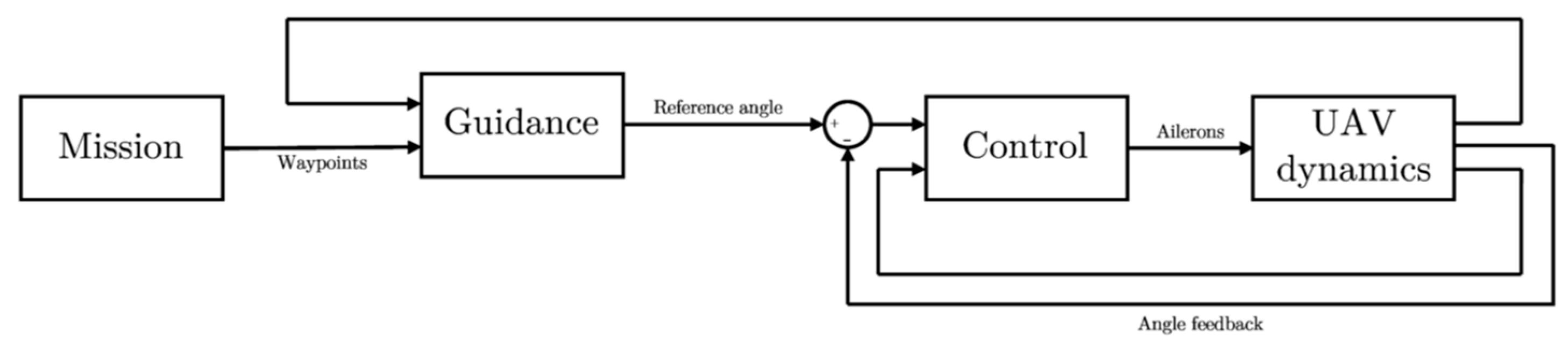
- the flight control system employs the guidance law to produce reference command signals for the nested PID controllers to drive motors and control surfaces of the UAV;
- high-fidelity six DoF flight dynamics is processed by reproducing the aerodynamic behavior of the aircraft structure. The parameters of aerodynamics were derived from experimental measurements on the proposed UAV prototype and allow for the evaluation of the forces and moments acting due to flight and wind conditions.
2. Problem Statement
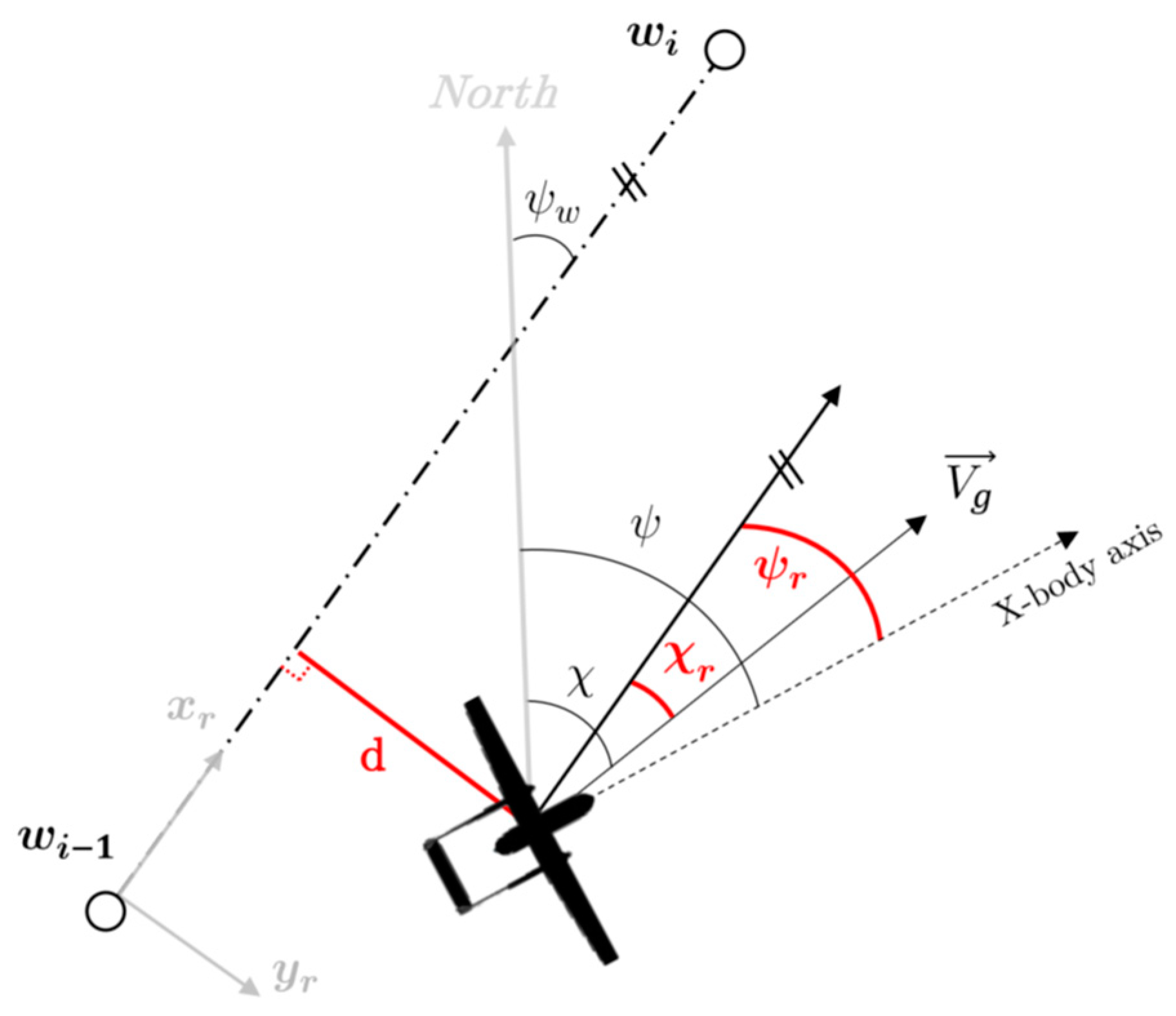
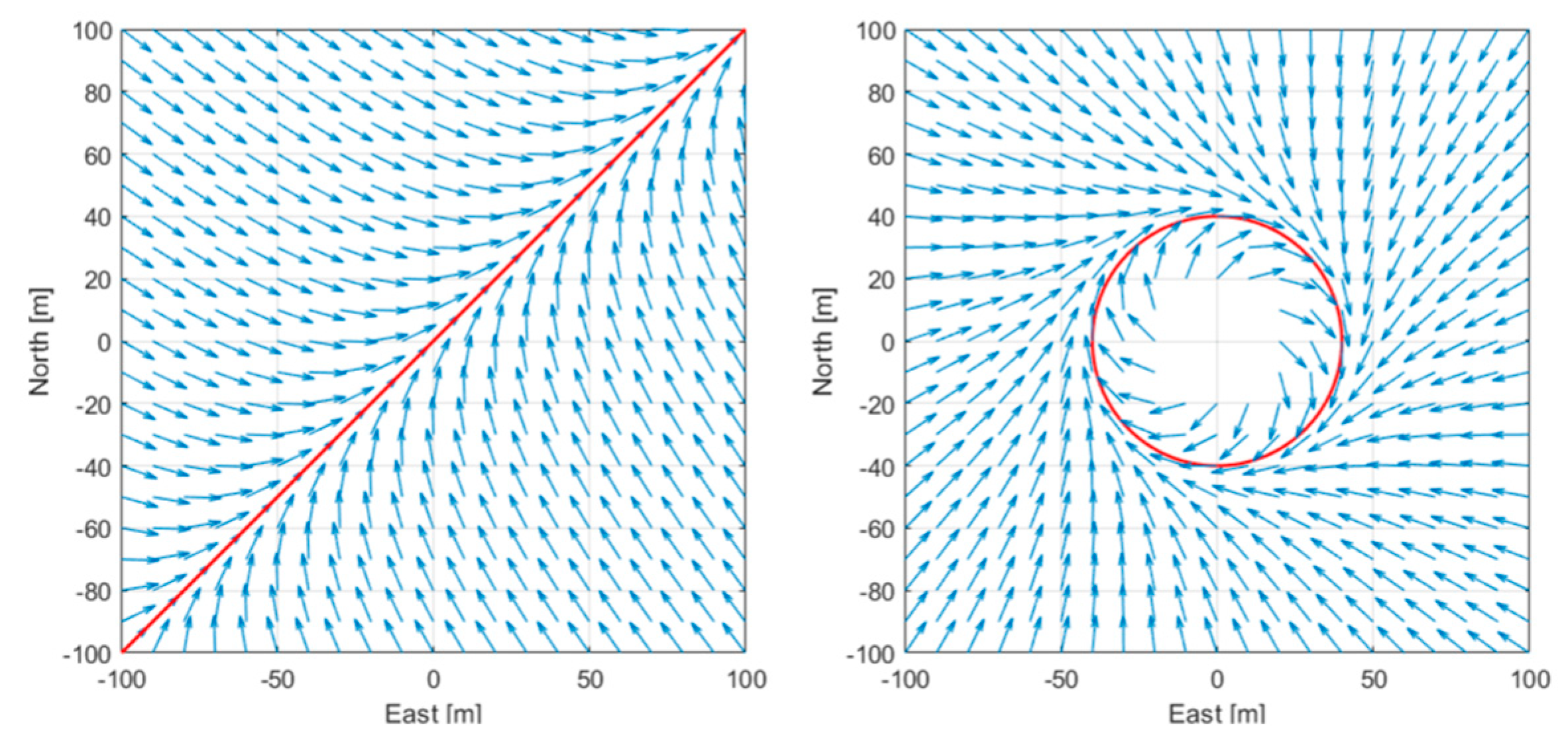
- straight line, where in the desired path is defined as the trait joining two adjacent waypoints and where the UAV is expected to lie (Figure 3);
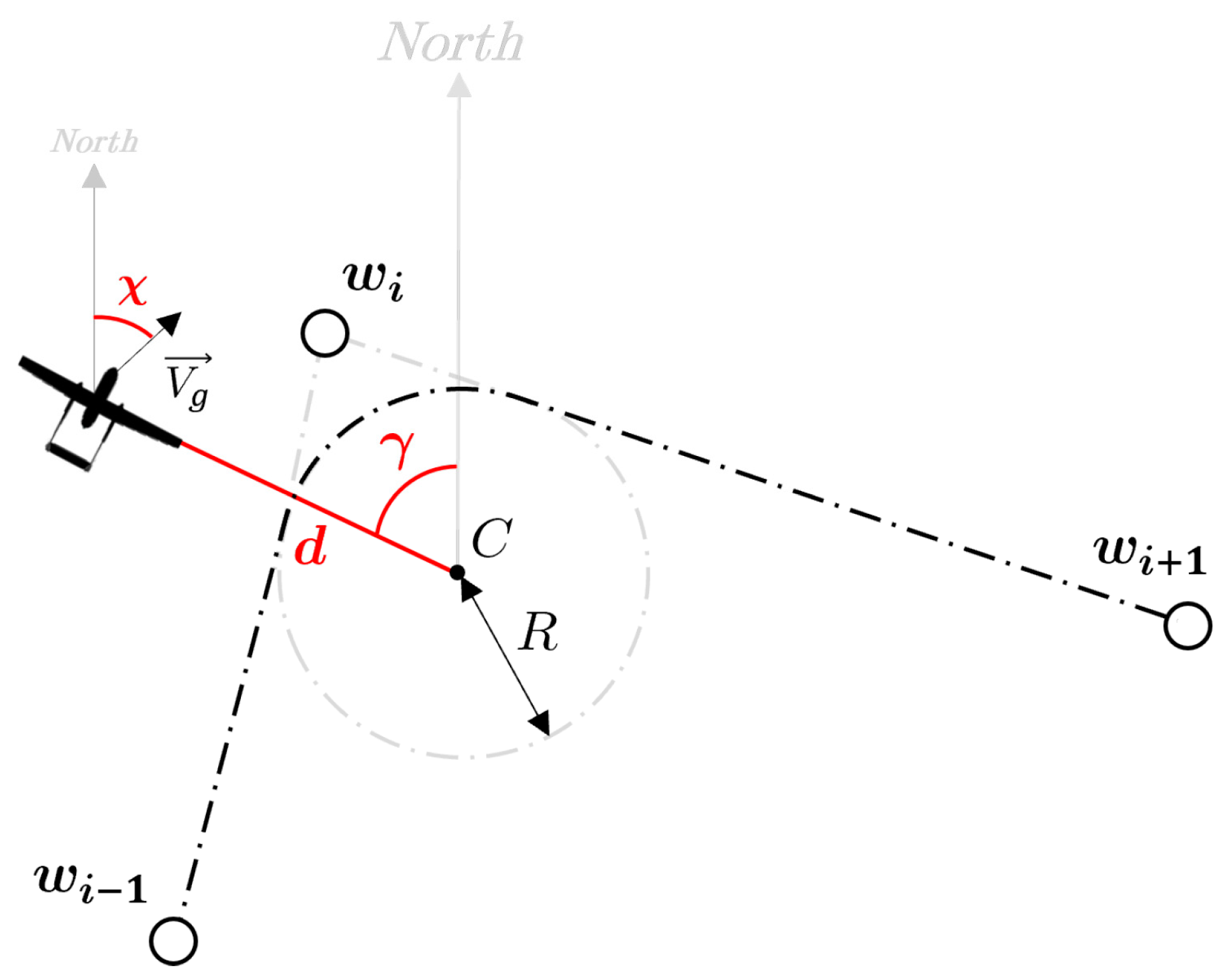
- orbit path, wherein the desired path is defined as a circular orbit which can be traveled clockwise or counterclockwise at a constant distance from the center (Figure 4).
3. Path Following Guidance Laws
- a model-based term built on the available model of the system, which in case of exact model knowledge guarantees the state to remain on the sliding surface;
- a discontinuous term that forces the state on the surface in the case of drift and thus provides robustness against internal and external disturbances (e.g. model uncertainty and measurement noise).
3.1. Problem Dynamics
3.2. Straight Line
3.3. Orbit Path
4. Results
- norm-1 ||d||1 is used as an effectiveness parameter and it is mostly indicative of the magnitude of small oscillations around the planned path;
- root mean square error RMSE (d) allows also the evaluation of path following performance heavily penalizing wide deviations from the desired path;
- fuel consumption fuel is used as an indirect parameter of the control effort of the generic law.
- For the reader convenience, each of the above strategies is associated with an acronym:
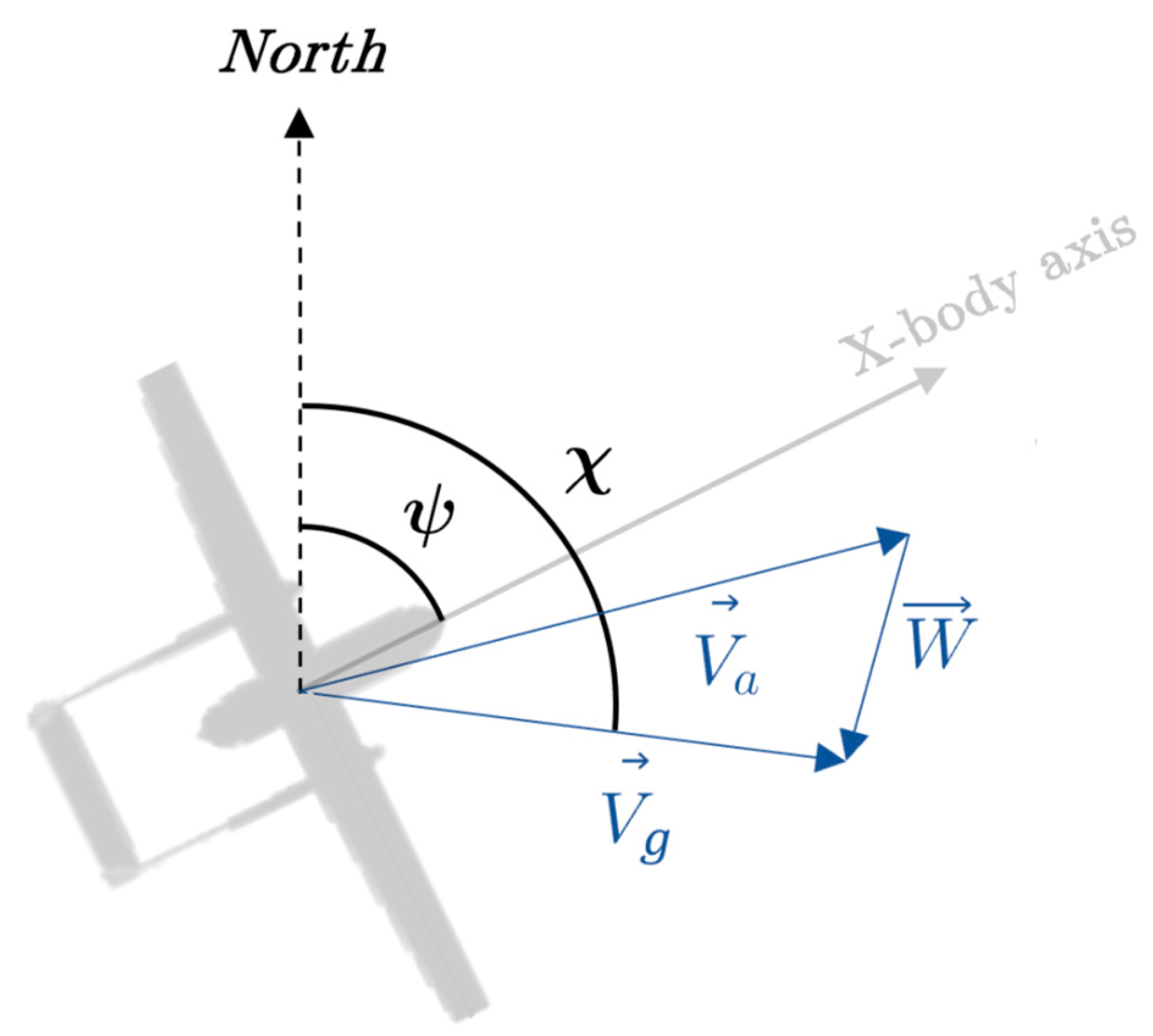
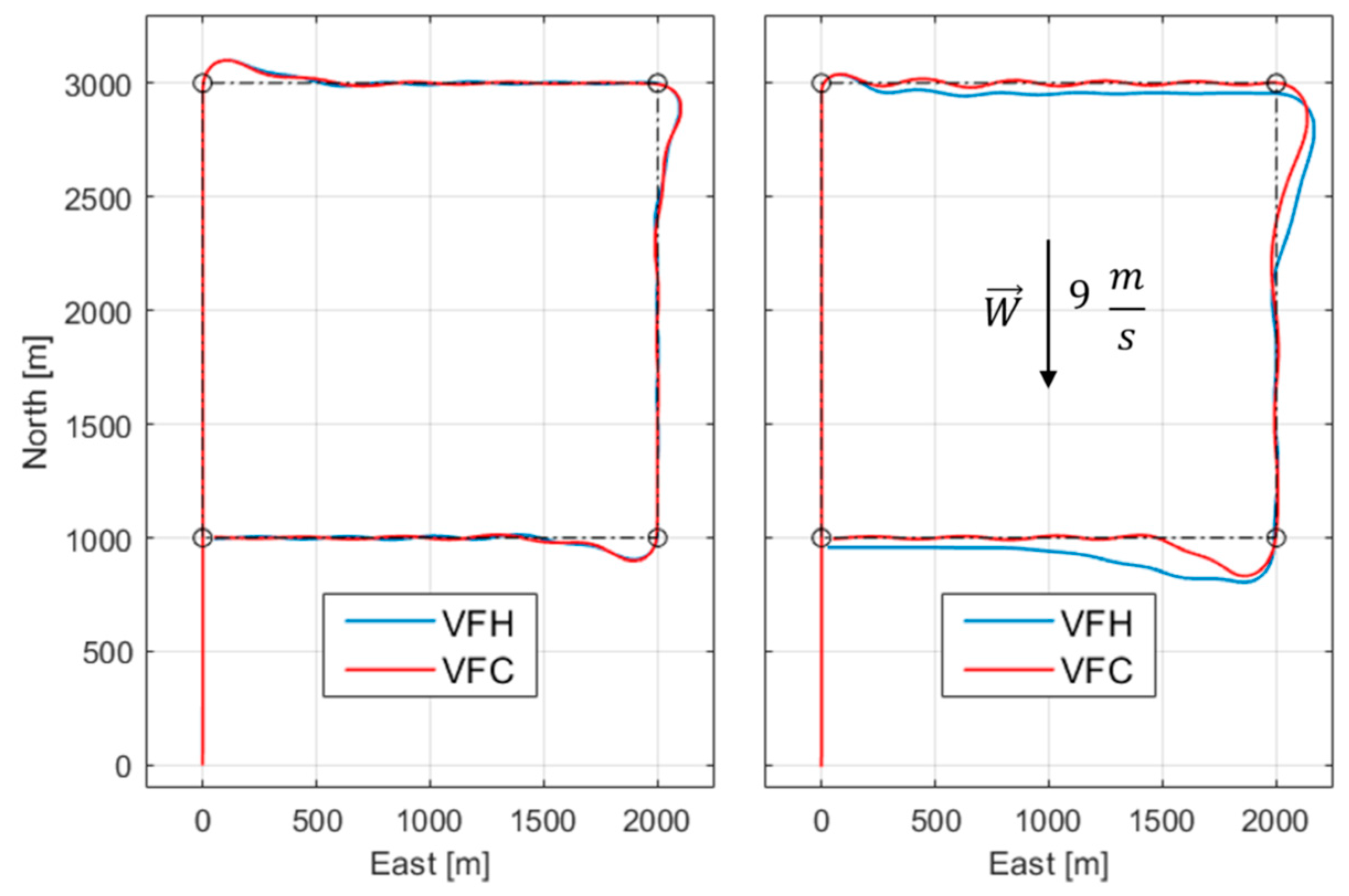
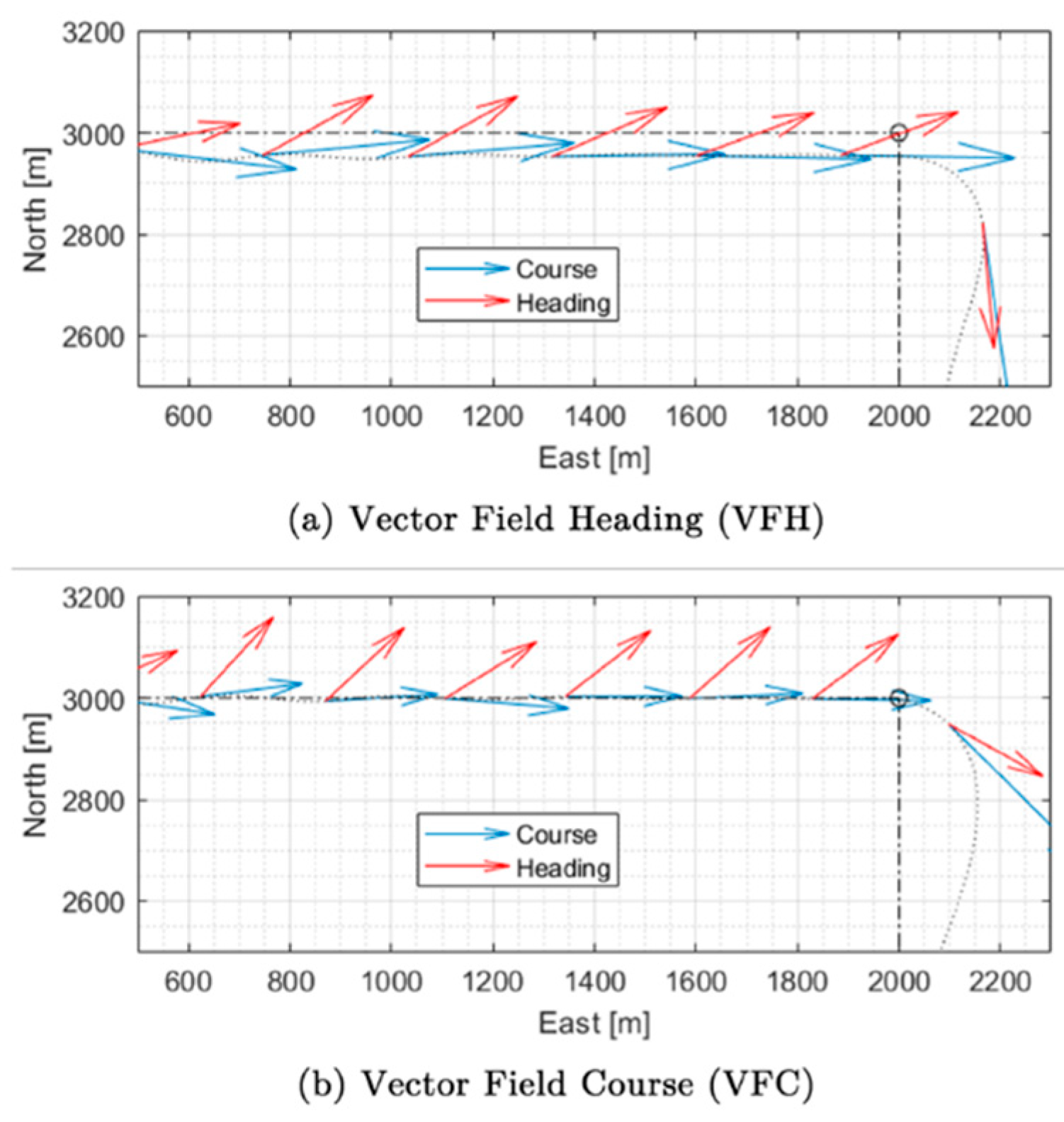
- VFH: vector field guidance law based on controlling the heading angle ψ though;
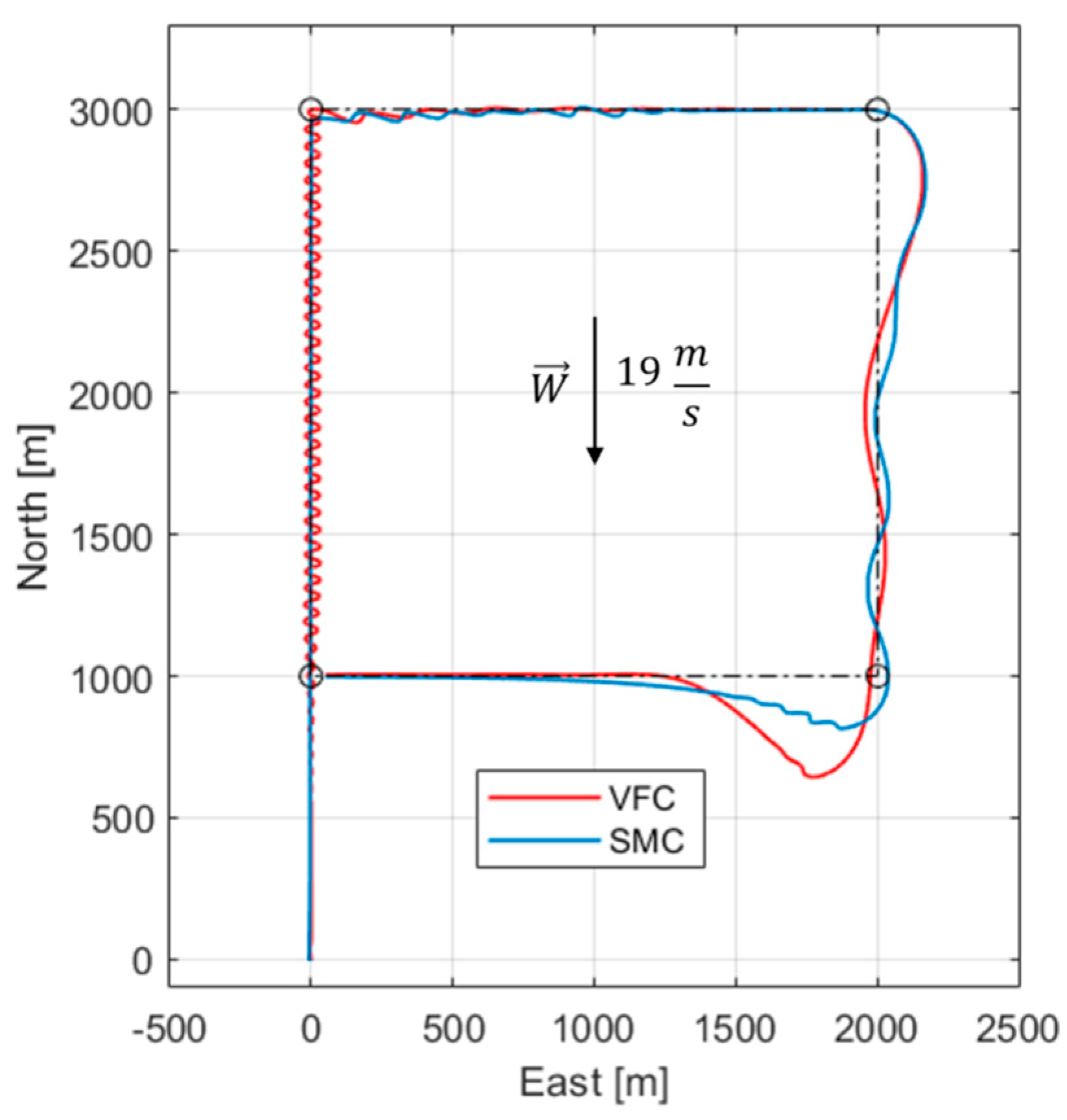
- VFC: path-following strategy for vector field course χ;
- SMC: sliding mode control algorithm applied to VFC law.
4.1. Waypoint Transitions
- no real desired path is planned within the circle so the trajectory is unpredictable;
- the radius rwp of the circle must be chosen within a limited range: too large a radius will cause loss of flight accuracy while too small a radius will cause an incapacity to reach the waypoint and start the maneuver.
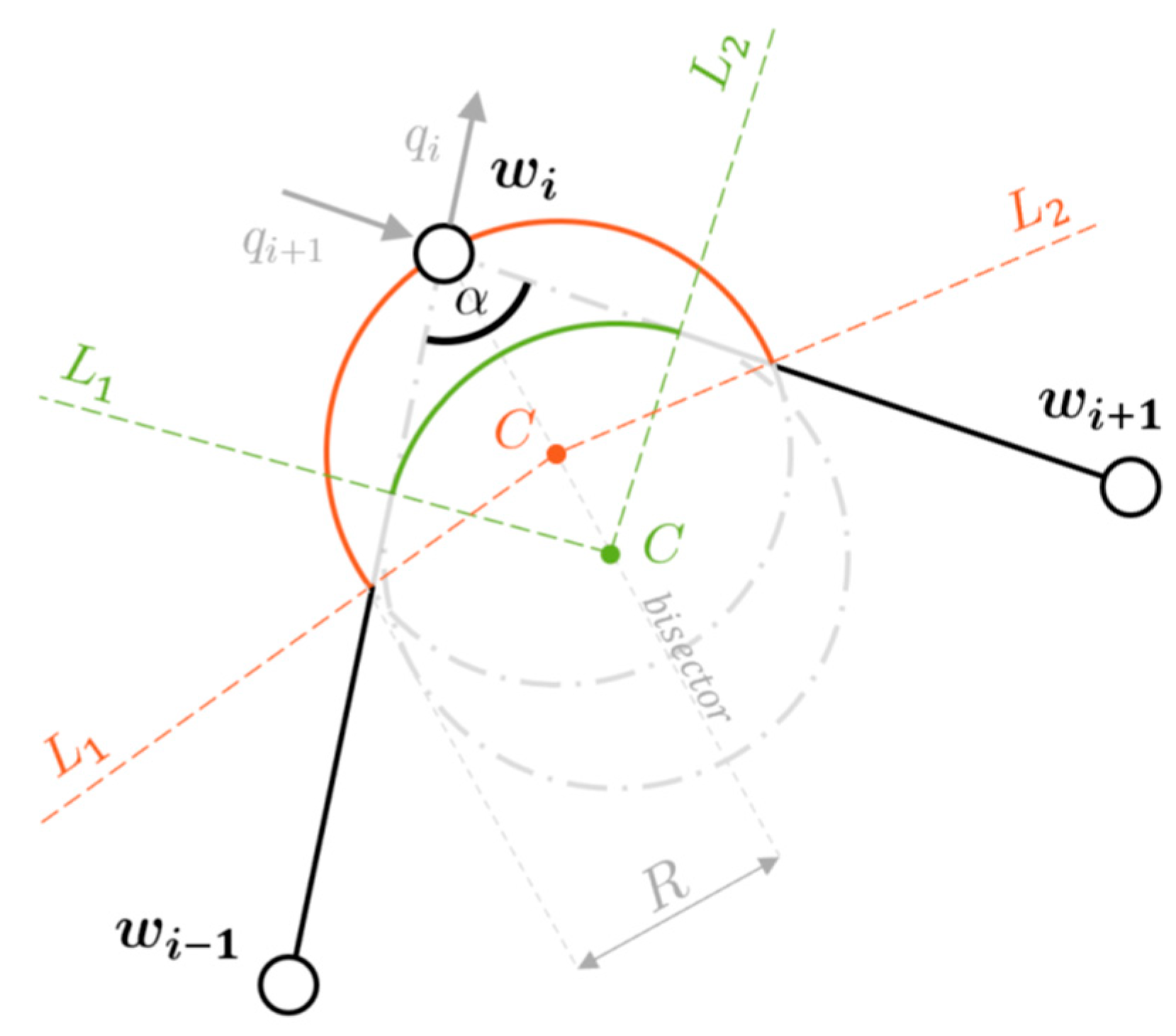
- the angle α between the two adjacent traits of the path;
- the center of the orbit C, which always lies on the bisector of the angle α;
- the distance l along the path between the destination waypoint and the line L of the beginning/ending of the transition.
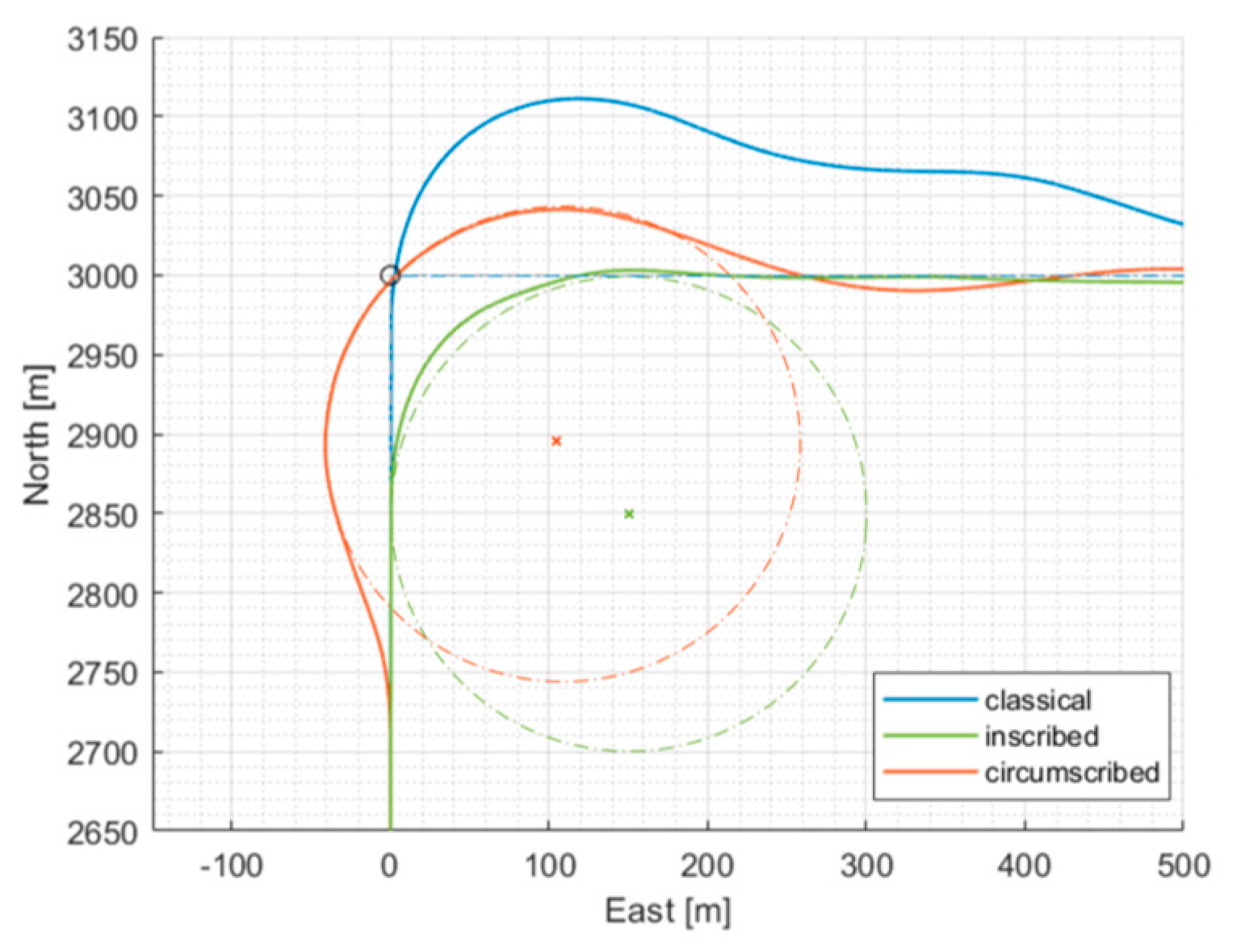
- the inscribed technique minimizes time and distance traveled by anticipating the turn and thus avoiding passing over the waypoint;
- the circumscribed technique instead imposes the reaching of the waypoint but increases the desired path length and thus the associated fuel consumption consequently.
5. Conclusions
Funding
Acknowledgments
Conflicts of Interest
References
- Sujit, P.B.; Saripalli, S.; Sousa, J.B. Unmanned aerial vehicle path following: A survey and analysis of algorithms for fixed-wing unmanned aerial vehicles. IEEE Control Systems Magazine 2014, 34, 42–59. [Google Scholar]
- Conte, G.; Duranti, S.; Merz, T. Dynamic 3D path following for an autonomous helicopter. IFAC Proceedings Volumes 2004, 37, 472–477. [Google Scholar] [CrossRef]
- Ambrosino, G.; Ariola, M.; Ciniglio, U.; Corraro, F.; De Lellis, E.; Pironti, A. Path generation and tracking in 3-D for UAVs. IEEE Transactions on Control Systems Technology 2009, 17, 980–988. [Google Scholar] [CrossRef]
- Wang, Y.; Wang, X.; Zhao, S.; Shen, L. Vector field based sliding mode control of curved path following for miniature unmanned aerial vehicles in winds. Journal of Systems Science and Complexity 2018, 31, 302–324. [Google Scholar] [CrossRef]
- Ratnoo, A.; Sujit, P.B.; Kothari, M. Adaptive optimal path following for high wind flights. IFAC Proceedings Volumes 2011, 44, 12985–12990. [Google Scholar] [CrossRef]
- Dacic, D.B.; Nesic, D.; Kokotovic, P.V. Path-following for nonlinear systems with unstable zero dynamics. IEEE Transactions on Automatic Control 2007, 52, 481–487. [Google Scholar] [CrossRef]
- Ostertag, E. An Improved Path-Following Method for Mixed H2/H∞ Controller Design. IEEE Transactions on Automatic Control 2008, 53, 1967–1971. [Google Scholar] [CrossRef]
- Nelson, D.R.; Barber, D.B.; McLain, T.W.; Beard, R.W. Vector field path following for miniature air vehicles. IEEE Transactions on Robotics 2007, 23, 519–529. [Google Scholar] [CrossRef]
- Beard, R.W.; Ferrin, J.; Humpherys, J. Fixed wing UAV path following in wind with input constraints. IEEE Transactions on Control Systems Technology 2014, 22, 2103–2117. [Google Scholar] [CrossRef]
- Coelho, P.; Nunes, U. Path-following control of mobile robots in presence of uncertainties. IEEE Transactions on Robotics 2005, 21, 252–261. [Google Scholar] [CrossRef]
- Aguiar, A.P.; Hespanha, J.P. Trajectory-tracking and path-following of underactuated autonomous vehicles with parametric modeling uncertainty. IEEE transactions on automatic control 2007, 52, 1362–1379. [Google Scholar] [CrossRef]
- Casazza, A.; Fiorenzani, R.; Mela, A.; Pugi, L.; Reatti, A. Modelling of Unmanned Aerial Vehicles with Vertical Take Off and Landing Capabilities. In International Workshop IFToMM for Sustainable Development Goals; Springer: Cham, 2021; pp. 255–263. [Google Scholar]
- Beard, R.W.; McLain, T.W. Small unmanned aircraft: Theory and practice; Princeton university press, 2012. [Google Scholar]
- Rysdyk, R. (2003) UAV path following for constant lineof-sight, In 2nd AIAA” Unmanned Unlimited” Conf. and Workshop & Exhibit (p. 6626).
- Park, S.; Deyst, J.; How, J.P. Performance and lyapunov stability of a nonlinear path following guidance method. Journal of Guidance, Control, and Dynamics 2007, 30, 1718–1728. [Google Scholar] [CrossRef]
- Machmudah, A.; Shanmugavel, M.; Parman, S.; Manan TS, A.; Dutykh, D.; Beddu, S.; Rajabi, A. Flight Trajectories Optimization of Fixed-Wing UAV by Bank-Turn Mechanism. Drones 2022, 6, 69. [Google Scholar] [CrossRef]
- Shah, M.Z.; Samar, R.; Bhatti, A.I. Guidance of air vehicles: A sliding mode approach. IEEE Transactions on Control Systems Technology 2014, 23, 231–244. [Google Scholar] [CrossRef]
- Kim, K.J.; Park, J.B.; Choi, Y.H. (2006) Chattering free sliding mode control, In 2006 SICE-ICASE international Joint conference (pp. 732-735). [CrossRef]
- Beard, R.W.; Humpherys, J. (2011) Following straight line and orbital paths with input constraints., In Proceedings of the 2011 American Control Conference (pp. 1587-1592). [CrossRef]
- Capello, E.; Guglieri, G.; Quagliotti, F.B. (2009) UAVs and simulation: an experience on MAVs, Aircraft Engineering and Aerospace Technology. [CrossRef]
- McLain, T.; Beard, R.W.; Owen, M. (2014) Implementing dubins airplane paths on fixed-wing uavs, Contributed chapter to the Handbook of Unmanned Aerial Vehicles, Springer, ch. 68, pp. 1677–1701. [CrossRef]
- Kikutis, R.; Stank¯unas, J.; Rudinskas, D. Autonomous unmanned aerial vehicle flight accuracy evaluation for three different path-tracking algorithms. Transport 2019, 34, 652–661. [Google Scholar] [CrossRef]

| Wind [m/s] |
||d||1 [m] |
RMSE(d) [m] |
Fuel [g] |
Mission Duration[s] |
|
| VFC | 19 | 22.43 | 63.99 | 119.61 | 917.05 |
| SMC | 19 | 10.66 | 25.03 | 102.52 | 883.48 |
| SMC | 22 | 21.18 | 61.39 | 197.74 | 1731.38 |
| ||d||1 [m] |
RMSE(d) [m] |
Fuel [g] |
Mission Duration[s] |
|
| Classical | 17.45 | 30.65 | 47.90 | 385.72 |
| Inscribed | 2.74 | 6.72 | 41.27 | 373.81 |
| Circumscribed | 4.78 | 11.36 | 43.45 | 383.97 |
Disclaimer/Publisher’s Note: The statements, opinions and data contained in all publications are solely those of the individual author(s) and contributor(s) and not of MDPI and/or the editor(s). MDPI and/or the editor(s) disclaim responsibility for any injury to people or property resulting from any ideas, methods, instructions or products referred to in the content. |
© 2024 by the authors. Licensee MDPI, Basel, Switzerland. This article is an open access article distributed under the terms and conditions of the Creative Commons Attribution (CC BY) license (http://creativecommons.org/licenses/by/4.0/).


