

Submitted:
21 October 2024
Posted:
23 October 2024
You are already at the latest version
Abstract
Non-orthogonal multiple access (NOMA) enables the parallel offloading of multiuser tasks, effectively enhancing throughput and reducing latency. Backscatter communication, which passively reflects radio frequency (RF) signals, improves energy efficiency and extends the operational lifespan of terminal devices. Both technologies are pivotal for the next generation of wireless networks. However, there is little research focusing on optimizing the transmit power in backscatter-assisted NOMA-MEC systems from a green IoT perspective. In this paper, we aim to minimize the transmit energy consumption of a Hybrid Access Point (HAP) while ensuring task deadlines are met. We consider the integration of Backscatter Communication (BackCom) and Active Transmission (AT), and leverage NOMA technology and user cooperation to mitigate the double near-far effect. Specifically, we formulate a transmit energy consumption minimization problem, accounting for task deadline constraints, task offloading decisions, transmit power allocation, and energy constraints. To tackle the non-convex optimization problem, we employ variable substitution and convex optimization theory to transform the original non-convex problem into a convex one, which is then efficiently solved. We deduce the semi-closed form expression of the optimal solution and propose an energy-efficient algorithm to minimize the transmit power of the entire wireless powered MEC. Simulation results demonstrate that our proposed scheme significantly reduces the transmit power of the HAP compared to existing schemes, validating the effectiveness of our approach.This study provides valuable insights for the design of green IoT systems by optimizing the transmit power in NOMA-MEC networks.
Keywords:
NOMA-MEC (non-orthogonal multiple access - mobile edge computing)
; wireless power transfer (WPT)
; Backscatter communication (Backcom)
; Lyapunov optimization
; transmit power
1. Introduction
The rapid development of the Internet of Things (IoT) has driven an increasing demand for efficient data processing and low-latency communication in mobile devices such as autonomous vehicles, facial recognition systems, virtual reality (VR) devices, and electronic health monitors [1,2]. To address the limitations in computational power and battery life of these devices, Mobile Edge Computing (MEC) technology offloads computationally intensive tasks to servers deployed at the network’s edge, such as base stations, thereby effectively enhancing the devices’ computational capacity and response speed [3,4]. Additionally, Wireless Power Transmission (WPT) [5] technology collects energy remotely through radio frequency (RF) signals, further extending the battery life of devices. Leveraging the advantages of MEC and WPT networks, numerous studies have been conducted to explore the potential of Wireless-Powered MEC (WPMEC) systems, and a multitude of efficient algorithms have been proposed to address the joint allocation of communication and computational resources.
However, to address the challenges of serving the massive number of devices in future wireless networks, relying solely on MEC may not suffice to meet service demands. Beyond computational and battery limitations, the double near-far effect can severely impact network performance, particularly for devices far from the Hybrid Access Point (HAP) and often facing poor channel conditions [6]. To overcome these challenges, researchers have proposed a collaborative computing model [7]. This model activates underutilized computational resources within the network, allowing nearby users to assist distant users in offloading computational tasks, thereby improving data transmission rates under unfavorable channel conditions and enhancing the overall performance of the system. This approach not only increases the efficiency with which distant users offload tasks to access points but also makes full use of idle computing resources in the network through Device-to-Device (D2D) [8,9] communication and User Collaboration (UC) [10,11,12] mechanisms, optimizing resource allocation, effectively improving energy efficiency, and addressing the challenges posed by geographical disparities.
The integration of Non-Orthogonal Multiple Access (NOMA) technology into WPMEC systems has been identified as a means to enhance overall performance [13,14]. This approach allows for the shared use of time-frequency resources among users, leveraging power domain multiplexing and multi-user detection techniques such as Successive Interference Cancellation (SIC) [15]. The adoption of these techniques not only improves spectral efficiency but also substantially increases system capacity and coverage, which is particularly beneficial in frequency-constrained or densely populated urban scenarios.
Backscatter Communication (BackCom) technology has emerged as a promising approach in mobile communication due to its low energy footprint [10,16,17,18,19,20]. This technology facilitates the transmission of information through the passive reflection of radio frequency signals, concurrently harvesting energy to power circuit operations. When compared to the traditional active transmission (AT) model, which follows the Harvest-then-Transmit (HTT) protocol, BackCom dramatically minimizes energy usage, typically requiring only a few microwatts to hundreds of microwatts, despite offering comparatively lower transmission rates. To optimize the trade-off between energy harvesting and data transmission, and to concurrently enhance system throughput and energy efficiency (EE) [21], BackCom can be strategically combined with AT. This dual-mode approach capitalizes on the complementary strengths of both communication methods.
While extensive research [22,23,24,25,26] has explored the use of BackCom and NOMA to improve the efficiency of wireless spectrum utilization and wireless energy transfer, there is a lack of studies investigating the synergistic application of BackCom and NOMA in scenarios involving user cooperation. Additionally, the majority of existing work on energy optimization in WPMEC systems has focused on energy consumption at the mobile device (MD) level. However, since the energy for MDs is entirely harvested from the RF signals emitted by the HAP, the energy transmitted by the HAP constitutes the total energy budget of the WPMEC system. Therefore, optimizing the energy consumption of HAP transmissions is of significant practical importance.
In this paper, we consider a transmit energy minimization (TEM) problem for a UC-based wireless powered NOMA-MEC network, integrating BackCom and AT communication modes. We jointly optimize the WPT time fraction, backscatter time fraction, task offloading time fraction, transmit power allocation of the MD node, and backscatter reflection coefficients, aiming to minimize the total transmit power of the HAP while meeting task latency constraints. We formulate the mathematical model for the TEM problem, which is strongly non-convex. Due to signal interference in NOMA communication, there is a coupling between transmission power allocation decisions, and the coupling between BackCom communication and AC communication introduces additional coupling in the offloading of data, posing significant challenges in solving the problem. To address this highly non-convex TEM problem, we employ variable substitution techniques and convex optimization theory to convert it into a convex problem, allowing for efficient solutions. Extensive numerical simulations are conducted to verify the performance and effectiveness of our proposed scheme.
The primary contributions are summarized as follows:
- Proposing an innovative energy optimization model for a WPMEC system from a green IoT perspective.We formulate a TEM problem for HAP under task delay constraints, while leveraging the NOMA technique, integrating BackCom with AT communication, and employing user cooperation to alleviate the impact of the double near-far effect. Furthermore, our model focuses on the optimization of the overall energy consumption in WPMEC networks, rather than solely considering the energy expenditure of mobile nodes. The model has practical application value for reducing carbon emissions in WPMEC and promoting the development of green IoT technologies.
- Applying variable substitution and convex optimization theory to convert the non-convex TEM problem into a convex one. Through a meticulous analysis of the problem’s structure, we have developed a low-complexity algorithm to solve it and derived a semi-closed-form expression for the optimal solution.
- Evaluating the performance of our scheme through extensive simulations. The experimental results demonstrate that our proposed scheme surpasses the state-of-the-art methods, with an approximate improvement of 8%.
The remainder of this paper is organized as follows: Section II provides an overview of the related works in the field. In Section III, we details the model of the Backscatter-Aided wireless powered NOMA-MEC system. In Section IV, formulates the transmit power optimization problem, presenting the mathematical formulation. Section V, we develop a low-complexity algorithm designed to solve the optimization problem. Section V offers a comprehensive evaluation of the proposed algorithm’s performance through extensive simulations. In Section VI, we conclude the paper by summarizing the key findings and contributions, and suggest potential directions for future research.
2. Related Work
In order to increase the data computation capability and decrease the task processing delay, the resource management in WPT assisted MEC network has been extensively studied [27]. Zhang et al. [28] presents a mobility-aware hierarchical MEC framework for IoT, employing a game theoretic approach to enhance energy efficiency and reduce latency in computation offloading. Dinh et al. [29] introduces a semidefinite relaxation (SDR)-based approach for task offloading from a mobile device to multiple edge devices, aiming to minimize execution latency through joint task allocation and CPU frequency optimization in both fixed and elastic CPU frequency scenarios. Moreover, energy consumption as a determining factor of network performance has been widely explored in MEC networks. Wang et al. [30] proposes a modified-cutting-plane (MCP) algorithm and a pivoting-and-subgradient (PS) algorithm to minimize total energy consumption in a multi-cell MEC system. Mei et al. [31] explores a dynamic energy-efficient task offloading algorithm for a multi-device single-MEC system, leveraging Lyapunov optimization to minimize energy consumption while maintaining system stability. Chen et al. [32] introduces a polling callback energy-saving offloading strategy for MEC systems to address asynchronous data transmission and task processing times, and employs a game-learning algorithm combining DDQN and distributed LSTM to optimize energy consumption. However, prior researches have not accounted for the dynamic network conditions, such as stochastic task arrivals and variable wireless channel states.
For energy-efficient and low-latency task offloading, a variety of innovative technologies, especially BackCom and NOMA, have been leveraged in MEC networks [33,34]. Toro et al. [35] provides a comprehensive survey on BackCom for green IoT, examining its operating principles, applications in various domains, and addressing operational and security challenges. Shi et al. [36] introduces a hybrid approach combining Harvest-Then-Transmit (HTT) with Backscatter communication aimed at maximizing the weighted sum of computation bits within a WPT-MEC network, taking into account a realistic non-linear energy harvesting (EH) model. Additionally, Khan et al. [34] explores the integration of 6G communications, specifically NOMA and Backcom, to enhance energy efficiency and data sharing in Automotive Industry 5.0, proposing a multicell optimization framework for backscatter-enabled NOMA vehicular networks. Fang et al. [37] proposes an energy-efficient optimization scheme for a multi-user NOMA-MEC network, employing a bilevel programming method to derive optimal solutions for a one-user two-base station (BS) scenario and extends it to a low-complexity algorithm for the multi-user and multi-BS case. Shi et al. [38] presents a NOMA-based millimeter-wave (mmW) MEC mechanism to minimize the average delay of MEC offloading by jointly optimizing beamwidth, user equipment scheduling, and transmit power, employing alternative optimization and matrix control algorithms to enhance accessing efficiency.
Researchers have extensively adopted user cooperation mechanism to mitigate the double-near-far effect and optimize resource utilization in MEC systems [39,40,41]. Sun et al. [39] introduces an iterative algorithm designed to minimize end-to-end latency in IoT environment, jointly optimizing user association and resource allocation in a three-phase operation protocol. Lyu et al. [40] considered user-cooperation schemes in different communication modes, Backscatter and HTT, improving network communication capability and energy efficiency by optimizing time and power allocation and energy beamforming. Li et al. [11] employs a multi-user cooperation scheme to enhance computation performance in a WPMEC system, focusing on maximizing the weighted sum computation rate by jointly optimizing collaboration, time, and data allocation among IoT devices and an HAP. Huang et al. [41] introduces a NOMA-assisted cooperative computing scheme with user cooperaration in a three-node MEC system to leverage idle mobile device resources, optimizing energy consumption and offloading data through joint communication and computation resource allocation. Our previous research [7] addresses the challenge of energy management in WPT-MEC networks with user cooperation by proposing a multi-stage stochastic optimization approach, introducing Lyapunov optimization technique to ensure sustainability and stability in the dynamic IoT environment. However, the integration of BackCom and NOMA in user collaboration systems remains unexplored in the aforementioned work.
3. System Model
3.1. Communication Model
We consider a user-cooperative wireless-powered MEC system, comprising a user node, a helper node, and a HAP, as illustrated in Figure 1. The HAP is equipped with an RF energy transmitter and is directly connected to an edge server. The user node, denoted as , is located at a greater distance from the HAP, while the helper node, , is positioned closer to the HAP. Both and have individual computation tasks that must be completed within a specified latency constraint. Additionally, both nodes are equipped with a BackCom circuit and an AT circuit, allowing them to select between backscatter communication and active communication modes.
In this three-node model, both and have their own data processing tasks with data-size and that need to be completed within a specified time T. is positioned between and the HAP, allowing it not only to process its own data but also to assist in relaying data offloaded to the edge server. The system employs a NOMA communication scheme, which allows to offload data simultaneously to both and the HAP. We focus on a zero-power IoT system, where the energy for mobile nodes and is entirely derived from wireless power transfer by the HAP. By using wireless charging, and eliminate the additional costs associated with battery replacement.
The system adopts a partial offloading model, allowing computational tasks to be fragmented and offloaded to the edge server. The communication process of the system is as follows: Initially, at time , and receive wireless energy transmitted by the HAP’s RF equipment, which is used to process their respective computational tasks, denoted as and . Since the system employs a hybrid transmission mode combining BackCom and AC, data offloading begins with BackCom. At time , partially offloads its data to using BackCom, with the offloaded data size denoted as . Subsequently, during the time slot, offloads its data to the HAP via BackCom, with the offloaded data size denoted as .
Next, task offloading proceeds using the AT mode. During the time slot, , utilizing NOMA technique, simultaneously offloads data to both and the HAP, with data sizes denoted as and , respectively. In the time slot, offloads its data to the edge server connected to the HAP, with the offloaded data size denoted as . Finally, during the time slot, the computation results are downloaded from the edge server. because the computation result data is typically small, the time required for this step can be considered negligible.
The primary symbols and definitions used are listed in Table 1.
3.2. Wireless Powered Transfer Model
During both the WPT charging phase and the BackCom communication phase, the MD can harvest RF energy from the HAP’s RF transmitter. This harvested energy is used for both local computation and task offloading. Let denote the RF transmit power of the HAP, and represents the energy conversion efficiency. The amount of harvested energy of is given by [10]:
where represents the channel gain from the HAP to , which remain constant within the T time period. Similar , the amount of harvested energy of is as
where represents the channel gain from the HAP to
3.3. Computing Model
Upon the arrival of a task at a mobile node, a portion of the task may be offloaded to the edge server, while the remaining part is processed locally. Let the CPU frequencies of and be denoted as and , respectively, and let the number of CPU cycles required to process one bit of data be represented by and . The amount of task data processed locally at is . Thus, the corresponding energy consumption for local computing can be expressed as [10]
where represents the computing energy efficiency parameter of [10].
The local computing latency constraint for is
For , which is responsible for forwarding ’s data to HAP without performing local computation on ’s data. Therefor, we have the following data constraint:
Similarly, the amount of task data that is processed locally on is equal , and the energy consumption for local computing at is
where denotes the computing energy efficiency parameter of [10].
The local computing latency constraint for is
where denotes the computing energy efficiency parameter of [10].
3.4. Task Offloading Model
3.4.1. Offloading Task by BackCom
During time slot, offload tasks to by using Backscatter communication. We denote the reflection coefficient of BackCom at as , which plays a crucial role for a balance between energy harvesting and communication performance. Thus, there is proportion of energy utilized as a carrier to transfer data, and proportion of incident power that is absorbed by [17]. According to Shannon’s theorem [42], the amount of tasks offloaded from to is as follows:
where represents the performance gap reflecting real modulation of BackCom [18], denotes the channel gain from to , and is the noise power.
The corresponding energy consumption for task offloading by BackCom is
where is the circuit power consumption of by BackCom, which is a constant value depending on the circuit structure. In BackCom communication, a node can simultaneously reflect the signal and harvest RF energy. The energy harvested by during the BackCom communication at time is expressed as follows:
After receiving the tasks offloaded by , will act as a relay and forward a portion of these tasks to the HAP. Additionally, will offload its own tasks to the HAP. At time , the task data transmitted by via BackCom is subject to the following constraints.
where is the reflection coefficient of the BackCom at , and represents the channel gain from to the HAP. The corresponding energy consumption for task offloading by BackCom is
where is the circuit power consumption of by BackCom. The energy harvested of by Backcom during is
3.4.2. Offloading Task by NOMA-Aided AC Communication
In the AC transfer mode, we adopt NOMA technique improve the task transmission efficiency. In time slot , simultaneously offload task to and the HAP with data size and , respectively. In the NOMA transmission process, the transmit allocation allocated for task offloading to and the HAP are denoted as and . transmits a linear superposition signal to and the HAP. We suppose that the global channel state information (CSI) of network can be obtained. After receiving the signal, first decodes the ’s signal and subtracts it from the received signal by leveraging the successive interference cancellation (SIC) technique. By denoting the channel coefficients from to and the HAP as and , respectively. Therefore, the task offloading rate from to and the HAP can be expressed as follows:
where and represent the effective channel gain to the noise power ratio (ECGNR) from to and the HAP, respectively.
During the time slot , the amount of offloaded task from offloading to and the HAP are define to be
The energy consumption of task offloading from to and the HAP via NOMA are obtained as and .
At the time slot, offloads computation task to HAP by utilizing the AC mode, which includes tasks offloaded from and task native to . The amount of task offloading from to the HAP is
where represents the transmit power allocated to AC at [10]. represents ECGNR from to the HAP, and is channel coefficients from to the HAP.
The energy consumption for offloading task from to the HAP is .
4. Problem Formulation
In this paper, we consider to design computation task offloading algorithm to minimize the carbon footprint for a green IoT network with NOMA-Backscatter assisted under user cooperation. We make jointly decisions on time slot allocation , power allocation , Backscatter reflection coefficients and the size of offloading tasks to minimize the total transmit power of HAP subjected to the common latency constraints. The HAP’s transmit power minimization (TPM) problem can be defined as follows:
where constraint (19b) specifies the time slot allocation. Constraints (19c) and (19d) set the energy consumption limits for and , respectively. Constraints (19e) and (19f) governs the transmit power allocation for both and . Constraint (19g) ensures that the task offloaded from to is relayed to the HAP within the specified time T. Constraints (19h) and (19i) impose the task processing latency requirements for and , respectively. Constraint (19j) defines the feasible domain for the decision variables.
Note that Problem (P1) is a non-convex optimization problem due to the novconvex the objective function and novconvex constraints (19c) and (19d). This characteristic precludes the use of traditional convex optimization methods for its direct solution. Therefore, through in-depth analysis of the problem’s structure and careful design, we employ the variable substitutions to solve Problem P1.
5. Optimal Solution for the TPM Problem
Problem P1 remains a nonconvex optimization problem due to the nonconvexity of constraints (19c) and (19d), and the presence of the coupling decision variables and . To address this, we first rewrite and based on equations (14) and (18) as follows:
where the function f is define as for all .
Lemma 1.
The sum of the transmit power and can be expressed as:
Proof.
From equation (15), we have
Substituting equation (20) into (22), we express as
Utilizing the identity , we can expand the right hand size of (24) as
By combining this result with equation (20), the lemma is proven. □
To address the nonconvexity of constraints (19c) and (19d), we introduce auxiliary variable and , where , and . Additionally, based on Lemma 1, we replace the decision variables with and introduce decision variables set . We define as the amount of task processing locally and offloading for both and . Meanwhile, to simplify the mathematical expression, we denote some constants ,,. , and . Therefore, sub-problem P2 can be transformed into problem P1.1.1, as follows:
Problem P2 is a convex optimization problem according to the following Lemma.
Lemma 2.
Problem P2 is convex and can be efficiently solved using optimization tools such as CVX.
Proof.
First,the objective function is convex when is given. The constraints (25b),(25g), (25h), (25i) are linear inequalities, which are inherently convex.
Next, consider constraint (25c). The function is convex, and its perspective is also convex with respect to the variables and , as the perspective operation preserve the convexity [43]. Similarly, the term is convex. Since the remaining terms in constraint (25c) are linear with respect to , , , , , , the entire constraint (25c) is convex. The same reasoning applies to constraint (25d), confirming its convexity.
For constraint (25e), the convexity is less straightforward. However, by multiplying both sides of the inequality by , we obtain:
In this inequantion (26), is convex with respect to and , as it represents the perspective of . Similarly, is convex with respect to and . The term is linear in , making constraint (25e) a convex inequality. Using the same approach, we can confirm that constraint (25f) is also convex.
Therefore, Problem P2 is proved to be convex. □
Besides, We use the Lagrange multiplier technique to derive valuable insights into the characteristics of the optimal solution.
Theorem 1.
Given non-negative Lagrange multipliers , , the optimal power allocation must fulfill certain conditions
Proof.
Let for represent the Lagrange multipliers associated with the constraints. The Lagrangian function for problem (P1.1.1), formulated using these multipliers, is given by
We can use the first-order optimality conditions. Taking the derivative of the Lagrangian function yields
By analyzing the first-order partial derivatives, we can determine the essential conditions for an optimal solution. Utilizing the connections between the auxiliary variables and the primary variables allows us to formulate the theorem. □
According to this theorem, we can deduce that in the process of wireless radio frequency energy transfer, increasing the value of B will motivate and entities to offload data more, which correspondingly reduces the computational tasks they perform locally. Specifically, when the is more inclined to offload tasks through the AT mode. For the , a similar conclusion can be drawn.
The process of solving the original TEP problem, denoted as (P1), is encapsulated within Algorithm 1.
| Algorithm 1:User-Assisted Dynamic Resource Allocation Algorithm |
| Input: the task arrical ; the channel gain , , . |
|
| Output: Obtain the optimal resource allocation ; |
5.1. Algorithm Complexity Analysis
After transformation, the non-convex problem P1 is converted into a convex optimization problem P2, which involves a total of 12 variables. P2 can be solved using existing mature convex optimization algorithms, such as the interior-point method, with a time complexity of , where n is the number of decision variables. For P2, due to its small scale of variables, it can be solved quickly. Here we use the open-source cvx toolbox for solving it.
6. Simulation Results
In this section, we assess the performance of our proposed scheme through comprehensive numerical simulations. Our high-performance experimental setup, featuring a 2.10 GHz Intel(R) Xeon(R) Silver 4116 CPU and two GeForce RTX 4070 GPUs, ensures efficient simulation processing. We define the following parameters: for antenna gain, for carrier frequency, for the path loss exponent, and for the distance between nodes. We employ a free-space path loss model to simulate signal propagation, with the average channel gain . Additionally, we incorporate a Rayleigh fading model to account for channel gains. The simulation parameters are summarized in Table 2.
To verify the performance of our proposed algorithm, we consider the following three representative benchmarks:
(1) UC With NOMA scheme [41]: By introducing NOMA technology without BackCom, offloads tasks to and HAP simultaneously.
(2) UC with BackCom scheme [10]: Users opt to complete computational tasks exclusively via the BackCom mode. Specifically, the HAP continuously broadcasts RF energy to the users throughout the time slot.
(3) Integrated BackCom and NOMA Without UC scheme [44]: The remote users directly offload computation tasks to the MEC server without the assistance of the nearby node.
Figure 2 illustrates the comparative analysis of energy consumption across different schemes under various latency constraint T, with parameters defined as , , and . The results indicate a consistent decline in energy consumption for all four schemes, with our proposed algorithm demonstrating the lowest energy expenditure at any task processing latency constraints. Our proposed algorithm outperforms the other three schemes by reducing energy consumption by 20%, 40%, and 40% respectively when s. From Figure 3, it can be observed that as the task execution delay constraint becomes tighter, our scheme achieves greater energy savings. Our algorithm outperforms the current state-of-the-art methods by approximately 8% under the same network configuration. This improvement underscores the algorithm’s efficiency in energy utilization, as a result of effectively integrating multiple communication technologies, such as BackCom and NOMA.
Figure 3 illustrates the amount of data processed by task offloading across various schemes with the latency constraint T ranging from 1.0 s to 1.5 s. The proposed algorithm is observed to consistently facilitate higher data offloading as the latency constraint T increases. It can be observed that the gap in offloaded data between the proposed algorithm and the other schemes widens when the latency constraint T is small, highlighting the algorithm’s robustness and effectiveness under time-sensitive conditions. This trend indicates the algorithm’s adeptness at managing task offloading within tight time constraints, suggesting the capability to utilize constraint resources in real-life scenarios. In contrast, the without UC scheme, in which directly offloads tasks to the HAP, suffers from the poor channel condition between and HAP and exhibits the lowest data offloading capability.
Figure 4 illustrates the impact of input computation bits at on energy consumption. It can be observed that our proposed algorithm achieves an average energy reduction of approximately 30% compared to other benchmark schemes. Notably, as the input computation bits escalate, the disparity in energy consumption between the proposed algorithm and the other three schemes becomes more pronounced. This divergence can be attributed to the algorithm’s ability to optimize resource allocation and leverage advanced communication techniques, such as BackCom and NOMA, which become more beneficial under higher computational input. This experiment underscores the robustness of our proposed algorithm across various levels of input computation bits, suggesting its superior adaptability in diverse scenarios.
Figure 5 illustrates the task offloading capabilities across four schemes. It is clear that the proposed algorithm consistently achieves the largest amount of data processed by task offloading, indicating its enhanced transmit capability. With an increase in the input computation bits, the performance gap between the proposed scheme and the benchmark schemes widens. The proposed algorithm demonstrates a notable advantage of 7%, 12%, and 17% over the other schemes. This advantage can be attributed to the integration of advanced communication techniques and the efficient allocation of resources. Furthermore, at an input computation bit value of 2.4 Mbits, the proposed algorithm reaches its peak performance, suggesting that an optimal balance has been achieved among the various communication techniques employed.
Figure 6 compares the energy consumption of four different algorithms under varying transmit power levels of the HAP, which in turn affects the energy harvested by MDs. It is evident that the our proposed algorithm consistently exhibits the lowest energy consumption of approximately 0.06 J across the entire spectrum of transmit power levels. The UC with BackCom scheme exhibits slightly higher energy consumption attributable to its less effective task offloading capability in the absence of NOMA’s assistance. Moreover, the UC with NOMA and Integrated BackCom and NOMA without UC schemes demonstrates a steady decrease in energy consumption as the transmit power increases. This is because that their restricted transmission modes can not process enough tasks when energy is insufficient. This suggests that the proposed algorithm can adapts well to the variations in energy supplies in different scenarios. The sub-optimal performance of benchmark schemes also indicates that the integration of BackCom and NOMA significantly enhances the energy efficiency and robustness of the system.
Figure 7 compares the offloaded data of four schemes under different transmit power of the HAP. Notably, the proposed algorithm offloads largest amount of data whatever is, suggesting that MDs prefer to process tasks by task offloading. This is due to the strong task offloading capability of the proposed algorithm, coming from the integrated communication techniques. The UC with BackCom, without NOMA technique, exhibits less favorable performance, with the UC with BackCom and Integrated BackCom and NOMA performing the worst. The Proposed UC with NOMA’s ability to maintain high offloaded data levels even at lower power settings is particularly noteworthy. This indicates its robustness and adaptability, enabling efficient data offloading even under constrained energy conditions.
In Figure 8, we evaluate the energy consumption of the four schemes under different offloading power constraint of . It is evident that the proposed algorithm consistently demonstrates the lowest energy consumption across the entire range of power constraints, indicating its superior efficiency. Interestingly, at lower power constraints for , the without UC with integrated BackCom and AC scheme performs extremely poorly. This underscores the critical role of user collaboration in energy-efficient task offloading. Meanwhile, the UC with BackCom scheme performs relatively better among benchmark schemes, suggesting that BackCom technology can significantly enhance task offloading efficiency when ’s power is constrained. Overall, this simulation highlights the benefits of integrating multiple communication techniques, especially UC and BackCom, into the proposed algorithm.
Figure 9 illustrates the energy consumption patterns under varying distances between and from 50 to 110 meters. It is observed that the energy consumption for the proposed scheme, as well as the schemes incorporating UC with NOMA and UC with BackCom, all exhibit a decline as the distance grows. This decrease can be attributed to the reduction in channel gain with distance, which in turn requires more time and higher power to offload tasks, consequently increasing energy consumption. the scheme without UC but with integrated BackCom and NOMA does not show variation with distance, as it does not rely on task offloading between and . This observation underscores the practical deployment consideration that the proper choice of helper devices should be maintained within an optimal range to prevent a sharp deterioration in network performance. The analysis not only quantifies the impact of distance on energy consumption but also highlights the critical role of user-cooperation in efficient network architectures.
Figure 10 evaluates the task offloading strategy from as the distance between and varies. As the distance between and increases, offloading tasks via UC to becomes less efficient, prompting to offload tasks directly to the HAP rather than relying on UC. This observation indicates that the proposed algorithm effectively adapts to network topological changes, such as the distance between mobile devices. By strategically diverting offloaded tasks to the HAP when UC is less efficient, the algorithm enhances overall network performance and minimizes energy consumption. In conclusion, the offloading strategy illustrated in Figure 10 demonstrates the algorithm’s adaptability and efficiency in managing data flow, underscoring its capability to enhance network performance and energy efficiency in real-world scenarios.
7. Conclusions
This paper explores the strategy of using cooperative communication technology for computation offloading in a NOMA-WPMEC system. In this framework, the HAP provides power supply to user devices through wireless power transmission technology and acts as a mobile edge computing server to assist two mobile devices with different distances (near-end and far-end) in completing their computation-intensive and latency-sensitive tasks. We adopt a block-based "harvest-then-offload" protocol and allow for two offloading methods: BackCom and AC. In particular, the far-end device utilizes the NOMA protocol for task offloading when adopting the asynchronous computing mode. This study considers the joint allocation of time, resource allocation strategies, backscatter reflection coefficients, and power allocation for cooperative computation offloading, aiming to minimize the transmission energy required for the access point to complete the computing tasks of the two users. Simulation results prove that our proposed strategy significantly outperforms existing baseline schemes. Looking forward, our research will extend to configurations that include multiple edge nodes and helper nodes, in order to further enhance the flexibility and practicality of the system in a variety of real-world application environments.
Author Contributions
Methodology, H.H.; Validation, Z.C. and Y.Y.; Formal analysis, H.H.; Investigation, H.H. and H.F.; Resources, H.H.; Data curation, H.H. and S.H.; Writing—original draft, H.H. and H.F.; Writing—review and editing, H.H.; Supervision, D.Y. and H.H.; All authors have read and agreed to the published version of the manuscript.
Funding
This research was supported by the Science and Technology Planning Project of Guangdong Province, China (No.2021A0101180005), Science and Technology Development Fund of Macao (FDCT), Macao, China (#0033/2023/RIA1)
Institutional Review Board Statement
Not applicable
Informed Consent Statement
Not applicable
Data Availability Statement
Data are contained within the article.
Acknowledgments
We thank all of the reviewers for their valuable comments.
Conflicts of Interest
The authors declare no conflicts of interest.
References
- Mi, X.; He, H.; Shen, H. A Multi-Agent RL Algorithm for Dynamic Task Offloading in D2D-MEC Network with Energy Harvesting. Sensors 2024, 24. [Google Scholar] [CrossRef] [PubMed]
- Wang, X.; Li, J.; Ning, Z.; Song, Q.; Guo, L.; Guo, S.; Obaidat, M.S. Wireless powered mobile edge computing networks: A survey. ACM Computing Surveys 2023, 55, 1–37. [Google Scholar] [CrossRef]
- Ling, C.; Zhang, W.; He, H.; Yadav, R.; Wang, J.; Wang, D. QoS and Fairness Oriented Dynamic Computation Offloading in the Internet of Vehicles based on Estimate Time of Arrival. IEEE Transactions on Vehicular Technology 2024. [Google Scholar] [CrossRef]
- Younis, A.; Maheshwari, S.; Pompili, D. Energy-Latency Computation Offloading and Approximate Computing in Mobile-Edge Computing Networks. IEEE Transactions on Network and Service Management 2024. [Google Scholar] [CrossRef]
- Wei, Z.; Zhang, B.; Lin, S.; Wang, C. A self-oscillation WPT system with high misalignment tolerance. IEEE Transactions on Power Electronics 2023. [Google Scholar] [CrossRef]
- Su, B.; Ni, Q.; Yu, W.; Pervaiz, H. Optimizing computation efficiency for NOMA-assisted mobile edge computing with user cooperation. IEEE Transactions on Green Communications and Networking 2021, 5, 858–867. [Google Scholar] [CrossRef]
- He, H.; Huang, F.; Zhou, C.; Shen, H.; Yang, Y. Maximizing Computation Rate for Sustainable Wireless-Powered MEC Network: An Efficient Dynamic Task Offloading Algorithm with User Assistance. Mathematics 2024, 12. [Google Scholar] [CrossRef]
- Sun, M.; Xu, X.; Huang, Y.; Wu, Q.; Tao, X.; Zhang, P. Resource Management for Computation Offloading in D2D-Aided Wireless Powered Mobile-Edge Computing Networks. Ieee Internet of Things Journal 2021, 8, 8005–8020. [Google Scholar] [CrossRef]
- Peng, J.; Qiu, H.; Cai, J.; Xu, W.; Wang, J. D2D-assisted multi-user cooperative partial offloading, transmission scheduling and computation allocating for MEC. IEEE Transactions on Wireless Communications 2021, 20, 4858–4873. [Google Scholar] [CrossRef]
- He, Y.; Wu, X.; He, Z.; Guizani, M. Energy efficiency maximization of backscatter-assisted wireless-powered MEC with user cooperation. IEEE Transactions on Mobile Computing 2023, 23, 1878–1887. [Google Scholar] [CrossRef]
- Li, Y.; Zhang, X.; Lei, B.; Zhao, Q.; Wei, M.; Qu, Z.; Wang, W. Computation Rate Maximization for Wireless Powered Edge Computing With Multi-User Cooperation. IEEE Open Journal of the Communications Society 2024. [Google Scholar] [CrossRef]
- He, H.; Zhou, C.; Huang, F.; Shen, H.; Li, S. Energy-Efficient Task Offloading in Wireless-Powered MEC: A Dynamic and Cooperative Approach 2024.
- Liu, Z.; Qi, J.; Shen, Y.; Ma, K.; Guan, X. Maximizing energy efficiency in UAV-assisted NOMA-MEC networks. IEEE Internet of Things Journal 2023. [Google Scholar] [CrossRef]
- Liu, P.; Wang, J.; Ma, K.; Guo, Q. Joint Cooperative Computation and Communication for Demand-Side NOMA-MEC Systems With Relay-Assisted in Smart Grid Communications. IEEE Internet of Things Journal 2024. [Google Scholar]
- Jiao, X.; Chen, Y.; Chen, Y.; Wu, X.; Guo, S.; Zhu, W.; Lou, W. SIC-Enabled Intelligent Online Task Concurrent Offloading for Wireless Powered MEC. IEEE Internet of Things Journal 2024. [Google Scholar] [CrossRef]
- Gu, B.; Xu, Y.; Huang, C.; Hu, R.Q. Energy-efficient resource allocation for OFDMA-based wireless-powered backscatter communications. ICC 2021-IEEE International Conference on Communications. IEEE, 2021, pp. 1–6.
- Xu, Y.; Gu, B.; Hu, R.Q.; Li, D.; Zhang, H. Joint computation offloading and radio resource allocation in MEC-based wireless-powered backscatter communication networks. IEEE Transactions on Vehicular Technology 2021, 70, 6200–6205. [Google Scholar] [CrossRef]
- Shi, L.; Ye, Y.; Chu, X.; Sun, S.; Lu, G. Energy-efficient resource allocation for backscatter-assisted wireless powered MEC. IEEE Transactions on Vehicular Technology 2023, 72, 9591–9596. [Google Scholar] [CrossRef]
- Gu, B.; Li, D.; Xie, H. Computation-Efficient Backscatter-Blessed MEC with User Reciprocity. IEEE Transactions on Vehicular Technology 2023. [Google Scholar] [CrossRef]
- Ye, Y.; Shi, L.; Chu, X.; Hu, R.Q.; Lu, G. Resource allocation in backscatter-assisted wireless powered MEC networks with limited MEC computation capacity. IEEE Transactions on Wireless Communications 2022, 21, 10678–10694. [Google Scholar] [CrossRef]
- Wu, T.; He, H. An Efficient Energy Efficiency Maximization Algorithm for Backscatter-Assisted WP-MEC Network with Relay. Proceedings of the 2024 16th International Conference on Machine Learning and Computing, 2024, pp. 720–727.
- Li, X.; Zhao, M.; Zeng, M.; Mumtaz, S.; Menon, V.G.; Ding, Z.; Dobre, O.A. Hardware impaired ambient backscatter NOMA systems: Reliability and security. IEEE Transactions on Communications 2021, 69, 2723–2736. [Google Scholar] [CrossRef]
- Chen, W.; Ding, H.; Wang, S.; da Costa, D.B.; Gong, F.; Nardelli, P.H.J. Backscatter cooperation in NOMA communications systems. IEEE Transactions on Wireless Communications 2021, 20, 3458–3474. [Google Scholar] [CrossRef]
- Asif, M.; Ihsan, A.; Khan, W.U.; Ranjha, A.; Zhang, S.; Wu, S.X. Energy-efficient backscatter-assisted coded cooperative NOMA for B5G wireless communications. IEEE Transactions on Green Communications and Networking 2022, 7, 70–83. [Google Scholar] [CrossRef]
- Ahmed, M.; Shahwar, M.; Khan, F.; Khan, W.U.; Ihsan, A.; Khan, U.S.; Xu, F.; Chatzinotas, S. NOMA-Based Backscatter Communications: Fundamentals, Applications, and Advancements. IEEE Internet of Things Journal 2024. [Google Scholar] [CrossRef]
- Van Nguyen, M.S.; Do, D.T.; Vahid, A.; Muhaidat, S.; Sicker, D. Enhancing NOMA backscatter IoT communications with RIS. IEEE Internet of Things Journal 2023. [Google Scholar] [CrossRef]
- Mach, P.; Becvar, Z. Mobile edge computing: A survey on architecture and computation offloading. IEEE communications surveys & tutorials 2017, 19, 1628–1656. [Google Scholar]
- Zhang, K.; Leng, S.; He, Y.; Maharjan, S.; Zhang, Y. Mobile edge computing and networking for green and low-latency Internet of Things. IEEE Communications Magazine 2018, 56, 39–45. [Google Scholar] [CrossRef]
- Dinh, T.Q.; Tang, J.; La, Q.D.; Quek, T.Q. Offloading in mobile edge computing: Task allocation and computational frequency scaling. IEEE Transactions on Communications 2017, 65, 3571–3584. [Google Scholar]
- Wang, Y.; Chen, M.; Li, Z.; Hu, Y. Joint allocations of radio and computational resource for user energy consumption minimization under latency constraints in multi-cell MEC systems. IEEE Transactions on Vehicular Technology 2022, 72, 3304–3320. [Google Scholar] [CrossRef]
- Mei, J.; Dai, L.; Tong, Z.; Zhang, L.; Li, K. Lyapunov optimized energy-efficient dynamic offloading with queue length constraints. Journal of Systems Architecture 2023, 143, 102979. [Google Scholar] [CrossRef]
- Chen, M.; Liu, W.; Wang, T.; Zhang, S.; Liu, A. A game-based deep reinforcement learning approach for energy-efficient computation in MEC systems. Knowledge-Based Systems 2022, 235, 107660. [Google Scholar] [CrossRef]
- Ding, Z.; Poor, H.V. Advantages of NOMA for multi-user BackCom networks. IEEE Communications Letters 2021, 25, 3408–3412. [Google Scholar] [CrossRef]
- Khan, W.U.; Ihsan, A.; Nguyen, T.N.; Ali, Z.; Javed, M.A. NOMA-enabled backscatter communications for green transportation in automotive-industry 5.0. IEEE Transactions on Industrial Informatics 2022, 18, 7862–7874. [Google Scholar] [CrossRef]
- Toro, U.S.; Wu, K.; Leung, V.C. Backscatter wireless communications and sensing in green Internet of Things. IEEE Transactions on Green Communications and Networking 2021, 6, 37–55. [Google Scholar] [CrossRef]
- Shi, L.; Ye, Y.; Chu, X.; Lu, G. Computation bits maximization in a backscatter assisted wirelessly powered MEC network. IEEE Communications Letters 2020, 25, 528–532. [Google Scholar] [CrossRef]
- Fang, F.; Wang, K.; Ding, Z.; Leung, V.C. Energy-efficient resource allocation for NOMA-MEC networks with imperfect CSI. IEEE Transactions on Communications 2021, 69, 3436–3449. [Google Scholar] [CrossRef]
- Shi, J.; Zhou, Y.; Li, Z.; Zhao, Z.; Chu, Z.; Xiao, P. Delay minimization for NOMA-mmW scheme-based MEC offloading. IEEE Internet of Things Journal 2022, 10, 2285–2296. [Google Scholar] [CrossRef]
- Sun, Y.; Xu, J.; Cui, S. User association and resource allocation for MEC-enabled IoT networks. IEEE Transactions on Wireless Communications 2022, 21, 8051–8062. [Google Scholar] [CrossRef]
- Lyu, B.; Hoang, D.T.; Yang, Z. User cooperation in wireless-powered backscatter communication networks. IEEE Wireless Communications Letters 2019, 8, 632–635. [Google Scholar] [CrossRef]
- Huang, Y.; Liu, Y.; Chen, F. NOMA-aided mobile edge computing via user cooperation. IEEE Transactions on Communications 2020, 68, 2221–2235. [Google Scholar] [CrossRef]
- Verdu, S. Fifty years of Shannon theory. IEEE Transactions on information theory 1998, 44, 2057–2078. [Google Scholar] [CrossRef]
- Vandenberghe, L.; Boyd, S. Convex optimization; Vol. 1, Cambridge university press Cambridge, 2004.
- Shi, L.; Ye, Y.; Chu, X.; Lu, G. Computation Bits Maximization in a Backscatter Assisted Wirelessly Powered MEC Network. IEEE Communications Letters 2021, 25, 528–532. [Google Scholar] [CrossRef]
Figure 1.
System model of WPMEC network with user-assisted
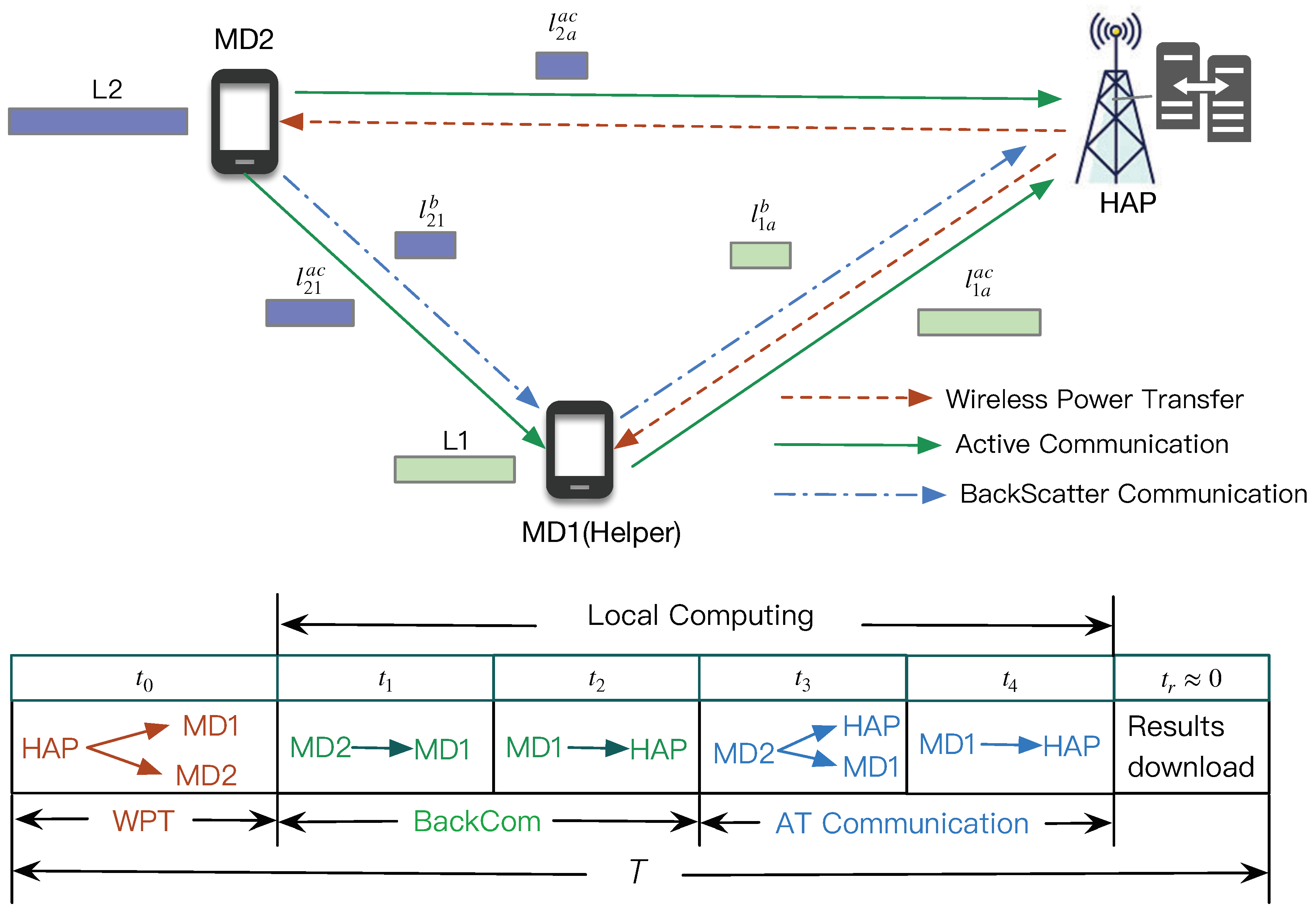
Figure 2.
Energy consumption in different schemes versus the latency constraint T.
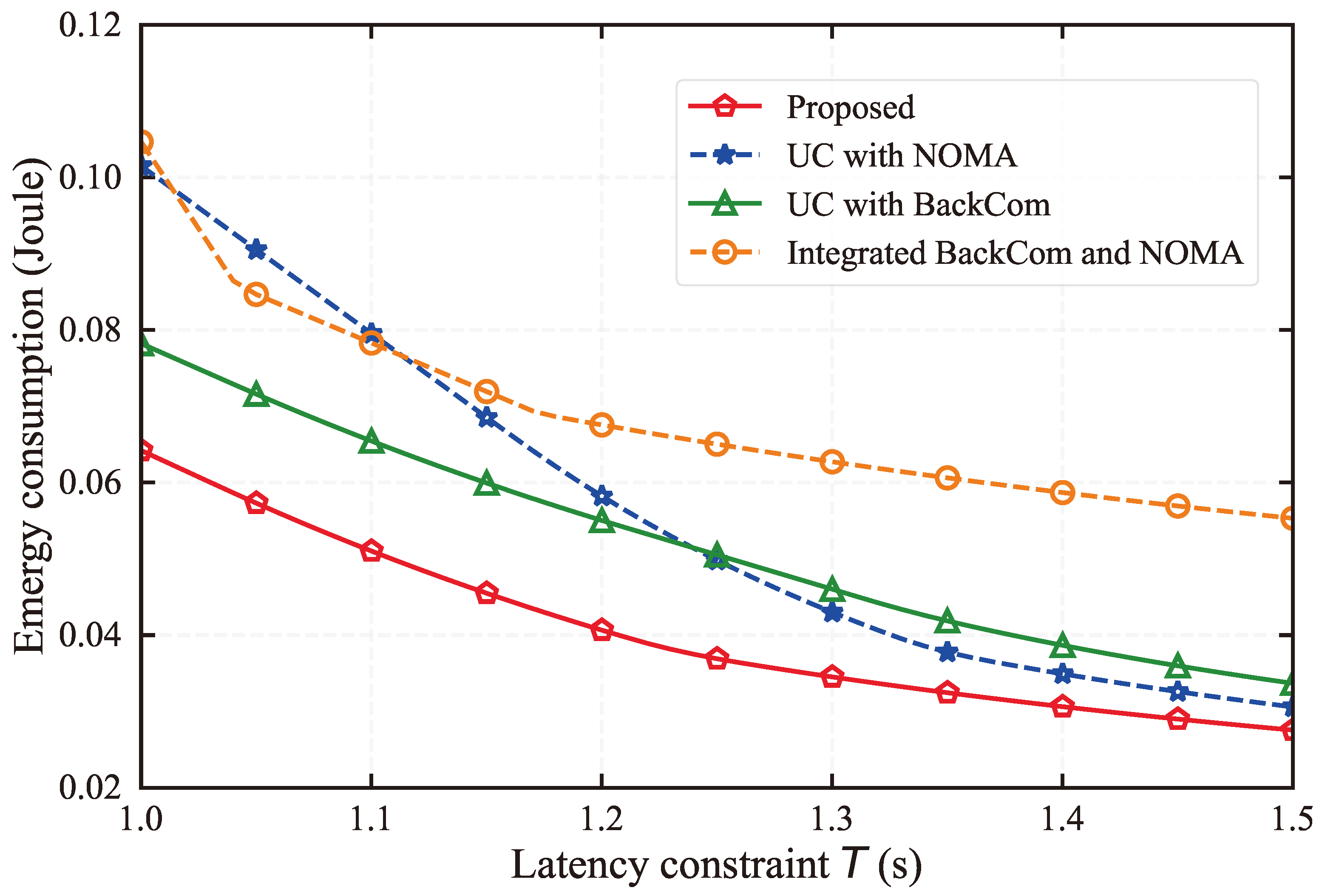
Figure 3.
Offloaded data in different schemes versus the latency constraint T.
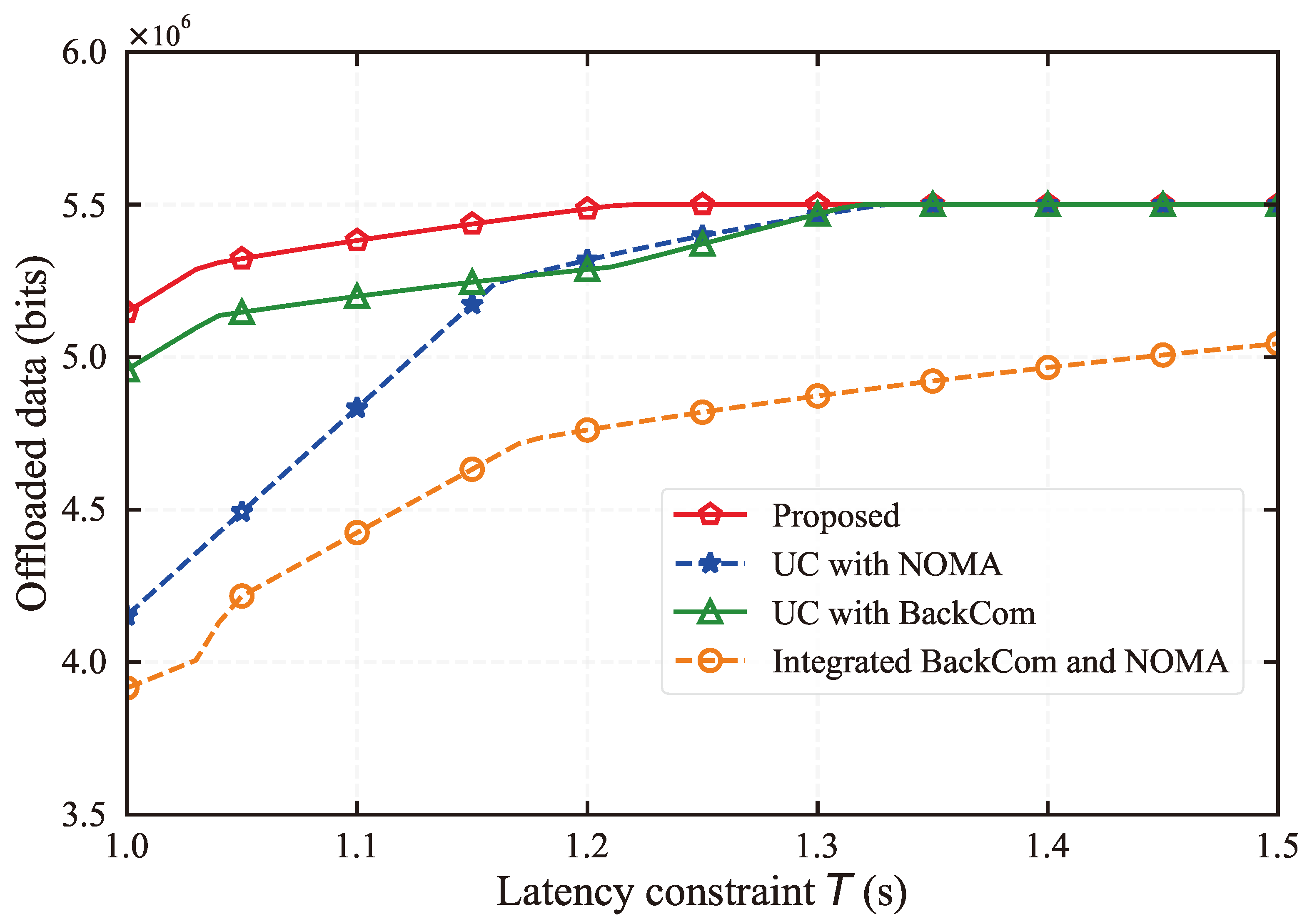
Figure 4.
Energy consumption in different schemes versus input computation bits at .
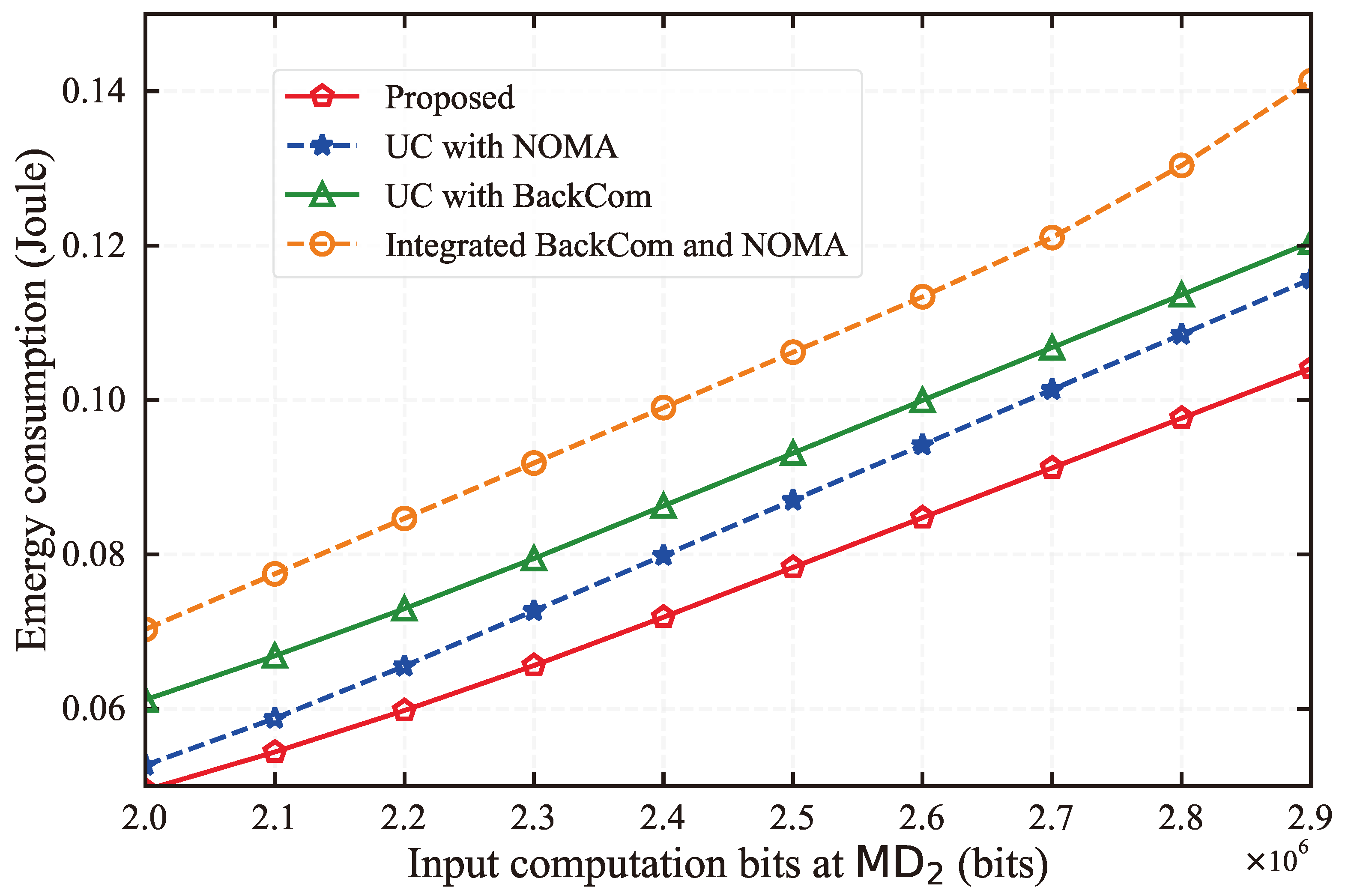
Figure 5.
Offloaded data in different schemes versus input computation bits at .
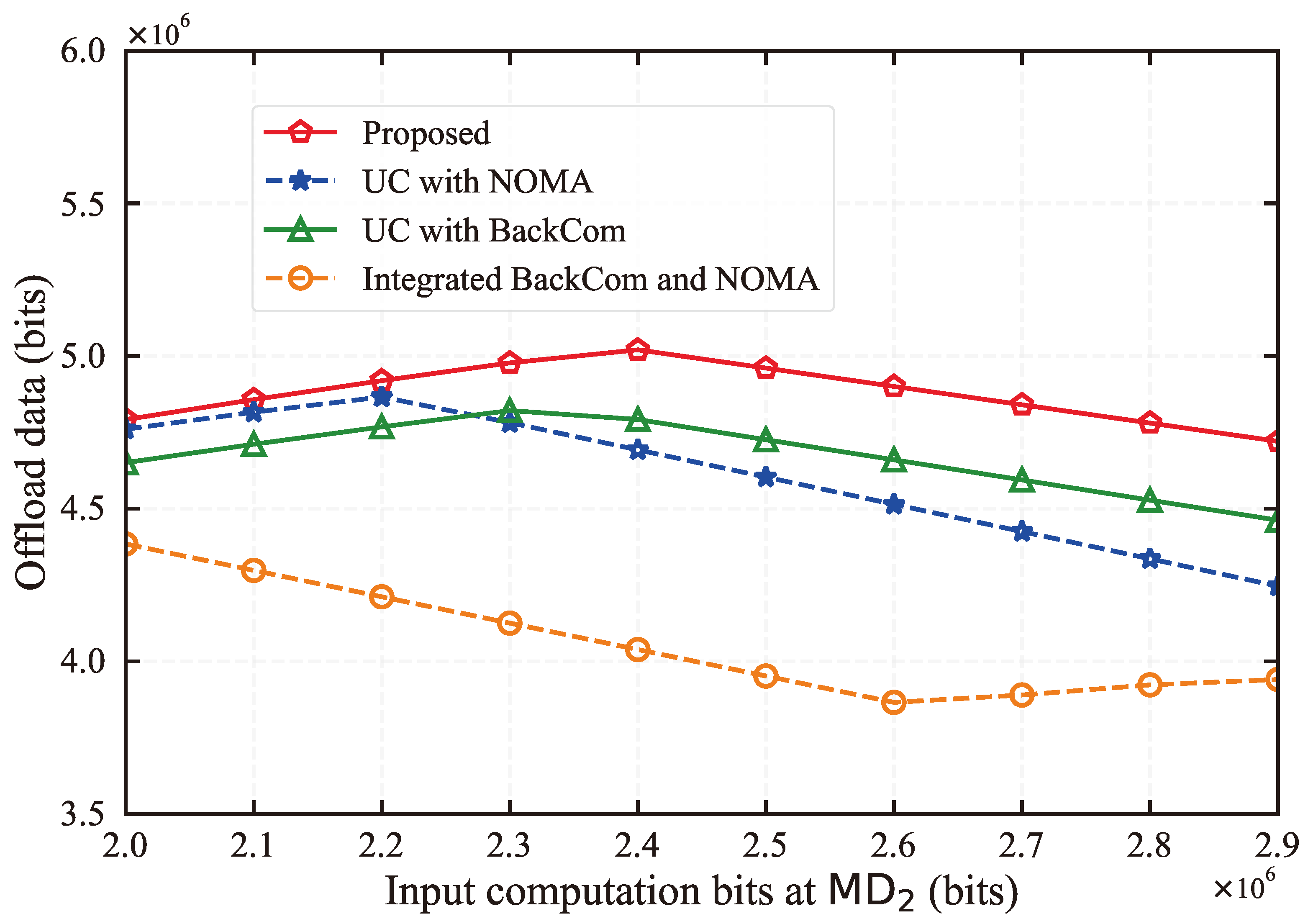
Figure 6.
Energy consumption in different schemes versus transmit power of HAP.
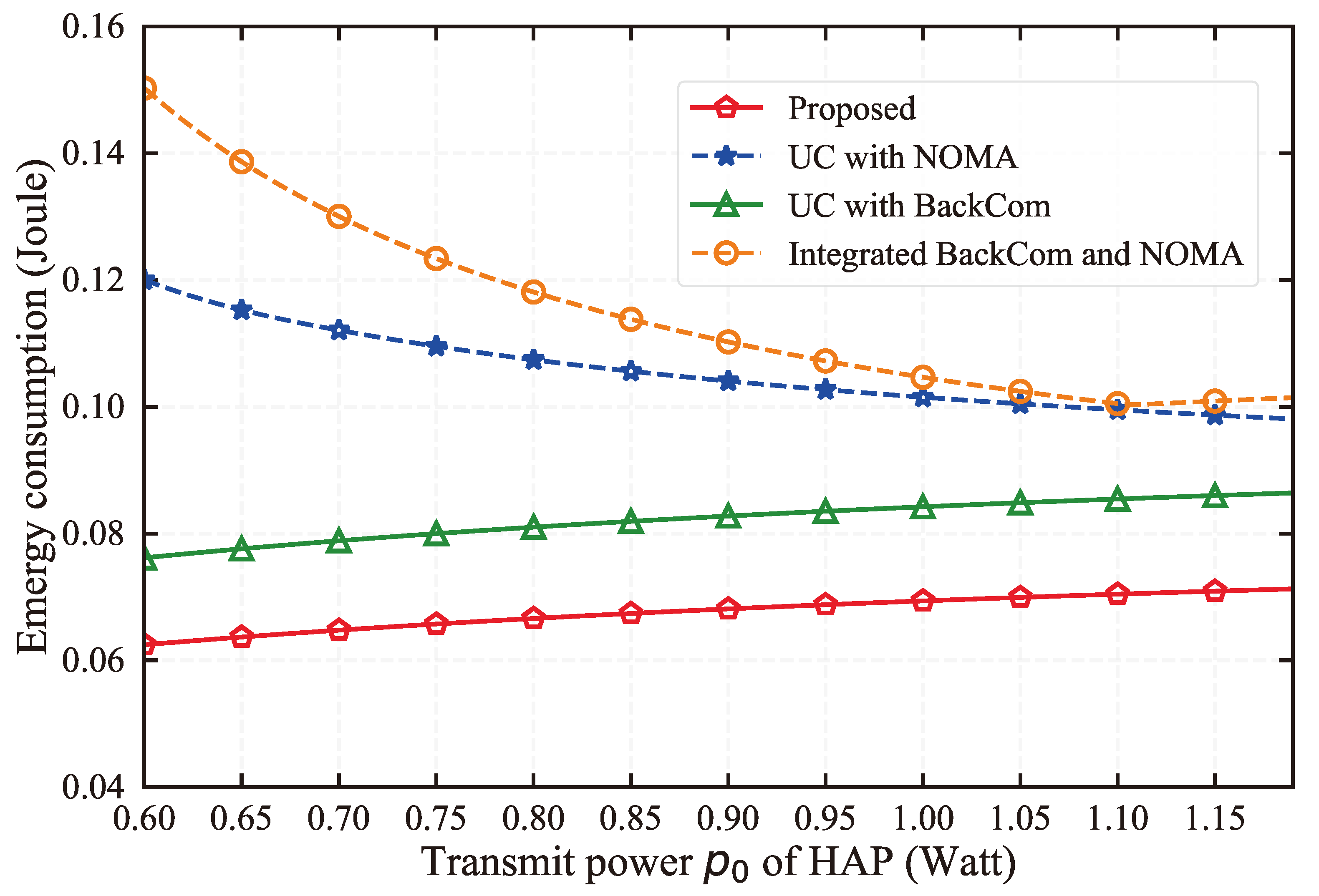
Figure 7.
Offloaded data in different schemes versus transmit power of HAP.
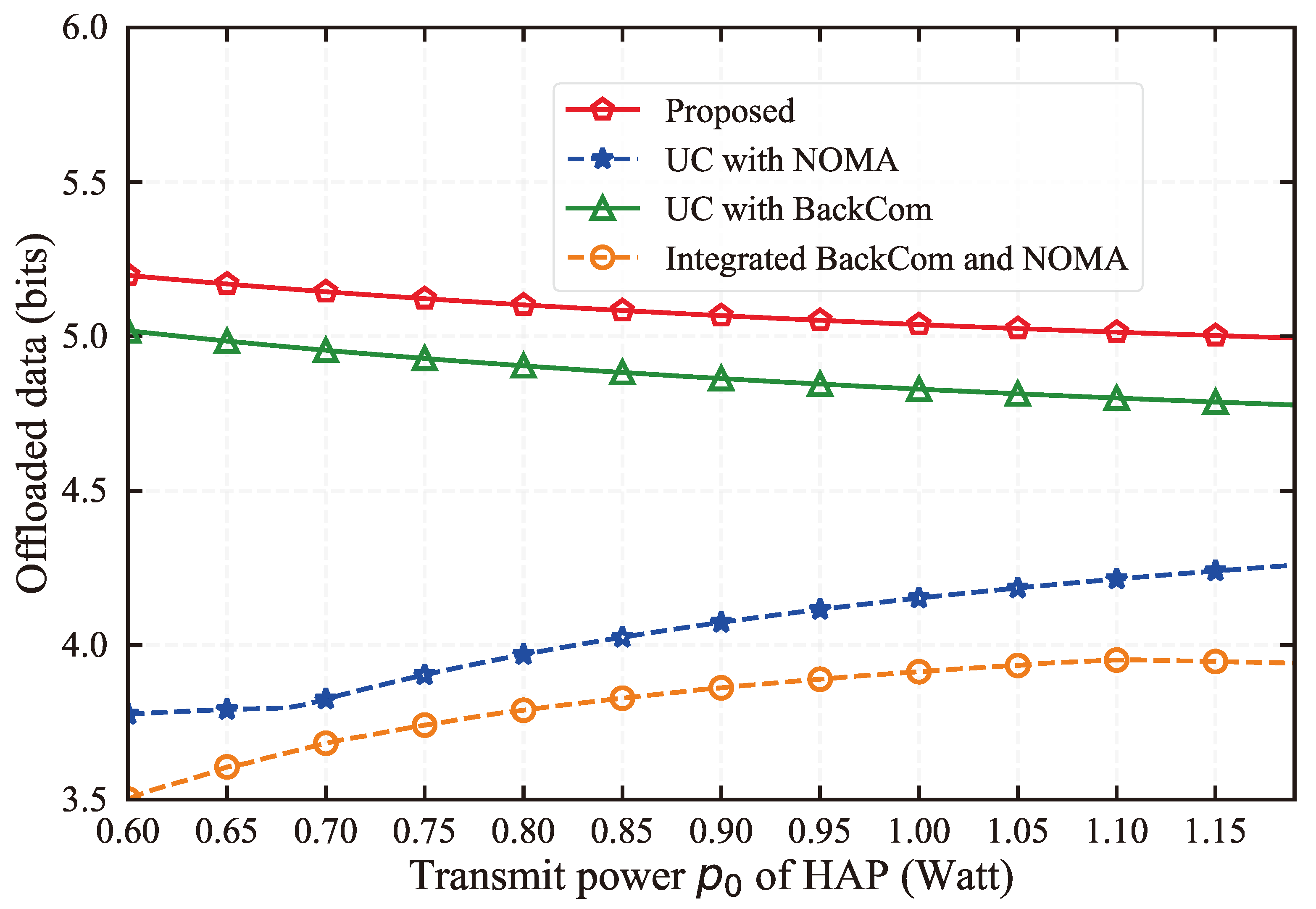
Figure 8.
Energy consumption in different schemes versus transmit power constraint of .
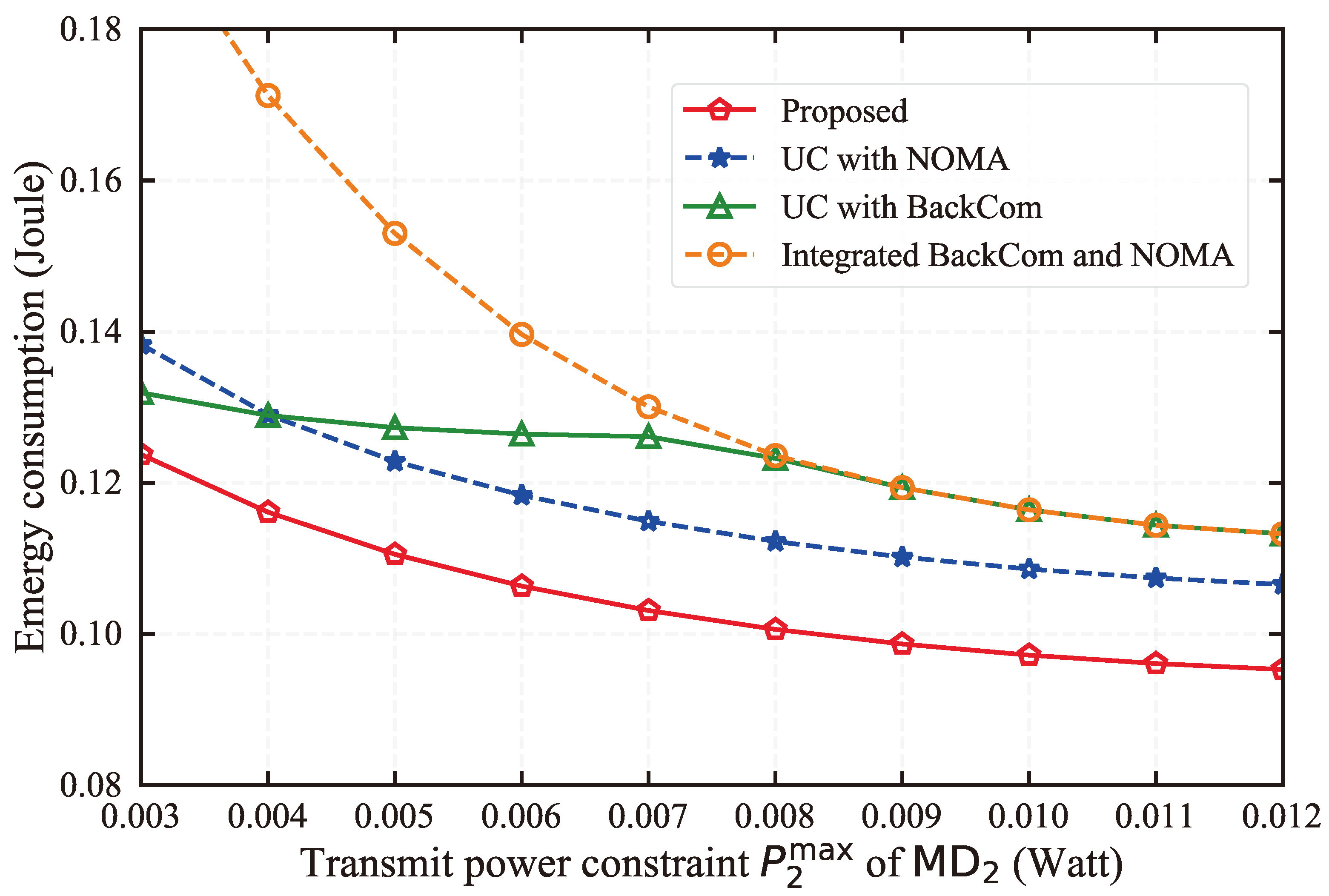
Figure 9.
Energy consumption in different schemes versus the distance between and .
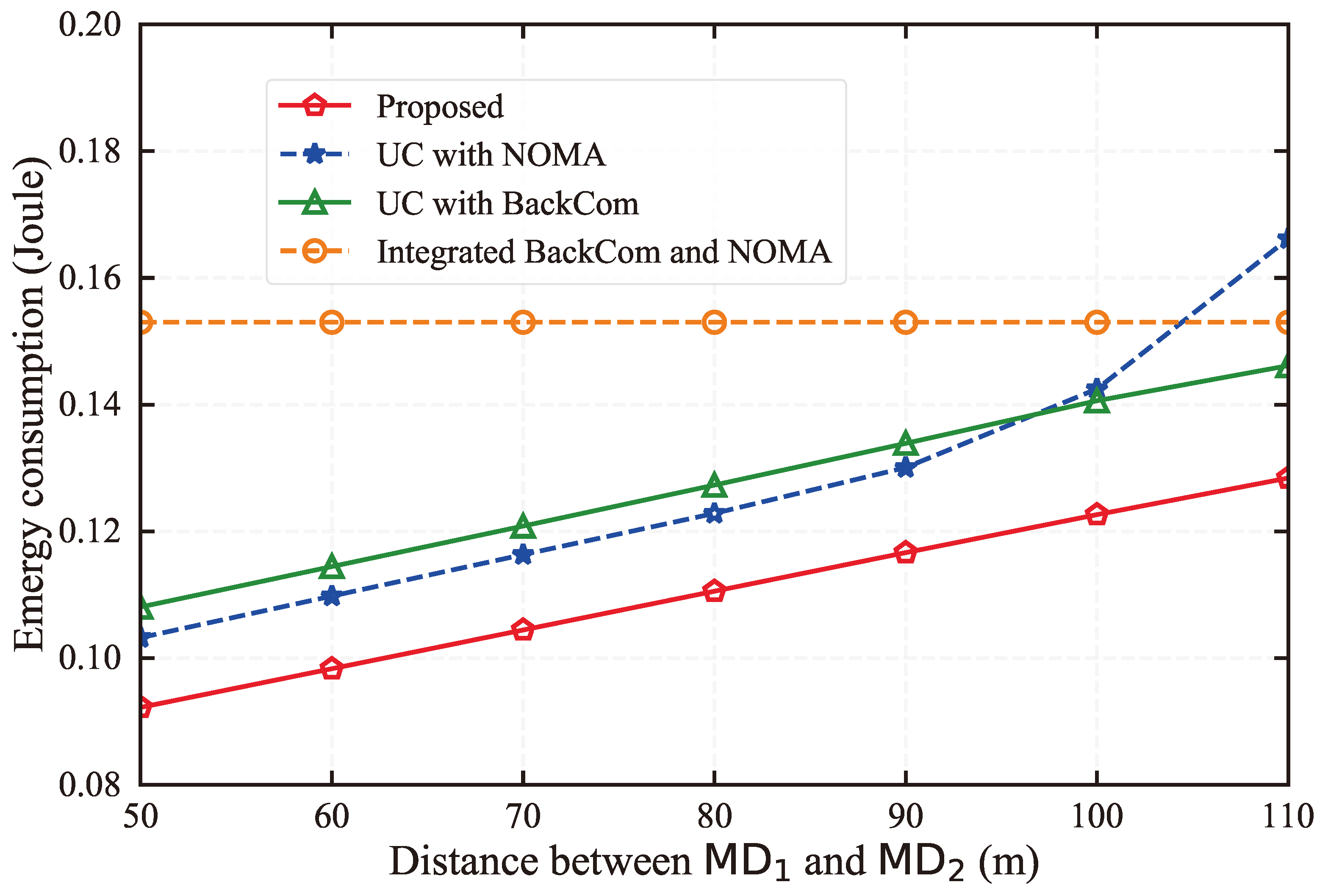
Figure 10.
Offloading strategy under different distance between and
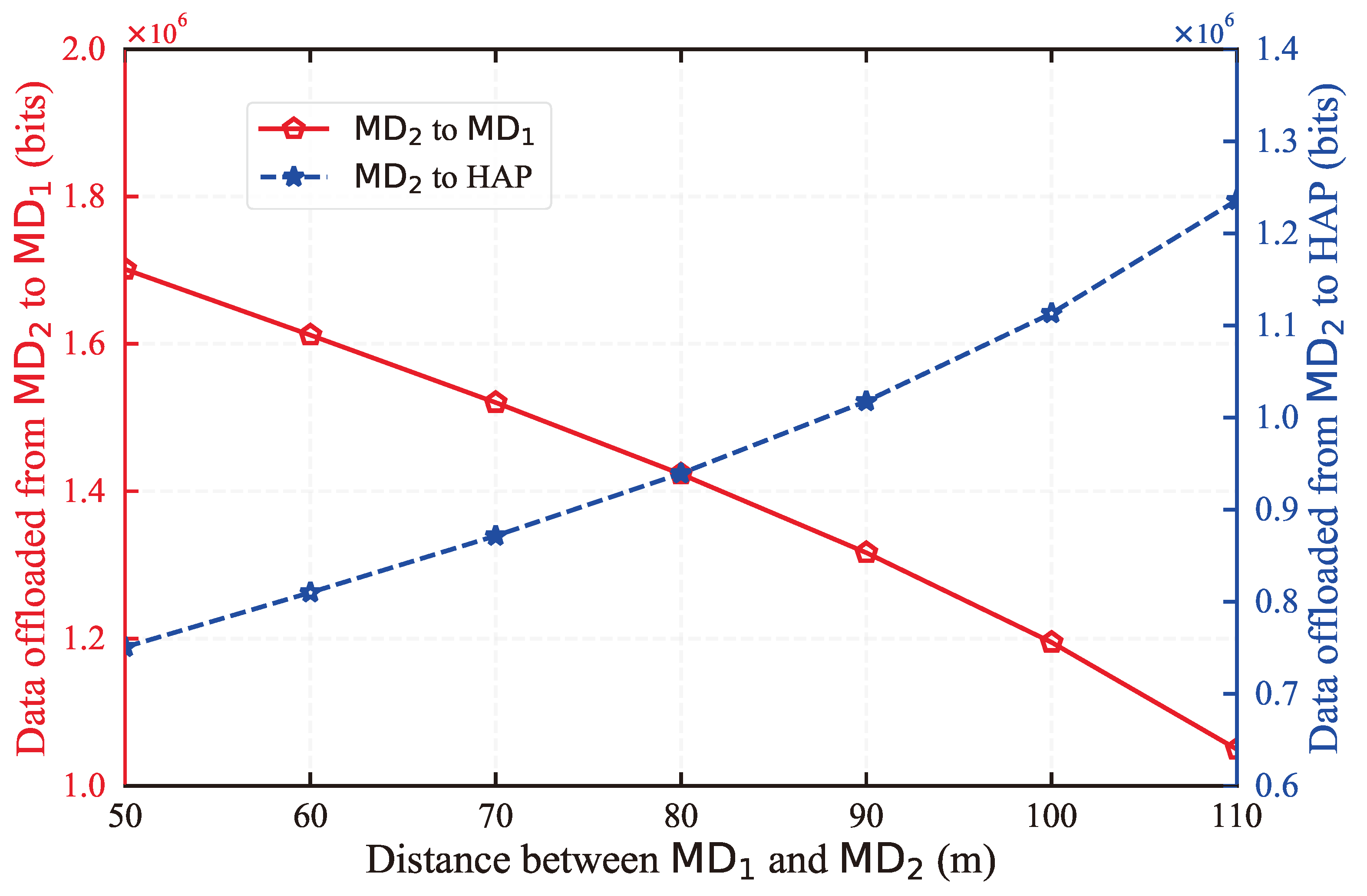

Table 1.
KEY NOTATIONS AND DEFINITIONS
| Notation | Definition |
|---|---|
| T | The time block |
| The time for WPT | |
| The time for offloading by Backcom of and | |
| The time for offloading by AC of and | |
| the amount of computational tasks of and | |
| The WPT channel gain between and HAP | |
| , | The offloading channel gain between and , and HAP |
| ,,, | The transmit power by AC at HAP, and |
| The circuit power by Backcom at | |
| The amount of tasks processed locally at | |
| , | The amount of tasks offloaded by Backcom at and |
| , , | The amount of tasks offloaded by AC at and |
| The energy consumed by processing tasks locally at | |
| The energy consumed by offloading tasks by Backcom at | |
| The local CPU frequency at | |
| The CPU cycles required to compute one bit task at | |
| The reflection coefficient of at slot t | |
| The energy conversion efficiency | |
| The computing energy efficiency of and | |
| B | The channel bandwidth |
| The additive white Gaussian noise |
Table 2.
SIMULATION PARAMETERS
| Symbol | Value |
|---|---|
| Transmit power of the AP | 1 W |
| Bandwidth W | MHz |
| Noise power | W |
| The circuit consumption of the BackCom and | W |
| The distance between , and HAP | 130 m, 180 m |
| The distance between and | 80 m |
| CPU frequency of | 250 MHz |
| CPU cycles to compute 1 bit task of | 250 cycles/bit |
| CPU frequency of | 250 MHz |
| CPU cycles to compute 1 bit task of | 150 cycles/bit |
| Equal computing efficiency parameter of | |
| Equal computing efficiency parameter of | |
| The antenna gain | 3 |
| The carrier frequency | 915 Mhz |
| The path loss exponent | 3 |
Disclaimer/Publisher’s Note: The statements, opinions and data contained in all publications are solely those of the individual author(s) and contributor(s) and not of MDPI and/or the editor(s). MDPI and/or the editor(s) disclaim responsibility for any injury to people or property resulting from any ideas, methods, instructions or products referred to in the content. |
© 2024 by the authors. Licensee MDPI, Basel, Switzerland. This article is an open access article distributed under the terms and conditions of the Creative Commons Attribution (CC BY) license (http://creativecommons.org/licenses/by/4.0/).
Copyright: This open access article is published under a Creative Commons CC BY 4.0 license, which permit the free download, distribution, and reuse, provided that the author and preprint are cited in any reuse.