

Submitted:
16 October 2024
Posted:
18 October 2024
You are already at the latest version
Abstract
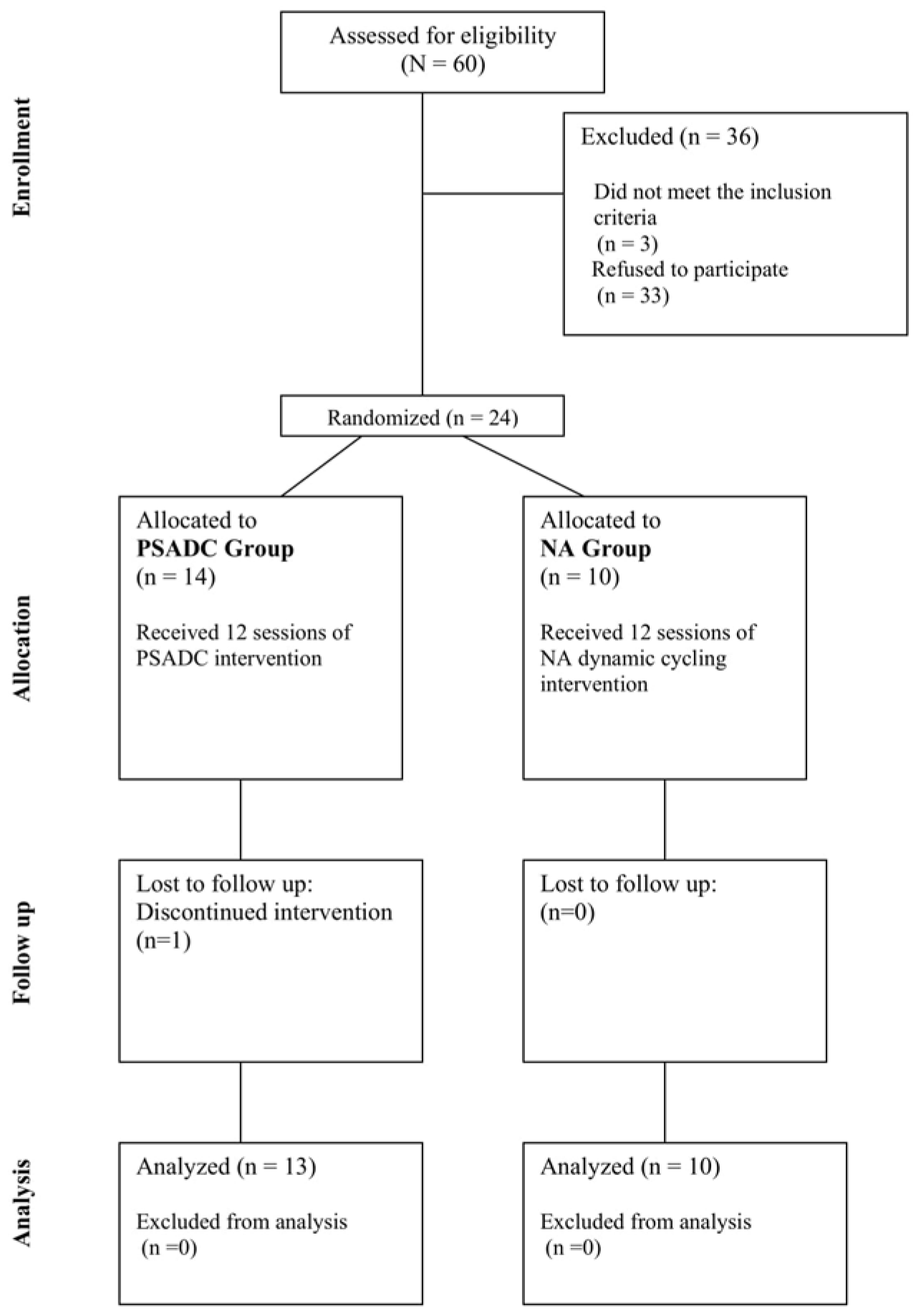
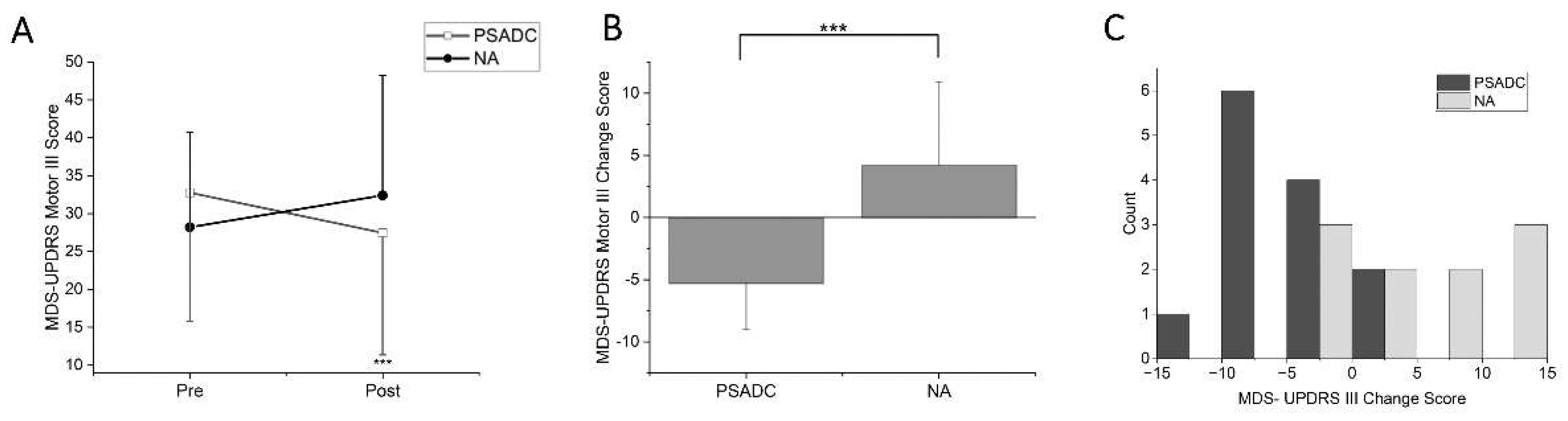
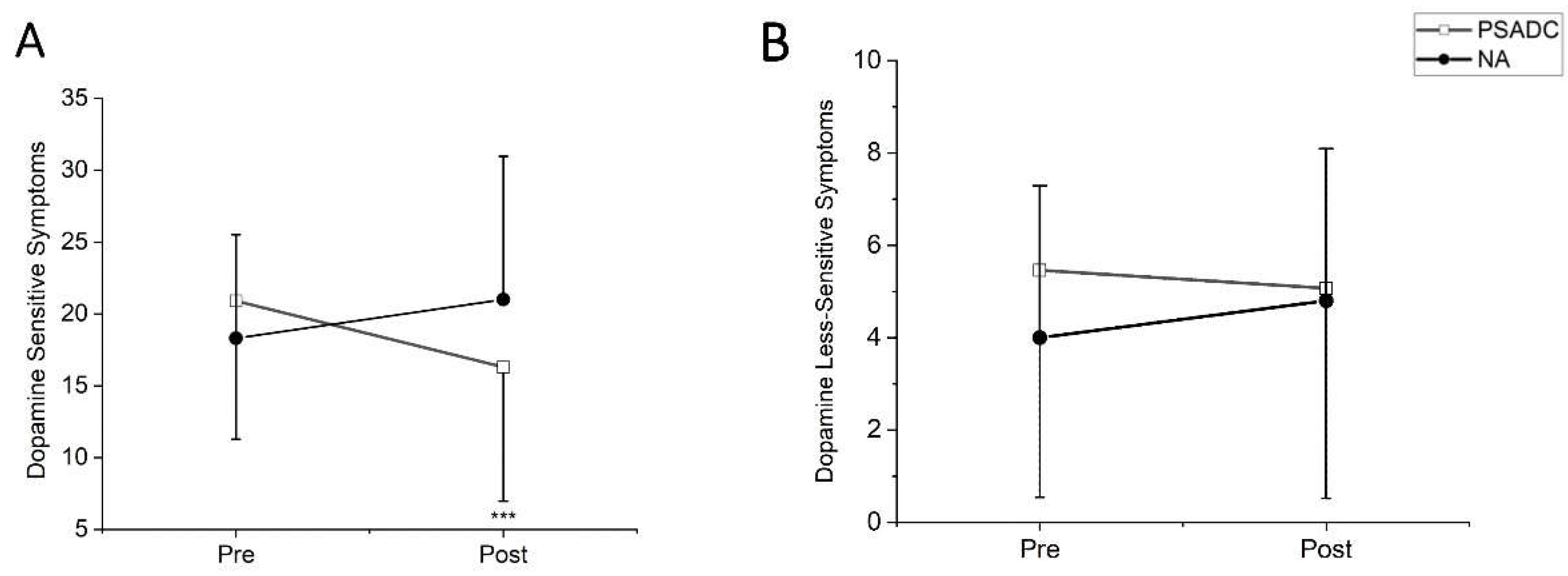
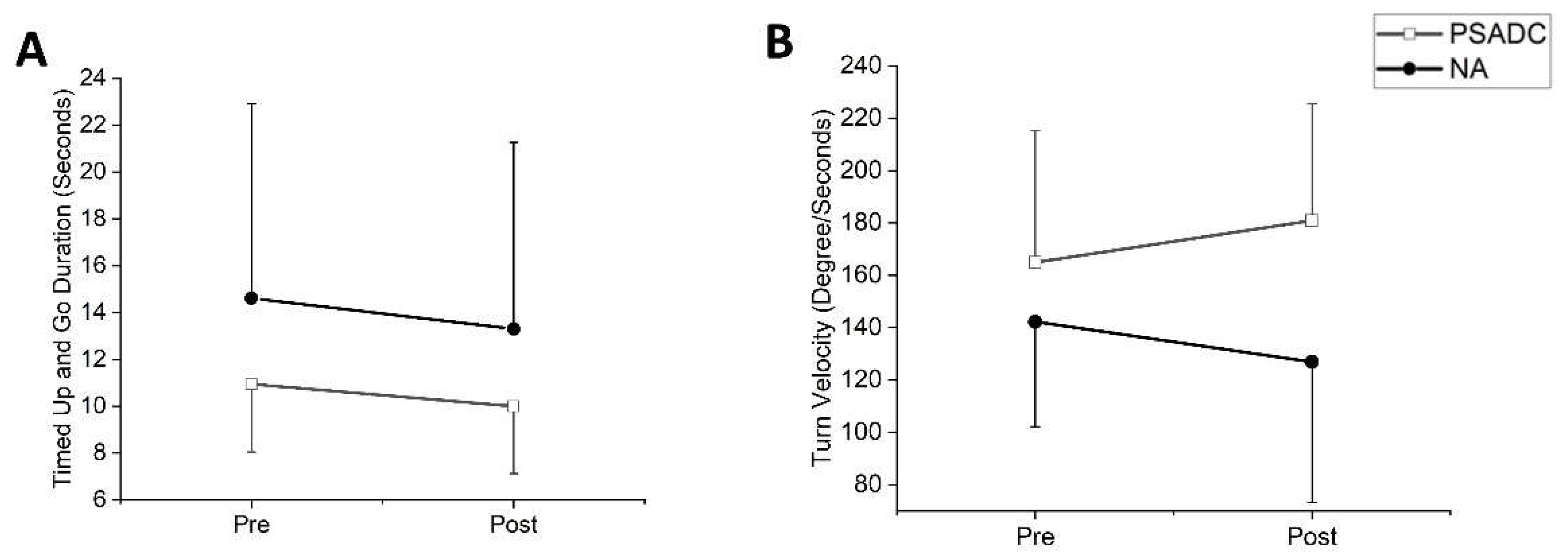
Background and Purpose: This pilot randomized controlled trial evaluated the effects of 12 sessions of patient-specific adaptive dynamic cycling (PSADC) versus non-adaptive cycling (NA) on motor function and mobility in individuals with Parkinson’s disease (PD), using IMU sensors for objective assessment. Methods: Twenty-three participants with PD (13 in the PSADC group and 10 in the NA group) completed the study over a 4-week period. Motor function was measured using the Kinesia™ sensors and the MDS-UPDRS Motor III, while mobility was assessed with the TUG test using OPAL IMU sensors. Results: The PSADC group showed significant improvements in MDS-UPDRS Motor III scores (t = 5.165, p < 0.001) and dopamine-sensitive symptoms (t = 4.629, p = 0.001), whereas the NA group did not improve. Both groups showed non-significant improvements in TUG time. IMU sensors provided continuous, quantitative, and unbiased measurements of motor function and mobility, offering a more accurate tracking of improvements over time. Conclusion: PSADC demonstrated enhanced treatment effects on PD motor function compared to NA, while also reducing variability in individual responses. The integration of IMU sensors was essential for precise monitoring, supporting the feasibility of a data-driven, individualized exercise approach to optimize treatment outcomes for individuals with PD.
Keywords:
1. Introduction
2. Materials and Methods
2.1. Research Design
2.2. Participants
2.2.1. Inclusion and Exclusion Criteria
2.2.2. Sample Size Calculation
2.3. Group Allocation and Exercise Intervention
2.4. Outcome Measurements
2.4.1. PD Motor Functions
2.4.2. Mobility
2.4.3. Exercise Variables
2.5. Statistical Analysis
3. Results
3.1. MDS-UPDRS Motor III Score Changes
3.2. Dopamine-Sensitive and Less-Sensitive MDS-UPDRS Motor III Score Changes
3.3. Kinesia One Motor Function Test Score Changes
3.4. Functional Mobility Changes
4. Discussion
Effects of PSADC on Functional Mobility
Limitations
5. Conclusions
6. Patents
Author Contributions
Funding
Institutional Review Board Statement
Informed Consent Statement
Data Availability Statement
Acknowledgments
Conflicts of Interest
References
- Willis, A.W.; Roberts, E.; Beck, J.C.; Fiske, B.; Ross, W.; Savica, R.; Van Den Eeden, S.K.; Tanner, C.M.; Marras, C.; Alcalay, R.; et al. Incidence of Parkinson disease in North America. npj Parkinson's Disease 2022, 8, 170. [CrossRef]
- Tolosa, E.; Garrido, A.; Scholz, S.W.; Poewe, W. Challenges in the diagnosis of Parkinson's disease. Lancet Neurol 2021, 20, 385-397. [CrossRef]
- Berardelli, A.; Rothwell, J.C.; Thompson, P.D.; Hallett, M. Pathophysiology of bradykinesia in Parkinson's disease. Brain 2001, 124, 2131-2146. [CrossRef]
- Borovac, J.A. Side effects of a dopamine agonist therapy for Parkinson's disease: A mini-review of clinical pharmacology. Yale J Biol Med 2016, 89, 37-47.
- Patel, A.B.; Jimenez-Shahed, J. Profile of inhaled levodopa and its potential in the treatment of Parkinson's disease: Evidence to date. Neuropsychiatr Dis Treat 2018, 14, 2955-2964. [CrossRef]
- Poewe, W.; Chaudhuri, K.R.; Bergmann, L.; Antonini, A. Levodopa-carbidopa intestinal gel in a subgroup of patients with dyskinesia at baseline from the GLORIA Registry. Neurodegener Dis Manag 2019, 9, 39-46. [CrossRef]
- Trenkwalder, C.; Kuoppamäki, M.; Vahteristo, M.; Müller, T.; Ellmén, J. Increased dose of carbidopa with levodopa and entacapone improves "off" time in a randomized trial. Neurology 2019, 92, e1487-e1496. [CrossRef]
- Jiang, L.; Chen, W.; Guo, Q.; Yang, C.; Gu, J.; Xian, W.; Liu, Y.; Zheng, Y.; Ye, J.; Xu, S.; et al. Eight-year follow-up outcome of subthalamic deep brain stimulation for Parkinson's disease: Maintenance of therapeutic efficacy with a relatively low levodopa dosage and stimulation intensity. CNS Neurosci Ther 2021, 27, 1366-1373. [CrossRef]
- Vergani, F.; Landi, A.; Pirillo, D.; Cilia, R.; Antonini, A.; Sganzerla, E.P. Surgical, medical, and hardware adverse events in a series of 141 patients undergoing subthalamic deep brain stimulation for Parkinson disease. World Neurosurg 2010, 73, 338-344. [CrossRef]
- Zarzycki, M.Z.; Domitrz, I. Stimulation-induced side effects after deep brain stimulation - a systematic review. Acta Neuropsychiatr 2020, 32, 57-64. [CrossRef]
- Alberts, J.L.; Phillips, M.; Lowe, M.J.; Frankemolle, A.; Thota, A.; Beall, E.B.; Feldman, M.; Ahmed, A.; Ridgel, A.L. Cortical and motor responses to acute forced exercise in Parkinson's disease. Parkinsonism Relat Disord 2016, 24, 56-62. [CrossRef]
- Alberts, J.L.; Linder, S.M.; Penko, A.L.; Lowe, M.J.; Phillips, M. It is not about the bike, it is about the pedaling: Forced exercise and Parkinson's disease. Exerc Sport Sci Rev 2011, 39, 177-186. [CrossRef]
- Segura, C.; Eraso, M.; Bonilla, J.; Mendivil, C.O.; Santiago, G.; Useche, N.; Bernal-Pacheco, O.; Monsalve, G.; Sanchez, L.; Hernández, E.; et al. Effect of a High-Intensity Tandem Bicycle Exercise Program on Clinical Severity, Functional Magnetic Resonance Imaging, and Plasma Biomarkers in Parkinson's Disease. Front Neurol 2020, 11, 656. [CrossRef]
- Miner, D.G.; Aron, A.; DiSalvo, E. Therapeutic effects of forced exercise cycling in individuals with Parkinson's disease. J Neurol Sci 2020, 410, 116677. [CrossRef]
- Ridgel; Phillips, R.S.; Walter, B.L.; Discenzo, F.M.; Loparo, K.A. Dynamic High-Cadence Cycling Improves Motor Symptoms in Parkinson's Disease. Front Neurol 2015, 6, 194. [CrossRef]
- Ridgel, A.L.; Ault, D.L. High-Cadence Cycling Promotes Sustained Improvement in Bradykinesia, Rigidity, and Mobility in Individuals with Mild-Moderate Parkinson's Disease. Parkinsons Dis 2019, 2019, 4076862. [CrossRef]
- Mohammadi-Abdar, H.; Ridgel, A.L.; Discenzo, F.M.; Loparo, K.A. Design and Development of a Smart Exercise Bike for Motor Rehabilitation in Individuals with Parkinson's Disease. IEEE ASME Trans Mechatron 2016, 21, 1650-1658. [CrossRef]
- Mohammadi-Abdar, H.; Ridgel, A.L.; Discenzo, F.M.; Phillips, R.S.; Walter, B.L.; Loparo, K.A. Test and Validation of a Smart Exercise Bike for Motor Rehabilitation in Individuals With Parkinson's Disease. IEEE Trans Neural Syst Rehabil Eng 2016, 24, 1254-1264. [CrossRef]
- Ridgel, A.L.; Abdar, H.M.; Alberts, J.L.; Discenzo, F.M.; Loparo, K.A. Variability in cadence during forced cycling predicts motor improvement in individuals with Parkinson's disease. IEEE Trans Neural Syst Rehabil Eng 2013, 21, 481-489. [CrossRef]
- Gates, P.; Ridgel, A.L. Body Mass Index and Exercise Effort Influences Changes in Motor Symptoms After High-Cadence Dynamic Cycling in Parkinson's Disease. Frontiers in Rehabilitation Sciences 2022, 3. [CrossRef]
- Kim, Y.; Smith, B.E.; Shigo, L.M.; Shaikh, A.G.; Loparo, K.A.; Ridgel, A.L. Utilizing Entropy of Cadence to Optimize Cycling Rehabilitation in Individuals With Parkinson’s Disease. Neurorehabilitation and Neural Repair 2024, 0, 15459683241268556. [CrossRef]
- Bo, F.; Yerebakan, M.; Dai, Y.; Wang, W.; Li, J.; Hu, B.; Gao, S. IMU-Based Monitoring for Assistive Diagnosis and Management of IoHT: A Review. Healthcare (Basel) 2022, 10. [CrossRef]
- Sotirakis, C.; Su, Z.; Brzezicki, M.A.; Conway, N.; Tarassenko, L.; FitzGerald, J.J.; Antoniades, C.A. Identification of motor progression in Parkinson's disease using wearable sensors and machine learning. NPJ Parkinsons Dis 2023, 9, 142. [CrossRef]
- Stillerova, T.; Liddle, J.; Gustafsson, L.; Lamont, R.; Silburn, P. Remotely Assessing Symptoms of Parkinson’s Disease Using Videoconferencing: A Feasibility Study. Neurology Research International 2016, 2016, 4802570. [CrossRef]
- Achey, M.; Aldred, J.L.; Aljehani, N.; Bloem, B.R.; Biglan, K.M.; Chan, P.; Cubo, E.; Dorsey, E.R.; Goetz, C.G.; Guttman, M.; et al. The past, present, and future of telemedicine for Parkinson's disease. Mov Disord 2014, 29, 871-883. [CrossRef]
- Hughes, A.J.; Daniel, S.E.; Kilford, L.; Lees, A.J. Accuracy of clinical diagnosis of idiopathic Parkinson's disease: A clinico-pathological study of 100 cases. J Neurol Neurosurg Psychiatry 1992, 55, 181-184. [CrossRef]
- Heldman, D.A.; Urrea-Mendoza, E.; Lovera, L.C.; Schmerler, D.A.; Garcia, X.; Mohammad, M.E.; McFarlane, M.C.U.; Giuffrida, J.P.; Espay, A.J.; Fernandez, H.H. App-Based Bradykinesia Tasks for Clinic and Home Assessment in Parkinson's Disease: Reliability and Responsiveness. J Parkinsons Dis 2017, 7, 741-747. [CrossRef]
- Morris, R.; S., S.; McBarron, G.; Fino, P.C.; Mancini, M.; Curtze, C. Validity of Mobility Lab (version 2) for gait assessment in young adults, older adults and Parkinson's disease. Physiological measurement 2019, 40. [CrossRef]
- Mancini, M.; Horak, F.B. Potential of APDM mobility lab for the monitoring of the progression of Parkinson's disease. Expert Rev Med Devices 2016, 13, 455-462. [CrossRef]
- Borg, G. Borg's Perceived Exertion and Pain Scales; Human Kinetics: 1998.
- Shulman, L.M.; Gruber-Baldini, A.L.; Anderson, K.E.; Fishman, P.S.; Reich, S.G.; Weiner, W.J. The clinically important difference on the unified Parkinson's disease rating scale. Arch Neurol 2010, 67, 64-70. [CrossRef]
- Perrey, S. Promoting motor function by exercising the brain. Brain Sci 2013, 3, 101-122. [CrossRef]
- Davies, G.; Riemann, B.L.; Manske, R. CURRENT CONCEPTS OF PLYOMETRIC EXERCISE. Int J Sports Phys Ther 2015, 10, 760-786.
- Baladron, J.; Vitay, J.; Fietzek, T.; Hamker, F.H. The contribution of the basal ganglia and cerebellum to motor learning: A neuro-computational approach. PLoS Comput Biol 2023, 19, e1011024. [CrossRef]
- Mazzoni, P.; Shabbott, B.; Cortés, J.C. Motor control abnormalities in Parkinson's disease. Cold Spring Harb Perspect Med 2012, 2, a009282. [CrossRef]
- Sacheli, M.A.; Neva, J.L.; Lakhani, B.; Murray, D.K.; Vafai, N.; Shahinfard, E.; English, C.; McCormick, S.; Dinelle, K.; Neilson, N.; et al. Exercise increases caudate dopamine release and ventral striatal activation in Parkinson's disease. Mov Disord 2019, 34, 1891-1900. [CrossRef]
- Vina, J.; Sanchis-Gomar, F.; Martinez-Bello, V.; Gomez-Cabrera, M.C. Exercise acts as a drug; the pharmacological benefits of exercise. Br J Pharmacol 2012, 167, 1-12. [CrossRef]
- Ahlskog, J.E. Aerobic Exercise: Evidence for a Direct Brain Effect to Slow Parkinson Disease Progression. Mayo Clin Proc 2018, 93, 360-372. [CrossRef]
- MacIntosh, B.R.; Neptune, R.R.; Horton, J.F. Cadence, power, and muscle activation in cycle ergometry. Medicine & Science in Sports & Exercise 2000, 32.
- Wu, T.; Hallett, M.; Chan, P. Motor automaticity in Parkinson's disease. Neurobiol Dis 2015, 82, 226-234. [CrossRef]
- Linder, S.M.; Baron, E.; Learman, K.; Koop, M.M.; Penko, A.; Espy, D.; Streicher, M.; Alberts, J.L. An 8-week aerobic cycling intervention elicits improved gait velocity and biomechanics in persons with Parkinson's disease. Gait Posture 2022, 98, 313-315. [CrossRef]
- Prodoehl, J.; Rafferty, M.R.; David, F.J.; Poon, C.; Vaillancourt, D.E.; Comella, C.L.; Leurgans, S.E.; Kohrt, W.M.; Corcos, D.M.; Robichaud, J.A. Two-year exercise program improves physical function in Parkinson's disease: The PRET-PD randomized clinical trial. Neurorehabil Neural Repair 2015, 29, 112-122. [CrossRef]

| Variables | PSADC (n = 13) | NA (n = 10) | p-value |
|---|---|---|---|
| Ages (Years) | 72.08±5.56 | 72.20±4.82 | 0.956 |
| Height (cm) | 175.64±12.48 | 177.42±8.71 | 0.706 |
| Weight (kg) | 78.71±25.23 | 88.82±16.77 | 0.288 |
| BMI (kg/m2) | 25.54±5.48 | 27.69±3.52 | 0.297 |
| H&Y (stage) | 2.38±1.12 | 2.10±0.56 | 0.473 |
| LEDD (mg) | 654.00±563.51 | 510.00±338.13 | 0.484 |
| Years with PD (Years) | 8.95±6.63 | 4.39±3.91 | 0.071 |
| Pedaling Speed (RPM) | 79.42±0.06 | 79.42±0.09 | 0.813 |
| Power (W) | 21.33±18.11 | 7.13±18.40 | 0.078 |
| Effort (%) | 84.59±30.64 | 54.18±38.46 | 0.047 |
| SampEn of Cadence | 1.64±0.14 | 1.57±0.10 | 0.217 |
| RPE | 11.96±1.52 | 12.78±0.87 | 0.145 |
| HR (BPM) | 85.77±6.54 | 80.23±4.89 | 0.036 |
Disclaimer/Publisher’s Note: The statements, opinions and data contained in all publications are solely those of the individual author(s) and contributor(s) and not of MDPI and/or the editor(s). MDPI and/or the editor(s) disclaim responsibility for any injury to people or property resulting from any ideas, methods, instructions or products referred to in the content. |
© 2024 by the authors. Licensee MDPI, Basel, Switzerland. This article is an open access article distributed under the terms and conditions of the Creative Commons Attribution (CC BY) license (http://creativecommons.org/licenses/by/4.0/).


