

Submitted:
14 October 2024
Posted:
14 October 2024
You are already at the latest version
Abstract
Polluting discharges are produced at a rate that is inexorably rising in tandem with human activity development. Eutrophication and other matters, such as offensive aquatic life, require wastewater to be treated before being discharged into the environment. Prior releasing into water bodies, the treated waters must to undertake laboratory analysis. For this purpose, an analysis using standard methods was carried out at the Laboratory Waterworks in Debrecen on various samples taken from various wastewater treatment plants (sewage treatment plants) in Hungary. The overall objective of this study was to assess the quality of the effluents from the fourteen (14) wastewater treatment plants and investigate their efficiency by measuring various physicochemical parameters and microbiological parameters as excellent indicators to evaluate the performance of the studied wastewater treatment plants. The microbiological indicator monitored was the heterotrophic count (HPC) by estimating its total number, which provides useful information for the assessment and monitoring of water samples. The determination of physicochemical parameters included biological oxygen demand (BOD5), chemical oxygen demand (COD) and nitrite -N (NO2), ammonia-N (NH3-N), nitrate-N (NO3) total phosphorus (TP), Kjeldahl- Nitrogen (organic N+ammonia-N) (TKN), total inorganic N (TI), total suspended solids (TSS) and total nitrogen (TN). The performance of the wastewater treatment plants examined was checked and the results were conclusive. In the future, solutions should be applied to these wastewater treatment plants and some recommendations are suggested.
Keywords:
1. Introduction

| Parameters | Units | Standards used |
|---|---|---|
| pH | - | 6,5-8,5 |
| BOD5 | Mg/l | <30 |
| COD | Mg/l | <90 |
| TSS | Mg/l | <20 |
| NH4+ | Mg/l | <0.5 |
| NO2 | Mg/l | 1 |
| NO3 | Mg/l | <1 |
| P2O5 | Mg/l | <2 |
| Temperature | °C | <30 |
| Color | - | Colorless |
| Odor | - | Odorless |
2. Material and Method
2.1. Areas Studied
2.2. Sampling Processes
2.3. Laboratory Methods
2.4. Statistical Analysis

3. Results and Discussion
3.1. Physicochemical Parameters
3.2. Nitrite-N and Nitrate-N Results
3.3. Microbiological Parameter HPC (Heterotrophic Place Count)
4. Conclusions
- Advanced oxidation processes (AOPs): AOPs are used to treat wastewater by eliminating organic compounds, micropollutants, and other contaminants that may not be effectively removed by conventional methods. These include ozone, hydrogen peroxide, and ultraviolet (UV) combined with hydrogen peroxide. The goal is to purify the wastewater and make it suitable for residential use (Kaur et al., 2017; Zahmatkesh et al., 2022).
- Membrane bioreactors (MBRs): Wastewater can be treated more effectively and compactly when biological treatment and membrane separation are combined (Zahmatkesh et al., 2022).
- Microscreening: This method offers an affordable water treatment option by eliminating suspended solids from wastewater (Advanced Wastewater Treatment Methods (Complete List) - EngineeringCivil.Org, n.d.).
- Ultrafiltration: When combined with the activated sludge process, ultrafiltration effectively eliminates toxic materials, suspended solids, and dissolved solids from wastewater (Advanced Wastewater Treatment Methods (Complete List) - EngineeringCivil.Org, n.d.; Zahmatkesh et al., 2022).
- Advanced carbon adsorption: Wastewater is treated with activated carbon adsorption to eliminate organic pollutants, hazardous materials, and persistent organic pollutants (Advanced Wastewater Treatment Methods (Complete List) - EngineeringCivil.Org, n.d.).
- Phosphorus and nitrogen elimination: Phosphorus and nitrogen, which are necessary nutrients for the growth of algae and can cause eutrophication, are taken out of wastewater by chemical precipitation and clarification, as well as chemical coagulation and clarification (Advanced Wastewater Treatment Methods (Complete List) - EngineeringCivil.Org, n.d.).
References
- 6 wastewater parameters and dealing with discharge limits - alumichem.com. (n.d.). Retrieved December 20, 2023, from https://alumichem.com/6-wastewater-parameters-and-dealing-with-discharge-limits/.
- Advanced Wastewater Treatment Methods - EngineeringCivil.org. (n.d.). Retrieved December 21, 2023, from https://engineeringcivil.org/articles/advanced-wastewater-treatment-methods-complete-list/.
- ANIYIKAIYE, T. E., OLUSEYI, T., ODIYO, J. O., EDOKPAYI, J. N. (2019). Physico-Chemical Analysis of Wastewater Discharge from Selected Paint Industries in Lagos, Nigeria. International Journal of Environmental Research and Public Health, Vol. 16. Issue 7. [CrossRef]
- ARREGUI, L., LIÉBANA, R., CALVO, P., PÉREZ-UZ, B., SALVADÓ, H., SERRANO, S. (2013). Bioindication in activated sludge wastewater treatment plants. In Handbook of Wastewater Treatment: Biological Methods, Technology and Environmental Impact pp. 277–291.
- BAHARVAND, S., MANSOURI DANESHVAR, M. R. (2019). Impact assessment of treating wastewater on the physiochemical variables of environment: a case of Kermanshah wastewater treatment plant in Iran. Environmental Systems Research, Vol.8, Issue 1. [CrossRef]
- BALAZS, M., MR, D., GAYER, J., GABOR, M., MR, G., KOVACS, R. (2013). The Hungarian Water and Sanitation Industry in the 21st century, Hungarian investment and trade agency, Budapest water summit, 19 p. WWW.HITA.HU.
- BENFRÉHA BENYELLES, M., BELGHARBI ALLAM, A., MOKRANI, S., TIR TOUIL MEDDAH, A., MOUSSA-BOUDJEMÂA, B. (2022). Microbiological aspects of the aeration tanks of an activated sludge treatment plant in dysfunction: Consequences on its treatment performance. Lebanese Science Journal, Vol. 23, Issue 1, pp. 17–32. [CrossRef]
- CARTER, J. T., RICE, E. W., BUCHBERGER, S. G., LEE, Y. (2000). Relationships between levels of heterotrophic bacteria and water quality parameters in a drinking water distribution system. Water Research, Vol.34, Issue 5, pp.1495–1502. [CrossRef]
- COLMENAREJO, M. F., RUBIO, A., SÁNCHEZ, E., VICENTE, J., GARCÍA, M. G., BORJA, R. (2006). Evaluation of municipal wastewater treatment plants with different technologies at Las Rozas, Madrid (Spain). Journal of Environmental Management, Vol. 81, Issue 4, pp 399–404. [CrossRef]
- ELMEDDAHI, Y., MAHMOUDI, H., ISSAADI, A., GOOSEN, M. F. A. (2016). Analysis of treated wastewater and feasibility for reuse in irrigation: a case study from Chlef, Algeria. Desalination and Water Treatment, Vol. 57, Issue 12, pp.5222–5231. [CrossRef]
- EU WATER LAW. (n.d.). Retrieved December 20, 2023, from https://www.era-comm.eu/EU_water_law/part_4/index.html.
- FRANCISQUE, A., RODRIGUEZ, M. J., MIRANDA-MORENO, L. F., SADIQ, R., PROULX, F. (2009). Modeling of heterotrophic bacteria counts in a water distribution system. Water Research, Vol. 43, Issue 4, pp.1075–1087. [CrossRef]
- GALLOWAY, J. N. (2003). The Global Nitrogen Cycle. Treatise on Geochemistry, Vol. 8–9, pp. 557–583. [CrossRef]
- HALLAS, G., MONIS, P. (2015). Evaluation of heterotrophic plate and chromogenic agar colony counting in water quality laboratories. MethodsX, Vol. 2, pp. 415-422. [CrossRef]
- HEJABI, N., SAGHEBIAN, S. M., AALAMI, M. T., NOURANI, V. (2021). Evaluation of the effluent quality parameters of wastewater treatment plant based on uncertainty analysis and post-processing approaches (case study). Water Science and Technology, Vol.83, Issue 7, pp. 1633–1648. [CrossRef]
- Heterotrophic Plate Count (HPC) Testing - Phoslab Environmental Laboratories Phoslab Environmental Laboratories. (n.d.). Retrieved December 20, 2023, from https://www.phoslab.com/environmental-services/hpc/.
- HOWARD, I., ESPIGARES, E., LARDELLI, P., MARTÍN, J. L., ESPIGARES, M. (2004). Evaluation of microbiological and physicochemical indicators for wastewater treatment. Environmental Toxicology, Vol.19, Issue 3, pp. 241–249. [CrossRef]
- KALLOUM, S., BOUABDESSALEM, H., TOUZI, A., IDDOU, A., OUALI, M. S. (2011). Biogas production from the sludge of the municipal wastewater treatment plant of Adrar city (southwest of Algeria). Biomass and Bioenergy, Vol. 35, Issue 7, pp. 2554–2560. [CrossRef]
- KAUR, J., PUNIA, S., KUMAR, K. (2017). Need for the advanced technologies for wastewater treatment. Advances in Environmental Biotechnology, pp. 39–52. [CrossRef]
- KHAN, S. A., ATTA, T., REHMAN, U., NASIR, A., AFTAB, S., HAFEEZ, A. (2017). Assessment of Waste Water Treatment Plant Efficiency through Physico-Chemical Analysis: A Case Study of I-9 Waste Water Treatment Plant, Islamabad, Pakistan. In Int.J.Econ.Environ.Geol Vol. 8, Issue 4. www.econ-environ-geol.org.
- LAM, S., NGUYEN-VIET, H., TUYET-HANH, T. T., NGUYEN-MAI, H., HARPER, S. (2015). Evidence for Public Health Risks of Wastewater and Excreta Management Practices in Southeast Asia: A Scoping Review. International Journal of Environmental Research and Public Health, Vol. 12, Issue 10, Article number 12863. [CrossRef]
- MAGUVU, T. E., BEZUIDENHOUT, C. C., KRITZINGER, R., TSHOLO, K., PLAATJIE, M., MOLALE-TOM, L. G., MIENIE, C. M., COERTZE, R. D. (2020). Combining physicochemical properties and microbiome data to evaluate the water quality of South African drinking water production plants. PLoS ONE, Vol. 15, Issue 8. [CrossRef]
- MAKUWA, S. MAKUWA, S., TLOU, M., FOSSO-KANKEU, E., GREEN, E. (2020). Evaluation of fecal coliform prevalence and physicochemical indicators in the effluent from a wastewater treatment plant in the north-west province, south Africa. International Journal of Environmental Research and Public Health, Vol.17, Issue 17, pp. 1–13. [CrossRef]
- MUELA, A., ORRUÑO, M., ALONSO, M. L., PAZOS, M., ARANA, I., ALONSO, R. M., JIMÉNEZ, R. M., GARAIZABAL, I., MAGUREGUI, M. I., BARCINA, I. (2011). Microbiological parameters as an additional tool to improve wastewater treatment plant monitoring. Ecological Indicators, Vol. 11, Issue 2, pp. 431–437. [CrossRef]
- OECD (2018) Environmental Performance Reviews: Hungary, 208 p. (also available in French). [CrossRef]
- PAVLOV, D., DE WET, C. M. E., GRABOW, W. O. K., EHLERS, M. M. (2004). Potentially pathogenic features of heterotrophic plate count bacteria isolated from treated and untreated drinking water. International Journal of Food Microbiology, Vol. 92, Issue 3, pp. 275–287. [CrossRef]
- PISTOCCHI, A., HUSEMANN, J., MASI, F., NANU, C., EUROPÄISCHE KOMMISSION GEMEINSAME FORSCHUNGSSTELLE. (2020). Wastewater treatment in the Danube region: opportunities and challenges lessons learnt from a “synthesis centres” exercise, the European commission’s science and knowledge service, Joint Research Center, 84 p.
- SAID HAMAIDI, M., HAMAIDI-CHERGUI, F., ERRAHMANI, M. B., LAMROUSSI, A., BENMIRA, H. (n.d.). EFFICIENCY OF INDICATOR BACTERIA REMOVAL IN A WASTEWATER TREATMENT PLANT (ALGIERS, ALGERIA). http://www.limnology.ro/water2014/proceedings.html.
- SALEEM, M., BUKHARI, A. A., AL-MALACK, M. H. (2000). Removal efficiencies of indicator micro-organisms in the Al-Khobar wastewater treatment plant. Environmental Engineering Science, Vol.17, Issue 4, pp. 227–232. [CrossRef]
- SINGH, U. K., KUMAR, B. (2017). Pathways of heavy metals contamination and associated human health risk in Ajay River basin, India. Chemosphere, Vol.174, pp.183–199. [CrossRef]
- SLOMP, C. P. (2012). Phosphorus Cycling in the Estuarine and Coastal Zones: Sources, Sinks, and Transformations. Treatise on Estuarine and Coastal Science, Vol.5, pp. 201–229. [CrossRef]
- SUNDARA KUMAR, * K, SUNDARA KUMAR, P., BABU, M. J. R. (2010). Performance evaluation of Waste water treatment plant. In International Journal of Engineering Science and Technology Vol. 2, Issue 12.
- TAKMAN, M., SVAHN, O., PAUL, C., CIMBRITZ, M., BLOMQVIST, S., STRUCKMANN POULSEN, J., LUND NIELSEN, J., DAVIDSSON, Å. (2023). Assessing the potential of a membrane bioreactor and granular activated carbon process for wastewater reuse – A full-scale WWTP operated over one year in Scania, Sweden. Science of the Total Environment, Vol. 895, Article number: 165185. [CrossRef]
- TAVAZZI, S., CACCIATORI, C., COMERO, S., FATTA-KASSINOS, D., KARAOLIA, P., IAKOVIDES, I. C., LOUTSIOU, P., GUTIERREZ-AGUIRRE, I., LENGAR, Z., BAJDE, I., TENSON, T., KISAND, V., LAAS, P., PANKSEP, K., TAMMERT, H., MARIANI, G., SKEJO, H., GAWLIK, B. M. (2023). Short-term stability of wastewater samples for storage and shipment in the context of the EU Sewage Sentinel System for SARS-CoV-2. In Journal of Environmental Chemical Engineering Vol. 11, Issue 2. Elsevier Ltd. [CrossRef]
- TSAGARAKIS, K. P., MARA, D. D., HORAN, N. J., ANGELAKIS, A. N. (2001). Institutional status and structure of wastewater quality management in Greece. Water Policy, Vol. 3, Issue 1, pp.81–99. [CrossRef]
- UGOH, S. C., NNEJI, L. M., ATOYEBI, B. A. (2013). Bacteriological and Physico-Chemical Assessment of Wastewater from Wupa Wastewater Treatment Plant. Abuja. World Rural Observ, Vol. 5, Issue 11, pp. 74–79. http://www.sciencepub.net/ruralhttp://www.sciencepub.net/rural74.
- Understanding wastewater parameters and standards. (n.d.). Retrieved December 20, 2023, from https://www.1h2o3.com/en/learn/wastewater-parameters/.
- VAN GIJN, K., CHEN, Y. L., VAN OUDHEUSDEN, B., GONG, S., DE WILT, H. A., RIJNAARTS, H. H. M., LANGENHOFF, A. A. M. (2021). Optimizing biological effluent organic matter removal for subsequent micropollutant removal. Journal of Environmental Chemical Engineering, Vol. 9, Issue 5, article number 106247. [CrossRef]
- VAN PUIJENBROEK, P. J. T. M., BEUSEN, A. H. W., BOUWMAN, A. F. (2018). Datasets of the phosphorus content in laundry and dishwasher detergents. Data in Brief, Vol. 21, pp. 2284–2289. [CrossRef]
- Wastewater Treatment. (n.d.). Retrieved December 19, 2023, from https://www.fcsm.hu/en/services/wastewater-treatment/wastewater-treatment.
- ZAHMATKESH, S., KLEMEŠ, J. J., BOKHARI, A., WANG, C., SILLANPAA, M., AMESHO, K. T. T., VITHANAGE, M. (2022). Various advanced wastewater treatment methods to remove microplastics and prevent transmission of SARS-CoV-2 to airborne microplastics. International Journal of Environmental Science and Technology, Vol. 20, Issue 2, pp. 2229–2246. [CrossRef]
| WWTPs | Biological treatment | Elimination of N forms | Elimination of P forms | Capacity m3/day |
|---|---|---|---|---|
| 1 | X | X | X | nd |
| 2 | X | X | X | nd |
| 3 | X | X | X | nd |
| 4 | ✔ | ✔ | ✔ | 400 |
| 5 | X | X | X | nd |
| 6 | X | X | X | nd |
| 7 | X | X | X | nd |
| 8 | X | X | X | nd |
| 9 | X | X | X | nd |
| 10 | X | X | X | nd |
| 11 | ✔ | X | X | 388 |
| 12 | X | X | X | nd |
| 13 | X | X | X | nd |
| 14 | ✔ | ✔ | ✔ | 2000 |
| WWTPs | 1 | 2 | 3 | 4 | 5 | 6 | 7 | 8 | 9 | 10 | 11 | 12 | 13 | 14 | |||||||||||||||||
|---|---|---|---|---|---|---|---|---|---|---|---|---|---|---|---|---|---|---|---|---|---|---|---|---|---|---|---|---|---|---|---|
| Parameters | RW | TW | RW | TW | RW | TW | RW | TW | RW | TW | RW | TW | RW | TW | RW | TW | RW | TW | RW | TW | RW | TW | RW | TW | RW | TW | RW | TW | |||
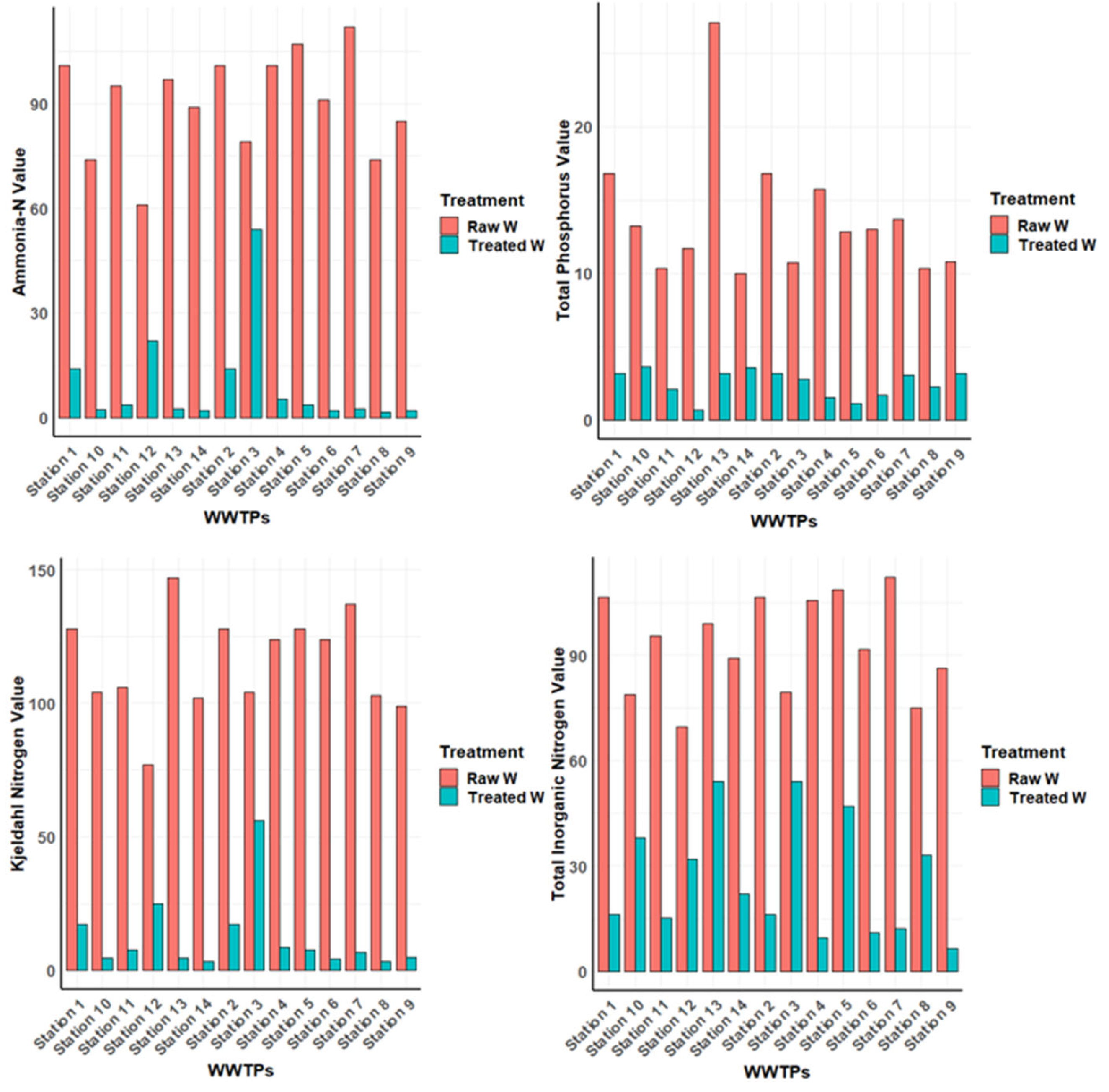
| Ammonia-N (mg/l) | 101 | 14 | 101 | 14 | 79 | 54 | 101 | 5.3 | 107 | 3.7 | 91 | 2.1 | 112 | 2.6 | 74 | 1.62 | 85 | 2 | 74 | 2.3 | 95 | 3.7 | 61 | 22 | 97 | 2.4 | 89 | 2.1 | |||
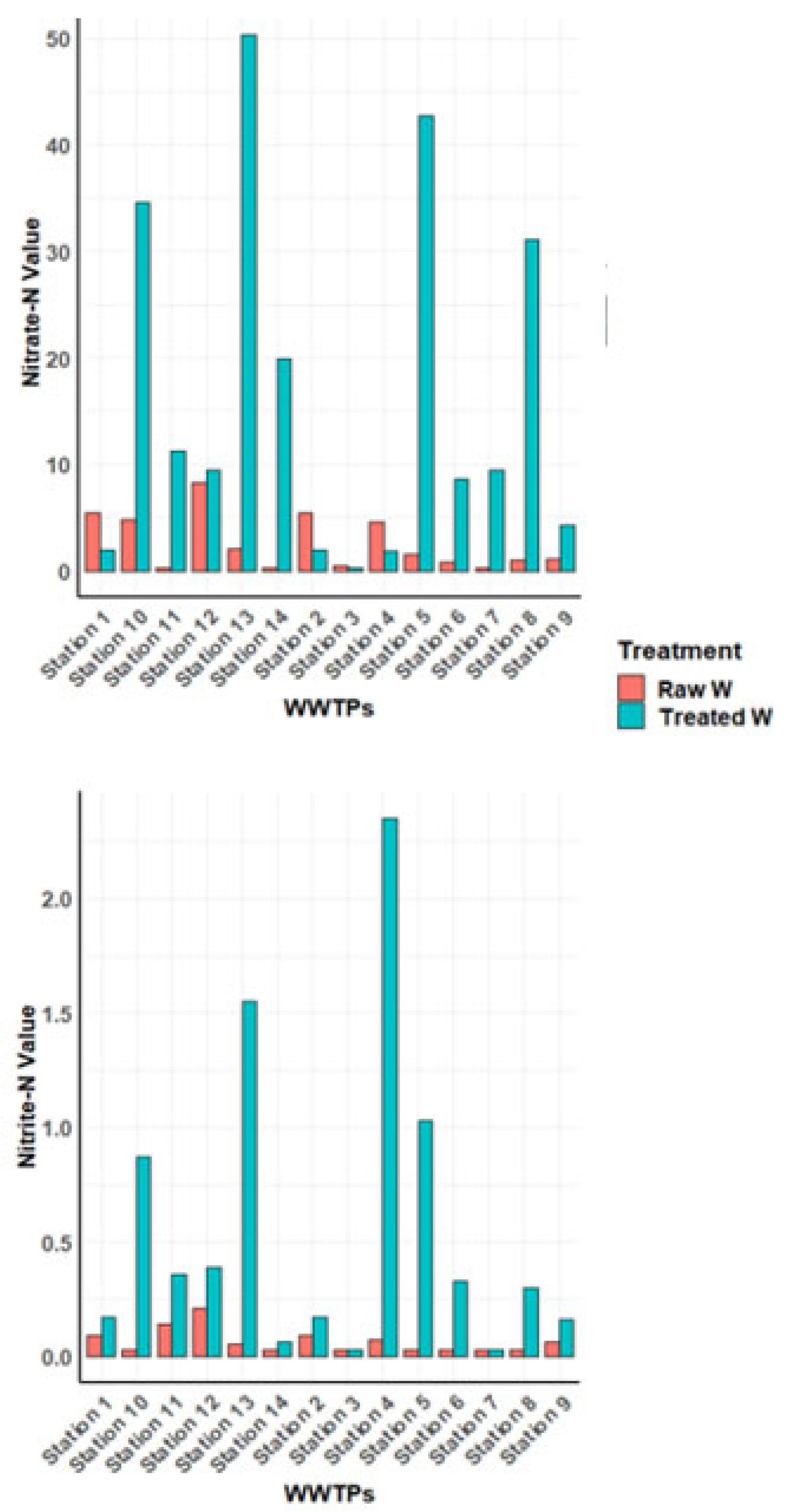
| Nitrate-N (mg/l) | 5.49 | 2 | 5.49 | 2 | 0.54 | 0.2 | 4.56 | 1.88 | 1.55 | 42.7 | 0.83 | 8.61 | 0.24 | 9.51 | 1.07 | 31.1 | 1.2 | 4.3 | 4.8 | 34.6 | 0.3 | 11.2 | 8.26 | 9.4 | 2.02 | 50 | 0.23 | 20 | |||
| Total phosphorus (mg/l) | 16.8 | 3.14 | 16.8 | 3.14 | 10.7 | 2.8 | 15.7 | 1.5 | 12.8 | 1.13 | 13 | 1.68 | 13.7 | 3.04 | 10.3 | 2.28 | 11 | 3.2 | 13 | 3.59 | 10 | 2.08 | 11.7 | 0.7 | 27.1 | 3.2 | 10 | 3.58 | |||
| Kjeldahl-nitrogen (organic N+ammonia-N) mg/l | 128 | 17.1 | 128 | 17.1 | 104 | 56 | 124 | 8.59 | 128 | 7.7 | 124 | 4.29 | 137 | 6.77 | 103 | 3.38 | 99 | 4.8 | 104 | 4.63 | 106 | 7.53 | 77 | 25 | 147 | 4.6 | 102 | 3.27 | |||
| Total inorganic N (mg/l) | 107 | 16.2 | 107 | 16.2 | 79.5 | 54 | 106 | 9.5 | 109 | 47 | 91.8 | 11 | 112 | 12.1 | 75.1 | 33 | 86 | 6.4 | 79 | 38 | 96 | 15.3 | 69.5 | 32 | 99.1 | 54 | 89.2 | 22 | |||
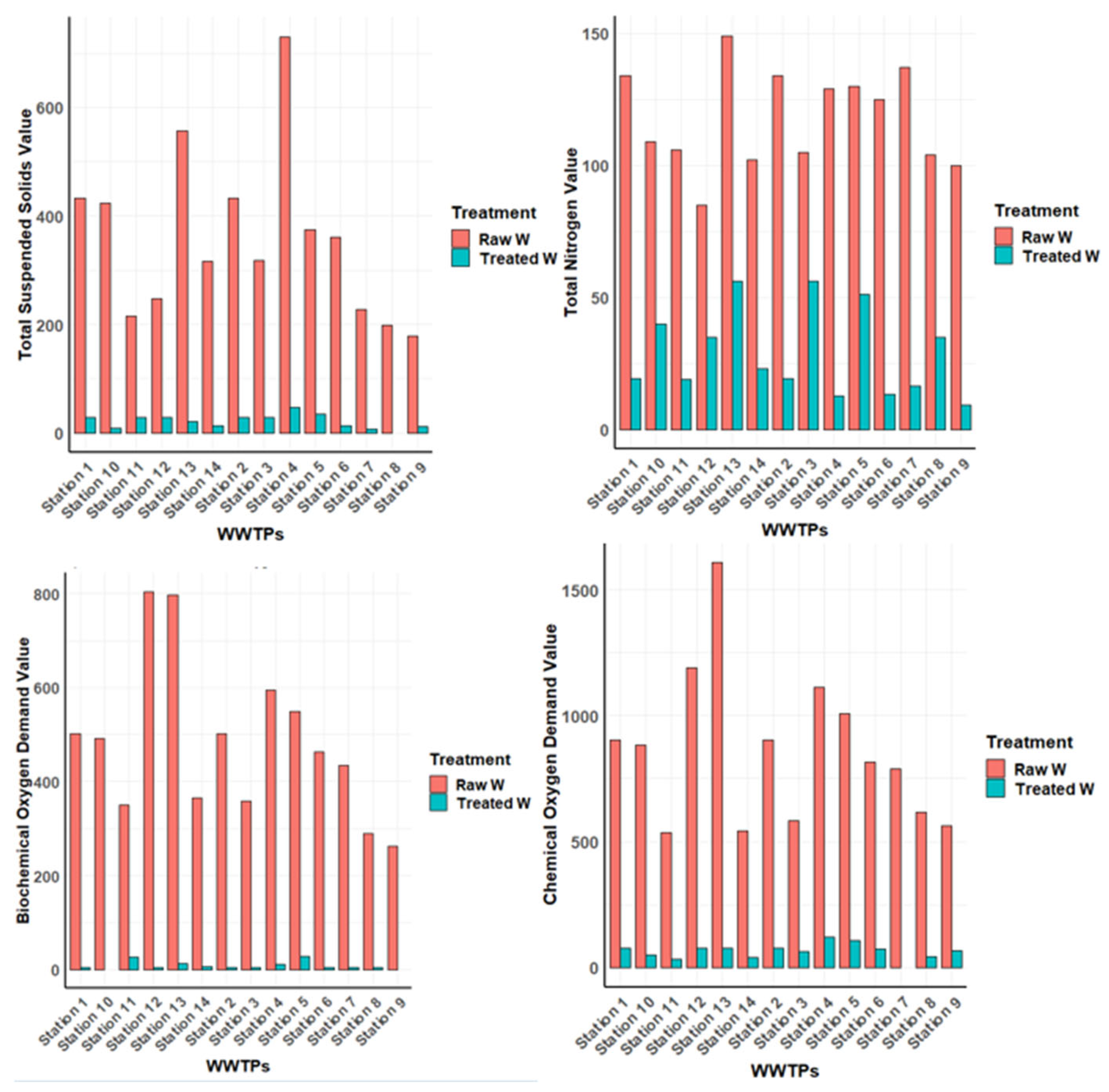
| Total suspended solids (mg/l) | 433 | 28 | 433 | 28 | 318 | 28 | 730 | 47 | 375 | 34 | 361 | 13 | 228 | 7 | 199 | <7 | 179 | 12 | 423 | 8 | 215 | 29 | 248 | 28 | 557 | 21 | 317 | 13 | |||
| Total N (mg/l) | 134 | 19.3 | 134 | 19.3 | 105 | 56 | 129 | 12.8 | 130 | 51 | 125 | 13.2 | 137 | 16.3 | 104 | 35 | 100 | 9.3 | 109 | 40 | 106 | 19.1 | 85 | 35 | 149 | 56 | 102 | 23 | |||
| Biochemical oxygen demand (mg/l) | 502 | 5 | 502 | 5 | 358 | 5 | 594 | 12 | 550 | 28 | 464 | 5 | 435 | 4 | 290 | 4 | 263 | <3 | 492 | <3 | 350 | 26 | 804 | 4 | 797 | 13 | 365 | 6 | |||
| Chemical oxygen demand (mg/l) | 905 | 75 | 905 | 75 | 584 | 64 | 1112 | 119 | 1008 | 106 | 815 | 72 | 787 | <30 | 616 | 44 | 564 | 66 | 883 | 48 | 535 | 31 | 1191 | 75 | 1609 | 75 | 541 | 39 | |||
| Nitrite-N (mg/l) | 0.09 | 0.17 | 0.09 | 0.17 | <0.03 | 0 | 0.07 | 2.35 | <0.03 | 1.03 | <0.03 | 0.33 | <0.03 | <0.03 | <0.03 | 0.3 | 0.1 | 0.2 | 0 | 0.87 | 0.1 | 0.36 | 0.21 | 0.4 | 0.05 | 1.6 | <0.03 | 0.06 | |||
| Physico-chemical parameters | Removal efficiency % | |||||||||||||
|---|---|---|---|---|---|---|---|---|---|---|---|---|---|---|
| 1 | 2 | 3 | 4 | 5 | 6 | 7 | 8 | 9 | 10 | 11 | 12 | 13 | 14 | |
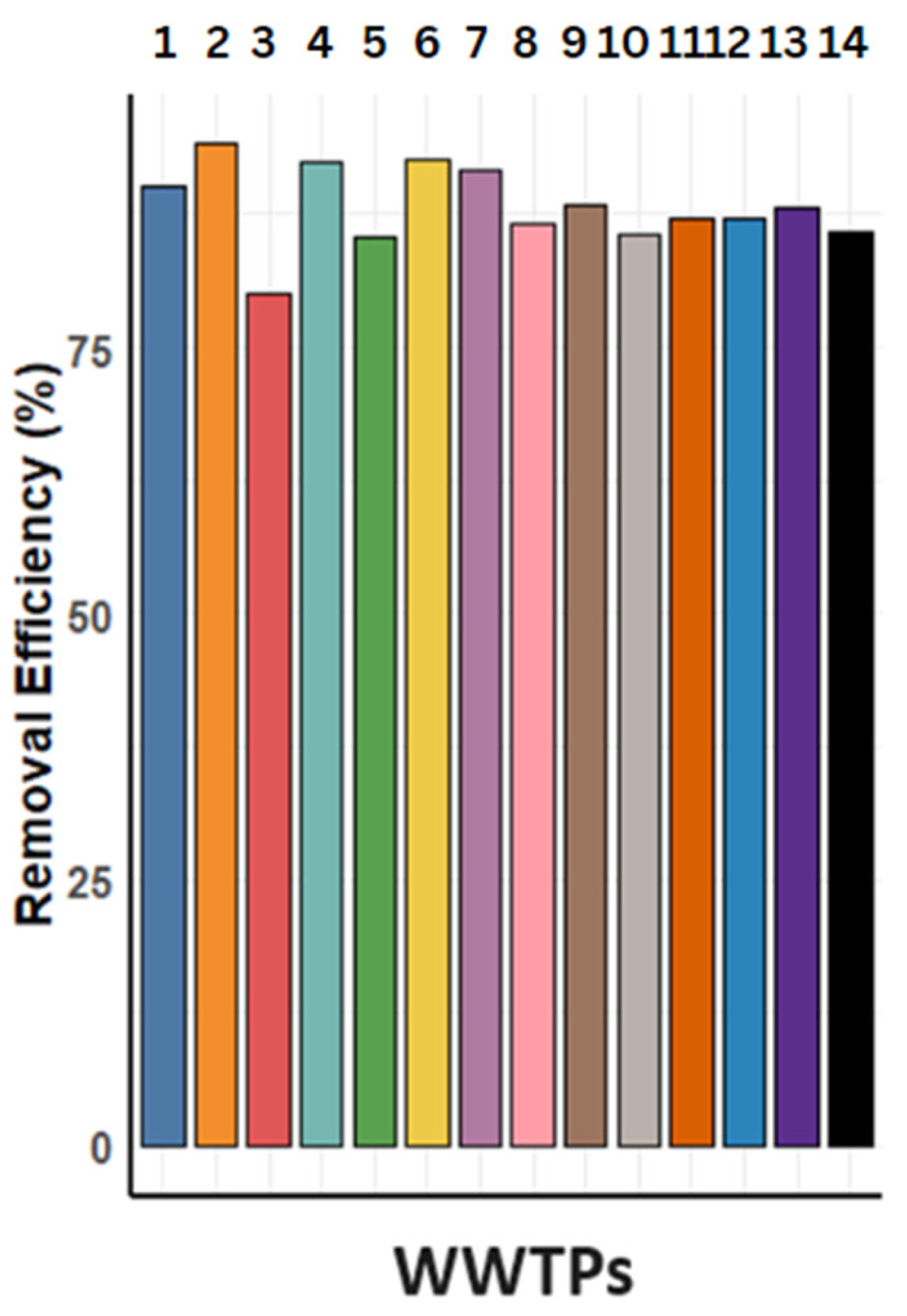
| NH3 | 86.14 | 95.37 | 31.65 | 94.75 | 96.54 | 97.69 | 97.68 | 97.81 | 97.65 | 96.89 | 96.11 | 63.93 | 97.53 | 97.64 |
| NO3 | 63.57 | 0.00 | 57.41 | 58.77 | 0.00 | 0.00 | 0.00 | 0.00 | 0.00 | 0.00 | 0.00 | 0.00 | 0.00 | 0.00 |
| TP | 81.31 | 92.62 | 74.21 | 90.45 | 91.17 | 87.08 | 77.81 | 77.86 | 70.83 | 72.80 | 79.81 | 94.44 | 88.23 | 64.20 |
| TKN | 86.65 | 57.18 | 46.15 | 93.07 | 93.98 | 96.54 | 95.06 | 96.72 | 95.12 | 95.55 | 92.90 | 67.53 | 96.85 | 96.79 |
| TI | 84.80 | 86.59 | 32.08 | 91.01 | 56.72 | 88.02 | 89.22 | 56.06 | 92.58 | 51.78 | 83.98 | 53.96 | 45.51 | 75.34 |
| TSS | 93.53 | 97.84 | 91.19 | 93.56 | 90.93 | 96.40 | 96.93 | 96.98 | 93.30 | 98.11 | 86.51 | 88.71 | 96.23 | 95.90 |
| TN | 85.63 | 89.08 | 46.67 | 90.06 | 60.77 | 89.42 | 88.10 | 66.35 | 90.74 | 63.30 | 81.99 | 58.82 | 62.42 | 77.45 |
| BOD | 99.00 | 98.10 | 98.60 | 97.98 | 94.91 | 98.92 | 99.08 | 98.62 | 99.24 | 99.59 | 92.57 | 99.50 | 98.37 | 98.36 |
| COD | 91.71 | 93.31 | 89.04 | 89.30 | 89.48 | 91.17 | 96.32 | 92.86 | 88.30 | 94.56 | 94.21 | 93.70 | 95.34 | 92.79 |
| NO2− | 0 | 0 | 0 | 0 | 0 | 0 | 0 | 0 | 0 | 0 | 0 | 0 | 0 | 0 |
| WWTPs | Incoming W | Effluents W |
|---|---|---|
| 1 | 5.49 | 2 |
| 2 | 1.48 | 9.06 |
| 3 | 0.54 | 0.23 |
| 4 | 4.59 | 1.88 |
| 5 | 1.55 | 42.68 |
| 6 | 0.83 | 8.61 |
| 7 | 0.24 | 9.51 |
| 8 | 1.07 | 31.08 |
| 9 | 1.17 | 4.27 |
| 10 | 4.78 | 34.59 |
| 11 | 0.33 | 11.2 |
| 12 | 8.26 | 9.43 |
| 13 | 2.02 | 50.3 |
| 14 | 0.23 | 19.95 |
| WWTPs | Raw W | Treated W |
|---|---|---|
| 1 | 0.09 | 0.17 |
| 2 | 0.08 | 0.59 |
| 3 | <0.03 | 0.03 |
| 4 | 0.07 | 2.35 |
| 5 | <0.03 | 1.03 |
| 6 | <0.03 | 0.33 |
| 7 | <0.03 | <0.03 |
| 8 | <0.03 | 0.3 |
| 9 | 0.06 | 0.16 |
| 10 | 0.03 | 0.87 |
| 11 | 0.14 | 0.36 |
| 12 | 0.21 | 0.39 |
| 13 | 0.05 | 1.55 |
| 14 | <0.03 | 0.06 |
| Classes | Sewage Treatment Plants per order | Removal efficiency (RE) |
|---|---|---|
| A | 1.2.4.6.7.9 | Excellent |
| B | 5.8.11.12.13 | Very good |
| C | 3.10.14 | Good enough |
Disclaimer/Publisher’s Note: The statements, opinions and data contained in all publications are solely those of the individual author(s) and contributor(s) and not of MDPI and/or the editor(s). MDPI and/or the editor(s) disclaim responsibility for any injury to people or property resulting from any ideas, methods, instructions or products referred to in the content. |
© 2024 by the authors. Licensee MDPI, Basel, Switzerland. This article is an open access article distributed under the terms and conditions of the Creative Commons Attribution (CC BY) license (http://creativecommons.org/licenses/by/4.0/).


