

Submitted:
29 September 2024
Posted:
30 September 2024
You are already at the latest version
Abstract
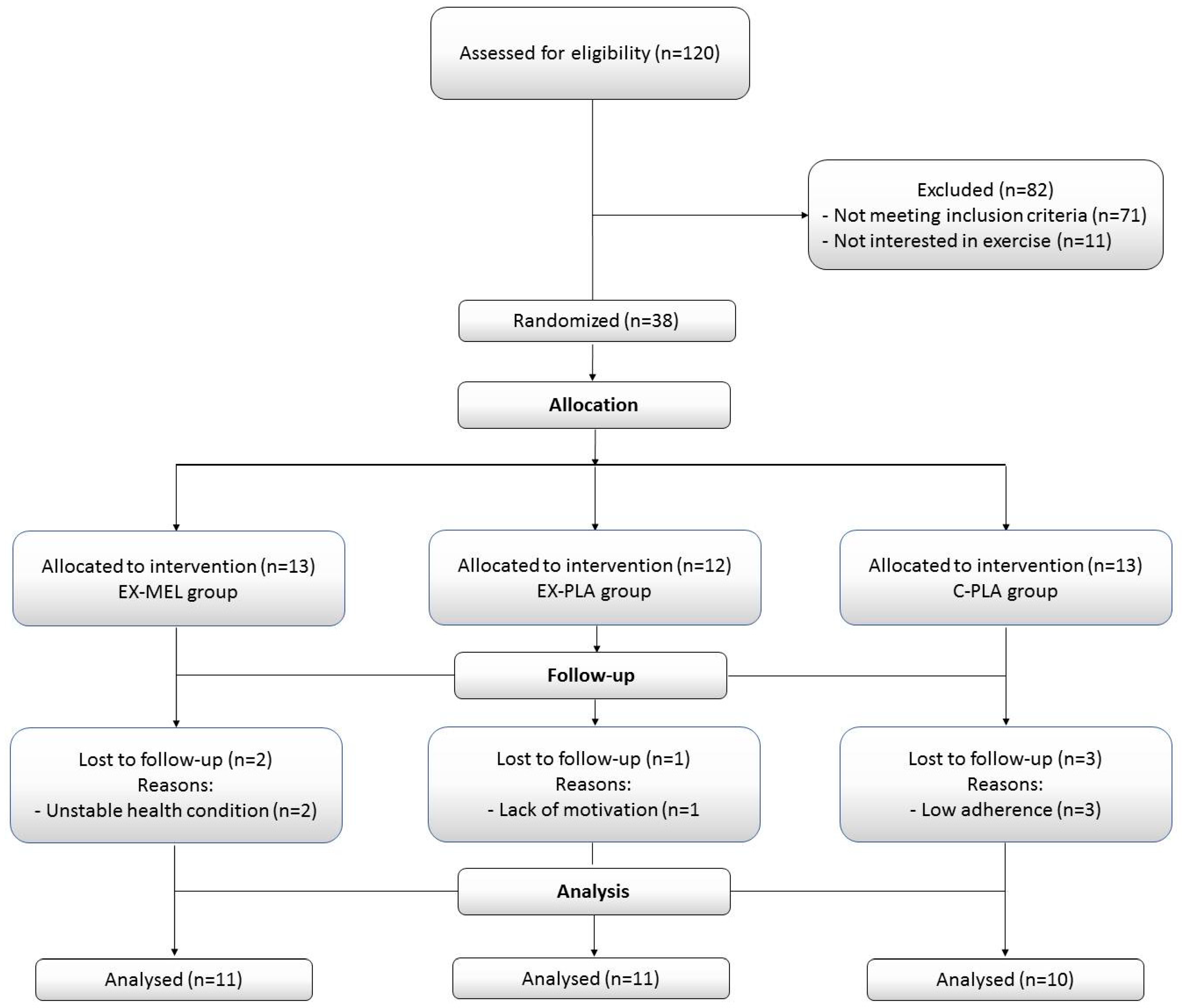
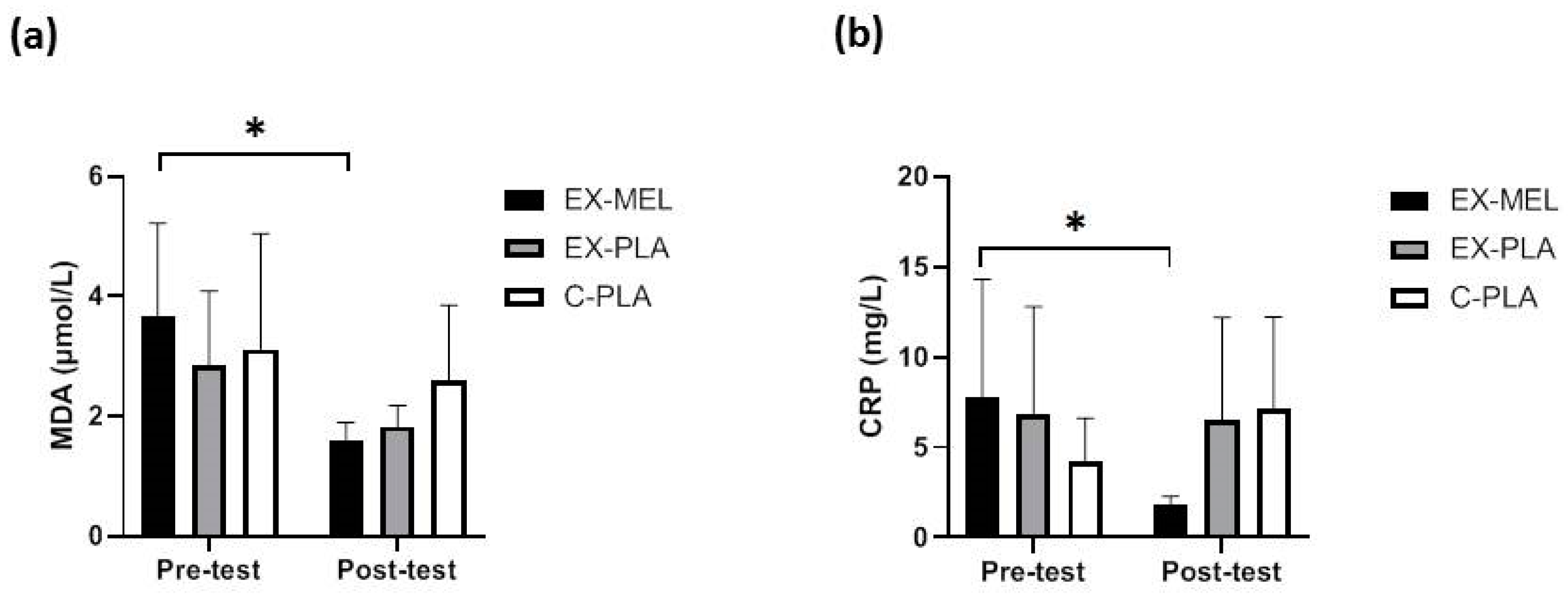
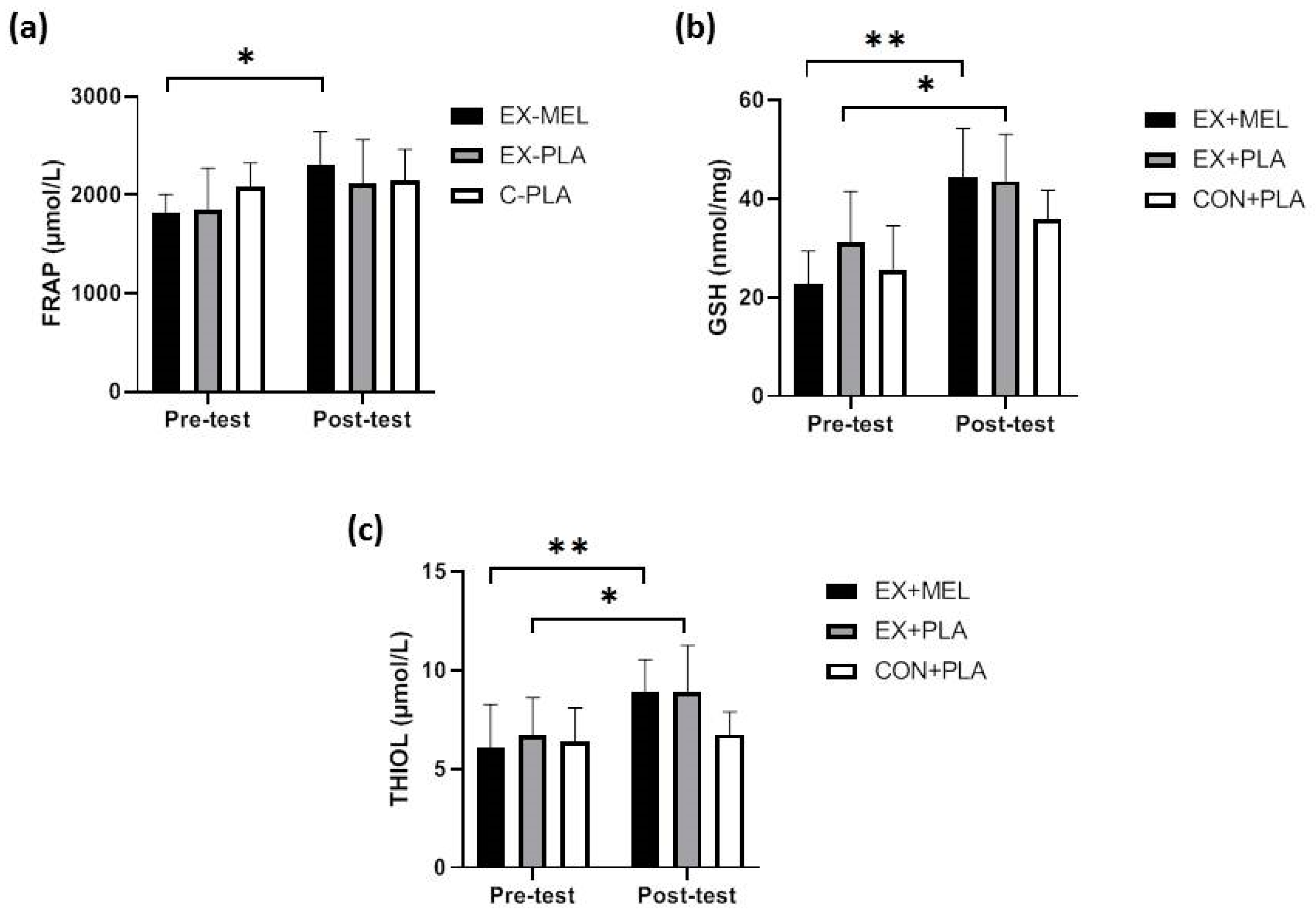
Background: This study aimed to investigate the effects of intradialytic concurrent (resistance-endurance) training combined with melatonin (MEL) supplementation on oxidative stress, inflammation, and cellular damage in hemodialysis (HD) patients. Methods: Thirty-two hemodialysis (HD) patients were randomly assigned to three groups: Exercise (EX)-MEL, EX-Placebo (PLA), and Control (C)-PLA. Participants in the EX-MEL and EX-PLA groups underwent 12 weeks of concurrent training. Before nocturnal sleep, they ingested either 3 mg of MEL (EX-MEL) or a placebo (EX-PLA and C-PLA). Blood samples were collected at baseline and after 12 weeks of intervention to assess lipid peroxidation [malondialdehyde (MDA)], antioxidant biomarkers [ferric reducing antioxidant power (FRAP), reduced glutathione (GSH), total thiol (THIOL)], total bilirubin (TBIL), uric acid (UA), biomarkers of muscle and liver damage [aspartate aminotransferase (ASAT), alanine aminotransferase (ALAT), creatine kinase (CK), lactate dehydrogenase (LDH), Gamma-glutamyltransferase (Gamma-GT)], and inflammation [C-reactive protein (CRP)]. Results: EX-MEL demonstrated a decrease of MDA (p<0.05) and CRP (p<0.05), and an increase of FRAP (p<0.05) pre- and post-training. Both EX-MEL and EX-PLA showed an increase in GSH (p<0.001, and p<0.05, respectively) and THIOL (p<0.01, and p<0.05, respectively) pre- and post-training. No significant changes were observed in TBIL, UA, ASAT, ALAT, CK, LDH, and Gamma-GT pre- and post-training across all groups. Conclusion: Concurrent training combined with MEL supplementation enhances oxidant-antioxidant balance and reduces inflammation in HD patients more effectively than intradialytic concurrent training alone.
Keywords:
1. Introduction
2. Materials and Methods
2.1. Sample Size
2.2. Participants
2.3. Experimental Design
2.4. Concurrent Training Program
2.5. Blood Sampling and Assays
2.5.1. Determination of Lipid Peroxidation (MDA)
2.5.2. Measurement of FRAP Levels
- Principle: This reaction involves the reduction of the ferric tripyridyltriazine complex (TPTZ-Fe3+) to the ferrous form (Fe2+) in an acidic medium by antioxidants present in the sample.
- Required reagents include: Acetate buffer (pH 3.6), which is a mixture of two solutions: 46.3 ml of solution A and 3.7 ml of solution B. Solution A consists of 0.2 M acetic acid (11.55 ml in 1 L of distilled water), with a molar mass of 60.052 g/mol. Solution B consists of 0.2 M sodium acetate (16.4 g sodium acetate in 1 L of distilled water). The reactive mixture (1:1) comprises 20 mM ferric chloride [FeCl3•6H2O] and 10 mM tripyridyltriazine in 40 mM HCl. Ferric sulfate (FeSO4) was used to create the calibration curve [1-0.1 mmol/L]. The method was calibrated using a standard solution of hydrated ferrous sulfate FeSO4•5H2O with concentrations ranging from 0 to 1.5 mM. The reducing capacity of the sample was expressed in equivalents of ferrous ions in plasma (μmol Fe2+/L).
- Calculation: The FRAP concentrations were calculated using the formula [FRAP] (μmol/L) = DO - b/a * 1000, where DO is the optical density, 'a' is the slope of the Fe2+SO4 calibration curve (mmol/L), 'b' is the y-intercept, and 1000 is the conversion factor from mmol to μmol.
2.5.3. Measurement of GSH Levels
2.5.4. Determination of THIOL Levels
2.5.5. Routine Biochemistry Parameters
2.6. Statistical Analysis
3. Results
4. Discussion
5. Conclusions
Author Contributions
Funding
Institutional Review Board Statement
Informed Consent Statement
Acknowledgments
Conflicts of Interest
References
- Daugirdas, J.T.; Depner, T.A.; Inrig, J.; Mehrotra, R.; Rocco, M.V.; Suri, R.S.; Weiner, D.E.; Greer, N.; Ishani, A.; MacDonald, R. KDOQI clinical practice guideline for hemodialysis adequacy: 2015 update. American Journal of Kidney Diseases 2015, 66, 884–930. [Google Scholar] [CrossRef] [PubMed]
- Halliwell, B.; Gutteridge, J.M. Free radicals in biology and medicine; Oxford university press, USA: 2015.
- Stenvinkel, P.; Heimbürger, O.; Paultre, F.; Diczfalusy, U.; Wang, T.; Berglund, L.; Jogestrand, T. Strong association between malnutrition, inflammation, and atherosclerosis in chronic renal failure. Kidney international 1999, 55, 1899–1911. [Google Scholar] [CrossRef] [PubMed]
- Daenen, K.; Andries, A.; Mekahli, D.; Van Schepdael, A.; Jouret, F.; Bammens, B. Oxidative stress in chronic kidney disease. Pediatric nephrology 2019, 34, 975–991. [Google Scholar] [CrossRef] [PubMed]
- Marzougui, H.; Maaloul, R.; Ben Dhia, I.; Toumi, S.; Kammoun, K.; Ben Hmida, M.; Ayadi, F.; Turki, M.; Elleuch, M.H.; Ghroubi, S. Effects of intradialytic exercise in combination with melatonin supplementation on functional capacity, postural balance, and quality of life in hemodialysis patients. Therapeutic Apheresis and Dialysis 2023, 27, 669–681. [Google Scholar] [CrossRef]
- Cheema, B.S.B.; Fiatarone Singh, M.A. Exercise training in patients receiving maintenance hemodialysis: a systematic review of clinical trials. American journal of nephrology 2005, 25, 352–364. [Google Scholar] [CrossRef]
- Smart, N.A.; Williams, A.D.; Levinger, I.; Selig, S.; Howden, E.; Coombes, J.S.; Fassett, R.G. Exercise & Sports Science Australia (ESSA) position statement on exercise and chronic kidney disease. Journal of Science and Medicine in Sport 2013, 16, 406–411. [Google Scholar]
- Wilund, K.R.; Tomayko, E.J.; Wu, P.-T.; Ryong Chung, H.; Vallurupalli, S.; Lakshminarayanan, B.; Fernhall, B. Intradialytic exercise training reduces oxidative stress and epicardial fat: a pilot study. Nephrology Dialysis Transplantation 2010, 25, 2695–2701. [Google Scholar] [CrossRef]
- Parsons, T.L.; Toffelmire, E.B.; King-VanVlack, C.E. Exercise training during hemodialysis improves dialysis efficacy and physical performance. Archives of physical medicine and rehabilitation 2006, 87, 680–687. [Google Scholar] [CrossRef]
- Reiter, R.J., et al., Peripheral reproductive organ health and melatonin: ready for prime time. International journal of molecular sciences, 2013. 14(4): p. 7231-7272.
- Marzougui, H., et al., Melatonin ingestion before intradialytic exercise improves immune responses in hemodialysis patients. International Urology and Nephrology, 2021. 53: p. 553-562.
- Marzougui, H. , et al., Melatonin intake before intradialytic exercise reverses oxidative stress and improves antioxidant status in hemodialysis patients. The International Journal of Artificial Organs, 2023. 46(5): p. 264-273.
- Beck, T.W. The importance of a priori sample size estimation in strength and conditioning research. The Journal of Strength & Conditioning Research 2013, 27, 2323–2337. [Google Scholar]
- Faul, F.; Erdfelder, E.; Lang, A.-G.; Buchner, A. G* Power 3: A flexible statistical power analysis program for the social, behavioral, and biomedical sciences. Behavior research methods 2007, 39, 175–191. [Google Scholar] [CrossRef]
- Association, W.M. World Medical Association Declaration of Helsinki. Ethical principles for medical research involving human subjects. Bulletin of the World Health Organization 2001, 79, 373. [Google Scholar]
- Koch, B.C.; Nagtegaal, J.E.; Hagen, E.C.; Van Der Westerlaken, M.M.; Boringa, J.B.; Kerkhof, G.A.; Ter Wee, P.M. The effects of melatonin on sleep–wake rhythm of daytime haemodialysis patients: a randomized, placebo-controlled, cross-over study (EMSCAP study). British journal of clinical pharmacology 2009, 67, 68–75. [Google Scholar] [CrossRef] [PubMed]
- Russcher, M.; Koch, B.C.; Nagtegaal, J.E.; van Ittersum, F.J.; Pasker-de Jong, P.C.; Hagen, E.C.; van Dorp, W.T.; Gabreëls, B.; Wildbergh, T.X.; van der Westerlaken, M.M. Long-term effects of melatonin on quality of life and sleep in haemodialysis patients (M elody study): a randomized controlled trial. British journal of clinical pharmacology 2013, 76, 668–679. [Google Scholar] [CrossRef] [PubMed]
- Gellish, R.L.; Goslin, B.R.; Olson, R.E.; McDONALD, A.; Russi, G.D.; Moudgil, V.K. Longitudinal modeling of the relationship between age and maximal heart rate. Medicine and science in sports and exercise 2007, 39, 822–829. [Google Scholar] [CrossRef]
- Borg, G.A. Psychophysical bases of perceived exertion. Medicine and science in sports and exercise 1982, 14, 377–381. [Google Scholar] [CrossRef]
- Wong, S.; Knight, J.A.; Hopfer, S.; Zaharia, O.; Leach Jr, C.N.; Sunderman Jr, F.W. Lipoperoxides in plasma as measured by liquid-chromatographic separation of malondialdehyde-thiobarbituric acid adduct. Clinical chemistry 1987, 33, 214–220. [Google Scholar] [CrossRef]
- Płonka-Półtorak, E.; Zagrodzki, P.; Chłopicka, J.; Bartoń, H.; Westermarck, T.; Kaipainen, P.; Kaski, M.; Atroshi, F. Valproic acid modulates superoxide dismutase, uric acid-independent FRAP and zinc in blood of adult epileptic patients. Biological trace element research 2011, 143, 1424–1434. [Google Scholar] [CrossRef]
- Akarsu, S.; Bolu, A.; Aydemir, E.; Zincir, S.B.; Kurt, Y.G.; Zincir, S.; Erdem, M.; Uzun, Ö. The relationship between the number of manic episodes and oxidative stress indicators in bipolar disorder. Psychiatry investigation 2018, 15, 514. [Google Scholar] [CrossRef]
- Jollow, D.; Mitchell, J.; Zampaglione, N.a.; Gillette, J. Bromobenzene-induced liver necrosis. Protective role of glutathione and evidence for 3, 4-bromobenzene oxide as the hepatotoxic metabolite. Pharmacology 1974, 11, 151–169. [Google Scholar] [CrossRef]
- Hu, M.-L. [41] Measurement of protein thiol groups and glutathione in plasma. In Methods in enzymology, Elsevier: 1994; Vol. 233, pp. 380-385.
- Watson, D. Analytic methods for bilirubin in blood plasma. Clinical Chemistry 1961, 7, 603–625. [Google Scholar] [CrossRef]
- SUzUKI, M.; TAKAYANAGI, M.; YASHIRO, T. Use of the o-phenylenediamine fluorescence system in the enzymatic assay of serum uric acid. Chemical and pharmaceutical bulletin 1991, 39, 2745–2747. [Google Scholar] [CrossRef] [PubMed]
- Nealon, D.; Henderson, A. N-Acetyl-L-cysteine as a reactivator of creatine kinase. Clinical chemistry 1977, 23, 618–618. [Google Scholar] [CrossRef] [PubMed]
- Siekmann, L.; Bonora, R.; Burtis, C.A.; Ceriotti, F.; Clerc-Renaud, P.; Férard, G.; Ferrero, C.A.; Forest, J.-C.; Franck, P.F.; Gella, F.-J. IFCC primary reference procedures for the measurement of catalytic activity concentrations of enzymes at 37 C. Part 7. Certification of four reference materials for the determination of enzymatic activity of γ-glutamyltransferase, lactate dehydrogenase, alanine aminotransferase and creatine kinase according to IFCC reference procedures at 37 C. 2002.
- Dupuy, A.M.; Badiou, S.; Descomps, B.; Cristol, J.P. Immunoturbidimetric determination of C-reactive protein (CRP) and high-sensitivity CRP on heparin plasma. Comparison with serum determination. Walter de Gruyter: 2003.
- Cohen, J. Statistical power analysis for the behavioral sciences; routledge: 2013.
- Storer, T.W.; Casaburi, R.; Sawelson, S.; Kopple, J.D. Endurance exercise training during haemodialysis improves strength, power, fatigability and physical performance in maintenance haemodialysis patients. Nephrology Dialysis Transplantation 2005, 20, 1429–1437. [Google Scholar] [CrossRef]
- Koufaki, P.; Mercer, T.H.; Naish, P.F. Effects of exercise training on aerobic and functional capacity of end-stage renal disease patients. Clinical physiology and functional imaging 2002, 22, 115–124. [Google Scholar] [CrossRef]
- Mustata, S.; Groeneveld, S.; Davidson, W.; Ford, G.; Kiland, K.; Manns, B. Effects of exercise training on physical impairment, arterial stiffness and health-related quality of life in patients with chronic kidney disease: a pilot study. International urology and nephrology 2011, 43, 1133–1141. [Google Scholar] [CrossRef]
- Johansen, K.L.; Painter, P.L.; Sakkas, G.K.; Gordon, P.; Doyle, J.; Shubert, T. Effects of resistance exercise training and nandrolone decanoate on body composition and muscle function among patients who receive hemodialysis: a randomized, controlled trial. Journal of the American Society of Nephrology 2006, 17, 2307–2314. [Google Scholar] [CrossRef]
- Gomes, E.C.; Silva, A.N.; Oliveira, M.R.d. Oxidants, antioxidants, and the beneficial roles of exercise-induced production of reactive species. Oxidative medicine and cellular longevity 2012, 2012, 756132. [Google Scholar] [CrossRef]
- Powers, S.K.; Jackson, M.J. Exercise-induced oxidative stress: cellular mechanisms and impact on muscle force production. Physiological reviews 2008, 88, 1243–1276. [Google Scholar] [CrossRef]
- Powers, S.K.; Duarte, J.; Kavazis, A.N.; Talbert, E.E. Reactive oxygen species are signalling molecules for skeletal muscle adaptation. Experimental physiology 2010, 95, 1–9. [Google Scholar] [CrossRef]
- Done, A.J.; Traustadóttir, T. Nrf2 mediates redox adaptations to exercise. Redox biology 2016, 10, 191–199. [Google Scholar] [CrossRef]
- Brown, D.I.; Griendling, K.K. Regulation of signal transduction by reactive oxygen species in the cardiovascular system. Circulation research 2015, 116, 531–549. [Google Scholar] [CrossRef] [PubMed]
- Marzougui, H.; Hammouda, O.; Dhia, I.B.; Maaloul, R.; Agrebi, I.; Chaker, H.; Kammoun, K.; Hmida, M.B.; Ayadi, F.; Kallel, C. Melatonin ingestion before intradialytic exercise improves immune responses in hemodialysis patients. International Urology and Nephrology 2021, 53, 553–562. [Google Scholar] [CrossRef] [PubMed]
- Reiter, R.J.; Tan, D.-x.; Mayo, J.C.; Sainz, R.M.; Leon, J.; Czarnocki, Z. Melatonin as an antioxidant: biochemical mechanisms and pathophysiological implications in humans. Acta Biochimica Polonica 2003, 50, 1129–1146. [Google Scholar] [CrossRef]
- Pandi-Perumal, S.R.; Srinivasan, V.; Maestroni, G.; Cardinali, D.P.; Poeggeler, B.; Hardeland, R. Melatonin: Nature's most versatile biological signal? The FEBS journal 2006, 273, 2813–2838. [Google Scholar] [CrossRef]
- Hardeland, R. Atioxidative protection by melatonin: Multiplicity of mechanisms from radical detoxification to radical avoidance. Endocrine 2005, 27, 119–130. [Google Scholar] [CrossRef]
- Carrillo-Vico, A.; Lardone, P.J.; Álvarez-Sánchez, N.; Rodríguez-Rodríguez, A.; Guerrero, J.M. Melatonin: buffering the immune system. International journal of molecular sciences 2013, 14, 8638–8683. [Google Scholar] [CrossRef]
- Stocker, R.; Yamamoto, Y.; McDonagh, A.F.; Glazer, A.N.; Ames, B.N. Bilirubin is an antioxidant of possible physiological importance. Science 1987, 235, 1043–1046. [Google Scholar] [CrossRef]
- Vitek, L.; Ostrow, J.D. Bilirubin chemistry and metabolism; harmful and protective aspects. Current pharmaceutical design 2009, 15, 2869–2883. [Google Scholar] [CrossRef]
- Johnson, R.J.; Lanaspa, M.A.; Gaucher, E.A. Uric acid: a danger signal from the RNA world that may have a role in the epidemic of obesity, metabolic syndrome, and cardiorenal disease: evolutionary considerations. In Proceedings of Seminars in nephrology; pp. 394-399.
- Feig, D.I.; Johnson, R.J. Hyperuricemia in childhood primary hypertension. hypertension 2003, 42, 247–252. [Google Scholar] [CrossRef]
- Choi, Y.J.; Yoon, Y.; Lee, K.Y.; Hien, T.T.; Kang, K.W.; Kim, K.C.; Lee, J.; Lee, M.Y.; Lee, S.M.; Kang, D.H. Uric acid induces endothelial dysfunction by vascular insulin resistance associated with the impairment of nitric oxide synthesis. The FASEB Journal 2014, 28, 3197–3204. [Google Scholar] [CrossRef]
- Fowler Jr, W.; Gardner, G.; Kazerunian, H.; Lauvstad, W. The effect of exercise on serum enzymes. Archives of physical medicine and rehabilitation 1968, 49, 554–565. [Google Scholar]
- Nathwani, R.A.; Pais, S.; Reynolds, T.B.; Kaplowitz, N. Serum alanine aminotransferase in skeletal muscle diseases. Hepatology 2005, 41, 380–382. [Google Scholar] [CrossRef]

| Characteristic | EX-MEL (n=11) | EX-PLA (n=11) | C-PLA (n=10) | P-value |
|---|---|---|---|---|
| Sex (Male/Female) | 8/3 | 7/4 | 4/6 | |
| Age (years) | 49.27 ± 10.23 | 49.00 ± 12.51 | 41.00 ± 9.68 | 0.88 |
| Height (cm) | 166.72 ± 7.01 | 166.00 ± 9.48 | 162.70 ± 10.62 | 0.79 |
| Dry weight (kg) | 61.95 ± 6.22 | 63.44 ± 6.66 | 65.20 ± 14.36 | 0.83 |
| BMI (kg/m2) | 22.37 ± 2.79 | 23.25 ± 3.99 | 24.54 ± 3.99 | 0.60 |
| Hemodialysis (months) | 105.68 ± 18.78 | 115.79 ± 28.48 | 124.50 ± 24.37 | 0.67 |
| Urea (mmol/l) | 22.21 ± 5.10 | 21.94 ± 4.41 | 27,99± 6.03.47 | 0.29 |
| Creatinine (µmol/l) | 944.09 ± 158.75 | 976.90 ± 205.99 | 992.06± 157.04 | 0.47 |
| Primary disease (n) | ||||
|
4 3 2 2 |
3 4 3 1 |
2 3 2 3 |
| Variables | EX-MEL (n=11) | EX-PLA (n=11) | C-PLA (n=10) | Anova | |||||
|---|---|---|---|---|---|---|---|---|---|
| Pre | Post | Pre | Post | Pre | Post | Groups effect F(2,30) (p; ηp2) |
Time effect F(1,31) (p; ηp2) |
Interaction F(2,30) (p; ηp2) |
|
| CK (U/L) | 73.90 ± 28.66 |
80.36 ± 31.63 |
86.36 ± 36.15 |
88.90 ± 39.41 |
69.1 ± 32.96 |
88.90 ± 36.66 |
0.52 (p = 0.60; 0.05) | 2.00 (p = 0.19; 0.18) | 1.34 (p = 0.28; 0.13) |
| LDH (UI/L) | 167.90 ± 25.52 |
162.09 ± 22.63 |
186.45 ± 41.12 |
181.63 ± 44.02 |
183.90 ± 44.76 |
187.10 ± 46.04 |
1.05 (p = 0.37; 0.10) | 0.18 (p = 0.67; 0.02) | 0.30 (p = 0.73; 0.03) |
| ASAT (U/L) | 14.15 ± 6.76 |
11.79 ± 4.38 |
11.90 ± 4.91 |
11.78 ± 6.81 |
10.80 ± 4.06 |
13.89 ± 5.78 |
0.02 (p = 0.98; 0.002) | 0.001 (p = 0.96; 0.0002) | 4.16 (p = 0.03; 0.31) |
| ALAT (U/L) | 11.75 ± 6.39 |
9.46 ± 3.86 |
8.66 ± 5.69 |
8.47 ± 4.03 |
4.46 ± 2.48 |
10.46 ± 4.08 |
1.20 (p = 0.32; 0.11) | 0.52 (p = 0.48; 0.05) | 9.13 (p < 0.01; 0.50) |
| Gamma-GT (IU/L) | 28.27 ± 15.57 |
24.09 ± 15.67 |
25.63 ± 15.53 |
20.27 ± 10.86 |
22.60 ± 9.14 |
18.70 ± 4.66 |
0.34 (p = 0.70; 0.03) | 9.79 (p < 0.01; 0.52) | 0.08 (p = 0.91; 0.009) |
| TBIL (µmol/l) | 4.90 ± 0.70 |
5.54 ± 1.57 |
5.09 ± 1.70 |
4.90 ± 1.30 |
4.10 ± 1.10 |
4.90 ± 1.37 |
0.88 (p = 0.43; 0.08) | 3.31 (p = 0.10; 0.26) | 1.75 (p = 0.20; 0.16) |
| UA (µmol/l) | 370.45 ± 72.81 |
319.36 ± 85.16 |
391.09 ± 84.31 |
376.27 ± 78.22 |
372.30 ± 62.73 |
349.40 ± 41.16 |
1.23 (p = 0.31; 0.12) | 3.68 (p = 0.08; 0.29) | 0.66 (p = 0.52; 0.06) |
Disclaimer/Publisher’s Note: The statements, opinions and data contained in all publications are solely those of the individual author(s) and contributor(s) and not of MDPI and/or the editor(s). MDPI and/or the editor(s) disclaim responsibility for any injury to people or property resulting from any ideas, methods, instructions or products referred to in the content. |
© 2024 by the authors. Licensee MDPI, Basel, Switzerland. This article is an open access article distributed under the terms and conditions of the Creative Commons Attribution (CC BY) license (http://creativecommons.org/licenses/by/4.0/).