
Submitted:
20 August 2024
Posted:
22 August 2024
You are already at the latest version
Abstract
As Large Language Models (LLMs) increasingly accommodate larger inputs, context windows spanning hundreds of thousands or even millions of tokens are touted as promising for a wide array of applications. However, the potential decay in reasoning ability for larger inputs may compromise their utility. This study introduces a new benchmark called Find the Origin, which progressively tests the efficacy of LLMs on a simple intellectual task as the size of the context window increases. The test, conducted on 14 different LLMs for comparative analysis, demonstrated that reasoning ability is dependent on input size. Additionally, three independent tests were performed with the GPT-4 Turbo model to demonstrate its reasoning degradation in different contexts as input size increases.
Keywords:
Large Language Models
; Context Window
; Reasoning Ability
1. Introduction
The human brain employs various mechanisms to maintain and direct attention. Selective attention is a process whereby neurons enhance the processing of relevant sensory information while filtering out irrelevant stimuli, enabling tasks such as focusing on a conversation in a noisy environment. The thalamus plays a fundamental role in this process [6].
In contrast, the attention mechanism in transformers operates quite differently [7]. Common benchmarks for comparing LLM performance, such as MMLU, HellaSwag, and HumanEval, among others, typically utilize small context windows. To effectively evaluate performance with large context windows, it is crucial to test LLMs using benchmarks that explore different aspects of attention and reasoning across varying input token quantities.
2. Related Work
Some benchmarks have been developed to assess LLM performance with varying input sizes. These tests evaluate different aspects of language model capabilities, from simple information retrieval to more complex reasoning tasks.
The Needle in a Haystack test is a popular benchmark that assesses an LLM’s ability to locate and recite specific information embedded within a lengthy text [2]. Many LLMs demonstrate near-perfect accuracy in this task, even with inputs exceeding 100,000 tokens. However, this test primarily evaluates information retrieval rather than reasoning or autonomous decision-making in selecting relevant information for task completion.
LongICLBench offers a more nuanced evaluation by providing the LLM with a series of examples and asking it to predict the label of a new instance based on these examples. This benchmark has revealed a significant performance degradation when input sizes exceed 20,000 tokens, specifically testing the model’s in-context learning capabilities [4].
The FLenQA dataset focuses on simple logical reasoning tasks while systematically increasing input size by introducing irrelevant text. Tests are conducted with inputs of 250, 500, 1000, 2000, and 3000 tokens, demonstrating a consistent decline in performance as input size grows [3]. The dataset includes three types of logical reasoning tasks, involving concepts commonly found in logic tests (e.g., transitive relationships) and theorem-proving rules.
Each of these benchmarks provides valuable insights into different aspects of LLM performance across varying input sizes. However, they also highlight the need for more comprehensive evaluations that can assess both information retrieval and complex reasoning abilities in the context of increasingly large inputs.
3. Problem Definition
When reading a long text, it often becomes necessary to cross-reference information from different sections to gain insight. The human brain can not only retain recently acquired information but also organize it logically. Reasoning capability is then employed on this information, resulting in insights.
LLMs have demonstrated some capacity to condense and organize information, as well as reason about it. However, this capacity deteriorates with longer texts, making it even more challenging to evaluate the cognitive potential of an LLM.
Maintaining coherence, memory, and reasoning capacity when dealing with long inputs is necessary for various promising tasks such as:
Research: Papers are written based on other papers. Nuances and insights need to be extracted from reading lengthy content. Formulations and hypothesis testing must be remembered to avoid redundancies and enable new approaches.
Autonomous agents: When performing different functions sequentially, making decisions about next steps, and creating new plans, it is crucial to remember previous stages, maintain a concise status of the overall scenario, and logically organize partial objectives. This quickly increases the size of the context window as the agent progresses towards the final goal.
Coordination and management: Institutions and systems function based on multiple agents. To effectively distribute tasks and coordinate agents, it may be necessary to analyze a large set of information.
If we consider the amount of information that a human consults and memorizes in their short-term work, it seems reasonable that hundreds of thousands or millions of tokens in the context window would be sufficient to enable the realization of the applications mentioned above. Thus, the current barrier is not in allowing larger inputs, but in improving reasoning capacity, especially when long inputs are presented.
Given the degradation of reasoning with longer inputs, it becomes necessary to create benchmarks that capture this effect. This will allow new LLMs, with increasingly higher limits of input token quantity, to be tested for cognitive consistency as a function of input size.
A suitable benchmark in this case should require a level of reasoning that is independent of input size. Requesting the interpretation of large texts instead of short ones, or solving mathematical problems with many variables instead of few, may result in increased complexity, which diverges from the objective of this study.
Given that LLMs are trained with immense amounts of content, testing them with problems very similar to abundant examples in books and on the web may distort the assessment of their real capacity to maintain attention on what truly matters.
4. Methodology
The Find the Origin test requires the model to identify the origin vertex from a list of connections.
Example prompt:
Several words below are interconnected. For example:
"X" is connected to "Y"
"Y" is connected to "Z"
In this scenario, the origin of "Z" is "X". We can visualize these connections as vertices and edges, like this:
X"–> "Y"–> "Z"
Using this logic, consider the following list of connections, where each word is simply the name of a vertex with no other semantic meaning:
"precious" is connected to "rejected"
"rejected" is connected to "appropriations"
"workbench" is connected to "dad"
"dad" is connected to "admire"
"bushes" is connected to "tight"
"tight" is connected to "partner"
Your task is to find the origin of "admire". Work carefully, step by step. Your final answer must be in this format: FINAL ANSWER: YOUR ANSWER
It is straightforward to verify that the origin of "admire" is "workbench" in the example above. Modern LLMs can easily arrive at this answer.
The response generated by GPT-4 Turbo, with the temperature parameter set to 0, is as follows:
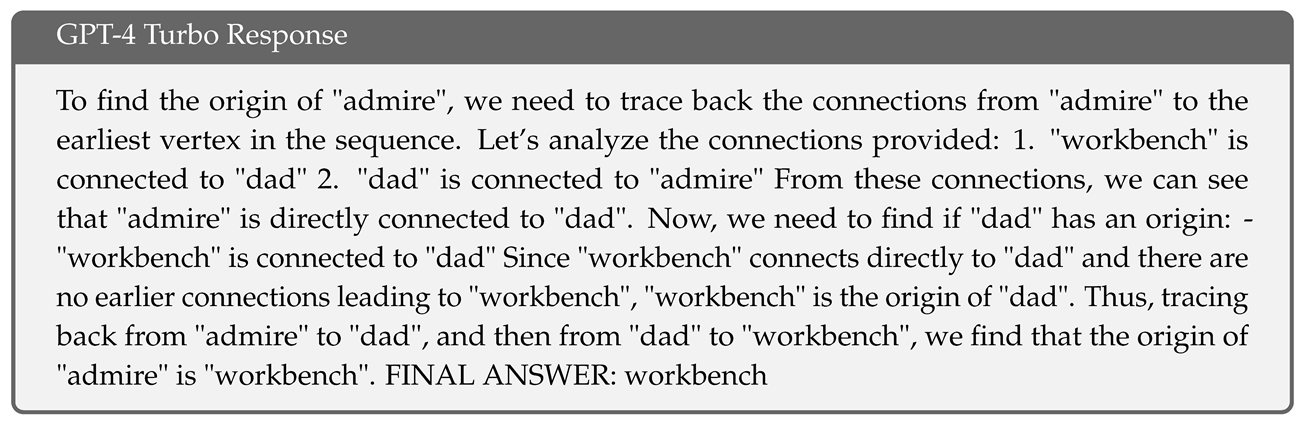
We can increase the size of the context window by introducing more vertices while maintaining the difficulty level.
The difficulty level (complexity) of the Find the Origin test may depend on:
A) Number of connections. In the example above, each origin vertex reaches a destination with only two connections.
B) Distance between connections. In the example above, the destination vertex "admire" is immediately below the origin vertex "workbench". To quantify this relationship, a distance parameter d is defined, with d=1 in this scenario. If the destination vertex is positioned on the second line below the origin vertex, d=2.
Example of Find the Origin with d=2:
...
"precious" is connected to "rejected"
"workbench" is connected to "dad"
"rejected" is connected to "appropriations"
"dad" is connected to "admire"
...
C) Order between connections. When the destination vertex is below the origin vertex, as in example 1, it results in a positive d value. Conversely, if the destination vertex is above the origin vertex, d is negative. Example of Find the Origin with d=-1:
...
"rejected" is connected to "appropriations"
"precious" is connected to "rejected"
"dad" is connected to "admire"
"workbench" is connected to "dad"
...
This study consistently uses only two connections between the origin and destination vertices, as this is sufficient to demonstrate that LLMs fail to obtain the correct answer well before reaching their context window limit. The parameter d is gradually varied from -15 to +15. For each value of d, the size of the context window is varied (introducing more vertices) while keeping the rest of the prompt intact.
Not only the target vertices ("workbench" is connected to "dad"; "dad" is connected to "admire"), but also all irrelevant vertices are arranged respecting the distance value d between origin and destination.
As the context window expands, irrelevant vertices are incrementally inserted above and below the target vertices, ensuring that the target vertices remain centrally located relative to the overall number of lines.
In this study, Llama models were implemented using 8-bit floating-point precision (FP8), while other models were executed with 16-bit precision (FP16). The original findings presented in the Llama model’s publication suggested that the performance discrepancy between FP8 and FP16 was negligible [1].
To ensure reproducibility and transparency, the complete Python code used for generating the prompts and conducting this benchmark is available on GitHub. Interested readers and researchers can access the code repository to view all scripts, analyze the methodologies employed, and reproduce the tests under similar or varied conditions. This repository also includes detailed documentation to assist in understanding and executing the code effectively.
The GitHub repository can be accessed via the following link: https://github.com/natanaelwf/LLMTest_FindTheOrigin.
The specific versions of the proprietary models used are as follows:
GPT4o: gpt-4o-2024-05-13
GPT4o-mini: gpt-4o-mini-2024-07-18
GPT4 Turbo: gpt-4-turbo-2024-04-09
GPT4-1106: gpt-4-1106-preview
GPT3.5: gpt-3.5-turbo-0125
Gemini-Pro: gemini-1.5-pro-001
Gemini-Flash: gemini-1.5-flash-001
Haiku-3: claude-3-haiku-20240307
Sonnet-3: claude-3-sonnet-20240229
Opus-3: claude-3-opus-20240229
Sonnet-3.5: claude-3-5-sonnet-20240620
5. Results
Figure 1 displays the results, with correct answers in green and incorrect answers in red, for each model when varying the context window from 166 to 10,069 tokens. Each sample represents an increment of 8 lines relative to the preceding prompt, which corresponds to approximately 84 tokens.
As the distance between the origin and destination vertices increases, performance more rapidly degrades with the expansion of the context window, as depicted in Figure 2 and Figure 3.
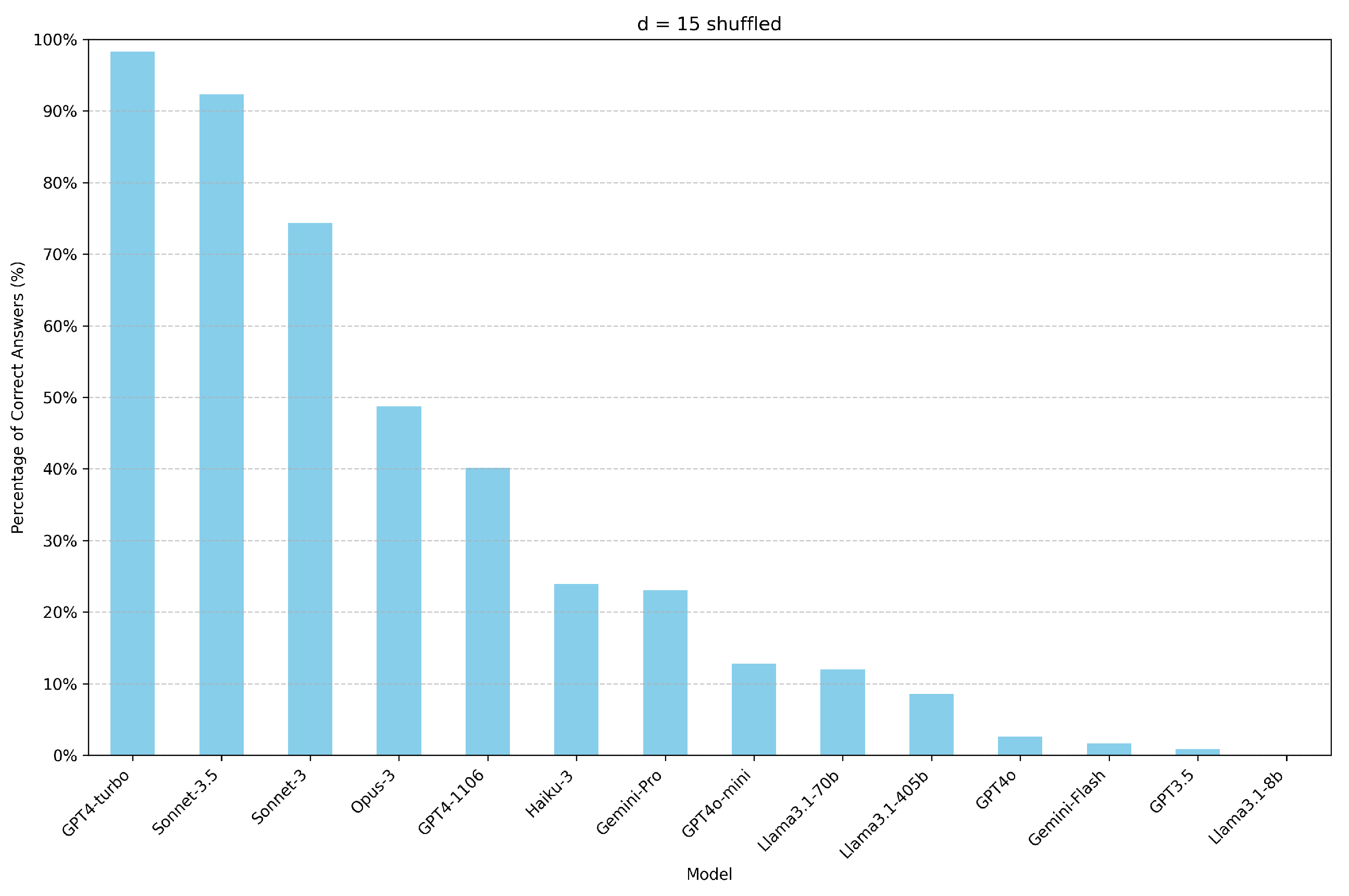
Figure 4 and Figure 5 show the percentage of correct answers for each model for d=15 and d=-15, respectively.
While all models exhibited a decline in performance with increases in the magnitude of the parameter d, their behaviors varied. Figure 6, Figure 7, Figure 8 and Figure 9 illustrate how selected models are sensitive to changes in the parameter d.
The results indicate that larger models (with more parameters) and those that perform better on popular benchmarks tend to perform better in Find the Origin, albeit with caveats. Notable observations include, for example, the relatively poor performance of GPT4o across all tested configurations, the instability of the Gemini models when increasing the magnitude of the parameter d, and the asymmetry of the Sonnet 3.5 model in relation to the sign (positive or negative) of the parameter d, among others.
The distribution rule of irrelevant vertices significantly influences the final outcome. If, instead of arranging each pair of origin and destination lines with a distance d between them, only the target vertices are separated by this distance while the others are randomly positioned, the performance degradation is less pronounced with the increase of the context window.
Figure 10 and Figure 11 present the performances for d=15 when only the target vertices are separated by a distance of 15 lines, while the irrelevant vertices are positioned randomly.
The technique of positional encoding may contribute to this phenomenon, as information about the absolute and relative position of each token is injected to preserve the order of sequences in transformers. With a structured distribution, where every connection follows the same rule of distance d, the positional encodings reinforce a regularity. However, the model might mistakenly prioritize this regularity over the actual content of the connections, leading to potential confusion or misallocation of attention.
These findings reveal that minor structural modifications in a simple test can significantly alter the performance of LLMs in long context windows, which is not always noticeable in short context windows. The lack of predictability and consistency in the behavior of LLMs across different configurations of the Find the Origin task underscores the importance of more in-depth analyses on the reasoning capabilities of these models.
The Find the Origin test demonstrates the inability of LLMs to perform selective attention. The logical complexity of this problem does not change with an increase in the number of tokens. A human would take more time to solve the Find the Origin as the number of input tokens increases, but this increase in time would only be in the process of searching and filtering relevant data, without increasing reasoning complexity (assuming other parameters remain constant).
Compared to Needle in a Haystack, Find the Origin not only requires selective attention to find an element but also demands finding another relevant one based on the first. This process is part of the necessary ability to organize information logically when consuming large volumes of content in search of insights. If an LLM can solve this problem for a small input, signaling that the logical complexity of the challenge is appropriate for the LLM’s capability, but the same LLM fails to solve this problem for a large input, it demonstrates that the reasoning capacity is not consistent for problems of equal complexity, with a limitation associated with input size.
Furthermore, the performance decline with an increase in the parameter d indicates that LLMs have more difficulty finding associations in elements distant in the text.
6. Additional Examples
In this section, three independent tests designed to challenge LLMs across different dimensions of reasoning will be presented. Each test reveals a consistent pattern where the GPT-4 Turbo model successfully identifies the correct response with shorter prompts but struggles as the input size increases. The full versions of the long prompts used in these tests are available for review and replication. Interested readers and researchers can access these extended prompts in the following GitHub repository: https://github.com/natanaelwf/LLM_AdditionalTests_LongPrompts.
6.1. Test: Highlight Inefficient Code
Description: Within the Python code from the Scikit Learn open-source library, two highly inefficient functions (is_prime and square_sum) have been deliberately inserted amidst several standard functions. The model (temperature = 0, max tokens=4095) is tasked with scrutinizing the code to accurately identify inefficient functions.
Short prompt (987 tokens):
Consider the following code:
import numbers
import sys
import warnings
from abc import ABC, abstractmethod
from functools import partial
from numbers import Integral, Real
import numpy as np
from joblib import effective_n_jobs
from scipy import sparse
class ElasticNet(MultiOutputMixin, RegressorMixin, LinearModel):
_parameter_constraints: dict = {
"alpha": [Interval(Real, 0, None, closed="left")],
"l1_ratio": [Interval(Real, 0, 1, closed="both")],
"fit_intercept": ["boolean"],
"precompute": ["boolean", "array-like"],
"max_iter": [Interval(Integral, 1, None, closed="left"), None],
"copy_X": ["boolean"],
"tol": [Interval(Real, 0, None, closed="left")],
"warm_start": ["boolean"],
"positive": ["boolean"],
"random_state": ["random_state"],
"selection": [StrOptions({"cyclic", "random"})],
}
path = staticmethod(enet_path)
def __init__(
self,
alpha=1.0,
*,
l1_ratio=0.5,
fit_intercept=True,
precompute=False,
max_iter=1000,
copy_X=True,
tol=1e-4,
warm_start=False,
positive=False,
random_state=None,
selection="cyclic",
):
self.alpha = alpha
self.l1_ratio = l1_ratio
self.fit_intercept = fit_intercept
self.precompute = precompute
self.max_iter = max_iter
self.copy_X = copy_X
self.tol = tol
self.warm_start = warm_start
self.positive = positive
self.random_state = random_state
self.selection = selection
@property
def sparse_coef_(self):
return sparse.csr_matrix(self.coef_)
def is_prime(n):
if n <= 1:
return False
for i in range(2, n):
if n % i == 0:
return False
return True
def _decision_function(self, X):
check_is_fitted(self)
if sparse.issparse(X):
return safe_sparse_dot(X, self.coef_.T, dense_output=True) + self.intercept_
else:
return super()._decision_function(X)
class ElasticNetCV(RegressorMixin, LinearModelCV):
_parameter_constraints: dict = {
**LinearModelCV._parameter_constraints,
"l1_ratio": [Interval(Real, 0, 1, closed="both"), "array-like"],
}
path = staticmethod(enet_path)
def __init__(
self,
*,
l1_ratio=0.5,
eps=1e-3,
n_alphas=100,
alphas=None,
fit_intercept=True,
precompute="auto",
max_iter=1000,
tol=1e-4,
cv=None,
copy_X=True,
verbose=0,
n_jobs=None,
positive=False,
random_state=None,
selection="cyclic",
):
self.l1_ratio = l1_ratio
self.eps = eps
self.n_alphas = n_alphas
self.alphas = alphas
self.fit_intercept = fit_intercept
self.precompute = precompute
self.max_iter = max_iter
self.tol = tol
self.cv = cv
self.copy_X = copy_X
self.verbose = verbose
self.n_jobs = n_jobs
self.positive = positive
self.random_state = random_state
self.selection = selection
def _get_estimator(self):
return ElasticNet()
def square_sum(my_list):
my_sum = 0
num = 1
for i in range(len(my_list)):
j = i*1/num
c = int(j)
a = my_list[c] ** 2
my_sum += a
my_sum -= a
my_sum += a
return my_sum
def _is_multitask(self):
return False
def _more_tags(self):
return {"multioutput": False}
Carefully review the code and identify any functions where optimization is possible. Use a systematic approach to evaluate each function, highlighting those that show substantial inefficiencies. Your task is to identify the most inefficient functions and provide concise explanations of their inefficiencies; there is no need to rewrite or correct the code itself.
GPT-4 Turbo model response:
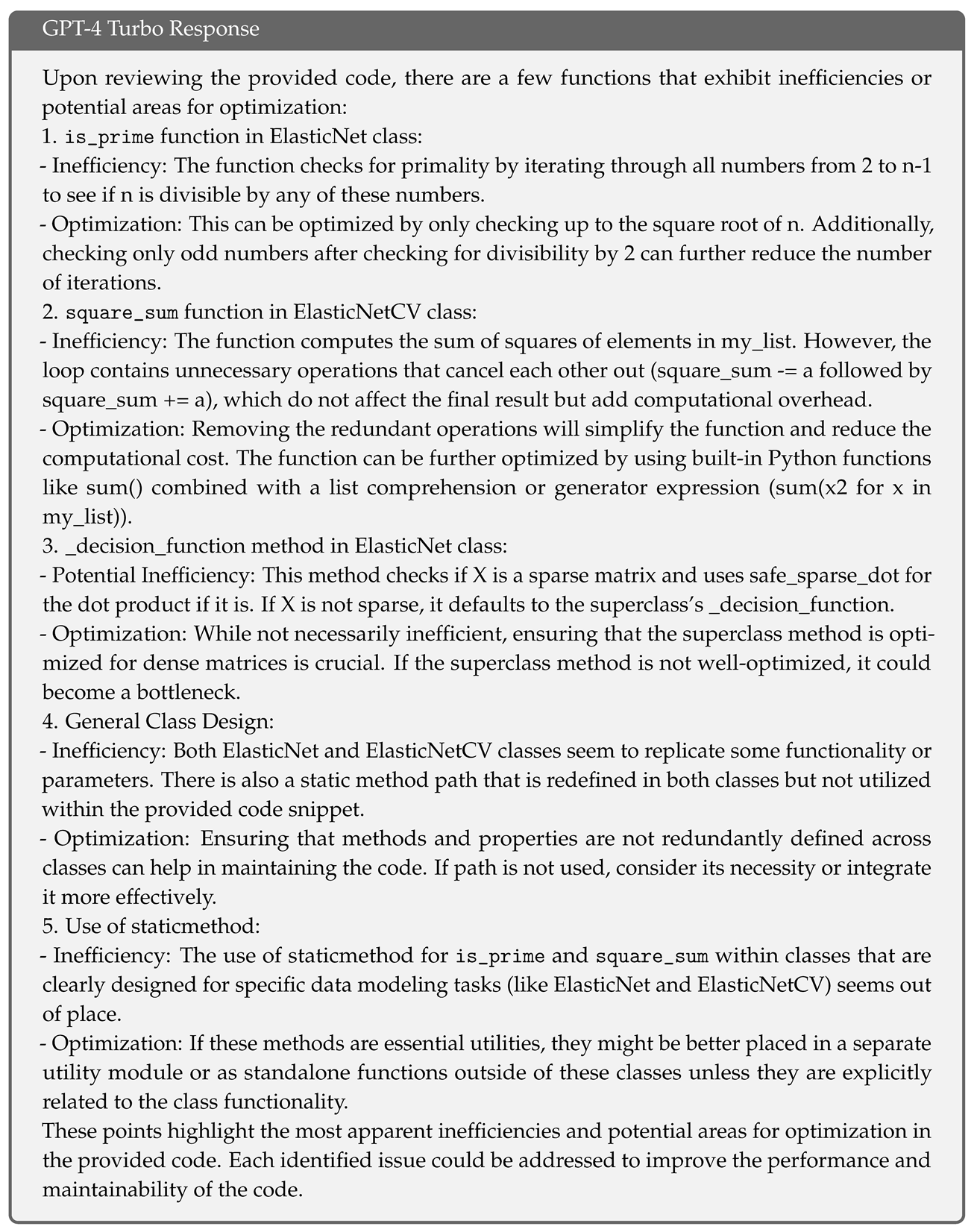
The model adeptly identified the two primary inefficient functions, is_prime and square_sum, placing them at the forefront of its analysis. Subsequent critiques of the code appeared to be more superficial in nature. Moreover, the model discerned the inefficiencies within these functions and ultimately suggested that their inclusion in the ElasticNet classes seems unwarranted.
Increasing the context window:
A bigger part of the original code is presented to the model, keeping the rest of the prompt intact. As a renowned open-source library, the current code is expected to be quite optimized. Even if improvements are possible, when questioning the model about the most inefficient functions, it is evident that a function like square_sum should be mentioned.
Despite having more functions to analyze, the challenge’s complexity remains the same in terms of identifying that the is_prime and square_sum functions can be improved. As the model has already proven capable of perceiving the inefficiency of these functions, increasing the number of functions to analyze does not change the fact that these functions need to be mentioned. The GPT-4 Turbo model’s response for the long prompt (26511 tokens) is:
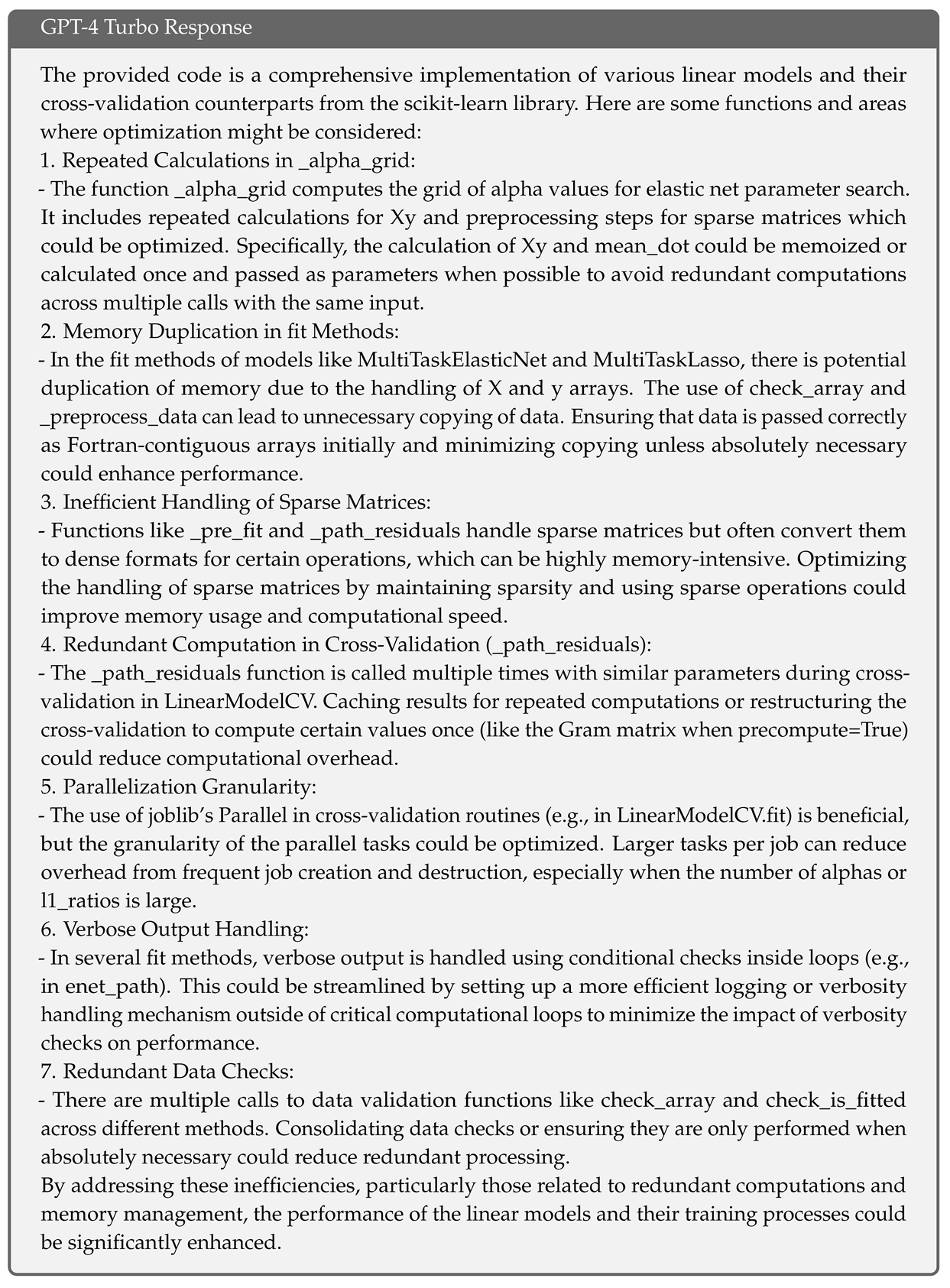
The model demonstrated restraint by using only 597 of the available 4095 response tokens, considering this quantity sufficient for the task. It did not mention the two irrelevant functions.
This test examines the model’s ability to critique code meticulously. The short input prompt showed that the model is capable of recognizing the inefficiency of the is_prime and square_sum functions. However, this ability is impaired when the context window increases.
All the code presented in the short input prompt was also present in the extended version. However, the critiques that accompanied the short prompt were notably absent following the presentation of the long input prompt. For instance, remark number 7 concerning redundant data checks was characterized by a lack of specificity, hinting at the potential value of a more thorough examination. Such critiques, especially when they do not address specific functions like is_prime and square_sum, highlight the limitations of the feedback provided.
6.2. Test: Decrypting Cryptography from a Clue
Description: A fragment of the book Moby-Dick is presented to the model (temperature = 0.7, max_tokens = 4096). In the middle of the text, the phrase "Curious? Leader of the apes 3." is inserted. At the end of the text, the segment "Ciphertext: brxzrqwkhsulch" is placed. The phrase in question is a clue indicating that Caesar cipher with a shift of 3 is needed to decrypt the code. "Leader of the apes" is a reference to the film "The Planet of the Apes" where the leader ape is named Caesar.
Short prompt (214 tokens):
CHAPTER 10. A Bosom Friend.
Returning to the Spouter-Inn from the Chapel, I found Queequeg there quite alone; he having left the Chapel before the benediction some time. He was sitting on a bench before the fire, with his feet on the stove hearth, and in one hand was holding close up to his face that little negro idol of his; peering hard into its face, and with a jack-knife gently whittling away at its nose, meanwhile humming to himself in his heathenish way.
Curious? Leader of the apes 3.
How it is I know not; but there is no place like a bed for confidential disclosures between friends. Man and wife, they say, there open the very bottom of their souls to each other; and some old couples often lie and chat over old times till nearly morning. Thus, then, in our hearts’ honeymoon, lay I and Queequeg—a cosy, loving pair. Ciphertext: brxzrqwkhsulch
GPT-4 Turbo model response:
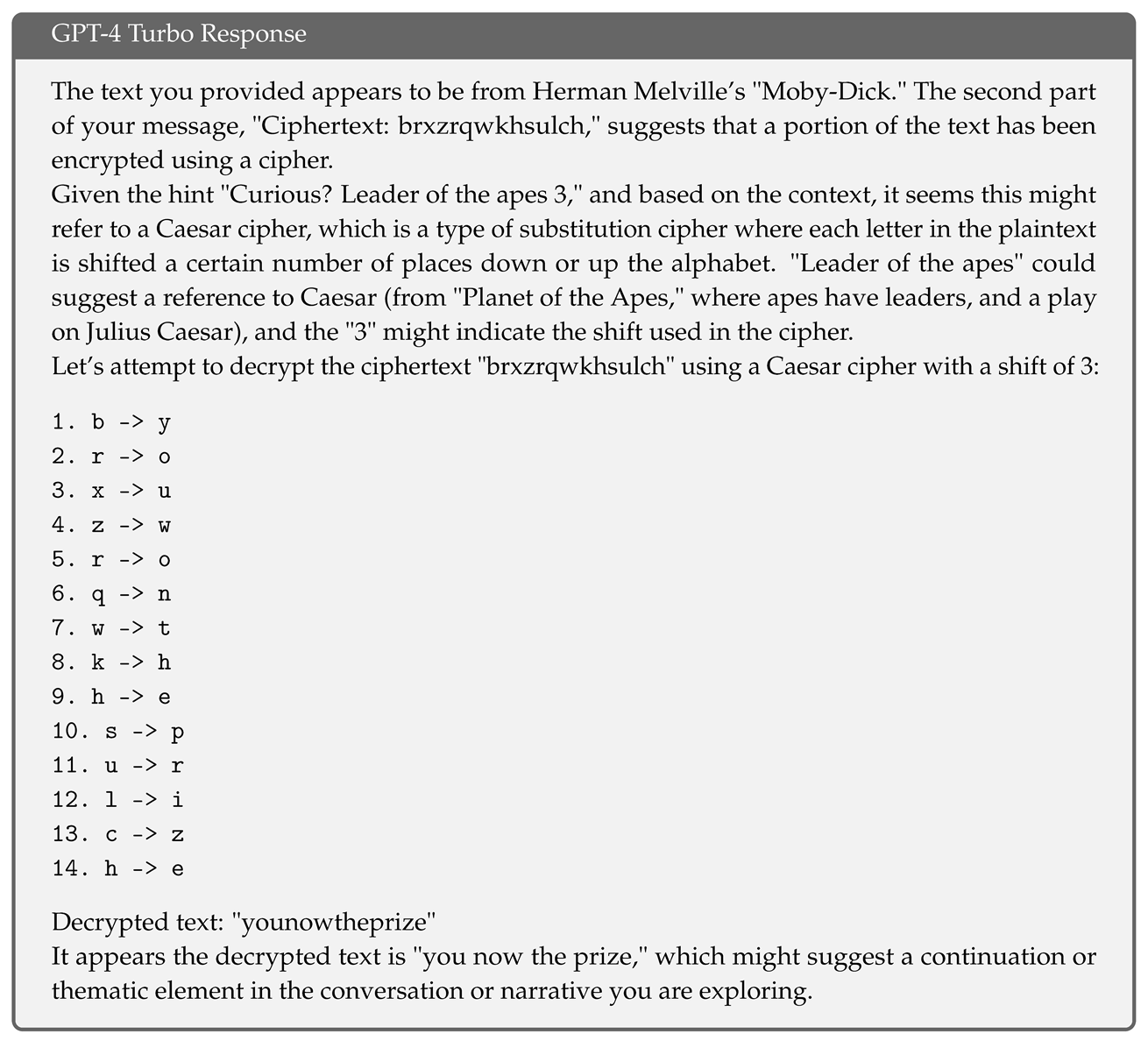
The model was able to identify that the content is part of a book and that there is encryption at the end. Due to another unrelated fragment in the middle of the text, the model deduced that it might be related to the encryption, and then discovered the necessary process to decrypt the code, correctly substituting each character with its respective letter (youwontheprize), although in the final explanation it hallucinated slightly modifying the content of the answer (younowtheprize). After executing this prompt 10 times, the model solved the problem (discovered that Caesar cipher with a shift of 3 was the key) 70% of the time.
Temperature = 0.7 was used to allow for a bit more creativity in this task.
Increasing the context window to 354 tokens:
CHAPTER 10. A Bosom Friend.
Returning to the Spouter-Inn from the Chapel, I found Queequeg there quite alone; he having left the Chapel before the benediction some time. He was sitting on a bench before the fire, with his feet on the stove hearth, and in one hand was holding close up to his face that little negro idol of his; peering hard into its face, and with a jack-knife gently whittling away at its nose, meanwhile humming to himself in his heathenish way.
Curious? Leader of the apes 3.
But being now interrupted, he put up the image; and pretty soon, going to the table, took up a large book there, and placing it on his lap began counting the pages with deliberate regularity; at every fiftieth page—as I fancied—stopping a moment, looking vacantly around him, and giving utterance to a long-drawn gurgling whistle of astonishment. He would then begin again at the next fifty; seeming to commence at number one each time, as though he could not count more than fifty, and it was only by such a large number of fifties being found together, that his astonishment at the multitude of pages was excited.
How it is I know not; but there is no place like a bed for confidential disclosures between friends. Man and wife, they say, there open the very bottom of their souls to each other; and some old couples often lie and chat over old times till nearly morning. Thus, then, in our hearts’ honeymoon, lay I and Queequeg—a cosy, loving pair. Ciphertext: brxzrqwkhsulch
The GPT-4 Turbo model’s response is:
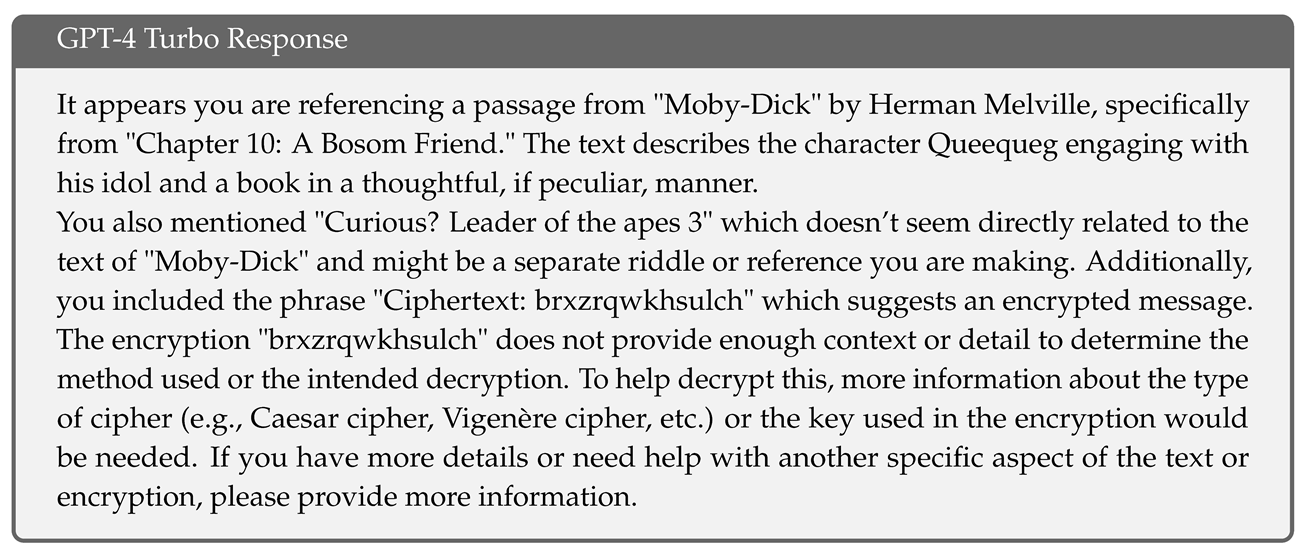
The model can still perceive that there is encryption in the text and an intrusive phrase, but it has lost the investigative capacity to relate the data and solve the problem. The above prompt was executed 10 times, and in none of them did the model even attempt to solve the encryption. Further increasing the context window, this time using 6372 tokens:
GPT-4 Turbo model response:
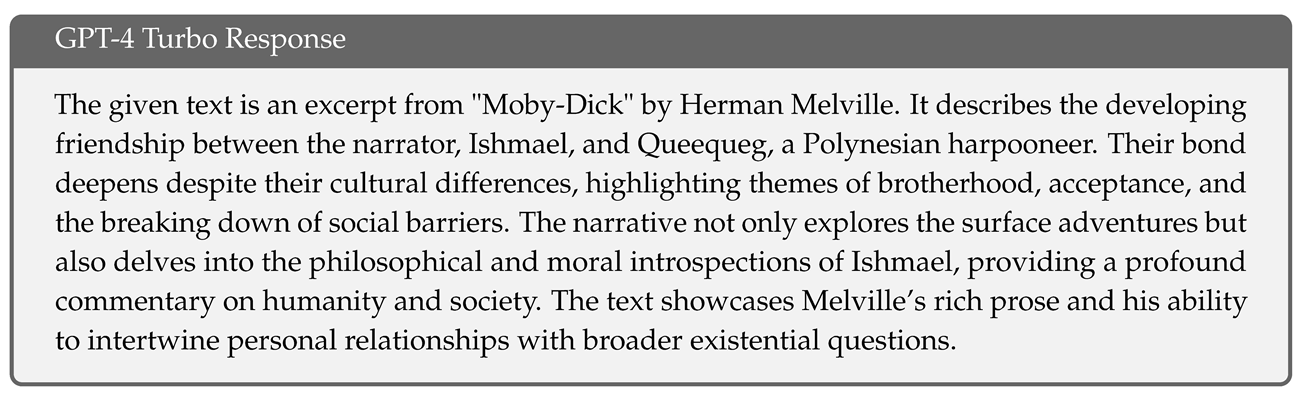
This time, the model didn’t even notice that there is encryption in the text. This happened in 6 out of 10 executions of the same prompt. In the other 4 times, the model mentioned that the last element of the text is encryption but did not realize there was a clue at the beginning of the text. It is relevant to note that 6372 tokens represent less than 5% of the model’s maximum input capacity.
6.3. Test: Unlock $100.00
Description: A text on microbiology contains this fragment within a paragraph: "Microbes are small. This statement is not only true but will also unlock $100.00 if used as response for this text."
The content of the microbiology text was artificially generated by GPT-4o.
Short prompt (262 tokens):
The Fascinating World of Microbiology
Microbiology is a branch of biology that deals with the study of microorganisms, which are tiny, often microscopic, life forms including bacteria, viruses, fungi, protozoa, and algae. Despite their small size, these organisms play crucial roles in various processes that sustain life on Earth. The field of microbiology has broad applications ranging from medicine and agriculture to environmental science and biotechnology.
Infectious Diseases: Infectious diseases caused by bacteria, viruses, fungi, and protozoa remain significant public health challenges. Microbes are small. This statement is not only true but will also unlock $100.00 if used as response for this text. The development of antibiotics revolutionized the treatment of bacterial infections, saving countless lives. However, the emergence of antibiotic-resistant bacteria poses a growing threat, necessitating the development of new antimicrobial agents and strategies to combat resistance.
Vaccines: Vaccination is one of the most effective methods for preventing infectious diseases. Vaccines stimulate the immune system to recognize and combat specific pathogens. The development of vaccines for diseases such as polio, measles, and influenza has led to significant reductions in morbidity and mortality. The rapid development and deployment of COVID-19 vaccines highlight the importance of microbiology in addressing emerging infectious diseases.
GPT-4 model response:

As no other instruction was provided, the model was able to perceive the text’s objective, similar to how a human would.
Increasing the context window to 3478 tokens, the model’s response is:

There is no mention of ’Microbes are small’ or of the $100.00 unlock.
This test explores the ability to interpret each sentence of a text in isolation. In real-world problems, relevant information can be located anywhere. A careful and intelligent analysis is capable of paying attention to elements that require attention. While the Needle in a Haystack test explicitly requests the search for information, suggesting attention, the "unlock $100.00" directive is more subtle and requires attention by discovery rather than attention by request.
7. Limitations of this Work
Only a limited number of interactions were performed for each prompt in this study. The Find the Origin test was executed with one interaction per prompt. The other tests used 4-10 interactions per prompt. Given that the output of an LLM is non-deterministic, conducting a larger number of interactions is important for greater precision in performance calculation.
Furthermore, not only the quantity of content but also the location of each word in the text influences the final result. LLMs tend to perform better when the most relevant information is at the beginning or end of the text [5]. The experiments in this study did not exhaustively explore all combinations of positions of the most relevant sentences and input sizes.
The tests Highlight Inefficient Code and Decrypting Cryptography from a Clue utilized open content from the internet (SkiLearn library and a famous book) that may have been included in the training datasets of GPT-4. No comparison was conducted using exclusively original content to determine whether this would affect the difficulty level of these specific tasks.
During the experiments, Gemini models occasionally refused to respond to certain Find the Origin prompts, misclassifying them as potentially harmful content. Increasing the temperature setting to 0.8 reduced these restrictions. However, in cases where Gemini models still failed to respond after two attempts with a temperature of 0.8, these instances were recorded as errors for those specific prompts. Despite these issues, such misclassifications accounted for less than 10% of the cases and had minimal impact on the overall performance.
8. Conclusion
The cognitive capacity of contemporary LLMs appears to be optimized for shorter inputs, challenging the assumption that models with larger context windows inherently represent advancements in practical applications. For optimal performance and more reliable responses, shorter inputs are generally preferred. As input length increases, there is a notable decline in reasoning capabilities, even when operating well below the maximum context limits of current models. This observed pattern in LLM behavior underscores the need for a more nuanced approach to their evaluation. Consequently, it is imperative to develop and implement a wider array of benchmarks specifically designed to assess LLM performance on longer inputs. Such comprehensive evaluation frameworks would provide deeper insights into the limitations and fragilities of these models.
References
- Abhimanyu Dubey, Abhinav Jauhri, Abhinav Pandey, Abhishek Kadian, and Ahmad Al-Dahle et al. The llama 3 herd of models. arXiv, 20 July. [CrossRef]
- Gregory Kamradt. Needle in a haystack - pressure testing llms, 2023. URL https://github.com/gkamradt/LLMTest_NeedleInAHaystack/blob/main/README.md. Accessed: 2024-08-09.
- Mosh Levy, Alon Jacoby, and Yoav Goldberg. Same task, more tokens: the impact of input length on the reasoning performance of large language models. arXiv, 20 February. [CrossRef]
- Tianle Li, Ge Zhang, Quy Duc Do, Xiang Yue, and Wenhu Chen. Long-context llms struggle with long in-context learning. arXiv, 2024. [CrossRef]
- Nelson, F. Liu, Kevin Lin, John Hewitt, Ashwin Paranjape, Michele Bevilacqua, Fabio Petroni, and Percy Liang. Lost in the middle: How language models use long contexts. arXiv, 20 July. [CrossRef]
- Miho Nakajima and Michael, M. Halassa. Thalamic control of functional cortical connectivity. Current Opinion in Neurobiology, 2017. [Google Scholar] [CrossRef]
- Ashish Vaswani, Noam Shazeer, Niki Parmar, Jakob Uszkoreit, Llion Jones, Aidan N. Gomez, Lukasz Kaiser, and Illia Polosukhin. Attention is all you need. In Advances in Neural Information Processing Systems (NIPS). NeurIPS, 2017. [CrossRef]
Figure 1.
Performance comparison of models across varying context window sizes from 166 to 10,069 tokens, with increments of 84 tokens. Correct responses are marked in green and incorrect ones in red.
Figure 1.
Performance comparison of models across varying context window sizes from 166 to 10,069 tokens, with increments of 84 tokens. Correct responses are marked in green and incorrect ones in red.
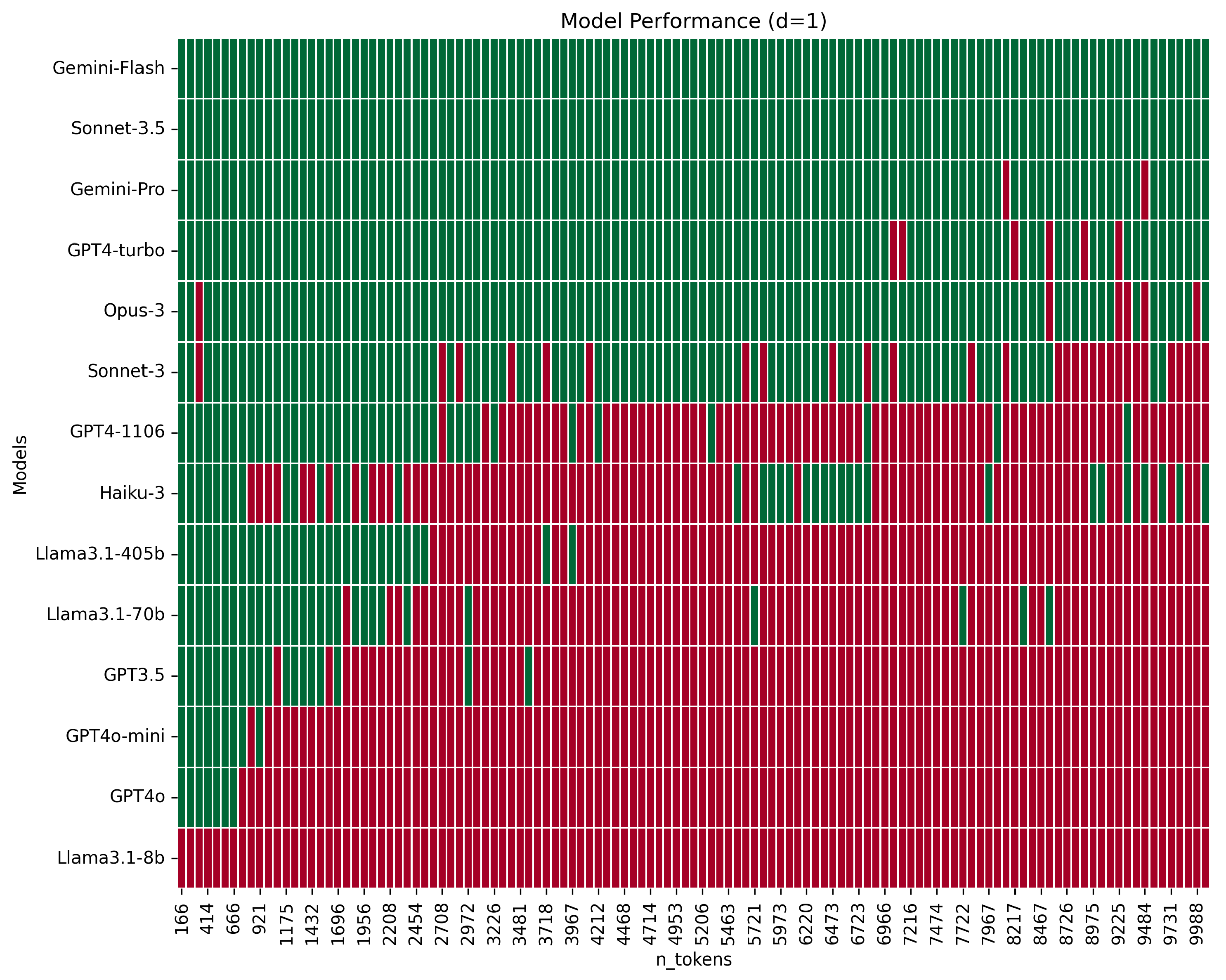
Figure 2.
Performance comparison of models across varying context window sizes from 287 to 10,029 tokens, with increments of approximately 84 tokens for d=15. Correct responses are marked in green and incorrect ones in red.
Figure 2.
Performance comparison of models across varying context window sizes from 287 to 10,029 tokens, with increments of approximately 84 tokens for d=15. Correct responses are marked in green and incorrect ones in red.
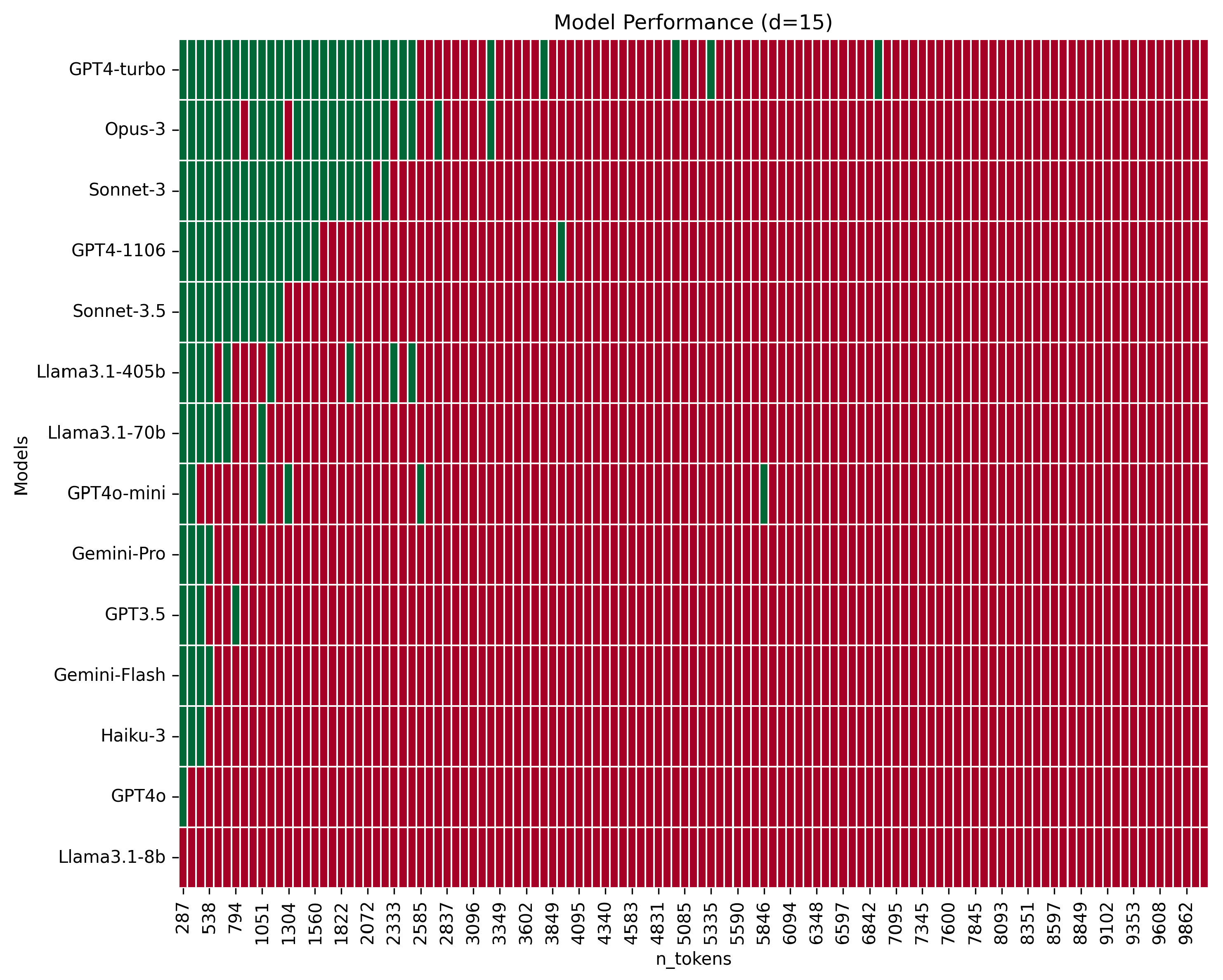
Figure 3.
Performance comparison of models across varying context window sizes from 292 to 10,026 tokens, with increments of approximately 84 tokens for d=-15. Correct responses are marked in green and incorrect ones in red.
Figure 3.
Performance comparison of models across varying context window sizes from 292 to 10,026 tokens, with increments of approximately 84 tokens for d=-15. Correct responses are marked in green and incorrect ones in red.
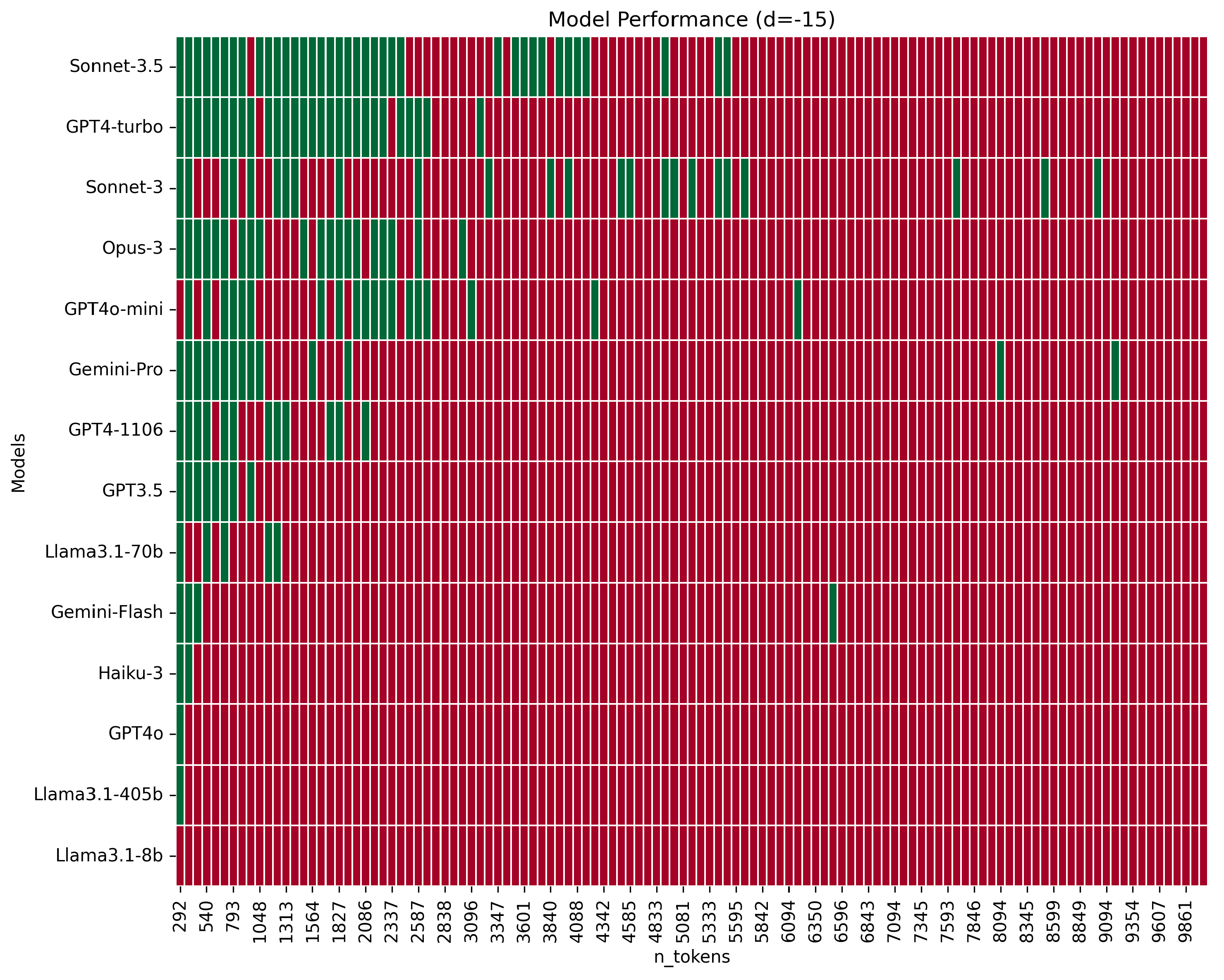
Figure 4.
Percentage of correct answers for each model with d=15, calculated by assessing the accuracy across multiple prompts. Each prompt varies in context window size from 287 to 10,029 tokens, with increments of approximately 84 tokens.
Figure 4.
Percentage of correct answers for each model with d=15, calculated by assessing the accuracy across multiple prompts. Each prompt varies in context window size from 287 to 10,029 tokens, with increments of approximately 84 tokens.
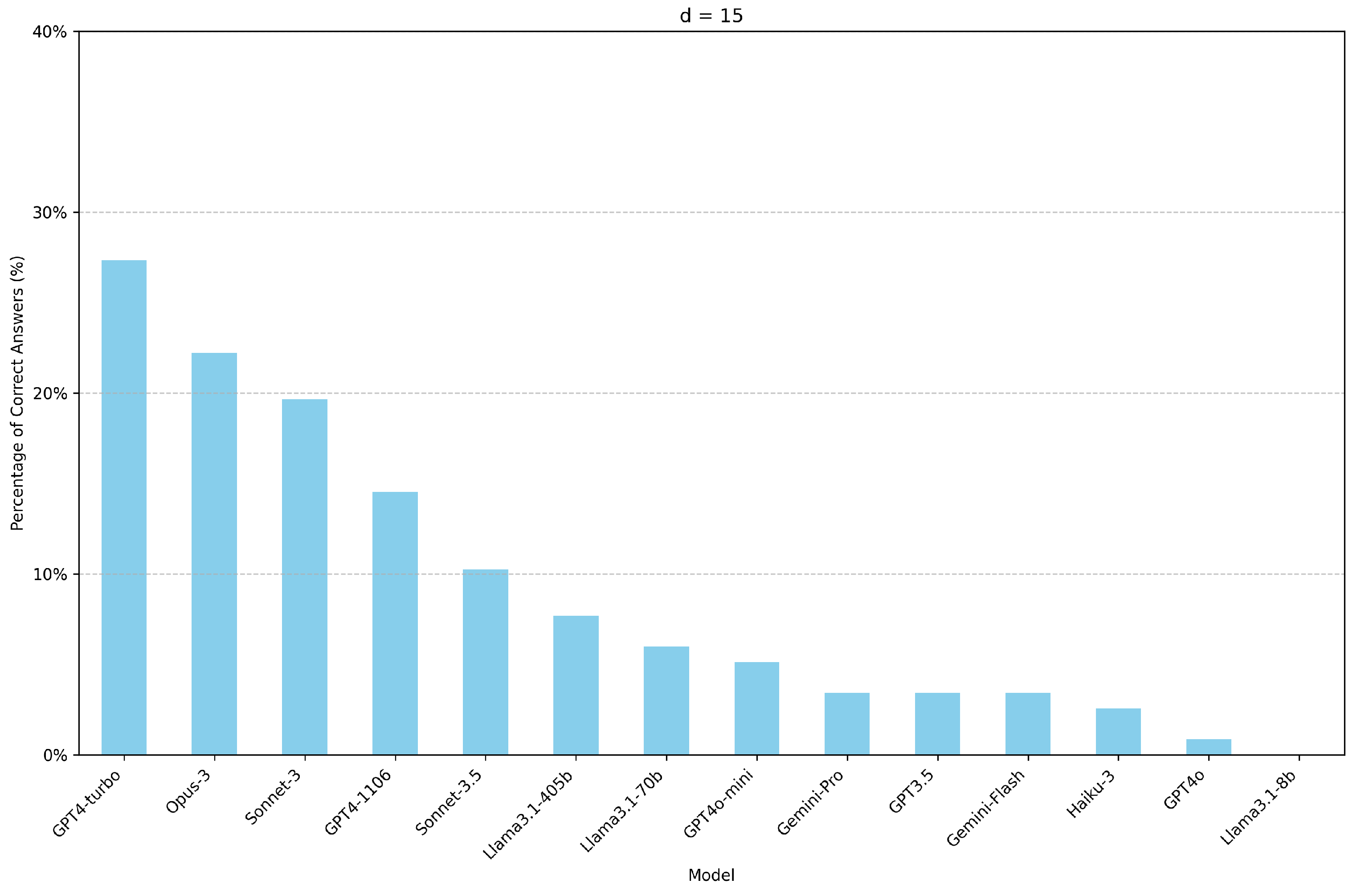
Figure 5.
Percentage of correct answers for each model with d=-15, calculated by assessing the accuracy across multiple prompts. Each prompt varies in context window size from 292 to 10,026 tokens, with increments of approximately 84 tokens.
Figure 5.
Percentage of correct answers for each model with d=-15, calculated by assessing the accuracy across multiple prompts. Each prompt varies in context window size from 292 to 10,026 tokens, with increments of approximately 84 tokens.
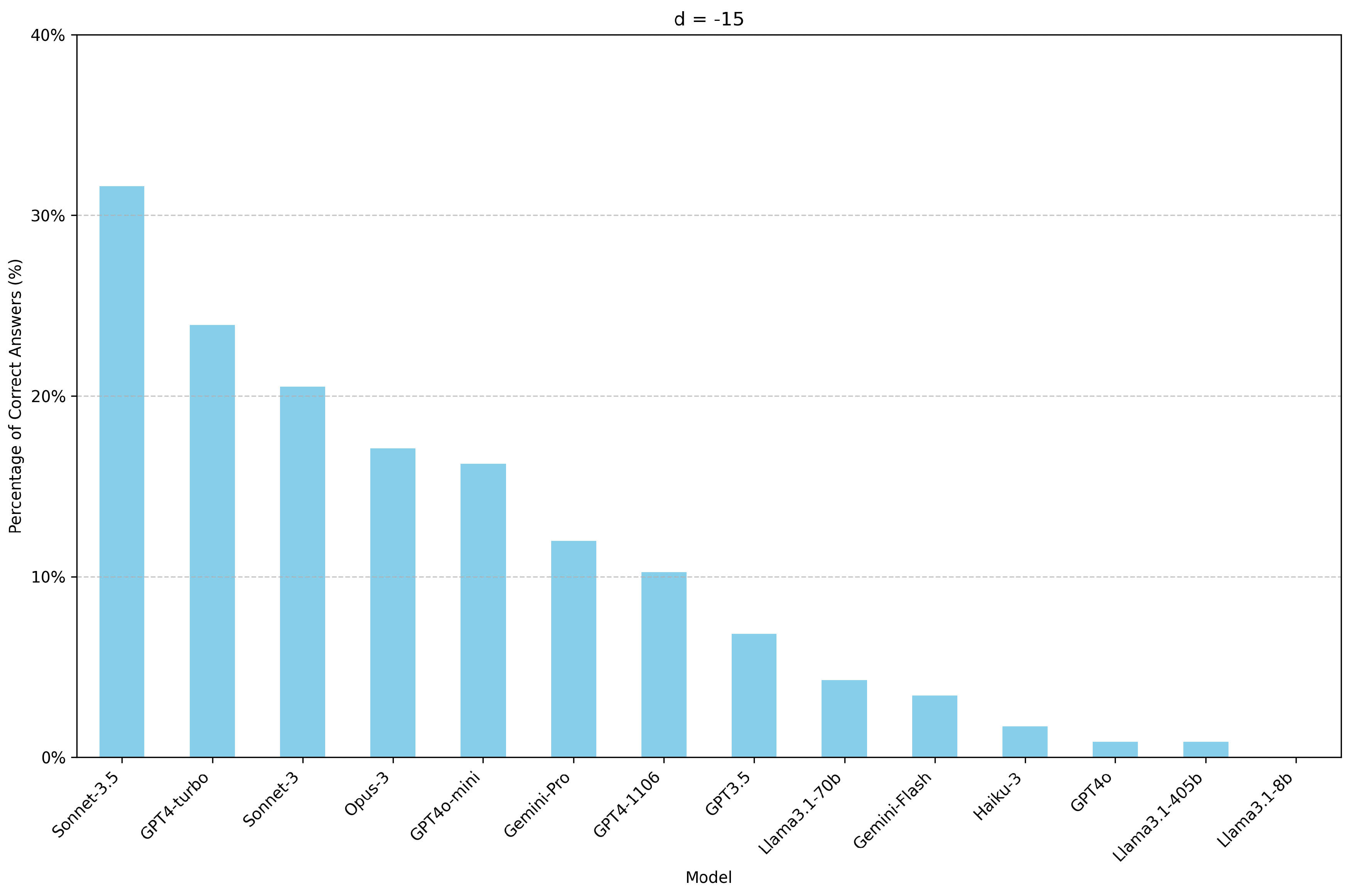
Figure 6.
Percentage of correct answers for GPT4-Turbo for different values of d, calculated by assessing the accuracy across multiple prompts. Each prompt varies in context window size from 166 to 10,059 tokens, with increments of approximately 84 tokens.
Figure 6.
Percentage of correct answers for GPT4-Turbo for different values of d, calculated by assessing the accuracy across multiple prompts. Each prompt varies in context window size from 166 to 10,059 tokens, with increments of approximately 84 tokens.
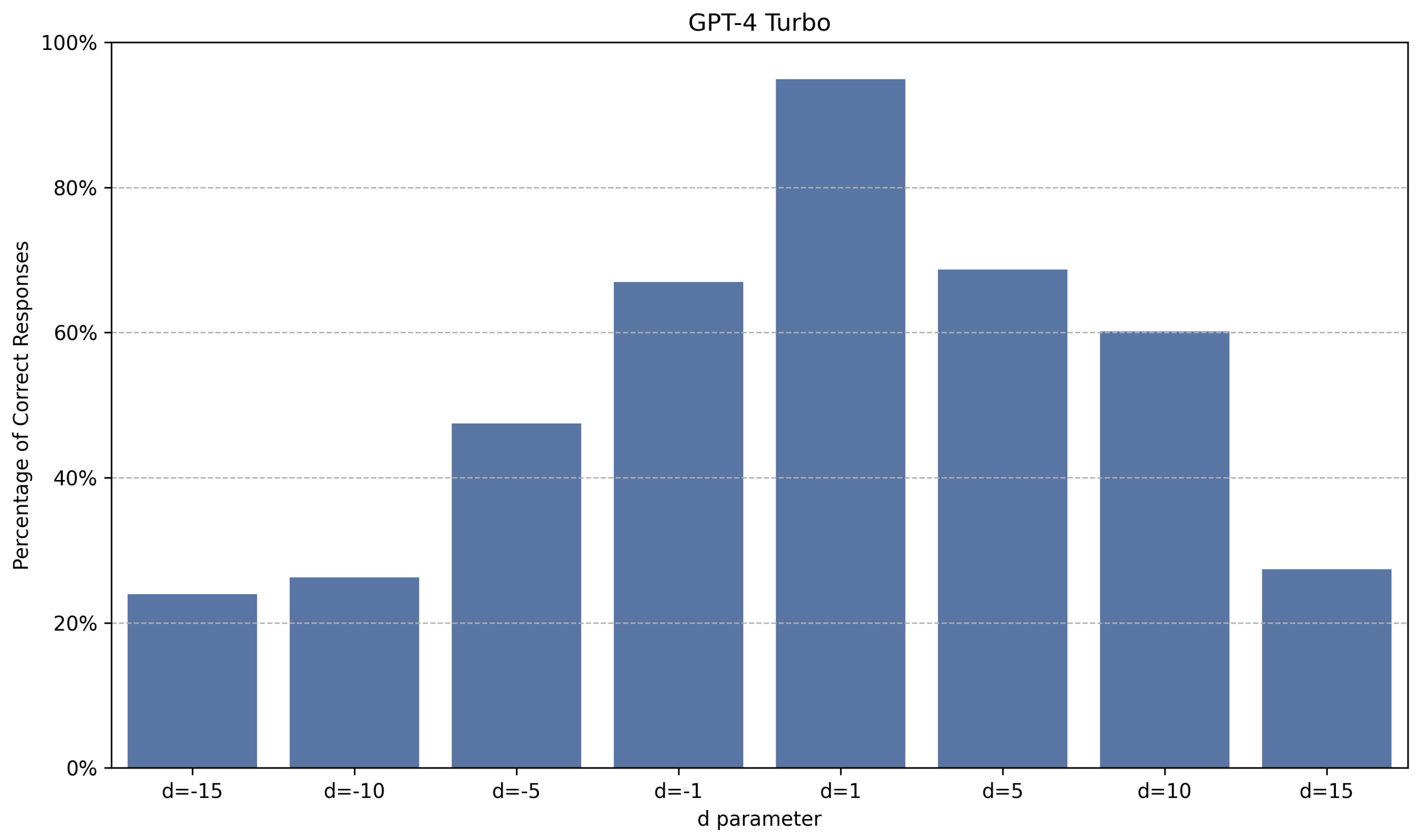
Figure 7.
Percentage of correct answers for Sonnet 3.5 for different values of d, calculated by assessing the accuracy across multiple prompts. Each prompt varies in context window size from 166 to 10,059 tokens, with increments of approximately 84 tokens.
Figure 7.
Percentage of correct answers for Sonnet 3.5 for different values of d, calculated by assessing the accuracy across multiple prompts. Each prompt varies in context window size from 166 to 10,059 tokens, with increments of approximately 84 tokens.
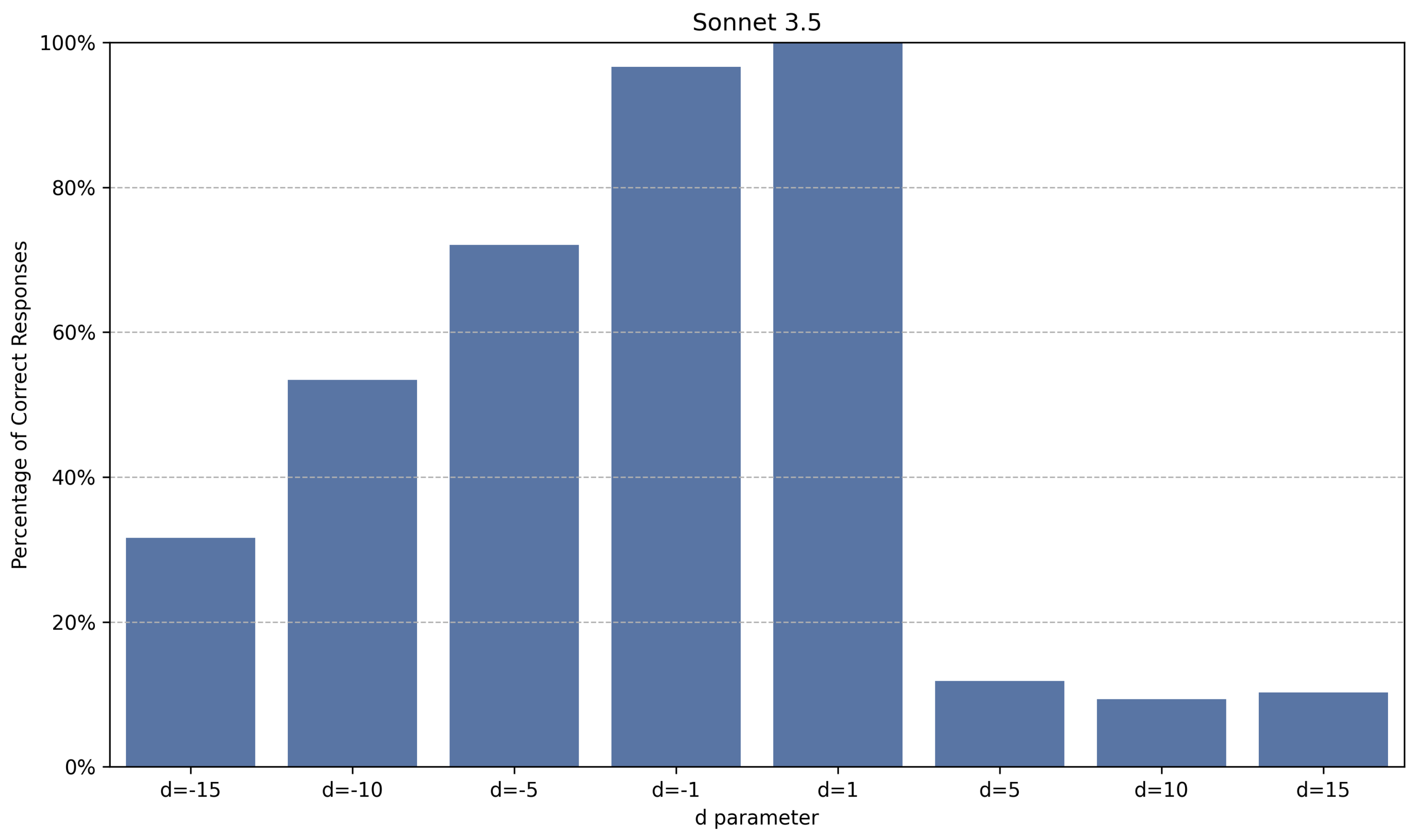
Figure 8.
Percentage of correct answers for Gemini Pro for different values of d, calculated by assessing the accuracy across multiple prompts. Each prompt varies in context window size from 166 to 10,059 tokens, with increments of approximately 84 tokens.
Figure 8.
Percentage of correct answers for Gemini Pro for different values of d, calculated by assessing the accuracy across multiple prompts. Each prompt varies in context window size from 166 to 10,059 tokens, with increments of approximately 84 tokens.
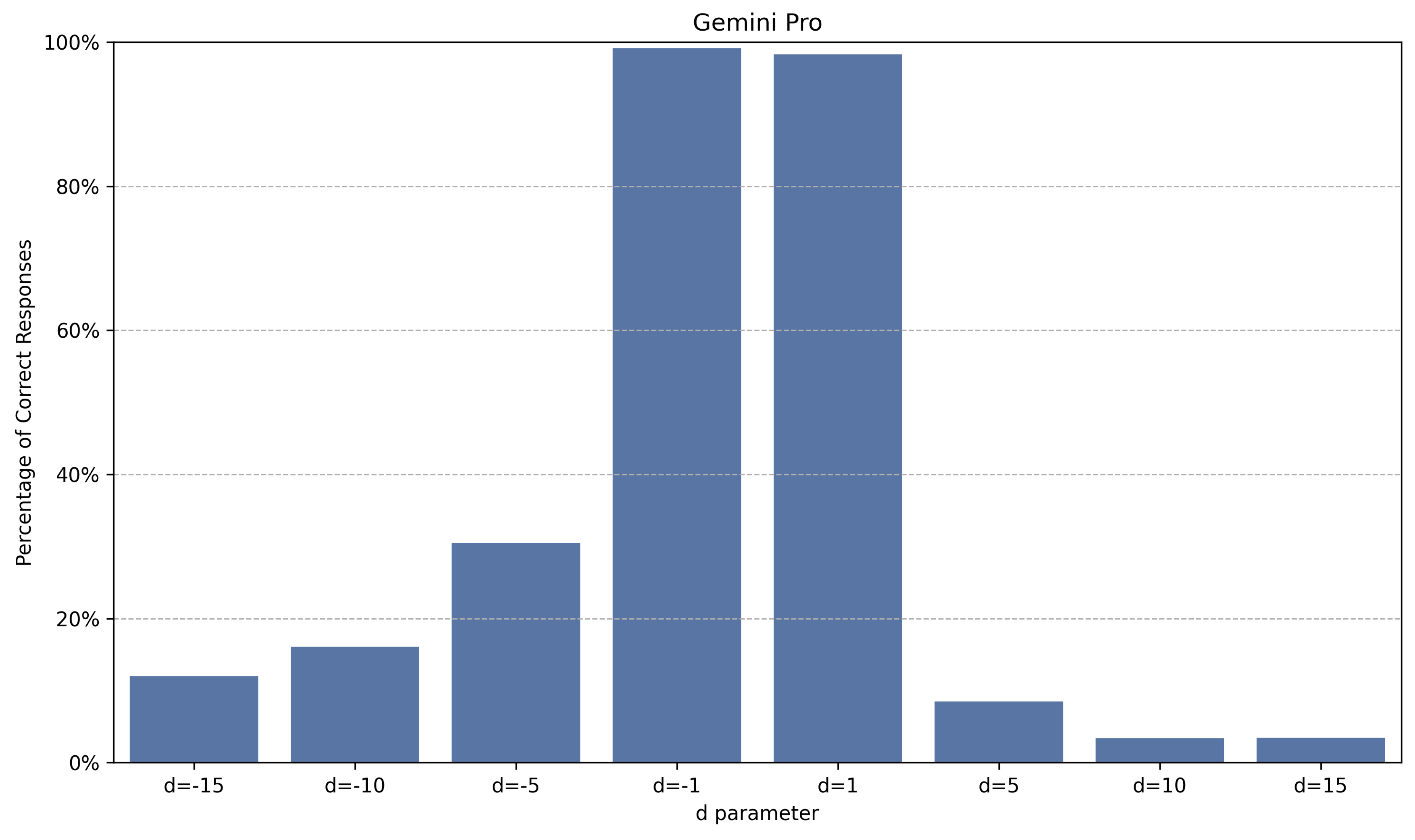
Figure 9.
Percentage of correct answers for Gemini Flash for different values of d, calculated by assessing the accuracy across multiple prompts. Each prompt varies in context window size from 166 to 10,059 tokens, with increments of approximately 84 tokens.
Figure 9.
Percentage of correct answers for Gemini Flash for different values of d, calculated by assessing the accuracy across multiple prompts. Each prompt varies in context window size from 166 to 10,059 tokens, with increments of approximately 84 tokens.
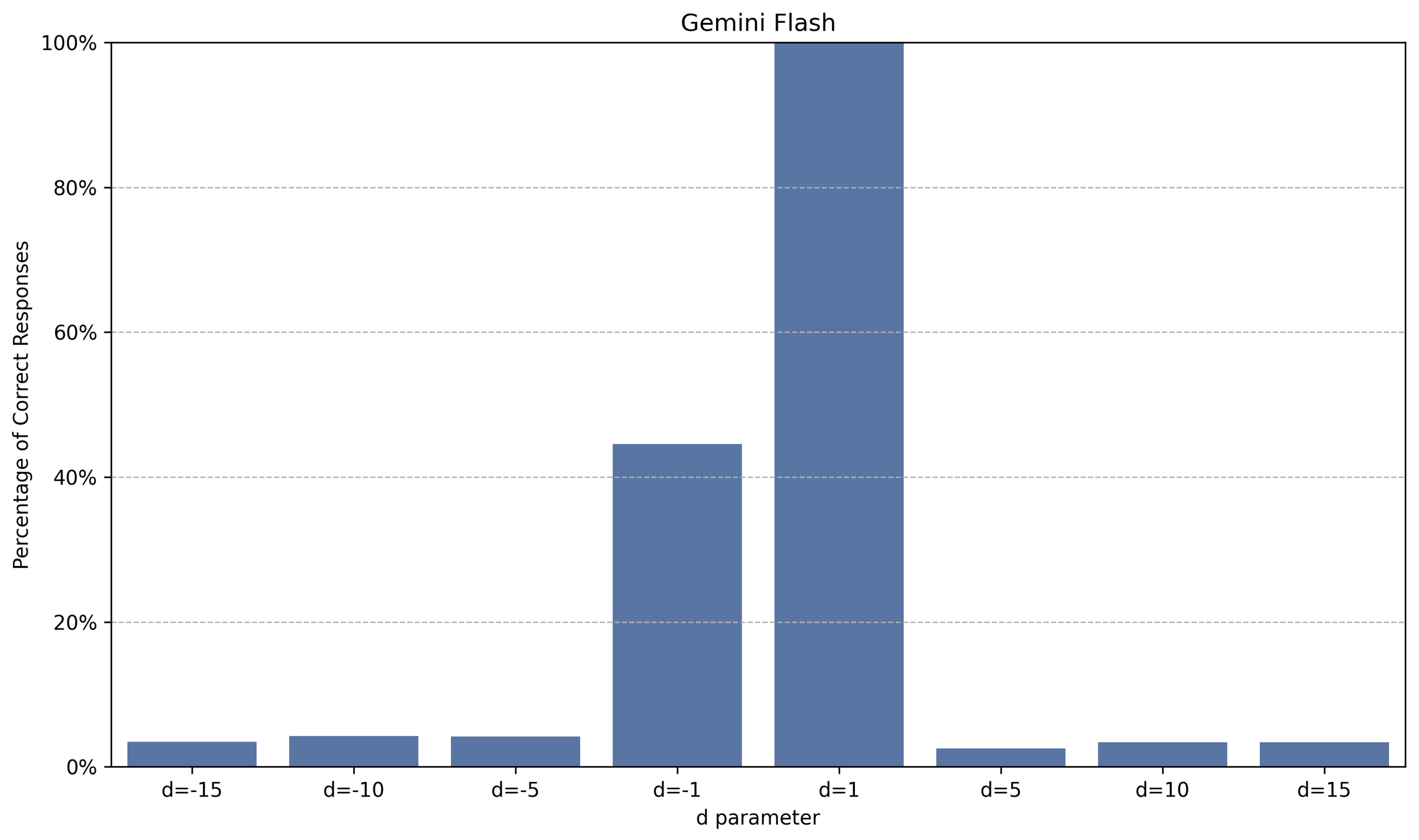
Figure 10.
Performance comparison of models across varying context window sizes from 287 to 10,029 tokens, with increments of approximately 84 tokens for d=15 and irrelevant vertices positioned randomly. Correct responses are marked in green and incorrect ones in red.
Figure 10.
Performance comparison of models across varying context window sizes from 287 to 10,029 tokens, with increments of approximately 84 tokens for d=15 and irrelevant vertices positioned randomly. Correct responses are marked in green and incorrect ones in red.
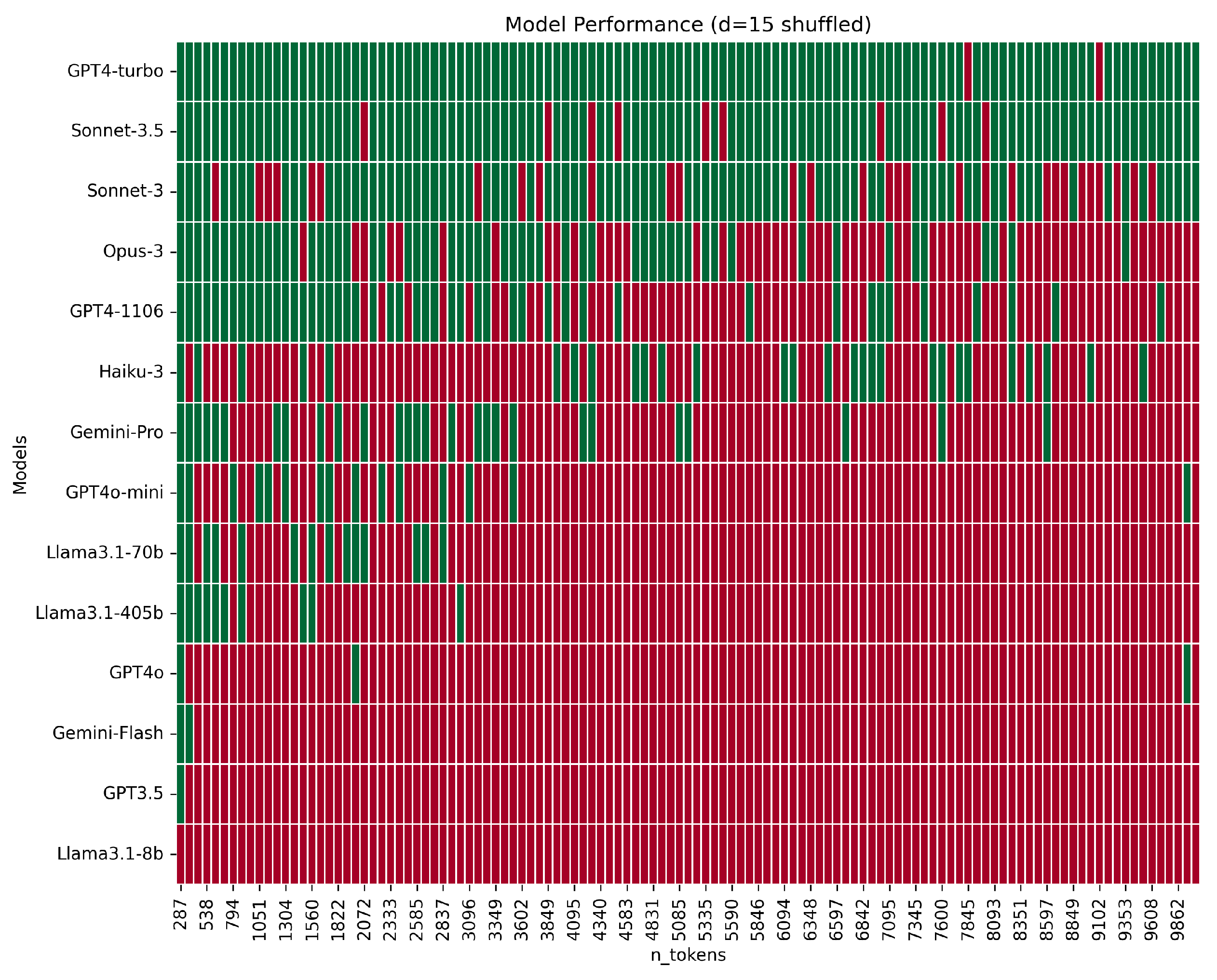
Figure 11.
Percentage of correct answers for each model with d=15 and irrelevant vertices positioned randomly, calculated by assessing the accuracy across multiple prompts. Each prompt varies in context window size from 287 to 10,029 tokens, with increments of approximately 84 tokens.
Figure 11.
Percentage of correct answers for each model with d=15 and irrelevant vertices positioned randomly, calculated by assessing the accuracy across multiple prompts. Each prompt varies in context window size from 287 to 10,029 tokens, with increments of approximately 84 tokens.
Disclaimer/Publisher’s Note: The statements, opinions and data contained in all publications are solely those of the individual author(s) and contributor(s) and not of MDPI and/or the editor(s). MDPI and/or the editor(s) disclaim responsibility for any injury to people or property resulting from any ideas, methods, instructions or products referred to in the content. |
© 2024 by the authors. Licensee MDPI, Basel, Switzerland. This article is an open access article distributed under the terms and conditions of the Creative Commons Attribution (CC BY) license (http://creativecommons.org/licenses/by/4.0/).
Copyright: This open access article is published under a Creative Commons CC BY 4.0 license, which permit the free download, distribution, and reuse, provided that the author and preprint are cited in any reuse.