

Submitted:
19 August 2024
Posted:
20 August 2024
You are already at the latest version
Abstract
Vertex-degree-based (VDB) topological indices have been applied in QSPR/QSAR. As an important category, the general logarithmic VDB topological index \(T_{lnf}(G)\), is defined as the summation of $ln{f(d(u),d(v))}$, where the summation over all $uv\in E(G)$.
In this paper, we give the sufficient conditions for that
(1) the path \(P_{n}\) is the only tree with the minimal \(T_{lnf}\);
(2) the star \(S_n\) is the only tree with the maximal and the minimal \(T_{lnf}\), respectively. As applications, the minimal and maximal trees of some logarithmic VDB indices are determined.
Keywords:
tree
; extreme value
; logarithmic VDB topological indices
MSC: 05C05; 05C09; 05C92
1. Introduction
Topological indices (or graphical indices, or chemical indices) have an important role in studying the structures and properties of a molecular compound. Related studies have shown that topological indices are closely related to physico-chemical properties or biological activity [1,2]. Vertex-degree-based (VDB shortly) topological indices, as an important type of topological index, have long been considered and applied in QSPR/QSAR research [3,4]. Due to its importance in the field of chemistry, a large number of mathematical and chemical literature for the extremal values and extremal graphs have been published, and they are often considered and verified to have some excellent chemical properties. For relevant research, see [5,6,7].
Throughout the whole paper, all graphs we considered are simple, undirected and connected. Let G is a graph of order n, the vertex set and edge set are and , respectively. We use , or shortly by to represent the degree of vertex v. A vertex v is said to be pendant if . If the edge , then the two vertices u and v in G are said to be adjacent. The vertex set adjacent to v is known as its neighbors, which denoted by or . If , the graph represents the resulting graph by adding the edge from G. Meanwhile, we use represents the resulting graph by deleting the edge in G for the edge . We use , , and to denote the star, the path, and the set of trees with order of n, respectively. Denote to represent the double star with the degrees of two centers being r and , where .
A general VDB (vertex-degree-based) index of a connected graph G is defined as
where is a real symmetric function for and . To learn more about the relevant results, readers can refer to [8,9,10]. Especially, Gutman in [8] collected some important and well-studied VDB topological indices.
In 2019, the exponential of , was first introduced in [11] by Rada, is defined as
where . The notation is known as an exponential VDB topological index, or abbreviated as exponential VDB index.
The sdudy of VDB topological index has attracted increasing attention, especially, to find the extremal values of or for some special types of graphs. The authors in [12] provides a general way to obtain whether the star or the path are extremal trees of the VDB topological index. Also, if is concave upwards and increasing relative to the variable x, the maximum trees of were determined in [13]. Gao in [14] provided some conditions for the function . If satisfies some conditions, then the necessary and sufficient conditions for a chemical tree to be a maximal are attained. Very recently, the authors [15] gave sufficient conditions for is the only tree with the smallest , the sufficient conditions for or is the only tree with the largest . For research on or , readers can refer to [16,17,18].
Inspired by [11], we introduce a new VDB topological indices, the logarithmic topological index, it is defined as
where , and is a real symmetric function for and . As a VDB topological indices corresponding to exponential of , the study for logarithmic of is of great significance.
In this paper, we mainly studied the extremal trees for logarithmic VDB topological indices. In section 3, we give the sufficient conditions for that the path is the only tree with the minimal . In section 4, we obtain the sufficient conditions for that the star is the only tree with the maximal and minimal . In addition, as applications, the minimal and maximal trees of some logarithmic VDB indices are determined in section 5.
2. Preliminaries
In the remainder of the paper, assume that , and is the real symmetric function, where and . In this section, we give the some lemmas firstly.
Lemma 1.
If , then is strictly increasing on .
Proof.
Since , thus is strictly increasing on under the condition . □
Lemma 2.
Let , where for . For any positive integer , if , then
Proof.
Since , according to the condition of lemma, we have
So, the lemma is proved. □
Lemma 3.
Let , then , and , where .
Proof.
Clearly, , where , and . In the following, we will verify that .
Without loss of generality, assuming . Note that
thus, lemma is true if the equality holds, i.e.
If , then
and
If , and because , then
So, the lemma is proved. □
Lemma 4.
Let binary function , where and . Then,
(1) , ; and
(2) , where .
Proof. (1) Since , and , thus . Note that
and therefore,
(2) Substituting into yields that
i.e.,
Therefore, to complete the proof of the lemma, it is only necessary to prove that
Let us first consider . Note that
And thus, we obtain
In the following, we only need to prove that . Let , where . Since then This implies that , and therefore,
Now, let us turn to prove . Let , where . Since
and
thus, we have
This is to say, y is an increasing function, and hence,
Therefore, combining the above two inequations, the lemma proof is completed. □
3. Sufficient Conditions for Being the Minimal Tree
In this section, we give sufficient conditions for the path being the minimal tree of . We present the following transformation at first.
Transformation 1. Assume , let x be the vertex in tree T. is the graph obtained from T by adding two pendant paths, and attached at x, where , and , , . is the resulting graph obtained from by deleting the edge and connecting an edge , i.e., . and are depicted in Figure 1. Clearly, .
Lemma 5.
Let and be the graphs in Transformation 1 (see Figure 1), where . If matches the conditions , and , then .
Proof.
Denote , , and . Since , then . And thus, we have
As , and Lemma 1, we obtain . Using Lemma 2, we have
So, the lemma is proved. □
Lemma 6.
Let and be the graphs in Transformation 1 (see Figure 1), where . If matches the conditions , and , then .
Proof.
Denote , , and . Since , then , and . Therefore, we have
According to , and Lemma 1, . This, together with Lemma 2, implies that
Hence, we finished the proof. □
Lemma 7.
Let and be the graphs in Transformation 1 (see Figure 1), where . If matches the conditions , and , then .
Proof.
Denote , , and . Since , then . Hence, we have
By , and Lemma 1, have . Now, applying Lemma 2, we have
So, the proof is done. □
With the above lemmas, we now present the following theorem.
Theorem 8.
Let , suppose meets the conditions:
,
,
, and
,
then , if and only if .
Proof.
The conditions (1)-(4) are satisfied for the results of Lemma 5, 6, and 7. If , then, using Transformation 1 repeatedly, is attained from T. Moreover, according to Lemma 5, 6, and 7, we have . Therefore, , if and only if , the equality holds. This completes the proof. □
4. Sufficient Conditions for Being Extremal Trees
In this section, we provide sufficient conditions for the star being the extremal trees of . We introduce a transformation which is very useful to prove our results.
Transformation 2. Assume , , and . Denote , , and . Let be a tree obtained from T by replacing the edge by a new edge for each vertex . T and are depicted in Figure 2. Clearly, .
With the help of Transformation 2, we firstly give sufficient conditions for the star being the maximal tree of .
Lemma 9.
Let T and be the graphs in Transformation 2 (see Fig. 2). If is a real symmetric function with , and meets the condition , then .
Proof.
Without loss of generality, we assume and , where . Thus, we have ,, and
Since the same expressions , , and are included in the above equation, therefore, under the condition , the above equation can be simplified as
Furthermore, if , we can easily obtain . Hence, the lemma is proved. □
Theorem 10.
Suppose is a real symmetric function with , and meets the condition , then among all trees of order n, the maximum index is the star .
Proof.
Let T be a tree with n vertices, and be the number of pendent vertices of T. Then . If or , then T is the star or double star , where . Thus assume for the rest of the proof.
Let be the graph obtained by removing all pendant vertices from T. Then is a subtree of T with vertices, where , and hold for all . Take two adjacent edges in , such as , thus , , and . Without loss of generality, let . By transformation 2, we obtain a new tree from the tree T, and have . According to Lemma 9, .
If , then using Transformation 2 again for , we can finally obtain the double star . Therefore, applying Lemma 9, have .
To complete the proof of theorem, we only need to prove that . Note that
And thus,
By substituting the condition into above equation, we can obtain that
Hence, the theorem holds, and this completes the proof. □
In the remaining of this section, by utilizing the monotonicity and concavity of functions, we will give sufficient conditions for the star being the minimal tree of .
Lemma 11.
Let T and be the trees in Transformation 2 (see Fig. 2). If meets the conditions , and , then .
Proof.
Denote and , where . Similar to Lemma 4.1, we have ,, and
As , and , is a decreasing function with respect to x. Then, for ,
and for ,
Since , thus, is concave down in respect to x. So,
Combining the above two equations, the lemma holds true. □
Theorem 12.
Suppose meets the conditions , , and , then among all trees of order n, the minimum index is the star .
Proof.
Firstly, we prove the extremal tree with the minimum index of is or . Let be the number of pendent vertices of T. Then . If or , then T is the star or double star , where . So, assume for the rest of the proof.
Let be the graph obtained by removing all pendant vertices from T. Then is a subtree of T with vertices, where , and hold for all . Take two adjacent edges in , such as and , thus , , and . Without loss of generality, let . By Transformation 2, we obtain a new tree from the tree T, and have . According to Lemma 4.3, .
If , then using Transformation 2 again for , we can finally obtain the double star . Therefore, according to Lemma 4.3, .
Secondly, we will prove that . Note that
By the condition , we obtain
Therefore, the theorem holds, and this completes the proof. □
5. Applications
In this paper, the main contribution of the current work is to investigate the minimal and maximal trees for logarithmic VDB topological indices. Sufficient conditions for being the minimal tree, sufficient conditions for being the minimal and maximal tree are given in section 3 and 4.
Note that , , , , , , , , , , and , then, the conditions of Theorem 8 are established. So, as an application of Theorem 8, we declare that the minimal tree is for the logarithmic VDB indices labeled in Table 1.
Likewise, if , or , by Lemma 3, the conditions of Theorem 10 are satisfied. Thus, according to Theorem 10, the maximal tree is for the logarithmic reciprocal Randic̆ index and general second Zagreb index. Similarly, if , then by Lemma 4, the conditions of Theorem 12 are satisfied. Thus, applying Theorem 12, the minimal tree is for the logarithmic Inverse sum index. The relevant results are shown in Table 1, where in all cases.
Data Availability Statement
No underlying data were collected or produced in this study.
Conflicts of Interest
The authors declare that they have no conflicts of interest.
References
- J. Devillers, A. T. Balaban (Eds.), Topological Indices and Related Descriptors in QSAR and QSPR, Gordon & Breach, Amsterdam, 1999.
- R. Todeschini, V. Consonni, Handbook of Molecular Descriptors, Wiley-VCH, Weinheim, 2000.
- R. Todeschini, V. Consonni, Molecular Descriptors for Chemoinformatics, Wiley-VCH, Weinheim, 2009.
- B. Furtula, I. Gutman, M. Dehmer, On structure-sensitivity of degree-based topological indices, Appl. Math. Comput. 219 (2013) 8973-8978. [CrossRef]
- B. Zhou, N. Trinajstič, On a novel connectivity index, J. Math. Chem. 46 (2009) 1252-1270. [CrossRef]
- M. Chen, Y. Zhu, Extremal unicyclic graphs of Sombor index, Appl. Math. Comput. 463 (2024) 128374. [CrossRef]
- I. Gutman, J. Tošović, Testing the quality of molecular structure descriptors. VertexCdegreeCbased topological indices, J. Serb. Chem. Soc. 78 (2013) 805-810. [CrossRef]
- I. Gutman, Geometric approach to degree-based topological indices: Sombor indices, MATCH Commun. Math. Comput. Chem. 86 (2021) 11-16.
- I. Gutman, B. Furtula, C. Elphick, Three new/old vertex-degree-based topological indices, MATCH Commun. Math. Comput. Chem. 72 (2014) 617-632.
- K.C. Das, I. Gutman, Some properties of the second Zagreb index, MATCH Commun. Math. Comput. Chem. 52 (2004) 103-112.
- J. Rada, Exponential vertex-degree-based topological indices and discrimination, MATCH Commun. Math. Comput. Chem. 82 (2019) 29-41.
- R. Cruz, J. Rada, The path and the star as extremal values of vertex-degree-based topological indices among trees, MATCH Commun. Math. Comput. Chem. 82 (2019) 715-732.
- W. Gao, Trees with maximum vertex-degree-based topological indices, MATCH Commun. Math. Comput. Chem. 88 (2022) 535-552. [CrossRef]
- W. Gao, Chemical trees with maximal VDB topological indices, MATCH Commun. Math. Comput. Chem. 89 (2023) 699-722. [CrossRef]
- W. Gao, Y. Gao, The extremal trees for exponential vertex-degree-based topological indices, Appl. Math. Comput. 472 (2024) 128634. [CrossRef]
- K. C. Das, S. Elumalai, S. Balachandran, Open problems on the exponential vertex-degree-based topological indices of graphs, Discrete Appl. Math. 293 (2021) 38-49. [CrossRef]
- R. Cruz, J. Monsalve, J. Rada, The balanced double star has maximum exponential second Zagreb index, J. Comb. Optim. 41 (2021) 544-552. [CrossRef]
- H. Liu, L. You, Z. Tang, J. Liu, On the reduced Sombor index and its applications, MATCH Commun. Math. Comput. Chem. 86 (2021) 729-753.
Figure 1.
Trees and in Transformation 1.
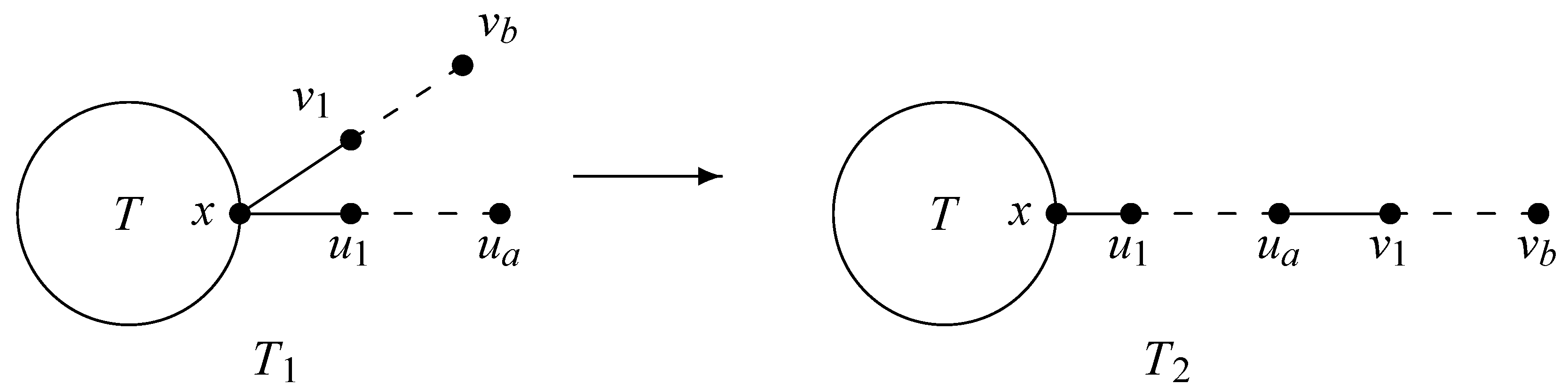
Figure 2.
Trees T and in Transformation 2.
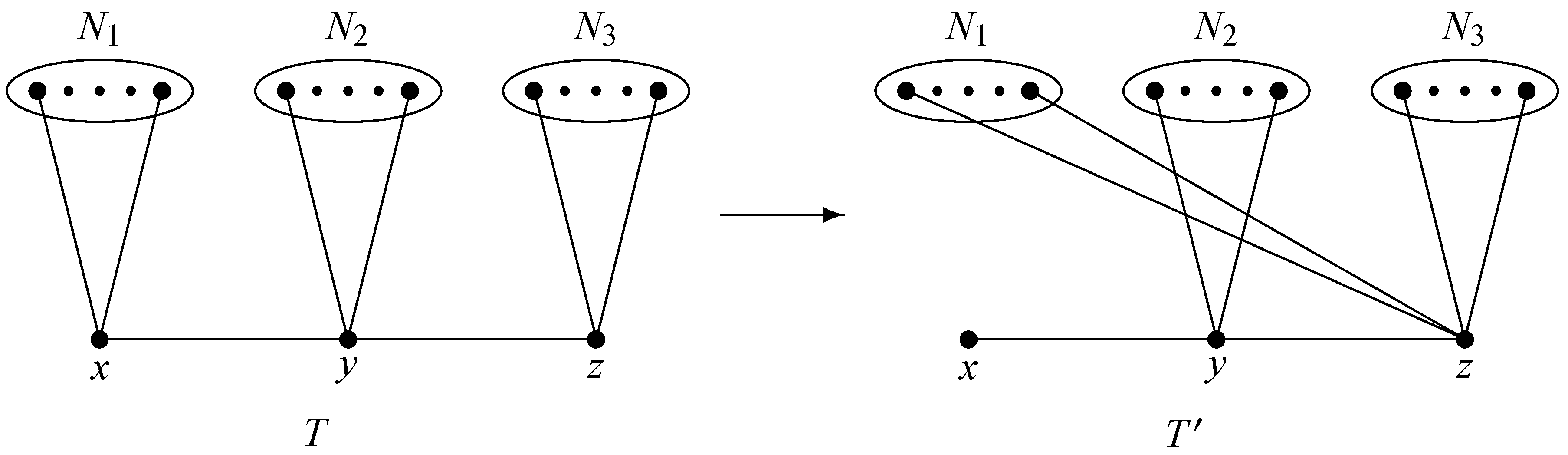

Table 1.
Extremal trees of .
| Indices | Min | Max | |
|---|---|---|---|
| Inverse sum index | |||
| reciprocal Randic̆ index | |||
| general second Zagreb index | |||
| forgotten index | |||
| Sombor index | |||
| reduced Sombor index | |||
| general first Zagreb index | |||
| first Gourava index | |||
| first hyper-Gourava index | |||
| second Gourava index | |||
| second hyper-Gourava index | |||
| product-connectivity Gourava index |
Disclaimer/Publisher’s Note: The statements, opinions and data contained in all publications are solely those of the individual author(s) and contributor(s) and not of MDPI and/or the editor(s). MDPI and/or the editor(s) disclaim responsibility for any injury to people or property resulting from any ideas, methods, instructions or products referred to in the content. |
© 2024 by the authors. Licensee MDPI, Basel, Switzerland. This article is an open access article distributed under the terms and conditions of the Creative Commons Attribution (CC BY) license (http://creativecommons.org/licenses/by/4.0/).
Copyright: This open access article is published under a Creative Commons CC BY 4.0 license, which permit the free download, distribution, and reuse, provided that the author and preprint are cited in any reuse.