
Submitted:
17 August 2024
Posted:
19 August 2024
You are already at the latest version
Abstract
New data obtained from core samples of two boreholes in Alba Guyot in the Magellan Seamount Trail (MST), Western Pacific, including 40Ar/39Ar age of basanite, mineralogy of basanite, tuff, tuffite, mantle-derived inclusions in basanite and tuff (lherzolite xenolith and Ol, Cpx, Opx xenocrysts), and calcareous nannofossils biostratigraphy, have implications for the guyot history. Volcanics in the upper part of the Alba Guyot main edifice and its Oma Vlinder satellite, at sea depths between 3600 and 2200 m, were deposited during the Cretaceous 112 to 86 Ma interval. In the following ~60 myr, the Alba Guyot became partly submerged, and denuded with the formation of a flat summit platform while the respective fragment of the Pacific Plate was moving to the Northern Hemisphere. Volcanic activity in the northeastern part of the guyot summit platform rejuvenated in the Miocene (24–15 Ma) and produced onshore basanitic volcanoes and layers of tuff in subaerial and tuffite in shallow-water near-shore conditions. In Middle-Late Miocene (10–6 Мa), after the guyot had submerged, carbonates containing calcareous nannofossils were deposited on the porous surfaces of tuff and tuffite. Precipitation of the Fe-Mn crust (Unit III) recommenced during the Pliocene-Pleistocene (< 1.8 Mа) when the guyot summit reached favorable sea depths. The location of the MST guyots in the northwestern segment of the Pacific Plate near the Mariana Trench, along with the Miocene age and alkali-basaltic signatures of basanite, provide evidence for petit-spot volcanism on the Alba Guyot. This inference agrees with the geochemistry of Cenozoic petit-spot basaltic rocks from the Pacific and Miocene basanite on the Alba Guyot. The numerous volcanic cones reaching up to 750 m high and 5.1 km in base diameter, which were discovered on the Alba summit platform, provide the first evidence of voluminous Miocene petit-spot basanitic volcanism upon the Cretaceous guyots and seamounts of the Pacific.
Keywords:
petit-spot volcanism
; Miocene basanitic volcanoes
; basanite
; tuff
; tuffite
; lherzolite xenolith
; Fe-Mn crust
; biostratigraphy
; calcareous nannofossils
; Alba Guyot
; Magellan Seamount Trail
; Pacific Plate
1. Introduction
Guyots in the Magellan Seamount Trail (MST) have been largely documented since the 1990s during cruise campaigns by the Research Department of the USSR/Russian Ministry of Geology, as well as by the Yuzhmorgeologia JSC and other institutions. The main results, including geological and geophysical maps, lithology, mineralogy, and chemistry of rocks, and data on Fe-Mn crusts, are available at http://guyot.ocean.ru, in technical reports of Yuzhmorgeologia, and in a number of publications [1,2,3,4,5,6,7], including our studies on the evolution of intraplate volcanism on guyots of Govorov and Alba [8,9,10].
Alba Guyot (17°00' N, 154°20' E) was named and renamed several times, and may be called in different ways in early and recent publications on the Pacific Plate volcanism. It was called Dalmorgeo, MAGL-3 or MA-15 in the Russian-language literature, while publications in English used the names Vlinder for the main edifice and Oma Vlinder for its SE satellite [4,5,7]. In 2004, the GEBCO Subcommittee of Undersea Feature Names approved a new name of Alba after Francisco Alba, a companion of Ferdinand Magellan.
The guyot has a shape of a truncated square prism with a 126×90 km pedestal at a bathymetric level of 5100 m and comprises a main edifice surrounded by several satellites (Figure 1a). The slopes of the main edifice dip at 35–40° near the top and flat out to 2–8° at the base. The 46×35 km flat top is at sea depths of 1250–1500 m. As evidenced by geophysical surveys, photo and video-profiling, dredging, and shallow drilling (within 1–1.5 m), the guyot is mainly composed of volcanic rocks, with subalkaline and alkali basalt varieties exposed on the slopes between the 3000 m sea depth and the summit [2]. The sediments deposited on the submerged guyot consist of shallow-water and hemipelagic limestone, carbonate-cemented breccia, carbonate, and mudrock lithologies. The cover of the summit platform consists partly of foraminifera silt and an up to 15 cm thick Fe-Mn crust on surfaces free from sediments, mainly along the guyot edge.
Fe-Mn crusts precipitated from seawater make up condensed stratigraphic sequences which record the accumulation of metals, as well as the Cenozoic evolution of the oceanic environment in general. Deposition of Fe and Mn oxyhydrates in the MST area lasted 60–65 myr in total and was interrupted by episodes of partial dissolution. The discontinuous precipitation process produced five units of Fe-Mn crusts that differ in structure, texture, composition, and age [11,12,13]: Late Paleocene-Early Eocene (Unit I-1), Middle-Late Eocene (Unit I-2a), Late Oligocene-Early Miocene (Unit I-2b), Middle-Late Miocene (Unit II), and Pliocene-Pleistocene (Unit III). The most complete sections resulting from successive deposition of Fe-Mn layers I-1 → I-2a → I-2b → II → III display three gaps of Early-Middle Oligocene (~12 myr), Early Miocene (~ 4 myr), and Early Pliocene (~ 1.6 myr). The longest gap separates the Paleocene-Eocene and Miocene-Pleistocene events, which correspond to older (I-1, I-2а) and younger (II, III) units. Fe-Mn crust samples often represent reduced sections that record local mineralization conditions in different zones of guyot and seamount surfaces. The gap between older and younger units may exceed 20 myr. Most of Fe-Mn crusts display the I-1 → I-2а → II → III and I-1 → II → III successions.
We report new data on Cenozoic volcanics that build several cones on the flat summit platform of Alba Guyot revealed by bathymetric survey in its northeastern part (Figure 1). The scope of work in cruises of 2019–2020 on R/V Gelendzhik included dredging at a small cone (15D266 dredge) and drilling of volcaniclastic rocks and a Fe-Mn crust (15B13 and 15B17 boreholes) in the guyot’s northeastern edge (Table 1). The samples of basanite, a lherzolite xenolith from basanite, tuff, and tuffite were analysed, including 40Ar/39Ar age of basanite, mineralogy of basanite, tuff, mantle-derived inclusions (lherzolite xenolith and Ol, Cpx, Opx xenocrysts), and calcareous nannofossils biostratigraphy found in the 15B13 and 15B17 cores. The earlier [9] and new data provide evidence of voluminous Miocene eruptions of basanitic magma on the guyot. The results have geodynamic implications and allow new insights into the Miocene petit-spot basanitic volcanism on Alba Guyot, as well as a more general idea of Cenozoic intraplate alkali-basaltic petit-spot volcanism in the subducting northwestern Pacific Plate.
2. Materials and Methods
The samples collected from Alba Guyot were analyzed at several institutions. Most of the analyses were performed at the Center for Isotope-Geochemical Studies of the Vinogradov Institute of Geochemistry, Siberian Branch of the Russian Academy of Sciences (IGC, Irkutsk).
2.1. XRF and SEM-EDS
Samples of volcanic rocks were analyzed for bulk chemistry by on a Bruker AXS S4 Pioneer wavelength dispersive X-ray fluorescence spectrometer using glass fusion discs (major oxides), as well as methods of titration (FeO, CO2), and gravimetric analysis (H2O+, H2O–, and total sulfur). The mineral and phase compositions were studied by scanning electron microscopy coupled with energy-dispersive spectrometry (SEM EDS) on a Carl Zeiss LEO-1430VP electron microscope equipped with an INCA Energy 350 analytical system at the Geological Institute (GI, Ulan-Ude), and on a Tescan Mira-3 LMU high-resolution electron microscope with an Ultim MAX-40 SDD detector at IGC (Irkutsk). The analyses were run in a scanning mode on carbon-coated polished cut surfaces of samples, at 1–10 μm2 spots, 20 kV accelerating voltage, 1 nA beam current, and 30 s acquisition time (excluding dead time). The data quality was checked against analyses of reference samples, including quartz, albite, orthoclase, wollastonite, MgO, Al2O3, CaF2, metals, and synthetic compounds from sets 6316 and 7682 of the reference standards by Microanalysis Consultants Limited (Oxford Instruments Ltd., UK). All the calculations and matrix corrections were done automatically with INCA and AZtec software (Oxford Instruments Nanoanalysis, UK). Silicate glasses were scanned over >10 μm2 spots, which allowed reducing the loss of alkalis and effects of the microtopography of polished samples on data quality. The detection limits of major elements were 0.2–0.3 wt%. Аverage random errors for major elements varied depending on their contents: ± 0.9 rel% at > 10 wt%, ± 3.0 rel% at 1–10 wt%, and ± 13 rel% at 0.3–1 wt% [14].
Mineral formulas and mass-balance calculations were performed in Crystal software, ver. 3.0 [15].
2.2. 40. Ar/39Ar Dating
Basanite sample 15D266A selected for dating was crushed to 250–500 µm and freed from coarse clasts of authigenic calcite, altered material, and Fe-Mn crust fragments under a binocular. The cleaned sample were crushed further, sieved to 150–250 µm, and leached in a 4N HNO3 solution for 10 min at room temperature in order to remove remnant calcite, volcanic glass, and soluble products of seawater alteration. Finally, the crushed material was rinsed several times with ultrapure water, till neutral pH of the solution. Incremental heating 40Ar/39Ar dating was applied to two specimens of the same crushed rock fraction digested in 4N HNO3. The specimens were wrapped in aluminum foil together with the BERN-4M muscovite standard certified as a 40Ar/39Ar reference (18.7 ± 0.096 Ma) and placed in a quartz capsule which was vacuumed and welded shut. The samples were irradiated in the cadmium-plated channel of the VVR-K research reactor at the Tomsk Polytechnical University, Tomsk, Russia. The stepwise heating experiments from 500 °С to 1150 °С were run in a quartz reactor with an external heating element. A blank run for 40Ar determination (10 min at 1200 °С) did not exceed 5×10⁻¹⁰ ncm3. Argon for the measurements was cleaned using ZrAl–SAES getters. The Ar isotope ratios were determined on a Noble Gas 5400 (MicroMass, UK) and on a Thermo Scientific Argus VI mass spectrometer at the Analytical Center for Multielemental and Isotopic Studies of the V.S. Sobolev Institute of Geology and Mineralogy (IGM, Novosibirsk). The 40Ar/39Ar ages were calculated for each temperature step of incremental heating and plateau ages were obtained according to cumulative 39Ar released.
2.3. С. alcareous Nannofossils Biostratigraphy
Mocro-nannofossils were detected and identified in chips of core fragments, under a Jeol JSM 6390LA scanning electron microscope, at the Botanical Institute (St. Petersburg). The rock chips, ≤ 5 mm in size, were mounted on a metal holder, spur coated with gold (60–90 Å), and examined at magnifications up to ×20000 with an accelerating voltage of 18 kV. The BSE images were used for taxonomic classification of the fossils, at the genus or species level. The age of the respective core intervals was determined according to nannoplankton species, with a focus on index species of main biozones and subzones [16,17,18]. The intervals of the identified сalcareous nannofossils were correlated with ample biostratigraphic evidence from oceanic sediments [16,17,18,19,20,21,22,23,24].
3. Results
The basaltic rocks of submerged Alba Guyot have been weathered more or less strongly under the effect of sea water, whereby an iddingsite aggregate (mixture of montmorillonite, chlorite, goethite, and other phases) replaced olivine (Ol) while a fine aggregate of palagonite (hydrated quenched glass) and secondary minerals partially replacing of the vitreous matrix. Vugs and cracks in volcanic rocks are often filled with authigenic calcite and organic-bearing phosphate-carbonate material; locally phillipsite, chlorite, and other secondary phases precipitated in vugs.
3.1. Core Samples
Borehole 15B13 drilled at the base of a cone near dredging site 15D266 (Figure 1b) stripped a Fe-Mn crust (Unit III), up to 3 cm thick (2.8 cm on average) lying over brick-red porous tuff (Figure 2). The core interval between 2.8 and 16 cm contains angular tuff clasts, from few mm to 3 cm long, amidst biomorphic carbonate cement and alteration products of fine glass and volcanic material. The tuff in the 16–42 cm interval is more porous and almost lacks carbonate inclusions.
Borehole 15B17 drilled at the eastern edge of the guyot (Figure 1b) stripped several units of the Fe-Mn crust and tuffaceous material (Figure 3). Unit III of the Fe-Mn crust, with sporadic carbonate inclusions, occupies the top 1.2 cm of the core above volcaniclastic tuffite with planktonic limestone, sand-size clasts of palagonite, and few fine detrital Cpx and Ol grains in a silt-pelitic groundmass (1.2–4 cm). The 4–8.5 cm interval encompasses Unit I-2b of the Fe-Mn crust containing two concretions in a carbonate-phosphate matrix partly damaged during drilling. The concretions enclose basaltic clasts in the central part. The lower portion of the core (8.5–14 cm) is composed of Unit I-1 of the Fe-Mn crust and basaltic clasts.
3.1.1. Calcareous Nannofossil Biostratigraphy
The 15B13 and 15B17 core samples of rocks and Fe-Mn crust material contain calcareous planktonic nannofossils of golden-brown coccolithophores and discoasters. They are commonly better preserved than other calcareous microfossils (e.g., formainifera) and can be identified from prints even when completely dissolved.
We analyzed two Fe-Mn crust chips and three samples of carbonate inclusions in tuff from the upper 16 cm of the 15B13 core (Figure 2). BSE images of the Fe-Mn crust (Unit III, points 1 and 2) reveal well pronounced casts of coccolithophores healed with by iron and manganese oxyhydrates. The samples from this interval contain a nannoplankton assemblage composed of Pseudoemiliania lacunosa, Syracosphaera pulchra, Umbilicosphera sibogae. Gephyrocapsa sp. cf. G. oceanica, and Coccolithus sp. cf. C. doronicoides (Figure 4). The identified species coexisted during biozones CP13 – CP14a. Abundant Pseudoemiliania lacunosa, an index species of zone NN19, marks an Early Pleistocene age of the Fe-Mn crust (Unit III).
Samples of carbonate cement from tuff, core depths 2.8 to 16 cm (points 3, 4, 5 in Figure 2), contain Miocene-Pliocene planktonic species of Discoasteraceae: most frequent Discoaster brouweri and D. Surculus (Figure 5), rarer Discoaster variabilis, Discoaster cf. D. chellengerrii and Discoaster bollii, and sporadic Calcidiscus macintyrei and Scyphosphaera sp. cf. S. aranta. All these species were extant during Middle-Late Miocene biozones CN7 and CN8.
The biostratigraphy of core 15B17 was studied in four Fe-Mn crust and tuffite samples (Figure 3). Prints of calcareous nannofossils were found in a homogeneous matrix of the Fe-Mn crust (Unit III), and original fossil remains also occurred in clay-carbonate inclusions (point 1). The nannoplankton assemblage includes Pliocene-Pleistocene species of Umbilicosphaera sibogae, Rhabdoshaera clavigera, Emiliania huxleyi, Ceratolithus cristatus, Coccolithus pelagicus, Helicosphaera carteri, and Cyclococcolithina leptopora (Figure 6). Taking into account the presence of the Emiliania huxleyi index species, the taxa identified at point 1 were extant during biozone CN15 (Late Pleistocene).
Carbonate inclusions in the tuffite layer bear abundant discasters and coccolithophores. The nannoplankton assemblage is mainly composed of Discoasteraceae (Figure 3, point 2): most frequent Discoaster brouweri, D. variabilis, and D. surculus, which were extant from the Late Miocene through the Pliocene (biozones CN9 – CN12a) (Figure 7); rare Cyclococcolithus leptoporus and Scyphoshaera globulata; sporadic Late Miocene index species of D. berggrenii, D. pentaradiatus and D. quinqueramus (lower and upper boundaries of biozone СN9).
Calcareous nannofossils were also found in a carbonate inclusion at larger core depths, between two buried Fe-Mn crust units (Figure 3, point 3). The assemblage comprises most abundant Discoasteraceae species of Discoaster deflandrei, Discoaster druggii, and Discoaster adamanteus, less frequent Discoaster formosus, as well as Sphenolithus genus (Sphenolithaceae) morphologically similar to Sphenolithus heteromorphus (Figure 8), which were extant during Early Miocene biozones CN1 – CN4.
Carbonate inclusions at the contact of Unit I-1 of the Fe-Mn crust with the overlying layer in the lower portion of the core (Figure 3, point 4) bear quite well preserved coccolithophores. The identified species are: Dictyococcites bisectus (Hay, Mohler, & Wade) Bukry & Percival, Reticulofenestra umbilica Martini, Coccolithus pelagicus Bukry, and Cyclicargolithus floridanus Bukry (Figure 9). This assemblage is typical of biozones CP14 – CP16 that span the Late Eocene – Early Oligocene period, while the identified species coexisted within biozone CP16.
3.2. Volcanic and Mantle Rocks
Basanite sample 15D266A has a porphyritic texture, with phenocrysts of olivine (Ol) and clinopyroxene (Cpх), without plagioclase, in a vuggy aphyric matrix. Olivine phenocrysts contain melt inclusions and spinel (Sp) grains. The hyalopelitic matrix is composed of randomly oriented euhedral Cpx and Ol microlites, titanomagnetite (Ti-Mgt) dendritic crystals and grains, and rare Sp grains rimmed with Ti-Mgt (Figure 10a), with interstitial glass, as well as frequent small and large Ol, orthopyroxene (Opx), and Cpx xenocrysts. Coarse (0.5–3 mm) angular Ol, Cpx and Opx xenocrysts are rimmed with newly formed Ol, Cpx or Cpx + Ol aggregate, respectively (Figure 10b,c). The matrix and the glass are partly weathered by sea water. The major-element chemistry of basanite and average oxide contents in minerals and glass are presented in Table 2.
Basanite from site 15D266B encloses a xenolith of lherzolite (10×12 cm in the largest section) with a coarse protogranular texture and a massive structure (Figure 10d). Its yellowish-brownish color is due to a large percentage of iddingsite aggregate partly replacing Ol. The amount of iddingsite reaches 33.4 wt%, as estimated by mass balance calculations [9], and the modal composition of lherzolite reconstructed with regard to average mineral chemistry of the constituent phases is 57.3 wt% Ol, 26 wt% Opx, 14 wt% Cpx, and 2.7 wt% Sp. Large particles of spinel in lherzolite are intergrown with Cpx, Opx, and Ol (Figure 10e,f). Cpx encloses quasi-parallel aligned exsolution lamelli of Opx and Sp, as well as round inclusions of pyrrhotite, while Opx encloses sporadic Cpx lamelli (Figure 10f). The original and reconstructed bulk compositions of lherzolite and average oxide contents in mantle minerals are presented in Table 3.
Tuff from core 15B13 (Figure 2) is composed of unsorted volcanic glass clasts with inclusions of euhedral phenocrysts and microlites of Cpx, Ol, and rare Sp grains. The tuff clasts contain small peridotite xenoliths, as well as Ol, Cpx, and Opx xenocrysts. The bulk composition of tuff and average oxide contents in minerals are presented in Table 4. The predominant volcanic rock in tuff is similar to 15D266A basanite in its mineral assemblage (see below), while the small peridotite xenoliths and xenocrysts of Ol, Cpx and Opx are compositionally similar to 15D266B lherzolite.
3.2.1. Chemistry of Minerals and Glasses
Olivine in volcanics becomes easily replaced by an iddingsite aggregate under a prolonged effect of sea water but is present in abundance in the lherzolite xenolith, basanite, and tuff (Table 2–4). Olivine phenocrysts and microlites in tuff and basanite contain similar amounts of the Fo component (100·Mg/(Mg+Fe) 82.2–86.5 mol%) and NiO (0.15–0.42 wt%). Olivine in lherzolite, peridotite xenoliths, and xenocrysts from basanite and tuff has the highest Fo of 89.5–91.7 mol% and is richer in NiO 0.31–0.57 wt% (Figure 11a).
Most of analyses for clinopyroxene from basanite and tuff fall within the diopside field in the Wo–Fs–En diagram (Figure 11b; Table 2, Table 3 and Table 4). Most highly magnesian diopside-augite (Mg#, 100·Mg/(Mg+Fe) 91.4–94.8) containing 0.4–1 wt% Cr2O3 and the smallest amount of TiO2 (< 0.35 wt%) is found in lherzolite and in peridotite xenoliths from tuff (Figure 11c,d). Cpx xenocrysts in tuff have a larger Mg# range than those from lherzolite: 89.7–93.9 to 73.9–76. Cpx phenocrysts and microlites from basanite and tuff show negative correlation between Mg# (69–86) and TiO2 contents (0.9–3.7 wt%), while Cr2O3 varies up to 1 wt% (Figure 11b,c).
Orthopyroxene (89–91 mol% En, enstatite) occurs in lherzolite as a rock-forming phase or as Cpx-hosted exsolution lamelli, as well as in Cpx xenocrysts from tuff and basanite (Figure 10c,f,l). Opx from lherzolite also encloses thin diopside lamelli. Opx xenocrysts from basanite and tuff are partly or fully replaced by the Cpx + Ol aggregate (Figure 10c,l). Opx in all rock samples has rather uniform major-oxide chemistry, with 54–56 wt% SiO2, 32–34 wt% MgO, 6–7 wt% FeO, 2–4 wt% Al2O3, 0.4–0.8 wt% Cr2O3, and 0.3–0.7 wt% CaO (Table 3 and Table 4; Figure 11b). Opx in a small peridotite xenolith from tuff encloses phlogopite containing 38.4 wt% SiO2, 0.9 wt% TiO2, 14.1 wt% Al2O3, 1 wt% Cr2O3, 23.5 wt% MgO, 1.2 wt% Na2O, 8.4 wt% K2O, 0.7 wt% BaO, 0.2 wt% NiO, and 0.1 wt% Cl. Clinopyroxene from lherzolite likewise hosts sporadic phlogopite inclusions.
Spinel-group minerals in lherzolite and peridotite xenoliths from tuff have highest Al2O3 contents (36–54 wt%) and Mg#, Mg/(Mg+Fe2+) 0.70–0.85, at low Cr#, Cr/(Cr+Al) 0.13–0.38 and TiO2 < 0.38 wt% (Table 2, Table 3 and Table 4, Figure 12). Spinel from basanite and some peridotite xenoliths in tuff show lower Mg# of 0.6–0.7 and higher Cr# (0.29–0.73), while Sp in tuff has the lowest Mg# (0.33–0.48) and highest Cr# 0.68–0.73 values (Figure 12b). The Mg# values in Sp from all analyzed rocks are in negative correlation with Cr# and total iron (Fe2+ + Fe3+). TiO2 in Sp from basanite and tuff varies from 0.2 to 4.8 wt% (2–4 wt% on average) (Figure 12c).
Alkaline silicate glass (25–30 wt% according to mass-balance calculations) fills interstices between phenocrysts and microlites in the basanite matrix (Table 2, Figure 10a-c). Its composition normalized to 100 wt% plots within the field of Tephri-Phonolite and Phonolite in the TAS diagram for volcanic rocks (Figure 13). The glass contains more Na2O than K2O (5.4–8.7 wt% against 4.6–6.1 wt%) and minor amounts of FeO (3.3–6.8 wt%), CaO (1.6–4.6 wt%), MgO (0.4–1.2 wt%), TiO2 (1–2.2 wt%), MnO (≤ 0.2 wt%), BaO (0.3–0.7 wt%), P2O5 (0.7–2.2 wt%), SO3 (≤ 1 wt%), and Cl (0.3–0.5 wt%). Raman spectroscopy revealed molecular H2O which may reach 4–6 wt%, as inferred from deficit of totals in SEM-EDS analyses.
The amounts of glass and palagonite are greater in volcanic clasts from tuff than in basanite (Figure 10a,b,g,l). All glass in small clasts has been replaced by palagonite while glass particles in large clasts have reaction palagonite rims but their cores lack alteration signatures detectable by SEM EDS (Figure 10h). Compared to that from basanite, glass from tuff contains more CaO (6.8–10.8 wt%) and less Na2O + K2O (3–4.9 wt% Na2O, 2.9–4.2 wt% K2O) (Table 4). Other major oxides in glass are 8.7–11.1 wt% FeO, 3.4–5.1 wt% MgO, 2.6–3.4 wt% TiO2, 1–1.4 wt% P2O5, up to 0.3 wt% MnO, up to 0.5 wt% BaO, up to 0.4 wt% SO3, 0.1–0.2 wt% Cl, and 3–5 wt% H2O (according to Raman spectroscopy and SEM EDS). In the TAS diagram, glass plots in the fields of Tеphrite-Basanite and Phono-Tephrite (Figure 13).
3.3. 40Ar/39Ar Age of Basanite
Incremental heating 40Ar/39Ar dating of volcanic rocks weathered by sea water was applied to acid-leached groundmass samples. The results include plateau ages and 39Ar/40Ar – 36Ar/40Ar isochron ages, mainly for fractions of K-bearing minerals, such as amphibole or plagioclase [6,32]. Isotope measurements were performed for two specimens of sample 15D266A (Table 5). One specimen (197.51 mg) yielded a 19.9 ± 0.8 Ma 40Ar/39Ar age calculated using 100% of cumulative 39Ar released (Figure 14). However, no statistically justified plateau age could be obtained for the other specimen (246.34 mg), because of large variance and error at 675, 975, 1025, 1075, and 1150 °С temperature steps. The calculated age values were 18.3 ± 0.4 Ma (Miocene) at the 500–600 °С (53.2% cumulative 39Ar released) and from 16.1 ± 1.9 Ma to 24.0 ± 0.9 Ma at 750–925 °С (24.6% cumulative 39Ar) steps (Figure 14; Table 5). The analytical problems with the second specimen may be due to rock alteration by sea water and to the presence of amorphous glass preserved partly in large specimen (246.34 mg) of crushed and acid-leached basanite, as 39Ar may move from one phase to another in a process known as recoil.
4. Discussion
4.1. Formation Conditions of Mineral Assemblages
The lack of plagioclase in basanite (sample 15D266A) and tuff (sample 15B13), as well as the presence of 3–6 wt% H2O in volcanic glass, bear evidence of originally hydrous compositions of alkali-basaltic (basanitic) parent melts. Judging by the amount and chemistry of glass (Table 2 and Table 4; Figure 13) and petrography of rocks (Figure 10 a-c,g-l), the sampled tuff formed during fragmentation of alkali-basaltic magma with a higher melt fraction than in the in the more crystalline erupted basanitic magma.
The analyzed samples enclose various mantle-derived fragments: a lherzolite xenolith in sample 15B266B and small peridotite xenoliths, as well as Cpx xenocrysts with Sp exsolution lamelli and Opx xenocrysts partially replaced by an Cpx + Ol aggregate in 15B13 tuff.
Lherzolite has a typically peridotitic protogranular texture (Figure 10d,e,f). Its crystallization P-T conditions were estimated previously using mineral chemistry data [9]. The crystallization temperature reconstructed by two-pyroxene (Cpx + Opx) geothermometry is 818 °С [33]. Other estimates we obtained with mineral thermobarometry for pressures in the 1.5–2 GPa interval: 719–732 °С from Cpx + Opx [34,35]; 754–767 °С from Fe-Mg–Ol/Sp [36], and 832–860 °С according to Ca–in–Opx thermobarometry [34]. The pressure calculated for the fixed temperature range between minimum and maximum estimates (720–860 °С) varies from 1.59 to 2.04 GPa or from 1.89 to 2.33 GPa, based on Cpx [37] and Cr–in–Cpx [38]geobarometers, respectively.
Thus, given the large uncertainty of the estimates, the equilibrium Ol + Cpx + Opx + Sp mineral assemblage of lherzolite presumably crystallized at 800 ± 50 °С and 2.0 ± 0.3 GPa, at depths 60 ± 5 km in oceanic lithosphere. Judging by the mineral chemistry of Sp, the melt fraction at crystallization of lherzolite mineral assemblage found using the empirical formula F,% = 10Ln(Cr#) + 24 [39] was within 6–10%. Furthermore, sporadic inclusions of phlogopite in the lherzolite xenolith and an Opx xenocryst from tuff provide implicit evidence for metasomatic changes in peridotite.
4.2. Evolution of Volcanism in Alba Guyot
The oldest volcanic edifices of Alba Guyot formed around 160 Ma within the Jurassic Magnetic Quiet Zone (JQZ) of the Pacific Plate [40], which was then located north of the Ontong Java Nui plateau in the Southern Hemisphere [41]. Large-scale Cretaceous volcanism in that part of the Pacific produced a Super-LIP [42], with numerous volcanoes in spreading zones along the Izanagi, Farallon, and Phoenix Plate boundaries.
The Alba Guyot slopes at 2400–3100 m sea depths are composed of amphibole-bearing basanite with an 40Ar/39Ar age of 102–100 Ma [5,6], while a part of the summit platform at a depth of 2200 m and the deeper (3400 m) Oma Vlinder satellite edifice consist of younger (95–93 Ma) basalts and hawaiites. Our 40Ar/39Ar determinations bracket the age of 1400 m thick (3600 to 2200 m deep) basalts, trachybasalts, and basaltic andesites in the upper portion of the Alba Guyot and Oma Vlinder satellite section between 112 and 86 Ma. In this respect, the Miocene age of basanite sample 15D266A from the vicinity of a small volcanic cone in the eastern margin of the guyot (Figure 1b) is unusual for the Cretaceous MST guyots and seamounts. The obtained 40Ar/39Ar age estimates have large variance though, in a range between 16.1 ± 1.9 Ma and 24.0 ± 0.9 Ma, the most probable values being 19.9 ± 0.8 Ma and 18.3 ± 0.4 Ma (Figure 14).
The bathymetric map of the guyot images five large and several small cones in the northwestern part (Figure 1b). Earlier sonar surveys and dredging at sites 15D21 and 15D18 revealed cones of basanite and tuff intercalated with organic (planktonic) limestone [3]. The cones were timed as Miocene proceeding from a single K/Ar date (15 ± 2 Ma) for dredged basanite sample 15D21, as well as from the biostratigraphy of calcareous nannofossils found in the carbonate cement of tuff. The chains of volcanic cones are aligned with large NW and NE faults which delineate topographically expressed scarps and a graben in the northern slope of the guyot [2]. Basanitic magma apparently ascended through deformed oceanic lithosphere in faults and at their junctions and erupted to build cones reaching 750 m high and 2.2 to 5.1 km diameter at base, upon the flat summit platform of the main guyot edifice.
Borehole 15B13 drilled near the small cone and dredging site 15D266 stripped a tuff layer (Figure 1b) deposited during eruption of basanitic magma, judging by the mineralogy of clasts (Figure 11,12). Furthermore, core samples from borehole 15B17 show a Miocene gap in the formation of the Fe-Mn crust (Figure 3). The presence of volcaniclastic rocks (tuff and tuffite), in the absence of hyaloclastic material on the guyot top, indicates that basanitic magma erupted above the sea level in the Miocene, between ~24 and 15 Ma (ages of basanite samples 15D266A and 15D21). The tuff cored at 15B13 was deposited in subaerial conditions while the deposition of tuffite from 15B17 occurred in shallow-water near-shore conditions.
According to previous estimates [2], the summit of the largest 750 m high basanitic cone near dredging site 15D21 is located at a sea depth of 551 m which is the shallowest over the summits of all subsea MST edifices. Therefore, it was the last submerged mountain in the MST. As evidenced by biostratigraphic data for 15B13 core (Figure 2), carbonate sediments containing calcareous nannofossils of biozones CN7 and CN8 were deposited on porous tuff surfaces in the Middle-Late Miocene, about 10 to 7 Мa, when the guyot was already below the sea level. Most likely, calcareous nannoplakton from biozone CN9 appeared in the 15B17 tuffite layer around 6 Ма, in the Late Miocene (Figure 3). The evolution of the edifice was completed by the latest event of Fe-Mn crust precipitation (Unit III) in the Pleistocene, after 1.8 Mа. The age of the crust covering samples of basanite 15D266А, lherzolite xenolith 15D266B, and surfaces of cores 15B13 and 15B17 (Figure 2,3,10d) is constrained by the presence of calcareous nannofossils that belong to biozones CN19 and CN20.
4.2. Petit-Spot Volcanoes in the Pacifiс Plate and in Alba Guyot
There are several known occurrences of Cenozoic petit-spot volcanism associated with an unusual geodynamic setting of the Pacific Plate [43,44]. Petit-spot volcanoes younger than 8.5 Ma were found not far from the Japan trench, along the subducting slab front [43], and even younger (< 3 Ma) small cones were discovered recently on the abyssal plain near Marcus (Minamitorishima) Island, about 2000 km east of the Mariana trench [44]. Geodynamic models [45,46,47,48] attribute petit-spot volcanic activity to stress release into trenches during the Pacific subduction and related faulting. The flexure of the > 100 km thick Pacific Plate in the Cenozoic subduction zone produced tension in the oceanic lithosphere, which led to faulting from the Lithosphere–Asthenosphere Boundary (LAB) or Low-Velocity Zone (LVZ) level and to the related petit-spot alkali basaltic volcanism. Therefore, alkali-basaltic melts may result from decompression (adiabatic) melting of the asthenospheric and metasomatized oceanic lithospheric material under the effect of tectonic motions, without any plume involved [8,9,10,44,45,47,48,49].
The rejuvenated Cenozoic petit-spot volcanism apparently produced the Miocene basanitic cones and tuff layers on the summit platform of Alba Guyot (Figure 1b). This inference is consistent with the location of MST guyots near the Mariana trench in the northwestern segment of the Pacific Plate and with the alkali-basaltic signatures of the Alba basanite. The compositions of glass from tuff (15B13) and basanite (15D266A) plot the most alkaline trend in the TAS diagram (Figure 13), and our data have provided the first evidence of basanite in the Cenozoic volcanics of the Pacific Plate. Basanite sample 15D266A after Peretyazhko et al. [9] shares geochemical similarity (incl. Sr, Nd, and Pb isotopic ratios) with petit-spot basalts, trachybasalts, and basaltic trachyandesites reported previously from the Pacific and Indian Oceans [30,31,50,51,52]. Namely, similar shapes are observed in multi-element patterns normalized to primitive mantle, with typical Zr–Hf and Ti depletion, and in chondrite-normalized REE + Y spectra with (La/Yb)N up to 31 [9]. Petit-spot volcanics with such signatures presumably originate from alkali-basaltic melts produced by decompression partial melting of carbonatized peridotite in metasomatized oceanic lithosphere at the LAB or LVZ level [9,31,53].
5. Conclusions
The previously published [9] and our new data on mineralogy, Miocene age of basanite, and biostratigraphy of core samples from Alba Guyot shed light on the history of its volcanism.
The Cretaceous volcanics in the upper part of the main guyot edifice and its satellite Oma Vlinder, between the 3600–2200 m bathymetric levels, were formed between 112 and 86 Ma. For the following ~60 myr, the guyot edifice became partially submerged, exposed to sea water weathering, and acquired a flat summit platform while the respective part of the Pacific Plate was moving to the Northern Hemisphere.
According to biostratigraphic evidence, a Fe-Mn crust (units I-1 and 1-2b) had formed no later than in the Oligocene (> 38 Ma) at the bathymetric level of borehole 15B17 and was then overlain by a layer of tuffite about ~6 Ma, in the Late Miocene (Figure 3).
Volcanic activity in the northeastern part of the guyot resumed in the Miocene (24–15 Ma) as voluminous outpourings of basanitic magma from several edifices which produced layers of tuff and tuffite above and below the sea level, respectively. The volcanic events inhibited the growth of Fe-Mn crusts around the summit of the guyot.
The mantle sources of basanitic magma were located at depths > 60 ± 5 km (according to P-T conditions inferred for the crystallization of the mineral assemblage in lherzolite), in metasomatized (carbonatized) oceanic lithosphere, possibly, at the LAB level. The basanitic magma ascended along deep faults in the oceanic lithosphere and Cretaceous Alba Guyot main edifice and entrapped fragments of mantle rocks (lherzolite xenoliths and Ol, Cpx, and Opx xenocrysts).
In Middle-Late Miocene (10–6 Мa), after the Alba Guyot had submerged, carbonates containing calcareous nannofossils were deposited on porous surfaces of tuff (15B13) and during the formation of a tuffite layer (15I17). Рrecipitation of the Fe-Mn crust (Unit III) recommenced during the Pliocene-Pleistocene (< 1.8 Mа) when the guyot summit reached favorable sea depths.
The numerous small and large volcanic cones found on the Alba summit platform (Figure 1b) provide the first evidence of voluminous Miocene petit-spot basanitic volcanism upon the Cretaceous guyots and seamounts of the Pacific.
Author Contributions
Conceptualization and investigation, I.S.P.; field sampling, I.A.P.; writing, review, and editing, all authors; Visualization, I.A.P. and E.A.S. All authors have read and agreed to the published version of the manuscript.
Funding
The study was carried out as part of Basic Research Program 0284-2021-0006 of the Russian Academy of Sciences.
Acknowledgments
We would like to thank crew members of R/V Gelendzhik (JSC Yuzhmorgeologiya) for sampling work and support during the cruises of 2019–2020. We are grateful to our colleagues: Yudin D.S. (Sobolev Institute of Geology and Mineralogy, Novosibirsk) for Ar-Ar dating, Cherbakov Yu.D. (Vinogradov Institute of Geochemistry, Irkutsk) and Khromova E.A. (Geological Institute, Ulan-Ude) for SEM-EDS measurements.
Conflicts of Interest
The authors declare no conflict of interest.
References
- Volokhin, Yu.G.; Melnikov, M.E.; Shkolnik, E.L.; Vasiliev, B.I.; Govorin, I.N.; Khersberg, L.B.; Zadornov, M.V.; Baturin, G.N.; Mechetin, A.V.; Chudaev, O.V.; Michailik, E.V.; Konovalov, Y.I.; Evlanov, Y.B.; Malyarenko, A.N.; Tatarin, I.A.; Govorov, G.I.; Simanenko, V.P.; Martinov, Y.A.; Panchenko, I.V.; Dmitriev, Y.D.; Golubeva, E.D.; S'edin, V.T.; Birulina, M.G.; Burikova, I.A.; Gerasimova, G.I.; Kiselev, V.V.; Pletnev, S.P.; Popova, T.V.; Oktyabrskiy, R.A.; Senkova, T.V. Guyots of the Western Pacific and their Mineralisation. Moscow, 1995, Nauka, 368 p. (in Russian).
- Pletnev, S.P.; Melnikov, M.E.; S'edin, V.T.; Sedysheva, T.E.; Avdonin, V.V.; Anokhin, V.M.; Zakharov, Y.D.; Punina, T.A.; Smirnova, O.L. Geology of Guyots in the Magellan Seamounts (Pacific Ocean): Vladivostok, 2020, Dalnauka, 200 p. (in Russian).
- Melnikov, M.Ye.; Podschuveit, V.B.; Pulyaeva, I.A.; Nevretdinov, E.B. Middle Miocene volcanic structures on the Dalmorgeologiya Guyot (Magellan Seamounts, Pacific Ocean). Russ. J. Pacific Geol., 2000, 19(5), 38–46.
- Melnikov, M.Ye.; Pletnev, S.P.; Anokhin, V.M.; Sedysheva, T.E.; Ivanov, V.V. Volcanic edifice on guyots of the Magellan Seamounts (Pacific Ocean). Russ. J. Pacific Geol., 2016, 35(6), 46–53. [CrossRef]
- Koppers, A.A.P.; Staudigel, H.; Wijbrans, J.R.; Pringle, M.S. The Magellan seamount trail: implications for Cretaceous hotspot volcanism and absolute Pacific Plate motion. Earth and Planetary Science Letters (EPSL), 1998, 163, 53–68. [CrossRef]
- Koppers, A.A.P.; Staudigel, H.; Wijbrans, J.R. Dating crystalline groundmass separates of altered Cretaceous seamount basalts by the 40Ar/39Ar incremental heating technique. Chem. Geol., 2000, 166, 139–158. [CrossRef]
- Wei, H.; Zhang, G-L.; Zhang, Ji.; Shi, X-F.; Castillo, P.R.; Zhang, Y.; Zhang, W-F.; Xu, Y-G.; Li, H-Y.; Hui Zhang, H. Overlapping hotspot tracks and melts from diffuse plume materials in the upper mantle generated intraplate seamount groups in the West Pacific. Earth and Planetary Science Letters (EPSL), 2024, V. 643. [CrossRef]
- Peretyazhko, I.S.; Savina, E.A. Chemistry and crystallization conditions of minerals in metasomatized oceanic lithosphere and basaltic rocks of Govorov Guyot, Magellan Seamounts, Pacific Ocean. Minerals, 2022, 12(10):1305. [CrossRef]
- Peretyazhko, I.S.; Savina, E.A.; Pulyaeva, I.A.; Yudin, D.S. Intraplate volcanism of the Alba Guyot. Geodynamic formation models of the Magellan Seamounts in the Pacific Ocean for 100 million years: Russ. Geol. Geophys., 2023, 64 (1): 1–27. [CrossRef]
- Peretyazhko, I.S.; Savina, E.A. Cretaceous intraplate volcanism of Govorov Guyot and formation models of the Magellan seamounts, Pacific Ocean. International Geology Review, 2023, 65(16):2479-2505. [CrossRef]
- Pulyaeva, I.A. Stratification of ferromanganese crusts on the Magellan seamounts: In: Proceedings of 30th International Geological Congress, 8-14 August 1996 1997?, Beijing, Vol. 13, 111–128.
- Glasby, G.P.; Ren, X.; Shi, X.; Pulyaeva, I.A. Co-rich Mn crusts from the Magellan seamounts cluster: the long journey through time. Geo-Mar Lett., 2007, 27:315–323.
- Pulyaeva, I.A.; Hein, J.R. Hydrogenetic Fe-Mn crusts from the Atlantic and Pacific oceans: geological evolution and conditions of formation. Marine minerals: Recent Innovations in Technology. UMI, Hawaii, 2011, 11.
- Lavrent’ev, Yu.G.; Karmanov, N.S.; Usova, L.V. Electron probe microanalysis of minerals: microprobe or scanning electron microscope? Russian Geology and Geophysics, 2015, 56(8), 1154–1161. [CrossRef]
- Peretyazhko, I.S. CRYSTAL – Applied software for mineralogists, petrologists, and geochemists. Zapiski Rossiiskogo Mineralogicheskogo Obshchestva, 1996, 3, 141–148 (in Russian).
- Martini, E. Standard Neogene calcareous nannoplankton zonation. In: E. Martini, T. Worsley (ed.), Naturfa, 1970, 225, 289–290.
- Martini, E. Standard Tertiary and Quaternary calcareous nannoplankton zonation. In: Farinacci A (ed.) Proceedings of 2nd Planktonic Conference, 1971, V. 2. Edizioni Tecnoscienza, Roma, 1225–1230.
- Bukry, D. Coocolith stratigraphy, eastern equatorial Pacific, Leg. 16, Deep Sea Drilling Project. In: Initial Reports DSDP, 1973a, 16, 653–711.
- Bukry, D. Biostratigraphy of Cenozoic marine sediment by calcareous nannofossils. Micropaleontology, 1978, 24(1), 44–60.
- Bukry, D. Phytoplankton stratigraphy, Deep Sea Drilling Project, Leg 20, Western Pacific Ocean. In: Initial Reports DSDP, 1973b, 20, 307–317.
- Bukry, D. Phytoplankton stratigraphy, Deep Sea Drilling Project, Leg 20, Western Pacific Ocean. In: Initial Reports DSDP, 1973b, 20, 307–317.
- Okada, H; Bukry, D. Supplementary modification and introduction of code numbers to the low latitude coccolith biostratigraphic zonation. Marine Micropaleontology, 1980, 5:321–325.
- Perch-Nielsen, K. Cenozoic calcareous nannofossils. In H.M. Bolli, J.B. Saunders and K. Perch-Nielsen (Eds.), Plankton Stratigraphy (Cambridge Earth Science Series) Cambridge University Press, 1985, 427–554.
- Shumenko, S.I. Guide to Microfossils of the USSR. Leningrad, Nedra, 1987, 1, 198 p. (in Russian).
- Takahashi, E.; Uto, K.; Schilling, J-G. Primary magma compositions and Mg/Fe ratios of their mantle residues along Mid Atlantic Ridge 29° N to 73°N. Technical report of ISEI Okayama University Series, 1987, A 9:1–4.
- Wass, S.Y. Multiple origins of clinopyroxenes in alkali basaltic rocks. Lithos, 1979, 12:115–132. [CrossRef]
- Chen, L.; Tang, L.; Li, X.; Dong, Y.; Xing; Yu, X.; Ding, W. Geochemistry of peridotites from the Yap Trench, Western Pacific: Implications for subduction zone mantle evolution. Int. Geol. Rev. 2019, 61, 1037–1051. [CrossRef]
- Le Bas, M. J.; Le Maitre, R.; Strackeisen, A.; Zanettin, B. A chemical classification of volcanic rocks based on the total alkali–silica diagram. J. Petrol., 1986, 27, 745–750. [CrossRef]
- Irvine, T.N.; Baragar, W.R.A. A Guide to the Chemical Classification of the Common Volcanic Rocks. Can. J. Earth Sci., 1971, 8, 523–548. [CrossRef]
- Hirano, N.; Machida, S. The mantle structure below petit-spot volcanoes, Commun. Earth Environ., 2022, 3, 110. [CrossRef]
- Mikuni, K.; Hirano, N.; Machida, S.; Sumino, H.; Akizawa, N.; Tamura, A.; Morishita, T.; Kato, Y. Contribution of carbonatite and recycled oceanic crust to petit-spot lavas on the western Pacific Plate. Solid Earth, 2024, 15, 167–196. [CrossRef]
- Heaton, D.E.; Koppers, A.A.P. High-resolution 40Ar/39Ar geochronology of the Louisville seamounts IODP expedition 330 drill sites: Implications for the duration of hot spot-related volcanism and age progressions. Geochemistry, Geophysics, Geosystems (GGG), 2019, 20, 4073–4102. [CrossRef]
- Wells, P.R.A. Pyroxene thermometry in simple and complex systems. Contrib. Mineral. Petrol., 1977, 46, 129–139. [CrossRef]
- Brey, G.P.; Köhler, T. 1990. Geothermobarometry in four-phase lherzolites II: New thermobarometers and practical assessment of existing thermobarometers. J. Petrol., 1990, 31 (6), 1353–1378. [CrossRef]
- Taylor, W. An experimental test of some geothermometer and geobarometer formulations for upper mantle peridotites with application to the thermobarometry of fertile lherzolite and garnet websterite. Neues Jahrbuch Mineral. Abhandlungen, 1998, 172:381–408. [CrossRef]
- O'Neill, H.St.C.; Wall, V.J. The olivine-orthopyroxene-spinel oxygen-geobarometer, the nickel precipitation curve and the oxygen fugacity of the earth's upper mantle. J. Petrol., 1987, 28, 1169–1191. [CrossRef]
- Nimis, P.; Taylor, W.R. Single clinopyroxene thermobarometry for garnet peridotites. Part I. Calibration and testing of a Cr-in-Cpx barometer and an enstatite-in-Cpx thermometer. Contrib. Mineral. Petrol., 2000, 139(5), 541–554. [CrossRef]
- Sudholz, Z.J.; Yaxley, G.M.; Jaques, A.L.; Brey, G.P. Experimental recalibration of the Cr-in-clinopyroxene geobarometer: improved precision and reliability above 4.5 GPa. Contrib. Mineral. Petrol., 2021, 176:11. [CrossRef]
- Hellebrand, E.; Snow, J.E.; Dick, H.J.B.; Hofmann, A.W. Coupled major and trace elements as indicators of the extent of melting in mid-ocean-ridge peridotites. Nature, 2001, 410(6829), 677–681. [CrossRef]
- Tivey, M.A.; Sager, W.W.; Lee, S.M.; Tominaga, M. Origin of the Pacific Jurassic quiet zone. Geology, 2006, 34, 789–792. [CrossRef]
- Hochmuth, K.; Golf, K.; Uenzelmann-Neben, G. Playing jigsaw with Large Igneous Provinces – A plate tectonic reconstruction of Ontong Java Nui, West Pacific. Geochemistry, Geophysics, Geosystems (GGG), 2015, 16, 3789-3807. [CrossRef]
- Seton, M.; Müller, R.D.; Zahirovic, S.; Gain, C.; Torsvik, T.; Shephard, G.; Talsma, A.; Gurnis, M.; Turner, M.; Maush, S.; Chandler, M. Global continental and ocean basin reconstructions since 200Ma. Earth Science Review, 2012, 113(3-4), 212–270. [CrossRef]
- Hirano, N.; Kawamura, K.; Hattori, M.; Saito, K.; Ogawa, Y. A new type of intra-plate volcanism; Young alkali-basalts discovered from the subducting Pacific Plate, Northern Japan Trench. Geophys. Res. Let., 2001, 28, 2719–2722. [CrossRef]
- Hirano, N.; Machida, S.; Sumino, H.; Shimizu, K.; Tamura, A.; Morishita, T.; Iwano, H.; Sakata, S.; Ishii, T.; Arai, S.; Yoneda, S.; Danhara, T.; Hirata, T. Petit-spot volcanoes on the oldest portion of the Pacific Plate. Deep-Sea Research Part I, 2019, 154, 103142. [CrossRef]
- Hirano, N. Petit-spot volcanism: a new type of volcanic zone discovered near a trench, Geochem. J., 45, 157–167, 2011. [CrossRef]
- Harigane, Y.; Mizukami, T.; Morishita, T.; Michibayashi, K.; Abe, N.; Hirano, N. Direct evidence for upper mantle structure in the NW Pacific Plate: Microstructural analysis of a petit-spot peridotite xenolith: Earth and Planetary Science Letters (EPSL), 2011, 302, 194–202. [CrossRef]
- Machida, S.; Kogiso, T.; Hirano, N. Petit-spot as definitive evidence for partial melting in the asthenosphere caused by CO2. Nature Communications, 2017, 8, 14302. [CrossRef]
- Pilet,S.; Baker, M.B.; Stolper, E.M. Metasomatized lithosphere and the origin of alkaline lavas. Science, 2008, 320, 916–919. [CrossRef]
- Pilet, S.; Abe, N.; Rochat, L.; Kaczmarek, M.A.; Hirano, N.; Machida, S.; Buchs D.M.; Baumgartner, P.O.; Müntener, O. Pre-subduction metasomatic enrichment of the oceanic lithosphere induced by plate flexure. Nature Geosciences, 2016, 9, 898–903. [CrossRef]
- Taneja, R.; Rushmer, T.; Blichert-Toft, J.; Turner, S.; O’Neill, C. Mantle heterogeneities beneath the Northeast Indian Ocean as sampled by intra-plate volcanism at Christmas Island. Lithos, 2016, 262, 561–575. [CrossRef]
- Reinhard, A.A.; Jackson, M.G.; Blusztajn, J.; Koppers, A.A.P.; Simms, A.R.; Konter, J.G. “Petit Spot” rejuvenated volcanism superimposed on plume-derived Samoan Shield volcanoes: Evidence from a 645m drill core from Tutuila Island, American Samoa. Geochemistry, Geophysics, Geosystems (GGG), 2019, 20, 1485–1507. [CrossRef]
- Falloon, T.J.; Hoernle, K.; Schaefer, B.F.; Bindeman, I.N.; Hart, S.R.; Garbe-Schonberg, D.; Duncan, R.A. Petrogenesis of lava from Christmas Island, Northeast Indian Ocean. Implications for the nature of recycled components in non-plume intraplate settings. Geosciences, 2022, 12, 118. [CrossRef]
- Dasgupta, R.; Hirschmann; M.M.; McDonough, W.F.; Spiegelman, M.; Withers, A.C. Trace element partitioning between garnet lherzolite and carbonatite at 6.6 and 8.6 GPa with applications to the geochemistry of the mantle and of mantle-derived melts. Chem. Geol., 2009, 262, 57–77. [CrossRef]
Figure 1.
Bathymetry map of Kocebu and Alba Guyots (a); enlarged fragments of the main Alba Guyot edifice (b), modified from Peretyazhko et al. [9]. Panel (b) shows inferred faults and cones of petit-spot volcanoes. Location of sampling sites (Table 1): 15D21, 15D18, and 15D266 dredges; 15B13 and 15B17 boreholes. Bold lines in panels (b) are isobaths at 100 m intervals.
Figure 1.
Bathymetry map of Kocebu and Alba Guyots (a); enlarged fragments of the main Alba Guyot edifice (b), modified from Peretyazhko et al. [9]. Panel (b) shows inferred faults and cones of petit-spot volcanoes. Location of sampling sites (Table 1): 15D21, 15D18, and 15D266 dredges; 15B13 and 15B17 boreholes. Bold lines in panels (b) are isobaths at 100 m intervals.
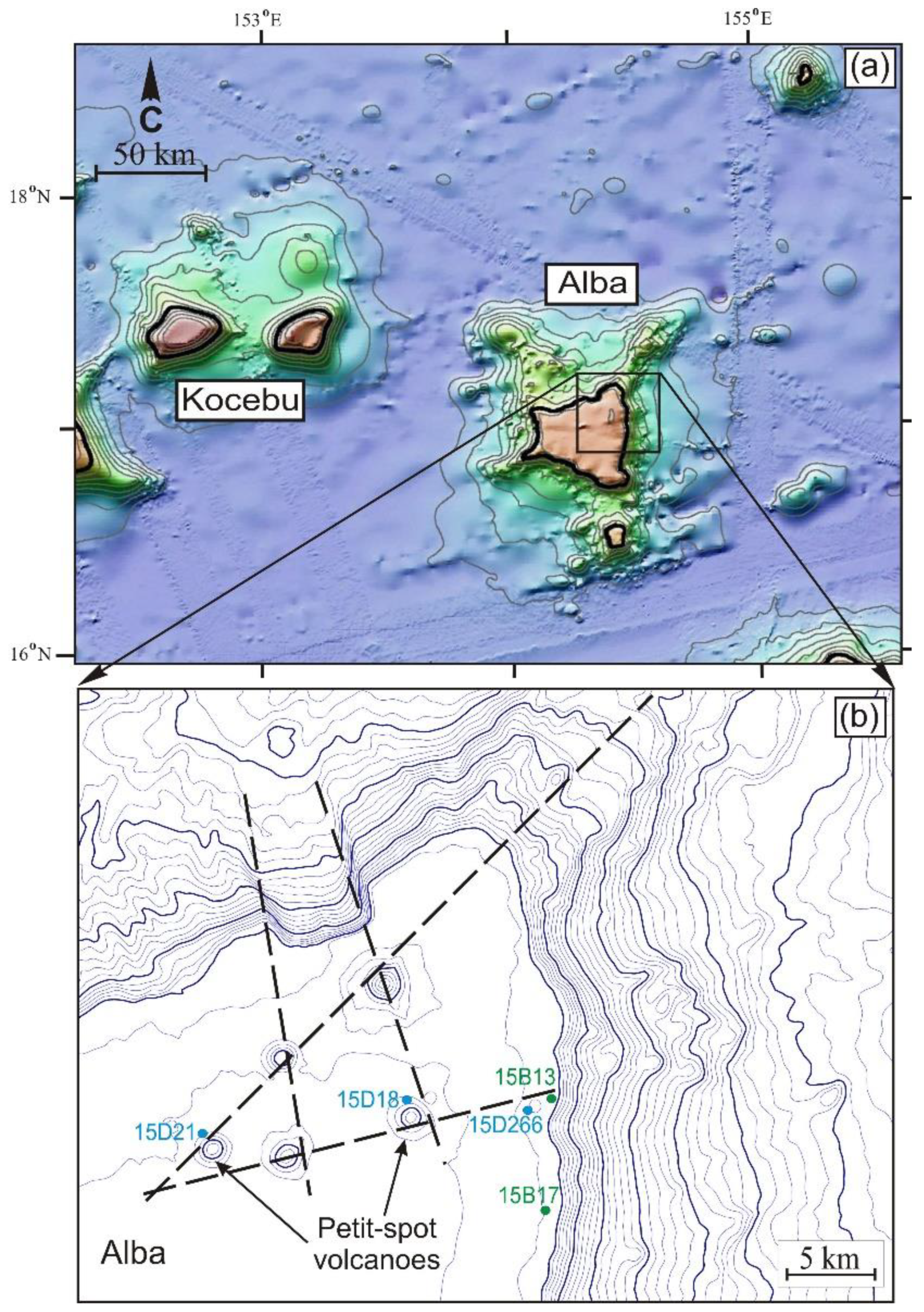
Figure 2.
Calcareous nannofossil biostratigraphy, core sample 15B13. Nannofossils were found and identified in Fe-Mn crust (Unit III, points 1 and 2) and in tuff section at points 3, 4, and 5. Colored zones show age ranges for different samples based on extant periods for identified nannoplankton species. Cenozoic time scale is based on Neogene (NN), Martini [16], (CN), Okada, Bukry [22], and Palaeogene (NP), Martini [16], and (CP) Okada, Bukry [22] zonal scales correlated to ages by Shumenko [24]. Numbers 1 to 21 refer to zone numbers.
Figure 2.
Calcareous nannofossil biostratigraphy, core sample 15B13. Nannofossils were found and identified in Fe-Mn crust (Unit III, points 1 and 2) and in tuff section at points 3, 4, and 5. Colored zones show age ranges for different samples based on extant periods for identified nannoplankton species. Cenozoic time scale is based on Neogene (NN), Martini [16], (CN), Okada, Bukry [22], and Palaeogene (NP), Martini [16], and (CP) Okada, Bukry [22] zonal scales correlated to ages by Shumenko [24]. Numbers 1 to 21 refer to zone numbers.
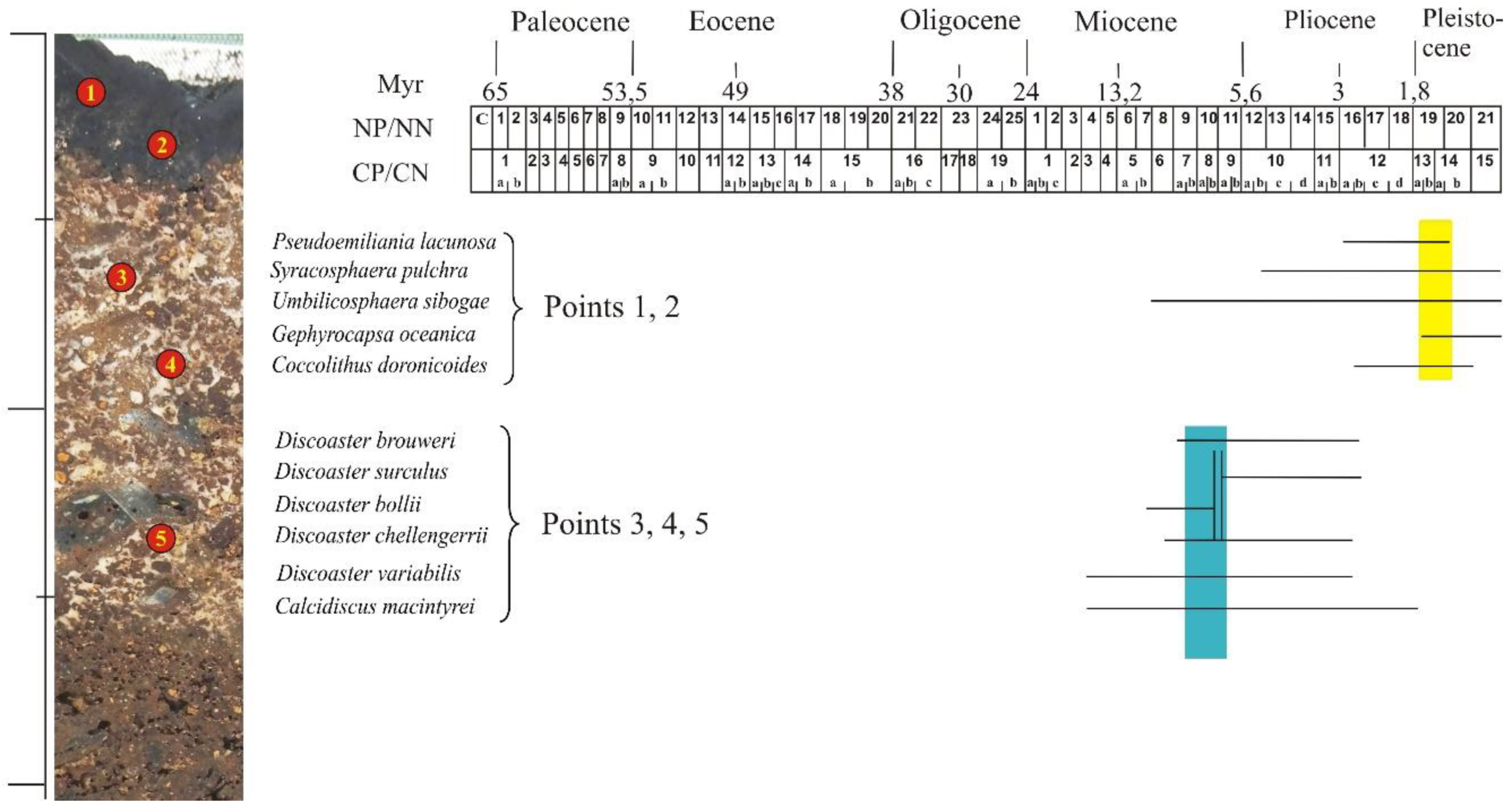
Figure 3.
Calcareous nannofossil biostratigraphy of core sample 15B17. Nannofossils were identified and their respective extant periods were determined for Fe-Mn crust (Unit III, point 1); tuffite; point 2; carbonate inclusions in buried nodules, Unit I-2b, point 3; carbonate inclusions at the contact between Units I-1 and I-2b, point 4. Colored zones show age ranges for different samples. Cenozoic time scale is based on zonal scales (see Figure 2 for explanations).
Figure 3.
Calcareous nannofossil biostratigraphy of core sample 15B17. Nannofossils were identified and their respective extant periods were determined for Fe-Mn crust (Unit III, point 1); tuffite; point 2; carbonate inclusions in buried nodules, Unit I-2b, point 3; carbonate inclusions at the contact between Units I-1 and I-2b, point 4. Colored zones show age ranges for different samples. Cenozoic time scale is based on zonal scales (see Figure 2 for explanations).
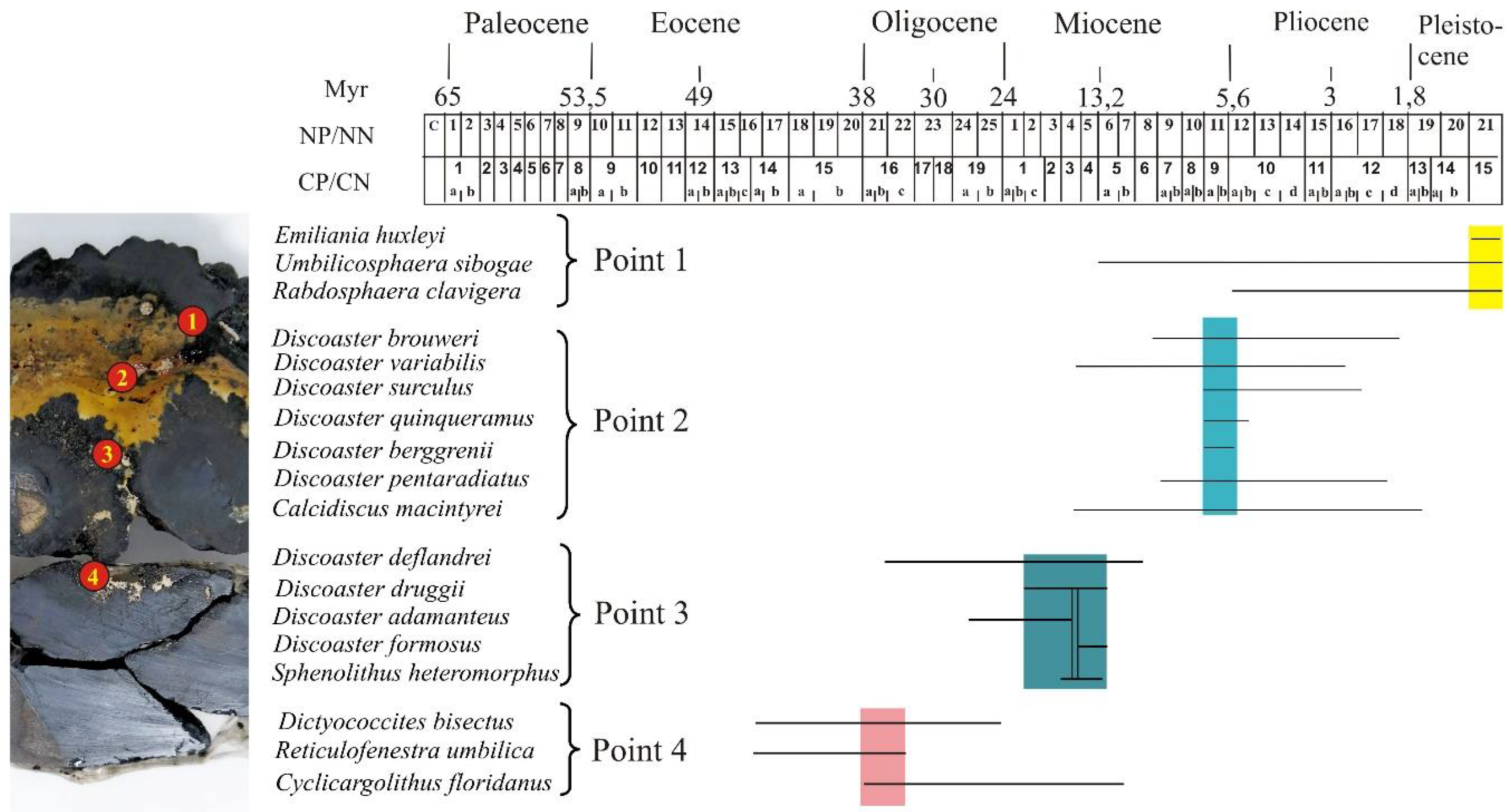
Figure 4.
Early Pleistocene calcareous nannofossils (biozones NN19, CP13 – CP14a) in Unit III of Fe-Mn crust, (core 15B13, interval 0–2.8 cm, points 1 and 2). Scale bar 1 µm, if not indicated in BSE images.
Figure 4.
Early Pleistocene calcareous nannofossils (biozones NN19, CP13 – CP14a) in Unit III of Fe-Mn crust, (core 15B13, interval 0–2.8 cm, points 1 and 2). Scale bar 1 µm, if not indicated in BSE images.
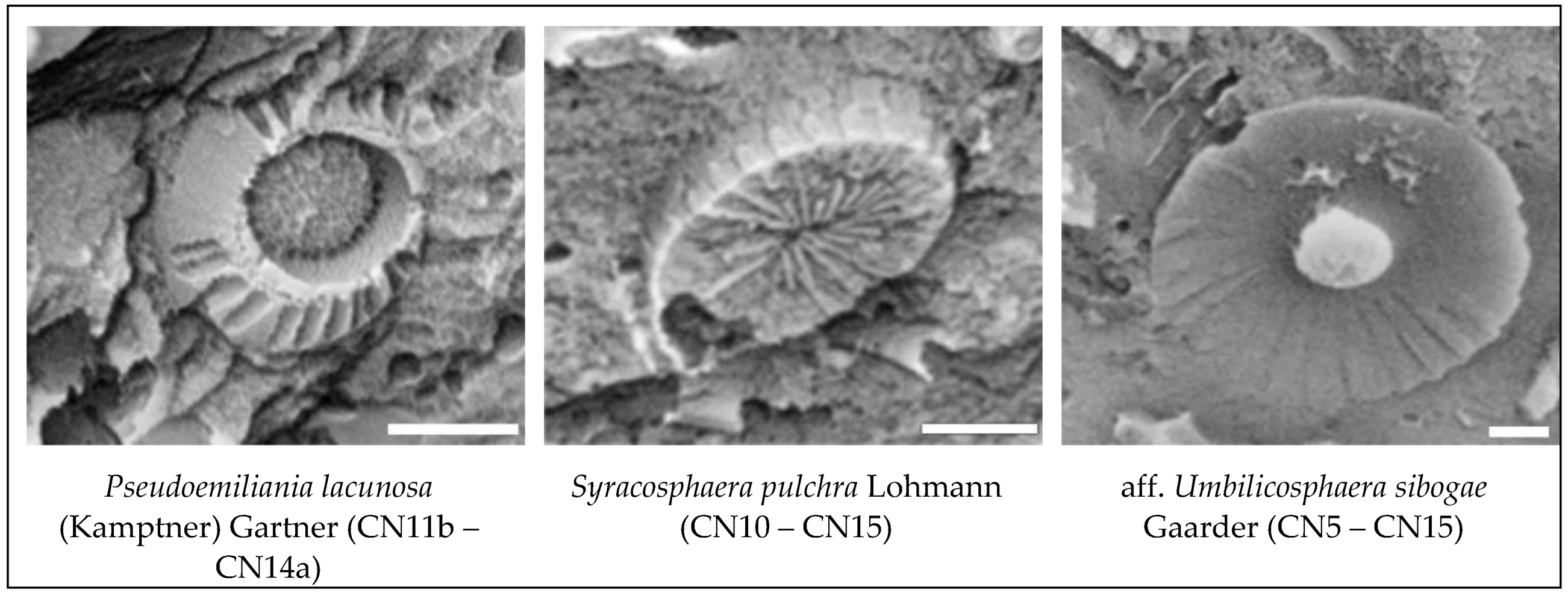
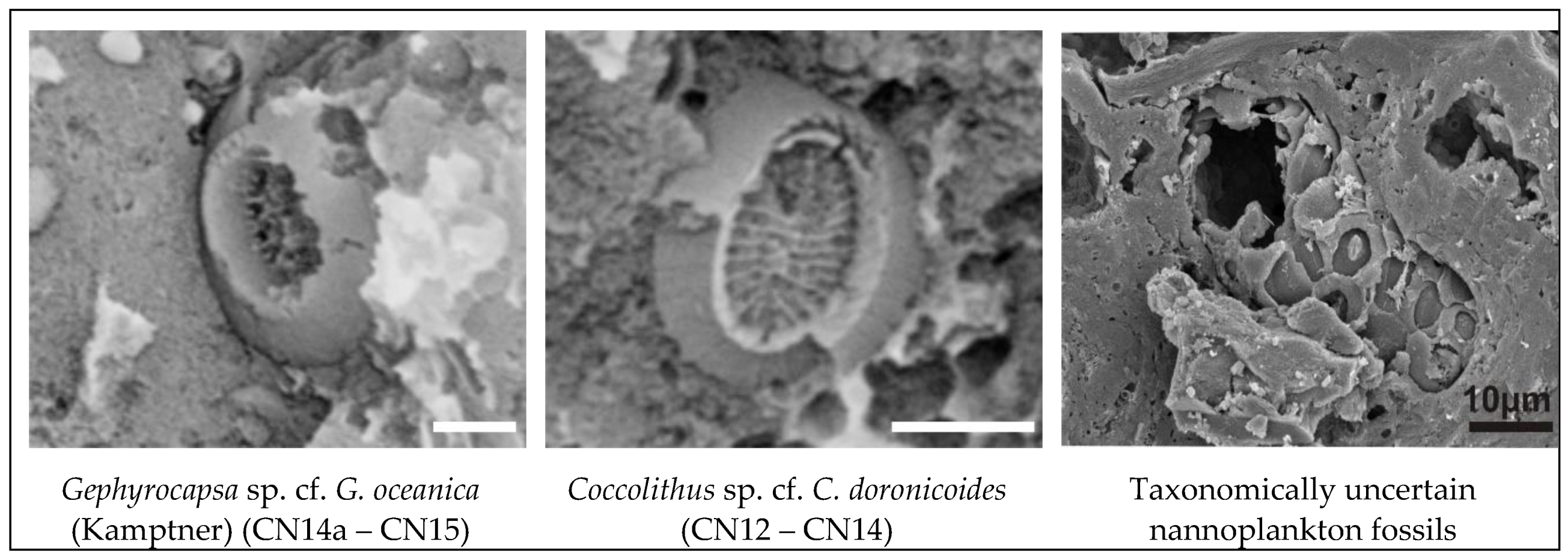
Figure 5.
Middle-Late Miocene calcareous nannofossils from carbonate cement in tuff (core 15B13, interval 2.8–16 cm, points 3, 4, 5). Scale bar 2 µm.
Figure 5.
Middle-Late Miocene calcareous nannofossils from carbonate cement in tuff (core 15B13, interval 2.8–16 cm, points 3, 4, 5). Scale bar 2 µm.
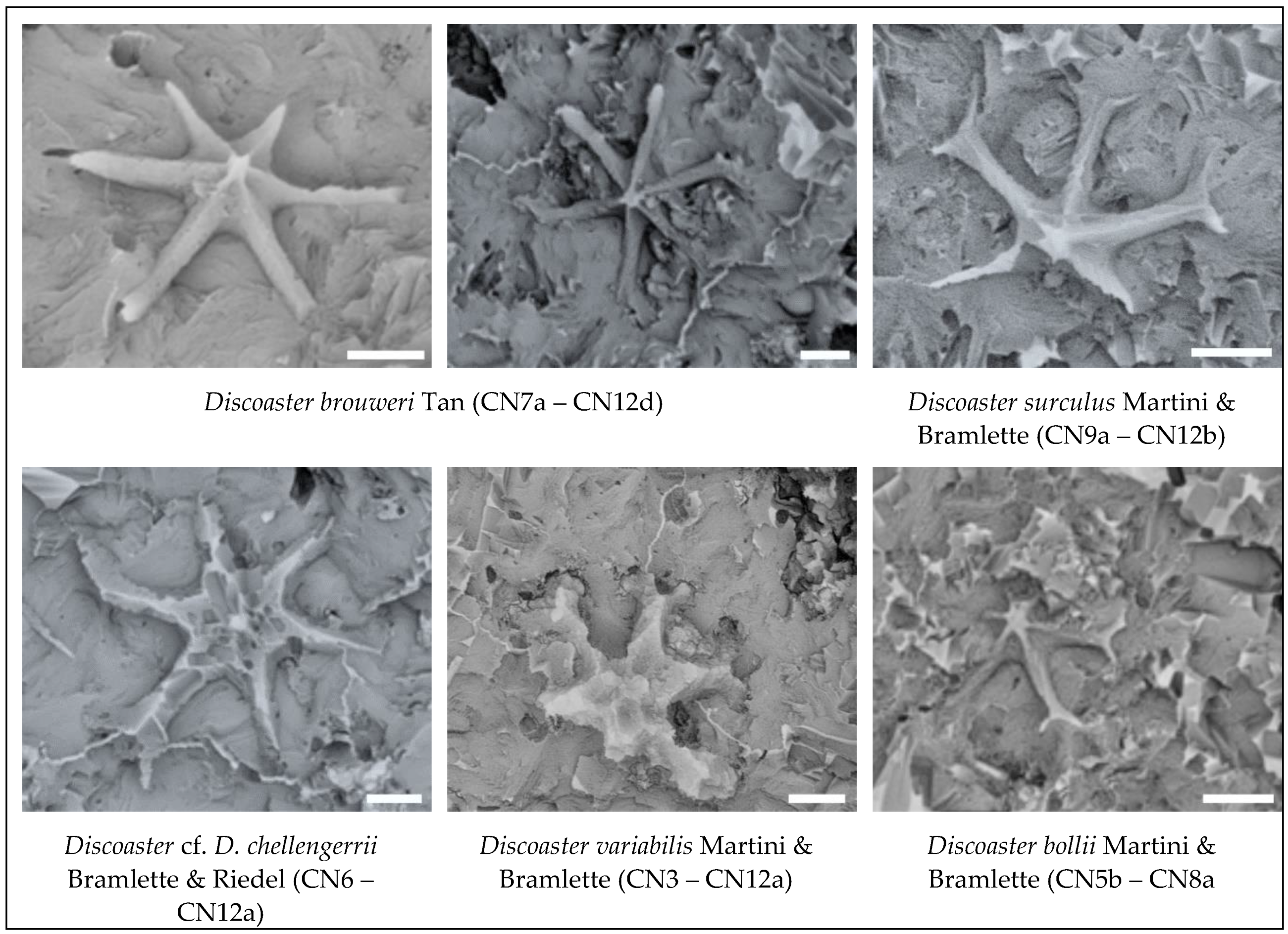
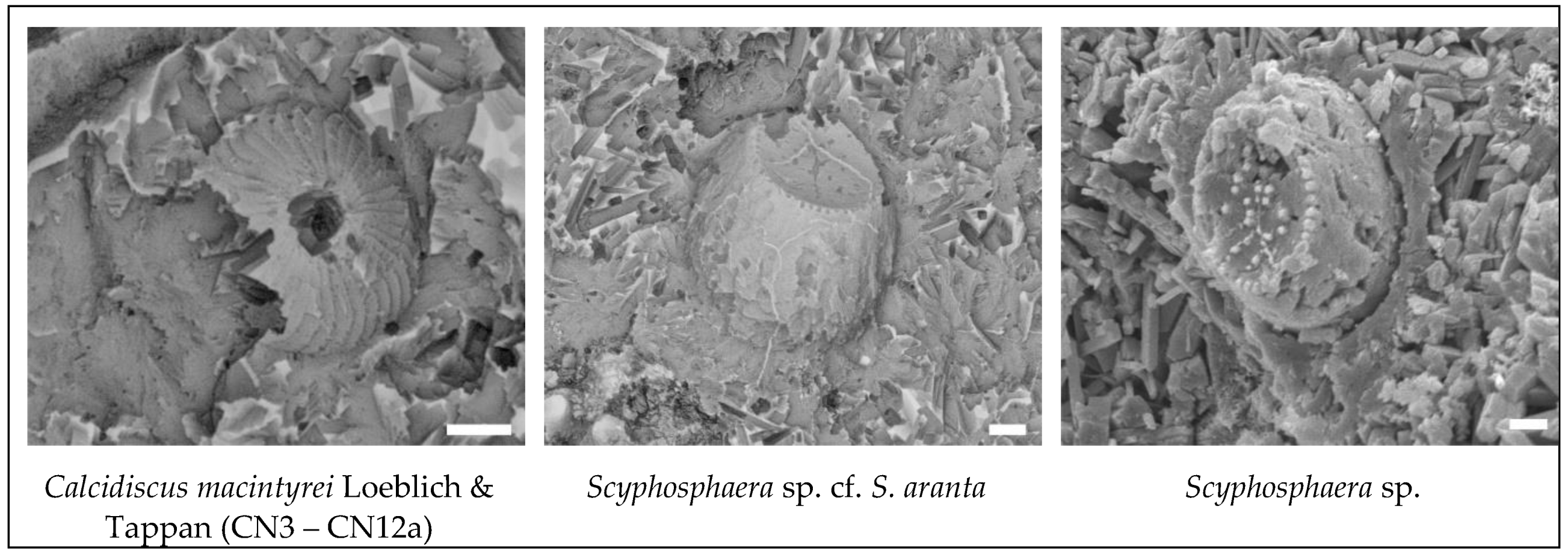
Figure 6.
Pleistocene calcareous nannofossils from Fe-Mn crust, Unit III (core 15B17, interval 0–1.2 cm, point 1). Scale bar 1 µm.
Figure 6.
Pleistocene calcareous nannofossils from Fe-Mn crust, Unit III (core 15B17, interval 0–1.2 cm, point 1). Scale bar 1 µm.
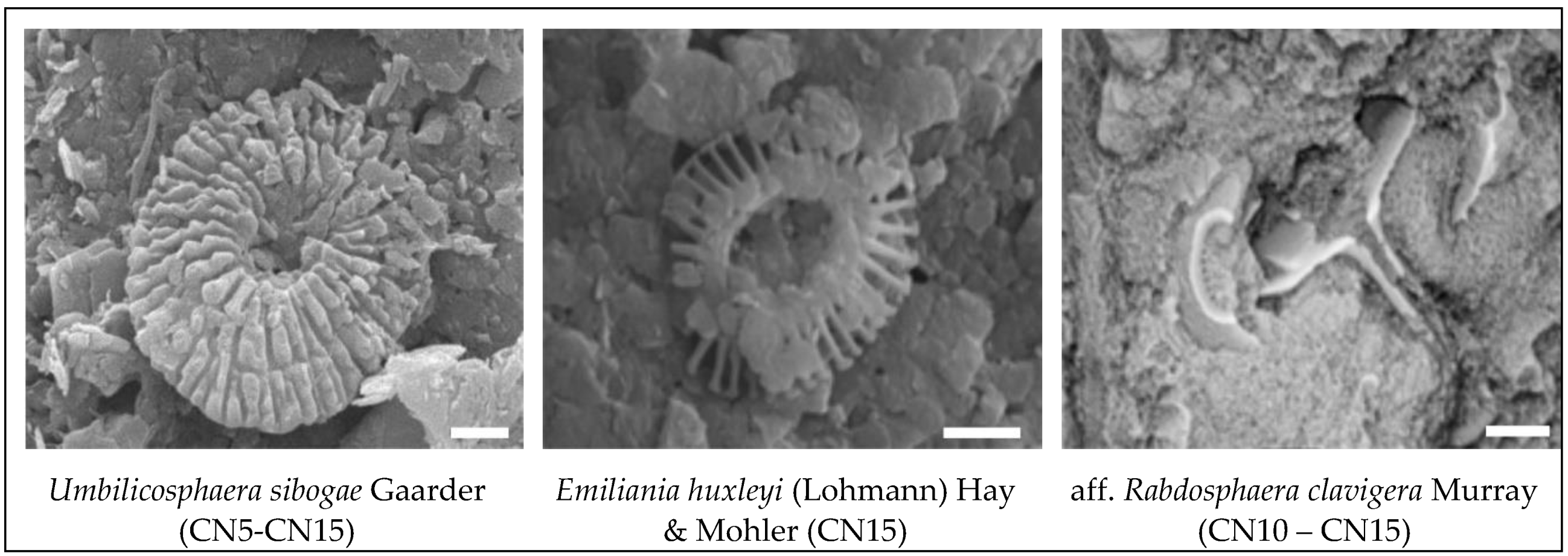
Figure 7.
Late Miocene calcareous nannofossils from tuffite (core 15B17, interval 1.2–4 cm, point 2). Scale bar 2 µm.
Figure 7.
Late Miocene calcareous nannofossils from tuffite (core 15B17, interval 1.2–4 cm, point 2). Scale bar 2 µm.
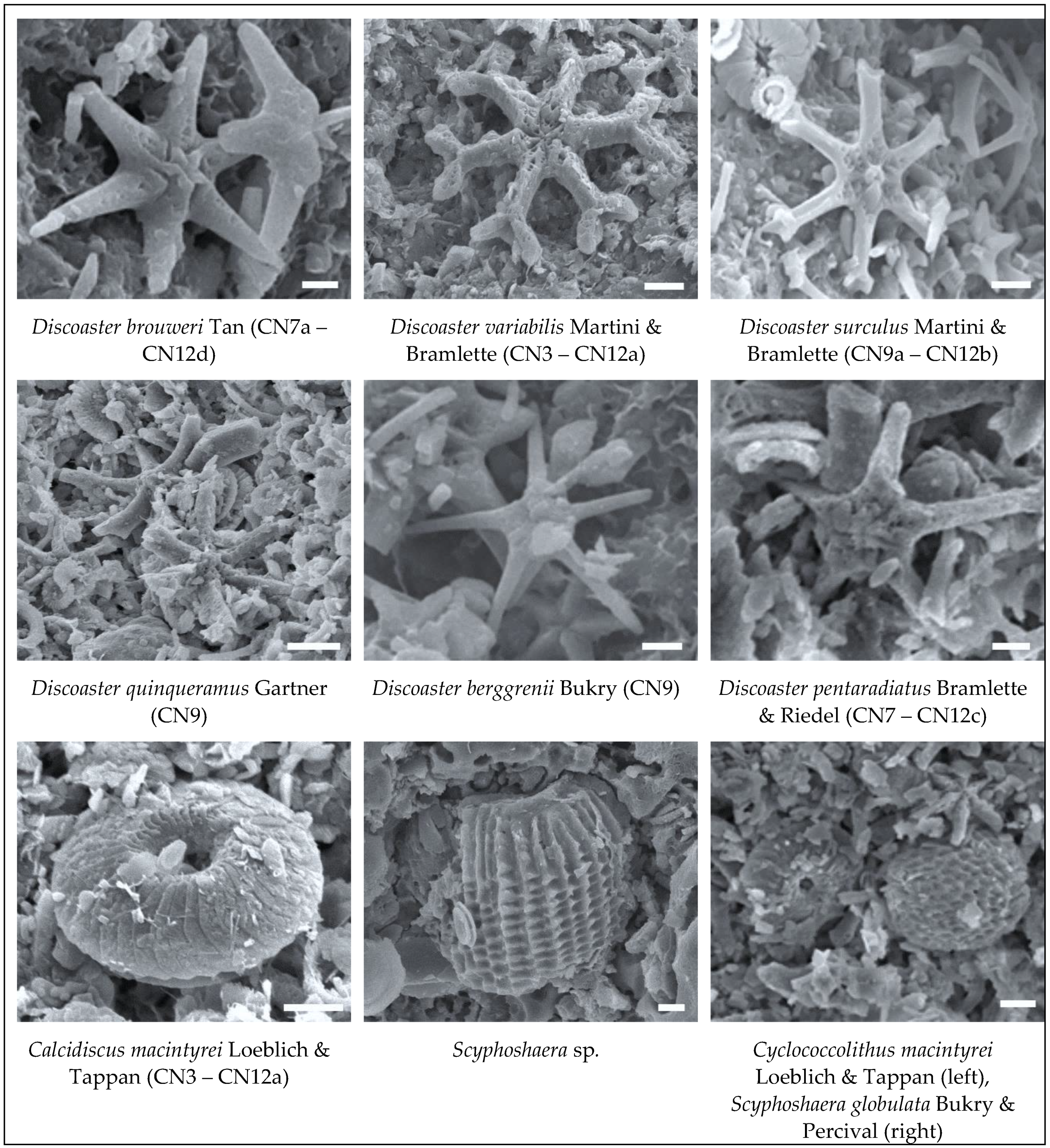
Figure 8.
Late Oligocene-Early Miocene calcareous nannofossils from limestone between Fe-Mn crust units (core 15B17, interval 4.0–8.5 cm, point 3). Scale bar 2 µm.
Figure 8.
Late Oligocene-Early Miocene calcareous nannofossils from limestone between Fe-Mn crust units (core 15B17, interval 4.0–8.5 cm, point 3). Scale bar 2 µm.
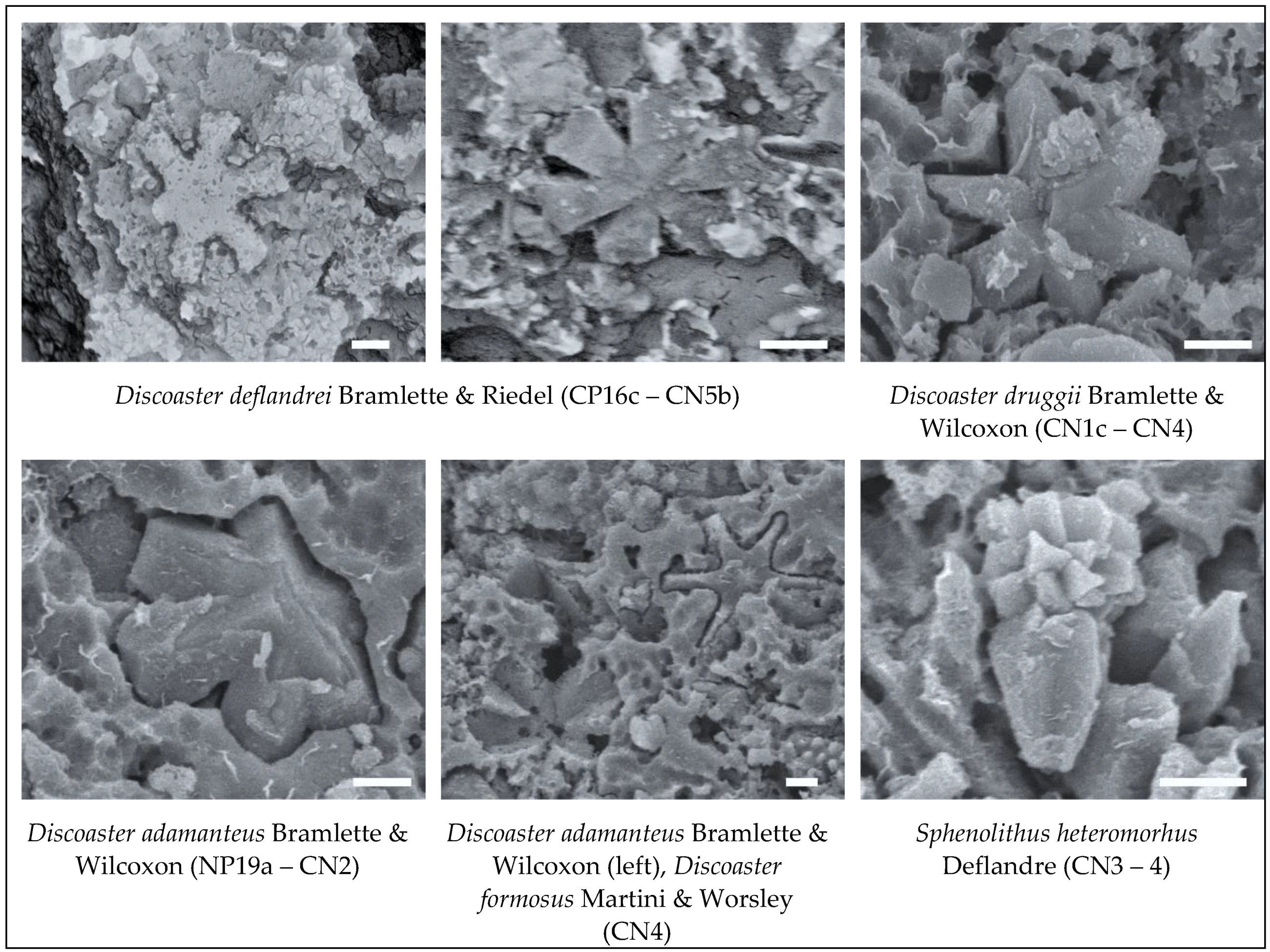
Figure 9.
Late Eocene-Early Oligocene calcareous nannofossils from limestone above Unit I-1 of the Fe-Mn crust, (core 15B17, interval 8.5–14.0 cm, point 4). Scale bar 5 µm.
Figure 9.
Late Eocene-Early Oligocene calcareous nannofossils from limestone above Unit I-1 of the Fe-Mn crust, (core 15B17, interval 8.5–14.0 cm, point 4). Scale bar 5 µm.
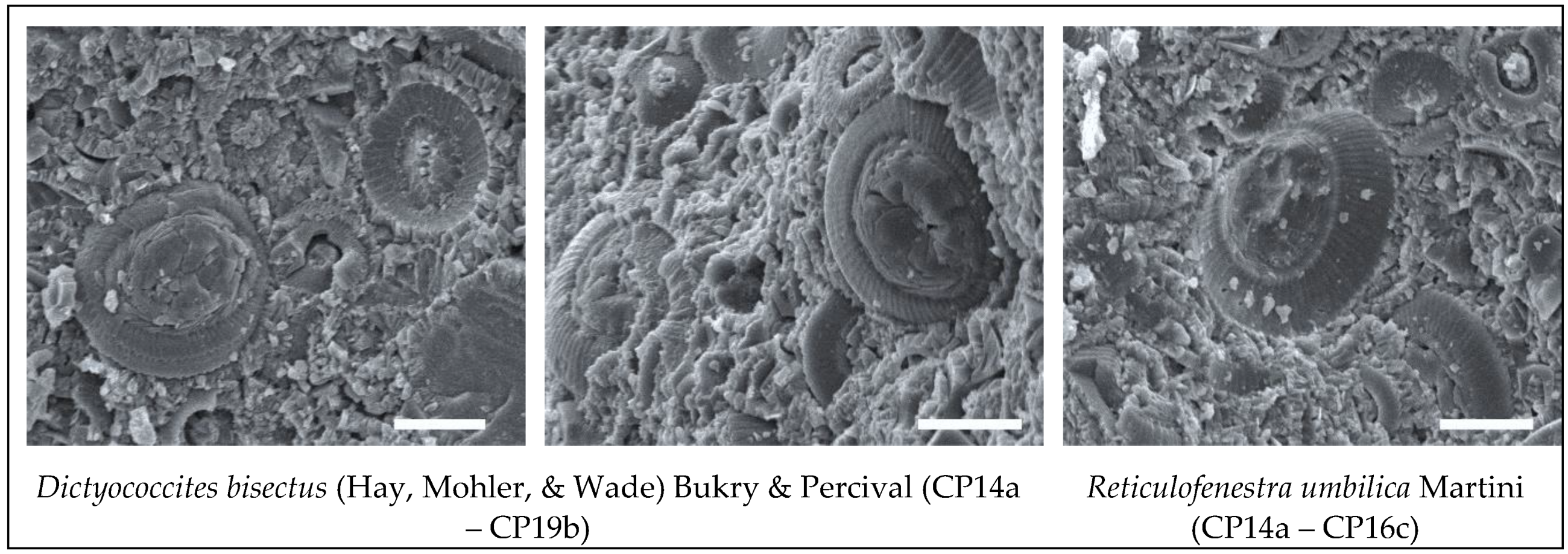
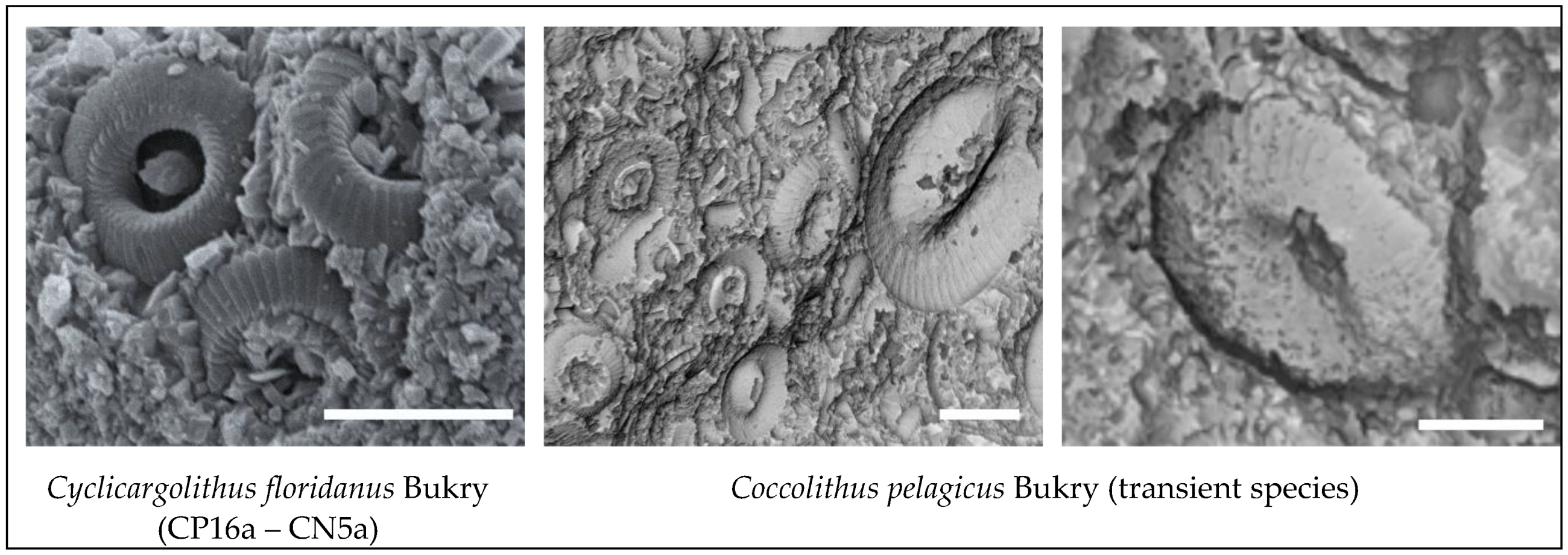
Figure 10.
Matrix fragments of basanite 15D266A (a–c), lherzolite xenolith 15D266B (d–f), and tuff 15B13 (g–i). Abbreviations stand for Ol = olivine, Opx = orthopyroxene, Cpx = clinopyroxene, Sp = spinel, Ti–Mag = Ti-magnetite, Gl = glass, Fe-Mn = ore crust, Pgn = palagonite, Phy = phyllipsite. Scale bar 20 µm for (a,b,c), and 100 µm for (e,f,g,h,l).
Figure 10.
Matrix fragments of basanite 15D266A (a–c), lherzolite xenolith 15D266B (d–f), and tuff 15B13 (g–i). Abbreviations stand for Ol = olivine, Opx = orthopyroxene, Cpx = clinopyroxene, Sp = spinel, Ti–Mag = Ti-magnetite, Gl = glass, Fe-Mn = ore crust, Pgn = palagonite, Phy = phyllipsite. Scale bar 20 µm for (a,b,c), and 100 µm for (e,f,g,h,l).
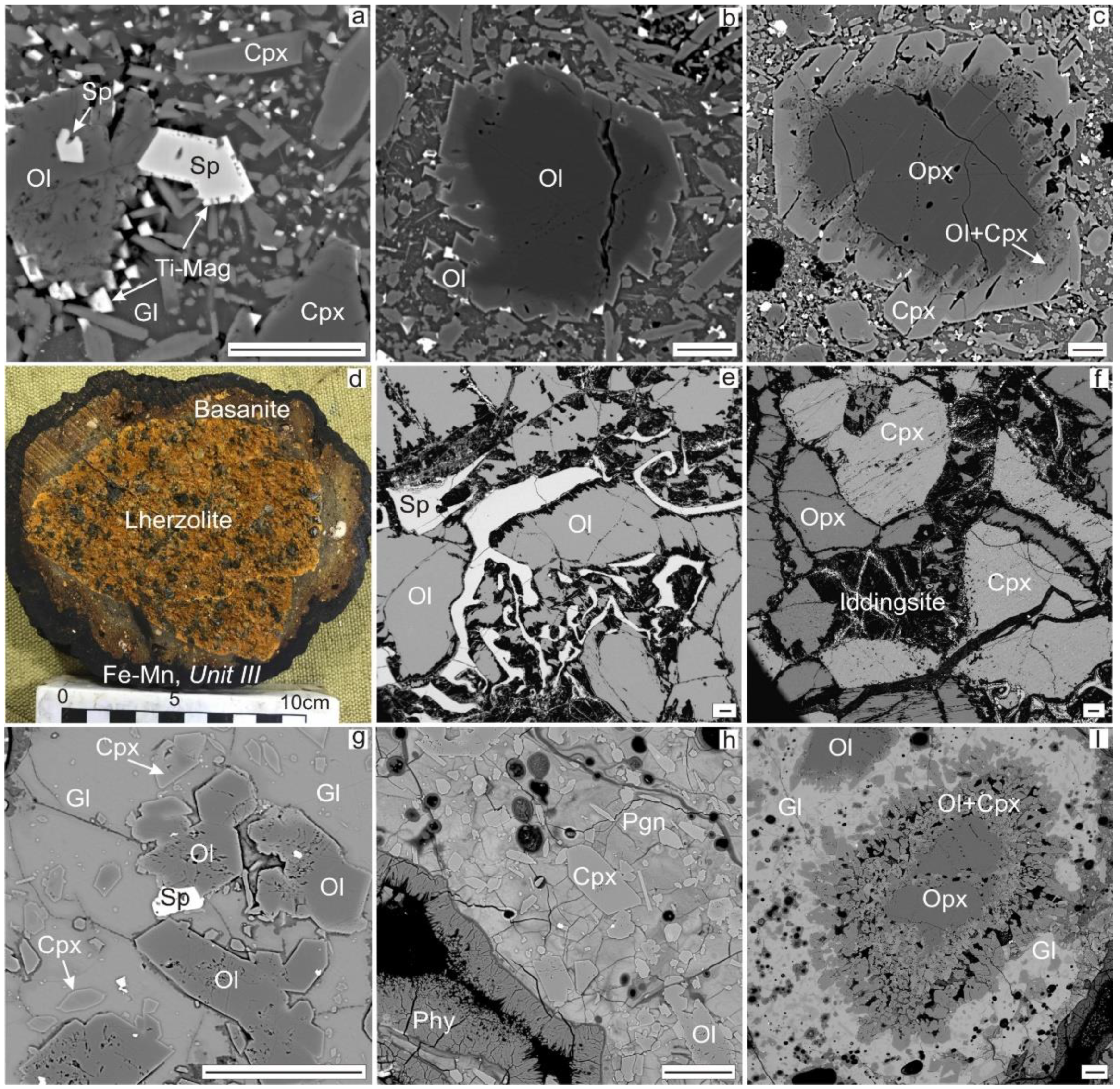
Figure 11.
Major-element compositions of olivine and pyroxene in Alba Guyot volcanic and mantle rocks. Mantle olivine arrays in (a) are quoted from Takahashi et al. [25]. (c) TiO2 vs. Mg# clinopyroxene classification from Wass [26].
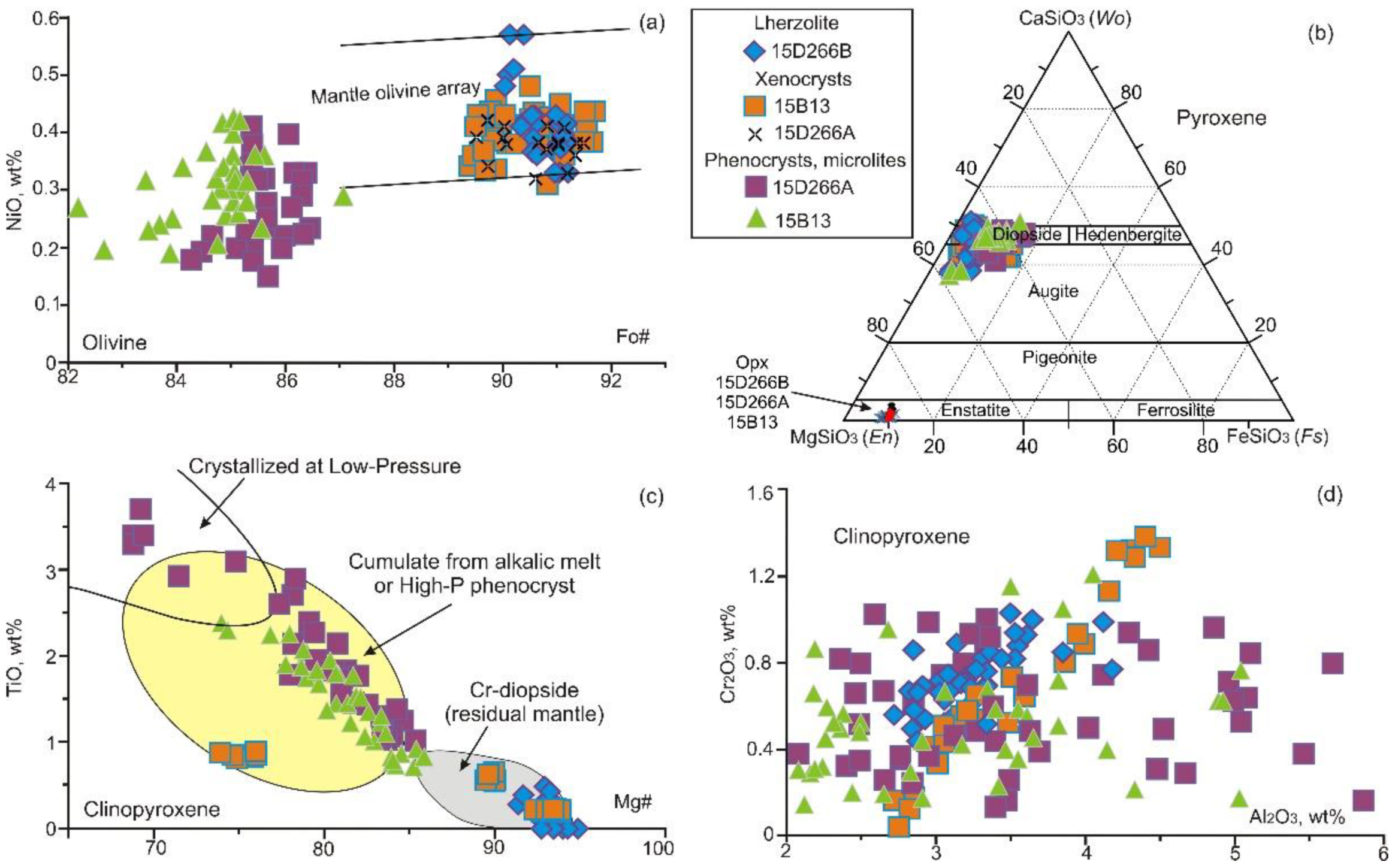
Figure 12.
Major-element compositions of spinel-group minerals in Alba Guyot volcanic and mantle rocks. Dashed lines in panels (c,d) contour the fields of oceanic spinel from Mariana Trough, Mariana Trench, Parece Vela Basin, and Yap Trench, after Chen et al. [27].
Figure 12.
Major-element compositions of spinel-group minerals in Alba Guyot volcanic and mantle rocks. Dashed lines in panels (c,d) contour the fields of oceanic spinel from Mariana Trough, Mariana Trench, Parece Vela Basin, and Yap Trench, after Chen et al. [27].
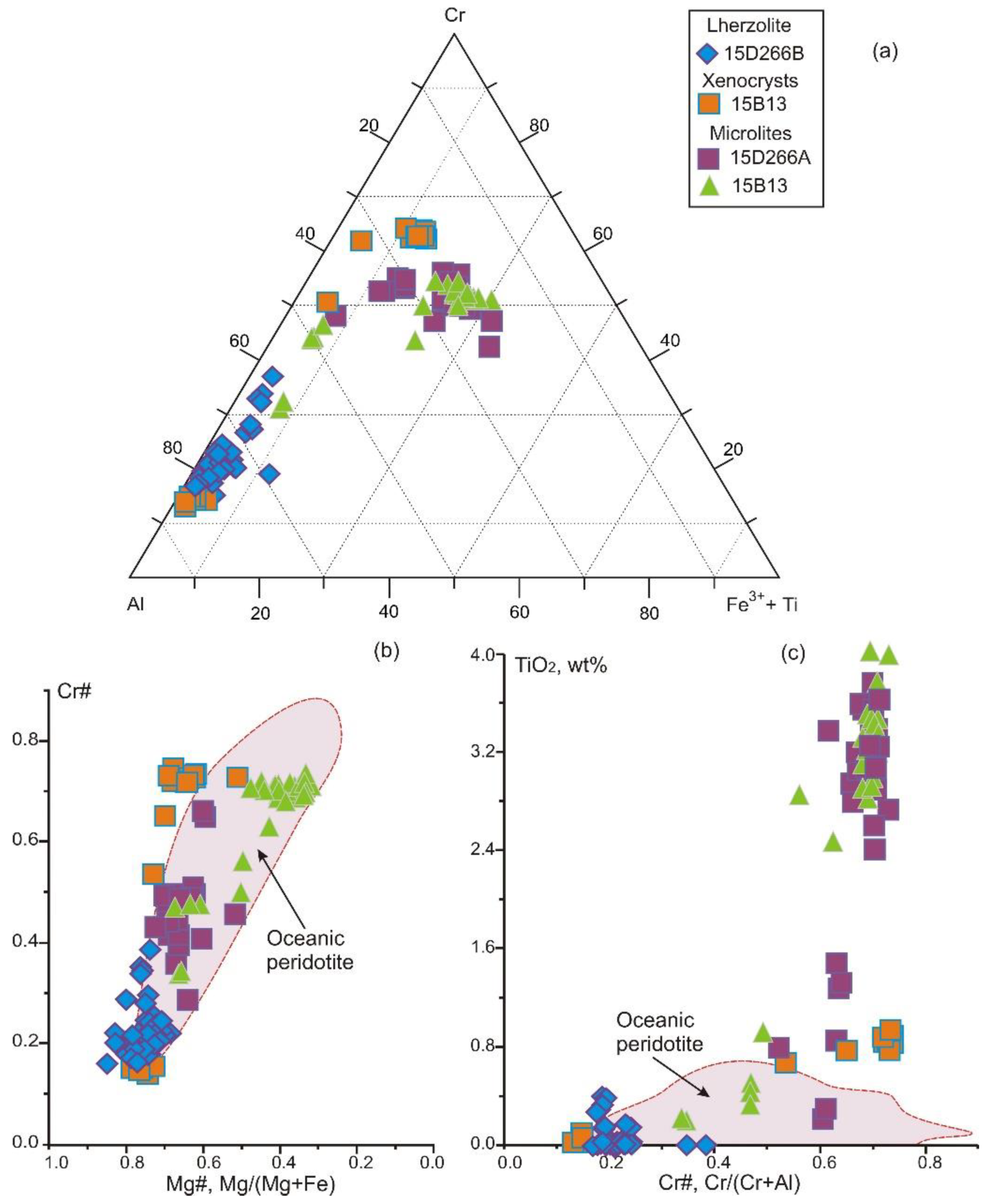
Figure 13.
Total alkali vs. silica (TAS) diagram for volcanic rocks, after Le Bas et al. [28] and Irvine, Baragar [29]. The compositions of the whole rock petit-spot basaltic rocks are represented for Alba Guyot from Peretyazhko et al. [9], NW Pacific and unusual compositions by triangles from Hirano, Machida [30] and Mikuni et al. [31]. The data are plotted as the total 100 wt%.
Figure 13.
Total alkali vs. silica (TAS) diagram for volcanic rocks, after Le Bas et al. [28] and Irvine, Baragar [29]. The compositions of the whole rock petit-spot basaltic rocks are represented for Alba Guyot from Peretyazhko et al. [9], NW Pacific and unusual compositions by triangles from Hirano, Machida [30] and Mikuni et al. [31]. The data are plotted as the total 100 wt%.
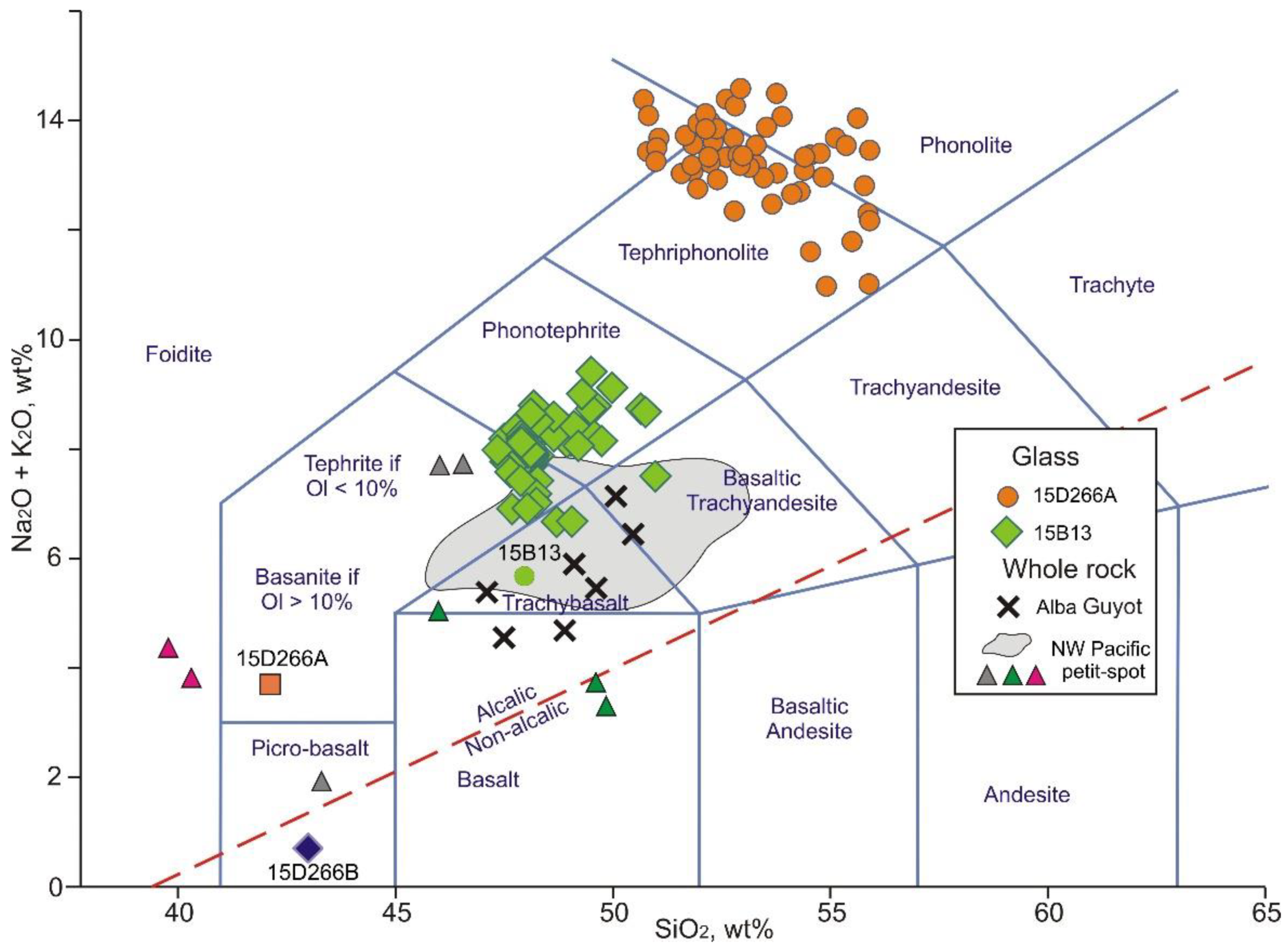
Figure 14.
40Ar/39Ar dating of basanite sample 15D266A.
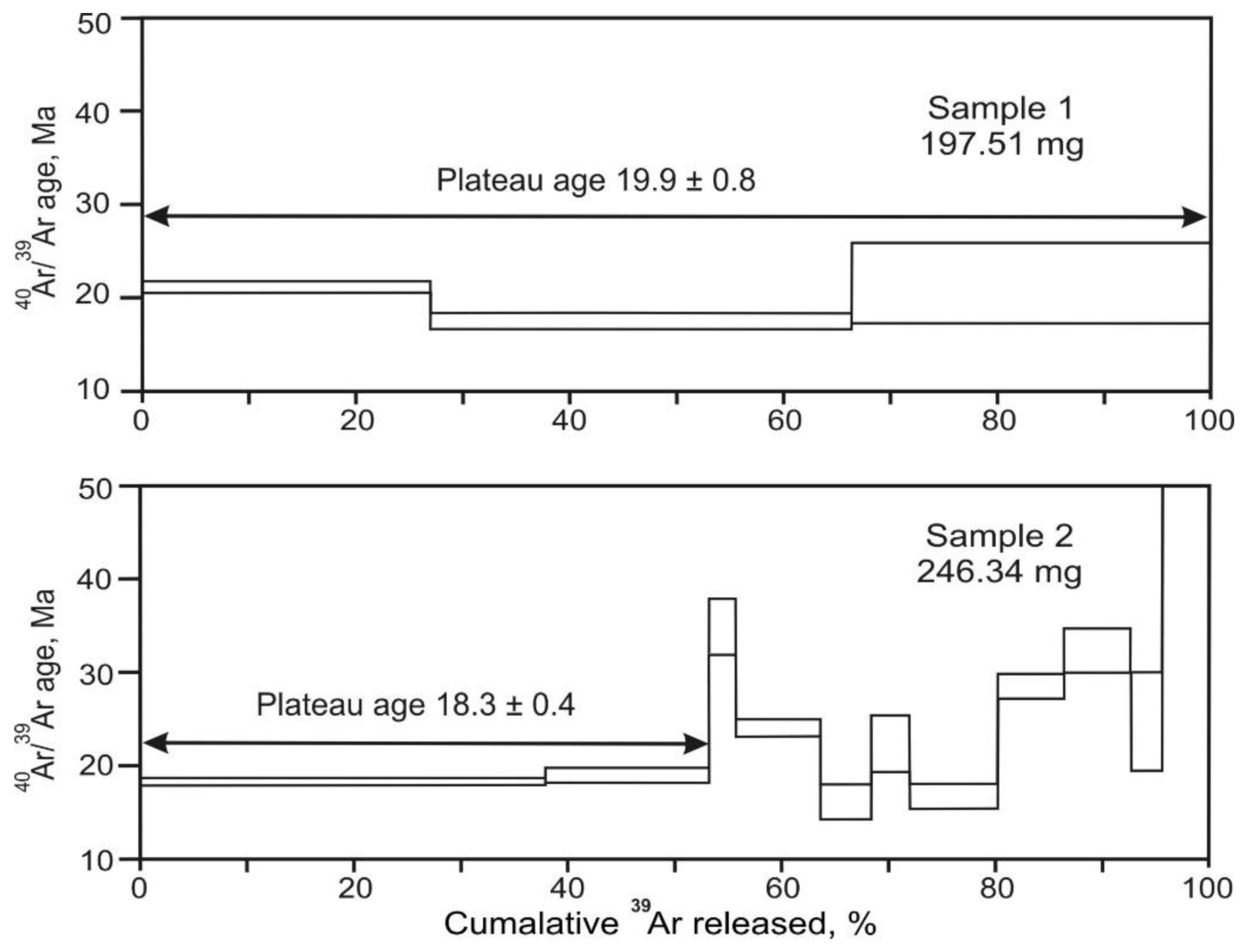

Table 1.
Location of sampling sites at Alba Guyot.
| Sample | Type sampling | Latitude (°N) | Longitude (°E) | Sea depth, m |
|---|---|---|---|---|
| 15D266 | Dredging | 17.019914 | 154.426390 | 1414 |
| 15D21 | Dredging | 17.0104830 | 154.2580171 | 1202 |
| 15D18 | Dredging | 17.0256170 | 154.3648169 | 922 |
| 15B13 | Drilling | 17.0281988 | 154.4403234 | 1148 |
| 15B17 | Drilling | 16.9563422 | 145.4331726 | 1409 |
Dredging was performed within a 600 m long interval; coordinates are for the starting point.
Table 3.
Major-element chemistry of lherzolite xenolith and its constituent minerals (wt%).
| 15D266B | Ol | Opx | Cpx | Sp | ||
| 1 | 2 | 3(37) | 4(26) | 5(38) | 6(51) | |
| SiO2 | 42.29 | 45.26 | 40.24 | 55.63 | 52.67 | |
| TiO2 | 0.11 | 0.06 | 0.22 | |||
| Al2O3 | 3.85 | 2.52 | 3.02 | 3.30 | 47.13 | |
| FeO | 5.11 | 7.53* | 9.09 | 5.73 | 1.15 | 11.28 |
| Fe2O3 | 8.80 | 0.53 | 0.95 | 2.88 | ||
| MnO | 0.23 | 0.12 | 0.10 | 0.12 | ||
| MgO | 33.15 | 40.02 | 49.31 | 33.53 | 16.13 | 18.08 |
| CaO | 3.78 | 3.38 | 0.38 | 23.16 | ||
| Na2O | 0.59 | 0.12 | 0.76 | |||
| K2O | 0.15 | |||||
| P2O5 | 0.21 | |||||
| NiO | 0.26 | 0.42 | 0.21 | |||
| Cr2O3 | 0.74 | 0.39 | 0.76 | 18.79 | ||
| V2O3 | 0.09 | |||||
| ZnO | 0.25 | |||||
| H2O- | 0.46 | |||||
| H2O+ | 0.96 | |||||
| Total | 99.94 | 100.00 | 99.16 | 99.34 | 99.12 | 99.61 |
| Fo 90.6 | Mg# 90.5 | Mg# 93.5 | Cr# 0.22 | |||
Sample 15D266B also contains 0.22 wt% CO2, and 0.03 wt% S tot. Major-element composition of lherzolite (column 2) was calculated from average analyses of Ol, Cpx, Opx, and Sp corrected for Ol replaced by iddingsite aggregate [9]. * All iron as FeO. The contents of FeO and Fe2O3 in minerals are calculated by stoichiometry. Fo, 100·Mg/(Mg+Fe); Mg#, 100·Mg/(Mg+Fe); Cr#, Cr/(Cr+Al).
Table 4.
Composition of tuff, its constituent minerals and glass (wt%).
| 15B13 | Ol | Cpx | Opx | Sp | Glass | ||
| 1 | 2(39) | 3(46) | 4(59) | 5(84) | 6(30) | 7(121) | |
| SiO2 | 44.28 | 39.48 | 40.62 | 50.38 | 55.14 | 0.60 | 46.34 |
| TiO2 | 2.39 | 1.38 | 2.65 | 3.10 | |||
| Al2O3 | 10.36 | 2.97 | 2.39 | 14.81 | 14.52 | ||
| FeO | 14.39 | 9.34 | 3.90 | 5.73 | 21.43 | 10.47** | |
| Fe2O3 | 12.84* | 2.28 | 0.17 | 12.58 | |||
| MnO | 0.18 | 0.22 | 0.14 | 0.08 | 0.15 | 0.16 | |
| MgO | 11.94 | 44.73 | 49.09 | 15.27 | 33.33 | 9.72 | 4.14 |
| CaO | 4.42 | 0.29 | 0.12 | 22.01 | 0.38 | 0.28 | 8.42 |
| Na2O | 2.81 | 0.44 | 4.06 | ||||
| K2O | 2.54 | 3.58 | |||||
| P2O5 | 0.32 | 1.27 | |||||
| LOI | 8.79 | ||||||
| NiO | 0.31 | 0.40 | 0.14 | ||||
| Cr2O3 | 0.54 | 35.73 | |||||
| V2O3 | 0.16 | ||||||
| Total | 100.95 | 99.42 | 99.71 | 99.26 | 97.63 | 98.10 | 96.42 |
| Fo 84.9 | Fo 90.4 | Mg# 81.9 | Mg# 91.0 | Cr# 0.62 | |||
Glass also contains 0.18 wt% BaO, 0.11 wt% SO3, and 0.18 wt% Cl. * All iron as Fe2O3. ** All iron as FeO. The contents of FeO and Fe2O3 in minerals are calculated by stoichiometry. LOI = loss on ignition.
Table 5.
40Ar/39Ar dating of basanite sample 15D266А.
| T°C | 40Ar 10-9cm3 STP | 40Ar/39Ar | 38Ar/39Ar | 37Ar/39Ar | 36Ar/39Ar | Ca/K | ∑39Ar (%) | 40Ar/39Ar age, Ma |
| 197.51 mg; J=0.005355±0.000075 | ||||||||
| 850 | 24.5 | 3.0±0.002 | 0.018±0.00016 | 1.2345±0.0052 | 0.0028±0.00020 | 4.44 | 27.03 | 21.2±0.6 |
| 1000 | 24.6 | 2.1±0.002 | 0.017±0.00013 | 2.8868±0.0027 | 0.0009±0.00028 | 10.39 | 66.35 | 17.5±0.8 |
| 1150 | 17.6 | 1.7±0.003 | 0.021±0.00014 | 18.1577±0.0208 | 0.00017±0.00154 | 65.37 | 100.00 | 21.6±4.3 |
| 246.34 mg; J=0.004992±0.000065 | ||||||||
| 500 | 85.4 | 3.2±0.002 | 0.018±0.00007 | 0.36±0.02 | 0.0038±0.00012 | 1.31 | 37.9 | 18.2±0.4 |
| 600 | 33.8 | 3.1±0.002 | 0.020±0.00010 | 0.51±0.03 | 0.0033±0.00030 | 1.83 | 53.2 | 18.9±0.8 |
| 675 | 9.2 | 5.2±0.009 | 0.027±0.00057 | 0.80±0.14 | 0.0043±0.00114 | 2.89 | 55.7 | 34.9±3.0 |
| 750 | 30.8 | 5.4±0.003 | 0.020±0.00016 | 1.36±0.03 | 0.0093±0.00032 | 4.90 | 63.7 | 24.0±0.9 |
| 800 | 21.1 | 6.2±0.006 | 0.022±0.00051 | 1.81±0.11 | 0.0150±0.00070 | 6.51 | 68.4 | 16.1±1.9 |
| 850 | 15.5 | 6.0±0.009 | 0.018±0.00080 | 1.64±0.12 | 0.0120±0.00116 | 5.91 | 72.0 | 22.3±3.1 |
| 925 | 29.8 | 5.0±0.004 | 0.020±0.00020 | 3.05±0.06 | 0.0108±0.00052 | 10.99 | 80.3 | 16.6±1.4 |
| 975 | 23.5 | 5.3±0.004 | 0.018±0.00043 | 3.29±0.07 | 0.0073±0.00050 | 11.84 | 86.4 | 28.5±1.4 |
| 1025 | 19.1 | 4.3±0.005 | 0.018±0.00047 | 8.07±0.09 | 0.0021±0.00088 | 29.06 | 92.7 | 32.3±2.3 |
| 1075 | 14.0 | 6.6±0.012 | 0.036±0.00046 | 22.48±0.16 | 0.0130±0.00202 | 80.94 | 95.6 | 24.7±5.3 |
| 1150 | 44.5 | 14.3±0.070 | 0.035±0.00086 | 78.75±0.40 | 0.0133±0.00668 | 283.50 | 100.0 | 90.7±17.0 |
Measurement errors are quoted at the ± 1σ level.
Disclaimer/Publisher’s Note: The statements, opinions and data contained in all publications are solely those of the individual author(s) and contributor(s) and not of MDPI and/or the editor(s). MDPI and/or the editor(s) disclaim responsibility for any injury to people or property resulting from any ideas, methods, instructions or products referred to in the content. |
© 2024 by the authors. Licensee MDPI, Basel, Switzerland. This article is an open access article distributed under the terms and conditions of the Creative Commons Attribution (CC BY) license (http://creativecommons.org/licenses/by/4.0/).
Copyright: This open access article is published under a Creative Commons CC BY 4.0 license, which permit the free download, distribution, and reuse, provided that the author and preprint are cited in any reuse.


