

Submitted:
24 July 2024
Posted:
25 July 2024
You are already at the latest version
Abstract
The purpose of this paper is to assess the differential impacts of transformational and transactional leadership styles on employee performance during change initiatives within commercial banks in Sierra Leone. The research study utilised a cross-sectional survey design, and data was collected from 903 participants employed in the banking industry. The study used the structural equation model as the investigative instrument to examine the hypotheses. The findings reveal that transformational and transactional leadership styles demonstrate a strong bearing on employee performance, with the latter having a bigger influence. Organisational citizenship behaviour has a mediating effect between leadership styles and employee performance, while employee commitment does not act as a mediator between transformational leadership and employee performance, but it acts as a mediator between transactional leadership and employee performance. Commercial banks need to devise training programmes that will advance both leadership styles to arouse, energise, or inspire followers to display favourable behaviour and commitment to attain organisational. The paper makes an insightful contribution to the existing leadership literature by ascertaining the significance of leadership styles on performance and the role of commitment and organisational citizenship behaviour as mediators of the nexus between leadership styles and performance in the Sierra Leone banking industry.
Keywords:
Leadership styles
; Employee commitment
; Organisational citizenship behaviour
; Employee Performance
; Sierra Leone
1. Introduction
Organisational leadership has been explored intensively by scholars for a significant amount of time now [1,2], especially with a focus on the banking sector, a domain that is characterised by its dynamism and unpredictability [3].
Financial institutions are undergoing changes to adapt to the VUCA world, and to adjust to these changes, they need to create an environment that is conducive to implementing systemic and business-oriented management strategies [4]. Nonetheless, [5] contend that the task of implementing and overseeing successful organisational change has posed difficulties for numerous organisations and state that it takes effective leadership to initiate, manage, and sustain change efficiently being that it is a complicated and multifaceted process [6,7].
Change management programmes encompass several objectives and priorities that align with the overall success of an organisation [8] and leadership sits at the heart of organisational change initiatives and plays a key role in ensuring the success of change efforts among employees.
Transformational leadership style and transactional leadership styles are recognised as influential in driving project success and organisational change [9] and employee performance [10]. TRF is characterised by the ability to inspire and motivate individuals to adopt innovation, facilitate change, and attain desired goals for both individuals and the organisation [11], whereas TRS emphasises the interchange of defined duties and rewards, providing an alternative approach to managing the intricate process of organisational transformation [12]. Additionally, effective leaders can motivate staff to be committed; go beyond and contribute to performance that meets or surpasses objectives, and through these behaviours, highly motivated employees will support leaders in mobilising the workforce to achieve their goals [6], thus, dedicated employees are more proficient in completing tasks, enhance productivity, and demonstrate a strong commitment to achieving their goals [13].
The banking industry has indeed been compelled to evolve due to numerous causes, such as technological advancements, regulatory alterations, and changes in consumer behaviour [14]. In Sierra Leone, even though faced with numerous challenges, commercial banks play a decisive role in the nation's commercial stability and growth [14,15,16], and thus, banks must develop the capabilities to adapt and navigate change to their advantage. In addition, [14,16] further argue that much attention has not been given to leadership and its effect on employee outcomes during change initiatives within the Sierra Leonean context.
Despite extensive research on the impact of leadership styles, organisational citizenship behaviour, and employee commitment on employee performance, there is a lack of research exploring the potential combined effect of these factors on employee performance. It is crucial to comprehend how these dimensions can effectively facilitate sustainable organisational change in the context of Sierra Leone. Hence, this present investigation aims to bridge that gap by adding to the existing body of knowledge, offering valuable perspectives to banking professionals striving to achieve effective transformation in the banking industry.
2. Literature Review
2.1. Transformational Leadership
First proposed by [12] and enriched by [17], Transformational leadership (TRF) is a distinguished leadership style that has been studied for its impact on organisational outcomes. Transformational leaders inspire their teams with a captivating vision and intellectual progress while considering members’ needs [18]. According to [2], TRF occurs when an individual successfully interacts with another, creating a connection that boosts energy and confidence for the leader and the follower and it necessitates change at the individual and group levels [6,19]. Transformational leaders express four core features; idealized influence; inspirational motivation; intellectual stimulation; and individualised consideration, as suggested by [17].
- i.
- Idealized Influence:
According to [20], an idealised leader inspires admiration from their supporters by outlining a strong vision for the organisation's long-term aspirations and acting as an exemplary role model. Leaders with charisma inspire their teams by painting a picture of a prosperous future for their companies through symbolic communication.
- ii.
- Inspirational motivation
Inspirational motivation pertains to a leader who formulates a captivating vision and adeptly communicates it to followers, resulting in mutual benefits for both sides [21]. According to [20], inspirational motivation involves the capacity of leaders to inspire and encourage their staff towards the accomplishment of challenging, yet attainable objectives.
- iii.
- Intellectual stimulation
According to [22], intellectual stimulation occurs when a leader proposes several novel ideas to their followers to spark creative problem-solving within the organisation. However, by modelling this style of leadership, leaders can influence their followers to reframe challenges and issues in a more positive light [20].
- iv.
- Individualized consideration
Individualised consideration is the ongoing provision of feedback to followers, which connects their current requirements to the mission of the organisation [17,20]. Furthermore, [18] added that the goal of individualised attention is to help followers reach their potential by building on their strengths rather than dwelling on their weaknesses.
2.2. Transactional Leadership
According to [23], transactional leadership (TRS) motivate their followers to complete tasks by instituting a system of rewards and punishments and the followers are compensated for attaining performance criteria [24]. TRS involves providing contingent reinforcement to employees based on their performance [25] and it inspires followers by appealing to their individual or collective aspirations, employing instrumental economic exchanges [26]. According to [22], TRS is characterized by three crucial dimensions; contingent reward, management-by-exception active, and management-by-exception passive.
- i.
- Contingent reward
As stated by [27,28], contingent reward is a method that enables leaders to motivate their followers to accomplish a particular objective by providing commensurate rewards to them when they meet specific criteria.
- ii.
- Management-by-exception active
The practice of closely monitoring workers to ensure their productivity and compliance with performance objectives is referred to as management by exception-active [29]. The leader monitors followers' actions to guarantee that the rules are strictly followed and to issue corrective actions in the event of deviations.
- iii.
- Management-by-exception passive.
According to [28], management-by-exception passive refers to leaders that allow their follower's autonomy to do their jobs but step in when concerns arise or performance expectations aren't being fulfilled. Furthermore, [18], pointed out that a reactive organisational culture in which problems are only addressed when they reach a critical stage is one possible outcome of passive management by exception.
2.3. Organisational Citizenship Behaviour (OCB)
Although [30] were the pioneers in noticing employees' extra-role behaviour in the workplace, the term "organisational citizenship behaviour" was first used by [31]. According to [32], it describes actions taken by workers outside of the scope of their normal work responsibilities. However, [33,34], stated that it is the voluntary acts taken by individuals that contribute to the overall efficiency of an organisation, even if these actions are not officially acknowledged or rewarded. However, [34] posited that these behaviours are a requirement for effective modern-day organisations and regular behaviour alone is not enough for organisations to compete. Additionally, these behaviours enhance performance and productivity by fostering teamwork and reducing conflict [35] and engaging in it allows employees to develop skills, enhance capabilities and overall well-being. OCB is classified into five dimensions [32]:
- i.
- Altruism (assisting others); This involves the selfless behaviour of employees, where they show concern for the welfare of others. It is a way of helping others who get into trouble.
- ii.
- Conscientiousness (discipline); The concern that employees have for the organisation's policies and procedures, to serve the organisation's best interests without compromise.
- iii.
- Sportsmanship (positive attitude); This involves employees demonstrating behaviours that are mutually supportive and positive to execute tasks and avoid unnecessary complaints.
- iv.
- Courtesy (goodness): In this context, it refers to the actions of employees that enable them to avoid conflicts and problems related to their interpersonal relationships at work.
- v.
- Civic virtue (as an organisation member awareness): This involves encouraging habits that are not obligatory but are deemed significant and enable them to keep well-informed about changes in the working environment of the organisation.
2.4. Employee Commitment
Employee commitment (EC) is the extent to which an individual feels a sense of belonging and actively engages in the activities of a particular organisation. Recently, [36], found that individuals who are extremely devoted to an organisation's intentions and willing to work more are more likely to stay. In addition, [37], view it as the emotional reactions exhibited by individuals, encompassing psychological conditions such as attachment and loyalty. [38] introduced a model of OC that comprises three components: continuous, normative, and emotional commitment. Continuous commitment is the persistent dedication of an employee to stay with the company, along with their understanding of the potential drawbacks and expenses of quitting, as described by [38,39]. Normative commitment denotes the consciousness of duty felt by a worker to stay with an organisation. It represents the employee's allegiance and obligation to continue with the business [38]. Affective commitment refers to the emotional and attitudinal connection that employees have with an organisation, leading to a strong desire to stay with the organisation and actively contribute to its goals [38].
2.5. Employee Performance
Employee performance (EP) is the extent of an individual's capability to complete a certain activity based on their knowledge, skills, and work requirements and expectations [40,41]. However, [42], argues that EP has a substantial impact on the overall organisational effectiveness. Meanwhile [43] assert that the competence and efficacy of an organisation's workforce directly contribute to its level of growth, success and sustainability Nonetheless, [44] argue that performance can be assessed for an individual, a team, or the company as a whole and companies that execute at a high level tend to have more satisfied employees.
2.6. Hypothesis Development and Research Model
2.6.1. Transformational Leadership
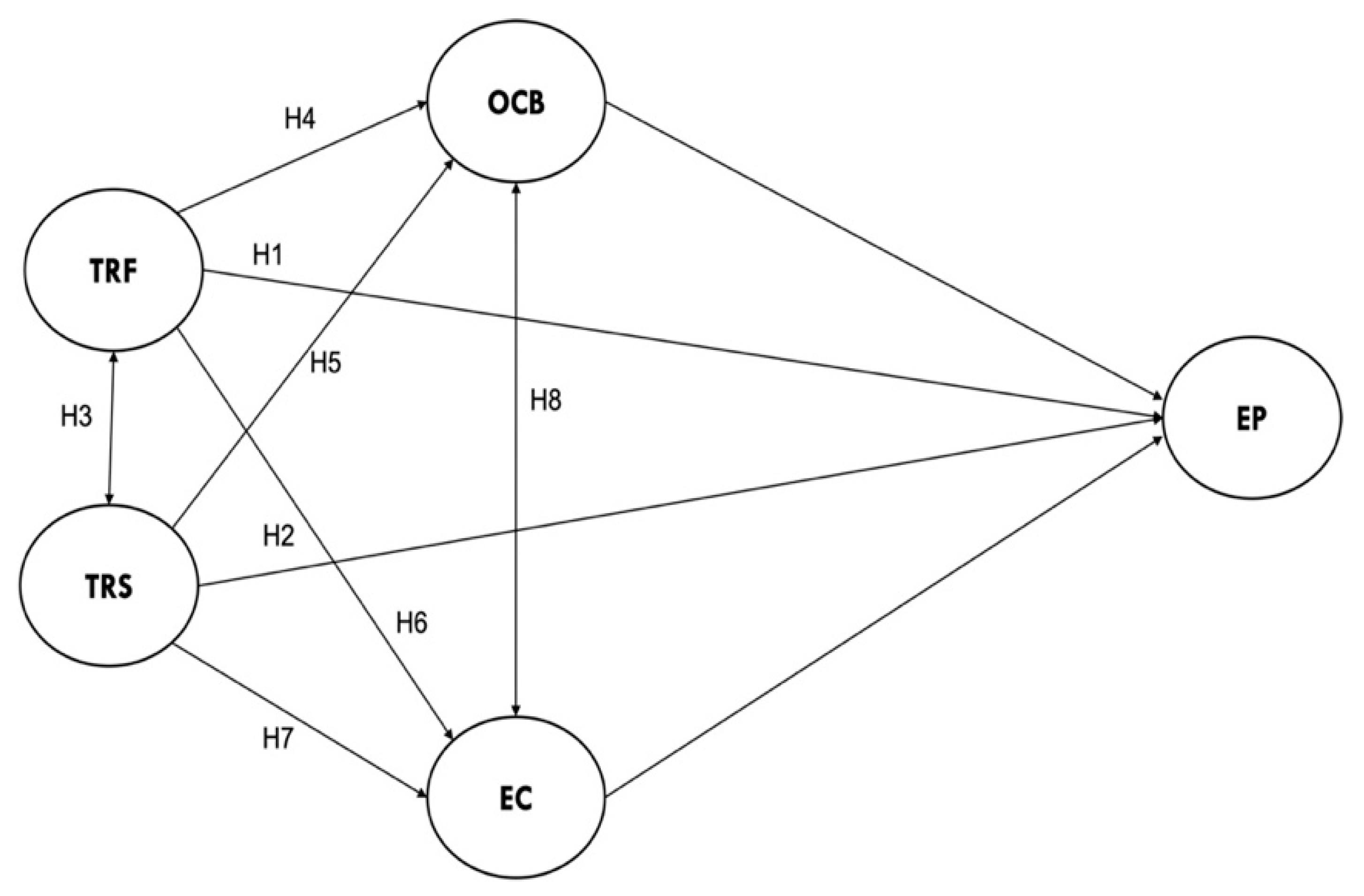
Employees led by transformational leaders can surpass expectations and achieve outstanding performance, reaching maximum potential [17], embrace change, [8,45], exhibit innovative behaviours [46] and go beyond transactions and compensation [24,47]. TRF is considered a critical factor that influences various individual outcomes, like followers’ behaviour [48], embracing organisational transformation [49], innovative thinking [50], organisational commitment and trust [51], OCB [6] and EP. A study by [52], found that TRF positively and significantly impacts EP. Hence, this hypothesis is proposed:
Hypothesis 1.
TRF positively impacts EP.
2.6.2. Transactional Leadership
Transactional leadership (TRS) involves providing contingent reinforcement to employees based on their performance [25] and it inspires followers by appealing to their individual or collective aspirations, employing instrumental economic exchanges. Various research has presented evidence that TRS significantly improves organisational effectiveness, employee job satisfaction, OCB, and organisational deviance behaviours [23,53]. Therefore, the subsequent hypothesis is put forth:
Hypothesis 2.
TRS has a positive impact on EP.
2.6.3. Transformational-Transactional Leadership Style Relationship
In leadership literature, TRF and TRS have been thoroughly examined in diverse settings [28]. They have been revealed to be connected with several work-related outcomes, like commitment followers' behaviour and performance outcomes [54]. However, [22,28], posit that TRF augments transactional leadership to bolster positive work practices but [55], contended that effective leaders should have a blend of TRF and TRS qualities and this viewpoint is corroborated by [22]. Conversely, the relationship between these two notions in forecasting work habits remains unresolved despite their high reputation for predicting organisational efficiency [24]. Thus, the study hypothesizes that:
Hypothesis 3.
A significant correlation exists between the TRF and TRS styles.
2.6.4. The Mediating Role of Organisational Citizenship Behaviour
Prior findings have examined the consequence of various leadership styles on OCB and have acknowledged that leadership is crucial to OCB [56], however, [57], suggest that OCB can intercede between the association between leadership and EP. This premise was established in a recent study by [58]. A comparable and valuable insight into the connection between OCB and EP in the setting of education 4.0 was also found by [59]. Consequently, previous research has demonstrated that TRS influences OCB [60,61]. However, [62], assert that both leadership styles have a bearing on OCB, with the TRF approach being more profound. Therefore, the following hypothesis is proposed:
Hypothesis 4.
OCB impacts the connection between TRF and EP.
Hypothesis 5.
OCB impacts the connection between TRS and EP.
2.6.5. The Mediating Role of Employee Commitment
Studies have looked at how different types of leadership styles influence EC [54]. According to [63], adopting effective leadership styles is crucial for boosting EC, facilitating the formulation and execution of company plans, and attaining predetermined objectives. However, [63], discovered a robust significant relationship between leadership style and OC. Therefore, the study proposes the following hypotheses:
Hypothesis 6.
EC significantly enhance the relationship between TRF and EP.
Hypothesis 7.
EC significantly enhance the relationship between TRS and EP.
2.6.6. The link between Employee Commitment and Organisational Citizenship Behaviour
EC and OCB have been the subject of multiple studies. The literature suggests a favourable and significant relationship between these two constructs [64,65]. However, devoted employees are more prone to engage in OCB. This is because their strong emotional connection to the organisation pushes them to go beyond their official job duties [58,66]. Thus, the following hypothesis is formulated:
Hypothesis 8.
There is a significant relationship between EC and OCB.
Figure 1.
Conceptual framework.
3. Methodology
The methodology employed entailed gathering quantitative data via questionnaires. The data gathering instrument was established by means of a five-point Likert scale, which ranged from "strongly disagree" to "strongly agree." The research primarily focused on the commercial banks in Sierra Leone, which consist of fourteen banks. They frequently undertake organisational transformation projects and play a vital role in fostering the financial stability and progress of the nation [15,16]. The Cochran technique was employed to define the appropriate sample size [67] and as a consequence, a total of 903 participants were included in the final sample.
3.1. Measurement section
To measure the effects of leadership styles on EP, the study utilized validated survey instruments and objective performance metrics. TRF and TRS were assessed by [68] Multifactor Leadership Questionnaire (MLQ), because of its broad use and adaptation to numerous cultures. The dimensions of TRF (idealized influence, inspirational motivation, intellectual stimulation and individualized consideration) and three dimensions of TRS (contingent reward and management-by-exception (active and passive) were assessed using a five-point Likert scale ranging from "strongly disagree" to "strongly agree." EP was assessed based on individual work performance adopted from [69] using a five-point Likert scale ranging from "strongly disagree" to "strongly agree." Mediating variables, EC were measured using [70] scale and adopted a five-point Likert scale going from "strongly disagree" to "strongly agree." OCB was examined using [35] scale, and a five-point Likert scale was used ranging from "strongly disagree" to "strongly agree."
3.2. Demographics
Table 1 illustrates the participants' demographics. Gender distribution reveals that males constitute 53%, while females comprise 47%. Age distribution, 9.1% are aged 18-25 years, 55.8% are aged 26-35 years, 28.0% are aged 36-45 years, 6.0% are aged 46-55 years, and 1.0% are aged 56 years and above. For education, (41.2%) hold bachelor's degrees, (31.9%) diplomas, (18.5%) master's degrees and (0.3%) doctorate degrees. The work experience distribution shows 1.0% have less than a year of experience, 9.3% have 1-3 years, 44.4% have 4-6 years, 35.3% have 7-10 years, and 10.0% have over 10 years of experience within the banking sector.
4. Results and Discussion
4.1. Introduction
The study utilised the structural equation modelling (SEM) approach to adopt the partial least squares (PLS) approach. The methodological characteristics of PLS-SEM set it apart from other SEM approaches and it has been generally recognised in management and social sciences research for its methodological prowess [71,72]. PLS-SEM was utilised to examine the model and hypothesis and it is suitable for this setting since it can simultaneously estimate hypothesised connections, hence, to assess the measurement model, it is necessary to calculate the constructs' discriminant validity, convergent validity, internal consistency, and reliability [71].
4.2. Assessment of Measurement Model
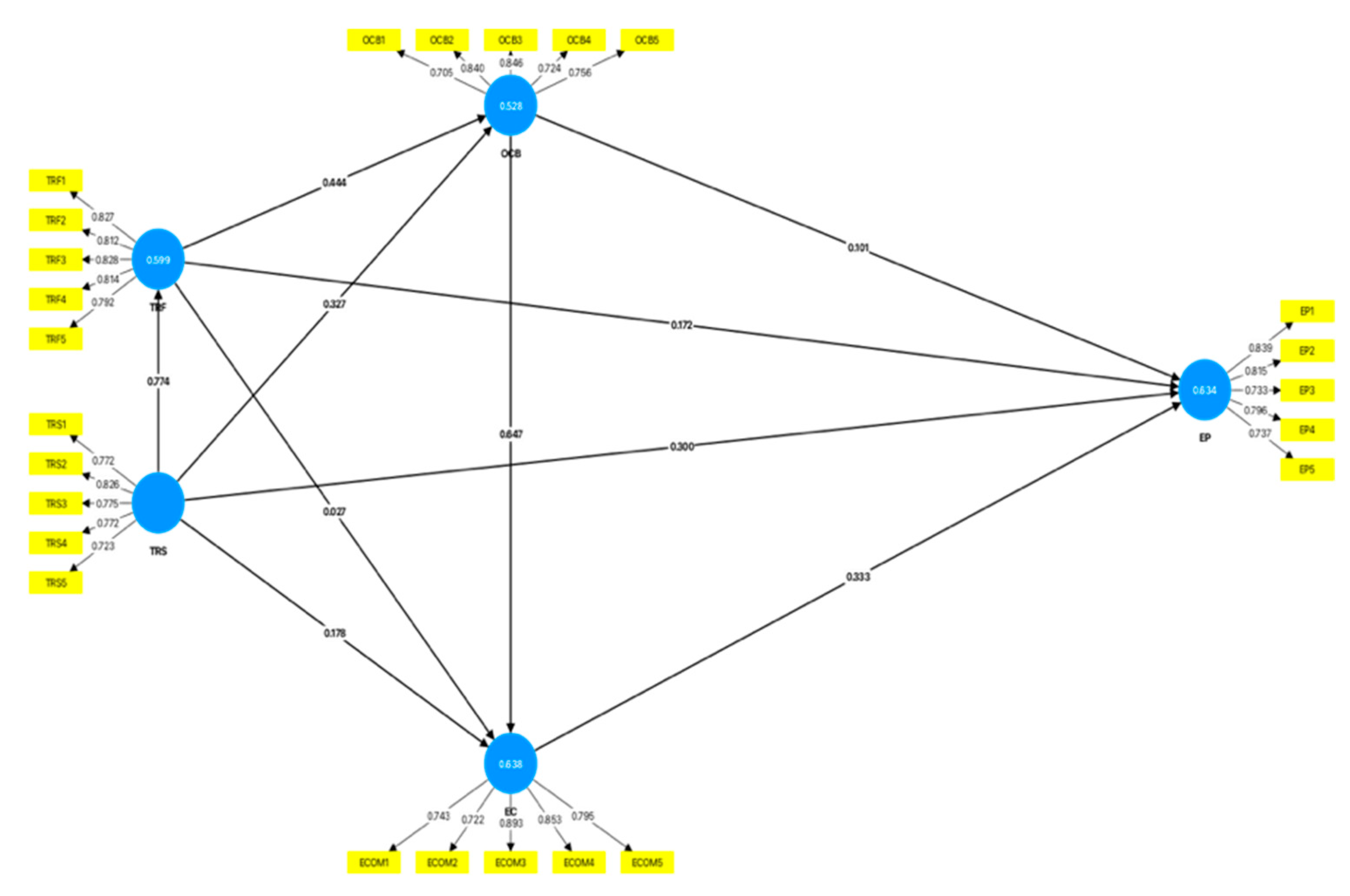
Before data analysis, researchers should make sure the constructs are reliable and legitimate [73]. Table 2 revealed that all constructs meet the acceptable thresholds for reliability and validity [74]. For factor loadings (FL), the generally accepted minimum is 0.70, which is considered adequate for item reliability [72]; here, all items load significantly on their respective constructs, varying from 0.705 to 0.893. Cronbach's Alpha (CA) values exceed the 0.70 threshold for internal consistency [75], with values ranging from 0.833 to 0.873. Composite Reliability (CR) values also surpass the 0.70 benchmark, indicating high reliability [72], with scores between 0.882 and 0.908. There is sufficient convergent validity since the AVE for all constructs is greater than the 0.50 criterion [76], with values from 0.600 to 0.664. Therefore, all AVEs demonstrate strong construct validity and reliability, making the measurement model robust for further analysis.
The estimated SEM coefficients for our hypothesised model are shown in Table 3. Hypothesis 1, posits that TRF positively impacts EP. The results (β 0.172, t = 3.991, p < .001) imply strong support for this hypothesis [72]. Hypothesis 2 suggests that TRS positively affects EP, and the results (β 0.300, t = 6.965, p < .001) provide robust evidence for support [72]. Hypothesis 3 asserts that TRS positively influences TRF. This is confirmed by the results (β 0.774, t = 43.731, p < .001) and supporting the hypothesis [72]. These results indicate that both leadership styles significantly enhance employee performance, and TRS significantly boosts TRF, thereby aligning with the theoretical framework and empirical evidence in organisational behaviour research.
Table 4 presents the results of the indirect effects of leadership styles on EP through mediators such as OCB and EC. Hypothesis 4 posits that OCB mediates the relationship between TRF and EP. The results (β 0.045, t = 2.382, p = .017) indicate a significant support for this mediation effect [77]. Hypothesis 5 suggests that OCB mediates the relationship between TRS and EP and this is supported by the results (β 0.033, t = 2.262, p = .024). Conversely, Hypothesis 6, proposes that EC mediates the relationship between TRF and EP, conflicting with what was expected, the results (β 0.009, t = 0.571, p = .568) revealed an insignificant positive effect and the hypothesis is unsupported. Hypothesis 7 posits that EC mediates the relationship between TRS and EP. The results (β 0.059, t = 3.433, p = .001) support this assertion. Finally, Hypothesis 8 proposed a statistically significant relationship between EC and OCB. The results (β 0.647, t = 11.723, p < .001) indicate a significant and positive association between OCB and EC, thus, the hypothesis is supported.
Figure 2.
Structural Model Analysis of Constructs.
5. Discussion
Conclusion and Recommendations
Leadership continues to play a critical role in influencing employee outcomes, and commercial banks need a blend of TRF and TRS to drive EP during change initiatives in this VUCA world. An effective blend of TRF and TRS can influence employees to demonstrate behaviours outside of their domain voluntarily without being officially acknowledged or compensated. The notion that committed employees are more likely to engage in OCB is reinforced in this study. However, as a mediator, EC was insignificant for TRF on EP but significant for TRS on EP, which lends credence to the fact that TRS is more effective within the context of banks since it underscores clear structures, performance targets, rewards, and penalties for employees, as it is deemed to be more effective in driving EP.
6.1. Theoretical Implications
This study enriches the existing theory of TRF and TRS and their influence on EP during organisational change in the VUCA world [2,78], especially in the banking sector [62]. The results support prior results that both styles can coexist in one organisation to achieve desirable results. The current study used OCB as a mediating variable to elucidate the connection between the two leadership styles and employee performance. This confirms previous results [6,33,58,59,62], and underscores the critical role leaders play in nurturing an atmosphere that encourages employees to exhibit citizenship practices. This study enhances leadership theory by highlighting the situational effectiveness of various styles and their intricate interactions with employee attitudes and behaviours throughout change.
6.2. Practical Implications
The findings offer valuable suggestions to top executives within the banking sector on the effect of adopting both TRF and TRS on driving desired results. The results might be used as a reference for business executives, administrators, and policymakers on the adoption of the transformational-transactional leader trait, which is regarded as a driver of performance. Commercial banks should devise training programmes that will advance both the ‘transformational’ and ‘transactional’ dimensions of leadership personality traits for those leaders who would arouse, energise, or inspire, followers with displays of OCB while also providing a clearer conceptualization of goal attainment and the rewards involved.
6.3. Limitations and Future Research Directions
The study's data was exclusively acquired from the banking industry, which raises concerns about the generalizability of the conclusions. Performance in various industry sectors may be influenced by factors such as sector-specific characteristics and cultural variations. Thus, future research could apply these findings to other industries to increase applicability. To better understand how contextual and cultural factors influence the bearing of leadership styles on employee performance, researchers could explore contrasting assessments of leadership styles in different contexts. Evaluating other mediating and moderating variables, like psychological capital employee engagement, and job autonomy to determine another dimension of the effect of leadership styles on employee performance. These potential areas can enhance the knowledge and understanding of the multifaceted relationship between leadership styles and performance.
Author Contributions
Conceptualization, Ibrahim Alusine Kebe and Christian Kahl.; methodology, Ibrahim Alusine Kebe; software, Ibrahim Alusine Kebe.; validation, Ibrahim Alusine Kebe.; formal analysis.; Ibrahim Alusine Kebe; investigation, Ibrahim Alusine Kebe.; resources, Ibrahim Alusine Kebe.; data curation, Ibrahim Alusine Kebe.; writing—original draft preparation, Ibrahim Alusine Kebe and Christian Kahl.; writing—review and editing, Ibrahim Alusine Kebe and Christian Kahl.; visualization, Ibrahim Alusine Kebe.; supervision, Christian Kahl and Liu Yingqi.; project administration, Ibrahim Alusine Kebe, Christian Kahl and Liu Yingqi.; funding acquisition, Ibrahim Alusine Kebe, Christian Kahl and Liu Yingqi. All authors have read and agreed to the published version of the manuscript.
Funding
This research received no external funding.
Data Availability Statement
The data that support the findings of this study are available from the corresponding authors upon reasonable request.
Acknowledgments
The authors are grateful to the employees and managers at the commercial banks for their participation in this research. The following author affiliations are duly acknowledged, Beijing Jiaotong University and the Institute of Public Administration and Management (University of Sierra Leone), and all the anonymous reviewers are duly acknowledged.
Conflicts of Interest
The authors declare no conflict of interest.
References
- Lu J, Falahat M, Cheah PK. A systematic literature review on the relationship between servant leadership and its team and organizational level outcomes. Journal of Organizational Change Management. 2024 Mar 22;37(2):255–82.
- Nguyen NP, Hang NTT, Hiep N, Flynn O. Does transformational leadership influence organisational culture and organisational performance: Empirical evidence from an emerging country. IIMB Management Review. 2023 Dec;35(4):382–92.
- Galil K, Varon E. National culture and banks stock volatility. Journal of International Financial Markets, Institutions and Money. 2024 Mar;91:101932.
- Shaw GB, Drucker PF, Senge PM. Challenges in change management in central banks. Journal of Central Banking Theory and Practice. 2013;2:35–49.
- Mosadeghrad AM, Ansarian M. Why do organisational change programmes fail? International Journal of Strategic Change Management. 2014;5(3):189.
- Hermanto YB, Srimulyani VA, Pitoyo DJ. The mediating role of quality of work life and organizational commitment in the link between transformational leadership and organizational citizenship behavior. Heliyon. 2024 Mar;10(6):e27664.
- Aitken K, von Treuer K. Leadership behaviours that foster organisational identification during change. Journal of Organizational Change Management. 2021 Mar 30;34(2):311–26.
- Latifah IN, Suhendra AA, Mufidah I. Factors affecting job satisfaction and employee performance: a case study in an Indonesian sharia property companies. International Journal of Productivity and Performance Management. 2024 Mar 6;73(3):719–48.
- Gilli K, Lettner N, Guettel W. The future of leadership: new digital skills or old analog virtues? Journal of Business Strategy. 2024 Jan 26;45(1):10–6.
- Lee CC, Yeh WC, Yu Z, Lin XC. The relationships between leader emotional intelligence, transformational leadership, and transactional leadership and job performance: A mediator model of trust. Heliyon. 2023 Aug;9(8):e18007.
- Rouzi KS, Purnomo H, Mustakim Muh, Bin Husen Ismail F. Transformational Leadership on Women’s Leadership in Islam. Journal of Feminism and Gender Studies. 2022 Jan 11;2(1):13.
- Burns JamesM. Leadership. New York: Harper and Row.; 1978.
- Heim I, Sardar-Drenda N. Assessment of employees’ attitudes toward ongoing organizational transformations. Journal of Organizational Change Management. 2021 Mar 30;34(2):327–49.
- Musa V, Kamara D. Assessing the effect of organisational change on performance (Sierra Leone Commercial Bank) (SLCB). Technium Education and Humanities. 2024 May 6;8:105–41.
- Duramany-Lakkoh EK, Jalloh MS, Jalloh A. An Empirical Examination of the Impact of Banks on Economic Growth in Sierra Leone (2001-2017). Journal of Financial Risk Management. 2022;11(02):258–76.
- Nuni SA, Kebe IA. Business Sustainability through Change Management Case Study: Rokel Commercial Bank (RCB) [Internet]. International Journal of Research and Innovation in Social Science. 2021 [cited 2024 Jul 15]. Available from: https://www.rsisinternational.org/journals/ijriss/Digital-Library/volume-5-issue-4/338-344.pdf.
- Bass, BM. Leadership and Performance beyond Expectations.. Free Press; Collier Macmillan; 1985.
- Yukl, G. Leadership in Organizations. Pearson, Boston, MA.; 2013.
- Escórcio Soares A, Pereira Lopes M, Geremias RL, Glińska-Neweś A. A leader–network exchange theory. Journal of Organizational Change Management. 2020 Nov 17;33(6):995–1010.
- Dartey-Baah K, Quartey SH, Wilberforce MT. Organizational ethics and workplace incivility: the mediating effects of transformational and transactional leadership styles. Leadership & Organization Development Journal. 2024.
- Bass BM, Riggio RE. Transformational Leadership. Psychology Press; 2006.
- Bass BM, Avolio BJ. Transformational leadership and organizational culture. Public administration quarterly. 1993;112–21.
- Bass BM, Avolio BJ. Full range leadership development: Manual for the Multifactor Leadership Questionnaire. Palo Alto, CA: Mindgarden.; 1997.
- Puni A, Hilton SK, Quao B. The interaction effect of transactional-transformational leadership on employee commitment in a developing country. Management Research Review. 2021 Mar 2;44(3):399–417.
- Jabeen F, Behery M, Abu Elanain H. Examining the relationship between the psychological contract and organisational commitment. International Journal of Organizational Analysis. 2015 Mar 9;23(1):102–22.
- Men LR, Stacks DW. The impact of leadership style and employee empowerment on perceived organizational reputation. Journal of Communication Management. 2013;17(2):171–92.
- Bass BM, Riggio RE. Transformational Leadership, Lawrence Erlbaum Associates. Mahwah, NJ. 2006.
- Dartey-Baah, K. Resilient leadership: a transformational-transactional leadership mix. Journal of Global Responsibility. 2015 May 11;6(1):99–112.
- Berraies S, Zine El Abidine S. Do leadership styles promote ambidextrous innovation? Case of knowledge-intensive firms. Journal of Knowledge Management. 2019 Jun 10;23(5):836–59.
- Katz D, Kahn RL. The social psychology of organizations. The social psychology of organizations. Oxford, England: Wiley; 1966.
- Bateman TS, Organ DW. Job Satisfaction and the Good Soldier: The Relationship Between Affect and Employee “Citizenship”. Academy of Management Journal. 1983 Dec 1;26(4):587–95.
- Organ, DW. Organizational citizenship behavior: The good soldier syndrome.. Lexington Books/D. C. Heath and Com.; 1988.
- Qalati SA, Zafar Z, Fan M, Sánchez Limón ML, Khaskheli MB. Employee performance under transformational leadership and organizational citizenship behavior: A mediated model. Heliyon. 2022 Nov;8(11):e11374.
- Santa R, Moros A, Morante D, Rodríguez D, Scavarda A. The impact of emotional intelligence on operational effectiveness: The mediating role of organizational citizenship behavior and leadership. PLoS One. 2023 Aug 2;18(8):e0284752.
- Podsakoff PM, MacKenzie SB, Moorman RH, Fetter R. Transformational leader behaviors and their effects on followers’ trust in leader, satisfaction, and organizational citizenship behaviors. Leadersh Q. 1990;1(2):107–42.
- Berber N, Gašić D. The mediating role of employee commitment in the relationship between compensation system and turnover intentions. Employee Relations: The International Journal. 2024 Mar 25.
- Mowday RT, Porter LW, Steers R. (1982), Organizational Linkages: The Psychology of Commitment, Absenteeism, and Turnover. San Diego, SD: Academic Press; 1982.
- Meyer JP, Allen NJ. A three-component conceptualization of organizational commitment. Human Resource Management Review. 1991 Mar;1(1):61–89.
- Noesgaard MS, Jørgensen F. Building organizational commitment through cognitive and relational job crafting. European Management Journal. 2024 Jun;42(3):348–57.
- Karyatun S, Wahyono T, Apriadi I, Priyono P, Arief H, Hakim MAR, et al. Determinants of employee performance in the manufacturing industry. American International Journal of Business Management (AIJBM) ISSN-2379-106X, www.aijbm.com. 2023;6(09):79–89.
- Rohman F, Noermijati N, Mugiono M, Soelton M. The role of quality assurance in improving the distribution of organizational performance. Uncertain Supply Chain Management. 2023;11(1):237–48.
- Otoo FNK. The mediating role of employee performance in the relationship between human resource management (HRM) practices and police service effectiveness. IIM Ranchi Journal of Management Studies. 2024 Feb 21.
- Dogbe CSK, Ablornyi KK, Pomegbe WWK, Duah E. Inducing employee performance among state-owned enterprises, through employee ethical behaviour and ethical leadership. Social Responsibility Journal. 2024 Jul 4;20(7):1378–97.
- Jain S, Singh A, Bhalla R. Can metacognition determine employee performance in the context of virtual workspace? An empirical investigation. International Journal of Organization Theory & Behavior. 2024 Jun 4.
- Singh P, Chaudhary K. Jharcraft: a gift of transformational leadership in an Indian state-owned enterprise. International Journal of Public Leadership. 2023 Nov 28;19(4):339–54.
- García-Morales VJ, Matías-Reche F, Hurtado-Torres N. Influence of transformational leadership on organizational innovation and performance depending on the level of organizational learning in the pharmaceutical sector. Journal of Organizational Change Management. 2008 Apr 4;21(2):188–212.
- House RJ, Spangler WD, Woycke J. Personality and Charisma in the U.S. Presidency: A Psychological Theory of Leader Effectiveness. Adm Sci Q. 1991 Sep;36(3):364.
- Stock G, Banks GC, Voss EN, Tonidandel S, Woznyj H. Putting leader (follower) behavior back into transformational leadership: A theoretical and empirical course correction. Leadersh Q. 2023 Dec;34(6):101632.
- Faupel S, Süß S. The Effect of Transformational Leadership on Employees During Organizational Change–An Empirical Analysis. Journal of Change Management. 2019 Jul 3;19(3):145–66.
- Steinmann B, Klug HJP, Maier GW. The Path Is the Goal: How Transformational Leaders Enhance Followers’ Job Attitudes and Proactive Behavior. Front Psychol. 2018 Nov 29;9.
- Xu H, Wang Z, Lian N, Khan A, Zhang L. The Impact of Transformational Leadership on Organizational Commitment and Intention to Stay: Empirical Evidence From China’s Performing Arts Industry. Front Psychol. 2022 May 6;13.
- Chau THP, Tran YT, Le TD. How does transformational leadership influence on the performance of public service organizations in a developing country? The interventional roles of NPM cultural orientations. Cogent Business & Management. 2022 Dec 31;9(1).
- Liu J, Liu X, Zeng X. Does transactional leadership count for team innovativeness? The moderating role of emotional labor and the mediating role of team efficacy. Journal of Organizational Change Management. 2011;24(3):282–98.
- Yahaya R, Ebrahim F. Leadership styles and organizational commitment: literature review. Journal of Management Development. 2016 Mar 7;35(2):190–216.
- Bass, BM. Does the transactional–transformational leadership paradigm transcend organizational and national boundaries? American psychologist. 1997;52(2):130.
- Kim, H. Transformational Leadership, Organizational Clan Culture, Organizational Affective Commitment, and Organizational Citizenship Behavior: A Case of South Korea’s Public Sector. Public Organization Review. 2014 Sep 19;14(3):397–417.
- Supriyanto AS, Ekowati VM, Maghfuroh U. Do organizational citizenship behavior and work satisfaction mediate the relationship between spiritual leadership and employee performance? Management Science Letters. 2020;1107–14. [CrossRef]
- Arifin S, Narmaditya BS. Fostering employee performance of civil servants in Indonesia: The mediating role of organisational citizenship behaviour. SA Journal of Human Resource Management [Internet]. 2024;22(1):2412. [CrossRef]
- Sharma RK, Kaur S. Analysing the mediating role of organisational citizenship behaviour between transformational leadership and education 4.0 using PLS-SEM approach. International Journal of Educational Management. 2024 Mar 6;38(2):391–412. [CrossRef]
- Addo SA, Dartey-Baah K. Leadership in the safety sense: where does perceived organisational support fit? Journal of Management Development. 2019 Nov 12;39(1):50–67.
- Podsakoff PM, MacKenzie SB, Paine JB, Bachrach DG. Organizational Citizenship Behaviors: A Critical Review of the Theoretical and Empirical Literature and Suggestions for Future Research. J Manage. 2000 Jun 1;26(3):513–63.
- Mekpor B, Dartey-Baah K. Leadership styles and employees’ voluntary work behaviors in the Ghanaian banking sector. Leadership & Organization Development Journal. 2017 Mar 6;38(1):74–88.
- Voon ML, Lo MC, Ngui KS, Ayob NB. The influence of leadership styles on employees’ job satisfaction in public sector organizations in Malaysia. International journal of business, management and social sciences. 2011;2(1):24–32.
- Massoudi AH, Jameel AS, Ahmad AR. Stimulating Organizational Citizenship Behavior by Applying Organizational Commitment and Satisfaction. International Journal of social Sciences and Economic Review. 2020 Jun 27;20–7.
- Tran QHN. Investigate the relationship between leadership behaviours, organisational commitment, occupational stress and organisational citizenship behaviours in Vietnamese private business school libraries. Library Management. 2024 Feb 21;45(1/2):101–17.
- Raza SA, Khan KA, Hakim F. Whether organizational citizenship behavior is triggered by employee CSR perception and spiritual values: the moderating role of Islamic work ethics. Management Research Review. 2024 Jan 22;47(3):353–73.
- Cochran, WG. Sampling Techniques. New York: John Wiley & Sons, Inc.; 2007.
- Avolio BJ, Bass BM. Multifactor leadership questionnaire (TM). Mind Garden, Inc Menlo Park, CA. 2004.
- Koopmans L, Bernaards CM, Hildebrandt VH, de Vet HCW, van der Beek AJ. Construct Validity of the Individual Work Performance Questionnaire. J Occup Environ Med [Internet]. 2014;56(3). Available from: https://journals.lww.com/joem/fulltext/2014/03000/construct_validity_of_the_individual_work.14.aspx.
- Mowday RT, Porter LW, Steers RM. Employee–Organization Linkages. Elsevier; 1982.
- Hair J, Hollingsworth CL, Randolph AB, Chong AYL. An updated and expanded assessment of PLS-SEM in information systems research. Industrial Management & Data Systems. 2017 Apr 10;117(3):442–58.
- Hair JF, Risher JJ, Sarstedt M, Ringle CM. When to use and how to report the results of PLS-SEM. European business review. 2019;31(1):2–24.
- Moschis, GP. Research Settings and Procedures. In: Moschis GP, editor. Academic Research in Business and the Social Sciences: A Guidebook for Early Career Researchers [Internet]. Cham: Springer Nature Switzerland; 2024. p. 121–39. [CrossRef]
- Sempere-Ruiz N, Sarabia JM, Baladzhaeva S, Moya-Ramón M. Reliability and validity of a non-linear index of heart rate variability to determine intensity thresholds. Front Physiol. 2024 Feb 5;15.
- Nunnally, J. Psychometric theory. (No Title). 1994.
- Fornell C, Larcker DF. Evaluating structural equation models with unobservable variables and measurement error. Journal of marketing research. 1981;18(1):39–50.
- Preacher KJ, Hayes AF. Asymptotic and resampling strategies for assessing and comparing indirect effects in multiple mediator models. Behav Res Methods. 2008;40(3):879–91.
- Hundie Z, Habtewold E. The Effect of Transformational, Transactional, and Laissez-Faire Leadership Styles on Employees’ Level of Performance: The Case of Hospital in Oromia Region, Ethiopia. J Healthc Leadersh. 2024 Feb;Volume 16:67–82.

Table 1.
Demographics of Respondents.
| Variable | Item | Frequency | % |
|---|---|---|---|
| Gender | Male | 482 | 53% |
| Female | 421 | 47% | |
| Total | 903 | 100% | |
| Age (in years) | 18-25 | 82 | 9.1% |
| 26-35 | 504 | 55.8% | |
| 36-45 | 252 | 28% | |
| 46-55 | 53 | 6% | |
| 56+ | 12 | 1% | |
| Total | 903 | 100% | |
| Education | Certificate | 73 | 8.1% |
| Diploma | 288 | 31.9% | |
| Bachelors | 372 | 41.2% | |
| Masters | 167 | 18.5% | |
| PhD | 3 | 0.3% | |
| Total | 903 | 100% | |
| Years of Experience | Below a year | 9 | 1% |
| 1-3 | 84 | 9.3% | |
| 4-6 | 401 | 44.4% | |
| 7-10 | 319 | 35.3% | |
| 10+ | 90 | 10% | |
| Total | 903 | 100% |
Source: Researcher’s field survey 2024.
Table 2.
Reliability and Validity of Constructs (TRF, TRS, OCB, EC and EP).
| Construct | FL | CA | CR | AVE |
|---|---|---|---|---|
| Transformational Leadership Style (TRF) | 0.873 | 0.908 | 0.664 | |
| TRF1 | 0.827 | |||
| TRF2 | 0.812 | |||
| TRF3 | 0.828 | |||
| TRF4 | 0.814 | |||
| TRF5 | 0.792 | |||
| Transactional Leadership Style (TRS) | 0.833 | 0.882 | 0.600 | |
| TRS1 | 0.772 | |||
| TRS2 | 0.826 | |||
| TRS3 | 0.775 | |||
| TRS4 | 0.772 | |||
| TRS5 | 0.723 | |||
| Employee Commitment (EC) | 0.861 | 0.901 | 0.646 | |
| EC1 | 0.743 | |||
| EC2 | 0.722 | |||
| EC3 | 0.893 | |||
| EC4 | 0.853 | |||
| EC5 | 0.795 | |||
| Organisational Citizenship Behaviours (OCB) | 0.834 | 0.883 | 0.603 | |
| OCB1 | 0.705 | |||
| OCB2 | 0.840 | |||
| OCB3 | 0.846 | |||
| OCB4 | 0.724 | |||
| OCB5 | 0.756 | |||
| Employee Performance (EP) | 0.845 | 0.889 | 0.617 | |
| EP1 | 0.839 | |||
| EP2 | 0.815 | |||
| EP3 | 0.733 | |||
| EP4 | 0.796 | |||
| EP5 | 0.737 |
Source: Researcher’s computation 2024.
Table 3.
Hypothesis testing results.
| Hypothesis | Structural relationship | β | T statistics | P values | Decision |
|---|---|---|---|---|---|
| H1 | TRF -> EP | 0.172 | 3.991 | 0.000 | Supported |
| H2 | TRS -> EP | 0.300 | 6.965 | 0.000 | Supported |
| H3 | TRS -> TRF | 0.774 | 41.731 | 0.000 | Supported |
Source: Researcher’s computation 2024.
Table 4.
Results of the Mediation Analysis.
| Hypothesis | Structural relationship | β | T statistics | P values | Decision |
|---|---|---|---|---|---|
| H4 | TRF -> OCB -> EP | 0.045 | 2.382 | 0.017 | Supported |
| H5 | TRS -> OCB -> EP | 0.033 | 2.262 | 0.024 | Supported |
| H6 | TRF -> EC -> EP | 0.009 | 0.571 | 0.568 | Unsupported |
| H7 | TRS -> EC -> EP | 0.059 | 3.433 | 0.001 | Supported |
| H8 | OCB -> EC | 0.647 | 11.723 | 0.000 | Supported |
Source: Researcher’s computation 2024.
Disclaimer/Publisher’s Note: The statements, opinions and data contained in all publications are solely those of the individual author(s) and contributor(s) and not of MDPI and/or the editor(s). MDPI and/or the editor(s) disclaim responsibility for any injury to people or property resulting from any ideas, methods, instructions or products referred to in the content. |
© 2024 by the authors. Licensee MDPI, Basel, Switzerland. This article is an open access article distributed under the terms and conditions of the Creative Commons Attribution (CC BY) license (http://creativecommons.org/licenses/by/4.0/).
Copyright: This open access article is published under a Creative Commons CC BY 4.0 license, which permit the free download, distribution, and reuse, provided that the author and preprint are cited in any reuse.