

Submitted:
15 July 2024
Posted:
16 July 2024
You are already at the latest version
Abstract
The landscape of tourism is undergoing rapid transformation in response to societal shifts, economic fluctuations, and advancements in the tourism sector, particularly in the post-pandemic. Tourists are increasingly inclined towards outdoor activities and natural landscapes, prioritizing experiences that emphasize health and safety. Conversely, cultural tourism emphasizes local heritage and immersive encounters to accommodate evolving preferences. Cultural tour guides play a pivotal role in shaping tourists' perceptions and intentions to revisit. Empirical research conducted among Chinese tourists visiting Nanjing Museum explores this paradigm shift. A questionnaire was distributed to 402 respondents to examine the principal factors influencing intentions to revisit. Factor and regression analyses illustrate the significance of cultural tour guides' competencies, revealing a positive correlation with intentions to revisit. It is noteworthy that tourist empathy moderates this relationship, wherein higher levels of empathy magnify the impact of tour guides' competencies on intentions to revisit. Robustness checks further validate these findings, affirming the nuanced interaction between service competencies, tourist empathy, and intentions to revisit. The study underscores the substantial influence of cultural tour guides on shaping tourist experiences and fostering repeat visits. This is contingent upon both the quality of service provided and the degree of empathy exhibited towards tourists.
Keywords:
Cultural Tourism
; Cultural Tourism Interpreter's Service
; Tourist Empathy
; Revisit Intention
; Tourist experiences
1. Introduction
Post-pandemic, the tourism landscape is undergoing transformations, with China’s domestic tourism sector poised for sustained growth amidst international constraints and heightened concerns for health and safety. A burgeoning preference for outdoor pursuits and the enchantment of natural panoramas characterizes the evolving tourist preferences, emphasizing experiences that prioritize well-being and security. Concurrently, cultural tourism is poised to place greater emphasis on local traditions and historical legacies, offering immersive and nuanced encounters tailored to consumer preferences. The pivotal role of cultural tourism interpreters is anticipated to underscore this paradigm shift.
In the 21st century, buoyed by advancements in economic prosperity and living standards, there has been a discernible uptick in disposable income among individuals. This trend is not merely confined to the pursuit of material gratification but extends to the quest for spiritual enrichment and cultural immersion. Furthermore, the proliferation of statutory holidays and advancements in transportation infrastructure have contributed to the burgeoning prevalence of tourism activities.
Accordingly, the tourism industry is transitioning from a focus on conventional tourist destinations to experiential cultural tourism. Cultural tour guides are crucial in imparting local culture to tourists, thereby expected to contribute significantly to the tourism sector’s development. Thus, this study empirically investigates the impact of cultural tour guides’ service competence on Chinese tourists’ revisitation intentions and their empathy towards tourists.
This study aims to enhance the brand equity of cultural tourism destinations by investigating the influence of cultural tourism interpreters’ service competence on revisit intention and tourist empathy. To achieve this objective, the study undertook the following steps: firstly, examining the conceptual definitions of service competence, tourist empathy, and revisit intention; secondly, analyzing the impact of cultural tourism interpreters’ service competence on revisit intention; thirdly, determining how tourist empathy mediates the relationship between service competence and revisit intention. Subsequently, hypotheses were tested, and both academic and practical implications were discussed. Specifically, by elucidating the effects of tourist empathy on the service competence and revisit intention of cultural tourism interpreters, this study aims to contribute to the management and development of cultural tourism destinations. Furthermore, the study seeks to offer valuable market insights through an understanding of tourist empathy and revisit intention.
2. Literature Review
2.1. Cultural Tourism and Cultural Tourism Interpreter
1) Cultural Tourism
There are numerous definitions of cultural tourism, with interpretations differing based on whether the focus is on the cultural aspect or on understanding tourism as a cultural experience. Se Jong Park (2014) suggests that the interpretation of cultural tourism greatly depends on whether it is perceived as tourism with a cultural focus or as a cultural experience in itself. The roots of tourism can be traced back to the Middle East, where individuals sought to expand their worldview beyond the confines of their everyday living spaces. Additionally, tourism can be viewed as an outcome of various social, political, economic, and cultural activities.
Liu, Y. D. (2014) defines cultural tourism as encompassing culturally motivated human movements, which include activities such as visiting cultural attractions, participating in artistic and cultural events, attending festivals, exploring historical sites and monuments, engaging with nature, experiencing folklore, conducting artistic research trips, and embarking on pilgrimages, among others. Alternatively, Richards, G. (2018) suggests that cultural tourism effectively encapsulates various facets of tourism and facilitates mutual understanding of individuals’ lives and ideas. Silberberg, T. (1995) offers a definition of cultural tourism as any travel outside one’s usual place of residence that is undertaken with a primary or partial interest in experiencing the history, art, science, way of life, or heritage of a particular community.
Cultural tourism encompasses not only tangible tourism resources such as artworks and cultural assets but also the intangible aspects of mental and social systems that shape the tourism experience. It transcends mere observation and enjoyment, involving direct experiences and emotions that can lead to the development of new worldviews and values.
2) Cultural Tourism Interpreter
Tilden (2009) defines interpretation as "an educational activity that aims to reveal the meaning and relationship of an original object through the use of direct experience and explanatory media rather than simply conveying factual information." Moscardo, G., Woods, B., & Saltzer, R (2004) define interpretation as an educational activity used to explain the meaning or significance of an object experienced by visitors. Jacobs, M. H. and Harms, M (2014) also recognize it as an on-site educational activity that involves communication with tourists. Poria, Y., Biran, A., & Reichel, A (2009) assert that interpretation, as a form of persuasive communication, should be strategically planned and executed to address the diverse motivations of visitors.
Edwards, A. D. (1976) underscores the service-oriented nature of cultural tourism interpretation, stating that "through interpretation, the appropriate combination of information services, guide services, educational services, entertainment services, and promotional services can create new understanding, new insights, expectations, and interest in the users of cultural and tourist resources." In essence, cultural tourism interpretation is considered a multifaceted service, and the integration of these various services is crucial in generating novel interests for tourists.
2.2. Cultural Tourism Interpreter’s Service Competence and Revisit Intention
1) Cultural Tourism Interpreter’s Service Competence
Previous research has confirmed that Tse, D. K., & Wilton, P. C (1988) identified the competencies of service industry managers to include specialized knowledge, effective communication, positive customer relationships, professional attitudes, and behavior, maintaining good internal working relationships, problem-solving from a consumer perspective, and adherence to ethical standards. Parry, S. B. (1996) defined competencies as a blend of knowledge, attitudes, and skills that impact an individual’s most important tasks, closely correlate with job performance, and are amenable to improvement through training and practices that can be measured by organizational outcomes. Park, G.-Y. (2018) investigated the competencies of cultural tourism interpretation services, identifying a sense of mission, expertise, communication skills, friendliness, and courage based on prior studies. Kim, S.-H., & Huh, Y.-D. (2019) presented the service competencies of cultural tourism interpreters as work competence, expertise competence, communication competence, and leadership competence, analyzing the contextual structural relationships between cultural tourism interpreters’ service competencies, tourism satisfaction, and behavioral intention.
2) Revisit Intention
Numerous studies have demonstrated that the decision-making process regarding visitation extends beyond the initial decision to visit, encompassing the evaluation of that decision and the determination of whether to return or not.
Oliver, R. L. (1980) defined revisit intention as the inclination to continue patronizing a favored product or service, constituting one aspect of the internal construct of consumer loyalty. It denotes an individual’s likelihood or willingness to revisit and experience a similar encounter again. When applied within the context of tourism, it signifies the intention to revisit a tourist destination either during the current trip or in subsequent visits. Kozak, M. (2003) posits that revisiting entails tourists returning to a destination they have previously visited. The tourist’s individual experiences and the overall conditions of the destination may influence their intention to revisit. Chen, C.-F., and Tsai, D. (2007) define tourists’ behavioral intention as their assessment of the likelihood of revisiting a destination and recommending it to others. Among these factors, revisit behavior is a focal point of interest for both academia and the tourism industry. Kim, S.-H., & Huh, Y.-D. (2019) delineated the service competencies of cultural tourism interpreters as encompassing work competence, expertise competence, communication competence, and leadership competence, and scrutinized the contextual structural relationships among these competencies, tourism satisfaction, and behavioral intention. Pei, Y. (2018) alternatively conducted a scholarly examination on the competencies exhibited by cultural tourism interpreters, classifying them into distinct categories: mission and friendliness, expertise, language proficiency and spontaneity, and communication.
In this study, we investigate how the service competence of cultural tourism interpreters varies based on tourist empathy during interactions with tourists through cultural tourism interpretation services. Previous research on the service competence of cultural tourism interpreters has highlighted that factor such as sincere attitude, communication ability, and friendliness significantly affect satisfaction (Ins son, J. 2003). Additionally, Jeong Ja, C., and Jae Myung, S. (2008) in their exploration of cultural tourism interpreters’ service competence, discovered that interpreters’ service competence can impact tourists’ intention to revisit. Consistent with Guo, C.-L., and Wang, J. (2023), this study scrutinized the service competencies of cultural tourism interpreters, encompassing factors such as sense of mission, professional knowledge, acceptance, kindness, and communication. Building upon this, Hypothesis 1 is formulated as follows:
Hypothesis 1 (H1):
The perceived service competence of cultural tourism interpreters in Nanjing museums among Chinese tourists will have a significant and positive impact on their intention to revisit.
2.3. Tourist Empathy
Miller, P. A. and Eisenberg, N. (1988) characterize empathy as a process that enables individuals to immerse themselves in another’s situation and engage in vicarious introspection, thereby replicating the internal experience of another as if it were their own.
Alternatively, Hackney, H. (1978) defines the essence of empathy as the ability to accurately anticipate the perspective or role of another person.
A review of prior studies on empathy elucidates that empathy denotes a relational dynamic wherein individuals prioritize and value the other party over themselves, thereby understanding and responding to situations from the perspective of the other rather than their own.
The researcher in question defines empathy as cognitive empathy, wherein tourists comprehend the behavior and circumstances of cultural tourism interpreters.
In summary, tourists’ satisfaction with interpretive services fosters positive behavioral intentions to revisit a tourist destination by augmenting the perceived value of the experience, which in turn enhances tourist empathy (Hyung Ju, L., & Sung Hyup, H. (2015). During the process of receiving interpretive services, tourists’ empathetic state increases, enhancing their learning and ultimately boosting tourism satisfaction, which plays a pivotal role in influencing their intention to revisit the destination.
Therefore, this study hypothesizes that differences in tourists’ intention to revisit a tourist destination will be contingent upon the level of empathy exhibited by tourists during the process of receiving interpretive services provided by cultural tourism interpreters interacting with tourists. Hypothesis 2 is formulated accordingly.
Hypothesis 2 (H2):
It is anticipated that tourist empathy will significantly moderate the relationship between the perceived service competence of cultural tourism interpreters and the intention of Chinese tourists to revisit Nanjing Museum.
3. Methodology
3.1. Sampling and Data Collection
Measures for all constructs were adopted from prior studies (see Appendix). Based on the preceding discussion, our research model is illustrated in Figure 1.
To fulfill the aim of this study, a sampling survey was conducted, wherein the contents of the questionnaire were explained to tourists who had received cultural tourism explanations within the past six months. The questionnaire administration took place from October to December 2023. Initially, 450 Chinese tourists were selected to receive the questionnaire, resulting in the collection of 425 completed copies. Subsequently, 23 unsuitable or dishonest responses were excluded, leaving 402 valid responses for final analysis. Statistical analysis was performed using SPSS 25.0, a widely utilized software package, with hierarchical regression analysis employed for detailed examination.
3.2. Measures
The interpretive service competence of cultural tourism interpreters was assessed using a total of 17 items derived from the research of Suk Hee, P. (1994),Min-Ho Chun (2011), and Jeong-Ja Choi (2011). These items encompassed dimensions such as a sense of mission, expertise, communication, and friendliness.
Empathy, as defined by Seung Kyu, N. (2010). involves a multifaceted process encompassing communication, understanding, and experiencing the emotions, mental states, and internal experiences of others as if they were one’s own. For this study, empathy was evaluated using three items adapted from the work of Kim, S.-H. and Huh, Y.-D (2019). Repeat visitor intention refers to the inclination to recommend a service product for repurchase or reuse or to voluntarily endorse it to others (Jin Woo J et al., 2011). Additionally, satisfied customers not only convey positive feedback to potential consumers but also exhibit actual revisit behavior (Ji, H, 2020). Thus, this study includes three questions based on prior research.
All items, with the exception of perceived customer value, were rated using a seven-point Likert-type scale ranging from "strongly disagree" to "strongly agree."
4. Data Analysis and Results
4.1. Demographic Profiles of Sample
The demographic characteristics of the survey participants are outlined in Table 1. As depicted in Table 1, the respondents consisted of 199 (49.50%) males and 203 (50.50%) females. Furthermore, 95 (23.63%) respondents were aged 21 to 25, and 144 (35.82%) reported vocational colleges as their highest level of education. Lastly, the majority of respondents had an average monthly income ranging from 4,000 to 5,000 RMB, with 103 (25.62%) falling into this category.
4.2. Factor Analysis and Reliability Analysis
In this study, factor analysis and reliability analysis were conducted for each variable to ensure the construct validity of the measurement tools prior to hypothesis testing. The results of the factor analysis and reliability analysis for each factor are presented in Table 2.
4.3. Descriptive Statistics between Variables
As depicted in Table 3 below, the mean, standard deviation, minimum, and maximum values of the variables in this study were computed. Descriptive statistical analysis was conducted based on the average value of the questionnaire items for each variable.
4.4. Hypotheses Testing
To empirically examine the hypotheses posited in this study, a comprehensive analytical approach incorporating multiple regression analysis and hierarchical regression analysis was employed to scrutinize potential moderating effects. The logical progression began with hypothesis testing, a foundational step necessary before delving into the moderating influence of specific tourist empathy through hierarchical regression analysis, which required the derivation of interaction terms. Initially, a multiple regression analysis was conducted, using the service competence of cultural tourism counselors as the independent variable and intention to revisit as the dependent variable, thus assessing the relationship between the variables of interest. Subsequently, to explore the moderating effect of tourist empathy as a moderating variable, hierarchical regression analysis was utilized, integrating interaction terms between the five factors of the independent variable (i.e., service competence of cultural tourism guides) and the moderating variables systematically into the regression model. The hierarchical regression analysis involved a sequential progression through three distinct regression models: the initial model comprising solely the independent variables, followed by the simultaneous inclusion of both independent and control variables in the subsequent model, and concluding with the incorporation of interaction terms of the independent and control variables in the final model. Notably, the explanatory power of the regression equation, denoted by the R-squared (R²) value, substantially increased with the introduction of additional variables at each step of the analysis. Furthermore, the regression coefficients obtained from each stage of the regression analysis were meticulously examined to ascertain the moderating effect. To address concerns regarding multicollinearity, the interaction term was computed through mean centering of each independent variable and control variable, facilitating the integration of the three-stage regression model into the analysis.
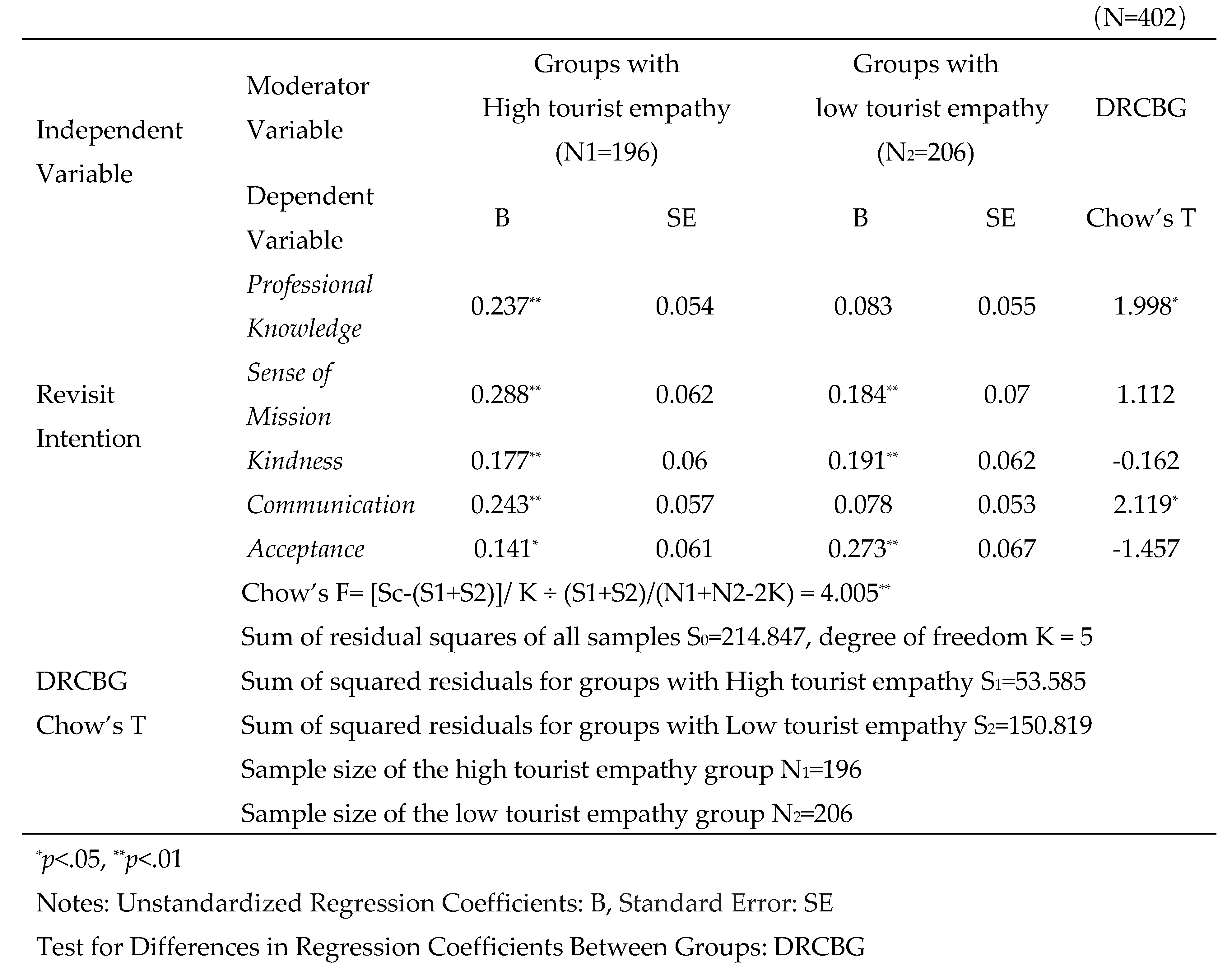
To fortify the validity of the identified moderating effects elucidated through both multiple regression analysis and hierarchical regression analysis with interaction terms, Chow’s test, comprising both T-test and F-test, was conducted. This comprehensive assessment aimed to ascertain the robustness of the obtained results in the face of potential differences in regression coefficients.
H1:
The perceived service competence of cultural tourism interpreters in Nanjing museums among Chinese tourists will have a significant and positive impact on their intention to revisit.
To investigate the proposition outlined in Research Hypothesis 1, which pertains to the impact of cultural tourism interpreters’ service competence on Chinese tourists’ perceptions and intention to revisit Nanjing Museum, multiple regression analysis was conducted. The outcomes of this analysis are presented in Table 4, where the service competence of cultural tourism interpreters is depicted as the independent variable, and the intention to revisit serves as the dependent variable.
H2:
It is anticipated that tourist empathy will significantly moderate the relationship between the perceived service competence of cultural tourism interpreters and the intention of Chinese tourists to revisit Nanjing Museum.
Hierarchical regression analysis was conducted to explore how tourist empathy, acting as a moderating variable, affects the relationship between service competency and revisit intention among cultural tourism commentators, as hypothesized in research hypothesis 2. The results of this analysis, presented in Table 4, Table 5, Table 6 and Table 7, illustrate the validation outcomes where the service of cultural tourism commentators, functioning as an independent variable, and the interaction variable between the independent variable and tourist empathy were sequentially incorporated into the regression model. To address concerns related to multicollinearity, the interaction variable was computed by taking the product of the mean-centered values for both the independent variable and the moderating variable ((average value of independent variable - independent variable) ☓ (average value of moderating variable - moderating variable)). Through the progressive inclusion of additional variables at each stage of the regression analysis, a notable increase in the R-squared (R²) value, indicating the explanatory power of the regression equation, was observed. Furthermore, the resultant change in the F value was statistically significant, confirming the presence of a moderating effect.
Furthermore, a comprehensive analysis was conducted to carefully interpret the regression coefficients obtained from the regression analysis conducted at each stage. Upon examining the results of the step-by-step analysis, it was noted that the independent variable, namely the service competence of the cultural tourism guide, exhibited a significant influence. In Model 1, focusing on the regression analysis of revisit intention, the obtained R-squared (R²) value was 0.489, with an adjusted R-squared (AdjR²) value of 0.482, indicating statistical significance (F = 75.702, p < .01). Subsequently, in Model 2, which incorporated both the independent and moderating variables, the regression coefficients remained statistically significant. Notably, the model’s explanatory power increased, with R² = 0.539 and AdjR² = 0.537, indicating an R² change of 0.051. Moreover, the regression model maintained statistical significance (F = 63.054, p < .01), with a notable change in the F value reported as 12.648.
In the analysis results of Model 3, incorporating the interaction term, it was noted that only the regression coefficient associated with the interaction between professional knowledge and communication and tourist empathy achieved statistical significance. With the inclusion of all interaction variables, the adjusted R-squared (AdjR²) value increased to 0.628, with an R-squared (R²) value of 0.634, indicating a substantial enhancement in explanatory power compared to Model 2. The R² change was calculated as 0.095 at the 1% significance level, and the regression model was considered statistically significant (F = 35.199, p < .01). Notably, there was a considerable change in the F value, reported as 27.855, confirming the presence of a significant moderating effect as determined by the F-test. This effect was corroborated by assessing whether Model 3, encompassing the interaction term, provided a significantly improved explanation of the dependent variable compared to Model 2, which does not include the interaction term, alongside a notable increase in the R² value, signifying enhanced explanatory power of the stepwise regression equation (Jin-hoo, K 2019). Conversely, the variance inflation index (VIF) of the interaction term consistently remained below 10, indicating that multicollinearity was not a significant concern. The results are displayed in Table 5.

Table 5.
Analysis of the moderating effect of Hypothesis 2.
| Dependent Variable: Revisit Intention | ||||||||||||||||||
| Model1 | Model2 | Model3 | ||||||||||||||||
| Factor | Unstd. Coeffs. | Std. Coeffs. | T-value | Unstd. Coeffs. | Std. Coeffs. | T-value | Unstd. Coeffs. | Std. Coeffs. | T-value | VIF | ||||||||
| B | SE | β | B | SE | β | B | SE | β | ||||||||||
| P.K (A) | .16 | .05 | .148** | 3.47 | .15 | .05 | .145** | 3.38 | .17 | .05 | .158** | 3.58 | 1.41 | |||||
| S.O.M (B) | .23 | .05 | .216** | 4.83 | .23 | .05 | 214** | 4.77 | .24 | .05 | .227** | 4.92 | 1.55 | |||||
| KND (C) | .20 | .04 | .202** | 4.64 | .20 | .04 | .200** | 4.58 | .18 | .05 | .177** | 3.84 | 1.47 | |||||
| COM (D) | .17 | .04 | .159** | 3.85 | .17 | .04 | .156** | 3.76 | .18 | .05 | .169** | 3.97 | 1.32 | |||||
| ACC (E) | .24 | .05 | .231** | 5.32 | .24 | .04 | .227** | 5.17 | .23 | .05 | .217** | 4.72 | 1.47 | |||||
| TM (M1) | .26 | .03 | .237** | 7.71 | .26 | .03 | .236** | 7.56 | 1.23 | |||||||||
| (A) * (M1) | .15 | .04 | .149** | 3.90 | 1.48 | |||||||||||||
| (B) * (M1) | .05 | .05 | .05 | 1.04 | 1.69 | |||||||||||||
| (C) * (M1) | -.03 | .04 | -.04 | -.86 | 1.56 | |||||||||||||
| (D) * (M1) | .18 | .04 | .167** | 4.29 | 1.35 | |||||||||||||
| (E) * (M1) | -21 | .04 | -21.00 | -.48 | 1.50 | |||||||||||||
| R2 | 0.489 | 0.539 | 0.634 | |||||||||||||||
| AdjR2 | 0.482 | 0.537 | 0.628 | |||||||||||||||
| R2 change | - | .051** | .095** | |||||||||||||||
| F | 75.702*** | 63.054.*** | 35.199*** | |||||||||||||||
| F change | - | 12.648*** | 27.855*** | |||||||||||||||
| *: p<.05, **: p<.01 | ||||||||||||||||||
| Notes: Professional Knowledge: P.K, Sense of Mission: S.O.M, Kindness:KND, Communication:COM, Acceptance:ACC Tourist Empathy: TM, unstandardized coefficients: Unstd. Coeffs., Standardized coefficients: Std. Coeffs. standard error: SE, Variance Inflation Factor:VIF | ||||||||||||||||||
4.5. Robustness Testing
This study conducted a comprehensive analysis to examine the moderating influence of tourist empathy through robustness testing, Shaw’s regression coefficient, and a regression model difference test.
The findings derived from the multiple regression analysis, assessing the influence of service competence exhibited by cultural tourism interpreters on revisit intention, along with the subsequent hierarchical regression analysis incorporating interaction terms between the various facets of cultural tourism interpreters’ service competence and tourists’ empathy, served as initial indicators for the presence of moderating effects.
This section undertook further statistical examinations, specifically employing Chow’s T-test and Chow’s F-test, to ascertain and validate the presence of moderating effects. These tests were crucial in not only identifying the existence of moderating effects but also in affirming their resilience and reliability within the analytical framework.
The relationship between an independent variable and a dependent variable may exhibit alterations in magnitude or direction consequent to the involvement of a moderating variable. In this study, Chow’s T-test and F-test, recognized analytical techniques for comparing regression coefficients and models across distinct groups, were employed to ascertain whether the effect of independent variables on the dependent variable significantly varies contingent upon control variables (Ghilagaber, G 2004). This method involves stratifying the entire sample into two groups based on the mean values of the control variables, subsequently conducting multiple regression analyses for each group to assess the statistical significance of differences in regression coefficients of the independent variables. The computation of Chow’s T-value and Chow’s F-value adheres to prescribed formulas, as delineated by Ghilagaber, G (2004).
Table 7.
Moderating Effects of Tourist Empathy: Between-Group Regression Models and Coefficient Difference Tests.
Table 7.
Moderating Effects of Tourist Empathy: Between-Group Regression Models and Coefficient Difference Tests.
 |
4.6. Summary of Hypothesis Test Results
Table 8 provides a comprehensive summary of the findings derived from a judgment sampling survey conducted among tourists acquainted with cultural tourism commentary in this study. Its objective is to examine the influence of service competencies exhibited by cultural tourism commentators on revisit intention, with particular attention to the moderating role of tourist empathy.
5. Discussion and Implications
5.1. Discussion
In the post-pandemic, characterized by shifting socioeconomic landscapes and dynamic changes in the tourism industry, there is a noticeable shift in the nature of tourism. As living standards improve and societal perspectives evolve, tourists’ preferences for cultural experiences and their travel consumption patterns undergo gradual transformation. Particularly, cultural cities are gaining increasing global attention as they strive to drive local, social, and economic development. The recognition of the value of cultural content, especially its role in enhancing cultural competitiveness within the realm of cultural tourism, highlights the significance of cultural cities as crucial components in regional development strategies. Furthermore, the burgeoning cultural tourism industry effectively meets the rising demand for cultural immersion, thereby playing a vital role in boosting local economies within the broader tourism sector.
This study empirically examines the influence of Cultural Tourism Interpreters’ service competence on tourists’ intention to revisit, with a focus on tourist empathy. By analyzing the impact of cultural tour guide service competence on tourists’ intention to revisit, the research aims to offer specific insights to enhance the activation of cultural tourism resources. Specifically, the study analyzes the characteristics of tourist empathy and examines the relationship between Cultural Tourism Interpreter service competence and intention to revisit.
5.2. Implications
This study investigated the influence of cultural tourism interpreters’ competence on tourist empathy and their likelihood to revisit cultural sites. Findings suggest that the impact of interpreter competence on empathy and revisit intention varies depending on tourists’ empathy levels. Therefore, it is essential to enhance interpreter expertise and communication skills through tailored training programs. Furthermore, heightened levels of tourist empathy amplify the significance of interpreter competence on revisit intention, emphasizing the importance of effective communication between interpreters and tourists. Overall, the study underscores the crucial role of interpreter competence in shaping tourists’ experiences and advocates for the improvement of tourism interpretation training programs accordingly.
The study acknowledges several limitations and outlines future research directions. Firstly, the focus is primarily on Chinese tourists, potentially limiting the generalizability of findings across diverse cultural tourism destinations and interpreter profiles. Moreover, variations in recent travel experiences among survey respondents pose challenges in accurately assessing their perceptions. Additionally, difficulties in effectively analyzing tourists’ demographic profiles further constrain the study’s scope. Addressing these limitations is essential to enhance the professionalism of cultural tourism interpreters and facilitate advancements in the industry.
References
- Chen, C.-F.; Tsai, D. How destination image and evaluative factors affect behavioral intentions? Tourism management 2007, 28, 1115–1122. [Google Scholar] [CrossRef]
- Edwards, A.D. (1976). International tourism development: forecasts to 1985. Economist Intelligence Unit.
- Ghilagaber, G. Another Look at Chow’s Test for the Equality of Two Heteroscedastic Regression Models. Quality and Quantity 2004, 38, 81–93. [Google Scholar] [CrossRef]
- Guo, C.-L.; Wang, J. The Effect of Cultural Tourism Commentator¡¯s Role on Interpretation Satisfaction and Revisiting Intention - Moderating Effects of Perceived. FoodService Industry Journal 2023, 19, 83–98, http://www.dbpia.co.kr/journal/articleDetail?nodeId=NODE11466007. [Google Scholar]
- Hackney, H. The evolution of empathy. The Personnel and Guidance Journal 1978, 57, 35–38. [Google Scholar] [CrossRef]
- Hyung Ju, L.; Sung Hyup, H. The Impact of Tour Guides` Rapport-Building Behavior on Tourist Empathy and Tourist Citizenship Behavior: Focused on Chinese Group Tourists Visiting Korea. International Journal of Tourism and Hospitality Research 2015, 29, 5–24, http://www.dbpia.co.kr/journal/articleDetail?nodeId=NODE06643361. [Google Scholar]
- Ins son, J. A study on the satisfaction degree of tourists visiting the Interpreter of Culture and Heritage. Journal of Tourism Management Research 2003, 7, 291–312, https://www.earticle.net/Article/A138953. [Google Scholar]
- Jacobs, M.H.; Harms, M. Influence of interpretation on conservation intentions of whale tourists. Tourism management 2014, 42, 123–131. [Google Scholar] [CrossRef]
- Jeong Ja, C.; Jae Myung, S. A Study on Roles and Qualifications from the Perspective of Culture and Tour Guides: An Application of Cultural Consensus Analysis. Journal of Hospitality and Tourism Studies 2008, 10, 157–169, http://www.dbpia.co.kr/journal/articleDetail?nodeId=NODE07439858. [Google Scholar]
- Ji, H. (2020). Restaurant Selection Attributes Influencing Customer Satisfaction, Revisit Intention, and Recommendation Intention -Michelin guide star Restaurant and Deluxe hotel Restaurant as Moderating Variables- Sejong University. Seoul. https://www.riss.kr/link?id=T15486642.
- Jin Woo, J.; Yeon Sook, K.; Hun Jin, P. A Study on the Effects of the Selection Attributes of Korean Restaurant Menu on Customer Satisfaction and Revisit Intention. Culinary Science & Hospitality Research 2011, 17, 1–17, http://www.dbpia.co.kr/journal/articleDetail?nodeId=NODE02436932. [Google Scholar]
- Jin-hoo, K. Moderated Regression Analysis in Korean Tourism and Hospitality Research: Is 3-step Hierarchical Procedure Necessary? The Tourism Sciences Society of Korea 2019, 43, 169–183, https://kiss.kstudy.com/Detail/Ar?key=3697280. [Google Scholar]
- Kim, S.-H.; Huh, Y.-D. The Structural Relationship Between Capacity of Cultural Tourism Commentator’s, Tourism Satisfaction and Behavior Intention. Journal of Tourism and Leisure Research 2019, 31, 21–37. [Google Scholar] [CrossRef]
- Kozak, M. Measuring tourist satisfaction with multiple destination attributes. Tourism analysis 2003, 7, 229–240. [Google Scholar] [CrossRef]
- Liu, Y.-D. Cultural events and cultural tourism development: Lessons from the European Capitals of Culture. European planning studies 2014, 22, 498–514. [Google Scholar] [CrossRef]
- Miller, P.A.; Eisenberg, N. The relation of empathy to aggressive and externalizing/antisocial behavior. Psychological bulletin 1988, 103, 324. [Google Scholar] [CrossRef] [PubMed]
- Moscardo, G.; Woods, B.; Saltzer, R. (2004). The role of interpretation in wildlife tourism. In. Common Ground Publishing.
- Oliver, R.L. A cognitive model of the antecedents and consequences of satisfaction decisions. Journal of marketing research 1980, 17, 460–469. [Google Scholar] [CrossRef]
- Park, G.-Y. A Study on the Effect of the competencies of Cultural Tourism Interpretation Tourist Satisfaction and Repeat Visitation: Focus on Dae-Jeon City Tourists Visitors. Journal of Tourism and Leisure Research 2018, 30, 281–298. [Google Scholar] [CrossRef]
- Parry, S.B. The quest for competencies. Training 1996, 33, 48. [Google Scholar]
- Pei, Y. (2018). The Influence of the Narrator’s Ability on Tourism Satisfaction and Educational Effect in Dark Tourist Scenic Spots - Taking the Nanjing Massacre Memorial as the survey object - Sejong University. https://m.riss.kr/link?id=T14926195. 1492. [Google Scholar]
- Poria, Y.; Biran, A.; Reichel, A. Visitors’ preferences for interpretation at heritage sites. Journal of Travel Research 2009, 48, 92–105. [Google Scholar] [CrossRef]
- Richards, G. Cultural tourism: A review of recent research and trends. Journal of Hospitality and Tourism Management 2018, 36, 12–21. [Google Scholar] [CrossRef]
- Suk Hee, P. Tourism Resources Interpretation System; The Case of Secret Garden in Seoul. Journal of Tourism Sciences 1994, 18, 43–69, https://kiss.kstudy.com/Detail/Ar?key=155494. [Google Scholar]
- Se Jong, P. The Exploration for the Theoretical Construction of Cultural Tourism Studies. International Journal of Tourism and Hospitality Research 2014, 28, 37–49, http://www.dbpia.co.kr/journal/articleDetail?nodeId=NODE06643105. [Google Scholar]
- Seung Kyu, N. The Theoretical Study of Consumer Sympathy. The Korean Journal of Consumer and Advertising Psychology 2010, 11, 619–636, https://kiss.kstudy.com/Detail/Ar?key=2883372. [Google Scholar] [CrossRef]
- Silberberg, T. Cultural tourism and business opportunities for museums and heritage sites. Tourism management 1995, 16, 361–365. [Google Scholar] [CrossRef]
- Tilden, F. (2009). Interpreting our heritage. ReadHowYouWant. com.
- Tse, D.K.; Wilton, P.C. Models of consumer satisfaction formation: An extension. Journal of marketing research 1988, 25, 204–212. [Google Scholar] [CrossRef]
Figure 1.
Research model.
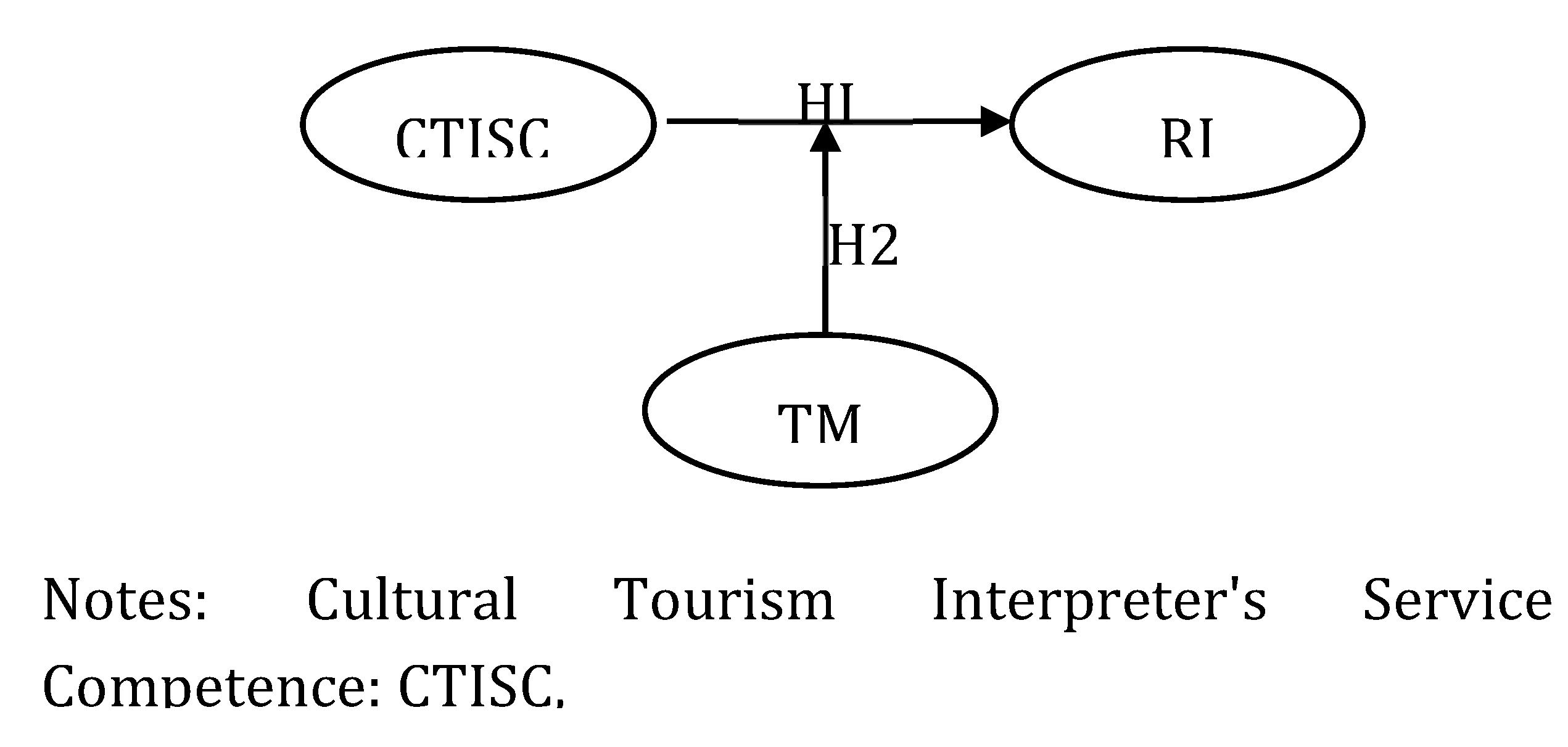
Table 1.
Profiles of the sample.
| Demographics | Engage responses (n=402) |
Percent (10%) |
|---|---|---|
| Gender | ||
| Female | 199 | 49.5 |
| Male | 203 | 50.50 |
| Age | ||
| Under 20 | 28 | 6.97 |
| 21-25 | 95 | 23.63 |
| 26-30 | 77 | 19.15 |
| 31-35 | 63 | 15.67 |
| 36-40 | 62 | 15.43 |
| 41 and over | 77 | 19.15 |
| Education | ||
| High School | 73 | 18.16 |
| Vocational colleges | 144 | 35.82 |
| University | 107 | 26.62 |
| Graduate School | 78 | 19.40 |
| Personal monthly income (RMB) | ||
| Less than 3000 | 62 | 15.42 |
| 3001~4000 | 28 | 6.97 |
| 4001~5000 | 103 | 25.62 |
| 5001~6000 | 66 | 16.42 |
| 6001~7000 | 69 | 17.16 |
| More than 7001 | 74 | 18.41 |
Table 2.
Cultural Tourism Interpreter’s Service Competence (CTISC) & Revisit Intention (RI) & Tourist Empathy (TE) Factor analysis and Reliability analysis.
Table 2.
Cultural Tourism Interpreter’s Service Competence (CTISC) & Revisit Intention (RI) & Tourist Empathy (TE) Factor analysis and Reliability analysis.
| Factor (Cronbach-αvalue) |
Factor loading | Eigenvalues | Explained Variance |
| CTISC | |||
| Sense of Mission(α=0.851) | 6.478 | 16.541 | |
| He responsibly explained to me | .750 | ||
| He explained with a sense of mission. | .679 | ||
| He explained as best he could. | .661 | ||
| I felt a fundamental sense of diligence." | .687 | ||
| Professional Knowledge(α=0.848) | 1.638 | 16.312 | |
| He possessed Professional knowledge. | .728 | ||
| He was familiar with the tourist attractions. | .668 | ||
| He gave a commentary with Professional knowledge. | .658 | ||
| He had a broad understanding of tourism. | .697 | ||
| Acceptance(α=0.804) | 1.463 | 13.195 | |
| His appearance was good. | .694 | ||
| He was well-dressed for commentary. | .642 | ||
| His overall impression was good. | .626 | ||
| Kindness(α=0.820) | 1.358 | 12.823 | |
| He was generally friendly to tourists. | .739 | ||
| He explained with good manners. | .648 | ||
| He explained courteously to the tourists." | .646 | ||
| Communication(α=0.795) | 1.222 | 12.651 | |
| His explanation was easy to understand. | .717 | ||
| He explained at the level of the tourists. | .637 | ||
| He had excellent communication skills. | .587 | ||
| Full Explained 71.522%, KMO=.882 Bartlett’s Test of Sphericity: Chi-square= 3166.077 (p<.01) | |||
| RI (α=0.916) | 2.573 | 85.775 | |
| I am willing to visit this tourist destination again. | .907 | ||
| If given the opportunity, I would visit again with friends and family. | .946 | ||
| When choosing a tourist attraction, it will be prioritized over other attractions. | .924 | ||
| Full Explained 85.775%, KMO=.742 Bartlett’s Test of Sphericity: Chi-square= 886.238(p<.01) | |||
| TE (α=0.945) | 2.704 | 90.121 | |
| I understood the behavior from the perspective of a cultural tourism interpreter. | .949 | ||
| I looked at the problem from the perspective of a cultural tourism interpreter. | .955 | ||
| I understand the situation of cultural tourism interpreters. | .945 | ||
| Full Explained 90.121%, KMO=.772 Bartlett’s Test of Sphericity: Chi-square= 1131.530(p<.01) | |||
| * Factor extraction method: Principal Component Analysis, Rotation method: Varimax rotation ** Variables with factor loading values of 0.5 or higher were interpreted. α = Reliability coefficient by internal consistency test using Cronbach’s Alpha value. | |||
Table 3.
Minimum, Maximum, Mean, and Standard Deviation between Variables.
| Minimum | Maximum | Mean | Standard Deviation | ||
| Independent Variable CTISC |
Sense of Mission | 1.00 | 5.00 | 3.381 | .969 |
| Professional Knowledge | 1.00 | 5.00 | 3.363 | .968 | |
| Acceptance | 1.00 | 5.00 | 3.444 | .971 | |
| Kindness | 1.00 | 5.00 | 3.359 | 1.026 | |
| Communication | 1.00 | 5.00 | 3.389 | .951 | |
| Dependent Variable | RI | 1.00 | 5.00 | 3.395 | 1.186 |
| Moderator Variable | TM | 1.00 | 5.00 | 3.361 | 1.024 |
| Notes: Cultural Tourism Interpreter’s Service Competence: CTISC, Revisit Intention: RI, Tourist Empathy: TM | |||||
Table 4.
Multiple Regression Analysis of Research Hypothesis 1.
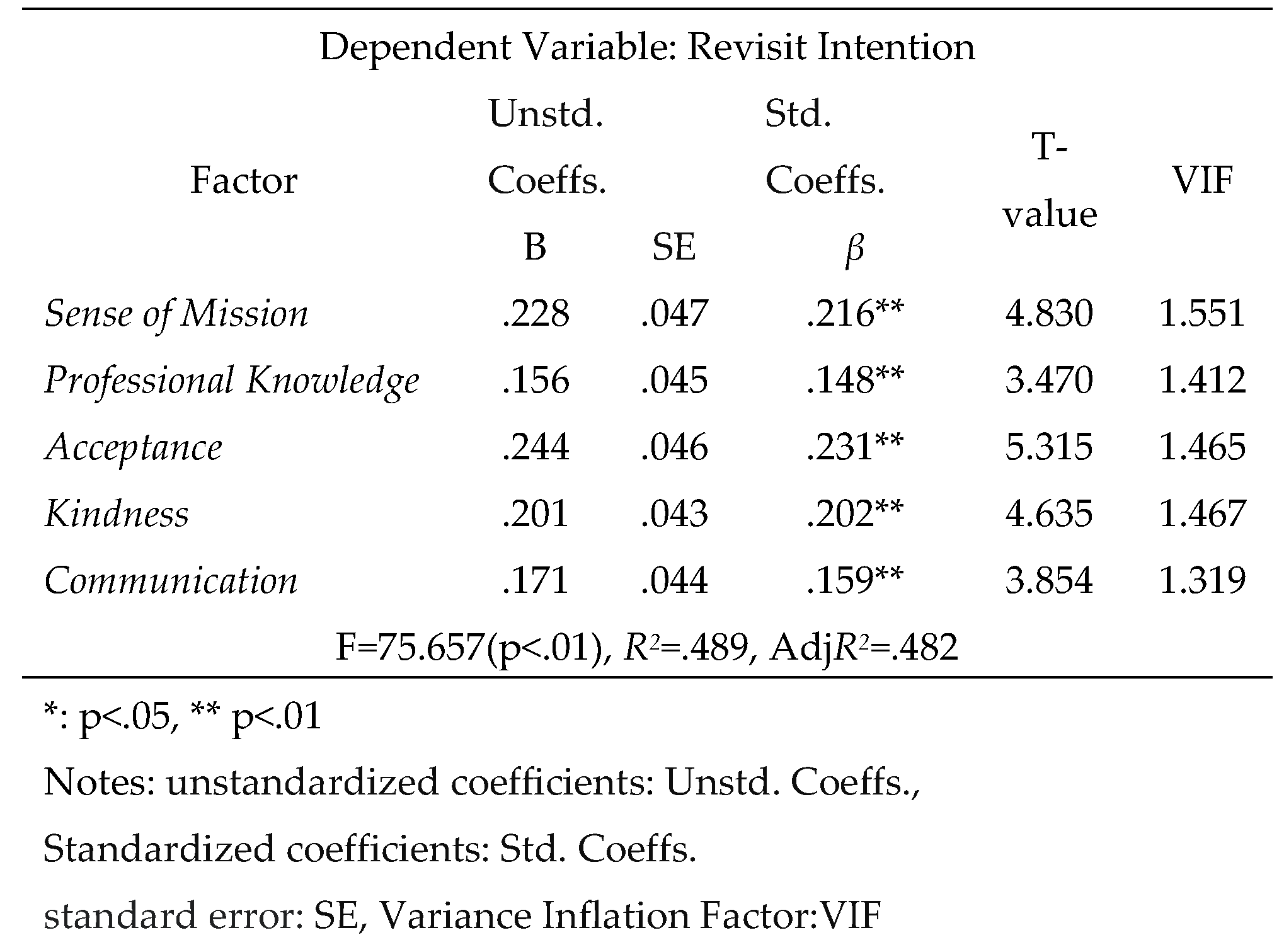 |
Table 8.
Summary of Hypothesis Test Results.
| Research Hypotheses | Summary of the Analysis Results | Acceptance Decision |
| H1 | Among the service competency factors perceived by Chinese tourists visiting the Nanjing Museum, expertise, kindness, appearance, and communication capabilities exhibit a significant positive effect (+) on the intention to revisit. | Acceptance |
| H2 | The study revealed notable distinctions in Chinese tourists’ perceptions of service competence among cultural tourism interpreters within Nanjing museums, contingent upon the level of empathy exhibited by the tourists. Specifically, variations were observed in the influence of interpreters’ expertise and communication skills on tourists’ intentions to revisit. | Acceptance (Moderation Effect) |
Disclaimer/Publisher’s Note: The statements, opinions and data contained in all publications are solely those of the individual author(s) and contributor(s) and not of MDPI and/or the editor(s). MDPI and/or the editor(s) disclaim responsibility for any injury to people or property resulting from any ideas, methods, instructions or products referred to in the content. |
© 2024 by the authors. Licensee MDPI, Basel, Switzerland. This article is an open access article distributed under the terms and conditions of the Creative Commons Attribution (CC BY) license (http://creativecommons.org/licenses/by/4.0/).
Copyright: This open access article is published under a Creative Commons CC BY 4.0 license, which permit the free download, distribution, and reuse, provided that the author and preprint are cited in any reuse.


