

Submitted:
11 July 2024
Posted:
11 July 2024
You are already at the latest version
Abstract
The objective of this investigation was to characterize the antimicrobial activity of the natural preservative, intended for cosmetic purpose, Kopraphinol (INCI name: Lactobacillus/Radish Root Ferment Extract Filtrate). It was tested against a panel of selected bacteria and mycetes by using conventional microbiological techniques (determination of MIC, time killing assay), and a chal-lenge test was used to verify its potential preservative in an O/W cream. Kopraphinol has shown an interesting antimicrobial effectiveness comparable to methylparaben. Moreover, it fulfilled challenge test criterion A and has proven effective against microbial contamination. The results obtained show that Kopraphinol can be considered a promising and effective candidate for anti-microbial preservation of cosmetics and could successfully complement or even replace conven-tional preservatives.
Keywords:
cosmetic preservatives
; Lactobacillus/Radish Root Ferment Extract Filtrate
; Kopraphinol©
; Challenge test
; MIC
1. Introduction
EU Regulation 1223/2009 on cosmetic products defines a cosmetic as “any substance or mixture intended to be placed in contact with the external parts of the human body (epidermis, hair system, nails, lips and external genital organs) or with the teeth and the mucous membranes of the oral cavity with a view exclusively or mainly to cleaning them, perfuming them, changing their appearance, protecting them, keeping them in good condition or correcting body odours”. The article 3 of the same Regulation states “a cosmetic product made available on the market shall be safe for human health when used under normal or reasonably foreseeable conditions of use” [1].
With regard to safety, microbial contamination of cosmetics is of special concern for industry, because microbial contaminants not only can alter products making them useless, but also pose a potential risk to health of consumers [2]. Given the way they are used, cosmetics are not expected to be sterile, but they are required to exhibit a controlled microbial content; however, they undergo microbial contamination both in the various phases of industrial production and during the use by the consumer, since their opening until they are discarded. The Scientific Committee on Consumer Safety [3] provides guidelines on microbiological quality of the finished cosmetic products, and defines two separate categories of cosmetic products on the basis of their use and of their non-pathogenic microbial load:
Category 1: Products specifically intended for children under 3 years, to be used in the eye area and on mucous membranes (microbial limits 1 x 10² cfu per g or ml).
Category 2: Other products (microbial limits 1 x 10³ cfu per g or ml).
To ensure that cosmetics and personal care products, especially of those with a high content of water, are microbiologically safe and stable, microbial contamination must be prevented by combining different strategies; they include the application of good manufacturing practices (GMPs), the use of suitable primary packaging, and, most importantly, the introduction into the formulation of an appropriate antimicrobial preservative system, one of the critical components in cosmetic formulations [4]. Antimicrobial preservatives have a double function: (i) to prevent the proliferation of microorganisms leading to deterioration of the product, and (ii) to prevent the growth of pathogenic microorganisms that may pose a potential health risk to the user during their repeated use, often by multiple persons, over extended periods of time; meeting these two requirements they ensure that cosmetics are safe to use, stable and effective during shelf-life. The availability of a wide and safe range of preservatives is one of the key challenges of the cosmetic industry. At present, Regulation 1223/2009 regulates the use of preservatives in cosmetic products marketed in the European Union, ruling that the only substances allowed as preservatives in cosmetics are those listed in Annex V of this Regulation. Preservatives allowed by the Regulation include different types of chemicals, such as parabens, alcohols, acids, quaternary ammonium compounds, and isothiazolinones. Parabens have been the most popular preservatives for quite a long time because they are effective and cheap, but European regulators put restrictions on them due to their endocrine-disrupting potential, and their safety status remains controversial [5]; on the other hand, isothiazolinones, that in recent times have largely replaced parabens due to their broad spectrum and high efficacy, present a high risk of sensitization, and have been recently banned in leave-on cosmetics [6]. Due to evidence or suspicion of adverse effects of synthetic preservatives, consumer demand for natural ingredients in cosmetics and personal care products is constantly growing. Consequently, cosmetic manufacturers are increasingly oriented to replace conventional synthetic preservatives with suitable alternatives. The replacement of conventional preservatives is very demanding, and current strategies include: use of nature identical synthetic preservatives (e.g., benzoic acid, sorbic acid, benzyl alcohol); use of natural plant-based preservatives (plant extracts, essential oils); use of auto-preservation techniques; and use of multifunctional ingredients [7]. Among all these, especially natural alternatives are gaining popularity not only because of consumers’ preferences, but also for their sustainability and lower environmental impact [8]. The systematic search for new preservatives has led to the discovery of a wide variety of promising alternatives, and currently the introduction into cosmetic formulations of “preservative booster” to support or even completely replace legally recognized preservatives is one of the major trends in the field of cosmetic preservation [9].
The aim of the present study was to characterize the antimicrobial activity of a commercially available natural preservative obtained from radish by fermentation, Kopraphinol© (INCI name Lactobacillus/Radish Root Ferment Extract Filtrate), comparing it to that of methylparaben. It is obtained from white radish roots (Raphanus sativus) fermented in solid state using Lactobacillus bacteria; the resulting ferment filtrate is stabilized. According to the information provided by the producer [10]. Kopraphinol© is a water-based formulation declared suitable for body creams and lotions, facial products, shampoos, and conditioners, and its recommended dosage is 0.2-4.0%. Conventional microbiological techniques were used to define the spectrum of action of the product, and a challenge test was used to verify its potential preservative in an O/W cream.
2. Materials and Methods
2.1. Materials
The test organisms used in this study were as follows: Escherichia coli (ATCC 8739), Staphylococcus aureus (ATCC 6538), Pseudomonas aeruginosa (ATCC 9027), Candida albicans (ATCC 10231), Aspergillus brasiliensis (niger) (ATCC 16404), and Penicillium rubens (ATCC 9179) (all purchased from Oxoid-Thermofisher Scientific, Rodano, Italy), and four Candida spp. clinical strains (respectively isolated from a vaginal, rectal, pharyngeal and cheek swab, kindly supplied by Dr. M. Tidore, Laboratory of Clinical and Microbiological Analysis of Policlinic Hospital of Sassari, Italy). Mueller Hinton Agar (MHA), Mueller Hinton Broth (MHB), Sabouraud Liquid Medium (SLM), Sabouraud Dextrose Agar (SDA), Peptone Water (PW), Tryptone Soy Agar (TSA) and phosphate-buffered saline tablets (PBS, Dulbecco A, pH 7.3) were purchased from Oxoid-Thermofisher Scientific (Rodano, Italy). Methylparaben (Sigma-Aldrich, Milan, Italy) was dissolved in DMSO at 5% wt/vol. Culture media, PBS, and other solutions were prepared with MilliQ water.
Kopraphinol (INCI name: Radish Root Ferment Filtrate) was kindly supplied by Kumar Organic Products Limited, Bangalore, India (batch number RFF/554/103). It is a clear, yellow, water-soluble liquid, pH 4.0-6.0. The characteristics of Kopraphinol declared in the data sheet by the supplier are: specific gravity at 25°C 1.000-1.100; solids (1 g at 105°C for 1 hour) 25.0%-30.0%; phenolics (tested as salicylic acid) 18.0%-22.0%; total aerobic microbial count <10 cfu/ml; yeast and molds <10 cfu/ml; E. coli and Salmonella spp. absent in 25 mL.
2.2. Antibacterial Activity of Kopraphinol and Methylparaben
The antibacterial activity of Kopraphinol and methylparaben was determined as Minimum Inhibitory Concentration (M.I.C.) by using a resazurin-based 96-well plate microdilution method [11]. This method is based on the use of resazurin dye as a redox indicator: viable bacteria reduce non fluorescent blue resazurin to the fluorescent pink resorufin. Resazurin sodium salt (Sigma) was dissolved in water at 0.015% wt/vol, filter sterilised (0.22 μm filter) and conserved at 4°C for no longer than 2 weeks. To evaluate bacterial M.I.C.s, twofold dilutions of Kopraphinol (ranging from 50% to 0.39% vol/vol) and methylparaben (ranging from 0.2% to 0.025% wt/vol) were prepared in MHB in wells of microplates; control wells contained only liquid medium. It must be observed that, although the recommended maximum concentration for single parabens is 0.4% [6], in these assays a lower concentration, but still active, was tested, essentially for technical reasons related to the solubility of the compound. All assays were performed at least in triplicate. Microplates were inoculated with about 1 x 10⁴ bacteria/well and aerobically incubated at 35 C for 24 h. After the incubation of microplates for 24 hours at 35°C, 30 μl of resazurin solution were added to each well, and microplates were further incubated at 35°C for 2 hours. After this time, the plates were visually inspected and M.I.C. was defined as the lowest concentration of Kopraphinol with no colour change (Figure 1).
To determine the M.B.C. (Minimum Bactericidal Concentration), aliquots of 2 μL of medium from each well with no visible growth were subcultured onto MHA plates, which were then incubated at 35 C for 24 h; M.B.C. was defined as the lowest concentration at which no growth was detectable. All tests were conducted at least in triplicate; at the concentrations tested, DMSO had no inhibitory effect on microorganisms’ growth. Results are reported in Table 1.
2.3. Antifungal Activity of Kopraphinol and Methylparaben
The antifungal activity of Kopraphinol was assessed on C. albicans, P. rubens and A. brasiliensis standard strains, and on four Candida spp. clinical isolates. Fungi were grown on SDA plates at 35°C (Candida strains) or 25 °C (other fungi).
M.I.C.s of Kopraphinol for Candida strains were determined by using a 96-well plate microdilution method; twofold dilutions of the preservative, ranging from 50% to 0.39% vol/vol, were prepared in SLM. All assays were performed at least in triplicate. Microplates were inoculated with about 1x10⁴ yeasts/well and aerobically incubated at 35 °C for 24 h. After incubation, plates were visually checked for fungal growth, and the M.I.C. was defined as the lowest concentration at which no growth was observed. To determine the M.F.C. (Minimum Fungicidal Concentration), aliquots of 2 μL of medium from each well with no visible growth were subcultured onto SDA plates, which were then incubated at 35 C for 24 h; M.F.C. was defined as the lowest concentration at which no growth was detectable. Results are reported in Table 1.
M.I.C.s of Kopraphinol against A. brasiliensis and P. ovale were determined using an agar macrodilution method [12]. Twofold serial dilutions of the product in SDA were made in 5 mm Petri dishes (final volume 10 mL) obtaining final concentrations of 10%, 5%, 2.5%, and 1.25% vol/vol. The experiments were all performed in triplicate. Control plates containing only SDA were run simultaneously. The agar surface of the plates was then inoculated into the center with 1–3 μL of a conidial or yeast cell suspension prepared in sterile distilled water +0.05% Tween-80, containing 103–104 conidia or cells. Plates, wrapped with Parafilm to maintain the correct water activity in the medium, were inverted and incubated at room temperature (about 25°C). Plates were visually checked for fungal growth; M.I.C.s were defined as the lowest concentrations of Kopraphinol preventing growth of macroscopically visible colonies on Kopraphinol containing plates when there was visible growth on the Kopraphinol-free control plates. Results are reported in Table 1.
2.4. Thermal Stability
Kopraphinol is declared resistant to heating up to 60°C, does not need to be refrigerated, and retains its antimicrobial activity over time if kept in dark at room temperature. To determine whether its antimicrobial activity is affected by exposure to temperatures far away from ambient temperature, Kopraphinol has been exposed to extreme thermal conditions, and subsequently its MIC has been re-evaluated against E. coli, P. aeruginosa. S. aureus and C. albicans. More specifically, Kopraphinol has been processed as follows:
-exposure to 50°C in a thermostatic water bath for 1 hour (K50);
-exposure to flowing steam at 100 °C in an autoclave for 1 hour (K100);
-freezing at -80°C for 24 hours and subsequent thawing (K*).
The antimicrobial activity of the samples subjected to these treatments has been reassessed with the method described above. The results are reported in Table 2.
2.5. Contact Time (Killing Time)
The antimicrobial activity of Kopraphinol was also characterized by a “killing time” test, performed on E. coli, P. aeruginosa, S. aureus and C. albicans; the purpose of this assay is to evaluate the reduction of viable count when microorganisms are incubated with the product in a liquid medium that does not support cell growth. The test was performed following the protocol developed by Juliano et al. [13]. Microorganisms in the logarithmic phase of growth were suspended at a density of 5 x 10⁵ – 1 x 10⁶ cfu/mL in a suitable volume of PBS (pH 7.3) containing 4% vol/vol of Kopraphinol (concentration suggested by the producer for the practical use). A control tube (microorganisms suspended in PBS only) was included in each experiment. At time zero and after 1, 2 and 3 hours of incubation at 35°C, 0.5 mL of the suspensions were removed, subjected to serial tenfold dilutions in PBS and seeded onto TSA (E. coli, S. aureus and P. aeruginosa) or SDA (Candida albicans). plates. The number of surviving microorganisms at each time was evaluated counting colonies after incubation for 24 hours at 35°C. The results are reported in Table 3.
2.6. Challenge Test
Challenge test consists in artificially contaminating the cosmetic formulations with a standard inoculum of suitable microorganisms and evaluating the number of surviving microorganisms at predetermined intervals of time. Different challenge test protocols are commonly available to evaluate the microbiological stability of cosmetics [14]. In this investigation, to test the preservative efficacy of Kopraphinol compared to methylparaben the method of the European Pharmacopoeia 7th Edition [15] was chosen, because it has the strictest acceptance criteria, which are difficult to achieve with many preservative systems [14].
Preliminary challenge tests were performed on several simple formulations, to choose the most suitable one; more precisely, Carbopol 940- and hydroxyethylcellulose-based gels, emulsions formulated with Sepigel® as an emulsifier, and Cetomacrogol aqueous cream were prepared and tested. However, hydroxyethylcellulose-based gels have proven to be unsuitable because they already exhibit an antimicrobial activity due to the presence of 10% glycerin, whereas Carbopol- and Sepigel-containing formulations show a sharp decrease of viscosity at the time of addition of Kopraphinol. Therefore, challenge tests were performed on Cetomacrogol aqueous cream, that does not undergo alterations after addition of the preservative; moreover, it is a formulation rich in free water, and for this reason represents a good substrate for microbial growth. Cetomacrogol cream was prepared as described by Juliano et al. [16]; Kopraphinol was added to the creams at 4% vol/vol, as suggested by the manufacturer, while methylparaben was used at 0.2% wt/vol. The addition of Kopraphinol did not cause appreciable changes in the appearance and texture of the cream.
The following bacterial strains were employed in the challenge tests: E.coli (ATCC 8739), Ps. aeruginosa (ATCC 9027), S. aureus (ATCC 6538), C. albicans (ATCC 10231) and A. brasiliensis (ATCC 16404). For each microorganism, fifty grams of cream were contaminated with a standard inoculum to obtain a concentration of about 106 colony forming units (cfu)/g, and preparations stored at room temperature. At time 0 and after 1, 7, 14 and 28 days, one gram of each product was aseptically sampled and suspended in 10 ml of peptone water; the resulting suspension was subjected to decimal serial dilutions in sterile saline and analyzed for enumeration of viable microorganisms onto TSA or SDA plates. The challenge tests were carried out in parallel with the corresponding controls (cream without preservative). Antimicrobial activity at each time was expressed in terms of logarithmic reduction of the number of viable microorganisms compared to time 0. The reduction of log number in each sample should comply with Criteria A in the European Pharmacopoeia: 2 log reduction after 24 hours and 3 log reduction after 7 days for bacteria, and 2 log reduction at 14 days for fungi (with no increase at 28 days in both cases). Results are reported in Table 4, Table 5, Table 6, Table 7 and Table 8.
3. Results
3.1. Antimicrobial Activity
Antimicrobial potential of Kopraphinol was determined by evaluating its MICs against a panel of selected microorganisms; the results are presented in Table 1. Overall, Kopraphinol exhibited a significant antibacterial activity, with the lowest MIC value observed with E.coli (0.78%) and the higher with P. aeruginosa (6.25%); the effect was bacteriostatic, as can be seen from the higher values of MBC (except in the case of P. aeruginosa).
Against the various strains of Candida Kopraphinol exhibited a good inhibitory activity, with MIC values ranging from 1.56% and 3.13%. Higher concentrations (5.00%) of the preservative are required to totally inhibit the growth of Aspergillus and Penicillium.
As Figure 2 shows, the radial growth of Aspergillus was totally inhibited by Kopraphinol at 5% concentration already from the fourth day; moreover, mycelial growth is considerably reduced at sub-MIC concentrations of the preservative, as shown by the reduction of the mycelial diameter compared to control.
3.2. Thermal Stability
The thermal stresses imposed to Kopraphinol did not affect its antimicrobial activity; in fact, as can be seen from Table 2, the MICs of the preservative subjected to various treatments are perfectly superimposed to those of the untreated product.
3.3. Killing Time
The results of killing time assays are quite different in relation to the strains tested, as can be observed in Table 3. After 3 hours of contact with 4% of Kopraphinol, viability of E. coli and P. aeruginosa was drastically reduced, with percentages of surviving bacteria of 0.17% and 9.8% respectively. On the contrary, after a 3 hour-long contact with the preservative S. aureus and C. albicans were still largely viable, with values of surviving microorganisms of 83.3% and 70.7%, respectively. The much faster action of Kopraphinol against Gram negative strains suggests that the peculiar structure of the outer envelope of these bacteria is more permeable to the preservative or is more easily damaged.
3.4. Challenge Test
According to Criterion A of the European Pharmacopoeia, an antimicrobial preservation system is accepted if in the challenge test bacteria number is reduced by 2 and 3 log units after respectively 2 and 14 days and no increase in plate counts is observed after day 14; with respect to molds and yeasts, their number must be reduced by 2 log units after 14 days, and no increase in plate counts is observed after day 14. Table 4, Table 5 and Table 6 show that Kopraphinol, as regards the bacterial strains tested, largely meets this criterion, exhibiting a preservative efficacy quite comparable to that one of methylparaben. It should be mentioned that in the control samples (without preservatives) the bacterial load of E. coli and S. aureus is reduced spontaneously to zero over time, while P. aeruginosa count gradually increased, reaching after 28 days a value about 1000 times higher than the initial one. With regard to mycetes tested, Kopraphinol exhibited an effective and fast preservation activity both against C. albicans and A. brasiliensis. Indeed, as illustrated in Table 7 and Table 8, in formulations with Kopraphinol the number of viable mycetes was already efficaciously reduced to satisfy criterion A from the day 2 (fungal contamination reduced of more 5 log units). It is noteworthy that Kopraphinol performance was better than methylparaben; in fact, the latter reduced C. albicans load but with values that do not meet criterion A, while at 0.2% concentration methylparaben failed to protect the cosmetic formulation from A. brasiliensis (at days 2 and 7 the reduction values did not fulfil criterion A, and after 28 days the mold started to grow again)
4. Discussion
Recent trends in cosmetic antimicrobial preservation include the use of compounds of natural origin (e.g., essential oils, herbal extracts, ferment filtrates), and the use of multifunctional ingredients (substances that offer preservation alongside other benefits, such as anti-aging or moisturizing effects). Kopraphinol fits perfectly into these trends for a number of reasons. First of all, our in vitro experiments confirmed a good broad spectrum antimicrobial activity of Kopraphinol, with a stronger inhibitory effect against E. coli and Candida strains; moreover, challenge tests, performed on an O/W emulsion deliberately contaminated with high microbial loads, demonstrated good conservative properties of Kopraphinol, complying with the requirements of current legislation, comparable with the efficacy of methylparaben, and sometimes better. It is also relevant that Kopraphinol is a natural ingredient obtained through a fermentation process. Fermentation is a process currently used to produce a wide range of cosmetic ingredients, such as emollients, surfactants, humectants, thickener, and, indeed, preservatives [17]. Bioferments are innovative cosmetic ingredients, whose advantages include better biocompatibility, bioavailability, sustainability, and an increased efficacy, compared to conventional ingredients [18]. Different cosmetic ingredients obtained by Lactobacillus fermentation of different substrates are classified as multifunctional ingredients with moisturizing properties and a strong preservative efficacy, due to bacteriocins and organic acids of bacterial origin [17]; Kopraphinol belongs to this category, and like all multifunctional ingredients would allow formulators to develop products less expensive, easier to manufacture, and more performing [19]. Other arguments in favour of Kopraphinol are ease of use and safety. As an aqueous liquid, Kopraphinol can be precisely dosed by volume, and due to its temperature resistance can be easily incorporated also in hot aqueous formulations, in which it will be perfectly dispersed. However, an important limit to the use of Kopraphinol, emerged during our investigation, is incompatibility of the preservative with polymeric emulsifiers (e.g., Sepigel©) and gels (e.g., Carbomer), which results in a drastic reduction of viscosity of the formulations. As far as safety, the use of Kopraphinol does not seem to pose a significant problem. The Expert Panel for Cosmetic Ingredient Safety (CIR) [20] assessed the safety of 7 radish root-derived ingredients, most of which are reported to function as hair and skin conditioning agents in cosmetic products. The Panel reviewed the available data and concluded that these ingredients are safe in cosmetics in the present practices of use and concentration described in that safety assessment when formulated to be non-sensitizing. However, as recently highlighted, the application of cosmetics on the skin can affect the resident microflora [21]; in this context, it should be verified that the antimicrobial activity of Kopraphinol does not constitute a problem for the skin microbiome, which could result from a lack of selectivity of the preservative.
Taken together, the results obtained show that Kopraphinol can be considered a promising and effective candidate for antimicrobial preservation of cosmetics and could successfully complement or even replace conventional preservatives.
Author Contributions
Conceptualization C.C.A.J. and G.A.M.; investigation C.C.A.J. and G.A.M.; writing C.C.A.J.
Funding
This research was funded by FAR2020Juliano (University of Sassari, Italy).
Institutional Review Board Statement
Not applicable.
Informed Consent Statement
Not applicable.
Data Availability Statement
The raw data supporting the conclusions of this article will be made available by the Authors on reasonable request.
Conflicts of Interest
The authors declare no conflicts of interest.
References
- European Commission. Regulation (EC) No 1223/2009 of the European Parliament and of the Council of 30 November 2009 on cosmetic products; Official Journal of the European Union L342/59, Publications Office of the European Union: Luxembourg, 2009. [Google Scholar]
- Giorgio, A.; Miele, L.; De Bonis, S.; Conforti, I.; Palmiero, L.; Guida, M.; Libralato, G.; Aliberti, F. Microbiological stability of cosmetics by using Challenge Test procedure. J. Pure App. Microbiol. 2018, 12, 23–28. [Google Scholar] [CrossRef]
- SCCS (Scientific Committee on Consumer Safety). The SCCS Notes of Guidance for the Testing of Cosmetic Ingredients and their Safety Evaluation, G: 2023. Appendix 9, 2023.
- Halla, N.; Fernandes, I.P.; Heleno, S.A.; Costa, P.; Boucherit-Otmani, Z.; Boucherit, K.; Rodrigues, A.E.; Ferreira, I.C.F.R.; Barreiro, M.F. Cosmetic preservation: A review on present strategies. Molecules 2018, 23, 1571. [Google Scholar] [CrossRef] [PubMed]
- Nowak, K; Jablónska, E; Ratajczak-Wrona, W. Controversy around parabens: Alternatives strategies for preservative use in cosmetics and personal care products. Environ. Res. 2021, 110488. [CrossRef]
- European Commission. Regulation (EU) N° 1004 (2014) of 18 September 2014 amending Annex V to Regulation (EC) N° 1223/2009 of the European Parliament and of the Council on cosmetic products; Official Journal of the European Union L282/5, Publications Office of the European Union: Luxembourg, 2009. [Google Scholar]
- Martins, A.M.; Marto, J.M. A sustainable life cycle for cosmetics: From design and development to post-use phase. Sustain. Chem. Pharm. 2023, 35, 101178. [Google Scholar] [CrossRef]
- Paramita, S.; Kusuma, I.W.; Sulistioadi, Y.B. ; Kiswanto (2024). Environmental and Safety Aspects of bio-based Cosmetics in Indonesia. In: Arung, E.T.; et al. Biomass-based Cosmetics 2024, pp.545-568, Springer, Singapore. [CrossRef]
- Poddebniak, P.; Kalinowska-Lis, U. A survey of preservatives used in cosmetic products. Appl. Sci. 2024, 14, 1581. [Google Scholar] [CrossRef]
- Kopraphinol (Radish Root Ferment Filtrate). Available online: https://www.kumarorganic.net/products/page.php?productcode=Prod-18-02-2019-HJIBQOWSP3&category=Preservative-Ingredients (accessed on 8 July 2024).
- Elshikh, M.; Ahmed, S.; Funston, S.; Dunlop, P.; McGaw, M.; Marchant, R.; Banat, I.M. Resazurin-based 96-well plate microdilution method for the determination of minimum inhibitory concentration of biosurfactants. Biotechnol. Lett. 2016, 38, 1015–1019. [Google Scholar] [CrossRef]
- Therese, K.L. , Bagyalakshmi R., Madhavan H.N., Deepa P. In-vitro susceptibility testing by agar dilution method to determine the minimum inhibitory concentrations of amphotericin B, fluconazole and ketoconazole against ocular fungal isolates. Ind. J. Med. Microbiol. 2006, 24, 273–279. [Google Scholar]
- Juliano, C.; Mattana, A.; Usai, M. Composition and in vitro Antimicrobial Activity of the Essential Oil of Thymus herba-barona Loisel growing wild in Sardinia. J. Essent. Oil Res. 2000, 12, 516–522. [Google Scholar] [CrossRef]
- Siegert, W. Comparison of microbial challenge testing methods for cosmetics. Household and Personal Care Today 2013, 8, 32–39. [Google Scholar]
- European Pharmacopeia 7th edition 2011. Chapter 5.1.3. Efficacy of antimicrobial preservation. Editor: Council of Europe: European Directorate for the Quality of Medicines and Healthcare, Strasbourg.
- Juliano, C.; Gavini, E.; Giunchedi, P.; Magrini, G.A. Evaluation of Manuka honey as an adjuvant antimicrobial preservative in a O/A emulsion. J. Appl. Cosmetol. 2016, 34, 87–98. [Google Scholar]
- Pérez-Rivero, C.; Lòpez-Gòmez, J.P. Unlocking the potential of fermentation in cosmetics: A review. Fermentation 2023, 9, 463. [Google Scholar] [CrossRef]
- Majchrzak, W.; Motyl, I.; Smigielski, K. Biological and cosmetical importance of fermented raw material: An overview. Molecules 2022, 27, 4845. [Google Scholar] [CrossRef] [PubMed]
- Romanowski, P.; Schueller, R. Definition and principles of multifunctional cosmetics. In: Multifunctional Cosmetics, 1st Ed., Schueller, R., Romanowski, P., Eds., Taylor & Francis, Boca Raton, FL, 2001; pp. 1-11.
- Cosmetic Ingredient Review. Safety assessment of Radish Root-derived ingredients as used in cosmetics, 2022. https://cir-safety.org/sites/default/files/Radish.pdf.
- Pinto, D.; Ciardiello, T.; Franzoni, M.; Pasini, F.; Giuliani, G.; Rinaldi, F. Effect of commonly used cosmetic preservatives on skin resident microflora dynamics. Sci. Rep. 2021, 11, 8695. [Google Scholar] [CrossRef]
Figure 1.
Evaluation of MIC of Kopraphinol against P. aeruginosa by using a resazurin-based 96-well plate microdilution method.
Figure 1.
Evaluation of MIC of Kopraphinol against P. aeruginosa by using a resazurin-based 96-well plate microdilution method.
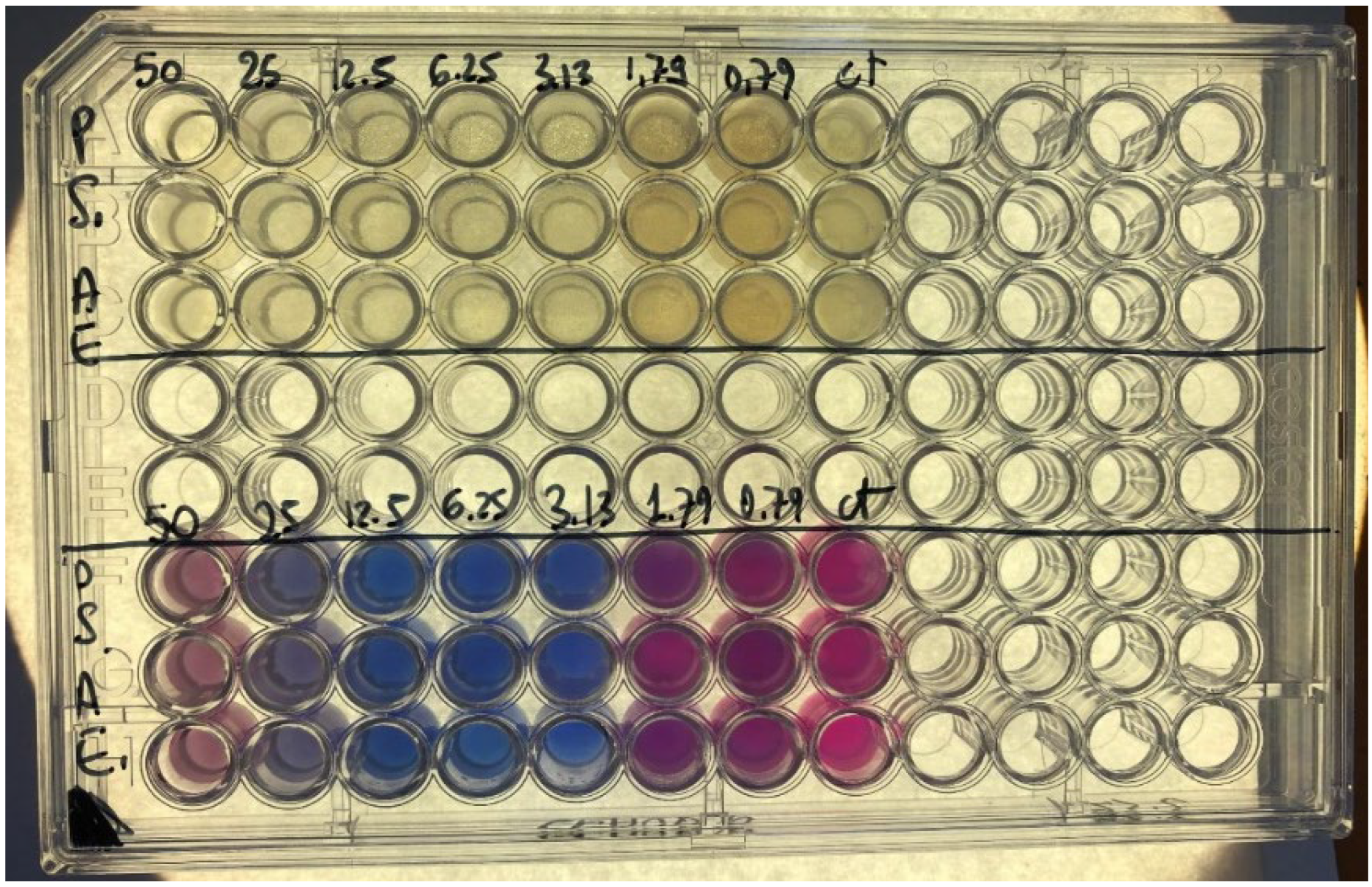
Figure 2.
Evaluation of the inhibitory effect of Kopraphinol against Aspergillus brasiliensis (ATCC 16404) after 4 days. At 5% the growth of fungus is totally inhibited, but a reduction of mycelial growth is already visible at lower concentrations.
Figure 2.
Evaluation of the inhibitory effect of Kopraphinol against Aspergillus brasiliensis (ATCC 16404) after 4 days. At 5% the growth of fungus is totally inhibited, but a reduction of mycelial growth is already visible at lower concentrations.
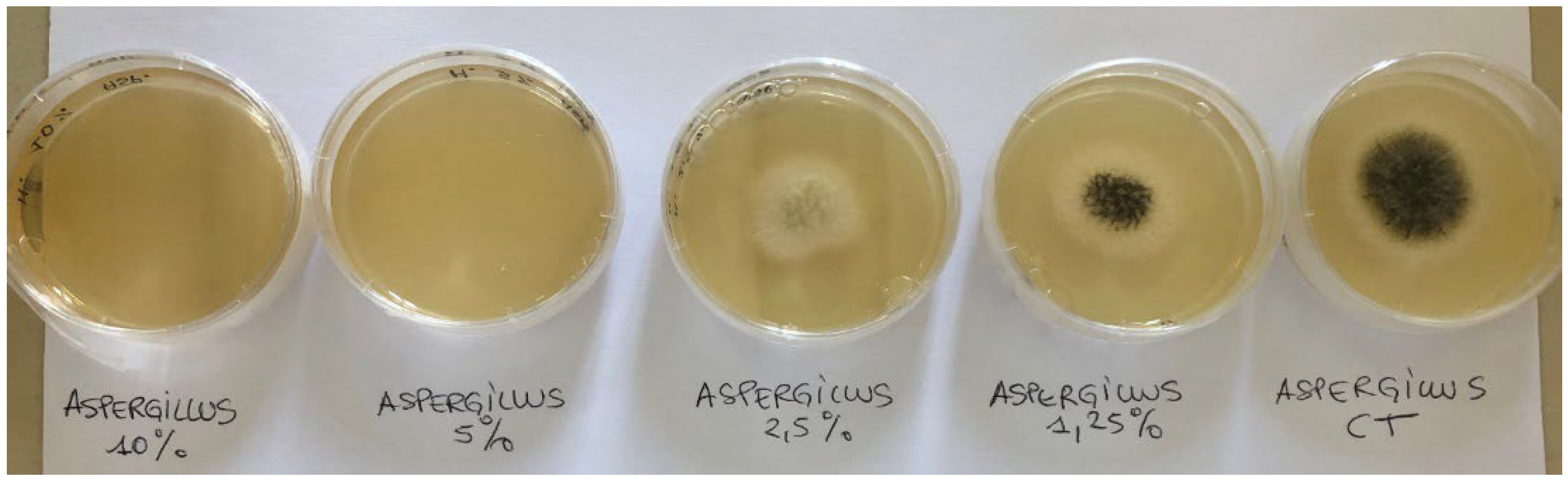

Table 1.
Evaluation of the antimicrobial activity of Kopraphinol and methylparaben. The values (±SD) represent the minimum inhibitory concentrations (MIC) (in brackets, the minimum bactericidal/fungicidal concentrations, MBC/MFC, are shown) (n.d. = not determined).
Table 1.
Evaluation of the antimicrobial activity of Kopraphinol and methylparaben. The values (±SD) represent the minimum inhibitory concentrations (MIC) (in brackets, the minimum bactericidal/fungicidal concentrations, MBC/MFC, are shown) (n.d. = not determined).
| Microorganisms | Kopraphinol (vol/vol) | Methyl paraben (wt/vol) |
|---|---|---|
| Escherichia coli (ATCC 8739) | 0.78±0.00% (6.25±0.00%) | 0.2±0.00% (0.2±0.00%) |
| Staphylococcus aureus (ATCC 6538) | 1.56±0.00% (12.5±0.00%) | 0.2±0.00% (0.2±0.00%) |
| Pseudomonas aeruginosa (ATCC 9027) | 6.25±0.00% (6.25±0.00%) | 0.2±0.00% (0.2±0.00%) |
| Candida albicans (ATCC 10231) | 1.56±0.00% (3.13±0.00%) | 0.05±0.00% (0.05±0.00%) |
| Candida spp. (from rectal swab) | 3.13±0.00% (6.25±0.00%) | n.d. |
| Candida spp. (from throat swab) | 1.56±0.00% (1.56±0.00%) | n.d |
| Candida spp. (from vaginal swab) | 1.56±0.00% (6.25±0.00%) | n.d. |
| Candida spp. (from mucosa of the cheek) | 1.56±0.00% (3.13±0.00%) | n.d. |
| Aspergillus brasiliensis (ATCC 16404) | 5.00±0.00% | 0.1±0.00% |
| Penicillium rubens (ATCC 9179) | 5.00±0.00% | n.d. |
Table 2.
Antimicrobial activity of Kopraphinol subjected to thermal treatment (K=no heat treatment: K50=heating to 50°C for 1 hour; K100= heating to 100°C for 1 hour; K*=freezing at -80°C for 24 hours and subsequent thawing.
Table 2.
Antimicrobial activity of Kopraphinol subjected to thermal treatment (K=no heat treatment: K50=heating to 50°C for 1 hour; K100= heating to 100°C for 1 hour; K*=freezing at -80°C for 24 hours and subsequent thawing.
| E. coli (ATCC 8739) | P. aeruginosa (ATCC 9027) | S. aureus (ATCC 6538) | C. albicans (ATCC 10231) | |
| MIC K | 0,78±0.00% | 6,25±0.00% | 1,56% | 1,56% |
| MIC K50 | 0,78±0.00% | 6,25% | 1,56% | 1,56% |
| MIC K100 | 0,78±0.00% | 6,25% | 1,56% | 1,56% |
| MIC K* | 0,78±0.00% | 6,25% | 1,56% | 1,56% |
Table 3.
Killing time test results.
| STRAIN | time 0 | 1h | 2h | 3h |
|---|---|---|---|---|
| E. coli (ATCC 8739) | 100% | 30% | 0,46% | 0,17% |
| P. aeruginosa (ATCC 9027) | 100% | 91,7% | 33,3% | 9,8% |
| S. aureus (ATCC 6538) | 100% | 120,8% | 141,7% | 83,3% |
| C. albicans (ATCC 10231) | 100% | 98,3% | 84,5% | 70,7% |
Table 4.
Log reduction in the number of viable micro-organisms: E. coli (NI = no increase).
| TIME | Eur. Ph. criteria | Without preservative | Kopraphinol | Methylparaben |
|---|---|---|---|---|
| DAY 2 | 2 | 0.01 | >5 | >5 |
| DAY 7 | 3 | -0.138 | >5 | >5 |
| DAY 14 | - | - | - | - |
| DAY 28 | NI | >5 | >5 | >5 |
Table 5.
Log reduction in the number of viable micro-organisms: S. aureus (NI = no increase).
| TIME | Eur. Ph. criteria | Without preservative | Kopraphinol | Methylparaben |
|---|---|---|---|---|
| DAY 2 | 2 | 0.209 | >5 | 0.017 |
| DAY 7 | Kopra3 | >5 | >5 | >5 |
| DAY 14 | - | - | - | - |
| DAY 28 | NI | >5 | >5 | >5 |
Table 6.
Log reduction in the number of viable micro-organisms: P. aeruginosa (NI = no increase).
| TIME | Eur. Ph. criteria | Without preservative | Kopraphinol | Methylparaben |
|---|---|---|---|---|
| DAY 2 | 2 | -1.438 | 4.828 | 1,216 |
| DAY 7 | 3 | -2.885 | >5 | -1,924 |
| DAY 14 | - | - | - | - |
| DAY 28 | NI | -2.793 | >5 | -0,711 |
Table 7.
Log reduction in the number of viable micro-organisms: C. albicans (NI = no increase).
| TIME | Eur. Ph. criteria | Without preservative | Kopraphinol | Methylparaben |
|---|---|---|---|---|
| DAY 2 | 2 | -3.117 | >5 | 0 |
| DAY 7 | 3 | -3.569 | >5 | 0.430 |
| DAY 14 | - | - | - | - |
| DAY 28 | NI | -3.944 | >5 | 2.964 |
Table 8.
Log reduction in the number of viable micro-organisms: A. brasiliensis (NI = no increase).
| TIME | Eur. Ph. criteria | Without preservative | Kopraphinol | Methylparaben |
|---|---|---|---|---|
| DAY 2 | 2 | 0 | >5 | 0.405 |
| DAY 7 | 3 | 0 | >5 | 0.310 |
| DAY 14 | - | - | - | - |
| DAY 28 | NI | -0.109 | >5 | -0.182 |
Disclaimer/Publisher’s Note: The statements, opinions and data contained in all publications are solely those of the individual author(s) and contributor(s) and not of MDPI and/or the editor(s). MDPI and/or the editor(s) disclaim responsibility for any injury to people or property resulting from any ideas, methods, instructions or products referred to in the content. |
© 2024 by the authors. Licensee MDPI, Basel, Switzerland. This article is an open access article distributed under the terms and conditions of the Creative Commons Attribution (CC BY) license (https://creativecommons.org/licenses/by/4.0/).
Copyright: This open access article is published under a Creative Commons CC BY 4.0 license, which permit the free download, distribution, and reuse, provided that the author and preprint are cited in any reuse.


