

Submitted:
27 June 2024
Posted:
27 June 2024
You are already at the latest version
Abstract
Abstract — Game development using technology was started in 1950 around the first video game created Tennis for Two by Higginbotham as a fun diversion, to show the power of technology. The advanced development of Artificial intelligence (AI), has turned out to be the heart of game development technology and AI has revolutionized gaming and brought so many features to life.in reality, it isn't easy to give a definition and meaning to it even though games are becoming a part of human survival. It is difficult to define the real meaning of a game but it is part of human survival as it usually refers to the cleverness of the way the human being involvement in the characters of the game.
As a part of game development, many technologies were used to create a game for the players with creativity, complex design, variety of levels, and aspects for the player to use choices effectively and efficiently to interact with the character in the game and enhance the experience to the next levels. This paper initially gives the importance of game development and need for the technology usage to enhance the current state of games. Then analyzes the history and present state of Artificial intelligence in game development. Finally, it explains the highlights of potential changes in game development and the impact and influence of artificial intelligence and machine learning models in the future development of games.
Keywords:
Artificial intelligence
; Game experience
; Machine learning
1. Introduction
There is huge progress made in traditional computer graphics, animation, audio, and video interfaces for games. Most existing games use fundamental Artificial Intelligence (AI) techniques and some of the games do not use artificial intelligence also.
As a result, the complete environment created by the game developers is simply to be broken when the game is played. So the experience of the game players is not that interesting and not acceptable potentially.
On the other hand, another side creating an interesting game and enhancing user experiences requires a lot of technical skills and technology usage in game development [1].
In the present scenario, the most of the video games have various AI-enabled features and applications. For example enemy bots and central characters etc. The foremost goal of using AI in game development is to bring a real feel and true sense of play so that the game players can enjoy the playing game and fight each other on the platform. In addition, AI-enabled technology used in game development will help players enhance their interest and satisfaction in the long run.
There are many routes in that the AI-enabled game development is increasing day by day and attracting the players to increase the efficiency and joy of the game players. However, the increasing usage of AI technology in game development has been accustomed to bringing lifespan to computer games, with video games designed to acquire new knowledge and patterns to enhance their algorithms which is one of the few ways that AI acquires [2].
According to the current study, the game player count has increased, and a need for enhancement in the quality of visuals, and audio features. For example, augmented reality and virtual reality (ARVR) are the needs of the current gaming industry. The most intelligent and collaborative games and close real sense are only possible by incorporating artificial technology in game development [3].
2. AI in Game Development Components
Figure 1.
AI in Game development: components.
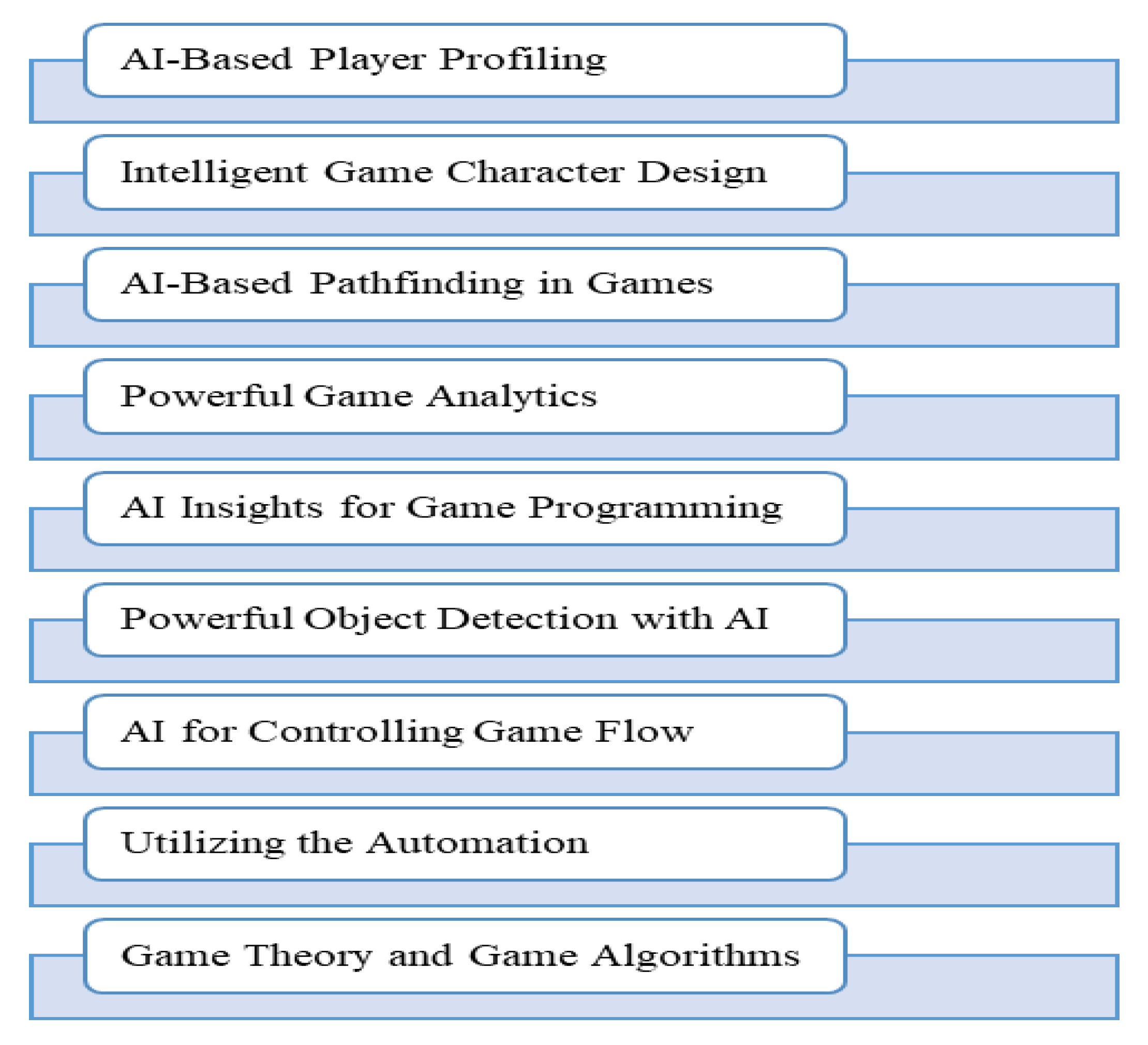
2.1. AI-Based Player Profiling
The fundamental concept is to create flexible, ongoing agents for games that may change as they are played. The sophistication and difficulty of AI-supported games will evolve as players' playing time increases. The game's gaming life will be significantly increased as a consequence. The use of AI methods that enable these possibilities will advance technologically as well. With all the elements discussed here, it is clear that AI will have an influence on the whole gaming business and may even become a standard technology for all different kinds of game production projects [4].
2.2. Intelligent Game Character Design
In addition to the skillfully created characters, which give the game its appearance and feel, the game can be lacking in visual appeal and entertainment value. However, there are several difficulties in developing a human character for a dynamic 3D video game, particularly if you [4] have emotions. Real-time gaming consoles employ AI-based deep learning techniques that can now produce an infinite amount of 3D animation for game characters [5].
2.3. AI-Based Path-Finding in Games
Any game that succeeds must provide a fast-paced gameplay experience, and AI-powered Path-finding is essential to this. Finding the shortest path between two game characters or action points you must travel or cross is known as path-finding. Pathfinding now makes it simple to win many video games, owing to AI.
2.4. Powerful Game Analytics
Ultimately, AI brought about revolutionary changes to gaming analytics by providing unique information and freedom to check for quick sequences within a game development project. Game analytics powered by AI successfully bring about the necessary changes and adjustments that can provide the improvement of the game experience.
2.5. AI Insights for Game Programming
AI is being actively used in video game experiments to enhance the playing experience. The use of devices continues to be better understood thanks to machine learning. Their behavior and preferred modes of play might give stadium game creators insightful data regarding key issues and well-liked game elements [6]. The game's sensitivity can be increased if creators take into account such data-driven information. In this regard, it should be mentioned that there must be reliable resources to obtain more information about playing mobile games for AI-based information to play an effective role in mobile games [7].
2.6. Powerful Object Detection with AI
The most recent technique for precise object identification in video game environments is artificial intelligence. Modern acquisition techniques are crucial for offering a visually life-saving absorbing game experience, and here is where AI has special powers. Powerful AI techniques like Tensor Flow are already being used by contemporary game creators to identify something special in video games [8].
2.7. AI for Controlling Game Flow
AI is also used by game designers to keep an eye on the action and make adjustments through the game mind. With the use of end-to-end gaming equipment, game makers are now able to keep an eye on and manage the game's flow. This also allows them to deliver a high-quality gaming experience without having to spend a lot on complex coding tasks.
2.8. Utilizing the Automation
The new game developers with a particular perspective on the video game business should harmonize that designers and developers are already exist in the market should collaborate to provide an entertaining gaming experience. According to present situations or current trends, there are numerous automation technologies available to support their efforts and provide aid in delivering the best outcomes.
The plot of the game is shaped by sophisticated AI automation, which gives developers and designers a better level of efficiency and success [9].
2.8. Game Theory and Game Algorithms
The current state of game development and production significantly relies on AI-based algorithms and techniques. An exceptional illustration of an AI-based algorithm is the Min-max algorithm [6]. In a variety of AI-based game development aspects, researchers looking into this claim have discovered game theories. The game makers or creators benefited very much from the use of a game theory which is the study of models of mathematical for active interactions among rational intelligent agents and their decision-making becomes as easy as using artificial gaming algorithms for decision-making concepts.
3. Evolution of AI in Games
Artificial intelligence first emerged in video games before the industry as a whole gained recognition in worldwide popular culture [10]. One of the most well-known examples of this technology being used in a game is the Min-Max algorithm-based computer chess games from the 1950s. The optimal move might be made by using this software's capacity to analyze the piece positions on the board. AI began to play a major role in the creation and development of the titles of big companies in the 1970s when video games redefined the market and users' entertainment experiences.
- a.
- Challenges in Computer Game AI
Many challenges are faced while developing Artificial Intelligence for Games, as they cease from making real AI-based games.
Some of the points are as follows:
- The most computer games are very complex strategic real-time games.
- Two kinds of players (player and opponent) share the properties of having huge decision spaces, and thus traditional search-based AI techniques to be improved.
- To manage complex games, very high-level illustrations are required.
- Traditionally, computer games use handcrafted strategies coded by the game developers, but these tend to be repetitive, and players easily find holes and exploit them. For example, in Ludo.
- It is unrealistic to foresee every scenario and player strategy that could happen during gameplay, hence making it difficult to design realistic behaviors that react to these unexpected circumstances and player actions [3].
- A game player could become sick of ever seeing the same actions and tactics.
- Choosing actions or approaches at random from a huge library may be deployed to add basic flexibility, but this increases the development work.
- Genuine curiosity is another issue highlighted by random selection.
- Ethical AI in Gaming: Wherever AI is used there it must be considered the ethics including game development. As AI is helping to change the gaming experience drastically, a few aspects are to be considered carefully for fair play and player privacy, positive experience of player, responsibility, and transparency so that players really can enjoy the games.
4. AI Games for Mobile Devices
It is widely perceived that marketing large-scale (commercial) video games is significantly more difficult than marketing mobile games [11]. As a result, they represent a realistic option for research and development in a typical classroom, where relatively small teams of students and professors might work together on a strict budget. Simple images—often just 2 or 2.5-dimensional—are anticipated on mobile devices because of their frequently tiny screens and subpar graphics capabilities, which negates the need for large teams of exceptionally talented designers and 3D design engineers [3]. Additionally, mobile devices frequently provide a wider selection of input data types and a greater number of output capabilities (including photographs, video, sound, acceleration, orientation, movement, and data from/about other users) (touch, location, photographs, video, sound, and more).
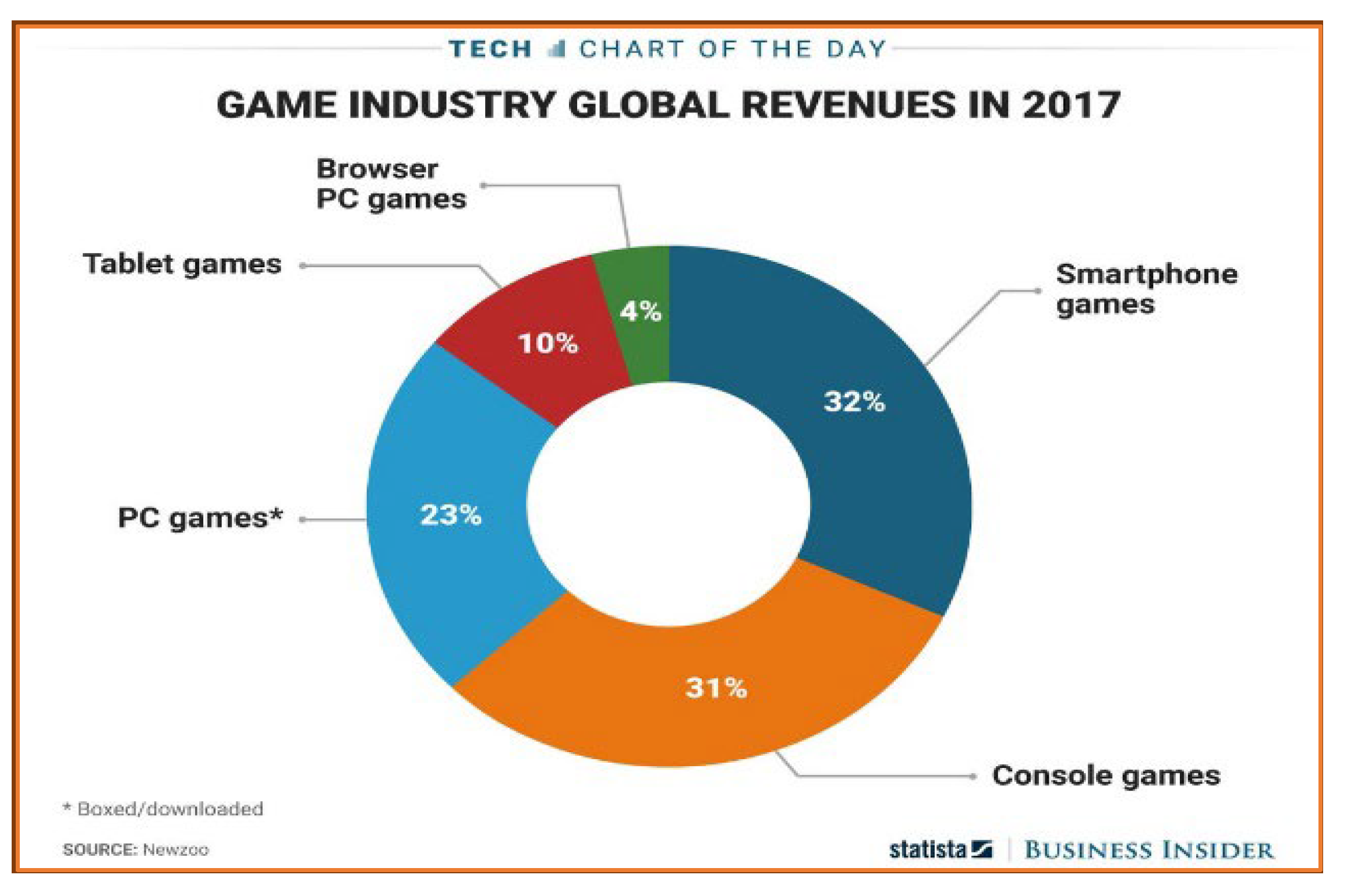
Figure 2.
the growth of the Gaming industry.
- b.
- The Importance and Impact of AI in Games
Game developers work hard to bring great joy and thrilling experiences to the interactive players [12]. The emotional attachment of players arises from the added effects in the game by arranging many elements of the game like graphics, audio, visuals, time, challenges thought processes, and the way the leads interact with the players [11]. So AI has become an incomparable tool that can help game developers to create and include the ever-interesting and increasing complexity of game evolution. The Gaming Industry is one of the most money-spinning sectors of the market valued at around 315 billion USD by 2026 as per the experts and as a result, funding for the development of AI-based gaming worldwide has been steadily growing. At present many young minds innovators and entrepreneurs are coming up with new startups. For example. - latitude, a game-based startup using AI-generated infinity storylines, collected 3.3 million USD in seed funding in January 2021[4]. The significant contribution towards game development is to add content such as landscape-level items, backgrounds, and quizzes algorithmically. There are many benefits of content generation such as Infinite Replayability, Efficiency, Scale, and Adaptability.
5. AI Methods Used in Games
Traditionally, rule-based and finite state machines were used to program the behavior of non-player characters (NPCs). When adopting these techniques, the development includes creating a variety of settings that provide NPCs with clear behavior. The use of fuzzy logic by game makers reduced the work required to improve while adding an element of unpredictable play. The so-called A * path-finding algorithms, which characterized NPC behavior and their exploration of open environments, were one of the first applications of AI in gaming systems. Writing, academic programs, and (Artificial)-life approaches are further tactics [12].
- (a)
- Decision trees
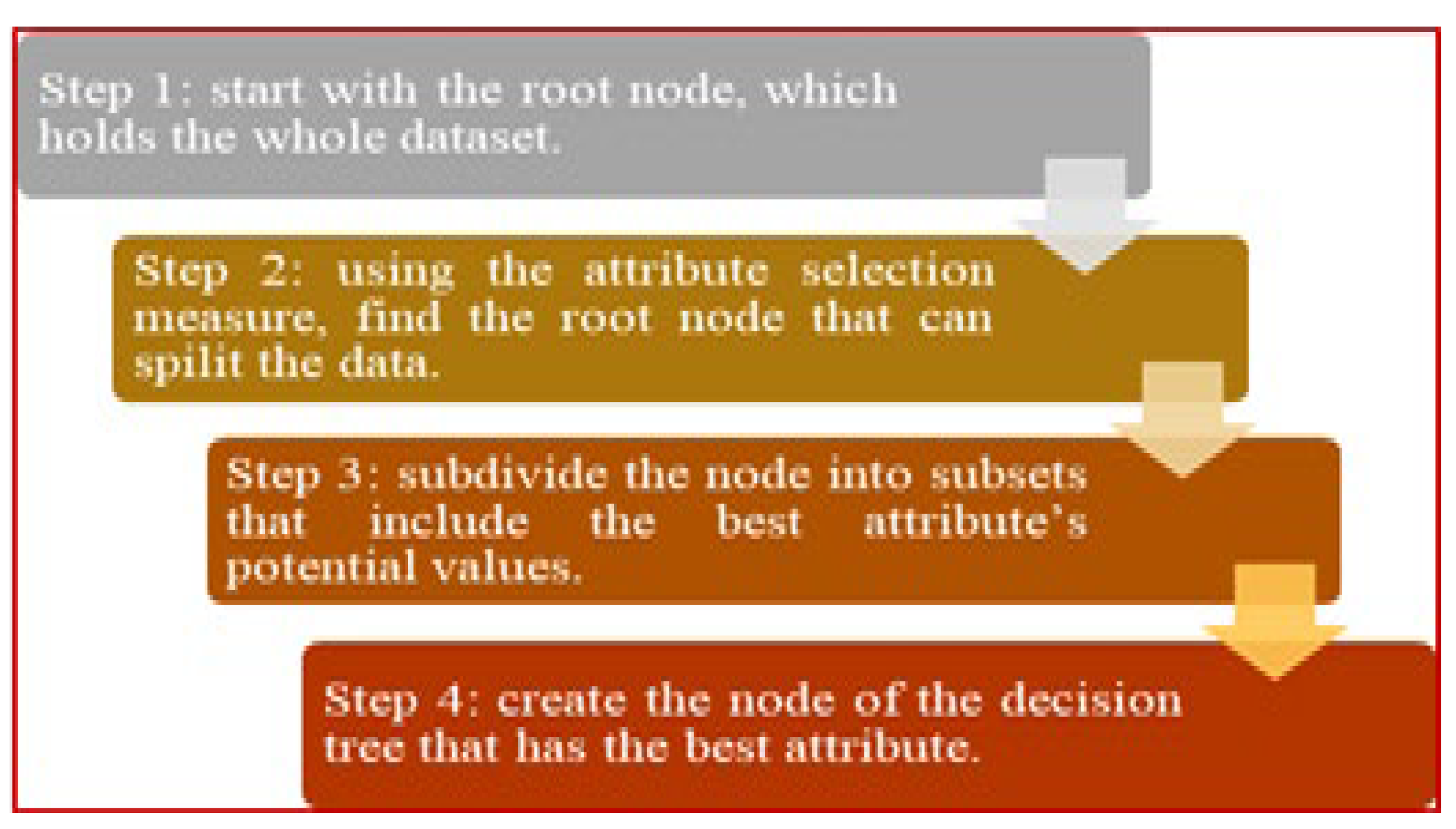
A Decision Tree (DT) is a supervised classification model that can trained and used in real-world problems [4]. This is a basic machine learning mechanism for game designing that enables interaction and creates variations of interest in them to predict by using simple decision tree rules framed by the data objects. In artificial intelligence games, DTs are used to describe options and outcomes (action predictions). The steps used in the decision tree are shown in the below figure.
Figure 3.
Work flow of Decision Tree.
- (b)
- Deep Neural Networks
The majority of computer game characters are created using traditional symbolic artificial intelligence (AI) methods. The AI approaches include branch-and-bound, heuristic search, and A* search strategies as well as production rules for very lengthy branching and conditional statements. Deep Neural Networks have recently gained a lot of popularity as a design choice for gaming agents. Multiple layers of neural networks are used in games' in-depth learning to "continuously" extract features from incoming data. Deep NN can perform better if it controls one or a few game agents because of its horizontal approach and increased architectural complexity.
- (c)
- Genetic algorithms
The genetic algorithm (GA), in its simplest form, is a high-level heuristic procedure that was motivated by the theory of evolution. The natural selection process, in which suitable candidates are chosen to have offspring for the following generation, is mimicked by the genetic algorithm. Several performance goals are achieved by using GAs. In multicriteria optimization, GAs are incomparable to other development strategies in terms of efficiency. In the past, GAs have established themselves in board games by employing a variety of searches to discover the next best move. The recent usage of GAs on NPCs enables these agents to become accustomed to fending off efficient but repetitive strategies that can be used by human gamers. Using GA creates a realistic gaming experience with human characters.
- (d)
- Reinforcement learning
A machine learning technique called reinforcement learning (RL) relies on learning from mistakes. The model may play out scenarios while being trained to determine whether or not things are going well. When designing NPCs to make judgments in dynamic and new contexts, learning to strengthen is helpful. Sports have long made use of strengthening techniques. Games are thus excellent testing grounds for reinforcement learning algorithms. Some of the top computer players are utilizing reinforcement training at the same time (Alpha Go). Basic reinforcement learning algorithms are frequently combined with other AI techniques like deep learning because they are insufficient for high-level gameplay.
- (e)
- Frameworks, and Best Practices in Game Development:
As AI technology is used in game development many tools are available in the market for new developers like Game engines, Integrated Development Environments (IDEs), Graphics Design Software, Audio Editing Software, Unity, Godot, Game Maker Studio, Blender, Visual Studio. The following are best practices that can be followed at the time of game development using AI technology. Iterative development, managing requirements, Managing change, Verify quality, Being user-focused, Research trends and competition, Differentiate your game, having a hook
6. Conclusions
The fundamental concept is to create flexible, ongoing agents for games that may change as they are played. The sophistication and difficulty of AI-supported games will rise as players' playing time increases. The game's gaming life will be significantly increased as a consequence. The use of AI methods that enable these possibilities will advance technologically as well. With all the elements discussed here, it is clear that AI will have an influence on the whole gaming business and may even become a standard technology for all different kinds of game production projects. Due to the increasing access of artificial intelligence algorithms and technologies to game creators and developers, surely there will be a great influence and growth in game production. Shortly definitely the use of advanced techniques and tools of artificial intelligence will be incorporated in the game development.
References
- S. Id, “Artificial Intelligence Usage in Game Development,” 2022.
- R. N. S, M. Varma, and R. Yamini, “Implementation of Dynamic Artificial Intelligence in Game Development,” no. 11, pp. 1055–1060, 2019. [CrossRef]
- Kultima, “Game Design Research,” no. September 2015. [CrossRef]
- P. C. Silva, “Assessment of science learning by elementary school children through digital games Livro de Resumos,” no. September, 2022.
- M. Mehta, A. M. Mehta, A. Ram, and S. Onta, “Artificial Intelligence for Adaptive Computer Games,” no. Ccl, 2007.
- A. Simonov, A. A. Simonov, A. Zagarskikh, V. Fedorov, A. Simonov, A. Zagarskikh, and V. Fedorov, “ScienceDirect Applying Behavior characteristics to the decision-making process to Applying Behavior create characteristics to game process to believable create believable game AI 8th International Young Scientist Conference on Computational Science,” Procedia Comput. Sci., vol. 156, pp. 404–413, 2019. [CrossRef]
- M. Ponsen and P. Spronck, “Knowledge acquisition for adaptive game AI,” vol. 67, pp. 59–75, 2007. [CrossRef]
- M. Lu et al., “ScienceDirect Micromanagement in StarCraft Game and AI : a case study Micromanagement in StarCraft Game AI : a case study,” Procedia Comput. Sci., vol. 174, pp. 518–523, 2020. [CrossRef]
- N. Fachada, “Computers and Education : Artificial Intelligence ColorShapeLinks : A board game AI competition for educators and students,” Comput. Educ. Artif. Intell. vol. 2, no. February, p. 100014, 2021. [CrossRef]
- Mittal, M. P. Mittal, M. P. Gupta, M. Chaturvedi, S. R. Chansarkar, and S. Gupta, “International Journal of Information Management Data Insights Cybersecurity Enhancement through Blockchain Training ( CEBT ) – A serious game approach,” vol. 1, no. October 2020, 2021. [CrossRef]
- Z. Hu, C. Z. Hu, C. Fan, Q. Zheng, W. Wu, and B. Liu, “Visual Informatics Asyncflow : A visual programming tool for game artificial intelligence,” Vis. Informatics, vol. 5, no. 4, pp. 20–25, 2021. [CrossRef]
- S. E. E. Profile, Game Development, no. November 2020. 2021.
- S. Id, “Artificial Intelligence Usage in Game Development,” 2022.
- Endear, A. Endear, A., Aslani, A., Zahedi, R., & Noorollahi, Y. (2023). Artificial intelligence and machine learning in energy systems:.
- A bibliographic perspective. In Energy Strategy Reviews (Vol. 45). https://. [CrossRef]
- Anwar, H. Anwar, H., Ifra Chaudhary, Umar Latif, & Ali Latif. (2023). Role of Artificial Intelligence in different aspects of Public Health. UMT Artificial Intelligence Review, 2(No 2). https://. [CrossRef]
- Anwar, H. Anwar, H., Ifra Chaudhary, Umar Latif, & Ali Latif. (2023). Role of Artificial Intelligence in different aspects of Public Health. UMT Artificial Intelligence Review, 2(No 2). https://. [CrossRef]
- ATASOY, B. ATASOY, B., EFE, M., & TUTAL, V. (2021). Towards the Artificial Intelligence Management in Sports. International Journal of Sport, Exercise & Training Sciences. https://. [CrossRef]
- Anwar, H. Anwar, H., Ifra Chaudhary, Umar Latif, & Ali Latif. (2023). Role of Artificial Intelligence in different aspects of Public Health. UMT Artificial Intelligence Review, 2(No 2). https://. [CrossRef]
- ATASOY, B. ATASOY, B., EFE, M., & TUTAL, V. (2021). Towards the Artificial Intelligence Management in Sports. International Journal of Sport, Exercise & Training Sciences. https://. [CrossRef]
- Friese, S. Friese, S., & Rother, K. (2016). A mixed-paradigm component architecture for implementing web-based game servers. Open Computer Science.
Disclaimer/Publisher’s Note: The statements, opinions and data contained in all publications are solely those of the individual author(s) and contributor(s) and not of MDPI and/or the editor(s). MDPI and/or the editor(s) disclaim responsibility for any injury to people or property resulting from any ideas, methods, instructions or products referred to in the content. |
© 2024 by the authors. Licensee MDPI, Basel, Switzerland. This article is an open access article distributed under the terms and conditions of the Creative Commons Attribution (CC BY) license (http://creativecommons.org/licenses/by/4.0/).
Copyright: This open access article is published under a Creative Commons CC BY 4.0 license, which permit the free download, distribution, and reuse, provided that the author and preprint are cited in any reuse.