

Submitted:
10 April 2024
Posted:
11 April 2024
You are already at the latest version
Abstract
Companies are increasingly focusing on sustainable business practices. Internal and external stakeholders’ expectations manifest in legal requirements, national and international standards, and market and customer expectations, among other things, must be considered. In addition to profit maximization as the usual target for corporate management, management must consider environmental sustainability aspects such as resource efficiency, greenhouse gas intensity, and a company's emissions behavior. In addition, social aspects relating to the company's employees, the immediate urban environment, the situation in the supply chain, and effects on the market environment must increasingly be considered. Specifically, companies are faced with the chal-lenge of dealing with conflicting objectives regarding the various aspects of sustainability and, if necessary, weighing them up against each other. These trade-offs must be made against the company's socio-economic and ecological environment, corporate strategy, and sustainability goals. This paper provides an overview of current approaches and research gaps on this topic through a literature review. It shows a lack of methods and frameworks to specifically deal with trade-offs and conflicts of goals.
Keywords:
sustainability
; trade-off
; interdependency
; decision tool
; sustainable production
; production
1. Introduction
Sustainability is becoming increasingly important for companies to consider as part of their strategies. When implementing measures to improve a company’s sustainability in all its dimensions, it is likely that management will encounter interactions between different aspects of sustainability and conflicts of goals [1,2,3] that must be considered and managed. Ideally, it would be desirable to synergetically resolve conflicts of goals among the different aspects of sustainability. While many frameworks postulate this goal [4,5,6], practical tools and guidelines for achieving this are scarce or missing altogether [7,8,9,10].
Against this backdrop, this paper provides an extensive literature review of methods and approaches to deal with interactions and conflicts of goals among aspects of sustainability in order to answer the research questions:
RQ1: What methods exist to address conflicting sustainability goals in companies systematically?
RQ2: What are the strengths and weaknesses of the existing methods?
It is shown that none of the methods fulfill the desired set of criteria necessary for a method to be successfully used in companies. How can the interactions, interdependencies and conflicts of goals among the different pillars of sustainability within the manufacturing company be identified and dealt with to synergetically resolve them. How should they be prioritized if synergies cannot be achieved? This remains an open question for future research.
2. Literature and Methodology
The research questions are to be examined based on the existing literature in order to identify research gaps and potential for further research. The "Preferred Reporting Items for Systematic Review and Meta-Analysis (PRISMA)" [11] method is used. The method aims to provide a “transparent, complete and accurate” [11] reporting of the review procedure so that the results are comprehensible and understandable.
Based on the research questions, a research matrix was developed in order to formulate a search string that covers the different aspects of the research questions. The research matrix was carefully spelled out to cover the research topic thoroughly while at the same time not limiting the results to a too narrow selection. The research questions thus determine the search matrix and, therefore, the primary search results. [12]
The search string derived from the research matrix was used in two databases, Scopus and Web of Science, since it is advised not to limit the search to a single database [13]. Scopus and Web of Science were chosen for this research since they have been proven comprehensive sources for scientific literature [14].
The goal is to find papers that deal with the analysis of and coping with the interaction and interdependencies among the different pillars of sustainability within the factory. Therefore, the research matrix depicted in Table 1 was used to find appropriate literature. The entries in the respective columns of the table were concatenated using the logical operator “OR” and the respective expressions concatenated using the logical operator “AND”. Asterisks were used for some expressions as placeholders for various endings for some search keys. English was chosen as search language in order to find results globally. To ensure adequate quality, it was required that the papers be peer-reviewed or works published by renowned publishers.
Using the search string from Table 1, Scopus and Web of Science were used to find potential publications that could answer the research question. Scopus yielded 43.287 search results and Web of Science 45.975 search results. From the total (89.262), double entries, empty entries, and proceedings were removed, which led to a reduction of the search results by 18.325 to 70.937. The remaining entries were selected for screening using ASReview.
ASReview is an artificial intelligence (AI) tool provided by the University of Utrecht that supports literature review. In order to use it, the search results, including the abstracts of the entries selected for review, have to be uploaded to the AI system and a number of relevant and irrelevant publications have to be identified. Based on the selection, the AI system learns which publications are relevant to the research question and sorts all entries according to relevance. The respective most likely candidate for the next relevant publication is then presented to the user who can decide (based on the abstract or review of the entire paper) whether it is in fact relevant. After each decision, ASReview reevaluates the current prioritization of the publication list, presents the next best option to the user, and so forth. Certain settings have to be specified for the active learning model. It consists of a feature extraction technique, a classifier, a query strategy, and a balance strategy. The default settings were used for this review (TF-IDF, Naive Bayes, Maximum, Dynamic resampling), which, according to the provider of ASReview, show “overall [...] fast and excellent performance.”
For this investigation, it was arbitrarily decided that the review of papers would stop after both 1,5% of the total number of papers (i.e., 1064 publications ) would be reviewed and 0,15% of the total number of publications (i.e., 106 publications) would be deemed irrelevant after the last relevant entry to answer the research question. Further review was stopped after 1064 reviews, which yielded 63 potentially relevant papers for detailed review. Of those 63 results, 60 publications could be procured. One of the 60 was in a foreign language and could not be translated; 16 were deemed irrelevant after reading. Thus 43 papers were included in this review. The evaluation history and number of identified relevant records are shown in Figure 1 and Figure 2.
In addition, three doctoral theses [15,16,17] were read, one publication by a fellow scientist [18], one publication from independent library research [19], and four publications from the citation list of the review [20,21,22,23]. Those four were deemed not relevant for this research.
Therefore, the total number of publications considered for this review is 48. The flow diagram of the research method is depicted in Figure 3.
3. Results
3.1. Requirements for a Method
The goal is to find papers that present methods or frameworks and approaches that deal with the analysis of and coping with the interaction and interdependencies among the different pillars of sustainability within the factory. To be useful for the analysis and coping with the interactions and interdependencies among different aspects of sustainability, a method needs to fulfill certain requirements.
To be practical for the use in a business setting, the first step needs to be to identify the sustainability goals of the respective company. These goals can be derived in particular from considering demands from stakeholders as well as the regulatory environment [24]. Ultimately, they need to find their way into the company’s overall strategy where they should be reflected and used to derive concrete operative targets. The second step is to define how each strategic sustainability target is to be prioritized within the company. The prioritization of strategic targets among each other will be important in later steps, when it may not be possible to synergetically resolve trade-offs and conflicts of goals among various targets. Third, the scope needs to be defined, i.e., the system boundary for which the sustainability targets and optimizations shall be considered.
After these prerequisites are identified, the next set of requirements pertains to the method’s properties. A method needs to be practical in the sense that it needs to be easy to use [25] and quick to implement [26,27]. It needs to be relevant [28,29] to the individual company and consider each companies peculiarities. It cannot be assumed that there is a one-size-fits-all solution [7]; hence the method needs to be company-specific. Since sustainability consists of at least three pillars (economic, environmental, and social), a method needs to be at least potentially comprehensive and capable of considering all aspects of sustainability. Finally, a method for coping with interactions and interdependencies among different aspects of sustainability needs to be stable. That means it needs to be able to deal with potentially inaccurate and incomplete data [27] and to ensure that the results it yields are comprehensible.
As a result, a useful method needs to provide specific deliverables. To make sustainability or aspects of it measurable and assessable, KPIs need to be identified that can serve as indicators for the impact on sustainability that relevant measures may have [28]. Next, interactions and interdependencies between different aspects of sustainability need to be made transparent and assessed. Regarding outright conflicts of goals between the sustainability impact of measures a method for coping with interactions and interdependencies among different aspects of sustainability has to provide guidance on how to resolve such conflicts: how to synergetically solve them and if this cannot be achieved, how to come to a prioritization that is in accordance with the overall strategic goals. Lastly, it needs to support decision-making through some kind of recommendation.
The literature identified in Section 2 has been screened regarding the aspects described above. None of the reviewed publications fulfills all requirements that have been identified as necessary. For each publication, it was determined whether the respective aspect was not fulfilled (0%), partially fulfilled (50%), or completely fulfilled (100%). A mean degree of fulfillment was calculated for each publication by computing the arithmetic mean of all individual evaluations. To provide an overview, the 48 publications have been clustered into eight groups based on commonalities between the methods.
- weighting approaches (13 publications)
- financial and utility-calculation-based approaches (9 publications
- system dynamics approaches (8 publications)
- graphical approaches (6 publications)
- mathematical optimizations (5 publications)
- management-systems (4 publications)
- single-index approaches (2 publications)
- time-variant models (1 publication)
In the subsequent sections, the evaluation results regarding each of the criteria described above will be discussed for each group. For methods described in the publications that have individually received an arithmetic mean rating of more than 50%, an individual discussion of these methods will follow at the end of each subsection.
3.2. Weighting Approaches
Weighting approaches refer to approaches where criteria are weighed and thus prioritized. [8,25,27,30,31,32,33,34,35,36,37,38,39].
3.2.1. Prerequisites
- Definition of system boundaries: System boundaries are not considered an explicit step of the method for most authors. Only [34] and [39] define the system boundary as part of their method, [38] implicitly considers the system boundary since the method focuses not so much on the assessment of interdependencies and conflicts of goals but on data acquisition.
3.2.2. Properties of the Method
- Stability: Most methods are not stable in the sense that they specifically deal with potentially inaccurate or incomplete data. Only [25] includes a sensitivity analysis that investigates and addresses potentially inadequate data.
3.2.3. Deliverables
- Identification of KPIs: Most methods contain a step to identify the KPIs for consideration. This yields an average of 69% for this aspect. Only three methods do not consider the selection of KPIs. In two publications [35,36] the KPI selection is a prerequisite for the application of their method. Some authors [30] do select some criteria, but this step is not part of their method for general application.
- Assessment of interactions: None of the methods explicitly assess the interactions between multiple aspects of sustainability.
Among the weighting methods, two publications [8,39] score an average of 50% or higher. They are individually discussed in more detail below.
Trade-Off Navigation Framework (TONF) [8]:
The authors develop a process model for dealing with conflicting objectives when implementing the circular economy in manufacturing. The focus is on product development. The method first selects KPIs for relevant sustainability parameters and defines acceptance criteria for each characteristic. In addition, a distinction is made between negotiable and non-negotiable features. The relevant characteristics of the alternatives under discussion are presented in a matrix. The non-negotiable characteristics are evaluated and then the negotiable characteristics are weighed against each other. Finally, the decision is reflected again. The strengths of this approach lie in the visualization, which makes the conflicting objectives transparent, the distinction between negotiable and non-negotiable objectives, and the reflection at the end. In particular, it can be considered here whether other measures can compensate negative effects of the selected alternative. However, no assessment of interactions between aspects of sustainability and no systematic attempt to synergetically resolve conflicts of interest among aspects of sustainability is made. Furthermore, the prioritization of the consideration of the individual target dimensions only takes place during the evaluation. As a result, there is a risk of decision-making under the impression of the result.
Novel Approach towards Sustainability Assessment [39]:
The focus of the proposed method is on the identification and involvement of relevant stakeholders (internal/external), whereby the stakeholders are categorized on the basis of "stakeholder impact", defined as the stakeholder expectations multiplied by the stakeholder influence. Furthermore, a selection of indicators is made, followed by prioritization and weighting. Company specifics are taken into account as a sustainability charter is required from company management with a corresponding strategic objective ("The first step includes a formal write-up of a sustainability charter by senior management, including an outline of objectives"). There is no analysis of interactions and conflicting objectives, only an identification of the need for action in relation to activities or KPIs. No systematic attempt to synergetically resolve conflicts of interest among aspects of sustainability is made and no decision support is provided. The method scores high among the prerequisites and the properties but low among the deliverables.
3.3. Financial and Utility Approaches
Financial and utility approaches refer to approaches where a utility or financial equivalent is calculated for each sustainability aspect, and the utility or financial gain is maximized. [2,15,16,24,26,40,41,42,43]
3.3.1. Prerequisites
- Identification of sustainability goals: None of the financial and utility approaches identify the sustainability goals as part of the respective method.
- Prioritization of goals: Only one publication [42] prioritizes sustainability goals through weighting factors.
3.3.2. Properties of the Method
- Stability: Most of the methods are not stable regarding inaccurate or incomplete data since they are purely quantitative and rely on accurate input information. Some authors [2] compare decision alternatives based on the same data. Therefore, some impact of inaccuracies is mitigated if the expected impact of decisions on the aspects of sustainability is directionally correct.
3.3.3. Deliverables
- Assessment of interactions: None of the financial and utility approaches assess the interactions between aspects of sustainability.
- Coping with conflicts of goals: None of the financial and utility approaches systematically syergetically address conflicts between sustainability goals as part of the respective method.
- Decision support: Decision support is provided by four out of nine methods [2,16,26,40] through financial or utility analysis of decision options. Five out of nine methods do not since the focus of the work is different, e.g., one publication [15] aims to determine an absolute measure of sustainability, some authors [24] focus on reporting, and some authors [42] aim to aid company valuations for external stakeholders.
None of the financial and utility approaches score an average of more than 50%; hence, none is individually considered for further analysis.
3.4. System Dynamics
System Dynamics approaches refer to approaches, where the system under consideration is modelled as a whole in order to be analyzed and optimized. [7,18,44,45,46,47,48,49]
3.4.1. Prerequisites
- Prioritization of goals: None of the publications prioritize the sustainability goals.
- Definition of system boundaries: Inherently, the system boundary is defined since the system dynamics model has to be set up and thus specifies the system boundaries. However, one publication [48] does not consider the system dynamics within a company but between the sustainable development goals (SDG). In that sense, no system boundary is identified in this publication.
3.4.2. Properties of the Method
- Practicality: All but one approach are not practical since creating a system dynamics model is inherently complicated and difficult. It requires knowledge of all interactions and the ability to quantify them accurately. The one exception [46] focuses on chemical processes, and the approach may be practical for this particular subset of applications.
- Company specificity: Since the system dynamics models are set up to investigate company interactions they are inherently company-specific. An exception applies to one publication [48] since the focus is on interactions between SDGs.
- (potential) Comprehensiveness: All aspects that can be quantified and mathematically described can potentially be considered in a system dynamics approach. Hence, this applies, at least to some degree, to all methods that were analyzed.
- Stability: Most methods are not stable in the sense that they specifically deal with potentially inaccurate or incomplete data. However, one group of authors provide a sensitivity analysis to address potentially inaccurate or incomplete data [46], and one group investigates and discusses potential uncertainties in the data [49]. One publication [48] considers the data on a more strategic level. General directions of interactions are more important than accuracy.
3.4.3. Deliverables
- Coping with conflicts of goals: There is no systematic way to synergetically resolve conflicts of goals in any of the methods.
Among the system dynamics approaches, only one [49] scores an average of more than 50%. Therefore, this publication is individually discussed in more detail below.
A decision-guidance framework for sustainability performance analysis [49]:
The authors develop a method for optimizing the process control of manufacturing processes. The sustainability goals are identified, and the manufacturing process is modelled and quantified. Thus, it can be simulated and optimized. Implicitly, this also constitutes the definition of the system boundaries. In particular, the externalities are also modeled, whereby the overall environmental impact is determined by weighting the externalities. However, the detailed modelling is complicated and mathematically challenging while being company-specific and at least potentially comprehensive. The model fundamentally relies on complete and accurate data but the uncertainties in the data are analyzed and interpreted. KPIs are selected as part of the method, but no assessment of interactions between aspects of sustainability and no systematic attempt is made to synergetically resolve conflicts of interest among aspects of sustainability. The result of the optimization provides decision support.
3.5. Graphic Approaches
Graphic approaches refer to approaches that use graphical methods to perform the assessment and optimization of the system under consideration. [28,50,51,52,53,54]
3.5.1. Prerequisites
- Identification of sustainability goals: Only one publication [50]considers the identification of the company’s sustainability goals as part of the process.
- Prioritization of goals: None of the graphical approaches contain a step within the method to prioritize the sustainability goals of the company.
- Definition of system boundaries: All but one [28] methods define system boundaries as part of the process.
3.5.2. Properties of the Method
- Practicality: Most of the methods (4 out of 6) can be considered very practical. They rely on workshops and established graphical tools such as value stream mapping for visualization. Two of the methods [53,54] require elaborate computations and interpretation of the results prior to visualization and are not practical.
- Company specificity: Two of the methods [51,53] are company-specific. Other methods consider company specifics but focus on intra-company comparisons [50] or consider the company specifics implicitly by selecting KPIs and reference values for the KPIs in workshops with management [28]. Two of the methods are not company-specific [52,54].
- Stability: All but one of the methods are stable due to their graphical qualitative nature, consideration of fuzzy approaches or the involvement of multiple experts to assess the data and results. One publication [50] is not stable regarding incomplete or inaccurate data but analyzes the impact of such data on the results.
3.5.3. Deliverables
- Assessment of interactions: Interactions are not assessed in any of the publications. [53] identify interactions but do not assess them.
- Coping with conflicts of goals: None of the graphical approaches contain a step to synergetically resolve conflicts of goals among aspects of sustainability.
- Decision support: There is no decision support, i.e., recommendation in any of the graphical methods.
None of the individual graphical methods score an average of more than 50%; hence, none is individually considered for further analysis.
3.6. Mathematical Optimization Approaches
Mathematical optimization approaches refer to approaches that focus on mathematical optimization algorithms to come to an optimal solution. [17,55,56,57,58]
3.6.1. Prerequisites
- Identification of sustainability goals: None of the mathematical optimization approaches determine sustainability goals as part of the method.
- Prioritization of goals: None of the mathematical optimization approaches determine the priority of sustainability goals for the company as part of the method.
- Definition of system boundaries: Definition is mostly not considered for the mathematical optimization approaches. In one publication, there is an implicit definition by formulation of a utility function [55], two more publications [17,57] formulate a system boundary, but the focus is not an individual company.
3.6.2. Properties of the Method
- Practicality: Most of the approaches are mathematically very challenging and therefore not practical to implement. One approach [56] is practical by the combination of comparatively simple mathematics and graphical analysis,
- (potential) Comprehensiveness: Generally speaking, the mathematical optimization approaches are not comprehensive. If the utility function can be expressed in commensurable terms for all KPIs, one of the methods [55] may be considered comprehensive.
- Stability: One of the methods [55] systematically considers variance and scatter in the data. The others do not.
3.6.3. Deliverables
- Assessment of interactions: None of the mathematical optimization approaches assess interactions between different aspects of sustainability.
- Coping with conflicts of goals: None of the mathematical optimization approaches attempt to synergetically resolve conflicts of goals among aspects of sustainability.
None of the individual mathematical optimization approaches score an average of more than 50%; hence, none is individually considered for further analysis.
3.7. Management Systems
Management Systems refer to sustainability methods that constitute new or build upon existing management systems. [9,19,59,60]
3.7.1. Prerequisites
- Definition of system boundaries: System boundaries are not defined in any of the management systems.
3.7.2. Properties of the Method
- Practicality: Three of the management systems are not practical for various reasons. [60] builds upon well-known management systems and is, therefore, very practical.
- (potential) Comprehensiveness: All management systems are potentially comprehensive, i.e., they at least potentially consider all aspects of sustainability.
- Stability: None of the management systems specifically address the issue of incomplete or inaccurate data. However, one publication [19] discusses “future worlds”, which is inherently a very inaccurate undertaking, so inaccuracies in the data are less important than generally possible long-term developments.
3.7.3. Deliverables
- Identification of KPIs: All management systems identify KPIs. One publication [60] proposes a KPI selection from the literature but does not identify KPIs as part of the management system.
- Assessment of interactions: The management systems do not asses interactions between different aspects of sustainability.
- Coping with conflicts of goals: There is no systematic way to synergetically resolve conflicts of goals in any of the management systems.
- Decision support: None of the management systems offer decision support.
None of the individual management system approaches score an average of more than 50%; hence, none is individually considered for further analysis.
3.8. Single Index Approaches
Single index approaches refer to methods where all sustainability information is aggregated into a single figure to assess the total sustainability of the entity of interest. Two publications are in this category. [5,61]
3.8.1. Prerequisites
- Identification of sustainability goals: Identification of the sustainability goals is not part of either of the methods.
- Prioritization of goals: For both methods, prioritization is done by weighting factors for each aspect.
- Definition of system boundaries: The system boundaries are defined in both methods.
3.8.2. Properties of the Method
- Practicality: One of the approaches [5] is practical to implement.
- Company specificity: Both methods consider company specifics.
- Stability: Both methods do not address the issue of potentially inaccurate or incomplete data.
3.8.3. Deliverables
- Assessment of interactions: Interactions are not discussed in either of the publications.
- Coping with conflicts of goals: Only one of the publications [5] considers conflicts of goals. However, there is no attempt to synergetically resolve them. They are dealt with merely on a weighting factor basis.
- Decision support: Only one publication [5] offers support of decision makers in companies as a result of the method.
Among the single index-related publications, one method [5] scores an average of more than 50%. Therefore, this publication is discussed in more detail individually below.
A Case Study for Sustainable Routing [5]:
The publication examines the sustainability of process sequencing in production processes that allow different sequences. The sustainability goals are not explicitly identified as part of the method. Weighting factors are used to prioritize. The method considers “gate-to-gate” as a system boundary. The method is easy, practical, considers company specifics, and is potentially comprehensive. However, it is reliant on complete and accurate data. KPIs are selected but not as part of a systematic and structured selection process. No assessment of interactions between aspects of sustainability and no systematic attempt to synergetically resolve conflicts of interest among aspects of sustainability is made beyond using simple weighting factors to prioritize. The method does provide a decision recommendation.
3.9. Time-Variant Approaches
One publication does not fit either of the aforementioned categories. It is introduced as a time-variant approach. It pertains to an approach where a sustainability vector of the system is calculated for multiple points in time, and an optimum path for sustainability measure implementation is derived. [62]
3.9.1. Prerequisites
- Identification of sustainability goals: The method does not contain a step to identify sustainability goals, but it is acknowledged that this would be a necessary step to perform the analysis.
- Prioritization of goals: The method does not contain a step to prioritize goals. But it is acknowledged that this would be a necessary step to perform the analysis.
- Definition of system boundaries: The method does not contain a step to identify the system boundaries. But again, it is acknowledged that this would be a necessary step to perform the analysis.
3.9.2. Properties of the Method
- Practicality: The method is not practical, it is very complicated mathematically and involves assumptions about the future state of the system.
- Company specificity: The publication only describes the mathematical part of the method; it would be possible to consider company specifics.
- (potential) Comprehensiveness: The method does consider all aspects of sustainability and is, therefore, comprehensive.
- Stability: The method relies heavily on numerical input for its analysis but does not contain any steps or precautions to deal with inaccurate or incomplete data.
3.9.3. Deliverables
- Identification of KPIs: The method does not identify KPIs. However, it is indicated that this is a necessary step.
- Assessment of interactions: Interactions among various aspects of sustainability are not analyzed.
- Coping with conflicts of goals: Coping systematically with conflicts of goals to synergetically resolve them is not part of the method.
- Decision support: The method offers decision support or, rather, decision options since the result is a set of pareto-optimal decision options that are presented to the decision-maker.
- The method only scores 27%.
3.10. Summary of Section 3
The preceding sections have shown that there is currently no method available that fulfills all required properties and features set out in Section 3.1 for analysis and coping with the interactions and interdependencies among different aspects of sustainability. Figure 4 shows how the different approaches fulfill the requirements, as discussed and explained in Section 3.1. Many methods lack the crucial step of identifying the sustainability goals of the company and subsequently prioritizing the goals. System boundaries are more commonly defined among the methods. Regarding the properties, many methods lack practicality, be it by being too mathematically complicated or requiring a priori knowledge of all interactions among the aspects in question. Especially the quantitative methods that heavily rely on data often do not account for inaccuracies or incomplete data. Most methods lack an assessment of interactions between the different aspects of sustainability. None of the methods provide a thorough and systematic approach to synergetically resolve conflicts of goals among the aspects of sustainability.
While some of the methods described in the publications analyzed for this review fulfill some of the requirements fully, none fulfills all requirements satisfactorily.
4. Discussion and Future Directions
The sustainability of companies and manufacturing businesses is an imminent challenge for the science community and management against the backdrop of ever- increasing regulatory challenges and public pressure. This literature review set out to answer two research questions:
RQ1: What methods exist to address conflicting sustainability goals in companies systematically?
RQ2: What are the strengths and weaknesses of the existing methods?
To answer these questions, comprehensive literature research was performed according to the PRISMA method, and 48 publications were analyzed in detail. Various approaches exist that address RQ1 were found.
They can be grouped into eight categories and have their individual advantages and disadvantages, which addresses RQ2: While weighting approaches show some strengths in almost all aspects of investigation, assessing interdependencies and coping with conflicts of goals remain open questions. Financial and utility approaches show strengths in defining the system boundaries and are generally more likely to be practical, company-specific, and potentially comprehensive. They also lack the assessment of interdependencies and means to cope with conflicts of goals. Systems dynamics approaches are mostly not very practical since the definition of the system dynamics model requires detailed a priori knowledge of the interactions between the aspects of sustainability under consideration and are often mathematically complex. The graphical methods were found to be mostly practical and stable, and they mostly defined the system boundaries and identified KPIs. At the same time, they lacked a step to identify sustainability goals and priorities and did not provide decision support. Again, systematic assessment of interactions and coping with conflicts of goals systematically is a major weakness. The mathematical optimization approaches place no priority on identifying the sustainability goals and prioritizing them. Formulating the challenge as a mathematical optimization problem generally requires the formulation of system boundaries and yields some degree of company specificity. The solution of the optimization problem also yields a result that serves as a decision guideline. The management systems focus on the identification of goals and priorities and are usually company-specific. They are at least potentially comprehensive and stable since, in general, they do not rely on detailed, accurate data. They also emphasize the definition of KPIs while not defining system boundaries. However, their weakness is in the remaining deliverables, namely assessment of interactions, systematically coping with conflicts of goals between the aspects of sustainability, and providing clear decision guidance. The single index approaches focus on prioritizing goals, defining system boundaries, and being company-specific. They also lack steps for assessing interactions and systematically coping with conflicts of goals between the aspects of sustainability. The last group (time-variant models), which only comprises one publication, does not fulfill any of the requirements aside from being company specific, since the assessment can be done for an individual company, and being potentially comprehensive. It also produces a result for decision guidance.
While methods exist that address the issue of conflicting goals among aspects of sustainability in some aspect or another, none of the methods fulfill a desired set of criteria necessary for a method to be successfully used by practitioners. The identification and analysis of interactions and interdependencies among the different aspects of sustainability, and a systematic approach to synergetically resolve arising conflicts of goals and prioritize them where synergetically resolving them proofs impossible or uneconomical, remains an open topic for future research.
References
- Hallam, C.R.; Contreras, C. The interrelation of Lean and green manufacturing Practices: A case of push or pull in implementation. In 2016 Portland International Conference on Management of Engineering and Technology (PICMET). 2016 Portland International Conference on Management of Engineering and Technology (PICMET), Honolulu, HI, USA, 04–08 Sep. 2016; IEEE, 2016; pp 1815–1823.
- Hahn, T.; Figge, F.; Liesen, A. Assessing Trade-Offs in Investments for the Environment – The Case of a VOC-Reduction Investment at AUTO Group. Corp Soc Responsibility Env 2012, 19, 114–128. [CrossRef]
- Elkington, J. Cannibals with forks: The triple bottom line of 21st century business, Pbk. ed.; Capstone: Oxford, U.K., Oxford, United Kingdom, 1997, ISBN 1-900961-27-X.
- Gbededo, M.A.; Liyanage, K. Sustainable Manufacturing Assessment: Approach and the Trend Towards Life Cycle Sustainability Analysis. In Advances in manufacturing technology XXXI: Proceedings of the 15th International Conference on Manufacturing Research, incorporating the 32nd National Conference on Manufacturing Research, September 5-7, 2017, University of Greenwich, UK; Gao, J., El Souri, M., Keates, S., Eds.; IOS Press: Amsterdam, Netherlands, 2017; pp 383–388, ISBN 978-1-61499-792-4.
- Gerdes, C.; Maier-Speredelozzi, V. A Case Study for Sustainable Routing in Manufacturing Enterprises. In IISE Annual Conference and Expo 2018: Orlando, Florida, USA, 19-22 May 2018; Barker, K., Berry, D., Rainwater, C., Eds.; Curran Associates Inc: Red Hook, NY, 2018; pp 913–918, ISBN 978-1-5108-6935-6.
- Gbededo, M.A.; Liyanage, K.; Garza-Reyes, J.A. Towards a Life Cycle Sustainability Analysis: A systematic review of approaches to sustainable manufacturing. Journal of Cleaner Production 2018, 184, 1002–1015. [CrossRef]
- Moldavska, A.; Welo, T. A Holistic approach to corporate sustainability assessment: Incorporating sustainable development goals into sustainable manufacturing performance evaluation. Journal of Manufacturing Systems 2019, 50, 53–68. [CrossRef]
- Kravchenko, M.; Pigosso, D.C.A.; McAloone, T.C. A Trade-Off Navigation Framework as a Decision Support for Conflicting Sustainability Indicators within Circular Economy Implementation in the Manufacturing Industry. Sustainability 2021, 13, 314. [CrossRef]
- de Souza, J.P.E. Lean integrated management system for sustainability improvement: An integrated system of tools and metrics for sustainability management. Methods in Sustainability Science; Elsevier, 2021; pp 265–293, ISBN 9780128239872.
- Ein Konzept auf dem Prüfstand: Das integrative Nachhaltigkeitskonzept in der Forschungspraxis; Kopfmüller, J., Ed.; Ed. Sigma: Berlin, 2006, ISBN 978-3-89404-582-1.
- Page, M.J.; McKenzie, J.E.; Bossuyt, P.M.; Boutron, I.; Hoffmann, T.C.; Mulrow, C.D.; Shamseer, L.; Tetzlaff, J.M.; Akl, E.A.; Brennan, S.E.; et al. The PRISMA 2020 statement: an updated guideline for reporting systematic reviews. Syst. Rev. 2021, 10, 89. [CrossRef]
- Shaffril, H.A.M.; Samsuddin, S.F.; Samah, A.A. The ABC of systematic literature review: the basic methodological guidance for beginners. Qual Quant 2021, 55, 1319–1346. [CrossRef]
- Wanyama, S.B.; McQuaid, R.W.; Kittler, M. Where you search determines what you find: the effects of bibliographic databases on systematic reviews. International Journal of Social Research Methodology 2022, 25, 409–422. [CrossRef]
- Pranckutė, R. Web of Science (WoS) and Scopus: The Titans of Bibliographic Information in Today’s Academic World. Publications 2021, 9, 12. [CrossRef]
- Miehe, R. Methodik zur Quantifizierung der nachhaltigen Wertschöpfung von Produktionssystemen an der ökonomisch-ökologischen Schnittstelle anhand ausgewählter Umweltprobleme. Dissertation, 2017.
- Siepelmeyer, D. Development of Material Flow Cost Accounting and Value Added Statements as Planning Instruments for Sustainability Management; Niedersächsische Staats- und Universitätsbibliothek Göttingen: Göttingen, 2023.
- Welsing, M. Bewertung der ökologischen Nachhaltigkeit von Produktionsnetzwerkkonfigurationen. Dissertation; RWTH Aachen, 2023.
- Kuhlmann, T.; Mandel, J.; Sauer, A. Bewertung von Ultraeffizienzmaßnahmen: Skalierbarer, ganzheitlicher Ansatz zur Bewertung von Ultraeffizienzmaßnahmen in der Produktion. wt Werkstattstechnik online 2016, 2016, 83–88.
- Kopfmüller, J.; Weimer-Jehle, W.; Naegler, T.; Buchgeister, J.; Bräutigam, K.-R.; Stelzer, V. Integrative Scenario Assessment as a Tool to Support Decisions in Energy Transition. Energies 2021, 14, 1580. [CrossRef]
- Wietschel, L.; Messmann, L.; Thorenz, A.; Tuma, A. Environmental benefits of large-scale second-generation bioethanol production in the EU: An integrated supply chain network optimization and life cycle assessment approach. Journal of Industrial Ecology 2021, 25, 677–692. [CrossRef]
- Cabral, I.F. An information model for lean, agile, resilient and green supply chain management. Dissertation; Faculdade de Ciências e Tecnologia, Lissabon, 2011.
- Govindan, K.; Garg, K.; Gupta, S.; Jha, P.C. Effect of product recovery and sustainability enhancing indicators on the location selection of manufacturing facility. Ecological Indicators 2016, 67, 517–532. [CrossRef]
- Reich-Weiser, C.; Dornfeld, D.A. A discussion of greenhouse gas emission tradeoffs and water scarcity within the supply chain. Journal of Manufacturing Systems 2009, 28, 23–27. [CrossRef]
- Chousa, J.P.; Castro, N.R. Integrating Sustainability into Traditional Financial Analysis. In Sustainability Accounting and Reporting; Schaltegger, S., Bennett, M., Burritt, R., Eds.; Springer Netherlands, 2006; pp 83–108, ISBN 978-1-4020-4079-5.
- Saad, M.H.; Nazzal, M.A.; Darras, B.M. A general framework for sustainability assessment of manufacturing processes. Ecological Indicators 2019, 97, 211–224. [CrossRef]
- Jasiński, D.; Meredith, J.; Kirwan, K. Sustainable development model for measuring and managing sustainability in the automotive sector. Sustainable Development 2021, 29, 1123–1137. [CrossRef]
- Jurík, L.; Horňáková, N.; Šantavá, E.; Cagáňová, D.; Sablik, J. Application of AHP method for project selection in the context of sustainable development. Wireless Netw 2022, 28, 893–902. [CrossRef]
- Helleno, A.L.; Moraes, A.J.I. de; Simon, A.T. Integrating sustainability indicators and Lean Manufacturing to assess manufacturing processes: Application case studies in Brazilian industry. Journal of Cleaner Production 2017, 153, 405–416. [CrossRef]
- Sauer, A. Machtbasierte Entwicklung von intellectual capital in Kollaborationen der produzierenden Industrie. Zugl.: Aachen, Techn. Hochsch., Diss., 2005; Shaker, Aachen, 2005.
- Bezerra, P.R.S.; Schramm, F.; Schramm, V.B. A multicriteria model, based on the PROMETHEE II, for assessing corporate sustainability. Clean Techn Environ Policy 2021, 23, 2927–2940. [CrossRef]
- Stoycheva, S.; Marchese, D.; Paul, C.; Padoan, S.; Juhmani, A.; Linkov, I. Multi-criteria decision analysis framework for sustainable manufacturing in automotive industry. Journal of Cleaner Production 2018, 187, 257–272. [CrossRef]
- Pattanaik, L.N.; Baug, T.K.; Koteswarapavan, C. A hybrid ELECTRE based prioritization of conjoint tools for lean and sustainable manufacturing. Prod. Eng. Res. Devel. 2019, 13, 665–673. [CrossRef]
- Ozmehmet Tasan, S.; Felekoglu, B.; Ozmehmet, E. Sustainability Assessment of Environmentally Conscious Manufacturing Companies. In Closing the Gap Between Practice and Research in Industrial Engineering; Viles, E., Ormazábal, M., Lleó, A., Eds.; Springer International Publishing: Cham, 2018; pp 59–66, ISBN 978-3-319-58408-9.
- Ong, M.C.; Leong, Y.T.; Wan, Y.K.; Chew, I.M.L. Multi-objective Optimization of Integrated Water System by FUCOM-VIKOR Approach. Process Integr Optim Sustain 2021, 5, 43–62. [CrossRef]
- Rao, R.V.; Patel, B.K. Novel method for decision making in the manufacturing environment. Proceedings of the Institution of Mechanical Engineers, Part B: Journal of Engineering Manufacture 2011, 225, 422–434. [CrossRef]
- van der Voet, H.; van der Heijden, G.W.; Kruisselbrink, J.W.; Tromp, S.-O.; Rijgersberg, H.; van Bussel, L.G.; van Asselt, E.D.; van der Fels-Klerx, H.J. A decision support tool for assessing scenario acceptability using a hierarchy of indicators with compensabilities and importance weights. Ecological Indicators 2014, 43, 306–314. [CrossRef]
- Kluczek, A. Application of Multi-criteria Approach for Sustainability Assessment of Manufacturing Processes. Management and Production Engineering Review 2016, 7, 62–78. [CrossRef]
- Castiglione, C.; Pastore, E.; Alfieri, A. Technical, economic, and environmental performance assessment of manufacturing systems: the multi-layer enterprise input-output formalization method. Production Planning & Control 2022, 1–18. [CrossRef]
- Rasheed, A.; Ion, W. A Novel Approach towards Sustainability Assessment in Manufacturing and Stakeholder’s Role. Sustainability 2022, 14, 3221. [CrossRef]
- Stuart, J.A.; Ammons, J.C.; Turbini, L.J.; Saunders, F.M.; Saminathan, M. Evaluation approach for environmental impact and yield trade-offs for electronics manufacturing product and process alternatives. In Proceedings of the 1995 IEEE International Symposium on Electronics and the Environment ISEE (Cat. No.95CH35718). 1995 IEEE International Symposium on Electronics and the Environment ISEE (Cat. No.95CH35718), Orlando, FL, USA, 1-3 May 1995; IEEE, 1995; pp 166–170, ISBN 0-7803-2137-5.
- Figge, F.; Hahn, T. Sustainable Value Added—measuring corporate contributions to sustainability beyond eco-efficiency. Ecological Economics 2004, 48, 173–187. [CrossRef]
- Wang, L.; Lin, L. Making sustainability accountable: a valuation model for corporate performance. In IEEE International Symposium on Electronics and the Environment, 2004. Conference Record. 2004. IEEE International Symposium on Electronics and the Environment, 2004. Conference Record. 2004, Scottsdale, AZ, USA, 10-13 May 2004; IEEE, 2004; pp 7–12, ISBN 0-7803-8250-1.
- Wright, J.M.; Caudill, R.J. A more comprehensive and quantitative approach to corporate sustainability. Environmental Impact Assessment Review 2020, 83, 106409. [CrossRef]
- Petry, M.; Köhler, C.; Zhang, H. Interaction analysis for dynamic sustainability assessment of manufacturing systems. Procedia CIRP 2020, 90, 477–482. [CrossRef]
- Petry, M.; Köhler, C.; Zhang, H. Nachhaltigkeitsbewertung in der Produktion. Zeitschrift für wirtschaftlichen Fabrikbetrieb 2021, 116, 511–514. [CrossRef]
- Carvalho, A.; Gani, R.; Matos, H. Design of sustainable chemical processes: Systematic retrofit analysis generation and evaluation of alternatives. Process Safety and Environmental Protection 2008, 86, 328–346. [CrossRef]
- Zhang, H. Understanding the Linkages: A Dynamic Sustainability Assessment Method and Decision Making in Manufacturing Systems. Procedia CIRP 2019, 80, 233–238. [CrossRef]
- van Zanten, J.A.; van Tulder, R. Improving companies' impacts on sustainable development: A nexus approach to the SDGS. Bus Strat Env 2021, 30, 3703–3720. [CrossRef]
- Kim, D.B.; Shin, S.-J.; Shao, G.; Brodsky, A. A decision-guidance framework for sustainability performance analysis of manufacturing processes. Int J Adv Manuf Technol 2015, 78, 1455–1471. [CrossRef]
- Paju, M.; Heilala, J.; Hentula, M.; Heikkila, A.; Johansson, B.; Leong, S.; Lyons, K. Framework and indicators for a Sustainable Manufacturing Mapping methodology. In Proceedings of the 2010 Winter Simulation Conference. 2010 Winter Simulation Conference - (WSC 2010), Baltimore, MD, USA, 05–08 Dec. 2010; IEEE, 2010; pp 3411–3422, ISBN 978-1-4244-9866-6.
- Rathore, B.; Pundir, A.K.; Iqbal, R.; Gupta, R. Development of fuzzy based ergonomic-value stream mapping (E-VSM) tool: a case study in Indian glass artware industry. Production Planning & Control 2022, 1–21. [CrossRef]
- Brown, A.; Amundson, J.; Badurdeen, F. Sustainable value stream mapping (Sus-VSM) in different manufacturing system configurations: application case studies. Journal of Cleaner Production 2014, 85, 164–179. [CrossRef]
- Bhanot, N.; Rao, P.V.; Deshmukh, S.G. Sustainable Manufacturing: An Interaction Analysis for Machining Parameters using Graph Theory. Procedia - Social and Behavioral Sciences 2015, 189, 57–63. [CrossRef]
- Badri Ahmadi, H.; Lo, H.-W.; Gupta, H.; Kusi-Sarpong, S.; Liou, J.J.H. Analyzing interrelationships among environmental sustainability innovation factors. Clean Techn Environ Policy 2022, 24, 1191–1207. [CrossRef]
- Camahan, J.V.; Thurston, D.L. Trade-off Modeling for Product and Manufacturing Process Design for the Environment. Journal of Industrial Ecology 1998, 2, 79–92. [CrossRef]
- Mishima, N. Decision Making for Sustainable Manufacturing Utilizing a Manufacturing Technology Database. In Distributed Computing and Artificial Intelligence; Omatu, S., Paz Santana, J.F. de, González, S.R., Molina, J.M., Bernardos, A.M., Rodríguez, J.M.C., Eds.; Springer Berlin Heidelberg: Berlin, Heidelberg, 2012; pp 17–24, ISBN 978-3-642-28764-0.
- Singh, A.; Lou, H.H. Hierarchical Pareto Optimization for the Sustainable Development of Industrial Ecosystems. Ind. Eng. Chem. Res. 2006, 45, 3265–3279. [CrossRef]
- Vadenbo, C.; Hellweg, S.; Guillén-Gosálbez, G. Multi-objective optimization of waste and resource management in industrial networks – Part I: Model description. Resources, Conservation and Recycling 2014, 89, 52–63. [CrossRef]
- Watanabe, E.H.; Da Silva, R.M.; Tsuzuki, M.S.; Junqueira, F.; dos Santos Filho, D.J.; Miyagi, P.E. A Framework to Evaluate the Performance of a New Industrial Business Model. IFAC-PapersOnLine 2016, 49, 61–66. [CrossRef]
- Erdil, N.O.; Aktas, C.B.; Arani, O.M. Embedding sustainability in lean six sigma efforts. Journal of Cleaner Production 2018, 198, 520–529. [CrossRef]
- Garbie, I.; Garbie, A. A holistic perspective of the sustainable manufacturing: a novel conceptual approach. International Journal of Industrial and Systems Engineering, 2022; pp 135–167.
- Moradi Aliabadi, M.; Huang, Y. A decision support framework for sustainable and smart manufacturing. Smart Manufacturing; Elsevier, 2020; pp 353–376, ISBN 9780128200278.
Figure 1.
Evaluation history in ASReview (Source: ASReview)
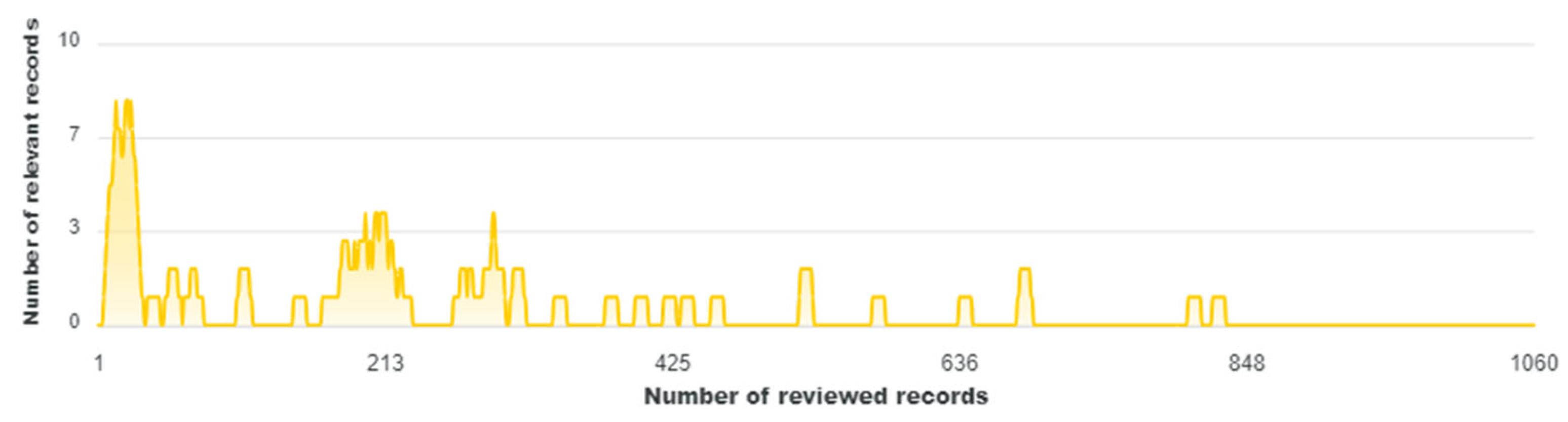
Figure 2.
Number of relevant records identified using ASReview (Source: ASReview).
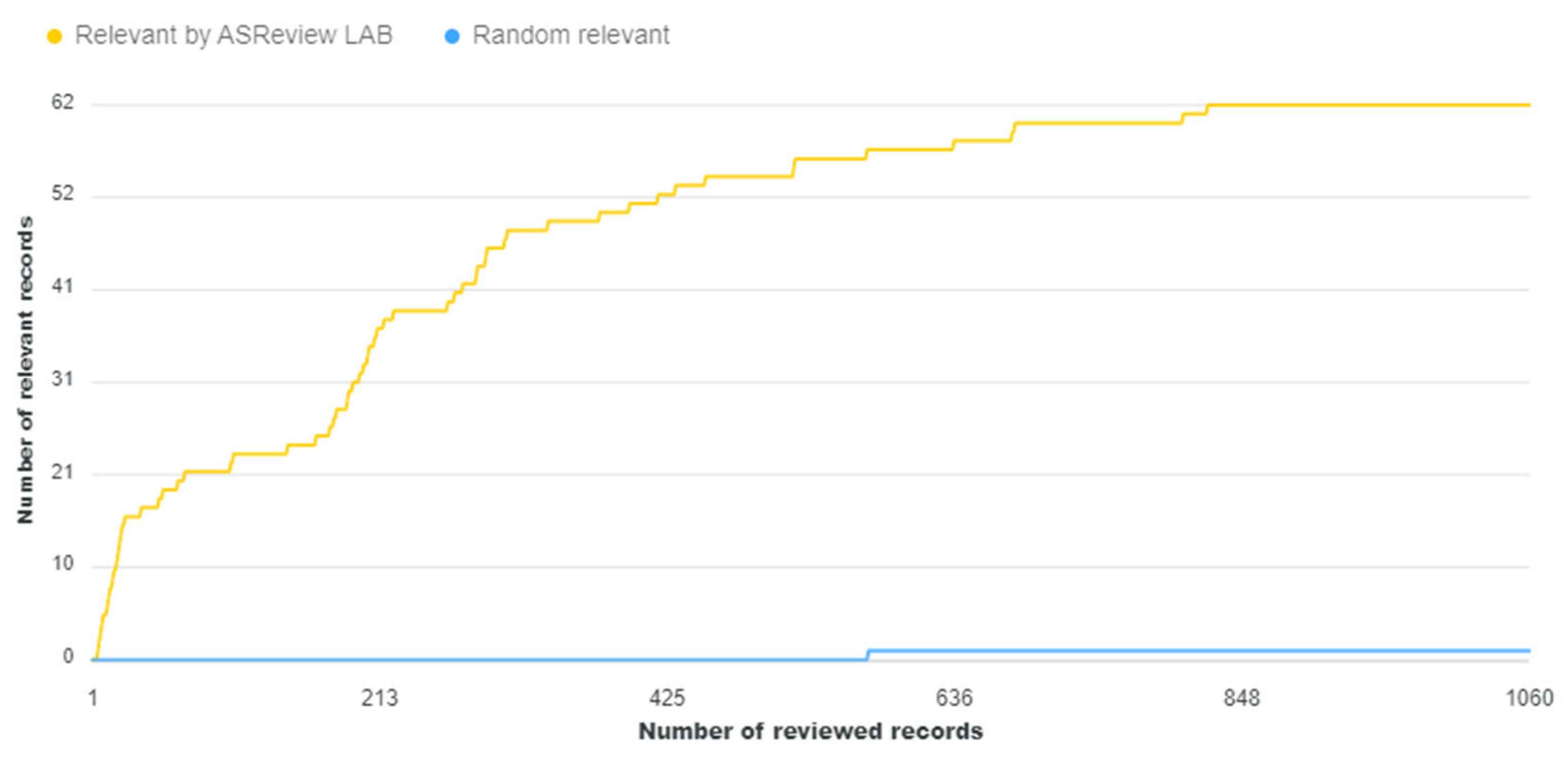
Figure 3.
PRISMA 2020 flow diagram for this review [11].
Figure 3.
PRISMA 2020 flow diagram for this review [11].
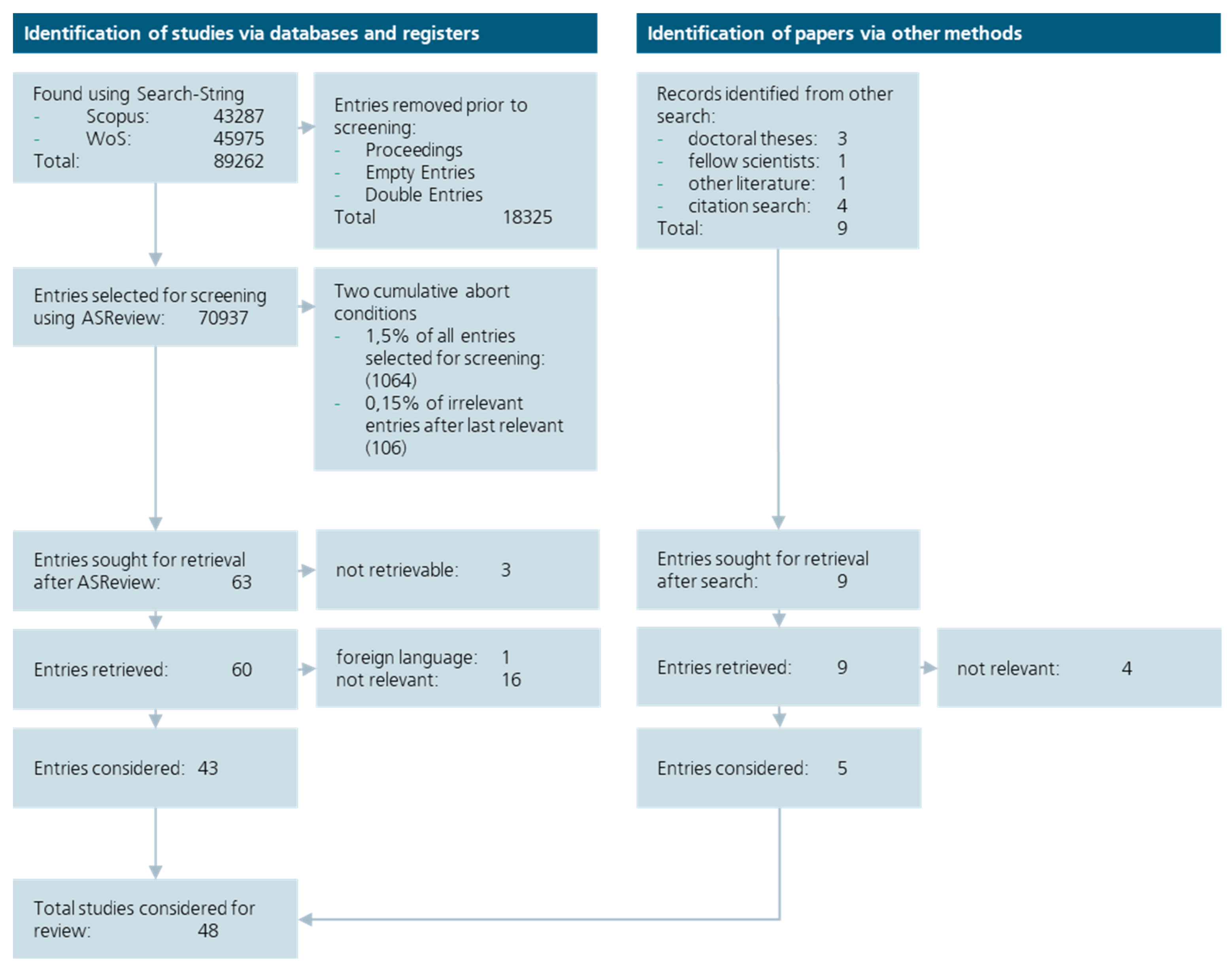
Figure 4.
Method assessment overview.
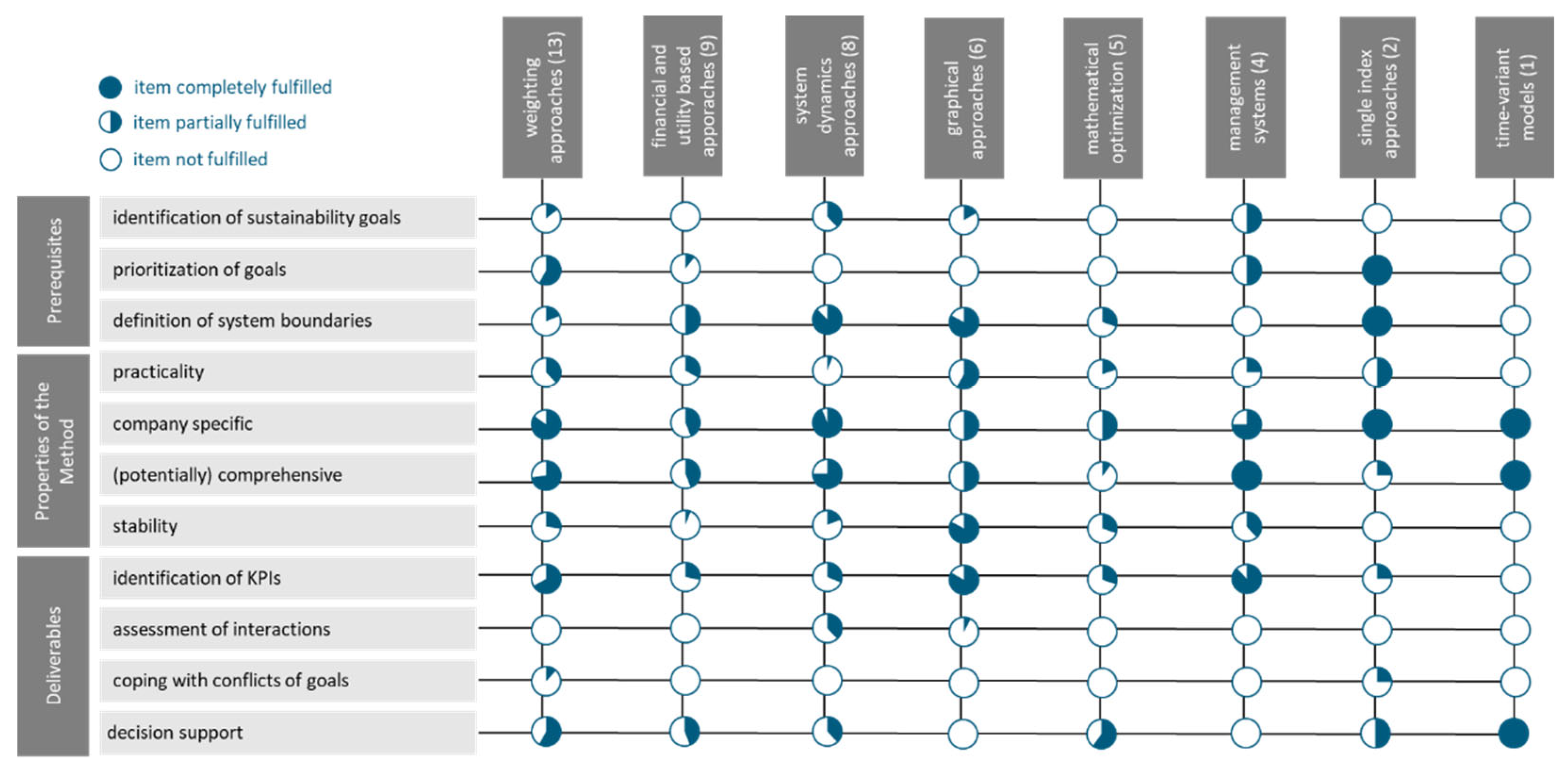

Table 1.
Research matrix.
| Analysis and coping |
Interaction and interdependencies |
Pillars of sustainability |
Within the factory |
|---|---|---|---|
| analy* | conflict* | Sustainab* | Compan* |
| evaluat* | interact* | environm* | Manufacturing* |
| assess* | interdependenc* | ecolo* | Factory |
| cope | synerg* | soci* | Production* |
| coping | goal* | ||
| deal | |||
| dealing |
Disclaimer/Publisher’s Note: The statements, opinions and data contained in all publications are solely those of the individual author(s) and contributor(s) and not of MDPI and/or the editor(s). MDPI and/or the editor(s) disclaim responsibility for any injury to people or property resulting from any ideas, methods, instructions or products referred to in the content. |
© 2024 by the authors. Licensee MDPI, Basel, Switzerland. This article is an open access article distributed under the terms and conditions of the Creative Commons Attribution (CC BY) license (http://creativecommons.org/licenses/by/4.0/).
Copyright: This open access article is published under a Creative Commons CC BY 4.0 license, which permit the free download, distribution, and reuse, provided that the author and preprint are cited in any reuse.


