

Submitted:
19 December 2023
Posted:
20 December 2023
You are already at the latest version
Abstract
In recent years, many cities throughout the world are facing the impact of last-mile logistics and the resulting rise in urban traffic and pollution: effects on the environment have been curbed by these dynamics. Urban traffic has a considerable impact in terms of noise emissions, road safety and air pollution: hence, both public and private parties shall undertake innovative solutions for reducing the negative effects of last-mile logistics and improving their operational effectiveness. This study aims to provide a systematic literature review on environmentally sustainable last-mile logistics. The main contributions of this paper are as follows: (1) exploring and analysing the existing literature on last-mile logistics, with a focus on various types of sustainable measures implemented by companies, governments (mainly local) and supra-national institutions; (2) clustering existing studies into five categories (i.e., agents’ preference and choices, shared logistics, stakeholders, studies on vehicles, and policy and decisions) clarifying the implications of the public economics analysis; (3) identifying the gaps and limitations of the existing literature and proposing potential issues for future research insights. The review of the literature reveals that the majority of recent studies have been based on engineering and urban planning approaches. Costs and benefits of last-mile logistics are researched with a public economics focus, gathering details from the different papers, starting from the business studies to the technology-oriented ones. This study aims at detecting the different topics and policies discussed in the literature and suggests how to incorporate them in creating new measures and policies or revamping current ones. Although the initial corpus was 583, only 108 papers were ultimately chosen for the review, since public economics studies were not thoroughly explored: following the results of this work, the topic has significant scope for further study.
Keywords:
last-mile logistics
; systematic review
; urban freight transports
; active transport
; transport policy
; sustainable mobility.
1. Introduction
Urban mobility research has grown significantly over the past years. Research topics range from private and public means of transport to shared logistics applications, from the policy claims of local authorities and the supra-national institutions to the stakeholder’s behaviour and inclinations. Urbanization is one of the main factors driving this growing tendency: by 2050, 70% of people and 90% of GDP will be imputable to urban areas (United Nations, 2018). The need to curb pollution and develop more sustainable forms of growth has become increasingly urgent. According to International Energy Agency (2021), the transport sector, which is the second most polluting industry, produces 25% of the total global Green House Gases (GHGs), 75% of which are related to road transport. As a result, all the efforts to decarbonize logistics are now essential to addressing environmental externalities, such as noise pollution and road safety as well as climate change.
Before the COVID-19 outbreak, Marmiroli et al. (2020) pointed out that just-in-time delivery and internet shopping were increasing the use of freight vehicles. Although the COVID-19 pandemic's limits on movement and activity led to a 57% fall in the world's oil demand in the first quarter of 2020, global transport emissions rose by 0.5% compared to those for the same period in 2019 (IEA, 2020). Urban deliveries became essential in areas where governments imposed strict restrictions on people's movements (e.g., France, Ireland, Italy, Spain, and USA), allowing them to use specific services only at home (e.g., food and groceries delivery). Additionally, even in the absence of restrictions, a number of retailers or supermarkets expanded their selection of home delivery services: according to Figliozzi and Unnikrishnan (2021), house deliveries of goods and food soared by 500% during the first pandemic months, making private services necessary overnight. Furthermore, the necessity to consider enhanced health protection procedures has given rise to new concerns including measures such as reduced capacity per vehicle - in order to allow physical distancing-, improved sanitation for public transportation, rear-door boarding, and design interventions (i.e., screens between seats, contactless sensor, hand sanitisers, and marked seats) (Budd and Ison, 2020; Tirachini and Cats, 2020; Vitrano, 2021).
The issue of sustainable development of the service determined increasing differentiations and subtopics in the literature, thus making urban mobility a research area spanning many disciplines. Engineering is the most developed field, with applications in technology development, programming, and optimization of vehicles and controlling systems; when electric vehicles are used for services, battery optimization and renewable use for charging are also investigated. On the other hand, research on urban mobility is becoming more and more popular in economics and management research, which focuses on operation management as well as transport and environmental economics. The legal field considers data compliance and the different kind of contracts being created to implement policy and strategies.
This review aims to investigate the state-of-the-art to the last leg of the supply chain (i.e., the last-mile logistics) taking place in the urban context. As already mentioned, the analysed matter encompasses several fields (e.g., engineering, economics, environmental studies, transport science, etc.) but, although we have not a priori limited the scope of our research, the point of view presented in this review will be mainly economic. Economic aspects are relevant to last-mile logistics as they heavily influence agents' choices in joining specific services, accepting technological changes for sustainable purposes, and also guiding regulatory decisions taken by local administrations. Moreover, considering the relevance of new services' environmental sustainability, we also shall translate into economic values the weight given to "sustainable" aspects by different agents.
The topic presents several aspects that need further study and, particularly from an economic point of view, it is difficult to narrow down on one specific aspect as many interconnections are present. The scope of this review is to detect the main issues discussed in the literature and under which approaches, to find out gaps worth to be developed in the future.
The remainder of the paper is organized as follows: Section 2 will be dedicated to describing the methodology used to perform the systematic literature review; Section 3 will present the topics detected by our review and, in particular, will focus on the discussions of the main findings relevant for economic research; finally, Section 4 will draw final conclusions and future insights.
2. Methodology
Last-mile logistics has a high impact on everyday life of consumers, delivery companies, and the entire society for carbon emissions. Since transportation in general is one of the most polluting sectors in terms of GHG emissions and plays a significant role in the energy transition process, we chose to focus attention primarily on environmental sustainability, although the concept of sustainability is arguably quite broad and may encompass other dimensions (e.g., economically or financially sustainable).
In order to select articles to be included in the review, we adopted a 3-steps protocol, as suggested by Lagorio et al. (2016): first, we selected a preliminary set of papers addressing our topic of interest and applied our inclusion/exclusion criteria; then, we refined our pool on the basis of titles and abstracts; finally, we have further refined the selection of papers on the basis of the full-text review.
2.1. Step 1: Inclusion/Exclusion Criteria
The first step was the identification of a preliminary set of scientific papers addressing our topic of interest. Then, we selected keywords to be used to search in abstracts, titles, and keywords and we conducted keyword research in the academic search engine Web of Science. The keywords chosen were sustainable urban freight transport, sustainable last-mile delivery, and sustainable last-mile logistics. Our preliminary pool considered 583 articles and was the result of two separate extractions: one performed in July 2021 and the other in November 2022. In merging the results of the two extractions from Web of Science we checked for duplicates and eliminated them.
Then we proceeded to refine our set according to the following selection criteria: year of publication, language, type of publication – whether a paper had been published in a scientific peer-reviewed journal.
We decided to consider only papers published from 2017 onward, as we detected a strong increase in interest for the topic starting that year. Moreover, considering the specific issue we are analysing, it can be fairly assumed that most recent papers are more likely to include in their analysis a setup that is still relevant with respect to current habits and available technologies.
According to the language criterion, which prescribed considering only papers written in English in order to make accessible the work to the majority of the scientific community, three articles were excluded (i.e., two written in Spanish and one in Russian).
Finally, we eliminated all the results which were published in sources different from scientific journals (mainly, conference proceedings) to be sure of considering only well-established contributions in scientific literature, published after a structured peer review process. As a result of this reiterated elimination process, our pool of articles was composed of 365 papers.
2.2. Step 2: Selection Based on Title and Abstract
In the second step, we read the list provided by Web of Science, considering title and abstract of the record. We discarded 204 papers that, despite automatic inclusion performed by Web of Science, were related to topics beyond our field of interest. These papers were either out of scope (i.e., the wording misled the automatic research) or their focus was different from urban last-mile logistics. Examples of works excluded from the topics covered were those which dealt with rural last mile or private vehicles. Moreover, we decided to exclude papers that were reviewed themselves.
2.3. Step 3: Selection on Full Text
Finally, we read the full text of the records to exclude articles that lacked an economic perspective on the topic addressed in this review. At the end of the selection process, we ended up with 108 papers dealing with our research question.
We summarized the results of the exclusion process in Figure 1. As expected, a noticeable drop in the number of articles was observed in the first step when we applied the three exclusion criteria (i.e., year, language, and type of publication).
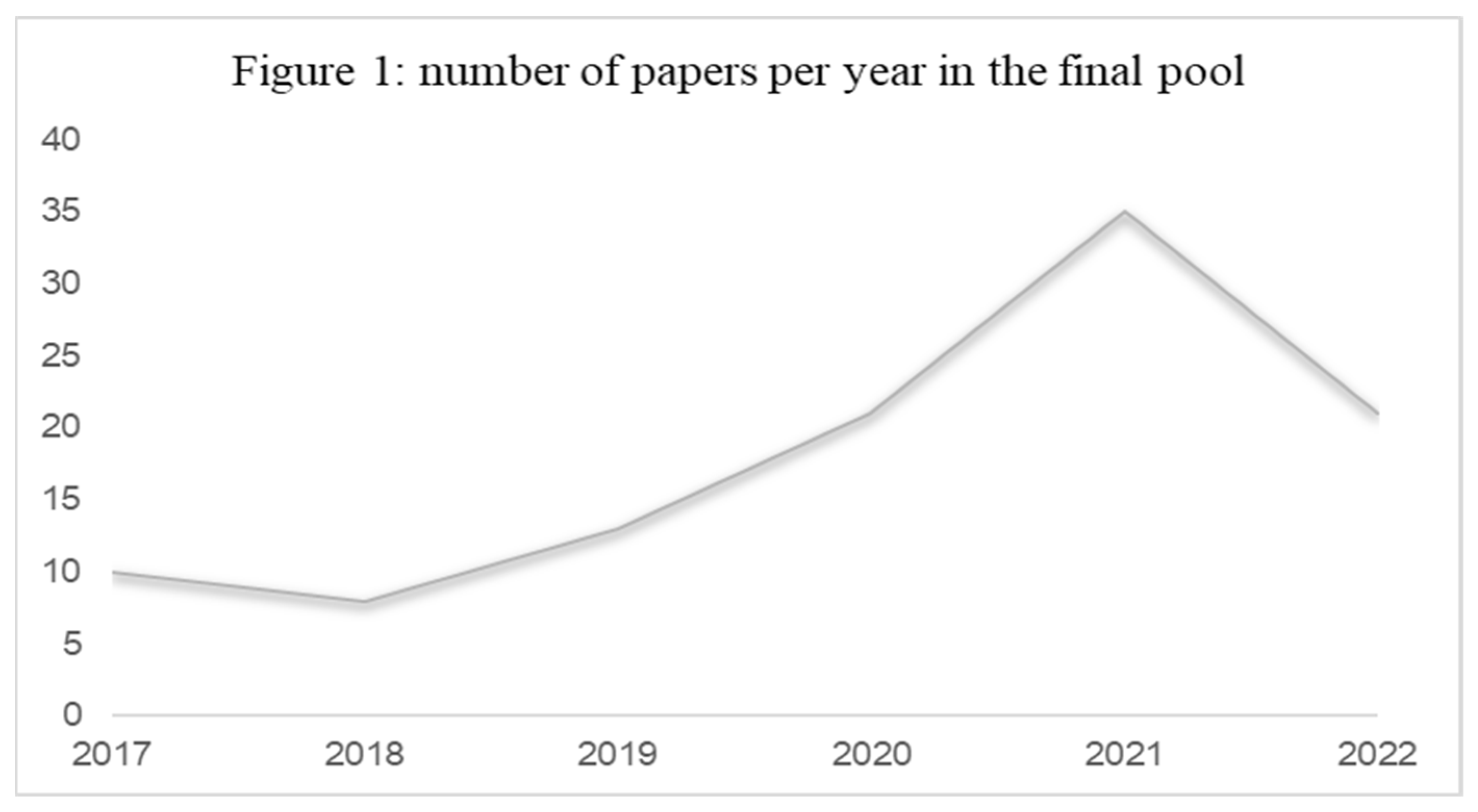
In the following paragraphs, we briefly describe the most interesting features of our selected articles. The final sample of papers covered a timespan of six years from 2017 to 2022 and, as shown in Figure 2, the scientific interest in urban last-mile logistics has increased over time. Furthermore, given that the interest in urban last-mile logistics encompasses many disciplines, selected works came from scientific journals covering different research areas.
3. Topics
To better discuss the evidences emerging from the systematic review, we decided to cluster the 108 selected papers into five main categories that – after the reading – seem to represent the most discussed topics with an economic perspective. We identified the categories:
- (1)
- Agents' preferences and choices. This cluster collects works suggesting models analysing or predicting choices of individuals, firms, and other relevant subjects, evaluating if and when to opt for last mile logistics, but also how agents influence the development of last mile services;
- (2)
- Shared logistics. The category represents one of the most popular topics in logistics research, focusing on the sharing economy of the last leg of the process;
- (3)
- The role of stakeholders. Differently from "Agents' preferences and choices", economic modelling has less consideration in the discussion, while the role of potential users, promoters, and society has a distinctive analysis;
- (4)
- Studies on vehicles. The section represents an extensive stream of literature, which represents the effort that – especially, from an engineering perspective – is made to develop a more sustainable last-mile logistics both from an economic and environmental point of view;
- (5)
- Policy and decisions. Papers clustered in this section deal with the role of public authorities and decision-makers in handling last-mile logistics through public investments and private-public agreements. Suggested incentives schemes and policies, where present as the main topic of the paper, will be reported in this section.

Table 1.
Authors’ elaboration on the review dataset.
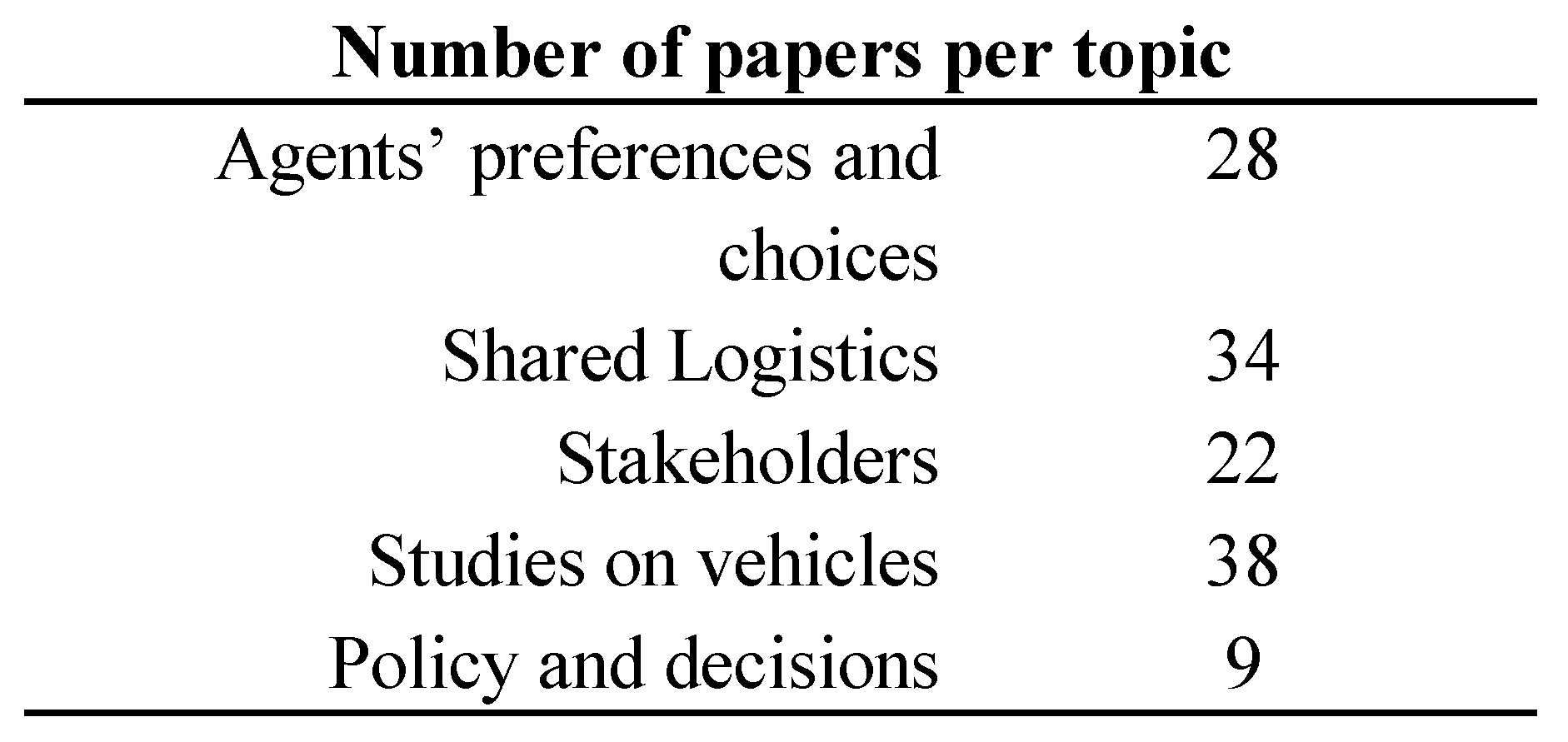
It might be argued that the same paper could touch on topics covered in more than one of the five clusters. As a result, 23 articles considered were included in more than one cluster.
3.1. Agents’ Preferences and Choices
3.1.1. Consumers’ Side
The disruptive growth of e-commerce is frequently linked to an increase in the number and frequency of deliveries.
Consumer choices and preferences on product shipment are usually influenced by multiple factors: delivery time, location, and price which is usually regarded as the most important attribute for consumer choices. These features are often investigated using stated preferences surveys, even though it may exist a risk of inconsistency between stated preferences and the actual behaviour of people due to social judgement (Ignat and Chankov, 2020). In their choice-based conjoint experiments, Rai et al. (2019) find that almost one-third of consumers have a neutral attitude towards sustainability in last-mile logistics and, in general, consumers prefer the delivery option which guarantees orders are delivered by the very next day to an address of choice on regular office hours.
Nevertheless, there is evidence that providing additional information on environmental and social impacts of last-mile deliveries makes consumers more likely to choose more sustainable delivery options (Ignat and Chankov, 2020; Thomas et al., 2022). Ignat and Chankov (2020) investigate whether e-commerce customers change their preferred delivery option after receiving additional information on its sustainability using a survey based on five sustainability factors (i.e., delivery cost, delivery time, location of the delivery, drivers’ working conditions, and CO2 emissions). Likewise, Thomas et al. (2022) find that providing information on emissions and environmental impacts of delivery is an effective strategy to alter preferences toward more sustainable solutions without hampering profit margins as it happens with price incentive strategies.
The use of non-financial incentives (i.e., information messages, order of delivery options, social media, and social norms) is analysed by Rai et al. (2021). In their study, presenting an informative message to consumers help them to grasp the environmental benefits of opting for a slower delivery alternative and to bridge the time gap between the moment of choice and the one in which its impacts are manifested. However, social media and social norms also seem to positively influence the choice in favour of a “greener” delivery option (Rai et al., 2021).
Nonetheless, it must be considered that individuals who differ in socioeconomic characteristics and sensitivity to environmental issues frequently show heterogeneous preferences. Different categories of consumers may present different attitudes towards the delay of deliveries to increase sustainability, or to whether it should be an individual (i.e., of the consumer) or a collective responsibility to require a more sustainable delivery service (Caspersen and Navrud, 2021).
Furthermore, consumer preferences may also regard the way deliveries are performed, especially with regards to the introduction of disruptive technologies like automation. The introduction of automatic vehicles may radically change the delivery process as recipients will have different roles in the process (Kapser and Abdelrahman, 2020), but it might also offer interesting solutions for the main issues of urban logistics (i.e., urban congestion and transport emissions) (Polydoropoulou et al., 2022).
In conclusion, it is widely recognised that the COVID-19 pandemic further boosted e-commerce and produced changes in consumers’ preferences and habits. It is not clear, however, if the modified patterns will be temporary or stable in time. Wang et al. (2021) argue that the persistence of those mutations will be erratic for different categories of consumers (e.g., prior adopters, temporary and permanent new adopters, and non-adopters) and different categories of products (e.g., grocery, food, home goods, and other goods).
3.1.2. Firms’ Side
The commitment of actors involved in last-mile logistics and the availability of adequate tools to evaluate options available are crucial to make processes and operations more efficient and sustainable.
Melkonyan et al. (2020) assess the sustainability of three delivery schemes with a focus on food products. These goods typically require frequent and fast deliveries and are characterised by low volumes which prevents consolidation. The results show that the distribution channel must be chosen according to the consumer group to be reached.
Recently, crowd logistics gained considerable relevance among delivery options, as will be discussed in detail in the following section. Based on a theoretical model of a technological-organizational environment, Bin et al. (2020) study various factors that affect the willingness of companies to implement this type of solution. However, retailers are frequently not directly involved in freight transportation, but they entrust logistics activities to professional logistics service providers as long as the reliability of the delivery service is guaranteed both in terms of quality and time (Mangano et al., 2021). With respect to the latter aspect, retailers often face the challenge of complying with shorter as possible lead time for their orders without having (full) control of some factors such as urban dynamics or, in case the delivery activities are outsourced, delivery drivers (de Kervenoael et al., 2020). On one hand, there are retailers who may be willing to pay a higher cost to benefit from a more reliable service and reduced stock (Mangano et al., 2021); on the other, there are independent delivery contractors who, if properly involved, can inform about conditions and ways to create sustainable value in retail logistics (de Kervenoael et al., 2020).
The insight of the section is that, since consumers and distributors are likely to have different preferences towards how the delivery should be performed, and are subject to different types of cost, it is fundamental to integrate their perspectives to pursue overall efficiency, and consequently sustainability, of delivery processes. Galkin et al. (2022) find that end-consumers incur monetary and non-monetary costs for e-commerce and propose a generalised distribution utility index that balances the losses of customers against profits created for the distribution system.
3.2. Shared Logistics
Sharing services are getting more and more competitive, particularly in sustainable last-mile logistics. Strulak-Wójcikiewicz and Wagner (2021) pointed out that shared or collaborative logistics encompasses several solutions ranging from crowd logistics – particularly, crowd shipping – and to the potential for businesses to share vehicles and/or distributional infrastructures. Rai et al. (2017) define crowd logistics as “an information connectivity enabled marketplace concept that matches supply and demand for logistics services with an undefined and external crowd that has free capacity with regards to time and/or space, participates on a voluntary basis and is compensated accordingly”.
The crowd deliveries are made with full vehicles capacity reducing the number of travels, whether couriers use their private vehicles, as reported by Rai et al. (2017), or public transportation, as pointed out by Gatta et al. (2019a) and Gatta et al. (2019b), creating the possibility of new income for non-logistics operators. Thus, it results in the implementation of monitoring and control systems, but it also lowers emissions and prevents the development of new traffic. Guo et al. (2019) warn about the risk of distortions if participation is motivated exclusively by economic incentives, losing the benefits of exploiting ex-ante planned trips.
Bajec and Tuljak-Suban (2022) showed that no scheme directly and solely promotes ESG goals through the analysis of various crowd-shipping models: the use of private vehicles for share logistics frequently results in an increase in environmental pollution. The lack of control over individual drivers not only causes negative impacts on the environment but also decreases quality for the end customer. Furthermore, Pourrahmani and Jaller (2021) stated that crowd shipping may support sustainability by using excess transportation capacity for freight deliveries without adding a new trip to the network, creating also cost reduction and infrastructural development for the service. On the other hand, Correia et al. (2021) demonstrated that the overall estimated cost is still quite high compared with the traditional supply chain. Nevertheless, Ghaderi et al. (2022) made clear that crowd shipping is evolving into a desirable response to consumers’ growing expectations for the effectiveness and sustainability of the service.
Last-Mile as a Service (LMaaS), Mobility as a Service (MaaS) or Freight as a Service (FaaS) – depending on distance and type of parcel considered – are promising concepts for transport systems based on digitalisation and integration among freight and passenger. MaaS optimise the environmental impact of the travels, increasing the resiliency by offering additional system and reducing the costs of the service, as demonstrated by Correia et al. (2021) and Pira et al. (2021).
The implementation of innovative collaborative logistics is not straightforward and may require a transition period in which crowd-sourced and traditional delivery networks coexist (Guo et al., 2019). According to Frehe et al. (2017), private companies typically develop crowd logistics during the seed or start-up phase. The potential for public-private investments and public incentives, as suggested by Bruzzone et al. (2021) and Bajec and Tuljak-Suban (2022), are crucial success elements for sharing services. However, as pointed out by Gatta et al. (2019a), crowd logistics services have a negative net present value, therefore the potential for public involvement could play a significant role. Anyway, as a consequence of the SARS-CoV-2 pandemic, it may be reasonable to expect a decreased propensity to accept the reduction of the space available on public vehicles in favour of freight transport Bruzzone et al. (2021).
A freight tram system can minimize the usage of commercial road vehicles, which reduces congestion, accidents, air pollution, noise level, and operational costs, as shown by Vajihi and Ricci (2021). However, drawbacks to employing a tram as a freight transport are noteworthy, mainly because the route is fixed and wagons need to be customized. A crowd shipping service was proposed by Gatta et al. (2019a) for last-mile B2C deliveries in which metro users pick up/drop off items in automated parcel lockers (APLs) situated within metro stations or in their neighbourhoods. According to the simulation, they find a negative net present value if no public incentives converting the reduction of negative externalities for the whole society are guaranteed.
The use of facilities that carry out the process of consolidation of goods might efficient last-mile logistics and reduce the externalities created. Urban Consolidation Centers (UCCs) are facilities in the city’s suburbs, where various suppliers' freights can be consolidated and delivered into the city using a two-tier system: trucks make deliveries from distribution centres to UCCs, then smaller vehicles, make deliveries to the final customers (Dreischerf and Buijs, 2022; Perboli et al., 2021). According to Dreischerf and Buijs (2022), even if it hasn’t been empirically shown yet, UCCs decrease the number of vehicles flowing in cities, increasing the load capacity of vehicles, and reducing traffic, pollution, and safety problems. UCCs, on the other hand, entail expenses including personnel, vehicle, and material handling expenses. Dreischerf and Buijs (2022) pointed out that the UCCs present cross-subsidization issues because of the lack of a single impact on the logistical procedures, expenses, and service standards of suppliers. The presence of UCCs has key implications for policymakers, influencing the existing logistics processes of actors and stakeholders. Nocera and Cavallaro (2017) studied four different logistics scenarios and their quantification in terms of the cost of wheel-to-tank emissions: the use of EVs for deliveries combined with UCCs coupled with access restrictions to city centres results in savings of about €10.000 when compared to the base scenario that includes no UCCs at all.
UCC’s shortcomings can be decreased by using lighter and more adaptable methods consolidation methods such as micro-depot and mobile access hubs, as stated by Faugère et al. (2020) and Rosenberg et al. (2021). Combining the lockers with crowd logistics, Fessler et al. (2022) stated that the use of non-dedicated public transport with parcel lockers and micro-depots represents an opportunity that potentially mitigates last-mile logistics inefficiency. Micro-depots are urban facilities that logistics providers use to perform different operations: loading or unloading, sorting, and warehousing items. Rosenberg et al. (2021) integrate a network of micro-depots used by various logistics service providers with parcel lockers that can be deployed either in the micro-depot or in key locations throughout the city. According to Ghaderi et al. (2022), the use of parcel lockers in a congested shipping network enables quicker trip diversions and more geographic coverage, even if it results in more movements for every shipment, which could result in more damage to the packages and more insurance costs. Reyes-Rubiano et al. (2020) suggested a multi-depot routing problem that considers sustainability from three perspectives: economic, social, and environmental. They highlighted that actions taken in favour of sustainability may conflict with the other two.
3.3. Stakeholders
We have discussed various measures and actions to assess the issues related to sustainable urban logistics. Yet, we cannot fail to observe that to boost the success of such initiatives they must be feasible in terms of resources and must take into consideration the multiplicity of stakeholders involved. Stakeholders are often characterised by different needs and points of view. Therefore, identifying stakeholders’ different perceptions on policies and existing trade-offs in implementing sustainable logistics solutions can contribute to enhancing the success chances of a project (Amaya et al., 2020). As a matter of fact, many sustainable last-mile logistics initiatives fail to reach their potential, despite the efforts made, because of the lack of stakeholders’ support and engagement (Marcucci et al., 2017). In the previous section, for example, it has been mentioned often UCCs struggle to survive. Dreischerf and Buijs (2022) suggest this might happen because the introduction of a UCC affects various actors along the distribution chain and impacts them differently with respect to costs, processes and services provided, depending on how logistic activities were carried out before the introduction of such a critical infrastructure.
There are several types of stakeholders involved in urban freight and analysing the reasons and objective they may have to participate in city logistics is crucial also to improve the interaction between them (Katsela and Browne, 2019). A general distinction is between private and public stakeholders (Rześny-Cieplińska and Szmelter-Jarosz, 2020). Nevertheless, there might be stakeholders not directly involved in logistics operations who are nonetheless affected by them, that is the case of citizens whose perception has been frequently neglected (Amaya et al., 2020; Kijewska et al., 2022).
A common way used to get a better understanding of stakeholders’ priorities is through Freight Quality Partnerships (FQPs). FQPs are forms of cooperation between many stakeholders that aim at setting up meetings and workshops to present problems relating to freight transport and work out consensual solutions (Kijewska et al., 2021b). The integration of complementary planning support tools can be helpful. Multi-Actor Multi-Criteria Analysis (MAMCA) is the method suggested by Lebeau et al. (2018) to foster greater involvement of stakeholders in the decision-making process of urban logistics. The MAMCA methodology allows public authorities to identify the priorities of the stakeholders and, on this basis, guide the debate towards an integrated and pragmatic discussion of the best strategies to be undertaken.
In Paddeu and Aditjandra (2020), the aim is to explore the use of a participatory approach different from MAMCA in Stakeholder Engagement Workshops to address current and future city logistics issues. The Stakeholder Engagement Workshops are composed of four steps: stakeholder analysis, problem analysis, solution analysis, and final summary and conclusions. The choice of a participatory approach responds to the willingness of providing stakeholders with a framework to discuss problems and related causes and effects, and then co-design a set of possible solutions considering drivers and barriers.
The behavioural components of decision-making matter greatly in designing and implementing effective urban logistics measures as was already discussed in the section on agents' preferences and choices. Engagement is crucial to enhance the acceptance of new policies (Paddeu and Aditjandra, 2020). Marcucci et al. (2018) propose gamification as a tool to support the adoption of sustainable behaviours and encourage stakeholder engagement. Based on the case study in the Netherlands, Tolentino-Zondervan et al. (2021) argue that behavioural factors, such as norms and attitudes, might play a significant role in pushing individuals and organizations along the supply chain to engage in sustainable last-mile logistics.
Building effective interactions among stakeholders along all the stages of the project's development can be useful to align objectives and avoid conflicts, although this factor is often overlooked. Knoppen et al. (2021), for example, point out the idea of cognitive consensus referring to the commonalities in stakeholders’ conceptualisation of fundamental issues that can support the decision process. They argue that “cognitive consensus” can be a powerful tool to broaden stakeholders’ perspectives on freight policies, mitigate conflicts and boost trust and cohesion among stakeholders.
The relevance of stakeholders’ engagement and interaction appears evident considering how they can help coordinate the different needs and enhance cooperation in actual city logistics initiatives, especially in shared logistics solutions which, by construction, involve several actors (Paddeu et al., 2018; Rześny-Cieplińska and Szmelter-Jarosz, 2019; Szmelter-Jarosz and Rześny-Cieplińska, 2020). Nevertheless, Bjørgen et al. (2021) investigate whether or not stakeholders are actually given enough power to affect the outcome in the planning of urban freight initiatives.
Finally, it is important to keep in mind that there may be other important factors that affect the success of sustainable urban logistics initiatives (e.g., durability and local context specificities). Durability refers to the capability of a project to generate, monitor, and preserve, over the longest possible time horizon, its positive effects in improving the quality of life for all the inhabitants of a city (Kijewska and Jedlinski, 2018). The second aspect concerns the tendency, or rather the temptation, to “import” successful city logistics initiatives from one urban environment to another. Context-specific characteristics should never be overlooked for what might work in one city or project might not be elsewhere (Amaya et al., 2020).
3.4. Studies on Vehicles
The decisions to exploit Internal Combustion Engine Vehicles (ICEVs) or Zero- and Low-Emission Vehicles (ZLEVs), light or heavy vehicles, and route optimization will play a crucial part in the decarbonization of the logistics industry. The above-mentioned decisions become even more relevant because the current study focuses on the final mile in an urban setting with stringent traffic constraints.
In particular, the adoption of light electric freight vehicles (LEFVs) such as cargo bikes and tricycles are a key frontier for the development of last-mile logistics toward increased sustainability from an environmental and social perspective. According to Melo and Baptista (2017) and Pahwa and Jaller (2022), LEFVs have several advantages over other means of transport, including lower distribution costs, emissions and noise, minor fuel cost, lower road occupancy, and ease of access and parking, which is a key drawback for delivery trucks. These advantages also result in fewer congestion and accidents, increasing road safety. Al-dal’ain and Celebi (2021) pointed out several studies assume constant transportation costs, in order to implement optimal replacement policy easier, however this assumption is relatively ill-defined and could lead to unrealistic solutions for real-world problems. On the other hand, as demonstrated by Melander and Nyquist-Magnusson (2022) and Pahwa and Jaller (2022), LEFVs have a number of drawbacks that need to be studied, including the range, battery characteristics (i.e., high price and high procurement costs), and, most significantly, the accessibility of public charging infrastructures. Although Iwan et al. (2021) point out that the potential cost of employing an electric fleet will decrease, at the moment it still remains a barrier for logistics providers.
Rudolph and Gruber (2017) identify four main market segments for commercial cargo cycles in last-mile delivery: postal services, courier service, parcel service, and home delivery. The uptake of cargo bikes and tricycles by delivery companies is influenced by different crucial factors that push the switch from ICEVs. The reason is that LEFVs are a profitable alternative for making last-mile deliveries more efficient in urban centres (i.e., lower operational costs and reduce total cost of ownership), but also because of the versatility of movements through densely populated cities and the lower environmental impact (Rudolph and Gruber, 2017; Gonzalez-Calderon et al., 2022; Narayanan et al., 2022).
Comparing vehicles based on the cost of daily operations, trucks are the most expensive and cargo bikes are the most economical. The average distance travelled by freight bikes is 50 km, compared to the trucks that travel 160 km per day. Light trucks become the most cost-effective mode of transportation when measured in kilometres, while the cargo bike is the most expensive (Fraselle et al., 2021). Pérez-Guzmán et al. (2022) pointed out that the most efficient business models to activate cargo cycles are on-demand currier services consisting of pick-up and delivery requests and business-to-business delivery, allowing consolidation, route optimization, and last-mile deliveries in urban areas.
de Mello Bandeira et al. (2019) evaluate an intermodal postal parcel delivery system in which deliveries are conducted while walking and assisted by LEFVs to move extra weight to designated locations (such as mobile depots) where they can be reloaded into mailbags. As a result, before moving to ZLEVs, there must be a transitional period in which the coexistence of ZLEVs and ICEVs must be handled effectively. The coexistence period needs to be managed carefully to reduce the possibility of cannibalization between conventional and green business models, which could lower the quality of the service (Brotcorne et al., 2019; Perboli and Rosano, 2019). According to Melo and Baptista (2017) only 10% of traditional vans should be replaced by cargo bikes because of the distribution network effectiveness reduction. McLeod et al. (2020) proposed a model where deliveries weight 5kg or less are performed by on-foot porters using wheeled bags, trolleys, or cycle couriers, implementing both environmental and financial conditions. In fact, according to their simulation, total cost reductions range from 34% to 39% (depending on whether deliveries are made by), along with a decrease in parking time and in CO2 and NOx emissions.
The use of electric vehicles for commercial transport and distribution is still relatively unexplored, according to Ehrler et al. (2021), thus further real-life trials and pilot projects will be essential to comprehend the needs and potential applications. Iwan et al. (2021) evaluated an electric pilot in Poland and showed that the service was not hindered by the delivery effectiveness or the battery’s lifespan. However, the availability of charging facilities and the city’s electric efficiency enlighten the lack of grid capacity for entire fleets (Woody et al., 2022). Furthermore, Woody et al. (2022), literature has also shown that electrifying fleets can reduce GHG emissions by 42–61% when compared to diesel alternatives in urban environments in the US, 69% in China, and just 10% in Europe.
According to Gružauskas et al. (2018), utilizing technologies such as automation might achieve a competitive advantage over time by balancing sustainability and cost-effectiveness. Autonomous vehicles can aid in lowering fuel consumption by choosing the most cost-efficient route and cutting down working time. In the pilot studied, Gružauskas et al. (2018) show a cost reduction of 5% and CO2 emissions cut of 20%. Route optimization can increase delivery efficiency and sustainability, in addition to the reduction of trip distance and delivery time. The ideal route for a mixed fleet was demonstrated by Pilati et al. (2020) because EVs may enjoy free access to metropolitan areas where circulation is restricted by entry fees and time limitations. On the other side, EVs require more time to charge and have shorter battery life. According to Kapser and Abdelrahman (2020) findings, people have a neutral view of the use of autonomous vehicles as a delivery option, which is consistent with expectations based on earlier studies on the acceptability of these vehicles.
3.5. Policy and Decisions
Urban freight transports rely on local infrastructures, rules and policies that have the power to encourage or limit innovations and changes in agents’ behaviour. Considering the presence of externalities (both positive and negative), the intervention of the public entity is not only desired but also necessary to achieve efficient results. Sustainable urban freight is strongly demanded by national and supra-national institutions: European Union implemented Directive 2014/94/EU on the deployment of infrastructure for alternative fuels, where electricity is going to act a main role in the transportation sector. On the other side, the EU also supported financing programs such as Fit for 55, which aims to reduce GHG emissions by at least 55% by 2030. How public authorities are managing these aspects - also trying to evaluate how effective the management is in terms of achievements - seems to be particularly relevant.
The systematic review of the literature shows that the verification of the policy and regulation aspects are reported in few studies, and mainly linked to the analysis of case studies rather than to a theoretical analysis of the theme.
The focus can be on the evaluation of carbon emissions determined by specific services. Allen et al. (2021) studied the impacts of on-demand meal deliveries in London, concluding that these kinds of deliveries are much more relevant in terms of impacts than other traditional forms of transport: this study, also impacts in terms of soil occupancy and interactions with other users (e.g., pedestrians) are considered. Policy implications show that to promote the use of bicycles instead of more pollutant vehicles like e.g., mopeds, specific investments in dedicated lines shall be undertaken.
Similar object, but with a different research question, is investigated by Bjørgen et al. (2021). The authors carried out a questionnaire in Norway regarding the use of e-groceries, matching it with the habits of personal travelling of the respondents: results show that the use of e-groceries impact on other travels, making them more sustainable (e.g., on foot rather than by car since they do not need to carry heavy bags). Despite the sample is not representative of the Norwegian population, it shed light on an impact that shall be taken into account while making a cost-benefit analysis of specific services and, consequently, while adopting new policies. The authors also suggest the inclusion of stakeholders in the early stages of the planning of city measures.
Still considering the analysis of cases, Astrid Bjørgen (Bjørgen and Ryghaug, 2022) extended the analysis on the integration of urban freight transport in city planning, by looking at other cities in Norway. The analysis confirmed the previous finding on how stakeholder involvement is very relevant for the successful planning of services.
Also in Dixit et al. (2022) the role of externalities is highlighted, comparing the two cases of Gothenburg (Sweden) and Delhi (India). The findings of the study show substantial dissimilarities between the two cities and indicate city-specific research as a solution to adopt the best sustainable urban freight measures.
Despite the interest arising from the discussion of cases, external validity is a big issue for this kind of approach, especially when it is not possible to understand to what extent the results could be used to approximate behaviours in other contexts (e.g., for analysis based on value transfer techniques). The contribution of these studies, however, is still helpful in the initial phases, to detect which kind of wider analysis shall be performed.
Since the phenomenon is relatively recent - or, at least, recently the use of e-commerce and urban deliveries has become more relevant - the use of cases is widely justified, but a broader approach must be hoped for in order to be able to address the issue from a theoretical and political analysis point of view.
4. Conclusions
The scope of the work was to detect the main research paths connected to last-mile logistics, keeping as a critical issue the sustainability of the service from the environmental point of view. This aspect is considered widely relevant, as transports are one of the chapters on which to work more to complete the energy transition. Moreover, changing habits are making the last mile deliveries increasingly used and strategic for consumers, firms, and authorities.
In the analysis, we wanted to detect how economic issues are treated in the literature. The topic is widely covered by engineering studies aiming at making more efficient tools, vehicles, and systems for the functioning of the service. In this sense, the approach is more related to business studies than economics with a theoretical perspective.
Technology drives studies that consider specific innovations, such as online platforms for crowd logistics, automated vehicles, and drones. Technological improvement (i.e., routing optimisation, automated warehouse management systems) might help in decreasing operating costs, as innovations in business models and firm organization and operations, but currently presents specific barriers – mainly related to the coordination and harmonization of stakeholders’ interests – prevent a full realization of such innovations. The conglomeration of deliveries, such as competing companies’ parcels, crowd logistics, and Last-Mile as a Service, might represent performing schemes in order to decrease operating costs and negative externalities (i.e., environmental impact, and urban noise). The adoption of Zero- or Low-Emission Vehicles, mainly electric vehicles, is one of the most promising methods to reduce costs and environmental impact, but it suffers from several issues, such as purchasing costs of the vehicles and their technological limitations (i.e., battery, hydraulic tail, etc.). Implementing hybrid fleets seems to be the best solution at the moment, but this does not overcome the problem of evaluating the impact of electric fleets on the network. Even if we plan to power the fleets with renewable sources, the moment in which these are recharged is extremely important for assessing the real environmental impact of the electricity produced (evaluating the marginal emission factor of the technology produced at the specific time).
The prevalence of business approaches justifies the double interpretation of the term “sustainable”, which is often used as financially sustainable – with a private approach – rather than with an environmental meaning which subtends institutional concerns, related to public economics and policy approaches. What emerges from the review is a general lack of institutional perspective. This gap might be justified by the relative novelty of the topic, given in the lack of policy application results and datasets, that mainly moves engineering and urban planning studies. Several issues, however, call for a deeper analysis from the public economics side.
The first justification for the interest of public economics in this field is the presence of externalities, both negative and positive, on the emission side (e.g., GHG and noise). As shown by several studies, last-mile logistics is one of the main responsible for urban carbon emissions. The increase and the decrease of these externalities is dependent on the conditions set by local, government and supra-national authorities, and dedicated policies. The direct applications of Urban Vehicles Access Regulations (UVARs) or Low Emissions Zones (LEZs) are the main policy applied by local authorities in order to decrease city centre pollution. The implementation of such restrictions may also be an incentive for the conglomeration of deliveries among competing companies, because of the contingent quantity of travel that can be done inside the city centre.
Given the vast amount of data collected in the optimization of urban systems, through delivery operations and the application of digital twins, privacy issues shall be investigated, and data treatment must be considered a priority to avoid opportunistic behaviours and unbalances in market forces, even if most of the companies collect data privately and hardly share them.
Articles dealing with operations management and business studies of services in downtown claim the relevance of stakeholders’ coordination and the need to consider different perspectives. The public authority is the only entity that can implement policies and has the right to coordinate both private and public interests in developing the last-mile and related services. However, it is necessary for the public authority to have its own perspective and objectives, which shall be aligned with the general and supra-national policies, thus preventing the final services from being distorted in favour of large market operators.
The review suggests that there is a major gap in economic research dealing with the public perspective in the sector and it is necessary to work in this direction also to complete other – more focussed – analysis that will be completed in the future, such as those related to the persistence of the effects of Covid-19 in the use of services, issue of space allocation in the city (e.g., electric vehicles charging points, delivery vehicles (un)loading spots, – with a focus on historical cities, etc.), and on common instead of private lockers, acting in the same way as conglomerated deliveries, reducing the operative costs and environmental pollution.
An interdisciplinary approach is also strategic, as only with a coordinated view it will be possible to detect and overcome barriers to practical solutions, and to align winning solutions to general policy targets for global sustainability of the last-mile logistic services.
Funding
Marina Bertolini acknowledges that this work was supported by the European Union under Grant Next Generation EU - Research Project “GRINS - Growing Resilient, INclusive and Sustainable” – The National Recovery and Resilience Plan (NRRP), Mission 4 Component 2 Investment 1.3 funded from the European Union - NextGenerationEU - Spoke n. 6; Giulia De Matteis acknowledges the Veneto Region funding under the European Social Fund Grant “Smart Cities: network solutions for sustainable mobility”; Alessandro Nava acknowledges the University of Padua Grant Uni-Impresa 2020 Program “MoveINN”.
Conflicts of Interest
The authors declare no conflict of interest.
References
- Al-dal’ain, R. and Celebi, D. (2021). Planning a mixed fleet of electric and conventional vehicles for urban freight with routing and replacement considerations. Sustainable Cities and Society, 73. [CrossRef]
- Allen, J., Piecyk, M., Cherrett, T., Juhari, M. N., McLeod, F., Piotrowska, M., Bates, O., Bektas, T., Cheliotis, K., Friday, A., and Wise, S. (2021). Understanding the transport and co2 impacts of on-demand meal deliveries: A london case study. Cities, 108, 102973. [CrossRef]
- Amaya, J., Arellana, J., and Delgado-Lindeman, M. (2020). Stakeholders perceptions to sustainable urban freight policies in emerging markets. Transportation Research Part A: Policy and Practice, 132, 329–348. [CrossRef]
- Bajec, P. and Tuljak-Suban, D. (2022). A strategic approach for promoting sustainable crowdshipping in last-mile deliveries. Sustainability (Switzerland), 14. [CrossRef]
- Bin, H., Zhao, F., Xie, G., Huang, L., Wang, H., Zhu, R., & Jiang, L. (2020). Crowd-sourcing a way to sustainable urban logistics: what factors influence enterprises’ willingness to implement crowd logistics?. IEEE Access, 8, 225064-225075. [CrossRef]
- Bjørgen, A., Fossheim, K., and Macharis, C. (2021). How to build stakeholder participation in collaborative urban freight planning. Cities, 112, 103149. [CrossRef]
- Bjørgen, A., Bjerkan, K. Y., and Hjelkrem, O. A. (2021). E-groceries: Sustainable last mile distribution in city planning. Research in Transportation Economics, 87, 100805. E-groceries, digitalization and sustainability. [CrossRef]
- Bjørgen, A. and Ryghaug, M. (2022). Integration of urban freight transport in city planning: Lesson learned. Transportation Research Part D: Transport and Environment, 107, 103310. [CrossRef]
- Brotcorne, L., Perboli, G., Rosano, M., and Wei, Q. (2019). A managerial analysis of urban parcel delivery: A lean business approach. Sustainability, 11(12), 3439. [CrossRef]
- Budd, L., and Ison, S. (2020). Responsible Transport: A post-COVID agenda for transport policy and practice. Transportation Research Interdisciplinary Perspectives, 6. [CrossRef]
- Bruzzone, F., Cavallaro, F., and Nocera, S. (2021). The integration of passenger and freight transport for first-last mile operations. Transport policy, 100, 31–48. [CrossRef]
- Caspersen, E. and Navrud, S. (2021). The sharing economy and consumer preferences for environmentally sustainable last mile deliveries. Transportation Research Part D: Transport and Environment, 95, 102863. [CrossRef]
- Correia, D., Teixeira, L., and Marques, J. L. (2021). Last-mile-as-a-service (lmaas): An innovative concept for the disruption of the supply chain. Sustainable Cities and Society, 75. [CrossRef]
- de Kervenoael, R., Schwob, A., and Chandra, C. (2020). E-retailers and the engagement of delivery workers in urban last-mile delivery for sustainable logistics value creation: Leveraging legitimate concerns under time-based marketing promise. Journal of Retailing and Consumer Services, 54, 102016.
- de Mello Bandeira, R. A., Goes, G. V., Gonçalves, D. N. S., Márcio de Almeida, D. A., & de Oliveira, C. M. (2019). Electric vehicles in the last mile of urban freight transportation: A sustainability assessment of postal deliveries in Rio de Janeiro-Brazil. Transportation Research Part D: Transport and Environment, 67, 491-502. [CrossRef]
- Dixit, S., Rao, K. R., Tiwari, G., and von Wieding, S. (2022). Urban freight characteristics and externalities – a comparative study of Gothenburg (Sweden) and Delhi (India). Journal of Transport and Supply Chain Management, 16(0), 10. [CrossRef]
- Dreischerf, A. J. and Buijs, P. (2022a). How urban consolidation centres affect distribution networks: An empirical investigation from the perspective of suppliers. Case Studies on Transport Policy, 10, 518–528. [CrossRef]
- Ehrler, V. C., Schöder, D., & Seidel, S. (2021). Challenges and perspectives for the use of electric vehicles for last mile logistics of grocery e-commerce–Findings from case studies in Germany. Research in Transportation Economics, 87, 100757. [CrossRef]
- EU, 2014. Consolidated text: Directive 2014/94/EU of the European Parliament and of the Council of 22 October 2014 on the deployment of alternative fuels infrastructure (Text with EEA relevance)Text with EEA relevance.
- Fan, Z., Yanjie, J., Huitao, L., Yuqian, Z., Blythe, P., and Jialiang, F. (2022). Travel satisfaction of delivery electric two-wheeler riders: Evidence from Nanjing, China. Transportation research part A: policy and practice, 162, 253-266. [CrossRef]
- Faugère, L., White, C., and Montreuil, B. (2020). Mobile access hub deployment for urban parcel logistics. Sustainability, 12(17), 7213. [CrossRef]
- Fessler, A., Thorhauge, M., Mabit, S., and Haustein, S. (2022). A public transport-based crowdshipping concept as a sustainable last-mile solution: Assessing user preferences with a stated choice experiment. Transportation Research Part A: Policy and Practice, 158, 210–223. [CrossRef]
- Figliozzi, M. A. and Unnikrishnan, A. (2021). Exploring the impact of socio-demographic characteristics, health concerns, and product type on home delivery rates and expenditures during a strict covid-19 lockdown period: A case study from portland. Transportation Research Part A: Policy and Practice, 153, 1–19. [CrossRef]
- Fraselle, J., Limbourg, S. L., and Vidal, L. (2021). Cost and environmental impacts of a mixed fleet of vehicles. Sustainability (Switzerland), 13. [CrossRef]
- Frehe, V., Mehmann, J., and Teuteberg, F. (2017). Understanding and assessing crowd logistics business models–using everyday people for last mile delivery. Journal of Business & Industrial Marketing. [CrossRef]
- Galkin, A., Schlosser, T., Khvesyk, Y., Kuzkin, O., Klapkiv, Y., and Balint, G. (2022). Development of generalized distribution utility index in consumer-driven logistics. Energies, 15(3), 872. [CrossRef]
- Gatta, V., Marcucci, E., Nigro, M., Patella, S. M., and Serafini, S. (2019a). Public transport-based crowdshipping for sustainable city logistics: Assessing economic and environmental impacts. Sustainability, 11(1), 145. [CrossRef]
- Gatta, V., Marcucci, E., Nigro, M., and Serafini, S. (2019b). Sustainable urban freight transport adopting public transport-based crowdshipping for b2c deliveries. European Transport Research Review, 11(1), 1–14. [CrossRef]
- Ghaderi, H., Zhang, L., Tsai, P. W., and Woo, J. (2022). Crowdsourced last-mile delivery with parcel lockers. International Journal of Production Economics, 251. [CrossRef]
- Gonzalez-Calderon, C. A., Posada-Henao, J. J., Granada-Mu±oz, C. A., Moreno-Palacio, D. P., and Arcila-Mena, G. (2022). Cargo bicycles as an alternative to make sustainable last-mile deliveries in Medellin, Colombia. Case Studies on Transport Policy, 10, 1172–1187. [CrossRef]
- Gružauskas, V., Baskutis, S., & Navickas, V. (2018). Minimizing the trade-off between sustainability and cost effective performance by using autonomous vehicles. Journal of Cleaner Production, 184, 709-717. [CrossRef]
- Guo, X., Jaramillo, Y. J. L., Bloemhof-Ruwaard, J., and Claassen, G. (2019). On integrating crowdsourced delivery in last-mile logistics: A simulation study to quantify its feasibility. Journal of Cleaner Production, 241, 118365. [CrossRef]
- IEA – International Energy Agency (2018). World Energy Outlook 2018, Paris. https://www.iea.org/reports/world-energy-outlook-2018, last accessed: 2022/10/20.
- IEA – International Energy Agency (2021). Global CO2 emissions from transport by sub-sector in the Net Zero Scenario 2000-2030, 270. Paris. https://www.iea.org/data-and-statistics/charts/global-co2-emissions-from-transport-by-sub271sector-in-the-net-zero-scenario-2000-2030, last accessed: 2022/10/20.
- Ignat, B. and Chankov, S. (2020). Do e-commerce customers change their preferred last-mile delivery based on its sustainability impact?. The International Journal of Logistics Management. [CrossRef]
- Iwan, S., Nürnberg, M., Jedliński, M., and Kijewska, K. (2021). Efficiency of light electric vehicles in last mile deliveries–Szczecin case study. Sustainable Cities and Society, 74, 103167. [CrossRef]
- Kapser, S., & Abdelrahman, M. (2020). Acceptance of autonomous delivery vehicles for last-mile delivery in Germany–Extending UTAUT2 with risk perceptions. Transportation Research Part C: Emerging Technologies, 111, 210-225. [CrossRef]
- Katsela, K. and Browne, M. (2019). Importance of the stakeholders’ interaction: Comparative, longitudinal study of two city logistics initiatives. Sustainability, 11(20), 5844. [CrossRef]
- Khan, K. S., Kunz, R., Kleijnen, J., and Antes, G. (2003). Five steps to conducting a systematic review. Journal of the royal society of medicine, 96(3), 118–121.
- Kijewska, K., Fran ̧ca, J. G. C. B., de Oliveira, L. K., and Iwan, S. (2022). Evaluation of urban mobility problems and freight solutions from residents’ perspectives: A comparison of Belo Horizonte (Brazil) and Szczecin (Poland). Energies, 15(3), 710.
- Kijewska, K. and Jedli ́nski, M. (2018). The concept of urban freight transport projects durability and its assessment within the framework of a freight quality partnership. Sustainability, 10(7), 2226.
- Kijewska, K., Jedliński, M., & Iwan, S. (2021). Ecological utility of FQP projects in the stakeholders’ opinion in the light of empirical studies based on the example of the city of Szczecin. Sustainable Cities and Society, 74, 103171. [CrossRef]
- Knoppen, D., Janjevic, M., and Winkenbach, M. (2021). Prioritizing urban freight logistics policies: Pursuing cognitive consensus across multiple stakeholders. Environmental Science & Policy, 125, 231–240. [CrossRef]
- Lagorio, A., Pinto, R., and Golini, R. (2016). Research in urban logistics: a systematic literature review. International Journal of Physical Distribution & Logistics Management.
- Lebeau, P., Macharis, C., Van Mierlo, J., and Janjevic, M. (2018). Improving policy support in city logistics: The contributions of a multi-actor multi-criteria analysis. Case Studies on Transport Policy, 6(4), 554–563. [CrossRef]
- Lemke, J., Kijewska, K., Iwan, S., and Dudek, T. (2021). Six sigma in urban logistics management — a case study. Sustainability, 13(8), 4302. [CrossRef]
- Mangano, G., Zenezini, G., and Cagliano, A. C. (2021). Value proposition for sustainable last-mile delivery. a retailer perspective. Sustainability, 13(7), 3774. [CrossRef]
- Marcucci, E., Gatta, V., and Le Pira, M. (2018). Gamification design to foster stakeholder engagement and behavior change: An application to urban freight transport. Transportation Research Part A: Policy and Practice, 118, 119–132. [CrossRef]
- Marcucci, E., Gatta, V., Marciani, M., and Cossu, P. (2017). Measuring the effects of an urban freight policy package defined via a collaborative governance model. Research in Transportation Economics, 65, 3–9. [CrossRef]
- Marmiroli, B., Venditti, M., Dotelli, G., and Spessa, E. (2020). The transport of goods in the urban environment: A comparative life cycle assessment of electric, compressed natural gas and diesel light-duty vehicles. Applied Energy, 260. [CrossRef]
- McLeod, F., Cherrett, T., Bektas, T., Allen, J., Martinez-Sykora, A., Lamas-Fernandez, C., Bates, O., Cheliotis, K., Friday, A., Piecyk, M., et al. (2020). Quantifying environmental and financial benefits of using porters and cycle couriers for last-mile parcel delivery. Transportation Research Part D: Transport and Environment, 82, 102311. [CrossRef]
- Melander, L. and Nyquist-Magnusson, C. (2022). Drivers for and barriers to electric freight vehicle adoption in Stockholm. Transportation Research Part D: Transport and Environment, 108. [CrossRef]
- Melkonyan, A., Gruchmann, T., Lohmar, F., Kamath, V., and Spinler, S. (2020). Sustainability assessment of last-mile logistics and distribution strategies: The case of local food networks. International Journal of Production Economics, 228, 107746. [CrossRef]
- Melo, S. and Baptista, P. (2017). Evaluating the impacts of using cargo cycles on urban logistics: integrating traffic, environmental and operational boundaries. European transport research review, 9(2), 30. [CrossRef]
- Narayanan, S., Gruber, J., Liedtke, G., and Antoniou, C. (2022). Purchase intention and actual purchase of cargo cycles: Influencing factors and policy insights. Transportation Research Part A: Policy and Practice, 155, 31–45. [CrossRef]
- Nocera, S. and Cavallaro, F. (2017). A two-step method to evaluate the well-to-wheel carbon efficiency of urban consolidation centres. Research in Transportation Economics, 65, 44–55. [CrossRef]
- Paddeu, D. and Aditjandra, P. (2020). Shaping urban freight systems via a participatory approach to inform policy-making. Sustainability, 12(1), 441. [CrossRef]
- Paddeu, D., Parkhurst, G., Fancello, G., Fadda, P., and Ricci, M. (2018). Multi-stakeholder collaboration in urban freight consolidation schemes: Drivers and barriers to implementation. Transport, 33(4), 913–929. [CrossRef]
- Pahwa, A. and Jaller, M. (2022). A cost-based comparative analysis of different last-mile strategies for e-commerce delivery. Transportation Research Part E: Logistics and Transportation Review, 164. [CrossRef]
- Perboli, G., Brotcorne, L., Bruni, M. E., and Rosano, M. (2021). A new model for last-mile delivery and satellite depots management: The impactof the on-demand economy. Transportation Research Part E: Logistics and Transportation Review, 145.
- Perboli, G. and Rosano, M. (2019). Parcel delivery in urban areas: Opportunities and threats for the mix of traditional and green business models. Transportation Research Part C: Emerging Technologies, 99, 19–36. [CrossRef]
- Pilati, F., Zennaro, I., Battini, D., & Persona, A. (2020). The sustainable parcel delivery (SPD) problem: Economic and environmental considerations for 3PLs. IEEE Access, 8, 71880-71892. [CrossRef]
- Pira, M. L., Tavasszy, L. A., de Almeida Correia, G. H., Ignaccolo, M., and Inturri, G. (2021). Opportunities for integration between mobility as a service (MaaS) and freight transport: A conceptual model. Sustainable Cities and Society, 74. [CrossRef]
- Polydoropoulou, A., Tsirimpa, A., Karakikes, I., Tsouros, I., and Pagoni,I. (2022). Mode choice modeling for sustainable last-mile delivery: The Greek perspective. Sustainability, 14(15), 8976. [CrossRef]
- Pourrahmani, E., & Jaller, M. (2021). Crowdshipping in last mile deliveries: Operational challenges and research opportunities. Socio-Economic Planning Sciences, 78, 101063. [CrossRef]
- Rai, H. B., Broekaert, C., Verlinde, S., and Macharis, C. (2021). Sharing is caring: How non-financial incentives drive sustainable e-commerce delivery. Transportation Research Part D: Transport and Environment, 93,102794. [CrossRef]
- Rai, H. B., Verlinde, S., and Macharis, C. (2019). The “next day, free delivery” myth unravelled: Possibilities for sustainable last mile transport in an omnichannel environment. International Journal of Retail & Distribution Management.
- Rai, H. B., Verlinde, S., Merckx, J., and Macharis, C. (2017). Crowd logistics: an opportunity for more sustainable urban freight transport?. European Transport Research Review, 9(3), 1–13. [CrossRef]
- Reyes-Rubiano, L., Calvet, L., Juan, A. A., Faulin, J., and Bov ́e, L. (2020). A biased-randomized variable neighborhood search for sustainable multi-depot vehicle routing problems. Journal of Heuristics, 26(3), 401–422.
- Rosenberg, L. N., Balouka, N., Herer, Y. T., Dani, E., Gasparin, P., Dobers, K., Rüdiger, D., Pättiniemi, P., Portheine, P., and van Uden, S. (2021). Introducing the shared micro-depot network for last-mile logistics. Sustainability, 13(4), 2067. [CrossRef]
- Rudolph, C. and Gruber, J. (2017). Cargo cycles in commercial transport: Potentials, constraints, and recommendations. Research in transportation business & management, 24, 26–36. [CrossRef]
- Rześny-Cieplińska, J., and Szmelter-Jarosz, A. (2019). Assessment of the crowd logistics solutions—the stakeholders’ analysis approach. Sustainability, 11(19), 5361. [CrossRef]
- Rześny-Cieplińska, J., and Szmelter-Jarosz, A. (2020). Environmental sustainability in city logistics measures. Energies, 13(6), 1303. [CrossRef]
- Strulak-Wójcikiewicz, R. and Wagner, N. (2021). Exploring opportunities of using the sharing economy in sustainable urban freight transport. Sustainable Cities and Society, 68, 102778. [CrossRef]
- Szmelter-Jarosz, A. and Rześny-Cieplińska, J., (2020). Priorities of urban transport system stakeholders according to crowd logistics solutions in city areas. a sustainability perspective. Sustainability, 12(1), 317. [CrossRef]
- The World Bank Group (2022). Urban Development. https://www.worldbank.org/en/topic/urbandevelopment/overview, last accessed: 2022/10/06.
- Thomas, R. W., Murfield, M. L. U., and Ellram, L. M. (2022). Leveraging sustainable supply chain information to alter last-mile delivery consumption: A social exchange perspective. Sustainable Production and Consumption, 34, 285–299. [CrossRef]
- Tirachini, A., and Cats, O. (2020). COVID-19 and public transportation: Current assessment, prospects, and research needs. Journal of Public Transportation, 22(1), 1-21. [CrossRef]
- Tolentino-Zondervan, F., Bogers, E., and van de Sande, L. (2021). A managerial and behavioral approach in aligning stakeholder goals in sustainable last mile logistics: A case study in the netherlands. Sustainability, 13(8), 4434. [CrossRef]
- Tranfield, D., Denyer, D., and Smart, P. (2003). Towards a methodology for developing evidence-informed management knowledge by means of systematic review. British journal of management, 14(3), 207–222. [CrossRef]
- Vajihi, M. and Ricci, S. (2021). Energy efficiency assessment of rail freight transport: Freight tram in berlin. Energies, 14. [CrossRef]
- Vitrano, C. (2021). COVID-19 and public transport. A Review of the International Academic Literature.
- Wang, X. C., Kim, W., Holguín-Veras, J., & Schmid, J. (2021). Adoption of delivery services in light of the COVID pandemic: Who and how long?. Transportation Research Part A: Policy and Practice, 154, 270-286. [CrossRef]
- Woody, M., Craig, M. T., Vaishnav, P. T., Lewis, G. M., and Keoleian,.
- G. A. (2022). Optimizing future cost and emissions of electric deliveryvehicles. Journal of Industrial Ecology, 26, 1108–1122.
Figure 1.
Systematic literature review results according to the selection protocol.

Figure 2.
Number of papers per year in our final pool of articles.
Disclaimer/Publisher’s Note: The statements, opinions and data contained in all publications are solely those of the individual author(s) and contributor(s) and not of MDPI and/or the editor(s). MDPI and/or the editor(s) disclaim responsibility for any injury to people or property resulting from any ideas, methods, instructions or products referred to in the content. |
© 2023 by the authors. Licensee MDPI, Basel, Switzerland. This article is an open access article distributed under the terms and conditions of the Creative Commons Attribution (CC BY) license (http://creativecommons.org/licenses/by/4.0/).
Copyright: This open access article is published under a Creative Commons CC BY 4.0 license, which permit the free download, distribution, and reuse, provided that the author and preprint are cited in any reuse.