

Submitted:
20 November 2023
Posted:
21 November 2023
You are already at the latest version
Abstract
Dementia is a major issue for healthcare systems worldwide, necessitating the development of creative and effective strategies for its management. This paper examines the use of Artificial Intelligence (AI) technologies in caring for and managing people with dementia. AI-driven solutions can improve diagnosis, personalize care, optimize medication management, and reduce the burden on caregivers. This paper discusses the implementation of an AI-based framework for creating videos related to people’s memories to support train-therapy or travel- therapy, a non-pharmacological intervention for Alzheimer’s disease patients
Keywords:
artificial intelligence
; patient management
1. Introduction
Dementia is a neurodegenerative disorder characterized by a decline in cognitive abilities, including memory, thinking, and problem-solving [1,2]. With the progression of the disease, people affected by dementia often struggle to recall recent events and significant memories, leading to feelings of isolation and confusion.
The increasing number of the incidence of the dementia poses big challenges to healthcare providers as well as to public administrations which need to individuate novel solution to increase the life quality of both healthy and their caregivers (or familiars). Consequently, there is interest to develop novel solutions to this problem, especially for elderly people management in little towns. This for instance has been treated in a trans-national cooperation in the SI-4CARE project [3]. The project aimed to create a transnational ecosystem for social innovation application in integrated healthcare services for the ageing populations in Adriatic Ionian European regions. In particular, one of the pilot projects based on the application of telemedicine and artificial intelligence to fulfil the needs of people and families of people affected by dementia within the daily centres and dementia-friendly communities [4].
Recently, there has been a growing interest in utilizing technology to improve the life quality of people with dementia [5], as well as to support nonpharmacological intervention such as train therapy. The therapy is based on the simulation of an imaginary train journey. A specially set up environment, with train seats, photos of landscapes, sounds and lights, creates a familiar and relaxing atmosphere that encourages the resurfacing of memories and positive emotions.
As a follow-up of the SI-4CARE project, it has been decide to explore the possibility of tailoring the train therapy by using the projection of the memories of the patients by using video generated by artificial intelligence models. One promising avenue involves the application of stable diffusion models for memory generation [6].
Stable diffusion models belong to a category of machine learning models capable of generating lifelike images based on textual descriptions. These models operate by progressively adding and removing noise from an initial image until it aligns with the specified description [7,8].
Within the realm of dementia, stable diffusion models can be harnessed to generate memories. By providing the model with a textual depiction of the desired memory, it produces an image corresponding to the description. This image can be shown to individuals with dementia, aiding them in recalling the memory.
There are several potential advantages to employing stable diffusion models in memory generation for people with dementia. Firstly, it can significantly enhance their quality of life by enabling access to and recollection of vital memories. Secondly, it can alleviate feelings of isolation and confusion by offering a means to share memories with others. Thirdly, it can enhance their communication skills by enabling expression of thoughts and emotions through images.
Nevertheless, there are challenges associated with utilizing stable diffusion models for generating memories for people with dementia. Ensuring the accuracy and realism of the generated memories is paramount. Additionally, the use of these memories must be approached with sensitivity and respect for the individuals with dementia.
We here describe the use of stable diffusion model to generate videos from memories of patients. These videso could be used to craft a personalized photo album or memorial video during the train therapy, enabling the person with dementia to maintain a connection with their loved one. In such a way Artificial Intelligence may assist therapist in guiding individuals with dementia through challenging memories.
It is crucial to note that stable diffusion models are still in the developmental stage. However, the potential benefits of using this technology for generating memories in people with dementia are substantial. With careful implementation, this innovation has the capacity to enhance the overall quality of life for individuals with dementia and their families.
2. Train Therapy
Train therapy is a non-pharmacological therapy created by Professor Ivo Cilesi to improve the quality of life of people with dementia, alleviating disorders and also avoiding excessive intake of calming drugs.
The therapy is based on the simulation of an imaginary train journey. A specially set up environment, with train seats, photos of landscapes, sounds and lights, creates a familiar and relaxing atmosphere that encourages the resurfacing of memories and positive emotions.
The benefits of train therapy are multiple:
- Improvement of affective-emotional memory: the imaginary journey stimulates the memory of episodes and places experienced in the past, with a consequent improvement in emotional well-being.
- Reduced agitation and anxiety: Therapy can help calm dementia patients, who often suffer from these disorders.
- Improved communication: therapy can promote communication between patients and caregivers, creating an atmosphere of sharing and closeness.
Train therapy can be applied in different contexts, such as retirement homes, day centers and rehabilitation centers. It is an activity that can be carried out both in groups and individually, and which can be adapted to the different needs of patients as in the following list.
- Reminiscence: the caregiver can help the patient remember episodes and places experienced in the past, showing him photos, objects or videos.
- Creative activities: The patient can draw, write or compose music to express his emotions.
- Physical activities: the patient can take an imaginary walk on the train carriage, or carry out breathing and relaxation exercises.
Train therapy is a unique and engaging experience that can bring numerous benefits to people with dementia. It is an activity that can be carried out by anyone, even people without professional experience.
3. The Proposed Framework
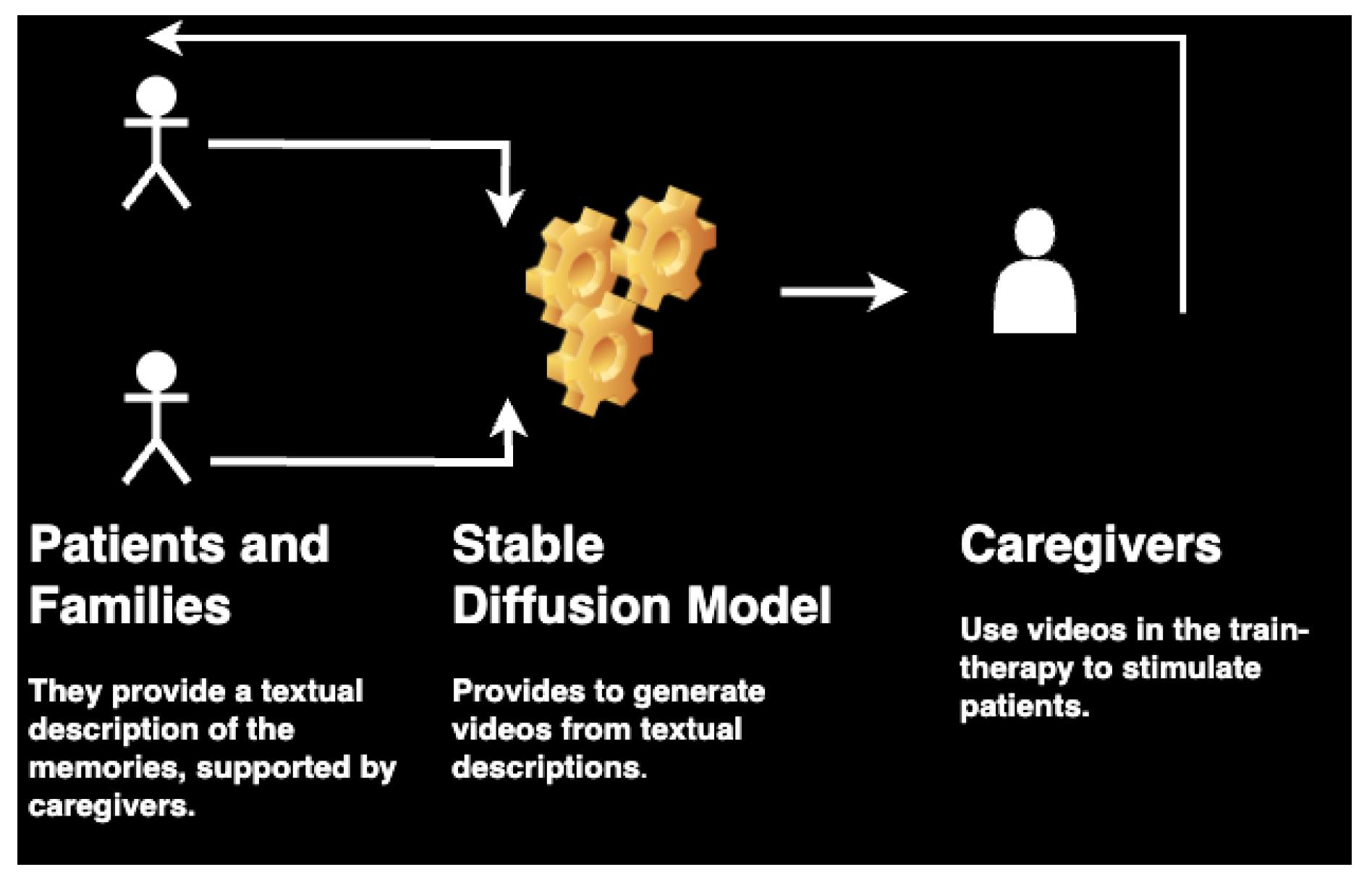
As depicted in Figure 1, in the proposed framework textual description of the memories are recorded from people affected by dementia and their families. Such descriptions are initially filtered by doctors to avoid possible dangerous memories. Then description are preprocessed to be inserted into the stable diffusion model to produce videos. Finally generated videos are used in the train-therapy. Stable diffusion model need to be trained with textual descriptions. In the first version of our model we used public available datasets. We plan to build an ad-hoc database to re-train successively our model.
4. Conclusion
This paper presented the implementation of an AI-based framework for creating videos related to people’s memories to support train-therapy or travel- therapy, a non-pharmacological intervention for Alzheimer’s disease patients. Future works will regard the experimentation of the approach in collaboration with dementia center and the refinement of the model itself with more train data.
Acknowledgments
Author thanks Angelo Costarella for developing some data pipelines and software modules.
References
- J. T O’Brien and A. Thomas, “Vascular dementia,” The Lancet, vol. 386, no. 10004, pp. 1698–1706, 2015. [CrossRef]
- J. B. Martin, “Molecular basis of the neurodegenerative disorders,” New England Journal of Medicine, vol. 340, no. 25, pp. 1970–1980, 1999. [CrossRef]
- A. Gallo, S. Fregola, M. Menon, F. Talarico, S. Fragkiadaki, D. Kontaxopolou, K. Vukojevic, D. Matijaca, M. Miljkovic, S. Kožetinac et al., “Using smart devices for monitoring elderly patients in rural areas of calabria after covid-19 vaccination: Experiences within the si4care project,” COVID, vol. 3, no. 2, pp. 124–130, 2023. [CrossRef]
- D. Mercatelli, E. Pedace, P. Veltri, F. M. Giorgi, and P. H. Guzzi, “Exploiting the molecular basis of age and gender differences in outcomes of sars-cov-2 infections,” Computational and Structural Biotechnology Journal, vol. 19, pp. 4092–4100, 2021. [CrossRef]
- S. Fragkiadaki, D. Kontaxopoulou, E. Stanitsa, E. Angelopoulou, D. Pavlou, D. Šemrov, S. Colnar, M. Lustrek, B. Blažica, I. Vučica et al., “How well did the healthcare system respond to the healthcare needs of older people with and without dementia during the covid-19 pandemic? the perception of healthcare providers and older people from the si4care project in the adrion region,” Geriatrics, vol. 8, no. 1, p. 21, 2023. [CrossRef]
- R. Rombach, A. Blattmann, D. Lorenz, P. Esser, and B. Ommer, “High-resolution image synthesis with latent diffusion models,” in Proceedings of the IEEE/CVF conference on computer vision and pattern recognition, 2022, pp. 10 684–10 695. [CrossRef]
- M. Zitnik, M. M. Li, A. Wells, K. Glass, D. M. Gysi, A. Krishnan, T. Murali, P. Radivojac, S. Roy, A. Baudot et al., “Current and future directions in network biology,” arXiv preprint arXiv:2309.08478, 2023. [CrossRef]
- B. Teji, D. S. Dhami, S. Roy, D. Bhandari, and P. Hiram Guzzi, “Empirical assessment of graph embedding techniques for predicting missing links in biological networks,” 2022. [CrossRef]
Disclaimer/Publisher’s Note: The statements, opinions and data contained in all publications are solely those of the individual author(s) and contributor(s) and not of MDPI and/or the editor(s). MDPI and/or the editor(s) disclaim responsibility for any injury to people or property resulting from any ideas, methods, instructions or products referred to in the content. |
© 2023 by the authors. Licensee MDPI, Basel, Switzerland. This article is an open access article distributed under the terms and conditions of the Creative Commons Attribution (CC BY) license (http://creativecommons.org/licenses/by/4.0/).
Copyright: This open access article is published under a Creative Commons CC BY 4.0 license, which permit the free download, distribution, and reuse, provided that the author and preprint are cited in any reuse.


