

Submitted:
25 October 2023
Posted:
26 October 2023
You are already at the latest version
Abstract
The craft guilds have been at the core of important historiographical debates on the economic, social and political history of medieval cities for twenty years. The aim of this article is to examine the seamen’s guilds in the town ports of Northern Peninsula in the late Middle Ages. This study analyzes fundamental aspects of the social assistance, labour organization and social identity of the town ports, located on the maritime border of the Kingdom of Castile. In contrast to the more classical view of the craft guilds as protectionist institutions, which only served the interests of a privileged group of masters, this analysis highlights the contribution of the seamen craft guilds to the organization of labor at sea, the training of sea workers, the ability to negotiate with merchants and avoid labor exploitation, the provision of social assistance to the most vulnerable population, and the ability to lead the social protest for the guilders’ representation in the urban government. In summary, it is concluded that the seafarers’ guilds were constituted as networks of mutual help between individuals in the labor, welfare and political spheres of the population of the town ports of Northern Iberia in the late Middle Ages.
Keywords:
Late Middle Ages 1
; Northern Iberia 2
; Labour 3
; Seamen’s guilds 4
; Town ports 5
; Social protest 6.
1. Introduction
The study of professional guilds provides a glimpse into a number of aspects of labor and social history, such as the relationship between the individual and the community, work-related, welfare and economic problems faced by the residents, the identity of popular groups and their political representation, dialogue between individuals and political institutions, the importance of the collective in the construction of European states, the role of the community vis-à-vis the individual, among many others (Uebel 2004). The craft guilds are situated, therefore, at the epicentre of important debates on economic, social and political medieval history.
Individuals, a priori, have always needed the collaboration of others in order to survive, owing to the fragile nature of the human condition. Medieval professional guilds occupied a position halfway between the individual and the community, since the individual found, within the craft guild, a vital manifestation of mutual assistance, without which subsistence was more difficult or impossible (Rosser 2009). It has been pointed out that the foundations of mutual assistance lay in a certain kind of friendship, which generate a security lacking, however, in the logic of vertical relationships, based on patronage and factionalism, which basically produce corrupt societies (Martín Romera and Ziegler 2021). Mutual assistance was, without a doubt, one of the main objectives of the medieval craft guilds (Vincent 2009).
Different kinds of corporations spread across Europe from the end of the twelfth century onwards, known as confratria in Latin, guilds in English, Bruderschaften in German, confréries in French, ghilde in Flemish, confrairias in Occitan and cofradías in Spanish (Rosser 2010 and 2015). Though their activities were diverse, in general they were organised around the invocation of a patron saint of the trade and were characterised by combining professional, religious, economic, social and political objectives with solidarity between members of the guild as a value shared by all (Escher-Apsner 2009).
The chronology of the appearance of craft guilds appears to be related to the first manifestations of the crisis of the Late Middle Ages, which led to a weakening of the support provided by family networks and an increase in rural migration, with the resultant social instability in cities (Black 1992 and 2003). Popular groups responded to the adversity of the time by creating or reinforcing mutual aid projects or institutions, prominent amongst which were the guilds (Solórzano Telechea 2014b). Similarly, the growth of the craft guilds responded to a new social ethic, since, on the one hand, membership of a craft guild meant integration within the community, so was accompanied by respectability and a certain social position within the urban centre, however humble (Skinner 1985). On the other hand, the emergence of guilds has traditionally been associated with the weakening of political institutions, which is what appears to be revealed by the attitude of the English Crown, and the measures adopted against guilds in France and Castile kingdoms, which a priori could be interpreted—as has been the case with many authors- as an incompatibility between the monarchy and the guilds (Kieser 1989). However, that binary opposition—monarchy vs. guilds-, evinced by the proliferation of professional guilds in Northern Iberia, Flanders and England, was not so simple, and there is an increasing awareness that centralising policies collaborated closely with the guilds in a relationship of mutual benefit, in spite of the fact that the latter were on occasions quite conflictive (Trio 2003) (Simon-Muscheid 2009).
The study of the craft guilds also has an important place within great historiographic debates, inherent to European culture (Putnam 2011). One of the significant of which has addressed the relationship between individualism and communitarianism. On the one hand, are the scholars who argue that today’s individualism is a consequence of the excesses of the modern absolutist state and of the weakening of networks of solidarity and mutual aid. Similarly, since the liberal historiography on nineteenth century established that the Renaissance and the Reform were the key moments in the development of the individual, individualism has been a trademark of the modern condition of mankind, so the guilds, by responding to a principle of collectivity, formed part of medieval societies (Lucassen 2008). This is a very singular vision of Western history, in which the reinforcement of individualism has been inexorable, even when that history has been far more plural and has seen the participation of a diversity of actors (Lynch 2003).
The debate on individualism and corporatism focused on the economic role of the craft guilds and inspired a vision of the latter as protectionist and medieval institution, which better served the interests of a privileged group of masters and officials, than individual entrepreneurial initiative (Pirenne 2009 [1910]). This resulted in certain prejudices about the medieval guilds, which determined historical research until beyond the 1970s, when historians again turned their attention to the guilds, no longer solely from an economic perspective, but also in view of their social, political, religious and cultural importance (Epstein 1997) (Boone 2010).
Since the last decade of the last century, there has been increased emphasis on the role played by medieval professional guilds. Stephan R. Epstein highlighted the significance of their contribution to the training of workers, as well as their capacity to negotiate with merchants, provide financial assistance to their members, and protect workers from exploitation by opportunist late Middle Age urban elites (Epstein 2008 and 2010). Sheilagh Ogilvie, however, profoundly disagreed with Epstein’s postulates, and maintained that the guilds had an adverse impact upon quality, skills and innovation (Ogilvie 2008 and 2011).
Other specialists—such as Jean-Pierre Sosson, Peter Stabel (Stabel 2004), Gervase Rosser, Maarten Prak, Jesús Solórzano and Jan Dumolyn—have drawn attention to the economic flexibility of the guilds and their leading role in the political and public sphere, and scholars have begun to analyse the guilds as networks of mutual aid between individuals who consciously interacted in the professional, welfare and political sphere that constitutes the perspective from which this article has been written (Lambrechts 1994).
The craft guilds of the seafaring population of the Cantabrian coast in the Middle Ages have interested Spanish researchers for some time and, in recent years, this interest has intensified, albeit, in general, what has prevailed is the empirical demonstration of different cases of the conceptual reflection briefly referred to above. In the 1980s, a prominent work was Juan Gracia Cárcamo’s study of the fishermen’s guild of Bermeo and its ordinances; although the most significant work was perhaps Josu Erkoreka’s PhD Thesis, in which the author exposed the origins, the genesis, the developments and the internal structure of seafaring guilds in the Basque community, although it is a very descriptive study (Erkoreka 1991). Mention should also be made of the comparative and synthetic works on the craft guilds by José Damián González Arce (González Arce 2011), Margarita Sernao (Serna Vallejo 2002) and Jesús Ángel Solórzano Telechea (Solórzano Telechea 2016) in relation to fishermen’s guilds in the Kingdom of Medieval Castile, by Ana María Rivera Medina on the legal framework of Basque fishing activity (Rivera Medina 2000), by Soledad Tena García (Tena García 1995) about the internal composition of the seafaring guilds of the Castilian Navy in the Late Middle Ages, by Ernesto García on guilds, fishermen, seafarers and sailors of Basque country in the Middle Ages (García Fernández 1997); by Juan Ignacio Ruiz de la Peña (Ruiz de la Peña 2007), on professional solidarity within guilds of seafarers and, finally by Elisa Ferreira Priegue on the relationship between trade and seafaring guilds in Northwestern Iberia (Ferreira Priegue 1988). Of the works on specific historiography cited so far, most could be described as analyses of cases, but an interpretative synthesis is still lacking.
2. The Organisation of the Seamen’s Guilds in the Bay of Biscay’s Town Ports
The organisation of the so called ‘people of the sea’ of the Cantabrian Sea into craft guilds was quite unusual in the history of Atlantic coastal communities (Davids 1994), since this was not a widespread phenomenon in all European regions (Tranchant 2012) (Miranda 2012) (Sousa Melo 2022); however, in all the town ports on the Cantabrian coastline there were guilds of fishermen and seafarers, as the guild of San Nicolás de Llanes observed in a letter of request, addressed to the Catholic Monarchs in 1480:
“On the coasts of the sea of our kingdoms, in all the towns and villages of them, the people of the sea, the inhabitants of these towns and villages have their own guilds, which regulates the trades of the sea by means of ordinances”. (Archivo General de Simancas. Registro General del Sello. 148004, 207 [Henceforth AGS. RGS.]
The guilds’ members were, in similar fashion, aware of their antiquity and specific origins. Many of them boasted a history of over thre and five hundred years, as was declared by the craft guilds of Santa Catalina de Gijon (Ruiz de la Peña 1981), San Andrés de Castro Urdiales (Garay Salazar 2003), San Martín de Laredo, Fuenterrabía or Bermeo in the 16th and 17th centuries. In 1480, the preamble of the ordinances of the guild of Santa María de Itziar de Deba indicated that its origins dated back to the devotional guild of the Virgen María en la Iglesia de Itziar and gave five main reasons for its founding: to honour the Church, to live honestly in accordance with good habits, to take pity on the poor, to serve the king, his justice and the common good of the town and people, and, finally, to organise seafaring activity (Herrero Liceaga 2005).
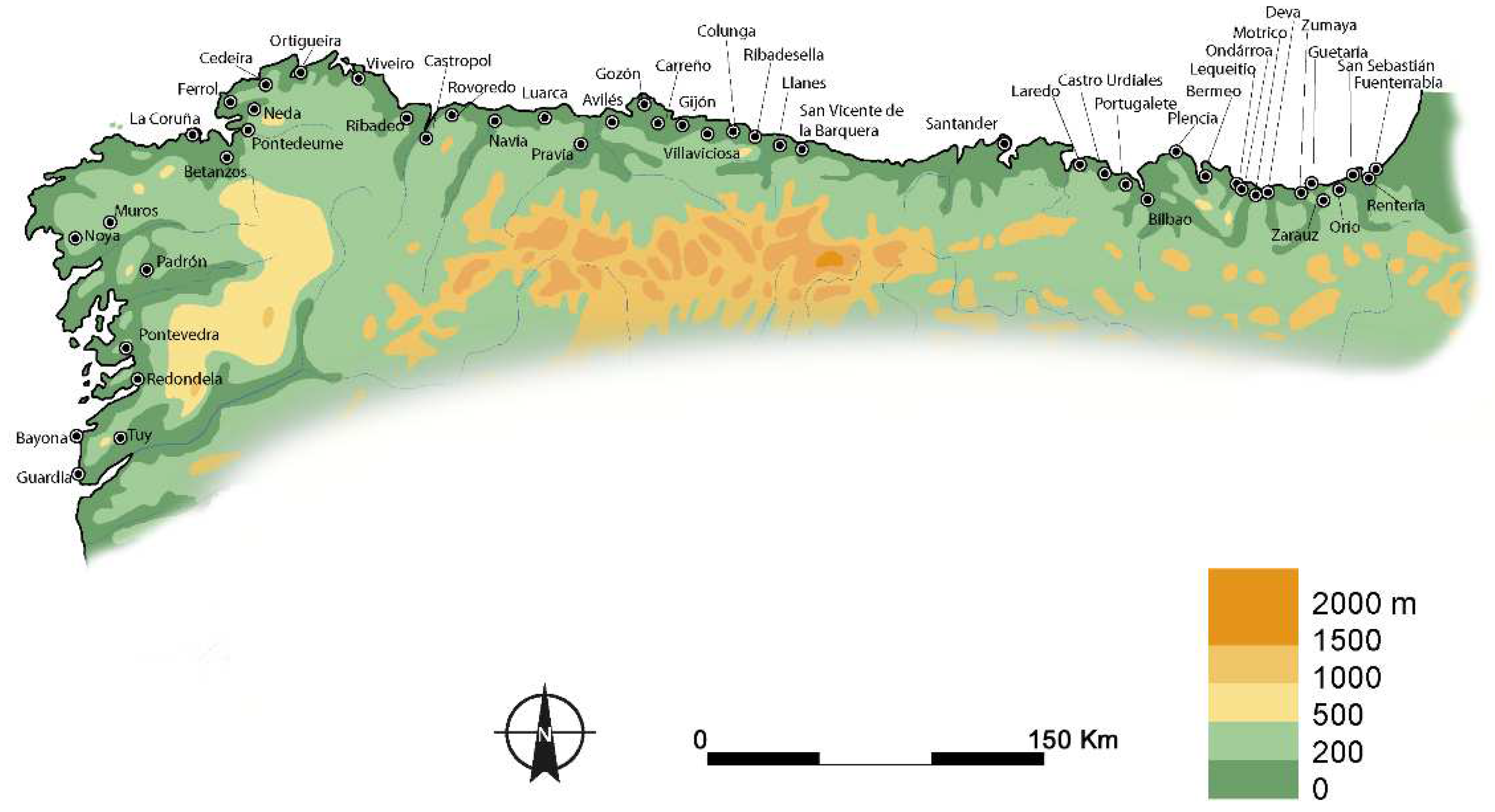
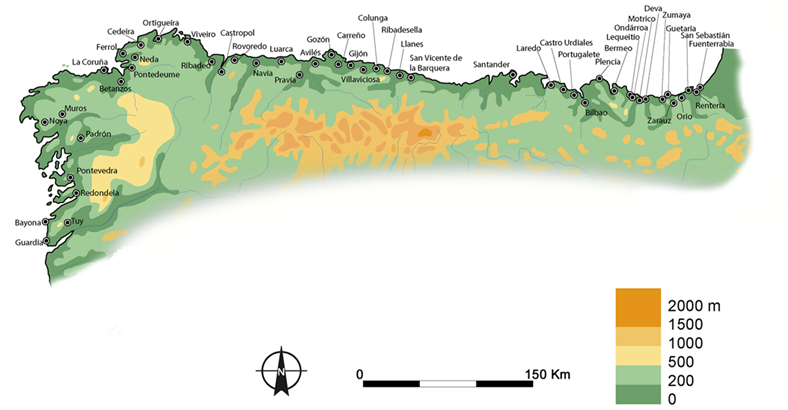
Figure 1.
Townports of Northern Iberia in the Late Middle Ages. © Solórzano-Telechea.
The chronology of the appearance of the guilds is similar to that of the other guilds in the European Atlantic in the late Middle Ages. The oldest guild on the Cantabrian shore was called San Martín de Laredo, founded in 1306. Followed by that of San Vicente de la Barquera, which appeared in 1330; San Pedro de Bermeo, in 1350; San Pedro de Fuenterrabía, in 1361; San Martín de Santander, in 1384; Santa María de Icíar de Deba, which would have been founded before 1394; and San Andrés de Castro Urdiales, in 1395. Prominent during the following century were the guilds of San Pedro de Lequeitio and San Pedro de San Sebastián in the mid-15th century, and those of Santiago in Bilbao and Santa Catalina de San Sebastián, both founded towards the end of the fifteenth century. Meanwhile, the first evidence of Asturian and Galician guilds came later, such as the guild of seafarers of Luarca de Valdés in 1468, San Nicolás de Llanes, before 1480, and those of Cuerpo Santo, San Miguel and San Juan in Pontevedra, Vera Cruz and San Andrés in La Coruña, San Pedro de Tuy, Santa Catalina de Gijón, and the guilds of Avilés, Cudillero, Lastres, Ribadesella and Vigo during the second half of the fifteenth century (Pérez Valle 1996) (Álvarez Fernández 2009). Other ports on the Cantabrian coast, such as Guetaria, Motrico, Ondárroa, Plencia and Orio, did not become craft guilds until the sixteenth century (Erkoreka 1991).
The guilds of fishermen and seafarers on the Bay of Biscay grouped together workers from the same trade, although in many towns this was extended to include most social sectors within the town or community. Thus, the guild of San Vicente in San Vicente de la Barquera sent a letter of complaint to the Catholic Kings in 1496, protesting that lineages divided up councilorships, despite the fact that the latter were a minority and most of the population belonged to the guild (Solórzano Telechea 2014d):
“Know that the members of the guild of San Vicente complained that despite the fact that there were eight hundred dwellers in the town and seven hundred of them belonged to the guild, the municipal positions of mayors, aldermen, tax inspectors, escribes were controlled by one hundred citizens who belonged to the lineages” (AGS. RGS. 149603, 142)
The guilds tended to monopolise professional activity. In San Vicente de la Barquera, for example, only members of the guild of sardine fishermen of San Andrés could fish for sardines: “no sardine fisherman can ply that trade in this town unless he is a member of the guild” (AGS. RGS. 149905, 256). The requirements for entry into a guild, apart from being a sailor by trade, basically consisted of being a male and Catholic, as was set out in the ordinances of Santa María de Itziar (Herrero Liceaga 2005). Women were not totally excluded from professional guilds, although they did organise themselves, unofficially, to defend their rights and lodge their complaints and requests collectively (Haemers 2017), as occurred with the female fish vendors and the Bilbao city council in 1510 (Vandeweerdt 2021), when the latter had to abandon its attempts to appropriate the area where they sold fish on the quayside, after the women organised themselves and successfully defended their position (Beattie 2007).
The guilds were run by a wealthy sector of the population, formed by the ship-owners; next came the shipmasters, the pilots, the skippers, the sailors and, finally, the fishermen. The latter, in spite of their hard lives, were in a better position than the elderly, the disabled, the sick, widows and orphans, who depended on the brethren’s charity. The ship-owners were the most powerful guild members, and were represented by the shipmasters, although some of the latter also owned vessels (Kowaleski 2011). The shipmasters’ main tasks were to arrange contracts and supervise the fishing season, and they had an obligation to attend the guild’s religious services and all assemblies, or face financial penalties (Ward 2009). The figure of the shipmaster was highly respected by other guild members at assemblies, as their training enabled them to “know and determine what proposals were made in their town council”, which contributed to the “good governance of said town hall, peace and serenity within”(Garay Salazar 2003). Moreover, shipmasters were responsible for preparing and fitting vessels, as was set out in the ordinances of the guild of San Vicente de la Barquera (Solórzano Telechea 2011). In addition, shipmasters participated in the election of guild officers, designating those responsible for appointing lookouts, as occurred in the case of San Martín de Santander (Casado Soto 1977). The prestigious role of these shipmasters was endorsed by the fact that they were also responsible for convening the guild lunches and ensuring that none of the brethren brought a “dagger to the table” (Solórzano Telechea 2011). The sailors¸ meanwhile, were in charge of sailing the vessels. Theirs was a position that required ample knowledge of the sea. Apart from piloting the boats, they were responsible, along with the shipmasters, for recruiting sailors and preparing the fishing trips, and checking, along with masters, the size of the nets”(Garay Salazar 2003).
The socio-professional basis of the guild was formed by seamen, sailors and simple fishermen, whose job was the most precarious of all, as they were paid directly in kind, in quiñónes and quintaladas, on the basis of verbal agreements (Enríquez Fernández 1991). The seamen occupied a position above simple sailors or fishermen, since they enjoyed greater financial capacity and were able to form small companies. Being a sailor was a risky occupation, into which men were usually driven by need. The fishermen were the humblest of those working at sea. The ordinances of San Vicente de la Barquera inform us that a sailor, in 1490, received 22 silver reals for working from San Martín until Shrovetide, and 11 silver reals from that date until Easter (Solórzano Telechea 2011). This suggests that workers earned 33 silver reals for their labours between November and a range of dates between March and April. At the lowest level were the deckhands and cabin boys, whom the ship-owners could strike with their hands or with sticks by way of punishment (Erkoreka 1991). In some guilds, however, the cabin boys enjoyed the same protection as the other members. Thus, the ordinances of the guild of San Andrés de Castro Urdiales protected both sailors and “cabin boys and apprentices” against illness, and those of San Vicente established that to serve a shipmaster, cabin boys required their father’s position, or their mother’s if she had been widowed (Sáñez Reguart 1791).
The considerable influence exercised by the guilds upon the development of companies and of merchant capitalism is illustrated by the socio-professional structure of the fishing companies, which was copied by professional guilds from the second half of the 15th century onwards for the organisation of deep-sea fishing off Ireland, Galicia or the Barbary Coast, to which was added a merchant lender, with the guilds enjoying exclusive rights to organising fishing in the so-called “mar de canto”, a maritime space situated around 20 km. from the coast. Involved in the commercial fishing companies were land-based merchants, moneylenders usually, those responsible for subsequent sales, as well as the sailors and fishermen, who went to sea to fish before coming back to port with their catch, or sold it in other ports, having to pay off their loans when returned. In fact, the precarious nature of the modus vivendi of sailors and fishermen changed significantly in the second half of the 15th century, thanks to the formation of these merchant-type deep-sea fishing companies, as they began to receive a previously agreed salary or a percentage of profits. Nevertheless, the fact that the guilds did not control these fishing companies had a detrimental effect upon working conditions. In 1506, for instance, a merchant lender from Vitoria, by the name of Antonio Esquivel, a shipmaster, teamed up with Captain Lope Aparicio to organise fishing in Ireland from 29 September until All Saints Day or San Martín, and both pledged to pay the fifty sailors and fishermen recruited, from Laredo and Castro Urdiales, 12 florins each; however, breach of this contract forced the sailors and fishermen to take the issue to court (Archivo de la Real Audiencia y Chancillería de Valladolid, Reales Ejecutorias, 211/6).
The guilds’ interests clashed with those of the fishing companies, as the latter offered greater profits to sailors and fishermen, as we have seen. This was apparent in the establishment of numerous penalties for those sailors that failed to fulfil their obligations. In the guild of San Andrés de Castro Urdiales, when an individual committed to a guild, they could not pledge their services to another, under penalty of 2.000 maravedies. (Garay Salazar 2003). This fine increased when the person was going to be recruited on dates close to the start of the fishing campaign, by a further 1.000 maravedis (Garay Salazar 2003). Similarly, the guilds of San Martín de la Mar de Santander and San Vicente de la Barquera, since it was interdicted by the guilds’ ordinances to take to sea members who “taken part in a campaign on another pinnace” (Solórzano Telechea 2011).
3. Governance of the Seamen’s Guilds
The guilds were governed by the board or council, which was the assembly of members, in which officers were appointed or elected and issues of interest to members debated. There were two types of assembly: on the one hand, elective, in which guild officers were elected, which normally coincide with the feast day of the patron saint, the opening of the fishing season and New Year’s Day. The guild boards elected the attorney general, the maritime mayor or judge, the stewards, the representatives, the weights and measures inspector, the overseers, the treasurer, the lantern bearer, the sellers or administrators and the lookouts (Garay Salazar 2003). It was also a requirement that all officers were elected by consensus of all the guilds. In some guilds, such as San Nicolás de Llanes, the office of steward was, as well as annual, non-renewable (AGS. RGS. 148004, 207). As for the electoral process, this varied from one guild to another, and there were diverse methods based on deliberative appointment, draw or sortition. The guild of Santa Catalina de San Sebastián employed the sortition method: the members wrote their names on papers and put them in a pot, after which a child drew out the name of the steward. In the case of the guild of San Andrés de Castro Urdiales, the ordinances decreed the holding of an elective board meeting on New Year’s Day, convened via public proclamation on the streets of the town, which would debate the election of the general representative, the maritime mayor or judge and his assistant steward (Banús 1974). All the “shipmasters, fishermen and sailors that are or were guild members” had to participate in this elective board meeting, and quorum was necessary, so all the guild members had to “be in agreement” (Garay Salazar 2003). Other guilds employed the co-opting method. The 1353 Bermeo ordinances established that outgoing guild members and stewards should meet annually on the day of San Martín to appoint an electoral commission comprised of six members, responsible for appointing the new guild officers (Labayru 1968). The elected members had to be sworn into office “on the cross and before the image of Our Lord” to which could be added the image of the patron saint, and promising to perform their work “without love, partiality or friendship”, given their role as mediators (Garay Salazar 2003).
The stewards or attorney generals were responsible for managing the guild, presiding over the board meetings and internal tribunals, competencies that, depending on the guild, could be performed by the maritime mayors (Garay Salazar 2003). These were well-paid positions. The tax inspector of the guild of San Andrés de Castro Urdiales had to pay each of the stewards 2.000 mrs. per annum. The guild of San Martín de Santander did not pay a fixed rate, but established that “those appointed be paid for their work as was appropriate, and if they did not accept the office, or gave sufficient cause, they could be expelled from the guild and charged the corresponding fines” (Casado Soto 1977). The procurador general represented the guild in their external relations; the diputados were the members’ permanent representatives, who met frequently to address urgent guild issues alongside the stewards; vendedores were responsible for the daily sale of captures and dealings with traders and transporters; the linterneros carried a lantern to prevent vessels from getting lost at night; the atalayeros or señeros were permanent lookouts with considerable responsibility, as they selected the ideal atmospheric conditions in which to fish safely.
Among the functions of the regular meetings were the establishment of sale prices of fish, supervision of guild expenditure and the organisation of fishing activities. The sale of fish must have been a delicate issue in relations with councils, since supplying town markets was a competence of the council. In order to sell their catch, fishermen required a council licence, but they often sought to avoid payment of this alcabala by selling their produce in the outskirts of the town. Councils legislated against this black market. Castro Urdiales stipulated that no person, especially “maiden and women”, could take fish out of the town in baskets or on their heads, in other words, for retail sale, to hand it over to the muleteers, thus avoiding the payment of town taxes and the muleteers’ obligation to transport wheat to the town (Baró Pazos 2006). In 1495, the guild of San Pedro de Bermeo and the council reached an arbitral agreement. The guild members wanted freedom to sell, both from their homes and in the town, the sea bream received in kind, but the council wanted these to be sold in the town square so everyone might have access to the fish and so as to control this retail selling (Epstein 2000). The arbitrators ruled that collective selling should take place, as usual, freely on the small wharf, but that individual bream could only be once the market had been supplied and within the territorial limits established by the agreement (González Arce 2011).
Meetings had to be attended by all sectors of the guild, from owners and captains/shipmasters to seamen and fishermen, including pilots and elderly members, and guild officials. All the guilds imposed a penalty for non-attendance; in San Andrés de Castro Urdiales, for instance, guild members had to give a pound of candlewax for guild masses and could find their assets seized by way of punishment if this fine was not paid (Garay Salazar 2003). The guilds convened the meetings via the town crier and held them in a closed space, generally a church or a chapel, or outdoors, as was the case of the guild of Castro Urdiales, in the arcos de Santa Ana. All the members took part in these assemblies, mass was sung, lunch was eaten and alms distributed. The guild united its members via religious and saintly sentiment, and organised collective activities, such as lunches and masses. Meetings were held in accordance with a strict code of conduct, and participants were instructed not to speak about their vote without the permission of the guild’s mayor, and everything had to take place with “calmness and docility”(Garay Salazar 2003). The guilds of San Pedro de Fuenterrabía used to hold their annual lunch inside the Church of Nuestra Señora, until they decided in 1482 to move to an attic of the bell-tower, as it seemed dishonest (Irixoa Cortés 2013). The cost of these meals was borne by the guilds, many of which limited or prohibited this expenditure. The ordinances of San Martín de Santander banned spending on food or drink on the occasion of meetings or similar events, under penalty of seizure of assets and a 2,000 maravedís fine (Casado Soto 1977).
The guild mayors and stewards had very broad jurisdictional powers that were included in the ordinances, the provisions of which were based on the experiences of Cantabrian seafarers, born of use send custom, and on the significant influence of the Rôles de Oleron or Fuero de Layron (Solórzano Telechea 2004). These regulations feature numerous references to this Atlantic maritime code, such as the prohibition of the right to shipwrecks in favour of merchants. For example, the ordinances of the guild of Luarca reproduce entire paragraphs of the Leyes de Layrón; in the case of Pontevedra, the Catholic Monarchs granted fishermen the right to the quintalada de la pesca “según el Fuero de Layron”(Filgueira Valverde 1946), in similar fashion to the twenty-four articles of the ordinances of the guild of San Vicente de la Barquera, based on the Fuero de Olerón.
The sphere of competence of the guild leaders implied a restriction of the jurisdictional powers of the town mayor or magistrate, since guild members settled their legal disputes before the heads of the guilds, a factor at the root of the conflicts between guilds and councils, as was evidenced by a lawsuit in 1496, in which the seafarers of San Vicente de la Barquera appealed against a ruling by the mayor in relation to a dispute between neighbours on the Barbary Coast, since the ruling judge was not as provided for by the Laws of Olèron:
“The charter and laws that are called of Lerión, which said charter and laws were made and ordered to judge the cases and damages and disputes that occur in the ports of sea and at sea between the ships and boats, and caravels and pinaces that sailed and used to navigate, which the said judge of the sea and charter and laws of Leryón were used and kept and obeyed in all Spains and coasts of the sea”(Solórzano Telechea 2004).
Similarly, there is evidence that some years earlier, in the guild of San Martín de Santander, there was lawsuit over the steward’s jurisdiction, and a ruling, dated 20 June 1429, stating that maritime cases could only be ruled by maritime judges, which in this ton meant the seafarers’ steward, without royal or any other justice having the authority to intercede (Solórzano Telechea 2002). Some towns established jurisdictional limits to avoid these conflicts over areas of competence. Thus, in Bermeo, council mayors had to intervene whenever there was bloodshed and loss of limbs (Erkoreka 1991). Guild jurisdiction also clashed with that of the reeves. At the end of the 15th century, the reeve of Guipúzcoa, Juan de Rivera, attempted to take over the jurisdiction of the guild of San Pedro de San Sebastián, but in 1492, the Council of Castile ordered him to respect the existing situation 1492 (Erkoreka 1991).
4. Seamen’s Guilds Finances
Guilds needed sufficient funding to undertake governance activities, protect members’ interests, defend themselves in court, perform the guild’s work, assist members in need, and for extraordinary expenditure. Some guilds had ample resources, although this was not normally the case. The guild of Corpo Santo de Pontevedra, for example, was said “This Town Council and the Guild usually have so much money that they have for extraordinary expenses, and for lawsuits, and works, often five and six thousand ducats, and it does not hurt them in their budget” (Ferreira Priegue 1988). There were two ways of raising funds, either directly from members, voluntarily or not, or via indirect contributions, though fines imposed as a result of non-compliance with ordinances (Cantera Montenegro 1990).
The first source of financing was contributions made by guild members, in the form of their quiñón or mareage. This was part each fishermen’s payment after distribution of the catch. Thus, sailors handed over part of what had corresponded to them, which could be variable when paid in kind, as occurred in Castro Urdiales or Santander, or a fixed sum in cash, as was the case in Motrico, Bermeo or San Vicente de la Barquera. The ordinances of San Vicente de la Barquera Guild, for instance, established that “Each member of ours must comply with the payment of two maravedíes in each entrance and each week that the pinaces go out to sea” (Solórzano Telechea 2011). The shipmaster ensured that the fishermen paid their portion or “quiñon”.
The second principal source of income for the guilds were fines, payable as a result of non-compliance with ordinances, contracts, fishing conflicts between guilds, size of nets or boats, among other questions. The size of the fine depended upon what the guild considered most important, so varied from one place to another. In Santander, for example, there were fines of 600 maravedis. for those who collected bait without a licence and 2,000 maravedis. for those who turned down positions in the guild, a figure that rose to 10,000 maravedis. in the case of the Castro Urdiales’s guild (Garay Salazar 2003).
Fines associated with disobeying guild officials were very common. In San Andrés de Castro Urdiales, it was stipulated that the “The confreres are not daring to speak, nor speak, nor give their vote, nor appear, without first being commanded by the said procurator under penalty of a pound of wax”(Garay Salazar 2003); in Santander there were fines of 1.000 mrs. for captains and seafarers who disobeyed lookouts; in Laredo, fines were issued not only to those who “went to fish in spite of instructions to the contrary from the watchtower or the dangerous state of the sea”, but also to lookouts who did not carry out their work satisfactorily (Casado Soto 1977).
The guilds also fined acts of physical and verbal violence, although when there was bloodshed or loss of limbs, the town law courts had to intervene. The ban on carrying arms was established, for example, in the ordinances of Castro Urdiales, with a fine of 2,000 mrs. (Garay Salazar 2003). There were also penalties for those who proffered insults. According to Santander’s ordinances, any guild member who “uttered injurious words against a guild lawyer, official or lookout faced as fine six hundred maravedís for the first offence and two thousand for the second” (Casado Soto 1977). In San Pedro de Fuenterrabía, members had to participate in the annual lunch and treat one another with respect “no guild member may say to another any word that should not be said or be impolite at table” under penalty of 20 maravedis (Irixoa Cortés 2013).
Control of vessels was regulated, with various fines for offenders. Thus, boat size was one of the factors most taken into account by fishing ordinances, as in Castro Urdiales, where no vessel measuring less than 22 cubits could take to sea, under penalty of 2.000 maravedís (Garay Salazar 2003). The fishing season had to be strictly observed by guild members. And non-compliance was subject to a heavy fine, as occurred in Castro Urdiales, where there was a ban on “fishing and setting to sea before the day of San Martín of each year, under penalty of ten thousand mrs” (Garay Salazar 2003).
Meanwhile, the guilds incurred a series of expenses in relation to their activity, such as officers’ salaries, providing food and drink at lunches, providing assistance for sick members, the elderly, widows and orphans, funerals and burials, fishing gear and bait, among others. Accounts were controlled by the stewards, though there were other specific officers, whose job titles varied from one guild to another: the tax inspectors issued payments and the veedores audited the accounts. The number of inspectors varied between one and six. The guild of San Martín, for instance, appointed “seis hombres, para que en compañía de los oficiales tomen y reciban las cuentas de los que salieren bien y fielmente” (Solórzano Telechea 2011). Furthermore, the ordinances prohibited the appointment as veedores of anyone with up to four degrees of kinship with the stewards (Erkoreka 1991). In Santa María de Deba, accounts were recorded in a book, with the names of guild members, income, expenditure and rights, which was kept alongside the money pouch in a chest with two locks under the stewards’ supervision (Irixoa Cortés 2013).
5. The Regulation of Professional Activity
It is not easy to learn about medieval fishing, because in general this was an everyday activity that has left little in the way of documentary evidence, except when vessels went to fish in distant fishing grounds that called for a more complex voyage, or when a conflict arose that ended up in court. Fishing activity was organised into two annual seasons, winter and summer, determined by the migration of species according to the time of year. The winter fishing season started in autumn—it normally began in November, around All Saints or San Martín—and ended in spring, coinciding with Easter, and the second ran from Easter until San Martín. In some ports, like San Vicente de la Barquera, there was an intermediate season, between San Miguel and San Martín (Solórzano Telechea 2011). The guilds prohibited fishermen from fishing out of season, as was the case in Castro Urdiales, where there was a ban on fishing “before the day of San Martín” (Casado Soto 1977) or from catching different species, like the guild of San Martín de Santander, which banned “catching sardines when fishing for sea bream” under penalty of a fine (Garay Salazar 2003). The objective of this measure was that all guild members should enjoy the same conditions and benefits. Fishing days were very long, lasting from dawn to dusk.
The winter season involved greater risks for fishermen than summer. The ordinances of San Martín de Laredo referred to the “bad weather during winter and Lent” and those of San Andrés de Castro Urdiales alluded to “grave and harsh misfortunes and storms that often strike in winter, night and day”(Garay Salazar 2003). For this reason, the ordinances stipulated that the lookouts’ indications should be respected or that there should be no fishing at night, as was the case with the guild of San Andrés de Castro Urdiales, which prohibited “remaining at sea at night in pinnace, dinghy or launch”(Solórzano Telechea 2016). In winter, the ordinances established that fishermen should set to sea very early to take full advantage of the daylight.
The guilds also ensured that fishing vessels adhered to minimum dimensions. For example, the ordinances of the guild of San Andrés de Castro Urdiales established that pinnaces that went to fish for sea bream should be “twenty-two cubits long inside” and those of San Vicente de la Barquera required a minimum keel-length of 15 cubits (Solórzano Telechea 2004). Meanwhile, fishing gear was subject to control by the guilds and net size was taken into account; as in Castro Urdiales, for instance, where sardine nets had to be “the same in breadth and length”, under penalty of loss of catch plus a fine of 4,000 mrs. Incorrect use of or an excessive number of nets were fineable offences. In San Martín de Santander, fishermen were prohibited from “casting more than two hundred and sixty nets” (Casado Soto 1977). Similarly, some types of nets were also banned, like the jito or geito. This net was suspended with floats over a sardine zone but did not discriminate between species, so its use was prohibited by all fishing guilds in the Cantabrian Sea. In San Pedro de Fuenterrabía, these nets were not banned, but fishermen using geito nets had to maintain a distance of 60 strokes from the sardine vessels in order to avoid conflicts, under penalty of a fine of ten florins (Irixoa Cortés 2013).
The sale of fish was also regulated by the ordinances. The guilds had sellers or catch administrators, although in some it was the first captain to reach port, assisted by the next to arrive, as occurred in Santander. Fish was auctioned in public. In Castro Urdiales, sales were held in the town square and the guild of San Vicente de la Barquera banned the sale of fish on the boats themselves and catches had to be taken “to the river bank and sold at the best possible price”, although the fishermen’s houses could be used in the event of bad weather (Solórzano Telechea 2016). The ordinances of Luarca prohibited fishermen from selling fish to muleteers and wholesalers, since only administrators could sell the produce in a public place and under the mayor’s supervision. In 1428, the guildsmen of San Martín de Santander won a lawsuit initiated by the tenants of the fish sales tax after being denounced, because the wives, girls and daughters of the fishermen were selling the fish in the town square without paying the corresponding alcabala. The plaintiffs demanded 20 mrs. from each by way of alcabala, but the accused fishermen were absolved, as they demonstrated that since time immemorial they had enjoyed the right to sell the fish in their baskets from the boat. Years later, in 1472, the guild members signed an advantageous agreement with the council of Santander, granting the fishermen freedom to fish in the bay in exchange for the payment of the fixed sum of 3.500 mrs. yearly with a commitment not to increase the latter, even in the event of an increase in the amount of tax the town had to contribute to the royal coffers; for its part, the council declared that it had signed the agreement in compensation for the fish taken from the pinnaces for public consumption (Solórzano Telechea 2002). The ordinances of Plencia established that fish should be sold on the riverbank in the presence of all those wishing to buy, and of the innkeeper hosts of the mule drivers (Erkoreka 1991). During the sale of fish, priority was given to the fishermen themselves and the town inhabitants, after which the remainder of the catch was sold wholesale to visiting muleteers and retailers, who subsequently marketed the fish elsewhere.
The system of wholesale purchase of the fish was via an auction, known as “mío sea”, in which the opening price was set by the stewards and shipmasters and the first purchaser to utter these words acquired the lot in question, as is reflected in the ordinances of San Martín de Santander and San Martín de Laredo, which also state that note should be taken of the purchaser’s name. The guilds prohibited individuals from fixing the sales price of fish. The guild of Castro Urdiales forbid “The innkeepers, muleteers, transporters and other persons” to assemble “in private homes as they pleased and there form leagues or monopolies to fix a price for a dozen sea breams, sardines or other fish, which constitutes a considerable prejudice to the Crown and royal tax revenues”(Garay Salazar 2003). The fish sold supplied Spain’s domestic market (Salicrú i Lluch 2009).
6. Seamen’s Guilds and Social Assistance
One of the fundamental purposes of the guilds was the provision of aid to sick members and their families, as well as to other needy sectors in the town (Vincent 2009). Social assistance was provided for those guild members in need due to temporary circumstances, old age, precarious living standards or ill health. In the guild of San Andrés de Castro Urdiales, for example, reference was made to those “elderly, blind and needy persons, who on account of their woes and being poor and unable to take to sea” received aid from the guild (Garay Salazar 2003). Thus, the guilds offered these members a series of aid measures, financed by the “quiñón” or mareage and the fines resulting from infractions. For instance, the elderly, the disabled and the sick received the benefits resulting from a fictitious catch, organised by means of a draw, coinciding with the feast of the patron saint, in the case of Castro Urdiales for Santa Catalina, or after the election of the guild officers, as in Laredo for San Martín (San Feliú 1944). Elderly guildsmen were called by the town crier, along with the shipmasters and owners, for a simulated boarding, and given a payment and the sea bream that would correspond to a pinnace crew member. Similarly, sick guild members also benefited from this aid, especially if they had family. In Bermeo, the ordinances stated that it was obligatory to help “Many honest men are poor and needy, and there are children, or men with their arms or feet crippled or broken so that they cannot be maintained by themselves”(Erkoreka 1991). Both groups were given part of the vessels’ quiñón, in the same way that any fishermen would be. In San Martín de Santander, refusal to assist a sick guild member was subject to a fine of 1.000 maravedís (Solórzano Telechea 2002). In the case of sick guildsmen, the guild of San Martín de Laredo even established that if they could not get by on one payment, the guild should borrow money to help them (San Feliú 1944). In the guild of Luarca, alms were given to members whose boats were broken or who had been injured while fishing and could not take to the sea, and even their treatment was paid for (Solórzano Telechea 2016). In the guild of Santa María de Deba, the elderly and disabled were examined by the stewards and five or six good men, after which, once their degree of disability had been assessed, the guild assumed responsibility for their upkeep (Irixoa Cortés 2013).
Orphans and widows also received social assistance from the guild. In San Vicente de la Barquera, the steward called upon “orphan children and their widowed mothers” to participate in the distribution among the different boats, in similar fashion to the simulated handout to the sick and elderly, as the document refers to the fact that the orphan should be given a quiñón “as if he had actually taken to sea to fish”, a similar measure to that employed in Luarca, where widow and orphans received the full quiñón (Solórzano Telechea 2011). Finally, guild charity was also directed towards the poor in general, particularly on patron saint days, when the needy were invited to lunch or given the leftovers from the banquet enjoyed by the guildsmen. In San Vicente de la Barquera, the stewards fed the destitute on the day of the annual lunch (Solórzano Telechea 2011). In San Pedro de Fuenterrabía, the guild mayor gave the poor the food and drink left over after the guild banquet (Irixoa Cortés 2013).
Another of the guilds’ charitable goals was providing assistance for members at the time of death and with funerals. Funeral ceremonies and burial were to place with all the dignity owed to a deceased colleague. In Laredo, the body was wrapped in the guild cape and accompanied by a cross, belonging to the congregation (San Feliú 1944). The guilds also paid for the funeral candles. In Santa María de Deba, the deceased’s body had to be accompanied by guild members with four lit candles from his home to the cemetery (Irixoa Cortés 2013). All guild members were obliged to attend their colleagues’ funerals, unless they had to set out to sea to fish, in which case they were to be represented by the stewards, escorted by a sailor from each vessel. In Luarca, those who received assistance from the guild also had to attend funerals, with the oldest guildsman at the head of the cortege (Solórzano Telechea 2016). The guild of Santa María de Deba imposed a fine of a silver real on guild members who failed to fulfil this obligation, a similar penalty to those in place in Bermeo and Plencia (Erkoreka 1991).
The guilds ensured that members who died outside the town were buried among their own. In San Vicente de la Barquera, if a guild member died between Santander and Ribadesella, he should be brought, by sea or by land, at the guild’s expense, and if he died in Castile or Liébana, he should also be returned to San Vicente, accompanied by the guildsmen, who were to receive the body a league’s distance outside the city. If a guild member died during the fishing campaign, the body should preserved until the latter ended and buried in the town (Solórzano Telkechea 2011).
Thus, the guilds’ positive response to the social changes of the Late Middle Ages must have alerted their members to the need for an institution that ensured their survival in difficult times, and to practise charity not only among themselves, but also with strangers, which served to consolidate bonds between guild members, on the one hand, and between the latter and the society in which they lived, on the other.
7. The Defence of the Common’s Voice
The relationship between guilds and political power has been the subject of considerable controversy since the mid-19th century, between those who defended the guilds’ political role in urban political life and those who regarded them as an obstacle to the consolidation of monarchic authority (Rosser 2006), as their privileges and rights were incompatible with the legal standardisation of Late Middle Age monarchic states (Dumolyn 2014). The underlying tenet was that the construction of centralised states clashed with the existence of local institutions and exclusiveness. However, the formation of Late Middle Age monarchic states was a complex process, and one that proved compatible with the participation of other local powers, many of which collaborated with centralised institutions, so the guilds can be said to have been an indicator of the weakness of the state. In fact, the guilds of seafarers and fishermen received ample royal protection, the concession of privileges and support for letters of request, making them fundamental political actors in these towns (Epstein 1997).
The seafaring guilds became the common voice of the townspeople. Following the introduction of the Regimiento into these towns between the late-14th and early-15th centuries, the councils relegated the townsfolk to a position of irrelevance, without any political influence in political issues, in spite of being residents, which raised hackles within this important social sector in Cantabrian coast line town ports (Naegle and Solórzano 2014). In 1428, the council of Noya complained to the Archbishop of Santiago that “on occasions, when the council met, fishermen, carpenters and other persons appeared on the scene, spoke at will in ill-mannered fashion and prevented necessary and opportune agreements from being reached” (Solórzano Telechea 2014a). The guilds were formed by residents that did not belong to the urban ruling group, but who represented people with common origins, although their socio-economic level and their activities were diverse. Thus, the guilds played a fundamental role in the defence of the rights of the common townspeople in the 15th century. The collective action taken by guilds against the abuses of the urban oligarchies stimulated a civic consciousness, a strong sentiment of collective common identity, to the extent that in most towns, the objectives and interest of the guilds and the townspeople were inseparable. The royal administration made few distinctions between the town population and the guilds, as for example when the Catholic Monarchs confirmed the privileges of the guild of San Martín de Laredo, which they addressed as “people and community of the town of Laredo” (Solórzano Telechea 2016). In this way, the guilds were able to organise a collective defence of the townspeople to guarantee protection of their members and even negotiate with local authorities.
A regular complaint made by guilds was over economic irregularities committed by councils (Solórzano Telechea 2014c). In 1451, the guild of San Martín de Santander addressed several letters of request to King John II in the name of the townspeople, as “the guild members of San Martín de la Mar, the people of the town”, denouncing the fact that council members were repeatedly committing fraud with communal accounts and properties, so they requested that two guild representatives be present at council meetings to oversee council decisions (Solórzano Telechea 2002). King John II acceded to the request and granted the guild the privilege of appointing representatives to the council, one from the Puebla Nueva and another from the Puebla Vieja, to represent the guild when the a council was addressing economic and fiscal issues of general interest to all. However, the council did not heed the royal mandate, alleging that guild members could not take part in council meetings because common people were ignorant (Vaquerizo Gil 1977).
The guild of San Vicente de la Barquera served to channel popular discontent. In 1428, this guild denounced a charge imposed upon residents by the council, which it regarded as unfair, and requested representation at council meetings (Solórzano Telechea 2014c). In 1453, the Prince of Asturias, Don Enrique, granted them a privilege by dint of which the guild steward could attend council meetings when economic questions related to maritime activity were addressed (Biblioteca Municipal de Santander, ms. 219, volume I, folio 696). This guild’s collaboration with the monarchy was clearly evidenced two years later, in 1455, when the council prohibited the guilds from participating in struggles between factions, except to help the mayors and the town’s legal authorities.
Despite the royal support, at the end of the 15th century, the council had still not heeded the guild’s request, so the latter turned to the Catholic Monarchs, arguing that, although it represented 700 of the town’s nearly 800 inhabitants, urban governance was in the hands of a minority of 100 residents (Solórzano Telechea 2004). The Catholic Monarchs ruled in favor of the guild and ordered the council to grant representation to “all the estates of persons able to participate so that the said officials of the City Council are chosen according to our letter and not by partialities of nobles”(AGS. RGS. 149603, 142).
Until 1480, the guild of San Nicolás de Llanes played a significant part in local government of the town, but that year it presented a series of requests to the Catholic Kings, related to the rights enjoyed by the steward and the representatives, since time immemorial, to attend the election of town council officials, just as “occurs in other towns and places on the coast where there are guilds”, and to supervise council accounts; however, Fernando de Estrada, exploiting the difficult situation within the kingdom, had stripped the guild of that right (Solórzano Telechea 2014d).
One of the most influential guilds with regard to local politics was Lequeitio’s. In 1488, the monarchs reprimanded the guild because it had arrogated the right to impart justice and was organising unrest in the town (AGS. RGS. 148807, 308). The official sent by the monarchs to establish order, the lawyer Chinchilla, prohibited the guild from intervening in the mayors’ legal issues and annulled its ordinances. However, the guild ignored the prohibition and increased its political power to the extent that it was able to appoint half of the council officials via the two stewards who represented the guild on the council in the name of the community. In 1514, Queen Juana acceded to a request by Lope de Endaldi, guild steward, contrary to the opinion of the council, to the effect that at least one of the stewards should be a man of letters, as until that time, “because they are not literate or experienced in business, but men who live by labor of their hands by the sea”, their decisions had prejudiced the community, which served to increase his knowledge of council issues (Enríquez Fernández 1991). The guild’s political influence was based on the discourse of common good, as is evidenced by a document of 1530, in which the guild stated that it had been formed to combat the violence provoked by local factions and to defend the interest of the monarchs of Castile and of the town (Solórzano Telechea 2014c).
The other guilds on the Cantabrian coast lodged similar protests or requests, almost all related to their participation in local council politics, the vindication of the representation of the commons and their request were endorsed by the monarchy. Both the introduction of the electoral system of sortition and the acceptance of most of the townspeople’s demands in the towns of the northern peninsular, led to a significant degree of collusion between the guilds and the Castilian monarchy.
8. Conclusions
Thus, the medieval guilds of Atlantic Spain were grouped into what historiography has come to describe as “institutions for collective action”, in other words, a kind of socio-professional organisation that emerged when people involved in activities related, in one way or another, with the sea, committed their resources and efforts in order to help one another. This collaboration responded to the needs of the inhabitants and the social or professional groups of the coastal towns. The guilds successfully tackled the organisational, work-related, economic, welfare and political problems of the townspeople’s lives. Similarly, these professional guilds played a fundamental political role, bringing together and representing the común—the majority of the population of the coastal towns—who faced a policy of exclusion from the councils implemented by the urban oligarchies. The seafaring guilds thus provided an effective response, on the one hand, to the organisation of professions and duties associated with the sea; and, on the other, to the welfare needs of guild members, widows, the disabled, the elderly and orphans, as well as making a significant contribution to urban political life. The professional guilds found a good ally in the Castilian monarchy, as was demonstrated by the monarchs’ support for letters of request and the granting of privileges. The professional guilds created models of political action for townspeople and participated actively in local politics, which reduced the political tension so characteristic within the population of towns and cities in the Kingdom of Castile between the late-15th century and the War of the Communities. The monarchy’s centralising policies merged with the guilds’ need for support, and the two parties collaborated closely in their quest for mutual reinforcement.
Funding
This research article was funded by State Investigation Agency (Ministry of Science and Innovation of the Government of Spain), grant number PID2020- 118105GBI00.
Conflicts of Interest
The author declares no conflict of interest.
References
- (Álvarez Fernández 2009) Álvarez Fernández, María. 2009. Abastecimiento y consumo de pescado en Oviedo a finales de la Edad Media. In La pesca en la Edad Media. Madrid: Sociedad Española de Estudios Medievales, pp. 71-86.
- (Banús y Aguirre 1974) Banús y Aguirre, José Luis. 1974. Ordenanzas de la cofradía de Santa Catalina. Boletín de Estudios Históricos sobre San Sebastián 8: 73-106.
- (Baró Pazos 2006) Baró Pazos, Juan and Carmen Galván Rivero. 2006. Libro de ordenanzas de la villa de Castro Urdiales (1519-1571). Santander: Editorial de la Universidad de Cantabria.
- (Beattie 2007) Beattie, Cordelia. 2007. Medieval single women. The politics of social classification in Late Medieval England. Oxford: Oxford University Press.
- (Black 1992) Black, Antony. 1992. “The Italian City Republics”, Democracy: The Unfinished Journey 508 DC to AD 1993. Edited John Dunn. Oxford: Oxford University Press, pp. 57-69.
- (Black 2003) Black, Antony. 2003. Guild and State. European political thought from the twelfth century to the Present. New Brunswick: Transaction publishers.
- (Boone 2010) Boone, Marc. 2010. A la recherche d’une modernité civique. La société urbaine des anciens Pays-Bas au bas Moyen Age. Bruxelles: Université de Bruxelles.
- (Cantera Montenegro 1990) Cantera Montenegro, Margarita. 1990. La cofradía de S. Juan Bautista de Pontevedra (s. XV). In Galicia en la Edad Media. Madrid: Sociedad Española de Estudios Medievales, pp. 337-358.
- (Casado Soto 1977) Casado Soto, José Luis. 1977. Los pescadores de la villa de Santander entre los siglos XVI y XVII. Anuario de Juan de la Cosa 1: 53-146.
- (Davids 1994) Davids, Karel. 1994. Seamen’s Organizations and Social Protest in Europe, c. 1300-1825. International Review of Social History 39, supplement 2: 145-169.
- (Dumolyn 2014) Dumolyn, Jan. 2014. Guilds politics and political guilds in 14th century Flanders. In The voices of the people in Late Medieval Europe. Edited by Jan Dumolyn, Jelle Haemers, Hipólito R. Oliva, Vincent Challet. Turnhout: Brepols, pp. 15-48.
- (Enríquez Fernández 1991) Enríquez Fernández, Javier et al.ii. 1991. Colección documental del archivo de la cofradía de pescadores de la villa de Lequeitio (1325-1520). San Sebastián/Donostia: Sociedad de Estudios Vascos.
- (Epstein 1997) Epstein, Stephan, R. 1997. Power, resistance and authorities: Craft guilds and technological change in pre-industrial Europe. In Guild-Hall and government: An exploration of power, control and resistance in Britain and China, vol. II. Power, resistance and authorities: Aspects of guild organisation in England. Edited by Brian Ranson. Hong Kong: Hong Kong Baptist University, pp. 46-69.
- (Epstein 2000) Epstein, Stephan, R. 2000. Freedom and Growth: The rise of states and markets in Europe, 1300-1750. London: Routlege.
- (Epstein 2008) Epstein, Stephan R. 2008. Craft guilds in the pre-modern economy: a discussion. Economic history review, 61/1: 155-174.
- (Epstein 2010) Epstein, Stephan R. and Maarten Prak. 2010. Guild innovation and the European Economy, 1400-1800. Cambridge: Cambridge University Press.
- (Erkoreka 1991) Erkoreka Gervasio, Josu Iñaki. 1991. Análisis histórico-institucional de las Cofradías de Mareantes del País Vasco. Vitoria/Gasteiz: Gobierno del País Vasco.
- (Escher-Apsner 2009) Escher-Apsner, Monika. Ed. 2009. Mittelalterliche Bruderschaften in europäischen Städten. Funktionen, Formen, Akteure. Frankfurt am Main: Peter Lang.
- (Ferreira Priegue 1988) Ferreira Priegue, Elisa. 1988. Galicia en el comercio marítimo medieval. La Coruña: Fundación Pedro Barrié de la Maza.
- (Filgueira Valverde 1946) Filgueira Valverde, José. 1946. Archivo de mareantes. Pontevedra: Instituto social de la Marina.
- (Garay Salazar 2003) Garay Salazar, Javier and Rafael Ojeda San Miguel. 2003. Proa a la villa: Notas históricas del Noble Cabildo de Pescadores y Mareantes de San Andrés y San Pedro de Castro Urdiales. Bilbao: Ediciones Beta III Milenio.
- (García Fernández 1997) García Fernández, Ernesto. 1997. Las cofradías de oficios en el País Vasco durante la Edad Media (1530-1550). Studia histórica, Historia Medieval 15: 11-40.
- (González Arce 2011) González Arce, José Damián. 2011. Análisis comparativo de las cofradías de pescadores de Castilla (siglos XIII-XV). Historia, Instituciones y Documentos 38: 141-217.
- (Haemers 2017) Haemers, Jelle and Chanelle Delameillieure. 2017. Women and Contentious Speech in Fifteenth-Century Brabant. Continuity and Change 32/3: 323–47.
- (Herrero Liceaga 2005) Herrero Liceaga, Victoriano José. 2005. Archivo municipal de Deba (1181-1520). San Sebastián/Donostia: Sociedad de Estudios Vascos.
- (Irixoa Cortés 2013) Irixoa Cortés, Iago. 2013. Documentación medieval de los archivos municipales de Pasaia y Lezo (1361-1520). San Sebastián/Donostia: Sociedad de Estudios Vascos.
- (Kieser 1989) Kieser, Alfred. 1989. Organizacional, institucional and societal evolution: Medieval Craft Guilds and the Genesis of formal Organizations. Administrative Science Quarterly, 34/4: 540-564.
- (Kowaleski 2011) Kowaleski, Maryanne. 2011. The Shipmaster as Entrepreneur in Medieval England. In Markets and Entrepreneurs in the Middle Ages. Essays in Honour of Richard Britnell. Edited by Ben Dodds and Christian D. Liddy. Woodbridge: Boydell Press, pp. 165-182.
- (Labayru Goicoechea 1968) Labayru Goicoechea, Estanislao. 1968. Historia general del Señorío de Vizcaya. Bilbao: La gran enciclopedia Vasca.
- (Lambrechts 1994) Lambrechts, Pascale and Jean-Pierre Sosson. Eds. 1994. Les métiers au Moyen Âge. Aspects économiques et sociaux. Louvain: Université catholique de Louvain- Institut d’Etudes médiévales.
- (Lynch 2003) Lynch, Katherine A. 2003. Individuals, families and communities in Europe, 1200-1800. The urban foundations of Western Society. Cambridge: Cambridge University Press.
- (Lucassen 2008) Lucassen, Jan, Tine De Moor, & Jan Luiten Van Zanden. 2008. The Return of the Guilds: Towards a Global History of the Guilds in Pre-industrial Times. International Review of Social History, 53 (S16): 5-18. [CrossRef]
- (Martín Romera and Ziegler 2021) Martín Romera, Mª Ángeles and Hannes Ziegler. 2021. Local communities and central officers: the rise of public accountability. In The officer and the people. Accountability and Authority in Premodern Europe. Edited by Mª Ángeles Martín Romera and Hannes Ziegler. Oxford: Oxford University Press, 2021, pp. 1-23.
- (Miranda 2012) Miranda, Flávio. 2012. The Portuguese and the Sea: Urban Interaction and Exchange in the Late Middle Ages. In Gentes de mar en la ciudad atlántica medieval. Edited by Jesús Ángel Solórzano Telechea et al.ii. Logroño: Instituto de Estudios Riojanos, pp. 275-292.
- (Naegle and Solórzano 2014) Naegle, Gisela and Jesús Ángel Solórzano Telechea. 2014. Geschlechter und Zünfte, Prinçipales und Común. Städtische Konflikte in Kastilien und dem spätmittelalterlichen Reich. Zeitschrift für historische Forschung 41/4: 561-618. [CrossRef]
- (Ogilvie 2008) Ogilvie, Sheilagh. 2008. Rehabilitating the guilds: a reply. Economic History Review, 61/1: 175-182.
- (Ogilvie 2011) Ogilvie, Sheilagh. 2011. Institutions and European Trade. Merchant guilds, 1000-1800. Cambridge: Cambridge, Cambridge University Press.
- (Pérez Valle 1996) Pérez Valle, Juan José. 1990. El noble gremio de la mar de la villa y puerto de Ribadesella. Boletín del Real Instituto de Estudios Asturianos 50: 99-164.
- (Pirenne 2009) Pirenne, Henri. 2009 [1st edition 1910]. La democracia urbana: una vieja historia. Madrid: Capitán Swing.
- (Putnam 2011) Putnam, Robert D. 2011. Para que la democracia funcione. Las tradiciones cívicas en la Italia moderna. Madrid: Centro de Investigaciones sociológicas.
- (Rivera Medina 2000) Rivera Medina, Ana María. 2000. Marco jurídico y actividad pesquera en Vizcaya (siglos XV al XVIII). Itsas Memoria: Revista de estudios marítimos del País Vasco 3: 131-152.
- (Rosser 2006) Rosser, Gervase. 2006. Big Brotherhood: guilds in urban politics in Late Medieval England. In Guilds and association in Europe, 900-1900. Edited by Ian Gadd and Patrick Wallis. London: Institute of Historical Research.
- (Rosser 2009) Rosser, Gervase. 2009. Finding oneself in a medieval fraternity: individual and collective identities in the English guilds. In Mittelalterliche Bruderschaften in europäischen Städten/Medieval Confraternities in European Towns. Edited by Monika Escher-Apsner. Frankfurt am Main: Peter Lang, pp. 255-291.
- (Rosser 2010) Rosser, Gervase. 2010. Guilds and confraternities: architects of unnatural community. In De bono communi. The discourse and practice of the Common Good in the European City (13th-16th c.). Edited by Elodie Lecuppre-Desjardin, Anne Laure Van Bruane. Tornhout: Brepols, pp. 217-224.
- (Rosser 2015) Rosser, Gervase. 2015. The art of solidarity in the Middle Ages: guilds in England 1250–1550. Oxford: Oxford University Press.
- (Ruiz de la Peña 1981) Ruiz de la Peña, Juan Ignacio. 1981. Las polas asturianas en la Edad Media. Oviedo: Universidad de Oviedo.
- (Ruiz de la Peña 2007) Ruiz de la Peña, Juan Ignacio. 2007. Solidaridades profesionales en las ciudades de la Corona de Castilla. Las cofradías de mareantes. In Tra economia e politica. Le corporazioni nell’Europa medievale. Pistoia: Centro italiano di studi di Storia e d’Arte, pp. 141-162.
- (Salicrú i Lluch 2009) Salicrú i Lluch, Roser. 2009. En torno al comercio de pescado atlántico ibérico en el Mediterráneo catalanoaragonés del siglo XV. In La pesca en la Edad Media. Madrid: Sociedad Española de Estudios Medievales, pp. 167-180.
- (San Feliú 1944) San Feliú, Lorenzo. 1944. La Cofradía de San Martín de Hijosdalgo, Navegantes y Mareantes de Laredo. Madrid: Instituto Histórico de Marina.
- (Sáñez Reguart 1791) Sáñez Reguart, Antonio. 1791. Diccionario histórico de las artes de la pesca nacional. Madrid: Imprenta Joaquín Ibarra. http://bdh.bne.es/bnesearch/detalle/bdh0000023088.
- (Serna Vallejo 2002) Serna Vallejo, Margarita. 2002. Una aproximación a las cofradías de mareantes del corregimiento de las Cuatro Villas de la Costa. Rudimientos legales. Revista de Historia del Derecho 5: 299-345.
- (Simon-Muscheid 2009) Simon-Muscheid, Katherina. 2009. Spätmittelalterliche Bruderschaften und Königreiche. Stadtübergreifende un überregionale Netzwerke mobiler Gruppen im eidgenösisch-elsässisch-badischen Raum. In Mittelalterliche Bruderschaften in europäischen Städten/Medieval Confraternities in European Towns. Edited by Monika Escher-Apsner. Frankfurt am Main: Peter Lang, pp. 255-292.
- (Skinner 1985) Skinner, Quentin. 1985. Los fundamentos del pensamiento político moderno. I El Renacimiento. México: Fondo de Cultura Económica, México, 1985.
- (Solórzano Telechea 2002) Solórzano Telechea, Jesús Ángel. 2002. Santander en la Edad Media: patrimonio, parentesco y poder. Editorial de la Universidad de Cantabria., Santander: Universidad de Cantabria, 2002.
- (Solórzano Telechea 2004) Solórzano Telechea, Jesús Ángel et al.ii. 2004. San Vicente de la Barquera en la Edad Media: una villa en conflicto. Archivo de la Real Audiencia y Chancillería de Valladolid. Documentación medieval (1241-1500). Santander: Gobierno de Cantabria.
- (Solórzano Telechea 2011) Solórzano Telechea, Jesús Ángel. 2011. “Las ordenanzas de la cofradía de Mareantes de San Vicente de la Barquera (1330-1537): un ejemplo temprano de institución para la acción colectiva en la Costa Cantábrica en la Edad Media. Anuario de Historia del Derecho Español, LXXXI: 1029-1050.
- (Solórzano Telechea 2014a) Solórzano Telechea, Jesús Ángel. 2014. The politics of the urban commons in Northern Atlantic Spain in the Later Middle Ages. In Urban History 41/2: 83 - 204. [CrossRef]
- (Solórzano Telechea 2014b) Solórzano Telechea, Jesús Ángel and Jelle Haemers. Eds. 2014. Los grupos populares en la ciudad medieval europea. Logroño: Instituto de Estudios Riojanos.
- (Solórzano Telechea 2014c) Solórzano Telechea, Jesús Ángel. 2014. Las voces del común en el mundo urbano de la España atlántica en la Baja Edad Media. In Los grupos populares en la ciudad medieval europea. Edited by Jesús Ángel Solórzano Telechea and Jelle Haemers. Logroño: Instituto de Estudios Riojanos, pp. 301–344.
- (Solórzano Telechea 2014d) Solórzano Telechea, Jesús Ángel. 2014. “Protestas del común y cambio político en las villas portuarias de la España atlántica a finales de la Edad Media”. La comunidad medieval como esfera pública. Edited by Rafael H. Oliva; Vincent Challet; Jan Dumolyn; María Antonia Carmona. Sevilla: Universidad de Sevilla, pp. 45-72.
- (Solórzano Telechea 2016) Solórzano Telechea, Jesús Ángel. 2016. ‘Por bien y utilidad de los dichos maestres, pescadores y navegantes’: trabajo, solidaridad y acción política en las cofradías de las gentes de la mar en la España atlántica medieval. Medievalismo 26: 329-356.
- (Sousa Melo 2022) Sousa Melo, Arnaldo and Joana Sequeira. 2022. Regulamentação dos mesteres em Portugal nos finais da Idade Média. Braga: Universidade do Minho. https://repositorium.uminho.pt/bitstream/1822/86832/1/Regulamentac%cc%a7a%cc%83oMesteres_Vol%20II_e-book.pdf.
- (Stabel 2004) Stabel, Peter. 2004. Guilds in Medieval Flanders: myths and realities of guild life in an exported-oriented environment. Journal of Medieval History 30/2: 187-212. [CrossRef]
- (Tena García 1995) Tena García, Mª Soledad. 1995. Composición social y articulación interna de las cofradías de pescadores y mareantes. (Un análisis de la explotación de los recursos marítimos en la Marina de Castilla durante la Baja Edad Media). Espacio, tiempo y forma. Serie III, Historia medieval 8: 111-134.
- (Tilly 1981) Tilly, Charles. 1981. As sociology meets history. New York, New York Academic Press.
- (Tranchant 2012) Tranchant, Mathias. 2012. Pêches et pêcheurs des villes-ports du Centre-Ouest français au Moyen Âge. In Gentes de mar en la ciudad atlántica medieval. Edited by Jesús Ángel Solórzano Telechea et al.ii. Logroño: Instituto de Estudios Riojanos, pp. 83-94.
- (Trio 2003) Trio, Paul. 2003. Les confréries comme expression de solidarité et de conscience urbaine aux Pays-Bas à la fin du Moyen Âge. In Memoria, communitas, civitas. Memoire et conscience urbaines en Occident à la fin du Moyen Age. Edited by Hanno Brand; Pierre Monnet, Martial Staub. Stuttgart: Thorbecke, pp. 131-144.
- (Uebel 2004) Uebel, Michael and Kellie Robertson. 2004. Introduction. Conceptualizing Labor in the Middle Ages. In The Middle Ages at work. New York: Palgrave Macmillan, pp. 1-15. [CrossRef]
- (Vandeweerdt Nena) Vandeweerdt, Nena. 2021. Dismantling the borders. A comparative Analysis of Women’s Market Activities in Brabant and Biscay, ca. 1420-ca. 1550. PhD in Medieval History by Leuven University and Cantabria University. Leuven/Santander. https://repositorio2.unican.es/xmlui/bitstream/handle/10902/24341/Tesis%20NV.pdf?sequence=1.
- (Vaquerizo Gil 1977) Vaquerizo Gil, Manuel and Rogelio Pérez Bustamante. 1977. Documentación del Archivo Municipal de Santander (siglos XIII-XVI). Documentación real. Santander: Ayuntamiento de Santander.
- (Vincent 2009) Catherine Vincent. 2009. Les multiples formes de l’assistance dans les confréries du royaume de France à la fin du Moyen Âge. In Mittelalterliche Bruderschaften in europäischen Städten/Medieval Confraternities in European Towns. Edited by Monika Escher-Apsner. Frankfurt am Main: Peter Lang, pp. 67-90.
- (Ward 2009) Ward, Robin. 2009. The World of the Medieval Shipmaster. Law, Business & the Sea, c.1350-c.1450. Woodbridge: Boydell Press.
Disclaimer/Publisher’s Note: The statements, opinions and data contained in all publications are solely those of the individual author(s) and contributor(s) and not of MDPI and/or the editor(s). MDPI and/or the editor(s) disclaim responsibility for any injury to people or property resulting from any ideas, methods, instructions or products referred to in the content. |
© 2023 by the authors. Licensee MDPI, Basel, Switzerland. This article is an open access article distributed under the terms and conditions of the Creative Commons Attribution (CC BY) license (http://creativecommons.org/licenses/by/4.0/).
Copyright: This open access article is published under a Creative Commons CC BY 4.0 license, which permit the free download, distribution, and reuse, provided that the author and preprint are cited in any reuse.


