

Submitted:
17 November 2026
Posted:
18 November 2026
You are already at the latest version
Abstract
Purpose: To evaluate performance of different surveillance strategies for antimicrobial-resistant (AMR) gonorrhea. This can provide insights for different surveillance projects such as the Combatting Antimicrobial Resistant Gonorrhea and Other Sexually Transmitted Infections (CARGOS) etc. Methods: We developed an agent-based model of gonorrhea transmission among US men who have sex with men and calibrated it to local epidemiological data using the Bayesian calibration approach. The model also integrated a surveillance system for AMR gonorrhea, a feature that was not previously employed in any model of this kind. Results: The absolute error of the strategy that utilizes isolates from symptomatic men with urethral gonorrhea is 2.6 (95% uncertainty interval (UI): 0, 6) years. In comparison, the absolute error of a lower-volume strategy that relies on a mix of urethral, rectal and pharyngeal isolates is 0.3 (95% UI: 0, 3) years. The exclusion of rectal isolates from this strategy would increase the estimation error to 0.9 (95% UI: 0, 4) years. This difference is statistically significant (sign test, p-value<0.01). Meanwhile, a significant increase in the number of urethral isolates used in the first strategy is not expected to improve the performance. Conclusion: Extragenital isolates are important for the accurate surveillance of AMR gonorrhea and should be included in national surveillance strategies. The presented evidence supports the compulsory incorporation of rectal isolates in the CARGOS.
Keywords:
agent-based modelling
; Bayesian calibration
; gonorrhea
; antimicrobial resistance
; surveillance
1. Introduction
Gonorrhea is one of the oldest sexually transmitted diseases known to humanity. Since 1937, it has been successfully treated with different antibiotics [1]. However, since then the pathogen has developed resistance to most classes of antibiotics used for its treatment and continues to develop resistance to ceftriaxone, the last remaining universally approved option for empiric first-line treatment [2]. The World Health Organization (WHO) has defined a number of measures that can fight antimicrobial-resistant (AMR) gonorrhea such as the establishment of effective drug regulations, strengthening of surveillance systems for antimicrobial resistance, effective prevention and control of this disease etc. [3].
Mathematical modelling has been used extensively to model the spread of gonorrhea and to investigate the impact of different interventions. Examples include studying the impact of various screening strategies [4,5,6,7,8], the use of mouthwash [10,11], doxycycline post-exposure prophylaxis [12], different response strategies to gonorrhea outbreaks [9], point-of-care tests [16? ?–18] and gonorrhea vaccination [13,14,15]. Compartmental models account for the vast majority of the published models, with agent-based and network approaches used only in a small number of studies.
The goal of this study is to evaluate performance of different surveillance strategies for AMR gonorrhea. In the United States, the surveillance has been historically conducted under the Gonococcal Isolate Surveillance Project (GISP) formed in 1986 [21]. Its protocol involved the monthly collection of isolates from symptomatic men with urethral gonorrhea and estimation of the percentage of cases resistant to the antibiotics currently or previously used for the treatment of gonorrhea. Once that value for a first-line drug reaches 5%, a switch to a different antibiotic is normally made according to the WHO guidelines [22]. The United States also implemented the enhanced Gonococcal Isolate Surveillance Project (eGISP) [23], which additionally collected rectal, pharyngeal and endocervical isolates. This represents another surveillance strategy.
Recently, GISP and eGISP were incorporated into the Combatting Antimicrobial Resistant Gonorrhea and Other Sexually Transmitted Infections (CARGOS) initiative [24]. Unlike GISP and eGISP which had very clear protocols, this newly-established project outlines a framework of strategies comprising both required and optional activities. Currently, improving the collection and surveillance of urethral and pharyngeal isolates is listed as a required activity, while improving the collection and surveillance of rectal isolates is listed as an optional activity [24].
The same surveillance strategy – collection of urethral isolates from symptomatic men presenting with urethral discharge – is currently implemented under the WHO Enhanced Gonococcal Antimicrobial Surveillance Programme (EGASP) [25] which is running in many countries from the majority of the WHO regions [26].
Despite the long history of surveillance of AMR gonorrhea, the specific strategies have never been evaluated quantitatively. In this study, we aim to address this gap. First, we will evaluate performance of GISP and eGISP surveillance strategies. They have been in place long enough and sufficient data are available for such analysis. The assessment of CARGOS is currently impossible as only very limited information exists. In order to assess the importance of rectal isolates for performance of a surveillance strategy, we will instead evaluate performance of eGISP without such isolates. The impact of the increase in the isolate volume used in GISP strategy will also be investigated.
In order to conduct this evaluation, we developed an agent-based model of gonorrhea transmission among US men who have sex with men (MSM) who often form a population of gonorrhea transmission models as they are disproportionally affected by this disease [28]. The model includes a surveillance system for AMR gonorrhea – a feature that is not currently incorporated in any other model of this type. Another distinct feature of the model is that it was calibrated to the prevalence of AMR gonorrhea at different anatomical sites, which allows for capturing the growth of the resistance accurately.
2. Methods
2.1. Agent-Based Model of Gonorrhea Transmission
2.1.1. Model Description
An agent-based model of gonorrhea transmission was developed using the Java-based simulation modelling tool AnyLogic (version 8.8.1 University). AnyLogic is a multimethod modelling platform supporting agent-based, discrete-event and system dynamics simulation, as well as hybrid combinations of these [29]. It includes a graphical modelling language that simplifies the development of simulation models significantly. However, the models can also be extended with manually typed code to incorporate additional features.
The population of the proposed model is 10,000 US MSM of a sexually active age. We assumed that the number of individuals leaving this population group (e.g., aging out of the sexually active age) is balanced by an equal number of individuals entering this group (e.g., aging into this age). Therefore, the population remains constant.
The transmission pathways and different types of interpersonal connection are shown in Figure 1.
The individuals can get infected at rectum, pharynx and urethra. All possible transmission routes were modelled: rectum to pharynx, rectum to urethra, pharynx to rectum, pharynx to pharynx, pharynx to urethra, urethra to rectum, urethra to pharynx and urethra to urethra. The infection strain can be susceptible or resistant to ceftriaxone, the current first-line antibiotic [31]. Urethral infection was allowed to be symptomatic or asymptomatic, while rectal and pharyngeal infections were assumed to be asymptomatic as symptomatic cases are rare [28].
The individuals can form either main partnership or casual partnerships (a sexual relationships involving repeated encounters with the same individual to whom a person does not feel committed). An individual can have multiple casual partners at the same time. We assumed that MSM in main partnerships remain monogamous. The individuals who are not in main partnership can also have one-time contacts. The effect of condom use during anal sex and oral sex was also modelled.
The recovery pathways are shown in Figure 2.
Symptomatic individuals seek care at the healthcare facilities, receive the first-line treatment and, in most cases, recover. However, the treatment failure can occur if the strain is resistant to ceftriaxone or the pathogen develops resistance during the therapy. In this case, a patient receives the second-line treatment (gentamicin and azithromycin [31]) and fully recovers.
Asymptomatic individuals can either recover naturally or have their infection detected during the screening conducted using nucleic acid amplification tests (NAATs) at three sites [31,32]. The screening only determines whether a patient has gonorrhea or not, but does not determine the infection strain. Following the detection, the patients receive the first-line treatment. Recovery occurs unless the treatment fails due to ceftriaxone resistance (either pre-existing or acquired). Unlike symptomatic individuals, for asymptomatic ones the treatment failure at any infected site results in persistence of the infection.
The implementation of the model is described in Section 1 of the Supplement.
2.1.2. Calibration Targets
The model was calibrated using the Bayesian approach, which was implemented in a sequential manner. The Bayesian calibration is a statistical method that leverages the Bayes’ theorem to refine parameters of a model by combining prior beliefs with observed data [33]. The calibration targets are listed in Table 1.
Ceftriaxone started to be used as the first-line treatment for the MSM in the US in 2004 [37]. The isolates used for the estimation of the prevalence of ceftriaxone-resistant gonorrhea at different anatomical sites among the US MSM reported in [23] were collected between 2018 and 2019. Therefore, in order to model the spread of resistance to ceftriaxone, we initiated the model in 2004, assigned the initial prevalence of gonorrhea resistant to ceftriaxone to zero at all the anatomical sites and ran the model for 15 years.
A number of studies conducted during the simulation period attempted to estimate the prevalence of gonorrhea at different anatomical sites. We only used the estimates that were made utilizing isolates obtained through community venue surveys and online surveys as they reflect prevalence among a broad population of MSM [34]. For the prevalence of rectal and pharyngeal gonorrhea, we used a large survey conducted in 2017 [34]. This survey is not population-based, so we have standardized it by age, the strongest predictor of gonorrhea. Race is also an important driver of disparities, but its effect diminishes at older ages [38]. The direct standardization was applied. We could not find any suitable dataset to inform the calibration target on the prevalence of urethral gonorrhea among the US MSM.
There is scarce data for the annual rate of reported gonorrhea cases per 100,000 US MSM. The available estimate was made for 2018, which we used as a calibration target.
In terms of the model parameters, we had data to assign only a few of them precisely. They are listed in Table S1 in the Supplement. The rest of the parameters were assigned by certain distributions having accounted for uncertainty around them (Table S2 in the Supplement).
The standardization of the dataset [34] is described below. Let index the infection sites with for rectum and for pharynx. Let index the age groups: 18–29, 30–39, 40–49 and ≥50 years. The standard population used was the age distribution of the US males from the US Census [36]. For each infection site s, we calculated the age-standardized prevalence as:
where is the proportion of US males in age group i and is the prevalence estimate for infection site s in age group i (expressed as a proportion).
Since all the are below 0.1, we used the logit transformation for the estimation of the 95% confidence intervals.
The logit transformation is defined as:
Using the Delta method, the variance of this function can be approximated as:
where is the number of participants in age group i for infection site s.
Taking the square root gives:
The lower and upper bounds of the 95% confidence interval on the logit scale were computed as:
They were then back-transformed to the proportion scale using the inverse logit function:
where and are the lower and upper bounds of the 95% confidence interval for .
The standard error of each age-specific estimate was derived from the width of its confidence interval:
These standard errors were propagated through the weighted sum to obtain the variance of the standardized estimate:
The 95% confidence interval for the standardized prevalence was calculated as:
2.1.3. Calibration Procedure
During the calibration, the parameters are randomly sampled from the prior distributions and a large number of trajectories are generated. Only the trajectories that satisfy the conditions listed below are kept:
1. The prevalence of rectal gonorrhea among the US MSM is between 2.5% and 7%.
2. The prevalence of pharyngeal gonorrhea among the US MSM is between 2.5% and 7%.
3. The prevalence of rectal gonorrhea resistant to ceftriaxone among the US MSM is less than 1%.
4. The prevalence of pharyngeal gonorrhea resistant to ceftriaxone among the US MSM is less than 2%.
5. The prevalence of urethral gonorrhea resistant to ceftriaxone among the US MSM is less than 0.8%.
6. The annual rate of reported gonorrhea cases per 100,000 US MSM is between 4,000 and 8,500.
We assumed that the random variable , the number of positive cases, follows the Binomial distribution with participants and success probability , . Here - are the proportions of the population infected with certain types of gonorrhea at the end of a simulation run and is the proportion of the population that was diagnosed with gonorrhea at the end of a simulation run. The likelihood functions of the observed data are:
where
are the binomial coefficients.
Then the log-likelihoods can be written as:
After the standardization, the prevalence estimates of rectal and pharyngeal gonorrhea among the US MSM are no longer based on a direct count from a simple random sample, so we could not use the Binomial distribution. Instead, we assumed that the random variable , the observed prevalence, follows the Normal distribution with the mean and variance , . Here and are the proportions of the population infected with rectal and pharyngeal gonorrhea at the end of a simulation run. The likelihood functions of the observed data and are:
Then the log-likelihoods can be written as:
For each trajectory that satisfies the listed conditions, these log-likelihoods are calculated and their sum is computed:
Then the trajectories are ranked in descending order according to their and the top 100 trajectories are selected.
2.1.4. Modelling the Operation of a Surveillance System for Antimicrobial-Resistant Gonorrhea
Two factors caused the discrepancy between the output of the surveillance system under GISP surveillance strategy and the real percentage of diagnosed cases resistant to ceftriaxone: the sampling error and the systematic bias stemming from the system’s exclusive focus on isolates from symptomatic men with urethral gonorrhea. As our model population is composed solely of the MSM, the surveillance is limited to isolates from this group.
The sample proportion of the MSM diagnosed with symptomatic, ceftriaxone-resistant urethral gonorrhea in year t can be assigned as:
where is the proportion of the MSM diagnosed with symptomatic, ceftriaxone-resistant urethral gonorrhea in year t in the entire modelled population (the population proportion) and is the estimation error in year t. The value of is calculated during the simulations. In order to assign , the approach described below was used.
Suppose that are independent and identically distributed binary random variables such that if the i-th isolate is susceptible to ceftriaxone and if the i-th isolate is resistant to ceftriaxone. Then the total number of successes in year t follows the Binomial distribution and is calculated as:
where K is the number of urethral isolates submitted to the surveillance system by the symptomatic MSM in year t.
Then the sample proportion of the MSM diagnosed with symptomatic, ceftriaxone-resistant urethral gonorrhea in year t can be written as:
The variance of is:
The estimation error in year t was assigned as:
Its value is sampled during the simulations.
The output of the surveillance system in year t is calculated as:
The output of the surveillance system under eGISP surveillance strategy is calculated as:
where is the proportion of the MSM diagnosed with either symptomatic, ceftriaxone-resistant urethral gonorrhea or with ceftriaxone-resistant rectal gonorrhea or with ceftriaxone-resistant pharyngeal gonorrhea in year t in the entire modelled population. The term is the estimation error in year t:
where Y is the total number of isolates submitted to the surveillance system in year t, consisting of urethral isolates from symptomatic MSM plus rectal and pharyngeal isolates from MSM who reported sexual exposure at these sites.
The outputs of the surveillance systems operating under the hypothetical surveillance strategies (eGISP- and GISP 4000) were calculated similarly.
2.2. Surveillance Strategies for Antimicrobial-Resistant Gonorrhea
We evaluated four different surveillance strategies:
1. GISP: monthly collection of isolates from up to the first 25 symptomatic men diagnosed with urethral gonorrhea at the selected surveillance sites.
2. eGISP: monthly collection of isolates from up to the first 25 symptomatic men diagnosed with urethral gonorrhea at the selected surveillance sites, as well as monthly collection of pharyngeal and rectal isolates from up to the first 25 patients who reported sexual exposure at pharynx or rectum.
3. eGISP-: the variant of eGISP that operates without the rectal isolates.
4. GISP 4000: represents GISP that relies on the increased number of isolates from symptomatic men with urethral gonorrhea.
The actual number of isolates varied per site and per month. During the simulations, we used the aggregate annual numbers obtained from the Centers for Disease Control and Prevention (CDC) reports. The number of isolates used in GISP was typically around 5000-6000 isolates per year [39]. Since 2013, the MSM represented around one third of all the submitted isolates [40]. Therefore, we used an average of 1833 isolates per year in our calculations for GISP. The number of isolates used in eGISP that come from the MSM ranged between 411 and 1050 isolates per year with an average of 662 isolates per year [41,42,43]. This constituted around 40% of all the isolates used in this system [41,42,43]. If eGISP operated without the rectal isolates, the average number of isolates used in the system would be 526 isolates per year [41,42,43].
2.3. Evaluation of Performance of the Surveillance Strategies for Antimicrobial-Resistant Gonorrhea
The main performance indicator used is the absolute error of a surveillance strategy. For each simulated trajectory i, it was computed as:
where is the year when the percentage of diagnosed cases resistant to ceftriaxone reached 5%, is the year when this percentage was detected by the surveillance system operating under a certain surveillance strategy and n is the number of trajectories. The CDC’s elevated Minimum Inhibitory Concentration (MIC) criterion (MIC ≥ 0.125 g/mL) was used as a definition for resistance. Then the mean and 95% uncertainty interval (UI) were computed across all the simulated trajectories for each surveillance strategy. The UIs were calculated as the 95% highest density intervals (as the distributions of the absolute errors are skewed).
In order to obtain a deeper understanding of the behaviour of the strategies, we also computed the percentage of premature detection and percentage of delayed detection.
To calculate all these performance metrics, we ran the simulations for 25 years, starting from 2017, the year when eGISP was established. Only the trajectories for which the percentage of diagnosed cases resistant to ceftriaxone reached 5% and this value was detected under all the surveillance strategies during the simulation period were used for the calculations. To ensure that this does not affect our conclusions, we computed the performance metrics under shorter and longer simulation durations.
All the analyses were conducted in MS Excel and Python (version 3.11.5).
3. Results
3.1. Calibration Results
The selected trajectories along with the calibration targets are shown in Figure 3.
The model fit well to the calibration targets. Through the calibration, we have estimated a total of 20 model parameters. Their prior distributions and posterior estimates (mean and 95% credible interval) are listed in Table S2 in the Supplement. The posterior distributions of the model parameters are shown in Figure S1 in the Supplement.
3.2. Performance Results of the Surveillance Strategies for Antimicrobial-Resistant Gonorrhea
The performance results of the surveillance strategies are presented in Figure 4. The percentage of premature detection was 0 under all the surveillance strategies.
Our results indicate that the absolute error of GISP strategy is 2.6 (95% UI: 0, 6) years, while the absolute error of eGISP strategy is 0.3 (95% UI: 0, 3) years. The enhanced surveillance strategy has a significantly lower mean estimate and a considerably narrower uncertainty interval than the original strategy, despite reliance on a substantially smaller number of isolates. The percentage of delayed detection for GISP strategy is 89%, while for eGISP strategy it is 14%. For most of the trajections, the moment of switch to a new antibiotic is detected later than necessary under GISP strategy, which leads to the spread of the resistance.
The removal of rectal isolates from eGISP strategy would increase the absolute error to 0.9 (95% UI: 0, 4) years. In order to ensure that this difference is statistically significant, we conducted the sign test. It was chosen due to the paired nature of the data and the non-symmetrical distribution of the absolute error differences. The obtained p-value is below 0.001, confirming that this difference is statistically significant. This removal would also increase the percentage of delayed detection to 50%.
A more than two-fold increase in the number of isolates used in GISP strategy is not expected to improve the performance metrics.
There was no single case of premature detection. So, the reduction of the antibiotic lifespan because of it should not be of concern.
3.3. Results of the Sensitivity Analysis
The results of the sensitivity analysis are shown in Figure 5. The percentage of premature detection was again 0 under all the surveillance strategies.
It is evident that our conclusions hold under different simulation durations.
4. Discussion
This paper proposes a new agent-based model of gonorrhea transmission among US MSM. It was calibrated to the local epidemiological data using the Bayesian calibration approach. The model was used to evaluate performance of several surveillance strategies for AMR gonorrhea. Our findings indicate that a strategy that relies on a lower number of isolates but includes a mix of isolates from different anatomical sites outperforms a strategy that uses a large number of isolates from symptomatic men with urethral gonorrhea. These results support the inclusion of rectal and pharyngeal isolates in national surveillance strategies.
Our findings demonstrate that the removal of rectal isolates increases the incidence of delayed detection and the associated spread of the resistance. Therefore, the compulsory inclusion of rectal isolates in CARGOS warrants attention. Since self-collected rectal swabs have similar patient acceptability to pharyngeal ones [44], this improvement can be achieved with little additional effort. In contrast, merely increasing the number of urethral isolates is not expected to improve the surveillance.
As with any modelling study, ours has some limitations. First, a full adherence to the gonorrhea treatment guidelines was assumed. In reality, according to a recent study [45], only around 80% of the male patients have received the recommended first-line antibiotic therapy. Second, our model is focused on single-site infections only which have the highest prevalence of gonorrhea, but does not include double-site and triple-site infections. Third, we assumed that MSM couples always remain monogamous. However, a recent research [?] found that roughly half of US MSM couples opt for open relationships, permitting sexual activity outside the primary partnership. Finally, it was assumed that the probability of developing resistance to ceftriaxone is independent of the dose used (which has been increased from 125 mg to 500 mg between 2004 and 2021 [31,32]) as currently there is mixed evidence on the connection between these two [46,47,48]. If further research provides insight into this connection, it can be incorporated into the modelling. However, all these limitations are not expected to have a major impact on our conclusions, especially given the comparative nature of our research.
Another point to note is that, similarly to many other models of gonorrhea transmission, the population of our model is limited to MSM – a group that is disproportionally impacted by this disease and experiences notably high rates of asymptomatic infections. For the entire US population, the specific numbers will be different. However, the main conclusion is expected to hold.
Our model is the first model of gonorrhea transmission among the US MSM that was calibrated to the prevalence of gonorrhea resistant to ceftriaxone at three anatomical sites. This is in contrast to the earlier models (e.g., [12,18]) where the probability that develops resistance to ceftriaxone under the treatment was assumed without quantitative constraints and was applied uniformly across all the sites. To our knowledge, only one other model [49] was calibrated to the prevalence of ceftriaxone-resistant gonorrhea, but that study used the UK data and did not distinguish anatomical sites. The estimates that we obtained for these probabilities at different anatomical sites give an idea of their magnitude and can be used in further research. Another strength of the proposed agent-based model is the inclusion of a national surveillance system for AMR gonorrhea. This model can be used for further studies on combating gonorrhea, especially the ones that deal with the rise of antimicrobial resistance. The outcomes of this work can be used by the policymakers who form the relevant national and international surveillance strategies.
Author Contributions
Sofya Prakhova: Conceptualization, Data curation, Formal analysis, Investigation, Methodology, Software, Validation, Visualization, Writing – original draft, Writing – review and editing.
Funding
Research reported in this publication was partially supported by the National Institute Of Allergy And Infectious Diseases of the National Institutes of Health under Award Number R01AI153351. The content is solely the responsibility of the author and does not necessarily represent the official views of the National Institutes of Health.
Data Availability Statement
All relevant data are within the manuscript and its supplement.
Conflicts of Interest
The author has no competing interests to declare.
Abbreviations
The following abbreviations are used in this manuscript:
| WHO | World Health Organization |
| AMR | Antimicrobial-resistant |
| GISP | Gonococcal Isolate Surveillance Project |
| eGISP | Enhanced Gonococcal Isolate Surveillance Project |
| CARGOS | Combatting Antimicrobial Resistant Gonorrhea and |
| Other Sexually Transmitted Infections | |
| EGASP | Enhanced Gonococcal Antimicrobial Surveillance |
| Programme | |
| MSM | Men who have sex with men |
| UI | Uncertainty interval |
| CRO | Ceftriaxone |
| CDC | Centers for Disease Control and Prevention |
| MIC | Minimum Inhibitory Concentration |
| NAAT | Nucleic Acid Amplification Test |
References
- Jose, P.P.; Vivekanandan, V.; Sobhanakumari, K. Gonorrhea: Historical outlook. J. Skin. Sex. Transm. Dis. 2020, 2(2), 110–114. [Google Scholar] [CrossRef]
- Alirol, E.; Wi, T.E.; Bala, M.; Bazzo, M.L.; Chen, X.-S.; Deal, C. Multidrug-resistant gonorrhea: A research and development roadmap to discover new medicines. PLoS Med. 2017, 14(7), 1002366. [Google Scholar] [CrossRef]
- World Health Organization. Multi-drug resistant gonorrhoea. Available online: https://www.who.int/news-room/fact-sheets/detail/multi-drug-resistant-gonorrhoea (accessed on 11 March 2026).
- Voirin, N.; Allam, C.; Charre, C.; Fernandez, C.; Godinot, M.; Oria, F. Optimizing strategies for Chlamydia trachomatis and Neisseria gonorrhoeae screening in men who have sex with men: A modeling study. Clin. Infect. Dis. 2020, 70(9), 1966–1972. [Google Scholar] [CrossRef]
- Earnest, R.; Rönn, M.M.; Bellerose, M.; Gift, T.L.; Berruti, A.A.; Hsu, K.K. Population-level benefits of extragenital gonorrhea screening among men who have sex with men: An exploratory modeling analysis. Sex. Transm. Dis. 2020, 47(7), 484–490. [Google Scholar] [CrossRef]
- Flaig, J.; Hocqueloux, L.; Palich, R.; Cuzin, L.; Robineau, O.; Pugliese, P. Epidemiological impact of Neisseria gonorrhoeae and Chlamydia trachomatis screening in men having sex with men: A modelling study. Sex. Transm. Infect. 2024, 100(6), 349–355. [Google Scholar] [CrossRef]
- Tuite, A.R.; Rönn, M.M.; Wolf, E.E.; Gift, T.L.; Chesson, H.W.; Berruti, A. Estimated impact of screening on gonorrhea epidemiology in the United States: Insights from a mathematical model. Sex. Transm. Dis. 2018, 45(11), 713–722. [Google Scholar] [CrossRef]
- Rönn, M.M.; Testa, C.; Tuite, A.R.; Chesson, H.W.; Gift, T.L.; Schumacher, C. The potential population-level impact of different gonorrhea screening strategies in Baltimore and San Francisco: An exploratory mathematical modeling analysis. Sex. Transm. Dis. 2020, 47(3), 143–150. [Google Scholar] [CrossRef]
- Duan, Q.; Carmody, C.; Donovan, B.; Guy, R.J.; Hui, B.B.; Kaldor, J.M. Modelling response strategies for controlling gonorrhoea outbreaks in men who have sex with men in Australia. PLoS Comput. Biol. 2021, 17(11), e1009385. [Google Scholar] [CrossRef]
- Xu, X.; Chow, E.P.; Shen, M.; Zou, Z.; Wang, C.; Ong, J.J. Potential effect of antiseptic mouthwash on the incidence of Neisseria gonorrhoeae among men who have sex with men: A mathematical modelling study. BMJ Open 2021, 11(10), 052823. [Google Scholar] [CrossRef]
- Zhang, L.; Regan, D.G.; Chow, E.P.; Gambhir, M.; Cornelisse, V.; Grulich, A. Neisseria gonorrhoeae transmission among men who have sex with men: An anatomical site-specific mathematical model evaluating the potential preventive impact of mouthwash. Sex. Transm. Dis. 2017, 44(10), 586–592. [Google Scholar] [CrossRef]
- Reichert, E.; Grad, Y.H. Effects of doxycycline post-exposure prophylaxis for prevention of sexually transmitted infections on gonorrhoea prevalence and antimicrobial resistance among men who have sex with men in the USA: A modelling study. Lancet Microbe 2024, 5(11). [Google Scholar] [CrossRef]
- Craig, A.P.; Gray, R.T.; Edwards, J.L.; Apicella, M.A.; Jennings, M.P.; Wilson, D.P. The potential impact of vaccination on the prevalence of gonorrhea. Vaccine 2015, 33(36), 4520–4525. [Google Scholar] [CrossRef]
- Whittles, L.K.; Didelot, X.; White, P.J. Public health impact and cost-effectiveness of gonorrhoea vaccination: An integrated transmission-dynamic health-economic modelling analysis. Lancet Infect. Dis. 2022, 22(7), 1030–1041. [Google Scholar] [CrossRef]
- Geng, L.; Whittles, L.K.; Dickens, B.L.; Chio, M.T.; Chen, Y.; Tan, R.K.J. Potential public health impacts of gonorrhea vaccination programmes under declining incidences: A modeling study. PLoS Med. 2025, 22(2), 1004521. [Google Scholar] [CrossRef]
- Tuite, A.R.; Gift, T.L.; Chesson, H.W.; Hsu, K.; Salomon, J.A.; Grad, Y.H. Impact of rapid susceptibility testing and antibiotic selection strategy on the emergence and spread of antibiotic resistance in gonorrhea. J. Infect. Dis. 2017, 216(9), 1141–1149. [Google Scholar] [CrossRef]
- Zienkiewicz, A.K.; Rees, N.; Homer, M.; Ong, J.J.; Christensen, H.; Hill, D. Agent-based modelling study of antimicrobial-resistant Neisseria gonorrhoeae transmission in men who have sex with men: Towards individualised diagnosis and treatment. Sex. Health 2019, 16(5), 514–522. [Google Scholar] [CrossRef]
- Yaesoubi, R.; Xi, Q.; Hsu, K.; Gift, T.L.; St. Cyr, S.B.; Rönn, M.M. The impact of rapid drug susceptibility tests on gonorrhea burden and the life span of antibiotic treatments: A modeling study among men who have sex with men in the United States. Am. J. Epidemiol. 2024, 193(1), 17–25. [Google Scholar] [CrossRef]
- Do, P.C.; Assefa, Y.A.; Batikawai, S.M.; Abate, M.A.; Reid, S.A. Policy, practice, and prediction: Model-based approaches to evaluating N. gonorrhoeae antibiotic susceptibility test uptake in Australia. BMC Infect. Dis. 2024, 24(1), 498. [Google Scholar] [CrossRef]
- Yaesoubi, R.; Cohen, T.; Hsu, K.; Gift, T.L.; Chesson, H.; Salomon, J.A.; Grad, Y.H. Adaptive guidelines for the treatment of gonorrhea to increase the effective life span of antibiotics among men who have sex with men in the United States: A mathematical modeling study. PLoS Med. 2020, 17(4), e1003077. [Google Scholar] [CrossRef]
- St. Cyr, S.; Kreisel, K.; Pham, C. Gonococcal Isolate Surveillance Project (GISP) and Enhanced GISP (eGISP) Protocol. Available online: https://stacks.cdc.gov/view/cdc/125949 (accessed on 26 March 2026).
- World Health Organization. Global action plan to control the spread and impact of antimicrobial resistance in Neisseria gonorrhoeae. Available online: https://www.who.int/publications/i/item/9789241503501 (accessed on 10 March 2026).
- Quilter, L.A.; Cyr, S.B.S.; Hong, J.; Asbel, L.; Bautista, I.; Carter, B. Antimicrobial susceptibility of urogenital and extragenital Neisseria gonorrhoeae isolates among men who have sex with men: Strengthening the US response to resistant gonorrhea and enhanced gonococcal isolate surveillance project, 2018 to 2019. Sex. Transm. Dis. 2021, 48(12S), 111–117. [Google Scholar] [CrossRef]
- Centers for Disease Control and Prevention. Combatting Antimicrobial Resistant Gonorrhea and Other STIs (CARGOS). Available online: https://www.cdc.gov/sti/php/projects/cargos.html (accessed on 27 March 2026).
- World Health Organization. Enhanced Gonococcal Antimicrobial Surveillance Programme (EGASP): General protocol. Available online: https://www.who.int/publications/i/item/9789240021341 (accessed on 27 March 2026).
- World Health Organization. The Gonococcal Antimicrobial Surveillance Programme (GASP). Available online: https://www.who.int/initiatives/gonococcal-antimicrobial-surveillance-programme (accessed on 27 March 2026).
- World Health Organization. Enhanced Gonococcal Antimicrobial Surveillance Programme (EGASP): Supplementary protocols. Available online: https://www.who.int/publications/i/item/9789240086647 (accessed on 27 March 2026).
- Fairley, C.K.; Hocking, J.S.; Zhang, L.; Chow, E.P. Frequent transmission of gonorrhea in men who have sex with men. Emerg. Infect. Dis. 2017, 23(1), 102. [Google Scholar] [CrossRef]
- Borshchev, A. The Big Book of Simulation Modeling: Multimethod Modeling with AnyLogic 6; Lightning Source Inc., 2013. [Google Scholar]
- Spicknall, I.H.; Mayer, K.H.; Aral, S.O.; Romero-Severson, E.O. Assessing uncertainty in an anatomical site-specific gonorrhea transmission model of men who have sex with men. Sex. Transm. Dis. 2019, 46(5), 321–328. [Google Scholar] [CrossRef]
- Workowski, K.A. Sexually transmitted infections treatment guidelines, 2021. Available online: https://www.cdc.gov/mmwr/volumes/70/rr/rr7004a1.htm (accessed on 12 March 2026).
- Workowski, K.A. Sexually transmitted infections treatment guidelines–2002. Available online: https://www.cdc.gov/mmwr/preview/mmwrhtml/rr5106a1.htm (accessed on 12 March 2026).
- Semochkina, D.; Walsh, C.D. Incorporating additional evidence as prior information to resolve non-identifiability in Bayesian disease model calibration: A tutorial. Stat. Med. 2025, 44(6), 70039. [Google Scholar] [CrossRef]
- Jones, M.L.J.; Chapin-Bardales, J.; Bizune, D.; Papp, J.R.; Phillips, C.; Kirkcaldy, R.D. Extragenital chlamydia and gonorrhea among community venue-attending men who have sex with men–five cities, United States, 2017. Morb. Mortal. Wkly. Rep. 2019, 68. [Google Scholar] [CrossRef]
- Newman, L.M.; Dowell, D.; Bernstein, K.; Donnelly, J.; Martins, S.; Stenger, M.; Stover, J.; Weinstock, H. A tale of two gonorrhea epidemics: Results from the STD Surveillance Network. Public Health Rep. 2012, 127(3), 282–292. [Google Scholar] [CrossRef]
- Centers for Disease Control and Prevention. Single-Race Population Estimates 2010-2019 Request. Available online: https://wonder.cdc.gov/single-race-v2019.html (accessed on 17 June 2026).
- Ratelle, S.; Bertrand, T.; Dumas, W.; Macomber, K.; Ganoczy, D.; Schillinger, J. Increases in fluoroquinolone-resistant Neisseria gonorrhoeae among men who have sex with men–United States, 2003, and revised recommendations for gonorrhea treatment, 2004. Available online: https://www.cdc.gov/mmwr/preview/mmwrhtml/mm5316a1.htm (accessed on 13 May 2024).
- Tuddenham, S.A.; Page, K.R.; Chaulk, P.; Lobe, E.B.; Ghanem, K.G. Patients fifty years and older attending two sexually transmitted disease clinics in Baltimore, Maryland. Int. J. STD AIDS 2017, 28(4), 330–344. [Google Scholar] [CrossRef]
- Kersh, E.N.; Pham, C.D.; Papp, J.R.; Myers, R.; Steece, R.; Kubin, G. Expanding US laboratory capacity for Neisseria gonorrhoeae antimicrobial susceptibility testing and whole-genome sequencing through the CDC’s antibiotic resistance laboratory network. J. Clin. Microbiol. 2020, 58(4), 10–1128. [Google Scholar] [CrossRef]
- Centers for Disease Control and Prevention. Sexually Transmitted Disease Surveillance 2022: Gonococcal Isolate Surveillance Project National Profile. Available online: https://stacks.cdc.gov/view/cdc/251250 (accessed on 20 March 2026).
- Centers for Disease Control and Prevention. Sexually Transmitted Disease Surveillance 2020: Enhanced Gonococcal Isolate Surveillance Project National Profile. Available online: https://stacks.cdc.gov/view/cdc/124189 (accessed on 20 March 2026).
- Centers for Disease Control and Prevention. Sexually Transmitted Disease Surveillance 2022: Enhanced Gonococcal Isolate Surveillance Project National Profile. Available online: https://stacks.cdc.gov/view/cdc/251252 (accessed on 20 March 2026).
- Centers for Disease Control and Prevention. Sexually Transmitted Disease Surveillance January–July 2024: Enhanced Gonococcal Isolate Surveillance Project Profile. Available online: https://stacks.cdc.gov/view/cdc/252432 (accessed on 27 March 2026).
- Wayal, S.; Llewellyn, C.; Smith, H.; Hankins, M.; Phillips, A.; Richardson, D. Self-sampling for oropharyngeal and rectal specimens to screen for sexually transmitted infections: Acceptability among men who have sex with men. Sex. Transm. Infect. 2009, 85(1), 60–64. [Google Scholar] [CrossRef]
- Sittig, K.R.; Collin, S.M.; Rosa, R. Factors associated with non-guideline-adherent treatment for gonorrhea and chlamydia among outpatient prescriptions in the United States. Int. J. STD AIDS 2022, 33(7), 694–700. [Google Scholar] [CrossRef]
- Roberts, J.A.; Kruger, P.; Paterson, D.L.; Lipman, J. Antibiotic resistance–what’s dosing got to do with it? Crit. Care Med. 2008, 36(8), 2433–2440. [Google Scholar] [CrossRef]
- Lagator, M.; Uecker, H.; Neve, P. Adaptation at different points along antibiotic concentration gradients. Biol. Lett. 2021, 17(5). [Google Scholar] [CrossRef]
- Chandra Deb, L.; Timsina, A.; Lenhart, S.; Foster, D.; Lanzas, C. Quantifying trade-offs between therapeutic efficacy and resistance dissemination for enrofloxacin dose regimens in cattle. Sci. Rep. 2024, 14(1), 20598. [Google Scholar] [CrossRef]
- Riou, J.; Althaus, C.L.; Allen, H.; Cole, M.J.; Grad, Y.H.; Heijne, J.C.M.; Unemo, M.; Low, N. Projecting the development of antimicrobial resistance in Neisseria gonorrhoeae from antimicrobial surveillance data: A mathematical modelling study. BMC Infect. Dis. 2023, 23(1), 252. [Google Scholar] [CrossRef]
Figure 1.
Transmission pathways (a) and different types of interpersonal connection (b). R stands for rectum, P for pharynx and U for urethra.
Figure 1.
Transmission pathways (a) and different types of interpersonal connection (b). R stands for rectum, P for pharynx and U for urethra.
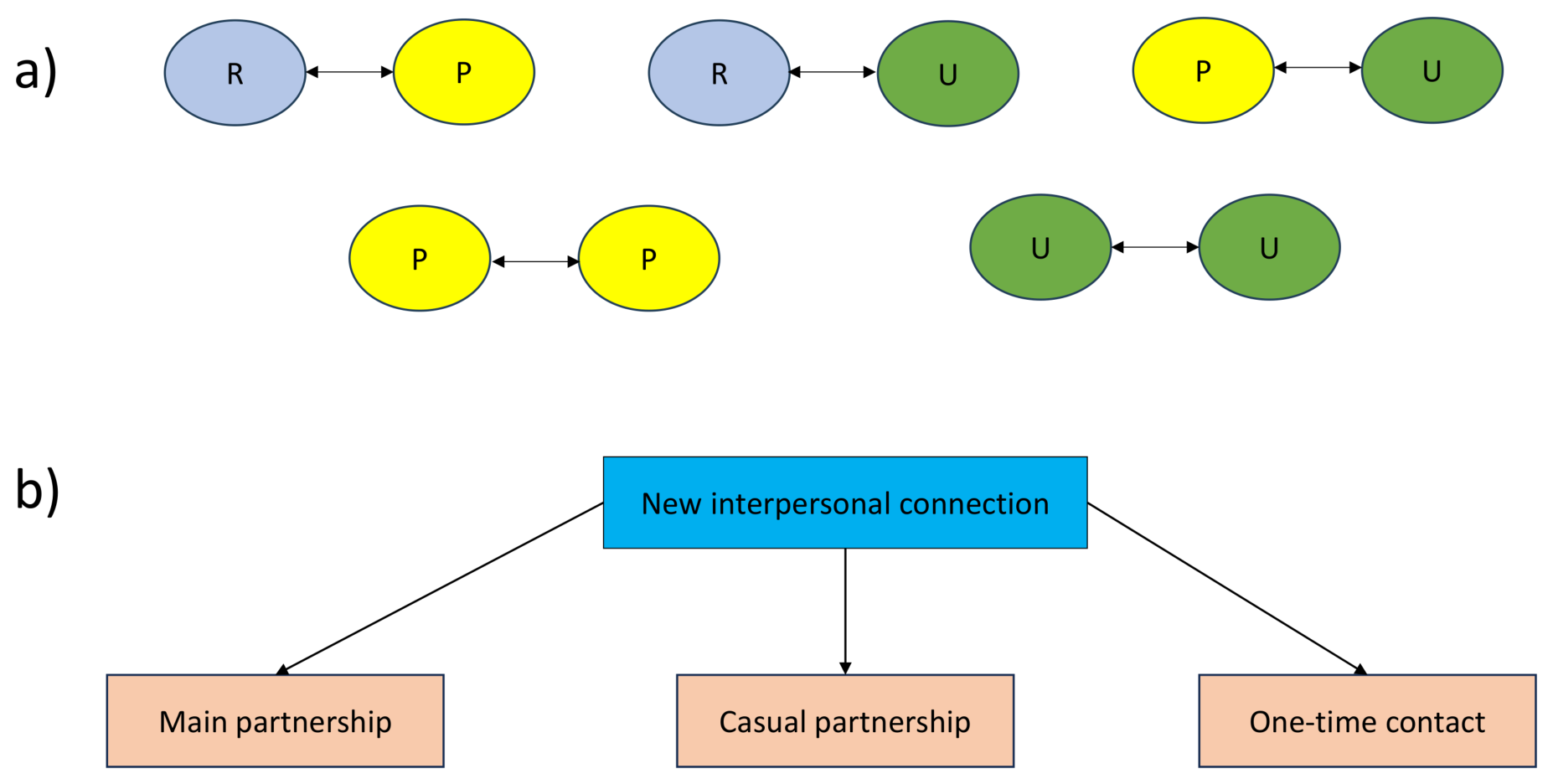
Figure 2.
Recovery pathways. The black arrows represent conscious actions of the agents, the blue arrows denote full recovery after the treatment, the grey arrows indicate the situation when the treatment has not resulted in recovery at all the infected sites and the green arrows represent natural recovery.
Figure 2.
Recovery pathways. The black arrows represent conscious actions of the agents, the blue arrows denote full recovery after the treatment, the grey arrows indicate the situation when the treatment has not resulted in recovery at all the infected sites and the green arrows represent natural recovery.
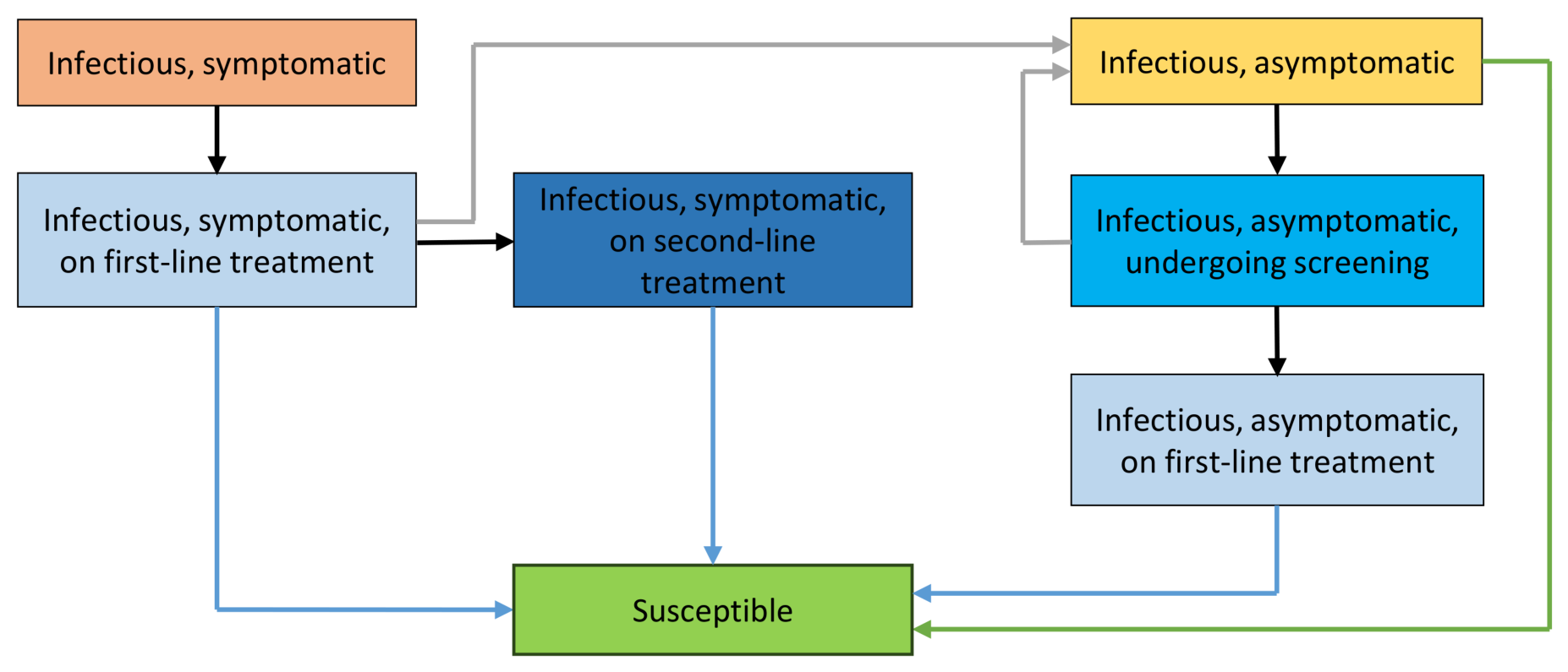
Figure 3.
The selected trajectories and the calibration targets. The bars represent the 95% uncertainty intervals. Abbreviations: MSM, men who have sex with men; CRO, ceftriaxone.
Figure 3.
The selected trajectories and the calibration targets. The bars represent the 95% uncertainty intervals. Abbreviations: MSM, men who have sex with men; CRO, ceftriaxone.
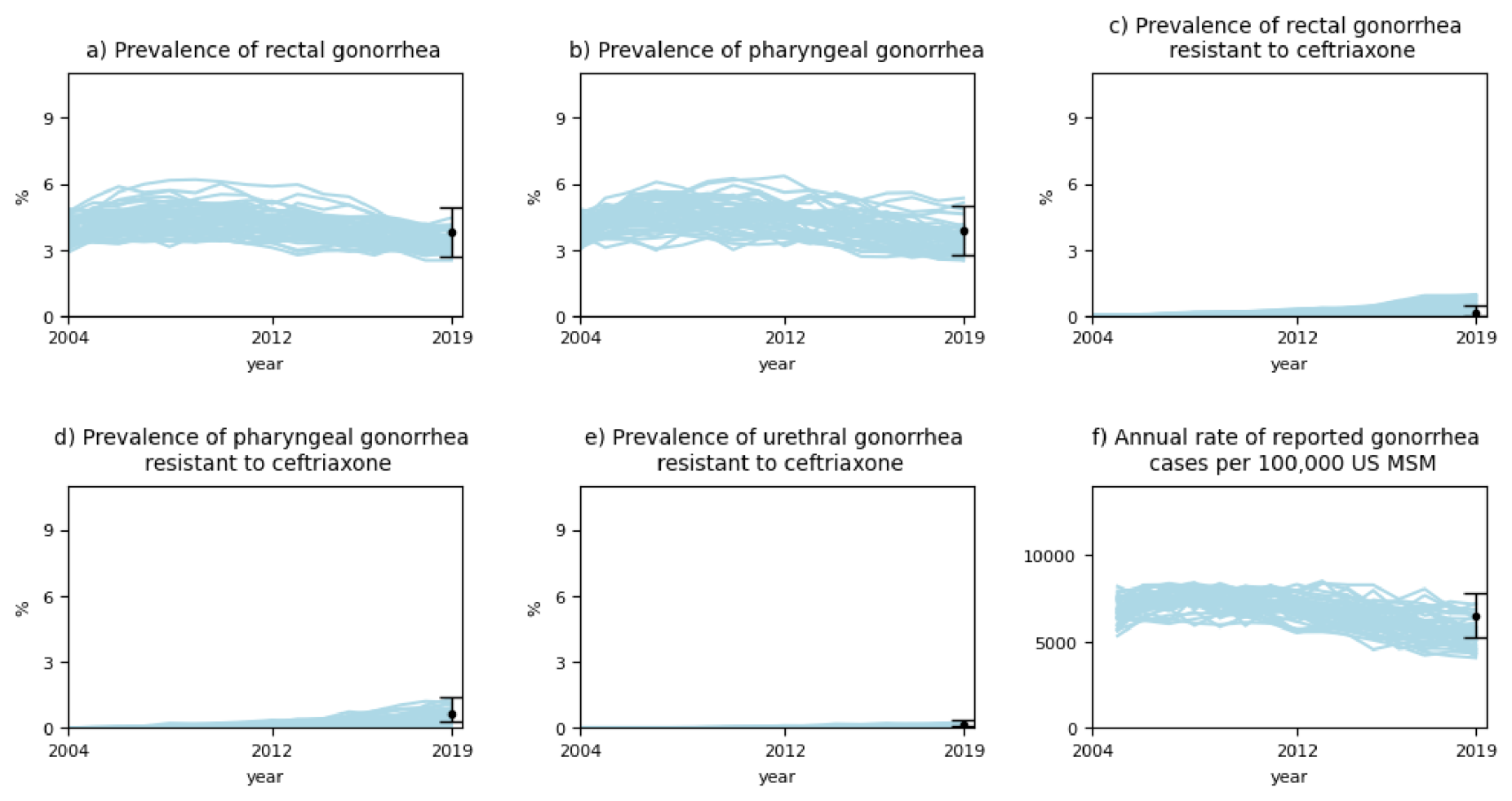
Figure 4.
Performance of different surveillance strategies. The bars represent the 95% uncertainty intervals. Abbreviations: GISP, the Gonococcal Isolate Surveillance Project; eGISP, the enhanced Gonococcal Isolate Surveillance Project. eGISP- is the variant of eGISP that operates without the rectal isolates. GISP 4000 represents GISP that relies on 4000 isolates from symptomatic men who have sex with men (MSM) with urethral gonorrhea.
Figure 4.
Performance of different surveillance strategies. The bars represent the 95% uncertainty intervals. Abbreviations: GISP, the Gonococcal Isolate Surveillance Project; eGISP, the enhanced Gonococcal Isolate Surveillance Project. eGISP- is the variant of eGISP that operates without the rectal isolates. GISP 4000 represents GISP that relies on 4000 isolates from symptomatic men who have sex with men (MSM) with urethral gonorrhea.
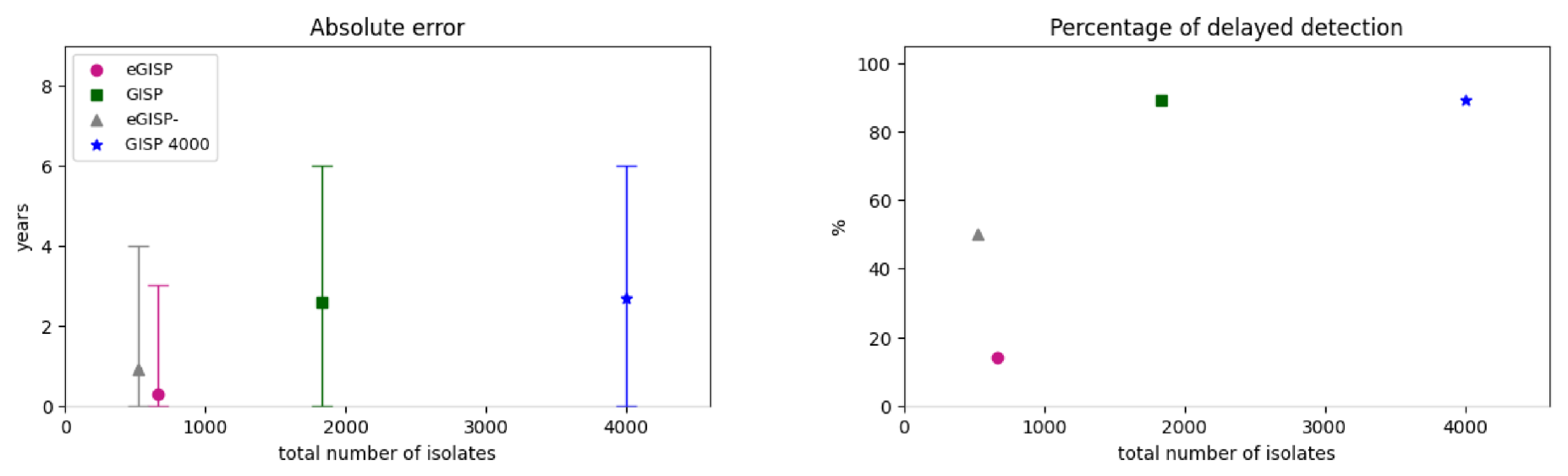
Figure 5.
Results of the sensitivity analysis. The bars represent the 95% uncertainty intervals. Abbreviations: GISP, the Gonococcal Isolate Surveillance Project; eGISP, the enhanced Gonococcal Isolate Surveillance Project. eGISP- is the variant of eGISP that operates without the rectal isolates. GISP 4000 represents GISP that relies on 4000 isolates from symptomatic men who have sex with men (MSM) with urethral gonorrhea.
Figure 5.
Results of the sensitivity analysis. The bars represent the 95% uncertainty intervals. Abbreviations: GISP, the Gonococcal Isolate Surveillance Project; eGISP, the enhanced Gonococcal Isolate Surveillance Project. eGISP- is the variant of eGISP that operates without the rectal isolates. GISP 4000 represents GISP that relies on 4000 isolates from symptomatic men who have sex with men (MSM) with urethral gonorrhea.
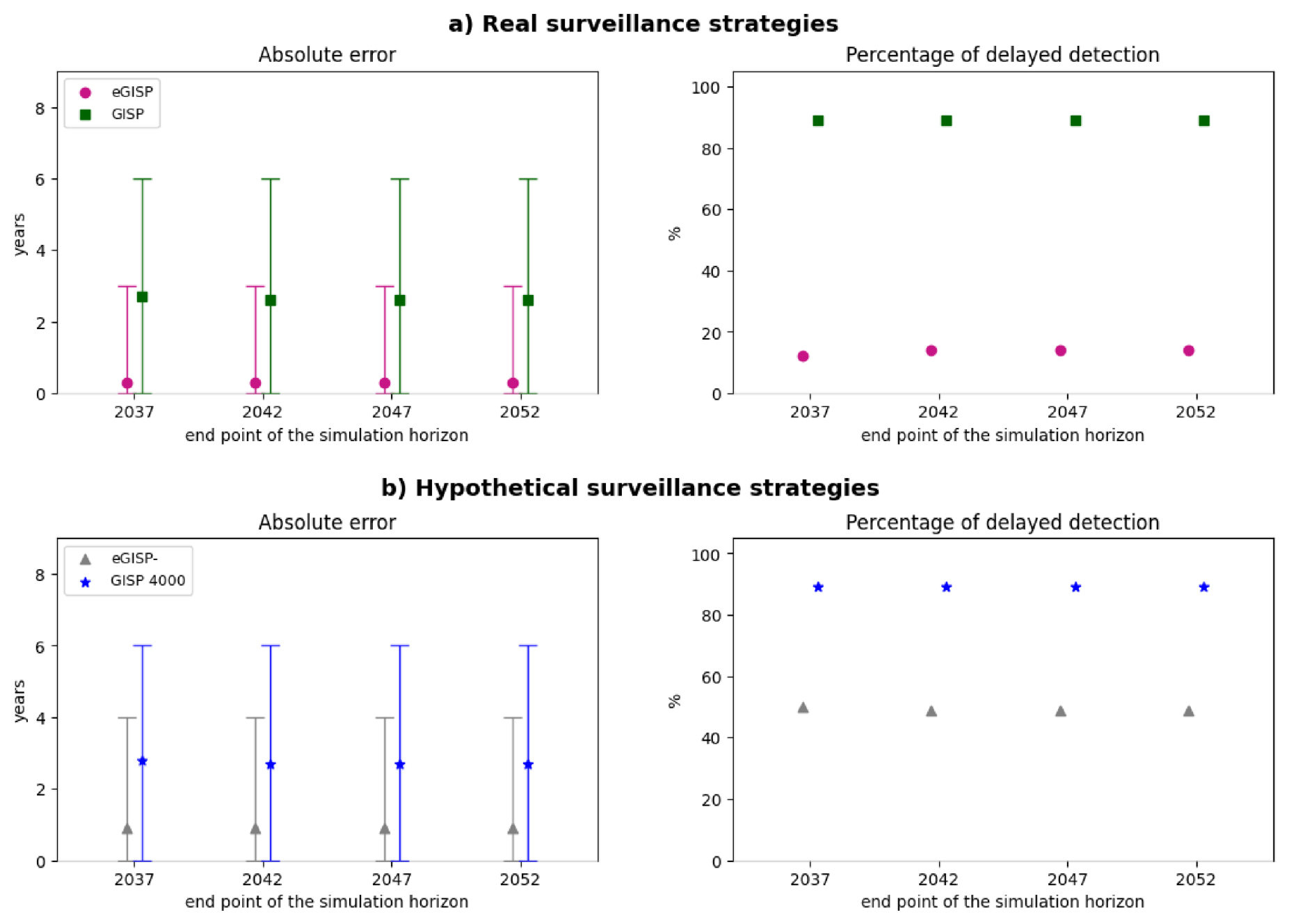

Table 1.
Calibration targets. The first two targets were standardized by age. Abbreviation: MSM, men who have sex with men.
Table 1.
Calibration targets. The first two targets were standardized by age. Abbreviation: MSM, men who have sex with men.
| Calibration target | Number of participants and number of positive cases | Mean and 95% uncertainty interval | Source |
|---|---|---|---|
| Prevalence of rectal gonorrhea among the US MSM | N/A | 3.8% (2.7%, 4.9%) | [34] |
| Prevalence of pharyngeal gonorrhea among the US MSM | N/A | 3.9% (2.8%, 5%) | [34] |
| Prevalence of rectal gonorrhea resistant to ceftriaxone among the US MSM | 1553, 2 | 0.13% (0.03%, 0.51%) | [23] |
| Prevalence of pharyngeal gonorrhea resistant to ceftriaxone among the US MSM | 1049, 7 | 0.67% (0.32%, 1.4%) | [23] |
| Prevalence of urethral gonorrhea resistant to ceftriaxone among the US MSM | 3974, 7 | 0.18% (0.08%, 0.37%) | [23] |
| Annual rate of reported gonorrhea cases per 100,000 US MSM | 1380, 90 | 6508 (5206, 7809) | [18] |
Disclaimer/Publisher’s Note: The statements, opinions and data contained in all publications are solely those of the individual author(s) and contributor(s) and not of MDPI and/or the editor(s). MDPI and/or the editor(s) disclaim responsibility for any injury to people or property resulting from any ideas, methods, instructions or products referred to in the content. |
© 2026 by the author. Licensee MDPI, Basel, Switzerland. This article is an open access article distributed under the terms and conditions of the Creative Commons Attribution (CC BY) license.
Copyright: This open access article is published under a Creative Commons CC BY 4.0 license, which permit the free download, distribution, and reuse, provided that the author and preprint are cited in any reuse.