

Submitted:
26 September 2023
Posted:
28 September 2023
You are already at the latest version
Abstract
This paper initiates the study of the mathematical aspects of the ad-hoc Lanzhou index. If G is a graph with the vertex set {x1,⋯,xn}, then the ad-hoc Lanzhou index of G is defined by Lz¯(G)=∑i=1ndi(n−1−di)2, where di represents the degree of the vertex xi. Several identities for the ad-hoc Lanzhou index, involving some existing topological indices are established. The problems of finding graphs with the extremum values of the ad-hoc Lanzhou index from the following sets of graphs are also attacked: (i) set of all connected ξ-cyclic graphs of a fixed order, (ii) set of all connected molecular ξ-cyclic graphs of a fixed order, (iii) set of all graphs of a fixed order, (iv) set of all connected molecular graphs of a fixed order.
Keywords:
topological index
; chemical graph theory
; ad-hoc Lanzhou index
; Lanzhou index
; forgotten topological coindex
MSC: 05C07; 05C09; 05C92
1. Introduction
Graph invariants are regarded as the properties of a graph that the graph isomorphism preserves [1]. Real-valued graph invariants are often known as topological indices [3]. We mention [2,3,4,5] as sources for terminology and notations related to (chemical) graph theory.
One of the most extensively researched topological indices is the first Zagreb index, which originally appeared in [6]. For a graph G, its first Zagreb index is often represented by and is defined (for example see [7]) as
where represent the degree of the vertex t in G and is the set of edges of G. The forgotten topological index [8] (which is sometimes referred to as the F-index, see also [9]) is another index that first appeared in [6]. The F-index of a graph G is represented by and is defined [8] as follows.
Vukičević et al. [10] studied (chemically as well as mathematically) the following linear combination of the indices and for a graph of order n and referred it to as the Lanzhou index:
The Lanzhou index can be rewritten as
where is the complement of G and represent the degree of t in . The Refs. [11,12,13,14] provide some recent extremal results regarding the Lanzhou index.
If is a topological index of a graph G, then is known as its reformulated version [15,16]. Here, means the line graph of G. Motivated by the concept of reformulated topological indices [15,16], we consider ad-hoc topological indices: if is a topological index of a graph G, then we call as the ad-hoc version of , where represents the complement of G. Thus, applying the idea of ad-hoc topological indices on the Lanzhou index gives the ad-hoc Lanzhou index, represented by . The ad-hoc Lanzhou index [10], for a graph G, is defined as
If , then and thus
The ad-hoc Lanzhou index was examined in [10] for predicting the octanol-water partition coefficient of nonane isomers and it was found that this index performs better than both the well-known first Zagreb index and the F-index.
A graph with n vertices is called an n-order graph. Molecular graphs are those with the maximum degree at most 4. A connected -cyclic graph of order n is a connected n-order graph with edges. For , and 3, a connected -cyclic graph is also known as a tree, connected unicyclic graph, connected bicyclic graph, and connected tricyclic graph, respectively.
In this paper, several identities for the ad-hoc Lanzhou index, involving some existing topological indices are established. The problems of finding graphs with the extremum values of the ad-hoc Lanzhou index from the following sets of graphs are also attacked: (i) set of all n-order connected -cyclic graphs (with a particular emphasis on unicyclic graphs, trees, bicyclic as well as tricyclic graphs), (ii) set of all n-order connected molecular -cyclic graphs, (iii) set of all n-order graphs, (iv) set of all n-order connected molecular graphs.
2. Identities
For a graph G, its forgotten topological coindex (or simply the F-coindex) is represented by and is defined [17,18] by
Actually, the F-coindex is equal to the Lanzhou index for every graph, see for example [19]. Generally, if is a topological index of a graph G then the corresponding coindex is defined as , where g maybe the degree, the eccentricity, or any other (real-valued) parameter defined on the vertices of G and f is a real-valued symmetric function. Note that the Lanzhou index can be rewritten as
where and indicate the degrees of the vertex in G and , respectively. When there is no chance of confusion, we drop “” from the notation . Applying the definition of a coindex to the Lanzhou index yields the Lanzhou coindex :
Consequently, we have
The following result is immediate from the above.
Observation 1.
For every graph G, its Lanzhou coindex is equal to the Lanzhou index of (which is termed as the ad-hoc Lanzhou index of G), which is equal to the F-coindex of ; that is,
Because of (1), the identity given in the following proposition is already known (see Equation (3.6) in [18]); however, here we provide its more simple proof.
Proposition 1.
For any graph G with size m and order n, the following identity holds
Proof.
Note that the formula for can be rewritten as
Expanding the squared terms in (2) and then making use of the definitions of F and , we get the desired identity. □
By Proposition 1, every upper bound on provides a lower bound on and every lower bound on gives an upper bound on ; many bounds on can be found in [7]. Also, from the aforementioned proposition, it is concluded that every lower/upper bound on F provides a(n) lower/upper bound on , respectively; several bounds on F-index can be found in [20].
Proposition 2.
For any graph G with size m and order n, the following identity holds
Proof.
The identity given in Proposition 1 gives the desired result after utilizing the following well-known trivial formula:
□
By Proposition 2, every upper bound on provides a lower bound on and every lower bound on gives an upper bound on ; considerable number of bounds on can be found in [20].
3. Extremal Results Concerning -Cyclic Graphs
If and then let denote the graph formed from G by removing the edge and adding the edge . We begin this section by providing the following simple but useful lemma that will be used frequently in the remaining part of this paper:
Lemma 1.
Suppose that G is an n-order graph containing such that and . If , then
where and .
Proof.
Utilizing the definition of , we get
□
Lemma 2.
Let G be an n-order graph containing a path such that and the edge does not lie on any cycle of length 3, where and . If , then
Proof.
By Lemma 1 we get
where and . Since the edge does not lie on any cycle of length 3, we have and thus under the given constraints, Equation (3) gives
□
Now, we provide the first extremal result involving the minimum possible value of for trees.
Theorem 1.
In the set of all n-order trees, with , only the star graph possesses the lowest value of ; the mentioned lowest value is .
Proof.
Let T be a tree possessing the lowest value of in the set of all n-order trees. Suppose on the contrary that . Then . Consider a path of T such that . If is the graph deduced from T by dropping and inserting , then by Lemma 2 we have
a contradiction. Also, by elementary computations, one has
□
Next, we pay attention to deriving extremal results involving the minimum possible value of for connected -cyclic graphs. For this, we require the next two results.
Lemma 3.
If G is an n-order connected ξ-cyclic graph, is an edge of G and γ is the number of common neighbors of s and r, then .
Proof.
Let be the number of those neighbors of r that are neither adjacent to s nor equal to s; see Figure 1. Let be the number of those neighbors of s that are neither adjacent to r nor equal to r. Then and . Note that and . Thus,
□
Lemma 4.
Suppose that G is a connected ξ-cyclic graph of order n containing a path such that , where and . If , then
Proof.
In the following, we take and . By Lemma 3, the inequality holds and thus under the given constraints, Lemma 1 yileds
□
Corollary 1.
Let G be a graph possessing the lowest value of in the set of all n-order connected ξ-cyclic graph, with . Then .
Proof.
Contrarily, assume that . Take a vertex satisfying . Then G has a path such that . Take . By Lemma 4, it holds that , which is not possible because of the definition of G. Thus, . □
Next, we provide extremal results involving the minimum possible values of for connected -cyclic graphs when . For , connected -cyclic graphs are also known as unicyclic, bicyclic, tricyclic, tetracyclic, and pentacyclic.
Note that there are only two (non-isomorphic) 4-order connected unicyclic graphs and both of them have the same value of . Thus, in the next theorem, we find the extremal graphs of order at least 5.
Theorem 2.
The graph generated from the n-order start graph by inserting an edge, solely possesses the lowest value of in the set of all n-order connected unicyclic graphs, for every . For , the extremal graphs are depicted in the first row, second row, third row of Figure 2, respectively.
Proof.
Since there is only one n-order unicyclic graph of maximum degree for every , the desired conclusion follows from Corollary 1 for . Lemma 2 implies that if G is a graph possessing the least value of in the set of all n-order connected unicyclic graphs, with , then the number of pendent vertices in G becomes . Simple calculations yield the desired conclusion for . □
For , denote by the n-order bicyclic graph shown in Figure 3, where with and . Also, for , denote by the n-order bicyclic graph shown in Figure 4, where with and for every .
Theorem 3.
Considering the family of all n-order bicyclic connected graphs having , only the graph possesses the lowest value of .
Proof.
Let be an n-order connected bicyclic graph, with . If then Corollary 1 implies that cannot possess the lowest value of in the set of all n-order connected bicyclic graph. If then . By elementary calculations, we verify that the inequality
holds for . Hence, for every , it holds that
□
Next, we characterize the graphs possessing the lowest value of from the set of graphs mentioned in Theorem 3 for .
Theorem 4.
Let be an n-order connected bicyclic graph with such that the cycles of do not share any edge and . Then, does not possess the lowest value of in the set of all n-order connected bicyclic graphs for every .
Proof.
Take a vertex satisfying . Since , the graph has a path such that . Form a new graph from by dropping and inserting . By Lemma 3, the inequality holds and thus by bearing in mind the given assumptions and Lemma 1, we get
which implies that cannot possess the lowest value of in the set of all n-order connected bicyclic graphs for every . □
Lemma 2 implies the next corollary.
Corollary 2.
Lemma 5.
For the n-order bicyclic graph (depicted in Figure 3) with and , the following inequality holds:
Proof.
Since with , it holds that . Therefore, by bearing in mind the given assumptions and Lemma 1, we get
□
Lemma 6.
For the n-order bicyclic graph (depicted in Figure 3) with and , it holds that
Proof.
By Lemma 1, we get
Lemma 7.
For the n-order bicyclic graph with , the following relations hold:
and
Proof.
Since , we have
and
which yield the desired relations. □
Lemma 8.
Proof.
Since with for , it holds that for every . Also, we recall that . Therefore, by using the given constraints, we have
□
Lemma 9.
For the n-order bicyclic graph , the following relations hold:
and
Proof.
Since , we have
and
from which the required relations follow. □
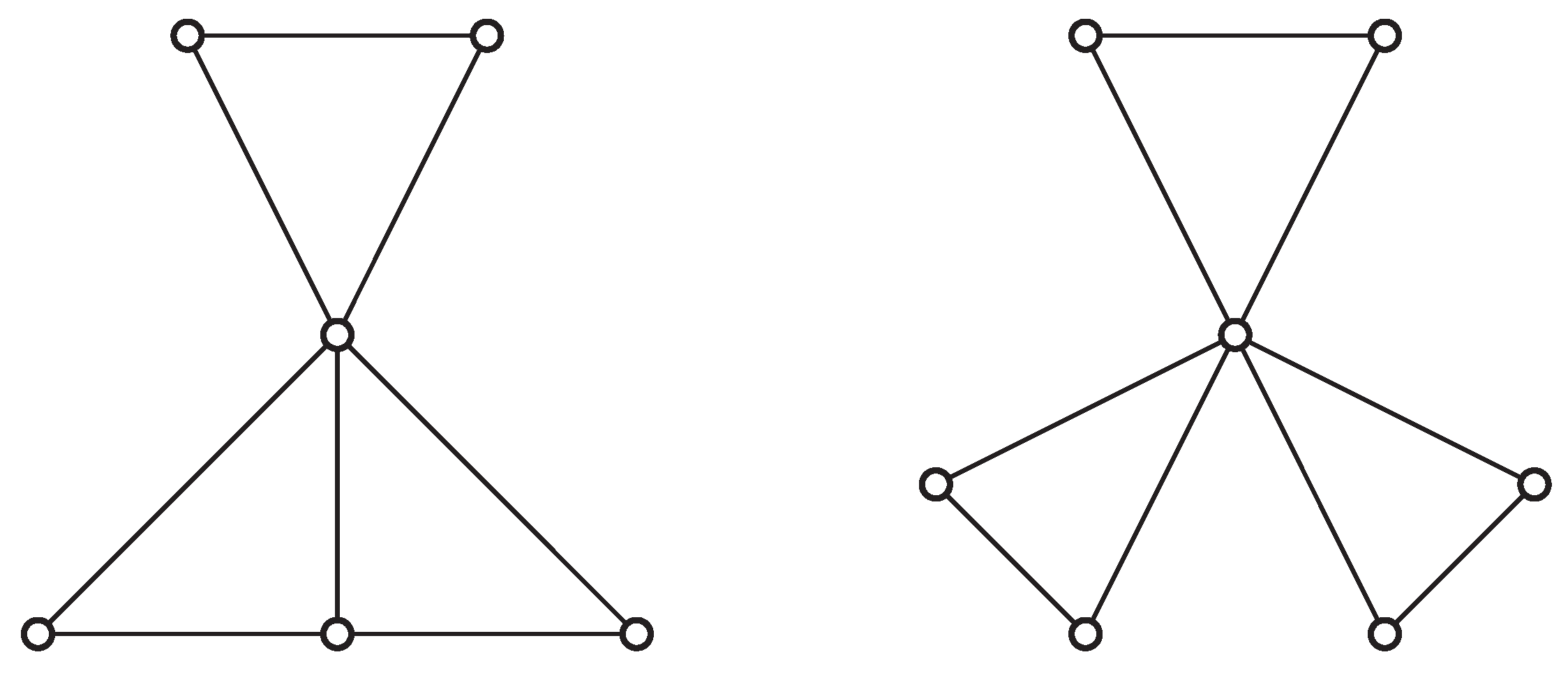
Denote by the graph deduced from the 4-order complete graph by dropping an edge. Let be the graph formed from by connecting pendent vertices with one vertex having degree 3 and the rest pendent vertices with the other vertex having degree 3 (see the graph placed on the left-hand side in Figure 5), where . Let denote the graph generated from by attaching pendent vertices to a vertex of degree 2 (see the graph placed on the right-hand side in Figure 5). Certainly, .
Now, we are in the position to characterize the graphs possessing the lowest value of from the set of graphs mentioned in Theorem 3 for .
Theorem 5.
Among all n-order connected bicyclic graphs,
- (i)
- only the graph has the minimum value of for ,
- (ii)
- only the graph has the minimum value of for each ,
- (iii)
- only the graph has the minimum value of for each ,
- (iv)
- only the graphs have the minimum value of for .
Proof.
By Corollary 2, it is enough to investigate the values of for the graphs:
For , there are only three such graphs; namely, , and . Certainly, for , it holds that
which confirms Part (i) of the theorem.
If G is a graph possessing the least value of in the set of all 6-order connected bicyclic graphs, then from Lemmas 6, 7, 8 and 9, it follows that where the graphs are depicted in Figure 6. It holds that
If G is a graph possessing the least value of in the set of all 7-order connected bicyclic graphs, then from Lemmas 6, 7, 8 and 9, it follows that where the graphs are depicted in Figure 7. It holds that
and
Since and , the proof of Part (ii) is completed.
Theorem 4 states that if is an n-order connected bicyclic graph with such that the cycles of do not share any edge and , then does not possess the lowest value of in the family of all n-order bicyclic connected graphs having . Thus, if G is a graph possessing the least value of in the set of all n-order connected bicyclic graphs for , then from Lemmas 6 and 7 it follows that
where . For the following relations hold:
Also, the inequality holds for each . Moreover, the equation holds for every . Thus, Parts (iii) and (iv) also hold.
□
Theorem 6.
Considering the family of all n-order tricyclic connected graphs having with , only the right-most graph in Figure 8 possesses the lowest value of .
Proof.
Let G be an n-order connected tricyclic graph, with . If then Corollary 1 implies that G cannot possess the lowest value of in the set of all n-order connected tricyclic graph. If then G is one of the graphs (from left to right, respectively) shown in Figure 8. We have
But, for every . Hence, with equality if and only if . □
A non-trivial path of a graph G is said to be a pendent path if
provided that when . By adjacent pendent paths in a graph G, we mean the pendent paths of G having a common vertex.
Lemma 10.
For , if G is a connected n-order graph possessing adjacent pendent paths, then there exists a connected n-order graph which has no adjacent pendent paths satisfying and
Proof.
Let s be the common vertex of two adjacent pendent paths and in G. Assume that the edge belongs to the path . Let be the vertex of satisfying . Take . Evidently, . Since and , by Lemma 1 we get
If contains no adjacent pendent paths, the lemma holds true. If does contain such paths, we can perform again the above-mentioned transformation successively until we obtain the desired graph satisfying . □
The next result is one of the direct outcomes of Lemma 10.
Theorem 7.
In the set of all n-order trees, with , only the path graph possesses the highest value of ; the mentioned highest value is
Lemma 11.
If G is a graph possessing the highest value of among the family of all n-order connected ξ-cyclic graphs admitting and , then .
Proof.
Contrary, let . Because of the constraint , the graph G must contain at least one pendent path, say P. Let r and s be the terminal end vertices of the path P; particularly, assume that and . Let where t does not belong to the path P. Take . After the same calculations as made in the proof of Lemma 10, we arrive at ; this contradicts the definition of G. Thereby, .
□
The next result is one of the direct outcomes of Lemma 11.
Theorem 8.
Considering the family of all n-order unicyclic connected graphs having , only the cycle graph possesses the highest value of ; the mentioned highest value is
Lemma 12.
If G is a graph possessing the highest value of in the family of all n-order connected ξ-cyclic graphs admitting and , then .
Proof.
The connectedness of G and the constraint guaranty that . Contrarily, let . By Lemma 11, the inequality holds.
Suppose that G has m edges. Represent by the number of members of . Since , the inequality yields , which further implies that
which guaranties that
that is, G possess at least one vertex with degree 2.
Consider a vertex such that (then certainly we have ). Consider also a vertex having degree 2. The inequality confirms the existence of no less than two neighbors of s that are not adjacent to r. We pick from these neighbors of s a vertex t such that the graph is connected. First, by using Lemma 1 and then by using the inequalities and , we get
which is at odds with the definition of G. Therefore we derive that , as desired. □
Theorem 9.
Consider the set of all n-order connected ξ-cyclic graphs with and .
- (i).
- If then only (the) 3-regular graph(s) possess(es) the highest value of in .
- (ii).
- If then only the graphs with possess the highest value of in .
Proof.
Assume G is a graph possessing the highest value of in . Then, by Lemmas 11 and 12, it holds that and . Thus, we have
and
where is defined in the proof of Lemma 12.
One of the implications of Theorem 9 is the following result.
Theorem 10.
Only the graphs with possess the highest value of in the family of all n-order bicyclic connected graphs admitting . For , such an extremal graph can be constructed from the star graph through inserting two non-adjacent edges.
Proof.
If then the desired conclusion follows from Theorem 9. If then by Lemma 11, the minimum degree of a graph possessing the highest value of in the set of all n-order connected bicyclic graphs must be at least 2. If then there are only three n-order connected bicyclic graphs with minimum degree at least 2; Figure 9 shows all these three graphs together with the values of . Now, in the following, assume that .
Assume that G is a graph possessing the highest value of in the family of all n-order connected bicyclic graphs. Then, by Lemma 11, it holds that . We claim that . We note that there is no bicyclic graph with and (because ). Thus, from the proof of Lemma 12 it follows that . Since , from the proof of Theorem 9(ii) it follows that .
□
Another implication of Theorem 9 is the following theorem.
Theorem 11.
Only the graphs with possess the highest value of in the family of all n-order tricyclic connected graphs admitting . For , such an extremal graph can be constructed from the star graph through inserting three edges between one fixed pendent vertex and three other pendent vertices (see the right-most graph in Figure 10). For , such an extremal graph is the one with minimum degree 2 and maximum degree .
Proof.
If then the desired conclusion follows from Theorem 9. If then by Lemma 11, the minimum degree of a graph possessing the highest value of in the set of all n-order connected tricyclic graphs must be at least 2. If then there are only three n-order connected tricyclic graphs with minimum degree at least 2; Figure 10 shows all these three graphs and its caption gives the values of for the mentioned three graphs. Now, in the following, assume that .
Assume that G is a graph possessing the highest value of in the family of all n-order tricyclic connected graphs. Then, by Lemma 11, it holds that . We claim that . Contrarily, let . Then from the proof of Lemma 12, it follows that . Since , from the proof of Theorem 9(ii) it follows that . Equations (5) and (6) yield and . Thus, we have
a contradiction, where is the n-order connected tricyclic graph with maximum degree and minimum degree at least 2 (see Figure 11). □
4. Extremal Results Concerning Molecular -Cyclic Graphs
Note that the extremal graphs specified in Theorems 9, 10 and 11 are molecular ones, except for in Theorem 11. Thus, these graphs remain extremal if one puts the following additional constraint on the graphs considered in these theorems: maximum degree is at most 4. Also, from the proof of Theorem 11 we deduce that the graphs with are the only graphs possessing the highest ad-hoc Lanzhou index in the set of all n-order molecular connected tricyclic graphs for . Next, we turn our attention to the results concerning the minimum ad-hoc Lanzhou index of molecular -graphs (or, equivalently n-order -cyclic graphs). An -graph is an n-order graph of size m. For a graph G, define
where f is a real-valued function. Some initial studies, recent developments, and a survey on the indices of the form (7) can be found in [21,22], [23,24,25,27], and [26], respectively.
Lemma 13.
[28] Consider a molecular -graph G, where . Take
If and , then
where the equality holds if and only if the degree set of G is
- and G admits exactly one vertex of degree 2 whenever ;
- and G admits exactly one vertex of degree 3 whenever ;
- whenever .
Theorem 12.
For a molecular -graph G, with , the following holds:
where the equality characterization is the same as mentioned in Lemma 13.
Proof.
Consider with . Then, we have
and
Thus, by Lemma 13, the desired result follows. □
One of the simple but noticeable consequences of Theorem 12 is the following extremal result involving molecular trees.
Corollary 3.
For every , in the family of all n-order molecular trees, only the trees having the degree set
- (i)
- and admitting exactly one vertex of degree 2, possess the least value of , when ;
- (ii)
- and admitting exactly one vertex of degree 3, possess the least value of , when ;
- (iii)
- possess the least value of , when .
5. Extremal Results for n-Order Graphs
To prove the first extremal result involving for n-order graphs, we require the following known result:
Lemma 14.
[10] If G is an n-order graph, then
Here the left equality is true if and only if , and the right equality is true if and only if and G is a - regular graph.
Proposition 3.
In the set of all n-order graphs, only the edgeless graph and the complete graph possess the least value of ; the mentioned least value is 0. Also, in the same set with the constraint , only the -regular graph possesses the highest value of ; the mentioned highest value is
Proof.
Since , by Lemma 14 it is enough to show the existence of at least one -regular graph with n vertices satisfying the congruence . Since , we have for some integer k. Thus, if is even then k must be even and thereby remains even. Eventually, whether is even or odd, in either case, we conclude that is even. Also, it is a well-known observation that there exists at least one t-regular graph with order n whenever is even; this fact implies that there exists at least one -regular graph with order n for every n satisfying .
□
Next, we pay our attention to the extremum values of for n-order molecular graphs.
Theorem 13.
In the set of all n-order molecular graphs, with the constraint , only 4-regular graphs possess the highest value of .
Proof.
Consider an n-order molecular graph G. For every , it holds that with equality if and only if . Consequently, we have
where the equality is true if and only if G is 4-regular. Since at least one 4-regular graph exists for every , the desired result follows from (8). □
For the minimal version of Theorem 13, we require the following:
Lemma 15.
If G is an n-order molecular graph, with , and , then
Proof.
Since the function , with , is strictly increasing for , we get
where and . □
Theorem 14.
For every , in the set of all n-order connected molecular graphs, only the trees having the degree set
- (i)
- and admitting exactly one vertex of degree 2, possess the least value of , when ;
- (ii)
- and admitting exactly one vertex of degree 3, possess the least value of , when ;
- (iii)
- possess the least value of , when .
Proof.
Consider an n-order connected molecular graph G containing at least one cycle, where . By Lemma 15, it holds that , where is an edge lying on a cycle of G. Thus, for every , a graph possessing the least value of in the set of all n-order connected molecular graphs must be a tree. Consequently, the desired conclusion follows from Corollary 3. □
Author Contributions
Conceptualization, A.A., Y.S., D.D., T.R.; methodology, A.A., Y.S., D.D., T.R.; software, A.A., Y.S., D.D., T.R.; validation, A.A., Y.S., D.D., T.R.; formal analysis, A.A., Y.S., D.D., T.R.; investigation, A.A., Y.S., D.D., T.R.; resources, A.A., Y.S., D.D., T.R.; data curation, A.A., Y.S., D.D., T.R.; writing—original draft preparation, A.A., Y.S., D.D., T.R.; writing—review and editing, A.A., Y.S., D.D., T.R.; visualization, A.A., Y.S., D.D., T.R.; supervision, Y.S., D.D., T.R.; project administration, Y.S., D.D., T.R. All authors have read and agreed to the published version of the manuscript.
Data Availability Statement
The authors can be contacted for details regarding this study’s data.
Conflicts of Interest
The authors declare no conflict of interest.
References
- Gross, J. L.; Yellen, J. Graph Theory and Its Applications; Second Edition: CRC Press, 2005. [Google Scholar]
- Bondy, J. A.; Murty, U. S. R. Graph Theory; Springer: New York, 2008. [Google Scholar]
- Wagner, S; Wang, H. Introduction to Chemical Graph Theory; CRC Press: Boca Raton, 2018. [Google Scholar]
- Trinajstić, N. Chemical Graph Theory; CRC Press: Boca Raton, FL, USA, 1992. [Google Scholar]
- Chartrand, G; Lesniak, L.; Zhang, P. Graphs & Digraphs, Sixth ed.; CRC Press: Boca Raton, 2016. [Google Scholar]
- Gutman, I.; Trinajstić, N. Graph theory and molecular orbitals. Total π-electron energy of alternant hydrocarbons. Chem. Phys. Lett. 1972, 17, 535–538. [Google Scholar] [CrossRef]
- Borovićanin, B.; Das, K. C.; Furtula, B.; Gutman, I. Bounds for Zagreb indices, MATCH Commun. Math. Comput. Chem. 2017, 78, 17–100. [Google Scholar]
- Furtula, B; Gutman, I. A forgotten topological index. J. Math. Chem. 2015, 53, 1184–1190. [Google Scholar] [CrossRef]
- Su, G.; Wang, S.; Du, J.; Gao, M.; Das, K. C.; Shang, Y. Sufficient conditions for a graph to be ℓ-connected, ℓ-deficient, ℓ-Hamiltonian and ℓ--independent in terms of the forgotten topological index. Mathematics 2022, 10, 1802. [Google Scholar] [CrossRef]
- Vukičević, D.; Li, Q.; Sedlar, J.; Došlić, T. Lanzhou index. MATCH Commun. Math. Comput. Chem. 2018, 80, 863–876. [Google Scholar]
- Alrowaili, D.A.; Zafar, F.; Javaid, M. Characterization of Extremal Unicyclic Graphs with Fixed Leaves Using the Lanzhou Index. Symmetry 2022, 14, 2408. [Google Scholar] [CrossRef]
- Li, Q.; Deng, H.; Tang, Z. Lanzhou index of trees and unicyclic graphs. Electron. J. Math. 2023, 5, 29–45. [Google Scholar]
- Liu, Q.; Li, Q.; Zhang, H. Unicyclic graphs with extremal Lanzhou index. Appl. Math. J. Chinese Univ. 2022, 37, 350–365. [Google Scholar] [CrossRef]
- Saha, L. Lanzhou index of trees with fixed maximum and second maximum degree. MATCH Commun. Math. Comput. Chem. 2022, 88, 593–603. [Google Scholar] [CrossRef]
- Ali, A., Iqbal, Z.; Iqbal, Z. Two physicochemical properties of benzenoid chains: solvent accessible molecular volume and molar refraction. Can. J. Phys. 2019, 97, 524–528. [Google Scholar] [CrossRef]
- Estrada, E. Edge adjacency relationships and a novel topological index related to molecular volume, J. Chem. Inf. Comput. Sci. 1995, 35, 31–33. [Google Scholar] [CrossRef]
- Azari, M.; Falahati-Nezhad, F. Some results on forgotten topological coindex. Iranian J. Math. Chem. 2019, 10, 307–318. [Google Scholar] [CrossRef]
- Furtula, B.; Gutman, I.; Kovijanić Vukićević, Z.; Lekishvili, G; Popivoda, G. On an old/new degree-based topological index. Bull. Acad. Serbe Sci. Arts (Cl. Sci. Math. Natur.) 2015, 40, 19–31. [Google Scholar]
- Milovanović, I.; Matejić, M.; Milovanović, E. A note on the general zeroth-order Randić coindex of graphs. Contrib. Math. 2020, 1, 17–21. [Google Scholar] [CrossRef]
- Liu, J. B.; Matejić, M. M.; Milovanović, E. I.; Milovanović, I. Ž. Some new inequalities for the forgotten topological index and coindex of graphs. MATCH Commun. Math. Comput. Chem. 2020, 84, 719–738. [Google Scholar]
- Linial, N.; Rozenman, E. An extremal problem on degree sequences of graphs. Graphs Combin. 2002, 18, 573–582. [Google Scholar] [CrossRef]
- Yao, Y.; Liu, M.; Belardo, F.; Yang, C. Unified extremal results of topological index and graph spectrum. Discrete Appl. Math. 2019, 271, 218–232. [Google Scholar] [CrossRef]
- Hu, Z.; Li, L.; Li, X.; Peng, D. Extremal graphs for topological index defined by a degree-based edge-weight function. MATCH Commun. Math. Comput. Chem. 2022, 88, 505–520. [Google Scholar] [CrossRef]
- Tomescu, I. Graphs with given cyclomatic number extremal relatively to vertex degree function index for convex functions. MATCH Commun. Math. Comput. Chem. 2022, 87, 109–114. [Google Scholar] [CrossRef]
- Tomescu, I. Extremal vertex-degree function index for trees and unicyclic graphs with given independence number. Discrete Appl. Math. 2022, 306, 83–88. [Google Scholar] [CrossRef]
- Li, X.; Peng, D. Extremal problems for graphical function-indices and f-weighted adjacency matrix. Discrete Math. Lett. 2022, 9, 57–66. [Google Scholar]
- Rizwan, M.; Bhatti, A. A.; Javaid, M.; Shang, Y. Conjugated tricyclic graphs with maximum variable sum exdeg index. Heliyon 2023, 9, e15706. [Google Scholar] [CrossRef] [PubMed]
- Albalahi, A. M.; Milovanović, I. Ž.; Raza, Z.; Ali, A.; Hamza, A. E. On the vertex-degree-function indices of connected (n,m)-graphs of maximum degree at most four. arXiv:2207.00353v2 [math.CO]; Bull. Math. Soc. Sci. Math. Roumanie, accepted.
Figure 1.
The structure of the graph G used in Lemma 3.
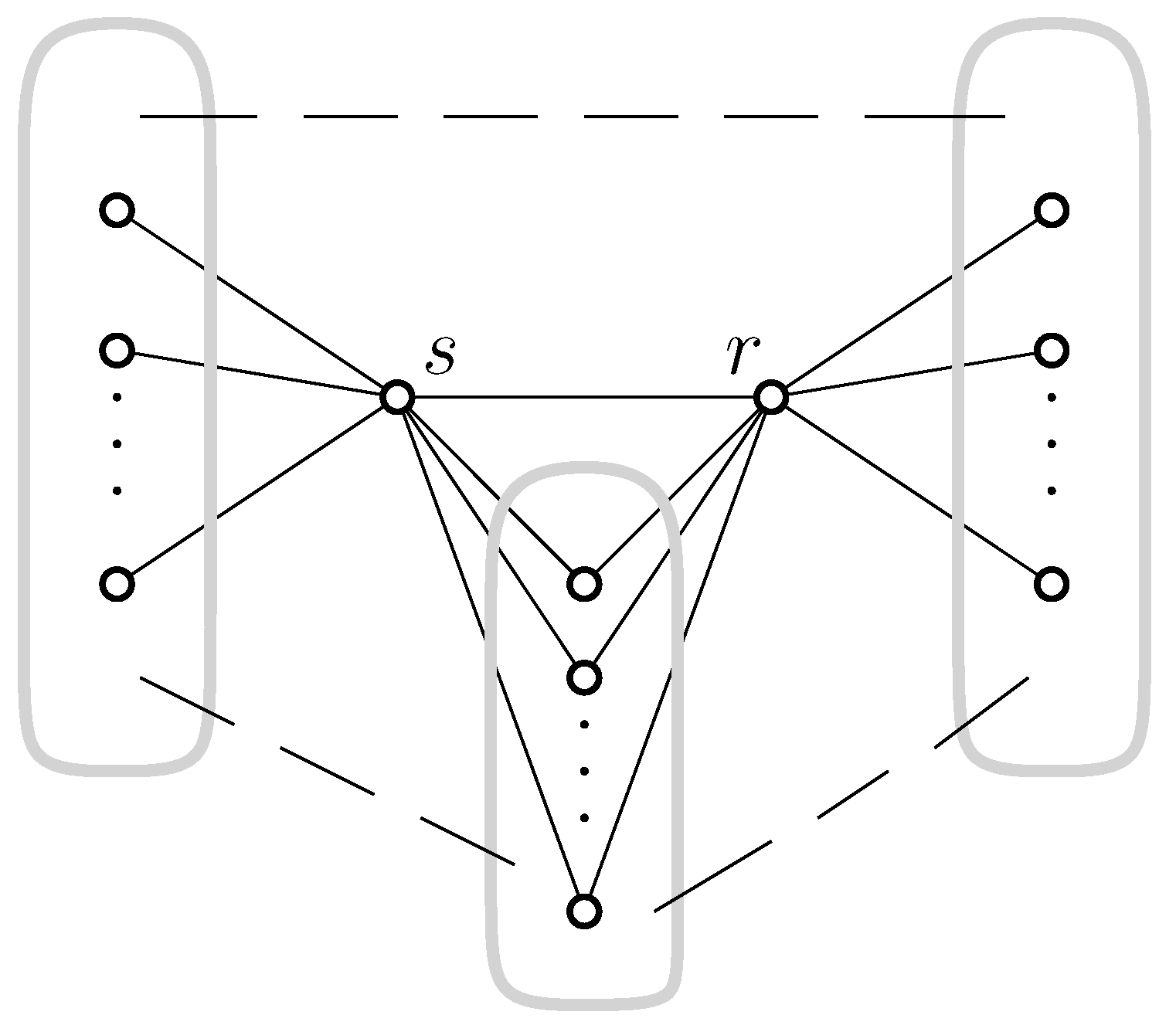
Figure 2.
The graphs possessing the lowest value of in the set of all n-order connected unicyclic graphs, for .
Figure 2.
The graphs possessing the lowest value of in the set of all n-order connected unicyclic graphs, for .
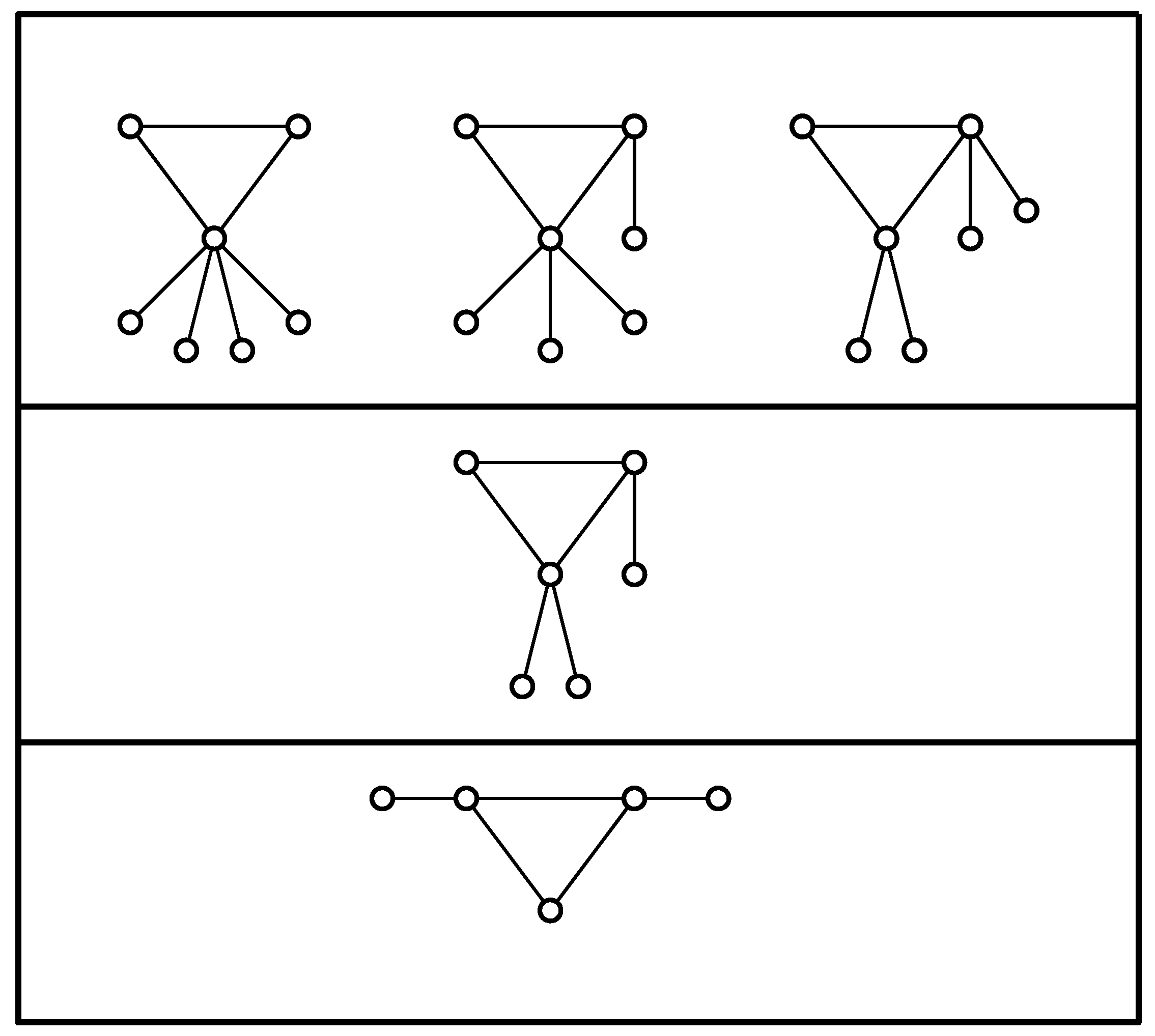
Figure 3.
The n-order bicyclic graph , where with and .
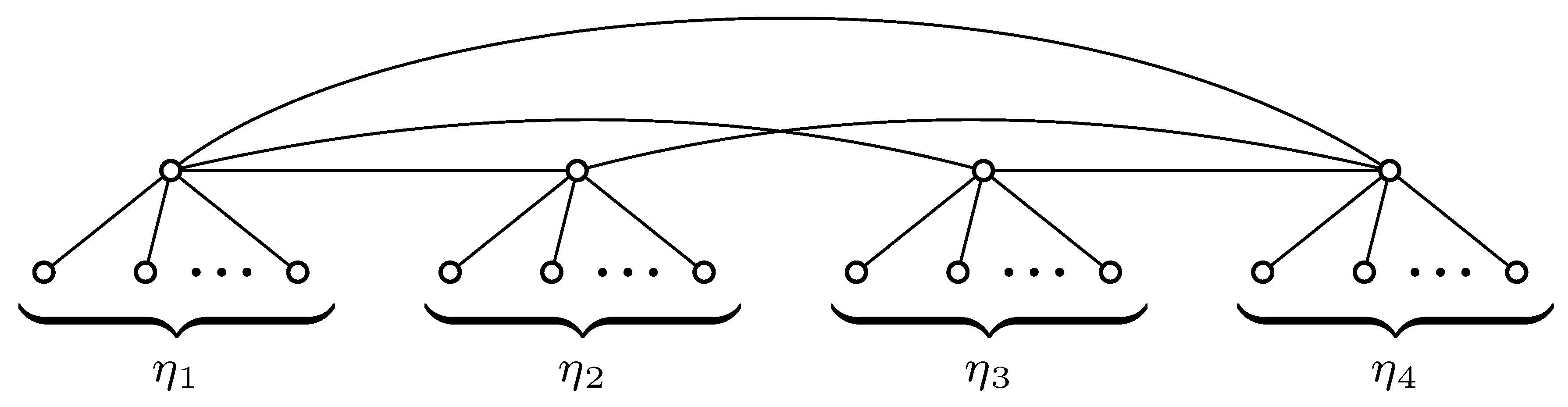
Figure 4.
The n-order bicyclic graph , where with and for every .

Figure 5.
The n-order bicyclic graphs (on the left side) and (on the right side), where .
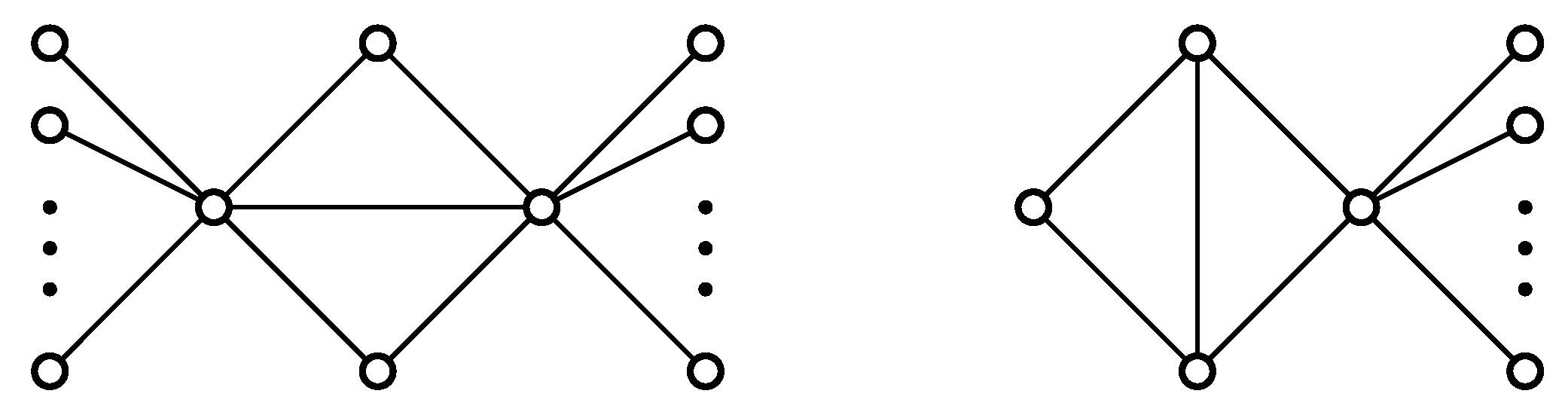
Figure 6.
The 6-order connected bicyclic graphs , , and .
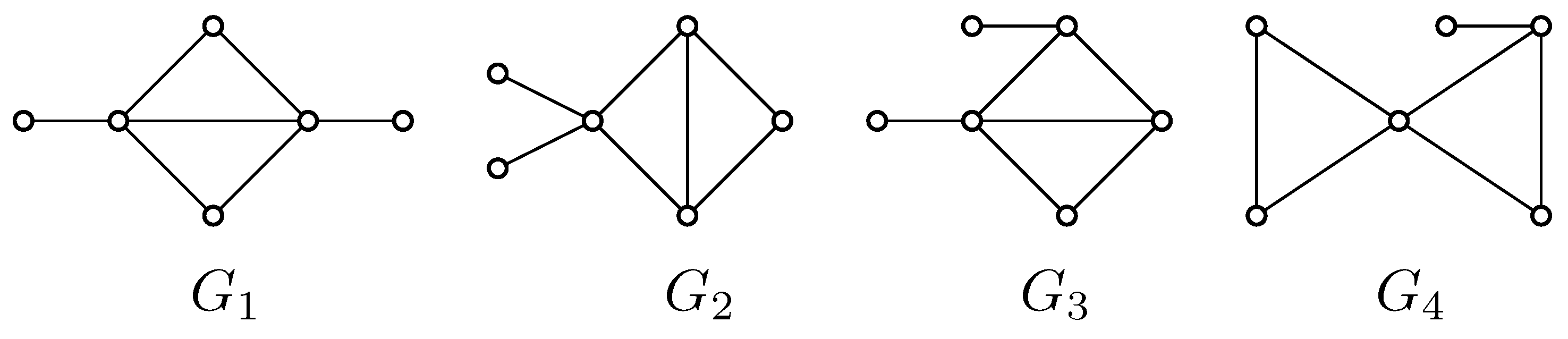
Figure 7.
The 7-order connected bicyclic graphs .
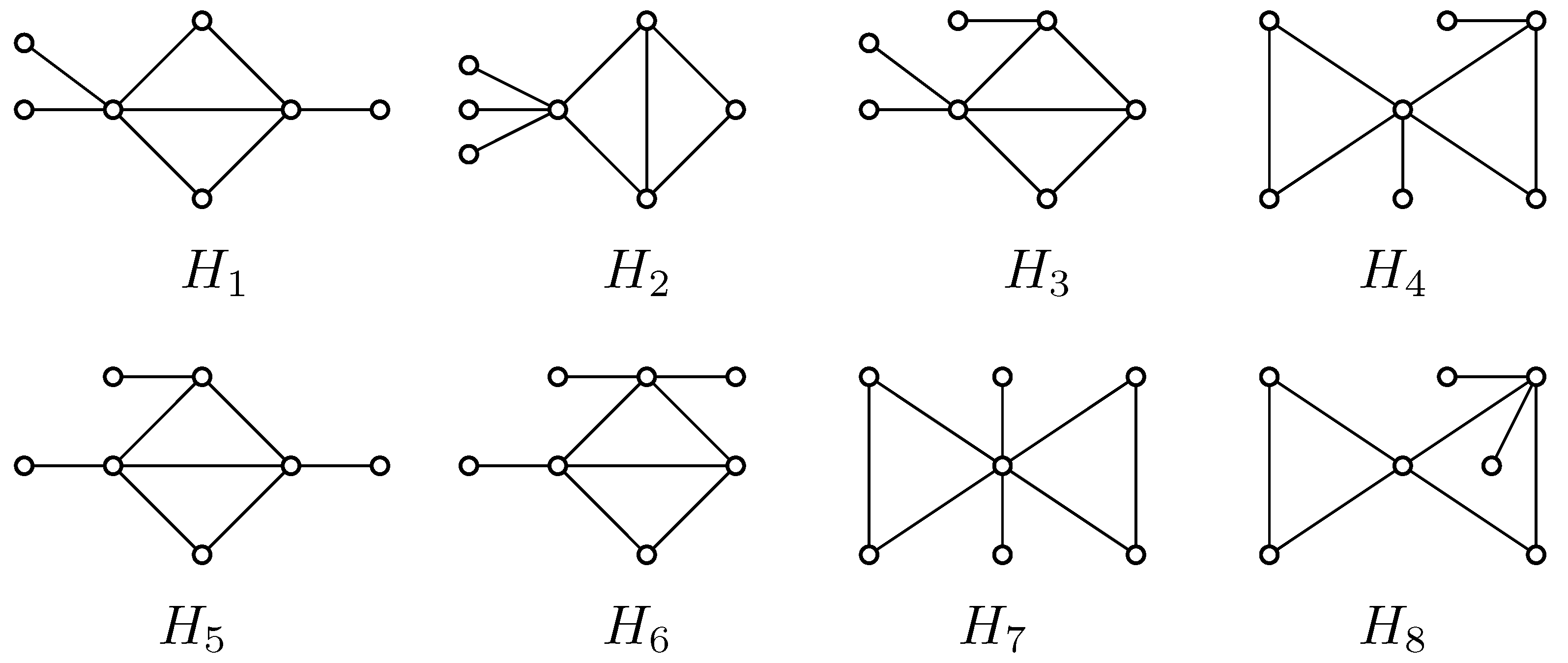
Figure 8.
The graphs (from left to right, respectively) used in Theorem 6.

Figure 9.
All connected bicyclic graphs of order 5 and minimum degree at least 2, together with the values of .
Figure 9.
All connected bicyclic graphs of order 5 and minimum degree at least 2, together with the values of .
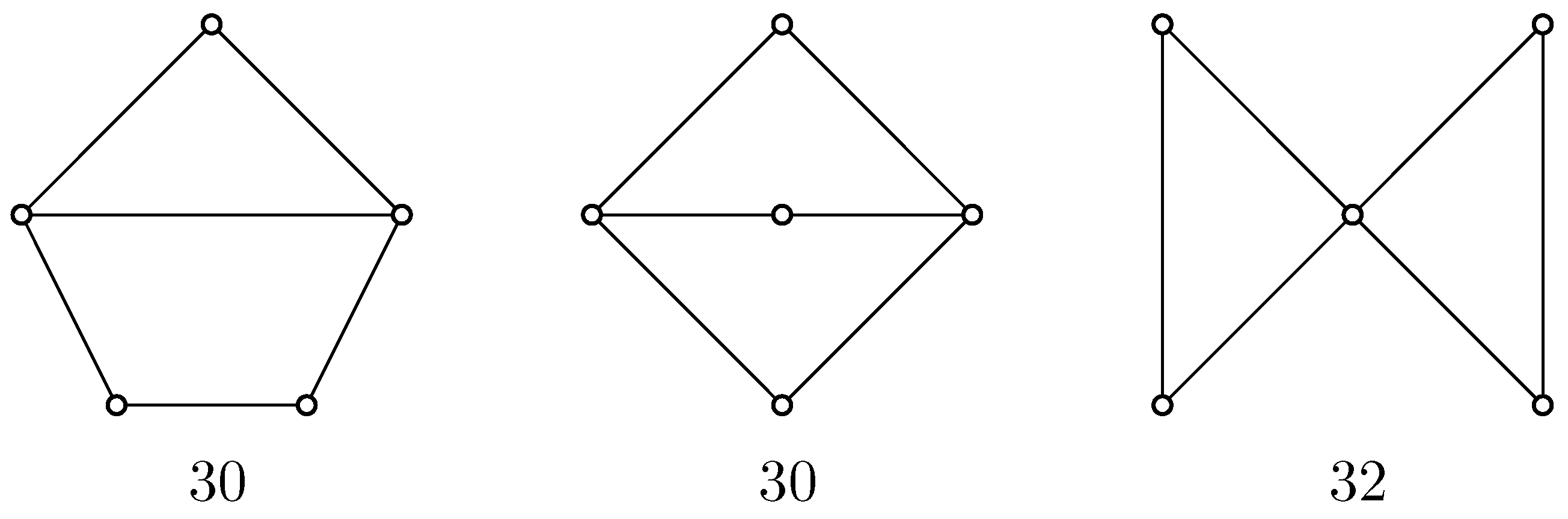
Figure 10.
All connected tricyclic graphs of order 5 and minimum degree at least 2. The first, second, and third graphs (from left to right) have the following values of , respectively: 20, 22, and 24.
Figure 10.
All connected tricyclic graphs of order 5 and minimum degree at least 2. The first, second, and third graphs (from left to right) have the following values of , respectively: 20, 22, and 24.
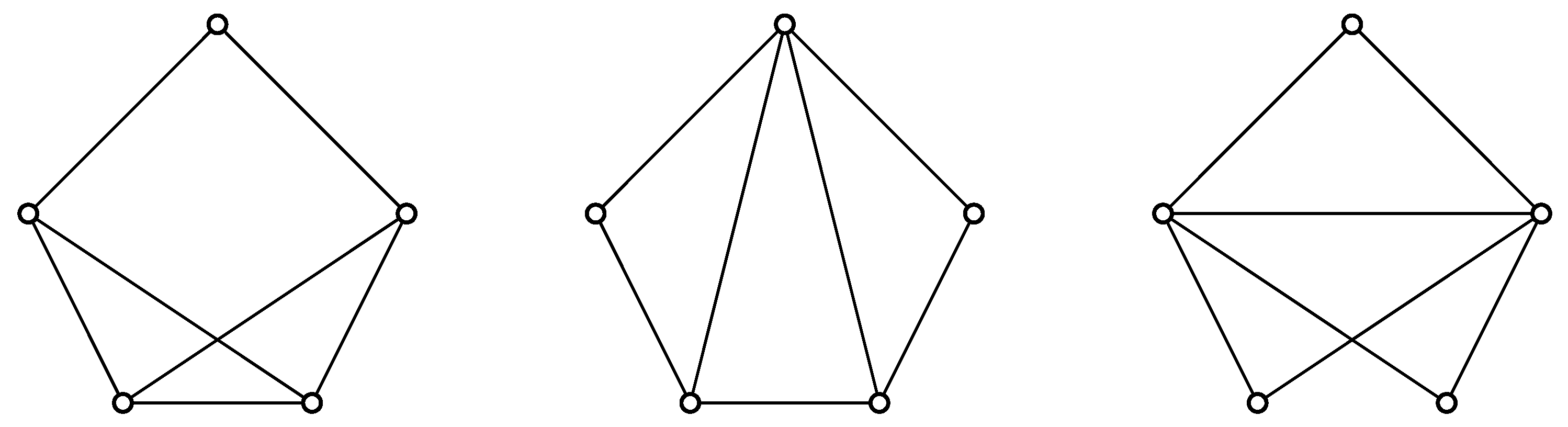
Figure 11.
The n-order connected tricyclic graphs of maximum degree and minimum degree no less than 2, for .
Figure 11.
The n-order connected tricyclic graphs of maximum degree and minimum degree no less than 2, for .
Disclaimer/Publisher’s Note: The statements, opinions and data contained in all publications are solely those of the individual author(s) and contributor(s) and not of MDPI and/or the editor(s). MDPI and/or the editor(s) disclaim responsibility for any injury to people or property resulting from any ideas, methods, instructions or products referred to in the content. |
© 2023 by the authors. Licensee MDPI, Basel, Switzerland. This article is an open access article distributed under the terms and conditions of the Creative Commons Attribution (CC BY) license (http://creativecommons.org/licenses/by/4.0/).
Copyright: This open access article is published under a Creative Commons CC BY 4.0 license, which permit the free download, distribution, and reuse, provided that the author and preprint are cited in any reuse.


