

Submitted:
01 August 2023
Posted:
02 August 2023
You are already at the latest version
Abstract
In 2021 an acute energy crisis inflicted severe damage on the global economy, leading to escalated prices for electricity, gas, and fuel. In order to shield individuals and businesses from the mounting energy expenses, governments have been compelled to implement policy measures, including tax reductions, price restrictions or discounts, and subsidies. This research paper examines these policy responses through the lens of energy sufficiency. Energy poverty poses a significant threat to social cohesion and support for climate-related initiatives. Therefore, it is imperative to employ compensatory measures. However, the design of such solutions must carefully consider the incentives to reduce energy consumption and associated carbon emissions. The findings of the analysis demonstrate that the escalation of energy costs holds promise for achieving energy sufficiency. Nevertheless, the government's response to the surge in energy prices and energy poverty falls short and lacks precision. Most of the policy changes primarily focus on regressive energy cost subsidies and nudging households away from fossil fuels, but they fail to generate the necessary impetus for achieving energy sufficiency, which involves the elimination of energy poverty and excessive energy consumption.
Keywords:
sufficiency
; energy crises
; energy poverty
; policy instruments
1. Introduction
In 2021, the world economy was rocked by a major energy crisis. Oil, gas, and electricity prices surged when global economies recovered from the COVID-19 pandemic. This was followed by the Russian invasion of Ukraine and sanctions and trade restrictions imposed by many countries on Russia. This even further increased global energy costs.
These distortions in the energy market are also affecting energy and climate policies. As part of the European Green Deal European Union (EU) has adopted a set of proposals to make the EU’s climate and energy policies fit for reducing greenhouse gas (GHG) by at least 55% by 2030, compared to 1990 levels, and aims to reach net climate neutrality by 2050. Similarly, in order to adhere to the Paris Agreement, Nordic and Baltic countries plan to cut their GHG emissions and become carbon neutral by 2050. Energy crises in Europe have not derailed the EU from its climate goals and the newly adopted plan (REPowerEU) to make the EU independent from Russian fossil fuels also emphasizes the need for further investments in the green transition.
There are three main approaches how to reach these climate goals: efficiency, substitution, and sufficiency. Additionally, there is a growing recognition that improvements in energy efficiency and renewable energy sources may not be sufficient to reduce energy consumption in order to meet the 1,5°C climate objective [1,2]. Thus, there is a need for additional policy measures focussing on energy sufficiency. Unfortunately, so far the governments do not use the full potential of the sufficiency policy instruments [3] even if they tend to solve sustainability issues in a more systematic and multidimensional way by promoting changes in societal structures, social norms, and economic system [4] and thus redesigning and rethinking group and individual behavior in order to prioritize energy-efficient activities and services [5].
Sufficiency also raises debate about the quality of life [6]. Policymakers are reluctant to use sufficiency policy approaches because of the fear that these measures might interfere with the material quality of life. While supporters of the sufficiency approach argue that reducing energy consumption and eliminating energy poverty would improve the quality of life and support a more just distribution of resources.
The current rise in energy prices has pushed governments to introduce new policy measures (tax cuts, price caps or discounts, and subsidies) to protect households and companies from the sharp increases in gas, fuel, and electricity prices. Some of these measures might be conflicting with existing climate and social policy aims and lack support for a sufficiency approach to ensure energy transition.
In this paper aims to analyze the policy responses to increasing energy costs in the Baltic Sea region, specifically focusing on Denmark, Latvia, and Lithuania, from the perspective of energy sufficiency. The study takes into consideration the ecological and social equity aspects of these policy interventions. It confines its examination to national-level interventions, excluding supranational or local policies, due to the prevalent setup where energy regulation and energy taxes are primarily determined at the national level in most EU countries.
2. Energy sufficiency approach
Energy sufficiency should be clearly distinguished from energy efficiency, which is defined as providing the same energy service while using less energy for criticism on energy efficiency see [7,8], and substitution where energy carriers are substituted to more environmentally friendly ones to decrease environmental impact and deliver the same energy service. Energy sufficiency, in this case, is linked to demand-side management and can be seen as a different approach to energy demand reduction as it is questioning the service in the first place.
Thus, in this paper, we define energy sufficiency as a demand-side management strategy that seeks to ensure an adequate provision of energy services while considering both environmental limitations and societal minimums by establishing upper and lower limits on energy consumption [9]. Therefore, energy must be used to the extent that, from one side, it adequately meets basic needs and, from another side, it is sufficiently low to keep consumption within the planetary boundaries and reduce GHG emissions to limit climate change. Concepts like doughnut economy [10] and consumption corridors [11] also illustrate this dual meaning of sufficiency.
However, sufficiency actions similarly to efficiency actions might cause rebound effects by making resources available for other uses and user groups [12]. If energy sufficiency actions reduce the consumption of energy services with a low carbon intensity and if the associated rebounds and spillovers increase the consumption of energy services with a high carbon intensity, the net result may be to increase aggregate emissions (‘backfire’).
Therefore, broader issues need to be considered (Marignac 2019):
- Focussing on sufficiency only in terms of demand reduction takes attention away from the need to ensure adequate energy services for everyone (link to social wellbeing and equity);
- Pointing to specific, conscious individual decisions and actions to change lifestyle draws attention away from the unconscious, routine nature of many activities associated with energy consumption;
- Infrastructures of supply and demand, which greatly influence the possibilities (agency) open to individuals, may not receive enough attention if sufficiency is framed primarily in terms of lifestyle choices (risk of lock-in to high-consuming practices through design and construction of the built environment).
Some of these issues can be captured by considering practices as underlying structures for actions. However, energy sufficiency requires reflecting on human needs, social equity, planetary boundaries, economic development, urban structures, social norms, consumption habits, as well as the role of policies to support the necessary transition. Many of these terms would be good bases for the whole discussion still raising a lot of questions: How do we define ‘basic needs’? What do we mean by ‘equitably’, and which ‘ecological limits’ do we have in mind? Energy poverty is one more concept to be addressed as an equity element to be taken into account when modeling energy sufficiency. Fawcett and Darby [13] in their paper explore the meanings of some of these concepts (e.g., ‘basic needs’ and ‘equitably’) in the context of energy sufficiency.
However, there is ongoing discussion regarding what amount of energy and resource usage is necessary to have a “good life,” whether this can be accomplished for everyone while still respecting planetary limitations, and who should be engaged in making these decisions. Several scholars [14,15] have raised these questions. O’Neill, Fanning, Lamb and Steinberger [14] concluded that based on present consumption and production patterns the universal accomplishment of greater qualitative goals (such as high life satisfaction) would necessitate a level of resource use that is 2–6 times the sustainable level. Hickel [15] is more optimistic arguing that it is theoretically feasible to ensure a good living for all within the planetary boundaries by expanding on current best practices and implementing more equitable distributive policies. However, in order to fit inside the safe and just operational space, affluent countries must lower their footprints by 50%, give up economic development as a policy goal, and switch to post-capitalist economic structures. For more prosperous nations, this would entail refraining from consuming - not consuming certain goods and services, e.g., living space (overly large homes, secondary residences of the wealthy) to oversized vehicles, environmentally damaging and wasteful food, leisure patterns and work patterns involving driving and flying [16,17].
However, clear-cut benchmarks for potential safe and fair energy services are still lacking. According to the ENERGISE Resource Consumption Typology, attempts to lower energy use to a predetermined maximum level or to cap it at a specific quantity e.g., as in [18,19] are considered sufficient. Depending on the actors involved in the calculation and the methods used, the amount of energy considered necessary to live a decent life is open to various interpretations. Additionally, it continues to be very context-specific and can change, for instance, depending on location, climate, the quantity and socio-demographic makeup of residents, the style of building, culture, etc. [20].
3. Methodology
In this paper we have looked at the different energy sufficiency actions and policy measures to support these actions in the Nordic and Baltic countries (Latvia, Lithuania, and Denmark). The selection of these countries was made to ensure feasible and effective workshop arrangements, considering factors like accessibility, cooperation from relevant authorities, and the availability of resources. Additionally, these countries share certain similarities in terms of energy policies, geographical proximity, and socio-economic factors, making them suitable candidates for comparative analysis.
To gather comprehensive insights into energy sufficiency we emploed both desk research and active participation policy workshops. Such workshops featuring conversations between participants and facilitators promote the exchange of knowledge, and sharing of best practices, and help participants to discuss and come up with concepts specifically related to policies and actions that promote energy sufficiency and deal with the energy crises.
In order to represent a variety of viewpoints and areas of expertise, participants from the mobility, housing, and energy policy sectors were invited. These participants included researchers, decision-makers, grassroots activists, etc. However, the number of participants varied among the countries. In the Danish workshop, a total of 12 participants were present, a relatively low number partially due to Covid-19 related cancellations. In Latvia, 33 participants from ministries, professional associations, NGOs and academia participated in the meeting. But in Lithuania due to considerations for the changing Covid-19 pandemic, the workshop was held in hybrid mode with almost 19 attendees participating in person and more than 32 online participants. The registered participants include representatives from Energy, Environment, Transport, and Foreign affairs ministries, Lithuanian Energy Agency, energy companies, research institutions, and non-governmental organizations.
The discussions were structured around several topics. They started with discussions on the demand changes from a sufficiency perspective, the viability of various sufficiency strategies, and the policy measures to support transition processes. From there, the discussions moved on to the opportunities and constraints for socio-economic and regulatory changes to support this transition in energy policymaking.
Throughout the workshops, the identified energy policy measures were intended to act as boundary objects [21] between the heterogeneous groups of relevant actors, as the basis of dialogues and participation. As described by Carlile [21] an effective boundary object enables communication across both syntactic, semantic, and pragmatic knowledge boundaries. A boundary object on the syntactic boundary “establishes a shared syntax or language for individuals to represent their knowledge”, whereas a boundary object at the semantic boundary can take the form of a concrete method that “allows individuals to specify what they know—what they worry about—as concretely as possible to the problem at hand” [21]. It is also not enough to transfer knowledge, in the workshops we used these boundary objects to facilitate a process where individuals can jointly transform their knowledge.
Sufficiency actions and policy options were presented and discussed with the workshop participants. The visual and educational materials presented during the workshops provided a shared framework and a starting point for conversation despite the fact that the participant groups were varied, having a range of backgrounds and viewpoints on the topic. The proposed sufficiency approaches were intended to challenge some political norms and traditions while providing insight and inspiration for fresh ways of climate mitigation.
4. Energy sufficiency policy instruments
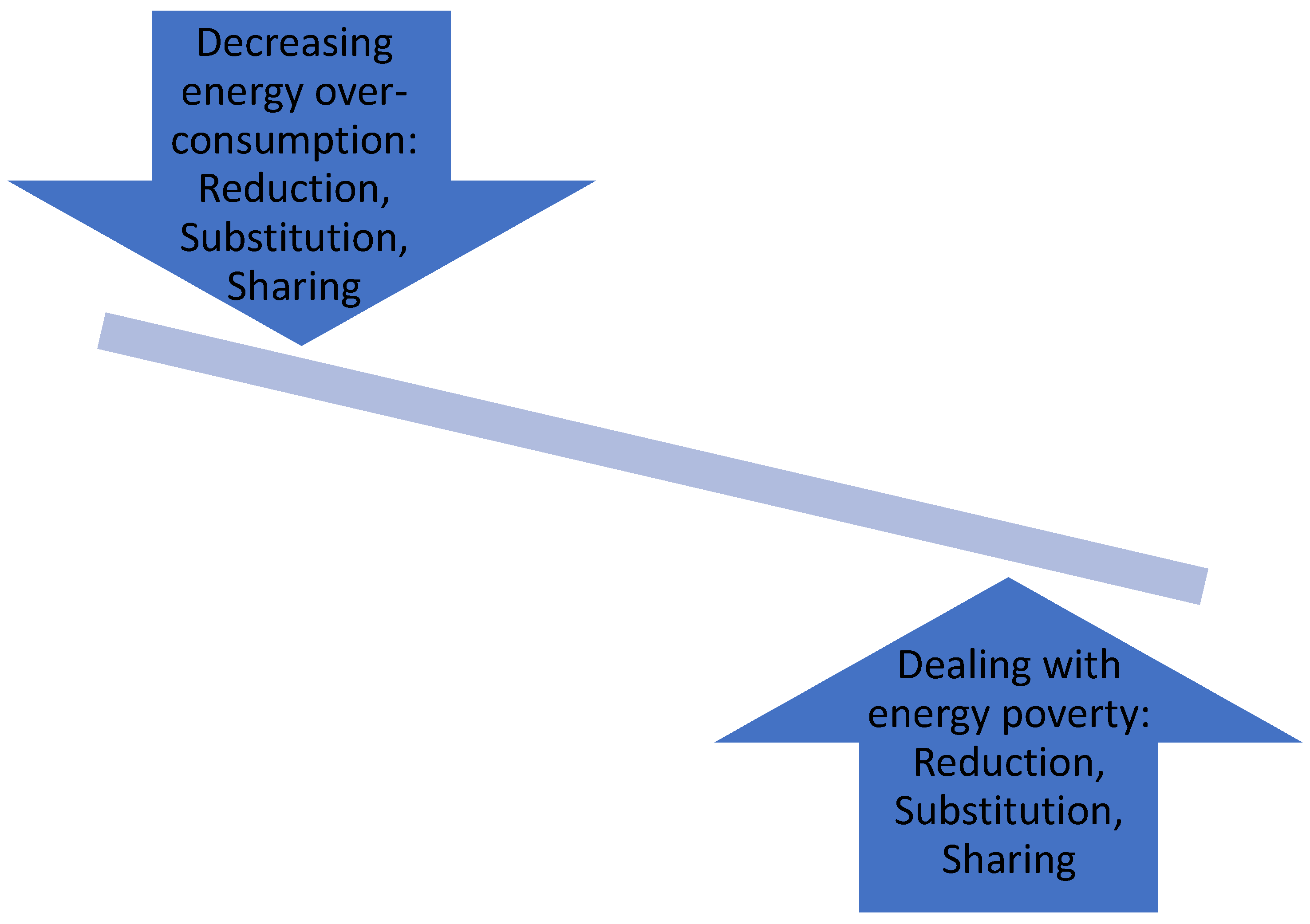
The sufficiency policy measures on the one hand should aim to reduce energy poverty, but on the other hand, aim for reducing energy consumption and related GHG emissions which can be ensured in several ways (see Figure 1):
- Reduction: The reduction strategy aims to aims to reduce energy service levels by influencing the intensity and duration of use (e.g., switching off lights, number of washing cycles per week, distance travelled by passengers or goods) or determining the size and nominal capacity of equipment and buildings whose use necessitates the consumption of energy (e.g., decreasing heated floor space, using a smaller car).
- Substitution: The substitution strategy aims to substitute certain energy-intensive services with less energy-intensive services, implying changes in social and behavioural practices. This for example includes shifting from individual motorized transport to public transport or cycling and walking.
- Sharing: The sharing strategy emphasizes collective resource use and cooperation, aiming to reduce individual energy demands by sharing goods (products or appliances) or buildings (from co-working spaces to shared laundering areas in collective housing). Examples include carpooling to reduce transportation energy consumption or sharing community spaces with energy-efficient appliances.
Other differentiations of sufficiency policy measures are possible, e.g., in terms of the character of perceived change Sachs [22] or four levels of “perceived restraint or effort” [23], free categories of policy measures (Reduction, Substitution, General), as proposed by Zell-Ziegler, Thema, Best, Wiese, Lage, Schmidt, Toulouse and Stagl [4] or more elaborated subcategorizations of sufficiency measures (e.g., “Reducing”, “Substituting”, “Better sizing”, “Sharing”, etc.), as proposed by Toulouse, et al. [24] and similarly used by Sandberg [25].
Newetheless, all these sufficiency strategies are aiming to stimulate quantitative reduction, the substitution, and adjustment of services delivered to meet user needs and have an impact on energy consumption as well as energy poverty. For example, for heating, this would mean initiatives supporting:
- minimized heating of unnecessary areas of the building and hours;
- appropriate sizing of dwellings and other structures, such as sizing dwellings to meet resident needs;
- reduced indoor temperature;
- sharing floor space and engaging in communal living.
It should be recognized that energy sufficiency strategies can also bring multiple advantages to energy-poor households. Access to affordable renewable energy sources offers stable and predictable energy costs, shielding these households from fluctuations in fossil fuel prices. Additionally, localized renewable energy projects, like community solar installations or microgrids, play a crucial role in providing energy access to underserved areas, empowering communities to meet their energy needs sustainably. Furthermore, energy reduction policies directly benefit vulnerable households by lowering their energy bills through improved efficiency and energy-saving initiatives. This decrease in energy expenses frees up more income for other essential expenses, alleviating the burden of energy costs on low-income families. Moreover, energy sharing initiatives can be particularly beneficial for energy-vulnerable communities. By adopting collaborative consumption models, these initiatives reduce the cost burden on individuals and grant access to energy-efficient resources that might otherwise be financially unfeasible for a single household. This cooperative approach fosters social equity by ensuring that even disadvantaged communities can access energy services and reap the benefits of energy sufficiency practices.
5. Policy instruments for energy sufficiency policy intervention
Energy sufficiency policy approaches can use regular policy instruments also used to stimulate energy efficiency and shift to renewable energy, but in many cases it also requires new approaches different from existing practices addressing the drivers of overconsumption [26]. We used the following categorization of the energy sufficiency policy instruments to support above menthed sufficiency strategies:
- ECONOMIC - energy pricing instruments connect to both the environmental limits and energy poverty aspects of energy sufficiency. Electricity and natural gas transmission charges and energy tariffs in addition to excise taxes are the main economic instruments used to shape energy price policy. Depending on how these instruments are designed they support energy efficiency, substitution, as well as sufficiency. Transmission changes distribute costs evenly among energy users, but proportionally high transmission costs discourage energy savings and increase the energy costs for a household with low energy consumption thus increasing the effective price per kWh for those households. Since energy spending is generally very inelastic and is a significant share of income for less-prosperous households, energy taxes tend to be regressive [27]. Progressive energy prices would be a better instrument to stimulate sufficiency and energy conservation. They exist in several countries, e.g., South Africa and Latvia have introduced a ‘poverty tariff’, In South Africa first 50 kWh per month of free electricity [28], but in Latvia households with 3 and more children receive subsidized electricity for the first 200 kWh per month. Latvia also has introduced a progressive demand capacity charge for power connections above 16A. Currently, the main focus on tariff development is on time-of-use pricing, due to concerns about peak electricity demand and the integration of renewables into the electricity supply [13]. Thus more active citizen involvement in the energy market is expected and there is a clear need to encourage energy citizenship. Nevertheless, these price signals are not enough to realize the full potential of energy sufficiency as they are not addressing all the barriers related to the energy transition.
- INFRASTRUCTURE AND CHOICE ARCHITECTURES – energy infrastructure (e.g., buildings, transport networks, provisioning systems) in most cases is out of the direct control of individuals and can have an enormous influence on behavioral patterns. For example, urban planning to support car free living can be strong support for energy sufficiency. Many energy-sufficiency measures require no or very little infrastructure. This means they can be implemented quickly and require low investments. This frees up resources for investments in other energy transition initiatives, like public transportation networks. However, technologies and infrastructure can also be effectively used to support sufficiency action, e.g., thermostats in buildings help minimize indoor air temperature, investments in cycling and pedestrian infrastructure (bike lanes, repair, parking, etc.) and shared infrastructure (e.g., communal laundry facilities) help minimize fossil fuel and material use.
- INFORMATION - energy product labeling and energy sufficiency advice are the two main communication tools used to promote energy sufficiency. Lack of information and motivation could be important barriers to energy sufficiency action. Energy labeling is one of the cornerstones of the EU energy product policy. However, many academics propose switching to absolute measures (e.g., kWh/cycle rather than kWh/kg/cycle) and from linear to progressive standards [13,26] used in the labeling criteria, e.g., the current EU eco-label encourages larger washing machines (easier to achieve A+++) as it is easier for producers to reach higher energy efficiency standards per kg of closing washed, but could increase the total energy consumption as small households can not load them to full capacity. We also have to acknowledge the potential for energy sufficiency advice which are are even more acute now with high energy prices when people and companies are eager to save energy. However, sometimes energy savings are dependent on external infrastructures and services, e.g., policy workshops recognized the important role of thermostats to adjust heat indoor air temperature depending on the use of premises. Research also shows that personalized energy sufficiency advice can be much more effective than general information campaigns.
- REGULATION AND STANDARDS – this includes e.g., various measures implemented at the national level to promote sufficient energy use. These include national building codes that set guidelines for construction, territorial planning regulations that shape land use and urban planning, and regulations setting thermal and humidity set-points in buildings. Additionally, sufficiency regulations may involve setting urban speed limits to 30 km/h and mandating spaces within buildings for bicycles, wheelchairs, strollers, and line drying. These measures contribute to improving energy sufficiency, reducing GHG emissions, enhancing safety, and creating more sustainable and livable communities.
In most cases to reach the level of energy sufficiency mix of policy, instruments should be used. For example, to stimulate sharing economy which also has the potential for energy sufficiency different economic instruments could be mixed with regulatory planning and information campaign to motivate people to use these services.
6. Sufficiency policy approach in mitigating energy price increase
Already in 2019, 8% of the population in the EU, said they were unable to keep their housing warm enough [29] but the situation with energy poverty even worsens with increasing energy costs in 2022. Results from the energy policy workshop discussions show that areas that offer the highest potential for energy sufficiency actions are transport, heating, and domestic electricity use. These are also the areas that have suffered the most from the energy price increase in 2022 which affected many households across Europe. Here we are providing an assessment of the policy interventions which took place to respond to the energy price increase in Denmark, Latvia, and Lithuania.
6.1. Denmark
The Danish government has committed €13.4 million to supplement the existing scheme to help vulnerable households, and it is developing a tax-free check to help some 400,000 households pay their energy bills.
The so-called ‘heat check’ will be targeted at households with these heat sources, which are particularly exposed to price increases:
- Individual gas boiler;
- District heating areas with a gas share of more than 65 percent or areas based on combinations of electricity and gas with corresponding average price increases;
- Households with electric heating as the primary heat source (electricity panels and heat pumps) are experiencing a corresponding price increase.
There will be an income limit so that only households with a total annual, personal income of a maximum of DKK 550,000 (around 74,000 EUR) after a labor market tax deduction will be able to receive the heat check.
At the beginning of March 2022, the Danish government proposed together with a number of other Danish political parties to speed up the substitution of Russian natural gas to reduce the impact of rising costs and at the same time increase the speed of the deployment of renewable energy [30].
A so-called “freezing scheme”, which is a scheme where households can have part of their bill for electricity, gas, and district heating frozen (which means part of the payment is postponed) if the price is above a set limit was approved was decided by the Danish Parliament 23 September 2022 and approved by the EU Commission 31 October 2022. The scheme is a temporary and voluntary arrangement, which starts functioning on 1 November 2022.
The freezing scheme applies for six years, respectively one year, during which it is possible to have part of the energy bill frozen, one year grace period, and a repayment period of four years.
A household gets the opportunity to temporarily freeze part of its energy bills for a period of 12 months. This period is called the freezing period. When the freezing period of 12 months has expired, an interest-free year follows. The households must then choose whether they want to pay their debt to the energy company at once or whether they want to pay off the debt to the energy company over 4 years.
6.2. Latvia
By producing slightly more than 42.1% of the annual domestic energy consumption from renewable energy, Latvia in the EU has the third-highest share of renewable energy in total energy consumption [31]. The final per capita energy consumption in households in Latvia is slightly above the EU average [32], but per capita electricity consumption is also one of the lowest in the union [33,34]. Sufficiency policy interventions are poorly reflected in the Latvian National Energy and Climate Plan [4].
In response to increasing energy prices in the second half of 2021, Latvia introduced policy measures to compensate 200 million EUR for an energy price increase, enlarged support for protected users and energy-intensive businesses, and created a solution for phasing out feed-in tariffs and reduced distribution fees. The monthly allowance for vaccinated seniors was also approved, as well as increased state co-financing for municipal housing benefits.
At the end of 2021 as part of the decarbonization strategy the Riga city council proposed an initiative to move away from natural gas. However, this initiative so far does not have a specific action plan and measures in place.
In early 2022 the national parliament approved a new “Low on measures to reduce extreme energy prices”. According to this regulation:
- The state will cover the costs of payments of the mandatory procurement component for electricity and electricity system services at a 100% rate. Around 860 000 clients (households, companies, governmental/municipal institutions) will benefit and the total costs of the measure are 84.7 million EUR (on average around 98 EUR per client for the 4-month period);
- For district heating tariffs up to 150 EUR/MWh, the state compensates 50% of the tariff that exceeds the established threshold – 68 EUR/MWh, and 90% of the tariff that exceeds 150 EUR/MWh. It is estimated that most district heating users will be affected by this measure (around 78 500), but the costs of the measure are around 7 million EUR.
-
The support for households with annual natural gas consumption for heating is differentiated:
- o
- For households with annual consumption between 21-500 m³ state compensation will be 0,03045 EUR/kWh;
- o
- For households with annual consumption above 500 m³ state compensation will be 0,02279 EUR/kWh.
It is expected that 65 000 households will benefit from the measure and the total budget is 27.4 million EUR.
- For families, support for each child is 50 EUR per month (covers 397 936 persons with a total budget of 80 million EUR) and 20 EUR per month for all seniors (553 000 people, 44 million EUR) as well as disabled people.
As a result, around 150 000 most vulnerable households, including those with disabilities and multi-child families, receive between 15 and 20 EUR per month for electricity or gas bills. The total budget for these measures is 250 million EUR. These measures have been complemented by additional policy interventions before the 2022 winter, including:
- Partial compensation for the increase in the price of electricity for households that use electricity for heating their homes. The compensation (50% of the electricity price, which exceeds 0.16 EUR/kWh) is applied to electricity consumption above 500 kWh, but not more than 2000 kWh.
- The aid for natural gas consumption above 221 kWh per month is set to 35 EUR/MWh.
- The reduction in the district heating service charge applicable to households is set to be 50% of the difference between the tariff and the median heat tariff of 68 EUR/MWh.
- The cost of pellets or briquettes would be compensated for 50% if costs exceeded EUR 300/tonne, but the sum for compensation would not exceed EUR 100/tonne.
- The increase in the cost of wood is compensated at 50% if costs exceeded 40 EUR/m3 but not more than 15 EUR/m3.
6.3. Lithuania
In Lithuania, several measures are taken to soften the impact of increasing energy prices. At the beginning of the high price period, it was decided to distribute increases in electricity and gas prices to some consumers over 5 years. However, as the high energy price period continued, the government tried to combine various compensation forms that can soften price increases.
The Lithuanian Government has proposed a 0% value-added tax (VAT) on district heat [35]. This proposal was accepted by the parliament, while the proposal to reduce the VAT on electricity to 9% (the standard VAT is 21%), is still under discussion in Parliament [36]. VAT reduction may be considered a universal measure that may benefit everyone, ignoring both socio-economic differences and energy consumption patterns. A similar situation is with natural gas and electricity price compensations for all households consuming these energy sources. However, if electricity price compensation can be considered as a horizontal measure for households to avoid energy poverty (current price rises are likely to result in energy poverty for the majority of the population), natural gas price compensations would provide more benefits for higher-income households that may not be eligible for heating subsidies.
With means-testing (limits on income and/or asset value), energy cost compensations are more targeted to socially vulnerable households. Since 2022 heating subsidies are available to a broader circle of potential beneficiaries as the income requirements for means-testing, have been relaxed. However, there still are limits on the useful floor area of the dwelling that is subject to heating compensation (50 m2 for single and two-person households, 60 m2 for three-person households, and 70 m2 for four-person households) [37]. This limitation on compensations can be considered a sufficiency measure since heating compensation is not provided to the useful floor area that exceeds these limits.
Finally, as a response to increasing energy prices, additional funding is foreseen for the subsidies on household investments in solar power plants [38]. Due to affordability constraints, such grants are generally more accessible to higher-income households [39]. An additional subsidy measure targeted at low-income households is implemented to involve vulnerable households in the energy transition process and reduce their energy bills. This measure provides subsidies for household investments in solar power plants, solar parks, and RES heating systems that replace fossil fuel heating. To ensure proper targeting, the eligible households must be the beneficiaries of state monetary social support [40].
Although electricity market liberalization is not directly related to a price increase, on October 10, 2022, the Lithuanian Parliament decided to postpone the final phase of the liberalization of the energy market due to possible disruptions to energy prices [41].
7. Discussion and Recommendations
Workshop results in assessing the policy interventions to deal with the rising energy costs show that they are missing the aims of targeted energy poverty eradication as well as reduction of energy consumption by households. Covering the costs of mandatory procurement components for electricity and electricity system services as well as covering the increasing costs of district heating (most of it is provided by natural gas) as it was done in Latvia are not well-targeted energy poverty reduction policy approaches as they benefit all the particular energy users and even more those with the highest energy consumption. Subsidy for natural gas consumption is similar – most benefits are ensured by the biggest gas consumers. Similarly also in Lithuania, zero VAT for electricity and district heating tends to be regressive and only slightly minimizes energy poverty and disengages people from energy conservation. Denmark also supported households with limited income (~74,000 EUR).
As a result of these policy interventions energy (natural gas and electricity) bills for most of the households in the first half of 2022 in Latvia and Lithuania were lower than during the previous heating season, discouraging energy conservation and initiatives to switch away from fossil fuels. In the long term, this leaves energy consumers locked in fossil fuel consumption and dependent on external market factors for their energy supply. The “freezing scheme” used in Denmark provide more space for energy sufficiency as they don’t cancel the paymnets for the energy services but give the choice for households to either repay the energy company debt in a lump sum or over a four-year period.
Some of the measures are meant to encourage switching away from fossil fuels, e.g., subsidy schemes in Latvia and Lithuania to support the replacement of gas boilers with ones fueled by renewable energy or electricity (heat pumps) as well as solar photovoltaics. However, these measures are mostly benefiting the more affluent part of society as they demand upfront investments not accessible to those in energy poverty.
Nevertheless, there are also good examples encouraging energy sufficiency, e.g., in Lithuania compensation for increasing energy costs are linked to the useful per capita floor area discouraging excessive floor space.
There is a need for a more integrated policy approach to better integrate sufficiency into energy and social policies and create the enabling policy framework to support sufficiency lifestyles. Some examples of such policies would be:
- PROMOTION OF ENERGY-SUFFICIENT SERVICES (house & car-sharing, from product to service, communal laundry facilities, etc.) through public awareness, information, and motivation programs, but their establishment may also need financial incentive programs and/ or public investment.
-
LIMITING DWELLING FLOOR AREA PER PERSON:
- Different reasons behind (e.g., wealth, inelasticity) – need for different approaches;
- ECONOMIC - waive tax for the acquisition of real estate (or property tax), when moving to a smaller dwelling;
- INFRASTRUCTURE/CONSTRUCTION CODES – flexible apartments - comparably small, but completed by rooms for communal use (Munich);
- REGULATION - a centralized cap for new living space (very problematic to introduce).
- PRACTICE-ORIENTED POLICY - understanding that practices compete for resources (time, energy, and money). When formulating policies, it is essential to acknowledge this competition and consider how different practices may impact resource allocation and sustainability. This approach involves identifying barriers and incentives that influence the adoption of specific practices and designing policies to promote more sustainable and resource-efficient behaviors.
To support just energy transition and necessary GHG emission reduction sufficiency energy policy measures should be integrated into the climate and energy policy plans. Additionally, more attention should be paid to social practices and stakeholder engagement like stakeholders’ discussion workshops organized as part of this study. It is important to involve stakeholders with knowledge of social practices, energy poverty, and the energy system.
Literature in which policy instruments have been identified stresses the importance of integrating several instruments in order to change practices. From the perspective of practice theory, it necessitates departing from the accepted notion that society and societal development are composed of a collection of rational people and their decisions and actions. Making socially shared activities the unit of analysis shifts the focus away from methodological individualism, which creates opportunities and problems for policy initiatives. Shifting the focus away from methodological individualism, by making socially shared practices the unit of analysis, presents challenges as well as possibilities with regard to policy initiatives. Jensen, et al. [42] emphasize that “policy neither can nor should aspire to ‘silver bullet solutions’. Society and ‘everyday life’ are different across countries and even within countries. Therefore, policies need to consider socio-material constitutions of energy demand and energy systems, as well as cultural contexts” (p. 11). In this regard, consumption is not a practice in itself, instead “people consume resources as they engage in socially-recognizable activities. These activities might contribute to accomplishing standards of comfort and cleanliness [43] such as bathing, showering, or laundering” [44]. Hence, it is by advocates in the field of practice theory argued that policy initiatives “could and should be rooted in an understanding of the elements of which practices and systems of practice are formed, and of the connective tissue that holds them together” [45].
The study shows how sufficiency practices can help decrease energy costs and energy consumption. Nevertheless, rebound effects have to be taken into account. When there are no physical or financial restrictions on behavior, policies and voluntary individual actions for resource conservation can produce rebound effects, but Freire-González [46] argues there are two ways to overcome this: 1) use existing capitalist system policy instruments (such as resource taxation, cap-and-trade systems, regulation, voluntary actions, and changing lifestyles), or 2) implement the most well-known systemic post-growth alternatives (including systemic alternatives such as steady-state economy, degrowth, agrowth, and post-development). When dealing with sufficiency and efficiency in global socio-economic contexts, both ways present opportunities and restrictions that are important to take into account. The second group makes the assumption that the issue cannot be solved as it now stands and that significant adjustments to socioeconomic structures are required. Such improvements, however, may be constrained by socioeconomic, institutional, and cultural concerns that restrict their viability. Collective adjustments in behavior can prevent rebound effects and lead to a more sustainable society in general. However, this calls for fundamental shifts in cultural norms, such as emphasizing the importance of non-material means of ensuring happy and fulfilling lives.
8. Conclusions
Energy sufficiency goes beyond energy conservation and energy efficiency. While increasing energy prices can incentivize energy conservation and efficiency, true energy sufficiency involves broader considerations, such as addressing energy poverty, ensuring equitable access to energy services, and reevaluating the overall energy demand in society.
The government’s response to rising energy costs and energy poverty requires improvement and better targeting. Current policy interventions mainly focus on regressive energy subsidies and encouraging a shift away from fossil fuels, but they lack the necessary stimulus for achieving energy sufficiency, including the elimination of energy poverty and overconsumption.
Nevertheless, there are positive examples of recent energy policy initiatives that are supporting energy sufficiency by targeting vulnerable households and promoting energy conservation..
To effectively address energy poverty without compromising climate-related goals, compensatory measures are essential. However, these measures should be carefully designed to avoid conflicting with incentives for energy conservation and reducing GHG emissions. It is crucial for governments to uphold their commitment to reducing GHG emissions in the face of rising energy prices and not slow down the transition to cleaner energy sources or delay phasing out fossil-fuel subsidies.
By ensuring a balanced approach that considers both energy sufficiency and climate action, governments can foster social cohesion and support for sustainable energy policies. These efforts should prioritize equitable access to energy services and encourage practices that reduce energy consumption while promoting clean energy alternatives.
Author Contributions
JB designed the analyses. JB, MSJ, GBO, and VL collected data. All authors provided critical feedback and helped shape the research, analysis, and manuscript.
Funding
This research is funded by Nordic Energy Research, project nr. 96751 “Integrating energy sufficiency into modelling of sustainable energy scenarios”.
Acknowledgments
We thank the anonymous reviewers for their constructive comments.
Conflicts of Interest
The authors declare no conflict of interest.
References
- Cordroch, L.; Hilpert, S.; Wiese, F. Why renewables and energy efficiency are not enough-the relevance of sufficiency in the heating sector for limiting global warming to 1.5°C. Technological Forecasting and Social Change 2022, 175, 121313. [Google Scholar] [CrossRef]
- Lorek, S.; Spangenberg, J.H. Energy sufficiency through social innovation in housing. Energy Policy 2019, 126, 287–294. [Google Scholar] [CrossRef]
- Speck, M.; Hasselkuss, M. Sufficiency in social practice: searching potentials for sufficient behavior in a consumerist culture. Sustainability: Science, Practice and Policy 2015, 11, 14–32. [Google Scholar] [CrossRef]
- Zell-Ziegler, C.; Thema, J.; Best, B.; Wiese, F.; Lage, J.; Schmidt, A.; Toulouse, E.; Stagl, S. Enough? The role of sufficiency in European energy and climate plans. Energy Policy 2021, 157, 112483. [Google Scholar] [CrossRef]
- Toulouse, E.; Le Dû, M.; Gorge, H.; Semal, L. In Stimulating energy sufficiency: Barriers and opportunities, ECEEE Summer Study, 2017; ECEEE Toulon: pp 59-70.
- Jungell-Michelsson, J.; Heikkurinen, P. Sufficiency: A systematic literature review. Ecological Economics 2022, 195, 107380. [Google Scholar] [CrossRef]
- Labanca, N.; Bertoldi, P. Beyond energy efficiency and individual behaviours: policy insights from social practice theories. Energy Policy 2018, 115, 494–502. [Google Scholar] [CrossRef]
- Shove, E. What is wrong with energy efficiency? Building Research & Information 2018, 46, 779–789. [Google Scholar]
- Bärnthaler, R.; Gough, I. Provisioning for sufficiency: envisaging production corridors. Sustainability: Science, Practice and Policy 2023, 19, 2218690. [Google Scholar] [CrossRef]
- Raworth, K. Doughnut economics: seven ways to think like a 21st-century economist. Chelsea Green Publishing: 2017.
- Di Giulio, A.; Fuchs, D. Sustainable consumption corridors: concept, objections, and responses. GAIA-Ecological Perspectives for Science and Society 2014, 23, 184–192. [Google Scholar] [CrossRef]
- Alcott, B. The sufficiency strategy: Would rich-world frugality lower environmental impact? Ecological Economics 2008, 64, 770–786. [Google Scholar] [CrossRef]
- Fawcett, T.; Darby, S. In Energy sufficiency in policy and practice: the question of needs and wants, 2019; European Council for an Energy Efficient Economy.
- O’Neill, D.W.; Fanning, A.L.; Lamb, W.F.; Steinberger, J.K. A good life for all within planetary boundaries. Nature sustainability 2018, 1, 88–95. [Google Scholar] [CrossRef]
- Hickel, J. Is it possible to achieve a good life for all within planetary boundaries? Third World Quarterly 2019, 40, 18–35. [Google Scholar] [CrossRef]
- Alexander, S. Sufficiency Economy. Simplicity Institute: 2015.
- Wiedmann, T.; Lenzen, M.; Keyßer, L.T.; Steinberger, J.K. Scientists’ warning on affluence. Nat. Commun. 2020, 11, 1–10. [Google Scholar] [CrossRef]
- Figge, F.; Young, W.; Barkemeyer, R. Sufficiency or efficiency to achieve lower resource consumption and emissions? The role of the rebound effect. Journal of Cleaner Production 2014, 69, 216–224. [Google Scholar] [CrossRef]
- Spengler, L. Two types of ‘enough’: Sufficiency as minimum and maximum. Environmental Politics 2016, 25, 921–940. [Google Scholar] [CrossRef]
- Thomas, S.; Brischke, L.-A.; Thema, J.; Leuser, L.; Kopatz, M. Energy sufficiency policy: how to limit energy consumption and per capita dwelling size in a decent way. 2017.
- Carlile, P.R. A pragmatic view of knowledge and boundaries: Boundary objects in new product development. Organization science 2002, 13, 442–455. [Google Scholar] [CrossRef]
- Sachs, W. Die vier E’s: Merkposten für einen maß-vollen Wirtschaftsstil. 1993.
- Fischer, C.; Grießhammer, R.; Barth, R.; Brohmann, B.; Brunn, C.; Heyen, D.A.; Keimeyer, F.; Wolff, F. Mehr als nur weniger. Suffizienz: Begriff, Begründung und Potenziale. Freiburg: Öko-Institut Working Paper 2013, 2, 2013. [Google Scholar]
- Toulouse, E.; Sahakian, M.; Lorek, S.; Bohnenberger, K.; Bierwirth, A.; Leuser, L. Energy sufficiency: how can research better help and inform policy-making? 2019.
- Sandberg, M. Sufficiency transitions: A review of consumption changes for environmental sustainability. Journal of Cleaner Production 2021, 293, 126097. [Google Scholar] [CrossRef]
- Thomas, S.; Brischke, L.-A.; Thema, J.; Kopatz, M. Energy Sufficiency Policy: An evolution of energy efficiency policy or radically new approaches? 2015.
- Känzig, D.R. The economic consequences of putting a price on carbon. Available at SSRN 3786030 2021. [Google Scholar] [CrossRef]
- Winkler, H. Energy policies for sustainable development in South Africa. Energy for sustainable Development 2007, 11, 26–34. [Google Scholar] [CrossRef]
- European Commission. State of the Energy Union 2021 – Contributing to the European Green Deal and the Union’s recovery; European Commission: Brussels, 2021. [Google Scholar]
- KEFM. Agreement on targeted heat check (Aftale om målrettet varmecheck). KEFM, Ed. 2022.
- Eurostat. Share of energy from renewable sources. 2022.
- Eurostat. Final energy consumption in households per capita. 2022.
- Eurostat. Supply, transformation and consumption of electricity. 2022.
- Eurostat. Population on 1 January by age and sex. 2022.
- Seimas. The zero VAT rate for central heating will be applied for another two seasons. 2022.
- Beliavska, J. A VAT discount is offered for household electricity consumers. Delfi 2022. [Google Scholar]
- Ministry of Energy of the Republic of Lithuania. Compensation for home heating in 2022: what is important to know? 2022.
- Ministry of Energy of the Republic of Lithuania. Additional measures to reduce energy prices - 40 million. for own solar power plants and zero VAT for heating. 2022.
- Lekavičius, V.; Bobinaitė, V.; Galinis, A.; Pažėraitė, A. Distributional impacts of investment subsidies for residential energy technologies. Renewable and Sustainable Energy Reviews 2020, 130, 109961. [Google Scholar] [CrossRef]
- Ministry of Environmental Protection. Invitation to socially assisted residents to submit applications for the use of renewable energy resources for electricity needs and replacement of heating devices using fossil fuels. 2021.
- Balčiūnaitė, S. The Seimas will decide on postponing the third phase of electricity market liberalization until 2026. LRT 2022. [Google Scholar]
- Jensen, C.L.; Goggins, G.; Røpke, I.; Fahy, F. Achieving sustainability transitions in residential energy use across Europe: The importance of problem framings. Energy Policy 2019, 133, 110927. [Google Scholar] [CrossRef]
- Shove, E. Converging conventions of comfort, cleanliness and convenience. Journal of Consumer Policy 2003, 26, 395–418. [Google Scholar] [CrossRef]
- Spurling, N.; McMeekin, A.; Shove, E.; Southerton, D.; Welch, D. Interventions in practice: re-framing policy approaches to consumer behaviour. 2013.
- Shove, E.; Pantzar, M.; Watson, M. The dynamics of social practice: everyday life and how it changes. Sage Publications: 2012.
- Freire-González, J. Governing Jevons’ Paradox: Policies and systemic alternatives to avoid the rebound effect. Energy Research & Social Science 2021, 72, 101893. [Google Scholar] [CrossRef]
Figure 1.
Bending the line for sufficient energy consumption.
Disclaimer/Publisher’s Note: The statements, opinions and data contained in all publications are solely those of the individual author(s) and contributor(s) and not of MDPI and/or the editor(s). MDPI and/or the editor(s) disclaim responsibility for any injury to people or property resulting from any ideas, methods, instructions or products referred to in the content. |
© 2023 by the authors. Licensee MDPI, Basel, Switzerland. This article is an open access article distributed under the terms and conditions of the Creative Commons Attribution (CC BY) license (http://creativecommons.org/licenses/by/4.0/).
Copyright: This open access article is published under a Creative Commons CC BY 4.0 license, which permit the free download, distribution, and reuse, provided that the author and preprint are cited in any reuse.