

Submitted:
27 July 2023
Posted:
28 July 2023
You are already at the latest version
Abstract
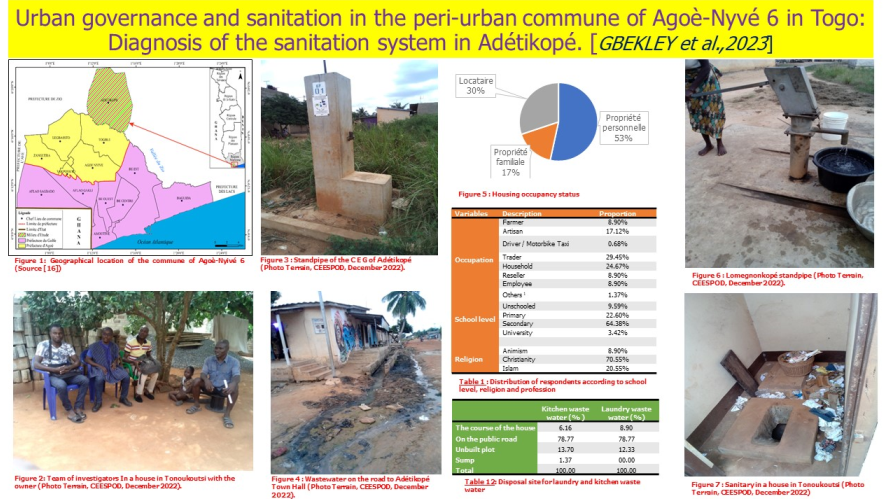
Urban governance and sanitation in the peri-urban commune of Agoè-Nyvé 6 in Togo: Diagnosis of the sanitation system in Adétikopé.
Keywords:
urban governance
; sustainable development
; wastewater management
; Adétikopé
; Togo
1. Introduction
Over the last two decades, the issue of waste management has become increasingly complex for both developed and resource-limited countries [1,2]. Developing countries are urbanising very fast, and this urban growth is more rapid in Africa than on other continents. Indeed, "African cities are growing at an unprecedented rate. Between 1950 and today, the proportion of Africans living in cities has risen from 14% to 40%, whereas it took Europe 110 years to achieve the same level of growth" [3]. Demographic growth, higher per capita incomes and greater economic activity have all led to an increase in the production of solid waste [4]. In African cities, the ever-increasing production of household refuse and other waste poses a major management problem in terms of collection and treatment [5]. With sanitation policies virtually non-existent or not yet a priority in some cities, it is not surprising to see the proliferation of stagnant water in certain neighbourhoods. The absence of a sanitation master plan in these cities is not conducive to efficient, sustainable waste management [6]. Studies conducted around the world and in Africa show that the environment is unhealthy because wastewater, rainwater and solid waste are not properly treated [7]. As solutions the results indicate that wastewater treatment enables sustainable resource management by improving the supply of drinking water and minimising pressure on natural resources, energy recovery and agricultural support. Wastewater treatment offers one of the most sustainable approaches to water conservation, energy production and agricultural productivity [8].
In Togo, the results of the Unified Questionnaire of Basic Well-Being Indicators (QUIBB) survey carried out in 2011 showed that 70.80% and 21% of households dispose of wastewater in nature and in the street respectively [9,10]. The increase in the volume of municipal wastewater poses serious problems in urban areas, as it threatens the quality of the environment, the health of the population, the image of the city and the living environment of the inhabitants. Wastewater management is becoming more than a major challenge that must be met because of the threat that wastewater poses to public health, the environment and socio-economic development [6].
Faced with this concern, the public authorities are advocating a strategy ranging from an environmental protection law to the definition of a national health policy. The general legal framework for environmental management in Togo aims to: (1) preserve and sustainably manage the environment; (2) guarantee, for all citizens, an ecologically sound and balanced living environment; (3) create the conditions for rational and sustainable management of natural resources for present and future generations; (4) establish the fundamental principles intended to manage, preserve the environment against all forms of degradation in order to enhance the value of natural resources, fight against all kinds of pollution and nuisances; (5) sustainably improve the living conditions of the populations while respecting the balance with the surrounding environment [11]. The national health policy focuses on high-impact interventions to control the diseases that contribute most to the burden of morbidity and mortality, the main determinants of reproductive and child health, and other determinants of health at community level. The health policy defines three strategic directions, namely: (i) strengthening prevention services and access to drinking water, hygiene and sanitation at family level (MSHPAUS, 2013). In addition, the Togolese government's ratification of the eThekwini Declaration on Hygiene and Sanitation, in South Africa, February 2008; the national action plan for the water and sanitation sector adopted in 2010 [12].
As part of the decentralization process, these measures have enabled local authorities to attach particular and major importance to waste management. While the Gulf prefecture seems to be improving the image of its urban infrastructure, the prefecture of Agoè-Nyvé in the Greater Lomé Autonomous District (DAGL) is no exception, despite the efforts made by the municipal authorities, and is not immune to the problems of household waste and wastewater management. The chief town of Agoè-Nyivé 6 is affected by problems of efficient wastewater management and the sustainability of management solutions and systems.
With this in mind, we ask ourselves what is the mode of domestic wastewater management in the commune of Adétikopé that explains the inefficiency of sanitation strategies and systems? We conclude, in line with current urban governance, that the way in which domestic wastewater is managed in the commune of Adétikopé and the sanitary behaviour of households are the result, on the one hand, of the lack of state resources to provide sanitation services and, on the other hand, of the economic and financial situation of households and the absence of viable and sustainable alternative solutions. Aware of the role that academics should play in sustainable governance, we propose to diagnose the current state of the sanitation system in Adétikopé, the capital of the commune of Agoè-Nyivé 6. Specifically, this will involve (1) assessing wastewater management by taking stock of basic sanitation facilities (latrines, cesspools, waste bins) in households, (2) assessing wastewater management practices in households and (3) analysing the level of knowledge of households in terms of wastewater management.
2. Materials and Methods
2.1. Study framework
2.1.1. Geographical scope of the study
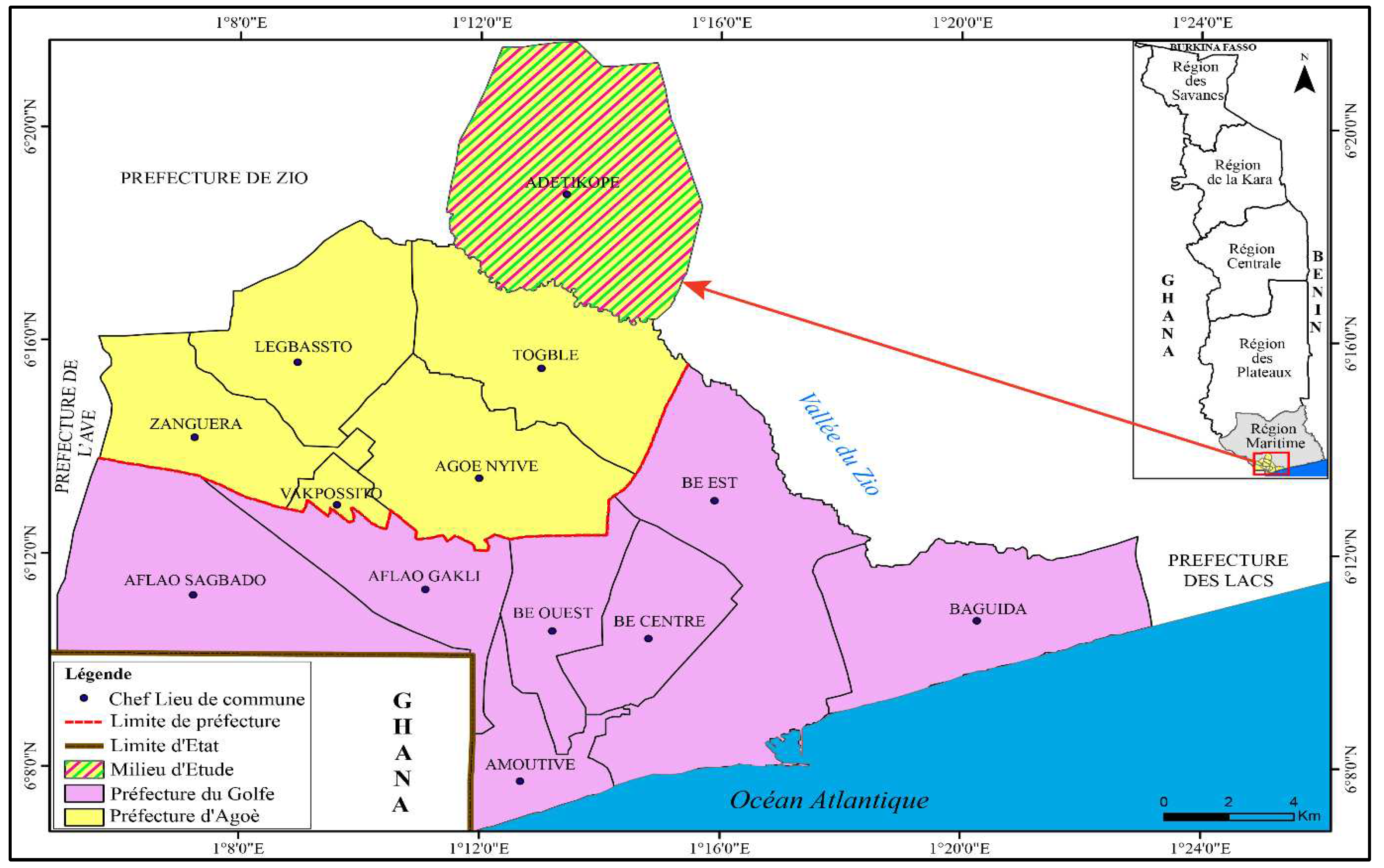
Adétikopé is the capital of the Commune of Agoè-Nyivé 6 under Law No. 2017-008 of 29 June 2017 on the creation of communes, amended by Law No. 2019-001 of 09 January 2019, and is located north of Lomé on Route Nationale N°1 (RN 1), some twenty kilometres from the Atlantic Ocean. The Commune of Agoè-Nyivé 6 is made up of twelve (12) villages and is crossed from south to north by the RN 1, which forms the backbone of its road network. With a surface area of 56.6 km2 , it makes up more than a third of the surface area of the Agoè-Nyivé prefecture (26%) and is larger than the other communes in the prefecture [13]. The area has seen rapid growth due to its proximity to Lomé and the housing opportunities that attract people because of the cheap land and rents. The municipality has seen a massive population influx, reaching 12,269 inhabitants in 2010, 23,371 inhabitants and 51,163 inhabitants respectively according to the Mass Treatment (TDM) of Neglected Tropical Diseases (MTN) in 2017 and 2020. It has a population of 110,194 according to RGPH 5, 2022.
Figure 1.
Geographical location of the commune of Agoè-Nyivé 6 (Source [16]).
Figure 1.
Geographical location of the commune of Agoè-Nyivé 6 (Source [16]).
2.1.2. Scientific framework
The Laboratory of Biomedical Sciences, Agrifood and Environmental Health (LaSBASE) at the University of Lomé provided the scientific framework for our study, and we received advice and technical support from the Clinic for Societal Educational Expertise and Development Policies (CEESPOD) at the African Institute for Biomedical, Agrifood, Societal and Environmental Sciences (IASBASE) for the preparation of our work.
2.2. Study material
Study population
It was made up of households from the twelve villages of Adétikopé; the head of the technical division of the Commune of Agoè-Nyivé 6; the staff of the CMS Adéikopé (the head of the hygiene and sanitation department and the supervisor of the medical department); the councillor and secretary of the town hall of Agoč-Nyivé 6 and the head of the Village Development Committee (CDV).
2.3. Study methods
2.3.1. Type of study
This was a cross-sectional and descriptive study of the knowledge, attitudes and practices of the population of the Adétikopé locality in terms of household waste management, which took place from August 2022 to July 2023, including the preparatory phase, data collection and processing.
2.3.2. Method used for data collection
To carry out our study, we proceeded with a preparatory phase consisting of (1) obtaining a field trip authorisation from the CERViDA-DOUNEDON management. Authorisation N° 45/AT/D/CERViDA-UL/2022; (2) obtaining a survey authorisation from the Agoè-Nyivé 6 town hall. Authorisation N°0274/RM/PA-N/CA-N6/SG. The drafting of a preparatory document that identified the structures visited for data collection, the people targeted and the information sought. It also covered the identification and preparation of survey tools and the planning of activities. The document review enabled us to consult all the documents, reports, dissertations and articles produced in the study area or related to our research theme, in order to gather data on sanitation and demographics for the design of this document. Research was carried out in the following structures: the library of the School of Medical Assistants, CEESPOD and IASBASE; the CMS in Adétikopé; the Adétikopé town hall; the secretariat of the chief township of Adétikopé; and scientific platforms such as Google scholar and web of science.
2.3.3. Sampling
Method and technique: A visit was made to the locality of Adétikopé centre in order to gain a better understanding of the problems of household waste management in the area. This visit enabled us to define our objectives. The primary statistical unit is the household and the secondary unit is the head of household or his/her representative. The heads of the departments were chosen on the basis of their involvement in household waste issues. Thus, the head of the hygiene and sanitation department, the head of the Village Development Committee (VDC), the head of the technical division and the secretary of the Marie were contacted in order to gather their experience of household waste management.
Sample criteria and purpose: The study covered all 12 villages in the commune of Agoè-Nyvé 6 (Table 1). According to available demographic data from the RGPH5, the locality of Adétikopé has 110,194 people, including 53,910 men and 56,284 women (Table 1). According to the survey results, the average household size in urban areas is 4.5 people. The number of households is therefore estimated at 24487 households (110194/4.5).
Given a confidence level of 95%, i.e. a margin of error of 1%, the sample size (n) can be calculated as follows using Robert Magnani's formula (Robert Magnani and sampling, 2001):
with: n (sample size); p (estimated proportion of the population with the characteristic (0.5 by default)); tp (confidence level (the standard value of the 95% confidence level will be 1.96)).
y (margin of error set at 5%); N (number of households (N= 24487))
we have
Therefore, n = 6898
The sample size is therefore set at 6898 households. The ratio 6898/24487 (number of households surveyed to total number of households), i.e. 28.1%, is used to calculate the breakdown by neighbourhood. The data for this breakdown are shown in Table 2.
Choice of concessions and households: In the neighbourhoods, we moved around the concessions using the pen-throwing method practised by the interviewers. In this method, the interviewers throw the pen at the entrance to the neighbourhood and follow a straight line from the end of the pen to the end of the neighbourhood. If the enumerators finish a line without having reached the number of households to be surveyed, they turn right and repeat the throw until they have reached the desired number of households in the concessions. A questionnaire covering sanitation items was administered to each household. In the households, it was the head of household or his substitute who was surveyed. The substitute head of household was either his wife or his child who had reached the age of 18. One household per concession was surveyed. The first household ả from the left in each concession was surveyed. In a concession with only one household, the said household was systematically retained. If the first household selected for the survey was absent, the next household was surveyed.
2.3.4. Data collection techniques and tools
The techniques and tools used to collect the data are set out in the table below (Table 2).
Inclusion and non-inclusion criteria: The main inclusion criterion was actual presence during the survey and consent to respond to the interviewers. Those who met the criteria of head of household or his or her representative, households that had been resident in the locality for more than three months, the head of the technical division, the municipal councillor, the staff of the CMS and the head of the VDC were included. Excluded were all heads of households who did not wish to be surveyed or were absent at the time of the survey, visitors to households and those who did not meet the head of household criterion.
2.3.5. Conduct of the survey
The data collection phase took place from August 2022 to July 2023 in the neighbourhoods of Adétikopé. Teams of three (3) were set up and each team consisted of two (2) Community Health Workers (CHWs). Before arriving in the neighbourhoods, the interviewers first went to the house of the village chief to present the objectives of the survey. In the households, the interviewers first went through the formalities of civility before explaining the objectives of the survey to the households.
2.3.6. Data processing
Processing of the survey forms was both manual and computerised. Using Excel 2016 (MicroSolft Office 365), the data collected was entered and formatted in accordance with EPI info version 6.04 fr of April 2001 developed by CDC Atlanta, a software package used to carry out all the processing and analysis. The values obtained were compared using the significance level p. Values of p < 0.05 are considered significant and values of p < 0.01 are considered highly significant. Values are expressed as mean value ± standard deviation. The axes of these statistical treatments were the descriptive statistics of the socio-demographic parameters (level of education, age and sex), the hierarchical classification based on multivariate component analysis (Analysis of physico-chemical and microbiological analysis categories) and the descriptive statistics of the groups obtained (Me: mean, CV: coefficient of variation), respectively, to test and describe the variation in the values obtained. The following assumptions were made: (1) Assumption H0: no significant variation between the percentages compared; (2) Assumption H1: there is a significant variation between the percentages compared. The value of the probability p' is given by the Epi info6 software. The decision and conclusion are as follows: (1) If p' < p: H1 is accepted; It is concluded that there is a significant variation between the percentages of the values compared. The value may have a significant increase or decrease in relation to the target value; (2) If p' > p: rejection of H1; It is concluded that there is not a significant variation between the percentages of the values compared. The percentages are compared sample by sample and between sampling sites. Epi info6 does not give the probability value α' when the percentage of modalities is obtained from a small number of people (n=5).
2.4. Ethical aspects of research
The administrative formalities were completed before the start of our study. This involved the field trip authorization issued by the CERViDA-DOUNEDON management. The survey authorizations issued by the Town Hall and DPS authorities provided reassurance to the households and the Adétikopé CMS staff. The questionnaire was administered to households with the consent of the respondent. Measures were taken to guarantee the anonymity of the respondents, so the tools did not contain any information about their identity. In addition, the study was carried out in strict compliance with barrier measures against the coronavirus (Covid-19), with respect for the population and their cultural values.
2.5. Difficulties encountered
The difficulties encountered were: (1) the reluctance of some households to give intonations related to their daily practices; (2) the mistrust of some concessions to a foreign presence for fear of coronavirus contamination; (3) the slowing down of the pace of work by the protocols to be followed in the administrative services to obtain authorizations; (4) the refusal by some households to take photographs and (5) the refusal of some women to answer questions in the absence of their husbands.
3. Results
3.1. Household solid and liquid waste management
Of the 100% households surveyed in the 12 villages of the peri-urban commune of Adétikopé, 27.40% were male and 72.60% were female. The ages of the household respondents were divided into 6 age groups. The majority of respondents belonged to the age group ]30-40]. A proportion of 20.55% were over 40 and under or equal to 50. Proportions of 19.98%, 15.75%, 3.42% and 0.68% belong to age groups ]20-30], ]50-60], ]60-70] and ]0-20] respectively. In terms of tenure status, 53.42% had their own property, 30.14% rented and 16.44% lived in family properties. The majority of respondents practise Christianity (70.55%), 8.90% are animists and 20.55% are Muslims. With regard to the level of education of the respondents, 64.38% have secondary education, 22.60% have primary education, 3.42% have university education and 9.59% have not attended school.

Table 3.
shows the breakdown of respondents by gender, employment status, religion and level of education.
Table 3.
shows the breakdown of respondents by gender, employment status, religion and level of education.
| Indicators | Terms | % | P. Values |
|---|---|---|---|
| Neighbourhoods | Adétikopé Adoglové | 15.07% | < 0,05 |
| Adétikopé Agnavé | 21.92% | - | |
| Adétikopé Agotimé | 6.16% | < 0,001 | |
| Adétikopé Centre | 12.33% | < 0,001 | |
| Adétikopé Dévimé | 4.11% | < 0,001 | |
| Adétikopé Djové | 2.05% | < 0,001 | |
| Adétikopé Kladjémé | 6.85% | < 0,001 | |
| Adétikopé Agouté | 10.96% | < 0,001 | |
| Adétikopé Kpotavé | 5.48% | < 0,001 | |
| Adétikopé Lomenyo Kopé | 4.11% | < 0,001 | |
| Adétikopé Tonoukouti | 3.42% | < 0,001 | |
| Adétikopé Tsikponou Kondji | 7.53% | < 0,001 | |
| Total | 100.00% | ||
| Gender | Female | 72.60% | - |
| Male | 27.40% | < 0,001 | |
| Total | 100.00% | ||
| Age | ]0-20] | 0.68% | < 0,001 |
| ]20-30] | 19.98% | < 0,001 | |
| ]30-40] | 39.61% | - | |
| ]40-50] | 20.55% | < 0,001 | |
| ]50-60] | 15.75% | < 0,001 | |
| ]60-70] | 3.42% | < 0,001 | |
| Total | 100.00% | ||
| Occupancy status | Rental | 30.14% | < 0,001 |
| Family properties | 16.44% | < 0,001 | |
| Personal properties | 53.42% | - | |
| Total | 100.00% | ||
| Religions | Animist | 8.90% | < 0,001 |
| Christian | 70.55% | - | |
| Muslim | 20.55% | < 0,001 | |
| Total | 100.00% | ||
| Level of education | Out of school | 9.59% | < 0,001 |
| Primary | 22.60% | < 0,001 | |
| Secondary | 64.38% | - | |
| University | 3.42% | < 0,001 | |
| Total | 100.00% |
Table 4 shows the distribution of the heads of household encountered during our survey according to their main occupation.
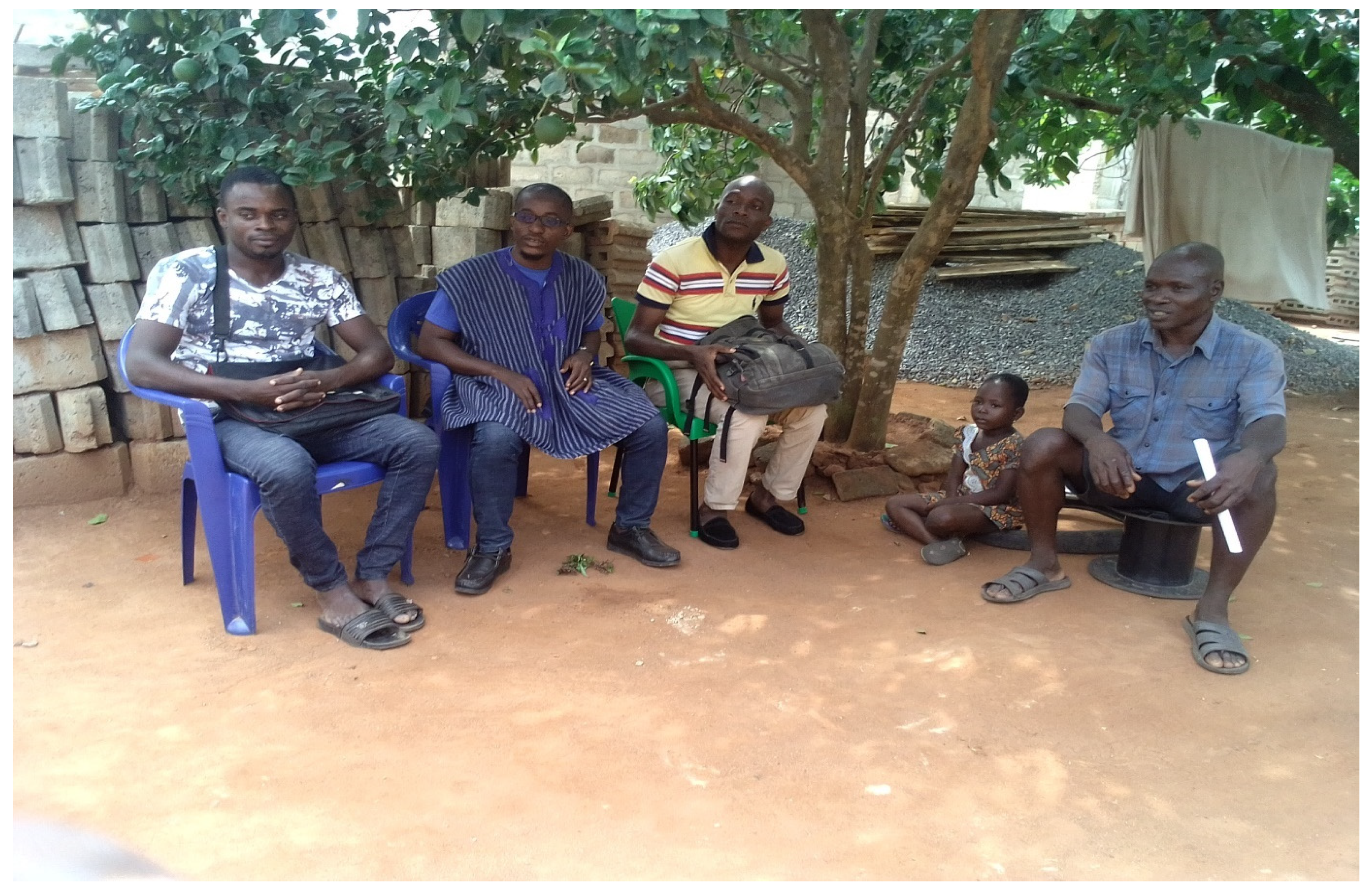
Figure 2.
Survey team in a house in Tonoukoutsi with the owner (Field photo, CEESPOD, December 2022).
Figure 2.
Survey team in a house in Tonoukoutsi with the owner (Field photo, CEESPOD, December 2022).
The majority of respondents were shopkeepers (29.45%). Housewives and craftsmen represented 24.66% and 17.12% of respondents respectively. Farmers, wage-earners and retailers each accounted for 8.90%. Motorbike taxi drivers represent 0.68% and others 1.37%. The average household size was 5.6 ± 3.2 people and the maximum number of people per household was 32.
3.1. Household water supply
Table 5 shows the distribution of households according to the main source of water they use and their uses
Table 4 shows that borehole water is used most by households. In fact, 74.66% of respondents use only borehole water, 6.85% use only well water and 6.16% use water from the TDE. Well water and borehole water are used jointly by 9.59% of respondents. According to Table 3, 80.14% of respondents use borehole water for drinking, 72.60% for cooking and 70.55% for showering. Packaged water is used only for drinking by 8.90% of respondents. Well water is used for drinking, cooking and showering by 4.11%, 15.07% and 21.92% of respondents respectively. As for water from the TDE, 91.10% of respondents do not use it, 5.48% use it for all purposes, 2.05% for drinking and cooking and 1.37% use it for showering and washing clothes. Regarding the source of water from the TDE, 6.62% of respondents use water from standpipes and 93.38% are TDE subscribers.
Figure 3.
Lomegnonkopé fountain bollard (Field photo, CEESPOD, December 2022).
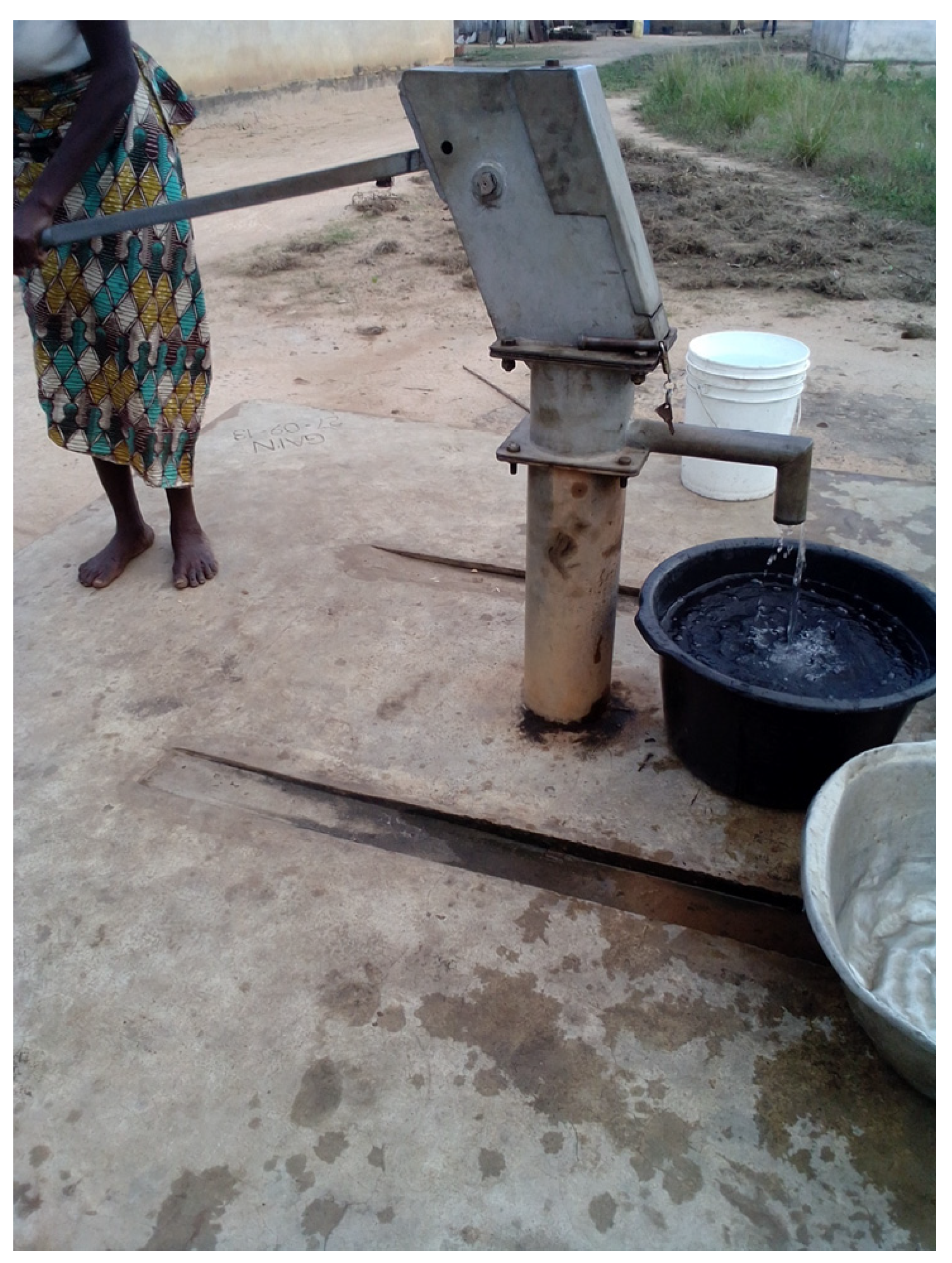
Figure 4.
Fountain bollard at the Adétikopé C E G (Field photo, CEESPOD, December 2022).
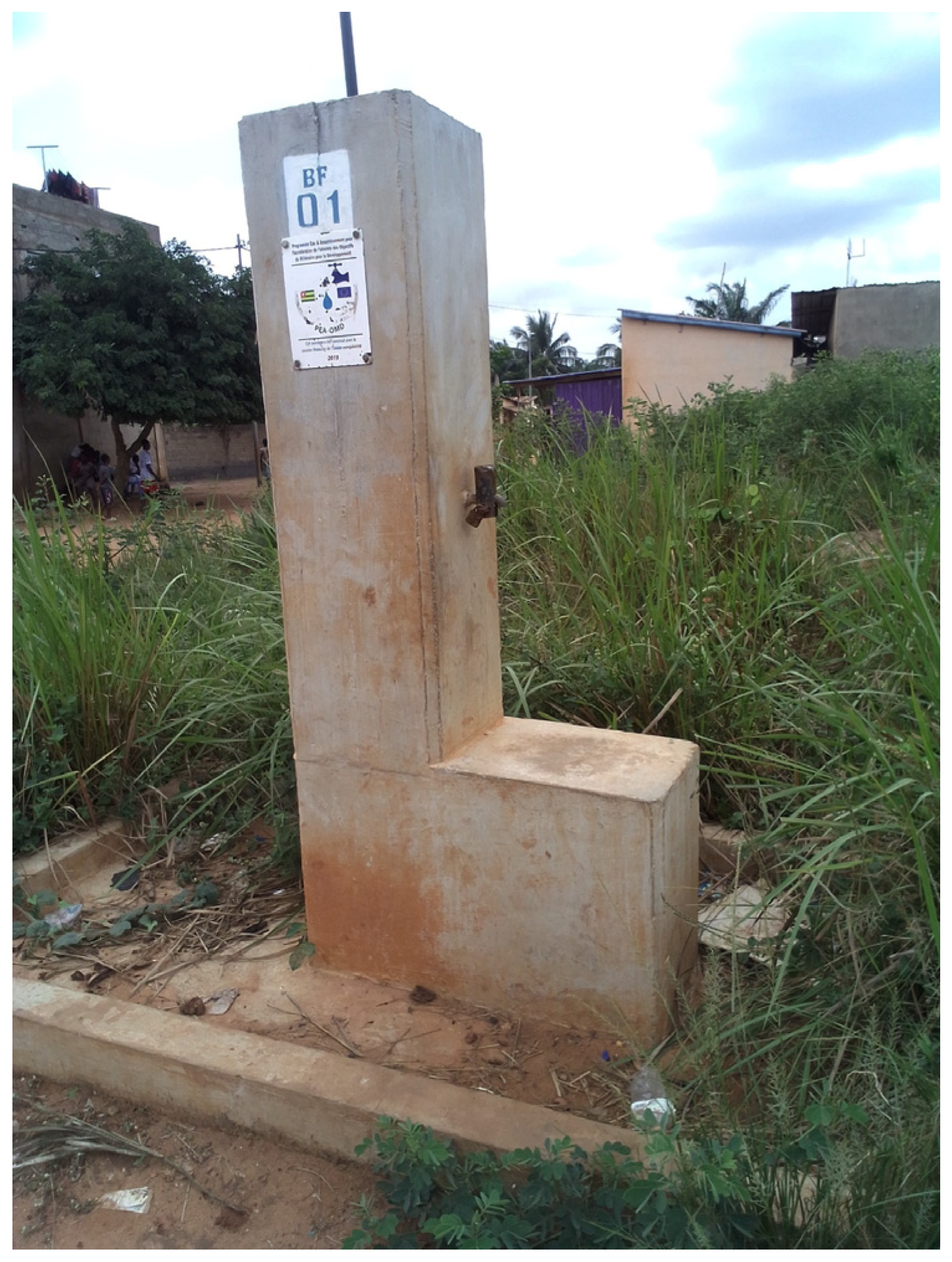
Table 7.
Waste water and excreta management (continued).
| Indicators | Terms and conditions | % | P. Values |
|---|---|---|---|
| Method of emptying the pit once it has been filled | Emptying truck | 5.48% | < 0,001 |
| Never emptied + don't know | 80.14% | < 0,001 | |
| Total | 85.62% | ||
| Final treatment after emptying | Don't know | 99.20% | < 0,001 |
| Other | 0.80% | < 0,001 | |
| Total | 100% | ||
| Places where latrines are not available | In the wild | 66.67% | < 0,001 |
| The neighbours | 14.28% | < 0,001 | |
| In a public toilet | 19.05% | < 0,001 | |
| Total | 100% | ||
| Places where children's faeces are discharged | In a toilet | 14.38% | < 0,001 |
| In the wild | 85.62% | < 0,001 | |
| Total | 100.00% | ||
| Observation of flooding in the concession during the rainy season | Yes | 12.33% | < 0,001 |
| No | 87.67% | < 0,001 | |
| Total | 100.00% | ||
| Observing flooding in the neighbourhood | Yes | 11.64% | < 0,001 |
| No | 88.36% | < 0,001 | |
| Total | 100.00% | ||
| Knowledge of what happens to the place where the lorries are deposited | Yes | 67.12% | < 0,001 |
| No | 32.88% | < 0,001 | |
| Total | 100.00% | ||
| Condition of gutters | Bad | 0.68% | < 0,001 |
| Do not exist | 99.32% | < 0,001 | |
| Total | 100.00% |
3.2. Household wastewater management
According to the survey data, the public highway is the most popular place for respondents to dispose of kitchen and laundry wastewater. Of the 100% people surveyed, 78.77% discharged their cooking and washing water onto the public highway. 12.33% and 8.90% of respondents dumped their washing water in undeveloped plots and backyards respectively. Kitchen wastewater was discharged by 13.70%, 6.16% and 1.37% of respondents respectively into undeveloped plots, house yards and cesspools. Septic tanks and undeveloped plots are the places most used by households for discharging or draining wastewater. Indeed, 58.22% reject this waste water in septic tanks and 32.19% on unbuilt plots. Of the 100% people surveyed, 85.62% had a stool latrine, while only 14.38% said they did not have one. The majority of respondents (54.40%) had traditional pits, 30.47% had VIP (Ventilated Improvised Pit) latrines and 15.13% had manual flush latrines. Of the respondents with latrines, 93.60% said their latrines were in good condition, 4% said their latrines were in acceptable condition and 2.40% said their latrines were in poor condition. According to the survey data, 68% of respondents maintained their toilets or latrines twice a month, 31.20% once a week and 0.80% once a month. As for the frequency with which latrines are emptied, 2.40% empty their pits every three years, 3.20% every two years, 66.40% have never done so and 26.40% don't know. The majority of respondents (80.14%) thought that their latrine pits were never emptied or did not know whether their latrine pits were emptied. 5.48% of respondents said that their pits were emptied by lorry. 99.20% of respondents were unaware of the final treatment given to emptied pits. Respondents without latrines defecated in a variety of places. Thus, 14.28% defecate with neighbours, 66.67% in the open and 19.05% in public latrines. Households with children dispose of their children's faeces in a variety of places. Thus 85.62% dump their children's faeces in the open and 14.38% said they dump their children's faeces in a toilet. Flooding occurs in the homes of 12.33% of respondents and in the neighbourhoods of 11.64%. 87.67% said they had not experienced flooding in their compound and 88.36% said there was no flooding in their neighbourhood. 67.12% of respondents said they knew where the lorries were dumped, while 32.88% had no idea where the lorries were dumped.
Figure 5.
Sanitary facilities in a house in Tonoukoutsi (Field photo, CEESPOD, December 2022).
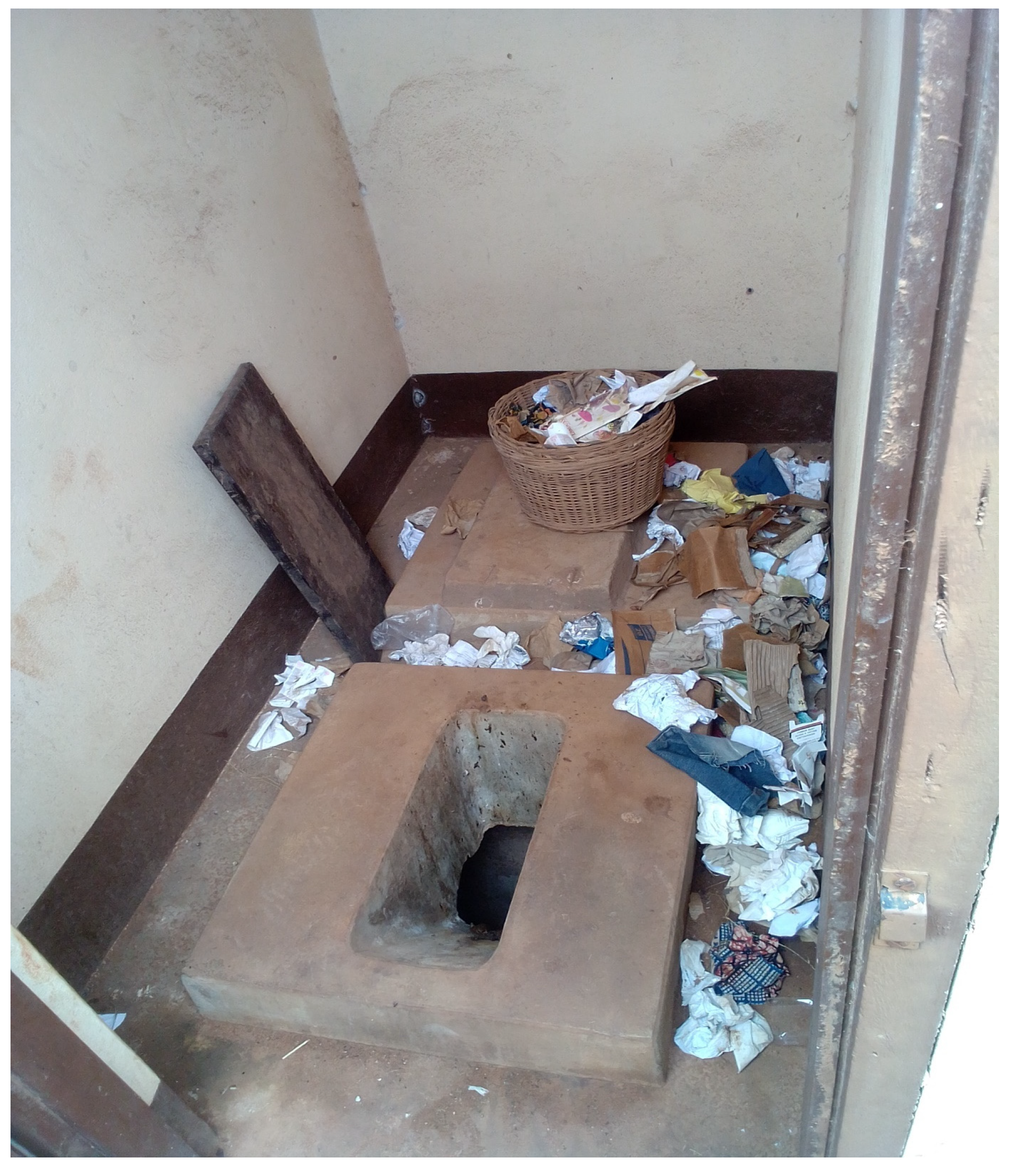
Figure 6.
Wastewater on the Adétikopé-Centre road town hall (Field photo, CEESPOD, December 2022).
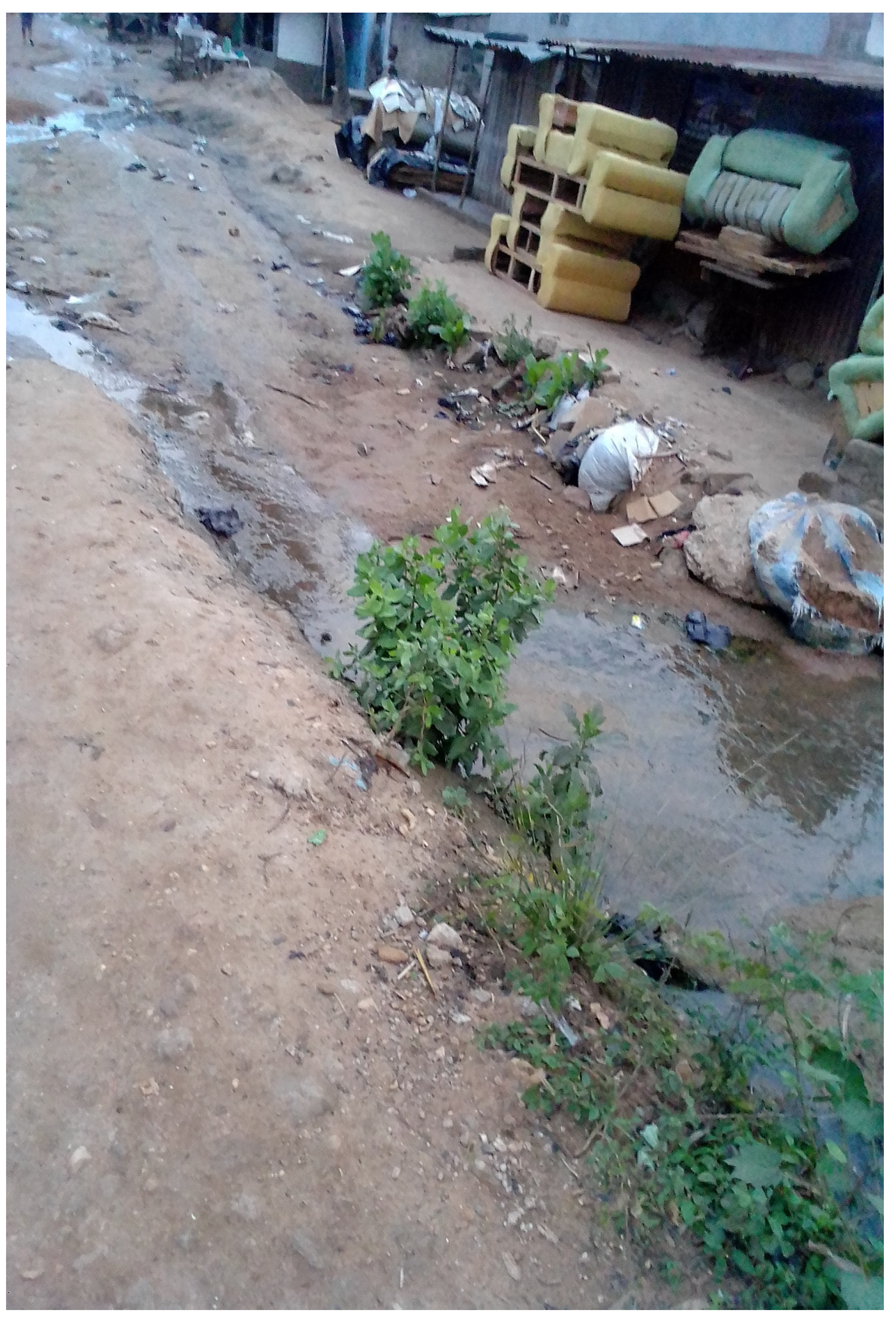
Figure 7.
Wastewater on the road to Adétikopé town hall (Field photo, CEESPOD, December 2022).
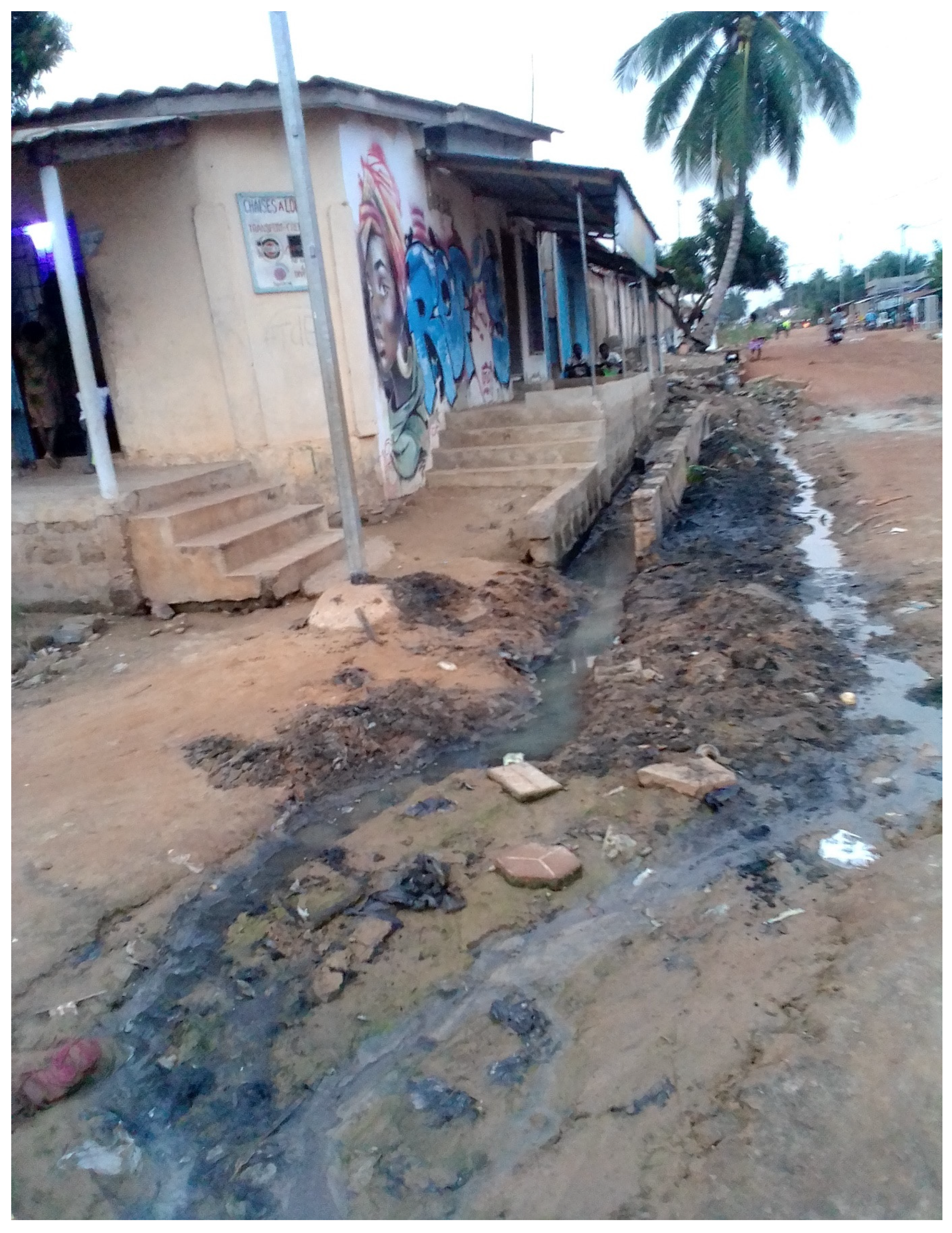
Figure 8.
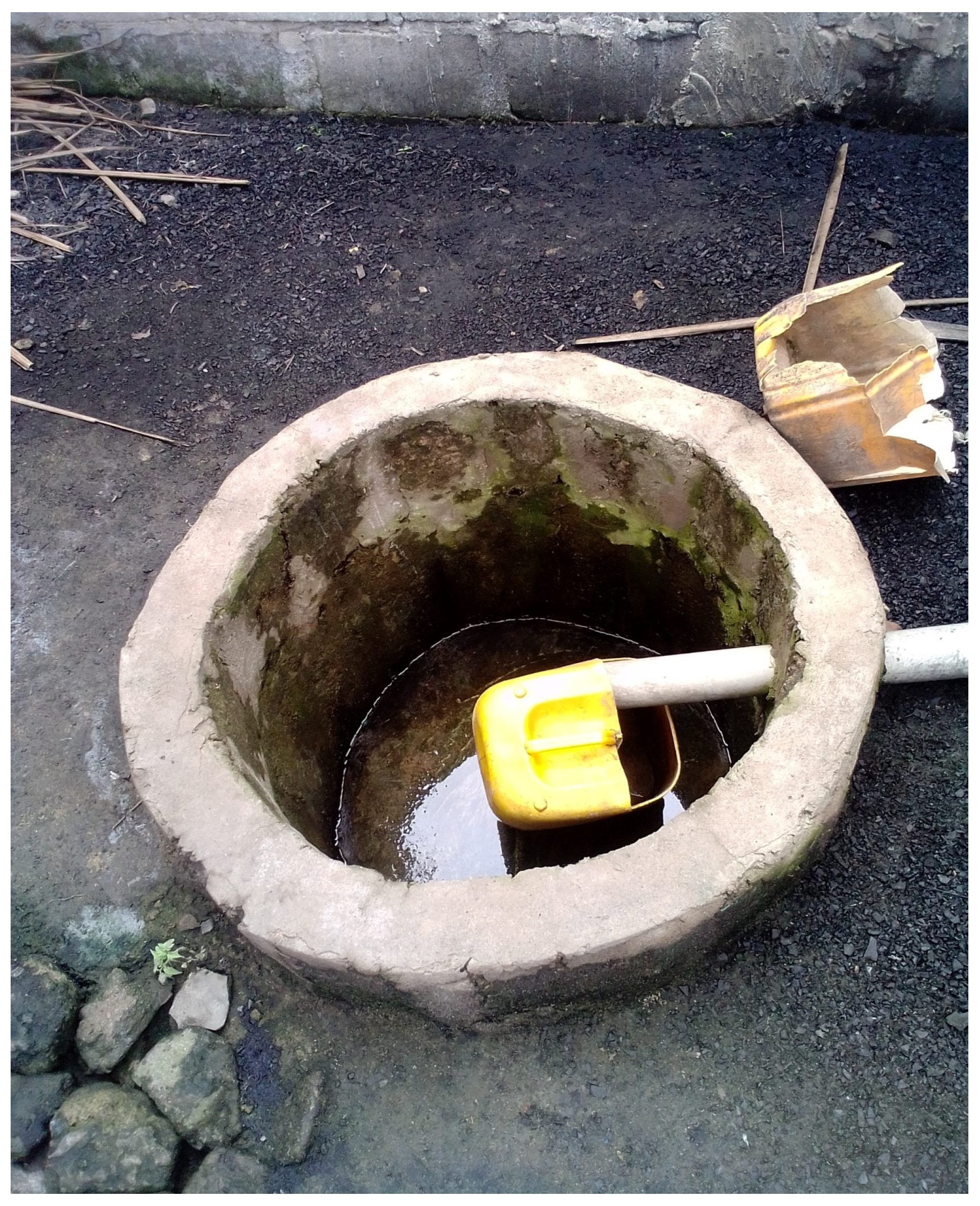
Wastewater reservoir in the centre of Adétikopé (Field photo, CEESPOD, December 2022).
3.3. Knowledge of wastewater management
Table 8 shows the distribution of respondents according to their knowledge of waste management and recycling.
58.22% of respondents knew about waste management and 62.33% about waste recovery. However, 41.78% said they had no knowledge of waste management and 36.30% had never heard of waste recovery. The majority of respondents (56.22%) had heard about waste management via the media (radio) and 2% had heard about it in the street. For 96.58% of respondents, wastewater poses a health risk, while 2.74% do not know that wastewater poses a health risk.
Figure 9.
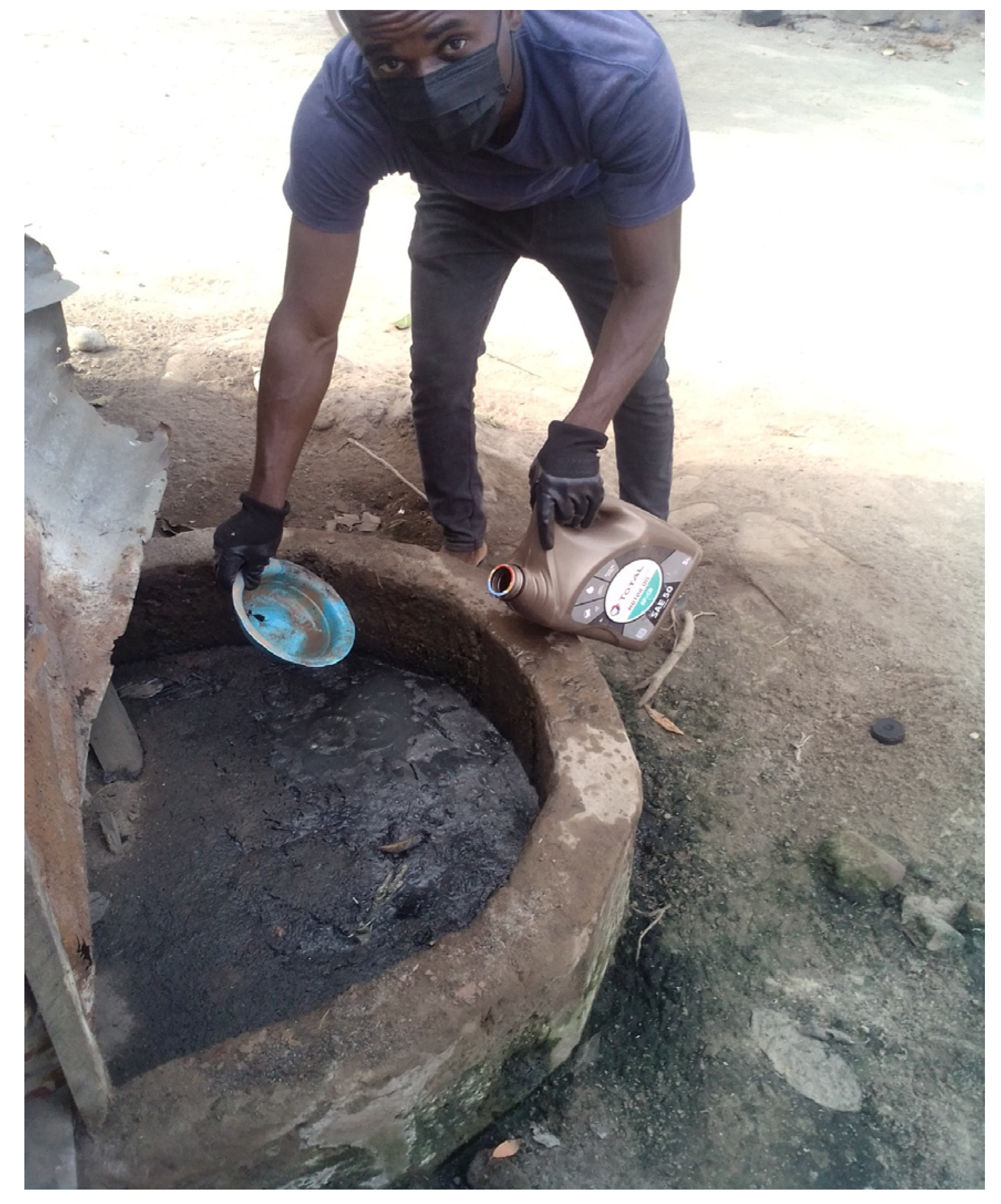
Wastewater sampling at Adétikopé (Field photo, CEESPOD, December 2022).
3.3.1. Raising awareness of sanitation issues in the hygiene department
The results show that only 2.87% of households (n=7) mention the presence of the Basic Hygiene and Sanitation Service (SHAB) in the locality to raise awareness of sanitation issues.
3.3.2. Interview with the head of the basic hygiene and sanitation department
This interview showed that public awareness is raised four (4) times a month, once a week, on the issue of environmental sanitation. Home visits are also made 4 times a month, i.e. once a week. The department is not involved in the installation of sanitation facilities by the public. The department does not have a sanitation plan for the area. The department has suggested that the town hall should get involved in managing sanitation problems, organise awareness-raising sessions involving the village chiefs, and provide the department with more staff (Hygiene and Sanitation Technicians).
3.3.3. Interview with the head of the town hall's technical division
To manage domestic wastewater, the town council is raising awareness, regulating pipe connections to the streets, and carrying out regular household inspections. As far as rainwater and excreta management is concerned, nothing has yet been envisaged, and projects are still in the pipeline. There are no public latrines in the commune.
3.3.4. Interview with the head of the village development committee
The interview with the head of the VDC showed that there are no public latrines or dustbins in the public squares. Each neighbourhood organises awareness-raising sessions on hygiene and sanitation.
3.3.5. Interview with the town hall councillor
The interview showed that, in terms of domestic wastewater management, the town council plans to work with the CMS SHAB to put in place a local sanitation policy. Awareness-raising sessions and community work have been discontinued since then because of the Covid-19 pandemic.
3.3.6. Observation grid for the general environment of the village
Observation of the general environment in Adétikopé revealed seventy-two (72) uncontrolled dumps in the 12 villages. Gutters were built during the redevelopment of the RN°1 to evacuate rainwater, and in some neighbourhoods the gutters were built by the residents themselves. Domestic sewage is found in all neighbourhoods.
4. Discussion
Methodology of the study: In our study, the household survey was random and took into account all socio-professional and religious strata without discrimination as to standard of living, since it covered the different types of housing. In this way, the results obtained give a picture of the practices and habits of the majority of households and can therefore effectively represent the reality of the daily lives of the entire population of the city. These results can also be used as an aid to decision-making with a view to improving citizens' living conditions. However, our results concern only 5256 out of nearly 24487 households in the locality. A survey with a larger sample would provide even more reliable and accurate data. However, this study, conducted with a margin of error of 0.01%, guarantees results that are more reliable for extrapolation than if it were conducted with a margin of error of 0.05%, as in most studies. Also, the survey was aimed at heads of household, but it turned out that in the field we had to record the men present at the time of the survey as respondents (being heads of household), even though it was their wives who had to answer the questionnaire, since the answers stemmed from household activities. A redefinition of the respondent in this type of research would make it possible to dissociate the respondents, who should be mostly women, from the heads of household, who are often men.
Socio-demographic characteristics: Our survey covered 5256 heads of household in the peri-urban commune of Adétikopé. The results showed that 27.40% of heads of household or representatives were men and 72.60% were women. The female predominance found in our study was also found by Guidi in the same locality in 2020 but at a higher proportion [15]. There are several possible explanations for the predominance of women in households. At the time of our visit to the households, women were much more likely to be encountered, while the men were off about their business. There is also a worldwide predominance of women in the population. In a similar study conducted by Titone in the prefecture of Agou in Togo in 2020, the majority level of education was secondary [16]. The average age of the men and women surveyed was 40.83 ± 11.05 years, and their ages ranged from 20 to 70 years. Most of them had at least an average level of school education (64.38% and 3.42% respectively for secondary and university education); 9.59% of them had never been to school. This level of education may also reflect the socio-economic standard of living of households faced with a number of unhealthy and environmental problems. Similar studies by Titone in Agou1 in 2020 and Tchakou in Vo3 in 2021 also reported average secondary school ages of 47.75 and 45 respectively [16,17]. Similarly, Guidi found that 18.72% of households surveyed in Adétikope in 2020 did not attend school [15]. His results are similar to those of a study carried out in 2022 on 350 heads of household in the 20 neighbourhoods of the town of Vogan, which showed that 54.00% of the heads of household or representatives were men and 46.00% were women. The average age of the men and women surveyed in Vogan was 45.43, with ages ranging from 18 to 82; most had at least an average level of education (47.43% and 3.14% respectively for secondary and university education); 20.86% of them had never been to school. 29.45% of heads of household were shopkeepers. This was the observation made in 2020 by Guidi and Titone in Agoé Nyivé 6 and Agou Gadzépé respectively [15,16].
Identification of the socio-professional characteristics of the respondents: The income-generating activities were trade; in reality, most of them were petty trade or the resale of products. This observation was made in another town in Togo, where 26.23% of the surveys involved trade [18]. In 2022, Nyakpo's study showed that trade was the most common activity in Vogan [19]. Modern and high-standard housing accounted for 79.45% of the households surveyed, with 53.42% personally owned, 16.44% family-owned and 30.14% rented. These results reflect the Vogan study, which found that four out of five households surveyed (81.43%) lived in concessions of fair quality (medium standard) in relation to the population's relatively average standard of living, with traditional concessions estimated at 12.57%. The households surveyed in these concessions in Vogan were 43.14% owners, 32.57% family members and 24.29% tenants [19]. The average number of people per household was 5.6 ± 3.2, with a high proportion of 6-member households. In Vogan, the average number of people per household was 5.2, with four (4) people per household being the most represented [19]. These results reflect that of the QUIBB 2015 survey, according to which the average household size in Togo was 4.7 in general and in particular 4.1 in urban areas and 5.3 in rural areas [10].
Water supply: This study notes three main sources of water supply (borehole water, TDE water and well water), as do the results of QUIBB Togo 2015 [10]. Specifically, our results show borehole water as the main source of supply (74.66%), with 80.14% used as drinking water and 72.60% as cooking water. Nyakpo's study in Vogan showed that borehole water was used most by households in the town of Vogan. In fact, 53.43% of households used it as their main source of water, ahead of water from the ToE and the well. This use concerns almost all household water needs (55.14% for drinking and 53.71% for cooking and showering) [19]. Our results are similar to those of Guidi, who showed in 2020 that borehole water is used more in Adétikope, 61.70% for drinking and 50.21% for cooking [15]. Although the ToE service was available, the supply did not cover all the town's localities, so many households relied on boreholes for their water needs. Unfortunately, all the operators questioned said that they had not analysed the water from the boreholes before using it, including those who sold it, which constitutes a real health hazard for consumers.
Existing wastewater and excreta management system: Grey water management is a problem in the locality. Only 1.37% have a cesspool for draining grey water and discharge onto public roads reaches 78.77%. These results corroborate the data from the QUIBB 2015 survey, which had estimated the discharge of wastewater onto streets in Lomé and in urban areas at 52.5% and 53.0% respectively [10]. The same observation was made by Awou and Kpizou, who showed that the majority of laundry and kitchen wastewater is poured into the streets [20,21]. The other places where wastewater was discharged were the courtyard, undeveloped plots and gutters. In 2022, few households in Vogan had cesspools or pits to collect wastewater from washing (18.29%) and cooking (18.57%). In fact, more than half of our respondents dumped this liquid waste on the public highway in 54.00% and 52.00% of cases respectively [19]. As far as latrines are concerned, 85.62% of households have latrines in their concessions. These results reflect the reality of the situation in metropolitan Lomé and its urban perimeter. Tchindou in 2019 found that 84% of his respondents had a latrine in their concessions, 29% of whom were VIPs [22]. These results are close to our own, proof that our communities share almost the same realities when it comes to sanitation. Nyakpo revealed that almost nine out of ten households (89.43%) in the town of Vogan had a latrine, 95% of which were in good condition. Essentially three types of latrine were found in the households surveyed: traditional pits (38.02%), VIPs (32.91%) and manual flush toilets (29.07%). Open defecation (DFAL) was practised in 3.14% of the population surveyed. Titone in 2020 found a DFAL rate of 5.86% in Agou Gadzépé, while Awou in 2011 found that the DFAL rate in Kpalimé was 16% [16,20]. Although these different data do not overlap, they describe a decrease in the phenomenon over time, considering that these localities are experiencing almost the same realities. DFAL is often a source of faecal peril, which is an important factor in the prevalence of several diseases, in particular diarrhoea, cholera, intestinal parasitosis, typhoid fever, hepatitis A, poliomyelitis, etc. The provision of appropriate facilities, awareness-raising campaigns and raising people's awareness could help stop this practice. Among households without latrines, 66.67% defecate in the open, compared with 14.28% at neighbours' homes and 19.05% in public toilets. The almost total absence of public toilets in the commune (only one latrine per village) explains why this high number defecates in the open. Tchindou in Tsévié, had also reported that 15% of his respondents threw children's faeces directly onto a rubbish dump [22]. In Vogan, among households without latrines, 29.73% defecated in the open, while 13.51% used their pigsties installed in their homes. 2.57% said they used public latrines to defecate. Another form of open defecation in Vogan is the dumping of children's faeces on rubbish dumps or in the open air, which increases the health risks associated with faecal peril. Some households with children throw their faeces into the dustbins (10.19%) or directly onto the dump (13.42%). This practice exposes children, who are used to wandering from dump to dump or rummaging through bins looking for recyclable waste, given that many households do not sort their waste at source before throwing it away.
Knowledge of waste management: More than three out of five respondents (62.29%) said they had heard about waste management at least once, the majority through local radio stations (50.00%) and health workers (24.31%).
Excreta management: The lack of latrines in households is still a problem in countries with limited resources. This observation was made in another study in which not all households had latrines [16]. All this encourages open defecation, which causes diarrhoeal diseases such as cholera. Even when latrines do exist, they are of various types, most of which do not meet hygiene standards. The difficulty for households, most of which have low incomes, is to afford modern latrines with watertight septic tanks. All this represents a huge financial outlay that is beyond the reach of household budgets. Other studies in other communes have made the same observation [18,23,24].
The availability of latrines in the concessions, together with good management of them. The availability of latrines in the concessions, together with good management of these, through their maintenance and the proper disposal of the sludge, guarantee the health safety of the population. This remains a challenge for households. The management of faecal sludge, and in particular its disposal, requires specific resources and facilities that the commune does not currently have, which is a problem for households. Emptying is carried out by mechanical emptying trucks run by private companies from the city of Lomé. This service is expensive, and only households that can afford the cost use it. Otherwise, the waste is emptied manually, polluting the environment. Several studies have shown that very few households use emptying trucks [16,23].
With regard to faecal sludge, 66.40% had never emptied their toilets and 80.14% did not know the exact process for managing latrines. In the Nyakpo study in Vogan, more than half (53.14%) of respondents said they had never emptied their toilet pits. Other respondents, particularly tenants, did not even know whether their latrine pits had ever been emptied. Manual emptying, despite the risks involved, is still practised by a small proportion of our respondents (1.14%). Filling latrine pits depends on several factors, including the size and use of the structure (the number of people using it). It has to be said that many of our respondents who had emptied their pits at least once expressed the difficulties they had encountered before finding an emptying lorry, which most often came from Lomé. Emptying by lorry was done by 16.57% of our respondents, and all of them did not know where the emptied sludge was to be dumped or how it was to be treated, as the town of Vogan, like other towns in the country, does not yet have a sludge treatment plant.
Domestic wastewater management: Domestic wastewater is managed individually in the municipality. From inside to outside, each household manages its own wastewater without worrying about its neighbours. The study showed that most households have a shower but not necessarily a sump for draining shower water. For those households that do have sumps, some are not in good condition and contribute to environmental pollution. In contrast to our study, Titone had noted that the majority of households surveyed in the commune of Agou I in Togo did not have a shower [16]. Although households make an effort to dig makeshift pits for excreta, the water from the showers is mostly drained behind the houses on the ground, making these areas constantly damp and mosquito breeding grounds for the frequent cases of malaria. This is particularly true in the poor neighbourhoods of Lomé, as shown in the study by Ahatefou et al. [25]. The same applies to waste from cooking, washing and dishwashing, which is most often spread in the street, as Awou also showed in his study [20]. As always, households give as their reason the lack of financial means to build a cesspit for kitchen, laundry, dishwashing and shower waste. The challenge is not just to build the toilets, but to build them according to the rules of the trade [26]. The uncontrolled dumping of sewage in the streets not only creates nests for mosquito larvae but also pollutes surface water and the water table, which affects the immune system, especially of children (who are often in direct contact with this sewage) in terms of parasitosis. In the neighbourhoods surveyed, rainwater is not drained due to the lack of appropriate drainage systems. Some residents try to divert run-off water from their plot by installing makeshift gutters.
Households' knowledge of common diseases: Poor management of household waste encourages the production of disease vectors such as mosquitoes, flies, cockroaches, etc., which swarm in unsanitary areas and are a source of water and air pollution. Households' level of knowledge about common diseases caused by poor management of the EU is fairly good. Malaria, digestive parasites and diarrhoeal diseases are frequently mentioned. These results are to be expected, given the presence of unauthorised rubbish dumps and, above all, the stagnation of water in the streets, since malaria and digestive parasites were the two most frequently consulted illnesses at the Adétikopé health centre (60.44% and 16.60%). As a control method, 73.77% of the surveys used mosquito nets impregnated with long-acting insecticide (MIILDA). The services provided by the hygiene and sanitation department, which should have weighed in the balance, are almost non-existent due to a lack of human resources.
Like other developing countries, Togo is committed to achieving the Millennium Development Goals, in particular the fight against poverty and hunger, and access to a healthy and sustainable environment. According to the results of the Multiple Indicator Cluster Survey (MICS 4) (2010), only 35.6% of the population use improved sanitation facilities, and there are disparities between urban areas (73.8%) and rural areas (12%). It should be noted that many of the facilities built do not comply with standard construction plans, and the treatment systems are not appropriate. This situation and poor hygiene practices explain the recurrence of diseases linked to faecal peril, in particular gastro-enteritis and intestinal parasitosis, which account for 7% of outpatient consultations in health facilities (source: main health indicators in Togo in 2013). In addition, the sanitation sub-sector remains marked by the multiplicity of actors from different Ministries including those [27]
Causes of consultations : The work showed that the leading cause of consultation at the Adétikopé CMS in the first half of 2021 was malaria, with a proportional morbidity of 60.44%. These results are in agreement with those of Titone in the town of Gadzépé and those of Attisso in the commune of Bassar, which showed that malaria was the leading cause of consultation with proportional morbidities of 63.99% and 30.02% [16,28]. It is true that malaria is endemic in Togo. But if it is the leading cause of consultations, as several authors who have conducted studies on liquid waste management have pointed out, it is because all these studies have found that wastewater is poorly disposed of, creating breeding grounds for the mosquitoes that cause malaria.
Interview with the head of hygiene and sanitation, the head of the village development committee, the head of the technical division and the town hall councillor : Analysis of their interview shows that the locality of Adétikopé is suffering from the organisation of essential hygiene and sanitation services. With the creation of the new communes. The town council is gradually getting involved in organising the commune's sanitation sector by raising awareness, monitoring and managing wastewater and excreta.
Suggestion s for a sustainable management model for wastewater and excreta: At the end of this work, we recognise that wastewater treatment remains the best way of managing wastewater and excreta with a view to good urban governance in terms of sanitation. The current wastewater and excreta management model is not part of a continuous improvement process, but remains stagnant or even degrading. It is not sustainable because the underlying economic model is not in line with either social promotion or environmental protection. The model needs to be reviewed to ensure sustainable development. The reasoning remains that wastewater treatment involves extracting pollutants, removing coarse particles and eliminating toxic substances. In addition, wastewater treatment kills pathogens and produces biomethane and fresh manure for agricultural production. The link between waste management and sustainability laid the foundations for this research. Wastewater treatment is part of efforts to minimise water wastage, minimise pressure on natural water sources and create a pathway to clean energy [8].
We are formulating contextualised proposals for sustainable development for the current state of the municipality, with a view to guiding action on household waste management.
Households: (1) Include a sanitation system in the construction plan; (2) Observe the decisions taken by the municipal and health authorities to ensure sound management of liquid waste in the locality; (3) Have their work and the installation of sanitation facilities monitored by specialist services.
To the village development committee: To step up public awareness campaigns on the harmful consequences of improper disposal of wastewater and excreta.
For the CMS Hygiene and Sanitation Department: Intensify awareness-raising sessions on the construction of cesspools.
To the SHAB of the DPS: (1) Continue to work with the city authorities on sanitation management; (2) Increase public awareness of liquid waste management.
To the Agoè-Nyivé 6 town council: (1) Reinforce the technical staff with a hygiene and sanitation technician for better management of sanitation-related problems; (2) Set up a green brigade; (3) Draw up a municipal development plan; (4) Create a waste recovery system; (5) Publicise and enforce the laws governing sanitation in the Togolese Republic; (6) Repairs to decommissioned standpipes and putting them into service; (7) Improving people's access to drinking water (extending the drinking water supply network, particularly in new districts); (8) Building public latrines in all districts; (9) Initiating the construction of a wastewater treatment plant. In addition, the general legal framework for environmental management in Togo needs to be reviewed on an ongoing basis and its day-to-day application ensured.
The treatment of rural domestic wastewater is essential for the overall improvement of the rural environment. At present, the rate of use of rural domestic wastewater resources is generally low in emerging countries, which corresponds to the actual situation in rural areas, and the low cost becomes the need to develop rural wastewater treatment technologies [29].
6. Conclusions
The aim of our work was to take stock of household liquid waste management in the commune of Agoè-Nyvé 6. At the end of our study, we were able to highlight the town's problems relating to the management of household wastewater and the resulting consequences. This report provides an overview of how household waste, domestic wastewater and excreta are disposed of.
These discharges have led to a lack of sanitation, which is the cause of illnesses linked to unhealthy living conditions and which are frequently encountered in the area. This study enabled us to understand the problems of household waste management in the municipality. The results of this research show that 93.85% of the concessions have an individual sanitation facility. Most of these facilities were in good working order and clean. The surveys revealed that the management of excreta and wastewater is marked by the absence of public latrines, leading to the risk of faecal contamination from open defecation. For domestic wastewater management, the use of cesspools is not widespread, with only 71.31% of existing cesspools. Most concessions use unsanitary methods to manage wastewater from cooking, washing and dishwashing, which is discharged into the environment (71.3% of households discharge it into the street).
The immediate consequence of this situation is the recurrence of the diseases mentioned by the respondents, including malaria and digestive parasites. The management of liquid waste in the commune is encountering organisational and financial difficulties. The current wastewater and excreta management prototype is not undergoing continuous change, but remains stagnant or even degrading. It is not sustainable because the underlying economic model is not in line with either social promotion or environmental protection. This model needs to be reviewed to ensure sustainable development. For sustainable urban governance of wastewater and excreta, it is time to think about how to organise wastewater collection in our municipalities. Effective awareness-raising on the part of all those involved, along with actions such as stepping up awareness-raising campaigns and installing sanitation facilities, will not only help to clean up the environment and give the city an attractive appearance, but will also, and above all, guarantee good health for the population.
Author Contributions
Conceptualisation, GBEH; Methodology, GBEH, K K, KA, PA ; Software, GBEH; Validation, PA; Formal analysis, GBEH, SP, KK; Survey, GBEH, AA; Resources, AN, AMA; Data curation, GBEH, AAGVA; Original drafting, GBEH; Revision and editing, GBEH, PA; Visualisation, K Z H, K Z-K; Supervision, PA. . All authors have read and accepted the published version of the manuscript.
Funding
This research was funded by the Regional Centre of Excellence on Sustainable Cities in Africa (CERViDA_DOUNEDON), the Association of African Universities (AAU) and the World Bank.
Institutional Review Board Statement
not applicable.
Informed Consent Statement
not applicable.
Data Availability Statement
data will be made available on request.
Acknowledgments
We would like to thank the Regional Centre of Excellence on Sustainable Cities of Africa (CERViDA_DOUNEDON), the Association of African Universities (AAU) and the World Bank for providing the necessary funding that facilitated our research work leading to these results. We would also like to express our gratitude to Cyprien AHOLOU, and Kossiwa ZINSOU-KLASSOU, for their support and enlightened leadership in promoting this Centre of Excellence.
Conflicts of Interest
The authors declare no conflict of interest.
References
- Attar, M. Les Enjeux de La Gestion Des Déchets Ménagers et Assimilés En France En 2008; Direction des Journaux Officiels, 2008.
- Koné-Bodou Possilétya, J.; Kouamé, V.K.; Fé Doukouré, C.; Yapi, D.A.C.; Kouadio, A.S.; Ballo, Z.; Sanogo, T.A. Risques sanitaires liés aux déchets ménagers sur la population d’Anyama (Abidjan-Côte d’Ivoire). VertigO - Rev. Électronique En Sci. Environ. 2019. [CrossRef]
- Diabagate, S.; konan, kouamé P. Gestion Des Ordures Ménagères Dans La Ville de Bouaké, Sources d’inégalités Socio-Spatiales et Environnementales. Rev. Espace Territ. Sociétés Santé 2018, 1, 126–142.
- abbari, K.; A.Najih; Amir, S.; A.Agbalou GESTION DES DECHETS MENAGERS DANS LA VILLE DE KHOURIBGA (MAROC) : ETUDE DU COMPORTEMENT DU CITOYEN. ScienceLib 2014, 6.
- Gbekley, E.H.; Kouawo, A.C.A.; Awokou, K. L’éducation Relative à l’environnement (ERE) Au Togo : Evaluation Du Paradigme de Formation 2021.
- Kondoh, E.; Bodjona, M.B.; Aziable, E.; Tchegueni, S.; Kili, K.A.; Tchangbedji, G. Etat Des Lieux de La Gestion Des Déchets Dans Le Grand Lomé. Int. J. Biol. Chem. Sci. 2019, 13, 2200–2209. [Google Scholar] [CrossRef]
- JICA Projet d’Assainissement Des Eaux Usées, Des Eaux Pluviales et Des Déchets Solides de La Ville de Kaolack En République Du Sénégal. CTI Engineering International - Recherche Google Available online: https://www.google.com/search?hl=fr&q=Projet+d%27Assainissement+des+Eaux+Us%C3%A9es,+des+Eaux+Pluviales+et+des+D%C3%A9chets+Solides+de+la+ville+de+Kaolack+en+R%C3%A9publique+du+S%C3%A9n%C3%A9gal.+CTI+Engineering+International (accessed on 11 July 2023).
- Silva, J.A. Wastewater Treatment and Reuse for Sustainable Water Resources Management: A Systematic Literature Review. Sustainability 2023, 15, 10940. [CrossRef]
- DGSNC Ministère Auprès Du Président de La République, Chargé de La Planification, Du Développement et de l’aménagement Du Territoire. Available online: https://planification.gouv.tg/ (accessed on 11 July 2023).
- QUIBB; MPDAT-DGSCN République Togolaise, Rapport Enquête QUIBB; 2015;
- Ministère de l’Environnement et des Ressources Forestières du Togo. Loi No 2008-005 Du 30 Mai 2008 Portant Loi-Cadre Sur l’environnement.; 2008; p. 37;
- MSHPAUS Politique Nationale de Santé, Togo Available online: https://www.afro.who.int/fr/publications/politique-nationale-de-sante-togo (accessed on 9 October 2022).
- inistère de l’Urbanisme, de l’Habitat et du Cadre de Vie de la République Togolaise. Elaboration Du Schéma Directeur d’Aménagement et d’Urbanisme (SDAU) Du Grand Lomé. 2018. 15p. Available online: https://urbanisme.gouv.tg/le-ministere-de-lurbanisme-de-lhabitat-et-de-la-reforme-fonciere-a-dote-quarante-huit-48-communes-et-le-treize-13-du-grand-lome-de-schemas-directeurs-damenagement/ (accessed on 11 July 2023).
- Robert Magnani et echantillonage Guide d’Echantillonnage Available online: https://www.bing.com:9943/search?q=Robert+Magnani+et+echantillonage&form=ANNTH1&refig=3da28ced7efe4ade9bda7c66ea89acac (accessed on 24 February 2023).
- Guidi, A. Disponibilité de l’eau Potable et Santé Des Populations de La Localité d’Adétikopé. Mémoire de master santé environnementale spécialité eau et assainissement, Université de Lomé, Ecole des Assistants Médicaux, 2020.
- Titone, B. Etat Des Lieux de La Gestion Des Déchets Ménagers Solides et Liquides Dans La Commune Agou1 de La Préfecture d’Agou : Cas de La Ville de Gadzépé. Mémoire de master santé environnementale spécialité eau et assainissement, Université de Lomé, Ecole des Assistants Médicaux: Université de Lomé, Lomé, Togo, 2020.
- Tchakou, T. Etat Des Lieux de l’assainissement Dans La Commune Vo3. Mémoire de master santé environnementale spécialité eau et assainissement, Université de Lomé, Ecole des Assistants Médicaux: Université de Lomé, Lomé, Togo, 2022.
- Dinégré, M. Etat Des Lieux de l’assainissement de l’hygiène et de l’approvisionnement En Eau Potable de La Commune de Notsè. Mémoire de master santé environnementale spécialité eau et assainissement, Université de Lomé, Ecole des Assistants Médicaux: Université de Lomé, Lomé, Togo, 2016.
- Nyakpo, A. Etat Des Lieux de La Gestion Des Déchets Ménagers Solides et Liquides Dans La Commune Agou1 de La Préfecture d’Agou : Cas de La Ville de Gadzépé. Mémoire de master santé environnementale spécialité eau et assainissement, Université de Lomé, Ecole des Assistants Médicaux: Université de Lomé, Lomé, Togo, 2022.
- Awou, K. Contribution à l’amélioration de La Gestion Des Excréta et Eaux Usées Dans La Ville de Kpalimé. Mémoire de Technicien Supérieur en Génie Sanitaireé, Université de Lomé, Ecole des Assistants Médicaux: Université de Lomé, Lomé, Togo, 2011.
- Kpizou Etat Des Lieux de La Gestion Des Déchets Ménagers Dans La Commune d’Agoé Nyivé 6 : Cas de La Localité d’Adétikopé Centre. , Mémoire de master santé environnementale spécialité eau et assainissement, Université de Lomé, Ecole des Assistants Médicaux: Université de Lomé, Lomé, Togo, 2022.
- Tchindou, P. Etude Diagnostique de La Gestion Des Boues de Vidange Dans La Ville de Tsévié Au Togo. Mémoire de master santé environnementale spécialité eau et assainissement, Université de Lomé, Ecole des Assistants Médicaux: Université de Lomé, Lomé, Togo, 2019.
- Ali, A. Problématique de l’assainissement Au Togo : Cas Du Quartier Haoussa- Zongo/Togblékopé Dans La Préfecture Du Golfe. Mémoire de master santé environnementale spécialité eau et assainissement, Université de Lomé, Ecole des Assistants Médicaux: Université de Lomé, Lomé, Togo, 2014.
- Mukuku, O.; Musung, J.; Samba, C.; Tshibanda, K.; Zalula, C.; Bamba, M.; Luboya, N. Évaluation de La Gestion Des Déchets Ménagers Dans La Commune de Katuba à Lubumbashi (République Démocratique Du Congo). Rev. Infirm. Congo. 2018, 2, 50–56.
- Ahatefou, E.L.; Koriko, M.; Koledzi, K.E.; Tchegueni, S.; Tchangbédji, G.; Hafidi, M. Diagnostic Du Système de Collecte Des Excréta et Eaux Usées Domestiques Dans Les Milieux Inondables de La Ville de Lomé: Cas Du Quartier Zogbedji. Déchets Sci. Tech. 2013, 65, 12–19.
- Gabert, J. Mémento de l’assainissement; éditions Quae, 2018.
- PEA-OMD Guide Opérationnel de l’Assainissement Autonome Des Excréta et Eaux Usées Au Togo. Available online: https://www.bing.com/search?q=PEA-OMD.+%282016%29.+Guide+Op%C3%A9rationnel+de+l%E2%80%99Assainissement+Autonome+des+Excr%C3%A9ta+et+Eaux+Us%C3%A9es+au+Togo.+161p&qs=n&form=QBRE&sp=-1&pq=porno&sc=1-5&sk=&cvid=86806E52E1754318A0A49456CBFFBC9B&ghsh=0&ghacc=0&ghpl= (accessed on 9 October 2022).
- Attisso, A. Etude Diagnostique de La Gestion Des Déchets Solides et Liquides Dans La Commune de Bassar. Région de La Kara. Mémoire de master santé environnementale spécialité eau et assainissement, Université de Lomé, Ecole des Assistants Médicaux, 2015.
- Gui, Z.; Wen, J.; Fu, L.; Wang, S.; Zheng, B. Analysis on Mode and Benefit of Resource Utilization of Rural Sewage in a Typical Chinese City. Water 2023, 15, 2062. [CrossRef]
Table 1.
Population and households in the 12 villages of Adétikopé (Source: RGPH 5, 2022).
| 12 Villages of Adétikopé | Number of men | Number of women | Total | Total households surveyed |
|---|---|---|---|---|
| ADETIKOPE-CENTRE | 8 708 | 9 325 | 18 033 | 1128 |
| AGNAVE | 3 625 | 3 687 | 7 312 | 458 |
| DEVIME | 5 098 | 5 447 | 10 545 | 660 |
| DZOVE | 3 104 | 3 098 | 6 202 | 388 |
| ADOGLOVE | 2 134 | 2 169 | 4 303 | 269 |
| LOMENYO KOPE | 2 075 | 2 120 | 4 195 | 263 |
| KPOKPOME-AGUTE | 13 608 | 14 385 | 27 993 | 1752 |
| AGOTIME | 1 923 | 1 901 | 3 824 | 239 |
| KLADJEME | 4 253 | 4 371 | 8 624 | 540 |
| KPOTAVE | 5 432 | 5 632 | 11 064 | 693 |
| TONOUKOUTI | 2 396 | 2 466 | 4 862 | 304 |
| TSIKPLONOU-KONDJI | 1 554 | 1 683 | 3 237 | 203 |
| TOTAL COMMUNE AGOE-NYIVE 6 | 53 910 | 56 284 | 110 194 | 6898 |
Table 2.
Data collection techniques and tools.
| Technical | Tools | Target |
|---|---|---|
| Observation | Observation grid | General neighbourhood environment Household environment |
| Maintenance | Interview guide | Head of the town hall's technical division Head of the CMS hygiene and sanitation department Head of CDV Town councillor and secretary |
| Questionnaire survey | Questionnaire | Head of household/representative |
| Literature review | Tabulation sheet | Consultation register, scientific websites |
Table 4.
Socio-demographic characteristics of the population.
| Indicators | Terms | % | P. Values |
|---|---|---|---|
| Main occupation of head of household | Farmer | 8.90% | < 0,05 |
| Artisan | 17.12% | < 0,05 | |
| Car / Motorcycle Taxi Driver | 0.68% | < 0,001 | |
| Retailer | 29.45% | - | |
| Housekeeper | 24.66% | < 0,05 | |
| Retailer | 8.90% | < 0,001 | |
| Employee | 8.90% | < 0,001 | |
| Other | 1.37% | < 0,001 | |
| Total | 100.00% | ||
| Average household sizeMode | M-1 | 2.05% | < 0,001 |
| M-2 | 4.79% | < 0,001 | |
| M-3 | 13.01% | < 0,06 | |
| M-4 | 19.86% | < 0,09 | |
| M-5 | 10.27% | < 0,001 | |
| M-6 | 20.66% | - | |
| M-7 | 10.33% | < 0,05 | |
| M-8 | 9.65% | < 0,05 | |
| M-9 | 5.54% | < 0,05 | |
| M-10 | 2.11% | < 0,001 | |
| M-11 | 0.06% | < 0,001 | |
| M-12 | 0.06% | < 0,001 | |
| M-13 | 0.06% | < 0,001 | |
| M-14 | 0.06% | < 0,001 | |
| M-15 | 0.06% | < 0,001 | |
| M-16 | 0.34% | < 0,001 | |
| M-20 | 0.29% | < 0,001 | |
| M-24 | 0.40% | < 0,001 | |
| M-32 | 0.40% | < 0,001 | |
| Total | 100.00% |
Table 5.
Water supply.
| Indicators | Terms | % | P. values |
|---|---|---|---|
| Main source of drinking water | TDE* (Togolese of the waters) only | 6.16% | < 0,001 |
| TDE and drilling | 1.37% | < 0,001 | |
| Drilling only | 74.66% | - | |
| Drilling and wells | 9.59% | < 0,001 | |
| Well only | 6.85% | < 0,001 | |
| Wells and TDE | 1.37% | < 0,001 | |
| Total | 100.00% | ||
| Use made of water TDE | Drinks and Cooking | 2.05% | < 0,001 |
| Shower and laundry | 1.37% | < 0,001 | |
| All | 5.48% | < 0,001 | |
| Do not use | 91.10% | - | |
| Total | 100.00% | ||
| Water used for drinking | Conditioned water | 8.90% | < 0,001 |
| Borehole water | 80.14% | - | |
| Well water | 4.11% | < 0,001 | |
| TDE water | 6.85% | < 0,001 | |
| Total | 100.00% | ||
| Water used for cooking | Drilling | 72.60% | - |
| Drilling and wells | 3.42% | < 0,001 | |
| Well | 15.07% | < 0,001 | |
| TDE water | 8.90% | < 0,001 | |
| Total | 100.00% | ||
| Water used for showering | Drilling | 70.55% | - |
| Well | 21.92% | < 0,001 | |
| TDE | 7.53% | < 0,001 | |
| Total | 100.00% | ||
| TDE water source | TDE subscriber | 93.38% | - |
| Fountain bollard | 6.62% | < 0,001 | |
| Total | 100.00% | ||
| Satisfaction with TDE services | Satisfied | 23.08% | < 0,05 |
| Not very satisfied | 30.77% | < 0,05 | |
| Not satisfied | 38.46% | - | |
| Does not wish to express | 7.69% | < 0,001 | |
| Total | 100.00% |
* National company providing access to drinking water in Togo
Table 6.
Wastewater and excreta management.
| Indicators | Terms and conditions | % | P. Values |
|---|---|---|---|
| Discharge points for kitchen water | In the courtyard of the house | 6.16% | < 0,001 |
| In a sump | 1.37% | < 0,001 | |
| On the public highway | 78.77% | - | |
| On an undeveloped plot | 13.70% | < 0,001 | |
| Total | 100.00% | ||
| Discharge points for washing water | In the courtyard of the house | 8.90% | < 0,001 |
| On the public highway | 78.77% | - | |
| On an undeveloped plot | 12.33% | < 0,001 | |
| Total | 100.00% | ||
| Drainage / discharge of waste water | Septic tank | 58.22% | - |
| On the public highway | 6.16% | < 0,001 | |
| On an undeveloped plot | 32.19% | < 0,001 | |
| In a sump | 3.42% | < 0,001 | |
| Total | 100.00% | ||
| Existence of latrines in the concession | Yes | 85.62% | - |
| No | 14.38% | < 0,001 | |
| Total | 100.00% | ||
| Types of latrines | Traditional pit | 54.40% | - |
| VIP (Ventilated Improvised Pit) latrines | 30.47% | < 0,001 | |
| Manual flush toilet (TCM) | 15.13% | < 0,001 | |
| Total | 100% | ||
| Condition of latrines | Good | 93.60% | - |
| Acceptable | 4.00% | < 0,001 | |
| Bad | 2.40% | < 0,001 | |
| Total | 100% | ||
| Frequency of toilet / latrine maintenance | Twice a month | 68.00% | - |
| Once (1) a month | 0.80% | < 0,001 | |
| Once (1) a week | 31.20% | < 0,001 | |
| Total | 100% | ||
| Frequency of latrine emptying | 1 time every 3 years | 2.40% | < 0,001 |
| 1 time every 2 years | 3.20% | < 0,001 | |
| Once a year | 1.60% | < 0,001 | |
| Never | 66.40% | - | |
| Don't know | 26.40% | < 0,001 | |
| Total | 100% |
Table 8.
Information on wastewater recovery.
| Indicators | Terms and conditions | % | Capital gains |
|---|---|---|---|
| Knowledge of wastewater management | Yes | 58.22% | < 0,001 |
| No | 41.78% | < 0,001 | |
| Total | 100.00% | < 0,001 | |
| Information channel on wastewater management knowledge | Media | 56.22% | < 0,001 |
| Rue | 2.00% | < 0,001 | |
| NA | 43.15% | < 0,001 | |
| Total | 101.37% | < 0,001 | |
| Knowledge of wastewater reclamation | Yes | 62.33% | < 0,001 |
| No | 36.30% | < 0,001 | |
| No answer | 1.37% | < 0,001 | |
| 100.00% | < 0,001 | ||
| Knowledge of the health hazards of waste water | Yes | 96.58% | < 0,001 |
| No | 2.74% | < 0,001 | |
| No answer | 0.68% | < 0,001 | |
| 100.00% | < 0,001 |
Disclaimer/Publisher’s Note: The statements, opinions and data contained in all publications are solely those of the individual author(s) and contributor(s) and not of MDPI and/or the editor(s). MDPI and/or the editor(s) disclaim responsibility for any injury to people or property resulting from any ideas, methods, instructions or products referred to in the content. |
© 2023 by the authors. Licensee MDPI, Basel, Switzerland. This article is an open access article distributed under the terms and conditions of the Creative Commons Attribution (CC BY) license (http://creativecommons.org/licenses/by/4.0/).
Copyright: This open access article is published under a Creative Commons CC BY 4.0 license, which permit the free download, distribution, and reuse, provided that the author and preprint are cited in any reuse.


