

Submitted:
11 July 2023
Posted:
12 July 2023
You are already at the latest version
Abstract
This paper starts with hypothesis (and presents some evidence) that anxiety in migrants is sufficiently important to be modelled. It presents a small (and very incomplete) review of emotion modelling in literature. It asks the question of how to translate these into agent-based modelling, and whether this can be orthogonal to specific modelling of goals and capabilities of agents. This short paper is offered as a motivator for discussion, rather than a discussion of results.
Keywords:
economic migrants
; capabilities approach
; simulation
1. Introduction
Migration is a complex phenomenon. A number of factors, personal, economic, (geo-) political, cultural, and environmental, are involved in the decision to move, and integrate with, a new society. The `new’ society need not be a different country, with a different language. Even a different physical region within the same country, with different environment, pace of life, urbanization-level, etc. can contribute to a feeling of otherness. If not alleviated, this feeling of otherness can result in anxiety [11]. At a sufficiently large-scale, anxiety can result in deleterious consequences for an individual’s physical and mental health. This paper attempts to look at modelling of emotions, specifically anxiety, as well as modelling its spread among migrants. It asks whether a good computational modelling of emotions in agents exists, and if not, what properties it ought to have.
Our investigation into anxiety modelling occurs in the context of the COTHROM1 project. The COTHROM project attempts to model the post-migration experience of economic migrants. The phenomenon of settling down in a new place, acquiring social capacities, integrating into social networks, etc. is partly a cognitive experience, that has no direct physical, or environmental measure. Hence, we needed to create a model that reflected both, the legal processes that migrants went through, as well as anxiety that migrants feel while reacting to these processes. The feeling of being integrated with society is a nebulous one, and there is little data available on any systematic way to measure it. There have been agent-based simulation of migrants previously [24] [27][8]. However all of these have been with regard to distressed peoples or refugees, and hence their motivations are sufficiently different from economic migrants, so as not to be directly comparable.
2. Modelling
The presence of anxiety in migrants at a significantly higher rate, than the background/normal rate of the population, has been well-documented [1][5][15]. One might intuitively expect the stress of cultural adaptation to be present in across-country migrants. However, increased rates of anxiety, and even clinical depression, have also been reported among within-country migrants [11], where one would not expect cultural, or language barriers to be stressors. With factors such as climate change, and lack of population growth (in certain regions) making migration an almost-inevitable phenomenon, it is imperative that we understand how to model anxiety in migrants, how it spreads, how it dissipates, and what can be done to alleviate it.
2.1. Modelling Emotions
There are many theories on the nature of emotion, its causation and generation, from James’s “affective warmth" [9], to Schachter and Singer’s Cognition-Arousal theory [20] to Lazarus’s Appraisal theory [23] and many more. While a review of these theories is out of scope for this paper, the common thread (according to this author) running through these theories, is the simultaneous presence of multiple components, with varying levels of activation and inter-relatedness. The precise level of physical (or neuro-physical) stimulus required for a full recognition of emotion remains contested. However what is not contested is the effect of the prior personality. That is, different people may be primed to experience different emotions, in the presence of the same stimuli, depending on their expectation from the context [2]. The variation in emotional experience, conditioned by prior expectations as well as precise local conditions, suggests that agent-based modelling could be a good computational approach for understanding the decision-making of migrants.
2.2. Classical Theory of Emotions
In affective computing, the sub-field of sentiment categorization and analysis, is concerned with the attempts to infer the emotions being expressed or experienced, given the state of some perceptual variables. One of the earliest attempts to define a model began with Shaveret al. [22], who first categorized words into emotion words and non-emotion words. Then, through an iterative process of clustering and hierarchy generation, reached a `basic’ level which contained six emotions: anger, fear, love, joy, sadness and surprise. Subsequent research has contested this notion of basic emotions and proposed multiple other models, such as the Valence-Arousal model [14], revised OCC model [17], Hourglass model [4], the revised hourglass model [25], the Ekman model [6], and Plutchik’s Wheel of Emotions model [19], among others. The Wheel of Emotions uses an evolutionary model as the foundational explanatory framework, and posits that emotions coexist with functional abilities, as an essential adaptive mechanism.
The Wheel of Emotions has been fairly popular in computational modelling. Perhaps this is so (in the author’s opinion), since it offers a continuous three-dimensional model which allows functions to work upon a particular state variable, and either categorize or predict the result. Other models that offer discrete categories may be simpler, however there is no guidance (from a computational point of view) as to how a variable moves from one state to the other. Of particular interest is Gratch and Marsella’s work on a domain-independent computational interpretation of appraisal theory [7]. This theory (barbarically summarized) views emotions as emerging out of two basic processes, appraisal (evaluating the significance of events), and coping (strategies for responding to the appraisal). The claim of the theory is that causal interpretation of the appraisal variables combined with adaptable plan representations and world models are able to provide “a first approximation of the type of reasoning that underlies appraisal and coping". Figure 1 shows the various components involved in implementing such a theory.
2.3. Affective Neuroscience
In the classical theory, emotions are basic to human beings and cannot be broken down further. However, some scholars in the field of neuroscience have a different view. The Theory of Constructed Emotion [2] as proposed by Lisa Feldman Barrett, for instance, posits that what we recognize as emotion is actually a complex interplay of past experience, cultural cues, and interoception. This, according to the theory, has better explanatory power, and is supported by empirical evidence, as opposed to the classical psychophysiological theory. It would be overstating the case, to imply that this is well-accepted even among neuroscientists. While scholars such as Joseph LeDoux [12] seem to agree with Barrett, however others such as Panksepp disagree [18]. According to Panksepp [18], Barrett disregards the available evidence from cross-species neuroscience, which suggests that interoceptive systems of visceral brains are involved in generation of affective properties. LeDoux, on the other hand, agrees with Barrett that while subcortical circuits in the brain are responsible for detecting and responding to sensory perceptions, their activity do not constitute emotions by themselves [13].
2.4. Computer Science
The lack of consilience between neuroscience, and psychology, means that researchers in computer science have to pick a particular theory, based on their own modelling needs. A review of emotion modelling in agent-based simulation [3] suggests that the most popular theoretical model adopted by various researchers has been the classical OCC model [17]. Even a literature survey on computational emotion modelling (without regard to social simulation) [10] appears to confirm this, with the OCC model being the most widely implemented. Surprisingly, the Theory of Constructed Emotion is not even referenced in any of these surveys.
Among the literature that specifically addresses the modelling of anxiety, Vanhée et al. propose using Anxiety-Aware Markov Decision Processes [26] for representing uncertainty regarding future situations, and their associated probabilistic rewards, also grounded in psychological theories. The psychological (classical) theories on emotion and anxiety seem to be most popular, perhaps due to the ease (we use this word in a relative sense) of integrating it with regular computational functions. In this paper, we do not take a position on which theory would be best to model anxiety, specifically.
3. Our Currrent Agent Model
In our approach, we are inspired by Sen [21] and Nussbaum’s capability model [16] to inform our notion of what a migrant should be able to do. According to the capabilities approach, a human being may be seen not just as being but also as a set of “doings" and “functionings". That is, the quality of life being led by a human being, can be seen as evaluating the functionings and the capability to function. By definition, this indicates that there are several dimensions involved in experiencing and evaluating the capability to function. Hence, we decided to define a migrant’s state of life in the new host country, as a function of the number of capabilities that they are able to acquire. Our assumption is that the quicker a migrant is able to acquire a verisimilitude of capabilities as that of a citizen, the more satisfied they are, at having migrated. There are a range of capabilities that an average adult citizen is able to wield. We attempt to capture some of these:
- Labour Mobility
- Access to Health Services such as GPs
- Access to Maternity Care
- Access to Child Care
- Access to Rented Housing
We are acutely aware that these do not form the entirety of the lived experience of a migrant. However, we would like to ensure that our simulation’s input data have internal validity in the form of macro-economic data, that is source-able from reputable, third-party sources. A different, yet important, form of validation for our model’s results are its consonance with trends from personal interviews also being conducted as a part of our work. However, since these have not yet been completed, we do not mention them further in this paper.
3.1. The Multi Queue Model Approach
The multi-queue approach imagines a migrant (and their family) as being present in multiple queues, some due to legal processes and others due to their own physical, social and emotional needs. These queues form an approximation of state capacity in providing access to resources. These resources may be of multiple types: legal (e.g., access to a PPSN2), physical (e.g., access to housing), socio-economic (e.g., being accepted in a GP surgery). The arrival rate for the queue associated with each resource is a function of the number of agents trying to access it, while the service time is a function of the type of resource. That is, certain kinds of legal resources have a well-defined service time (e.g., the mean service time, as measured by the Central Statistics Office, to be allocated a PPSN is 42 days), whereas others (e.g., being accepted in a GP surgery) have a service time that is sourced from media reports, and migrant interviews. The service time is used in the simulation to move a migrant(agent) through time, and allows us to visualize how many agents possess what kinds of capabilities, as time passes.
The capabilities that the agents seek to acquire, are not affected solely by the economy, and the social framework they find themselves in. They are also impacted by historical factors, which may sometimes be somewhat measurable and also time-varying. The phrase somewhat measurable is used after some consideration. Wealth, for instance, can be measured as a function of the estimated income received by the migrant in their new job. However, economic migrants may also have access to savings or family-based wealth, which affects their actual disposable income. A further variable that affects Wealth is Spouse Employment which is further impacted by laws that regulate whether a spouse has an automatic right to work, or must follow a different process to be allowed gainful employment. A further wrinkle is an employment law condition that certain migrants (of certain income-groups, and/or certain professions) must remain with the same employer for a specified time-period, for their work-visa to remain valid. If the employer terminates employment within this period, or the employee stops working with the employer, then the visa condition is violated, and the migrant’s permission to remain may be cancelled. These constraints on capabilities are modelled as lack of capabilities (e.g., labour mobility) when benchmarked against the background level of capabilities that typical citizens enjoy. It is pertinent to note that these capabilities change with time, as different conditions have a knock on effect on the initial starting conditions. An example would be about the capability to access health services. Although the law does not forbid access to healthcare, the lack of labour mobility (affecting Wealth) may affect a migrant’s ability to reside in a location, which may further affect their access to GP services. The stress brought upon by lack of access to healthcare is denoted (partially) by the Health variable. These variables interact with one another in various ways, denoting either increase in capabilities or the lack of them. The simulation names the composite value of capabilities across the various factors as Satisfaction. The delays suffered due to interaction between multiple dimensions also affect the anxiety level of the migrants.
4. Technical Details
We use Mesa, a Python-based library to build our agent models.3 Our key agent is an immigrant with a work permit. To create representative agents, we first construct a sample of immigrants using various data on immigrants in Ireland. Table 1 reports the details of the variables and sources from which we retrieved the data. The Department of Justice (DoJ) has provided us with demographic data on non-EU immigrants with work permits in Ireland. According to the data from the DoJ, the number of non-EU immigrants who have been granted work permits between 2019 and 2021 is about 19,000.4 From the constructed sample, we randomly draw 5,000 agents for our model. The code for the model and the analysis can be freely downloaded from our repository.5
In the model, each agent seeks to achieve a certain level of satisfaction along seven dimensions: economic wealth, housing, health care, employment (visa renewal), spouse employment, maternity care, and child care. The number of eligible layers depends on the immigrants’ family status. The first four dimensions are applicable to all immigrants, whereas the last three dimensions are applicable only to those having partners and/or their children.
To measure each immigrant’s overall satisfaction, we construct the satisfaction composite index. This index calculates the proportion of the layers in which they are satisfied to the number of all layers they want to achieve satisfaction.6 The value of the composite index is defined as one, if the immigrant is fully satisfied in all possible dimensions.
The unit of time in our model is a day. Everyday, each immigrant performs some goal selection, i.e., they pick a task they seek to complete, including applying for PPSN and residential permit, getting an apartment rent or buying a house, visiting a GP if needed, applying for recognition of his/her partner’s work experience or education, and applying for a new position, etc. The amount of energy they are able to expend on this task is a function of existing measurable variables, such as Wealth and Health, and also the anxiety they experience with respect to that goal. Immigrants in the model can be involved in at maximum two different tasks within a day. If they successfully accomplish the task, they are assumed to be satisfied in that dimension.
4.1. Adding Anxiety To the Agent Model
While the computational aspects of this simulation work well, there are several aspects of the model that are not ideal. Measuring how welcome a migrant feels, and how quickly and thoroughly they are able to acquire capabilities that allow them to live a full life, is a difficult task. The current state-variable approach is not a true representation of the cognitive state of a migrant. Anxiety is both, an individual state, as well as diffuses through a social network. This can have real consequences for goal selection, as well as for the amount of energy employed in goal achievement. Anxiety works in both positive, as well as negative ways. Mild amounts of anxiety on a particular dimension, result in that particular goal-task being selected multiple times. Non-satisfaction of the goal, either due to variables associated with the individual agent, or due to environmental factors over which the agent has no control, leads to increased anxiety. The stressor variables that we would like to include are:
- -
- Lack of recognition of educational / practice credentials
- -
- Family relocation
- -
- Religion / ethnicity based discrimination
- -
- Incivility at workplace
- -
- Socio-cultural adaptation stress
4.2. Applying the computational models
As per the computational models discussed in Section 2.2, the fundamental requirement for modelling emotions is to maintain a state-based mapping of goals, capabilities and then evaluate the likelihood of success/failure of plans to achieve goals. However, there seems to be no obvious way to model the anxiety the stressors variables induce (e.g., incivility at workplace or religion based discrimination), apart from introducing extremely higher-level proxy goals (e.g., pleasant social interaction). The proxy goals would then require satisfaction processes of their own, which threaten an infinite regress of proxies. Social influences of community support structures, family and friends are also ignored in these models. Given this context, we ask the following questions:
- What is a viable computational model for modelling an emotion that is not a direct consequence of invisible/proxy variables? Can the same emotion be used for positive and negative effects?
- How do we validate a computational implementation of emotion, from macro third-party data?
- How do social influence dynamics affect computational models of emotions?
- Should resource and task modelling be independent of (or orthogonal to) emotion modelling? If not, how do we retain comprehensibility, in terms of architectural/design patterns?
5. Conclusion
We are acutely aware that the simulation is a pale reflection of the cognitive state of a migrant, and a coarse proxy of the interaction of various migration laws present in Ireland, and their (possibly inadvertent) interaction with domestic capacities, and constraints. The simulation is nevertheless, we believe, a better mechanism for understanding the impact of policy change, with differentiated results on different migrant sub-communities. A majority of the team-members of COTHROM are migrants themselves, and hence are able to reflect on their own experiences to ensure that the simulation, while striving to be objectively faithful to recorded macro-level data, is also able to surface micro-level problems, that are currently invisible due to lack of representation. The simulation may be used as a tool to consider the cost-benefit impact of policy changes, and (hopefully) to prevent any well-intentioned policy from having a deleterious impact.
References
- Aalto, A.M., Heponiemi, T., Keskimäki, I., Kuusio, H., Hietapakka, L., Lämsä, R., Sinervo, T., Elovainio, M.: Employment, psychosocial work environment and well-being among migrant and native physicians in finnish health care 24(3), 445–451. [CrossRef]
- Barrett, L.F.: The theory of constructed emotion: an active inference account of interoception and categorization 12(1), 1–23. [CrossRef]
- Bourgais, M., Taillandier, P., Vercouter, L., Adam, C.: Emotion modeling in social simulation: A survey 21(2), 5. [CrossRef]
- Cambria, E., Livingstone, A., Hussain, A.: The hourglass of emotions. In: Esposito, A., Esposito, A.M., Vinciarelli, A., Hoffmann, R., Müller, V.C. (eds.) Cognitive Behavioural Systems, vol. 7403, pp. 144–157. Springer Berlin Heidelberg. [CrossRef]
- Cayuela, A., Malmusi, D., López-Jacob, M.J., Gotsens, M., Ronda, E.: The impact of education and socioeconomic and occupational conditions on self-perceived and mental health inequalities among immigrants and native workers in spain 17(6), 1906–1910. [CrossRef]
- Ekman, P.: An argument for basic emotions 6(3), 169–200, publisher: Taylor & Francis.
- Gratch, J., Marsella, S.: A domain-independent framework for modeling emotion 5(4), 269–306. https://www.sciencedirect.com/science/article/pii/S1389041704000142. [CrossRef]
- Hébert, G.A., Perez, L., Harati, S.: An agent-based model to identify migration pathways of refugees: The case of syria. In: Perez, L., Kim, E.K., Sengupta, R. (eds.) Agent-Based Models and Complexity Science in the Age of Geospatial Big Data. pp. 45–58. Advances in Geographic Information Science, Springer International Publishing. [CrossRef]
- James, W.: Principles of Psychology. Holt, 2nd edn.
- Kowalczuk, Z. Kowalczuk, Z., Czubenko, M.: Computational approaches to modeling artificial emotion – an overview of the proposed solutions 3. https://www.frontiersin.org/articles/10.3389/frobt.2016.00021.
- Lam, K.K.F., Johnston, J.M.: Depression and health-seeking behaviour among migrant workers in shenzhen 61(4), 350–357. [CrossRef]
- LeDoux, J.E.: The emotional brain: the mysterious underspinnings of emotional life. Simon & Schuster Paperbacks, 16th print edn., OCLC: 605049863.
- LeDoux, J.E., Brown, R.: A higher-order theory of emotional consciousness 114(10), E2016–E2025. https://www.pnas.org/doi/10.1073/pnas.1619316114, publisher: Proceedings of the National Academy of Sciences. [CrossRef]
- Mehrabian, A.: Pleasure-arousal-dominance: A general framework for describing and measuring individual differences in temperament 14, 261–292, publisher: Springer.
- Meyer, S.R., Decker, M.R., Tol, W.A., Abshir, N., Mar, A.A., Robinson, W.C.: Workplace and security stressors and mental health among migrant workers on the thailand-myanmar border 51(5), 713–723. [CrossRef]
- Nussbaum, M.C.: Creating Capabilities: The Human Development Approach. Harvard University Press, reprint edition edn.
- Ortony, A., Clore, G.L., Collins, A.: The cognitive structure of emotions. Cambridge university press.
- Panksepp, J.: Neurologizing the psychology of affects: How appraisal-based constructivism and basic emotion theory can coexist 2(3), 281–296. publisher: SAGE Publications Inc. [CrossRef]
- Plutchik, R.: The nature of emotions: Human emotions have deep evolutionary roots, a fact that may explain their complexity and provide tools for clinical practice 89(4), 344–350, https://www.jstor.org/stable/27857503, publisher: Sigma Xi, The Scientific Research Society.
- Schachter, S., Singer, J.: Cognitive, social and physiological determinants of emotional states 69, 379–399.
- Sen, A.: Development as capability expansion. In: Readings in Human Development, pp. 2–16. 1.1, Oxford University Press.
- Shaver, P., Schwartz, J., Kirson, D., O’connor, C.: Emotion knowledge: further exploration of a prototype approach. 52(6), 1061, publisher: American Psychological Association.
- Smith, C., Lazarus: Emotion and adaptation. In: Handbook of Personality: Theory and Research, pp. 609–637.
- Sokolowski, J.A., Banks, C.M.: A methodology for environment and agent development to model population displacement. In: Proceedings of the 2014 Symposium on Agent Directed Simulation. pp. 1–11. ADS ’14, Society for Computer Simulation International.
- Susanto, Y., Livingstone, A.G., Ng, B.C., Cambria, E.: The hourglass model revisited 35(5), 96–102. [CrossRef]
- Vanhée, L., Jeanpierre, L., Mouaddib, A.I.: Anxiety-sensitive planning: From formal foundations to algorithms and applications 32, 730–740. [CrossRef]
- Warnke, T., Reinhardt, O., Klabunde, A., Willekens, F., Uhrmacher, A.M.: Modelling and simulating decision processes of linked lives: An approach based on concurrent processes and stochastic race 71, 69–83. [CrossRef]
| 1 | Supported by the Irish Research Council via Grant COALESCE/2021/4 |
| 2 | A PPSN is a number that is allocated to every adult individual and is used for multiple purposes, from taxation to vaccination |
| 3 | |
| 4 | But only about 9,500 immigrants have information on their positions. |
| 5 | |
| 6 | For wealth dimension, we define as satisfied if the migrant’s cumulative wealth values are greater than his/her half of annual salary. |
| 7 | |
| 8 | |
| 9 |
Figure 1.
A computational instantiation of appraisal theory. From Gratch and Marsella[7]
Figure 1.
A computational instantiation of appraisal theory. From Gratch and Marsella[7]
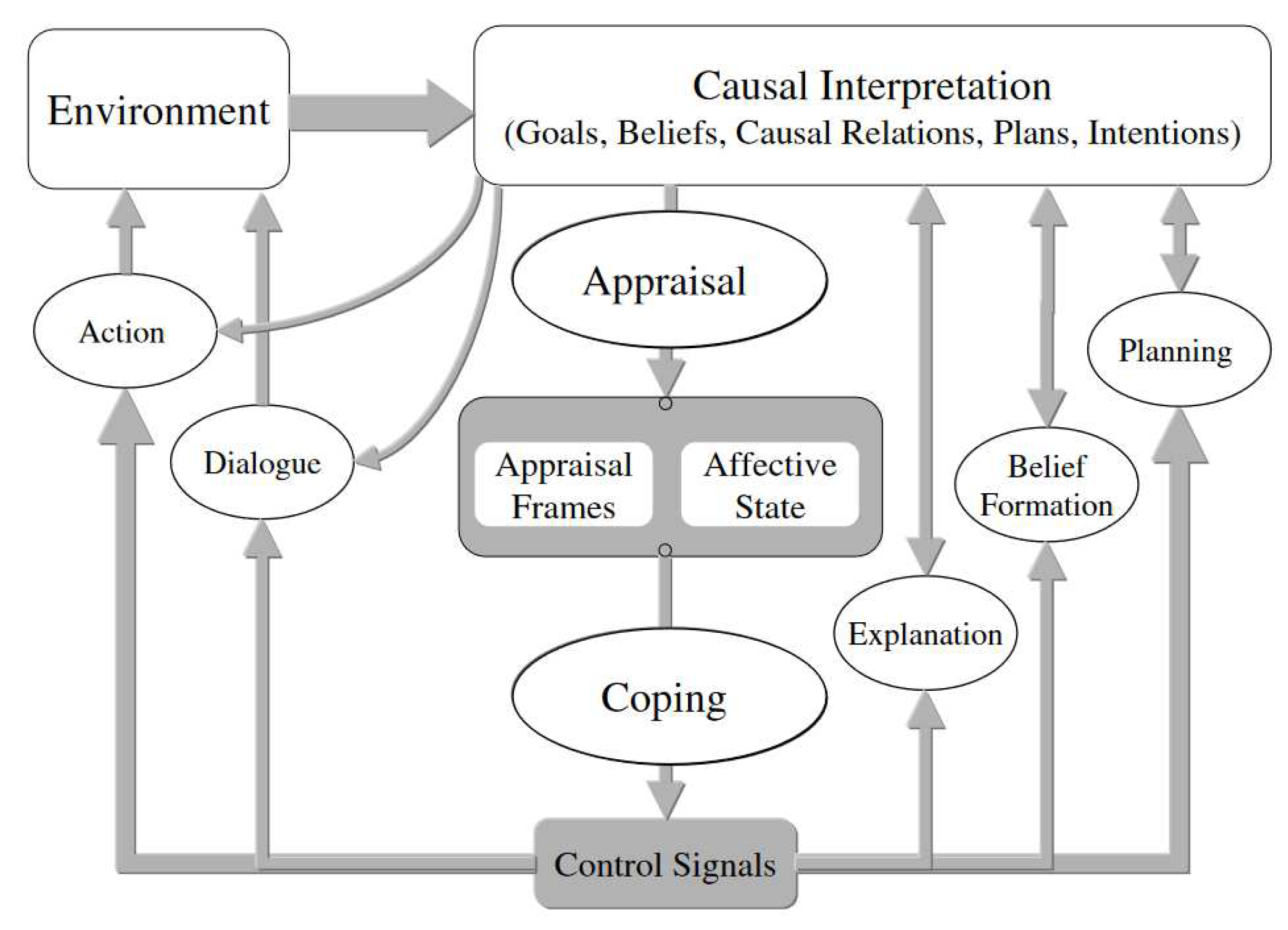

Table 1.
Data Sources and Variables
| Variables | Measurement (Source) |
|---|---|
| Demographic data (origin country, | Department of Justice |
| position, age, gender, and marriage) | |
| Initial wealth | GDP per capita (World Bank) |
| English fluency | UN Statistics Division & CIA Factbook |
| Salary | Morgan McKinley7 |
| Education level | CareersPortal.ie8 |
| Housing market | Rent report & Price of Houses |
| (Central Statistics Office9) |
Disclaimer/Publisher’s Note: The statements, opinions and data contained in all publications are solely those of the individual author(s) and contributor(s) and not of MDPI and/or the editor(s). MDPI and/or the editor(s) disclaim responsibility for any injury to people or property resulting from any ideas, methods, instructions or products referred to in the content. |
© 2020 by the author. Licensee MDPI, Basel, Switzerland. This article is an open access article distributed under the terms and conditions of the Creative Commons Attribution (CC BY) license (https://creativecommons.org/licenses/by/4.0/).
Copyright: This open access article is published under a Creative Commons CC BY 4.0 license, which permit the free download, distribution, and reuse, provided that the author and preprint are cited in any reuse.


