

Submitted:
04 July 2023
Posted:
05 July 2023
You are already at the latest version
Abstract
The objective of this research is to propose archetypes of accessible design with a neuroarchitec-ture approach for the design of initial level educational centers, in Peru, especially in areas of ur-ban growth, many children do not manage to access initial education, there is even school drop-out. . At this educational level, with an increase of 4.4% in recent years, the process of developing mental abilities such as memory, perception, thinking, reactions, attention, language, among oth-ers, is of the utmost importance. in the first years of life. As a methodology, sensory design strate-gies were applied, likewise through instruments such as interviews, observation, photographic taking and measurement carried out during the field visit for the analysis of the space-child in-teraction and spatial stimuli, supported by digital tools (Autocad, Google Earth, Andrés Marsh). As results, accessible design archetypes were obtained based on neuroarchitecture based on 10 spatial indicators (Lighting; Green area; roofs; shape; size; distribution; accessibility; scale; colors; materiality). In conclusion, the provision of adequate spaces that provide exploratory facilities greatly contributes to cognitive development in early childhood. The environment where these cognitive activities take place needs to be conditioned to allow children to develop, bond and ap-propriate the space.
Keywords:
Neuroarchitecture
; schools
; cognitive development
; Pronoei
1. Introduction
The discipline of architecture has foundations and approaches that have been devel-oped over the years, among the best known are those linked to space, form, function, acoustic structures,[1] etc., however not they are the only existing and important ap-proaches. The environment has effects on human beings[2], these can be measurable through neuroarchitecture, this is a field of neuroscience that objectively and systematically analyzes, recognizes and measures how the elements of the architectural space affect or interfere with emotions and capabilities of the people who occupy a given space[3]. Neuroarchitecture determines interesting clues to help us understand how the habitat in which we live affects our physical and mental health. As well as the relationship that spaces have with stress, hormones and the type of thoughts that we generate [4]. Broenbrenner's eco-logical theory tells us about the relationship of individuals with the environment and how these consequently influence their development, generating certain behavior patterns, which arise precisely from the interaction with the different elements and stimuli. The most internal part of this ecological environment system is called microsystem, with the closest framework to the school or educational centers, the family, the neighborhood...[5] (Figure 1a), the human being by nature seeks adaptation to the environment based on this, we develop new behaviors, modifying or eliminating those that do not serve us and considering those that are effective [6] (Figure 1b).
Human beings are not born with all our neurons developed, this happens progressively as we grow [7], when a baby is born it is approx. 100,000 million neurons but there are still very few neural connections [8], these develop with movement and by assimilating sensory experiences, especially in the first years of life, the first years of life the brain establishes connections at a higher speed [9]. With the above we can recognize the important link of the spaces that house the learning activities, that is, the educational centers with the cognitive development in the first years of life.
The economic and social inequalities present in our societies are reflected in the living conditions of children during the first years of life [10], the most economically disadvantaged see their cognitive development limited by not having access to early stimulation, quality education or many times without access to it[11] In Peru, especially in rural areas with recent urban growth, many children cannot access initial education, there is even school dropout at this educational level whose figures in recent years are in a worrying increase with 4.40%[12 ] (Figure 2).
2. Materials and Methods
The reasons for school dropout in Peru reflect the worrisome situation (Graph 3a), thus they fall behind the children who have greater possibilities and are often relegated to illiteracy and worse living conditions and opportunities in the future [12]. With which we could understand through these development factors that school dropout at the initial level is a contextual and economic problem that seriously harms children at an early age [13]. Reflecting in the number of annual school enrollments, with worrying values at the initial level (Figure 3b).
Since 2015, Vice-ministerial resolution No. 036-2015-ED has been in force, which con-ditions and evaluates the opening, renewal and closure of the Pronoeis [14], these of-fer an alternative for non-school education at the initial education level for children and girls who do not have access to it, often in rural areas or areas in recent urban development [15].Today, this regulation has already wreaked havoc on educational accessibility, with the closure of more than 15 Pronoeis nationwide since in 2015, leaving children between the ages of 2-6 who should continue to have access to this right without any viable alternative solution [16], due to the fact that the vast majority of children who attend these school units are of precarious resources or In remote areas of the city, there is no alternative to being enrolled in a private educational center and many times they are left without studies and delay their learning [17]. Speaking of urban areas, it has been possible to find the so-called "colegios bamba" that would be houses or properties that are conditioned to function as nests, cribs, nurseries and schools which often do not have the corresponding licenses [18] Offering environments without the adequate infrastructure and without meeting the minimum design requirements for this type of establishment. The problems directly impair the cognitive development of children[17]
In the analysis of the birth rate, for 2019 the department of Lima had a figure of 1,044.6 children between 0-5 years of age (Table 1), children who should already be enrolled in an educational center or awaiting early stimulation. , within Lima the districts of Villa María del Triunfo, San Juan de Miraflores and Villa el Salvador are those with the highest birth rate (Figure 4), these data are alarming because many of the educational centers in these districts are not prepared, [19] They do not have an adequate infrastructure, nor do they have adequate furniture or classrooms that invite them to stay and attend classes, which does not guarantee that children who are currently in this stage of childhood stimulate all their capacities within these educational centers that must take charge of the environments present in the home to promote cognitive development at this early age.
In the district of Villa el Salvador, a concentration of initial level educational centers can be observed to the north and center [Figure 6a], at first glance it can be deter-mined that many of the national schools and Pronoeis do not have the support of the state that they should, this is reflected in the broken windows or half-built education-al centers, etc. Many of the private educational centers are informal [Figure 5], these factors are alarming if we consider the children who live in these centers, since they do not offer environments in accordance with the provisions, much less promote and/or contribute to cognitive development. of children through predisposed design strategies in the built space.
Figure 5.
(a) Facade of the Rosa de America national educational center in Villa el Salvador; (b) Facade of the Mariscal Oscar Benavides Private Educational Center in Villa el Salvador; (c) Facade of the pronoei Nuevo Horizonte in Villa el Salvador.
Figure 5.
(a) Facade of the Rosa de America national educational center in Villa el Salvador; (b) Facade of the Mariscal Oscar Benavides Private Educational Center in Villa el Salvador; (c) Facade of the pronoei Nuevo Horizonte in Villa el Salvador.
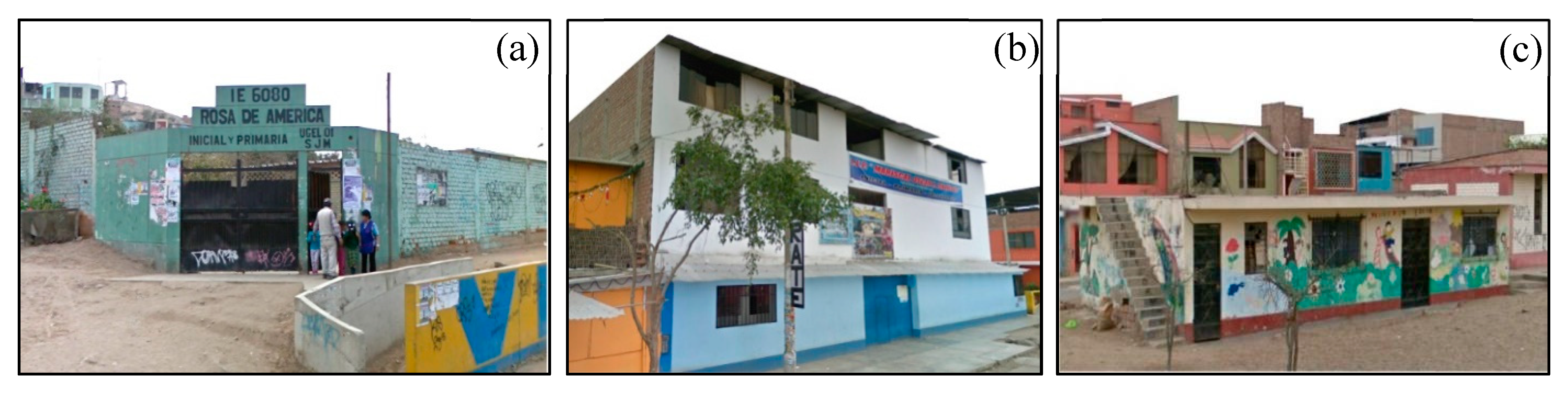
Figure 5.
(a)Mapping of the location of the schools at the initial level in the district of Villa el salvador; (b)Estadistics grafics of the location of the schools at the initial level in the district of Villa el salvador Own elaboration based on figure 5a.
Figure 5.
(a)Mapping of the location of the schools at the initial level in the district of Villa el salvador; (b)Estadistics grafics of the location of the schools at the initial level in the district of Villa el salvador Own elaboration based on figure 5a.
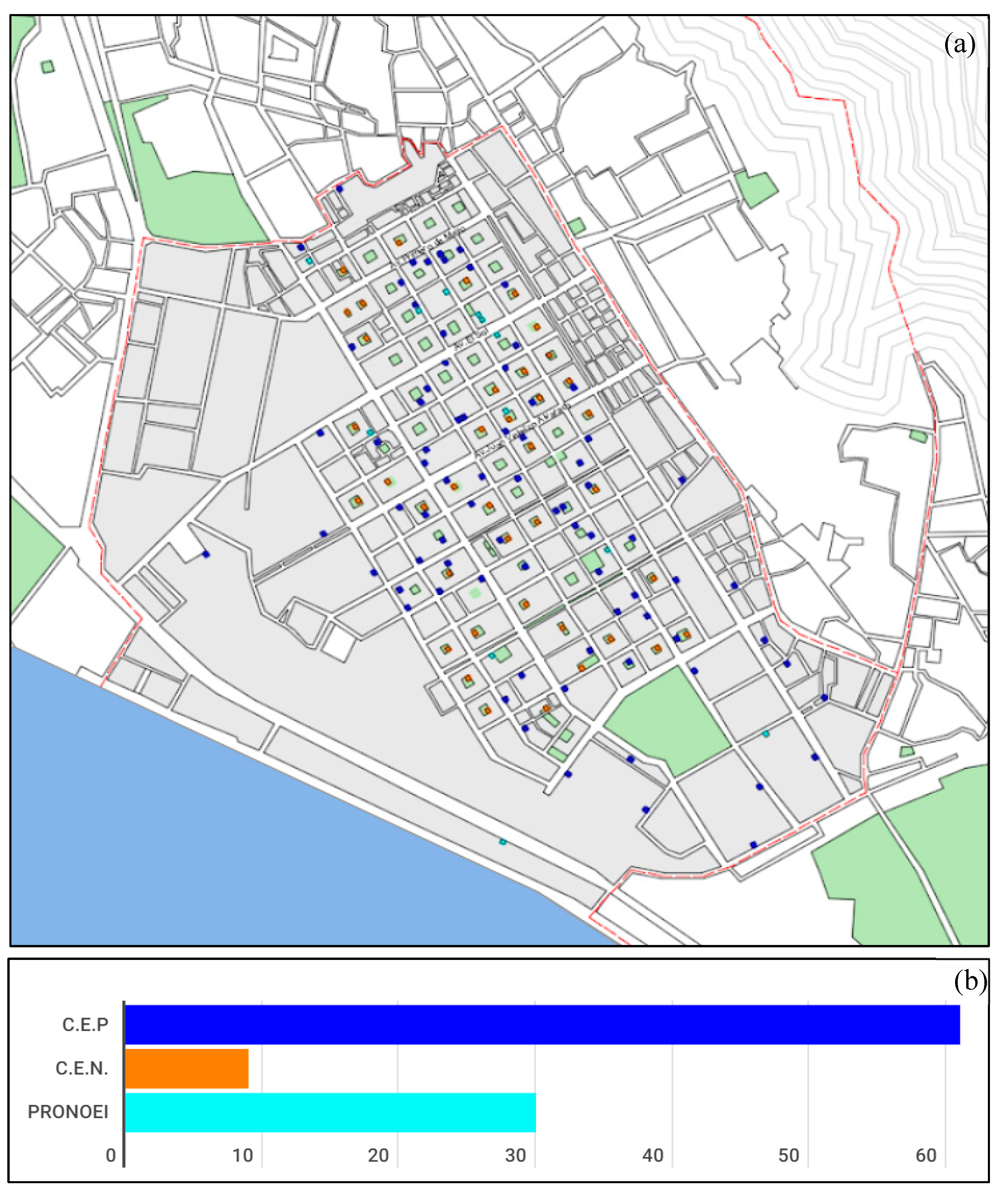
Figure 6.
Organization of the applied methodology (Step 1-5).

With which the present investigation aims to propose accessible and understandable design archetypes with a neuroarchitecture approach for the design of educational centers or places of study, to allow in a certain way and contribute to cognitive development at the initial level in the district of Villa el Salvador, Lima 2022.
2. Materials and Methods
2.1. Methodology
As a methodology, sensory design strategies were applied, likewise through data collection instruments such as (interviews, observation, photographic taking and measurement of spaces and furniture) carried out during the field visit for the analysis of the space-child interaction and spatial stimuli, supported by digital tools (Autocad, Google Earth, Andrew Marsh). Two main variables were identified (Neuroarchitecture and Educational Centers), based on them, terms that contribute theoretically were analyzed, likewise a background review was carried out linked to the design of spaces based on neuroarchitecture, the analysis of the place of study was carried out. study, evaluation of the conditions and state of the place of location of the proposal, with the collection of information in-situ, material for the archetypes in the architectural design was evaluated and elaborated.
2.2. Place of study
The place of study will be in the South American country of Peru, in the department and province of Lima, in the district of Villa el Salvador [20] (Figure 7a;b;c) which, as already mentioned in the introduction, is the department and province with the highest birth rate and educational infrastructure problems. The district of Villa el Salvador is located to the south of Metropolitan Lima. It limits to the north, with the district of San Juan de Miraflores; to the east, with the district of Villa María del Triunfo; to the south, with the district of Lurín; to the west, with the district of Chorrillos and the Pacific Ocean[21]. Likewise, as an application, an intervention area is proposed (Figure 7d) projected for an educational center that covers the levels of Early Childhood Education (1-2), 3, 4 and 5 years, taking as a premise this built element proposed as articulator, For Therefore, the link it has with other educational centers, accessibility, proximity to public elements such as sports fields, predisposition of a potentially unused lot (Figure 7e;f) have been considered
The topographic analysis of the study area shows a high slope towards the center and north of the district, but in turn these lands are accentuated for the construction of buildings because the slopes are not very sinuous, so this factor does not influence - interferes a lot in construction [19] (Figure 8).
3.1.1. Climate analysis
The solar variation in the city of Lima corresponding to the month of January 2020 was of a moderate index for health, which was 6 of the ultraviolet radiation level (UV-B) (Figure 9a). The index had an increase of 20.0% compared to the month of January 2019[21]. Although it is true that in the department of Lima there is not a high probability of rain, it is important to recognize that there is a presence of drizzle with associated fog phenomena [22] (Table 2). The prevailing winds during the mornings from 6 to 11 a.m. show westerly direction, while afternoon winds from 12 to 5 p.m. They are in a southerly direction, ending at night with a predominance of the southeast (Figure 9b;9c;9d). Likewise, strong and regular winds are observed from December to April and calm winds from June to October [23]. In Lima, the warmest month (with the highest average high temperature) is February (25.4°C). The month with the lowest average high temperature is August (20°C)[24].
The psychometric diagram shows that Lima is in a comfort zone during some stages of the year, during the summer months strategies related to ventilation must be applied, the months of March and April are within the possible control zone with inertia in summer[22]( Figure 10a). With which 10 design strategies are proposed based on the analysis of the climate and the psychometric abacus, 1. Linear volumetry and open plan; 2.windows facing north and south; 3. low windows to the south; 4. Use of winds [25], with cross ventilation against bodies of water by orientation; 5. Roof slope of 0-10%; 6. Use of horizontal eaves;7. Prevent indirect radiation with shade in the gardens;8. Green areas to reduce the absorption of thermal energy;8. High ceilings inside and 10. Use of materials such as mud bricks, concrete blocks, thermoclay, stone and/or steel. (Image 10b)
Regarding the flora developed in Villa El Salvador, there are species such as Molle Costeño, Molle Serrano, Huaranguay, Papelillo, Mimosa, Tipa and Jacarandá.[35] The South Municipal Educational Forest, located in the Huáscar zonal club, has an extension of 19 hectares. More than 5,000 trees grow here, such as eucalyptus, coastal molles, meijos, and tecomas. Foci of salt grasses (halophytes), reeds, and sedges have been identified near the coast and in the natural lagoons of Barlovento and Venice beaches [26]. There are migratory and resident birds (mostly Ardeidae) that usually appear in zonal parks, since these also have bodies of water and green areas in the contiguous Agricultural Zone, but this component is small, since a greater number of birds they prefer the shallow aquatic environments presented in the Villa wetlands. The generation of algae and the consequent invertebrates associated with them in the treatment ponds of the WWTP San Juan de Miraflores and Parque Nº 26 attracted a resident population of herons, yanavicos and vultures [27].
3. Results
3.1. Evaluation
It is important to identify and substantiate the concept[28] of neuroarchitecture in educational centers already built and in operation within the district, this with the aim of collecting information to be able to evaluate the interaction and link between the spaces and/or architectural elements predisposed in a space. determined with children[29]. 2 initial level educational centers were visited, the first private educational center Rosa de Santa María de Villa, located at Av. Central gr 7 mz E, lot 14 sector 2, Lima, Villa El Salvador on October 18, the second educational center It was the Pronoei Mi Mundo Infantil, located inside the park of group 2, sector 2, Villa el Salvador on October 20, both educational centers were entered with an authorization requested and accepted by the corresponding authorities. During the field visit, 3 types of measurement instruments were used, which are 1. Spatial evaluation sheet based on 10 indicators focused on the evaluation of neuroarchitecture (Table 4 and Table 5) 2. Survey of teachers and photographic capture, these were evaluated based on the Likert scale [30] (Table 3). For the photographic capture, 5 criteria were used, which are 1. Show the environment with a panoramic view that allows us to see the entire space; 2.Show natural and daily situations the interactions of the occupants with the space; 3. Bring the shots to the child's scale. Approximately 95 cm to the line of sight.
3.2. Evaluation results
The evaluation carried out in the two selected educational centers provides us with information on the state and presence of neurparquitectra in facilities such as classrooms, playgrounds and gardens (Table 4 and 5).
Figure 11.
Summary diagram of the spatial assessment to the two selected schools.

The results are divided into 10 indicators for a better evaluation and identification in which there are 1 (a. Artificial lighting, b. Artificial lighting); 2. Green areas; 3 (a. High ceilings, b. Low ceilings) ; 4 (a. Curved shapes, b. Orthogonal shapes) ; 5 (a. Enlarged size, b. Reduced size); 6(Linear distribution,b.Dynamic distribution);7.Accessibility;8.Scale;9(a.Intense colors, b.Neutral colors);10(a.Soft materiality,b.Textured materiality)(Figure 10).
Natural lighting generates better results in learning ability, dazzling positive effects such as greater concentration and improvements in mood, on the other hand, artificial lighting would have a negative effect, since it will produce stress and anxiety hormones that harm the concentration and cooperation of children. in the development of activities [31]. In the case of educational center 1, the photograph shows the use of artificial lighting competing with the entry of natural light, there is the presence of windows, however, these are covered by paper to prevent the direct entry of light, in what regarding student behavior. Children prefer to be located in the row where the heat of the sun does not reach their backs directly (Figure 12a). On the other hand, in educational center 2 there are tall windows through which natural light is obtained, however, the lower areas of the classroom are left without lighting and when writing or copying from the blackboard they will have the need to turn on the lights. fluorescent (Figure 12b) With which the use of floor-to-ceiling windows facing north to south is proposed for the climatic study of the place to locate the proposal, as well as the implementation of overhead openings that allow the passage of light and ventilation throughout the day in main study environments such as classrooms (Figure 12c).
Green areas can be great restorers of the mind and memory, likewise they contribute to the reduction of stress and depression, they improve productivity in children, due to the oxygenation that is taking place in them, the direct contact with the areas greens in the first years of life has a great impact on quality of life [32]. The green areas that are found in each of the educational centers are very scarce or non-existent, as is the case of educational center #, in the case of educational center 2 (Figure 13a and 13b) it has a garden and a school garden, both spatially alien to children, in terms of the interaction of this natural element, there is none, since by not feeling attached or direct bond in their care, they do not give it due importance, this translates into rejection or disinterest [33], in addition to this, each of these areas are fenced off, which prevents viewing and arouses the interest of children, as well as interpreting it as a barrier that isolates them. With this, a direct link between green areas and children would be proposed as an archetype, making available the reflection of their care with the support of teachers so that little by little the natural interest and value of their care is awakened, generating a relationship much more reflective setting. environment to the extent that awareness of these elements is made. (Figure 13c)
High ceilings in built spaces improve and influence concentration and cooperation in carrying out activities, on the other hand, low ceilings are not recommended in spaces for children since it limits creativity and does not evoke a certain ease, these are recommended for environments routines where it is not necessary to think much. Regarding the ceilings of the classrooms in the educational centers evaluated, they have the minimum allowable, educational center 1 with a height of 2.30m from floor to ceiling in 90% of its closed environments (Figure 14a) and the educational center 2 has all its interior environment has ceilings of 2.50. (Figure 14b). With respect to the behavior of children in these environments with low ceilings and no level of play, it is not easy for them to distinguish between a play space, a reading space and a play space that with a certain dynamism of heights we can achieve. Therefore, the implementation of high ceilings greater than 2.50 in environments is proposed, as well as the game of heights to distinguish functions and environments with low ceilings -2.50 for reading areas or routine activities (Figure 14c).
The size and distribution of the environments for children must be wide, well differentiated, likewise they must have some flexibility, these help a good development and exploitative activity [34]. What was observed in relation to the size of the spaces in the educational center 1 was at snack time where the children have the freedom to move between the living room/bathroom/patio, it was possible to observe that although it is true, the patio is wide, but not many children go out to play, on the contrary, they prefer to stay in the classroom playing with some objects, such as legos, dolls, or meet in a group (Figure 15a). This is because the spaces are rigorously unrelated, and children prefer the environment where they have more to play and it attracts their attention. The opposite is observed in educational center 2, where the space for play and learning seems to be one (Figure 15b). -Place the design of spacious and functional environments with spatial links through architectural elements, such as windows, transparencies or some furniture that does not obstruct the view, so that children can easily identify their functions (Figure 15c).
Accessibility and scale are extremely important elements so that children can explore the objects in their environment, experience complex sensorimotor and cognitive processes such as anticipation, when they think about what they are going to do, where they are going to go, planning their motor actions. . it allows him to be effective and all of this contributes to practical intelligence in the young child[35]. Just like adults, children need to feel a certain belonging with the environments so that they feel free without limits to think and their brain can capture its best stimuli [36]. The scales of the architectural spaces and/or furniture found in the educational centers evaluated are intended to be those required (figure 16a), as well as some children with certain limitations produced based on the scale (figure 16b). which is to propose adaptable furniture and according to the scale of the children by ages that strengthen the autonomy of each one (Figure 16c).
Colors are elements that greatly influence the state of childhood of the inhabitants of a certain space. Intense tones such as green, yellow, blue, colors that we associate with living nature, would be increasing the capacity for creativity and ease when carrying out activities [37]. On the other hand, neutral colors reflect the mental order and organization that is sought to be fostered in students and contributes to a greater absorption of stimuli, since the child focuses attention on the objects or activities that surround him [38]. Educational center 1 has intense colors to a great extent with 90% (Figure 17a), while in educational center 2 neutral colors predominate with 70% (Figure 17b) additionally it has been observed that in classrooms with children of color neutral bonds much more with the objects that surround them such as toys, ramps, books or mats, on the other hand, children in colorful environments are more extroverted. Therefore, the use of intense differentiated colors as primary colors (Red, blue, yellow) and some of their derivatives for environments where more development is needed for recreational activities and neutral/light colors such as white are proposed as an archetype. for environments that require attention and concentration such as classrooms (Figure 17c)
The materiality predisposed in the environment develops the sense of touch, provides information about the environment, information about the body itself, allows the creation of a body schema, so interpreting a texture enhances neural connections [39]. In the evaluation carried out, this indicator was divided into two, smooth and textured, from the observation it was possible to identify certain elements such as smooth majolica walls that somehow invite children to paint on it and are easy to clean compared to the graffiti on plastered walls, on the other hand, elements such as stained glass were observed and identified, which due to their transparency characteristic provoke a certain degree of curiosity in the child (Figure 18a), likewise it could be identified in the educational center 2 , in the The room for 2-year-old children has a large presence of flexible soft mats and mats (Figure 18b). With this, the intentional implementation of elements with different types of textures is recommended, such as soft (they do not hurt, easy to use) smooth (cold, for mark or paint), transparent (to discover), rigid or pointed (to delimit, generate alerts) (Figure 18c).
Currently the lot is partially empty, it was mainly a lot determined for a park with a sports slab, however the current state is unfavorable and worrying (Figure 19a) so the strategic location of the proposal would be fair. in central axis (Figure 19b) allowing to restore the vegetation at the ends and creating accesses to the interior, directly linking the proposal with the green areas, likewise it is proposed to generate a participatory link with the residents of the area and parents. students, likewise, it is proposed to integrate into the project a rehabilitated sports slab towards the left end and integrate in the future a social room and a popular dining room, two establishments that are necessary in the area and that not only connect very well functionally but also generate the sense of community that is sought in the proposal. The volumetric proposal is not invasive, it consists of two open-plan floors with a lower articulated interior patio (Figure 19c;d;e;f).
For the strategies used for natural lighting and ventilation, the Giovoni graph made previously was used. The proposal has strategies that allow cross ventilation and natural lighting throughout the day (Figure 20a and Figure 20b), this is due to the strategic South-East, Northwest orientation, allowing the entry of light but not solar rays in a way that it has been created. an acoustic mattress thanks to the implementation in vegetation to the southeast of the land to be located, a school garden is proposed, to take advantage of the orientation, to be able to waterproof and finally insulate the slab.
4. Discussion
At the beginning of the 1990s, the use of neuroscience in architecture within the medical field was raised, precisely in the ICU for premature babies in Florida, USA, based on the concept of the three stages of development of a new ser [40] that postulates that when a baby is born prematurely, the development of the senses is interrupted, especially the auditory and visual, premature babies are relegated to continue forming outside the maternal womb [41] , in this way the spaces of the ICU wards, these were designed only to meet the functional requirements of doctors and nurses, but features were omitted such as light intensity, temperature and filtering of external sounds. The result of this study determined that the last stage of a baby's development is extremely important and will determine the predisposition to receive stimuli for when it is born. According to this proposal of changes such as the management of light, sound, smells in relation to the senses, these changes had a positive effect on the development of babies [40]. With this research and the one carried out, it is possible to understand the importance of cognitive development from the first months of life, which is when it is in the womb and childhood, which is where these receptors, which are the senses, are enhanced , the child is creating awareness and meanings of the outside world, this can be reflected in the research also based on observation as it was carried out in the Media Lab Prado building [42] where the behavior of the children was observed while they played in the environment, This consisted in the creation of three game environments and whose stimuli were gradually changing, light, sound, level of interaction and scale were identified to project game stations according to a range of somatosensory needs[43]. On the other hand, in this report 10 indicators were identified that help us to be able to comprehensively evaluate space/child interactions based on the 5 senses, although it is true that working with naturally built environments yields consistent results. The creation and evaluation of new environments in relation to children could also help in the generation of new hypotheses or behavior patterns.
5. Conclusions
Neuroarchitecture applied to the design of initial level educational centers could become a potential tool for learning since it enhances attention, concentration, reflexes, autonomy, sensitivity and the ability to reflect.
Although it is true, it is not possible to homogenize an educational or architectural proposal due to the parameters or requirements that each work entails, but it is possible and advisable to project based on certain archetypes or architectural models, as is the case of those proposed. in this report that are defined based on processes of observation of the real environment / child interactions and that the impact it has on cognitive development at an early age has been demonstrated, the greater the interaction and exploration by the child of the environment that surrounds him , the greater it will be. the possibility for their sensory receptors to fully develop, opening up a world of possibilities and opportunities for the future.
For Peru and specifically in areas of difficult access to education, the implementation of these archetypes that are accessible and easy to apply in any space, small changes can have a great impact on the quality of child development, likewise, these could help to combat the lack of early stimulation and open new exploratory possibilities in children so that they are better prepared and receptive to stimuli and learning when they reach the appropriate age in which they accept them in children, cribs, nurseries, pronoei and showing a certain degree interest in learning reflected in curiosity at that age, there would be a lower probability of dropping out of school at that early age. These archetypes can be applied at home, in play spaces, and in classrooms.
This research integrates 7 sustainable development goals of SDG #4 Quality education, #7 Sustainable and clean energy, #10 Reduction of inequalities and #11 Sustainable cities and communities [43].
Author Contributions
Ccalla J. carried out the conceptualization, methodology, application of the software, field visits, validation, formal analysis and writing. The author has read and agrees with the published version of the manuscript. Funding: This research received no external funding.
Funding
This research did not receive specific grants from funding agencies in public: commercial or non-profit sector.
Conflicts of Interest statement
The authors declare that they have no economic interests. Conflicting relationships or known personal relationships that may have influenced the work being done presented in this document.
Acknowledgments
To the educational centers I.E.P Rosa de Santa María and PRONOEI Mi mundo infantil for granting permission to enter, observe, photograph and measure within their facilities, as well as a special thanks to the assistants and teachers of each classroom.
References
- Leland M. Entender la arquitectura. 5th. Ed. México: Editorial GG ; 2008.
- Vasquez, M. La relación del ser humano con su entorno: dimensión ética y social. Studiositas 2007, 2, 56–60. [Google Scholar]
- Solis E, Herrera R. El espacio físico y la mente: Reflexión sobre la neuroarquitectura. Cuadernos de Arquitectura N° 7 [internet]. 2017[Consultado 02 de Octubre 2022]. 42-44. Disponible en: http://cuadernos.uanl.mx/pdf/num7/4.%20El%20Espacio%20Fisico%20y%20la%20Mente.%20Reflexion%20sobre%20la%20neuroarquitectura.pdf.
- Punset E. Neuroarquitectura, el reflejo por fuera de lo que somos por dentro . 2th. Ed. España: Destino; 2013.
- Bronfenbrenner, U. La ecología del desarrollo humano. 1th. Ed. España: Paidós Ibérica S.A.;1979.
- Barthey S. Principios de percepción. 2th.Ed. México :Trillas.;1982.
- Fontaine I.,.Experiencia emocional, factor determinante en el desarrollo cerebral del niño pequeño , Mexico: Estudios pedagógicos . 26, 119-126; 2000. [CrossRef]
- Regidor R. Las capacidades del niño. 5th. Ed .España:Ediciones palabra S.A,pag16 ;2005.
- Valverde J. El Cerebro de los bebés se prepara para el habla meses antes de la primera palabra. [Repertorio Científico].. . 2015[Consultado 04 de Octubre 2022]. 18(1), 53–54.Dicponible en :. Available online: https://revistas.uned.ac.cr/index.php/repertorio/article/view/2557.
- UIS; FHI360; Oxford Policy Management; University of Cambridge, Research for Equitable Access and Learning Centre. 2018. Handbook on measuring equity in education. Montreal: UIS.
- Education for All Fast Track Initiative Secretariat, EFA-FTI; United Nations. 2010. Equity and inclusion in education: A guide to support education sector plan preparation, revision, and appraisal. Washington, D.C.: EFA-FTI Secretariat.
- Cueto S., Felipe C., León J. Predictores de la deserción escolar en el Perú . Análisis & Propuestas. Lima, Perú : Niños del Milenio; 2020. 52p.
- Lewin K . Improving access, equity and transitions in education: Creating a research agenda. Sussex: CREATE Pathways to Access Research Monograph No. 1 [Internet]. 2007 [Consultado 05 de Octubre 2022]. 7-9 .Disponible en :. http://www.create-rpc.org/pdf_documents/PTA1.pdf.
- Ministerio de educación. Normas para la planificación, creación, implementación, funcionamiento, evaluación, renovación y cierre de los Programas No Escolarizados de Educación Inicial . Pronoei ,Viceministerial N° 036-2015-ED . Perú ;2015. Disponible en : Resolución Viceministerial N.° 036-2015-MINEDU - Normas y documentos legales - Ministerio de Educación - Gobierno del Perú (www.gob.pe).
- Menacho L.,Villari C.,Cuando la educación familiar andina se interrumpe en la educación inicial: los PRONOEIs Programas no Escolarizados de Educación Inicial en la sierra de Ancash .Perú :Indiana, vol. 36, núm. 1, pp. 141-154; 2019. [CrossRef]
- Vocero La Republica .Cierran 18 Pronoei dejando cientos de alumnos sin estudiar. La Republica. Trujillo,Perú. 2020 [Consultado 06 de octubre 2022] . Disponible en :. Available online: https://larepublica.pe/sociedad/2020/02/19/trujillo-cierran-18-pronoei-dejando-cientos-de-alumnos-sin-estudiar-lrnd/.
- Rebello, P. Rebello P. La primera infancia importa para cada niño. Estados Unidos: Fondo de las Naciones Unidas para la Infancia (UNICEF); 2017. Disponible en :. Available online: https://www.unicef.org/nicaragua/media/506/file/La%20Primera%20Infancia%20Importa%20para%20Cada%20Ni%C3%B1o.pdf.
- Acosta M.,Tupayachi M, No a los colegios bamba: todo inicial debe contar con. El Comercio. Perú .2014 [Consultado 09 de octubre 2022] .Disponible en :. https://elcomercio.pe/lima/colegios-bamba-inicial-debe-contar-286963-noticia/.
- Orlando Villanueva a , Doris Esenarrob , Ciro Rodriguezc , Pedro Guerra, Evaluation of the additional public infrastructures during the execution of the construction, Turkish Journal of Computer and Mathematics Education Vol.12 No.10(2021), 554-559. [CrossRef]
- Ministerio del Interior. Observatorio nacional de seguridad ciudadana. Indicadores para la gestión de la seguridad ciudadana en Lima sur. 2019 [Consultado 10 de Noviembre 2022]. disponible en. Available online: https://observatorio.mininter.gob.pe/sites/default/files/reporte/archivos/INDICADORESPA RALAGESTION_LimaSUR.pdf.
- Romero M, Romero T. Villa el Salvador ciudad de las generaciones : 1971 - 2021, 50 años [Internet]. Perú: Fondo Editorial USIL; 2021 [Consultado 11 de Noviembre 2022]. Disponible en:. Available online: https://fondoeditorial.usil.edu.pe/wp-content/uploads/LIBRO-VILLA-SALVADOR-cc2019PORATDA.pdf.
- Instituto nacional de estadísticas e informática,Estadísticas ambientales Perú:Informe técnico;2020.
- Servicio Nacional de Meteorología e hidrología del Perú.SENAMI.;2020 [Consultado 15 de Noviembre 2022].
- M. Dolmos, D. Esenarro, C. Rodriguez y C. Minga, "Wind Energy Potential in Pillcomarca, Peru", 2020 5th Asia Conference on Power and Electrical Engineering (ACPEE) , Chengdu, China, 2020, págs. 284-288. [CrossRef]
- Corresponsal. Lima ya tiene un nuevo pulmón ecológico en Villa El Salvador .Agencia peruana de noticias Andina;2019. [Consultado 17 de Noviembre 2022] . Disponible en :. https://andina.pe/agencia/noticia-lima-ya-tiene-un-nuevo-pulmon-ecologico-villa-salvador-727710.aspx.
- Sub gerencia de limpieza pública y maestranza Villa el salvador -Plan de manejo de residuos sólidos 2015-2016 ; 2016 [Consultado 20 de Noviembre 2022]. Disponible en :. Available online: https://busquedas.elperuano.pe/normaslegales/aprueban-el-plan-de-manejo-de-residuos-solidos-de-villa-el-s-ordenanza-no-348-mves-1408261-2/.
- Palomino D. Evaluación de humedales de Villa El Salvador.Tesis de grado.Lima:UniversidadFederico Villareal; Disponible en :. Available online: https://alicia.concytec.gob.pe/vufind/Record/RUNF_08225abb8a7bc290f696ebc1d3cdcbbc.
- Rubinstein L. El proceso del pensamiento. La Habana, Cuba: Editora Universitaria; 1966. p. 38.
- Tudela, F. Arquitectura y procesos de significación [Internet]. México: Edicol ; 1980.
- Elejabarrieta F, Iñiguez L. Construcción de escalas de actitud tipo Thurstone y Likert. SOCESC [Internet]. 2010 [Consultado 21 de noviembre de 2022]; (17). Disponible en:. Available online: https://revistas.udea.edu.co/index.php/ceo/article/view/6820.
- Küller R, Lindsten C. Health and behavior of children in classrooms with and without windows. J. ENVIRON. PSYCHOL. [Internet]. 1992 [Consultado 19 de noviembre de 2022]; (12):205-217. Volume 12, Issue 4. Disponible en:. 12. https://portal.research.lu.se/en/publications/health-and-behavior-of-children-in-classrooms-with-and-without-wi.
- Küller R, Lindsten C. Health and behavior of children in classrooms with and without windows. Journal of Environmental Psychology. 1992;(12):205-217. [CrossRef]
- Keijzer C. Instituto de Salud Global Barcelona[Internet]2020[Consultado 25 de Noviembre de 2022];1.Disponible en:. https://www.isglobal.org/healthisglobal/-/custom-blog-portlet/espacios-verdes-un-recurso-para-la-salud-mental/6113078/0.
- Chokler, M. “Teoría de los Organizadores del Desarrollo”. En Los Organizadores del Desarrollo Psicomotor, del mecanicismo a la psicomotricidad operativa. Buenos Aires, Ediciones Cinco, 1988.
- Chokler, M. Extraído de la Tesis doctoral: Subjetividad y comunicación: La ontogénesis de la significación en la actividad autónoma del protoinfante. UMSA, 1999.
- Goldenberg, J. Goldenberg J.Ambientes armónicos que ayudan a la salud mental.2022[Internet]2022.[Consultado 30 de Noviembre de 2022].Disponible en:. https://mnews.com.ar/estilo/3943-%C2%BFComo-lograr-ambientes-armonicos-que-ayudaran-a-tu-salud-mental?%C2%A0.
- Zabalza, M. Calidad en la Educación Infantil. Madrid: Narcea; 1996.1 p.
- Rivero R.La exploración , juego y desarrollo de niños y niñas.Perú: Archivos 2017. a-educa-inicial;2017. Disponible n :. https://www.dreapurimac.gob.pe/inicio/images/ARCHIVOS2017/a-educa-inicial/Modulo-2-Juego-y-exploracion.pdf.
- Isaac M. ¿Cuál es la Importancia del Sistema Táctil en el Desarrollo del Niño?.Estados Unidos. Comunidad Informativa sobre los Problemas del Desarrollo y Aprendizaje ; 2020 [Consultado 02 de Diciembre de 2022]. Disponible en :. http://www.ceril.cl/index.php/12-comentarios/48-cual-es-la-importancia-del-sistema-tactil-en-el-desarrollo-del-nino-ceril.
- Sass L. , Rivka O. Materializing Design: The Implications of Rapid Prototyping in Digital Design”. Design Studies 27 no. 3 (2006): 325-355. [CrossRef]
- Eberhard J. Applying Neuroscience to Architecture. Neuron. Neuro View [Internet] 2015.[Consultado 10 de Diciembr 2022]Disponible en:. 2022. [CrossRef]
- Berhard, J.. Brain Landscape: The Coexistence of Neuroscience and Architecture New York: Oxford University Press[Internet]. 2009 [Consultado 11 de Diciembre 2022]. Disponible en:. Available online: https://academic.oup.com/book/32846.
- Esenarro D, Cabello F, Amaya P, and Vargas C (2020). Camping Area and Dock with Viewpoint to Promote Sustainable Ecotourist in the Ticcllacocha Lagoon, Tanta-Perü, International Journal of Environmental Science and Development ISSN 2010-0264, p. 268-272 doi: 10.18178, Vol. 11, No. 51261.
Figure 1.
(a)Broenbrenner's ecological theory;(b) Diagram of the principles of perception by Barthey, S. H.
Figure 1.
(a)Broenbrenner's ecological theory;(b) Diagram of the principles of perception by Barthey, S. H.
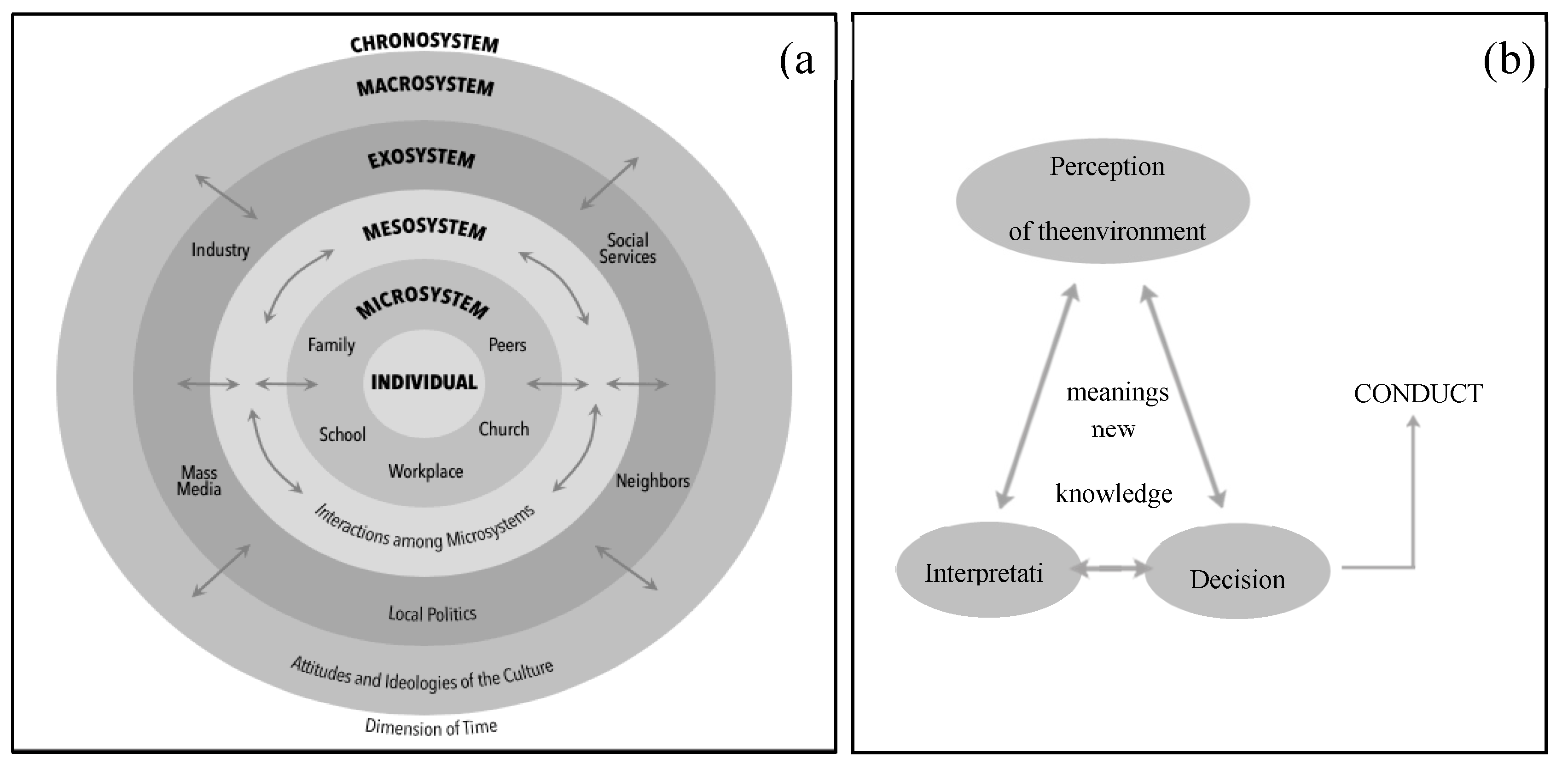
Figure 2.
School dropout rate in Peru 2013-2020.
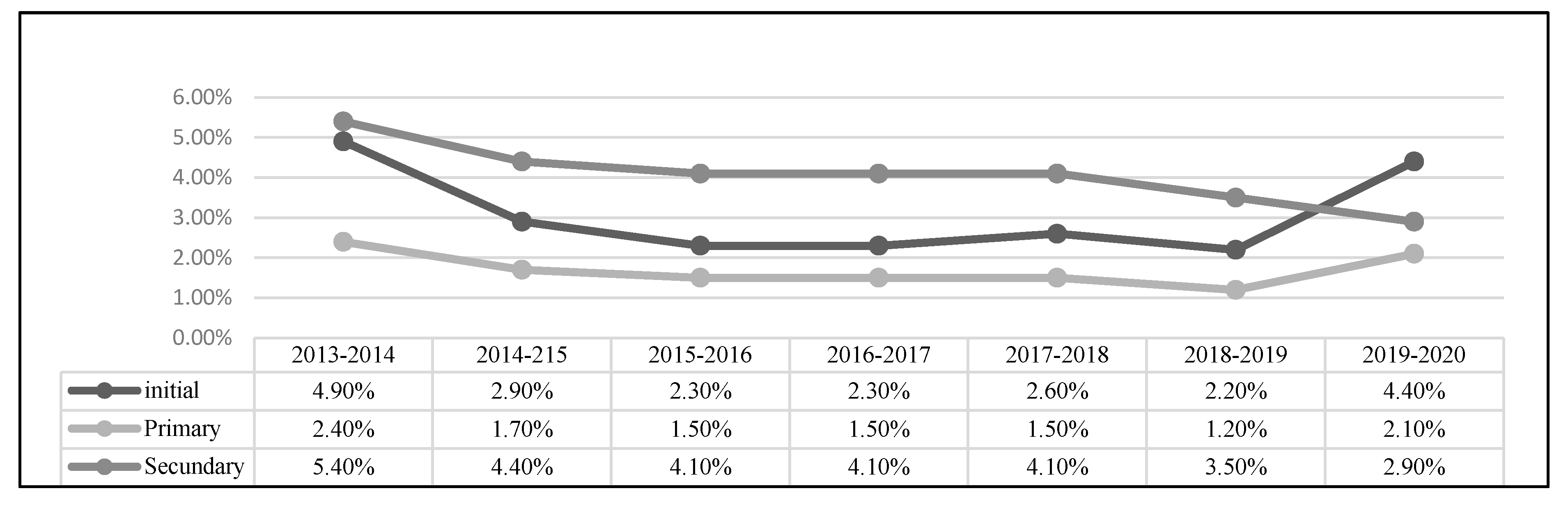
Figure 3.
(a) Reasons for school dropout in Peru ;(b)Number of school enrollments by level 2018-2020 in Peru.
Figure 3.
(a) Reasons for school dropout in Peru ;(b)Number of school enrollments by level 2018-2020 in Peru.
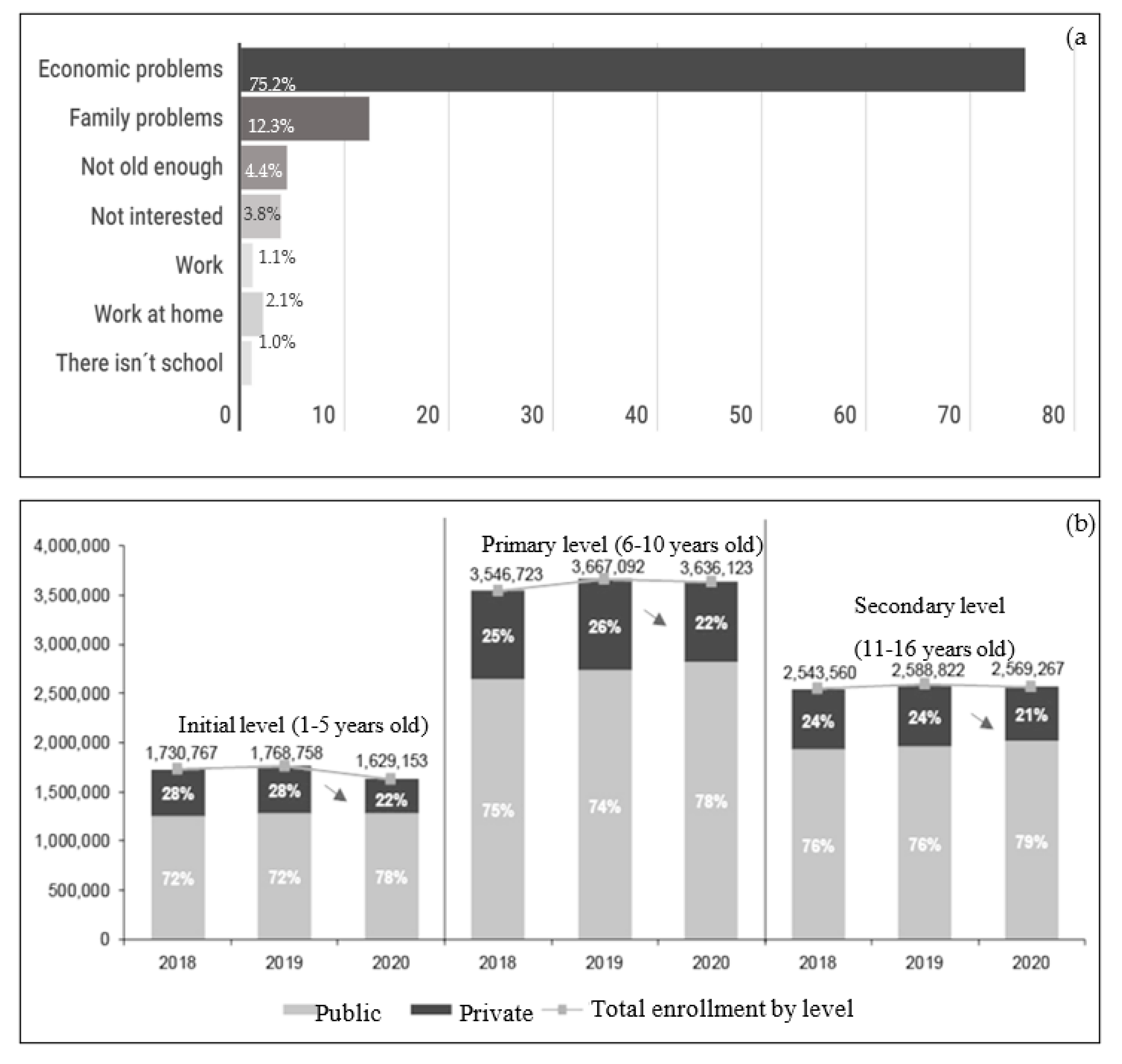
Figure 4.
Birth rate by districts of South Lima 2019.
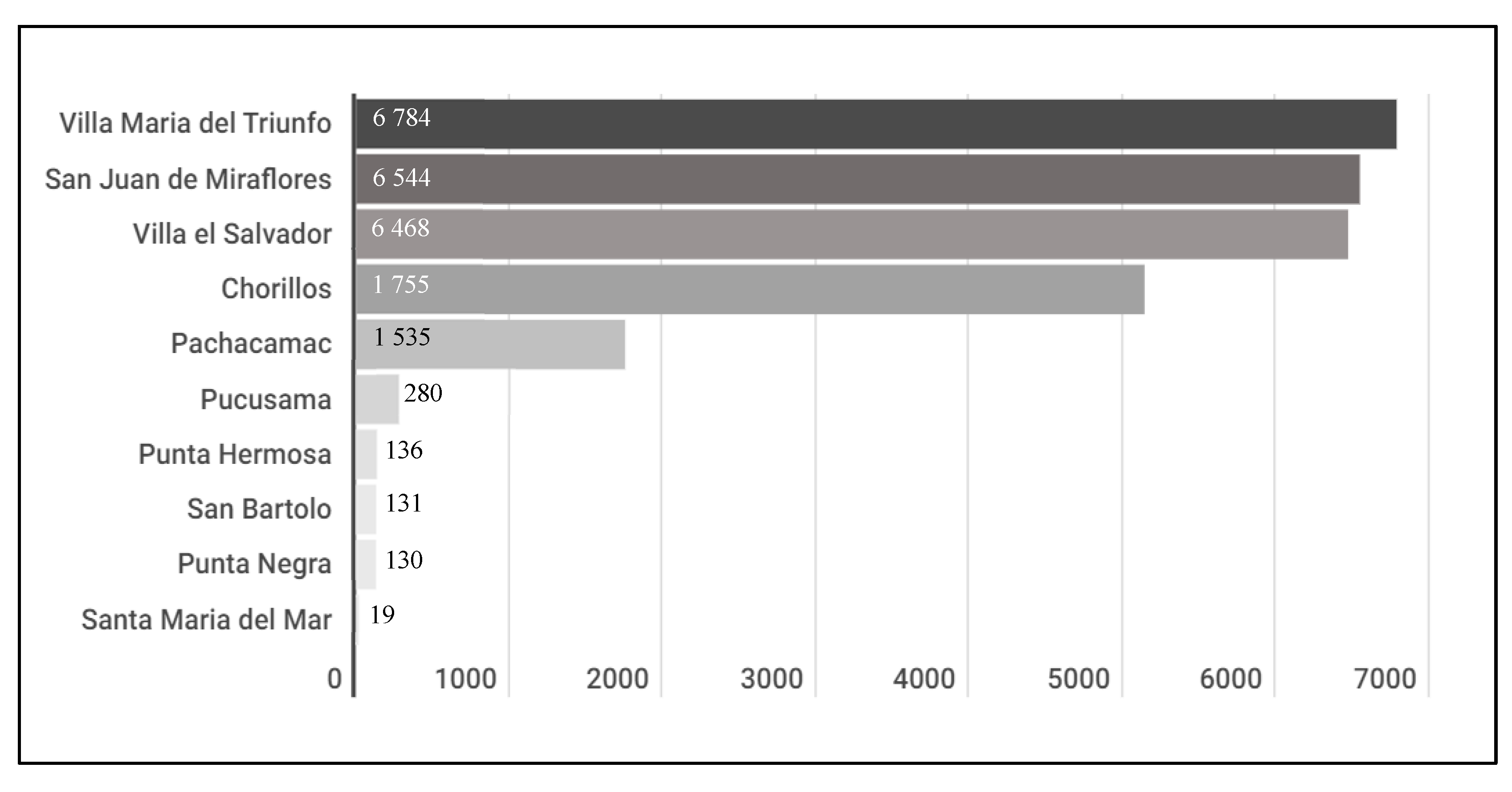
Figure 7.
(a) Map of Parú; (b) Map of Metropolitan Lima; (c) Map of the district of Villa El Salvador; (d) Intervention area; (e) perspective section of H street; (f) perspective section of G street.
Figure 7.
(a) Map of Parú; (b) Map of Metropolitan Lima; (c) Map of the district of Villa El Salvador; (d) Intervention area; (e) perspective section of H street; (f) perspective section of G street.
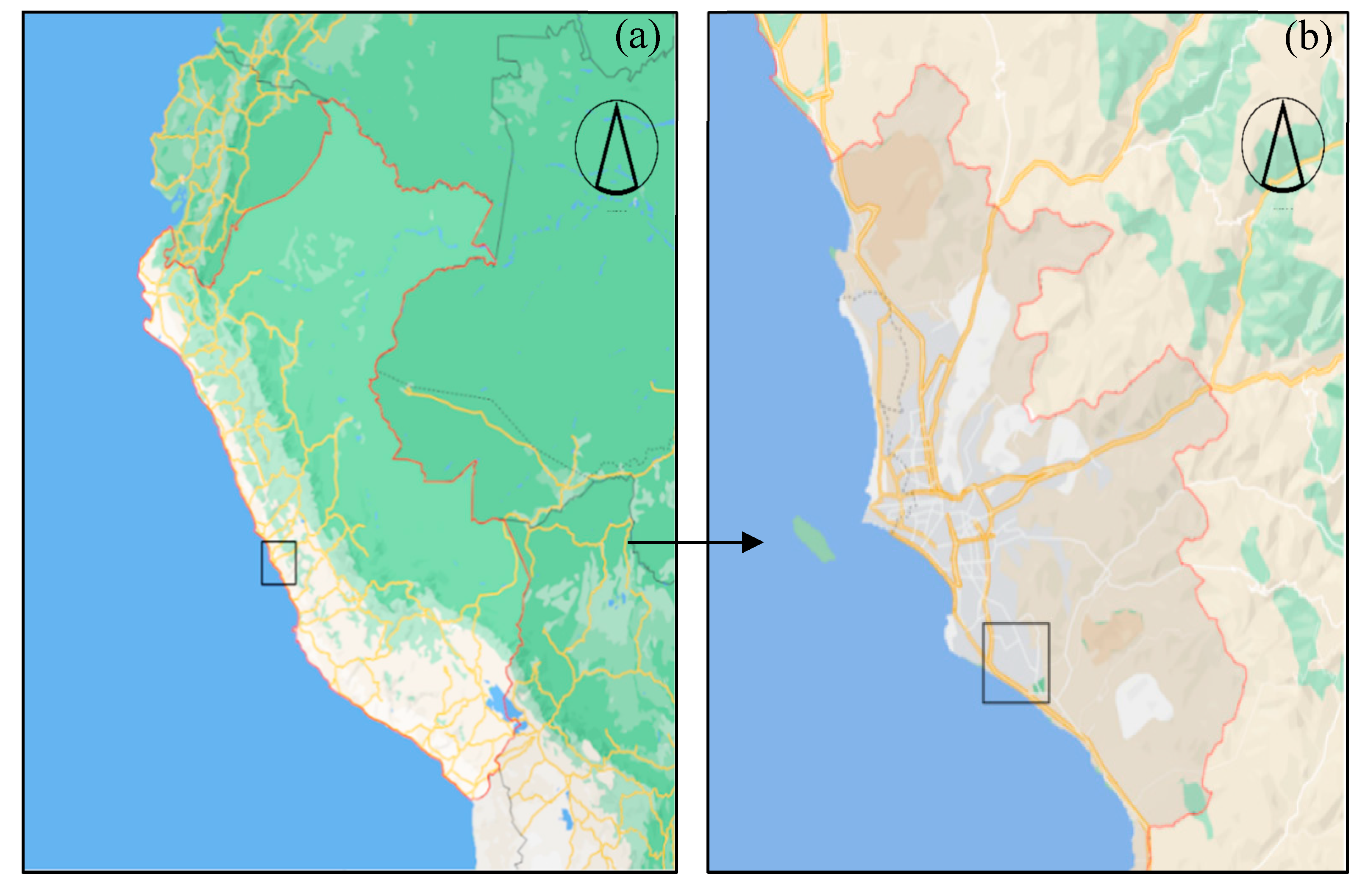
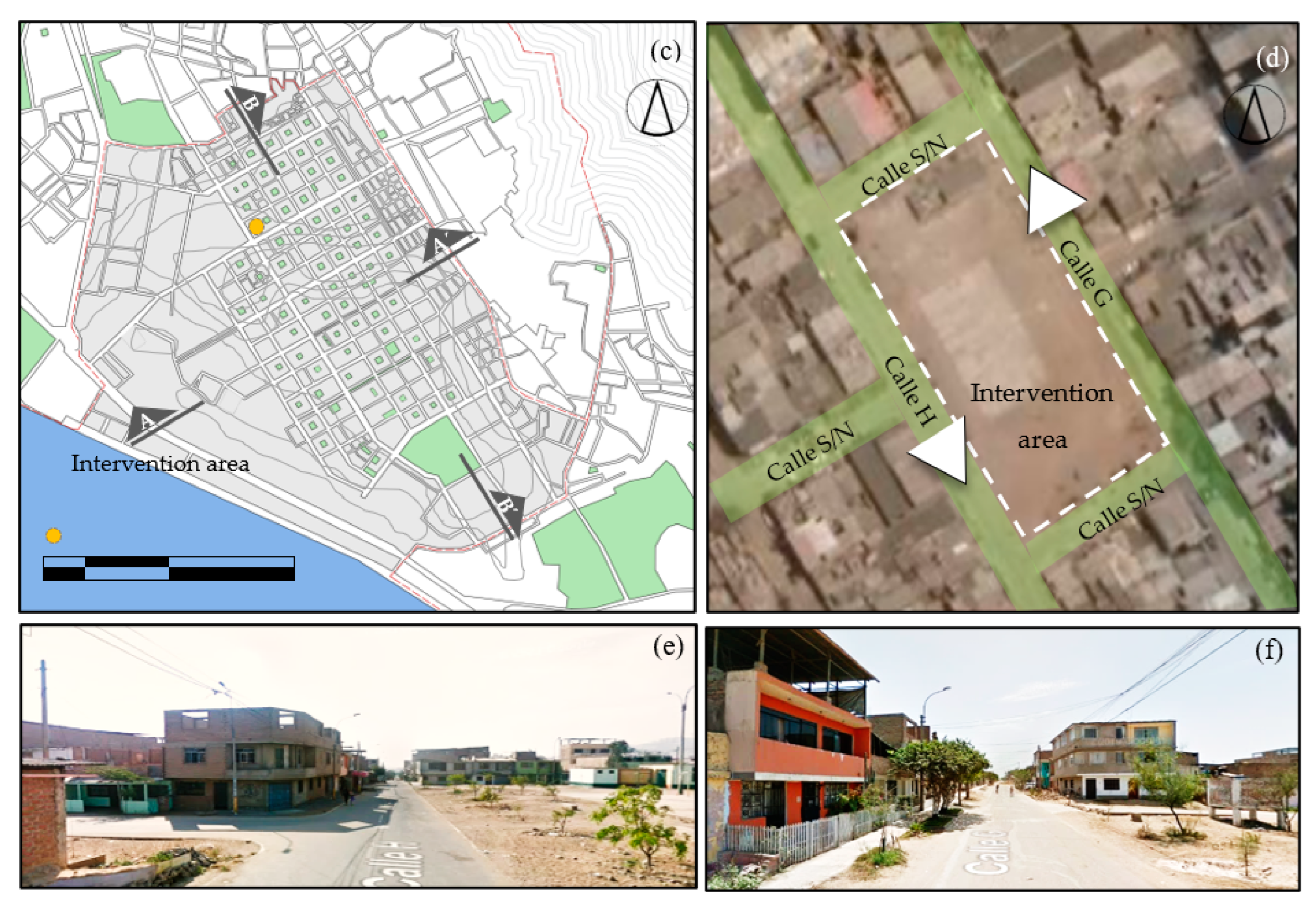
Figure 8.
(a) Cross section A-A´; (b) Longitudinal section B-B´.
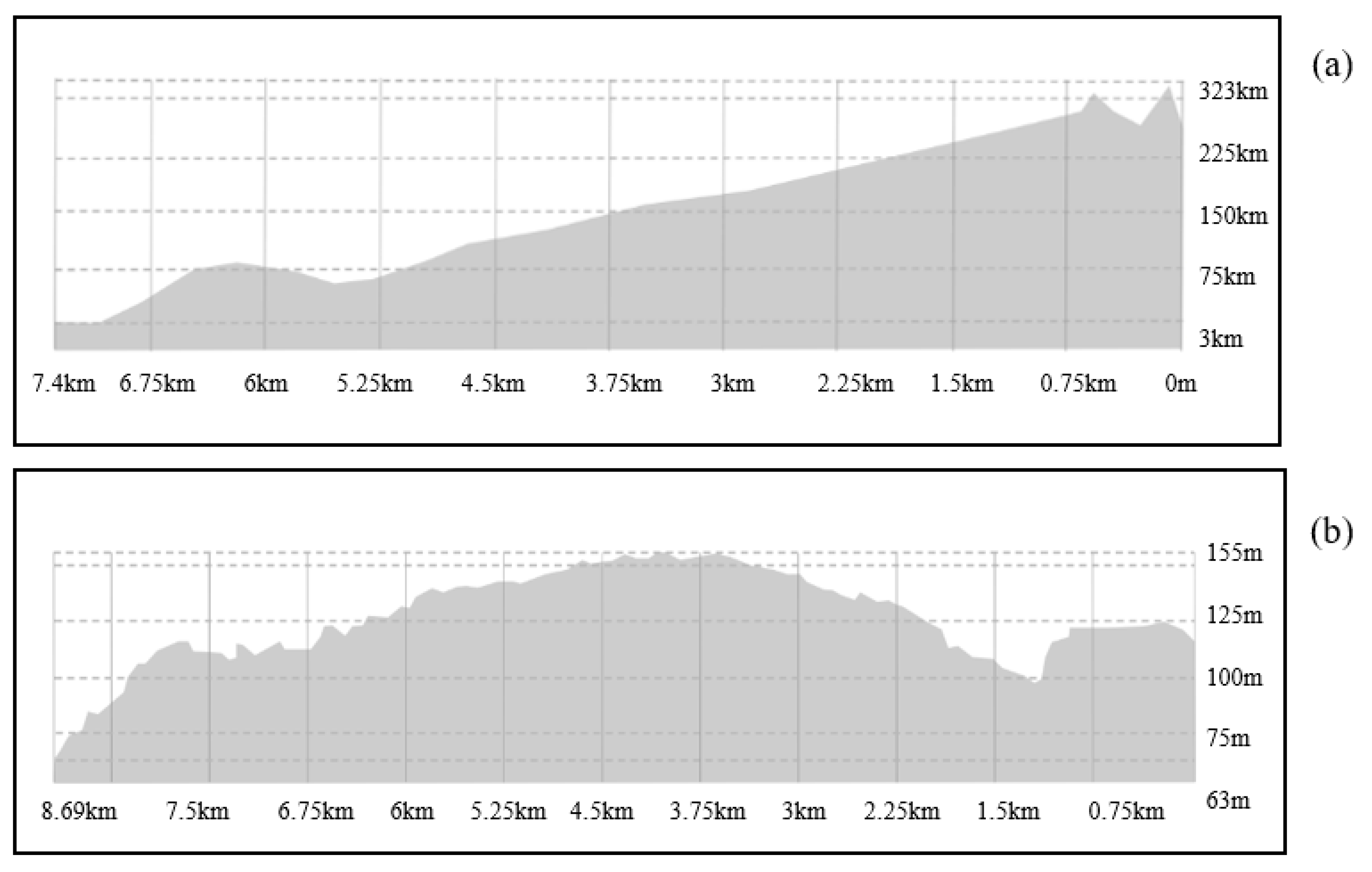
Figure 9.
(a) Solar variation graph Lima 2019-2020; (b) Wind rose in the mornig in South Lima; (c) Wind rose in the afternoon in South Lima; (d) Wind rose at night in South Lima.
Figure 9.
(a) Solar variation graph Lima 2019-2020; (b) Wind rose in the mornig in South Lima; (c) Wind rose in the afternoon in South Lima; (d) Wind rose at night in South Lima.
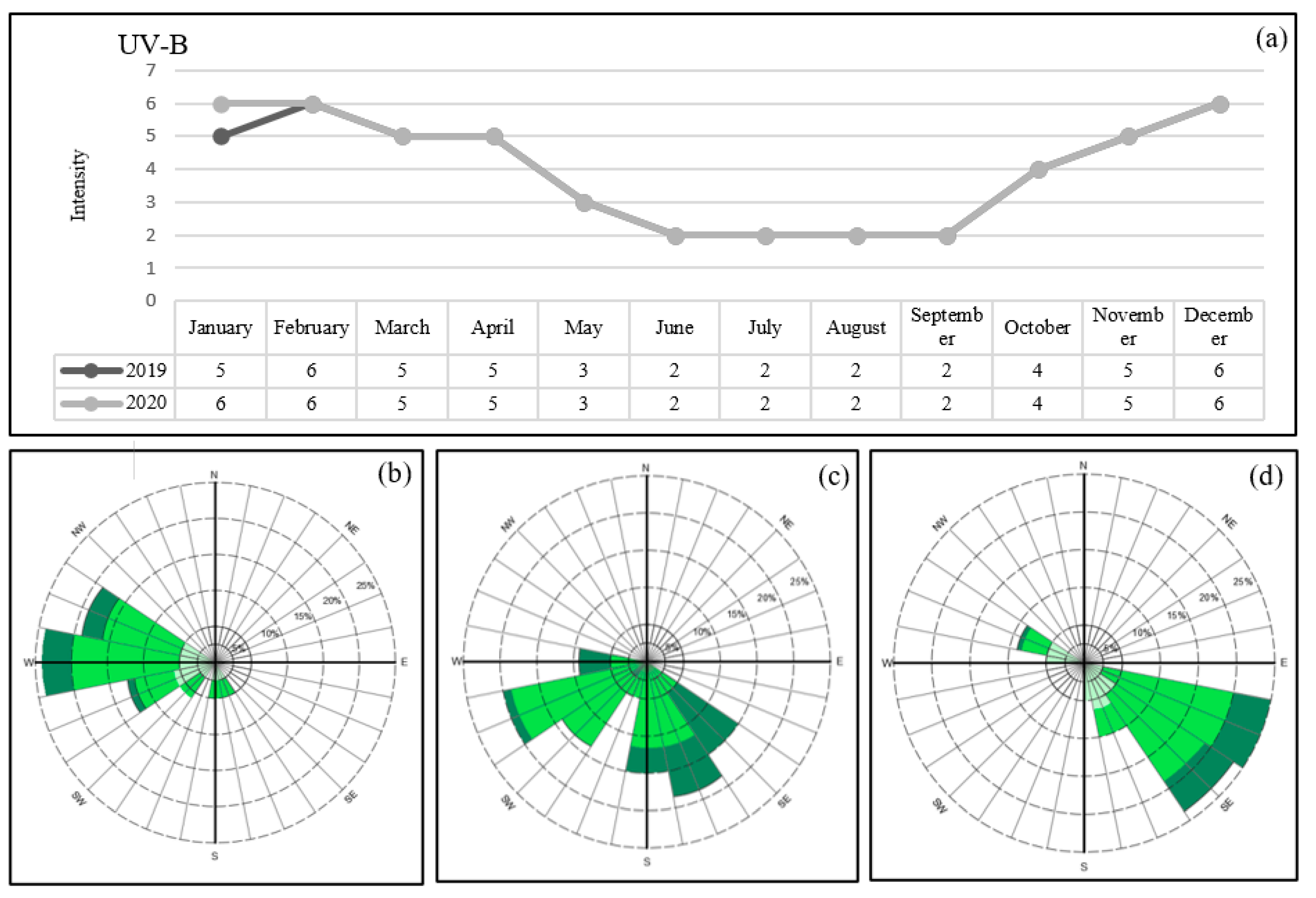
Figure 10.
(a) Lima psychometric diagram´; (b) Design recommendations.
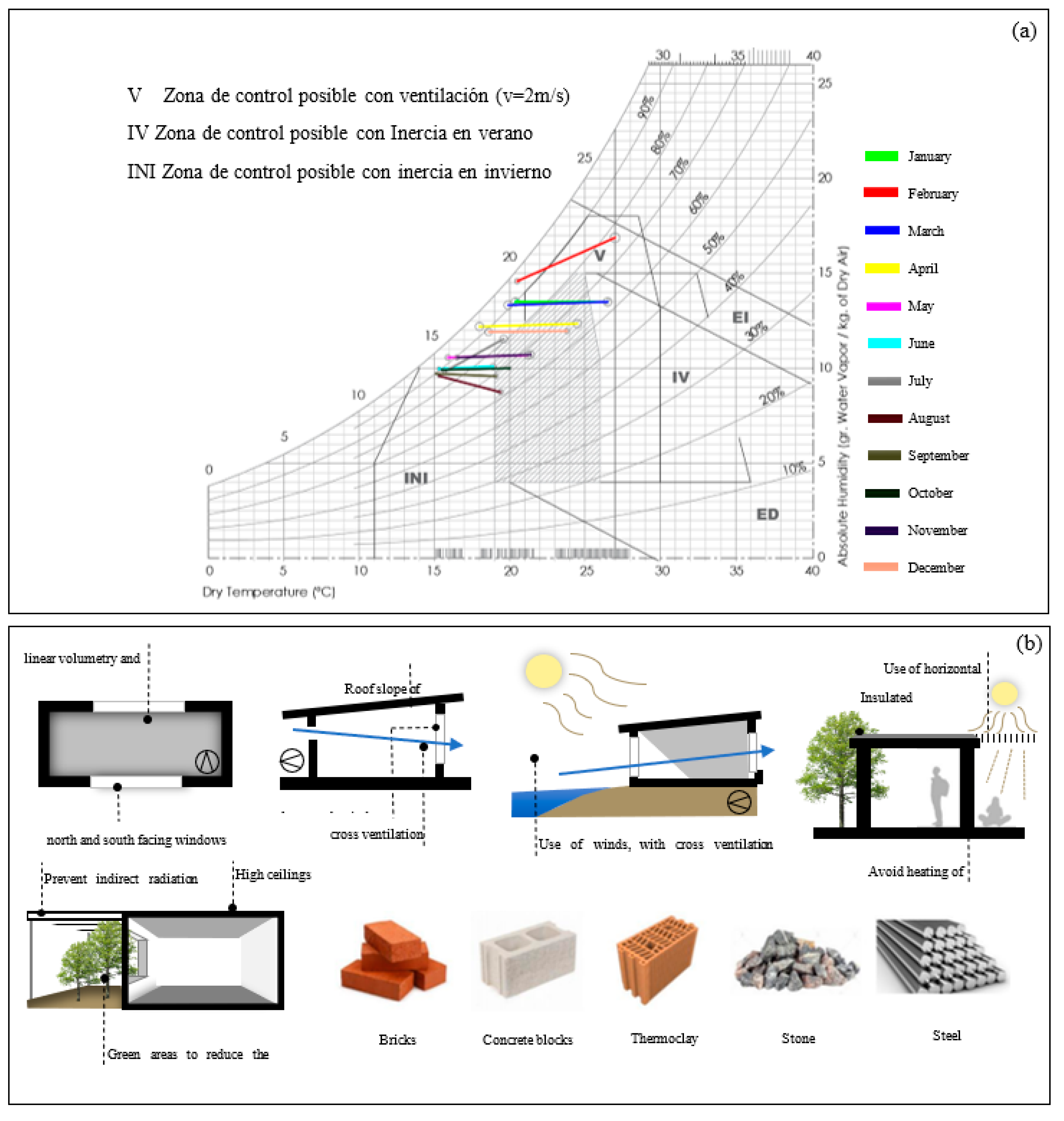
Figure 12.
(a) Classroom educational center 1 Rosa de Santa Maria ;(b)Classroom educational center 2 Pronoei My children's world,(c) Architectural lighting proposal.
Figure 12.
(a) Classroom educational center 1 Rosa de Santa Maria ;(b)Classroom educational center 2 Pronoei My children's world,(c) Architectural lighting proposal.
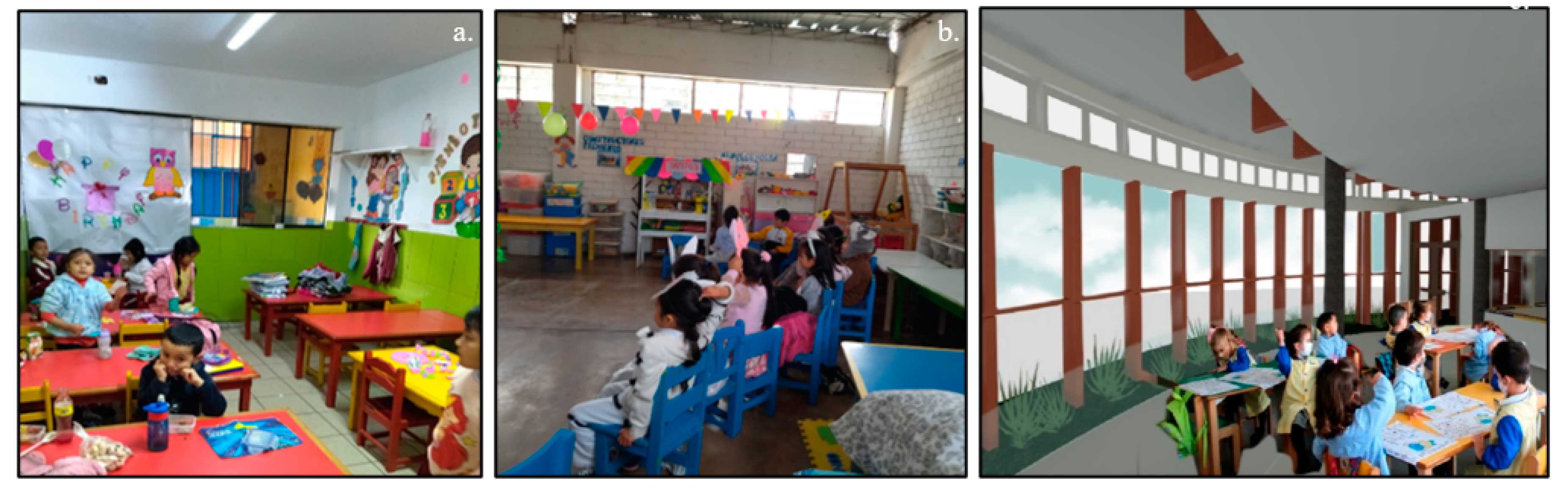
Figure 13.
(a) Playground of the educational center 2 Pronoei My children's world ;(b) School garden of the educational center 2 Pronoei My children's world,(c) Proposal for green areas.
Figure 13.
(a) Playground of the educational center 2 Pronoei My children's world ;(b) School garden of the educational center 2 Pronoei My children's world,(c) Proposal for green areas.
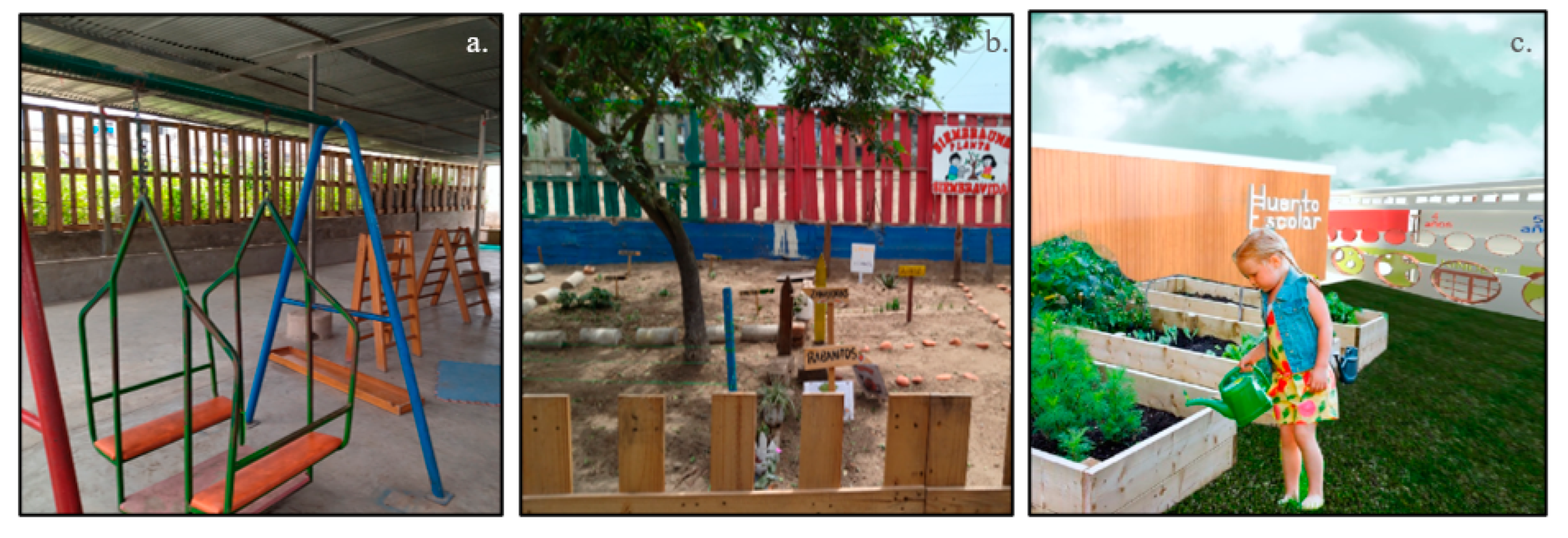
Figure 14.
(a) Playground of the educational center 1 Rosa de Santa Maria ;(b) Classroom of the educational center 2 Pronoei My children's world ,(c) Height proposal.
Figure 14.
(a) Playground of the educational center 1 Rosa de Santa Maria ;(b) Classroom of the educational center 2 Pronoei My children's world ,(c) Height proposal.
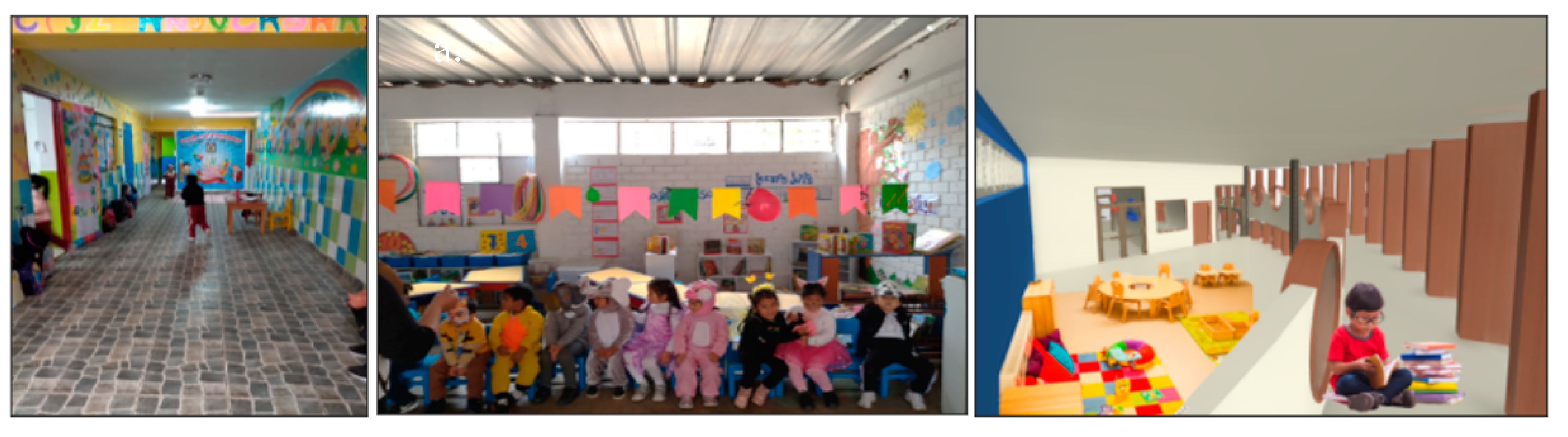
Figure 15.
(a) Classroom of the educational center 1 Rosa de Santa Maria ;(b) Games area of the educational center 2 Pronoei My children's world ,(c) Proposal for the distribution of the common area and patio.
Figure 15.
(a) Classroom of the educational center 1 Rosa de Santa Maria ;(b) Games area of the educational center 2 Pronoei My children's world ,(c) Proposal for the distribution of the common area and patio.
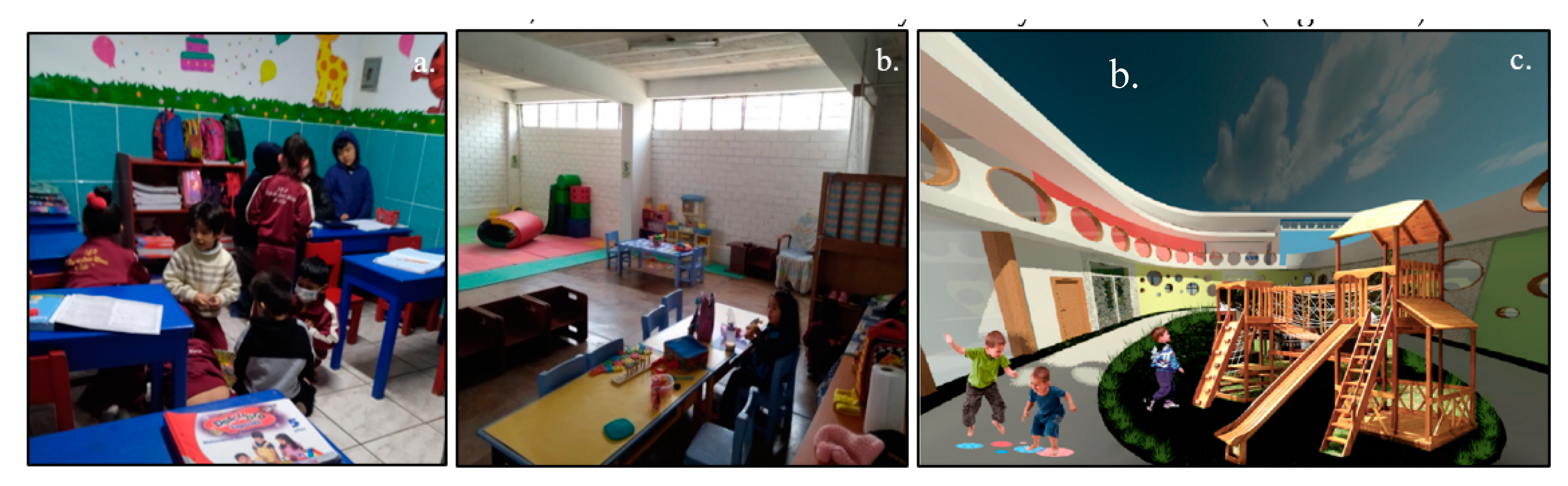
Figure 16.
(a) Toilet area of the educational center 1 Rosa de Santa Maria ;(b) Interaction with furniture at the educational center 2 Pronoei My children's world ,(c) Proposal for accessibility of elements in the corridor.
Figure 16.
(a) Toilet area of the educational center 1 Rosa de Santa Maria ;(b) Interaction with furniture at the educational center 2 Pronoei My children's world ,(c) Proposal for accessibility of elements in the corridor.
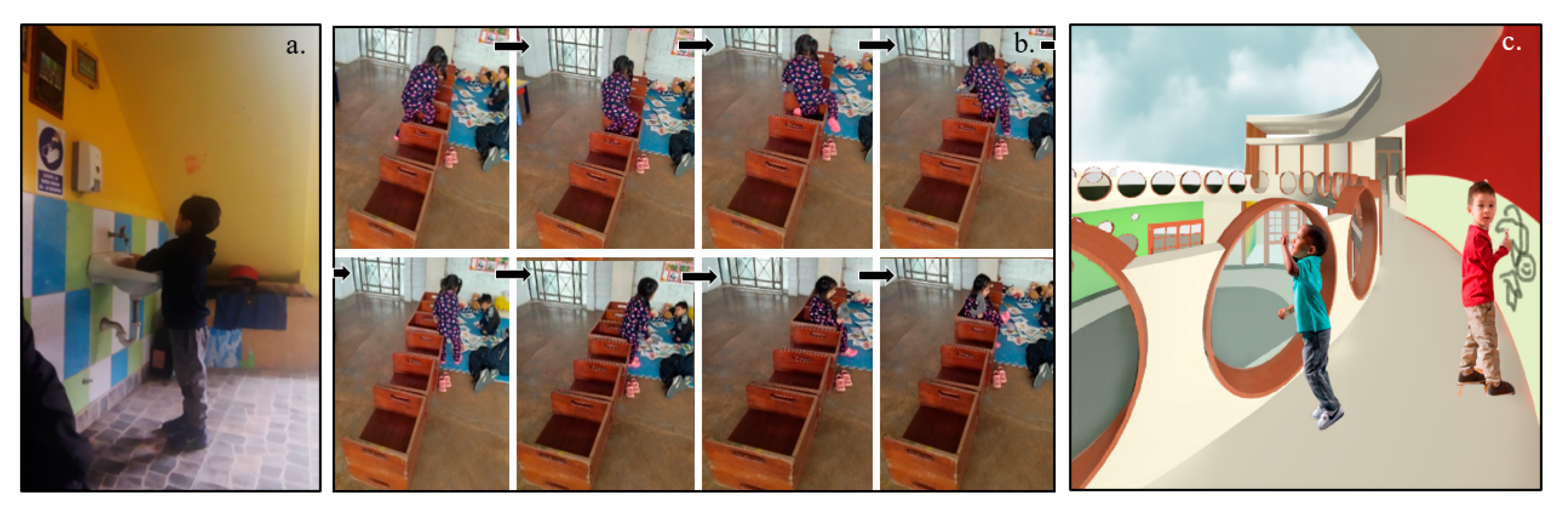
Figure 17.
(a) Dining area of the educational center 1 Rosa de Santa Maria ;(b) reading area of the educational center 2 Pronoei My children's world ,(c)Proposal for the use of neutral and basic colors.
Figure 17.
(a) Dining area of the educational center 1 Rosa de Santa Maria ;(b) reading area of the educational center 2 Pronoei My children's world ,(c)Proposal for the use of neutral and basic colors.
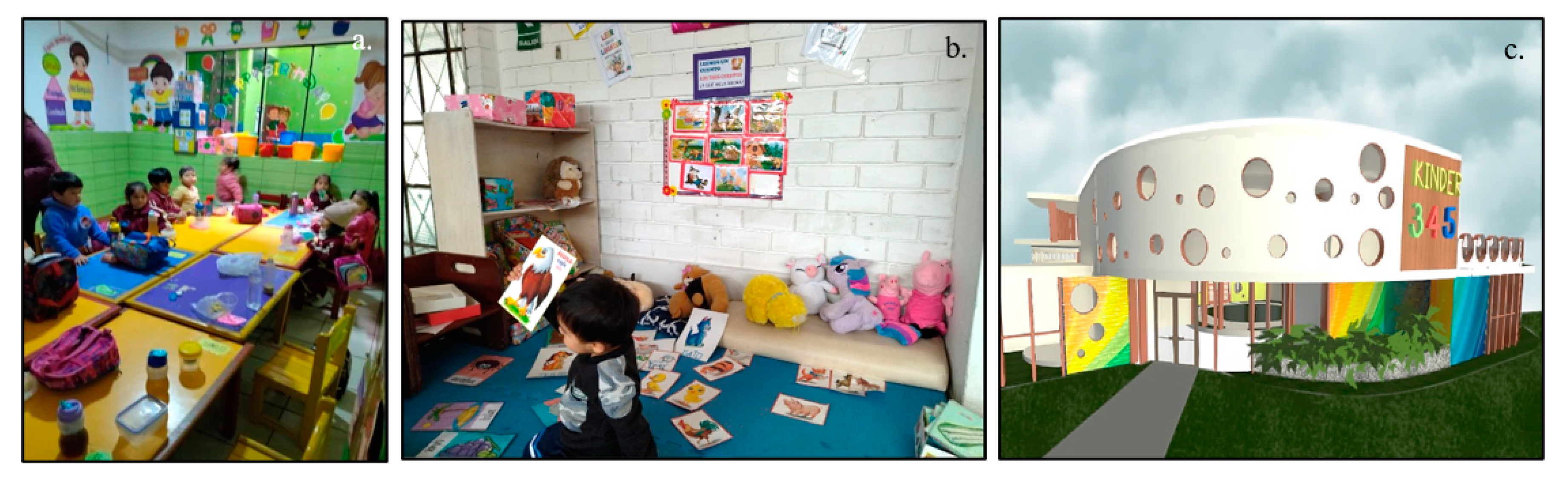
Figure 18.
(a) Classroom of the educational center 1 Rosa de Santa Maria ;(b)Game area of the educational center 2 Pronoei My children's world ,(c) Proposed materiality for a playgroun.
Figure 18.
(a) Classroom of the educational center 1 Rosa de Santa Maria ;(b)Game area of the educational center 2 Pronoei My children's world ,(c) Proposed materiality for a playgroun.
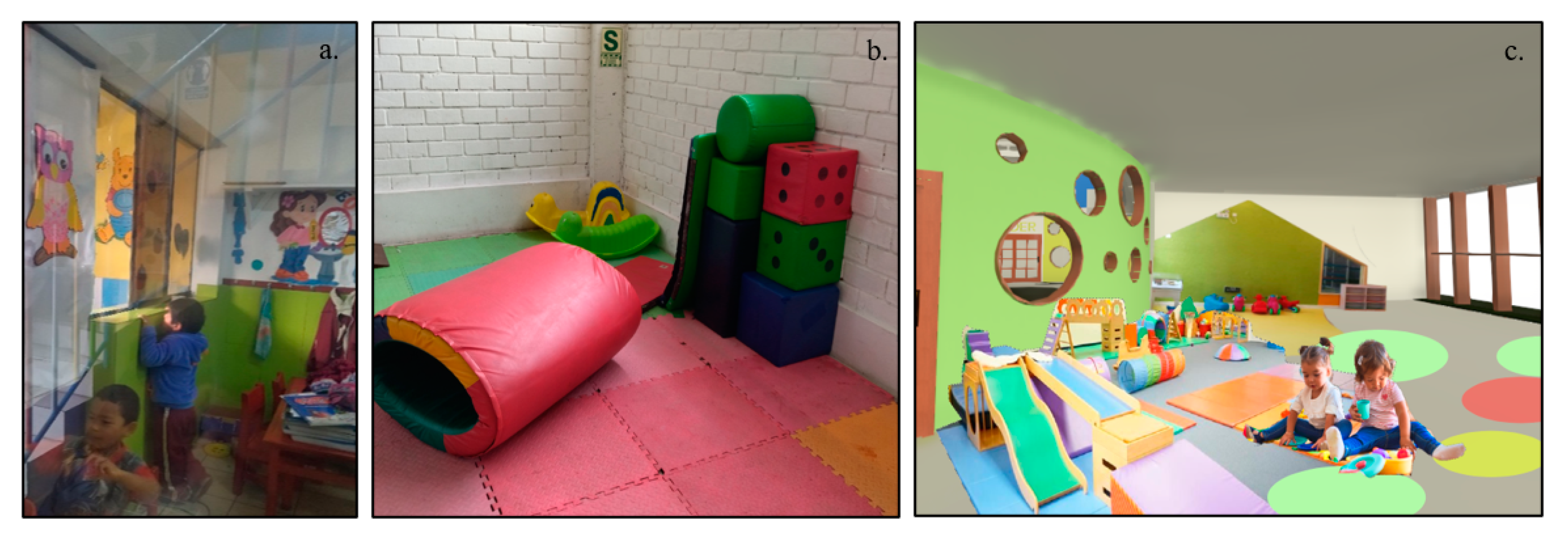
Figure 19.
(a) Current state of the area to intervene;(b) Proposal placed,(c) front perspective view, (d) side perspective view 1, (e) side perspective view 2, (f) rear perspective view.
Figure 19.
(a) Current state of the area to intervene;(b) Proposal placed,(c) front perspective view, (d) side perspective view 1, (e) side perspective view 2, (f) rear perspective view.
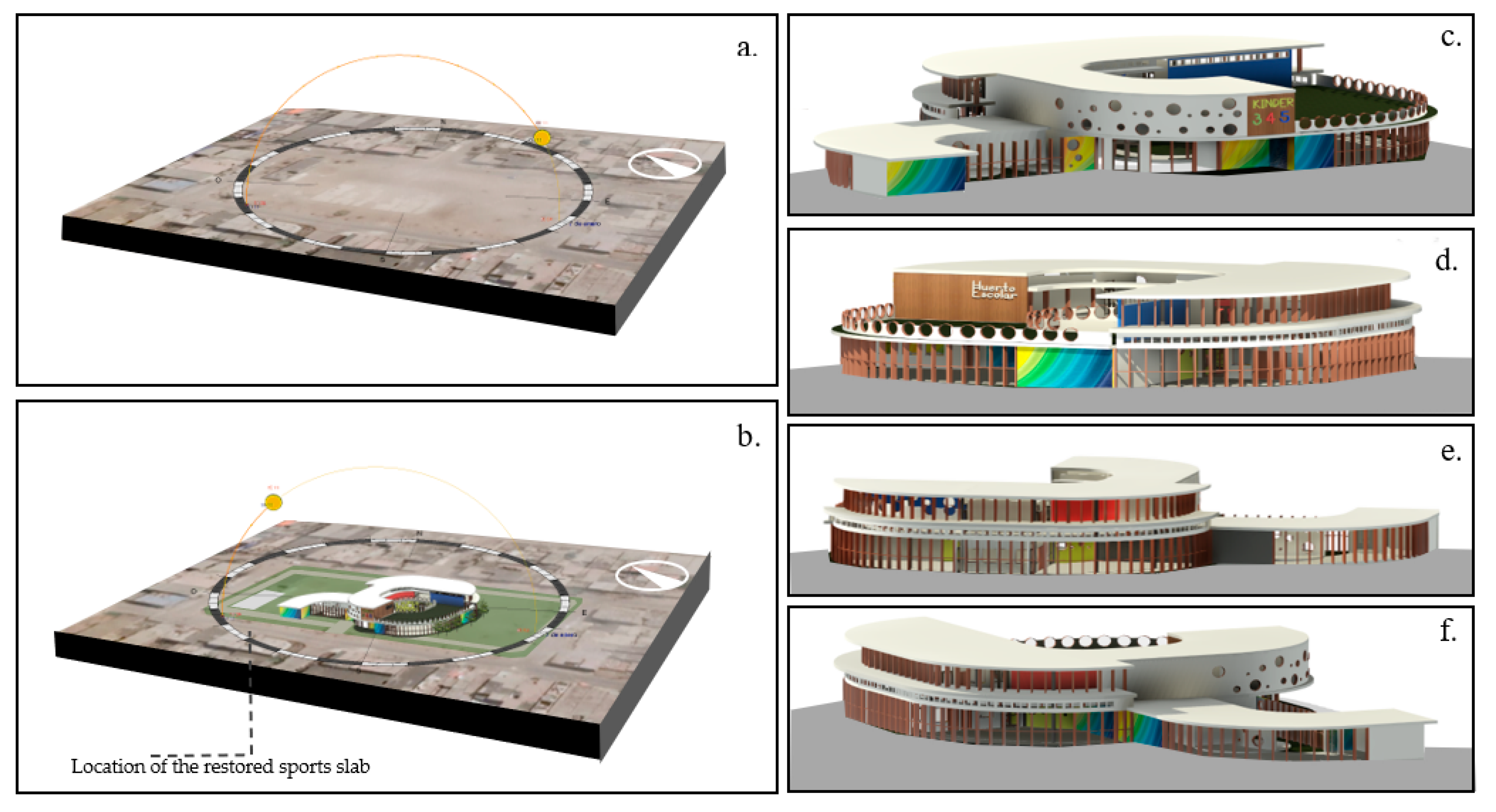
Figure 20.
(a) Cut A-A´;(b) Cut B-B´.
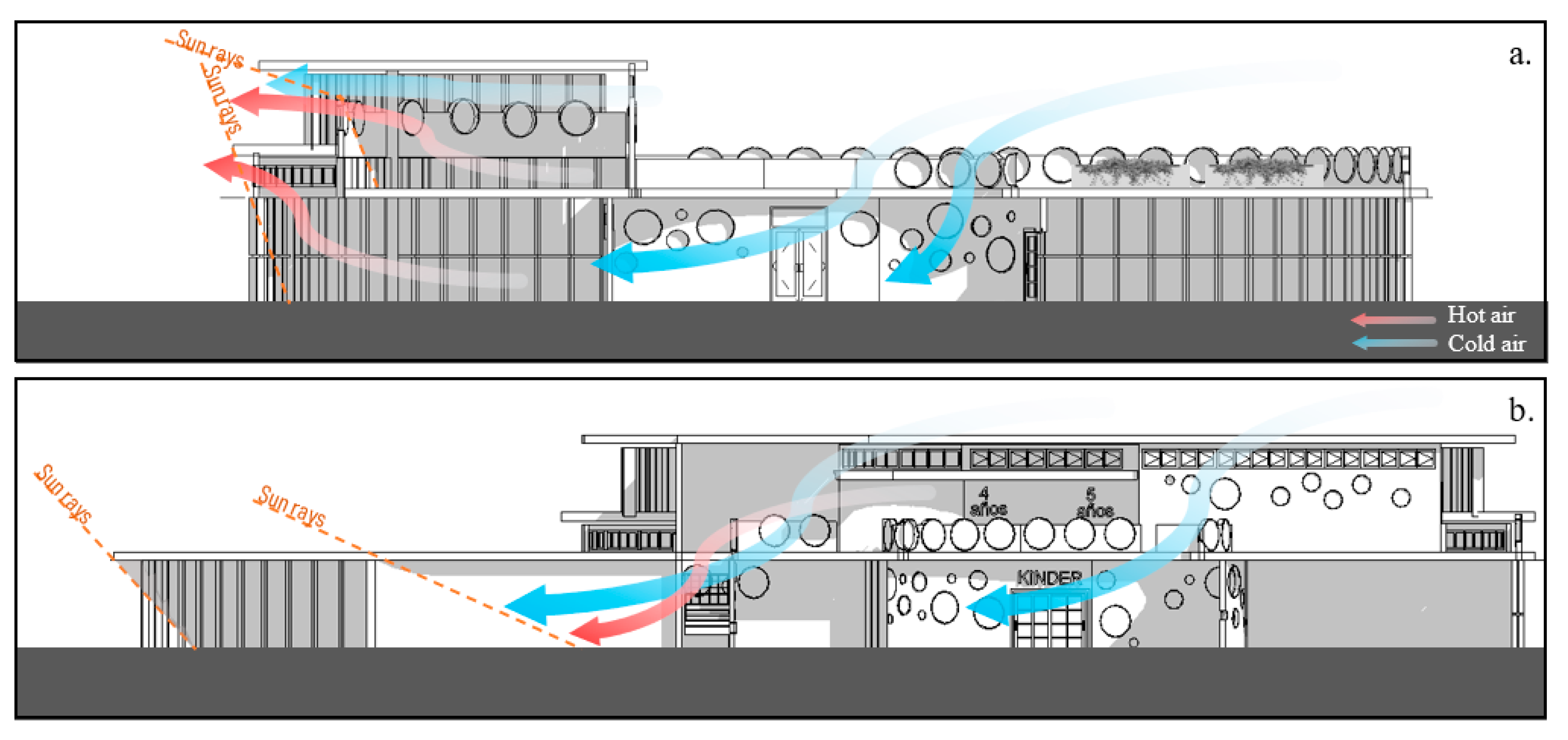
Figure 21.
Distribution of rooms on the first and second floors.
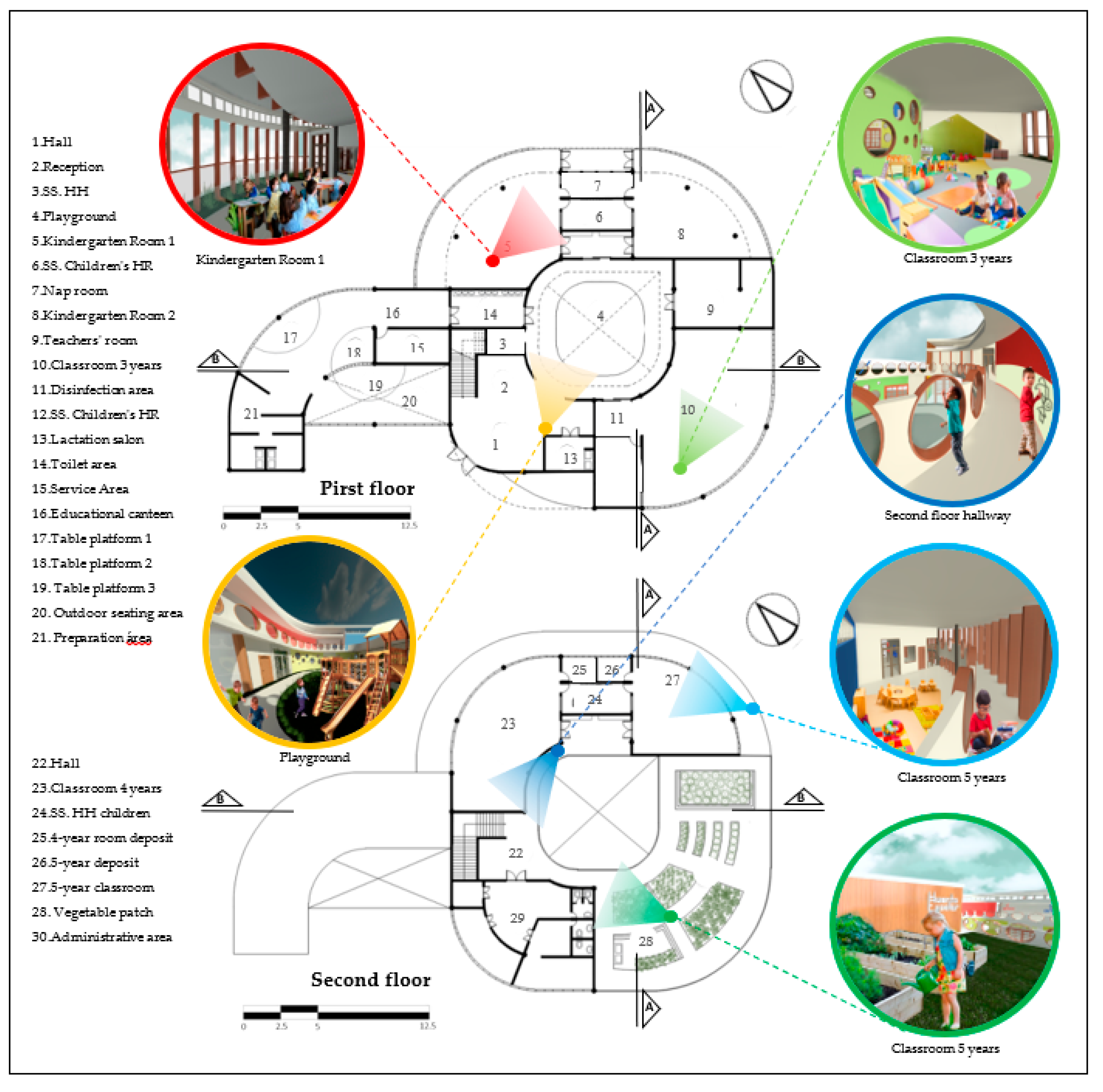

Table 1.
Population by age segments according to department 2019.
| . | Age segment | ||||||||
|---|---|---|---|---|---|---|---|---|---|
| Department | Population | % | 00-05 | 06-12 | 13-17 | 18-24 | 15-39 | 40-55 | 56-+ |
| Lima | 12 053,1 | 36.0 | 1 044.6 | 1 151.3 | 835.0 | 1 353.1 | 2 995.7 | 2 497.4 | 2 176.0 |
| Piura | 2 102.5 | 6.2 | 240.9 | 268.7 | 176.3 | 216.6 | 463.6 | 391.7 | 344.7 |
| La libertad | 2 016.7 | 5.9 | 216.0 | 238.8 | 159.1 | 225.1 | 452.4 | 378.5 | 346.8 |
| Arequipa | 1 581.2 | 4.7 | 146.0 | 159.0 | 111.9 | 176.8 | 385.6 | 323.4 | 2 815 |
| Cajamarca | 1 495.6 | 4.5 | 162.0 | 1 91.3 | 130.9 | 144.2 | 333.4 | 279.7 | 254.1 |
| Junín | 1 406.9 | 4.2 | 147.4 | 168.6 | 122.3 | 158.4 | 321.0 | 257.2 | 232.0 |
| Lambayeque | 1 360.5 | 4.1 | 143.4 | 155.7 | 108.0 | 151.2 | 292.1 | 264.3 | 245.8 |
| Cusco | 1 358.3 | 4.1 | 133.5 | 156.7 | 123.6 | 150.0 | 310.5 | 262.7 | 221.3 |
| Puno | 1 323.0 | 4.0 | 117.7 | 141.3 | 111.4 | 148.6 | 304.2 | 256.7 | 243.1 |
| Ancash | 1 227.2 | 3.7 | 120.6 | 142.0 | 98.3 | 122.4 | 268.0 | 241.3 | 234.6 |
| Loreto | 987.9 | 3.0 | 134.7 | 160.4 | 94.8 | 94.2 | 206.6 | 165.7 | 131.5 |
| Ica | 970.1 | 2.9 | 104.8 | 111.1 | 71.2 | 107.2 | 227.5 | 186.3 | 162.0 |
| San Martin | 915.7 | 2.7 | 108.4 | 123.9 | 78.3 | 92.3 | 211.9 | 172.5 | 128.4 |
| Huánuco | 806.6 | 2.4 | 88.3 | 104.5 | 75.5 | 89.7 | 176.9 | 144.4 | 127.3 |
| Ayacucho | 691.7 | 2.1 | 70.4 | 84.9 | 65.7 | 76.6 | 152.6 | 124.6 | 116.9 |
| Ucayali | 558.3 | 1.7 | 75.6 | 83.0 | 48.6 | 58.7 | 127.6 | 96.6 | 68.2 |
| Apurimac | 454.5 | 1.4 | 46.0 | 56.9 | 41.4 | 46.2 | 98.2 | 84.5 | 81.3 |
| Amazonas | 423.0 | 1.3 | 49.5 | 57.9 | 38.7 | 40.1 | 93.6 | 78.1 | 65.1 |
| Huancavelica | 385.9 | 1.2 | 40.4 | 50.3 | 40.9 | 39.9 | 75.0 | 67.5 | 71.9 |
| Tacna | 376.1 | 1.1 | 31.7 | 37.3 | 27.7 | 42.2 | 96.7 | 81.3 | 59.2 |
| Pasco | 286.1 | 0.9 | 29.8 | 35.3 | 22.7 | 32.5 | 69.6 | 53.8 | 42.4 |
| Tumbes | 256.1 | 0.8 | 29.2 | 31.9 | 20.1 | 26.2 | 59.7 | 50.1 | 38.9 |
| Moquegua | 200.5 | 0.6 | 17.3 | 20.00 | 14.0 | 19.6 | 48.2 | 43.7 | 37.7 |
| Madre de Dios | 159.1 | 0.5 | 19.4 | 21.1 | 11.8 | 17.4 | 44.1 | 29.2 | 16.1 |
| Total | 33 396.6 | 100 | 3 317.6 | 3 748.9 | 2 628.2 | 3 629.2 | 7 814.7 | 6 531.2 | 5 726.8 |
*The data comes from CPI (Peruvian Company for Market Research and Public Opinion.
Table 2.
Precipitation indicators according to regions of Peru.
| Region | Precipitation type | Maximum amount of PP (mm/24hrs) | Probability |
|---|---|---|---|
| Costa | Drizzle | 0.1-0.2 | Moderate 40-60% |
| Sierra | Rain/hail/snow | 5-20 | High>60% |
| Selva | Rain | 15-55 | High>60% |
*The data comes from National Meteorology and Hydrology Service (SENAMHI).
Table 3.
Likert Scale.
| Deficient | Insufficient | Middle | Enough | Outstanding | |
| VALUE | 0% | 1-25% | 26-50% | 51-70% | 71-100% |
Table 4.
Table of results of the application of neuroarchitecture in the Rosa de Santa Maria de Villa Private Educational Center.
Table 4.
Table of results of the application of neuroarchitecture in the Rosa de Santa Maria de Villa Private Educational Center.
| DIMENSIONS | INDICATORS | PERCENTAGE | WORTH LIKERT SCALE | ||
|---|---|---|---|---|---|
| Neuroarchitecture | Lightning | Indicate the percentage in which the use of natural light predominates over artificial light | Natural | 30% | HALF |
| Artificial | 70% | ENOUGH | |||
| Parkland | Percentage of implementation of green spaces in the project | 0% | DEFICIENT | ||
| Roofs | Indicate the percentage of spaces with high and/or low ceilings included in the project | Tall | 30% | HALF | |
| Low | 70% | ENOUGH | |||
| Shape | Indicate in what percentage the implementation of orthogonal, curved elements predominates in the architectural space. | Curve | 10% | INSUFFICIENT | |
| Orthogonal | 90% | OUTSTANDING | |||
| Size | Indicate the percentage of rooms with large and/or small spaces | Broad | 20% | INSUFFICIENT | |
| Reduced | 80% | OUTSTANDING | |||
| Distribution | The percentage of application of linear or dynamic distribution in the spaces | Linear | 80% | OUTSTANDING | |
| Dynamic | 20% | INSUFFICIENT | |||
| Accessibility | Indicate the percentage in which environments are accessible to children | 50% | HALF | ||
| Scale | Indicate the percentage of the architectural elements are at the scale of the child | 30% | HALF | ||
| Colors | Percentage of color application | Intense | 90% | OUTSTANDING | |
| Neutral | 10% | INSUFFICIENT | |||
| Materiality | Indicate the percentage of material used in the elements | Smooth | 60% | ENOUGH | |
| Textured | 40% | HALF | |||
*The data comes from observation, photographing and measurement.Date and time of the evaluation October 18, 2022, 9-11am.
Table 5.
Table of results of the application of neuroarchitecture in Pronoei Mi Mundo infantil.
| DIMENSIONS | INDICATORS | PERCENTAGE | WORTH LIKERT SCALE | ||
|---|---|---|---|---|---|
| Neuroarchitecture | Lightning | Indicate the percentage in which the use of natural light predominates over artificial light | Natural | 70% | ENOUGH |
| Artificial | 30% | HALF | |||
| Parkland | Percentage of implementation of green spaces in the project | 30% | HALF | ||
| Roofs | Indicate the percentage of spaces with high and/or low ceilings included in the project | Tall | 20% | INSUFFICIENT | |
| Low | 80% | OUTSTANDING | |||
| Shape | Indicate in what percentage the implementation of orthogonal, curved elements predominates in the architectural space. | Curve | 10% | INSUFFICIENT | |
| Orthogonal | 90% | OUTSTANDING | |||
| Size | Indicate the percentage of rooms with large and/or small spaces | Broad | 70% | ENOUGH | |
| Reduced | 30% | HALF | |||
| Distribution | The percentage of application of linear or dynamic distribution in the spaces | Linear | 50% | HALF | |
| Dynamic | 50% | HALF | |||
| Accessibility | Indicate the percentage in which environments are accessible to children | 90% | OUTSTANDING | ||
| Scale | Indicate the percentage of the architectural elements are at the scale of the child | 50% | HALF | ||
| Colors | Percentage of color application | Intense | 30% | OUTSTANDING | |
| Neutral | 70% | INSUFFICIENT | |||
| Materiality | Indicate the percentage of material used in the elements | Smooth | 50% | HALF | |
| Textured | 50% | HALF | |||
*The data comes from observation, photographing and measurement. Date and time of the evaluation October 20, 2022 9-11am.
Disclaimer/Publisher’s Note: The statements, opinions and data contained in all publications are solely those of the individual author(s) and contributor(s) and not of MDPI and/or the editor(s). MDPI and/or the editor(s) disclaim responsibility for any injury to people or property resulting from any ideas, methods, instructions or products referred to in the content. |
© 2023 by the authors. Licensee MDPI, Basel, Switzerland. This article is an open access article distributed under the terms and conditions of the Creative Commons Attribution (CC BY) license (http://creativecommons.org/licenses/by/4.0/).
Copyright: This open access article is published under a Creative Commons CC BY 4.0 license, which permit the free download, distribution, and reuse, provided that the author and preprint are cited in any reuse.