
Submitted:
28 June 2023
Posted:
30 June 2023
You are already at the latest version
Abstract
Abstract: This Study attempts to tackle the most plausible timeframe of the biblical figure Abraham from a holistic point of view. We have employed the archeological, astronomical, environmental, and documentary evidence in arriving at our results. In doing so, we able to synchronize the most influential global forces with the real and original older historic sources like the chronologies of Manetho and Berrosus. Furthermore, key material culture changes were observed as tracers of major markers for civilization shift. We also consulted various signs from the holy scriptures as appropriate. The patriarchal chronology closely followed major shifts in Egyptian dynastic rotation. It was found that Abraham time was within the second Egyptian dynasty. The findings were confirmed by matching events from the Babylonian chronology, where he is found to have lived during Kish 2 dynasty. As a follow up on this result, we established the identity of Joseph as Imhotep, the vizier of king Djoser from the 3rd dynasty.
Keywords:
Abraham
; Joseph
; chronology
; Canaan
; Chaldea
; Babylon
; Egypt
Introduction:
We shall engage in this study the historiography1 of the patriarch Abraham and how it evolved over the years, in an effort to establish his historicity. For that matter we present an overview of the secular ancient historiographies and how it was adapted to suit the biblical ones, and how this process dominated historical writing till the current times. It is well known that current chronological traditions go back to modifications and adaptations made in the Roman and Byzantine period to an older system developed by two historians both of which lived during Hellenistic times. The former, Berossos is from Babylon and wrote his history of Babylonia around 290 B.C. (Verbrugghe and Wickersham, 2001, 13). The other one, Manetho is an Egyptian priest or chief of priests who was active in the period from 300-240 B.C. and his most important work was The History of Egypt (Verbrugghe and Wickersham, 2001, 96-97). Berossos produced dynasty lists after the Flood that spanned over 33,000 years till the time of the Gutian kings of the Medes, and the so called older Sumerian King lists produced similar time spans (Verbrugghe and Wickersham, 2001, 20, 73-74). Manetho’s history provided a timeframe like that of Berossos for the kings of Egypt. In total, Egypt was ruled after the great Flood by kings of various titles and dynasties till the thirtieth dynasty within a time span of 36,531 years (Verbrugghe and Wickersham, 2001, 126-127). These timelines were ridiculed by later historians as fanciful, and what have come down through the generations of subsequent historians are just fragments. The cohorts of Josephus and later Eusebius, Africanus and Syncellus were influenced by the much shorter biblical timeline, and hence modified what came down to them from Berossos and Manetho to fit their shorter chronologies (Verbrugghe and Wickersham, 2001, 29-30, 116-118). The great Flood episode, which off course was a major milestone, was reduced by thousands of years to the neighborhood of 3251 B.C., thus wasting about thirty thousand years of history, while the creation itself was calculated at 5492 B.C. (Adler and Tuffin, 2012, 1xxi). In modern times archaeologists uncovered a host clay tablet from Mesopotamia that listed the kings and kingdoms of the land, so called “the Royal Chronicles”, in a much similar fashion to the system of Berossos, and probably were sources available for him. Several copies of them are available and they take kingdoms in sequential order from the time after the deluge down to the kingdom of Isin (Glassner, 2004, 117-127)2. Another act of adaptation took place, on the ground that these lists cannot be considered sequential but somehow simultaneous, and some of them legendary (Glassner, 2004, 49, 66-70; De Mieroop, 2004, 41). The first kingdom of Kish and the kings of Uruk I in the Sumerian King-list had a duration of 24,510 and 2310 years respectively (Delaporte, 1925, 61). However, modern references put their chronology as Early dynastic I, which spans the period from 2900-2700 B.C. (Verbrugghe and Wickersham, 2001, 72; De Mieroop, 2004, 39-40).
Turning our attention to Egyptian chronology, the discoveries of major monuments inscriptions and their decipherment planted the seed for another round of adaptation of Manetho’s chronology. Not being able to dispose of it because of its systematic and detailed kingly records, Egyptologists in the 19th century found excuses and methodologies to reduce it to shorter, more “acceptable” form. The scheme attracted interest from several researchers, whose attitude ranged from adherence, to order of magnitude reduction. One can thus see the ascension of Menes, the founder of the 1st dynasty (according to Egyptologists) as early as 5702 B.C. according to Boeckh, and as late as 2691 B.C. according to Wilkinson, the difference being 3011 years (Meriette-Bey, 1892, 86). Nolan went as short as 2673 B.C. for the ascension of Menes, mainly justified on the ground that some dynasties are contemporaneous rather than sequential, a theory whose origin goes back to the Greek historian Erastothenes (Nolan, 1848, 210-212). The Egyptian chronology continue to attract attention of researchers, since every modification brings about host of problems and discussions (Bernal, 1991, XXVIII, 28-29)3.
Central to the foregoing historical discourse is the search for a historical Abraham (Arabic: Ibrahim), whom Syncellus placed his birth on 2181 B.C. (Adler and Tuffin, 2012, 1xxi) in conformity to his adaptations designed to suit biblical chronology. The only ancient reference to Abraham is attributed to Berossos, who did not mention him by name, but mentioned a Chaldean man who lived ten generations after the Flood, and was great, just and knowledgeable astrologist. Josephus thought that this reference was to Abraham (Barrick, 2003; Verbrugghe and Wickersham, 2001, 53)4. Short chronology prevailed in Christian Europe, and another estimate for the creation time was made at 4004 B.C. as declared by archbishop Ussher in 1650 C.E. which gained wide acceptance (Daniel, 1962, 24). After major Egyptian and Mesopotamian archaeological discoveries were revealed, leading scholars and archaeologists from the 19th and 20th century placed the biblical patriarchs in the bronze age, in accordance with their favored view of sacred chronology (Tomkins, 1878, 8, 130)5. Such chronology had major problems and was subject to numerous interpretations and calculations. Voices that called for decoupling biblical sacredness from assumed chronology were raised early on, recalling the antiquities proven by geological and monumental discoveries. Baldwin (1872, 27) stated that all attempts to construct systems of biblical chronology lack scientific method and purpose. The proponents of short chronology, however, prevailed and their literature dominated the scene. Several decades later, this approach was contested by several scholars as not realistic and lacking tangible evidence. For example, Thompson openly rejected it and described the attempt to place biblical patriarchs in the second millennia as void of logical or historical evidence (Thompson, 1974, 187-196, 296). The historical origin of the biblical material and their relevance to historical events were subject to intense discussion since then. Finkelstein (2005, 207-222) indicated that the view of Thompson on the above matter has been widely accepted. He also summarized the outcome of the historicity discussion by placing the authorship of Pentateuch (the Five Books of Moses) between the seventh century and the latter part of the first century B.C., considering the various schools of thought6. Accordingly, he sees the histories of the biblical texts as creative compositions, rather than objective facts. Using his own words: “This does not mean that the texts have no historical value, but it does mean that in many cases they tell us more about the society and politics of the writers than about the times described in them” (Finkelstein, 2005, 207-222).
Bernbeck (2005, 97-122) criticized written histories from a single narrative perspective as unrealistic representation of the past. He maintained that single narrator perspective conceals conflicts by telling a story from one angle. He advocated approaching the past from several different perspectives at the same time. It is to be noted that the Quran does not suffer from the historicity dilemma, as it was compiled by the same cohorts who received it from the prophet Muhammad (PBUH) (Muheisin, 1393 A.H., 142-146), (Noldeke, et. Al., 2013, 252-261)7. Quran agreed with the bible in much of the stories of the past. However, the Quran does not provide historical chronology for them. This leads one to think of a holistic approach to writing a history for Abraham, which we shall describe in the methodology section.
Research concerning the chronology of Abraham continues to evolve within modified chronologies framework. Two separate studies have dated Abraham to sometime during the Early Dynastic or the Old Kingdom periods in Egypt. John Ashton and David Down (2006) dated him to the Fourth Dynasty, while (McClellan 2011, 155) gave him a range of dates from the 2nd–6th Dynasties. McClellan (2012) further discussed Abraham from Mesopotamian perspective, discussed former research, and concluded that his chronology must be sought in early Bronze age and early dynastic period (2900-2600 B.C.), in conformity with early dynastic or old kingdom Egypt. This is by itself a big push backward from the traditional early dating that placed Abraham during the reign of Hammurabi of Babylon (2250–2100 B.C.) as we have shown above.
Objective:
The current study aims to readdress the historicity of the patriarch Abraham from wider angles. The royal chronicles and the original chronologies of Manetho and Berossos shall be considered as source material. Although considered fantastic and legendary by mainstream historians, old and modern, they remain the most widely used source of our knowledge of the ancient near east. We ask the question, perhaps Manetho, Berossos and the royal scribes of Babylon were right, perhaps the proponents of the extended chronology were right, can we find evidence elsewhere that supports their findings, especially in relation to Abraham and his contemporary dynasties. In other words, can we find in the story of Abraham signs of relevance to the older chronology, bits and pieces that fit the Neolithic and the wet Holocene era, indicated by the long chronologies? We are not interested in modifying the currently dominant chronologies that begin in the bronze age. In fact, we are abandoning them altogether and starting afresh with Manetho, Berossos and likewise documents relating to older times. Within the process, we invoke other scientific disciplines to see if they support the older chronologies, in relevance to our holistic approach.
Methodology:
We tackle the history of Abraham from different aspects at the same time. We invoke ancient historical records and archaeological discoveries, results that clearly indicate high state of civilization in prehistoric times, as defined by Daniel, (1962, 13, 58-59)8. We make use of astronomy, earth science, genetic science, and climatology to help us draw a clearer and consistent picture of the past, in which we can see Abraham and his descendants travel from one land to the other, see their encounters with monarchs that have traceable attributes. We begin by a brief description of the chosen chronology especially with respect to Egypt, where most of the action took place. We justify our choice of specific Manetho’s timetable and move on to describe the most likely timing of the patriarch’s place within, based on their mutually accepted stories from the Old Testament and the Quran. We point out to events synchronous to events which took place in Egypt and Mesopotamia during prehistoric dynasties.
This of course may be a too ambitious task, but if it can be of any value, perhaps it can open the door for a fresh and interesting debate on a subject that has been long contested without a clear resolution. That is why we spend some effort to establish the plausibility of old chronologies before we demonstrate their relevance to the stories of Abraham.
Prehistoric Civilizations:
Knowledge of ancient civilizations has come to us from the Sumerians down to Hellenistic time. Manetho and Berossos listed older kingdoms that were around over thirty thousand years before their time. The Sumerian king list scribes described the rise of civilized society of a black race, only few hundred years after the Flood. After they were declined in population by famine and death of their livestock, the learned how to dig canals and raise barley, the seeds of agriculture started to appear (Glassner, 2004, 147-149)9. This may seem strange considering the current classification of the stone age for that paleolithic era. However, such classifications do not eliminate the possibility of people’s knowledge of agriculture and shall not hinder us from looking for otherwise documented evidence. Another document that was almost totally ignored in this context is the book of Nabathean Agriculture. This book was introduced by Chwolson in 1859, who published fragments and a commentary of it in German and was subject to critical reviews by the learned scholars at the time (The Christian Remembrance, 1869, 417-453), and a whole volume was dedicated for its study in modern time (Hameen-Anttila, 2006). Renan,1862, 9-21, engaged himself in a critical discussion about its antiquity, and provided different views of the scholars who studied it at his time. Their estimates range from classical antiquity to as early as 15th century B.C.10 Its original editor was one Ibn Wahshiyya Al-Nabati, a Syriac resident of Iraq during the Abbaside Islamic dynasty11. He referred the authorship of the book to a Chaldean called Quthama, whose time is so remote that he described Abraham as a respectable leader and frequent traveler who lived not so long ago12. The Nabathean Agriculture answered a long and difficult question about the long absence of Chaldeans reference outside the Book of Genesis (Barrick, 2009)13. It is also the only explicit ancient reference to Abraham in secular literature, and hence I shall refer to it later. Quthama included material in the book that he ascribed to two wise men before him named “Saghrit” and “Yanbushad”. The three men lived far apart in time several astronomical cycles, amounting to twenty-one thousand years in time. They were sags of agriculture, star science and medicine (Hameen-Anttila, 2006, 98-99). Hence the older of these sags would have lived well into Kish I dynasty. This book with its extensive list of plants, medicine and trees known by the ancient is clear evidence of an ancient high civilization that spans the dynasties after the Flood known to us as prehistoric.
The Greeks had ample knowledge of the ancient civilizations. Herodotus had his dialogue with the Egyptian priests who showed him a continuous list of 341 generations between Min (Menes) the first dynastic king of Egypt and the one of his times. He calculated 11,340 years through these generations (Waterfield, 1988, the Histories, 2, 142). Manetho had a different interpretation and reckoned around 5100 years for them, that is before the time of Herodotus (Verbrugghe and Wickersham, 2001, 101)14. We have a difference of about two and a half millennia between Manetho’s account of Menes and modern references that places Menes’s rein in 3100 B.C. (Verbrugghe and Wickersham, 2001, 101, 187). Plato, recounting an encounter of his ancestor Solon15 with the Egyptian priests at Sais16, preserved a most vivid and elaborate account of a lost civilization. He was told that Athens was founded 9000 years before his time, and Sais were founded a 1000 years later. They spoke of a sophisticated society divided according to professions in casts of priests, artisans, shepherds, hunters, and husbandmen. They described a competing nation who dwelled in a massive island called Atlantis and possessed great powers. Its people dominated parts of Africa and Europe and had the desire to conquer Greece and Egypt, a venture that ended in their destruction by earthquake, flood, and rain, which also fell onto Greece and took so many lives (Donnelly, 1949, 4-9). We are not interested in Atlantis per se, as much as the antiquity of civilization in general. If the Egyptian priests were making stories up to impress the Athenian visitor, how do we explain the bronze vase discovered by Heinrich Schliemann17 in Troy in the treasures of King Priam18, upon which an inscription that described it as a gift from Chronos, the king of Atlantis (Schliemann, 1912, 9). Or how do we explain the numerous references to the Greeks (Yunanis), Canaanites, Pehlevis (old Persians), and other ancient, civilized nations in the book of Nabathean Agriculture (Chwolson, 1859, 40, 50, 88)19. We must give room to the thought that ancient civilizations exist, whom we know little about. We turn next to modern archaeological discoveries to shed some light on some enlightening picture that is beginning to emerge, about the people that predate currently accepted chronologies.
Archaeological Discoveries:
Man has exhibited diverse cultural manifestations from the upper paleolithic era (40000-10000 B.P.), an era that have shown him make and use stone tools, make clothing from animal skins, and construct dwelling from stones, timber, leaves, animal hides and bones. People also made and wore personal ornaments and decorative objects from horns and shells (Otte, 2007, 95-98). Figurative depictions have existed from 50,000 years B.P. in Europe, Asia, and Africa. Personal ornaments from Mongolia and Siberia were discovered that ranges from 46,000 to 25,000 Y.B.P. and took various forms like pendant, bracelet, bead, ring, etc., made by skillful artisans who utilised various materials like Talk, Graphite, Serpentine, Sepiolite, Muscovite, etc. (Rigaud, 2023). Paleolithic people developed artworks in caves and on rocks and bones, and made statuettes and figurines, depicting humans and animals (Otte, 2007, 101-103). They practiced religious rites, believed in shamanism, and practiced funeral burials (Otte, 2007, 110-112). This period had seen the emergence of the earlier kingdoms reported by old chronologies given above.
The onset of animal domestication began soon after people adopted sedentary lifestyle as seen early on in upper Mesopotamia. Cats, dogs, and pigs started to acquire special relationships with these societies, from 12,000 years ago, a relationship that shown itself spread over the following 3000 years. In that course of time, those communities gradually turned to goat, sheep, and cattle herding. Of all recent archaeological discoveries, Gobekli Tepe is an eye opener. Now a world heritage site, this megalithic sanctuary in upper Mesopotamia dates to 9500-8000 B.C., coinciding with the Pre-pottery Neolithic period (Clare, 2020). This massive site contains six enclosures in which series of massive stones are erected in regular shapes, with drawings of humans, animals, birds and other creatures engraved on them. Numerous papers and studies appeared in the literature trying to understand the logic and meaning of this sanctuary. Of the major questions that arose, still mysterious, is the engineering method that enabled such seemingly primitive people to move, cut and install such massive pillars, 2-3 m high and 5-15 metric tons in weight. Still more perplexing is the unfinished T shaped pillar sitting nearby, 7 m high and 50 tons in weight (Collins, 2014, 3-39, 45). Another curious enquiry is directed towards Pillar number 43, featuring carvings of vulture, scorpion, two long necked wader birds, three-man bags or baskets, a ball, and a headless figure. It was suggested by calculation that this scene depicts the alignment of Scorpius and Cygnus constellations in the sky in the year 9500 B.C., indicating an elaborate interest in astronomy from such ancient community (Collins, 2014, 101-102). It is to be noted that this date roughly coincided with the end of the Younger Dryas phenomena, that lasted 1300 years in which the world has seen extreme and rapid climatic changes from cooling to subsequent warming (10900-9600 B.C.), which must have created impact on the means of life, encouraged animal domestication, land use and management, and cereal cultivation (Torun, 2021, 83-93). One can hence appreciate the interest of these people in astronomic observation, which has direct impact on farming timetable.
Another startling discovery that has yet to make headlines is the chronology of the great sphinx of Giza in Egypt. It was generally believed that it was built by a king from the 4th dynasty, who was also responsible for establishment of the great pyramids. However, geologists Robert Schoch and David Coxill separately examined the sphinx’s structure and identified three stone layers, a harder limestone layer which forms the head, beneath it a softer and more porous limestone layer, and the lower portion of a very hard layer. The two layers under the head are eroded with a smooth and rolling appearance. It was concluded that the cause of erosion was flood waters, fluctuating ground water or salt exfoliation. The wet climate that can explain this finding is thought to be from 7000 B.C. to 5000, following the long dry period (Malkowski, 2006, 15-16, 26). Textual evidence, however, was lacking, Schoch with a team of researchers discovered the original title of the sphinx as “Mehit”, which is also the title of one of the highest officials in Egyptian court, who has been around since early dynastic times. They argued in support of earlier geological and astronomical findings that the sphinx foundation must have predated the fourth dynasty by at least five centuries. They described an inscription featuring lioness “Mehit” which suggests an association with a deluge. The original carving of the sphinx bottom layer may be traced back to the 11th Millennium (Seyfzadeh, 2017).
In southern Egypt lies the oldest astronomical observatory known thus far, another signature of a sophisticated prehistoric society. The Nabta playa as it is called houses a circular group of megalithic structures that are aligned in a calendar like circle. In the middle of the circle, another set of stones, six in number, aligned in a mysterious way. Thomas Brophy, a space physics scientist from the University of Colorado investigated the complex. After considerable research, he found out that “the three northernmost center stones represent the constellation Orion’s belt on the meridian solstice between 6400 and 4900 B.C. He also claimed that the three southernmost stones represent Orion’s head and shoulder in 16,500 B.C.” (Malkowski, 2006, 79-88). Brophy also examined a sketch map of the bedrock sculpture under the Napta complex structure, where he found that it depicts the milky way galaxy, as it was oriented astronomically at a specific time which is 17,700 B.C. (Malkowski, 2006, 93). It was found also that the Napta playa had impacted in some ways the culture of old kingdom’s Egypt (Malkowski, 2006, 96).
The foregoing examples are but a few of what can be invoked to show the plausibility of civilizations and kingdoms before the abridged period modern historians called “historic”. The fact of the matter is that ancient historians had a different view of what to be considered historic and have recorded with care the kingdoms and monarchs in the eras before them. We shall proceed now in describing what a historic period meant for Manetho before searching for the historic Abraham.
Genetic Evidence:
Genetic population studies have shown that the near East have experienced onset of population spread in about 50,000 years B.P. Branching of male specific haplogroups accelerated from about 35,000 B.P. and steadily increased up to 10,000 years B.P. This was followed by a neolithic male specific decline that lasted to about 7000 years B.P., with a reduction of over 70% on average20. About that time, the male population rebounded and assumed rapid expansion (Karmin, 2015). The reduction in male population is attributed to cultural changes from kinship-based relationship to sociopolitical one. Competition among sociopolitical groups induced conquest style warfare events and hence deaths specific to males. The reduction stopped at the time of rise in regional politics, states and chiefdoms around the world, a phenomenon that is associated with rapid population expansion across genders (Zeng, 2018). These observations are quite consistent with Berossos and Sumerian chronologies mentioned above, placing the accent of Kish 1 kingdom in around 33,800 B.C. and its fall around 10,500 B.C. From there onward, near east kingdoms rotated in a much faster timeframe. In every instance the scribe ascribes the fall to warfare between nations and weapons that resulted in the fall of a kingdom and rise of another (Glassner, 2004, 117-127). This must have had its toll on male population and accelerated its depletion. We think that the male specific population bottleneck described above is an important testimony to the plausibility of the old chronological system. It is likely that migrations, alliances and the rise of new regional kingdoms and chiefdoms signaled a new political relationship that contributed to the population expansion (Zeng, 2018). One can also sight climate changes that took place, which may encourage kinship groups to migrate from their original homelands to more fertile regions of Mesopotamia. Lazaridis et. Al., 2016, have shown that the first neolithic farmers of the southern levant and Zagros Mountains in Iran were strongly genetically differentiated. By the time of the Bronze Age, these two populations, along with Anatolian farmers had mixed with each other and with the hunter–gatherers of Europe to drastically reduce genetic differentiation. Lazaridis in his thesis combined people of four geographic areas, Iran, Anatolia, Europe, and the Levant, who blended with each other during neolithic time. This remarkable change must have come at cost to the original population of the Levant who were drastically marginalized. Conflict, competition, and cultural differentiation must have taken its toll on male population before the eventual intermixing took place. In addition, early Levantine farmers left clear ancestral markers in East Africa (Lazaridis, 2016). Kitchen, 2009, noted that semitic language branched from an ancestral source in 7400 B.P. into west semitic branch in 4450 B.P. and south semitic one in 4650 B.C. These observations further indicate the need to reconsider the old chronological system which require fresh and serious attention. One case of interest here is the beginning of the dynastic kingdom in Egypt, as we shall see later, dated around 5100 B.C., in agreement with the turnaround of population in the near east, given above as 7000 BP. We will show below that the Egyptian dynastic founders were of a foreign race, who took over the land before intermixing with the local population.
Egyptian Calendar:
It is well known that the Egyptians from time immemorial developed their calendar in consideration of the Flood of the Nile, linked with the simultaneous appearance on the horizon of the sun and the star Sothis (Sirius) (Mokhtar, 1981, 9-11). They considered the beginning of the Flood to repeat every 365 days, but the earth as we know complete its rotation around the sun every 365 and a quarter day. Every four years the Egyptian year lagged one day behind the astronomical year, and it was only after 1460 years the three phenomena, sun rise, rise of Sirius, and the beginning of the Flood occurred simultaneously on the first day of the official year. This lag enabled modern astronomers to determine when the Egyptians adopted their calendar, which must be the coincidence of Sirius helical rising with the beginning of the Flood rise. This took place in the years 1322, 2782, and 4242 B.C. Egyptologists currently think that 2782 B.C. is the date Egyptians adopted their calendar (Mokhtar, 1981, 9-11), which conveniently fits in their supposed time of the old kingdom. In their quest for getting a short chronology, they totally ignored the earlier possible date of 5702 B.C. which coincides with the full version of Manetho’s chronology, for the beginning of the historical kingdoms (Nolan, 1848, 197). The date for ascension of Menes seems most logical for the beginning of Egyptian historic calendar, in accordance with established traditions described above.
One of the last proponents of Manetho’s original version was W.M.F. Petrie, the celebrated British Egyptologist of the late 19th and the early 20th centuries. Petrie went to a great length in showing the credibility of Manetho’s chronology, putting astronomical, geological, and inscriptional evidence together to show that Senusret III of the 12th dynasty reigned in 3334 B.C., using a specific day of Sirius rising, putting aside the alternative date of 1874 B.C., and moving on to validate the whole of Manetho’s account. He showed that Manetho’s account is supported by Turin Papyrus, a record that originated during the 18th dynasty, and that the two of them had benefitted from earlier sources. He also discredited the claims of contemporaneous dynasties, mentioning that Manetho already accounted for this factor in his chronology. He calculated the dynastic chronology in detail and obtained 5510 B.C. for the first dynasty (Petrie, 1906, 166-176) (see Appendix 1). In his discussion, Petrie accepted the possibility that Sirius rising factor may adjust his calculation by two or three centuries in the earlier dynasties, effectively agreeing with the Boeckh’s calculation (Petrie, 1906, 166-176). It is to be noted that dynastic Egypt is now accepted to be dated about two centuries before the first dynasty, with what is titled “Dynasty 0” (Wilkinson, 1999, 27).
Petrie (1906, 163) in presenting his above-mentioned studies, criticized the blind negation almost everyone treated this subject, those who utilized uncritical and obsolete methods. Unfortunately, even a distinguished scholar like Petrie was not taken seriously on this subject. Mainstream researchers chose to ignore that discussion later and forge their way into the short chronology. We find, for example, Edgerton (1942) in studying the Sothic dates for the 12th dynasty, calculated the 7th year of Sesotris (Senusret) III, within the range of 1870 B.C. plus or minus 6 years. He claimed that the earliest possible equation for the Sothic date is 1876 B.C., thus completely ignoring Petrie’s choice of Sirius cycle date: 3334 B.C. given above. Edgerton’s results were adopted by Parker (1950) in his studies of Egyptian calendar and the subject was put to rest. There does not seem to be any logical reason for abandoning credible ancient records for the sake of unfounded assumptions, especially if these records were confirmed by astronomical and geological evidence. We hence shall confine our effort to the full version of Manetho’s chronology and shall also demonstrate how it is best suited within climatic, historical, and cultural frameworks. In this context, the 1st dynasty commenced in 5510 B.C., and the old dynasty ended on 4003 B.C. by the last monarch of the 6th dynasty as in Appendix 1.
The People and the Environment:
The African wet Period is known to have lasted between 12,800 and 3500 B.C., with interruption of the Younger Dryas event that lasted 1300 years from 10,900 to 9600 B.C. (De Menocal, et. al., 2000). The end of this event gave rise to the onset of the Holocene geological era and the Neolithic cultures whose life was characterized by sedentary living, herding and agriculture. This period, however, was not a smooth ride for these ancient communities. The wet Holocene period was interrupted by several intervals of weaker monsoons in central Asia, which gave rise to drier and colder climate cycles, which lasted between a century to five centuries, mainly the events that were centered around 6.3, 5.2, 4.3, and 3.5 Ky (1000 years) B.C. It was found that these events are partially caused by changes in solar output and/or North Atlantic ice-rafting event (Wang, 2005). Nevertheless, the major trend was wetting of the land, grass, and tree coverage, which supported the Neolithic cultural development. The sea level rose at a fast rate before 5500 B.C. and gradually thereafter until 4800 B.C., resulting in marine transgression far inland of the present shoreline (Faux, 2013). The Nile flow increased, causing formation of dynamic, swampy wetlands and marches with extensive flood basins and marches in the delta area, a condition that existed from 6000 to 4000 B.C. (Pennington et. al, 2017). The Egyptian priests had a vivid memory of these conditions, when they told Herodotus that much of lower Egypt was under water swamps at the time of King Menes, which extended up to lake Moeris (Waterfield, 1988, The Histories, 2,4). This was a solid testimony of the correct environmental features during the early dynasties. The frontier of monsoon rain started to move southward gradually, and from about 6000 B.C. there appeared hyper arid landscapes in what used to be grass lands, both in African Sahara and Southern Arabia, a condition which caused some people to form pastoral communities, raising cattle, sheep, and goats. Such pastoral communities left clear signs of ritual practice and material culture in a wide area as evident from the Egyptian Eastern desert to Kerma in North Sudan (Wengrow et. al., 2014). From about 5400-5000 B.C. aridification rates increased as mentioned above. In Northern Arabia, the aridification process started earlier and lasted from 5800 to 4800 B.C. (Kennedy, 2023). This caused people to move to isolated oasis or abandon pastoralism and move to the fertile Nile valley, a trend that continued afterwards in response to unfavorable climatic conditions (Yletyinen, 2009). The Egyptian people we denote prehistoric had developed fine material objects, decorated pottery, ornaments, gold, silver and copper objects hundreds of years before the time of Menes (Petrie, 1901, 28-29; Midant-Reynes, 2000, 195-198)21. The spread of copper processing and use of decorated pottery gave rise to a civilization denoted “chalcolithic” or copper age, that began around 5500 B.C., which was associated with storage and materials and money exchange across the near East (Gilead, 1988), Wilkinson, 1999, 41-44)22. Seafaring transport activities are evident in the Red Sea from the 6th Millennium. Goods trading activities and exchange were active part of the Egyptian economy, especially in prestige goods that were obtained from East Africa and southern Arabia (Boivin and Fuller, 2009)23. The Egyptian society was composed of different constituents, an indigenous race and one or two foreign invading races. It is believed that the invading race who founded the early dynasties came from the Red Sea country called Pun, or Punt, possibly through Quseir port (Petrie, 1920, 13-15). The long-distance transport and campaigns were facilitated by camel utilization, known to have been in use in Egypt from predynastic and early dynastic periods, coming from south Arabia (Ripinsky, 1985; Free, 1944). Life sized monumental camel sculptures in north Saudi Arabia were discovered and dated to 5600-5200 B.C., indicating wide utilization (Guagnin 2022). The above discussion set the stage to tackle the life of Abraham within the appropriate context.
Abraham according to Quthama:
Quthama described his race as Casdanians, commonly known as Chaldeans, the original inhabitants of Babylon. Their country at his time were taken and ruled by the Cananeans, a race whom he said were originally kinsmen to Chaldeans but were exiled by them in former times to Syria and Jordan (Chwolson, 1859, 50). The Roman historian Orosius thinks that the Cananean’s country extended to the south in Arabia and the Red Sea (Badawi, 1982, 92-95)24. Then the Cananeans conquered the Chaldeans and ruled over Mesopotamia. Their king’s name was Nimrod, and he brought from his country a priestly family to perform the religious duties, to whom Abraham belonged (Chwolson, 1859, 50)25. Abraham was a leader for his people and well respected by them, and he had to travel into different countries because of the droughts and famine that took place in Mesopotamia at the time of king Salbama, at which time misfortune dominated his land. The remnants or effects of such calamity can be felt during our time, said Quthama, because his time was not far from the time of Salbama. Abraham escaped once to Babylon, and another time to Egypt. Quthama goes on to narrate a story about the so called “The Tree of Abraham”, and the reason behind such terminology, for during his travel in the wilderness of Palmyra Abraham was attacked by a lion, he ran to a tree and climbed on it, his donkey shouted and kicked the soil with his feet, and the lion ran away, and from such time the tree was named after Abraham. Quthama goes on further to describe the health and nutritional benefits of that tree, in accordance with the book’s main theme (Fahad, 1993, 186).
The description assigns to Nimrud a Cananean origin which denotes Kanaan, a brother of Kush. Kanaan and Kush both were sons of Ham, and hence their heritage can be intermixed (Gen.,10:6), especially since they occupied adjacent lands. Now the kingdoms which were described by the chronicles consisted of four Cushitic dynasties, labeled Kish 1 to Kish 4. The one that paralleled Egyptian old kingdom is Kish 2, which lasted from 7625 to 4430 B.C. (Glassner, 2004, 117-127)26 (see Appendix 2). The search can be narrowed down to look for entries of Salbama, the king that reined at the time of Abraham. It was shown above that there was a global drought and cold cycle that was centered around 5200 B.C. This cycle, we can verify from atmospheric and geological charts from Oman, Greenland, and China, was relatively short and may have last only two hundred years, i.e., from 5300-5100 B.C. (Fleitmann, 2003, Wang, 2005). The only monarch that fits the description in Kish 2 dynasty is “Ga-Sub-nun-na”, who is etymologically the closest to Salb-ama, considering that the letters “m” and “n” are interchangeable, letter “l” in “salb” is an insertion or deleted in “Sub”, and “Ga” is a prefix. This king was also known by the name “Men-una” in the same record. This name has the quality of the Hellenized spelling “Ninius”, who is known to us as Nimrod who confronted the young Abraham over his rejection of paganism (Bryant, 1770, 243)27. This monarch started to rule in 5260 B.C. and lasted 180 years according to the Royal Chronicles (Glassner, 2004, 117-127). We can safely propose that Abraham was born after 5260 B.C. since he was young at the time of confrontation. One may logically object to the plausibility that a monarch could last for 180 years, but this objection applies also to the long life given to Abraham who is thought to have lived 175 years (Gen., 25:7–8), and his ancestors were given even a longer life (Gen., 11:10-18). We shall not address this objection here since it requires a separate treatment. We shall just point out to a similarity between lifespans in the Chronicles chronology as given in the appendix 2, and the biblical lifespans given to Abrahams’s ancestors in Genesis. For example, the average reign in Kish 2 kingdom is calculated as 399 years, and Gen., 11:10-16 tells us that four of Abraham’s ancestors lived over 400 years each28. Such a long lifespans are frequently told in ancient history, and its confirmation is quite difficult. The verification that conditions on earth could support such lifespan during the transformation from paleolithic to neolithic eras is beyond the scope of this study. In the next section we shall narrow down the time of Abraham from his episode in Egypt.
Abraham and the king of Egypt:
We have clues for the identification of the king of Egypt who had encountered Abraham. We know from the dynastic sequence that the 1st dynasty began 5510 B.C., the 2nd on 5247 B.C., and the 3rd on 4945 B.C. (Petrie, 1906, 175). The total period of the 2nd dynasty is then 302 years. Since Abraham lived 175 years and he was born sometime after 5260 B.C., we can look for his counter Egyptian monarch within the 2nd dynasty. If we are to accept Africanus story that Abraham was born in the 43rd year of Salbama’s rule, we can initially surmise his birth at 5217 B.C. and check for other clues to see if this makes sense. Abraham travelled with his wife Sarah to Egypt, escaping famine in their land. Out of fear for their lives he pretended that Sarah was his sister. The encounter of Abraham with the king is centered around Sarah. She was so beautiful that the king was informed about her, took her to his court and tried to flirt with her. As he extended his hand to reach her, she was protected by the lord, and calamities fell onto the king. The king eventually found out the truth and let the couple go unharmed. He even supplied Abraham with servants, oxen, sheep, asses, and camels (Tohar, 2013). In Islamic sources the king of Egypt is described as “Al-Jabbar”, an Arabic word which stands for the mighty or giant. We are given details of the calamity fell on the king, in terms of repeated episodes of shortness of breath, choking and kicking the ground with his feet, indicating temporary paralysis or cramps (Al-Bukhari, 1998, no. 2217)29. Sarah must have been in middle age at that time for her to have the pretty attributes that people took notice of. I have looked for the titles of the 2nd dynasty kings to find a matching character. Unfortunately, not much information is available. However, the 5th king from the list, Senda, Send, Senedj or Sethenes, whose throne name means “the Frightful one” (Petrie, 1920, 21; https://pharaoh.se/pharaoh/Senedj), carries the quality of Al-Jabbar (see Figure 1). We don’t have information about his body dimensions to tell if the “giant” description has a physical reality. There is only one reported and physically examined case of “gigantism” related to kings of the old kingdom, describing king Sa-Nakht of the third dynasty as very tall (1.87 m.) in comparison with common Egyptians of the time (Galassi, et. al., 2017), which cannot be generalized. A historic king of the 3rd dynasty, Sesochris, was described by Eratosthenes as a giant of much higher stature (2.67 m), (Bunsen, 1854, 89; Petrie, 1920, 21)30. King Senedj assigned to himself a godly status, and his cult was serviced by at least three high priests (Budge, 1895, xvi.; Wiedemann, 1887, 180-183), and such a situation may explain the apprehension of Abraham as he entered his land. Another record related to king Senedj showed that he had in his possessions a book for medical treatments from illnesses including cramps (Westendorf, 1992, 48). He ruled 41 years from 5106 to 5065 B.C. Now if we accept that Abraham was born 5217 B.C., then he would be 111 years at the beginning of the reign of Senedj. This situation requires adjustment for the story to make sense. The adjustment can be done by raising Senedj’s date which is a flexibility allowed by Petrie. A more convenient approach is to adjust Abraham’s birth date since it is only an initial guess. Abraham was ten years older than Sarah (Gen., 17: 15-16) and had been already old by the time his first-born Ismael was conceived (Quran, Ibrahim, 39). We can assume that Sarah had a maximum age of 40 when they went to Egypt and hence Abraham was 50. If their episode was in the middle of the reign of Senedj, which is not a bad guess, then Abraham was 50 in the year 5085 B.C. This sets the Birth of Abraham in 5135 B.C., at the 125th year of the reign of Salbama. This result finds support from early Arabic literature which named the king of Abraham: Sinan Al-Ashall (the paralyzed) (Ibn Dhahirah, 1969, 15)31 which carries most of the vocal quality of Senedj or Senethes and resonate his troublesome episode with Sarah.
We have demonstrated a good case for the time of Abraham, one that matches both his Mesopotamian and Egyptian stories. This result may be adjusted backward few decades had we taken the other option of moving the whole early dynasties back by a century as hinted by Petrie. This is given in Appendix 3. It fitted nicely within Salbama’s reign and with the drought cycle centered around 5200 B.C. Nevertheless, we shall restrict further analysis to the first scenario since it conforms to the adopted chronology calculated by Petrie, keeping in mind the possibility of slightly older dates. There remains a confirmation that is required from the story of his grandson Joseph, whose political role in Egypt left visible traces.
Joseph in Egypt:
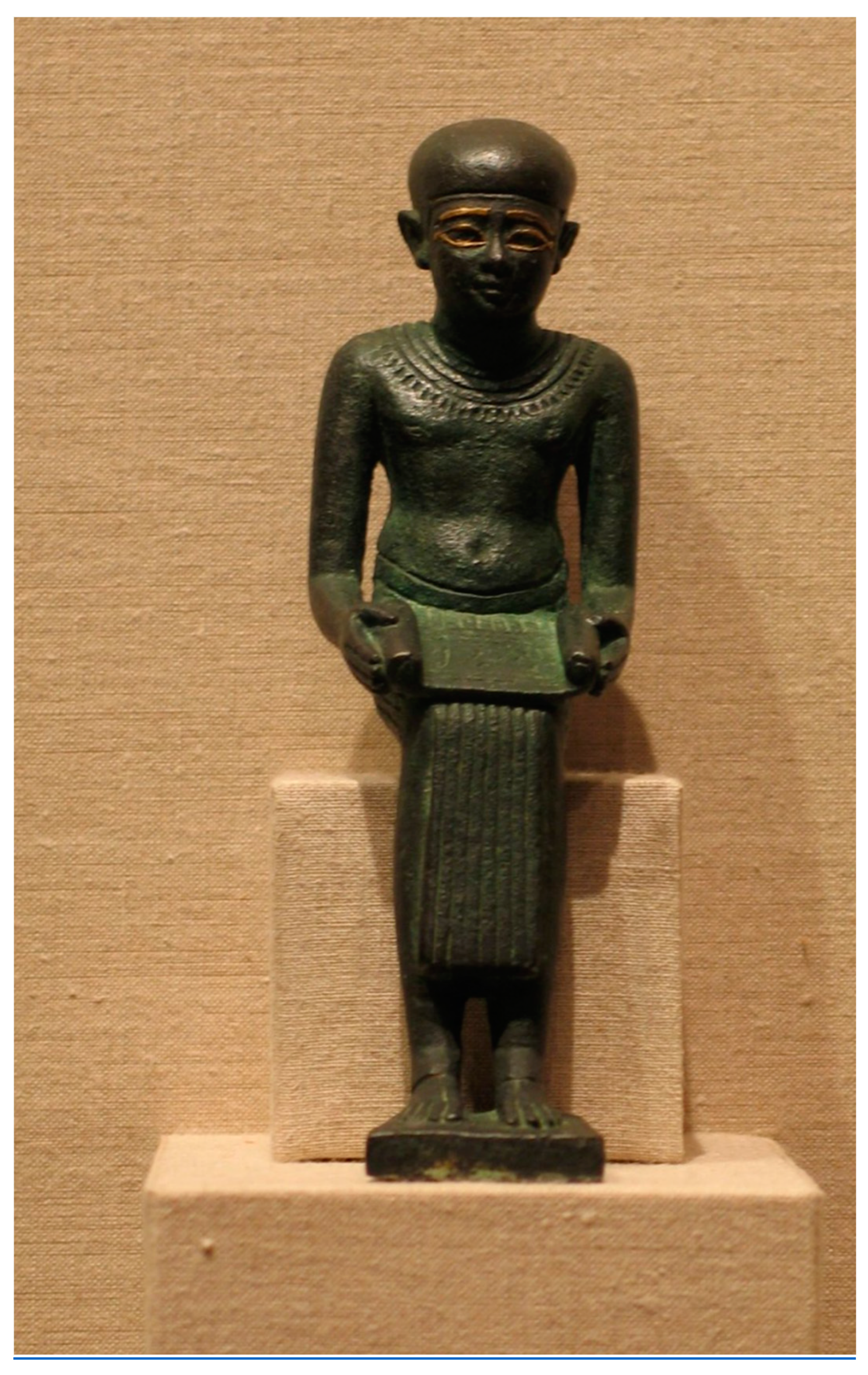
The story of Joseph (Arabic Yousuf) is well known in the scriptures (Gen., 39-50), and a whole verse was assigned to him in the Quran (Surat Yousuf). He is the man who was chosen to be the vizier of an Egyptian monarch, in a time of severe climate changes from favorable to draught, while he was able to manage the climate and crops variation with his wisdom and good management. He eventually brought his father Jacob and the whole family from nomadic life to settle in proper Egypt as is well known and further studied by Habermehl, 2013. She followed a series of researchers and produced a convincing argument that Joseph is equivalent to Imhotep, the vizier of Djoser, a monarch from the 3rd dynasty (Habermehl, 2013). The most striking record about Imhotep is his role in advising the pharaoh, Djoser, during a seven-year famine, an event that was later documented on the “Famine stela” stone in Sehel Island, southern Egypt, which copies the role of Joseph solving the problems of the famine, although with some variations (Lichtheim, 1980, 94)32(see Figure 2). Imhotep was considered the wisest man in the kingdom. He was known as the vizier, sage, architect, astrologer, and chief minister of Djoser. His reputation in medicine was so huge that that he was later worshipped as the god of medicine in Egypt and Greece as Asclepius (Encyclopedia Britannica, Imhotep). Joseph was a distinguished seer, as he predicted the fates of the chief butler and chief baker in Egypt and the seven years of plenty and the following seven years of famine, then chosen by the king to be the vizier overseeing the kingdom’s administration (Gen., 41: 39-45; Quran, Surat Yousuf). He is portrayed in Egyptian sculptures made at much later times seated on a chair, wearing a cap, and holding open papyrus scroll (Figure 3).
We are hence justified in looking for Joseph as the visier of Djoser, who ruled 29 years according to Manetho, started on 4917 B.C. and ended in 4888 B.C. (Verbrugghe and Wickersham, 2001). The chronology of Joseph is straightforward. Abraham bore Isaac at age 100, that is in the year 5035 B.C. Isaac bore Jacob at age 60, that is in 4975 B.C. Jacob bore Joseph at age 91, that is in 4884 B.C. We note that this sequence is well within the dry and arid period that dominated Egyptian eastern desert and Arabia as shown above and observed in the story of Jacob’s sons complaining from harsh desert conditions (Surat Yousuf, 88). We should expect Joseph to start his assignment as Imhotep at age 25, say in the middle of Djoser’s reign at the year 4902 B.C. He then would have been born in 4927 B.C. Therefore, according to Genesis and our calculations, there is about 43 years mismatch, not bad if distributed between three generations, considering a possible exaggeration in the ages of the patriarchs. We hence have a confirmation both for Joseph as Imhotep and for Abraham in the second dynasty of Egypt.
Conclusion:
We find that ancient secular documents, long considered fantastic, if properly utilized in conjunction with stories from religious sources, can be of valuable benefit in solving chronological issues, especially if studied within relevant climatic, geological, and astronomical context. We have demonstrated in this study a case for placing the chronology of prophet Abraham in the Egyptian second kingdom, and Joseph in the third kingdom, in sync with Mesopotamian Kish 2 dynasty. This placement corresponds to the near east chalcolithic period, roughly between 5250-4850 B.C. Abraham was found to be contemporary to king Menuna of Babylon, and Sethenes of Egypt. Joseph was found to be equivalent to Imhotep, the famous vizier of king Djoser of Egypt. This chronology fits very well the climatic conditions in west Asia/East Africa at the time, were droughts and famines were frequent. In addition, the farm and transport animals like cows, sheep asses and camels were already in common practice. Future research should be continued to allocate a time horizon for Moses, and the Exodus events.
References
- Adler, William and Tuffin, Paul, trans., 2012. The Chronography of George Synkellos, Oxford, Oxford University Press.
- Al-Bukhari, 1998, Mohammed bin Ismail, Sahih Al-Bukhari, Riyadh, International Ideas home for Publishing.
- Badawi, Aburrahman, 1982. Orosius-Tarikh Al-Aalam Al-Qadim, Beirut, Al-Muassash Al-Arabiya liddirasat wa Alnnashr.
- Baldwin, John D., 1872. Pre-Historic nations, New York, Harper & Brothers.
- Barrick, William D., 2009. Ur of the Chaldeans (Gen., 11:28-31): A model for dealing with difficult text, THSJ, 20/1 (Spring 2009), 7-18.
- Bernal, 1991. Black Athena The Afroasiatic roots of classical civilization, vol II, London, Free Association Books.
- Bernbeck, Reinhart, 2005. The Past as Fact and Fiction: from Historical Novels to Novel Histories, in: Pollock, Suzan & Bernbeck, Reinhart, editors, Archaeologies of the Middle East, Malden, MA, USA, Blackwell publishing, 97-122.
- Boivin, Nicole & Fuller, Dorian. Shell Middens, ships and seeds: exploring coastal subsistence, maritime trade and the dispersal of domesticates in and around the ancient Arabian Peninsula. Journal of World Prehistory 2009, 22, 113–180.
- Bryant, Jacob, 1767. Observations and Enquiries relating to various parts of ancient history, Cambridge, J. Archdeacon printer.
- Budge, Wallis E. A., 1895. The Egyptian Book of the Dead, New York, Dover Publications.
- Bunsen, Christian C. J., Cotterell, Charles L., transl., 1854, The Place of Egypt in ancient history, vol II, London, Longman Brown Green and Longmans.
- Chwolson, 1859. Uber die uberreste der Altbabylonischen literatur in Arabischen ubersetzungen, St. Petersburg, Kessinger Legacy Reprints.
- Clare, Lee. Göbekli Tepe, Turkey. A brief summary of research at a new World Heritage Site (2015-2019). e-Forschungsberichte 2020, 2, 81–88.
- Collins, Andrew, 2014. Gobekle Tepe Genesis of the Gods, Rochester, Bear and Company.
- Daniel, Glyn 1962. The idea of prehistory, Cleveland and New York, The World Publishing Company.
- De Laporte, L. , Childe, V. Gordon, Transl., 1925. Mesopotamia The Babylonian and Assyrian civilization, New York, Alfred Knopf.
- De Menocal, Peter, et. al. Abrupt onset and termination of the African Humid Period: rapid climate responses to gradual insolation forcing. Quaternary Science Reviews 2000, 19, 347–361. [CrossRef]
- De Mieroop, Marc Van. A History of the near east ca. 3000-323 B.C., Oxford, Blackwell Publishing.
- Der Toorn, K. van & der Horst, P. W. Nimrud before and after the Bible. HTR 1990, 83, 1–29.
- Donnelly, Ignatius, Sykes, Egerton, ed., 1949. Atlantis the Antediluvian World, New York, Gramercy Publishing.
- Edgerton, William F. The Chronology of the 12th Dynasty. JNES 1942, 1, 307–314.
- Fahad, Tawfiq, ed., 1993. Al-Filahah Annabatiyah, Dimashq, Al-Maahad Al-Ilmi Al-Faransi liddirasat Al-Arabiyah.
- Finkelstein, Israel, 2005. Archaeology, Bible, and the History of the Levant in the Iron Age, in: Pollock, Suzan & Bernbeck, Reinhart, editors, Archaeologies of the Middle East, Malden, MA, USA, Blackwell publishing, 207-222.
- Fleitmann, Dominic, et. al. Holocene Forcing of the Indian Monsoon Recorded in a Stalagmite from Southern Oman. Science 2003, 300, 1737–1739. [CrossRef]
- Faux, Clement. A 7500- year strontium isotope record from the northwestern Nile delta (Maryut lagoon, Egypt). Quaternary Science Reviews 2013, 78, 22–33. [CrossRef]
- Free, Joseph P. Abraham’s Camels. Journal of Near Eastern Studies 1944, 3, 187–193.
- Galassi, Francesco M., et. al. Oldest case of gigantism? Assessment of the alleged remains of Sa-Nakht king of ancient Egypt. The Lancet Diabetes and Endocrinology 2017, 5, 580–581. [CrossRef]
- Genesis, the Book of.
- Gilead, Isaac. The Chalcolithic Period in the Levant. Journal of World Prehistory 1988, 2, 397–444. [CrossRef]
- Glassner, Jean-Jacques, Foster, Benjamin R., Ed., 2004. Mesopotamian chronicles, Atlanta, Society of Biblical Literature.
- Guagnin, Maria, et al. Life-sized Neolithic Camel Sculptures in Arabia: A Scientific Assessment of the Craftmanship and Age of the Camel Site Reliefs. Journal of Archaeological Science: Reports 2022, 42, 103165.
- Guralnick, David B., 1979. Webster’s New World Dictionary, New York, 228.
- Habermehl, Anne, 2013. Revising the Egyptian Chronology: Joseph as Imhotep, and Amenemhat IV as Pharaoh of the Exodus, Proceedings of the seventh international congress on creationism, Pittsburg, Pa., July, 2013. The Holy Quran.
- Kennedy, Melissa, et. al. Cult, herding, and ‘pilgrimage’ in the Late Neolithic of north-west Arabia: Excavations at a mustatil east of AlUla. PLOS ONE 2023. [CrossRef]
- Kitchen, Andrew, et. al. Bayesian Phylogenetic Analysis of Semitic Languages Identifies an Early Bronze Age Origin of Semitic in the Near East. Proceedings of the Royal Society B 2009, 276, 2703–2710. [CrossRef]
- Lazaridis, Iosif, et. al. Genomic insights into the origin of farming in the ancient Near East. Nature 2016, 536, 419–424. [CrossRef] [PubMed]
- Lichtheim, Miriam, 1980. Ancient Egyptian Literature, A Book of Reading, vol. 3, Berkeley, University of California Press.
- Malkowski, Edward F., 2006. Before the Pharaohs Egypt mysterious prehistory, Rochester, Bears & Company.
- Midant-Reynes, Beatrix, Shaw, Ian (trans.), The Prehistory of Egypt, Oxford, Blackwell publishing.
- Mokhtar, G, ed.,1981. Ancient civilizations of Africa, Paris, UNESCO.
- Muheisin, Muhammad Salim, 1393 A.H. Tarikh Al-Quran Al-Karim, Alexandria, Mu’ssasat Shabab Al-Jami’ah.
- Nolan, Frederick, 1848. The Egyptian Chronology Analyzed, London, Seelens.
- Noldeke, Theodore, et. Al., Behn, Wolfgang H. edit. 2013. The History of the Quran, Leiden, Brill.
- Ibn Dhahirah, Assaqqa, Mustafa & Al-Muhandis, Kamil, ed., 1969. Al-Fadhail Al-bahirah fi Mahasin Misr wa Al-Qahirah, Cairo, Dar Al-Kutub.
- Otte, Marcel, 2007. Vers la Prehistoire-Une Initiation, Bruxelles, de Boeck.
- Parker, Richard A., 1950. The Calendars of ancient Egypt, Chicago, the Oriental Institute of the University of Chicago.
- Pennington, B. T., et. al. The fluvial evolution of the Holocene Nile Delta. Quarterly Science Reviews 2017, 170, 212–23. [CrossRef]
- Petrie, W.M. Flinders, 1906. Researches in Sinai, New York, E. P. Dutton & Company.
- Petrie, W.M. Flinders, 1920. A History of Egypt, vol. I, 3rd ed., London, Methuen & Co.
- Rigaud. Symbolic innovation at the onset of the Upper Paleolithic in Eurasia shown by the personal ornaments from Tolbor-21 (Mongolia). Nature, Sci Rep 2023, 13, 9545.
- Ripinsky, Michael. The Camel in predynastic Egypt. The Journal of Egyptian Archaeology 1985, 71, 134–141. [CrossRef]
- Roux, Georges, 1992. Ancient Iraq, London, Penguin Books.
- Schliemann, Paul, 1912, How I found the lost Atlantis, Forgotten Books.
- Seyfzadeh, Manu; Schoch, Robert M., Bauval, Robert. A New Interpretation of a Rare Old Kingdom Dual Title: The King’s Chief Librarian and Guardian of the Royal Archives of Mehit. Archaeological Discovery 2017, 5, 163–177. [CrossRef]
- Tohar, Vered. Abraham and Sarah in Egypt (Genesis 12:10-20): Sexual Transgressions as Apologetic Interpretations in post-biblical Jewish sources. Women in Judaism: A Multidisciplinary Journal 2013, 10, 1–14.
- Tomkins, Henry George, 1878. Studies on the times of Abraham, London, Samuel Baxter and sons.
- Torun, Ahmet Onur, 2021. Animal exploration at the late Pleistocene-holocene transition in upper Mesopotamia (10900- 7700 cal. B.C.) with a focus on a proposed hunter- gatherer crisis, MS. Thesis, Middle East Technical University, Türkiye.
- Verbrugghe, Gerald, P. & Wickersham, John, M., 2001. Berossos and Manetho introduced and translated, Ann Arbor, The University of Michigan Press.
- Wang, Yongin, et. al. The Holocene Asian Monsoon: Links to Solar Changes and North Atlantic Climate. Science 2005, 308, 854–857. [CrossRef]
- Waterfield, Robin, 1988. Herodotus The Histories, Oxford, Oxford University Press.
- Wengrow, David, et. al. Cultural convergence in the Neolithic of the Nile Valley: a prehistoric perspective on Egypt's place in Africa. Antiquity 2014, 88, 95–111. [CrossRef]
- Westendorf, Wolfhart, 1992. Erwachen der Heilkunst Die Medizin im Alten Ägypten, Zurich, Artemis & Winkler.
- Wiedemann, A. on a monument of the 1st dynasties of Egypt. Proceedings of the Society of Biblical archeology 1887, 180–184. [Google Scholar]
- Wilkinson, 2003. Toby A. H., Early Dynastic Egypt, New York and London, Routledge.
- Yletyinen, Johanna, 2009. Holocene climate variability and cultural changes at river Nile and its Saharan Surroundings, Stockholm, Instituteonen for natur geografi och kvartargeoloy, Stockholms Universitet.
- Web Resources: -Encyclopedia Britannica, Imhotep. https://www.britannica.com/biography/Imhotep. -https://pharaoh.se/pharaoh/Senedj.
| 1 | We understand historiography and history in the standard dictionary meaning as: “the study of the techniques of historical research”, as opposed to history: “an account of what has happened in the life of a people, country, etc”. See: Guralnick, 1979, 228. |
| 2 | Glassner thinks that some of the chronicles date back to the time of Naram Sin the king of Akkad. |
| 3 | Bernal and other scholars advocated 3400 B.C. as the date of the beginning of the 1st dynasty. |
| 4 | Such a vague reference may be subject to debate whether Berossos reference meant Abraham. If it is accepted, then he or a later editor of his work was influenced by the scripture, especially the book of Genesis, 11:10-26, indicating Abraham was the 10th in descent from Shem son of Noah. Verbrugghe and Wickersham, 2001, discussed a claimed Manetho reference to Abraham but shown to be false, see note on p. 177. |
| 5 | Tomkins reckoned the time of Abraham’s entrance into Canaan between 2027 and 1921 B.C. Entry into Egypt is estimated at 1900 B.C., (see p. 155). |
| 6 | Finkelstein divided the schools of thoughts into three camps. The conservatives (maximalists) want to believe that the bible is a reliable historical and chronological source. The centrists like Finkelstein himself would shed doubts on the biblical narrative due to the fact of subsequent editing processes. The radicals (minimalists) like Thompson and others reject most biblical histories and treat them as fictional stories. See Finkelstein (2005) for details. |
| 7 | Theodore Noldeke Originally published his “History of the Quran” in 1909 in German. |
| 8 | Daniel explained that the idea of Prehistory surfaced in the literature only in 1851 C.E. It was then quickly adopted to indicate the geological eras: Paleolithic, Neolithic, Bronze and Iron ages. John Lubbock published his “Prehistoric Times” in 1865. John Baldwin published his “Prehistoric Nations” in 1872. |
| 9 | The Royal Chronicle of Lagash. |
| 10 | The older estimate was given by Chwolson, on the basis that it had no mention of the Israelites. This of course is based on the biblical chronology of Moses. |
| 11 | His name is Abu Bakr Ahmad Al-Kasdani, known as Ibn Wahshiyyah Al-Nabati. He found the manuscript with his kinsmen the native Kasdaneans, translated it from Syriyac language to Arabic in 291 A.H./904 C.E. It was published by the French Institute for Arabic Studies in Danascus in 1993, edited by Tawfiq Fahad. There is a manuscript of it in the Ottoman Collection named “Nur Osmaniye”, number 3028. |
| 12 | I am inclined here to take the word of Quthama as authentic since there is no justification exists that this part of the text is falsified. Some parts of this work are thought to be of a more recent authorship, for this and other views about it, see: Hameen-Anttila, 2006, 10-33. |
| 13 | According to Barrick, the 1st mention of Chaldeans in secular texts appeared in Assyrian inscriptions (883-859 B.C.). |
| 14 | Herodotus finished writing his history in 425 B.C. |
| 15 | Solon (630-560 B.C.) was a Greek stateman and poet. He was the grandfather of Plato. |
| 16 | An ancient Egyptian city currently known as Sa El-Hagar, situated on the Rosetta branch of the Nile. |
| 17 | He was a German archaeologist (1822-1890) famous for his excavations in Greece and especially in Troy. |
| 18 | The last king of ancient Troy. |
| 19 | An early discussion on the historicity of the Nabathean Agriculture book can be found in: The Christian Remembrance, 1869, 417-453. It was suggested that the the Cananeans mentioned therein referred to the Arabians who ruled Babylon from 1520 to 1275 B.C. as documented in Berossus chronology. This would be a convenient choice had we believed the chronology that placed Abraham around 2000 B.C. |
| 20 | Karmin, 2015. See Fig. S4 A&B. The male population decline was universal but took various timetables in different areas of the world. Europe and African populations’ decline lagged the near East and bottomed around 5000 B.P. |
| 21 | The copper and metal industry flourished since Naqada II period, |
| 22 | According to Gilead, the Chalcolithic age extended from 5500 till 3500 B.C. when the Bronze age began. |
| 23 | Prestige good include Ivory tusk, hides, Myrrh, Frankincense, etc. |
| 24 | Orosius was a 5th century C.E. Byzantine historian. Badawi edited an Arabic old copy of Orosius world history which is the one quoted here. |
| 25 | Here Nimrod refers to a king who ruled prior to the time of Abraham. Although the script indicates that Abraham’s family was Cananean, this should not be interpreted in racial but geographical context, see Barrick, 2009 for discussion on this subject. |
| 26 | We calculated the sequence based on the dynastic list, taking datum point the fall of Isin dynasty on 1794 B.C., see Roux, 1992, 92; de Mieroop, Op. Cit, 282. |
| 27 | Bryant is referring to Africanus, saying that Ninius ruled 52 years and Abraham was born in the 43rd year of his reign. This does not give Abraham enough maturity to confront the monarch with radical ideas. For a review of literature on Nimrod and Abraham, see: der Toorn and der Horst, 1990. |
| 28 | Shem, Arphaxad, Shelah and Eber. |
| 29 | Al-Bukhari (d. 256 A.H/ 870 C.E.) is a most respected narrator of prophet Mohammed’s sayings. |
| 30 | We cannot pursue this issue further but only note that monumental descriptions of ancient Egyptian kings often show them of great stature, see for example the palette of king Narmer in Midant-Reynes, 2000, 243-246. |
| 31 | This identification is related to Qatadah, an early Islamic scholar from Iraq, died 117 A.H. (735 C. E.). |
| 32 | The Stele was most likely written in Ptolemaic period in memory of Imhotep and his achievement. Accordingly, its author may have been influence by the biblical literature available at that time. If this to be the case the author was well informed to represent Joseph as Imhotep. |
Figure 1.
Cartouche of king Senedj. Source: https://en.wikipedia.org/wiki/Senedj#/media/File:Abydos_KL_02-05_n13.jpg.
Figure 1.
Cartouche of king Senedj. Source: https://en.wikipedia.org/wiki/Senedj#/media/File:Abydos_KL_02-05_n13.jpg.
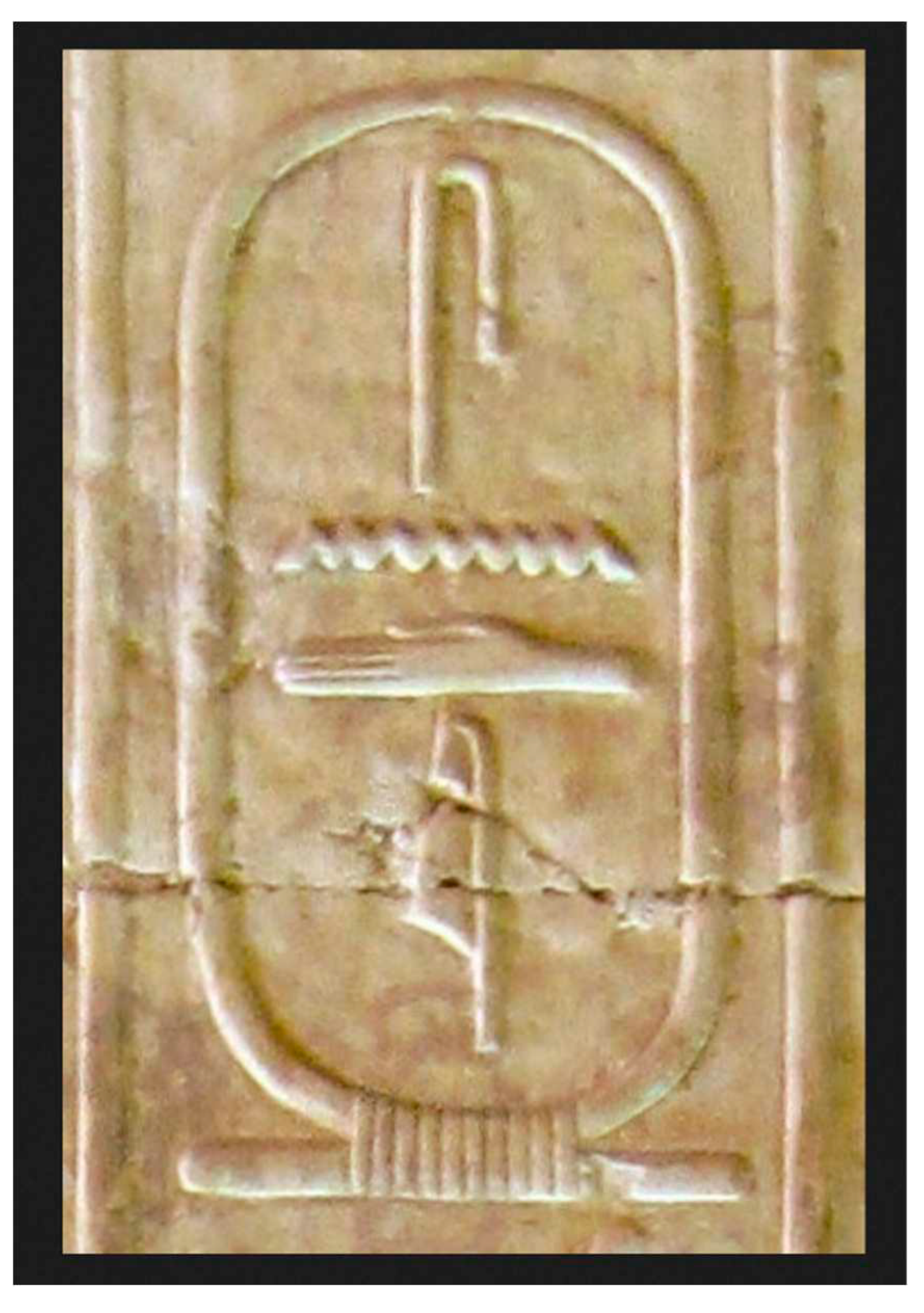
Figure 2.
the Upper part of Famine stele in Sehel Islands. Source: https://upload.wikimedia.org/wikipedia/commons/e/eb/Sehel-steleFamine.jpg.
Figure 2.
the Upper part of Famine stele in Sehel Islands. Source: https://upload.wikimedia.org/wikipedia/commons/e/eb/Sehel-steleFamine.jpg.
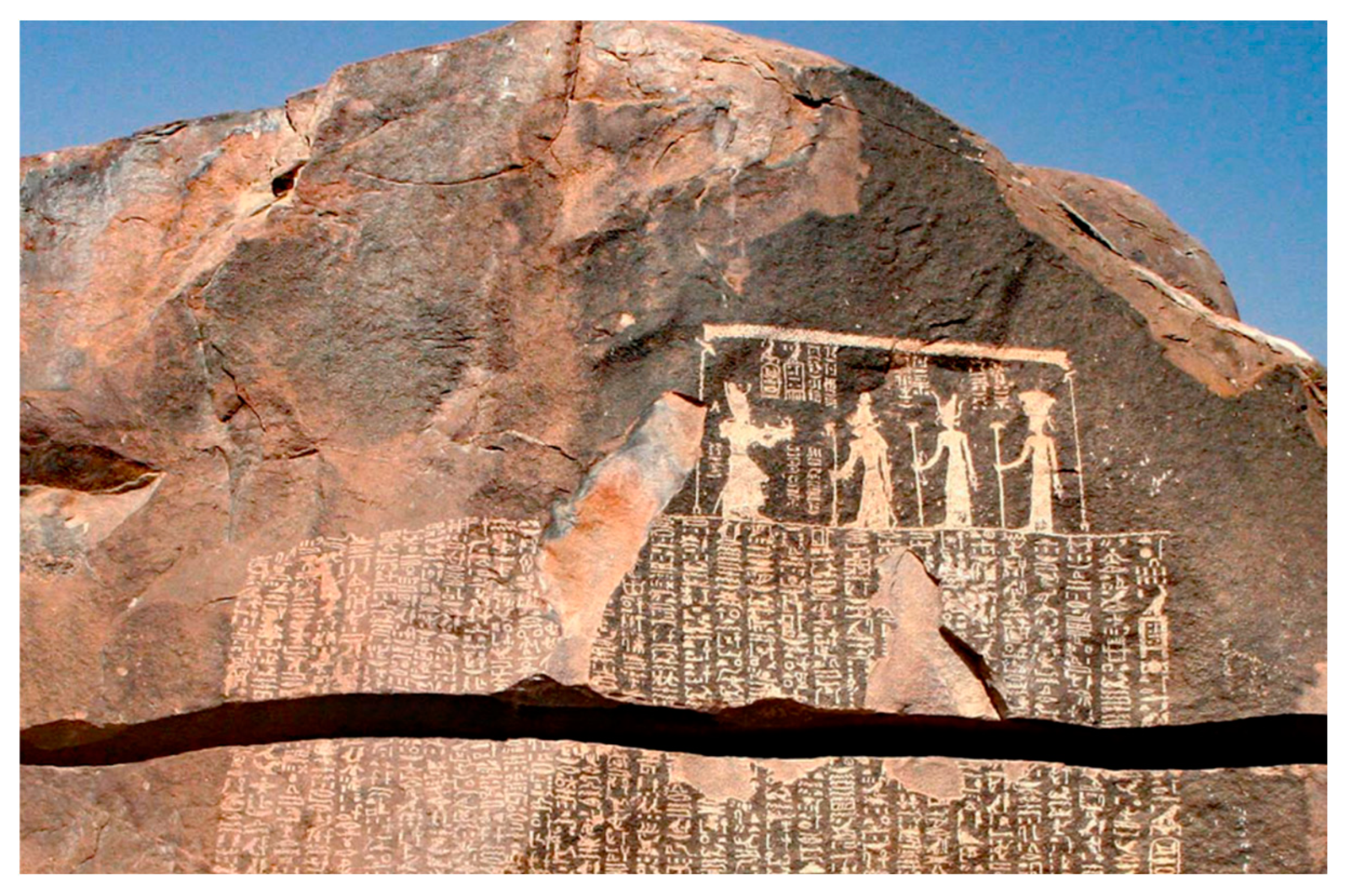
Figure 3.
Imhotep seated Bronze Statue, 664-630 B.C. Source: https://www.brooklynmuseum.org/opencollection/objects/3234.
Figure 3.
Imhotep seated Bronze Statue, 664-630 B.C. Source: https://www.brooklynmuseum.org/opencollection/objects/3234.
Disclaimer/Publisher’s Note: The statements, opinions and data contained in all publications are solely those of the individual author(s) and contributor(s) and not of MDPI and/or the editor(s). MDPI and/or the editor(s) disclaim responsibility for any injury to people or property resulting from any ideas, methods, instructions or products referred to in the content. |
© 2023 by the authors. Licensee MDPI, Basel, Switzerland. This article is an open access article distributed under the terms and conditions of the Creative Commons Attribution (CC BY) license (http://creativecommons.org/licenses/by/4.0/).
Copyright: This open access article is published under a Creative Commons CC BY 4.0 license, which permit the free download, distribution, and reuse, provided that the author and preprint are cited in any reuse.


