

Submitted:
27 June 2023
Posted:
27 June 2023
You are already at the latest version
Abstract
Mosquitoes transmit pathogens that cause human diseases such as malaria, Dengue fever, Chikungunya, yellow fever, Zika fever, and filariasis. Chemical pesticides are effective instruments for reducing disease transmission and managing mosquito populations. However, these chemicals have drawbacks such as high production costs and negative effects on the environment and non-target organisms. Furthermore, as mosquitoes develop resistance to chemical insecticides, they become less effective. As a result, researchers are investigating novel insecticides. Advances in microbial biotechnology have resulted in a wide range of value-added products, including biopesticides for agricultural and public health purposes. In this review, we highlight the mainly untapped biotechnological potential of microorganisms for vector mosquito control and disease transmission reduction. Also, we underline the importance of more basic research and improved translational research methodologies, encouraging efforts to bridge the gap between academic research on biopesticides and public health interventions.
Keywords:
Biotechnology
; microorganisms
; bacteria
; fungi
; vector control
; mosquitoes
‡ current address: J.A.S-N.: Department of Diagnostic Medicine/Pathobiology, College of Veterinary Medicine, Kansas State University, Manhattan, Kansas, USA.
1. Introduction
Microorganisms constitute a large group of genetically diverse biological entities found in a wide range of terrestrial and aquatic habitats, playing crucial roles in the balance of ecosystems [1,2,3]. Advances in microbiology, molecular biology, and genomics enabled the biotechnological exploration of microbes, allowing the discovery and production of antibiotics [4,5], foods [6,7], alcoholic beverages [8], bioremediators [9,10], fertilizers [11], and biopesticides [12,13]. The microorganisms associated with mosquitoes have drawn special attention for their potential applications in public health (Figure 1) [14,15,16]. In this review, we highlight the largely unexplored potential of microbes for the control of mosquito-borne diseases and the need for better translational research strategies, encouraging efforts toward bridging the gap between academic research and public health interventions.
2. Bacteria for biological control of medically important mosquitoes
Today, chemical insecticides are used as the main tool for mosquito control [17,18], but are no longer as effective as in the past due to the selection of insecticide resistant individuals in mosquito populations worldwide [19,20,21,22]. Furthermore, chemical insecticides harm the environment, contaminating groundwater systems through infiltration into the soil, reaching riverbeds, accumulating in fish and other animals [23], and through spraying, contaminating the air, affecting human health [24,25]. These facts emphasize the prominent need to develop new, efficient, and environmentally safe tools for the control of vector mosquitoes and the diseases they transmit.
Bacteria of the Bacillaceae family infect insects and produce toxins with insecticidal properties. Bacillus thuringiensis israelensis (Bti) and Lysinibacillus sphaericus (Lbs), the latter formerly known as Bacillus sphaericus, are widely known for their larvicidal activity against several species of mosquitoes [26,27,28,29,30]. Due to their high efficacy, safety, and the well-characterized mechanisms of action of their toxins, several strains of Bti and Lbs are included in commercially available biological larvicide formulations endorsed by organizations such as the World Health Organization [31] and the Environmental Protection Agency (EPA) in the United States of America (www.epa.gov/mosquitocontrol/bti-mosquito-control).
The toxins of Bti and Lbs and the mechanisms associated with mosquito mortality have been extensively studied [32,33]. Briefly, in Bti, the molecules responsible for the entomopathogenic action are mainly the crystal toxins Cry4Aa, Cry4Ba, Cry10Aa, and Cry11Aa, the cytolytic toxins Cyt1Aa, and Cyt2Ba, and the P19 and P20 proteins [34,35]. Cry and Cyt toxins, also known as δ-endotoxins, when present in the midgut of mosquito larvae, are proteolytically activated by digestive proteases, bind to specific receptors on the host cell membranes, and cause cell rupture, resulting in death of infected larvae [36]. The Lbs Bin toxins [37,38,39], Mtx [40], Cry48Aa and Cry49Aa [41], display entomopathogenic mechanisms similar to those described above for the Bti toxins [42]. Acting synergistically, these toxins result in effective and potent toxic activity against mosquitoes [43,44,45].
Finding new microbes with larvicidal activities similar to those of Bti and Lbs has been the goal of several research groups around the world. However, this endeavor has been limited by the fact that culture media do not always meet the requirements for the growth of many species of bacteria [46]. Therefore, the search for entomopathogenic bacteria is often limited to those that grow in commercially available culture media. Despite these limitations, bacterial strains that are suitable for cultivation and have larvicidal activity have been identified. Unfortunately, most of them have not been further investigated, developed to applicable products, or tested under field or semi-field conditions. Additional research to understand their mechanisms of action, effects on non-target organisms and potential for large-scale production is needed.
Toward these goals, live bacteria, deactivated bacteria, and fractionated cells or culture media have been tested for their larvicidal activities. For example, Bacillus safensis, Bacillus paranthracis, and Bacillus velezensis culture supernatants and crude lipopeptide extracts were shown to be toxic to Aedes aegypti [47]. Whole genome sequencing and mass spectrometry analysis of those isolated bacteria strains revealed that these microorganisms synthesize bacteriocin, beta-lactone, and terpenes potentially toxic to mosquito larvae [47]. Nineteen Bacillus sp. strains and two strains of Brevibacillus halotolerans isolated from Amazonian environments showed larvicidal activity against Ae. aegypti [48]. The supernatant and pellet fractions of those strains were tested separately, revealing that cellular and secreted metabolites are toxic to mosquito larvae. Bacillus mojavensis kills Ae. aegypti larvae and its action was provisionally attributed to the biosurfactant surfactin thioesterase [49]. The testing of whole or fractionated bacteria and culture media is useful for defining procedures and formulation of new and promising biolarvicides. The identification of bacteria with mosquito larvicidal activities, in addition to Bti and Lbs (Table 1,) instigates their exploration as potential tools for mosquito control.
3. Fungi as vector mosquito biocontrol agents
Fungi, and their metabolites are also potentially useful for the control of medically important mosquitoes [132,133,134,135,136,137]. In fact, fungal strains have already been applied as complementary measures for the control of vector mosquitoes [138,139,140,141].
Beauveria bassiana strains infect and kill a variety of insects, including mosquitoes. Application of B. bassiana spores on surfaces where mosquitoes rest [142], the impregnation of spores in traps [143], association of the fungus with insecticides, such as the combination of B. bassiana and permethrin [144] and the spread of the fungus by females mating with pre-inoculated males [145] have been proposed as means of field applications of B. bassiana against mosquitoes. The attraction of An. stephensi to spores of B. bassiana present in dead and dying caterpillars infected with the fungus [146], has been proposed as a useful alternative to infect mosquitoes. Furthermore, experimental evolution has been applied successfully to increase the efficacy of B. bassiana to Anopheles coluzzii [147].
Exposure to lethal and sublethal doses of B. bassiana spores decreases Ae. aegypti and Ae. albopictus host-seeking behavior and fecundity [132,148]. Infected mosquitoes, while still alive, spread the fungus through the vector population. Beauveria bassiana spores and extracts are also effective against mosquito larvae [149,150,151]. As a result of this evidence, several strains of B. bassiana are authorized for use as biological insecticides, against vector mosquitoes, by regulatory agencies such as the EPA [152] and ANVISA in Brazil [153].
Metarhizium anisopliae is another fungus with biotechnological potential for mosquito control [154]. Its entomopathogenic mechanism is similar to that of B. bassiana. After contact, the spores germinate, producing hyphae, which in turn penetrate the insect exoskeleton, developing inside the host's body [155,156].
Metarhizium anisopliae CN6S1W1 is effective against Ae. albopictus and Cx. pipiens [157]. The fungus also affects the behavior of An. gambiae mosquitoes by inhibiting blood feeding and reducing fecundity and oviposition [158]. Concurrent infections with both M. anisopliae and B. bassiana shorten the lifespan of Ae. aegypti [142,159]. The synergistic actions of M. anisopliae and B. bassiana, together with the imidacloprid immunosuppressant, showed a greater larvicidal activity against Cx. quinquefasciatus than the respective entomopathogens alone [160]. The metabolites isolated from M. anisopliae are also active against Ae. aegypti, An. stephensi, and Cx. quinquefasciatus [135]. These metabolites represent a solution for mosquito larvae control, since M. anisopliae conidia are not effective in the aquatic environment [161].
In addition to B. bassiana and M. anisopliae, other fungi have been reported with high biotechnological potential for mosquito control. The killing activity of Aspergillus nomius spores toward adult Ae. albopictus was comparable to those of B. bassiana [162]. Crude and purified extracellular extracts of Aspergillus with larvicidal action against An. stephensi, Cx. quinquefasciatus, and Ae. aegypti were reported [163]. Di-N-Octyl phthalate, (1H-Benzoimidazole-2-Yl)-[4-(4-Methyl-Piperazin-1-Yl)-Phenyl]-Amine, and 6,8-Dimethyl-5-Oxo-2,3,5,8-Tetrahydroimidazo [1,2-A] Pyrimidine, secondary metabolites of Aspergillus flavus and Aspergillus fumigatus [164] and preg-4-en-3-one, 17. α-hydroxy-17. β-cyano-, trans-3-undecene-1,5-diyne, and pentane, 1,1,1,5-tetrachloro-, from Aspergillus tamarii have been suggested to be responsible for larvicidal activity [165]. The biosafety of products derived from Aspergillus spp, or the fungus itself, still needs to be investigated. Suspensions of A. flavus conidia exhibited considerable toxicity against non-target organisms present in aquatic environments of mosquito larvae [166].
Species of the genus Isaria also have entomopathogenic characteristics for mosquito control. Isaria tenuipes [167], Isaria javanica ARSEF 5874 and Isaria cateniannulata ARSEF 6241 strains showed high levels of pathogenicity toward Ae. aegypti [134]. Larvicidal activity against Cx. quinquefasciatus and Ae. aegypti were demonstrated with silver nanoparticles (AgNps), with secondary metabolites of Isaria fumosorosea (Ifr) [168]. Other fungal species of interest that may be useful for vector control include Trichoderma asperellum [169] and Hyalodendriella sp. [170] which produce metabolites toxic to mosquitoes.

Table 2.
Fungal strains toxic to Aedes, Culex, and/or Anopheles mosquito larvae.
| Fungus | Toxic formulation | Target mosquito genera | Refs | ||
|---|---|---|---|---|---|
| Aedes | Culex | Anopheles | |||
| Beauveria bassiana | Fungal suspensions | + | - | - | [142] |
| Surfaces treated with conidia | + | - | - | [145] | |
| Spores | + | - | - | [132] | |
| Oil-formulated spores | - | - | + | [146] | |
| Fungal suspensions | - | - | + | [149] | |
| Spores | - | - | + | [147] | |
| Fungal suspensions | + | + | - | [171] | |
| Metarhizium anisopliae | Conidial suspension | - | + | - | [172] |
| Fungal conidia | + | - | - | [173] | |
| Fungal suspensions | + | - | - | [142] | |
| Conidial suspension | + | + | - | [157] | |
| Oil formulation | - | + | + | [174] | |
| Secondary metabolites | + | + | + | [175] | |
| Aspergillus niger | Crude metabolites | + | + | + | [163] |
| Aspergillus flavus | Secondary metabolites | + | + | + | [164] |
| Suspensions of conidia | + | - | - | [166] | |
| Culture filtrates | - | + | - | [176] | |
| Aspergillus fumigatus | Secondary metabolites | + | + | + | [164] |
| Aspergillus parasiticus | Culture filtrates | - | + | - | [176] |
| Aspergillus tamarii | Endophytic Fungal Extracts | + | + | - | [165] |
| Aspergillus terreus | Mycelia (Ethyl acetate and methanol extracts) | + | + | + | [177] |
| Emodin compound | + | + | + | [178] | |
| Aspergillus nomius | Spores | + | - | - | [162] |
| Beauveria tenella | Blastospores suspensions | + | + | - | [179] |
| Cladophialophora bantiana | Secondary metabolites | + | + | - | [180] |
| Chrysosporium lobatum | Secondary metabolites | - | + | + | [181] |
| Chrysosporium tropicum | Secondary metabolites | + | + | + | [182] |
| Fusarium moniliforme | Isoquinoline type pigment | + | - | + | [183] |
| Fusarium oxysporum | Temephos + F. oxysporum extract | + | + | + | [184] |
| Fusarium vasinfectum | Culture filtrates | - | + | - | [176] |
| Isaria javanica | Conidial suspensions | + | - | - | [134] |
| Isaria cateniannulata | Conidial suspensions | + | - | - | [134] |
| Isaria tenuipes | Conidial suspensions | + | - | - | [167] |
| Isaria fumosorosea | Secondary metabolites | + | + | - | [168] |
| Paecilomyces sp. | Secondary metabolites | + | + | + | [131] |
| Penicillium daleae | Mycelium extract | + | + | - | [185] |
| Penicillium falicum | Culture filtrates | - | + | - | [176] |
| Penicillium marneffei | Spores | - | + | - | [186] |
| Penicillium sp. | Ethyl acetate extract | - | + | - | [187] |
| Ethyl acetate extract | + | + | - | [188] | |
| Pestalotiopsis virgulata | Ethyl acetate mycelia (EAM) extracts and liquid culture media (LCM) | + | - | + | [189] |
| Podospora sp. | Sterigmatocystin compound | - | - | + | [190] |
| Pycnoporus sanguineus | Ethyl acetate mycelia (EAM) extracts and liquid culture media (LCM) | + | - | + | [189] |
| Trichoderma asperellum | Methanolic extract | - | - | + | [169] |
| Trichoderma harzianum | Mycosynthesized silver nanoparticles (Ag NPs) | + | - | - | [191] |
| Trichoderma viride | Culture filtrates | - | + | - | [176] |
| Hyalodendriella sp. | EtOAc extract | + | - | - | [170] |
| Verticilluim lecanii | Spores | - | + | - | [186] |
This list is not exhaustive but provides ideas for future research and product development opportunities.
4. The role of insect-bacteria associations in vector competence
Associations between mosquitoes and their and microbiota have gained significant attention in scientific research due to their impact on vector competence [192,193,194,195,196,197]. Following, we discuss ways these associations can influence vector competence, including the blocking of pathogen infection through the distinctive properties of symbiotic microorganisms, stimulation of the vector's immune system, and the utilization of symbionts for paratransgenesis. Understanding these interactions is essential for developing effective vector-borne disease control strategies to reduce the impact of these diseases on public health.
4.1. Symbiotic bacteria and their potential against infectious agents
The mosquito microbiota influences host development, nutrition, reproduction, and immune responses to invading organisms [198,199,200,201]. While the composition of the mosquito microbiota is largely defined by the environment in which they live [202,203,204], resident bacteria can modulate the development and replication of parasites and viruses within their vectors [205,206,207,208,209,210,211,212]. Although this modulation can enhance or reduce the survival and replication of pathogens within mosquitoes, those mosquito-microbiota interactions that negatively affect pathogens offer innovative possibilities to control arthropod-borne diseases.
For example, the gram-negative bacteria, Escherichia coli H243, E. coli HB101, Pseudomonas aeruginosa and Ewingella americana inhibit the formation of Plasmodium falciparum oocysts, in Anopheles stephensi [213]. Enterobacter sp. (Esp_Z), isolated from the intestine of Anopheles gambiae, inhibited the development of malaria parasites when reintroduced into this same vector species [214,215]. The formation of oocysts of Plasmodium berghei was affected by the presence of Serratia marcescens-HB3 in An. stephensi [216]. In Anopheles gambiae, Escherichia coli, S. marcescens, and Pseudomonas stutzeri reduced the prevalence and intensity of P. falciparum infection [217]. The Serratia Y1 strain exerts inhibitory activity on P. berghei ookinetes by activation of the Toll immune pathway in An. stephensi [218]. Serratia ureilytica (Su_YN1) produces an antimalarial lipase (AmLip) that inhibits the formation of P. falciparum oocysts in An. stephensi and An. gambiae [219]. Asaia SF2.1 also inhibits Plasmodium development in anophelines [220].
Virus replication in their vectors is also regulated by the mosquito microbiota. Bacteria of the genera Proteus, Paenibacillus, and Chromobacterium inhibited the replication of dengue virus serotype 2 (DENV-2) when administered to mosquitoes [110,221]. Some of the mechanisms by which symbiotic bacteria can hamper pathogen development have been elucidated and can be exploited to inhibit the spread of infectious agents by mosquitoes (Figure 2).
The wMel and wAlbB strains of Wolbachia pipientis, an intracellular bacterium, inhibit dengue, chikungunya, and Zika virus replication within mosquito cells [222,223,224,225,226]. However, another Wolbachia strain, wPip, does not inhibit virus infection in Ae. aegypti [227] and the mechanism by which Wolbachia interferes with virus replication has not been fully elucidated. Current hypotheses include competition between Wolbachia and the virus for physical space within mosquito cells and metabolite resources [228,229] and Wolbachia induced modulation of the host's immune system and immune priming [230,231].
Despite the lack of a complete understanding of the mechanism or mechanisms involved in Wolbachia-associated modulation of viral suppression, the Wolbachia-carrying mosquito-based strategy has been deployed as a public health intervention to control dengue transmission (The World Mosquito Program https://www.worldmosquitoprogram.org/). A randomized study carried out in the city of Yogiakarta, Indonesia, compared the areas where Ae. aegypti infected Wolbachia was released with areas without Wolbachia and revealed a 77% lower incidence of dengue cases, in the Wolbachia-treated area [232]. Another study conducted in the city of Niterói, Rio de Janeiro, Brazil, reported a 69% reduction in dengue, 56% in chikungunya, and a 37% reduction in Zika incidence three years after the beginning of the release of Ae. aegypti with Wolbachia [233].
Although these results bring optimism regarding the use of Wolbachia for the control of dengue transmission, these bacteria can have variable effects on mosquito-borne viruses. For example, the Wolbachia strain wMel strongly blocked Mayaro virus (MAYV) infections in Ae. aegypti, but another strain, wAlbB, did not influence on MAYV infection in this same vector. Aedes aegypti infected with wAlbB and wMel showed enhanced Sindbis virus infection rates [234]. The variable effects of Wolbachia on vector competence bring into question the safety of the current release of Wolbachia-infected mosquitoes. Furthermore, the potential impact of these bacteria on biodiversity has not been thoroughly investigated [235,236], and the risk of the emergence of DENV variants that escape virus-specific inhibition in Wolbachia infected mosquitoes [237,238], underscores the importance of further research on interactions between Wolbachia, mosquitoes, viruses, and other organisms.
The intracellular bacterium Wolbachia pipientis has also been used to create conditional sterility between released males and wild-type females through cytoplasmic incompatibility [239]. Large-scale trials of Ae. aegypti population suppression carried out from 2017 to 2018 in California and based on the release of 7.5 million and 14.4 million Wolbachia-infected male mosquitoes, resulted in mosquito population suppression rates of 69% and 95%, respectively. Since 2011 in the United States, the Environmental Protection Agency (EPA) has regulated Wolbachia as a biopesticide [240].
4.2. Exploring the potential of fungi as anti-Plasmodium agents for malaria control
Fungi with potential antiparasitic properties, particularly against protozoa of the genus Plasmodium, have been researched as a potential tool to combat malaria. Endophytic fungi isolated from different organs of Annona muricata, a medicinal plant commonly used in traditional Cameroonian medicine against malaria, completely inhibited the growth of P. falciparum in vitro. Of the 152 fungi tested, 17.7% showed activities against different strains of the parasite, with the strongest effects from fungi belonging to the genus Fusarium, Thricoderma, Aspergillus, Penicillium, and Neocosmopora [241]. Compounds such as oxylipin and alternarlactones from Penicillium herquei and Alternaria alternata respectively, demonstrated in vitro antiplasmodial activity [242,243]. A killer toxin purified from Wickerhamomyces anomalus, a symbiotic yeast of insects, when supplemented in a mosquito diet interfered with the development of ookines in the An. stephensi midgut [244]. Aspergillus also showed antiplasmodial activity when supplemented in the mosquito diet. This activity was shown to be related to inhibition of the interaction between parasites and fibrinogen-related protein-1 (FREP1), an agonist of gametocytes and ookinetes [245]. These authors identified the fungal metabolite orlandin as a candidate reagent to inhibit P. falciparum infection in An. gambiae.
The topical application or spraying of B. bassiana on the mosquito cage mesh killed ~92% of An. stephensi on day 14 after exposure and reduced the number of Plasmodium chabaudi sporozoite positive mosquitoes. Although no impact on early stages of the parasite (gametocytes and oocyst stages) was noted, the combined effect of mosquito mortality and reduced sporozoite prevalence was estimated to result in the reduction of malaria transmission risk by a factor of about 80 [246]. However, other studies did not show an impact of B. bassiana or M. anisopliae on the development of Plasmodium species in Anopheles mosquitoes [247,248].
Metarhizium anisopliae has been genetically transformed to express anti-Plasmodium proteins. Mosquitos treated with transgenic M. anisopliae had 71-98% fewer sporozoites present in their salivary glands [248]. Scorpine, one of the molecules expressed by transgenic M. anisopliae, also affects negatively dengue virus replication, expanding the application of genetically transformed fungi to control arbovirus transmission [249]. This study supports the concept of engineering fungi to express proteins that can impact the development of pathogens in mosquitoes and further their use as biopesticides.
4.3. Symbiotic microorganisms and paratransgenesis
Paratransgenesis involves the colonization of vector insects with genetically engineered symbiotic microorganisms that are effective in inhibiting parasite development [250,251,252,253]. Ideal symbionts for effective paratransgenesis are easily manipulated genetically, colonize mosquitoes efficiently, spread into mosquito populations (vertical and horizontal transmission), and are efficient in inhibiting pathogen development in mosquitoes [254]. Proof-of-principle experiments demonstrated that genetically modified bacteria expressing antipathogen molecules are capable of interfering or blocking the development of malaria parasites in mosquitoes [255,256,257]. Among the mosquito symbiotic bacteria, strains of Asaia, Pantoea, Serratia, Pseudomonas, and Thorsellia have been evaluated as candidates for paratransgenesis [258,259,260,261,262].
Advances toward deploying paratransgenesis as a tool for blocking pathogen transmission by mosquitoes include the identification of anti-pathogen effector peptides [251,256]. The secretion of effector molecules from the cytoplasm of bacteria into the lumen of the mosquito intestine has been engineered using the Escherichia coli hemolysin-A secretion system [263]. The discovery of mosquito symbiotic bacteria [256,264,265,266], viruses [267,268,269,270] and fungi [271] is an active area of research. Safety concerns about the release of engineered bacteria into the environment and any uncertain consequences that might occur still need to be addressed when considering paratransgenesis field tests. Self-limiting paratransgenesis [254] has been suggested as an alternative for initial field trials. This approach proposes the utilization of transient expression of antipathogen compounds from a plasmid that is gradually lost, reverting bacteria to their original wild type. Risk assessment still needs to be carried out and laws and regulations need to be created and enacted before paratransgenesis can be tested in field conditions. However, the processes by which genetically modified microorganisms (GMs) can be spread in nature and how they should act to inhibit the development of target parasites in mosquitoes have already been envisaged. This is illustrated in Figure 3, which presents the paratransgenesis process as a multifaceted approach to combating mosquito-borne diseases using GM microorganisms.
5. Roadmap for the development of microbe-based products for controlling mosquito borne diseases
In this review article, we explored the biotechnological potential of microorganisms for mosquito population control and reduction of vector competence. We list many microbial agents with mosquito larvicidal activity and provide information on their active metabolites and mechanisms of action. However, most of these mosquitocidal microorganisms and their metabolites have not been developed into new products and marketed as tools and innovations that can be applied to public health interventions. The explanation for the few biolarvicides available on the market is complex and is determined by technical, regulatory, social, and economic factors.
For example, the Organization for Economic Co-operation and Development (OECD) provided a document with Data Requirements and Approaches to Biological Pesticide Registration (https://www.oecd.org/env/ehs/pesticides-biocides/data-for-biopesticide-registration.htm) including Guidance for Registration Requirements for Microbial Pesticides (https://one.oecd.org/document/env/jm/mono(2003)5/en/pdf). Accordingly, the Regulation of European Commission (EC) No. 1107/2009 regarding criteria for the approval of microbial pesticides emphasizes the importance of assessing the active substances or the microorganisms themselves for effects on the environment or harmful effects on human or animal health [272]. These directives require collaborative research efforts which may take years to complete. In the United States, the Federal Insecticide, Fungicide, and Rodenticide Act (FIFRA) requires similar assessments, and the U.S. Environmental Protection Agency (EPA) evaluates biopesticides to assure they do not pose unreasonable risks of harm to human health and the environment.
In Brazil [273], the registration of new pesticides, including biolarvicides, requires evaluation by three federal government agencies that assess them independently and in a specific manner. The Ministry of Agriculture and Livestock (Ministério da Agricultura e Pecuária -MAP) evaluates efficiency and potential for use in pest control; the Brazilian Institute of the Environment and Renewable Natural Resources (Instituto Brasileiro do Meio Ambiente e dos Recursos Naturais Renováveis-IBAMA) provides an environmental report; and the Brazilian Health Regulatory Agency (Agência Nacional de Vigilância Sanitária-ANVISA) conducts the toxicological dossier, assessing the product's toxicity for the population and the restrictions and requirements for pesticide use. Like in Europe, the USA, and Brazil, regulatory agencies around the world regulate the registration and application of biopesticides, monitoring efficacy and safety.
The main stages for discovering and developing new larvicides, based on the requirements set forth by the government entities mentioned above, have previously been reviewed [274,275,276]. In summary, the process consists of 1) Discover larvicidal microorganisms; 2) Identify the mechanisms of action of larvicidal microorganisms (live microbial fractions versus metabolites fractions); 3) Evaluating human toxicity and pathogenicity of microorganisms and evaluating their effects on nontarget organisms and the environment; 4) Determine the stability of the candidate larvicide product under field conditions and its shelf life considering its applications in tropical/subtropical, hot and humid environments; 5) Compare the activity of the candidate product with currently available larvicides; and 6) Cost analysis (production, storage, transportation, and field application costs) and research of market viability.
Similar considerations will be necessary for the applications designed for reducing disease transmission, such deployment of microorganisms with antiparasitic activity, including paratransgenesis discussed above.
We hope that this review will encourage additional research and investment in the development of new biopesticides, highlighting the need to follow the requirements established by regulatory agencies for the approval and registration of products that will assist in the control of mosquitoes and the diseases they transmit.
6. Final considerations
Biotechnological approaches using microorganisms have a significant potential to control mosquito populations and reduce their vector competence, making them alternatives to synthetic insecticides. The ongoing research has been crucial in identifying new products and approaches that can be used effectively to control disease transmission. However, the successful implementation of these newly proposed approaches requires a thorough understanding of the multipronged microorganism-mosquito-pathogen-environment interactions. The release of mosquitoes or microorganisms, genetically modified or not, into the environment requires an assessment of the associated risks and benefits. Therefore, environmental and ethical implications of these proposed releases are active areas of debate [277,278].
Although much has been done in discovering new entomopathogenic microorganisms, antipathogen compounds, and their mechanisms of action, reviewed above, only a few have been turned into viable products for mosquito control such as the Bti and Lbs. There is a discrepancy between the number of microorganisms with potential for the development of new products and the actual available products, highlighting the need for investments in the intersection of research and biotechnology to improve the transition of basic into applied research.
Author Contributions
Writing - review and editing, R.M.K., E.M.R., O.M., B.C.B., A.M.C and J.A.S.N; supervision, E.M.R and O.M.; All authors have read and agreed to the published version of the manuscript.
Funding
This work was supported by the Human Frontier Science Program Research Grant RGP0007/2017 to J.A.S.N.; by the São Paulo Research Foundation (FAPESP), 2020/06136-5 to J.A.S.N., and to Prodoc-AM/FAPEAM-003/2022 for providing the scholarship that benefited author RMK.
Conflicts of Interest
The authors declare that they have no conflict of interest.
References
- Onen, O.; Aboh, A.A.; Mfam, A.N.; Akor, M.O.; Nweke, C.N.; Osuagwu, A.N. Microbial Diversity: Values and Roles in Ecosystems. Asian J Biol 2020, 9, 10–22. [Google Scholar]
- Rousk, J.; Bengtson, P. Microbial Regulation of Global Biogeochemical Cycles. Frontiers in Microbiology 2014, 5. [Google Scholar] [CrossRef]
- Rodríguez-Frías, F.; Quer, J.; Tabernero, D.; Cortese, M.F.; Garcia-Garcia, S.; Rando-Segura, A.; Pumarola, T. Microorganisms as Shapers of Human Civilization, from Pandemics to Even Our Genomes: Villains or Friends? A Historical Approach. Microorganisms 2021, 9, 2518. [Google Scholar] [CrossRef]
- Raaijmakers, J.M.; Vlami, M.; De Souza, J.T. Antibiotic Production by Bacterial Biocontrol Agents. Antonie van leeuwenhoek 2002, 81, 537–547. [Google Scholar] [CrossRef] [PubMed]
- Uchida, R.; Imasato, R.; Tomoda, H.; Ōmura, S. Yaequinolones, New Insecticidal Antibiotics Produced by Penicillium Sp. FKI-2140. The Journal of antibiotics 2006, 59, 652–658. [Google Scholar] [CrossRef] [PubMed]
- Bintsis, T. Lactic Acid Bacteria: Their Applications in Foods. J. Bacteriol. Mycol 2018, 6, 89–94. [Google Scholar]
- Barzee, T.J.; Cao, L.; Pan, Z.; Zhang, R. Fungi for Future Foods. Journal of Future Foods 2021, 1, 25–37. [Google Scholar] [CrossRef]
- Torres-Guardado, R.; Esteve-Zarzoso, B.; Reguant, C.; Bordons, A. Microbial Interactions in Alcoholic Beverages. International Microbiology 2022, 25, 1–15. [Google Scholar] [CrossRef]
- Sevak, P.I.; Pushkar, B.K.; Kapadne, P.N. Lead Pollution and Bacterial Bioremediation: A Review. Environmental Chemistry Letters 2021, 19, 4463–4488. [Google Scholar] [CrossRef]
- Cowan, A.R.; Costanzo, C.M.; Benham, R.; Loveridge, E.J.; Moody, S.C. Fungal Bioremediation of Polyethylene: Challenges and Perspectives. Journal of Applied Microbiology 2022, 132, 78–89. [Google Scholar] [CrossRef]
- Jiménez-Gómez, A.; García-Estévez, I.; Escribano-Bailón, M.T.; García-Fraile, P.; Rivas, R. Bacterial Fertilizers Based on Rhizobium Laguerreae and Bacillus Halotolerans Enhance Cichorium Endivia L. Phenolic Compound and Mineral Contents and Plant Development. Foods 2021, 10, 424. [Google Scholar] [CrossRef]
- Dunham, B. Microbial Pesticides: A Key Role in the Multinational Portfolio. New Ag International 2015, 32–36. [Google Scholar]
- Ruiu, L. Microbial Biopesticides in Agroecosystems. Agronomy 2018, 8, 235. [Google Scholar] [CrossRef]
- Thongsripong, P.; Chandler, J.A.; Green, A.B.; Kittayapong, P.; Wilcox, B.A.; Kapan, D.D.; Bennett, S.N. Mosquito Vector-associated Microbiota: Metabarcoding Bacteria and Eukaryotic Symbionts across Habitat Types in Thailand Endemic for Dengue and Other Arthropod-borne Diseases. Ecology and evolution 2018, 8, 1352–1368. [Google Scholar] [CrossRef] [PubMed]
- da Silva Gonçalves, D.; Iturbe-Ormaetxe, I.; Martins-da-Silva, A.; Telleria, E.L.; Rocha, M.N.; Traub-Csekö, Y.M.; O’Neill, S.L.; Sant’Anna, M.R.V.; Moreira, L.A. Wolbachia Introduction into Lutzomyia Longipalpis (Diptera: Psychodidae) Cell Lines and Its Effects on Immune-Related Gene Expression and Interaction with Leishmania Infantum. Parasites & vectors 2019, 12, 1–13. [Google Scholar]
- Caragata, E.P.; Short, S.M. Vector Microbiota and Immunity: Modulating Arthropod Susceptibility to Vertebrate Pathogens. Current Opinion in Insect Science 2022, 100875. [Google Scholar] [CrossRef]
- Chavasse, D.C.; Yap, H.H.; Organization, W.H. Chemical Methods for the Control of Vectors and Pests of Public Health Importance; World Health Organization, 1997.
- Wilson, A.L.; Courtenay, O.; Kelly-Hope, L.A.; Scott, T.W.; Takken, W.; Torr, S.J.; Lindsay, S.W. The Importance of Vector Control for the Control and Elimination of Vector-Borne Diseases. PLoS Negl Trop Dis 2020, 14. [Google Scholar] [CrossRef]
- Rawlins, S.C.; Wan, J.O. Resistance in Some Caribbean Populations of Aedes Aegypti to Several Insecticides. Journal of the American Mosquito Control Association 1995, 11, 59–65. [Google Scholar] [PubMed]
- Nauen, R. Insecticide Resistance in Disease Vectors of Public Health Importance. Pest Management Science: formerly Pesticide Science 2007, 63, 628–633. [Google Scholar] [CrossRef] [PubMed]
- Hamid, P.H.; Prastowo, J.; Ghiffari, A.; Taubert, A.; Hermosilla, C. Aedes Aegypti Resistance Development to Commonly Used Insecticides in Jakarta, Indonesia. PLoS One 2017, 12, e0189680. [Google Scholar] [CrossRef]
- Lopes, R.P.; Lima, J.B.P.; Martins, A.J. Insecticide Resistance in Culex Quinquefasciatus Say, 1823 in Brazil: A Review. Parasites & vectors 2019, 12, 1–12. [Google Scholar]
- Kaushal, J.; Khatri, M.; Arya, S.K. A Treatise on Organophosphate Pesticide Pollution: Current Strategies and Advancements in Their Environmental Degradation and Elimination. Ecotoxicology and Environmental Safety 2021, 207, 111483. [Google Scholar] [CrossRef] [PubMed]
- Costa, L.G. Current Issues in Organophosphate Toxicology. Clinica chimica acta 2006, 366, 1–13. [Google Scholar] [CrossRef] [PubMed]
- Naughton, S.X.; Terry Jr, A.V. Neurotoxicity in Acute and Repeated Organophosphate Exposure. Toxicology 2018, 408, 101–112. [Google Scholar] [CrossRef] [PubMed]
- Margalith, Y.; Ben-Dov, E. Biological Control by Bacillus Thuringiensis Subsp. Israelensis. Insect pest management: techniques for environmental protection 2000, 243–301. [Google Scholar]
- Polanczyk, R.A.; Garcia, M. de O.; Alves, S.B. Potencial de Bacillus Thuringiensis Israelensis Berliner No Controle de Aedes Aegypti. Revista de saúde pública 2003, 37, 813–816. [Google Scholar] [CrossRef]
- Boyce, R.; Lenhart, A.; Kroeger, A.; Velayudhan, R.; Roberts, B.; Horstick, O. Bacillus Thuringiensis Israelensis (B Ti) for the Control of Dengue Vectors: Systematic Literature Review. Tropical Medicine & International Health 2013, 18, 564–577. [Google Scholar]
- Balakrishnan, S.; Indira, K.; Srinivasan, M. RETRACTED ARTICLE: Mosquitocidal Properties of Bacillus Species Isolated from Mangroves of Vellar Estuary, Southeast Coast of India. Journal of parasitic diseases 2015, 39, 385–392. [Google Scholar] [CrossRef]
- Santana-Martinez, J.C.; Silva, J.J.; Dussan, J. Efficacy of Lysinibacillus Sphaericus against Mixed-Cultures of Field-Collected and Laboratory Larvae of Aedes Aegypti and Culex Quinquefasciatus. Bulletin of entomological research 2019, 109, 111–118. [Google Scholar] [CrossRef]
- Organization, W.H. Report of the Seventh WHOPES Working Group Meeting : WHO/HQ, Geneva, 2-4 December 2003 : Review of : Vectobac WG Permanet Gokilaht-S 5EC. 2004 .
- Bravo, A.; Gill, S.S.; Soberón, M. Mode of Action of Bacillus Thuringiensis Cry and Cyt Toxins and Their Potential for Insect Control. Toxicon 2007, 49, 423–435. [Google Scholar] [CrossRef]
- Adang, M.J.; Crickmore, N.; Jurat-Fuentes, J.L. Diversity of Bacillus Thuringiensis Crystal Toxins and Mechanism of Action. In Advances in insect physiology; Elsevier, 2014; Vol. 47, pp. 39–87 ISBN 0065-2806.
- Berry, C.; O’Neil, S.; Ben-Dov, E.; Jones, A.F.; Murphy, L.; Quail, M.A.; Holden, M.T.; Harris, D.; Zaritsky, A.; Parkhill, J. Complete Sequence and Organization of PBtoxis, the Toxin-Coding Plasmid of Bacillus Thuringiensis Subsp. Israelensis. Applied and environmental microbiology 2002, 68, 5082–5095. [Google Scholar] [CrossRef] [PubMed]
- Wu, J.; Wei, L.; He, J.; Fu, K.; Li, X.; Jia, L.; Wang, R.; Zhang, W. Characterization of a Novel Bacillus Thuringiensis Toxin Active against Aedes Aegypti Larvae. Acta Tropica 2021, 223, 106088. [Google Scholar] [CrossRef] [PubMed]
- Palma, L.; Muñoz, D.; Berry, C.; Murillo, J.; Caballero, P. Bacillus Thuringiensis Toxins: An Overview of Their Biocidal Activity. Toxins 2014, 6, 3296–3325. [Google Scholar] [CrossRef] [PubMed]
- Baumann, L.; Broadwell, A.H.; Baumann, P. Sequence Analysis of the Mosquitocidal Toxin Genes Encoding 51.4-and 41.9-Kilodalton Proteins from Bacillus Sphaericus 2362 and 2297. Journal of Bacteriology 1988, 170, 2045–2050. [Google Scholar] [CrossRef]
- El-Bendary, M.; Priest, F.G.; Charles, J.-F.; Mitchell, W.J. Crystal Protein Synthesis Is Dependent on Early Sporulation Gene Expression in Bacillus Sphaericus. FEMS microbiology letters 2005, 252, 51–56. [Google Scholar] [CrossRef]
- Tangsongcharoen, C.; Chomanee, N.; Promdonkoy, B.; Boonserm, P. Lysinibacillus Sphaericus Binary Toxin Induces Apoptosis in Susceptible Culex Quinquefasciatus Larvae. Journal of invertebrate pathology 2015, 128, 57–63. [Google Scholar] [CrossRef]
- Liu, J.-W.; Porter, A.G.; Wee, B.Y.; Thanabalu, T. New Gene from Nine Bacillus Sphaericus Strains Encoding Highly Conserved 35.8-Kilodalton Mosquitocidal Toxins. Applied and Environmental Microbiology 1996, 62, 2174–2176. [Google Scholar] [CrossRef]
- Jones, G.W.; Nielsen-Leroux, C.; Yang, Y.; Yuan, Z.; Fiuza Dumas, V.; Monnerat, R.G.; Berry, C. A New Cry Toxin with a Unique Two-component Dependency from Bacillus Sphaericus. The FASEB Journal 2007, 21, 4112–4120. [Google Scholar] [CrossRef]
- Opota, O.; Gauthier, N.C.; Doye, A.; Berry, C.; Gounon, P.; Lemichez, E.; Pauron, D. Bacillus Sphaericus Binary Toxin Elicits Host Cell Autophagy as a Response to Intoxication. PLoS One 2011, 6, e14682. [Google Scholar] [CrossRef]
- Filha, M.H.N.L.S.; Berry, C.; Regis, L. Lysinibacillus Sphaericus: Toxins and Mode of Action, Applications for Mosquito Control and Resistance Management. In Advances in insect physiology; Elsevier, 2014; Vol. 47, pp. 89–176 ISBN 0065-2806.
- Wirth, M.C.; Berry, C.; Walton, W.E.; Federici, B.A. Mtx Toxins from Lysinibacillus Sphaericus Enhance Mosquitocidal Cry-Toxin Activity and Suppress Cry-Resistance in Culex Quinquefasciatus. Journal of invertebrate pathology 2014, 115, 62–67. [Google Scholar] [CrossRef]
- de Melo, J.V.; Jones, G.W.; Berry, C.; Vasconcelos, R.H.T.; de Oliveira, C.M.F.; Furtado, A.F.; Peixoto, C.A.; Silva-Filha, M.H.N.L. Cytopathological Effects of Bacillus Sphaericus Cry48Aa/Cry49Aa Toxin on Binary Toxin-Susceptible and-Resistant Culex Quinquefasciatus Larvae. Applied and environmental microbiology 2009, 75, 4782–4789. [Google Scholar] [CrossRef]
- Vartoukian, S.R.; Palmer, R.M.; Wade, W.G. Strategies for Culture of ‘Unculturable’Bacteria. FEMS microbiology letters 2010, 309, 1–7. [Google Scholar]
- Falqueto, S.A.; Pitaluga, B.F.; de Sousa, J.R.; Targanski, S.K.; Campos, M.G.; de Oliveira Mendes, T.A.; da Silva, G.F.; Silva, D.H.S.; Soares, M.A. Bacillus Spp. Metabolites Are Effective in Eradicating Aedes Aegypti (Diptera: Culicidae) Larvae with Low Toxicity to Non-Target Species. Journal of Invertebrate Pathology 2021, 179, 107525. [Google Scholar] [CrossRef] [PubMed]
- Katak, R.M.; Rocha, E.M.; Oliveira, J.C.; Muniz, V.A.; Oliveira, M.R.; Ferreira, F.A.; Silva, W.R.; Roque, R.A.; de Souza, A.Q.; Souza-Neto, J.A. Larvicidal Activities against Aedes Aegypti of Supernatant and Pellet Fractions from Cultured Bacillus Spp. Isolated from Amazonian Microenvironments. Tropical Medicine and Infectious Disease 2021, 6, 104. [Google Scholar] [CrossRef] [PubMed]
- Susetyo, R.D.; Nafidiastri, F.A.; Zain, R.A.; Sari, R.P.; Geraldi, A. Potential Biocontrol Agent of Indigenous Bacillus Sp. EG6. 4: Molecular Identification, Larvicidal Toxicity, and Mechanism of Actions. Biodiversitas 2022, 23, 5431–5438. [Google Scholar]
- Maldonado, B.M.G.; Galan, W.L.J.; Rodriguez, P.C.; Quiroz, M.H. Evaluation of Polymer-Based Granular Formulations of Bacillus Thuringiensis Israelensis against Larval Aedes Aegypti in the Laboratory. J Am Mosq Control Assoc 2002, 18, 352–358. [Google Scholar]
- Armengol, G.; Hernandez, J.; Velez, J.G.; Orduz, S. Long-Lasting Effects of a Bacillus Thuringiensis Serovar Israelensis Experimental Tablet Formulation for Aedes Aegypti (Diptera: Culicidae) Control. Journal of Economic Entomology 2006, 99, 1590–1595. [Google Scholar] [CrossRef]
- de Araujo, A.P.; de Melo-Santos, M.A.V.; de Oliveira Carlos, S.; Rios, E.M.M.M.; Regis, L. Evaluation of an Experimental Product Based on Bacillus Thuringiensis Sorovar. Israelensis against Aedes Aegypti Larvae (Diptera: Culicidae). Biological Control 2007, 41, 339–347. [Google Scholar] [CrossRef]
- de Melo-Santos, M.A.V.; de Araújo, A.P.; Rios, E.M.M.; Regis, L. Long Lasting Persistence of Bacillus Thuringiensis Serovar. Israelensis Larvicidal Activity in Aedes Aegypti (Diptera: Culicidae) Breeding Places Is Associated to Bacteria Recycling. Biological Control 2009, 49, 186–191. [Google Scholar] [CrossRef]
- Ritchie, S.A.; Rapley, L.P.; Benjamin, S. Bacillus Thuringiensis Var. Israelensis (Bti) Provides Residual Control of Aedes Aegypti in Small Containers. The American journal of tropical medicine and hygiene 2010, 82, 1053. [Google Scholar] [CrossRef]
- Kovendan, K.; Murugan, K.; Vincent, S.; Kamalakannan, S. Larvicidal Efficacy of Jatropha Curcas and Bacterial Insecticide, Bacillus Thuringiensis, against Lymphatic Filarial Vector, Culex Quinquefasciatus Say (Diptera: Culicidae). Parasitology research 2011, 109, 1251–1257. [Google Scholar] [CrossRef] [PubMed]
- Zahran, H.E.-D.M.; Kawanna, M.A.; Bosly, H.A. Larvicidal Activity and Joint Action Toxicity of Certain Combating Agents on Culex Pipiens L. Mosquitoes. Annual Research & Review in Biology, 2013; 1055–1065. [Google Scholar]
- Bideshi, D.K.; Waldrop, G.; Fernandez-Luna, M.T.; Diaz-Mendoza, M.; Wirth, M.C.; Johnson, J.J.; Park, H.-W.; Federici, B.A. Intermolecular Interaction between Cry2Aa and Cyt1Aa and Its Effect on Larvicidal Activity against Culex Quinquefasciatus. Journal of microbiology and biotechnology 2013, 23, 1107–1115. [Google Scholar] [CrossRef]
- Ermolova, V.P.; Grishechkina, S.D.; Belousova, M.E.; Antonets, K.S.; Nizhnikov, A.A. Insecticidal Properties of Bacillus Thuringiensis Var. Israelensis. II. Comparative Morphological and Molecular Genetic Analysis of the Crystallogenic and Acrystallogenic Strains. Sel’skokhozyaistvennaya Biol. 2019, 54, 1281–1289. [Google Scholar] [CrossRef]
- Valtierra-de-Luis, D.; Villanueva, M.; Lai, L.; Williams, T.; Caballero, P. Potential of Cry10Aa and Cyt2Ba, Two Minority δ-Endotoxins Produced by Bacillus Thuringiensis Ser. Israelensis, for the Control of Aedes Aegypti Larvae. Toxins 2020, 12, 355. [Google Scholar] [CrossRef] [PubMed]
- Nasser, S.; da Costa, M.P.M.; de Mello Ferreira, I.L.; Lima, J.B.P. K-Carrageenan-Bacillus Thuringiensis Israelensis Hydrogels: A Promising Material to Combat Larvae of the Aedes Aegypti Mosquito. Carbohydrate Polymer Technologies and Applications 2021, 2, 100125. [Google Scholar] [CrossRef]
- Fernández-Chapa, D.; Luna-Olvera, H.A.; Ramirez-Villalobos, J.; Rojas-Verde, G.; Arévalo-Niño, K.; Galán-Wong, L.J. Viability and Reconstitution of Delta-Endotoxins from Bacillus Thuringiensis Var. Israelensis Extracts after Forty Years of Storage against Aedes Aegypti (Diptera: Culicidae). Egyptian Journal of Biological Pest Control 2021, 31, 1–7. [Google Scholar] [CrossRef]
- Gad, A.A.; Al-Dakhil, A.A. Efficacy of Bacillus Thuringiensis Israelensis (Bti) and Four Plant Extracts on the Mortality and Development of Culex Quinquefasciatus Say (Diptera: Cullicidae). Egyptian journal of biological pest control 2018, 28, 1–5. [Google Scholar] [CrossRef]
- Shililu, J.I.; Tewolde, G.M.; Brantly, E.; Githure, J.I.; Mbogo, C.M.; Beier, J.C.; Fusco, R.; Novak, R.J. Efficacy of Bacillus Thuringiensis Israelensis, Bacillus Sphaericus and Temephos for Managing Anopheles Larvae in Eritrea. Journal of the American Mosquito Control Association 2003, 19, 251–258. [Google Scholar]
- Pires, S.; Alves, J.; Dia, I.; Gomez, L.F. Susceptibility of Mosquito Vectors of the City of Praia, Cabo Verde, to Temephos and Bacillus Thuringiensis Var Israelensis. PLoS One 2020, 15, e0234242. [Google Scholar] [CrossRef]
- Derua, Y.A.; Kweka, E.J.; Kisinza, W.N.; Yan, G.; Githeko, A.K.; Mosha, F.W. The Effect of Coexistence between Larvae of Anopheles Gambiae and Culex Quinquefasciatus on Larvicidal Efficacy of Bacillus Thuringiensis Var. Israelensis. East Africa Science 2021, 3, 77–85. [Google Scholar] [CrossRef]
- Kroeger, A.; Horstick, O.; Riedl, C.; Kaiser, A.; Becker, N. The Potential for Malaria Control with the Biological Larvicide Bacillus Thuringiensis Israelensis (Bti) in Peru and Ecuador. Acta Tropica 1995, 60, 47–57. [Google Scholar] [CrossRef]
- Nartey, R.; Owusu-Dabo, E.; Kruppa, T.; Baffour-Awuah, S.; Annan, A.; Oppong, S.; Becker, N.; Obiri-Danso, K. Use of Bacillus Thuringiensis Var Israelensis as a Viable Option in an Integrated Malaria Vector Control Programme in the Kumasi Metropolis, Ghana. Parasites & vectors 2013, 6, 1–10. [Google Scholar]
- Dambach, P.; Louis, V.R.; Kaiser, A.; Ouedraogo, S.; Sié, A.; Sauerborn, R.; Becker, N. Efficacy of Bacillus Thuringiensis Var. Israelensis against Malaria Mosquitoes in Northwestern Burkina Faso. Parasites & vectors 2014, 7, 1–8. [Google Scholar]
- Demissew, A.; Balkew, M.; Girma, M. Larvicidal Activities of Chinaberry, Neem and Bacillus Thuringiensis Israelensis (Bti) to an Insecticide Resistant Population of Anopheles Arabiensis from Tolay, Southwest Ethiopia. Asian Pacific Journal of Tropical Biomedicine 2016, 6, 554–561. [Google Scholar] [CrossRef]
- Dambach, P.; Winkler, V.; Bärnighausen, T.; Traoré, I.; Ouedraogo, S.; Sié, A.; Sauerborn, R.; Becker, N.; Louis, V.R. Biological Larviciding against Malaria Vector Mosquitoes with Bacillus Thuringiensis Israelensis (Bti)–Long Term Observations and Assessment of Repeatability during an Additional Intervention Year of a Large-Scale Field Trial in Rural Burkina Faso. Global Health Action 2020, 13, 1829828. [Google Scholar] [CrossRef]
- Monnerat, R.G.; Dias, D.G.S.; Silva, S.F. da; Martins, E.S.; Berry, C.; Falcão, R.; Gomes, A.C.M.M.; Praça, L.B.; Soares, C.M.S. Screening of Bacillus Thuringiensis Strains Effective against Mosquitoes. Pesquisa Agropecuária Brasileira 2005, 40, 103–106. [Google Scholar] [CrossRef]
- Patil, C.D.; Patil, S.V.; Salunke, B.K.; Salunkhe, R.B. Insecticidal Potency of Bacterial Species Bacillus Thuringiensis SV2 and Serratia Nematodiphila SV6 against Larvae of Mosquito Species Aedes Aegypti, Anopheles Stephensi, and Culex Quinquefasciatus. Parasitology research 2012, 110, 1841–1847. [Google Scholar] [CrossRef] [PubMed]
- Soares-da-Silva, J.; Pinheiro, V.C.S.; Litaiff-Abreu, E.; Polanczyk, R.A.; Tadei, W.P. Isolation of Bacillus Thuringiensis from the State of Amazonas, in Brazil, and Screening against Aedes Aegypti (Diptera, Culicidae). Revista Brasileira de Entomologia 2015, 59, 01–06. [Google Scholar] [CrossRef]
- Soares-da-Silva, J.; Queirós, S.G.; de Aguiar, J.S.; Viana, J.L.; dos RAV Neta, M.; da Silva, M.C.; Pinheiro, V.C.; Polanczyk, R.A.; Carvalho-Zilse, G.A.; Tadei, W.P. Molecular Characterization of the Gene Profile of Bacillus Thuringiensis Berliner Isolated from Brazilian Ecosystems and Showing Pathogenic Activity against Mosquito Larvae of Medical Importance. Acta tropica 2017, 176, 197–205. [Google Scholar] [CrossRef]
- Fatima, N.; Bibi, Z.; Rehman, A.; Bukhari, D.A. Biotoxicity Comparison of Bacillus Thuringiensis to Control Vector Borne Diseases against Mosquito Fauna. Saudi Journal of Biological Sciences 2023, 30, 103610. [Google Scholar] [CrossRef]
- López-Molina, S.; do Nascimento, N.A.; Silva-Filha, M.H.N.L.; Guerrero, A.; Sánchez, J.; Pacheco, S.; Gill, S.S.; Soberón, M.; Bravo, A. In Vivo Nanoscale Analysis of the Dynamic Synergistic Interaction of Bacillus Thuringiensis Cry11Aa and Cyt1Aa Toxins in Aedes Aegypti. PLoS Pathogens 2021, 17, e1009199. [Google Scholar] [CrossRef]
- Roy, M.; Chatterjee, S.; Dangar, T.K. Characterization and Mosquitocidal Potency of a Bacillus Thuringiensis Strain of Rice Field Soil of Burdwan, West Bengal, India. Microbial Pathogenesis 2021, 158, 105093. [Google Scholar] [CrossRef] [PubMed]
- Bernal, L.; Dussán, J. Synergistic Effect of Lysinibacillus Sphaericus and Glyphosate on Temephos-Resistant Larvae of Aedes Aegypti. Parasites & Vectors 2020, 13, 1–6. [Google Scholar]
- Almeida, J.; Mohanty, A.; Dharini, N.; Hoti, S.L.; Kerkar, S.; Kumar, A. A Report on Novel Mosquito Pathogenic Bacillus Spp. Isolated from a Beach in Goa, India. 2020.
- Nicolas, L.; Dossou-Yovo, J. Differential Effects of Bacillus Sphaericus Strain 2362 on Culex Quinquefasciatus and Its Competitor Culex Cinereus in West Africa. Medical and veterinary entomology 1987, 1, 23–27. [Google Scholar] [CrossRef] [PubMed]
- Andrade, C.; Campos, J.; Cabrini, I.; Filho, C.; Hibi, S. Susceptibilidade de Populações de Culex Quinquefasciatus Say (Diptera: Culicidae) Sujeitas Ao Controle Com Bacillus Sphaericus Neide No Rio Pinheiros, São Paulo. BioAssay 2009, 2. [Google Scholar] [CrossRef]
- Lozano, L.C.; Ayala, J.A.; Dussán, J. Lysinibacillus Sphaericus S-Layer Protein Toxicity against Culex Quinquefasciatus. Biotechnology letters 2011, 33, 2037–2041. [Google Scholar] [CrossRef] [PubMed]
- Kale, A.; Hire, R.S.; Hadapad, A.B.; D’Souza, S.F.; Kumar, V. Interaction between Mosquito-Larvicidal Lysinibacillus Sphaericus Binary Toxin Components: Analysis of Complex Formation. Insect biochemistry and molecular biology 2013, 43, 1045–1054. [Google Scholar] [CrossRef]
- Iftikhar, S.; Riaz, M.A.; Majeed, M.Z.; Afzal, M.; Ali, A.; Saadia, M.; Ali, Z.; Ahmed, S. Isolation, Characterization and Larvicidal Potential of Indigenous Soil Inhabiting Bacteria against Larvae of Southern House Mosquito (Culex Quinquefasciatus Say). International Journal of Tropical Insect Science 2023, 1–11. [Google Scholar] [CrossRef]
- Allievi, M.C.; Palomino, M.M.; Prado Acosta, M.; Lanati, L.; Ruzal, S.M.; Sánchez-Rivas, C. Contribution of S-Layer Proteins to the Mosquitocidal Activity of Lysinibacillus Sphaericus. PLoS One 2014, 9, e111114. [Google Scholar] [CrossRef] [PubMed]
- Lee, H.L.; David, L.; Nazni, W.A.; Rozilawati, H.; Nurulhusna, H.; Afizah, A.N.; Rosilawati, R.; Roziah, A.; Teh, C.H.; Seleena, B. THERMALLY APPLIED LYSINIBACILLUS SPHAERICUS AND PYRETHROIDS AGAINST CULEX SITIENS WIEDEMANN AND CULEX QUINQUEFASCIATUS SAY IN MALAYSIA. Southeast Asian Journal of Tropical Medicine and Public Health 2016, 47, 747–758. [Google Scholar]
- Guo, Q.-Y.; Hu, X.-M.; Cai, Q.-X.; Yan, J.-P.; Yuan, Z.-M. Interaction of L Ysinibacillus Sphaericus Cry48Aa/Cry49Aa Toxin with Midgut Brush-border Membrane Fractions from C Ulex Quinquefasciatus Larvae. Insect Molecular Biology 2016, 25, 163–170. [Google Scholar] [CrossRef]
- Lozano, L.C.; Dussán, J. Synergistic Activity between S-Layer Protein and Spore–Crystal Preparations from Lysinibacillus Sphaericus against Culex Quinquefasciatus Larvae. Current microbiology 2017, 74, 371–376. [Google Scholar] [CrossRef] [PubMed]
- Karch, S.; Asidi, N.; Manzambi, Z.M.; Salaun, J.J. Efficacy of Bacillus Sphaericus against the Malaria Vector Anopheles Gambiae and Other Mosquitoes in Swamps and Rice Fields in Zaire. Journal of the American Mosquito Control Association 1992, 8, 376–380. [Google Scholar]
- Rodrigues, I.B.; Tadei, W.P.; Dias, J.M.C. da S. Larvicidal Activity of Bacillus Sphaericus 2362 against Anopheles Nuneztovari, Anopheles Darlingi and Anopheles Braziliensis (Diptera, Culicidae). Revista do Instituto de Medicina Tropical de São Paulo 1999, 41, 101–105. [Google Scholar] [CrossRef] [PubMed]
- Galardo, A.K.R.; Zimmerman, R.; Galardo, C.D. Larval Control of Anopheles (Nyssorhinchus) Darlingi Using Granular Formulation of Bacillus Sphaericus in Abandoned Gold-Miners Excavation Pools in the Brazilian Amazon Rainforest. Revista da Sociedade Brasileira de Medicina Tropical 2013, 46, 172–177. [Google Scholar] [CrossRef] [PubMed]
- Riaz, M.A.; Adang, M.J.; Hua, G.; Rezende, T.M.T.; Rezende, A.M.; Shen, G.-M. Identification of Lysinibacillus Sphaericus Binary Toxin Binding Proteins in a Malarial Mosquito Cell Line by Proteomics: A Novel Approach towards Improving Mosquito Control. Journal of proteomics 2020, 227, 103918. [Google Scholar] [CrossRef] [PubMed]
- Dhayalan, A.; Kannupaiyan, J.; Govindasamy, B.; Pachiappan, P. Extraction and Characterization of Secondary Metabolites from the Soil Bacterium, Acidovorax Sp. SA5 and Evaluation of Their Larvicidal Activity Against Aedes Aegypti. International Journal of Environmental Research 2019, 13, 47–58. [Google Scholar] [CrossRef]
- Das, D.; Chatterjee, S.; Dangar, T.K. Characterization and Mosquitocidal Potential of the Soil Bacteria Aneurinibacillus Aneurinilyticus Isolated from Burdwan, West Bengal, India. Proceedings of the National Academy of Sciences, India Section B: Biological Sciences 2016, 86, 707–713. [Google Scholar] [CrossRef]
- Geetha, I.; Aruna, R.; Manonmani, A.M. Mosquitocidal Bacillus Amyloliquefaciens: Dynamics of Growth & Production of Novel Pupicidal Biosurfactant. The Indian journal of medical research 2014, 140, 427. [Google Scholar] [PubMed]
- Darriet, F.; Hougard, J.-M. An Isolate of Bacillus Circulans Toxic to Mosquito Larvae. Journal of the American Mosquito Control Association-Mosquito News 2002, 18, 65–67. [Google Scholar]
- Abinaya, M.; Vaseeharan, B.; Divya, M.; Vijayakumar, S.; Govindarajan, M.; Alharbi, N.S.; Khaled, J.M.; Al-Anbr, M.N.; Benelli, G. Structural Characterization of Bacillus Licheniformis Dahb1 Exopolysaccharide—Antimicrobial Potential and Larvicidal Activity on Malaria and Zika Virus Mosquito Vectors. Environmental Science and Pollution Research 2018, 25, 18604–18619. [Google Scholar] [CrossRef]
- Favret, M.E.; Yousten, A.A. Insecticidal Activity of Bacillus Laterosporus. Journal of invertebrate pathology 1985, 45, 195–203. [Google Scholar] [CrossRef]
- Ruiu, L.; Floris, I.; Satta, A.; Ellar, D.J. Toxicity of a Brevibacillus Laterosporus Strain Lacking Parasporal Crystals against Musca Domestica and Aedes Aegypti. Biological Control 2007, 43, 136–143. [Google Scholar] [CrossRef]
- Zubasheva, M.V.; Ganushkina, L.A.; Smirnova, T.A.; Azizbekyan, R.R. Larvicidal Activity of Crystal-Forming Strains of Brevibacillus Laterosporus. Applied Biochemistry and Microbiology 2010, 46, 755–762. [Google Scholar] [CrossRef]
- Barbieri, G.; Ferrari, C.; Mamberti, S.; Gabrieli, P.; Castelli, M.; Sassera, D.; Ursino, E.; Scoffone, V.C.; Radaelli, G.; Clementi, E. Identification of a Novel Brevibacillus Laterosporus Strain With Insecticidal Activity Against Aedes Albopictus Larvae. Frontiers in microbiology 2021, 12, 624014. [Google Scholar] [CrossRef] [PubMed]
- Bedini, S.; Conti, B.; Hamze, R.; Muniz, E.R.; Fernandes, É.K.; Ruiu, L. Lethal and Sub-Lethal Activity of Brevibacillus Laterosporus on the Mosquito Aedes Albopictus and Side Effects on Non-Target Water-Dwelling Invertebrates. Journal of Invertebrate Pathology 2021, 184, 107645. [Google Scholar] [CrossRef]
- Das, K.; Mukherjee, A.K. Assessment of Mosquito Larvicidal Potency of Cyclic Lipopeptides Produced by Bacillus Subtilis Strains. Acta Tropica 2006, 97, 168–173. [Google Scholar] [CrossRef]
- Geetha, I.; Manonmani, A.M. Surfactin: A Novel Mosquitocidal Biosurfactant Produced by Bacillus Subtilis Ssp. Subtilis (VCRC B471) and Influence of Abiotic Factors on Its Pupicidal Efficacy. Letters in applied microbiology 2010, 51, 406–412. [Google Scholar] [CrossRef]
- Ramathilaga, A.; Murugesan, A.G.; Prabu, C.S. Biolarvicidal Activity of Peanibacillus Macerans and Bacillus Subtilis Isolated from the Dead Larvae against Aedes Aegypti-Vector for Chikungunya. Proceedings of the International Academy of Ecology and Environmental Sciences 2012, 2, 90. [Google Scholar]
- Geetha, I.; Paily, K.P.; Manonmani, A.M. Mosquito Adulticidal Activity of a Biosurfactant Produced by Bacillus Subtilis Subsp. Subtilis. Pest management science 2012, 68, 1447–1450. [Google Scholar] [CrossRef] [PubMed]
- Parthipan, P.; Sarankumar, R.K.; Jaganathan, A.; Amuthavalli, P.; Babujanarthanam, R.; Rahman, P.K.; Murugan, K.; Higuchi, A.; Benelli, G.; Rajasekar, A. Biosurfactants Produced by Bacillus Subtilis A1 and Pseudomonas Stutzeri NA3 Reduce Longevity and Fecundity of Anopheles Stephensi and Show High Toxicity against Young Instars. Environmental Science and Pollution Research 2018, 25, 10471–10481. [Google Scholar] [CrossRef] [PubMed]
- Dahmana, H.; Sambou, M.; Raoult, D.; Fenollar, F.; Mediannikov, O. Biological Control of Aedes Albopictus: Obtained from the New Bacterial Candidates with Insecticidal Activity. Insects 2020, 11, 403. [Google Scholar] [CrossRef] [PubMed]
- Pradhan, A.K.; Rath, A.; Pradhan, N.; Hazra, R.K.; Nayak, R.R.; Kanjilal, S. Cyclic Lipopeptide Biosurfactant from Bacillus Tequilensis Exhibits Multifarious Activity. 3 Biotech 2018, 8, 1–7. [Google Scholar] [CrossRef]
- Ramirez, J.L.; Short, S.M.; Bahia, A.C.; Saraiva, R.G.; Dong, Y.; Kang, S.; Tripathi, A.; Mlambo, G.; Dimopoulos, G. Chromobacterium Csp_P Reduces Malaria and Dengue Infection in Vector Mosquitoes and Has Entomopathogenic and in Vitro Anti-Pathogen Activities. PLoS pathogens 2014, 10, e1004398. [Google Scholar] [CrossRef] [PubMed]
- Short, S.M.; Van Tol, S.; MacLeod, H.J.; Dimopoulos, G. Hydrogen Cyanide Produced by the Soil Bacterium Chromobacterium Sp. Panama Contributes to Mortality in Anopheles Gambiae Mosquito Larvae. Scientific reports 2018, 8, 1–13. [Google Scholar] [CrossRef] [PubMed]
- Gnambani, E.J.; Bilgo, E.; Dabiré, R.K.; Belem, A.M.G.; Diabaté, A. Infection of the Malaria Vector Anopheles Coluzzii with the Entomopathogenic Bacteria Chromobacterium Anophelis Sp. Nov. IRSSSOUMB001 Reduces Larval Survival and Adult Reproductive Potential. Malaria Journal 2023, 22, 122. [Google Scholar] [CrossRef] [PubMed]
- Wilson, J.J.; Harimuralikrishnaa, T.; Sivakumar, T.; Mahendran, S.; Ponmanickam, P.; Thangaraj, R.; Sevarkodiyone, S.; Alharbi, N.S.; Kadaikunnan, S.; Venkidasamy, B. Biogenic Synthesis of Silver Nanoparticles Using Pantoea Stewartii and Priestia Aryabhattai and Their Antimicrobial, Larvicidal, Histopathological, and Biotoxicity Potential. Bioengineering 2023, 10, 248. [Google Scholar] [CrossRef]
- Contreras, E.; Masuyer, G.; Qureshi, N.; Chawla, S.; Dhillon, H.S.; Lee, H.L.; Chen, J.; Stenmark, P.; Gill, S.S. A Neurotoxin That Specifically Targets Anopheles Mosquitoes. Nature communications 2019, 10, 2869. [Google Scholar] [CrossRef] [PubMed]
- Luiz Rosa da Silva, J.; Undurraga Schwalm, F.; Eugênio Silva, C.; da Costa, M.; Heermann, R.; Santos da Silva, O. Larvicidal and Growth-Inhibitory Activity of Entomopathogenic Bacteria Culture Fluids against Aedes Aegypti (Diptera: Culicidae). Journal of economic entomology 2017, 110, 378–385. [Google Scholar] [PubMed]
- da Silva, O.S.; Prado, G.R.; da Silva, J.L.R.; Silva, C.E.; da Costa, M.; Heermann, R. Oral Toxicity of Photorhabdus Luminescens and Xenorhabdus Nematophila (Enterobacteriaceae) against Aedes Aegypti (Diptera: Culicidae). Parasitology research 2013, 112, 2891–2896. [Google Scholar] [CrossRef]
- Vitta, A.; Thimpoo, P.; Meesil, W.; Yimthin, T.; Fukruksa, C.; Polseela, R.; Mangkit, B.; Tandhavanant, S.; Thanwisai, A. Larvicidal Activity of Xenorhabdus and Photorhabdus Bacteria against Aedes Aegypti and Aedes Albopictus. Asian Pacific Journal of Tropical Biomedicine 2018, 8, 31. [Google Scholar] [CrossRef]
- Patil, C.D.; Patil, S.V.; Salunke, B.K.; Salunkhe, R.B. Prodigiosin Produced by Serratia Marcescens NMCC46 as a Mosquito Larvicidal Agent against Aedes Aegypti and Anopheles Stephensi. Parasitology research 2011, 109, 1179–1187. [Google Scholar] [CrossRef]
- Suryawanshi, R.K.; Patil, C.D.; Borase, H.P.; Narkhede, C.P.; Salunke, B.K.; Patil, S.V. Mosquito Larvicidal and Pupaecidal Potential of Prodigiosin from Serratia Marcescens and Understanding Its Mechanism of Action. Pesticide biochemistry and physiology 2015, 123, 49–55. [Google Scholar] [CrossRef] [PubMed]
- Heu, K.; Romoli, O.; Schönbeck, J.C.; Ajenoe, R.; Epelboin, Y.; Kircher, V.; Houël, E.; Estevez, Y.; Gendrin, M. The Effect of Secondary Metabolites Produced by Serratia Marcescens on Aedes Aegypti and Its Microbiota. Frontiers in Microbiology 2021, 12, 645701. [Google Scholar] [CrossRef]
- Bond, J.G.; Marina, C.F.; Williams, T. The Naturally Derived Insecticide Spinosad Is Highly Toxic to Aedes and Anopheles Mosquito Larvae. Medical and Veterinary Entomology 2004, 18, 50–56. [Google Scholar] [CrossRef]
- Darriet, F.; Duchon, S.; Hougard, J.M. Spinosad: A New Larvicide against Insecticide-Resistant Mosquito Larvae. Journal of the American Mosquito Control Association 2005, 21, 495–496. [Google Scholar] [CrossRef] [PubMed]
- Romi, R.; Proietti, S.; Di Luca, M.; Cristofaro, M. Laboratory Evaluation of the Bioinsecticide Spinosad for Mosquito Control. Journal of the American Mosquito Control Association 2006, 22, 93–96. [Google Scholar] [CrossRef] [PubMed]
- Antonio, G.E.; Sanchez, D.; Williams, T.; Marina, C.F. Paradoxical Effects of Sublethal Exposure to the Naturally Derived Insecticide Spinosad in the Dengue Vector Mosquito, Aedes Aegypti. Pest Management Science: formerly Pesticide Science 2009, 65, 323–326. [Google Scholar] [CrossRef]
- Thavara, U.; Tawatsin, A.; Asavadachanukorn, P.; Mulla, M.S. Field Evaluation in Thailand of Spinosad, a Larvicide Derived from Saccharopolyspora Spinosa (Actinomycetales) against Aedes Aegypti (L.) Larvae. Southeast Asian journal of tropical medicine and public health 2009, 40, 235. [Google Scholar]
- Jiang, Y.; Mulla, M.S. Laboratory and Field Evaluation of Spinosad, a Biorational Natural Product, against Larvae of Culex Mosquitoes. Journal of the American Mosquito Control Association 2009, 25, 456–466. [Google Scholar] [CrossRef]
- Aarthi, N.; Murugan, K. Larvicidal and Repellent Activity of Vetiveria Zizanioides L, Ocimum Basilicum Linn and the Microbial Pesticide Spinosad against Malarial Vector, Anopheles Stephensi Liston (Insecta: Diptera: Culicidae). Journal of Biopesticides 2010, 3, 199. [Google Scholar]
- Prabhu, K.; Murugan, K.; Nareshkumar, A.; Bragadeeswaran, S. Larvicidal and Pupicidal Activity of Spinosad against the Malarial Vector Anopheles Stephensi. Asian Pacific Journal of Tropical Medicine 2011, 4, 610–613. [Google Scholar] [CrossRef]
- Su, T.; Cheng, M.-L.; Thieme, J. Laboratory and Field Evaluation of Spinosad Formulation Natular T30 against Immature Culex Mosquitoes (Diptera: Culicidae). Journal of medical entomology 2014, 51, 837–844. [Google Scholar] [CrossRef]
- Sadanandane, C.; Gunasekaran, K.; Doss, P.S.B.; Jambulingam, P. Field Evaluation of the Biolarvicide, Spinosad 20 per Cent Emulsifiable Concentrate in Comparison to Its 12 per Cent Suspension Concentrate Formulation against Culex Quinquefasciatus, the Vector of Bancroftian Filariasis in India. The Indian Journal of Medical Research 2018, 147, 32. [Google Scholar] [CrossRef]
- Vijayan, V.; Balaraman, K. Metabolites of Fungi & Actinomycetes Active against Mosquito Larvae. The Indian journal of medical research 1991, 93, 115–117. [Google Scholar] [PubMed]
- Darbro, J.M.; Graham, R.I.; Kay, B.H.; Ryan, P.A.; Thomas, M.B. Evaluation of Entomopathogenic Fungi as Potential Biological Control Agents of the Dengue Mosquito, Aedes Aegypti (Diptera: Culicidae). Biocontrol science and technology 2011, 21, 1027–1047. [Google Scholar] [CrossRef]
- Blanford, S.; Jenkins, N.E.; Read, A.F.; Thomas, M.B. Evaluating the Lethal and Pre-Lethal Effects of a Range of Fungi against Adult Anopheles Stephensi Mosquitoes. Malaria journal 2012, 11, 1–10. [Google Scholar] [CrossRef]
- Ramirez, J.L.; Muturi, E.J.; Dunlap, C.; Rooney, A.P. Strain-Specific Pathogenicity and Subversion of Phenoloxidase Activity in the Mosquito Aedes Aegypti by Members of the Fungal Entomopathogenic Genus Isaria. Scientific Reports 2018, 8, 9896. [Google Scholar] [CrossRef]
- Vivekanandhan, P.; Bedini, S.; Shivakumar, M.S. Isolation and Identification of Entomopathogenic Fungus from Eastern Ghats of South Indian Forest Soil and Their Efficacy as Biopesticide for Mosquito Control. Parasitology international 2020, 76, 102099. [Google Scholar] [CrossRef] [PubMed]
- Pathan, E.K.; Ghormade, V.; Tupe, S.G.; Deshpande, M.V. Insect Pathogenic Fungi and Their Applications: An Indian Perspective. Progress in Mycology: An Indian Perspective, 2021; 311–327. [Google Scholar]
- Renuka, S.; Vani H, C.; Alex, E. Entomopathogenic Fungi as a Potential Management Tool for the Control of Urban Malaria Vector, Anopheles Stephensi (Diptera: Culicidae). Journal of Fungi 2023, 9, 223. [Google Scholar] [CrossRef]
- Scholte, E.-J.; Knols, B.G.; Samson, R.A.; Takken, W. Entomopathogenic Fungi for Mosquito Control: A Review. Journal of insect science 2004, 4, 19. [Google Scholar] [CrossRef] [PubMed]
- Kanzok, S.M.; Jacobs-Lorena, M. Entomopathogenic Fungi as Biological Insecticides to Control Malaria. Trends in parasitology 2006, 22, 49–51. [Google Scholar] [CrossRef]
- Fang, W.; Azimzadeh, P.; Leger, R.J.S. Strain Improvement of Fungal Insecticides for Controlling Insect Pests and Vector-Borne Diseases. Current opinion in microbiology 2012, 15, 232–238. [Google Scholar] [CrossRef]
- Cafarchia, C.; Pellegrino, R.; Romano, V.; Friuli, M.; Demitri, C.; Pombi, M.; Benelli, G.; Otranto, D. Delivery and Effectiveness of Entomopathogenic Fungi for Mosquito and Tick Control: Current Knowledge and Research Challenges. Acta Tropica 2022, 106627. [Google Scholar] [CrossRef]
- de Paula, A.R.; Brito, E.S.; Pereira, C.R.; Carrera, M.P.; Samuels, R.I. Susceptibility of Adult Aedes Aegypti (Diptera: Culicidae) to Infection by Metarhizium Anisopliae and Beauveria Bassiana: Prospects for Dengue Vector Control. Biocontrol Science and Technology 2008, 18, 1017–1025. [Google Scholar] [CrossRef]
- Buckner, E.A.; Williams, K.F.; Marsicano, A.L.; Latham, M.D.; Lesser, C.R. Evaluating the Vector Control Potential of the In2Care® Mosquito Trap against Aedes Aegypti and Aedes Albopictus under Semifield Conditions in Manatee County, Florida. Journal of the American Mosquito Control Association 2017, 33, 193–199. [Google Scholar] [CrossRef]
- Howard, A.F.; N’guessan, R.; Koenraadt, C.J.; Asidi, A.; Farenhorst, M.; Akogbéto, M.; Thomas, M.B.; Knols, B.G.; Takken, W. The Entomopathogenic Fungus Beauveria Bassiana Reduces Instantaneous Blood Feeding in Wild Multi-Insecticide-Resistant Culex Quinquefasciatus Mosquitoes in Benin, West Africa. Parasites & Vectors 2010, 3, 1–11. [Google Scholar]
- García-Munguía, A.M.; Garza-Hernández, J.A.; Rebollar-Tellez, E.A.; Rodríguez-Pérez, M.A.; Reyes-Villanueva, F. Transmission of Beauveria Bassiana from Male to Female Aedes Aegypti Mosquitoes. Parasites & vectors 2011, 4, 1–6. [Google Scholar]
- George, J.; Jenkins, N.E.; Blanford, S.; Thomas, M.B.; Baker, T.C. Malaria Mosquitoes Attracted by Fatal Fungus. PLoS One 2013, 8, e62632. [Google Scholar] [CrossRef] [PubMed]
- Valero-Jiménez, C.A.; van Kan, J.A.; Koenraadt, C.J.; Zwaan, B.J.; Schoustra, S.E. Experimental Evolution to Increase the Efficacy of the Entomopathogenic Fungus Beauveria Bassiana against Malaria Mosquitoes: Effects on Mycelial Growth and Virulence. Evolutionary applications 2017, 10, 433–443. [Google Scholar] [CrossRef] [PubMed]
- Shoukat, R.F.; Zafar, J.; Shakeel, M.; Zhang, Y.; Freed, S.; Xu, X.; Jin, F. Assessment of Lethal, Sublethal, and Transgenerational Effects of Beauveria Bassiana on the Demography of Aedes Albopictus (Culicidae: Diptera). Insects 2020, 11, 178. [Google Scholar] [CrossRef]
- Veys-Behbahani, R.; Sharififard, M.; Dinparast-Djadid, N.; Shamsi, J.; Fakoorziba, M.R. Laboratory Evolution of the Entomopathogenic Fungus Beauveria Bassiana against Anopheles Stephensi Larvae (Diptera: Culicidae). Asian Pacific Journal of Tropical Disease 2014, 4, S799–S802. [Google Scholar] [CrossRef]
- Bezalwar, P.; Gomashe, A.; Gulhane, P. Laboratory-Based Evaluation of the Potential of Beauveria Bassiana Crude Metabolites for Mosquito Larvae. Annihilation (IOSR-JPBS) 2014, 9, 15–20. [Google Scholar]
- Farida, B.; Sonia, H.; Hakima, M.-K.; Fatma, B.; Fatma, H. Histological Changes in the Larvae of the Domestic Mosquito Culex Pipiens Treated with the Entomopathogenic Fungus Beauveria Bassiana. Scientific Research and Essays 2018, 13, 1–10. [Google Scholar]
- US EPA, O. Biopesticide Active Ingredients Available online:. Available online: https://www.epa.gov/ingredients-used-pesticide-products/biopesticide-active-ingredients (accessed on 12 April 2023).
- ANVISA Listas de ingredientes ativos com uso autorizado e banidos no Brasil Available online:. Available online: https://www.gov.br/anvisa/pt-br/assuntos/noticias-anvisa/2017/listas-de-ingredientes-ativos-com-uso-autorizado-e-banidos-no-brasil (accessed on 20 March 2023).
- Zimmermann, G. The Entomopathogenic Fungus Metarhizium Anisopliae and Its Potential as a Biocontrol Agent. Pesticide Science 1993, 37, 375–379. [Google Scholar] [CrossRef]
- Freimoser, F.M.; Screen, S.; Bagga, S.; Hu, G.; St Leger, R.J. Expressed Sequence Tag (EST) Analysis of Two Subspecies of Metarhizium Anisopliae Reveals a Plethora of Secreted Proteins with Potential Activity in Insect Hosts. Microbiology 2003, 149, 239–247. [Google Scholar] [CrossRef]
- Schrank, A.; Vainstein, M.H. Metarhizium Anisopliae Enzymes and Toxins. Toxicon 2010, 56, 1267–1274. [Google Scholar] [CrossRef] [PubMed]
- Choi, C.J.; Lee, J.Y.; Woo, R.M.; Shin, T.Y.; Gwak, W.S.; Woo, S.D. An Effective Entomopathogenic Fungus Metarhizium Anisopliae for the Simultaneous Control of Aedes Albopictus and Culex Pipiens Mosquito Adults. Journal of Asia-Pacific Entomology 2020, 23, 585–590. [Google Scholar] [CrossRef]
- Scholte, E.-J.; Knols, B.G.; Takken, W. Infection of the Malaria Mosquito Anopheles Gambiae with the Entomopathogenic Fungus Metarhizium Anisopliae Reduces Blood Feeding and Fecundity. Journal of invertebrate pathology 2006, 91, 43–49. [Google Scholar] [CrossRef]
- Pereira, C.R.; de Paula, A.R.; Gomes, S.A.; Pedra Jr, P.C.O.; Samuels, R.I. The Potential of Metarhizium Anisopliae and Beauveria Bassiana Isolates for the Control of Aedes Aegypti (Diptera: Culicidae) Larvae. Biocontrol Science and Technology 2009, 19, 881–886. [Google Scholar] [CrossRef]
- Koodalingam, A.; Dayanidhi, M.K. Studies on Biochemical and Synergistic Effects of Immunosuppressive Concentration of Imidacloprid with Beauveria Bassiana and Metarhizium Anisopliae for Enhancement of Virulence against Vector Mosquito Culex Quinquefasciatus. Pesticide Biochemistry and Physiology 2021, 176, 104882. [Google Scholar] [CrossRef] [PubMed]
- Butt, T.M.; Greenfield, B.P.; Greig, C.; Maffeis, T.G.; Taylor, J.W.; Piasecka, J.; Dudley, E.; Abdulla, A.; Dubovskiy, I.M.; Garrido-Jurado, I. Metarhizium Anisopliae Pathogenesis of Mosquito Larvae: A Verdict of Accidental Death. PloS one 2013, 8, e81686. [Google Scholar] [CrossRef]
- Jaber, S.; Mercier, A.; Knio, K.; Brun, S.; Kambris, Z. Isolation of Fungi from Dead Arthropods and Identification of a New Mosquito Natural Pathogen. Parasites & vectors 2016, 9, 1–10. [Google Scholar]
- Soni, N.; Prakash, S. Aspergillus Niger Metabolites Efficacies against the Mosquito Larval (Culex Quinquefasciatus, Anopheles Stephensi and Aedes Aegypti) Population after Column Chromatography. Am J Microbiol Res 2011, 2, 15–20. [Google Scholar]
- Balumahendhiran, K.; Vivekanandhan, P.; Shivakumar, M.S. Mosquito Control Potential of Secondary Metabolites Isolated from Aspergillus Flavus and Aspergillus Fumigatus. Biocatalysis and Agricultural Biotechnology 2019, 21, 101334. [Google Scholar] [CrossRef]
- Baskar, K.; Chinnasamy, R.; Pandy, K.; Venkatesan, M.; Sebastian, P.J.; Subban, M.; Thomas, A.; Kweka, E.J.; Devarajan, N. Larvicidal and Histopathology Effect of Endophytic Fungal Extracts of Aspergillus Tamarii against Aedes Aegypti and Culex Quinquefasciatus. Heliyon 2020, 6, e05331. [Google Scholar] [CrossRef]
- Vasantha-Srinivasan, P.; Karthi, S.; Chellappandian, M.; Ponsankar, A.; Thanigaivel, A.; Senthil-Nathan, S.; Chandramohan, D.; Ganesan, R. Aspergillus Flavus (Link) Toxins Reduces the Fitness of Dengue Vector Aedes Aegypti (Linn.) and Their Non-Target Toxicity against Aquatic Predator. Microbial pathogenesis 2019, 128, 281–287. [Google Scholar] [CrossRef]
- Karthi, S.; Vasantha-Srinivasan, P.; Ganesan, R.; Ramasamy, V.; Senthil-Nathan, S.; Khater, H.F.; Radhakrishnan, N.; Amala, K.; Kim, T.-J.; El-Sheikh, M.A. Target Activity of Isaria Tenuipes (Hypocreales: Clavicipitaceae) Fungal Strains against Dengue Vector Aedes Aegypti (Linn.) and Its Non-Target Activity against Aquatic Predators. Journal of fungi 2020, 6, 196. [Google Scholar] [CrossRef]
- Banu, A.N.; Balasubramanian, C. Optimization and Synthesis of Silver Nanoparticles Using Isaria Fumosorosea against Human Vector Mosquitoes. Parasitology research 2014, 113, 3843–3851. [Google Scholar] [CrossRef]
- Podder, D.; Ghosh, S.K. A New Application of Trichoderma Asperellum as an Anopheline Larvicide for Eco Friendly Management in Medical Science. Scientific reports 2019, 9, 1–15. [Google Scholar] [CrossRef]
- Mao, Z.; Wang, W.; Su, R.; Gu, G.; Liu, Z.L.; Lai, D.; Zhou, L. Hyalodendrins A and B, New Decalin-Type Tetramic Acid Larvicides from the Endophytic Fungus Hyalodendriella Sp. Ponipodef12. Molecules 2019, 25, 114. [Google Scholar] [CrossRef]
- Lee, J.Y.; Woo, R.M.; Choi, C.J.; Shin, T.Y.; Gwak, W.S.; Woo, S.D. Beauveria Bassiana for the Simultaneous Control of Aedes Albopictus and Culex Pipiens Mosquito Adults Shows High Conidia Persistence and Productivity. AMB Express 2019, 9, 1–9. [Google Scholar] [CrossRef]
- Alves, S.B.; Alves, L.F.A.; Lopes, R.B.; Pereira, R.M.; Vieira, S.A. Potential of Some Metarhizium Anisopliae Isolates for Control of Culex Quinquefasciatus (Dipt., Culicidae). Journal of Applied Entomology 2002, 126, 504–509. [Google Scholar] [CrossRef]
- Scholte, E.-J.; Takken, W.; Knols, B.G. Infection of Adult Aedes Aegypti and Ae. Albopictus Mosquitoes with the Entomopathogenic Fungus Metarhizium Anisopliae. Acta tropica 2007, 102, 151–158. [Google Scholar] [CrossRef]
- Seye, F.; Ndiaye, M.; Faye, O.; Afoutou, J.M. Evaluation of Entomopathogenic Fungus Metarhizium Anisopliae Formulated with Suneem (Neem Oil) against Anopheles Gambiae Sl and Culex Quinquefasciatus Adults. Malaria Chemotherapy Cont Elim 2012, 1. [Google Scholar]
- Vivekanandhan, P.; Swathy, K.; Kalaimurugan, D.; Ramachandran, M.; Yuvaraj, A.; Kumar, A.N.; Manikandan, A.T.; Poovarasan, N.; Shivakumar, M.S.; Kweka, E.J. Larvicidal Toxicity of Metarhizium Anisopliae Metabolites against Three Mosquito Species and Non-Targeting Organisms. Plos one 2020, 15, e0232172. [Google Scholar] [CrossRef] [PubMed]
- Govindarajan, M.; Jebanesan, A.; Reetha, D. Larvicidal Effect of Extracellular Secondary Metabolites of Different Fungi against the Mosquito, Culex Quinquefasciatus Say. Tropical biomedicine 2005, 22, 1–3. [Google Scholar] [PubMed]
- Ragavendran, C.; Natarajan, D. Insecticidal Potency of Aspergillus Terreus against Larvae and Pupae of Three Mosquito Species Anopheles Stephensi, Culex Quinquefasciatus, and Aedes Aegypti. Environmental Science and Pollution Research 2015, 22, 17224–17237. [Google Scholar] [CrossRef]
- Chinnasamy, R.; Govindasamy, B.; Venkatesh, M.; Magudeeswaran, S.; Dhanarajan, A.; Devarajan, N.; Willie, P.; Perumal, V.; Mekchay, S.; Krutmuang, P. Bio-Efficacy of Insecticidal Molecule Emodin against Dengue, Filariasis, and Malaria Vectors. Environmental Science and Pollution Research 2023, 30, 61842–61862. [Google Scholar] [CrossRef] [PubMed]
- Pinnock, D.E.; Garcia, R.; Cubbin, C.M. Beauveria Tenella as a Control Agent for Mosquito Larvae. Journal of Invertebrate Pathology 1973, 22, 143–147. [Google Scholar] [CrossRef]
- Ragavendran, C.; Balasubramani, G.; Tijo, C.; Manigandan, V.; Kweka, E.J.; Karthika, P.; Sivasankar, P.; Thomas, A.; Natarajan, D.; Nakouti, I. Cladophialophora Bantiana Metabolites Are Efficient in the Larvicidal and Ovicidal Control of Aedes Aegypti, and Culex Quinquefasciatus and Have Low Toxicity in Zebrafish Embryo. Science of the Total Environment 2022, 852, 158502. [Google Scholar] [CrossRef] [PubMed]
- Mohanty, S.S.; Prakash, S. Effects of Culture Media on Larvicidal Property of Secondary Metabolites of Mosquito Pathogenic Fungus Chrysosporium Lobatum (Moniliales: Moniliaceae). Acta tropica 2009, 109, 50–54. [Google Scholar] [CrossRef]
- Verma, P.; Prakash, S. Efficacy of Chrysosporium Tropicum Metabolite against Mixed Population of Adult Mosquito (Culex Quinquefasciatus, Anopheles Stephensii, and Aedes Aegypti) after Purification with Flash Chromatography. Parasitology research 2010, 107, 163–166. [Google Scholar] [CrossRef] [PubMed]
- Pradeep, F.S.; Palaniswamy, M.; Ravi, S.; Thangamani, A.; Pradeep, B.V. Larvicidal Activity of a Novel Isoquinoline Type Pigment from Fusarium Moniliforme KUMBF1201 against Aedes Aegypti and Anopheles Stephensi. Process Biochemistry 2015, 50, 1479–1486. [Google Scholar] [CrossRef]
- Vivekanandhan, P.; Karthi, S.; Shivakumar, M.S.; Benelli, G. Synergistic Effect of Entomopathogenic Fungus Fusarium Oxysporum Extract in Combination with Temephos against Three Major Mosquito Vectors. Pathogens and global health 2018, 112, 37–46. [Google Scholar] [CrossRef] [PubMed]
- Ragavendran, C.; Mariappan, T.; Natarajan, D. Larvicidal, Histopathological Efficacy of Penicillium Daleae against Larvae of Culex Quinquefasciatus and Aedes Aegypti plus Biotoxicity on Artemia Nauplii a Non-Target Aquatic Organism. Frontiers in pharmacology 2017, 8, 773. [Google Scholar] [CrossRef]
- Saady, R.H.; Mansoor, A.J. Laboratory Evaluation of the Entomopathogenic Fungi Penicillium Marneffei and Verticillium Lecanii against Culex Pipeins Molestus. Indian Journal of Forensic Medicine & Toxicology 2021, 15, 2126–2133. [Google Scholar]
- Arunthirumeni, M.; Vinitha, G.; Shivakumar, M.S. Antifeedant and Larvicidal Activity of Bioactive Compounds Isolated from Entomopathogenic Fungi Penicillium Sp. for the Control of Agricultural and Medically Important Insect Pest (Spodoptera Litura and Culex Quinquefasciatus). Parasitology International 2023, 92, 102688. [Google Scholar] [CrossRef]
- Ragavendran, C.; Manigandan, V.; Kamaraj, C.; Balasubramani, G.; Prakash, J.S.; Perumal, P.; Natarajan, D. Larvicidal, Histopathological, Antibacterial Activity of Indigenous Fungus Penicillium Sp. against Aedes Aegypti L and Culex Quinquefasciatus (Say)(Diptera: Culicidae) and Its Acetylcholinesterase Inhibition and Toxicity Assessment of Zebrafish (Danio Rerio). Frontiers in Microbiology 2019, 10, 427. [Google Scholar]
- Bücker, A.; Bücker, N.C.F.; Souza, A.Q.L. de; Gama, A.M. da; Rodrigues-Filho, E.; Costa, F.M. da; Nunez, C.V.; Tadei, W.P. Larvicidal Effects of Endophytic and Basidiomycete Fungus Extracts on Aedes and Anopheles Larvae (Diptera, Culicidae). Revista da Sociedade Brasileira de Medicina Tropical 2013, 46, 411–419. [Google Scholar] [CrossRef]
- Matasyoh, J.C.; Dittrich, B.; Schueffler, A.; Laatsch, H. Larvicidal Activity of Metabolites from the Endophytic Podospora Sp. against the Malaria Vector Anopheles Gambiae. Parasitology research 2011, 108, 561–566. [Google Scholar] [CrossRef]
- Sundaravadivelan, C.; Padmanabhan, M.N. Effect of Mycosynthesized Silver Nanoparticles from Filtrate of Trichoderma Harzianum against Larvae and Pupa of Dengue Vector Aedes Aegypti L. Environmental Science and Pollution Research 2014, 21, 4624–4633. [Google Scholar] [CrossRef]
- Dennison, N.J.; Jupatanakul, N.; Dimopoulos, G. The Mosquito Microbiota Influences Vector Competence for Human Pathogens. Current opinion in insect science 2014, 3, 6–13. [Google Scholar] [CrossRef]
- Carlson, J.S.; Short, S.M.; Angleró-Rodríguez, Y.I.; Dimopoulos, G. Larval Exposure to Bacteria Modulates Arbovirus Infection and Immune Gene Expression in Adult Aedes Aegypti. Developmental & Comparative Immunology 2020, 104, 103540. [Google Scholar]
- Gao, H.; Cui, C.; Wang, L.; Jacobs-Lorena, M.; Wang, S. Mosquito Microbiota and Implications for Disease Control. Trends in parasitology 2020, 36, 98–111. [Google Scholar] [CrossRef]
- Gabrieli, P.; Caccia, S.; Varotto-Boccazzi, I.; Arnoldi, I.; Barbieri, G.; Comandatore, F.; Epis, S. Mosquito Trilogy: Microbiota, Immunity and Pathogens, and Their Implications for the Control of Disease Transmission. Frontiers in microbiology 2021, 12, 630438. [Google Scholar] [CrossRef] [PubMed]
- Cansado-Utrilla, C.; Zhao, S.Y.; McCall, P.J.; Coon, K.L.; Hughes, G.L. The Microbiome and Mosquito Vectorial Capacity: Rich Potential for Discovery and Translation. Microbiome 2021, 9, 111. [Google Scholar] [CrossRef]
- Wang, J.; Gao, L.; Aksoy, S. Microbiota in Disease-Transmitting Vectors. Nature Reviews Microbiology 2023, 1–15. [Google Scholar] [CrossRef]
- Douglas, A.E. Lessons from Studying Insect Symbioses. Cell host & microbe 2011, 10, 359–367. [Google Scholar]
- Minard, G.; Mavingui, P.; Moro, C.V. Diversity and Function of Bacterial Microbiota in the Mosquito Holobiont. Parasites & vectors 2013, 6, 1–12. [Google Scholar]
- Kumar, A.; Srivastava, P.; Sirisena, P.; Dubey, S.K.; Kumar, R.; Shrinet, J.; Sunil, S. Mosquito Innate Immunity. Insects 2018, 9, 95. [Google Scholar] [CrossRef]
- Ferreira, Q.R.; Lemos, F.F.B.; Moura, M.N.; Nascimento, J.O. de S.; Novaes, A.F.; Barcelos, I.S.; Fernandes, L.A.; Amaral, L.S. de B.; Barreto, F.K.; Melo, F.F. de Role of the Microbiome in Aedes Spp. Vector Competence: What Do We Know? Viruses 2023, 15, 779. [Google Scholar] [CrossRef] [PubMed]
- Saab, S.A.; Dohna, H. zu; Nilsson, L.K.; Onorati, P.; Nakhleh, J.; Terenius, O.; Osta, M.A. The Environment and Species Affect Gut Bacteria Composition in Laboratory Co-Cultured Anopheles Gambiae and Aedes Albopictus Mosquitoes. Scientific Reports 2020, 10, 3352. [Google Scholar] [CrossRef]
- Mosquera, K.D.; Nilsson, L.K.J.; de Oliveira, M.R.; Rocha, E.M.; Marinotti, O.; Håkansson, S.; Tadei, W.P.; de Souza, A.Q.L.; Terenius, O. Comparative Assessment of the Bacterial Communities Associated with Anopheles Darlingi Immature Stages and Their Breeding Sites in the Brazilian Amazon. Parasites & Vectors 2023, 16, 156. [Google Scholar] [CrossRef]
- Santos, N.A.C. dos; Carvalho, V.R. de; Souza Neto, J.; Alonso, D.P.; Ribolla, P.E.M.; Medeiros, J.F.; Araujo, M. da S. Bacterial Microbiota from Lab-Reared and Field-Captured Anopheles Darlingi Midgut and Salivary Gland. Microorganisms 2023, 11, 1145. [Google Scholar] [CrossRef]
- Dong, Y.; Manfredini, F.; Dimopoulos, G. Implication of the Mosquito Midgut Microbiota in the Defense against Malaria Parasites. PLoS pathogens 2009, 5, e1000423. [Google Scholar] [CrossRef] [PubMed]
- Cirimotich, C.M.; Dong, Y.; Garver, L.S.; Sim, S.; Dimopoulos, G. Mosquito Immune Defenses against Plasmodium Infection. Developmental & Comparative Immunology 2010, 34, 387–395. [Google Scholar]
- Wang, Y.; Gilbreath III, T.M.; Kukutla, P.; Yan, G.; Xu, J. Dynamic Gut Microbiome across Life History of the Malaria Mosquito Anopheles Gambiae in Kenya. PloS one 2011, 6, e24767. [Google Scholar] [CrossRef] [PubMed]
- Gendrin, M.; Christophides, G.K. The Anopheles Mosquito Microbiota and Their Impact on Pathogen Transmission. In Anopheles mosquitoes-New insights into malaria vectors; IntechOpen, 2013 ISBN 953-51-1188-4.
- Ricci, I.; Valzano, M.; Ulissi, U.; Epis, S.; Cappelli, A.; Favia, G. Symbiotic Control of Mosquito Borne Disease. Pathogens and Global Health 2012, 106, 380–385. [Google Scholar] [CrossRef] [PubMed]
- Eappen, A.G.; Smith, R.C.; Jacobs-Lorena, M. Enterobacter-Activated Mosquito Immune Responses to Plasmodium Involve Activation of SRPN6 in Anopheles Stephensi. Plos one 2013, 8, e62937. [Google Scholar] [CrossRef] [PubMed]
- Romoli, O.; Gendrin, M. The Tripartite Interactions between the Mosquito, Its Microbiota and Plasmodium. Parasites & vectors 2018, 11, 1–8. [Google Scholar]
- Shi, C.; Beller, L.; Wang, L.; Rosales Rosas, A.; De Coninck, L.; Héry, L.; Mousson, L.; Pagès, N.; Raes, J.; Delang, L. Bidirectional Interactions between Arboviruses and the Bacterial and Viral Microbiota in Aedes Aegypti and Culex Quinquefasciatus. MBio 2022, 13, e01021–22. [Google Scholar] [CrossRef] [PubMed]
- PuMPUNI, Charle. B.; Beier, M.S.; Nataro, J.P.; Guers, L.D.; Davis, J.R. Plasmodium Falciparum: Inhibition of Sporogonic Development in Anopheles Stephensi by Gram-Negative Bacteria. Experimental parasitology 1993, 77, 195–199. [Google Scholar] [CrossRef]
- Cirimotich, C.M.; Dong, Y.; Clayton, A.M.; Sandiford, S.L.; Souza-Neto, J.A.; Mulenga, M.; Dimopoulos, G. Natural Microbe-Mediated Refractoriness to Plasmodium Infection in Anopheles Gambiae. Science 2011, 332, 855–858. [Google Scholar] [CrossRef] [PubMed]
- Dennison, N.J.; Saraiva, R.G.; Cirimotich, C.M.; Mlambo, G.; Mongodin, E.F.; Dimopoulos, G. Functional Genomic Analyses of Enterobacter, Anopheles and Plasmodium Reciprocal Interactions That Impact Vector Competence. Malaria journal 2016, 15, 1–15. [Google Scholar] [CrossRef]
- Bando, H.; Okado, K.; Guelbeogo, W.M.; Badolo, A.; Aonuma, H.; Nelson, B.; Fukumoto, S.; Xuan, X.; Sagnon, N.; Kanuka, H. Intra-Specific Diversity of Serratia Marcescens in Anopheles Mosquito Midgut Defines Plasmodium Transmission Capacity. Scientific reports 2013, 3, 1641. [Google Scholar] [CrossRef] [PubMed]
- Tchioffo, M.T.; Boissiere, A.; Churcher, T.S.; Abate, L.; Gimonneau, G.; Nsango, S.E.; Awono-Ambene, P.H.; Christen, R.; Berry, A.; Morlais, I. Modulation of Malaria Infection in Anopheles Gambiae Mosquitoes Exposed to Natural Midgut Bacteria. Plos one 2013, 8, e81663. [Google Scholar] [CrossRef]
- Bai, L.; Wang, L.; Vega-Rodríguez, J.; Wang, G.; Wang, S. A Gut Symbiotic Bacterium Serratia Marcescens Renders Mosquito Resistance to Plasmodium Infection through Activation of Mosquito Immune Responses. Frontiers in microbiology 2019, 10, 1580. [Google Scholar] [CrossRef] [PubMed]
- Gao, H.; Bai, L.; Jiang, Y.; Huang, W.; Wang, L.; Li, S.; Zhu, G.; Wang, D.; Huang, Z.; Li, X. A Natural Symbiotic Bacterium Drives Mosquito Refractoriness to Plasmodium Infection via Secretion of an Antimalarial Lipase. Nature microbiology 2021, 6, 806–817. [Google Scholar] [CrossRef] [PubMed]
- Cappelli, A.; Damiani, C.; Mancini, M.V.; Valzano, M.; Rossi, P.; Serrao, A.; Ricci, I.; Favia, G. Asaia Activates Immune Genes in Mosquito Eliciting an Anti-Plasmodium Response: Implications in Malaria Control. Frontiers in Genetics 2019, 10, 836. [Google Scholar] [CrossRef]
- Ramirez, J.L.; Souza-Neto, J.; Torres Cosme, R.; Rovira, J.; Ortiz, A.; Pascale, J.M.; Dimopoulos, G. Reciprocal Tripartite Interactions between the Aedes Aegypti Midgut Microbiota, Innate Immune System and Dengue Virus Influences Vector Competence. PLoS neglected tropical diseases 2012, 6, e1561. [Google Scholar] [CrossRef] [PubMed]
- Moreira, L.A.; Iturbe-Ormaetxe, I.; Jeffery, J.A.; Lu, G.; Pyke, A.T.; Hedges, L.M.; Rocha, B.C.; Hall-Mendelin, S.; Day, A.; Riegler, M. A Wolbachia Symbiont in Aedes Aegypti Limits Infection with Dengue, Chikungunya, and Plasmodium. Cell 2009, 139, 1268–1278. [Google Scholar] [CrossRef]
- Walker, T.; Johnson, P.H.; Moreira, L.A.; Iturbe-Ormaetxe, I.; Frentiu, F.D.; McMeniman, C.J.; Leong, Y.S.; Dong, Y.; Axford, J.; Kriesner, P. The w Mel Wolbachia Strain Blocks Dengue and Invades Caged Aedes Aegypti Populations. Nature 2011, 476, 450–453. [Google Scholar] [CrossRef] [PubMed]
- Aliota, M.T.; Peinado, S.A.; Velez, I.D.; Osorio, J.E. The WMel Strain of Wolbachia Reduces Transmission of Zika Virus by Aedes Aegypti. Scientific reports 2016, 6, 1–7. [Google Scholar] [CrossRef] [PubMed]
- Ryan, P.A.; Turley, A.P.; Wilson, G.; Hurst, T.P.; Retzki, K.; Brown-Kenyon, J.; Hodgson, L.; Kenny, N.; Cook, H.; Montgomery, B.L. Establishment of WMel Wolbachia in Aedes Aegypti Mosquitoes and Reduction of Local Dengue Transmission in Cairns and Surrounding Locations in Northern Queensland, Australia. Gates open research 2019, 3. [Google Scholar] [CrossRef]
- Nazni, W.A.; Hoffmann, A.A.; NoorAfizah, A.; Cheong, Y.L.; Mancini, M.V.; Golding, N.; Kamarul, G.M.; Arif, M.A.; Thohir, H.; NurSyamimi, H. Establishment of Wolbachia Strain WAlbB in Malaysian Populations of Aedes Aegypti for Dengue Control. Current biology 2019, 29, 4241–4248. [Google Scholar] [CrossRef]
- Fraser, J.E.; O’Donnell, T.B.; Duyvestyn, J.M.; O’Neill, S.L.; Simmons, C.P.; Flores, H.A. Novel Phenotype of Wolbachia Strain w Pip in Aedes Aegypti Challenges Assumptions on Mechanisms of Wolbachia-Mediated Dengue Virus Inhibition. PLoS Pathogens 2020, 16, e1008410. [Google Scholar] [CrossRef]
- Caragata, E.P.; Rancès, E.; Hedges, L.M.; Gofton, A.W.; Johnson, K.N.; O’Neill, S.L.; McGraw, E.A. Dietary Cholesterol Modulates Pathogen Blocking by Wolbachia. PLoS pathogens 2013, 9, e1003459. [Google Scholar] [CrossRef] [PubMed]
- Geoghegan, V.; Stainton, K.; Rainey, S.M.; Ant, T.H.; Dowle, A.A.; Larson, T.; Hester, S.; Charles, P.D.; Thomas, B.; Sinkins, S.P. Perturbed Cholesterol and Vesicular Trafficking Associated with Dengue Blocking in Wolbachia-Infected Aedes Aegypti Cells. Nature communications 2017, 8, 526. [Google Scholar] [CrossRef]
- Kambris, Z.; Cook, P.E.; Phuc, H.K.; Sinkins, S.P. Immune Activation by Life-Shortening Wolbachia and Reduced Filarial Competence in Mosquitoes. Science 2009, 326, 134–136. [Google Scholar] [CrossRef] [PubMed]
- Rancès, E.; Ye, Y.H.; Woolfit, M.; McGraw, E.A.; O’Neill, S.L. The Relative Importance of Innate Immune Priming in Wolbachia-Mediated Dengue Interference. PLoS pathogens 2012, 8, e1002548. [Google Scholar] [CrossRef] [PubMed]
- Utarini, A.; Indriani, C.; Ahmad, R.A.; Tantowijoyo, W.; Arguni, E.; Ansari, M.R.; Supriyati, E.; Wardana, D.S.; Meitika, Y.; Ernesia, I. Efficacy of Wolbachia-Infected Mosquito Deployments for the Control of Dengue. New England Journal of Medicine 2021, 384, 2177–2186. [Google Scholar] [CrossRef] [PubMed]
- Pinto, S.B.; Riback, T.I.; Sylvestre, G.; Costa, G.; Peixoto, J.; Dias, F.B.; Tanamas, S.K.; Simmons, C.P.; Dufault, S.M.; Ryan, P.A. Effectiveness of Wolbachia-Infected Mosquito Deployments in Reducing the Incidence of Dengue and Other Aedes-Borne Diseases in Niterói, Brazil: A Quasi-Experimental Study. PLoS neglected tropical diseases 2021, 15, e0009556. [Google Scholar] [CrossRef] [PubMed]
- Dodson, B.L.; Pujhari, S.; Brustolin, M.L.; Metz, H.C.; Rasgon, J.L. Variable Effects of Wolbachia on Alphavirus Infection in Aedes Aegypti. bioRxiv, 2023; 2023.01. 20.524939. [Google Scholar]
- Loreto, E.L.S.; Wallau, G.L. Risks of Wolbachia Mosquito Control. Science 2016, 351, 1273–1273. [Google Scholar] [CrossRef]
- Sanaei, E.; Charlat, S.; Engelstädter, J. Wolbachia Host Shifts: Routes, Mechanisms, Constraints and Evolutionary Consequences. Biological Reviews 2021, 96, 433–453. [Google Scholar] [CrossRef]
- Edenborough, K.M.; Flores, H.A.; Simmons, C.P.; Fraser, J.E. Using Wolbachia to Eliminate Dengue: Will the Virus Fight Back? Journal of virology 2021, 95, e02203–20. [Google Scholar] [CrossRef] [PubMed]
- Thi Hue Kien, D.; Edenborough, K.M.; da Silva Goncalves, D.; Thuy Vi, T.; Casagrande, E.; Thi Le Duyen, H.; Thi Long, V.; Thi Dui, L.; Thi Tuyet Nhu, V.; Thi Giang, N. Genome Evolution of Dengue Virus Serotype 1 under Selection by Wolbachia Pipientis in Aedes Aegypti Mosquitoes. Virus Evolution 2023, vead016. [Google Scholar] [CrossRef]
- Crawford, J.E.; Clarke, D.W.; Criswell, V.; Desnoyer, M.; Cornel, D.; Deegan, B.; Gong, K.; Hopkins, K.C.; Howell, P.; Hyde, J.S. Efficient Production of Male Wolbachia-Infected Aedes Aegypti Mosquitoes Enables Large-Scale Suppression of Wild Populations. Nature Biotechnology 2020, 38, 482–492. [Google Scholar] [CrossRef]
- Dobson, S.L.; Bordenstein, S.R.; Rose, R.I. Wolbachia Mosquito Control: Regulated. Science 2016, 352, 526–527. [Google Scholar] [CrossRef] [PubMed]
- Toghueo, R.M.K.; Kemgne, E.A.M.; Eke, P.; Kanko, M.I.M.; Dize, D.; Sahal, D.; Boyom, F.F. Antiplasmodial Potential and GC-MS Fingerprint of Endophytic Fungal Extracts Derived from Cameroonian Annona Muricata. Journal of ethnopharmacology 2019, 235, 111–121. [Google Scholar] [CrossRef]
- Hayibor, K.; Kwain, S.; Osei, E.; Nartey, A.P.; Tetevi, G.M.; Owusu, K.B.-A.; Camas, M.; Camas, A.S.; Kyeremeh, K. Ghanaian Mangrove Wetland Endophytic Fungus, Penicillium Herquei Strain BRS2A-AR Produces (9Z, 11E)-13-Oxooctadeca-9, 11-Dienoic Acid with Activity against Trichomonas Mobilensis. International Journal of Biological and Chemical Sciences 2019, 13, 1918–1937. [Google Scholar] [CrossRef]
- Shi, Y.-N.; Pusch, S.; Shi, Y.-M.; Richter, C.; Maciá-Vicente, J.G.; Schwalbe, H.; Kaiser, M.; Opatz, T.; Bode, H.B. (±)-Alternarlactones A and B, Two Antiparasitic Alternariol-like Dimers from the Fungus Alternaria Alternata P1210 Isolated from the Halophyte Salicornia Sp. The Journal of organic chemistry 2019, 84, 11203–11209. [Google Scholar] [CrossRef]
- Cappelli, A.; Valzano, M.; Cecarini, V.; Bozic, J.; Rossi, P.; Mensah, P.; Amantini, C.; Favia, G.; Ricci, I. Killer Yeasts Exert Anti-Plasmodial Activities against the Malaria Parasite Plasmodium Berghei in the Vector Mosquito Anopheles Stephensi and in Mice. Parasites & vectors 2019, 12, 1–8. [Google Scholar]
- Niu, G.; Wang, B.; Zhang, G.; King, J.B.; Cichewicz, R.H.; Li, J. Targeting Mosquito FREP1 with a Fungal Metabolite Blocks Malaria Transmission. Scientific reports 2015, 5, 1–18. [Google Scholar] [CrossRef] [PubMed]
- Blanford, S.; Chan, B.H.; Jenkins, N.; Sim, D.; Turner, R.J.; Read, A.F.; Thomas, M.B. Fungal Pathogen Reduces Potential for Malaria Transmission. Science 2005, 308, 1638–1641. [Google Scholar] [CrossRef] [PubMed]
- Heinig, R.L.; Thomas, M.B. Interactions between a Fungal Entomopathogen and Malaria Parasites within a Mosquito Vector. Malaria journal 2015, 14, 1–10. [Google Scholar] [CrossRef] [PubMed]
- Fang, W.; Vega-Rodríguez, J.; Ghosh, A.K.; Jacobs-Lorena, M.; Kang, A.; St. Leger, R.J. Development of Transgenic Fungi That Kill Human Malaria Parasites in Mosquitoes. Science 2011, 331, 1074–1077. [Google Scholar] [CrossRef] [PubMed]
- Carballar-Lejarazú, R.; Rodriguez, M.H.; de la Cruz Hernández-Hernández, F.; Ramos-Castaneda, J.; Possani, L.D.; Zurita-Ortega, M.; Reynaud-Garza, E.; Hernández-Rivas, R.; Loukeris, T.; Lycett, G. Recombinant Scorpine: A Multifunctional Antimicrobial Peptide with Activity against Different Pathogens. Cellular and Molecular Life Sciences 2008, 65, 3081–3092. [Google Scholar] [CrossRef] [PubMed]
- Wilke, A.B.B.; Marrelli, M.T. Paratransgenesis: A Promising New Strategy for Mosquito Vector Control. Parasites & vectors 2015, 8, 1–9. [Google Scholar]
- Wang, S.; Jacobs-Lorena, M. Paratransgenesis Applications: Fighting Malaria with Engineered Mosquito Symbiotic Bacteria. In Arthropod Vector: Controller of Disease Transmission, Volume 1; Elsevier, 2017; pp. 219–234.
- Ratcliffe, N.A.; Furtado Pacheco, J.P.; Dyson, P.; Castro, H.C.; Gonzalez, M.S.; Azambuja, P.; Mello, C.B. Overview of Paratransgenesis as a Strategy to Control Pathogen Transmission by Insect Vectors. Parasites & Vectors 2022, 15, 112. [Google Scholar]
- Wang, S.; Jacobs-Lorena, M. Transgenesis and Paratransgenesis for the Control of Malaria. In Mosquito Gene Drives and the Malaria Eradication Agenda; Jenny Stanford Publishing, 2023; pp. 21–37.
- Huang, W.; Wang, S.; Jacobs-Lorena, M. Use of Microbiota to Fight Mosquito-Borne Disease. Frontiers in genetics 2020, 11, 196. [Google Scholar] [CrossRef] [PubMed]
- Yoshida, S.; Ioka, D.; Matsuoka, H.; Endo, H.; Ishii, A. Bacteria Expressing Single-Chain Immunotoxin Inhibit Malaria Parasite Development in Mosquitoes. Molecular and biochemical parasitology 2001, 113, 89–96. [Google Scholar] [CrossRef] [PubMed]
- Wang, S.; Ghosh, A.K.; Bongio, N.; Stebbings, K.A.; Lampe, D.J.; Jacobs-Lorena, M. Fighting Malaria with Engineered Symbiotic Bacteria from Vector Mosquitoes. Proceedings of the National Academy of Sciences 2012, 109, 12734–12739. [Google Scholar] [CrossRef]
- Wang, S.; Dos-Santos, A.L.; Huang, W.; Liu, K.C.; Oshaghi, M.A.; Wei, G.; Agre, P.; Jacobs-Lorena, M. Driving Mosquito Refractoriness to Plasmodium Falciparum with Engineered Symbiotic Bacteria. Science 2017, 357, 1399–1402. [Google Scholar] [CrossRef]
- Villegas, L.M.; Pimenta, P.F.P. Metagenomics, Paratransgenesis and the Anopheles Microbiome: A Portrait of the Geographical Distribution of the Anopheline Microbiota Based on a Meta-Analysis of Reported Taxa. Memórias do Instituto Oswaldo Cruz 2014, 109, 672–684. [Google Scholar] [CrossRef]
- Bongio, N.J.; Lampe, D.J. Inhibition of Plasmodium Berghei Development in Mosquitoes by Effector Proteins Secreted from Asaia Sp. Bacteria Using a Novel Native Secretion Signal. PLoS One 2015, 10, e0143541. [Google Scholar] [CrossRef] [PubMed]
- Mancini, M.V.; Spaccapelo, R.; Damiani, C.; Accoti, A.; Tallarita, M.; Petraglia, E.; Rossi, P.; Cappelli, A.; Capone, A.; Peruzzi, G. Paratransgenesis to Control Malaria Vectors: A Semi-Field Pilot Study. Parasites & vectors 2016, 9, 1–9. [Google Scholar]
- Raharimalala, F.N.; Boukraa, S.; Bawin, T.; Boyer, S.; Francis, F. Molecular Detection of Six (Endo-) Symbiotic Bacteria in Belgian Mosquitoes: First Step towards the Selection of Appropriate Paratransgenesis Candidates. Parasitology research 2016, 115, 1391–1399. [Google Scholar] [CrossRef] [PubMed]
- Rocha, E.M.; Marinotti, O.; Serrão, D.M.; Correa, L.V.; Katak, R. de M.; de Oliveira, J.C.; Muniz, V.A.; de Oliveira, M.R.; do Nascimento Neto, J.F.; Pessoa, M.C.F. Culturable Bacteria Associated with Anopheles Darlingi and Their Paratransgenesis Potential. Malaria journal 2021, 20, 1–9. [Google Scholar] [CrossRef] [PubMed]
- Tzschaschel, B.D.; Guzmán, C.A.; Timmis, K.N.; Lorenzo, V. de An Escherichia Coli Hemolysin Transport System-Based Vector for the Export of Polypeptides: Export of Shiga-like Toxin IIeB Subunit by Salmonella Typhimurium AroA. Nature biotechnology 1996, 14, 765–769. [Google Scholar] [CrossRef]
- Riehle, M.A.; Moreira, C.K.; Lampe, D.; Lauzon, C.; Jacobs-Lorena, M. Using Bacteria to Express and Display Anti-Plasmodium Molecules in the Mosquito Midgut. International journal for parasitology 2007, 37, 595–603. [Google Scholar] [CrossRef] [PubMed]
- Favia, G.; Ricci, I.; Marzorati, M.; Negri, I.; Alma, A.; Sacchi, L.; Bandi, C.; Daffonchio, D. Bacteria of the Genus Asaia: A Potential Paratransgenic Weapon against Malaria. Transgenesis and the management of vector-borne disease 2008, 49–59.
- Dehghan, H.; Mosa-Kazemi, S.H.; Yakhchali, B.; Maleki-Ravasan, N.; Vatandoost, H.; Oshaghi, M.A. Evaluation of Anti-Malaria Potency of Wild and Genetically Modified Enterobacter Cloacae Expressing Effector Proteins in Anopheles Stephensi. Parasites & Vectors 2022, 15, 63. [Google Scholar]
- Ward, T.W.; Jenkins, M.S.; Afanasiev, B.N.; Edwards, M.; Duda, B.A.; Suchman, E.; Jacobs-Lorena, M.; Beaty, B.J.; Carlson, J.O. Aedes Aegypti Transducing Densovirus Pathogenesis and Expression in Aedes Aegypti and Anopheles Gambiae Larvae. Insect molecular biology 2001, 10, 397–405. [Google Scholar] [CrossRef] [PubMed]
- Carlson, J.; Suchman, E.; Buchatsky, L. Densoviruses for Control and Genetic Manipulation of Mosquitoes. Advances in virus research 2006, 68, 361–392. [Google Scholar]
- Ren, X.; Hoiczyk, E.; Rasgon, J.L. Viral Paratransgenesis in the Malaria Vector Anopheles Gambiae. PLoS pathogens 2008, 4, e1000135. [Google Scholar] [CrossRef] [PubMed]
- Johnson, R.M.; Rasgon, J.L. Densonucleosis Viruses (‘Densoviruses’) for Mosquito and Pathogen Control. Current opinion in insect science 2018, 28, 90–97. [Google Scholar] [CrossRef] [PubMed]
- Rasgon, J.L. Using Infections to Fight Infections: Paratransgenic Fungi Can Block Malaria Transmission in Mosquitoes. Future microbiology 2011, 6, 851–853. [Google Scholar] [CrossRef] [PubMed]
- Commission Regulation (EU) 2022/1438 of 31 August 2022 Amending Annex II to Regulation (EC) No 1107/2009 of the European Parliament and of the Council as Regards Specific Criteria for the Approval of Active Substances That Are Micro-Organisms (Text with EEA Relevance); 2022; Vol. 227, 31 August.
- Rezende-Teixeira, P.; Dusi, R.G.; Jimenez, P.C.; Espindola, L.S.; Costa-Lotufo, L.V. What Can We Learn from Commercial Insecticides? Efficacy, Toxicity, Environmental Impacts, and Future Developments. Environmental Pollution 2022, 118983. [Google Scholar] [CrossRef]
- Whitford, F.; Pike, D.; Burroughs, F.; Hanger, G.; Johnson, B.; Brassard, D.; Blessing, A. The Pesticide Marketplace, Discovering and Developing New Products. PPP-71. 2006. Available online: http://www. ppp.purdue. edu/Pubs/ppp-71.pdf.
- Roadmappers, T.I. A Roadmap for the Development of Ivermectin as a Complementary Malaria Vector Control Tool. The American journal of tropical medicine and hygiene 2020, 102, 3. [Google Scholar] [CrossRef]
- Koul, O. Biopesticides: Commercial Opportunities and Challenges. Development and Commercialization of Biopesticides 2023, 1–23. [Google Scholar]
- Deshayes, C.; Siegwart, M.; Pauron, D.; Froger, J.-A.; Lapied, B.; Apaire-Marchais, V. Microbial Pest Control Agents: Are They a Specific and Safe Tool for Insect Pest Management? Current medicinal chemistry 2017, 24, 2959–2973. [Google Scholar] [CrossRef] [PubMed]
- Beech, C.; Rose, N.; Dass, B. Regulation of Transgenic Insects. In Transgenic Insects: Techniques and Applications; CABI GB, 2022; pp. 493–517.
Figure 1.
Environmental and symbiotic fungi and bacteria interact with mosquitoes and the mosquito microbiota, modulating the survival and development of both pathogenic microorganisms and the mosquito. Research that elucidates these interactions is essential for the development of novel biotechnological products for vector control and reduction of disease transmission. Created with BioRender.com.
Figure 1.
Environmental and symbiotic fungi and bacteria interact with mosquitoes and the mosquito microbiota, modulating the survival and development of both pathogenic microorganisms and the mosquito. Research that elucidates these interactions is essential for the development of novel biotechnological products for vector control and reduction of disease transmission. Created with BioRender.com.
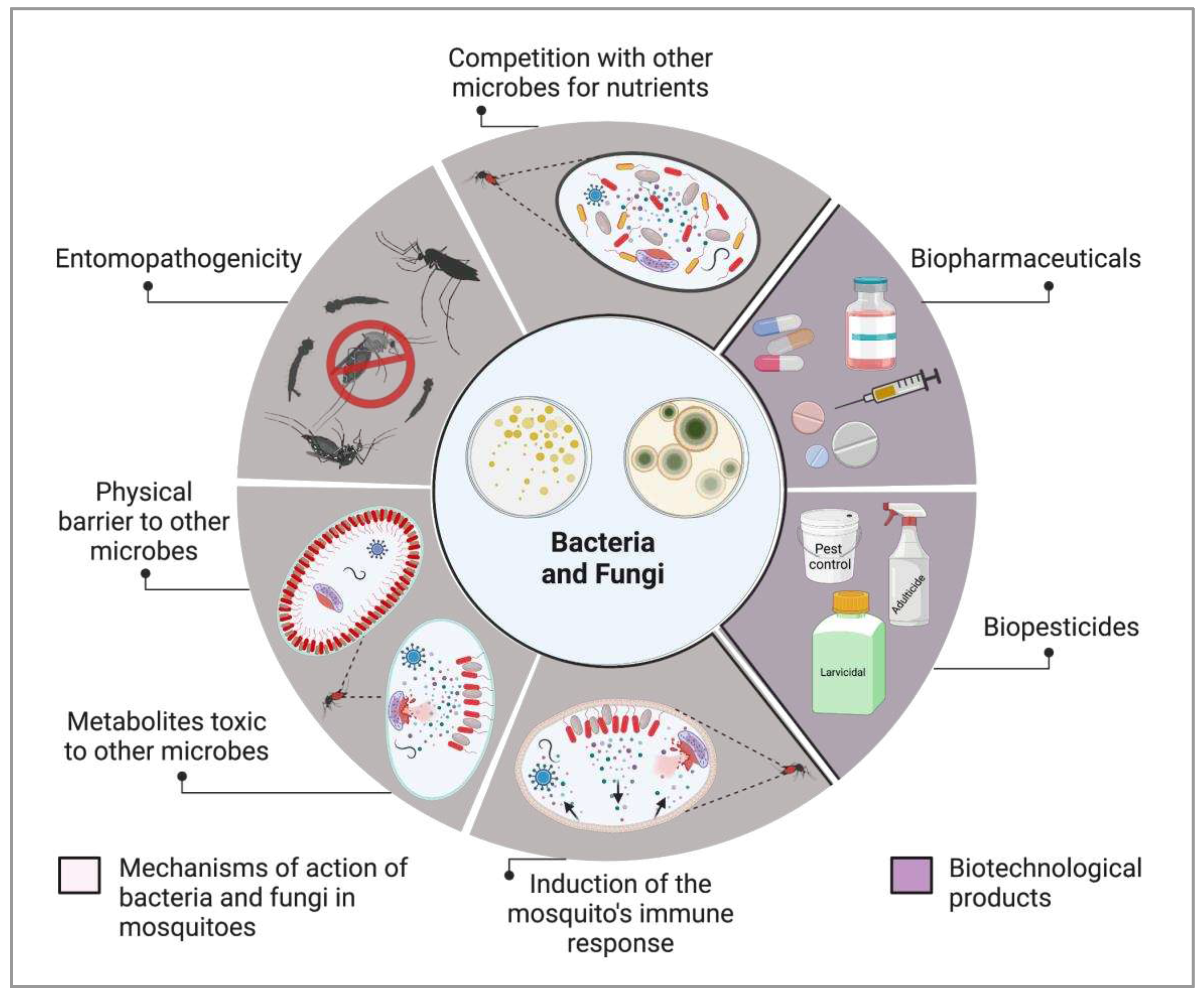
Figure 2.
Biotechnological potential of mosquito symbiotic bacteria against infectious agents. A, Secretion of toxic substances that either kill or arrest the development and replication of viruses and parasites. B, formation of physical barriers through large population accumulation or rearrangements of molecules secreted into the midgut lumen, preventing the passage of parasites to organs essential for their successful development. C, activation of the mosquito immune system, which not only reduces the load of symbiotic bacteria but also leads to the elimination of invading parasites through the secretion of toxic molecules, preventing their propagation in the mosquito's body. D, competition with infectious agents for space and nutrients can have dire consequences for these pathogens as they must compete with a vastly larger population of symbiotic bacteria in the mosquito's midgut lumen. This results in limited resources for the pathogens, ultimately leading to their decreased survival and replication within the mosquito. E, paratransgenesis approach to synthesize and secrete antipathogen molecules. If this approach receives more attention and research funding from government agencies in endemic countries, it could have a significant impact on reducing the transmission of vector-borne diseases. This topic is further explored in topic 4.3 of this review. Created with BioRender.com.
Figure 2.
Biotechnological potential of mosquito symbiotic bacteria against infectious agents. A, Secretion of toxic substances that either kill or arrest the development and replication of viruses and parasites. B, formation of physical barriers through large population accumulation or rearrangements of molecules secreted into the midgut lumen, preventing the passage of parasites to organs essential for their successful development. C, activation of the mosquito immune system, which not only reduces the load of symbiotic bacteria but also leads to the elimination of invading parasites through the secretion of toxic molecules, preventing their propagation in the mosquito's body. D, competition with infectious agents for space and nutrients can have dire consequences for these pathogens as they must compete with a vastly larger population of symbiotic bacteria in the mosquito's midgut lumen. This results in limited resources for the pathogens, ultimately leading to their decreased survival and replication within the mosquito. E, paratransgenesis approach to synthesize and secrete antipathogen molecules. If this approach receives more attention and research funding from government agencies in endemic countries, it could have a significant impact on reducing the transmission of vector-borne diseases. This topic is further explored in topic 4.3 of this review. Created with BioRender.com.
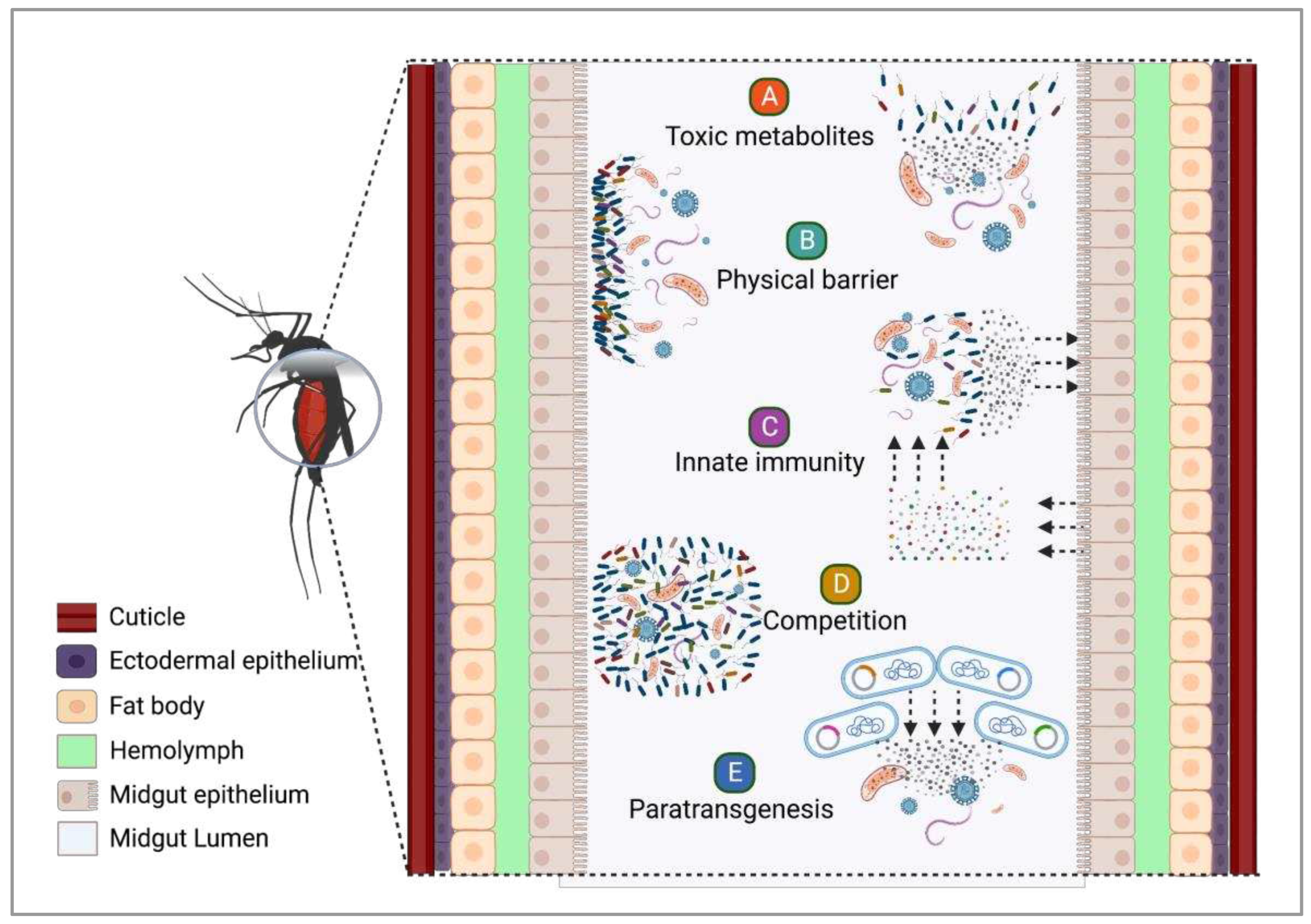
Figure 3.
Paratransgenesis: A multifaceted approach to combating mosquito-borne diseases using GM microorganisms. A, in the laboratory, male mosquitoes are fed a sucrose solution containing GM microorganisms and then released into the wild to mate with wild females. This enables the transmission of the GM microorganisms forward, allowing them to spread throughout the population of wild mosquitoes and helping to reduce the transmission of vector-borne diseases. B, release of GM microorganisms in natural larval breeding sites. GM microorganisms are ingested by larvae and remain associated until the adult phase. If the mosquitoes become infected with any virus or parasite, the GM microorganisms will interfere with the development of the pathogen, thus preventing their transmission. This would result in a reduction in the burden of diseases in the region. C, GM microorganisms can express effector molecules that act directly on the membrane of target parasites in the gut of adult female mosquitoes. These molecules can cause the parasite membrane to rupture, leading to their death or inability to develop. D, persistence of GM microorganisms in mosquitoes for generations through vertical and horizontal transmission. Vertical transmission occurs from parents to their offspring, while horizontal transmission occurs between mosquitoes during mating or sharing of breeding sites. The presence of GM microorganisms can continue to affect mosquito populations for a prolonged period. While it is important to carefully evaluate and monitor the release of GM microorganisms, it is also important to highlight their potential for controlling vector-borne diseases. Created with BioRender.com.
Figure 3.
Paratransgenesis: A multifaceted approach to combating mosquito-borne diseases using GM microorganisms. A, in the laboratory, male mosquitoes are fed a sucrose solution containing GM microorganisms and then released into the wild to mate with wild females. This enables the transmission of the GM microorganisms forward, allowing them to spread throughout the population of wild mosquitoes and helping to reduce the transmission of vector-borne diseases. B, release of GM microorganisms in natural larval breeding sites. GM microorganisms are ingested by larvae and remain associated until the adult phase. If the mosquitoes become infected with any virus or parasite, the GM microorganisms will interfere with the development of the pathogen, thus preventing their transmission. This would result in a reduction in the burden of diseases in the region. C, GM microorganisms can express effector molecules that act directly on the membrane of target parasites in the gut of adult female mosquitoes. These molecules can cause the parasite membrane to rupture, leading to their death or inability to develop. D, persistence of GM microorganisms in mosquitoes for generations through vertical and horizontal transmission. Vertical transmission occurs from parents to their offspring, while horizontal transmission occurs between mosquitoes during mating or sharing of breeding sites. The presence of GM microorganisms can continue to affect mosquito populations for a prolonged period. While it is important to carefully evaluate and monitor the release of GM microorganisms, it is also important to highlight their potential for controlling vector-borne diseases. Created with BioRender.com.
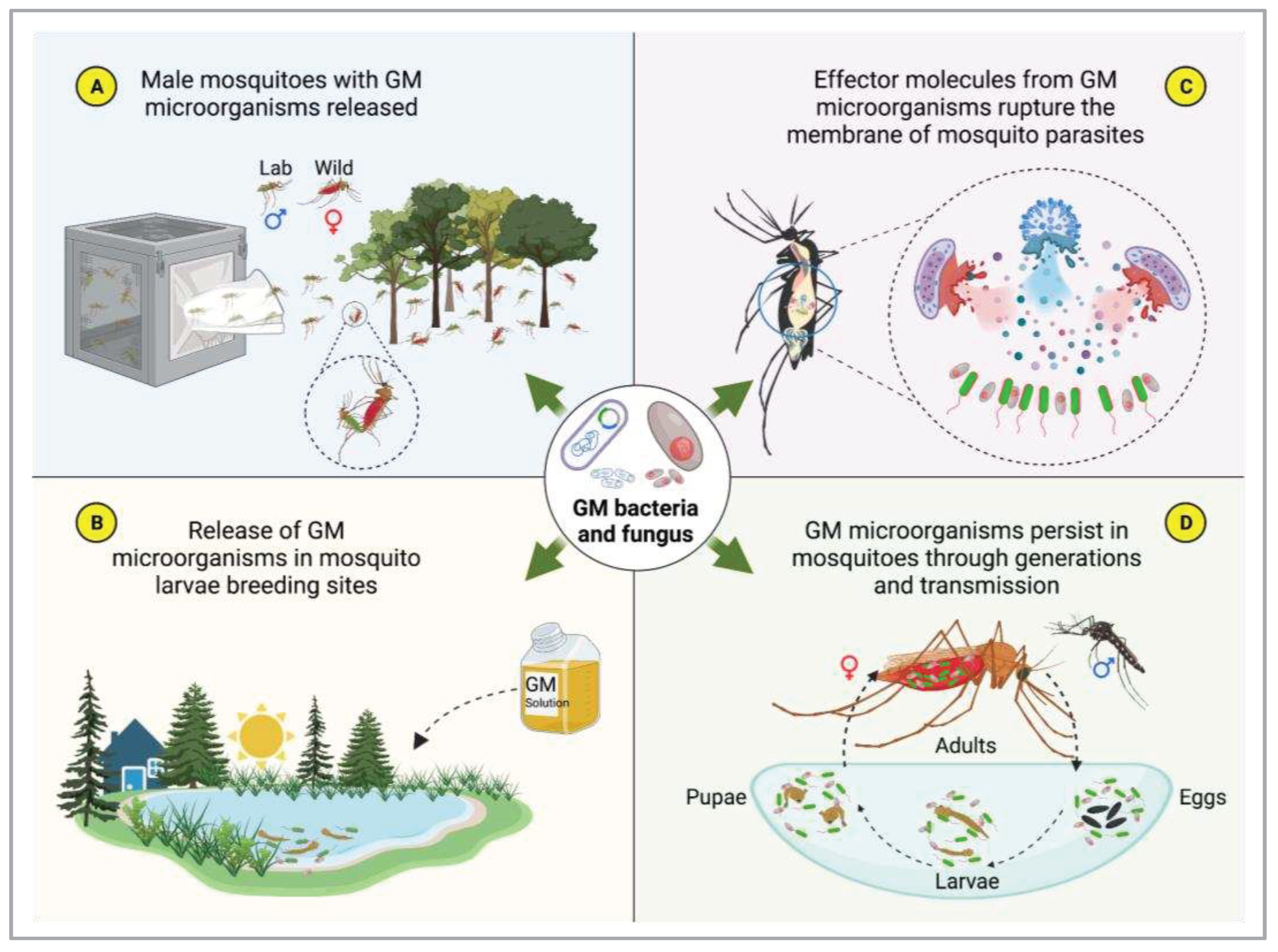
Table 1.
Bacterial strains toxic to Aedes, Culex and/or Anopheles mosquito larvae.
| Bacterium | Toxic formulation | Target mosquito genera | Refs | ||
|---|---|---|---|---|---|
| Aedes | Culex | Anopheles | |||
| Bacillus thuringiensis var. israelensis (Bti) | Extract (spores and crystals) | + | - | - | [50] |
| Sporulated culture powder (Tablet formulation XL-47) | + | - | - | [51] | |
| Spores and crystals tablet | + | - | - | [52] | |
| Spores and crystals tablet | + | - | - | [53] | |
| VectoBac WG | + | - | - | [54] | |
| Formulated product | - | + | - | [55] | |
| Binary mixtures (Bti plus Deltamethrin) | - | + | - | [56] | |
| Cry2Aa and Cyt1Aa crystals | - | + | - | [57] | |
| Crystallogenic variants. | + | + | - | [58] | |
| Two recombinant proteins (Cry10Aa and Cyt2Ba) | + | - | - | [59] | |
| Xpp81Aa toxin combined with Cry2Aa and Cry4Aa | + | - | - | [35] | |
| Kappa-carrageenan and Vectobac 12 AS hydrogels | + | - | - | [60] | |
| Bti extracts | + | - | - | [61] | |
| Vectobac® AS | - | + | - | [62] | |
| Granular formulation (Vectobac G) | - | - | + | [63] | |
| Dispersible granule (strain AM65-52) | + | + | + | [64] | |
| Bti strain Becker Microbial Products (BMP) | - | + | + | [65] | |
| Bti product VECTOBAC TP® sprayed | - | - | + | [66] | |
| Bti Water Dispersible Granular (WDG) formulation | - | - | + | [67] | |
| Water dispersible granule (Bti strain AM65-52 formulation, VectoBac® WDG) | - | - | + | [68] | |
| Water-dispersible granule Bti VectoBac (WDG) | - | - | + | [69] | |
| Bti VectoBac® WG, AM65-52 strain | - | - | + | [70] | |
| Bacillus thuringiensis (Other strains) | Total and lyophilised culture | + | + | - | [71] |
| Bacterial cultures | + | + | + | [72] | |
| Bacterial suspensions (spores and crystals) | + | - | - | [73] | |
| Spores | + | + | + | [74,75] | |
| Parasporal crystalline inclusion bodies | + | - | - | [35] | |
| Culture supernatant | + | - | + | [29] | |
| Synergistic interaction (Purified Cry11Aa and Cyt1Aa Toxins) | + | - | - | [76] | |
| Synergistic action of the Cry and Cyt proteins | - | - | + | [77] | |
| Lysinibacillus sphaericus (Lbs) | Culture supernatant | + | - | + | [29] |
| Spores and vegetative cells | + | + | - | [30] | |
| Cell suspension plus glyphosate | + | - | - | [78] | |
| Spore crystals (lyophilized powder) | + | + | + | [79] | |
| Spores | - | + | - | [80] | |
| Granular formulation (Vectobac G) | - | + | + | [63] | |
| Vectolex G | - | + | - | [81] | |
| S-layer protein | - | + | - | [82] | |
| Purified BinA and BinB proteins | - | + | + | [83,84] | |
| Spore-crystals and purified S-layers protein | - | + | + | [85] | |
| Synergy of Mtx and Cry proteins | - | + | - | [44] | |
| Purified BinA and BinB proteins | - | + | - | [39] | |
| VectoLex® WG plus Pyrethroid Resigen® | - | + | - | [86] | |
| Cry48Aa and Cry49Aa proteins combined | - | + | - | [87] | |
| Synergistic interaction (S-Layer and spores/crystals) | - | + | - | [88] | |
| VectoLex (ABG-6185) | - | - | + | [89] | |
| Suspension (Lyophilized bacteria) | - | - | + | [90] | |
| VectoLex® CG | - | - | + | [91] | |
| Bin toxin proteins | - | - | + | [92] | |
| Acidovorax sp. | Cell-Free Supernatant | + | - | - | [93] |
| Aneurinibacillus aneurinilyticus | Bacterial suspension | + | + | + | [94] |
| Bacillus amyloliquefaciens | Biosurfactant | + | + | + | [95] |
| Bacillus cereus | Culture supernatant | + | - | + | [29] |
| Bacillus circulans | Spores | + | + | + | [96] |
| Brevibacillus halotolerans | Supernatant and pellet fractions of bacterial cultures | + | - | - | [48] |
| Bacillus licheniformis | Dahb1 exopolysaccharide (Bl-EPS) | + | - | + | [97] |
| Brevibacillus laterosporus | Suspension of sporulated cells | + | - | + | [98] |
| Spore and the canoe-shaped parasporal body (CSPB) structure | + | - | - | [99] | |
| Purified protein crystals | + | - | + | [100] | |
| Pellets (cells and spores) | + | - | - | [101] | |
| Spores | + | - | - | [102] | |
| Bacillus paranthracis | Pellets (cells) | + | - | - | [47] |
| Bacillus safensis | Supernatant and pellet fractions of bacterial cultures | + | - | - | [48] |
| Pellets (cells) | + | - | - | [47] | |
| Bacillus subtilis | Culture supernatant | + | - | + | [29] |
| Crude cyclic lipopeptides (CLPs) | - | + | - | [103] | |
| Crude surfactin | - | - | + | [104] | |
| Bacterial biomass | + | - | - | [105] | |
| Biosurfactants | - | - | + | [106,107] | |
| Bacillus megaterium | Bacterial culture | + | - | - | [48] |
| Bacillus nealsonii | Secondary metabolites | + | - | - | [108] |
| Bacillus tequilensis | Cyclic Lipopeptide Biosurfactant | - | - | + | [109] |
| Bacillus velezensis | Bacterial culture | + | - | - | [48] |
| Pellets (cells) | + | - | - | [47] | |
| Chromobacterium sp. | Hydrogen cyanide | + | - | + | [110,111] |
| Chromobacterium anophelis | Bacterial suspension | - | - | + | [112] |
| Pantoea stewartii | Silver nanoparticles | + | + | + | [113] |
| Paraclostridium bifermentans | Clostridial neurotoxin | - | - | + | [114] |
| Peanibacillus macerans | Bacterial biomass | + | - | - | [105] |
| Photorhabdus luminescens | Secondary metabolites (Culture fluids) | + | - | - | [115] |
| Secondary metabolites | + | - | - | [116] | |
| Photorhabdus luminescens subsp. akhurstii | Bacterial cell suspension | + | - | - | [117] |
| Pseudomonas sp. | Bacterial cell suspension | - | + | - | [84] |
| Priestia aryabhattai | Silver nanoparticles | + | + | + | [113] |
| Serratia marcescens | Prodigiosin | + | - | + | [118,119] |
| Bacterial suspension | + | - | - | [120] | |
| Serratia nematodiphila | Bacterial cultures | + | + | + | [72] |
| Saccharopolyspora spinosa | Spinosad (Tracer®) | + | - | + | [121] |
| Spinosad formulation | + | + | + | [122] | |
| Spinosad-based product (Laser®) | + | + | + | [123] | |
| Spinosad | + | - | - | [124] | |
| Spinosad - Tablet (DT) and granules (GR) | + | - | - | [125] | |
| Spinosad powder | - | + | - | [126] | |
| Spinosad formulation | - | - | + | [127,128] | |
| Natular T-30 formulation | - | + | - | [129] | |
| Formulation Emulsifiable Concentrate | - | + | - | [130] | |
| Streptomyces sp. | Secondary metabolites | + | - | - | [108,131] |
| Xenorhabdus indica | Bacterial cell suspension | + | - | - | [117] |
| Xenorhabdus nematophila | Secondary metabolites | + | - | - | [116] |
| Secondary metabolites (Culture fluids) | + | - | - | [115] | |
| Xenorhabdus stockiae | Bacterial cell suspension | + | - | - | [117] |
This list is not exhaustive but provides ideas for future research and product development opportunities.
Disclaimer/Publisher’s Note: The statements, opinions and data contained in all publications are solely those of the individual author(s) and contributor(s) and not of MDPI and/or the editor(s). MDPI and/or the editor(s) disclaim responsibility for any injury to people or property resulting from any ideas, methods, instructions or products referred to in the content. |
© 2023 by the authors. Licensee MDPI, Basel, Switzerland. This article is an open access article distributed under the terms and conditions of the Creative Commons Attribution (CC BY) license (http://creativecommons.org/licenses/by/4.0/).
Copyright: This open access article is published under a Creative Commons CC BY 4.0 license, which permit the free download, distribution, and reuse, provided that the author and preprint are cited in any reuse.


