

Submitted:
30 May 2023
Posted:
31 May 2023
You are already at the latest version
Abstract
Primary materials supply is the heart for engineering and sciences; depletion of natural resources and an increase in the human population by a billion in 13 to 15 years pose a critical concern on the sustainability of the materials. Therefore, functionalizing renewable materials, such as nanocellulose, possibly exploiting its properties for various practical applications, has been undertaken worldwide. Nanocellulose has emerged as a dominant green natural material with attractive and tailorable physicochemical properties, renewable, sustainable, biocompatibility, and tunable surface properties. Nanocellulose is derived from cellulose, the most abundant polymer in nature with remarkable properties of nanomaterials. This article provides a comprehensive overview of the methods used for nanocellulose preparation, structure-property and processing-property correlations, and the application of nanocellulose and its nanocomposite materials. This article differentiates the classification of nanocellulose, provides a brief account of the production methods that have been developed for isolating nanocellulose, highlights a range of unique properties of nanocellulose that have been extracted from different kinds of experiments and studies; and elaborates on nanocellulose potential applications in various areas. The present review is anticipated to provide the readers regarding the progress and knowledge related to nanocellulose. Pushing the boundaries of nanocellulose further into cutting edge applications will be of particular interest for the future, especially as cost-effective commercial sources of nanocellulose continue to emerge.
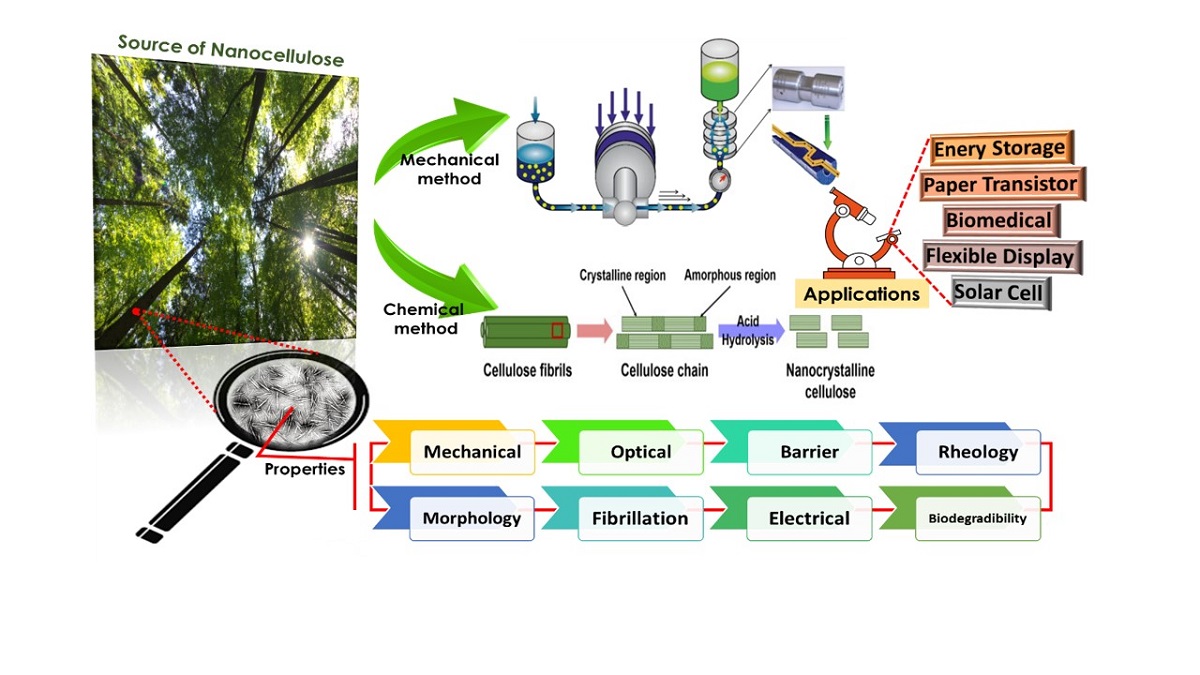
Keywords:
Nanocellulose
; Cellulose Nanofibrils
; Cellulose Nanocrystals
; Bacterial Nanocellulose
; Energy Storage
1. Introduction
Materials play a dominant role in human life and civilization. Every technological advancement has been achieved through the discovery of higher-performing materials than its predecessor. Steel, cement, and polymers are few materials that dominate the structural, construction, and architectural application domains, whereas silicon dominates the electronics and communication industry [1]. Most of the present-day products, including those mentioned above, are built using earth-borne or non-renewable materials, i.e., their constant stock on the planet would be exhausted as we consume it. At present, a great deal of research is dedicated to recuperating the earth-born materials (mainly metals and other inorganic components) from the products after their service life [2]. Adding on, carbon, a functional material of high market value, is traditionally obtained from petroleum coke, pitch and coal – which are earth-born and have been extensively researched for potential developed from renewable sources such as biomass. The above is a partial story of primary material supply for product development; the other part is the growing population-nearly a billion new members are expected to join the society in 13-15 years. Thus, a growing population and depleting natural material reserves demand strategic solutions for primary material supply to build our next-generation architects and devices. Besides, “renewability” has been evolved as a key term in almost every sector of life. One unique possibility in searching for a renewable material of diverse functionality is cellulose, derived from plants and plant-derived wastes. For example, cellulose can be derived from an empty fruit bunch of oil palm or coconut, which does not offer edibility or other functionality. Cellulose is the main component of several natural fibers such as cotton, flax, hemp, jute, sisal, etc. Recently, cellulose has been explored for its applications in electronic devices [3,4], material sciences [5,6], construction [7], and biomedical sciences [8]. The utilization of this particular element can be traced back to the commencement of civilization, characterized by wood, hay, papyrus, and cotton as examples of its natural form [9]. Similarly, it is also present as a fibrous component in oatmeal and a thickening agent in milkshakes in its modified form. Cellulose is a ubiquitous structural polymer that will influence the strength of plant structure. As apparent from Figure 1, the unique properties and high performance of natural fibers are influenced by their elementary nanocellulose fibers components [10].
Research on cellulose is fueled by two possibilities: the chemical structure of cellulose as a polymer, and the second is that cellulose contains crystalline domains that could be recovered using chemical treatment. The second possibility of making cellulose crystals offers a further advantage of developing nanocrystalline cellulose or nanocellulose with size-dependent properties [11]. These natural fibers (restocked by the natural process of photosynthesis) represents about one-third of plant cells. Research on nanocellulose has been undertaken worldwide, with the majority of work has been carried out in the USA, Sweden, Finland, China, and India. The biosynthesis of nanocellulose generates approximately 1,000 tons per year. Besides, nanocellulose is considered a viable alternative to the more expensive high-tech materials such as carbon fibers and carbon nanotubes [12]. Subsequently, the nanocellulose market is projected to register to a value of $530 Million by 2021, signifying the strong annualized CAGR of 25% between 2014 and 2021.
Lauded as the “next wonder” material, cellulose boasts phenomenal versatility and subsequently possesses a wide spectrum of characteristics. Nanocellulose, in particular, is lightweight and concomitantly stiffer in comparison to Kevlar, rendering it exemplary as an unprecedented armory [13]. It is also non-toxic, thereby opening up potential as additives and preservatives for food-based products. Moreover, it offers tensile strength that is higher than steel by eight-fold at similar dimensions. It is a plausible and sustainable alternative for the conventional paper due to its lightweight properties and flexibility. Similarly, its buoyancy is unparalleled, as a boat weighing one pound is capable of bearing cargo up to 1000 times heavier.
The nature of cellulose consists of both crystalline and amorphous phases [14]. In contrast to its incredible strength, its crystalline form is characterized by a transparent material, especially a gel containing microfibrils. As an advanced material, cellulose in its different state (e.g., nanofibers and nanocrystal) are vigorously explored by the researchers due to its exciting behavior which promises a wide range of application in electronic devices [3], material sciences [5], construction [7] and biomedical sciences [8]. Nanocellulose with the properties of large surface area, hydrophilicity, sites for chemical modifications; opens up their field for applications in industrial packaging, electronic devices, cosmetic and medical devices [15,16,17].
In relation to nanocellulose research, a number of reviews have been carried out. Thomas et al. [13] have reviewed and reported the challenges and recent developments in nanocellulose. They have classified nanocellulose as a nanomaterial with excellent mechanical properties and biocompatibility. Dhali et al. [3] reviewed the current status of industrial-scale production of nanocellulose and surface modification techniques for nanocellulose. Guo et al. [14] comprehensively scrutinized the progress of electrochemical energy storage of nanocellulose. Al-Oqla and Rababah [15] reviewed the design challenges of preparing nanocellulose composites. Li et al. [16] focus on manufacturing food-grade Pickering emulsions using nanocellulose, bacterial cellulose nanofibrils, and cellulose nanofibrils. Currently, this nanocellulose is in more demand in 3D printing technology and food package materials. Raghav et al. [17] reviewed nanocellulose for drug delivery applications. Guo et al. [6] reviewed the research progress of nanocellulose in derived materials in electrochemical energy storage.The present review is designed to cover the prospect that previous reviews have not covered. Supplementary Information (Table S1) summarizes and identifies the uniqueness of this paper compared to others.
From the above literature review, it can be declared that no review paper is available on the sustainability of nanocellulose and its derivatives. This article aims to present a comprehensive overview of the methods used for nanocellulose and its derivatives preparation, structure-property and highlights the processing-property correlations and application of nanocellulose and its nanocomposite materials. In the next section (Section 2), we provide a brief description of the classification of nanocellulose. The objectives of this article are as the following: i) to differentiate the classification of nanocellulose numbers; ii) to provide a brief account of the production methods that have been developed for isolating nanocellulose; iii) to highlight a range of unique properties of nanocellulose that have been extracted from different kind of experiments and studies; iv) to elaborate nanocellulose potential applications in various areas. The final section concludes with final remarks on the directions towards which future research on this new member of green technology nature-based materials might be directed.
2. Classification of Nanocellulose
This section provides a brief description of the classification of nanocellulose – there are three main classes, which are cellulose nanocrystals (CNC), cellulose nanofiber (CNF), and bacterial nanocellulose (BNC). Considering the enormity of data, cellulose nanofibers developed by a scalable top-down procedure, i.e., electrospinning, are also included in nanocellulose classes.
Two types of nanocellulose, CNC and CNF, are extracts from plant resources, such as wood, while bacterial nanocellulose (BNC) is mainly obtained from living organisms by the process of biosynthesis [15,16]. The behavior of CNF is classified by the crystalline and amorphous percentage of cellulose chains, while the CNC is crystalline domain cellulose. Figure 2 shows the SEM images of the three main types of nanocellulose. Table 1 tabulates the three main classes of nanocellulose with their typical resources, general formation method, and their size arrays.
2.1. Cellulose Nanocrystals (CNC) or Nanocrystalline Cellulose (NCC)
CNC usually serves as a reinforcing agent in a various field of applications, including improving nanocomposite’s mechanical strength and acting as a barrier material to reduce water vapor transmission and oxygen gas [21]. CNC shows improved mechanical properties with greater elastic modulus than Kevlar [22] and has a liquid crystalline behavior due to its asymmetric rod-like shape. For biopolymer application, CNC is being explored to replace chemicals with petroleum base in green technology evolution. With its interesting properties, CNC and its derivatives have been developed for the following purposes;water treatment technology [23]. nanofillers for polymer matrices [24,25], templates for photonic hydrogels [26,27], emulsifier for pickering emulsions [28,29], and mesoporous materials for biomedical fields [30]. CNC-based thin films have revealed to show its interesting applications in oxygen barriers [31], anti-reflection coatings [32], enzyme detection [33], and anti-counterfeiting [34].
2.2. Cellulose Nanofibrils (CNF) or Nano Fibrillated Cellulose (NFC)
The CNF being micrometer-long, consists of both amorphous and crystalline regions, different from CNC, which are crystalline dominant. Usually, the synthesis of CNF can be done by mechanical treatment such as grinding, milling, and homogenization or chemical treatment (e.g., TEMPO oxidation), or both [35]. CNF is ideally used for medicine, optical, and reinforced composite applications due to its renewability and biodegradability behavior and its amazing mechanical behavior [36]. Recently, CNF serves as a dry reinforcing agent in paper industry applications, suspension stabilizer and as a low-carb thickener [37]. The processed CNF have excellent mechanical strength compared to polypropylene and polyester – old method man-made fibers. Also, cellulose fibers can serve as a stabilizing crack, due to its close-spaced arrangement and high length-to-diameter ratios [38].
2.3. Bacterial Nanocellulose (BNC)
BNC (average diameter in the range of 20-100 nm with micrometer lengths) are microorganisms-based nanocellulose isolated from Gluconacetobacter - most efficient amongst cellulose-producing microorganisms. BC is synthesized as pure nanocellulose and does not require any pre-treatment procedures to eliminate lignin and hemicellulose [39]. Furthermore, it is a polysaccharide that is frequently utilized in the food manufacturing field [40,41], production of reinforced paper [42] and broadly studied by scientists for medicinal and therapeutic purposes. This is evident, in the multitude of in vitro and in vivo research that had revealed its biocompatibility [43,44]. Similarly, its outstanding mechanical performance encompassing water sorption capacity, porosity, stability and conformability resulted in its extensive usage in cartilage tissue engineering [45], blood vessel substitution in rats [46], and in wound healing [47].
BNC can be described as pure cellulose and unassociated with any other constituents [48]. BNC-based nanocellulose composites are typically producible via the synthesis of BNC gel to alter its cellulose biosynthesis. In contrast, BNC nanocomposites that are geared for biomedical applications with enhanced mechanical characteristics are produced by BNC being soaked on polyacrylamide and gelatin solutions [49,50]. Meanwhile, BNC-hydroxyapatite scaffolds meant for bone regeneration are fabricated by BC gel immersion, either in a simulated body fluid (SBF) or in both calcium and phosphate solutions [51].
Comparing CNC and CNF, bacterial nanocellulose has higher purity and crystallinity. These nanocellulose has a high modulus (100-130 GPa), low density (1.5–1.6 g cm−3), tensile strength in the range of 1.7 GPa, great water holding capacity, and biocompatibility [51]. Besides, various reports indicated that BNC membranes fabricated with carboxymethylcellulose (CMC) displayed superior metal ion adsorption capacity in comparison with pure BC membranes [52]. Electro spun cellulose is a secondary class of nanocellulose developed from the main class of nanocellulose using an electrospinning machine. The properties of the developed electro spun nanocellulose can be differed by manipulating the process parameters.
3. Production of Nanocellulose
Production of nanocellulose from plant fibers usually involves chemo-mechanical treatments, chemical methods, mechanical methods, and physicomechanical methods. Nanocellulose can be naturally isolated via mechanical treatment and/or chemical treatment due to its natural hierarchical structure. Figure 3 classifies the production method for nanocellulose.
3.1. Mechanical Method
3.1.1. Homogenization
Homogenization is one of the efficient methodologies for biomass refining due to its effectiveness and simplicity. In addition, organic solvents are not generally required for homogenization [53]. This method requires two types of equipment which are homogenizer and microfluidizer (Refer to Figure 4). These apparatus are usually and widely utilized in the pharmaceutical, cosmetics, food manufacturing, and biotechnology industries, and among others [54]. The homogenization procedures necessitates passing a raw cellulose resources via a very small channel from the valve to the impact ring, which subsequently subjects the raw cellulose resources to crush that ultimately guarantee nanocellulose formation.
Li et al. [55] synthesized sugarcane bagasse-based nanocellulose via a high-pressure homogenizer. The homogeneous solution was transferred via a homogenizer without any clogging. The isolation of nanocellulose involves 30 cycles pressurize procedure at the pressure of 80 MPa under the optimum value (90%) of refining conditions. The obtained nanocellulose has a dimension of 10-20 nm in diameter with reduced thermal stability and crystallinity compared to the original cellulose.
3.1.2. Cryocrushing
Cryocrushing is a technique to fabricate nanocellulose fibers by freezing the fibers using liquid nitrogen that undergo high shear forces process [56]. The use of the cryo crushing method is to produce an ice crystal from within the cell wall, whereby the ice crystal forms of fibers underwent high impact crushes resulting the breaking down and thereby liberating microfibrils [57].
Bhatnagar and Sain [58] successfully fabricated 5-80 nm nanocellulose fibers with a by the cryo crushing method, as shown in Figure 5. The procedure involves dispersion of the cryo crushed nanocellulose in a water suspension, incorporating a disintegrator prior to high-pressure fibrillation. Wang and Sain integrated the combination of cryo crushing and high-pressure fibrillation processes to produce 50-100 nm diameter of CNF by using soybean stock as the raw material [59,60].
3.1.3. Grinding
Ultra-fine friction grinding with a specially designed disk has been used by several scientists to produce cellulose nanofibers. In this process, the course raw cellulose will undergoes the static grinding process and 1,500 rpm rotating grinding process. During the process, the brake down process of cell wall of nanofibers composition will tahe place and the shear force from the grinding process will fragment the H-bonds, producing of individualized nanofibers from the pulp [61]. Figure 6 presents the grinding equipment for nanocellulose isolation procedure.
Taniguchi and Okamura [62] have successfully formed 20-90 nm diameter of nanocellulose fibers through the versatile super-grinding process. Meanwhile, the study by Iwamoto et al. [63] subjected homogenized cellulosic pulp to the grinder treatment, yielding a bundle of fibers. The procedure has come out with a uniform size of nanofibers in the range of 20-50 nm, after up to five passes through the grinder, and with additional passes, the size of the fibrillated pulp fibers does not change. In another article, Wang et al. [64] used a commercial stone grinder to synthesize CNF from bleached eucalyptus pulp. SEM and TEM analysis revealed that the synthesized CNF was highly kinked, had naturally helical and untwisted fibrils that serve as backbones of CNF networks.
3.1.4. Micro Fluidization
Microfluidizer is another instrument that can be used to isolate nanocellulose fibers. Figure 7 shows the schematic diagram of the microfluidizer. Microfluidizer consists of the interaction chamber and intensifier pump. The chamber is used to defibrillate the fibers while the pump serves as a pressure controller. The fibers were defibrillated via shear and impact forces against colliding streams and the channel walls inside the interaction chamber [65].
Lee et al. [66] studied the influence of the passing periods of MCC via microfluidizers on the behavior of nanocellulose fibers. The aspect ratio of the nanocellulose fibers was found to increase with the increase of cycles. Increasing further the passing times (up to 20 times) has caused in agglomeration resulting from an increment of OH-groups and surface area of obtained nanocellulose. These findings concluded that the number of cycles subjected to the homogenizer would yield CNF with a higher surface area [66]. Similarly, the morphological analysis also indicated that nanofibers of more homogenous size distribution could be produced by micro fluidization.
3.1.5. Refining
The refining approaches, commonly practiced in the manufacturing of paper production. The process involved the immersion of fibers in a based fluids medium until the cell wall of fibers swells and peels itself, resulting the significant improvement in volume and specific surface area [67], while also improving the microfibrils’ accessibility in case of extended biological or chemical processes. This renders it a typical process undertaken before big-scale CNF operations and production. However, increments and decrements of the number of fines during the procedure will decrease the fiber length. Figure 8 shows the schematic diagram of refining surfaces.
There are some devices utilized during the preliminary phases of CNF production to refine cellulose, namely disk refiners [68,69], PFI mills [70,71,72], and Valley beaters [73,74]. Moreover, grinders are also heavily referenced in reports as an instrument used to refine pulp before intensive mechanical integration of a higher degree [75,76]. Such a technique has also been evaluated as a sole mechanical process for CNF isolation.
Disc refiners and their usage has been studied by Karande et al. [77], specifically in disintegrating 0.5% weight percentage of cotton fibers dispersed in water which had successfully reduced the diameter of nanocellulose from 250 nm to 242 nm. The disintegration procedures occur alongside DP decrement from 2720 to 740 and a decreased cellulose crystallinity. Refining approach is a frequently used method as a mechanical pretreatment process during the initial phases of CNF isolation.
3.1.6. Blending
Uetani and Yano [79] demonstrated nanocellulose fibers isolation using a high specification blender from softwood pulp, yielding uniform fibers of 15-20 mm diameter, as shown in Figure 9. Their investigation looked into blending parameters under several isolated conditions, which included cellulose concentration, stirring speed, and stirring duration. Cellulose pulp suspension was found to be optimally processed at the concentration of 0.7 weight percentage at rpm of 37,000, specifically in the context of nanocellulose isolation via this technique.
Moreover, a similar isolation technique using rice straw-based nanocellulose fibers was demonstrated by Jiang and Hsieh [80]. The autbors mixed and crushed the fibers at the speed of 37,000 rpm with a heating temperature up to 97 0C for 2 hours. The experiment resulted in the nanocellulose fibers with a bimodal size distribution. (Ø= 2,7 and 8.5 nm, L= 100-200nm).
Chaker et al. [81] used the pulp of high hemicellulose to prove the possibility of isolating nanocellulose fibers. This was explicitly achieved by blending two-weight percentages of cellulose for 20 minutes, resulting in a comparable yield value by comparing it with suspension passed for ten cycles at a pressure of 600 bar in a homogenizer. Meanwhile, Nakagaito et al. [82] successfully improved the effectiveness in minimizing the blending period by inventing a new blender bottle.
3.1.7. Ball Milling
An alternative method was introduced in the context of CNF production recently, namely ball milling. This particular technique consists of a cellulose sample placed in a special bowl partially filled with zirconia balls, as illustrated in Figure 10. The high energy collision occurs between these balls resulting in cellulose disintegration, specifically during the rotation of the container [83].
Zhang et al. [84] have reported CNF isolation processes from softwood kraft pulp suspension at a one-weight percentage concentration via this technique. The investigation focused on the influence of isolation parameters such as zirconia ball size on the nanocellulose properties. The author found that to prevent the recrystallization of nanocellulose, control of the isolation process condition is needed.
Kekäläinen et al. [85] studied the isolation of nanocellulose fibers from hardwood kraft pulp via the ball mill method. The effect of the grinding period, amount of fluid, and carboxylic charge towards disintegration procedures and CNF properties were subsequently investigated in their work, yielding substantial output. Discrete nanocellulose fibers of 3.2 nm diameter were produced alongside nanofibril bundles of diameters ranging between 10-150 nm. Hence, such a method remains to be challenged by the issues of quality and homogeneity of the isolated nanocellulose fibers.
3.1.8. Aqueous Counter Collision (ACC)
ACC is yet another mechanical method elucidated for nanocellulose isolation, in which two high-pressure jets of aqueous suspensions containing cellulose are impacted by one another [87], as shown in Figure 11. Kose et al. [88] isolated discrete CNF via this method by using a homogenized aqueous suspension containing a 0.4 weight percentage of bacterial cellulose. The jets of aqueous suspension at a pressure of 200 MPa were processed for 80 passes, resulting in CNF with 30 nm diameter. This technique also successfully produces CNF from microcrystalline cellulose [89], measured at a length of 700 nm and diameter of 15 nm. However, as the precaution to prevent clogging at the nozzle section, the dimension of the cellulose slurry must be smaller that the diameter of nozzle channels.
3.2. Chemical Method
3.2.1. Acid Hydrolysis
Acid hydrolysis is one treatment procedure for nanocellulose sources, which involves breaking down the polysaccharides into simple sugar using acid solutions [91]. The acid hydrolysis process is illustrated in Figure 12. For example, acid hydrolysis treatment can yield lignocellulosic fibers flax (typically containing 20% to 40% hemicelluloses) as monomers. Hemicelluloses are more prone to oxidation and degradation due to the more amorphous properties compared to cellulose. The hydrolysis process may be faster when the pH value is reduced. For the acid hydrolysis procedure, hydrochloric and sulfuric acid may be used for nanocrystal production. Hydrochloric acid yields almost neutral nanocrystals of minimal dispersibility in water, whereas sulfuric acid generates products of higher stability across a broad spectrum of pH [92]. The hydrolysis process places key importance upon the reaction time, whereby an example is indicated by lengthy reaction time bringing about complete cellulosic hemp fiber digestion. In contrast, inadequate and short reaction period causes the large fibers generations and agglomerations not to disperse.
3.2.2. Alkaline Pre-treatment
Alkali pre-treatment (Figure 13) involves eliminating the lignin, wax, and oils found on the external surface of the plant cell wall as a cover. The treatment removes a certain amount of the lignin structure and aids in the separation of the structural linkage present between the lignin and carbohydrates [59,60,94,95]. This is achieved using sodium hydroxide (17%–18%), which is comparable to cotton mercerization. Furthermore, mild alkali treatment allows purification to occur, resulting in insolubilization of pectin, hemicellulose and lignin. Nevertheless, alkaline pre-treatment is subjected to careful control to prevent unwanted cellulose degradation and warrant hydrolysis that only occurs on the fiber surface, ensuring the extraction of intact nanofibers [58,59]. Similarly, some scholars opted for alkaline-acid pretreatment prior to the nanocellulose crystal mechanical isolation, leading to lignin, hemicelluloses and pectin solubilitization [58,94,96].
Alemdar and Sain [96] also demonstrated such treatment to yield boosted cellulose amount for wheat straw CNF, increasing it from 43 to 84%. It also revealed partial elimination of lignin and hemicelluloses from wheat straw and soy hull fibers. Their respective nanofiber diameters ranged between 10–80 nm and 20–120 nm. The nanocellulose production was sourced from pretreated fibers via cryo crushing and fibrillation methods.
3.2.3. Oxidation Pre-treatment
Isogai et al. [98] introduced the approach of TEMPO radicals as an oxidative pre-treatment before mechanical treatment takes place. The aggregation problem can be solved by TEMPO-mediated oxidation as the technique guarantees surface modification via the introduction of COOH-groups and CHO-groups into the solid native celluloses, subject to aqueous and mild conditions [19,99]. Oxidation that occurred at the surface of the nanocellulose becomes negatively charged and consequently causes the nanocellulose fibers to be repulsed, ultimately alleviating fibrillation.
3.2.4. Enzymatic Pre-treatment
The enzyme is good for lignin and hemicellulose modification and degradation process while maintaining the portion of cellulose [100]. Many experiments had been done on the isolation of nanocellulsoe fibers via enzymatic pretreatment [70,101,102,103]. Pääkkö et al. [104] used enzymatic pre-treatment in combination with homogenization and refining it to isolate softwood pulp-based nanocellulose fibers. These authors revealed the following in their findings: a more significant aspect ratio and lesser aggressiveness than acid hydrolysis in opting for mild hydrolysis using single-component endoglucanase enzyme.
Furthermore, CNF fibrillation attempted by Janarchnan and Sain [94] had encompassed the combination of bio-treatment with OS1, fungi isolation from elm tree infected with Dutch elm disease, and high-shear refining upon bleached kraft pulp. The resulting TEM micrographs revealed that more than 90% of the bio-treated nanofibers were characterized by a diameter less than 50 nm. Similarly, they also depicted a higher aspect ratio and distinct characteristics in comparison to the untreated nanofibers. Additionally, bio-treatment could increase the structural disorders seen in the crystalline region, which enhances internal defibrillation.
3.2.5. Ionic Liquid
Ionic liquids (ILs) are thermally and chemically stable fluids with low vapor pressure and non-flammability organic salts with operating temperatures less than 100 °C [105,106,107]. They are widely synonymous with dissolving cellulosic materials [108,109]. Li et al. [55] used 1-butyl-3-methylimidazolium chloride as an IL with HPH to generate sugarcane bagasse-based nanocellulose fibers. It is obtained by dissolving the cellulose using IL, which passes through the homogenizer easily without clogging. The cellulose precipitation occurs via addition of water and subsequently, freeze-drying that generates the CNF. Consequently, it was found that cellulose solubilization was influenced by several factors, namely the weight ratio of cellulose to ILs and the power of the microwave and reaction temperature. The best solubilization output was observed at a reaction temperature of 130 °C, 400W microwave power, and a 1% (g/g) cellulose to ILs ratio.
3.3. Physico-mechanical Treatment
3.3.1. Ultrasonication
High intensity ultrasonication (HIUS) waves may cause great mechanical oscillatory power secondary to cavitation. This is a physical occurrence encompassing the generation, growth, and breakdown of microscopic gas bubbles upon the absorption of ultrasonic energy by molecules in a liquid [110]. Figure 14 illustrates high intensity ultrasonication. The cavitation bubble and its immediate area around reveal the production of volatile shock waves, thus resulting in implosion sites characterized by temperatures reaching 5000 °C and pressures exceeding 500 atm. Therefore, ultrasonic radiation is commonly utilized in various processes, including emulsification, catalysis, homogenization, disaggregation, scission, and dispersion [111].
Extraction of nanocellulose from plant sources can also be done via HIUS energy in a bath process. In this technique, the temperature of the nanocellulose fibers suspension increased vigorously when the power was increased. A good amount of cellulose fibrillation can be obtained when the temperature of the suspension is increased since the fibrillation of nanocellulose influences the length of the raw fibers [112].
3.4. Chemico-mechanical Treatment
3.4.1. Steam Explosion
Steam explosion is a break down process of structural elements of cellulose via thermo mechanical approach. In this approach, lignocellulosic biomass is exposed to high pressure (in the range of 35 bar) and moderate temperature (on the range of 423–503 K) for 1–20 mins in either a batch or a continuous setup, as shown in Figure 15 [114]. Steam explosion usuallu executed in a batch mode, run for testing scale pre-treatment of continuous mode which usually applied for mass production in manufacturing line.
3.5. Summary of Other Preparation Methods
Literature surveys reveal that nanocellulose is prepared from various natural resources by several methods. Mechanical treatments mainly by homogenization, grinding, cryo crushing, ultrasonication, steam explosion, and oxidation method successfully isolates nanocellulose with diameters ranging from 10 to 80 nm. In contrast, chemical methods such as acid hydrolysis are used to eliminate the amorphous regions of fibers and isolate CNC. All these treatments are expensive and time-consuming as it involves high consumption of energy. For example, mechanical treatment may cause a reduction in yield and fibril dimension as low as 100–150 nm, and it is not environmentally friendly, same as chemical treatment procedures. The various preparation process, raw materials, and their lengths are summarized in Table 2.
Regardless, these two nanocellulose extraction techniques from plants are impoverished as they are time-consuming and expensive. Moreover, they require high energy consumption due to mechanical treatments and processes, resulting in dramatically decreased yields and fibril length up to 100–150 nm. Additionally, they are environmentally damaging, specifically for chemical treatments. Therefore, scientists nowadays focus and emphasize methods that offer environmentally friendly conservation, high efficacy, and minimal costs for nanocellulose production. Very few references are available about the systematic study of nanocellulose extraction methods’ influence on nanocellulose quality and its capability in reinforced nanocomposites.
4. Surface Modifications of Nanocellulose
Natural cellulose in its original form is inappropriate or unsuitable for particular applications because of its large dimensions and lower stability. To obtain a more suitable structure, cellulose may be modified physically or chemically, or biochemically [133]. There are various surface modification strategies, and some important modification methods were shown in Figure 16. The nanocellulose surface can be tuned chemically by physical interactions and biological approaches due to the hydrophilic nature and the presence of OH groups on its surface [134]. Surface functionalization of nanocellulose may be done before or after the manufacturing process. The changes result in the development of desirable properties, which improve the efficacy of the materials for a specific application. The surface of a nanocellulose material can also be tuned in terms of how it interacts with foreign substances by incorporating some chemical functionality, as noted by polymeric matrices with improved reinforcement. Table 3 illustrates the various effect of surface-modified nanocellulose. Lu et al. [135] investigated the properties of hydroxyapatite modified nanocellulose dispersed in polylactic acid (PLA). The structural properties of modified nanocellulose was confirmed via transmission electron microscopy, Fourier transform infrared spectroscopy, and X-ray diffraction analysis. The authors reported the mechanical properties and thermal stability of hydroxyapatite-modified nanocellulose enhanced dispersed in PLA enhanced due to the improved and stronger hydrogen bonding at the surface of modified nanocellulose [135].
Li et al. [136] enhance a nanocomposite films bonding of nanocellulose dispersed in polyvinyl alcohol (PVA) by transplantation process of polyacrylamide onto nanocellulose. FT-IR analysis confirmed the presence of strong H-bond on the interface of modified nanocelulose, while thermogravimetric analysis reported the modified nanocellulose-PVA nanocomposites had enhanced their thermal stability behavior [136]. In another research study on nanocellulose surface modification, Tang et al. [137] reported the nanocellulose implanted with butyryl chloride and cinnamoyl chloride had successfully improve their surface behavior and could stabilize oil-water emulsions in a sample. Nanocelulose with a high surface charge density limits their ability to stabilize in any based fluids and thus, the hydrophobic modification of nanocellulose could enhanced wettability, resulting in lower interfacial tension. Below some vital surface modification processes are discussed in detail.
4.1. Noncovalent Surface Modification
Generally, the surface modification is done through the absorption of surfactants with oppositely charged polyelectrolytes. So that the nanocellulose interactions are via electrostatic and hyperbolic attractions, Vander Walls forced or hydrogen bonds. Heux et al. [148] modified cellulose nanocrystals with surfactants containing mono and di-esters of phosphoric acid with alkylphenol tails. These surfactant molecules formed a coating at the surface of cellulose nanocrystals about 15 Å, and these coated cellulose nanocrystals dispersed well in nonpolar solvents. Zhou and Teeri [149] developed a new method for cellulose nanocrystal surface modification based on the adsorption of saccharide-based amphiphilic block copolymers. They coated cellulose nanocrystals with a xyloglucan oligosaccharide–polyethylene glycol–polystyrene triblock copolymer. In nonpolar solvents, these cellulose nanocrystals had a high dispersion capacity.
4.2. Carbonylation
Carbonylation is a surface modification process of an isocyanate with hydroxyl groups available at the surface of the nanocellulose to form a urethane linkage. The addition of an additional n-octadecyl isocyanate to cellulose nanocrystals and nano fibrillated cellulose in a bulk reaction in toluene at temperatures between 100 and 110°C for 30 minutes without the use of any catalyst improves their hydrophobicity [150]. Figure 17 shows the modification of cellulose nanocrystals with 3-isocyanatepropltriethoxysilane (IPTS) in Dimethyl formide. This modification reduced the hydrophilicity of nanocellulose surfaces, which are prone to react with a low amount of free hydroxyl.
4.3. TEMPO-mediated Oxidation
TEMPO-mediated oxidation method is one of the most used methods for surface modification method. TEMPO-mediated oxidation converts the hydroxymethyl groups in the nanocellulose to the carboxylic forms. It involves the use of constant nitroxyl radical, TEMPO, in the presence of NaOCl and NaBr [151]. Figure 18 illustrates the TEMPO surface modification structure of nanocellulose. De Nooy et al. [151] suggested this kind of approach involves oxidation of primary alcohols without effected the secondary OH-groups exposure of the glucose before it converted into carboxylic acids. The formation of carboxylic acids also donates from the conversion of stable nitroxyl radicals into OH-groups prior to oxidation reaction [63,152]. Habibi et al. [35] reported that TEMPO-mediated oxidation CNCs derived from HCl hydrolysis of tunicate-derived cellulose fibers and found that TEMPO-mediated oxidation did not affect the morphological integrity of the CNCs. Qing et al. [153] combined multiple approaches in the formation of eucalyptus kraft pulp into nanocellulose. The processes involves TEMPO-mediated oxidation, enzymatic pre-treatment, grinding and homogenization approaches in an accurate order. We can simply said that TEMPO-mediated oxidation in impanation of macromolecules by suing amidation in order to ensure continuously charging of negatively electrostatic force to the surface of nanocellulose, resulting in good dispersion stability than obtained after sulfuric acid hydrolysis. Also, Osong et al. [154] mentioned that TEMPO is a high cost approach. Cheng et al. [3] analyzed TEMPO mediated oxidized CNCs from different cellulose by one step ammonium persulfate (APS) hydrolysis and reached 81 percentage yield. It was found that the uniform CNCs with dense surface concentration of carboxyl groups and diameter of 35nm produced at optimum conditions 16h at 80°C.
4.4. Esterification
Esterification through carboxymethylation of nanocellulose is an efficient process of treating and forming nano-fibrillated cellulose. Generally, esterification is accomplished by activating the structural components of cellulose in diluted NaOH, and the hydroxyl groups are converted to carboxymethyl moieties with monochloroacetic acid C2H3ClO2 or its sodium salt [155]. The dispersion and capability of carboxymethylated NFCs powder functionalized with 1-hexanol in extruded PLA (Polylactic acid) composites have been investigated by Eyholzer et al. [156]. Hasani et al. [157] used the etherification method to show the grafted cationic surface modification of CNCs. It was reported that Alkali-activated hydroxyl (–OH) moieties of the cellulose backbone reacted with the epoxide of EPTMAC through nucleophilic addition, resulting to high dispersion stability of mixture with thixotropic gelling behaviour. This approach has some disadvantages, such as using a toxic halocarbon reactant and creating more hydrophilic cellulose fibers than the initial ones. Cationization can also be used to add positive charges to the surface of cellulose nanocrystals [158].
4.5. Acetylation
Acetylation is one of the most straightforward and inexpensive methods [159]. Acetylation improves the CNC in nonpolar polymeric matrices by removing of H-bonds at the interface of nanocellulose [160]. This approach replace hydroxyl groups with acetyl groups by applying an excess amount of acetic anhydride [161], as shown in Figure 19. The acetylation for surface modification of nanocellusoe is executed by removing the hydrophilicity of naocellulose, and enhances the affinity between nonpolar solutions and interface of nanocellulose. For cellulose nanocrystal, the extra approachs of post-esterification and acid hydrolysis procedures may cause lead to the low crystallinity and changed in surface morphology of the obtained final product. For example, the crystalllinity of cellulose nanocrystals reduced from 80% to 45%, resulting from the acetylation approach of nanocellulose derived from acid hydrolysis procedures [162]. As a result, further efforts are being applied in order to hydrolyze cellulose’s amorphous regions while simultaneously acetylating the hydroxyl groups.
4.6. Sulfonation
Sulfonation is a technique for increasing the hydrophilicity of cellulose surfaces. Sulfuric acid increase the rate of the hydrolysis of nanocellulose to produce cellulose nanocrystal in which the OH-groups are substituted with sulfate half ester moieties [164]. This substitution enhances the ability of nanocellulose to disperse in any based fluids by preventing the formation of H-bonds and exerting electrostatic repulsion between anionic groups [54]. The substitution of sulfate ester groups for hydroxyl groups prevents CNC aggregation and aids in producing a stable colloidal suspension [165]. Even when hydrolysis parameters are precisely regulated, producing cellulose nanocystals with a bulk amount of sulfate groups by straight forward sulfonation has proven difficult [166]. As a result, after sulfonation, further modification of CNCs needed to fabricate cellulose nanocrystals with high composition of sulfate groups. Neutralization process with NaOH, on the other hand, improves the thermal stability of the H2SO4 isolated nanocellulosic material. In comparison to pure H2SO4, spherical cellulose nanocrystals are produced through the sonication process during hydrolysis with H2SO4 and HCl, with low density-dependent sulfate groups and maximum thermal stability [167]. The addition of NaIO4 and NaHSO3 to nano-fibrillated hardwood pulp resulted in the formation of sulfonated based NFCs with diameters ranging from 10 to 60 nm [168]. Luo et al. [169] designed a straight forward approach of fabricating sulfonated cellulose nanofibers with a high surface charge density and fibrous structural morphology assisted with chloro-sulfonic acid. The authors reported the modified CNF obtained high zata potential value with significant dispersion ability in based fluids. The authors suggested post the sulfonation approach be utilized to adopt the dispersion ability of cellulose nanofibers so that they can be used in a variety of applications.
4.7. Summary of Nanocellulose Surface Modification
In this subsection, the various method of surface modification of nanocellulose was analyzed in detail. It was found that the surface modification pointedly improved the nanocellulose’s tensile strength, thermal stability and thermal modulus, indicated that hydroxyapatite modified nanocellulose is an excellent reinforcing matrix for PLA. The most used modification is covalently attached hydrophobic molecules to the nanocellulose hydroxyl group via acetylation, oxidation, esterification, and silylation. Table 4 listed different methods of surface modification of nanocellulose, their main findings, and their applications.
5. Processing-property Correlation of Nanocellulose
Owing to its eco-friendly attributes, excellent mechanical properties, low density, biodegradability, and large numbers of availability for renewable resources, nanocellulose production and applications in composites materials have recently attracted increasing attention. Different behavior of nanocellulose causes different reinforcement of nanocomposite properties. This section discusses the unique properties of nanocellulose, including the mechanical properties, optical properties, barrier properties, rheology properties, morphology, degree of fibrillation, electrical properties, and biodegradability.
5.1. Mechanical Properties
The mechanical properties of nanocellulose are influenced by the morphological aspect, geometry, crystal structure, and anisotropy and defects caused during manufacturing. The various studies and various methods of mechanical properties are shown in Table 5. Taniguchi and Okamura [62] synthesized CNF from different sources (cotton cellulose, wood pulp, and Tunisian cellulose) via a simple mechanical procedure. The CNF then undergoes the homogenizing procedure by using solvent casting to form translucent films with 3–100 µm thickness. The results obtained reveal that the tensile properties of wood pulp-based nanocellulose and tunicin-based nanocellulose were respectively 2.7 times more than that of polyethylene (PE) and 2.5 times more than standard grade paper. However, these tensile properties, which were measured in the work, have not been explicitly enumerated.
The mechanical characteristics of CNF films were also found to decrease upon immersion in water, but with most of the structures retained. Their non-dispersibility in fluid features is attributable to the high strength hydrogen bonding interaction present along side-by-side of the nanofibers after drying processes. Furthermore, arbitrary in-plane CNF orientation notwithstanding, these films display remarkable mechanical characteristics [176].
Zimmerman et al. [177] obtained nanocellulose fiber from sugar beet pulp chips using the solvent casting method. The tensile obtained strength - nearly reaches the tensile strength of clear wood in the range of 80-100 MPa with an elastic modulus of 6 GPa – the same results were also obtained by Leitner et al. [178]. Also, these authors demonstrated wide-angle X-ray scattering on the dried nanocellulose sourced to reveal the homogeneous azimuthal distribution of smattering intensity, further substantiating CNF’s arbitrary inclination. These sugar beet-derived nanocellulose generated 104 Mpa of tensile strength and 9.4Gpa of modulus of elasticity
Bruce et al. [179] obtained the tensile strength and elastic modulus of 100 MPa and 7 GPa from their investigation, respectively. The nanocellulose sheet was obtained via a homogenized high-pressure method with the sources of swede root pulp. Another researcher, Dufresne et al. [180], prepared nanocellulose fiber from sugar beet pulp and obtained significantly lower tensile strength in the range of 2.5 – 3.2 GPa. Moreover, these scholars highlighted the stiffer conditions of the CNF when pectin was present, which was one of the key components of pulp (25– 30 wt%).
Henriksson et al. [181] analyzed the influence of morphology on mechanical properties of pure nanocellulose fibers by varying molar mass of cellulose parameters. Upon altering the morphology of nanocellulose via the addition of solvents, SEM analysis reported a spider web-structure, fine and remarkably fibrous morphology arrangement on the surface of nanocellulose. The SEM analysis also revealed that the typical lateral dimension of nanocellulose was found to be in the range of 10-40 nm, proving that their arrangement is made up of aggregated cellulose microfibrils instead of smaller and discrete microfibrils.
5.2. Optical Properties
Reinforcing elements with diameters of less than 0.1nm of visible light wavelengths are not expected to cause light scattering [202]. Cellulose nanofibers which proven in this size range; unless significant nanofibers are densely packed, and the interstices between the fibers are small enough to avoid light scattering, optically transparent nanocellulose in film form should be predicted.
Transparency of nanocellulose was improved by Siro and Plackett [199] by exposing the preliminary nanocellulose gel to additional homogenization phases before the preparation process. These phases may be as many as three, thus resulting in disintegrating nanocellulose fiber aggregates of larger size. Consequently, improved light transmittance was seen at 600 nm for 20 µm-thick films, specifically from 61% to 82%.
Nogi et al. [200] investigated the influence of nanocellulose surface roughness on its transparency. The nanocellulose transmittance is shown in Figure 20. The authors revealed the significant decrease of light transparency of films with the increment of the light scattering (wavelength). The polished nanocellulose films obtained about 90% of total light transparency after impregnating via an optically transparent polymer layer [201].
5.3. Barrier Properties
Theoretically, it is not an easy way to diffuse the molecules to penetrate with the crystal parts of nanocellulose fibers [184]. The factor of having high crystallinity properties [202,203] and the nature of nanocellulose fibers to serve as a bulk network were held together by inter-fibrillar solid bonds, suggesting that nanocellulose fibers might serve as a barrier material.
Fukuzumi et al. [182] concluded that the oxygen permeability of polylactide (PLA) films improved by more than 700 times upon the addition of nanocellulose fiber layers to their surface. This indicates these fiber’s highly hydrophilic characteristics and subsequent tendency to absorb a notable amount of moisture. Nevertheless, their properties of water absorption and swelling phenomenon were highly intricate to be explained. Still, they were postulated to be affected by the arrangement of atoms of the cellulose and the film’s mesostructured alike. To the best of the author’s knowledge, one sole work has so far pioneered in publishing and discussing the water uptake for neat nanocellulose fibers films [203]. However, it is important to note that no findings regarding such film’s water vapor permeability have been obtained. Thus, this allows the conclusion that the addition of nanocellulose fibers reduces the water molecules absortion of potato starch-based nanocellulose [204,205]. However, the impact of density and porosity of nanocellulose on barrier properties remains complex to explain.
Another researcher demonstrated noteworthy nanocellulose fiber porosity, which seemingly opposed its high oxygen barrier characteristics. The researcher suggested that nanocellulose films possessed a very tight pores in the centre of their cross-section, rendering the inference that their oxygen barrier attribute was a consequence of close nanofiber order and pack. Additionally, it may also be influenced by the crystalline properties of nanocellulose [181].
5.4. Rheology of Nanocellulose
The rheological features were studied on nanocellulose crystal suspensions. In a “dilute” regime, these nanocellulose crystal suspensions undergo the shear-thinning process, and the obtained rheology properties improve as the concentration increases. Concentration correlation was notably prevalent at low shear rates, while high shear rates revealed the opposite. The nanocellulose crystal suspension is considered at lyotropic (high concentration condition) and causes anomalous transitions to occur in the flow. This suggests their tendency to situate themselves at a critical shear rate according to their rod-like temperament and, next, smoothening their flow at a higher rate. Such changes and their rate of occurrence in the flow properties are notably concentration dependent. Table 6 shows the various rheology results from the previous study.
Rheology of the nanocellulose fibers suspensions developed using TEMPO-oxidation also revealed that the associated shear-thinning characteristics stemmed after power-law and thixotropy. These elements are subjected to a discourse via percolation in the fibrils and flock establishment [206]. Another research regarding nanocellulose attributes also indicated that wood and bacterial nanocellulose alike demonstrate a significant capacity for water storage [207]. Similarly, in the case of a 2% solid content, its dispersion performance in the water also resulted in a transparent gel that is mechanically substantial. This suggested that wood-based nanocellulose crystal prepared via mechanical treatment seems to have reduced the Young Modulus in the range of 50 - 100 GPa [207] than those of bacterial nanocellulose.
5.5. Morphology
The morphology structure of nanocellulose generated is undoubtedly one of the critical properties capable of modulating the production processes. Therefore, the sources and manufacturing procedures of cellulose are significant because CNF morphology strongly depends on them. Besides, if dissimilar microscopy methods and sample preparation methods are utilized for the analysis, the observations can be slightly different. For example, some dehydration procedures may result in CNF aggregation to a certain degree [54].
In the study conducted by Henriksson et al. [72], homogenization and enzymatic hydrolysis of bleached wood sulfite pulp served to generate 5-30 nm diameter of nanocellulose, obtained from AFM analysis. In contrast, Liimatainen et al. [215] substantiated the production of CNF of 3-5 nm diameter via periodate chlorite oxidation and subsequent homogenization. TEM analysis also measured the diameter of 3–5 nm.
Olszewska et al. [216] agreed that CNF obtained via homogenization and quaternization revealed a diameter ranging from 2.6–3.0 nm as inferred using TEM. Hence, CNF of 3-5 nm diameter may be attributed to the elementary fibrils, whereas thicker diameters may represent elementary fibril bundles (generally microfibrils).
Because of the high aspect ratio of nanofibrils, the determination of CNF length becomes problematic. For a comparably high magnification case, the diameter of a cellulose nanofibril is identifiable, while its length had exceeded beyond the measurement range. Additionally, decreased magnification undertaken to capture the entire length will result in nanofibrils that cannot be detected because of the small diameter.
In conclusion, the introduction of charge groups may be notably attributed to the production of CNF of a smaller diameter. Besides, CNF is mechanically delaminated and enzymatically hydrolyzed prior to being associated with more entanglement and flocculated structures, as depicted by Nechyporchuk et al. [217]. The material generated is typically characterized by a section of non-fibrillated microscopic fibers or fiber chunks other than the nanofibrils.
5.6. Degree of Fibrillation
Usually, the morphology of the CNF is determined by the synthetic protocol. A microscopy technique is used to corroborate the existence of nanofibrils in the materials generated. Nevertheless, this particular investigation may eliminate the remaining microscopic fibers and fiber fragments. Other than that, the concept of “degree of fibrillation” is also required to calibrate the cellulose molecules as carrying out microscopy characterization at varying magnifications. It is also a time-consuming process. This is further compounded by the need to ensure repeated quantification to generate diagnostic findings.
Calculating the yield of fibrillation [218] is one of the methods undertaken to assess the extent to which fibrillation occurs. The suggested technique entails centrifugation of a cellulose suspension with a weight percentage in the range of 0.1–0.2 at 4500 rpm for 20 minutes, despite the instrumental details or relative centrifugal force were unnamed. This step will isolate the CNF in the sedimentation from the non-fibrillated residue. The CNF suspensions and films’ capacity to emit or disperse visible light will also elucidate with the degree of fibrillation, as light dispersion is more in the case of more microscopic fibers and their fragments that have sustained their form in the suspension. This will inevitably yield CNF suspensions or films that are less transparent, thus rendering the commonly utilized ultraviolet-visible spectroscopy used to test both CNF suspensions [98,168,218] and films [153,219].
Syverud et al. [184] incorporated a desktop imager scanner to assess nanocellulose film transparency. Meanwhile, Chinga-Carrasco [220] differentiated various optical methods to quantify the degree of CNF fibrillation in suspensions and films. They included ultraviolet-visible spectroscopy and turbidimetry and a multitude of devices like image scanners, fiber optic testing apparatus, and a light source digital camera system to obtain dynamic values. These optical methods and tools were detailed to be appropriate in quantifying CNF suspension and film light transmittance, which was impacted by surplus residual non-fibrillated fibers. Regardless, the image scanner was deemed as the most suitable in assessing the degree of fibrillation for CNF films as its fiber residues are easily identifiable. Besides, the light source–camera system for dynamic measurements was also performed according to a review of the grey level of the images, which displayed a promise for concomitant investigation of the degree of fibrillation in CNF production processes.
5.7. Electrical Properties
Nanocellulose nanoparticle utilization in conductive materials is an excellent idea as an alternative for carbon black-based nanocomposites. Recently, a substantial amount of efforts were expended on the fabrication of conductive paper and ink, parallel to their potential role as a component of batteries and electronic displays [221,222,223].
The first examination on nanocellulose crystal conductivity had tried to determine the accessibility of a percolated network of particles. Flandin et al. [224] secured the nanocellulose crystal particles with conductive polymer polypyrrole before bringing the samples into a poly (S-co-BuA) latex lattice. The investigation proved that conductivity had started in the material after accomplishing a critical volume fraction of particles, which neared the volume of particles tantamount with the percolation threshold computed.
Similarly, Schroers and colleagues [225] implemented nanocellulose crystal particles combined with ethylene oxide-epichlorohydrin as a matrix to get its conductivity with great mechanical behavior. The technique of nanoparticle coating with conductive polymers was also explored further in other varying reviews, with additional cases being fabricated with high conductive nanocellulose via PANI-modified BC. The resulting materials were found to display flexibility and excellent conductivity of 5.0×10² S/cm [192]. The various types of cellulose and their electrical properties are shown in Table 7. Meanwhile, Cao et al. [226] hybridized graphene sheets with nanocellulose crystal in water suspension prior to introducing hydrazine hydrate to reduce the particles. The ensuing hybrid nanoparticles were amalgamated with NR latex and then dried to yield conductive materials.
Additionally, Wang et al. [227] suggested that CNC-based conductive materials be utilized as an application for flexible strain sensors. The electric percolation threshold was lower by four-fold in case of a 3D structure incorporated with CNC compared to a pure NR carbon nanotube nanocomposite. These materials had demonstrated electrical responses upon being subjected to wide-ranging tensile strains.
5.8. Biodegradability
Polysaccharides like nanocellulose and starch may undergo degradation due to bacterial and fungal strains. In contrast, a few selected general matrices polymers are only degradable by bacterial strains (e.g., NR) or fungal strains (e.g., PLA) [227,237]. Regardless, nanocellulose is characterized by the role of the nanoparticles and matrix as a source of carbon for microorganisms, particularly if moisture is present. Additionally, Abraham et al. [237] depicted the step-by-step biodegradation of NR/nanocellulose, implying that the nanocellulose-reinforced phase had undergone degradation before the pure NR material. Such exacting biodegradation of the nanocellulose-fortified component over the NR part, while being subjected to identical experiment circumstances, is clear evidence of the process being instigated in the nanocellulose-reinforced NR.
6. Applications of Nanocellulose
Recently, nanocellulose emerged as a potential commercial material, whereby despite its broad spectrum of possible applications, more are being designed and visualized. Nanocellulose can even be described as a solution looking for more problems to solve. If utilized as an automotive material, it may be substituted for fiberglass to develop auto components that are 10% lighter, thereby instigating comparable vehicle fuel consumption reduction. Moreover, it may be utilized to relieve arthritic joints and the production of nano chitosan for immediate clotting and traumatic wound healing either in a battlefield or emergency cases. This section outlines the main applications of nanocellulose, as shown in Figure 21.
6.1. Biomedical
CNC with high crystalline properties can contribute to a rigid surface and is associated with tunable functional groups accessible for grafting and modification. Therefore, such unique properties of CNC are very engaging for biomedical applications and suggested by scientists for being widely used in medical science [238]. For example, modified CNC has been recommended to be used in chemotherapeutical drugs [239] due to its form that is valuable for folic acid delivery treating brain cancer tumors. Zoppe et al. [240] exposed CNC as viral inhibitors (alphavirus infectivity) and recommended that it is also used for other viruses. Also, CNC has compatibility for biosensing and detection, specifically for CNC-based biosensors via peptide conjugation to identify human neutrophil elastase [241,242].
The advantages of CNC in medical sciences and drug applications are primarily dependent on its usage as a liquid. In contrast, for biomedical applications, it is preferred in solid-state [243]. Meanwhile, CNF is the key material for biomedical applications. CNF, with the criteria of not being harmful in effect, having a large surface area, smoothness, and low porosity, makes it suitable as substrates for biosensors (processed by attaching peptides to the support matrix). These substrates that have spurred EDS/NHS chemistries have been proven to bind themselves to the bovine serum albumin (BSA), subject to non-porous cellulosic films for diagnostics [244]. The modification of CNF with reactive amine film is shown in Figure 22.
TEMPO-oxidized CNF (TOCNF) has been widely implemented to develop the support film with carboxyl groups before being transformed into amine-reactive species. The substrates were then utilized to bond with BSA and polyclonal anti-human immunoglobulin G (IgG). Another method used - CNF surface, activated via co-polymer grafting to manufacture biosensors for BSA and immunoglobulin G (IgG) detection. A peptide protein with a specific affinity to human IgG was chemically combined with the grafted polymer to generate a highly selective binding system [245,246]. The number of advantages highlighted accordingly has already underlined the potential for additional material anticipated by everyone and the assumption for CNF to be prospective and accessible for individuals in bioactive interfaces.
6.2. Flexible Display
Wood-based nanocellulose composite can be a platform for developing display substrates due to its optical transparency, flexibility, and low-CTE properties [247]. Advanced organic light-emitting diode (OLED) is one example of a successful device designed in this application [248]. Figure 23 shows the flexible display using the CNF substrate. It successfully scaled the 21 ppm/K of CTE value of cellulose substrate for OLED display. In contrast, transparent and flexible nanocomposites made up of BC, and PU-based resin was fabricated recently as a substrate for OLED. It boasted a high light transmittance of a whopping 80%, notable stability of up to 200 cd/m2, and CTE-based dimensional stability as low as 18 ppm/K [249].
6.3. Energy Storage
The morphological properties of nanocellulose make it a good alternative for energy storage applications [251,252]. The reduced porosity of nanocellulose exhibits its usage as a liquid electrolyte-ionic transport between the electrode surface [253]. For energy storage application usage, nanocellulose has been used with MWCNT to develop flexible energy storage gadgets [254]. The application of thermal energy storage on CNF aerogel is shown in Figure 24. Its arrangement is simple and comprises one individual, thin conductive cellulose paper fabricated from ionic liquid at room temperature while the MWCNT served as an electrode. The nanocellulose was also designed for high-power batteries, specifically as electrolytes, electrodes, and separators. As a benefit, nanocellulose based high power battery is a straightforward integrative procedure incorporating an individual flexible paper structure [255].
In Li-ion battery (LIB) polymer electrolytes, various reports have highlighted the use of CNF composite membranes with a significant Young’s Modulus of 80MPa, excellent ionic conductivity (approaching 103 S/cm), and stability with an all-inclusive electrochemical performance [256]. The latest update included a CNF composite with a liquid electrolyte with extremely high mechanical strength and an ionic conductivity value for LIB application of approximately 5×10⁻⁵ S/cm [257].
Sun et al. [252] developed 3D polypyrole electrode doped with nanocellose (CNC) for energy storage application. The research revealed that with the presence of nanocellulose, the 3D polypyrole electrode have a more porous and hierarchical structure, as well as better electrochemical performance. The porous morphology formation from the doping of polypyrole with CNC and inorganic salts opens up more active reaction areas to store charges in polypyrole electrodes as the stiff and ribbon-like nanocellulose that serve asdopants improve the strength and stability of PPy-based films [258].
Zhu et al. developed a sodium-ion battery by utilizing wood-based nanocellulose as the electrolyte. A nature of wood fibers exhibits mesoporous behavior that served as ion transportation through the fiber. This successfully resulted in a high stability and great performance of battery cycles with capacity of 339 mAh/g. The novel development is expected to be implemented for cost effective sodium-ion-based batteries [259].
6.4. Paper Transistor
As the green technology and low-cost substrate in the semiconductor industry flourishes, nanocellulose has been considered for the possibility as transparent insulation. The paper-based transistor was previously highlighted due to its flexibility, disposability, and low cost, packaged as biosensors, innovative packaging designed with the prerogative of organic semiconductors to be compatible with paper substrates [260]. However, the proposed paper-based transistor is unable to fill the role of silicon transistor because of the dimensional issue. Still, the fabrication is considered cheap and for disposable applications. The printing method used to fabricate the paper-based electronics devices ensures the inexpensive and express manufacturing process using low-cost disposable substrates from nature [261,262].
Fujisaki et al. announced the creation of a nanopaper transistor made of native wood CNF through lithographic and solution-based techniques, as shown in Figure 25. They created a nanopaper transistor that has good flexibility and can be formed into an arbitrary shape. These headway of green innovation and minimal effort paper substrates and solution-based natural thin-film transistors are promising for use in the future for adaptable devices application [263].
In another research, Hassinen et al. [264], revealed entirely printed top-gate-bottom-contact natural paper transistors by utilizing substrates arranged from CNF and monetarily accessible printing inks to create the gadgets. Gravure printing was used to coat the substrate with a polymer instead of diminishing the surface harshness and closing the surface. Transistor structures were manufactured utilizing inkjet printing for conveyors and gravure printing for the dielectric and semiconducting layers. They revealed that the transistor execution is contrasted with that of comparable transistors on the plastic substrate.
6.5. Solar Cell
Nanocellulose is also a suitable candidate in solar cell application due to its being inexpensive, high porosity, and flexibility that could enhance the express manufacturing way of solar cells [265,266]. However, the fiber diameter for commercial papers exceeds the visible light wavelength, rendering them non-transparent. However, some CNF fibers recorded diameters as low as 4 nm, highlighting its remarkable candidacy in developing ultrathin paper solar cells.
Zhou et al. [267] fabricated effective solar cells utilizing nanocellulose crystal as the substrate. They achieved positive rectification in the dark with high power efficiency of 2.7% and being recyclable into single components using low-energy processes at ambient conditions. Then, Zhou et al. extended their research for featuring solar cells with 4% efficiency of energy conversion. To achieve that, they developed solar cells using a film-transfer lamination, whereby the CNC substrate was deposited with conducting polymer.
Also, nanocellulose can be used as an extra mechanical component for solar cell systems. Yuwawech et al. [268] specifically looked into improving the barrier, thermal, and mechanical attributes for ethylene-vinyl acetate copolymer encapsulated solar cells, equipped with reinforced esterified nanocellulose fibers. Regardless, this research displayed chemical modification of bacteria nanocellulose using propionic anhydride before being intensified by EVA in a twin-screw extruder. The introduction of CNFs has delayed the degradation of the EVA film via deacetylation while retaining the EVA film’s visible light transparency of above 75%.
6.6. Overview of Nanocellulose Application
Nanocellulose holds a great prospect in many applications, including energy storage, paper transistor, solar cell, flexible display, and biomedical applications. Undoubtedly, nanocellulose has excellent potential to be used for the development of emerging devices and instruments for advanced applications. We believe that several areas need to be addressed and plenty of possibilities to be explored in this area. Table 9 had listed several examples of nanocellulose applications reported for different types of cellulose materials.
7. Future Perspectives and Challenges
At present, nanocellulose is currently required to go through several phases of alteration in the manufacturing process before its potential application, which necessitates the use of harmful chemicals and high risk reaction. Future research should focus on developing simple and straight forward procedures with less harmful conditions. During acid hydrolysis, extra caution is needed to avoid structural damage. The harm can be minimized by implementing pre-treatment procedures; however, several measures are expensive, limiting their commercial application. As a result, basic techniques may be used to preserve and/or improve the morphological behaviour of final products Low-cost and straightforward approaching should be at the the main objective for the future development. One of the most important moves towards environmental sustainability is the preparation of nanocellulose by mechanical and chemical treatment processes that could produce biodegradable green nanocomposites. Thus, researchers should focus and accentuate this method to be environmentally friendly, inexpensive, and high efficiency for nanocellulose production. There is currently a scarcity of adequate toxicity testing for extracted nanocellulose and modified nanocellulose, which is critical for their unrestricted and extensive use. We hope that this analysis will spur research into improving the manufacturing process and properties of nanocellulose, thereby broadening their industrial applications and promoting the long-term use of renewable materials. As a result, potential developments emphasizing cost-effective and environmentally sustainable nanocellulose extraction and modification routes would encourage the rapid and favorable development of this “wonder” biomaterial for various applications.
8. Conclusions
Nanocellulose is a sustainable, abundant biopolymer derived from various living species such as plants, animals, bacteria, and amoebas. This review differentiates three main classes of nanocellulose (CNF, CNC, and BNC). All these classes of nanocellulose are immediately accessible, renewable, and sustainable, thus presenting themselves as green technology and promises of amazing benefits in today’s nanotechnology. Comparing CNC to CNF, bacterial nanocellulose with higher purity and crystallinity possess outstanding merits. The natural behavior of this nanocellulose are high modulus, low density, has a great water holding capacity, and biocompatibility. Nanocellulose also offers a range of exciting mechanical, optical, barrier, rheology, morphology, degree of fibrillation, electrical and biodegradability properties. Besides, various methods of surface modification of nanocellulose were deliberated. Surface modification pointedly improved the nanocellulose’s tensile strength, thermal stability and thermal modulus. The most used modification is covalently attached hydrophobic molecules to the nanocellulose hydroxyl group via acetylation, oxidation, esterification, and sulfonation. In addition, nanocellulose is ready to have long-achieving impacts upon numerous applications. The isolation of nanocellulose can now address business needs, yet additionally improve the ecological issue of ozone harming substance discharged, giving advantages in carbon sequestration and biofuel generation that will, at last, be of assistance to lessen a worldwide temperature alteration. In blending with further distribution for subsidizing, nanocellulose is without a doubt destined towards acquiring worldwide demand and consequently sustaining an enormous scale generation.
Supplementary Materials
The following supporting information can be downloaded at the website of this paper posted on Preprints.org.
Acknowledgments
This work was supported by Tenaga Nasional Berhad (TNB) and Universiti Tenaga Nasional (UNITEN) through BOLD Refresh Publication Fund (J510050002-IC-6 BOLDREFRESH2025-Centre of Excellence).
Nomenclature
| Abbreviations | |||
| CNC | Cellulose nanocrystals | MCC | Microcrystalline cellulose |
| CNF | Cellulose nanofibrils | ACC | Aqueous counter collision |
| BNC | Bacterial nanocellulose | ILs | Ionic liquids |
| SEM | Scanning electron microscope | HIUS | High intensity ultrasonication |
| TEM | Transmission electron microscope | WAXS | Wide-angle X-ray scattering |
| CAGR | Compound annual growth rate | PLA | Polylactic acid |
| TEMPO | (2,2,6,6-Tetramethylpiperidin-1yl)oxyl | AFM | Atomic force microscopy |
| NaOCl | Sodium hypochlorite | IPTS | Isocyanatepropltriethoxysilane |
| CAGA | Compound annual growth rate | USA | United States of America |
| PVA | Polyvinyl alcohol | OLED | Organic light-emitting diode |
| LIB | Li-ion battery | Symbols | |
| MWCNT | Multi-walled carbon nanotube | $ | United States dollar |
| IgG | Immunoglobulin | µ | micro |
| PANI | Polyaniline | Å | Angstrom |
| CTE | Coefficient of thermal expansion | nm | Nanometer |
| APS | Ammonium persulfate | ppm | Parts per million |
References
- Wang, J.; Han, X.; Zhang, C.; Liu, K.; Duan, G. Source of nanocellulose and its application in nanocomposite packaging material: A review. Nanomaterials 2022, 12, 3158. [Google Scholar] [CrossRef]
- Tafete, G.A.; Abera, M.K.; Thothadri, G. Review on nanocellulose-based materials for supercapacitors applications. Journal of Energy Storage 2022, 48, 103938. [Google Scholar] [CrossRef]
- Shi, Z.; Phillips, G.O.; Yang, G. Nanocellulose electroconductive composites. Nanoscale 2013, 5, 3194–3201. [Google Scholar] [CrossRef]
- Sun, X.; Xu, W.; Zhang, X.; Lei, T.; Lee, S.-Y.; Wu, Q. ZIF-67@ Cellulose nanofiber hybrid membrane with controlled porosity for use as Li-ion battery separator. Journal of Energy Chemistry 2021, 52, 170–180. [Google Scholar] [CrossRef]
- Morán, J.I.; Alvarez, V.A.; Cyras, V.P.; Vázquez, A. Extraction of cellulose and preparation of nanocellulose from sisal fibers. Cellulose 2008, 15, 149–159. [Google Scholar] [CrossRef]
- Guo, R.; Zhang, L.; Lu, Y.; Zhang, X.; Yang, D. Research progress of nanocellulose for electrochemical energy storage: A review. Journal of Energy Chemistry 2020, 51, 342–361. [Google Scholar] [CrossRef]
- Hentze, H.-P. From nanocellulose science towards applications. Developments in advanced biocomposites 2010, 71. [Google Scholar]
- Jorfi, M.; Foster, E.J. Recent advances in nanocellulose for biomedical applications. Journal of Applied Polymer Science 2015, 132. [Google Scholar] [CrossRef]
- Greenstreet, E.; Ramsey, H. Properties of Nanocellulose.
- Dufresne, A. Nanocellulose: A new ageless bionanomaterial. Materials Today 2013, 16, 220–227. [Google Scholar] [CrossRef]
- Randhawa, A.; Dutta, S.D.; Ganguly, K.; Patil, T.V.; Patel, D.K.; Lim, K.-T. A review of properties of nanocellulose, its synthesis, and potential in biomedical applications. Applied Sciences 2022, 12, 7090. [Google Scholar] [CrossRef]
- Balat, M.; Ayar, G. Biomass energy in the world, use of biomass and potential trends. Energy sources 2005, 27, 931–940. [Google Scholar] [CrossRef]
- Norizan, M.N.; Shazleen, S.S.; Alias, A.H.; Sabaruddin, F.A.; Asyraf, M.R.M.; Zainudin, E.S.; Abdullah, N.; Samsudin, M.S.; Kamarudin, S.H.; Norrrahim, M.N.F. Nanocellulose-Based Nanocomposites for Sustainable Applications: A Review. Nanomaterials 2022, 12, 3483. [Google Scholar] [CrossRef]
- Peng, B.L.; Dhar, N.; Liu, H.; Tam, K. Chemistry and applications of nanocrystalline cellulose and its derivatives: A nanotechnology perspective. The Canadian Journal of Chemical Engineering 2011, 89, 1191–1206. [Google Scholar] [CrossRef]
- Moon, R.J.; Martini, A.; Nairn, J.; Simonsen, J.; Youngblood, J. Cellulose nanomaterials review: Structure, properties and nanocomposites. Chemical Society Reviews 2011, 40, 3941–3994. [Google Scholar] [CrossRef]
- Siqueira, G.; Bras, J.; Dufresne, A. Cellulosic bionanocomposites: A review of preparation, properties and applications. Polymers 2010, 2, 728–765. [Google Scholar] [CrossRef]
- Klemm, D.; Kramer, F.; Moritz, S.; Lindström, T.; Ankerfors, M.; Gray, D.; Dorris, A. Nanocelluloses: A new family of nature-based materials. Angewandte Chemie International Edition 2011, 50, 5438–5466. [Google Scholar] [CrossRef]
- Habibi, Y.; Goffin, A.-L.; Schiltz, N.; Duquesne, E.; Dubois, P.; Dufresne, A. Bionanocomposites based on poly (ε-caprolactone)-grafted cellulose nanocrystals by ring-opening polymerization. J Mater Chem 2008, 18, 5002–5010. [Google Scholar] [CrossRef]
- Saito, T.; Kimura, S.; Nishiyama, Y.; Isogai, A. Cellulose Nanofibers Prepared by TEMPO-Mediated Oxidation of Native Cellulose. Biomacromolecules 2007, 8, 2485–2491. [Google Scholar] [CrossRef]
- Mohammadkazemi, F.; Doosthoseini, K.; Ganjian, E.; Azin, M. Manufacturing of bacterial nano-cellulose reinforced fiber− cement composites. Construction and Building Materials 2015, 101, 958–964. [Google Scholar] [CrossRef]
- Wang, H.D.; Roeder, R.D.; Whitney, R.A.; Champagne, P.; Cunningham, M.F. Graft modification of crystalline nanocellulose by Cu (0)-mediated SET living radical polymerization. Journal of Polymer Science Part A: Polymer Chemistry 2015, 53, 2800–2808. [Google Scholar] [CrossRef]
- Milanez, D.H.; Amaral, R.M.d.; Faria, L.I.L.d.; Gregolin, J.A.R. Assessing nanocellulose developments using science and technology indicators. Materials Research 2013, 16, 635–641. [Google Scholar] [CrossRef]
- Batmaz, R.; Mohammed, N.; Zaman, M.; Minhas, G.; Berry, R.M.; Tam, K.C. Cellulose nanocrystals as promising adsorbents for the removal of cationic dyes. Cellulose 2014, 21, 1655–1665. [Google Scholar] [CrossRef]
- Fortunati, E.; Armentano, I.; Zhou, Q.; Iannoni, A.; Saino, E.; Visai, L.; Berglund, L.A.; Kenny, J. Multifunctional bionanocomposite films of poly (lactic acid), cellulose nanocrystals and silver nanoparticles. Carbohyd Polym 2012, 87, 1596–1605. [Google Scholar] [CrossRef]
- Peresin, M.S.; Habibi, Y.; Zoppe, J.O.; Pawlak, J.J.; Rojas, O.J. Nanofiber composites of polyvinyl alcohol and cellulose nanocrystals: Manufacture and characterization. Biomacromolecules 2010, 11, 674–681. [Google Scholar] [CrossRef]
- Kelly, J.A.; Shukaliak, A.M.; Cheung, C.C.; Shopsowitz, K.E.; Hamad, W.Y.; MacLachlan, M.J. Responsive photonic hydrogels based on nanocrystalline cellulose. Angewandte Chemie International Edition 2013, 52, 8912–8916. [Google Scholar] [CrossRef]
- Shopsowitz, K.E.; Qi, H.; Hamad, W.Y.; MacLachlan, M.J. Free-standing mesoporous silica films with tunable chiral nematic structures. Nature 2010, 468, 422. [Google Scholar] [CrossRef]
- Tang, J.; Lee, M.F.X.; Zhang, W.; Zhao, B.; Berry, R.M.; Tam, K.C. Dual responsive pickering emulsion stabilized by poly [2-(dimethylamino) ethyl methacrylate] grafted cellulose nanocrystals. Biomacromolecules 2014, 15, 3052–3060. [Google Scholar] [CrossRef] [PubMed]
- Hu, Z.; Marway, H.S.; Kasem, H.; Pelton, R.; Cranston, E.D. Dried and redispersible cellulose nanocrystal Pickering emulsions. ACS Macro Letters 2016, 5, 185–189. [Google Scholar] [CrossRef]
- Sunasee, R.; Hemraz, U.D.; Ckless, K. Cellulose nanocrystals: A versatile nanoplatform for emerging biomedical applications. Expert opinion on drug delivery 2016, 13, 1243–1256. [Google Scholar] [CrossRef]
- Li, F.; Biagioni, P.; Finazzi, M.; Tavazzi, S.; Piergiovanni, L. Tunable green oxygen barrier through layer-by-layer self-assembly of chitosan and cellulose nanocrystals. Carbohyd Polym 2013, 92, 2128–2134. [Google Scholar] [CrossRef]
- Podsiadlo, P.; Sui, L.; Elkasabi, Y.; Burgardt, P.; Lee, J.; Miryala, A.; Kusumaatmaja, W.; Carman, M.R.; Shtein, M.; Kieffer, J. Layer-by-layer assembled films of cellulose nanowires with antireflective properties. Langmuir 2007, 23, 7901–7906. [Google Scholar] [CrossRef] [PubMed]
- Cerclier, C.; Guyomard-Lack, A.; Moreau, C.; Cousin, F.; Beury, N.; Bonnin, E.; Jean, B.; Cathala, B. Coloured Semi-reflective Thin Films for Biomass-hydrolyzing Enzyme Detection. Adv Mater 2011, 23, 3791–3795. [Google Scholar] [CrossRef] [PubMed]
- Chen, L.; Lai, C.; Marchewka, R.; Berry, R.; Tam, K. Use of CdS quantum dot-functionalized cellulose nanocrystal films for anti-counterfeiting applications. Nanoscale 2016, 8, 13288–13296. [Google Scholar] [CrossRef]
- Habibi, Y.; Chanzy, H.; Vignon, M.R. TEMPO-mediated surface oxidation of cellulose whiskers. Cellulose 2006, 13, 679–687. [Google Scholar] [CrossRef]
- Zhang, W.; Zhang, Y.; Lu, C.; Deng, Y. Aerogels from crosslinked cellulose nano/micro-fibrils and their fast shape recovery property in water. J Mater Chem 2012, 22, 11642–11650. [Google Scholar] [CrossRef]
- Roco, M.C.; Bainbridge, W.S. Societal implications of nanoscience and nanotechnology: Maximizing human benefit. J Nanopart Res 2005, 7, 1–13. [Google Scholar] [CrossRef]
- Buch, N.; Rehman, O.; Hiller, J. Impact of processed cellulose fibers on portland cement concrete properties. Transportation Research Record: Journal of the Transportation Research Board 1999, 72–80. [Google Scholar] [CrossRef]
- Lokhande, P.; Singh, P.P.; Vo, D.-V.N.; Kumar, D.; Balasubramanian, K.; Mubayi, A.; Srivastava, A.; Sharma, A. Bacterial nanocellulose: Green polymer materials for high performance energy storage applications. Journal of Environmental Chemical Engineering 2022, 108176. [Google Scholar] [CrossRef]
- Iguchi, M.; Yamanaka, S.; Budhiono, A. Bacterial cellulose—A masterpiece of nature’s arts. J Mater Sci 2000, 35, 261–270. [Google Scholar] [CrossRef]
- Okiyama, A.; Motoki, M.; Yamanaka, S. Bacterial cellulose II. Processing of the gelatinous cellulose for food materials. Food Hydrocolloids 1992, 6, 479–487. [Google Scholar] [CrossRef]
- Nishi, Y.; Uryu, M.; Yamanaka, S.; Watanabe, K.; Kitamura, N.; Iguchi, M.; Mitsuhashi, S. The structure and mechanical properties of sheets prepared from bacterial cellulose. J Mater Sci 1990, 25, 2997–3001. [Google Scholar] [CrossRef]
- Watanabe, K.; Eto, Y.; Takano, S.; Nakamori, S.; Shibai, H.; Yamanaka, S. A new bacterial cellulose substrate for mammalian cell culture. Cytotechnology 1993, 13, 107–114. [Google Scholar] [CrossRef] [PubMed]
- Helenius, G.; Bäckdahl, H.; Bodin, A.; Nannmark, U.; Gatenholm, P.; Risberg, B. In vivo biocompatibility of bacterial cellulose. J Biomed Mater Res A 2006, 76, 431–438. [Google Scholar] [CrossRef] [PubMed]
- Svensson, A.; Nicklasson, E.; Harrah, T.; Panilaitis, B.; Kaplan, D.; Brittberg, M.; Gatenholm, P. Bacterial cellulose as a potential scaffold for tissue engineering of cartilage. Biomaterials 2005, 26, 419–431. [Google Scholar] [CrossRef]
- Klemm, D.; Schumann, D.; Udhardt, U.; Marsch, S. Bacterial synthesized cellulose—Artificial blood vessels for microsurgery. Progress in Polymer Science 2001, 26, 1561–1603. [Google Scholar] [CrossRef]
- Czaja, W.; Krystynowicz, A.; Bielecki, S.; Brown, R.M. Microbial cellulose—The natural power to heal wounds. Biomaterials 2006, 27, 145–151. [Google Scholar] [CrossRef] [PubMed]
- Chandana, A.; Mallick, S.P.; Dikshit, P.K.; Singh, B.N.; Sahi, A.K. Recent developments in bacterial nanocellulose production and its biomedical applications. Journal of Polymers and the Environment 2022, 1–28. [Google Scholar] [CrossRef]
- Yasuda, K.; Gong, J.P.; Katsuyama, Y.; Nakayama, A.; Tanabe, Y.; Kondo, E.; Ueno, M.; Osada, Y. Biomechanical properties of high-toughness double network hydrogels. Biomaterials 2005, 26, 4468–4475. [Google Scholar] [CrossRef]
- Nakayama, A.; Kakugo, A.; Gong, J.P.; Osada, Y.; Takai, M.; Erata, T.; Kawano, S. High mechanical strength double-network hydrogel with bacterial cellulose. Adv Funct Mater 2004, 14, 1124–1128. [Google Scholar] [CrossRef]
- Hong, L.; Wang, Y.; Jia, S.; Huang, Y.; Gao, C.; Wan, Y. Hydroxyapatite/bacterial cellulose composites synthesized via a biomimetic route. Mater Lett 2006, 60, 1710–1713. [Google Scholar] [CrossRef]
- Chen, S.; Zou, Y.; Yan, Z.; Shen, W.; Shi, S.; Zhang, X.; Wang, H. Carboxymethylated-bacterial cellulose for copper and lead ion removal. J Hazard Mater 2009, 161, 1355–1359. [Google Scholar] [CrossRef] [PubMed]
- Ismail, F.; Othman, N.E.A.; Wahab, N.A.; Aziz, A.A. The Effect of Chemical and High Pressure Homogenization Treatment Conditions on the Morphology of Nanocellulose. Journal of Advanced Research in Applied Mechanics 2022, 93, 1–7. [Google Scholar] [CrossRef]
- Nechyporchuk, O.; Belgacem, M.N.; Bras, J. Production of cellulose nanofibrils: A review of recent advances. Ind Crop Prod 2016, 93, 2–25. [Google Scholar] [CrossRef]
- Li, J.; Wei, X.; Wang, Q.; Chen, J.; Chang, G.; Kong, L.; Su, J.; Liu, Y. Homogeneous isolation of nanocellulose from sugarcane bagasse by high pressure homogenization. Carbohyd Polym 2012, 90, 1609–1613. [Google Scholar] [CrossRef] [PubMed]
- Chakraborty, A.; Sain, M.; Kortschot, M. Cellulose microfibrils: A novel method of preparation using high shear refining and cryocrushing. Holzforschung 2005, 59, 102–107. [Google Scholar] [CrossRef]
- Sihag, S.; Pal, J.; Yadav, M. Extraction and Characterization of Nanocellulose from Wheat Straw: Facile Approach. Journal of Water and Environmental Nanotechnology 2022, 7, 317–331. [Google Scholar]
- Bhatnagar, A.; Sain, M. Processing of cellulose nanofiber-reinforced composites. Journal of Reinforced Plastics and Composites 2005, 24, 1259–1268. [Google Scholar] [CrossRef]
- Wang, B.; Sain, M. Dispersion of soybean stock-based nanofiber in a plastic matrix. Polymer International 2007, 56, 538–546. [Google Scholar] [CrossRef]
- Wang, B.; Sain, M. Isolation of nanofibers from soybean source and their reinforcing capability on synthetic polymers. Composites Science and Technology 2007, 67, 2521–2527. [Google Scholar] [CrossRef]
- Gulipalli, P.; Borle, S.; Chivukula, K.; Adusumalli, R.B. Processing of nanocellulose sheet for capturing fine particulate matter. Materials Today: Proceedings 2022. [Google Scholar] [CrossRef]
- Taniguchi, T.; Okamura, K. New films produced from microfibrillated natural fibres. Polymer International 1998, 47, 291–294. [Google Scholar] [CrossRef]
- Iwamoto, S.; Nakagaito, A.; Yano, H. Nano-fibrillation of pulp fibers for the processing of transparent nanocomposites. Applied Physics A: Materials Science & Processing 2007, 89, 461–466. [Google Scholar]
- Wang, Q.; Zhu, J.; Gleisner, R.; Kuster, T.; Baxa, U.; McNeil, S. Morphological development of cellulose fibrils of a bleached eucalyptus pulp by mechanical fibrillation. Cellulose 2012, 19, 1631–1643. [Google Scholar] [CrossRef]
- Foo, M.L.; Ooi, C.W.; Tan, K.W.; Chew, I.M. Preparation of black cumin seed oil Pickering nanoemulsion with enhanced stability and antioxidant potential using nanocrystalline cellulose from oil palm empty fruit bunch. Chemosphere 2022, 287, 132108. [Google Scholar] [CrossRef] [PubMed]
- Ferrer, A.; Salas, C.; Rojas, O.J. Physical, thermal, chemical and rheological characterization of cellulosic microfibrils and microparticles produced from soybean hulls. Ind Crop Prod 2016, 84, 337–343. [Google Scholar] [CrossRef]
- Bharimalla, A.K.; Deshmukh, S.; Patil, S.; Nadanathangam, V.; Saxena, S. Development of energy efficient nanocellulose production process by enzymatic pretreatment and controlled temperature refining of cotton linters. Cellulose 2022, 1–15. [Google Scholar] [CrossRef]
- Hamada, H.; Tahara, K.; Uchida, A. The effects of nano-fibrillated cellulose as a coating agent for screen printing. Proceedings of 12th TAPPI Advanced Coating Fundamentals Symposium.
- Nakagaito, A.; Yano, H. The effect of morphological changes from pulp fiber towards nano-scale fibrillated cellulose on the mechanical properties of high-strength plant fiber based composites. Applied Physics A 2004, 78, 547–552. [Google Scholar] [CrossRef]
- Henriksson, M.; Berglund, L.A. Structure and properties of cellulose nanocomposite films containing melamine formaldehyde. Journal of Applied Polymer Science 2007, 106, 2817–2824. [Google Scholar] [CrossRef]
- Turbak, A.F.; Snyder, F.W.; Sandberg, K.R. Microfibrillated cellulose, a new cellulose product: Properties, uses, and commercial potential. J. Appl. Polym. Sci.: Appl. Polym. Symp. 1983, 37, 815–827. [Google Scholar]
- Turbak, A.F.; Snyder, F.W.; Sandberg, K.R. Microfibrillated cellulose. Google Patents: 1983.
- Joseleau, J.-P.; Chevalier-Billosta, V.; Ruel, K. Interaction between microfibrillar cellulose fines and fibers: Influence on pulp qualities and paper sheet properties. Cellulose 2012, 19, 769–777. [Google Scholar] [CrossRef]
- Spence, K.L.; Venditti, R.A.; Rojas, O.J.; Habibi, Y.; Pawlak, J.J. The effect of chemical composition on microfibrillar cellulose films from wood pulps: Water interactions and physical properties for packaging applications. Cellulose 2010, 17, 835–848. [Google Scholar] [CrossRef]
- Hassan, M.L.; Hassan, E.A.; Oksman, K.N. Effect of pretreatment of bagasse fibers on the properties of chitosan/microfibrillated cellulose nanocomposites. J Mater Sci 2011, 46, 1732–1740. [Google Scholar] [CrossRef]
- Stelte, W.; Sanadi, A.R. Preparation and characterization of cellulose nanofibers from two commercial hardwood and softwood pulps. Ind Eng Chem Res 2009, 48, 11211–11219. [Google Scholar] [CrossRef]
- Karande, V.; Bharimalla, A.; Hadge, G.; Mhaske, S.; Vigneshwaran, N. Nanofibrillation of cotton fibers by disc refiner and its characterization. Fibers and Polymers 2011, 12, 399–404. [Google Scholar] [CrossRef]
- Bharimalla, A.; Patil, P.; Deshmukh, S.; Vigneshwaran, N. ENERGY EFFICIENT PRODUCTION OF NANO-FIBRILLATED CELLULOSE (NFC) FROM COTTON LINTERS BY TRI-DISC REFINING AND ITS CHARACTERIZATION. CELLULOSE CHEMISTRY AND TECHNOLOGY 2017, 51, 395–401. [Google Scholar]
- Uetani, K.; Yano, H. Nanofibrillation of wood pulp using a high-speed blender. Biomacromolecules 2010, 12, 348–353. [Google Scholar] [CrossRef] [PubMed]
- Jiang, F.; Hsieh, Y.-L. Chemically and mechanically isolated nanocellulose and their self-assembled structures. Carbohyd Polym 2013, 95, 32–40. [Google Scholar] [CrossRef] [PubMed]
- Chaker, A.; Alila, S.; Mutjé, P.; Vilar, M.R.; Boufi, S. Key role of the hemicellulose content and the cell morphology on the nanofibrillation effectiveness of cellulose pulps. Cellulose 2013, 20, 2863–2875. [Google Scholar] [CrossRef]
- Nakagaito, A.N.; Ikenaga, K.; Takagi, H. Cellulose nanofiber extraction from grass by a modified kitchen blender. Mod Phys Lett B 2015, 29, 1540039. [Google Scholar] [CrossRef]
- Verma, Y.K.; Singh, A.K.; Paswan, M. Preparation of Bamboo-Based Nano-Cellulose by Ball Milling. In Advances in Material Science and Metallurgy; Springer, 2003; pp. 89–98. [Google Scholar]
- Zhang, L.; Tsuzuki, T.; Wang, X. Preparation of cellulose nanofiber from softwood pulp by ball milling. Cellulose 2015, 22, 1729–1741. [Google Scholar] [CrossRef]
- Kekäläinen, K.; Liimatainen, H.; Biale, F.; Niinimäki, J. Nanofibrillation of TEMPO-oxidized bleached hardwood kraft cellulose at high solids content. Holzforschung 2015, 69, 1077–1088. [Google Scholar] [CrossRef]
- Chen, Z.; Lu, S.; Mao, Q.; Buekens, A.; Wang, Y.; Yan, J. Energy transfer and kinetics in mechanochemistry. Environmental Science and Pollution Research 2017, 24, 24562–24571. [Google Scholar] [CrossRef] [PubMed]
- Tatsumi, D.; Kanda, A.; Kondo, T. Characterization of mercerized cellulose nanofibrils prepared by aqueous counter collision process. Journal of Wood Science 2022, 68, 1–9. [Google Scholar] [CrossRef]
- Kose, R.; Mitani, I.; Kasai, W.; Kondo, T. “Nanocellulose” as a single nanofiber prepared from pellicle secreted by gluconacetobacter xylinus using aqueous counter collision. Biomacromolecules 2011, 12, 716–720. [Google Scholar] [CrossRef]
- Kondo, T.; Kose, R.; Naito, H.; Kasai, W. Aqueous counter collision using paired water jets as a novel means of preparing bio-nanofibers. Carbohyd Polym 2014, 112, 284–290. [Google Scholar] [CrossRef] [PubMed]
- Tsuboi, K.; Yokota, S.; Kondo, T. Difference between bamboo-and wood-derived cellulose nanofibers prepared by the aqueous counter collision method. Nordic Pulp & Paper Research Journal 2014, 29, 69–76. [Google Scholar]
- Almashhadani, A.Q.; Leh, C.P.; Chan, S.-Y.; Lee, C.Y.; Goh, C.F. Nanocrystalline cellulose isolation via acid hydrolysis from non-woody biomass: Importance of hydrolysis parameters. Carbohydrate Polymers 2022, 119285. [Google Scholar] [CrossRef] [PubMed]
- Mohanty, A.K.; Misra, M.; Drzal, L.T. Natural fibers, biopolymers, and biocomposites; CRC press, 2005. [Google Scholar]
- Phanthong, P.; Reubroycharoen, P.; Hao, X.; Xu, G.; Abudula, A.; Guan, G. Nanocellulose: Extraction and application. Carbon Resources Conversion 2018, 1, 32–43. [Google Scholar] [CrossRef]
- Wang, B.; Sain, M. The effect of chemically coated nanofiber reinforcement on biopolymer based nanocomposites. Bioresources 2007, 2, 371–388. [Google Scholar] [CrossRef]
- Wang, B.; Sain, M.; Oksman, K. Study of structural morphology of hemp fiber from the micro to the nanoscale. Applied Composite Materials 2007, 14, 89. [Google Scholar] [CrossRef]
- Alemdar, A.; Sain, M. Isolation and characterization of nanofibers from agricultural residues–Wheat straw and soy hulls. Bioresource technology 2008, 99, 1664–1671. [Google Scholar] [CrossRef]
- Lee, H.; Hamid, S.B.A.; Zain, S. Conversion of lignocellulosic biomass to nanocellulose: Structure and chemical process. The Scientific World Journal 2014, 2014. [Google Scholar] [CrossRef] [PubMed]
- Saito, T.; Nishiyama, Y.; Putaux, J.-L.; Vignon, M.; Isogai, A. Homogeneous suspensions of individualized microfibrils from TEMPO-catalyzed oxidation of native cellulose. Biomacromolecules 2006, 7, 1687–1691. [Google Scholar] [CrossRef] [PubMed]
- Habibi, Y.; Vignon, M.R. Optimization of cellouronic acid synthesis by TEMPO-mediated oxidation of cellulose III from sugar beet pulp. Cellulose 2008, 15, 177–185. [Google Scholar] [CrossRef]
- Janardhnan, S.; Sain, M.M. Targeted disruption of hydroxyl chemistry and crystallinity in natural fibers for the isolation of cellulose nano-fibers via enzymatic treatment. BioResources 2011, 6, 1242–1250. [Google Scholar]
- López-Rubio, A.; Lagaron, J.; Ankerfors, M.; Lindström, T.; Nordqvist, D.; Mattozzi, A.; Hedenqvist, M.S. Enhanced film forming and film properties of amylopectin using micro-fibrillated cellulose. Carbohyd Polym 2007, 68, 718–727. [Google Scholar] [CrossRef]
- Svagan, A.J.; Azizi Samir, M.A.; Berglund, L.A. Biomimetic polysaccharide nanocomposites of high cellulose content and high toughness. Biomacromolecules 2007, 8, 2556–2563. [Google Scholar] [CrossRef]
- Tanpichai, S.; Quero, F.; Nogi, M.; Yano, H.; Young, R.J.; Lindstrom, T.; Sampson, W.W.; Eichhorn, S.J. Effective Young’s modulus of bacterial and microfibrillated cellulose fibrils in fibrous networks. Biomacromolecules 2012, 13, 1340–1349. [Google Scholar] [CrossRef]
- Pääkkö, M.; Ankerfors, M.; Kosonen, H.; Nykänen, A.; Ahola, S.; Österberg, M.; Ruokolainen, J.; Laine, J.; Larsson, P.T.; Ikkala, O. Enzymatic hydrolysis combined with mechanical shearing and high-pressure homogenization for nanoscale cellulose fibrils and strong gels. Biomacromolecules 2007, 8, 1934–1941. [Google Scholar] [CrossRef]
- Zhu, S.; Wu, Y.; Chen, Q.; Yu, Z.; Wang, C.; Jin, S.; Ding, Y.; Wu, G. Dissolution of cellulose with ionic liquids and its application: A mini-review. Green Chemistry 2006, 8, 325–327. [Google Scholar] [CrossRef]
- Kuzmina Olga, G.; Sashina Elena, S.; Svetlana, T.; Dariusz, W. Dissolved state of cellulose in ionic liquids-the impact of water. Issues 2017. [Google Scholar]
- Pinkert, A.; Marsh, K.N.; Pang, S.; Staiger, M.P. Ionic liquids and their interaction with cellulose. Chem Rev 2009, 109, 6712–6728. [Google Scholar] [CrossRef]
- Fukaya, Y.; Hayashi, K.; Wada, M.; Ohno, H. Cellulose dissolution with polar ionic liquids under mild conditions: Required factors for anions. Green Chemistry 2008, 10, 44–46. [Google Scholar] [CrossRef]
- Vitz, J.; Erdmenger, T.; Haensch, C.; Schubert, U.S. Extended dissolution studies of cellulose in imidazolium based ionic liquids. Green chemistry 2009, 11, 417–424. [Google Scholar] [CrossRef]
- Mohd Ishak, N.A.; Abdullah, F.Z.; Muhd Julkapli, N. Production and characteristics of nanocellulose obtained with using of ionic liquid and ultrasonication. Journal of Nanoparticle Research 2022, 24, 1–22. [Google Scholar] [CrossRef]
- Abramov, O. High Intensity Ultrasonics. Theory and Industrial Applications, Gordon and Breach Science Publishers. America 1998. [Google Scholar]
- Wang, S.; Cheng, Q. A novel process to isolate fibrils from cellulose fibers by high-intensity ultrasonication, Part 1: Process optimization. Journal of applied polymer science 2009, 113, 1270–1275. [Google Scholar] [CrossRef]
- Bang, J.H.; Suslick, K.S. Applications of ultrasound to the synthesis of nanostructured materials. Adv Mater 2010, 22, 1039–1059. [Google Scholar] [CrossRef]
- Gemmer, R.E.; Borsoi, C.; Hansen, B.; Dahlem Júnior, M.A.; Francisquetti, E.L.; Rossa Beltrami, L.V.; Zattera, A.J.; Catto, A.L. Extraction of Nanocellulose from Yerba Mate Residues Using Steam Explosion, TEMPO-mediated Oxidation and Ultra-fine Friction Grinding. Journal of Natural Fibers 2022, 19, 10539–10549. [Google Scholar] [CrossRef]
- Liao, Y.-C.; Yen, F.-Y.; Hung, F.; Su, C.-H.; Chen, W.-H. Intermittent pressurized operation of steam explosion pretreatment system. Journal of the Taiwan Institute of Chemical Engineers 2016, 67, 285–291. [Google Scholar] [CrossRef]
- Habibi, Y.; Mahrouz, M.; Vignon, M.R. Microfibrillated cellulose from the peel of prickly pear fruits. Food Chemistry 2009, 115, 423–429. [Google Scholar] [CrossRef]
- Savadekar, N.; Mhaske, S. Synthesis of nano cellulose fibers and effect on thermoplastics starch based films. Carbohyd Polym 2012, 89, 146–151. [Google Scholar] [CrossRef] [PubMed]
- Mandal, A.; Chakrabarty, D. Isolation of nanocellulose from waste sugarcane bagasse (SCB) and its characterization. Carbohyd Polym 2011, 86, 1291–1299. [Google Scholar] [CrossRef]
- Hamid, S.B.A.; Zain, S.K.; Das, R.; Centi, G. Synergic effect of tungstophosphoric acid and sonication for rapid synthesis of crystalline nanocellulose. Carbohyd Polym 2016, 138, 349–355. [Google Scholar] [CrossRef]
- Theivasanthi, T.; Christma, F.A.; Toyin, A.J.; Gopinath, S.C.; Ravichandran, R. Synthesis and characterization of cotton fiber-based nanocellulose. International journal of biological macromolecules 2018, 109, 832–836. [Google Scholar] [CrossRef] [PubMed]
- Zarei, S.; Niad, M.; Raanaei, H. The removal of mercury ion pollution by using Fe3O4-nanocellulose: Synthesis, characterizations and DFT studies. J Hazard Mater 2018, 344, 258–273. [Google Scholar] [CrossRef]
- Poonguzhali, R.; Basha, S.K.; Kumari, V.S. Synthesis and characterization of chitosan-PVP-nanocellulose composites for in-vitro wound dressing application. International Journal of Biological Macromolecules 2017, 105, 111–120. [Google Scholar] [CrossRef]
- Benini, K.C.C.d.C.; Voorwald, H.J.C.; Cioffi, M.O.H.; Rezende, M.C.; Arantes, V. Preparation of nanocellulose from Imperata brasiliensis grass using Taguchi method. Carbohyd Polym 2018, 192, 337–346. [Google Scholar] [CrossRef]
- Wang, H.; Kong, L.; Ziegler, G.R. Fabrication of starch - Nanocellulose composite fibers by electrospinning. Food Hydrocolloids 2019, 90, 90–98. [Google Scholar] [CrossRef]
- Szymańska-Chargot, M.; Chylińska, M.; Pieczywek, P.M.; Zdunek, A. Tailored nanocellulose structure depending on the origin. Example of apple parenchyma and carrot root celluloses. Carbohyd Polym 2019, 210, 186–195. [Google Scholar] [CrossRef]
- Franco, T.S.; Potulski, D.C.; Viana, L.C.; Forville, E.; de Andrade, A.S.; de Muniz, G.I.B. Nanocellulose obtained from residues of peach palm extraction (Bactris gasipaes). Carbohyd Polym 2019, 218, 8–19. [Google Scholar] [CrossRef] [PubMed]
- Xie, J.; Hse, C.-Y.; Cornelis, F.; Hu, T.; Qi, J.; Shupe, T.F. Isolation and characterization of cellulose nanofibers from bamboo using microwave liquefaction combined with chemical treatment and ultrasonication. Carbohyd Polym 2016, 151, 725–734. [Google Scholar] [CrossRef]
- Chandra, J.; George, N.; Narayanankutty, S.K. Isolation and characterization of cellulose nanofibrils from arecanut husk fibre. Carbohyd Polym 2016, 142, 158–166. [Google Scholar] [CrossRef] [PubMed]
- Oliveira, F.B.d.; Bras, J.; Pimenta, M.T.B.; Curvelo, A.A.d.S.; Belgacem, M.N. Production of cellulose nanocrystals from sugarcane bagasse fibers and pith. Ind Crop Prod 2016, 93, 48–57. [Google Scholar] [CrossRef]
- Lamaming, J.; Hashim, R.; Sulaiman, O.; Leh, C.P.; Sugimoto, T.; Nordin, N.A. Cellulose nanocrystals isolated from oil palm trunk. Carbohyd Polym 2015, 127, 202–208. [Google Scholar] [CrossRef]
- Tibolla, H.; Pelissari, F.M.; Menegalli, F.C. Cellulose nanofibers produced from banana peel by chemical and enzymatic treatment. LWT-Food Science and Technology 2014, 59, 1311–1318. [Google Scholar] [CrossRef]
- Thomas, M.G.; Abraham, E.; Jyotishkumar, P.; Maria, H.J.; Pothen, L.A.; Thomas, S. Nanocelluloses from jute fibers and their nanocomposites with natural rubber: Preparation and characterization. International Journal of Biological Macromolecules 2015, 81, 768–777. [Google Scholar] [CrossRef]
- Habibi, Y. Key advances in the chemical modification of nanocelluloses. Chemical Society Reviews 2014, 43, 1519–1542. [Google Scholar] [CrossRef] [PubMed]
- Huang, J.; Ma, X.; Yang, G.; Alain, D. Introduction to nanocellulose. Nanocellulose: From Fundamentals to Advanced Materials 2019, 1–20. [Google Scholar]
- Lu, J.; Sun, C.; Yang, K.; Wang, K.; Jiang, Y.; Tusiime, R.; Yang, Y.; Fan, F.; Sun, Z.; Liu, Y. Properties of polylactic acid reinforced by hydroxyapatite modified nanocellulose. Polymers 2019, 11, 1009. [Google Scholar] [CrossRef]
- Li, B.; Wu, C.; Zhang, Y.; Cao, X.; Luo, Z. Microstructure and thermal and tensile properties of poly (vinyl alcohol) nanocomposite films reinforced by polyacrylamide grafted cellulose nanocrystals. Journal of Macromolecular Science, Part B 2020, 59, 223–234. [Google Scholar] [CrossRef]
- Tang, C.; Chen, Y.; Luo, J.; Low, M.Y.; Shi, Z.; Tang, J.; Zhang, Z.; Peng, B.; Tam, K.C. Pickering emulsions stabilized by hydrophobically modified nanocellulose containing various structural characteristics. Cellulose 2019, 26, 7753–7767. [Google Scholar] [CrossRef]
- Dufresne, A. Nanocellulose processing properties and potential applications. Current Forestry Reports 2019, 5, 76–89. [Google Scholar] [CrossRef]
- Mariano, M.; El Kissi, N.; Dufresne, A. Cellulose nanocrystals and related nanocomposites: Review of some properties and challenges. Journal of Polymer Science Part B: Polymer Physics 2014, 52, 791–806. [Google Scholar] [CrossRef]
- Camarero-Espinosa, S.; Endes, C.; Mueller, S.; Petri-Fink, A.; Rothen-Rutishauser, B.; Weder, C.; Clift, M.J.D.; Foster, E.J. Elucidating the potential biological impact of cellulose nanocrystals. Fibers 2016, 4, 21. [Google Scholar] [CrossRef]
- Roman, M. Toxicity of cellulose nanocrystals: A review. Industrial Biotechnology 2015, 11, 25–33. [Google Scholar] [CrossRef]
- Siqueira, G.; Bras, J.; Dufresne, A. New process of chemical grafting of cellulose nanoparticles with a long chain isocyanate. Langmuir 2010, 26, 402–411. [Google Scholar] [CrossRef] [PubMed]
- Bras, J.; Viet, D.; Bruzzese, C.; Dufresne, A. Correlation between stiffness of sheets prepared from cellulose whiskers and nanoparticles dimensions. Carbohyd Polym 2011, 84, 211–215. [Google Scholar] [CrossRef]
- Sattar, M.A.; Patnaik, A. Role of interface structure and chain dynamics on the diverging glass transition behavior of SSBR-SiO2-PIL elastomers. ACS omega 2020, 5, 21191–21202. [Google Scholar] [CrossRef]
- Seddiqi, H.; Oliaei, E.; Honarkar, H.; Jin, J.; Geonzon, L.C.; Bacabac, R.G.; Klein-Nulend, J. Cellulose and its derivatives: Towards biomedical applications. Cellulose 2021, 28, 1893–1931. [Google Scholar] [CrossRef]
- Kargarzadeh, H.; Ahmad, I.; Thomas, S.; Dufresne, A. Handbook of nanocellulose and cellulose nanocomposites; John Wiley & Sons, 2017. [Google Scholar]
- Mishra, R.K.; Sabu, A.; Tiwari, S.K. Materials chemistry and the futurist eco-friendly applications of nanocellulose: Status and prospect. Journal of Saudi Chemical Society 2018, 22, 949–978. [Google Scholar] [CrossRef]
- Heux, L.; Chauve, G.; Bonini, C. Nonflocculating and chiral-nematic self-ordering of cellulose microcrystals suspensions in nonpolar solvents. Langmuir 2000, 16, 8210–8212. [Google Scholar] [CrossRef]
- Zhou, Q.; Brumer, H.; Teeri, T.T. Self-Organization of Cellulose Nanocrystals Adsorbed with Xyloglucan Oligosaccharide—Poly (ethylene glycol)—Polystyrene Triblock Copolymer. Macromolecules (Print) 2009, 42, 5430–5432. [Google Scholar] [CrossRef]
- Follain, N.; Belbekhouche, S.; Bras, J.; Siqueira, G.; Marais, S.; Dufresne, A. Water transport properties of bio-nanocomposites reinforced by Luffa cylindrica cellulose nanocrystals. Journal of membrane science 2013, 427, 218–229. [Google Scholar] [CrossRef]
- De Nooy, A.; Besemer, A.; Van Bekkum, H. Highly selective TEMPO mediated oxidation of primary alcohol groups in polysaccharides. Recueil des Travaux Chimiques des Pays-Bas 1994, 113, 165–166. [Google Scholar] [CrossRef]
- Xhanari, K.; Syverud, K.; Chinga-Carrasco, G.; Paso, K.; Stenius, P. Reduction of water wettability of nanofibrillated cellulose by adsorption of cationic surfactants. Cellulose 2011, 18, 257–270. [Google Scholar] [CrossRef]
- Qing, Y.; Sabo, R.; Zhu, J.; Agarwal, U.; Cai, Z.; Wu, Y. A comparative study of cellulose nanofibrils disintegrated via multiple processing approaches. Carbohyd Polym 2013, 97, 226–234. [Google Scholar] [CrossRef] [PubMed]
- Osong, S.H.; Norgren, S.; Engstrand, P. Processing of wood-based microfibrillated cellulose and nanofibrillated cellulose, and applications relating to papermaking: A review. Cellulose 2016, 23, 93–123. [Google Scholar] [CrossRef]
- Chin, K.M.; Sung Ting, S.; Ong, H.L.; Omar, M. Surface functionalized nanocellulose as a veritable inclusionary material in contemporary bioinspired applications: A review. Journal of Applied Polymer Science 2018, 135, 46065. [Google Scholar] [CrossRef]
- Eyholzer, C.; Tingaut, P.; Zimmermann, T.; Oksman, K. Dispersion and reinforcing potential of carboxymethylated nanofibrillated cellulose powders modified with 1-hexanol in extruded poly (lactic acid)(PLA) composites. Journal of Polymers and the Environment 2012, 20, 1052–1062. [Google Scholar] [CrossRef]
- Hasani, M.; Cranston, E.D.; Westman, G.; Gray, D.G. Cationic surface functionalization of cellulose nanocrystals. Soft Matter 2008, 4, 2238–2244. [Google Scholar] [CrossRef]
- Eyholzer, C.; Lopez-Suevos, F.; Tingaut, P.; Zimmermann, T.; Oksman, K. Reinforcing effect of carboxymethylated nanofibrillated cellulose powder on hydroxypropyl cellulose. Cellulose 2010, 17, 793–802. [Google Scholar] [CrossRef]
- Daud, J.B.; Lee, K.Y. Surface modification of nanocellulose. Handbook of nanocellulose and cellulose nanocomposites 2017, 1, 101–122. [Google Scholar]
- Nechita, P.; Panaitescu, D. Improving the dispersibility of cellulose microfibrillated structures in polymer matrix by controlling drying conditions and chemical surface modifications. Cell Chem Technol 2013, 47, 711–719. [Google Scholar]
- Ashori, A.; Babaee, M.; Jonoobi, M.; Hamzeh, Y. Solvent-free acetylation of cellulose nanofibers for improving compatibility and dispersion. Carbohyd Polym 2014, 102, 369–375. [Google Scholar] [CrossRef]
- Wu, Z.; Xu, J.; Gong, J.; Li, J.; Mo, L. Preparation, characterization and acetylation of cellulose nanocrystal allomorphs. Cellulose 2018, 25, 4905–4918. [Google Scholar] [CrossRef]
- Fathi, M.; Karim, M.; Ahmadi, N. Nanostructures of cellulose for encapsulation of food ingredients. In Biopolymer Nanostructures for Food Encapsulation Purposes; Elsevier, 2019; pp. 493–519. [Google Scholar]
- Sirviö, J.A.; Visanko, M.; Liimatainen, H. Deep eutectic solvent system based on choline chloride-urea as a pre-treatment for nanofibrillation of wood cellulose. Green Chemistry 2015, 17, 3401–3406. [Google Scholar] [CrossRef]
- Zhu, G.; Lin, N. Surface chemistry of nanocellulose. Nanocellulose: From fundamentals to advanced materials 2019, 115–153. [Google Scholar]
- Thakur, V.; Guleria, A.; Kumar, S.; Sharma, S.; Singh, K. Recent advances in nanocellulose processing, functionalization and applications: A review. Materials Advances 2021, 2, 1872–1895. [Google Scholar] [CrossRef]
- Thomas, B.; Raj, M.C.; Joy, J.; Moores, A.; Drisko, G.L.; Sanchez, C. Nanocellulose, a versatile green platform: From biosources to materials and their applications. Chem Rev 2018, 118, 11575–11625. [Google Scholar] [CrossRef]
- Liimatainen, H.; Visanko, M.; Sirvio, J.A.; Hormi, O.E.; Niinimaki, J. Enhancement of the nanofibrillation of wood cellulose through sequential periodate–chlorite oxidation. Biomacromolecules 2012, 13, 1592–1597. [Google Scholar] [CrossRef] [PubMed]
- Luo, J.; Semenikhin, N.; Chang, H.; Moon, R.J.; Kumar, S. Post-sulfonation of cellulose nanofibrils with a one-step reaction to improve dispersibility. Carbohyd Polym 2018, 181, 247–255. [Google Scholar] [CrossRef]
- Xu, Q.; Wang, Y.; Jin, L.; Wang, Y.; Qin, M. Adsorption of Cu (II), Pb (II) and Cr (VI) from aqueous solutions using black wattle tannin-immobilized nanocellulose. J Hazard Mater 2017, 339, 91–99. [Google Scholar] [CrossRef] [PubMed]
- Ferreira, F.; Mariano, M.; Rabelo, S.; Gouveia, R.; Lona, L. Isolation and surface modification of cellulose nanocrystals from sugarcane bagasse waste: From a micro-to a nano-scale view. Appl Surf Sci 2018, 436, 1113–1122. [Google Scholar] [CrossRef]
- Roman, M.; Winter, W.T. Effect of sulfate groups from sulfuric acid hydrolysis on the thermal degradation behavior of bacterial cellulose. Biomacromolecules 2004, 5, 1671–1677. [Google Scholar] [CrossRef]
- Syverud, K.; Chinga-Carrasco, G.; Toledo, J.; Toledo, P.G. A comparative study of Eucalyptus and Pinus radiata pulp fibres as raw materials for production of cellulose nanofibrils. Carbohyd Polym 2011, 84, 1033–1038. [Google Scholar] [CrossRef]
- Sassi, J.-F.; Chanzy, H. Ultrastructural aspects of the acetylation of cellulose. Cellulose 1995, 2, 111–127. [Google Scholar] [CrossRef]
- Qu, J.; Yuan, Z.; Wang, C.; Wang, A.; Liu, X.; Wei, B.; Wen, Y. Enhancing the redispersibility of TEMPO-mediated oxidized cellulose nanofibrils in N, N-dimethylformamide by modification with cetyltrimethylammonium bromide. Cellulose 2019, 26, 7769–7780. [Google Scholar] [CrossRef]
- Henriksson, M.; Henriksson, G.; Berglund, L.; Lindström, T. An environmentally friendly method for enzyme-assisted preparation of microfibrillated cellulose (MFC) nanofibers. European Polymer Journal 2007, 43, 3434–3441. [Google Scholar] [CrossRef]
- Zimmermann, T.; Pöhler, E.; Geiger, T. Cellulose fibrils for polymer reinforcement. Adv Eng Mater 2004, 6, 754–761. [Google Scholar] [CrossRef]
- Leitner, J.; Hinterstoisser, B.; Wastyn, M.; Keckes, J.; Gindl, W. Sugar beet cellulose nanofibril-reinforced composites. Cellulose 2007, 14, 419–425. [Google Scholar] [CrossRef]
- Bruce, D.; Hobson, R.; Farrent, J.; Hepworth, D. High-performance composites from low-cost plant primary cell walls. Composites Part A: Applied Science and Manufacturing 2005, 36, 1486–1493. [Google Scholar] [CrossRef]
- Dufresne, A.; Cavaille, J.-Y.; Vignon, M.R. Mechanical behavior of sheets prepared from sugar beet cellulose microfibrils. Journal of applied polymer science 1997, 64, 1185–1194. [Google Scholar] [CrossRef]
- Henriksson, M.; Berglund, L.A.; Isaksson, P.; Lindstrom, T.; Nishino, T. Cellulose nanopaper structures of high toughness. Biomacromolecules 2008, 9, 1579–1585. [Google Scholar] [CrossRef]
- Fukuzumi, H.; Saito, T.; Iwata, T.; Kumamoto, Y.; Isogai, A. Transparent and high gas barrier films of cellulose nanofibers prepared by TEMPO-mediated oxidation. Biomacromolecules 2008, 10, 162–165. [Google Scholar] [CrossRef] [PubMed]
- Saito, T.; Hirota, M.; Tamura, N.; Kimura, S.; Fukuzumi, H.; Heux, L.; Isogai, A. Individualization of nano-sized plant cellulose fibrils by direct surface carboxylation using TEMPO catalyst under neutral conditions. Biomacromolecules 2009, 10, 1992–1996. [Google Scholar] [CrossRef]
- Syverud, K.; Stenius, P. Strength and barrier properties of MFC films. Cellulose 2009, 16, 75. [Google Scholar] [CrossRef]
- Junior, C.P.; De Carvalho, L.; Fonseca, V.; Monteiro, S.; d’Almeida, J. Analysis of the tensile strength of polyester/hybrid ramie–cotton fabric composites. Polymer Testing 2004, 23, 131–135. [Google Scholar] [CrossRef]
- Stevens, C. Industrial applications of natural fibres: Structure, properties and technical applications; John Wiley & Sons, 2010; Volume 10. [Google Scholar]
- Morais, J.P.S.; de Freitas Rosa, M.; Nascimento, L.D.; do Nascimento, D.M.; Cassales, A.R. Extraction and characterization of nanocellulose structures from raw cotton linter. Carbohydrate Polymers 2013, 91, 229–235. [Google Scholar] [CrossRef]
- Nishino, T.; Hirao, K.; Kotera, M.; Nakamae, K.; Inagaki, H. Kenaf reinforced biodegradable composite. Composites science and technology 2003, 63, 1281–1286. [Google Scholar] [CrossRef]
- Rao, D.V.; Srinivas, K.; Naidu, A.L. A review on Jute stem Fiber and its Composites. International Journal of Engineering trends and Technology (IJETT) 2017, 6, 1–9. [Google Scholar]
- Rao, P.D.; Rao, D.V.; Naidu, A.L.; Bahubalendruni, M.R. Mechanical Properties of Banana fiber Reinforced Composites and Manufacturing Techniques: A Review.
- Dang, L.N.; Seppälä, J. Electrically conductive nanocellulose/graphene composites exhibiting improved mechanical properties in high-moisture condition. Cellulose 2015, 22, 1799–1812. [Google Scholar] [CrossRef]
- Hu, W.; Chen, S.; Yang, Z.; Liu, L.; Wang, H. Flexible electrically conductive nanocomposite membrane based on bacterial cellulose and polyaniline. The Journal of physical chemistry B 2011, 115, 8453–8457. [Google Scholar] [CrossRef] [PubMed]
- Gea, S.; Reynolds, C.T.; Roohpour, N.; Wirjosentono, B.; Soykeabkaew, N.; Bilotti, E.; Peijs, T. Investigation into the structural, morphological, mechanical and thermal behaviour of bacterial cellulose after a two-step purification process. Bioresource technology 2011, 102, 9105–9110. [Google Scholar] [CrossRef]
- Taokaew, S.; Seetabhawang, S.; Siripong, P.; Phisalaphong, M. Biosynthesis and characterization of nanocellulose-gelatin films. Materials 2013, 6, 782–794. [Google Scholar] [CrossRef]
- Reddy, J.P.; Rhim, J.-W. Characterization of bionanocomposite films prepared with agar and paper-mulberry pulp nanocellulose. Carbohyd Polym 2014, 110, 480–488. [Google Scholar] [CrossRef]
- Jabbar, A.; Militký, J.; Wiener, J.; Kale, B.M.; Ali, U.; Rwawiire, S. Nanocellulose coated woven jute/green epoxy composites: Characterization of mechanical and dynamic mechanical behavior. Composite Structures 2017, 161, 340–349. [Google Scholar] [CrossRef]
- Le Bras, D.; Strømme, M.; Mihranyan, A. Characterization of Dielectric Properties of Nanocellulose from Wood and Algae for Electrical Insulator Applications. The Journal of Physical Chemistry B 2015, 119, 5911–5917. [Google Scholar] [CrossRef]
- Savadekar, N.; Karande, V.; Vigneshwaran, N.; Bharimalla, A.; Mhaske, S. Preparation of nano cellulose fibers and its application in kappa-carrageenan based film. International journal of biological macromolecules 2012, 51, 1008–1013. [Google Scholar] [CrossRef]
- Siró, I.; Plackett, D. Characterization of microfibrillated cellulose (MFC) films made of different types of raw material. Nordic Polymer Days 2008, 11–13. [Google Scholar]
- Nogi, M.; Iwamoto, S.; Nakagaito, A.N.; Yano, H. Optically transparent nanofiber paper. Adv Mater 2009, 21, 1595–1598. [Google Scholar] [CrossRef]
- Nogi, M.; Yano, H. Optically transparent nanofiber sheets by deposition of transparent materials: A concept for a roll-to-roll processing. Appl Phys Lett 2009, 94, 233117. [Google Scholar] [CrossRef]
- Lu, J.; Wang, T.; Drzal, L.T. Preparation and properties of microfibrillated cellulose polyvinyl alcohol composite materials. Composites Part A: Applied Science and Manufacturing 2008, 39, 738–746. [Google Scholar] [CrossRef]
- Aulin, C.; Ahola, S.; Josefsson, P.; Nishino, T.; Hirose, Y.; Osterberg, M.; Wagberg, L. Nanoscale Cellulose Films with Different Crystallinities and Mesostructures Their Surface Properties and Interaction with Water. Langmuir 2009, 25, 7675–7685. [Google Scholar] [CrossRef]
- Dufresne, A.; Dupeyre, D.; Vignon, M.R. Cellulose microfibrils from potato tuber cells: Processing and characterization of starch–cellulose microfibril composites. Journal of Applied Polymer Science 2000, 76, 2080–2092. [Google Scholar] [CrossRef]
- Svagan, A.J.; Hedenqvist, M.S.; Berglund, L. Reduced water vapour sorption in cellulose nanocomposites with starch matrix. Composites Science and Technology 2009, 69, 500–506. [Google Scholar] [CrossRef]
- Lasseuguette, E.; Roux, D.; Nishiyama, Y. Rheological properties of microfibrillar suspension of TEMPO-oxidized pulp. Cellulose 2008, 15, 425–433. [Google Scholar] [CrossRef]
- Rusli, R.; Eichhorn, S.J. Determination of the stiffness of cellulose nanowhiskers and the fiber-matrix interface in a nanocomposite using Raman spectroscopy. Appl Phys Lett 2008, 93, 033111. [Google Scholar] [CrossRef]
- George, J.; Janardhan, R.; Anand, J.; Bhagawan, S.; Thomas, S. Melt rheological behaviour of short pineapple fibre reinforced low density polyethylene composites. Polymer 1996, 37, 5421–5431. [Google Scholar] [CrossRef]
- Colson, J.; Bauer, W.; Mayr, M.; Fischer, W.; Gindl-Altmutter, W. Morphology and rheology of cellulose nanofibrils derived from mixtures of pulp fibres and papermaking fines. Cellulose 2016, 23, 2439–2448. [Google Scholar] [CrossRef]
- Moberg, T.; Sahlin, K.; Yao, K.; Geng, S.; Westman, G.; Zhou, Q.; Oksman, K.; Rigdahl, M. Rheological properties of nanocellulose suspensions: Effects of fibril/particle dimensions and surface characteristics. Cellulose 2017, 24, 2499–2510. [Google Scholar] [CrossRef]
- Serizawa, S.; Inoue, K.; Iji, M. Kenaf-fiber-reinforced poly (lactic acid) used for electronic products. Journal of Applied Polymer Science 2006, 100, 618–624. [Google Scholar] [CrossRef]
- Mohanty, S.; Verma, S.K.; Nayak, S.K. Rheological characterization of PP/jute composite melts. Journal of applied polymer science 2006, 99, 1476–1484. [Google Scholar] [CrossRef]
- Twite-Kabamba, E.; Mechraoui, A.; Rodrigue, D. Rheological properties of polypropylene/hemp fiber composites. Polymer Composites 2009, 30, 1401–1407. [Google Scholar] [CrossRef]
- Wu, L.; Zhou, H.; Sun, H.-J.; Zhao, Y.; Yang, X.; Cheng, S.Z.; Yang, G. Thermoresponsive bacterial cellulose whisker/poly (NIPAM-co-BMA) nanogel complexes: Synthesis, characterization, and biological evaluation. Biomacromolecules 2013, 14, 1078–1084. [Google Scholar] [CrossRef] [PubMed]
- Liimatainen, H.; Ezekiel, N.; Sliz, R.; Ohenoja, K.; Sirviö, J.A.; Berglund, L.; Hormi, O.; Niinimäki, J. High-strength nanocellulose–talc hybrid barrier films. Acs Appl Mater Inter 2013, 5, 13412–13418. [Google Scholar] [CrossRef]
- Olszewska, A.; Eronen, P.; Johansson, L.-S.; Malho, J.-M.; Ankerfors, M.; Lindström, T.; Ruokolainen, J.; Laine, J.; Österberg, M. The behaviour of cationic nanofibrillar cellulose in aqueous media. Cellulose 2011, 18, 1213. [Google Scholar] [CrossRef]
- Nechyporchuk, O.; Pignon, F.; Belgacem, M.N. Morphological properties of nanofibrillated cellulose produced using wet grinding as an ultimate fibrillation process. J Mater Sci 2015, 50, 531–541. [Google Scholar] [CrossRef]
- Besbes, I.; Vilar, M.R.; Boufi, S. Nanofibrillated cellulose from alfa, eucalyptus and pine fibres: Preparation, characteristics and reinforcing potential. Carbohyd Polym 2011, 86, 1198–1206. [Google Scholar] [CrossRef]
- Siró, I.; Plackett, D.; Hedenqvist, M.; Ankerfors, M.; Lindström, T. Highly transparent films from carboxymethylated microfibrillated cellulose: The effect of multiple homogenization steps on key properties. Journal of Applied Polymer Science 2011, 119, 2652–2660. [Google Scholar] [CrossRef]
- Chinga-Carrasco, G. Optical methods for the quantification of the fibrillation degree of bleached MFC materials. Micron 2013, 48, 42–48. [Google Scholar] [CrossRef] [PubMed]
- Hoeng, F.; Denneulin, A.; Bras, J. Use of nanocellulose in printed electronics: A review. Nanoscale 2016, 8, 13131–13154. [Google Scholar] [CrossRef] [PubMed]
- El Baradai, O.; Beneventi, D.; Alloin, F.; Bongiovanni, R.; Bruas-Reverdy, N.; Bultel, Y.; Chaussy, D. Microfibrillated cellulose based ink for eco-sustainable screen printed flexible electrodes in lithium ion batteries. Journal of Materials Science & Technology 2016, 32, 566–572. [Google Scholar]
- Leijonmarck, S.; Cornell, A.; Lindbergh, G.; Wågberg, L. Single-paper flexible Li-ion battery cells through a paper-making process based on nano-fibrillated cellulose. J Mater Chem A 2013, 1, 4671–4677. [Google Scholar] [CrossRef]
- Flandin, L.; Cavaillé, J.; Bidan, G.; Brechet, Y. New nanocomposite materials made of an insulating matrix and conducting fillers: Processing and properties. Polymer Composites 2000, 21, 165–174. [Google Scholar] [CrossRef]
- Schroers, M.; Kokil, A.; Weder, C. Solid polymer electrolytes based on nanocomposites of ethylene oxide–epichlorohydrin copolymers and cellulose whiskers. Journal of Applied Polymer Science 2004, 93, 2883–2888. [Google Scholar] [CrossRef]
- Cao, J.; Zhang, X.; Wu, X.; Wang, S.; Lu, C. Cellulose nanocrystals mediated assembly of graphene in rubber composites for chemical sensing applications. Carbohyd Polym 2016, 140, 88–95. [Google Scholar] [CrossRef]
- Wang, S.; Zhang, X.; Wu, X.; Lu, C. Tailoring percolating conductive networks of natural rubber composites for flexible strain sensors via a cellulose nanocrystal templated assembly. Soft Matter 2016, 12, 845–852. [Google Scholar] [CrossRef]
- Wu, X.; Tang, J.; Duan, Y.; Yu, A.; Berry, R.M.; Tam, K.C. Conductive cellulose nanocrystals with high cycling stability for supercapacitor applications. Journal of Materials Chemistry A 2014, 2, 19268–19274. [Google Scholar] [CrossRef]
- Rubino, S.; Razaq, A.; Nyholm, L.; Strømme, M.; Leifer, K.; Mihranyan, A. Spatial mapping of elemental distributions in polypyrrole-cellulose nanofibers using energy-filtered transmission electron microscopy. The Journal of Physical Chemistry B 2010, 114, 13644–13649. [Google Scholar] [CrossRef]
- Silva, M.J.; Sanches, A.O.; Malmonge, L.F.; Medeiros, E.S.; Rosa, M.F.; McMahan, C.M.; Malmonge, J.A. Conductive Nanocomposites Based on Cellulose Nanofibrils Coated with Polyaniline-DBSA Via In Situ Polymerization. Proceedings of Macromolecular Symposia; 2012; pp. 196–202. [Google Scholar]
- Luong, N.D.; Korhonen, J.T.; Soininen, A.J.; Ruokolainen, J.; Johansson, L.-S.; Seppälä, J. Processable polyaniline suspensions through in situ polymerization onto nanocellulose. European Polymer Journal 2013, 49, 335–344. [Google Scholar] [CrossRef]
- Wu, M.; Kuga, S.; Huang, Y. Quasi-one-dimensional arrangement of silver nanoparticles templated by cellulose microfibrils. Langmuir 2008, 24, 10494–10497. [Google Scholar] [CrossRef] [PubMed]
- van den Berg, O.; Schroeter, M.; Capadona, J.R.; Weder, C. Nanocomposites based on cellulose whiskers and (semi) conducting conjugated polymers. Journal of Materials Chemistry 2007, 17, 2746–2753. [Google Scholar] [CrossRef]
- Wu, X.; Chabot, V.L.; Kim, B.K.; Yu, A.; Berry, R.M.; Tam, K.C. Cost-effective and scalable chemical synthesis of conductive cellulose nanocrystals for high-performance supercapacitors. Electrochimica Acta 2014, 138, 139–147. [Google Scholar] [CrossRef]
- Liu, D.Y.; Sui, G.; Bhattacharyya, D. Synthesis and characterisation of nanocellulose-based polyaniline conducting films. Composites Science and Technology 2014, 99, 31–36. [Google Scholar] [CrossRef]
- Choi, J.; Park, S.; Cheng, J.; Park, M.; Hyun, J. Amphiphilic comb-like polymer for harvest of conductive nano-cellulose. Colloids and Surfaces B: Biointerfaces 2012, 89, 161–166. [Google Scholar] [CrossRef] [PubMed]
- Abraham, E.; Elbi, P.; Deepa, B.; Jyotishkumar, P.; Pothen, L.; Narine, S.; Thomas, S. X-ray diffraction and biodegradation analysis of green composites of natural rubber/nanocellulose. Polymer degradation and stability 2012, 97, 2378–2387. [Google Scholar] [CrossRef]
- Lam, E.; Male, K.B.; Chong, J.H.; Leung, A.C.; Luong, J.H. Applications of functionalized and nanoparticle-modified nanocrystalline cellulose. Trends in biotechnology 2012, 30, 283–290. [Google Scholar] [CrossRef]
- Dong, S.; Cho, H.J.; Lee, Y.W.; Roman, M. Synthesis and cellular uptake of folic acid-conjugated cellulose nanocrystals for cancer targeting. Biomacromolecules 2014, 15, 1560–1567. [Google Scholar] [CrossRef]
- Zoppe, J.O.; Ruottinen, V.; Ruotsalainen, J.; Rönkkö, S.; Johansson, L.-S.; Hinkkanen, A.; Järvinen, K.; Seppälä, J. Synthesis of cellulose nanocrystals carrying tyrosine sulfate mimetic ligands and inhibition of alphavirus infection. Biomacromolecules 2014, 15, 1534–1542. [Google Scholar] [CrossRef]
- Edwards, J.V.; Prevost, N.; French, A.; Concha, M.; DeLucca, A.; Wu, Q. Nanocellulose-based biosensors: Design, preparation, and activity of peptide-linked cotton cellulose nanocrystals having fluorimetric and colorimetric elastase detection sensitivity. Engineering 2013, 5, 20. [Google Scholar] [CrossRef]
- Edwards, J.V.; Prevost, N.; Sethumadhavan, K.; Ullah, A.; Condon, B. Peptide conjugated cellulose nanocrystals with sensitive human neutrophil elastase sensor activity. Cellulose 2013, 20, 1223–1235. [Google Scholar] [CrossRef]
- Ullah, M.W.; Adhikari, M.; Atta, O.M.; Farooq, U.; Ul-Islam, M.; Shahzad, A.; Manan, S.; Yang, G. Biomedical Applications of Nanocellulose. In Emerging Nanotechnologies in Nanocellulose; Springer, 2023; pp. 367–406. [Google Scholar]
- Orelma, H.; Filpponen, I.; Johansson, L.-S.; Österberg, M.; Rojas, O.J.; Laine, J. Surface functionalized nanofibrillar cellulose (NFC) film as a platform for immunoassays and diagnostics. Biointerphases 2012, 7, 61. [Google Scholar] [CrossRef] [PubMed]
- Zhang, Y.; Carbonell, R.G.; Rojas, O.J. Bioactive cellulose nanofibrils for specific human IgG binding. Biomacromolecules 2013, 14, 4161–4168. [Google Scholar] [CrossRef]
- Zhang, Y.; Nypelö, T.; Salas, C.; Arboleda, J.; Hoeger, I.C.; Rojas, O.J. Cellulose nanofibrils. Journal of Renewable Materials 2013, 1, 195–211. [Google Scholar] [CrossRef]
- Li, Z.; Zhou, J.; Zhong, J. Nanocellulose Paper for Flexible Electronic Substrate. In Emerging Nanotechnologies in Nanocellulose; Springer, 2023; pp. 211–235. [Google Scholar]
- Okahisa, Y.; Yoshida, A.; Miyaguchi, S.; Yano, H. Optically transparent wood–cellulose nanocomposite as a base substrate for flexible organic light-emitting diode displays. Composites Science and Technology 2009, 69, 1958–1961. [Google Scholar] [CrossRef]
- Ummartyotin, S.; Juntaro, J.; Sain, M.; Manuspiya, H. Development of transparent bacterial cellulose nanocomposite film as substrate for flexible organic light emitting diode (OLED) display. Ind Crop Prod 2012, 35, 92–97. [Google Scholar] [CrossRef]
- Sabo, R.; Yermakov, A.; Law, C.T.; Elhajjar, R. Nanocellulose-enabled electronics, energy harvesting devices, smart materials and sensors: A review. , 4, 5 2016, 4, 297–312. [Google Scholar] [CrossRef]
- Wang, Z.; Nyholm, L. Energy Storage Applications. In Emerging Nanotechnologies in Nanocellulose; Springer, 2023; pp. 237–265. [Google Scholar]
- Sun, Z.; Eyley, S.; Guo, Y.; Salminen, R.; Thielemans, W. Synergistic effects of chloride anions and carboxylated cellulose nanocrystals on the assembly of thick three-dimensional high-performance polypyrrole-based electrodes. Journal of Energy Chemistry 2022, 70, 492–501. [Google Scholar] [CrossRef]
- Zheng, G.; Cui, Y.; Karabulut, E.; Wågberg, L.; Zhu, H.; Hu, L. Nanostructured paper for flexible energy and electronic devices. Mrs Bull 2013, 38, 320–325. [Google Scholar] [CrossRef]
- Pushparaj, V.L.; Shaijumon, M.M.; Kumar, A.; Murugesan, S.; Ci, L.; Vajtai, R.; Linhardt, R.J.; Nalamasu, O.; Ajayan, P.M. Flexible energy storage devices based on nanocomposite paper. Proceedings of the National Academy of Sciences 2007, 104, 13574–13577. [Google Scholar] [CrossRef] [PubMed]
- Jabbour, L.; Bongiovanni, R.; Chaussy, D.; Gerbaldi, C.; Beneventi, D. Cellulose-based Li-ion batteries: A review. Cellulose 2013, 20, 1523–1545. [Google Scholar] [CrossRef]
- Chiappone, A.; Nair, J.R.; Gerbaldi, C.; Jabbour, L.; Bongiovanni, R.; Zeno, E.; Beneventi, D.; Penazzi, N. Microfibrillated cellulose as reinforcement for Li-ion battery polymer electrolytes with excellent mechanical stability. J Power Sources 2011, 196, 10280–10288. [Google Scholar] [CrossRef]
- Willgert, M.; Leijonmarck, S.; Lindbergh, G.; Malmström, E.; Johansson, M. Cellulose nanofibril reinforced composite electrolytes for lithium ion battery applications. J Mater Chem A 2014, 2, 13556–13564. [Google Scholar] [CrossRef]
- Sun, Z.; Thielemans, W. Interconnected and high cycling stability polypyrrole supercapacitors using cellulose nanocrystals and commonly used inorganic salts as dopants. Journal of Energy Chemistry 2023, 76, 165–174. [Google Scholar] [CrossRef]
- Zhu, H.; Jia, Z.; Chen, Y.; Weadock, N.; Wan, J.; Vaaland, O.; Han, X.; Li, T.; Hu, L. Tin anode for sodium-ion batteries using natural wood fiber as a mechanical buffer and electrolyte reservoir. Nano Lett 2013, 13, 3093–3100. [Google Scholar] [CrossRef] [PubMed]
- Dinesh, G.; Kandasubramanian, B. Fabrication of transparent paper devices from nanocellulose fiber. Materials Chemistry and Physics 2022, 281, 125707. [Google Scholar] [CrossRef]
- Fortunato, E.; Correia, N.; Barquinha, P.; Pereira, L.; Goncalves, G.; Martins, R. High-performance flexible hybrid field-effect transistors based on cellulose fiber paper. Ieee Electr Device L 2008, 29, 988–990. [Google Scholar] [CrossRef]
- Kim, J.-H.; Yun, S.; Ko, H.-U.; Kim, J. A flexible paper transistor made with aligned single-walled carbon nanotube bonded cellulose composite. Current Applied Physics 2013, 13, 897–901. [Google Scholar] [CrossRef]
- Fujisaki, Y.; Koga, H.; Nakajima, Y.; Nakata, M.; Tsuji, H.; Yamamoto, T.; Kurita, T.; Nogi, M.; Shimidzu, N. Transparent nanopaper-based flexible organic thin-film transistor array. Adv Funct Mater 2014, 24, 1657–1663. [Google Scholar] [CrossRef]
- Hassinen, T.; Alastalo, A.; Eiroma, K.; Tenhunen, T.-M.; Kunnari, V.; Kaljunen, T.; Forsström, U.; Tammelin, T. All-Printed Transistors on Nano Cellulose Substrate. MRS Advances 2015, 1, 645–650. [Google Scholar] [CrossRef]
- Li, C.; Wang, F.; Jimmy, C.Y. Semiconductor/biomolecular composites for solar energy applications. Energy & Environmental Science 2011, 4, 100–113. [Google Scholar]
- Hu, L.; Zheng, G.; Yao, J.; Liu, N.; Weil, B.; Eskilsson, M.; Karabulut, E.; Ruan, Z.; Fan, S.; Bloking, J.T. Transparent and conductive paper from nanocellulose fibers. Energy & Environmental Science 2013, 6, 513–518. [Google Scholar]
- Zhou, Y.; Fuentes-Hernandez, C.; Khan, T.M.; Liu, J.-C.; Hsu, J.; Shim, J.W.; Dindar, A.; Youngblood, J.P.; Moon, R.J.; Kippelen, B. Recyclable organic solar cells on cellulose nanocrystal substrates. Sci Rep-Uk 2013, 3. [Google Scholar] [CrossRef] [PubMed]
- Yuwawech, K.; Wootthikanokkhan, J.; Tanpichai, S. Enhancement of thermal, mechanical and barrier properties of EVA solar cell encapsulating films by reinforcing with esterified cellulose nanofibres. Polymer Testing 2015, 48, 12–22. [Google Scholar] [CrossRef]
- Markstedt, K.; Mantas, A.; Tournier, I.; Martínez Ávila, H.; Hägg, D.; Gatenholm, P. 3D Bioprinting Human Chondrocytes with Nanocellulose–Alginate Bioink for Cartilage Tissue Engineering Applications. Biomacromolecules 2015, 16, 1489–1496. [Google Scholar] [CrossRef]
- Zhang, Z.; Sèbe, G.; Rentsch, D.; Zimmermann, T.; Tingaut, P. Ultralightweight and flexible silylated nanocellulose sponges for the selective removal of oil from water. Chem Mater 2014, 26, 2659–2668. [Google Scholar] [CrossRef]
- Jiang, Q.; Kacica, C.; Soundappan, T.; Liu, K.-k.; Tadepalli, S.; Biswas, P.; Singamaneni, S. An in situ grown bacterial nanocellulose/graphene oxide composite for flexible supercapacitors. J Mater Chem A 2017, 5, 13976–13982. [Google Scholar] [CrossRef]
- Zhu, H.; Xiao, Z.; Liu, D.; Li, Y.; Weadock, N.J.; Fang, Z.; Huang, J.; Hu, L. Biodegradable transparent substrates for flexible organic-light-emitting diodes. Energy & Environmental Science 2013, 6, 2105–2111. [Google Scholar]
- Huang, L.; Chen, X.; Nguyen, T.X.; Tang, H.; Zhang, L.; Yang, G. Nano-cellulose 3D-networks as controlled-release drug carriers. Journal of Materials Chemistry B 2013, 1, 2976–2984. [Google Scholar] [CrossRef]
- Yan, C.; Wang, J.; Kang, W.; Cui, M.; Wang, X.; Foo, C.Y.; Chee, K.J.; Lee, P.S. Highly stretchable piezoresistive graphene–nanocellulose nanopaper for strain sensors. Adv Mater 2014, 26, 2022–2027. [Google Scholar] [CrossRef] [PubMed]
- Korhonen, J.T.; Kettunen, M.; Ras, R.H.; Ikkala, O. Hydrophobic nanocellulose aerogels as floating, sustainable, reusable, and recyclable oil absorbents. Acs Appl Mater Inter 2011, 3, 1813–1816. [Google Scholar] [CrossRef] [PubMed]
- Nimeskern, L.; Ávila, H.M.; Sundberg, J.; Gatenholm, P.; Müller, R.; Stok, K.S. Mechanical evaluation of bacterial nanocellulose as an implant material for ear cartilage replacement. Journal of the mechanical behavior of biomedical materials 2013, 22, 12–21. [Google Scholar] [CrossRef] [PubMed]
- Sarwar, M.S.; Niazi, M.B.K.; Jahan, Z.; Ahmad, T.; Hussain, A. Preparation and characterization of PVA/nanocellulose/Ag nanocomposite films for antimicrobial food packaging. Carbohyd Polym 2018, 184, 453–464. [Google Scholar] [CrossRef]
Figure 1.
Hierarchical structure of cellulose [8] [Reused with permission from the publisher].
Figure 1.
Hierarchical structure of cellulose [8] [Reused with permission from the publisher].
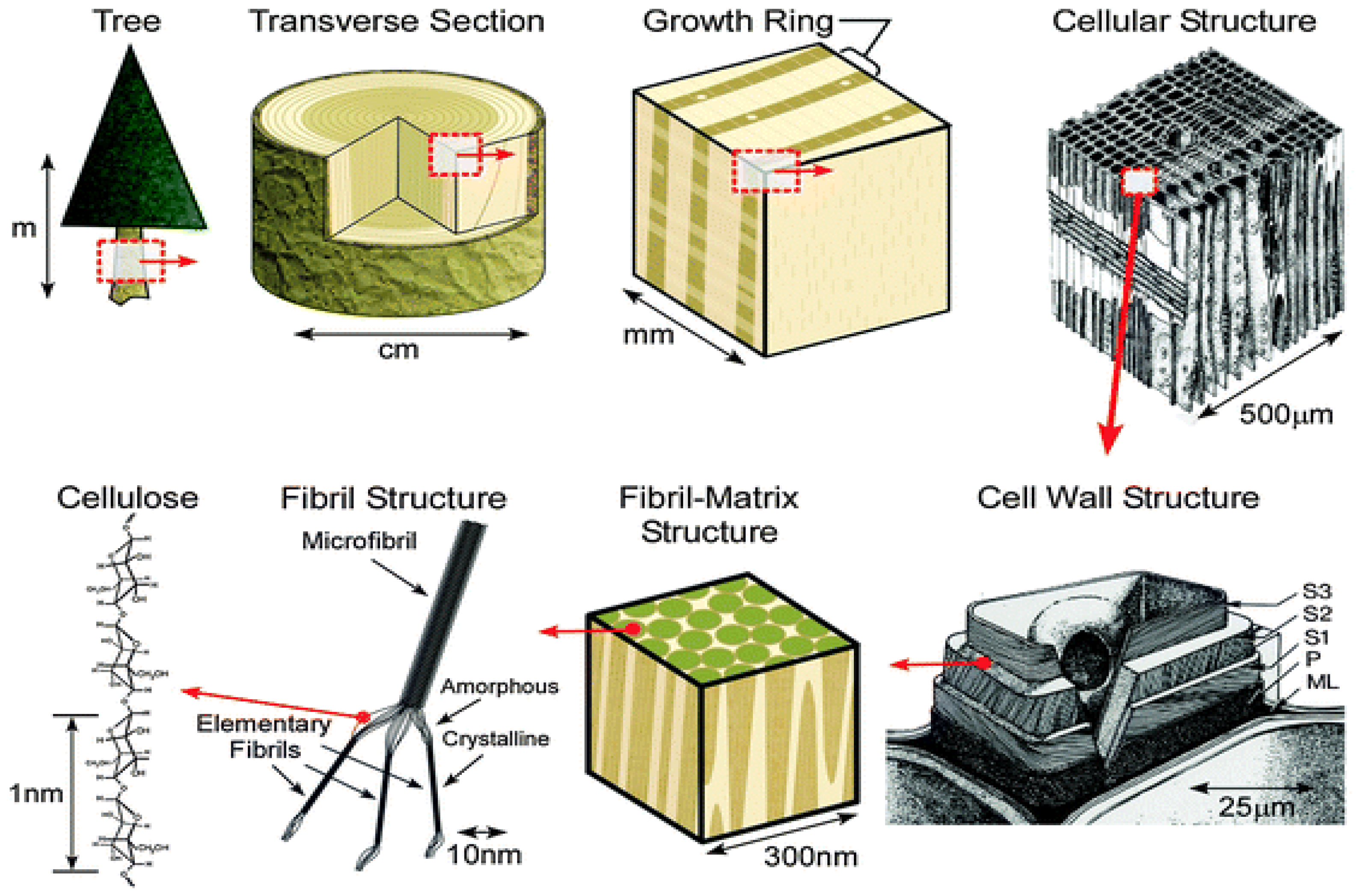
Figure 2.
Scanning Electron Microscope (SEM) images of three types of nanocellulose: (a) cellulose nanocrystals [18], (b) cellulose nanofibrils [19], (c) bacterial nanocellulose [20] [Reused with permission from publisher].

Figure 3.
Preparation methods for nanocellulose.
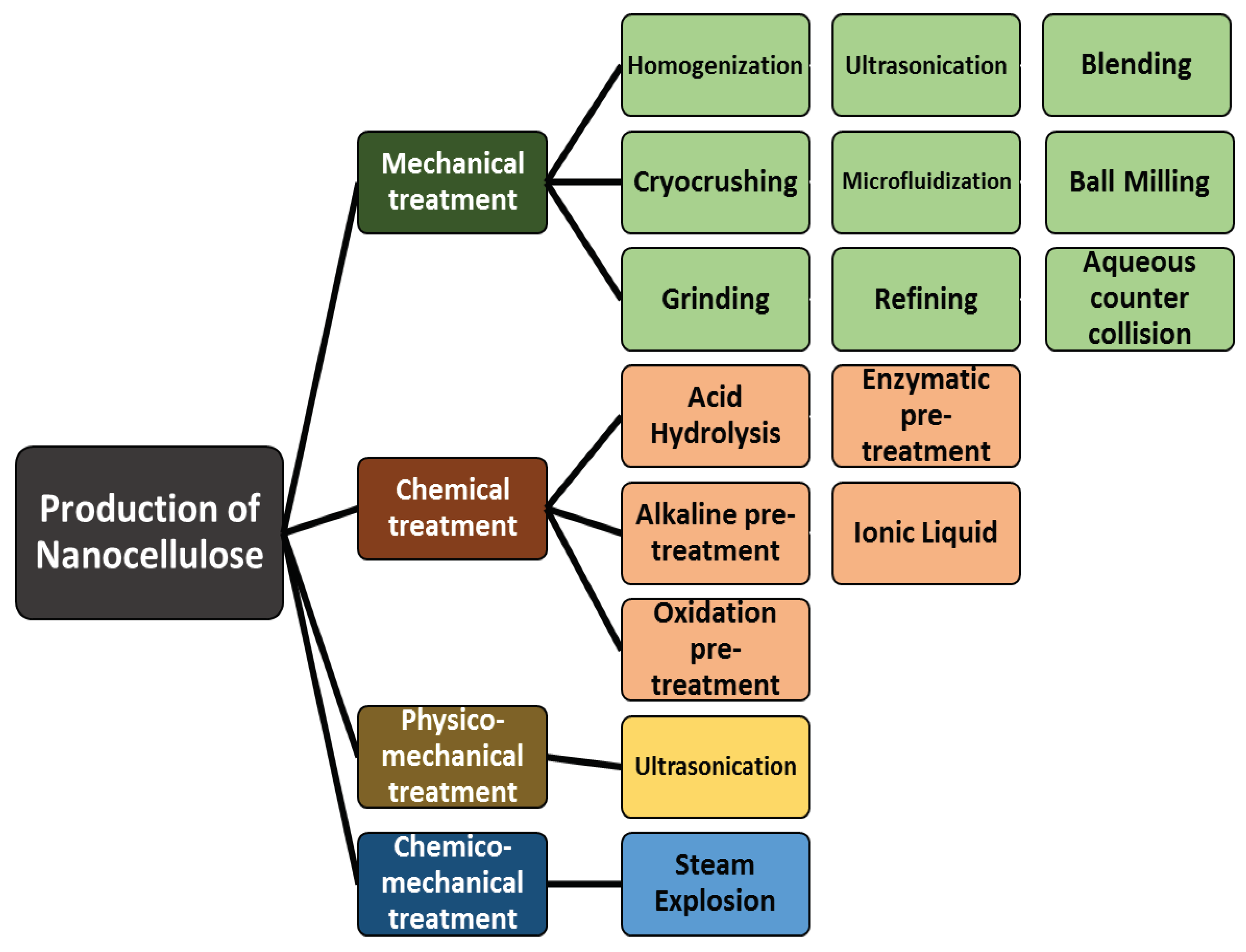
Figure 4.
Equipment used for homogenization process; (a) homogenizer (b) microfluidizer [Reused with permission from publisher].
Figure 4.
Equipment used for homogenization process; (a) homogenizer (b) microfluidizer [Reused with permission from publisher].
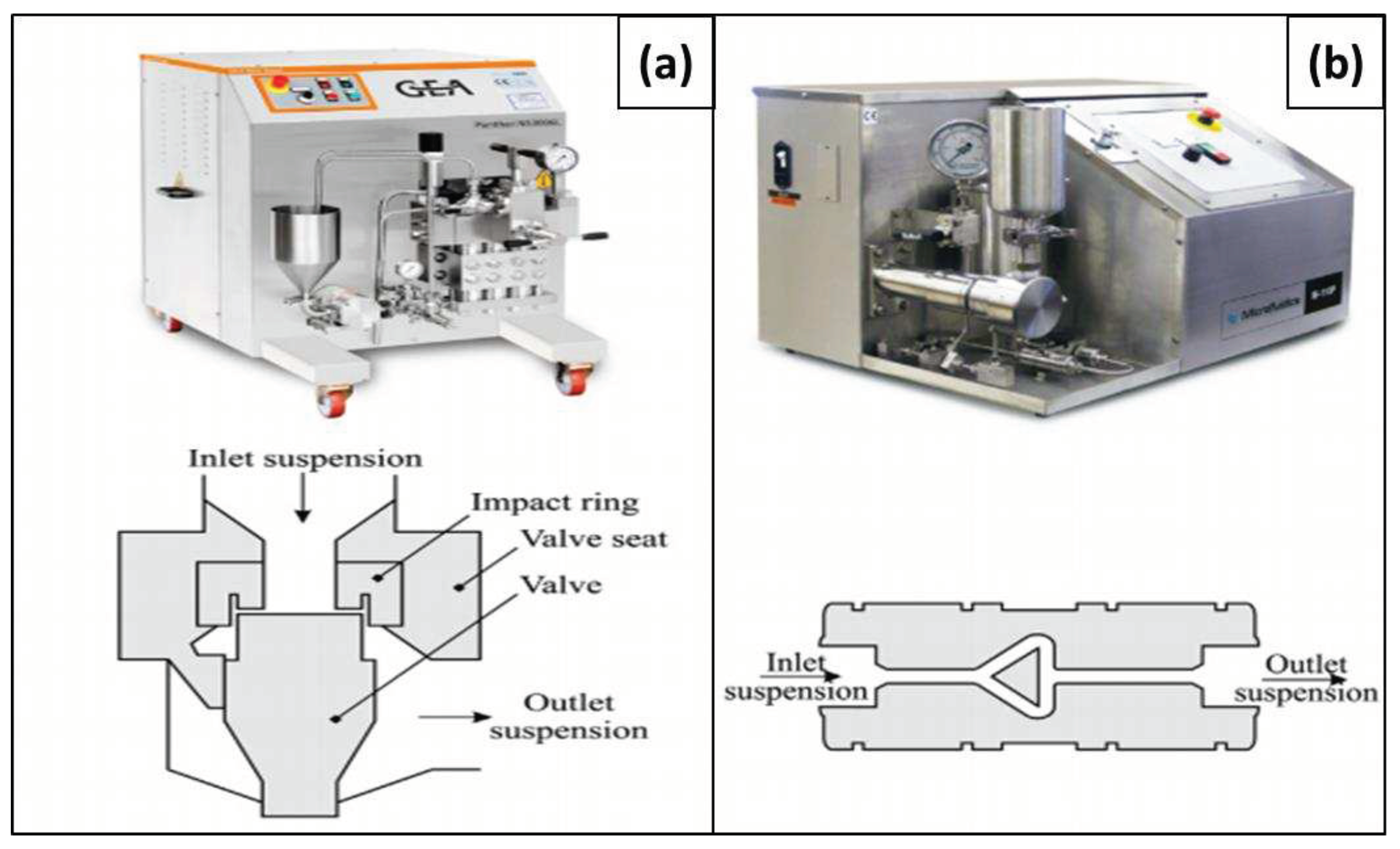
Figure 5.
Sample of cryo crushing system [Reused with permission from publisher].
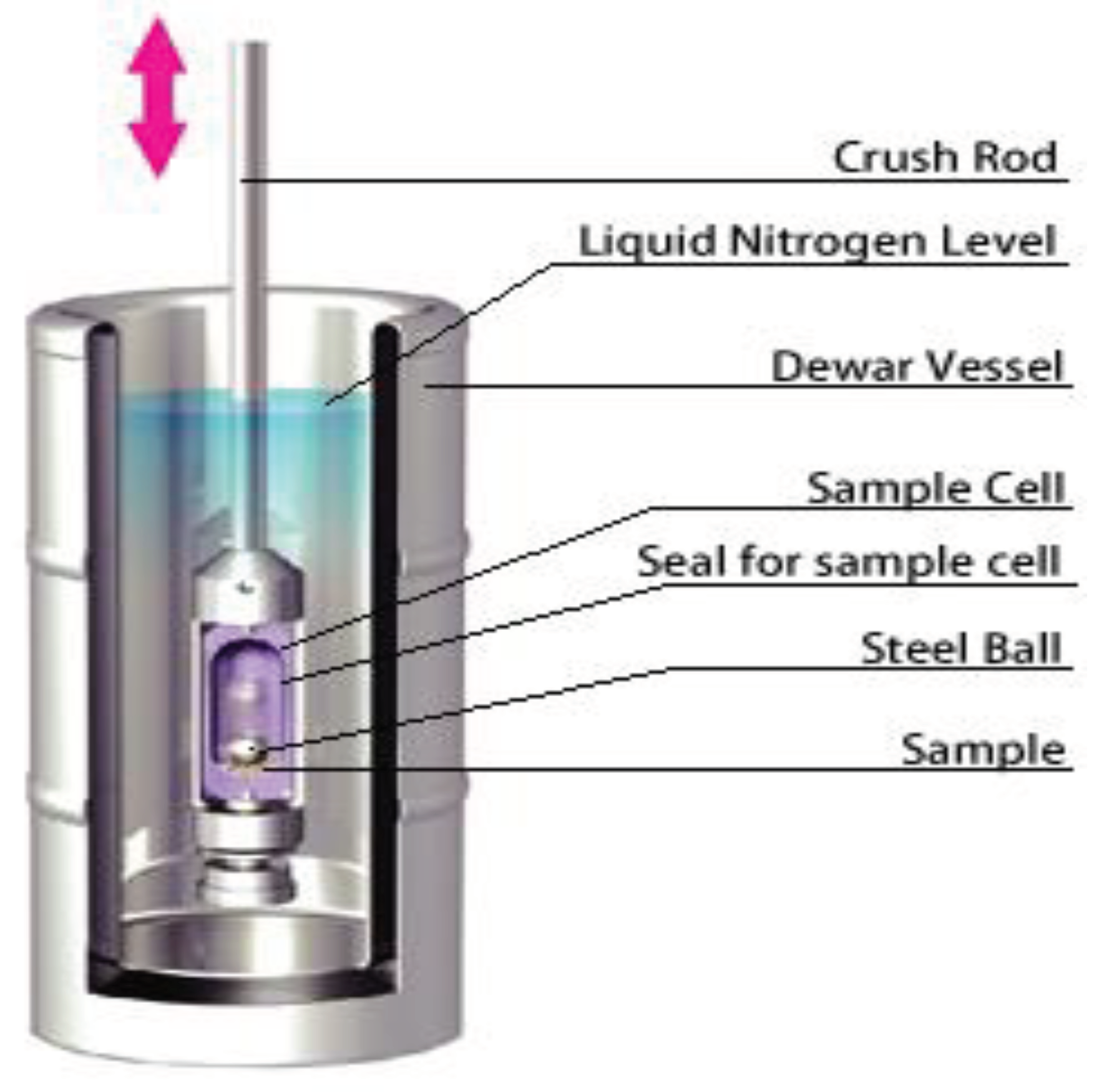
Figure 6.
Isolation of nanocellulose: Grinding equipment [64] [Reused with permission from publisher].
Figure 6.
Isolation of nanocellulose: Grinding equipment [64] [Reused with permission from publisher].
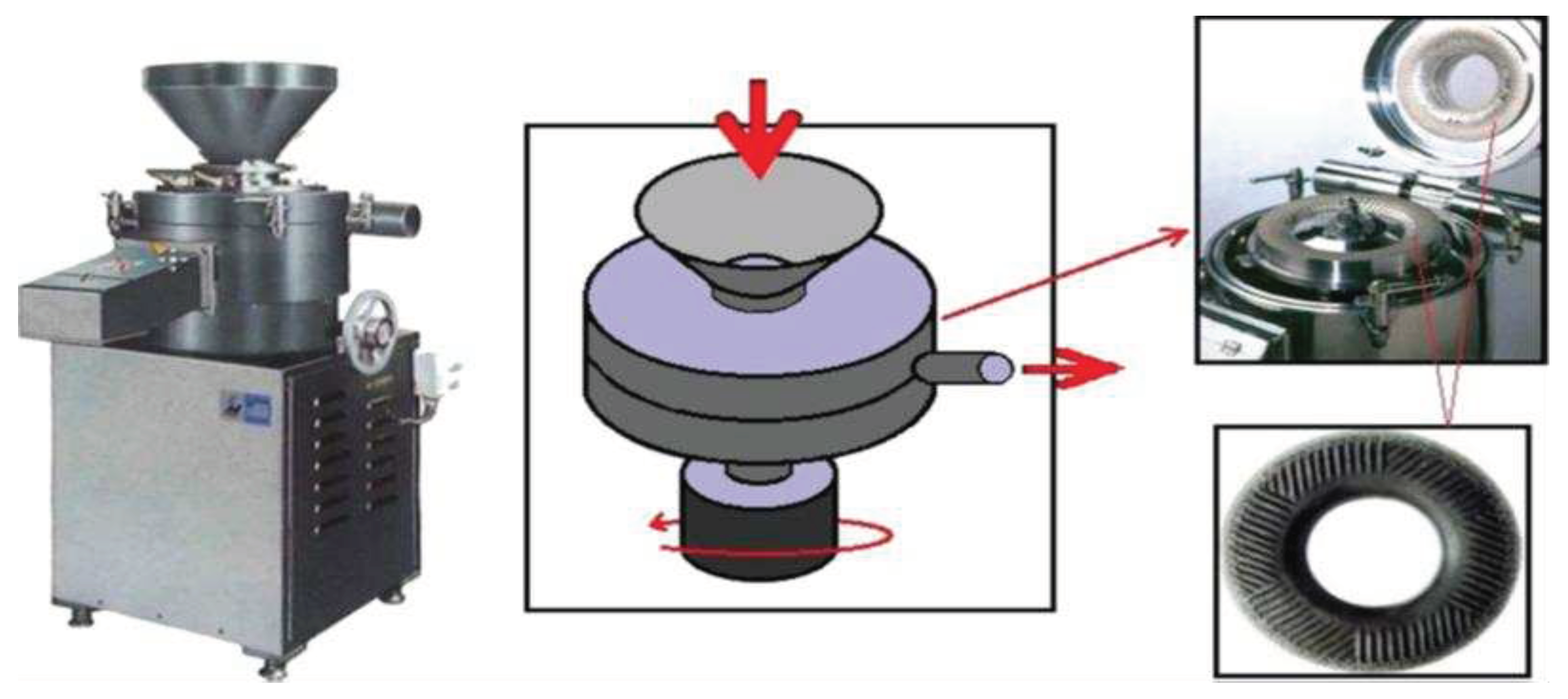
Figure 7.
Schematic diagram of microfluidizer [64] [Reused with permission from publisher].
Figure 7.
Schematic diagram of microfluidizer [64] [Reused with permission from publisher].
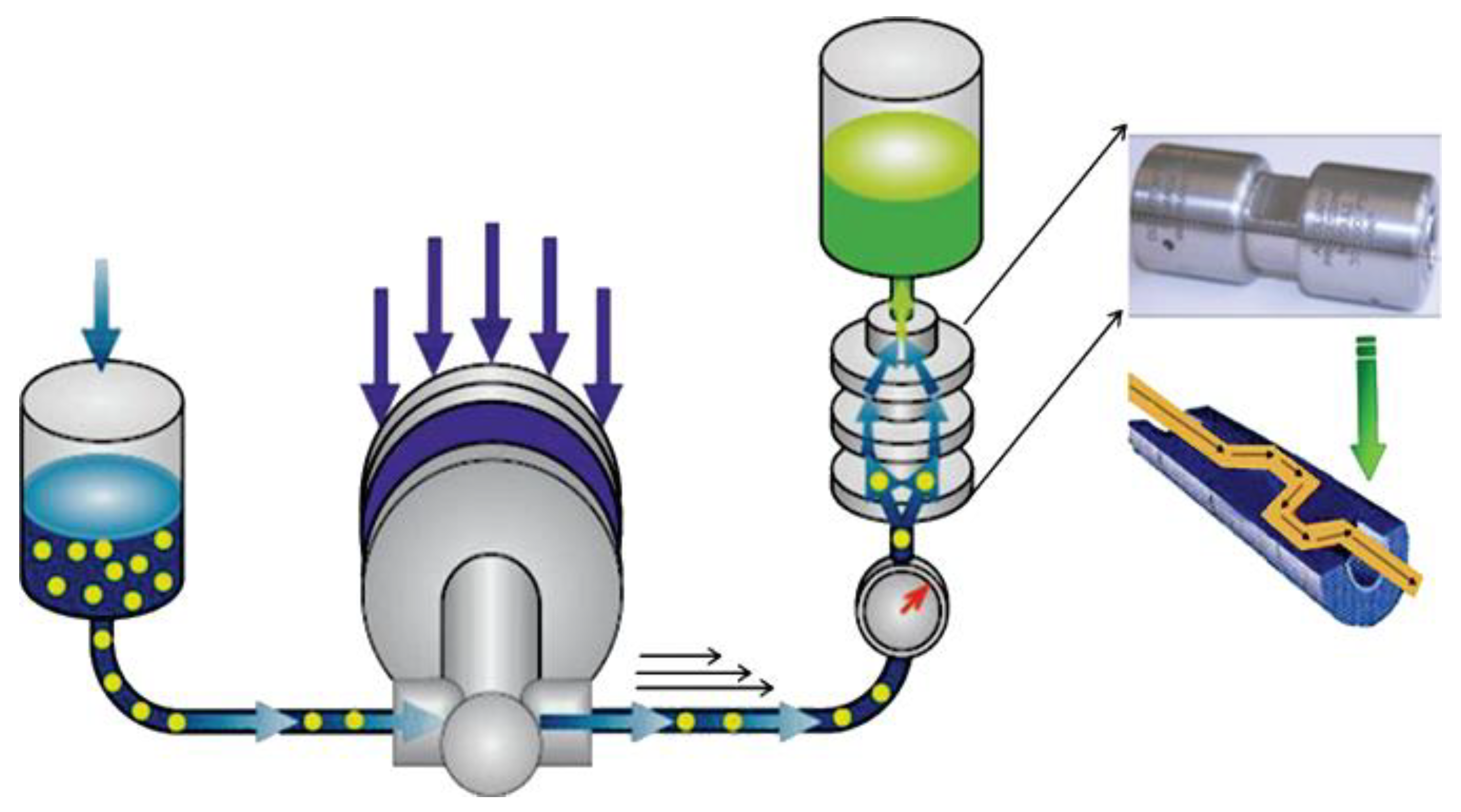
Figure 8.
Disc refiner opened to show the refining surfaces [78] [Reused with permission from publisher].
Figure 8.
Disc refiner opened to show the refining surfaces [78] [Reused with permission from publisher].
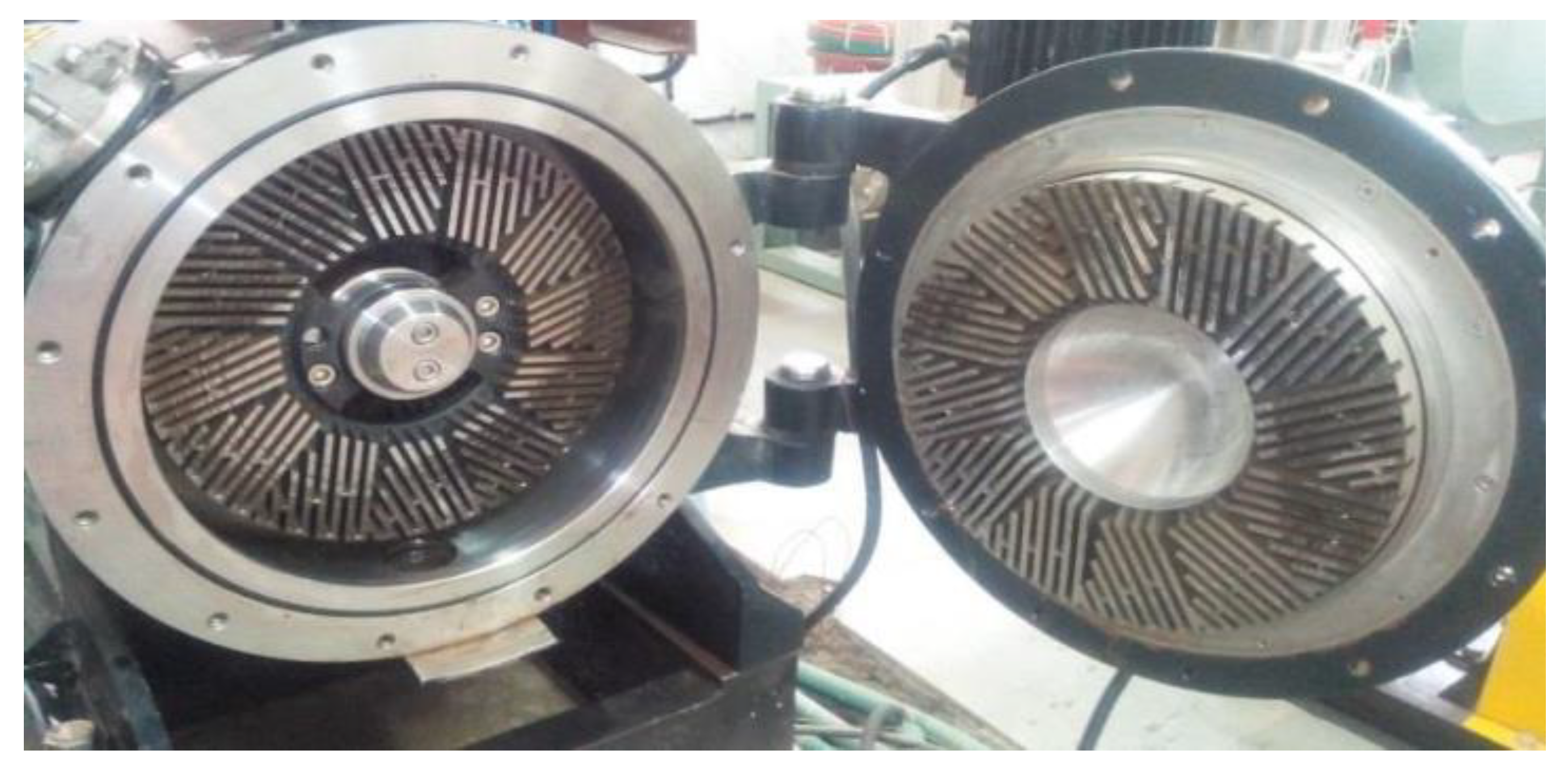
Figure 9.
High-speed blender. The stainless-steel bottle has a 4-blade propeller and an undulated inside wall [79] [Reused with permission from publisher].
Figure 9.
High-speed blender. The stainless-steel bottle has a 4-blade propeller and an undulated inside wall [79] [Reused with permission from publisher].
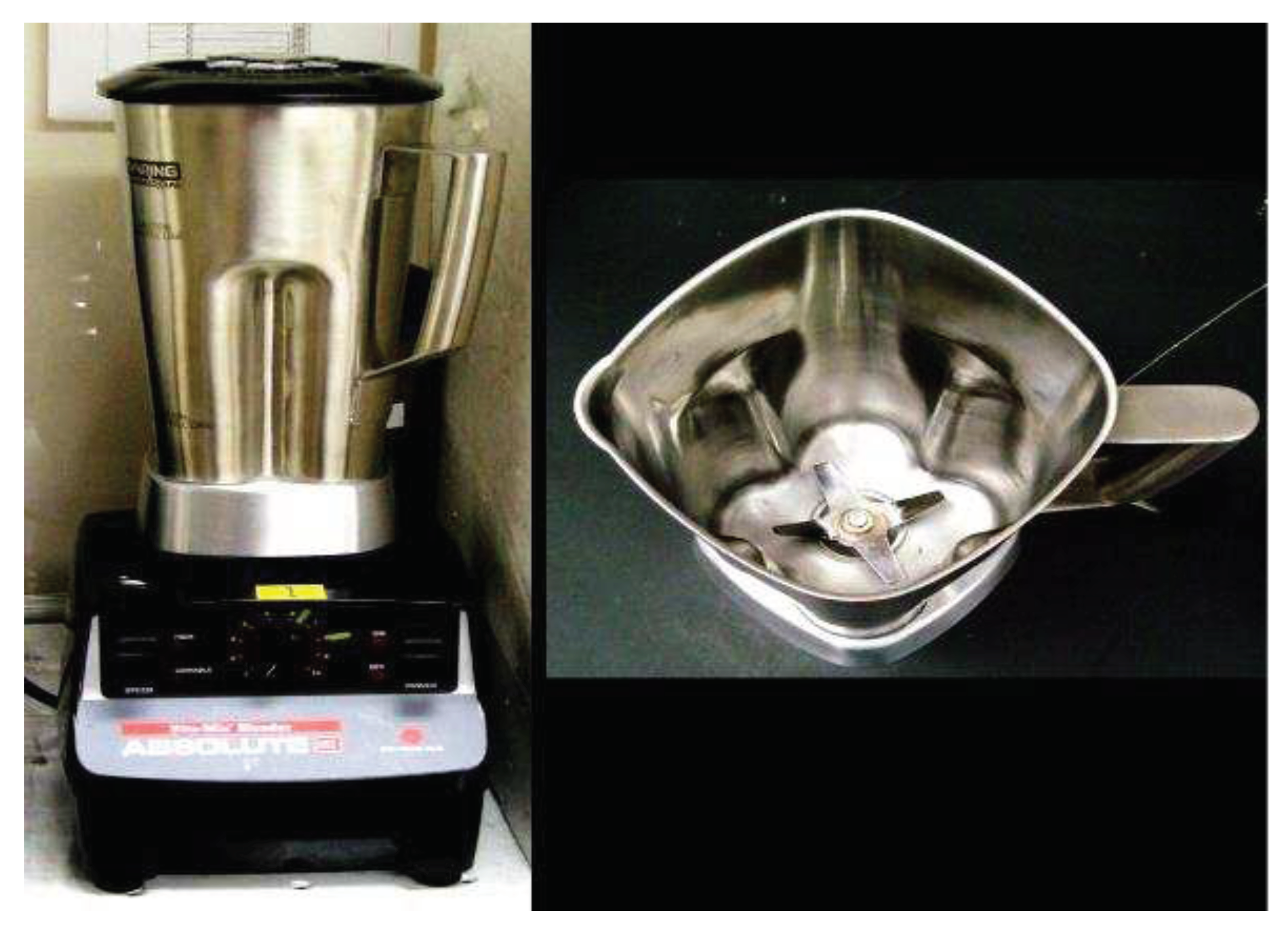
Figure 10.
Scheme of the all-dimensional planetary ball mill [86] [Reused with permission from publisher].
Figure 10.
Scheme of the all-dimensional planetary ball mill [86] [Reused with permission from publisher].
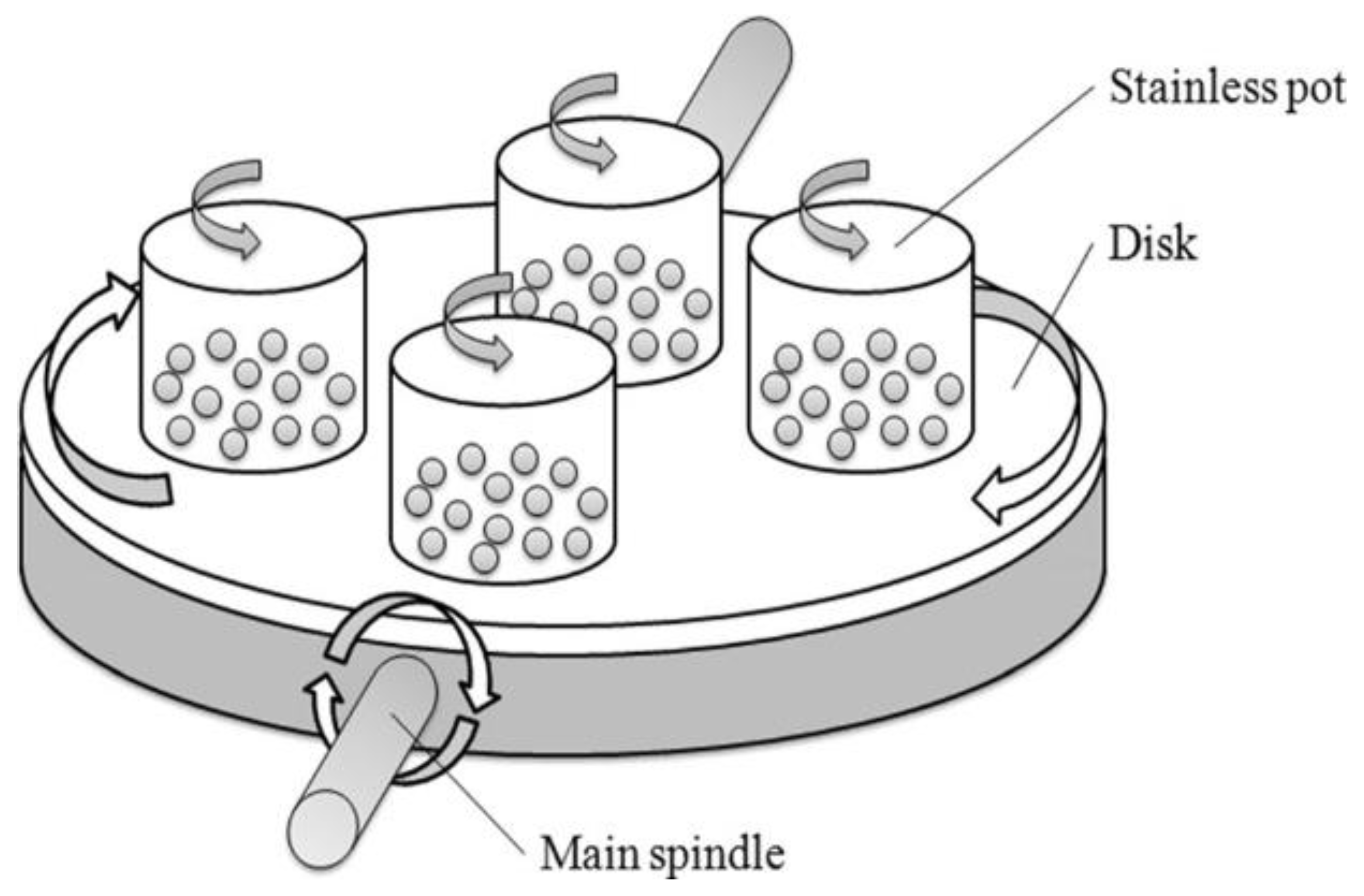
Figure 11.
Schematic view of the aqueous counter collision (ACC) method [90] [Reused with permission from publisher].
Figure 11.
Schematic view of the aqueous counter collision (ACC) method [90] [Reused with permission from publisher].
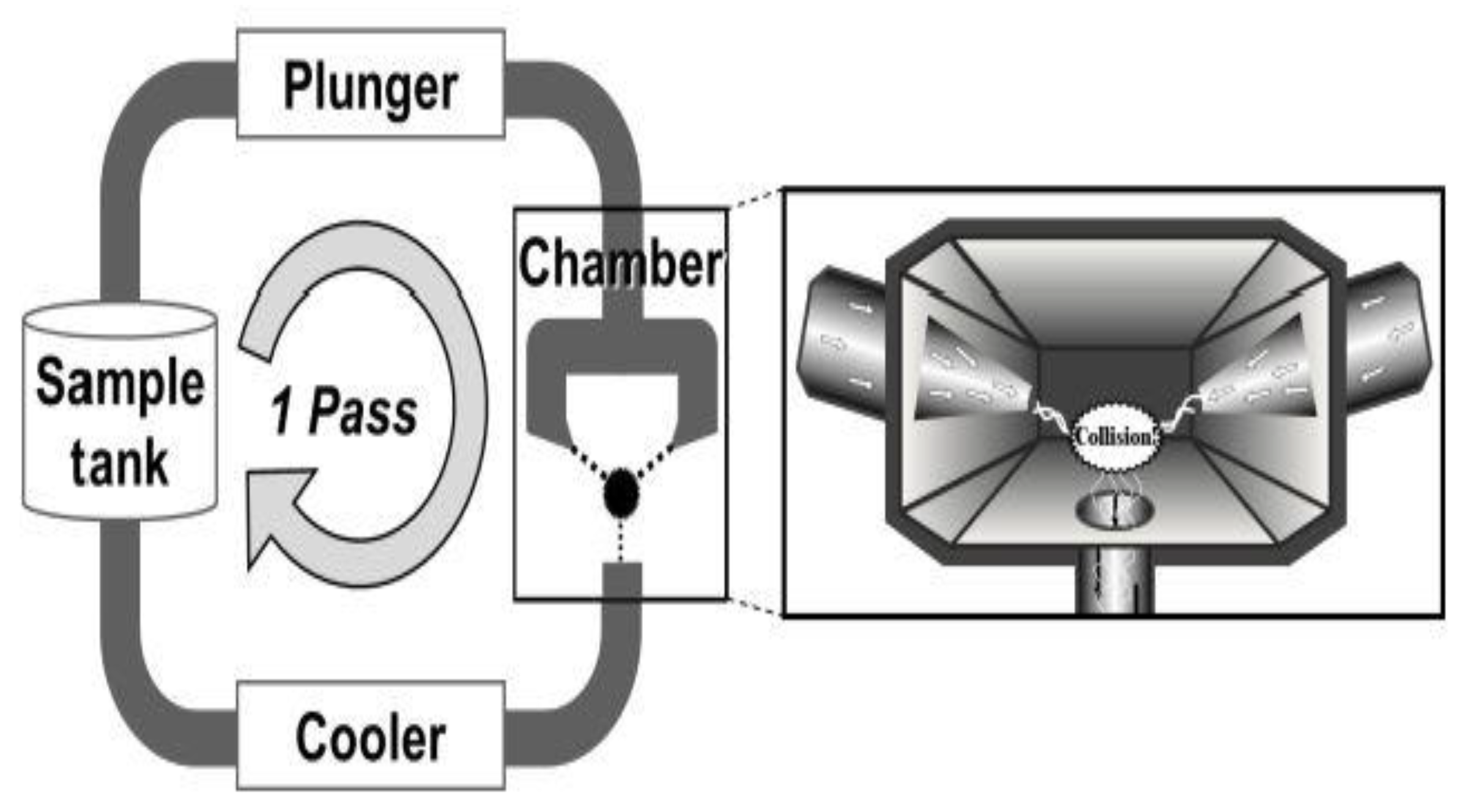
Figure 12.
Schematic of nanocrystalline cellulose extracted from cellulose chains using acid hydrolyzed [93] [Reused with permission from publisher].
Figure 12.
Schematic of nanocrystalline cellulose extracted from cellulose chains using acid hydrolyzed [93] [Reused with permission from publisher].
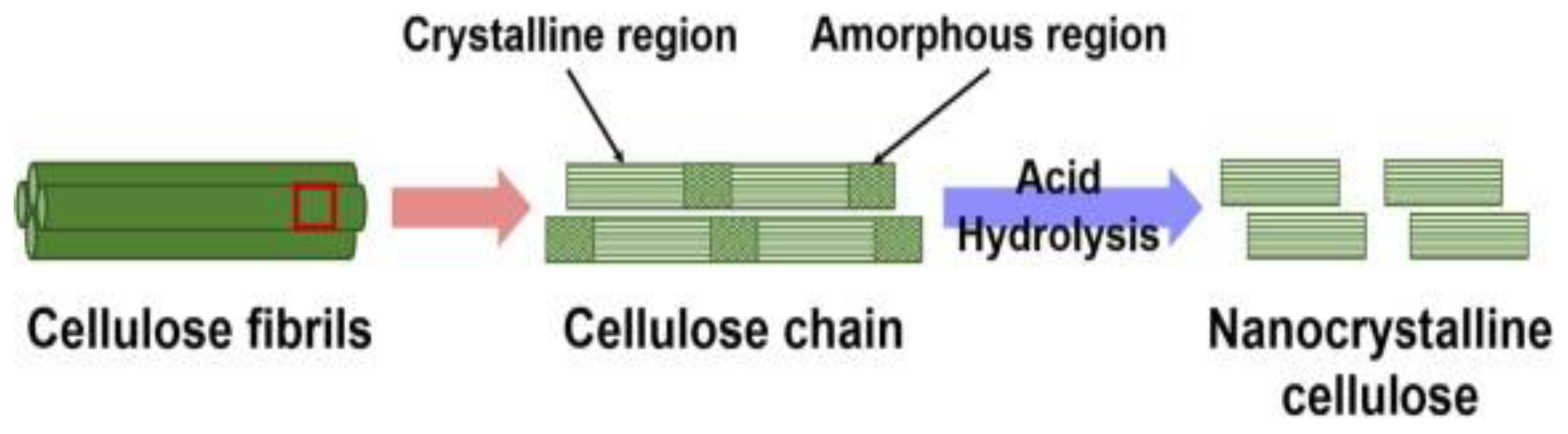
Figure 13.
Deconstruction of lignocelluloses into cellulose, hemicellulose, and lignin [97] [Reused with permission from publisher].
Figure 13.
Deconstruction of lignocelluloses into cellulose, hemicellulose, and lignin [97] [Reused with permission from publisher].
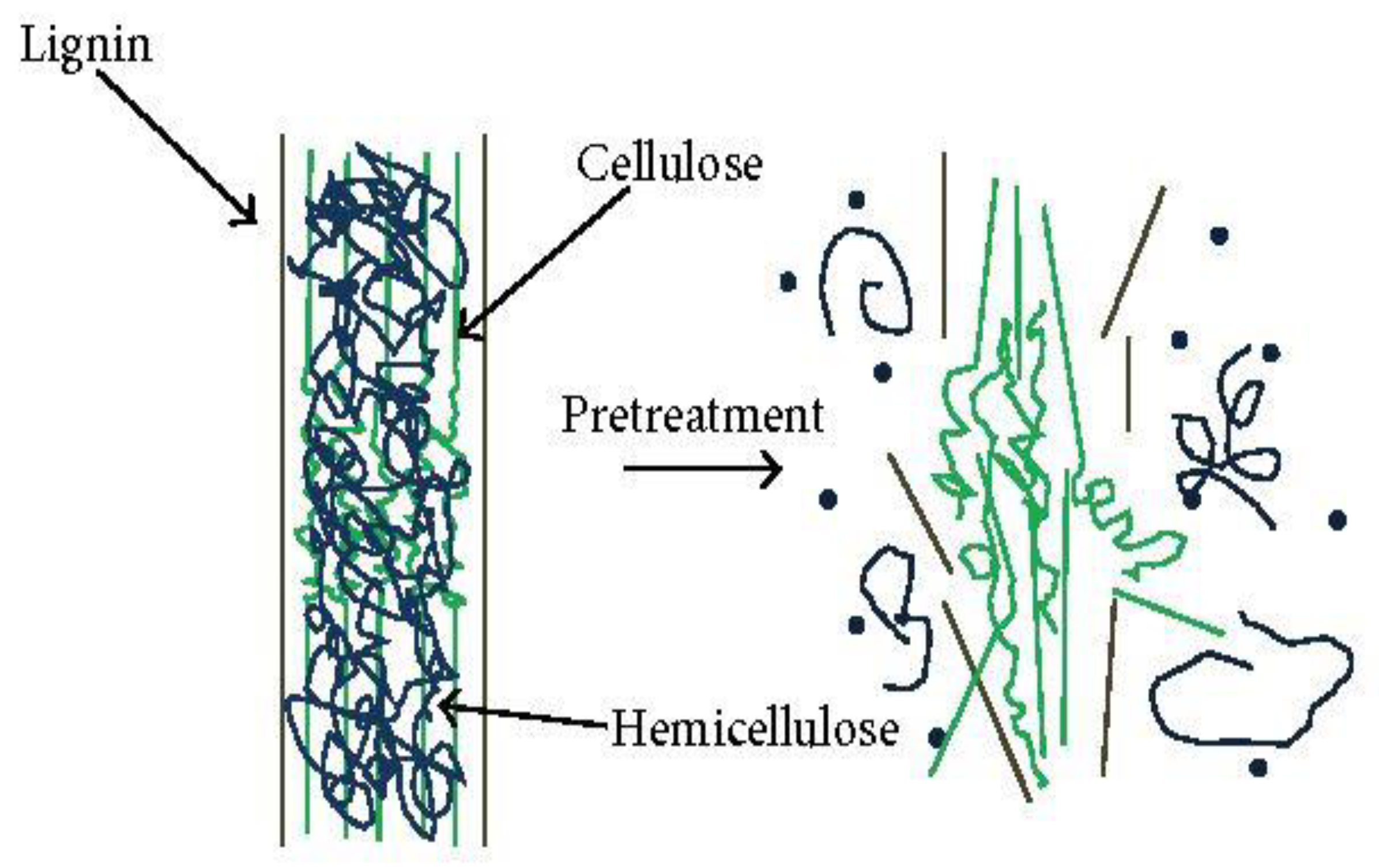
Figure 14.
A typical laboratory rig for sonochemical reactions uses a high intensity ultrasonic [113] [Reused with permission from publisher].
Figure 14.
A typical laboratory rig for sonochemical reactions uses a high intensity ultrasonic [113] [Reused with permission from publisher].
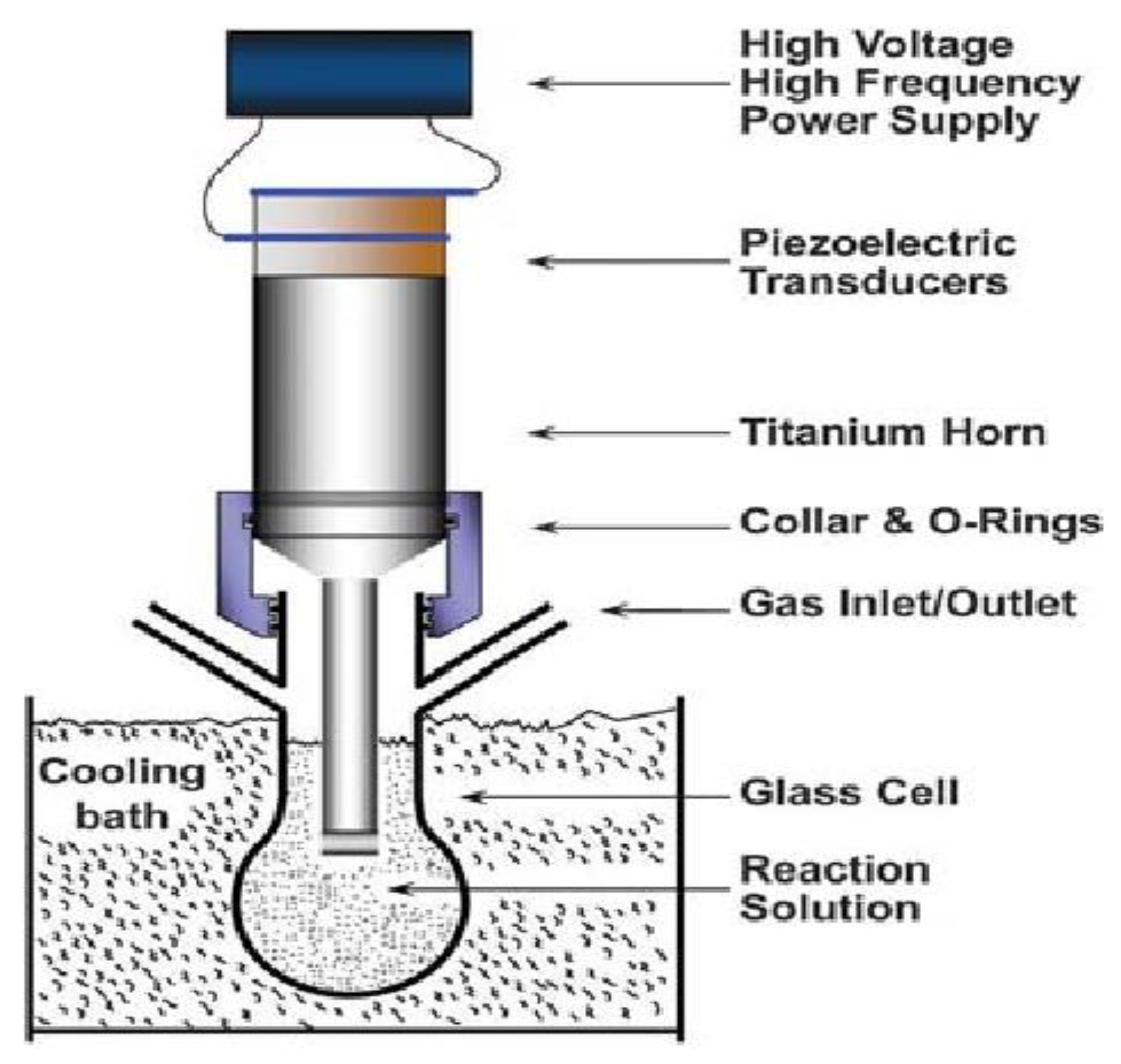
Figure 15.
Front and top view of the pressurizing vessel for steam explosion [115] [Reused with permission from publisher].
Figure 15.
Front and top view of the pressurizing vessel for steam explosion [115] [Reused with permission from publisher].
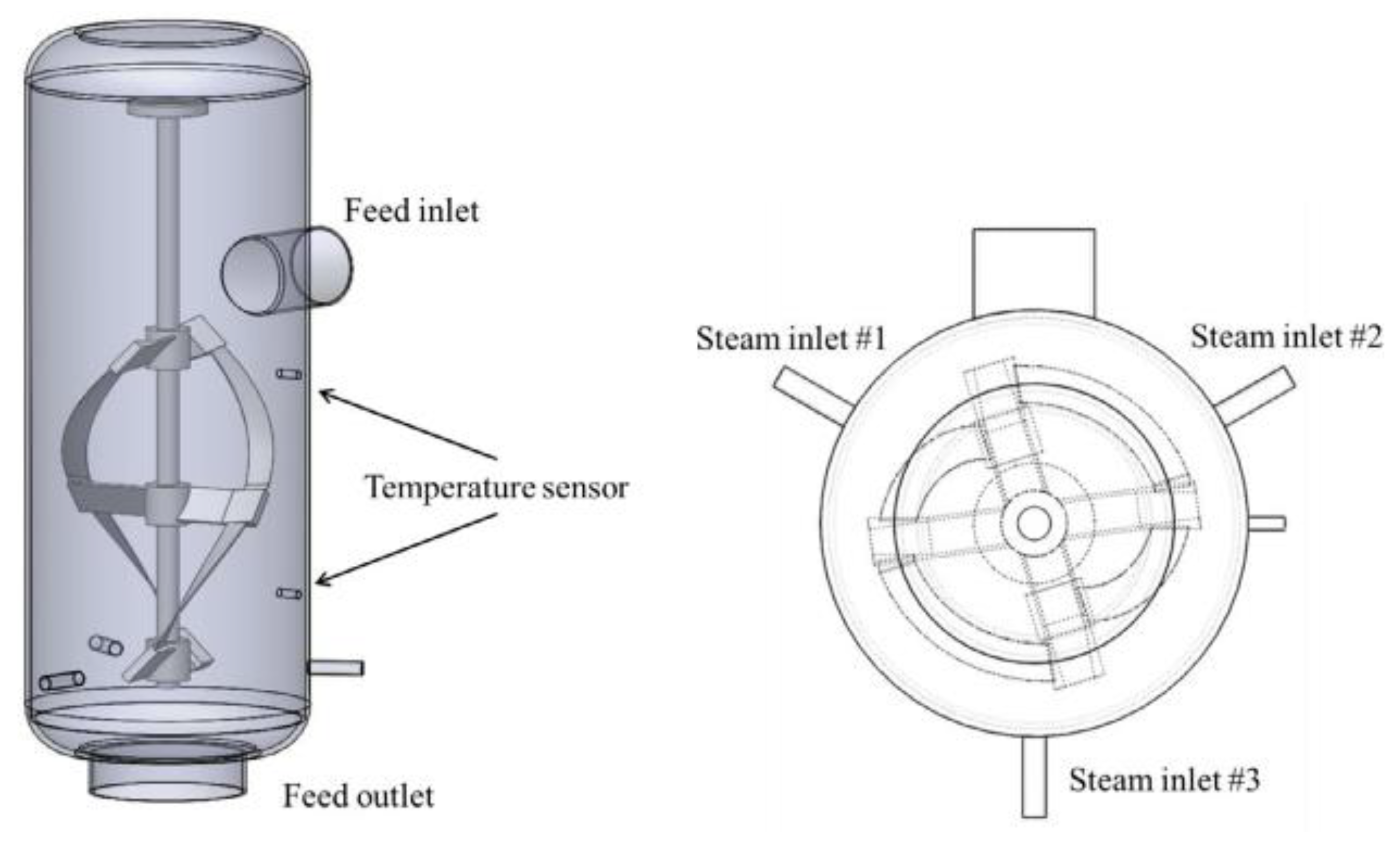
Figure 16.
Figure Surface modifications of nanocellulose.
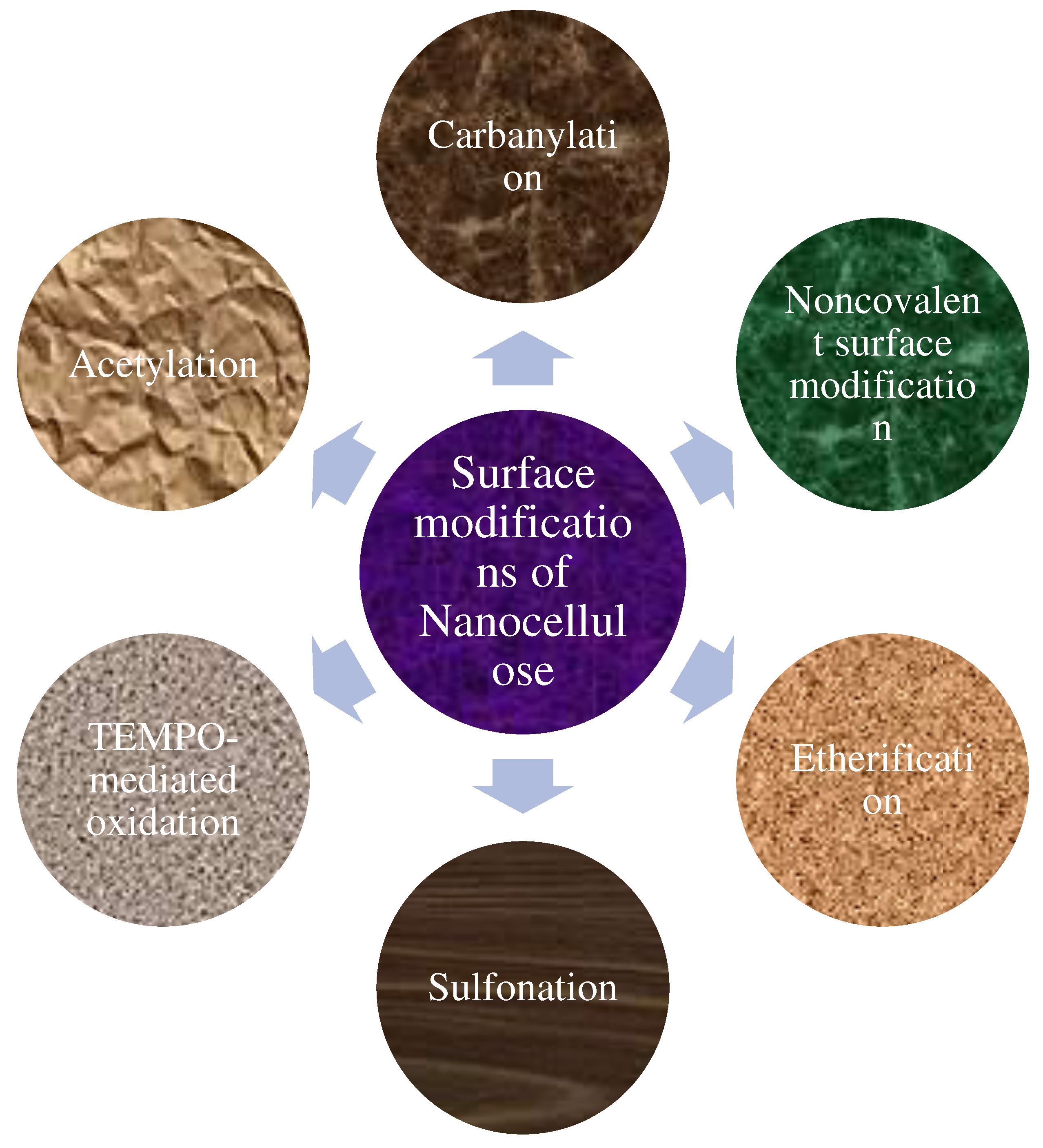
Figure 17.
Schematic diagram of carbonylation process of nanocellulose [150] [Reused with permission from publisher].
Figure 17.
Schematic diagram of carbonylation process of nanocellulose [150] [Reused with permission from publisher].
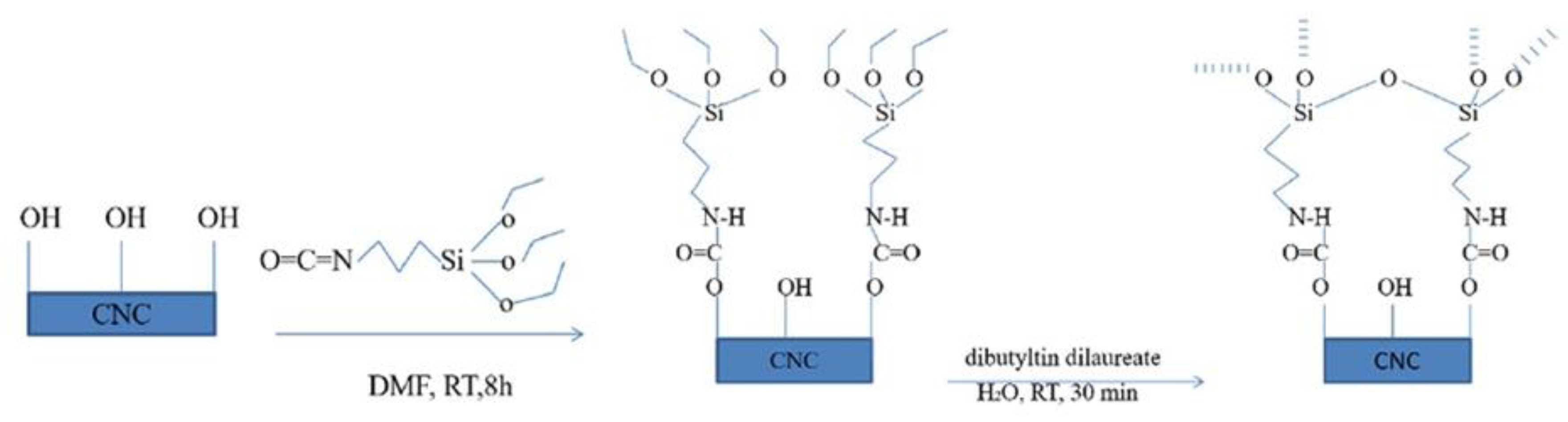
Figure 18.
Schematic diagram of TEMPO-mediated oxidation process of nanocellulose [Reused with permission from publisher].
Figure 18.
Schematic diagram of TEMPO-mediated oxidation process of nanocellulose [Reused with permission from publisher].
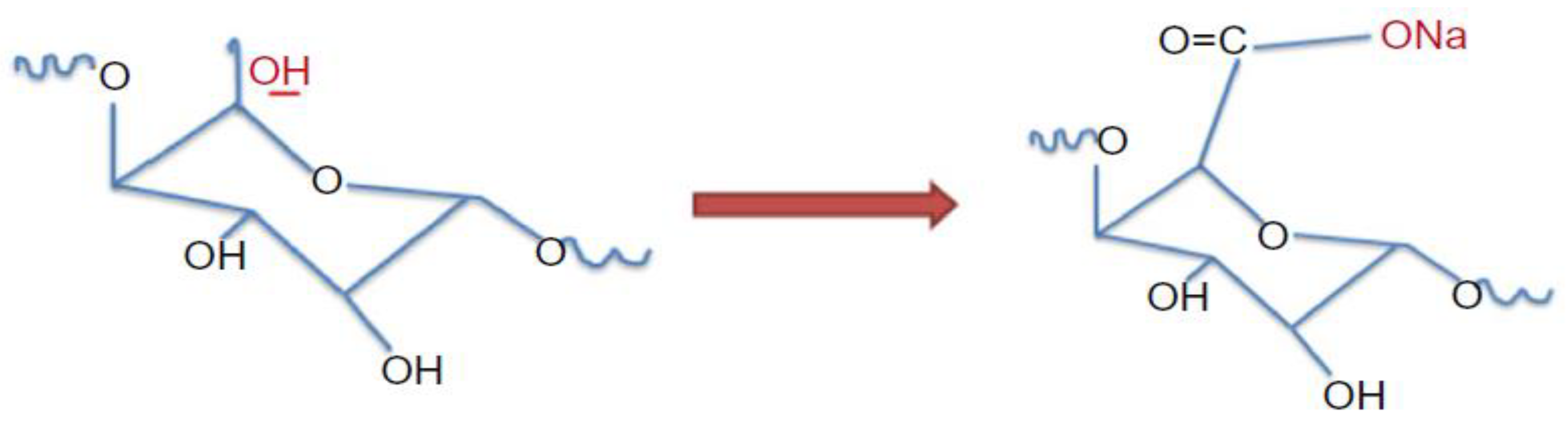
Figure 19.
Schematic diagram of acetylation process of nanocrystals [163] [Reused with permission from publisher].
Figure 19.
Schematic diagram of acetylation process of nanocrystals [163] [Reused with permission from publisher].
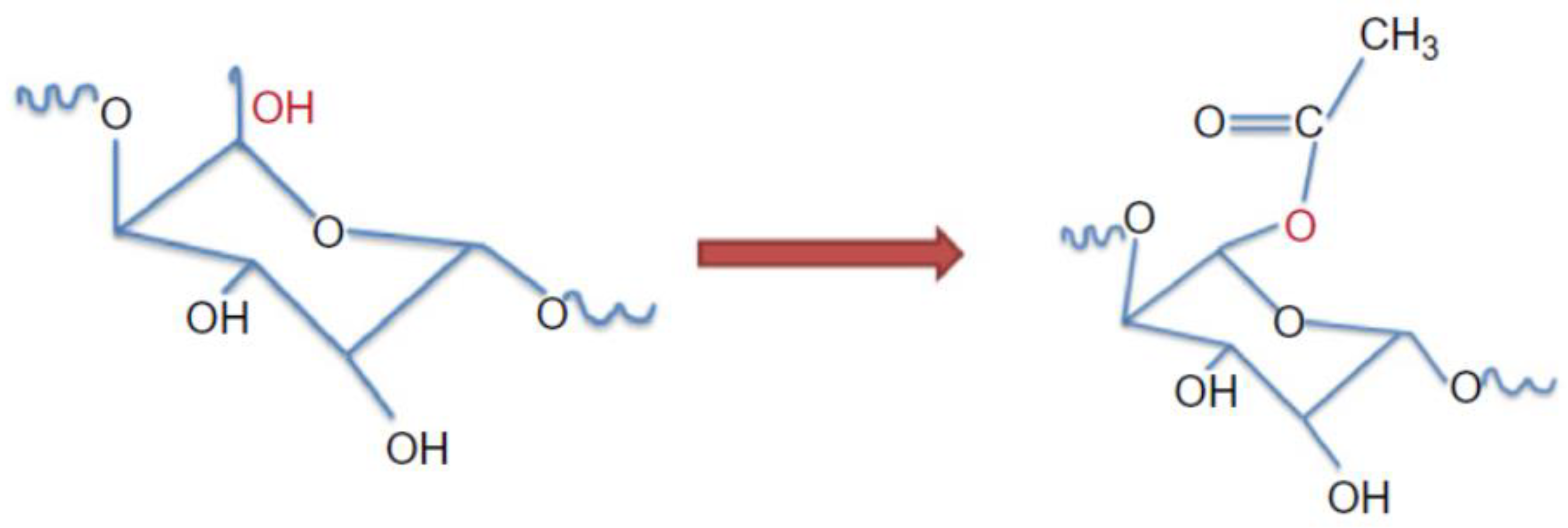
Figure 20.
Light transmittance of microfibrillated cellulose films [200] [Reused with permission from publisher].
Figure 20.
Light transmittance of microfibrillated cellulose films [200] [Reused with permission from publisher].
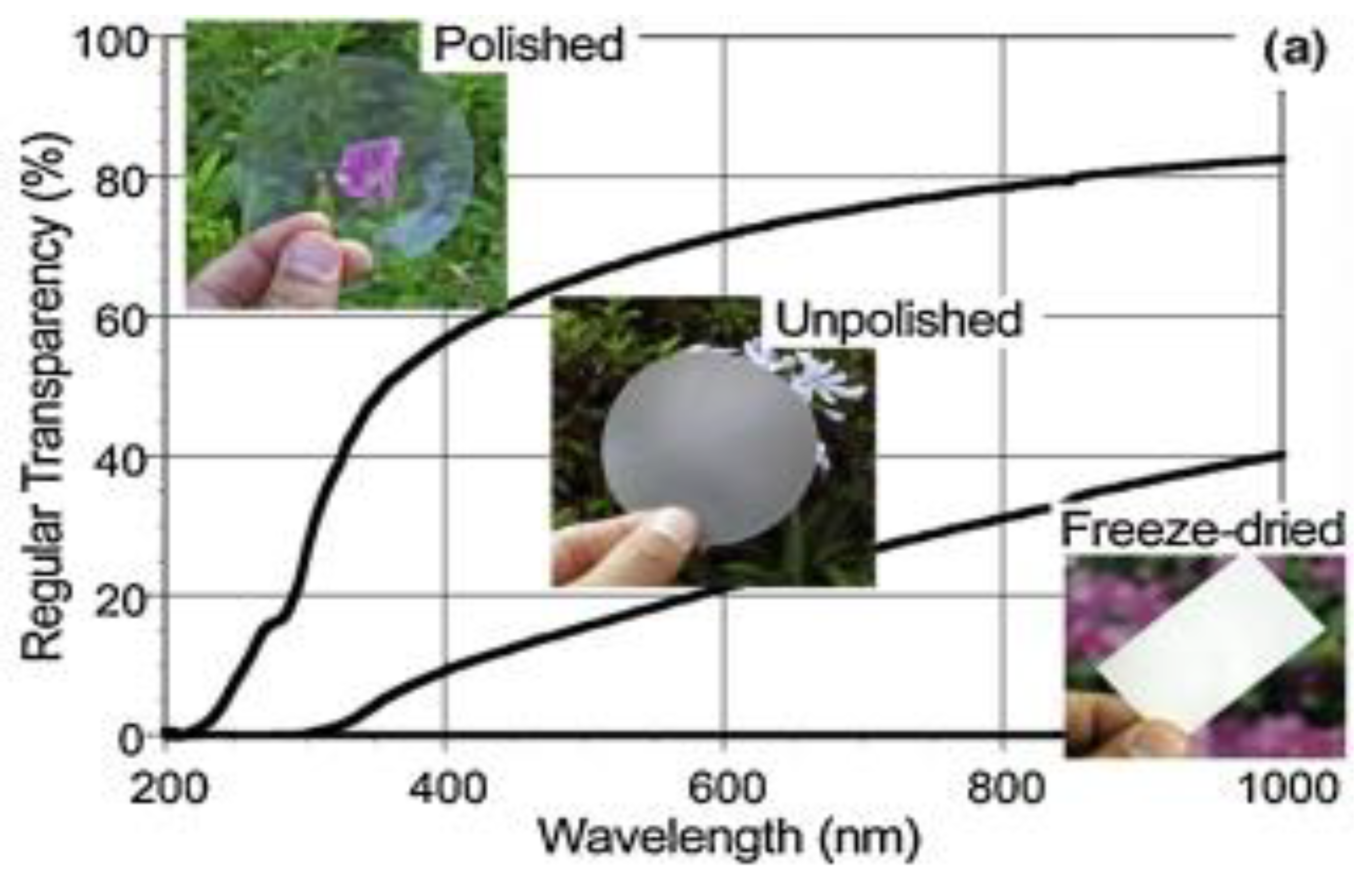
Figure 21.
Main Application of nanocellulose [Reused with permission from publisher].
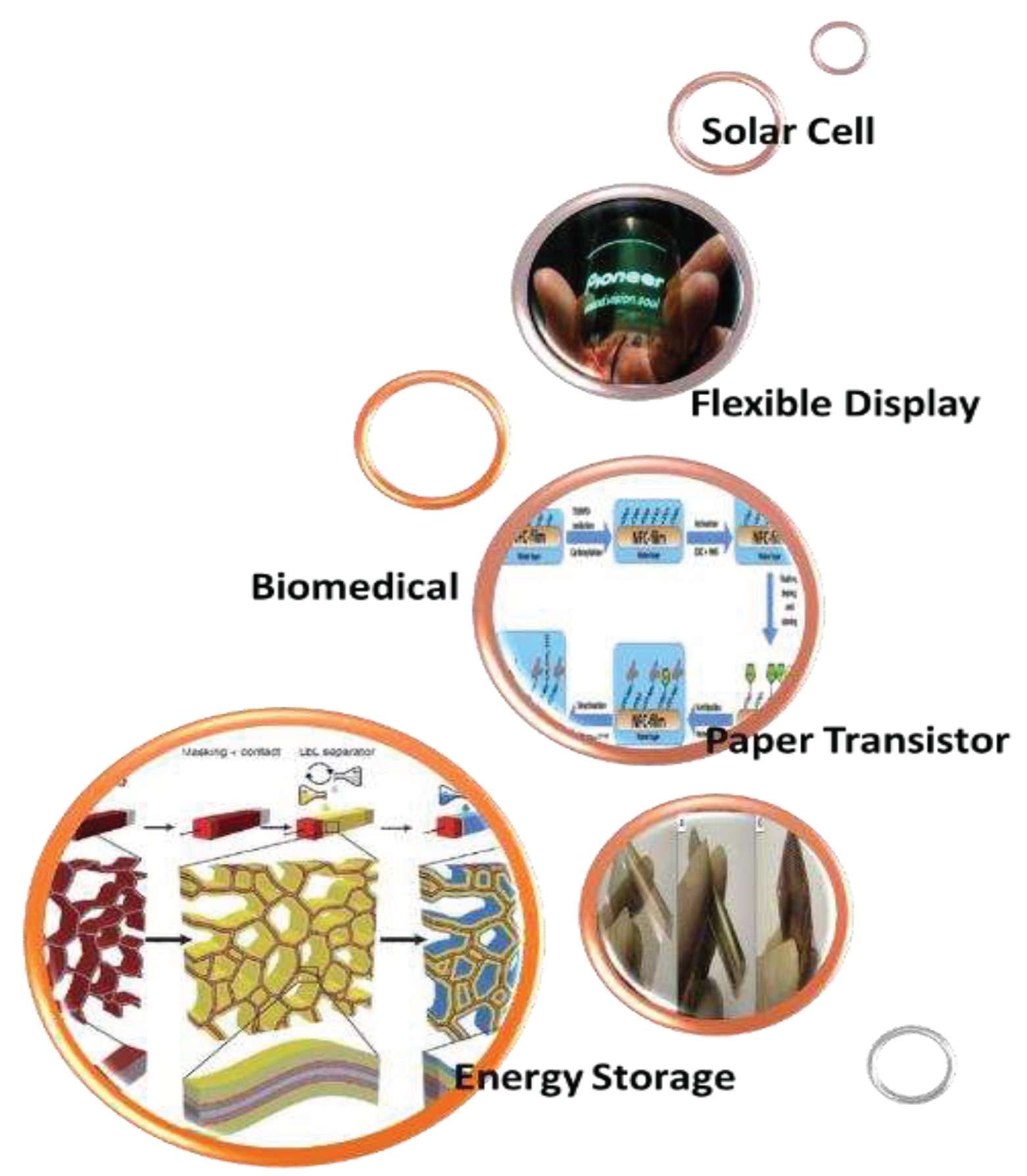
Figure 22.
Modification of CNF films with reactive amine groups for detection of biological species [244] [Reused with permission from publisher].
Figure 22.
Modification of CNF films with reactive amine groups for detection of biological species [244] [Reused with permission from publisher].
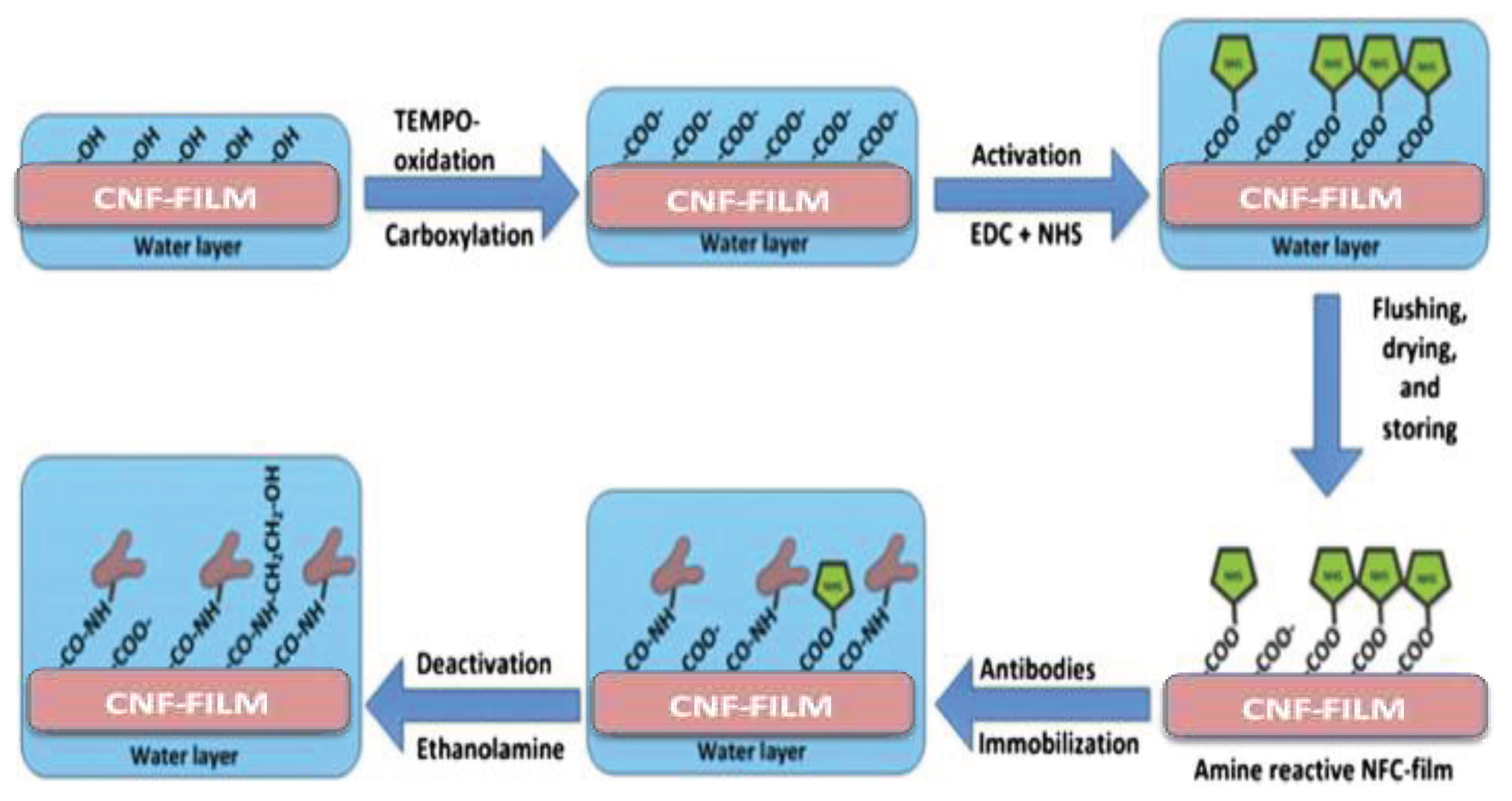
Figure 23.
Flexible display on CNF substrate [250]. [Reused with permission from publisher].
Figure 23.
Flexible display on CNF substrate [250]. [Reused with permission from publisher].
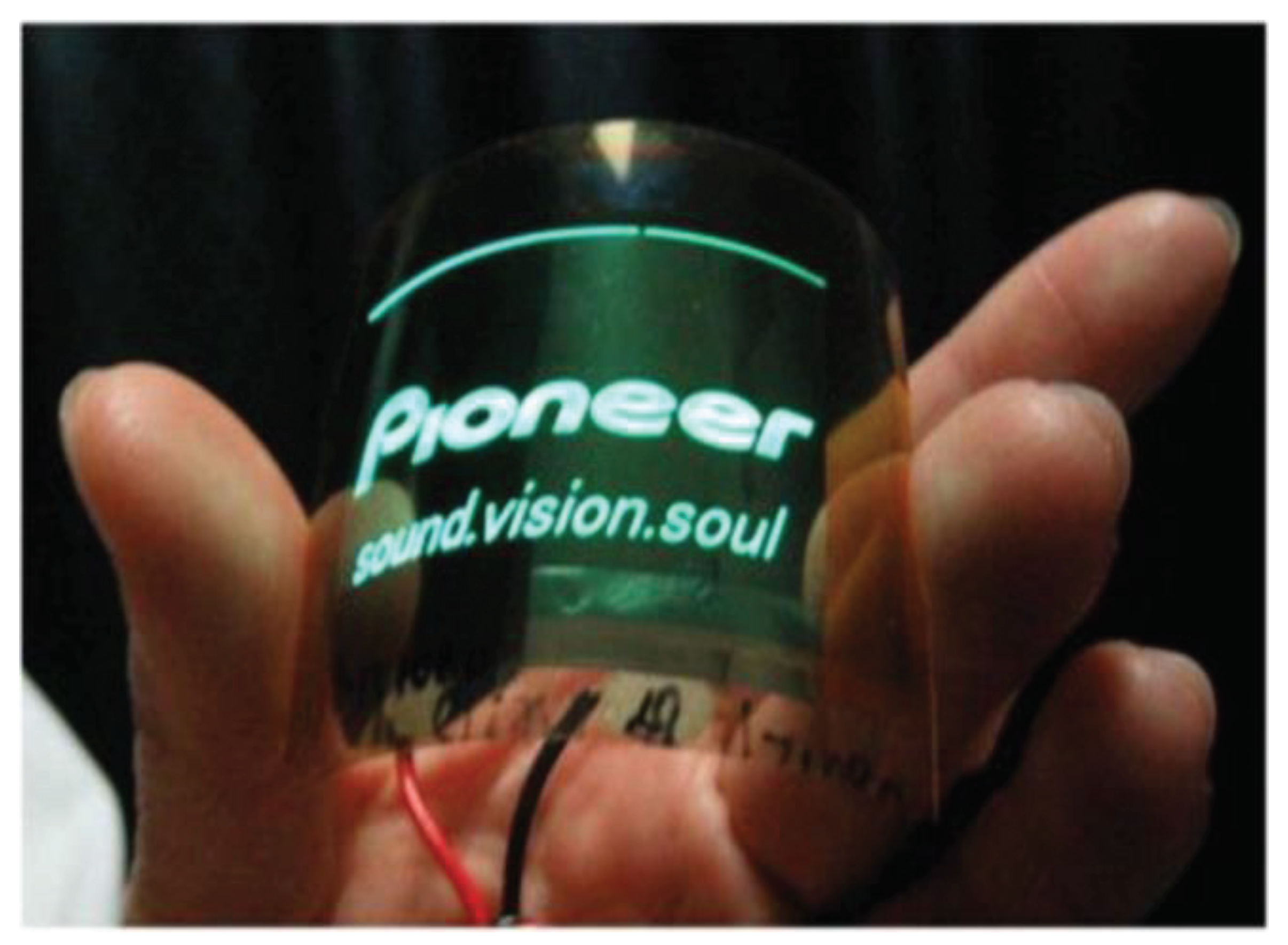
Figure 24.
Energy-storage device assembly in a CNF aerogel by LbL technique [250] [Reused with permission from publisher].
Figure 24.
Energy-storage device assembly in a CNF aerogel by LbL technique [250] [Reused with permission from publisher].
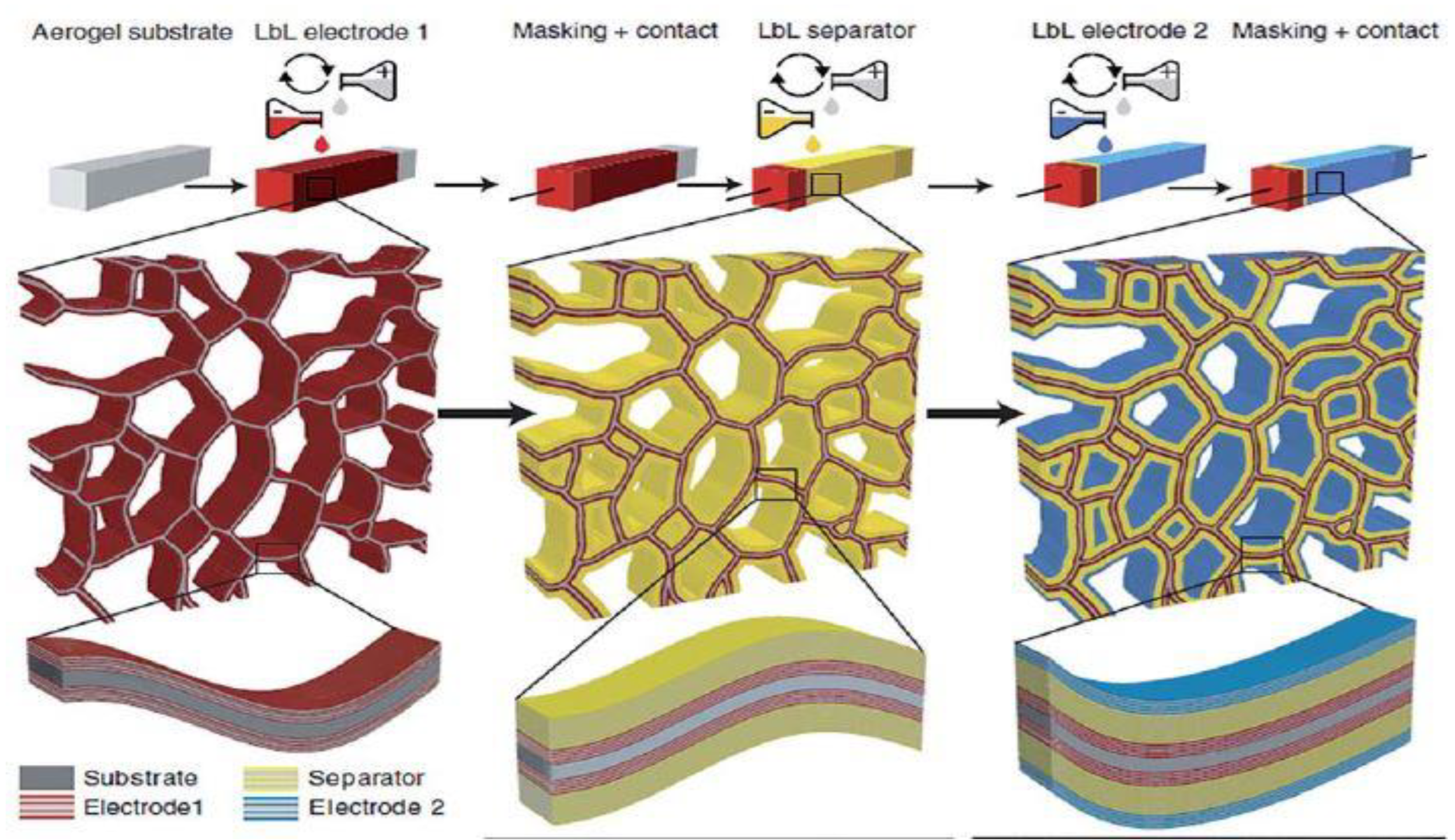
Figure 25.
(a) 20 μm thick of transistor nanopaper (b) bending state (c) folding state [263] [Reused with permission from publisher].
Figure 25.
(a) 20 μm thick of transistor nanopaper (b) bending state (c) folding state [263] [Reused with permission from publisher].
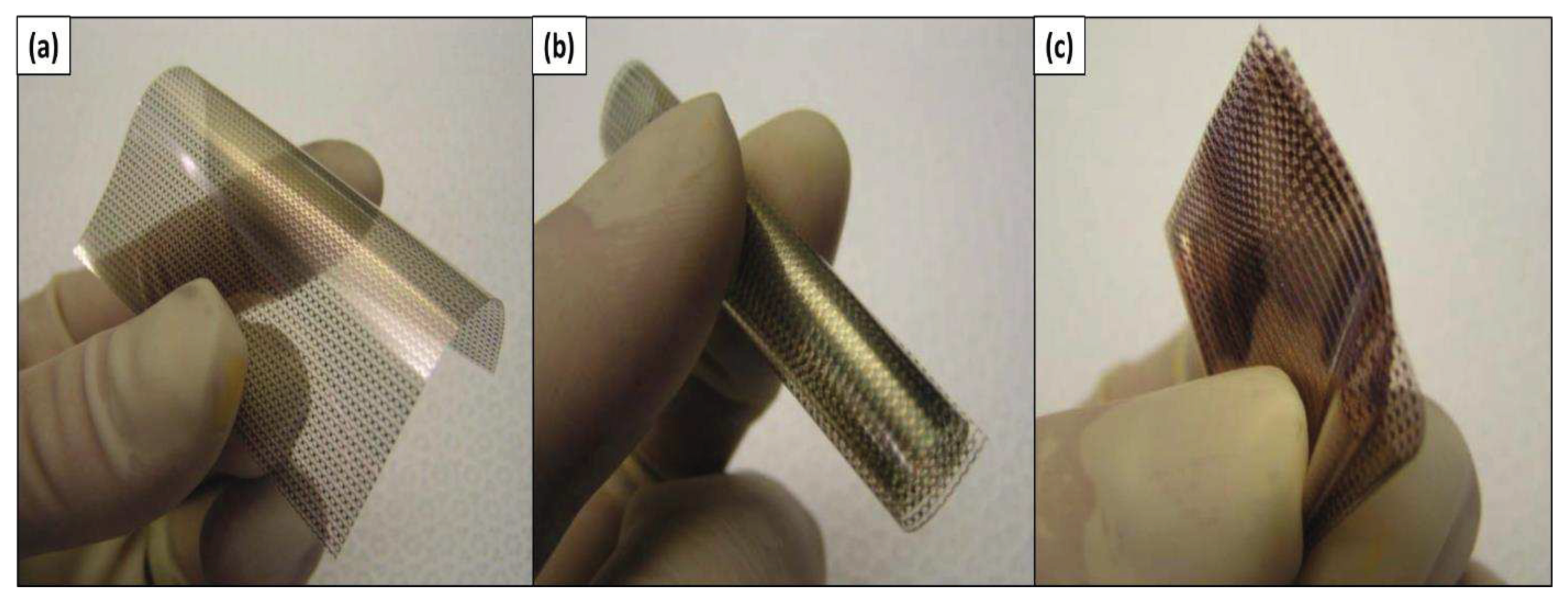

Table 1.
The Classification of Nanocellulose.
| Type of Nanocellulose | Synonyms | Typical Sources | Formation and average size |
|---|---|---|---|
| Cellulose nanocrystals (CNC) | Cellulose nanocrystals, crystallites, whiskers, rod-like cellulose microcrystals | Ramie tunicin, wood, wheat straw, mulberry bark | Method used: Acid Hydrolysis. Ø=5-70 nm L=100-250 nm |
| Cellulose nanofibrils (CNF) | Micro fibrillated cellulose, nanofibrils, and microfibrils | Sugar beet, hemp, wood, flax | Mechanical treatment and chemical treatment Ø=5-60 nm L=several micrometers |
| Bacterial Nanocellulose (BNC) | Bacterial cellulose, microbial cellulose, bio-cellulose | Low molecular weight sugar and alcohols | Bacterial based approach Ø=20-100 nm |
Table 2.
Summary of various preparation method for nanocellulose.
| Ref | Raw Materials | Preparation Method | Dimension |
|---|---|---|---|
| [116] | Cladodes of Opuntia Ficus Indica | Homogenization | ~ 5nm in width |
| [99] | Sugar beet pulp | TEMPO mediated oxidation | Not reported |
| [96] | Wheat straw | Cryocrushing and Homogenization | 20-120 nm in width |
| [63] | Kraft pulp | Refining and Homogenization | 50-100 nm in width |
| [117] | Cotton fibers | Refining | 242 ± 158 nm in diameter |
| [118] | Sugarcane bagasse | Acid Hydrolysis | ~32.84 nm |
| [119] | Cotton linter | Ultrasonication | 15-35 nm in diameter |
| [120] | Raw Cotton | Acid Hydrolysis and Alkaline pre-treatment | Not reported |
| [121] | Cystoseria myricaas algae | Acid Hydrolysis | 10-30 nm |
| [122] | Hibiscus cannabinus | Alkaline pre-treatment and Acid Hydrolysis | mean diameter of 6.1 ± 5 nm |
| [123] | Imperata brasiliensis grass | Acid Hydrolysis | diameters were 10–60 nm and length 150–250 nm. |
| [124] | Amylose maize starch | Electrospinning | 1-4 μm in diameter |
| [125] | Apple and carrot pomaces | Ultrasonication | 3.31-3.54 nm |
| [126] | Peach palm extraction (Bactris gasipaes) | Delignification treatments | Not reported |
| [127] | Moso bamboo culms | Microwave liquefaction and Ultrasonication | 567 ± 149 μm in diameter |
| [128] | Areca nut husk | Acid Hydrolysis and homogenization | 1-10 nm in diameter |
| [129] | Sugarcane bagasse | Acid hydrolysis | 69-117nm in length, 6-7nm in diameter |
| [130] | Oil palm trunk | Acid hydrolysis | 7.67-7.97 nm in diameter, 397- 367 nm in length |
| [131] | Banana peel | Alkaline pre-treatment and Acid hydrolysis | 7.6-10.9nm in diameter, 454.9-2889.7 nm in length |
| [132] | Raw jute fibers | Alkaline pre-treatment and steam explosion | ~50 nm in diameter |
Table 3.
Effect of surface modified nanocellulose.
| References | Effect of surface modification on various properties | Before surface modification | After surface modification | Reason |
|---|---|---|---|---|
| [138,139] | Crystallinity of nanocellulose | Lower crystalline value | Enhance the crystalline value | A greater hydrolysis time disintegration or remove the amorphous phase and improve the crystalline value |
| [140,141] | Toxicity of nanocellulose | Toxicity | As per the ecotoxicological evaluation, the nanocellulose has lower toxic and lower environmental damage | Proinflammatory and Cytotoxicity reactions are minimizing toxicity. |
| [142] | Specific surface area | Lower specific surface area 950-200 m2/g) | Excellent specific surface area (250-350 m2/g) | H2SO4 treatment |
| [143] | Aspect ratio | Low or medium aspect ratio | Higher aspect ratio | TEMPO oxidation method |
| [144,145] | Mechanical property | Poor mechanical property | Enhanced rigidity, strength, toughness, barrier features, and even flame retardancy | Collagen-based composite films reinforced with CNCs. |
| [146] | Thermal property | Lower thermal expansion coefficient due to its higher crystallinity and strength of nanocellulose network | Excellent thermal property | H2SO4 hydrolyzed method |
| [139] | Rheological property | Tendency to shear-thinning and pseudo-plasticity depends on the pH of the environment. | Enhancement in shear rate with lower viscosity of nanocellulose. | TEMPO-oxidation method |
| [147] | Stability dispersion and agglomeration | Agglomeration and clustering of nanocellulose problem | Minimize the agglomeration problem | Freeze drying or supercritical dying of CO2. |
Table 4.
Overview of cellulose modification methods, their key findings and their applications.
| References | Nanocellulose | Method | Key findings | Applications |
|---|---|---|---|---|
| [170] | CNC | H2SO4 Hydrolysis | High metal absorbing capability and good regeneration capacity | Better nanocomposite to remove the contaminant from industrial waste |
| [171] | CNC | H2SO4 hydrolysis | Improved dispersion and thermodynamic wetting | Reinforcements for hydrophobic materials |
| [148] | Nanocellulose | Noncovalent surface modification | Dispersion ability improved | Thermal energy storage |
| [172] | Nanocellulose | sulfonation | Improving formation of stable colloidal suspension | Determine aviation energies for the dehydration process |
| [158] | CNC | Esterification | Cationic charges over the surface of nanocellulose | - |
| [151,173] | CNF | TEMPO-medicated oxidation | Formation of stable colloidal suspensions | Thermal energy storage |
| [150] | Nanocellulose | Carbonylation | Improve the cellulose hydrophobicity | Packing applications |
| [174] | Nanocellulose | Acetylation | Improve the cellulose hydrophobicity | Packing applications |
| [175] | CNF | TEMPO-mediated oxidation | Improved hydrophobicity and thermal stability | Thermal storage |
Table 5.
Mechanical Properties of Nanocellulose from previous studies.
| References | Raw material | Preparation method | Max. Stress (MPa) | Modulus of elasticity (GPa) |
|---|---|---|---|---|
| [181] | Softwood dissolving pulp | Vacuum filtering | 104 | 14.0 |
| [182] | Softwood and hardwood bleached kraft pulp | Vacuum filtering | 222-233 | 6.2-6.9 |
| [183] | Hardwood bleached kraft pulp | Vacuum filtering | 222-312 | 6.2-6.5 |
| [184] | Bleached spruce sulfite pulp | Vacuum filtering | 104-154 | 15.7-17.5 |
| [178] | Sugar beet pulp chips | Casting | 104 | 9.3 |
| [185,186] | Ramie | Retting | 393-870 | 7.3 |
| [185,187] | Cotton | Acidic hydrolysis | 128-597 | 5.5-12.6 |
| [188] | Kenaf | Retting | 930 | 53 |
| [189] | Jute | Retting | 393-800 | 10-30 |
| [190] | Banana | Chemical treatment | 600 | 17.85 |
| [191] | Bleached birch pulp | Mechanical disintegration | 172 | 5.3 |
| [192] | Bacterial Nanocellulose | Not reported | 357.3 | 20.8 |
| [193] | A. xylinum | Two-step purification | 88.9 | 7.6 |
| [194] | Gelatin (A. xylinum) | Static cultivation | 63 | Not reported |
| [195] | Murlberry pulp | Acid Hydrolysis | 33.3-41.3 | 0.77-1.11 |
| [196] | Tossa jute fiber | Acid Hydrolysis | 32.94 – 48.66 | 4.81-5.76 |
| [197] | Softwood pulp | Ultrasonication | 141.6 | 12.27 |
| [197] | Algae | Ultrasonication | 77.97 | 8.12 |
| [198] | Cotton | Disc refiner | 23-26 | Not reported |
Table 6.
Rheology Properties of Nanocellulose from previous studies.
| References | Raw material | Shear rate (s-1) | Viscosity | Run Temp (oC) |
|---|---|---|---|---|
| [208] | Pineapple | 22.2 | 3.5 x 10⁴ Pa.s | 125 |
| [209] | Softwood sulphite pulp | 20 | 260 mPa.s | 20 |
| [210] | Cellulose nanofibrils | 0.1-1.0 | 10 – 100 mPa.s | 25 |
| [211] | Kenaf/PLA | 103-104 | 50-300 Pa.s | 200 |
| [212] | Jute/PP | 10-2-104 | 10 – 104Pa.s | 180 |
| [213] | Hemp/PP | 10-1-103 | 102-105 Pa.s | 180 |
| [214] | Gluconacetobacter xylinus | 0-400 | 170-400 Pa.s | 25 |
Table 7.
Electrical Properties of Nanocellulose from previous studies.
| References | Nanocellulose type | Conductive structure | Conductivity (S cm-1) |
|---|---|---|---|
| [228] | CNC | PPy | Up to 36 |
| [229] | CNF | PPy | 1.5 |
| [230] | CNC | PANI | Up to 10-1 |
| [231] | CNF | PANI | 2.6 x 10⁻⁵ |
| [232] | CNF | silver | 5 |
| [233] | CNC | PANI + PFE | 0.01 – 0.5 |
| [234] | CNC | PPy | Up to 4 |
| [235] | CNC | PANI | 2.6 x 10⁻⁵ |
| [236] | BC | CNT | 0.13 x 10⁻³ |
| [191] | CNF | GO | 7.3 x10⁻² -15.4 |
| [192] | BC | PANI | 2.0x10⁻⁴-9.5 10-3 |
Table 9.
Example of nanocellulose application.
| Ref | Class of Nanocellulose | Raw materials | Special Properties | Field of application |
|---|---|---|---|---|
| [181] | CNF | Softwood Pulp | High Toughness | Nanopaper |
| [269] | CNF | Not reported | Cell-friendly | 3D Bioprinting Human Chondrocytes |
| [270] | CNF | Oat Straw | High Porosity | Selective Removal of Oil from Water |
| [271] | BNC | Not reported | Natural Abundance | Energy Storage Device |
| [272] | CNF | Bleached softwood pulp | Not reported | Organic Light Emitting Diodes |
| [228] | CNC | Not reported | Not reported | Supercapacitor |
| [249] | BNC | Nata de coco (A. xylinum) | Flexible | Organic Light Emitting Diodes |
| [273] | BNC | Gluconacetobacter xylinum | Not reported | Drug delivery system |
| [274] | CNF | Not reported | Highly Stretchable | Strain Sensor |
| [266] | CNF | Softwood Cellulose fibers | Superior Optical properties | Conductive paper |
| [275] | CNF | Not reported | High Porosity | Oil absorbent |
| [276] | BNC | Bacteria suspension | Good tensile mechanical properties | Ear cartilage replacement |
| [239] | CNC | Bleached softwood sulfite pulp | Oblong geometry, lack of cytotoxicity, numerous surface hydroxyl groups | Chemotherapeutic agents to cancer cells |
| [277] | CNC | Not reported | Eco-friendliness and biodegradability | Anti-bacterial food packaging |
| [198] | CNF | Cotton | Not reported | Food-packaging |
Disclaimer/Publisher’s Note: The statements, opinions and data contained in all publications are solely those of the individual author(s) and contributor(s) and not of MDPI and/or the editor(s). MDPI and/or the editor(s) disclaim responsibility for any injury to people or property resulting from any ideas, methods, instructions or products referred to in the content. |
© 2023 by the authors. Licensee MDPI, Basel, Switzerland. This article is an open access article distributed under the terms and conditions of the Creative Commons Attribution (CC BY) license (http://creativecommons.org/licenses/by/4.0/).
Copyright: This open access article is published under a Creative Commons CC BY 4.0 license, which permit the free download, distribution, and reuse, provided that the author and preprint are cited in any reuse.


