

Submitted:
24 April 2023
Posted:
25 April 2023
You are already at the latest version
Abstract
The Azores bullfinch (Pyrrhula murina Godman, 1866) is a rare Passeriformes endemic from the eastern part of São Miguel Island. This bird was almost considered extinct in the first half of the 20th century and, due to recent conservation measures, it has experienced a recovery since the beginning of the 2000s. Despite the attention given to this bird, the size of its population is still controversial, and the most recent studies present significant divergences on this behalf. The pur-pose of the present study is to present data from the long-term monitoring of the Azores bullfinch to update the information about the population size and range of this species. In addition, we performed a literature review to highlight the limitations and advantages of the different ap-proaches for monitoring this species. In this study, we conclude that the most likely size of the Azores bullfinch population is 500 to 800 couples, with a slow population growth tendency, and an area of distribution of 130 Km2.
Keywords:
Bird census
; conservation
; Pyrrhula murina
; oceanic islands
; Macaronesia
; Laurel forest
1. Introduction
The Azores Bullfinch (Pyrrhula murina Godman, 1866) is an endemic bird that solely inhabits the eastern part of São Miguel Island, Azores [1]. The life cycle of this species is intrinsically related to the Azorean Laurel Forest [2,3], one of the most threatened ecosystems of the Macaronesian biogeographic region [4]. Due to human-induced habitat modification and degradation, only 3% of its original 200,000 ha. distribution remaining nowadays [5]. Besides further habitat destruction [6] and climate change [7], the current main threat to Laurel forest, especially in the Azores, is invasive species that outcompete native Laurel forest species, completely transforming the habitat and thus, leading to the extinction of endemic species [8,9,10].
Although the Azores Bullfinch was probably abundant in the second half of the 19th century [11], it is currently one of the rarest bird species in Europe and the one with the smallest distribution area [1]. The degradation of its original habitat forced the Azores Bullfinch to search for alternative food sources. Being a bird that feeds mainly on flowers, fruits, seeds, and ferns [12,13], orange blossoms became an essential resource for its survival during the 19th century [1]. The Azores Bullfinch was then considered a plague for orange production, which represented an important economic activity in São Miguel Island during this period, and for this reason, it was hunted by locals. Likely because of this hunting pressure, many naturalists who visited São Miguel Island in the first half of the 20th century noticed that the Azores' Bullfinch had become very scarce [14].
The first actual estimates of Azore’s Bullfinch population were obtained in the second half of the 20th century and showed a low number of individuals. At the end of the 1970s it was estimated that only 30 to 40 couples existed [15], and at the end of the 1980s, the Azores Bullfinch population was estimated to be around 100 birds [16,17]. Due to the low number of individuals and its reduced geographic range, the Azores Bullfinch's conservation status was considered "Critically threatened of extinction", according to the IUCN Red List [18].
To better understand this species’ biology and ecology (namely population size and distribution), the Azores Bullfinch has been monitored annually since 1991 (except for the period between 1997 and 2001). This monitoring consisted of point counts distributed throughout the distribution area of the species. The analysis of the data from 1991 to 2008 showed that the Azores Bullfinch experienced a significant population increase at the beginning of the 2000s [19]. It further showed that between 2005 and 2006 the number of individuals doubled. This increase in population size resulted in an update of its conservation status. In 2010, the Azores Bullfinch’s status was downgraded to "Threatened", and, in 2016, it was reclassified as "Vulnerable", which represents the lowest category for species at risk of extinction [18]. Such improvements likely result from several actions dedicated to its conservation, namely habitat restoration efforts and the implementation of scientific works regarding its ecology as well [14].
The work developed throughout the Ph.D. thesis of Ramos [1] and the discussion of the first action plan for the Azores Bullfinch conservation [20] was crucial for implementing appropriate measures for this bird protection. The main threats identified for the Azores Bullfinch were habitat loss and low food availability, especially during the winter [13]. Therefore, priority conservation actions were to control the spread of the invasive flora, responsible for much of the Laurel forest devastation, along with the recovery of the habitat quality to increase the availability of feeding resources provided by the native flora species on which this bird mostly forages [21]. Permanent monitoring was also considered a high priority and involved the annual estimation of the population size and breeding success. The most recent studies on this rare species addressed its ecological distribution and relation with natural and exotic vegetation [3], population dynamics [22], status assessment [19], phylogeny [23] and the impacts from introduced rodents predation [24].
With three different conservation projects funded by the LIFE Programme of the European Commission, the Portuguese Society for the Study of Birds (SPEA) has ensured annual monitoring of the Azores Bullfinch since 2003. This yearly monitoring allows for estimating the population size and trends of the Azores Bullfinch. In addition, some observations regarding the bio-ecology of this bird, such as reproductive success, feeding patterns, and distribution, are registered during the annual monitoring.
The present study analyses the data obtained from the last 12 years of the Azores bullfinch monitoring to update the information about its population size and the conservation status of this endangered species. In addition, previous literature is reviewed to highlight the limitations and advantages of the different approaches and propose a way forward to understand better the Azores Bullfinch population and its conservation.
2. Materials and Methods
2.1. The Azores Bullfinch Distribution Area
The Azores Bullfinch distribution area (Figure 1) comprises the mountainous region in the eastern part of São Miguel Island (Archipelago of the Azores, Portugal), included in two Natura 2000 sites, namely the Special Protection Area (SPA) "Pico da Vara/Ribeira do Guilherme", and the Site of Community Importance (SCI) "Serra da Tronqueira/Planalto dos Graminhais". The habitat of the Azores Bullfinch is the Azorean Laurel forest; however, due to human intervention, it has been substantially altered. For this reason, the distribution area of the bird includes spots of Laurel forest (with different degrees of degradation due to invasive alien plant species presence) and anthropogenic landscapes such as pastures, roads, and agriculture fields.
2.2. Azores Bullfinch Monitoring
The data collection took place throughout the Azores Bullfinch distribution area from 2009 to 2021. Fieldwork was performed in June and July during the reproduction period of the species to increase the detectability of the birds [25], on days with favorable climatic conditions (absence of rain, fog, and strong winds) from 6:30h to 11:30h AM (GMT -1).
Monitoring consisted of two different methodological approaches: single morning survey and annual monitoring. The single morning survey was employed in 2016, aiming to obtain more accurate distribution and population size data. The single morning survey involved 60 volunteers distributed across 307 counting points (including the 158 counting points from the annual monitoring plus 148 additional new counting points) covering an area of nearly 15,200 hectares (Figure 1). 2016 was the third edition of the single morning survey and was previously implemented in 2008 and 2012 [19,26]. The annual monitoring consisted in registering all birds heard or seen for 8 minutes, across 158 counting points covering an area of nearly 9000 hectares. One or two observers conducted the point counts for approximately one month. In both methodologies, the counting points were established at the corner and center of the squares of the 1 x 1 km units UTM grid superimposed in the study area. The annual monitoring was not performed in the years when the single-morning study was conducted.
For the bird counting during the single morning survey, the variable circular plot method was applied (VCPM; [27]). All P. murina individuals seen or heard were recorded following the recommendations by [28] for snapshot surveys. To do this, we adopted the methodology of the previous Azores Bullfinch studies performed by [19] and [26] that defined the "snapshot" moment as precisely five minutes after arrival at the point.
2.3. Data Analysis
2.3.1. Range Size
Using the data from the single morning survey, we estimated the range of the Azores Bullfinch by using the occurrence and occupancy areas (IUCN, 2001). The occurrence area corresponds to the minimal polygon that includes the UTM 1 x 1 km units with bird detections. The occupancy area is the sum of the UTM 1 x 1 km units with bird detections.
2.3.2. Population Trend
The annual population index is the estimation of the number of birds in the counting points, during the annual monitoring of the Azores Bullfinch. This index was employed before to describe the long-term trend in the Azores Bullfinch population size [19]. The population index is obtained through a Generalised Linear Mixed Model (GLMM). The response variable was the count of birds, at an individual point, assuming a Poisson distribution and log-link function. The coefficient estimates for each significant variable were back-transformed, producing an annual population index using the following equation: exp(intersection coefficient + previous year's estimate).
The population index was calculated, from 2008 to 2021 (except in the years of the single-morning study, namely 2008, 2012, and 2016), providing a long-term trend.
2.3.3. Population Density and Size
The population density was estimated using the data from the single morning surveys performed in 2012 and 2016. The data acquired during the 8-min and snapshot survey was analyzed to calculate densities (individuals*ha-1) using the software DISTANCE version 7.3 [29]. Analysis of distance sampling data consisted of three steps: exploratory analysis, model fitting and selection, and model inference. Available key functions (uniform, half-normal, hazard rate, and negative exponential), were tested with cosine series expansion. The selection of a suitable detection function was guided by Akaike's Information Criterion (AIC) corrected for small sample size [30,31], v2 model-fit statistics, and visual inspection of detection probability and probability density plots [28]. The population size for 2016 was estimated by multiplying the computed density by the total sampled area (15,200 ha).
3. Results
3.1. Azores Bullfinch Detection
During the annual monitoring, from 2009 to 2021, the Azores Bullfinch detections ranged from 70 to 119, with an average of 95 detections (± 14.6 standard deviation). The observed distribution from single morning survey (Figure 2) and annual monitoring (Figure 3) suggest the existence of three hot spots in the Azores Bullfinches along the ZPE Pico da Vara Ribeira do Guilherme, namely in the North (near Algarvia), in the Southeast (near to Serra da Tronqueira e Povoação) and in the West (near to Graminhais plateau).
Figure 4 summarizes all the Azores Bullfinch detections achieved only in the annual monitoring surveys, from 2009 to 2021 (excluding the Priolo Atlas 2012 and 2016).
3.2. Range Size
The Azores Bullfinch distribution of the records of the single morning survey from 2016 resulted in the extent of occurrence of 130 km² and an area of occupancy of 52 km² (Figure 2).
Taking into account all the annual surveys performed from 2009 to 2021, including the single morning surveys done in 2012 and 2016 (Priolo Atlas editions), all the Azores Bullfinch records resulted in the overall extent of occurrence of 136,5 km² and area of occupancy of 93 km² (Figure 3).
3.3. Population Size
The snapshot count at the fifth minute resulted in 23 Azores Bullfinch records in the single-morning study of 2016. Therefore, a density of 0.08 birds*ha-1 was estimated through the key function Half Normal, with a confidence interval (95%) of 0.04 and 0.16 lower and upper limits, respectively. The estimated population size (bird density multiplied by the size of the study area) is 1216 individuals (minimum of 608 and maximum of 2432 birds).
3.4. Population Trend
The population index ranged from 0.44 (2019) to 0.75 (2016), with an average of 0.57. In general, between 2008 and 2021, the population index showed a slight oscillation, with values similar to the series average, despite the large width of the 95% confidence intervals (Figure 5).
4. Discussion
The Azores Bullfinch is the unique endemic Passeriformes species in the Azores Archipelago. The Azores Bullfinch revealed a high adaptive capacity, through physiologic and behavioral changes in response to profound human-induced modifications of its habitat [32]. This allows this species to persist under such disturbances and to make a population recovery in the last two decades. This plasticity shows, for example, in the months with low food availability, by the foraging on exotic plant species, such as Clethra arborea [2]. Furthermore, the Azores Bullfinch can nest outside its natural habitat, using exotic trees to install and build its nest [32]. Nevertheless, it has been noticed that the Azores Bullfinch is still very dependent on the native Laurel forest for food and shelter. In these areas, their abundance is significantly higher than in other habitats across the species distribution area [3]. This apparent duality may result from the seasonal variation in their geographic distribution pattern associated with the availability of food resources. From May to December, the Azores bullfinch shows a preference for the edge of the Laurel forest, while from January and April, it inhabits mainly inside this forest [21]. The Azores Bullfinch records during the single morning survey from 2016 resulted in the extent of occurrence of 130 km² and an area of occupancy of 52 km² (Figure 2). Table 1 compares the Azores Bullfinch detection results obtained in 2008, 2012, and 2016 single-morning studies, where it can be seen that the extent of occurrence and area of occupancy decreased from 2008 to 2016 despite the increasing of points with detection and birds registered. Taking into account all the annual surveys performed from 2009 to 2021, including the single morning surveys done in 2012 and 2016 (Priolo Atlas editions), all the Azores Bullfinch records resulted in the overall extent of occurrence of 136,5 km² and area of occupancy of 93 km² (Figure 3).
The population size of the Azores Bullfinch seems a controversial issue when we compare the estimations provided in the literature (Table 2). There is an apparent disagreement between the study of [26], which estimated around 3500 individuals during the single morning surveys from 2008 and 2012, and previous studies estimates of 1064 [19] and 1608 [22] individuals.
Except for [22], all population size estimations were built from a single morning survey also used for the present study. This methodology is particularly interesting since the observers are distributed simultaneously in the counting stations, reducing substantially the risk of counting the same bird more than once. Furthermore, this methodology produces a snapshot of the population, providing valuable data to understand this species distribution pattern. However, the demand for many observers (more than 50) potentially increases the errors in the distance estimation of detections, which is one of the four critical assumptions of Distance Sampling methodology [33]. Moreover, even assuming that a higher number of observers does not produce random errors in bird distance estimation, the number of detections obtained from the snapshot count is much lower (Table 3) than the 60 observations recommended to accurately estimate density in Distance Sampling [28]. Table 2 presents the number of observations from the present study and other works, in which the population size of the Azores Bullfinch was estimated from single morning surveys. Note that, despite the low number of observations, all models could be validated by the goodness-of-fit test (χ2), and the coefficient of variation is acceptable. There are relevant differences between some parameters presented in Table 3 regarding the density estimate, which shows two different scenarios: the first one presented by Gil et al. (2016) and the second one suggested in this study and by [19]. The dissimilarity between these two scenarios is well represented in the population size calculated (Table 2). Whether we choose one or the other, we would assume that the Azores Bullfinch population is around 3500 or 1000 individuals.
To determine the most probable size of the Azores Bullfinch population and, thus, to evaluate their degree of threat more appropriately, the data provided by distance sampling models need validation. Beyond the uncertainty from data published by different studies, we must assume the abovementioned constraints of this methodology. In this sense, the study carried out by [22] seems the most appropriate to be used to validate the models produced by the distance sampling method. [22] used the mark-recapture method by ringing Azores Bullfinch individuals which seems the most robust approach. This study used data from 11 ringing stations covering the four main Azores Bullfinch habitats during 25 months (from 2005 to 2008), between May and October, thus reducing the effects of seasonality. By estimating catch probabilities, the authors estimated an Azores bullfinch population of 1608 individuals. Since the Azores Bullfinch abundance is strongly influenced by seasonality and habitat typology in their distribution area (Ramos, 1995; [2,22], the methodological approach employed by [22] seems the most reliable to date. Furthermore, the observer's bias is absent from this methodology.
Once we decide to use the data from [22] to validate or, at least, to support the selection of the best models generated by the distance sampling method, it is also necessary to analyze the data of the single morning surveys from 2008, 2012 and 2016 regarding the Azores Bullfinch population dynamics. According to Ramos [25], who used data from recaptured ringed birds, the recruitment and annual mortality rates of the Azores Bullfinch are similar with a recruitment rate of 45 to 59% and a maximum annual mortality rate of 58%. The data from [22] corroborate [25]' conclusions regarding the annual mortality rate, which was estimated at 62%. This information suggests that the Azores Bullfinch population is prone to experience slight changes in its population size every year.
5. Conclusions
In conclusion, we decided to accept the estimate presented by [19] (and the data from this study as well) since it seems more in accord with the estimation of 1608 individuals presented by [22]. Furthermore, if we analyze the population trends provided by the population index estimation (Figure 5) and the population dynamics of the Azores Bullfinch mentioned above, the population sizes estimated by [22] are not compatible with the study of [22]. In other words, it is unlikely that the Azores Bullfinch population experienced a growth of more than 100% in a few years, from approximately 1500 to more than 3000 individuals in ten years.
According to [34], who developed a spatial modeling framework to predict the Azores Bullfinch responses related to native forest management, it is expected for the next 25 years to increase by around 19% as a consequence of habitat management actions implemented since the beginning of the 2000s. This prediction agrees with the estimations from the single morning surveys presented by [19] and by the present study since the increase in this species’ population from 2008 to 2016 would be 14.3%, according to the data comparison produced in both studies. Therefore, we can conclude that the Azores Bullfinch population is approximately 500 to 800 pairs, relatively stable, with an expected growth of around 15% each decade. The stability of the Azores Bullfinch population and the expected growth depends on conservation efforts focused on their habitat restoration. Additionally, as proposed by the last species action plan [35], monitoring their population size and breeding success are priority actions that must be implemented once a year. Further studies to update this species' ecology would also be of great interest in estimating the recovery and additional conservation needs.
Author Contributions
Conceptualization and methodology, Sergio Timóteo and Ricardo S. Ceia.; writing—original draft preparation, Tarso de M. M. Costa, Azucena de la Cruz Martin; writing—review and editing, Artur Gil, Sergio Timóteo, Ricardo S. Ceia. and Ruben Coelho. All authors have read and agreed to the published version of the manuscript.
Funding
This project had the financial support of the LIFE program of the European Commission and the Azores Government. Sergio Timóteo acknowledges funding from FCT grant UID/BIA/04004/2020.
Data Availability Statement
The data presented in this study are available on request from the corresponding author.
Acknowledgments
The Priolo's Atlas is a citizen science project that is included in the Azores Bullfinch monitoring program developed by the Portuguese Society for the Study of Birds since 2003. This project would not have been possible without the collaboration of all the volunteers that participated.
Conflicts of Interest
The authors declare no conflict of interest. The funders had no role in the design of the study; in the collection, analyses, or interpretation of data; in the writing of the manuscript; or in the decision to publish the results.
References
- Ramos, J. Ramos, J. Status and Ecology of the Priolo or Azores Bullfinch, Pyrrhula murina, University of Oxford, 1993.
- Ramos, J.A. The Diet of the Azores Bullfinch Pyrrhula murina and Floristic Variation Within Its Range. Biol. Conserv. 1995, 71, 237–249. [CrossRef]
- Ceia, R.; Heleno, R.; Ramos, J.A. Summer Abundance and Ecological Distribution of Passerines in Native and Exotic Forests in São Miguel, Azores. Ardeola 2009, 56, 25–39.
- Florencio, M.; Patiño, J.; Nogué, S.; Traveset, A.; Borges, P.A.V.; Schaefer, H.; Amorim, I.R.; Arnedo, M.; Ávila, S.P.; Cardoso, P.; et al. Macaronesia as a Fruitful Arena for Ecology, Evolution, and Conservation Biology. Frontiers in Ecology and Evolution 2021, 9. [CrossRef]
- Fernández-Palacios, J.M.; de Nascimento, L.; Otto, R. … JR, Whittaker RJ 2011. A Reconstruction of Palaeo-Macaronesia, with Particular Reference to the Long-Term Biogeography of the Atlantic Island Laurel Forests. J. Biogeogr. 2011, 38, 226–246.
- Caujapé-Castells, J.; Tye, A.; Crawford, D.J.; Santos-Guerra, A.; Sakai, A.; Beaver, K.; Lobin, W.; Vincent Florens, F.B.; Moura, M.; Jardim, R.; et al. Conservation of Oceanic Island Floras: Present and Future Global Challenges. Perspect. Plant Ecol. Evol. Syst. 2010, 12, 107–129. [CrossRef]
- Harter, D.E.V.; Irl, S.D.H.; Seo, B.; Steinbauer, M.J.; Gillespie, R.; Triantis, K.A.; Fernández-Palacios, J.-M.; Beierkuhnlein, C. Impacts of Global Climate Change on the Floras of Oceanic Islands – Projections, Implications and Current Knowledge. Perspect. Plant Ecol. Evol. Syst. 2015, 17, 160–183. [CrossRef]
- Hortal, J.; Borges, P.A.V.; Jiménez-Valverde, A.; de Azevedo, E.B.; Silva, L. Assessing the Areas under Risk of Invasion within Islands through Potential Distribution Modelling: The Case of Pittosporum undulatum in São Miguel, Azores. J. Nat. Conserv. 2010, 18, 247–257. [CrossRef]
- Connor, S.E.; van Leeuwen, J.F.N.; Rittenour, T.M.; van der Knaap, W.O.; Ammann, B.; Björck, S. The Ecological Impact of Oceanic Island Colonization - a Palaeoecological Perspective from the Azores. J. Biogeogr. 2012, 39, 1007–1023. [CrossRef]
- Costa, H.; Bettencourt, M.J.; Silva, C.M.N.; Teodósio, J.; Gil, A.; Silva, L. Invasive Alien Plants in the Azorean Protected Areas: Invasion Status and Mitigation Actions. In Plant Invasions in Protected Areas: Patterns, Problems and Challenges; Foxcroft, L.C., Pyšek, P., Richardson, D.M., Genovesi, P., Eds.; Springer Netherlands: Dordrecht, 2013; pp. 375–394 ISBN 9789400777507.
- Bannerman, D.A.; Bannerman, W.M. Birds of the Atlantic Islands, Vol. III. A History of the Birds of the Azores; Oliver & Boyd, 1966.
- Ramos, J.A. Fern Frond Feeding by the Azores Bullfinch. J. Avian Biol. 1994, 25, 344–347. [CrossRef]
- Ramos, J.A. The Diet of the Azores Bullfinch Pyrrhula murina and Floristic Variation Whithin Its Range. Biol. Conserv. 1995, 71, 237–249.
- Aubrecht, G. The Azores Bullfinch - Pyrrhula Murina GODMAN, 1866 The History of a Bird Species: Persecuted - Missing - Rediscovered - Protected (?) (including a List of All Known Specimens and Syntypes). Ann. Naturhist. Mus. Wien 2001, 102B, 23–62.
- Le Grand, G. Der Wiederentdeckte Azorengimpel. Wir und Vogel 1983, 15, 37–38.
- Bibby, C.J.; Charlton, T.D. Observations on the São Miguel Bullfinch. Acoreana 1991, 7, 297–304.
- Bibby, C.J.; Charlton, T.D.; Ramos, J.A. Studies of West Paleartic Birds-Azores Bullfinch. Br. Birds 1992, 85, 677–680.
- European Red List of Birds 2021; European Commission, 2022; ISBN 9789276459743.
- Ceia, R.S.; Ramos, J.A.; Heleno, R.H.; Hilton, G.M.; Marques, T.A. Status Assessment of the Critically Endangered Azores Bullfinch Pyrrhula murina. Bird Conserv. Int. 2011, 21, 477–489. [CrossRef]
- Heredia, B.; Rose, L.; Painter, M.; BirdLife International Globally Threatened Birds in Europe: Action Plans; Council of Europe, 1996; ISBN 9789287130662.
- Ramos, J.A. Introduction of Exotic Tree Species as a Threat to the Azores Bullfinch Population. J. Appl. Ecol. 1996, 33, 710. [CrossRef]
- Monticelli, D.; Ceia, R.; Heleno, R.; Laborda, H.; Timóteo, S.; Jareño, D.; Hilton, G.M.; Ramos, J.A. High Survival Rate of a Critically Endangered Species, the Azores Bullfinch Pyrrhula Murina, as a Contribution to Population Recovery. J. Ornithol. 2010, 151, 627–636. [CrossRef]
- Lifjeld, J.T.; Hoenen, A.; Johannessen, L.E.; Laskemoen, T.; Lopes, R.J.; Rodrigues, P.; Rowe, M. The Azores Bullfinch (Pyrrhula murina) Has the Same Unusual and Size-Variable Sperm Morphology as the Eurasian Bullfinch (Pyrrhula pyrrhula). Biol. J. Linn. Soc. Lond. 2013, 108, 677–687. [CrossRef]
- Santos, S.F.; Coelho, R.; Ceia, R.S.; Ramos, J.A. Downside in Habitat Restoration: Predation of Artificial Nests by Invasive Rodents in Macaronesian Laurel Forest. J. Nat. Conserv. 2020, 56, 125869. [CrossRef]
- Ramos, J.A. Biometrics, Weights, Breeding and Moulting Seasons of Passerines in an Azores Cloud Forest. Ringing Migr. 1998, 19, 17–22.
- Gil, A.; Ceia, R.; Coelho, R.; Teodósio, J.; Sampaio, H.; Veríssimo, C.; Heleno, R.; Ramos, J.; Timóteo, S. The Priolo Atlas: A Citizen Science-Based Census Initiative for Supporting Pyrrhula murina Habitat Conservation and Restoration Policies in São Miguel Island (Azores, Portugal). Ecol. Eng. 2016, 86, 45–52. [CrossRef]
- Reynolds, R.T.; Scott, J.M.; Nussbaum, R.A. A Variable Circular-Plot Method for Estimating Bird Numbers. The Condor 1980, 82, 309.
- Buckland, S.T.; Anderson, D.R.; Burnham, K.P.; Laake, J.L.; Borchers, D.L.; Thomas, L. Introduction to Distance Sampling: Estimating Abundance of Biological Populations; Oxford University Press: Cary, NC, 2001; ISBN 9781280829529.
- Thomas, L.; Buckland, S.T.; Rexstad, E.A.; Laake, J.L.; Strindberg, S.; Hedley, S.L.; Bishop, J.R.; Marques, T.A.; Burnham, K.P. Distance Software: Design and Analysis of Distance Sampling Surveys for Estimating Population Size. J. Appl. Ecol. 2010, 47, 5–14. [CrossRef]
- Akaike, H. A New Look at the Statistical Model Identification. IEEE Trans. Automat. Contr. 1974, 19, 716–723. [CrossRef]
- Burnham, K.P.; Anderson, D.R. Model Selection and Inference: A Practical Information-Theoretic Approach; Springer New York, 1998; ISBN 9780387985046.
- Ramos, J.A. The Annual Cycle of the Azores Bullfinch, Pyrrhula murina Goldman, 1866 (Aves: Passeriformes). Arquipelago 1994, 12A, 101–109.
- Lloyd, H.; Cahill, A.; Jones, M.; Marsden, S.J. Estimating Bird Densities Using Distance Sampling. Expedition Field Techniques: Bird Surveys 1998.
- Bastos, R.; Santos, M.; Ramos, J.A.; Vicente, J.; Guerra, C.; Alonso, J.; Honrado, J.; Ceia, R.S.; Timóteo, S.; Cabral, J.A. Testing a Novel Spatially-Explicit Dynamic Modelling Approach in the Scope of the Laurel Forest Management for the Endangered Azores Bullfinch (Pyrrhula murina) Conservation. Biol. Conserv. 2012, 147, 243–254. [CrossRef]
- Teodosio, J.; Ceia, R.; Costa, L.T. Species Action Plan for the Azores Bulfinch Pyrrhula murina in the European Union. Lisbon: SPEA.
Figure 1.
Location of the Azores Bullfinch distribution area and the counting points used in the single-morning study. SPA: Special Protected Area Pico da Vara/Ribeira do Guilherme.
Figure 1.
Location of the Azores Bullfinch distribution area and the counting points used in the single-morning study. SPA: Special Protected Area Pico da Vara/Ribeira do Guilherme.
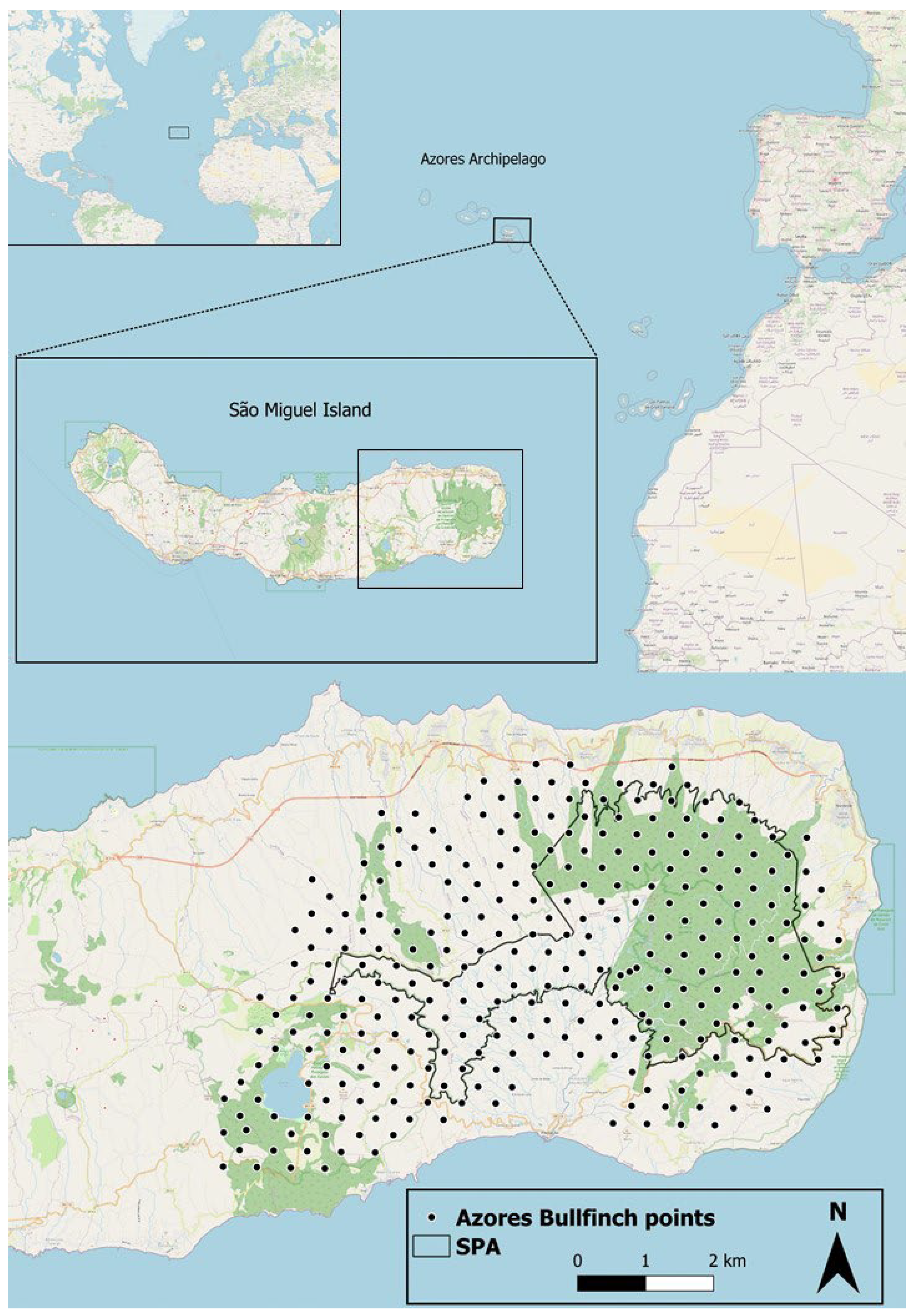
Figure 2.
Density map illustrating the number of Azores Bullfinch observations in every counting point used in the 2016 single morning survey (Priolo Atlas 2016).
Figure 2.
Density map illustrating the number of Azores Bullfinch observations in every counting point used in the 2016 single morning survey (Priolo Atlas 2016).
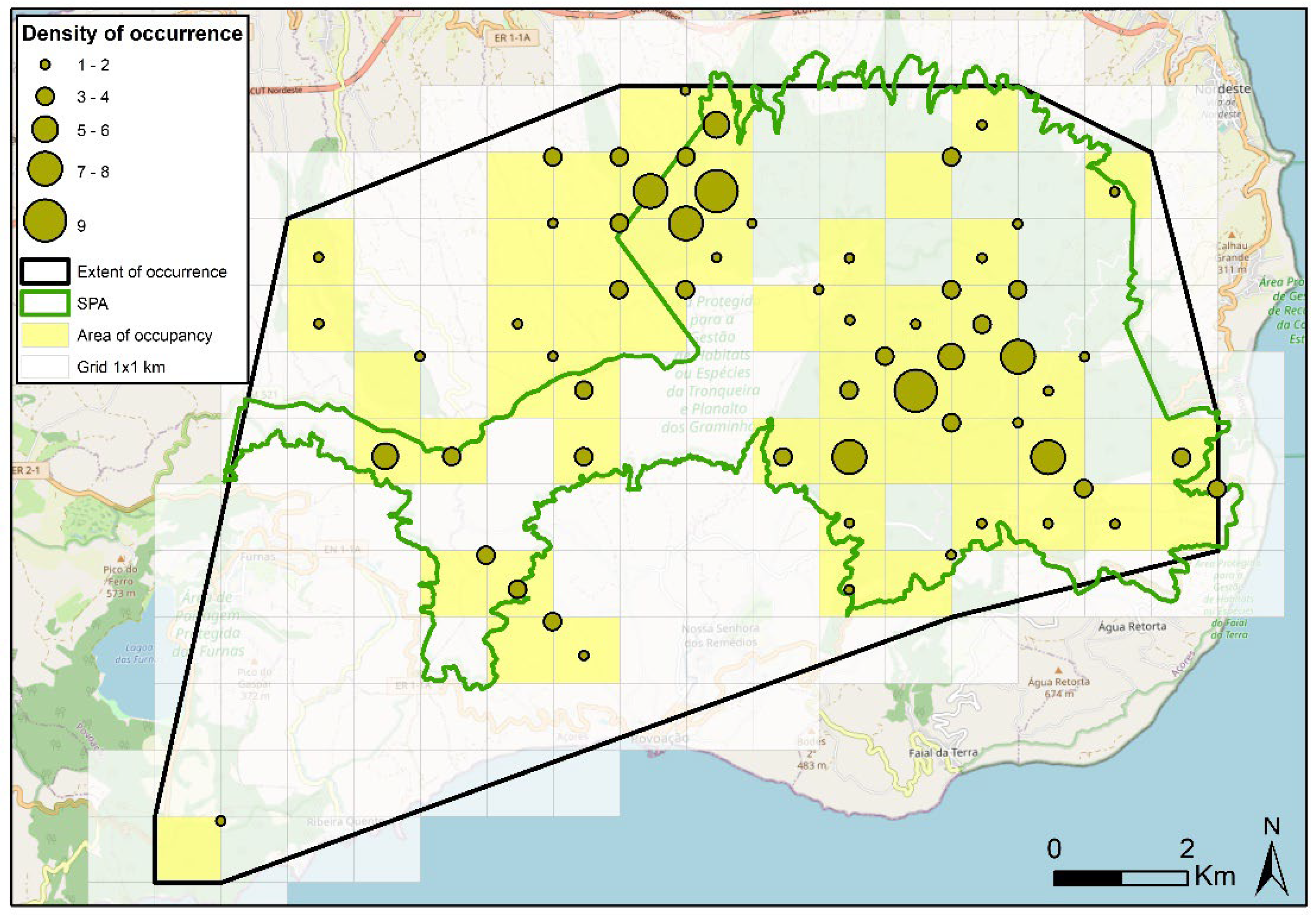
Figure 3.
Density map illustrating the number of Azores Bullfinch observations in every counting point used in the annual surveys, between 2009 and 2021 (including the Priolo Atlas 2012 and 2016).
Figure 3.
Density map illustrating the number of Azores Bullfinch observations in every counting point used in the annual surveys, between 2009 and 2021 (including the Priolo Atlas 2012 and 2016).
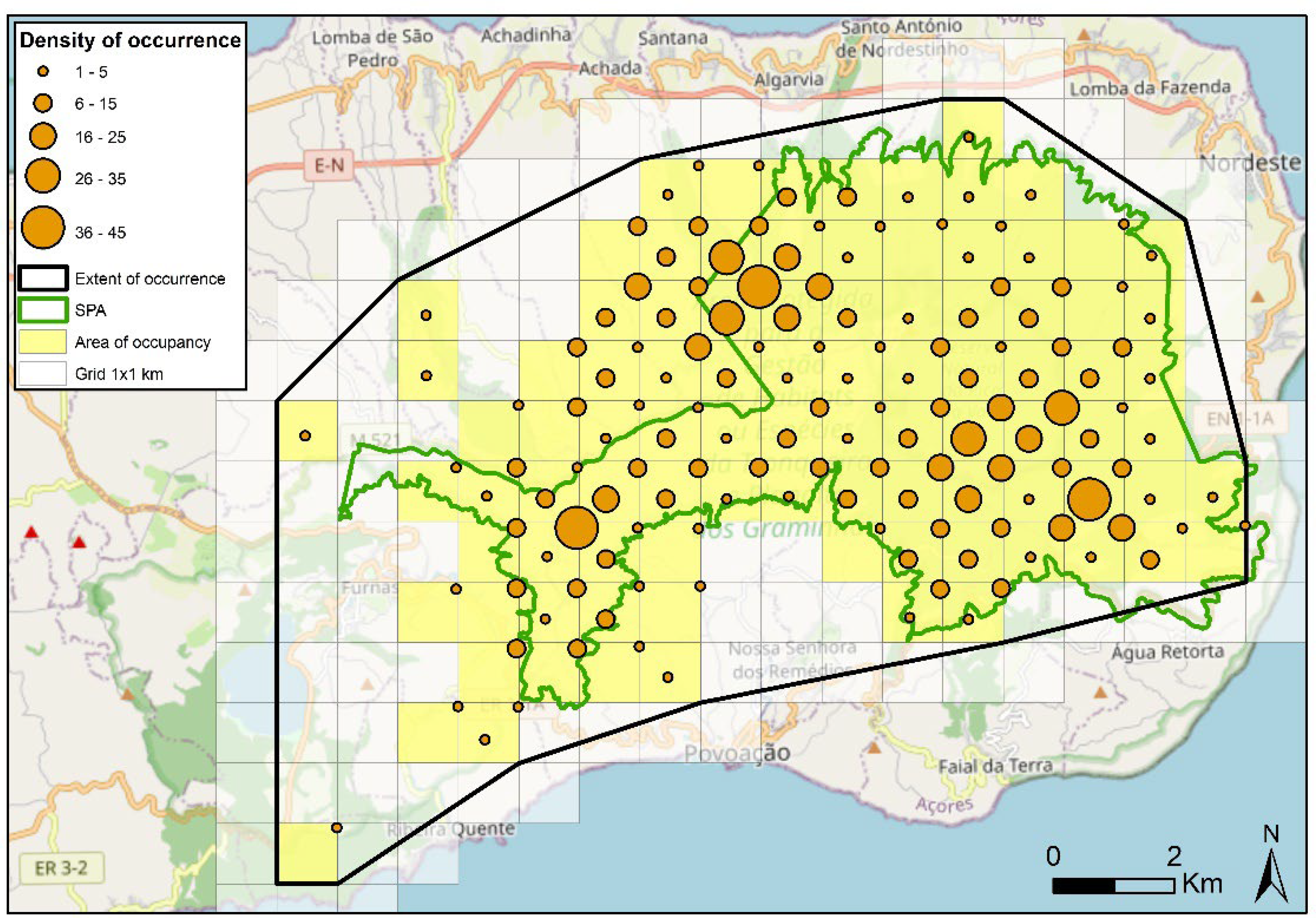
Figure 4.
Summary of Azores Bullfinch detections in the annual monitoring, from 2009 to 2021. The secondary axis shows points with detection percentages.
Figure 4.
Summary of Azores Bullfinch detections in the annual monitoring, from 2009 to 2021. The secondary axis shows points with detection percentages.
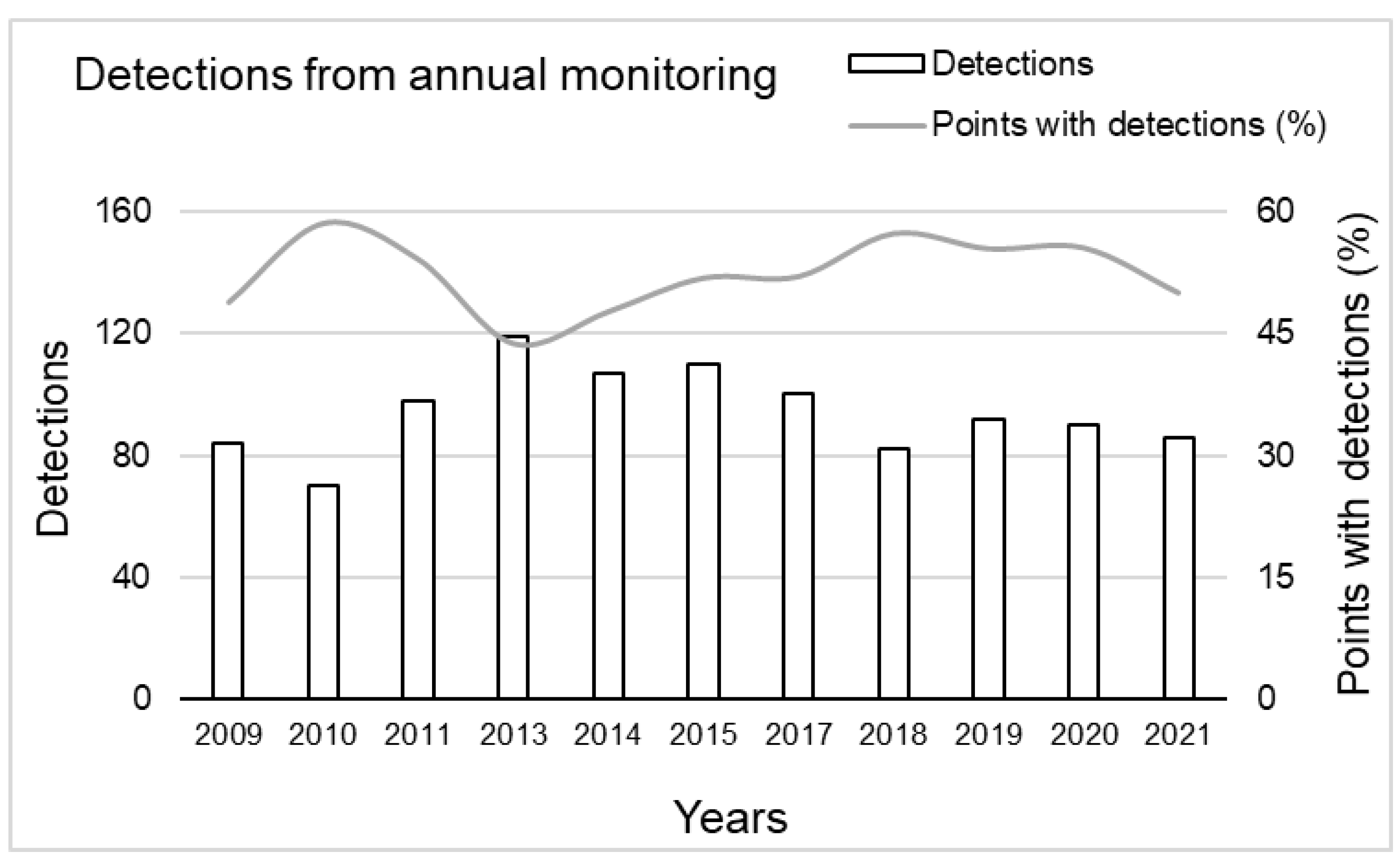
Figure 5.
Azores Bullfinch population trending estimated through GLM from the number of birds detected from 2008 to 2021. Vertical bars denote 95% of confidence intervals.
Figure 5.
Azores Bullfinch population trending estimated through GLM from the number of birds detected from 2008 to 2021. Vertical bars denote 95% of confidence intervals.
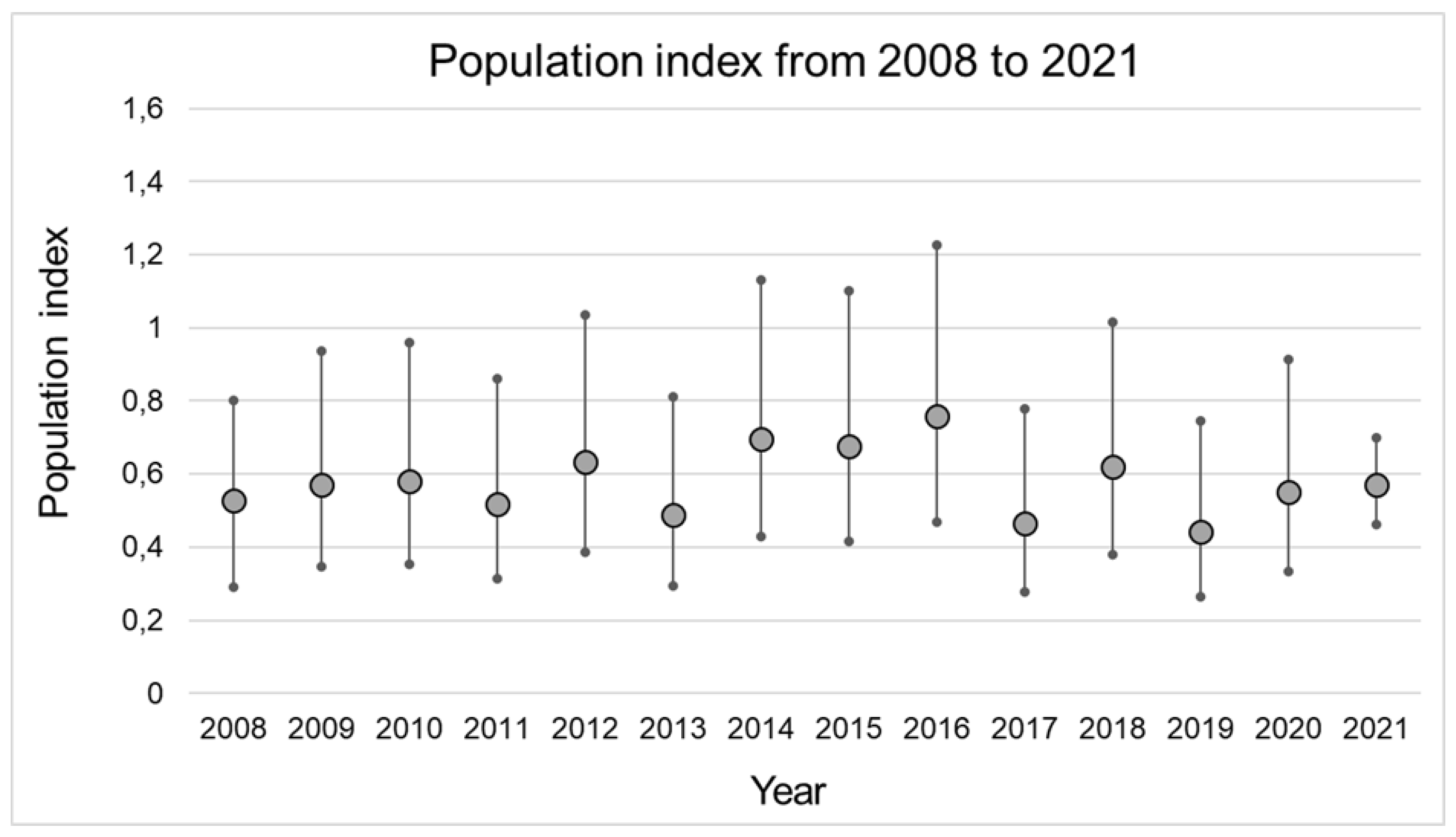

Table 1.
The number of birds detected and range size estimations during single morning surveys for Azores bullfinch population assessment.
Table 1.
The number of birds detected and range size estimations during single morning surveys for Azores bullfinch population assessment.
| year | Birds Registered | Points with Detections (%) | Extent of Occurrence (Km2) | Area of Occupancy (Km2) | Study |
|---|---|---|---|---|---|
| 2008 | 90 | 15.6 | 144 | 83 | Ceia et al. (2011)/ Gil et al. (2016) |
| 2012 | 87 | 16.4 | 137 | 90 | Gil et al. (2016) |
| 2016 | 99 | 19.8 | 130 | 52 | This study |
Table 2.
Population size estimates from different studies. n - Population size; Min. - Minimum population size; Max. - Maximum population size.
Table 2.
Population size estimates from different studies. n - Population size; Min. - Minimum population size; Max. - Maximum population size.
| Population Size | Sampling Period | Method | Study | ||
|---|---|---|---|---|---|
| Min. | n | Max. | |||
| 1282 | 1608 | 1934 | 2005-2008 | Mark-recapture | Monticelli et al. (2010) |
| 608 | 1064 | 1824 | 2008 | distance sampling approach | Ceia et al. (2011) |
| 1672 | 3344 | 6992 | 2008 | distance sampling approach | Gil et al. (2016) |
| 1824 | 3952 | 7904 | 2012 | distance sampling approach | Gil et al. (2016) |
| 608 | 1216 | 2432 | 2016 | distance sampling approach | This study |
Table 3.
Comparison of density estimates from single morning surveys for 2008, 2012, and 2016. Data from the present study and acquired from the literature were obtained through snapshot methodology and analyzed with DISTANCE software. CV - Coefficient of variation; CI - Confidence interval; LL - Lower limit; UL - Upper limit.
Table 3.
Comparison of density estimates from single morning surveys for 2008, 2012, and 2016. Data from the present study and acquired from the literature were obtained through snapshot methodology and analyzed with DISTANCE software. CV - Coefficient of variation; CI - Confidence interval; LL - Lower limit; UL - Upper limit.
| year | Number of Observations | Density (birds*h-1) | Key Function | %CV | 95% CI LL | 95% CI UL | P (X2) | Study |
|---|---|---|---|---|---|---|---|---|
| 2008 | 22 | 0.07 | Uniform | 28.05 | 0.04 | 0.12 | 0.05 | Ceia et al. (2011) |
| 2008 | 25 | 0.22 | Harzard-rate | 38.51 | 0.11 | 0.46 | 0.20 | Gil et al. (2016) |
| 2012 | 29 | 0.26 | Harzard-rate | 37.54 | 0.12 | 0.52 | 0.20 | Gil et al. (2016) |
| 2016 | 23 | 0.08 | Half-normal | 31.26 | 0.04 | 0.16 | 0.79 | This study |
Disclaimer/Publisher’s Note: The statements, opinions and data contained in all publications are solely those of the individual author(s) and contributor(s) and not of MDPI and/or the editor(s). MDPI and/or the editor(s) disclaim responsibility for any injury to people or property resulting from any ideas, methods, instructions or products referred to in the content. |
© 2023 by the authors. Licensee MDPI, Basel, Switzerland. This article is an open access article distributed under the terms and conditions of the Creative Commons Attribution (CC BY) license (http://creativecommons.org/licenses/by/4.0/).
Copyright: This open access article is published under a Creative Commons CC BY 4.0 license, which permit the free download, distribution, and reuse, provided that the author and preprint are cited in any reuse.