

Submitted:
17 April 2023
Posted:
18 April 2023
You are already at the latest version
Abstract
In Latvia, livestock depredation by wolves has increased during the last two decades. Most attacks had occurred in summer and autumn within wolf hunting season. Cumulative numbers of wolf attacks and number of affected sheep per year at regional forest management units were analyzed in relation to estimated wolf density, extent of culling and proportion of juveniles, as well as sheep density and estimated number of wild prey. The response variables (cumulative number of attacks and cumulative number of affected sheep) were modelled by a negative binomial regression, testing effects of every covariate separately and building models from the significant covariates. Depredation level was related to sheep density and estimated wolf population size. No reducing effect was found for culling, and even greater depredation rate was expected at higher proportions of culled wolves. Estimated number of wild prey or proportion of juvenile wolves had an insignificant effect. However, greater numbers of affected sheep were expected at higher red deer density, suggesting increased opportunistic livestock depredation when the red deer may locally outcompete the preferred wolf prey – roe deer.
Keywords:
wolf
; Canis lupus
; livestock
; sheep
; depredation
; Latvia
1. Introduction
For centuries humans have had diverse and complicated relationships with wolves [1], and livestock depredation has been one of the main human-carnivore conflicts in the history of this relationship [2,3]. Despite greater livestock losses due to diseases, harsh weather conditions or other reasons [2,4] wolf attacks on livestock are what contributed to negative attitude towards them [2,3,5,6], persecution and even complete eradication of this predator in many countries [1]. Due to successful and relatively recent recovery of wolf populations and increased depredation associated with prolonged livestock herding and breeding in absence of wolves, derogation and more extensive application of lethal control is being reconsidered [7]. Mitigation of the conflicts with wolves is important to ensure conservation of wolves as an important part of the ecosystem, to maintain habitual lifestyle and sources of income of local people and to improve attitudes towards these carnivores [8,9,10].
Compared to other European countries [11,12,13,14] livestock depredation by wolves in Latvia in the 20th century is rather low [15], varying from 9 to 79 reported cases per year [16], although it can cause significant damages to individual farmers. Currently there are no subsidies for acquisition of preventive measures and no compensations paid for lost animals [15]. As wolf is hunted in Latvia, culling is seen as a management measure to decrease the amount of the depredation. Lethal control of carnivore populations in order to reduce depredation and support livestock industry is used in many countries [1,4,17], however, effectivity of hunting is unclear and even questioned in some cases [8,9,18,19,20,21], as there are many factors influencing the occurrence of depredation and the impact hunting has on it [8,12,17,18,22,23,24].
We investigated relationship between reported livestock depredation in Latvia and available data on estimated density of wolves and their wild prey, as well as culling. Specifically, we looked for a negative impact of wolf hunting on reported number of attacks and affected livestock. As hunting can disrupt pack structure and may cause juvenile individuals to resort to livestock depredation [17], we also examined the relationship of depredation rate and juvenile proportion, which was estimated according to observed age structure among the culled individuals.
2. Materials and Methods
2.1. Wolves in Latvia
The study area, wolf management and routine sampling of culled individuals in Latvia is described in more detail by Šuba et al. [25]. Wolves are distributed throughout the whole country. A hunting season from 15th July until 31st March and a hunting quota were introduced in Latvia in 2004. Quota is set annually for the whole country and amount of livestock depredation is one of the considerations upon deciding its size. The quota has been increased since its introduction and for the last decade it has been around 270–300 wolves per hunting season. In Latvia, the hunting pressure is considered to be rather high and harvest mortality was estimated to be around 37% in last two decades [25]. Main prey species for wolves are roe deer (Capreolus capreolus) and wild boar (Sus scrofa) and to a lesser extent red deer (Cervus elaphus) and Eurasian beaver (Castor fiber) [15,26].
2.2. The Data
The data we analyzed in this study, referring to a period from 2004 until 2022, were obtained from the Latvian State Forest Service (SFS) and the Agricultural Data Center via the Central Statistical Bureau of Latvia. The SFS conducts game census and investigates reports on livestock depredation by wild carnivores, while the Agricultural Data Center compiled data on livestock number per statistical region per year.
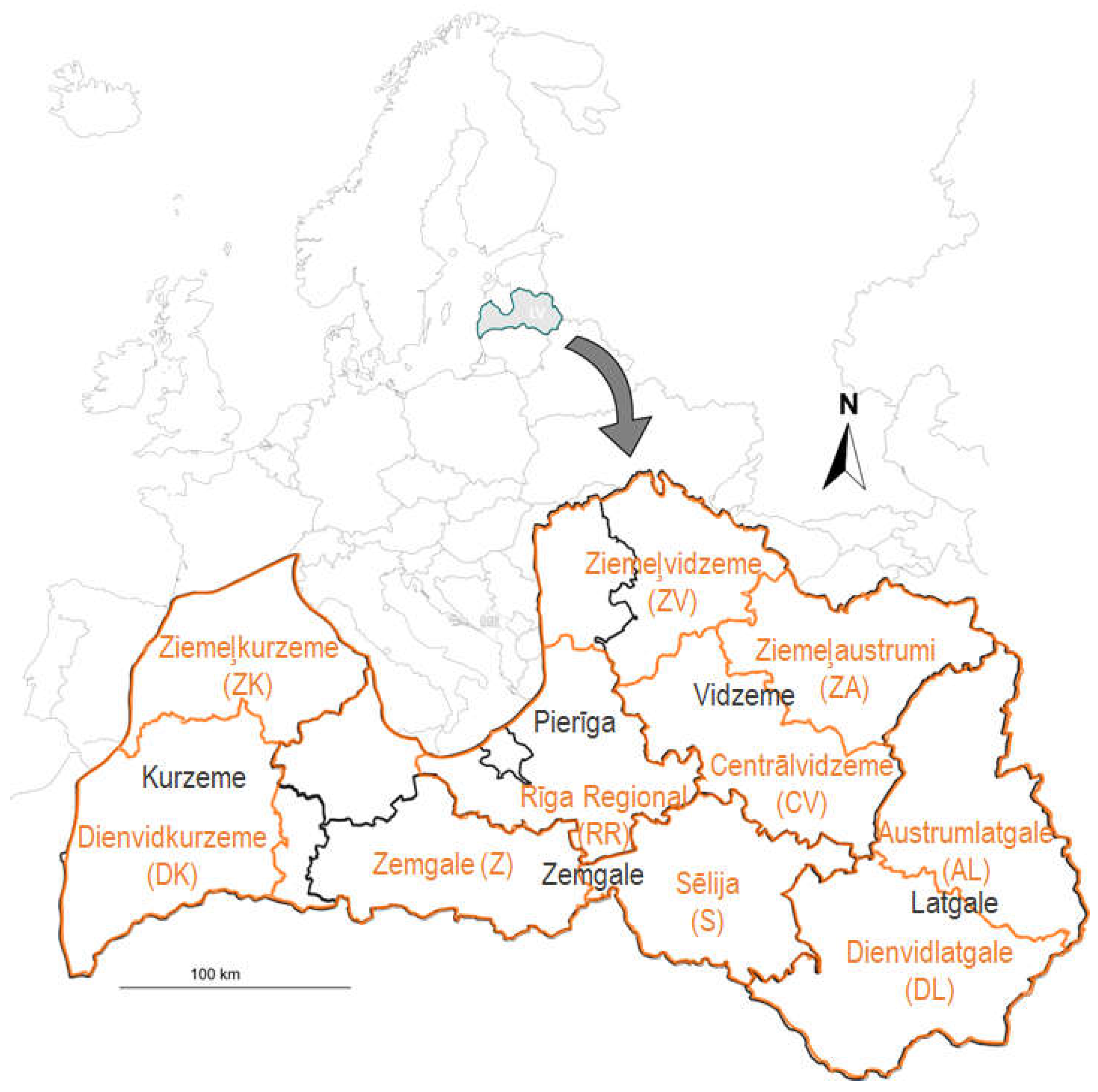
In this study, we focused on wolf attacks on sheep as they comprised 90% of all reported livestock depredation cases. The SFS data corresponding to 10 regional forestry units (Figure 1) were published at the SFS website [16,27] or available upon request. Reports on livestock depredation included information on date, location, numbers of killed, injured and lost sheep, as well as circumstances of the attack and applied preventive measures. In this study, victims were pooled into a single category (i.e., affected sheep). Data on applied livestock protection measures at sites where depredation had occurred (n = 506) were available for years 2000–2020. Effectiveness of preventive measures was evaluated according to available recommendations [21,28,29,30].
Estimated numbers of wolves, as well as red deer, roe dear, wild boar, and Eurasian beaver by the SFS within the forestry units were used to account for wolf density and availability of wild prey. The number of culled wolves per forestry unit per year was used to account for hunting pressure. However, as this number was expected to correlate with estimated abundance, the culling intensity was expressed as the ratio between the number of culled individuals and estimated number of wolves at the forestry unit. Summary statistics of SFS local forestry units is given in Table 1.

Table 1.
Summary statistics (minimum, maximum and median values per year) on wolf attacks on sheep and applied wildlife data of Latvian State Forest Service local forestry units (Figure 1) from 2004 to 2022.
Table 1.
Summary statistics (minimum, maximum and median values per year) on wolf attacks on sheep and applied wildlife data of Latvian State Forest Service local forestry units (Figure 1) from 2004 to 2022.
| Dienvidkurzeme | Ziemeļkurzeme | Zemgale | Rīga Regional | |||
| Reported wolf attacks on sheep | 1‒9 (3) | 1‒8 (3) | 5 | 1‒4 (1) | ||
| Total number of affected sheep | 1‒61 (20) | 1‒50 (17.5) | 26 | 1‒24 (12.5) | ||
| Estimated number of wolves | 95‒337 (169) | 77‒260 (158) | 11‒129 (88) | 5‒45 (14) | ||
| Number of culled wolves | 20‒42 (28) | 17‒55 (39) | 3‒39 (14) | 1‒11 (5) | ||
| Age structure | 175 juv 30 subad 130 ad |
163 juv 36 subad 171 ad |
85 juv 11 subad 58 ad |
26 juv 4 subad 21 ad |
||
| Estimated numbers of other wildlife (thousands) | red deer 4.9‒14.3 (10.8) roe deer 13.4‒38 (22.4) wild boars 2.4‒12.7 (7.2) beavers 4.9‒13 (7.7) |
red deer 6.6‒13.6 (10.6) roe deer 7.3‒22.6 (9) wild boars 1.2‒11.4 (6.1) beavers 3.0‒8.4 (4.0) |
red deer 1.9‒13.9 (10.2) roe deer 13.6‒27.4 (22.9) wild boars 2.3‒11.1 (4.0) beavers 3.4‒12.3 (7.0) |
red deer 1.3‒4.3 (2.0) roe deer 8.9‒28.9 (17.4) wild boars 0.8‒5.8 (2.3) beavers 4.1‒10.6 (5.7) |
||
| Sēlija | Dienvidlatgale | Austrumlatgale | ||||
| Reported wolf attacks on sheep | 1‒6 (1) | 1‒12 (2) | 1‒11 (3.5) | |||
| Total number of affected sheep | 1‒31 (11) | 7‒68 (12) | 2‒58 (16) | |||
| Estimated number of wolves | 63‒190 (151) | 39‒189 (124) | 68‒180 (99) | |||
| Number of culled wolves | 5‒37 (22) | 4‒36 (15) | 6‒53 (20) | |||
| Age structure | 101 juv 24 subad 82 ad |
50 juv 10 subad 45 ad |
57 juv 6 subad 56 ad |
|||
| Estimated numbers of other wildlife (thousands) | red deer 2.2‒7.7 (5.2) roe deer 11.1‒28.3 (18.4) wild boars 1.6‒7.5 (3.7) beavers 2‒7.7 (6.6) |
red deer 0.5‒3.1 (1.4) roe deer 10.1‒25.4 (16.5) wild boars 1.9‒5.9 (3.0) beavers 7.9‒13.0 (11.6) |
red deer 0.2‒1.8 (0.7) roe deer 9.2‒15.1 (12.2) wild boars 1.3‒4.3 (2.7) beavers 6.2‒8.6 (7.3) |
|||
| Centrālvidzeme | Ziemeļvidzeme | Ziemeļaustrumi | ||||
| Reported wolf attacks on sheep | 1‒28 (2) | 1‒9 (3.5) | 1‒9 (1) | |||
| Total number of affected sheep | 1‒277 (14) | 3‒76 (27) | 2‒62 (5) | |||
| Estimated number of wolves | 11‒205 (61) | 41‒143 (79) | 33‒169 (70) | |||
| Number of culled wolves | 4‒47 (19) | 2‒42 (28) | 3‒45 (19) | |||
| Age structure | 71 juv 15 subad 68 ad |
139 juv 17 subad 73 ad |
103 juv 10 subad 65 ad |
|||
| Estimated numbers of other wildlife (thousands | red deer 1‒7.2 (4.5) roe deer 8.9‒21.5 (13.5) wild boars 2.4‒7.3 (4.2) beavers 5.0‒8.9 (6.4) |
red deer 1.5‒4.7 (3.7) roe deer 12.6‒41.2 (20.1) wild boars 1.1‒10 (4.4) beavers 5.4‒11.9 (6.5) |
red deer 0.7‒5.1 (2.7) roe deer 6.1‒23.3 (10.0) wild boars 1.0‒6.3 (2.6) beavers 4.1‒8.4 (4.9) |
|||
Data on number of sheep at five statistical regions of Latvia (Figure 1) were used to account for regional variation of sheep density. A summary on sheep numbers from 2004 to 2022 is given in Table 2. As borders of the statistical regions differed from borders of the forestry units, data from individual or adjacent statistical regions corresponding to 2–6 neighboring forestry units within common or negligibly differing borders were pooled. The calculated number of sheep per km² was referred to all the forestry units within the array. Data on wolf age structure from 2004 until 2021 were obtained by the authors from examined legally culled individuals and otherwise found carcasses (see Šuba et al. [25] for more details). Teeth samples for age assessment were prepared according to methods described by Klevezal [31]. The age was determined by microscopic inspection and counting increment lines in cross-section of the extracted canine. For the purpose of this study, the age was assigned to three age classes, namely juveniles (i.e., individuals born in spring prior to opening of the hunting season), subadults (individuals aged one year) and adults (individuals aged two years and older). This allowed inclusion of some adult individuals from which the tooth sample was unavailable and precise age remained undetermined. In total, 1902 individual wolves of known location were aged. As the number of aged wolves from individual forestry units per year was often insufficient for credible estimates, data from 3 to 4 neighbouring forestry units were combined and calculated proportion of juveniles among the sampled individuals was assigned to every forestry of the array.
Table 2.
Summary statistics on minimum, maximum and median number of sheep of five Latvian statistical regions (Figure 1) from 2004 to 2022.
Table 2.
Summary statistics on minimum, maximum and median number of sheep of five Latvian statistical regions (Figure 1) from 2004 to 2022.
| Kurzeme | Zemgale | Pierīga | Vidzeme | Latgale | |
|---|---|---|---|---|---|
| Non-urban area (km²) | 12995 | 10678 | 8562 | 15750 | 14463 |
| Number of sheep (thousands) | 4.4‒19.0 (12.9) | 2.0‒14.6 (10.7) | 3.8‒17.8 (11.8) | 7.0‒33.5 (23.1) | 20.0‒28.5 (26.3) |
Figure 1.
Borders of local forestry units of Latvian State Forest Service (red) and statistical regions (black). Summary statistics on wolf attacks on sheep, wildlife abundance and number of sheep are provided in Tables.
Figure 1.
Borders of local forestry units of Latvian State Forest Service (red) and statistical regions (black). Summary statistics on wolf attacks on sheep, wildlife abundance and number of sheep are provided in Tables.
2.3. Data Analysis
First, we presented information on reported livestock depredation cases and number of affected sheep. Apart from general description, the timing of attacks and relationship with estimated wolf density within the country were analysed. Afterwards depredation cases within local forestry units were examined in relation to available data.
Cumulative number of attacks and affected sheep per year within a regional forestry unit were treated as response variables. Covariates included nominal variables corresponding to forestry units and quantitative variables, namely, number of sheep per 1 km², estimated number of wolves, proportion of juvenile wolves, proportion of culled individuals in current and in previous year and abundance of prey species in current and in previous year (Table 3). Estimated prey density was expressed in thousands. Both proportion variables (i.e., proportion of culled individuals and juveniles) were transformed by a logit function, in one case assuming the value of −7 below 0.1% and in two cases taking the value of 7 when exceeding 100% as slightly more individuals per forestry were culled than estimated to be present.
Table 3.
Investigated variables and coefficients corresponding to sheep depredation by wolves and available data.
Table 3.
Investigated variables and coefficients corresponding to sheep depredation by wolves and available data.
| Variable | Coefficient |
|---|---|
| Cumulative number of wolf attacks on sheep per year | 1 |
| Cumulative number of affected sheep in wolf attacks per year | 1 |
| Intercept | βint |
| Centrālvidzeme SFS forestry unit | βforestry[CV] |
| Dienvidkurzeme SFS forestry unit | βforestry[DK] |
| Dienvidlatgale SFS forestry unit | βforestry[DL] |
| Rīga Regional SFS forestry unit | βforestry[RR] |
| Sēlija SFS forestry unit | βforestry[S] |
| Ziemeļaustrumi SFS forestry unit | βforestry[ZA] |
| Ziemeļkurzeme SFS forestry unit | βforestry[ZK] |
| Ziemeļvidzeme SFS forestry unit | βforestry[ZV] |
| Number of sheep per 1 km² in respective region | βsheep |
| Estimated number of red deer in current year in current year (in thousands) | βwild[redd] |
| Estimated number of roe deer in current year in current year (in thousands) | βwild[roed] |
| Estimated number of wild boars in current year in current year (in thousands) | βwild[wildb] |
| Estimated number of beavers in current year in current year (in thousands) | βwild[beav] |
| Estimated number of red deer in previous year in previous year (in thousands) | βprevwild[redd] |
| Estimated number of roe deer in previous year in previous year (in thousands) | βprevwild[roed] |
| Estimated number of wild boars in previous year in previous year (in thousands) | βprevwild[wildb] |
| Estimated number of beavers in previous year in previous year (in thousands) | βprevwild[beav] |
| Estimated number of wolves in current year | βwolf |
| Logit-transformed proportion of culled wolves in current year | βwcull |
| Logit-transformed proportion of culled wolves in previous year | βprevwcull |
| Logit-transformed proportion of juvenile wolves in current year | βwjuv |
The relationship between number of attacks or affected sheep and the covariates was investigated by means of a negative binomial regression. The sample size contained 58 records of response variables (cumulative numbers per year) and associated values of the covariates. The effect of each covariate on dependent variables was tested separately with a null model by the likelihood ratio test. Also, we investigate five models containing combinations of multiple covariates. Covariates assumed to be correlated with each other, such as prey density or proportion of culled wolves in current and previous season, as well as estimated number of wolves and proportion of culled individuals, were not included into the same model. Finally, additional models were investigated, which contained the covariates found to be significant in previous analyses. All the statistical analyses were conducted by the software R [32] and applying the package MASS.
3. Results
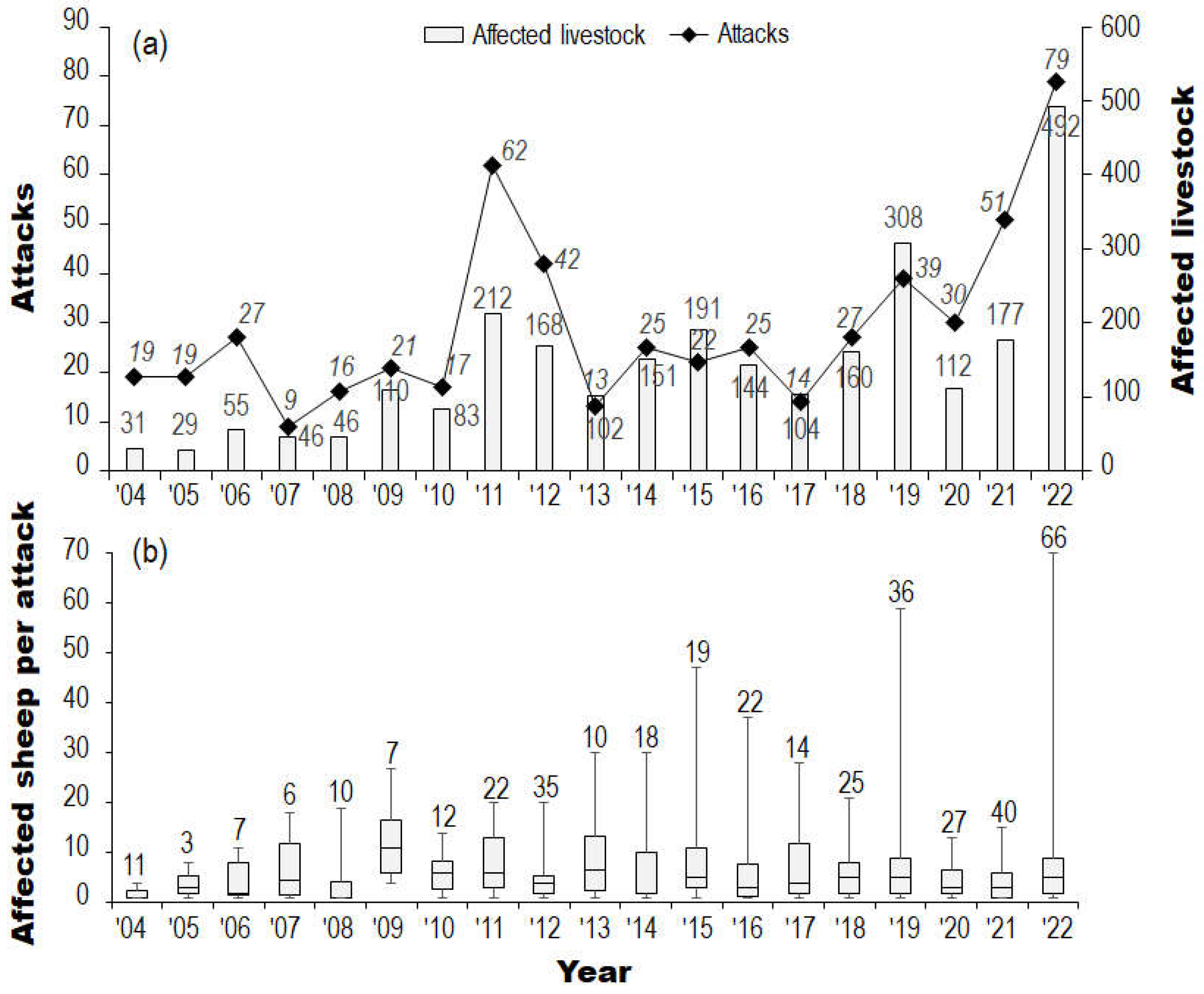
During the study period, number of reported and verified wolf attacks on livestock, as well as number of affected sheep have considerably fluctuated with a slightly increasing trend (Figure 2).
Figure 2.
Number of reported wolf attacks and affected livestock (a) and number of affected (i.e., killed, injured or lost) sheep per attack (b, minimum, maximum, median, inter-quartile range, number of cases shown) in Latvia from 2004 to 2022 (data from the Latvian State Forest Service).
Figure 2.
Number of reported wolf attacks and affected livestock (a) and number of affected (i.e., killed, injured or lost) sheep per attack (b, minimum, maximum, median, inter-quartile range, number of cases shown) in Latvia from 2004 to 2022 (data from the Latvian State Forest Service).
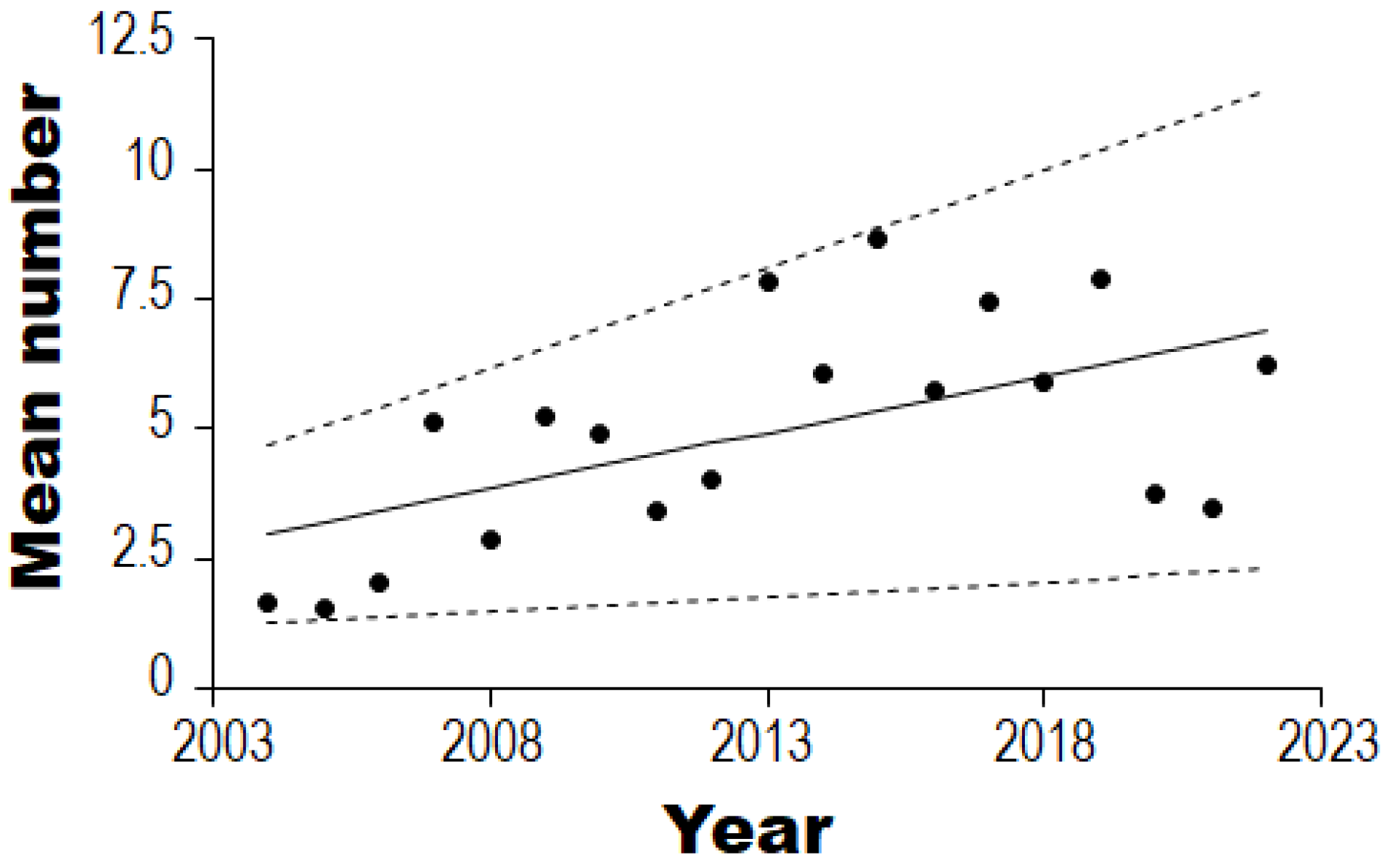
The mean number of affected sheep per reported attack had increased from 2.6 (in 2004–2009) to 5.5 (in 2017–2022) with a slope of 0.219 (SE = 0.077) per year (Figure 3). This increase was found to be statistically significant (linear regression analysis, F1,17 = 8.16, p = 0,011).
No livestock protection measures were used in 181 (35.8%) of reported depredation cases. In 266 (52.6%) cases, the applied preventive measures were considered as inappropriate (electric fences with only one or two wire lines, electric, wood or barb-wire fences less than 1 m high, chained guarding dogs). Only 10 (2%) farms, where depredation occurred, used preventive measures that could have been considered effective (e.g., presence of shepherd or appropriate electric fencing (at least 1.2 m high, with 5 or 6 wire lines or mesh weave). In 49 (9.7%) cases there was no information in the reports about the use of preventive measures.
Figure 3.
Increase in mean number of affected sheep per reported wolf attack in Latvia from 2004 to 2022 (solid and dashed lines indicate the linear trend and 95% confidence intervals, respectively; data from the Latvian State Forest Service).
Figure 3.
Increase in mean number of affected sheep per reported wolf attack in Latvia from 2004 to 2022 (solid and dashed lines indicate the linear trend and 95% confidence intervals, respectively; data from the Latvian State Forest Service).
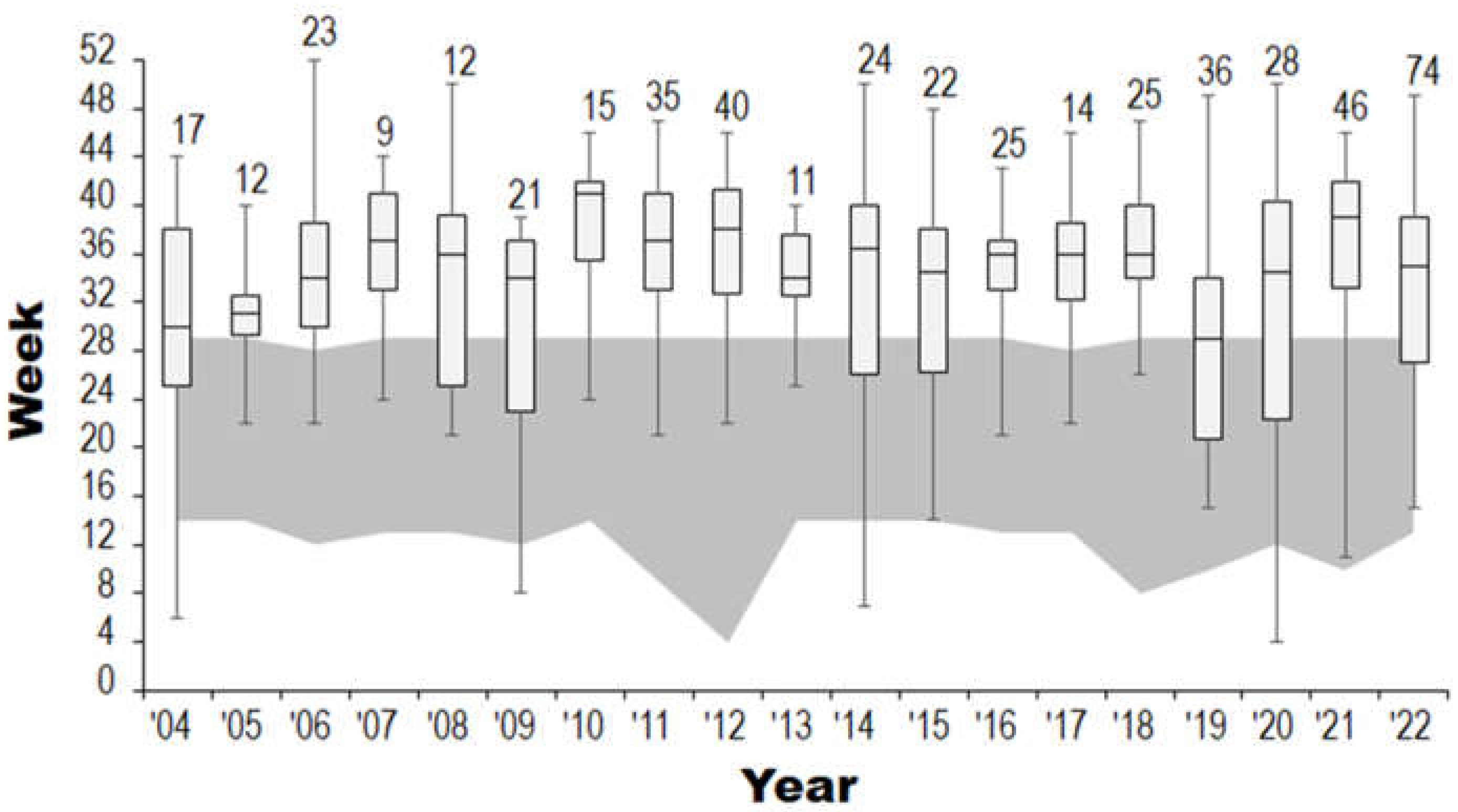
Wolf attacks were reported throughout the year, but the majority occurred in summer and autumn (Figure 4). As wolf hunting season was opened in 15th July, in most years it covered the period, when the majority of the attacks were reported.
Figure 4.
Timing of reported wolf attacks on livestock throughout the year (earliest, latest, median, inter-quartile range and number of cases). Grey shading indicates period of closed hunting season for wolves.
Figure 4.
Timing of reported wolf attacks on livestock throughout the year (earliest, latest, median, inter-quartile range and number of cases). Grey shading indicates period of closed hunting season for wolves.
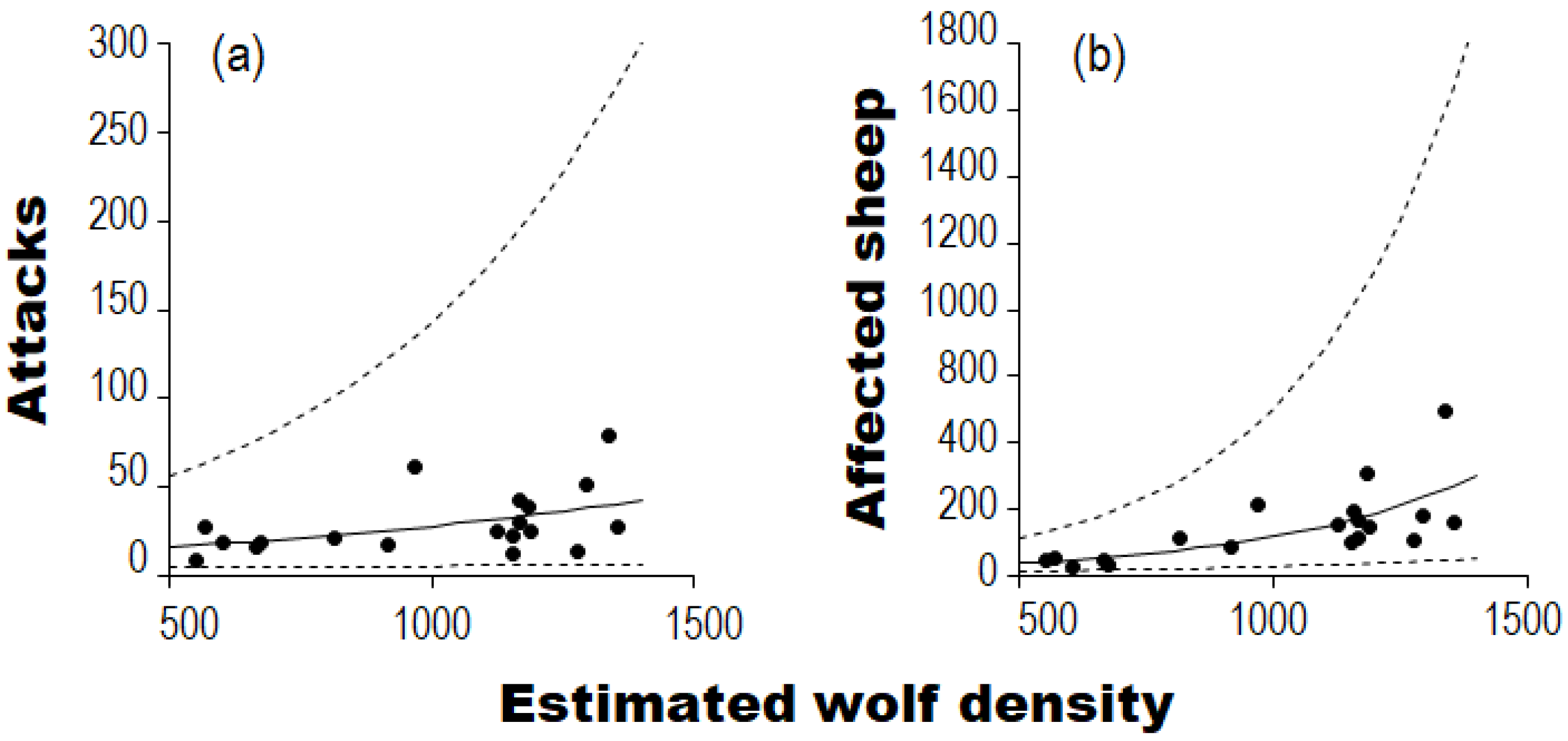
Overall, the total number of wolf attacks and affected sheep increased with estimated wolf density in the country (Figure 5), which was determined to be a significant factor according to negative binomial regression and likelihood ratio tests (for the number of the attacks, λLR = 5.911, df = 1, p = 0.015; for the number of affected sheep, λLR = 20.849, df = 1, p < 0.001). However, investigation at the level of SFS local forestry units revealed other relationships, in which estimated number of wolves no longer had such a significant effect.
Figure 5.
Observed and predicted number of reported attacks (a) and affected sheep (b) per year by wolves according to estimated wolf density (solid and dashed lines indicate the expected number and 95% confidence intervals according to a negative binomial regression, respectively; data from the Latvian State Forest Service).
Figure 5.
Observed and predicted number of reported attacks (a) and affected sheep (b) per year by wolves according to estimated wolf density (solid and dashed lines indicate the expected number and 95% confidence intervals according to a negative binomial regression, respectively; data from the Latvian State Forest Service).
By expressing the number of wolf attacks on sheep according to available covariates via negative binomial regression, local forestry unit (λLR = 18.17, df = 8, p = 0.02), mean number of sheep per km² (λLR = 7.724, df = 1, p = 0.005) and proportion of culled wolves in current year (λLR = 6.74, df = 1, p = 0.009) had a significant effect, while other covariates had no significant effect on the intercept (likelihood ratio tests, p > 0.05). Statistics of negative binomial regression models containing combinations of these covariates and the estimated wolf density are given in Table 4. However, the proportion of culled wolves had a positive coefficient values, i.e., higher expected depredation rate at higher culling intensity. Other covariates, such as density of other wildlife species and proportion of juveniles had an insignificant effect on cumulative number of depredation cases according to likelihood ratio tests (p > 0.05). Mean number of sheep per km² had also a significant effect on the cumulative number of affected sheep (λLR = 6.616, df = 1, p = 0.01). The most parsimonious models according to AIC values included forestry, as well as estimated number of wolves and red deer among the factors (Table 5). Likelihood ratio tests revealed no significant effect of other covariates (p > 0.05).
Table 4.
Coeficients of covariates and statistics of negative binomial regression models (overdispersion parameter, adjusted Akaike information criterion, difference, weight, and evidence ratio) describing cumulative number of wolf attacks on sheep per year at SFS local forestry units. Significant coefficients indicated by asterisks (*—p < 0.05, **—p < 0.01, ***—p < 0.001).
Table 4.
Coeficients of covariates and statistics of negative binomial regression models (overdispersion parameter, adjusted Akaike information criterion, difference, weight, and evidence ratio) describing cumulative number of wolf attacks on sheep per year at SFS local forestry units. Significant coefficients indicated by asterisks (*—p < 0.05, **—p < 0.01, ***—p < 0.001).
| Coefficients (± SE) | θ (± SE) | AICc | ∆ | ω | ER |
| βint = 0.742 (± 0.366)* βsheep = 0.442 (± 0.195)* βwcull = 0.263 (± 0.124)* |
5.96 (± 3.07) | 243.65 | 0 | 0.562 | 1 |
| βint = 0.293 ( ± 0.316) βsheep = 0.55 ( ± 0.196)** |
5.13 (± 2.44) | 245.39 | 1.73 | 0.236 | 2.4 |
| βint = 1.501 ( ± 0.163)*** βwcull = 0.345 ( ± 0.125)** |
4.71 (± 2.09) | 246.37 | 2.71 | 0.145 | 3.9 |
| βint = 0.999 (± 0.374)** βforestry[CV] = -0.304 (± 0.376) βforestry[DK] = -1.086 (± 0.368)** βforestry[DL] = -1.279 (± 0.391)** βforestry[RR] = -1.234 (± 0.669) βforestry[S] = -0.858 (± 0.335)* βforestry[ZA] = -0.824 (± 0.351)* βforestry[ZK] = -1.173 (± 0.377)** βforestry[ZV] = -0.099 (± 0.28) βwolf = 0.007 (± 0.003)* |
12.6 (± 11.0) | 250.02 | 6.37 | 0.023 | 24.1 |
| Coefficients (± SE) | θ (± SE) | AICc | ∆ | ω | ER |
| βint = 1.127 ( ± 0.101)*** | 3.81 (± 1.52) | 250.96 | 7.31 | 0.015 | 38.6 |
| βint = 1.735 ( ± 0.221)*** βforestry[CV] = -0.482 ( ± 0.387) βforestry[DK] = -0.736 ( ± 0.344)* βforestry[DL] = -1.042 ( ± 0.389)** βforestry[RR] = -1.735 ( ± 0.649)** βforestry[S] = -0.79 ( ± 0.348)* βforestry[ZA] = -1.042 ( ± 0.355)** βforestry[ZK] = -0.736 ( ± 0.344)* βforestry[ZV] = -0.253 ( ± 0.289) |
8.58 (± 5.69) | 252.47 | 8.82 | 0.007 | 82.1 |
| βint = 0.826 (± 0.496) βforestry[CV] = -0.545 (± 0.367) βforestry[DK] = -0.128 (± 0.393) βforestry[DL] = -0.867 (± 0.39)* βforestry[RR] = -1.436 (± 0.638)* βforestry[S] = -0.489 (± 0.342) βforestry[ZA] = -0.84 (± 0.34)* βforestry[ZK] = -0.359 (± 0.352) βforestry[ZV] = -0.14 (± 0.276) βsheep = 0.539 (± 0.225)* βwcull = 0.113 (± 0.135) |
14.5 (± 14.3) | 252.52 | 8.87 | 0.012 | 46.4 |
Table 5.
Coeficients of covariates and statistics of negative binomial regression models (overdispersion parameter, adjusted Akaike information criterion, difference, weight, and evidence ratio) describing cumulative number of affected sheep in wolf attacks per year at SFS local forestry units. Significant coefficients indicated by asterisks (*—p < 0.05, **—p < 0.01, ***—p < 0.001).
Table 5.
Coeficients of covariates and statistics of negative binomial regression models (overdispersion parameter, adjusted Akaike information criterion, difference, weight, and evidence ratio) describing cumulative number of affected sheep in wolf attacks per year at SFS local forestry units. Significant coefficients indicated by asterisks (*—p < 0.05, **—p < 0.01, ***—p < 0.001).
| Coefficients (± SE) | θ (± SE) | AICc | ∆ | ω | ER |
| βint = 1.486 (± 0.41)*** βsheep = 0.833 (± 0.226)*** βwild[redd] = 0.075 (± 0.031)* |
1.505 (± 0.287) | 474.97 | 0 | 0.423 | 1 |
| βint = 1.564 (± 0.42)*** βsheep = 0.674 (± 0.221)** βwolf = 0.005 (± 0.002)* |
1.462 (± 0.277) | 476.68 | 1.71 | 0.18 | 2.4 |
| βint = 1.414 (± 0.427)*** βsheep = 0.798 (± 0.233)*** βwild[redd] = 0.06 (± 0.041) βwolf = 0.002 (± 0.003) |
1.512 (± 0.289) | 476.98 | 2.01 | 0.155 | 2.7 |
| βint = 2.128 ( ± 0.349)*** βsheep = 0.65 ( ± 0.226)** |
1.379 (± 0.259) | 478.07 | 3.09 | 0.09 | 4.7 |
| βint = 2.982 (± 0.311)*** βforestry[CV] = -1.048 (± 0.586) βforestry[DK] = -3.085 (± 0.778)*** βforestry[DL] = -0.521 (± 0.438) βforestry[RR] = -1.419 (± 0.56)* βforestry[S] = -1.366 (± 0.504)** βforestry[ZA] = -1.585 (± 0.438)*** βforestry[ZK] = -3.389 (± 0.934)*** βforestry[ZV] = -0.547 (± 0.442) βwild[redd] = 0.311 (± 0.078)*** |
1.922 (± 0.386) | 478.94 | 3.97 | 0.058 | 7.3 |
| βint = 2.291 (± 0.463)*** βforestry[CV] = -0.449 (± 0.634) βforestry[DK] = -2.657 (± 0.78)*** βforestry[DL] = -0.632 (± 0.439) βforestry[RR] = -0.826 (± 0.629) βforestry[S] = -0.99 (± 0.507) βforestry[ZA] = -1.21 (± 0.465)** βforestry[ZK] = -2.86 (± 0.938)** βforestry[ZV] = -0.111 (± 0.473) βwild[redd] = 0.225 (± 0.087)** βwolf = 0.007 (± 0.004) |
2.026 (± 0.411) | 479.05 | 4.07 | 0.055 | 7.7 |
| Coefficients (± SE) | θ (± SE) | AICc | ∆ | ω | ER |
| βint = 1.988 (± 0.465)*** βforestry[CV] = 0.712 (± 0.497) βforestry[DK] = -0.894 (± 0.461) βforestry[DL] = -0.602 (± 0.458) βforestry[RR] = -0.264 (± 0.611) βforestry[S] = -0.246 (± 0.428) βforestry[ZA] = -0.606 (± 0.435) βforestry[ZK] = -0.697 (± 0.475) βforestry[ZV] = 0.658 (± 0.4) βwolf = 0.011 (± 0.003)*** |
1.85 (± 0.37) | 481.36 | 6.39 | 0.017 | 24.4 |
| βint = 2.404 (± 0.618)*** βforestry[CV] = -0.489 (± 0.646) βforestry[DK] = -2.851 (± 1.08)** βforestry[DL] = -0.654 (± 0.455) βforestry[RR] = -0.875 (± 0.636) βforestry[S] = -1.082 (± 0.599) βforestry[ZA] = -1.254 (± 0.486)** βforestry[ZK] = -3.046 (± 1.198)* βforestry[ZV] = -0.15 (± 0.508) βsheep = -0.08 (± 0.321) βwild[redd] = 0.237 (± 0.096)* βwolf = 0.007 (± 0.004) |
2.025 (± 0.411) | 482.19 | 7.22 | 0.011 | 36.9 |
| βint = 3.114 ( ± 0.121)*** | 1.241 (± 0.228) | 482.53 | 7.56 | 0.01 | 43.8 |
4. Discussion
We found that, in Latvia, cumulative number of reported livestock depredation cases and affected sheep were correlated with estimated wolf density as most farms (88.4%), where wolf attacks had occurred, applied no or insufficient preventive measures against such attacks. In a survey on public attitudes towards large carnivores [15] most of the livestock farmers (73.4%) claimed that they do not use any preventive measures. Wolf hunting was deemed as an effective means to reduce depredation by 84.1% of surveyed farmers and 41.1% of farmers considered hunters to be responsible for the prevention and reduction of the wolf depredation. Only 29% of surveyed farmers claimed that they themselves are responsible for the prevention of depredation cases. Mostly some prevention is introduced only after the loss of livestock had been suffered due to the wolf attacks.
Most attacks were reported during summer and autumn. Similar timing of wolf attacks on livestock was observed in other countries [1,5,11,14,22,23,33,34,35,36]. In Latvia, unlike in neighbouring Estonia [13] and Lithuania [37], wolf hunting season is opened considerably earlier on 15th July (compared to 1st November and 15th October, respectively), coinciding with the majority of the observed attacks on livestock. Nevertheless, we found no indication that wolf hunting in the current or in the following year decreased reported number of attacks or the number of affected sheep at SFS local forestry units. On the contrary, significantly more attacks were expected in current year at higher ratio between the number of culled wolves and estimated number of wolves, as the coefficient was positive and significantly different from zero. As seen in some studies, lethal predator control can be less effective than other preventive measures [18,21], and appropriate livestock protection can be more significant than reduction of wolf numbers in decreasing the number of depredation cases [29,38].
Sometimes hunting can have short-term positive effect on depredation reduction, however, it does not prevent attacks in long-term as harvested animals are soon replaced by dispersing individuals [22]. In some cases, wolf hunting can even increase the amount of depredation [17,18,24], as hunting impacts demographic, territorial and social structure of wolf population, thus leading to potentially higher reproduction rates [39] and possible changes in animal behaviour, including their hunting habits [17,40,41]. As wolf hunting in Latvia begins when pups are still very young and will depend on adult animals for their survival for some time [42], loss of parents or other adult pack members might make it more difficult for the remaining adults to provide for the pups [41] and they may choose more vulnerable prey (e.g., livestock).
Theoretically, increase in livestock depredation may be associated with disrupted pack structure and accidental removal of adults due to intensive hunting [17]. However, our analysis revealed no significant relationship between cumulative number of attacks or affected sheep and the observed proportion of juveniles. In fact, juveniles are more likely to be removed from the population due to hunting than the adults [43]. Also having an abundant wild prey base decreases the possibility of depredation by juvenile wolves. The impact of culling on wolf pack structure is to be evaluated in further studies involving existing kinship data, as individual circumstances in packs, like the juvenile’s age when losing adult pack members or early dispersal from the natal pack, might be important factors leading juveniles to depredation.
Another significant factor influencing number of reported depredation cases and affected sheep was the location at particular SFS forestry unit. Apart from regional variation of the analysed covariates (Table 1 and Table 2), local differences in operation of the SFS and activity of farmers in reporting the cases may be relevant. However, at this point qualitative or quantitative assessment of such characteristics is problematic.
No correlation was found between sheep depredation and estimated numbers of most prey species. Although the numbers of roe deer and wild boar in Latvia have fluctuated [15,25,44], there is no reason to assume significant shortage at any point. However, cumulative number of affected sheep was related to estimated numbers of red deer, and according to estimated coefficients more affected sheep were expected at higher red deer densities. This may be associated with a competition between the two deer species [45,46] as roe deer is more common in wolf diet in Latvia [26], but may be affected by higher red deer density, consequently advancing opportunistic livestock depredation. In Europe, red deer is preferred in wolf diet [47], but may require advanced hunting skills or greater pack size.
In Latvian society, various opinions exist concerning wolves [48,49]. Generally, livestock farmers and herders are the most negative in their attitudes towards wolves [50,51,52,53,54,55,56] as their income and lifestyle is affected by the depredation. In addition, wolf is sometimes seen as a symbol of domination of urban population over the lifestyle and needs of rural inhabitants. Therefore, negative attitude towards this carnivore can come from the symbolic meaning of the animal and general social and economic reasons and not due to personal negative experience with wolves [57,58]. Although it is often considered that attitudes should be improved in order to improve species conservation condition, in case of livestock depredation, more important could be practical measures that would ensure successful coexistence. Ability to accept presence of wolves and coexist with them can be more important than having positive attitude towards these carnivores. Acknowledgement of existing conflicts, hearing out of farmers and their problems, objective evaluation of the situation and practical solutions for conflict mitigation might be more successful than attempts to improve knowledge and attitude towards predators [59]. As seen from this study, current wolf hunting practice in Latvia might not have the desired positive effect on depredation reduction, therefore use of effective preventive measures and subsidies for their implementation are significant for sustainable coexistence with these carnivores.
Author Contributions
Conceptualization, G.B., G.D., A.O., J.O., D.P., A.S., J.Š., and A.Ž.; methodology, J.Š and A.Ž.; software J.Š.; validation, J.Š. and AŽ; formal analysis, J.Š. and A.Ž.; investigation, G.B., G.D., A.O., J.O., D.P., A.S., J.Š., and A.Ž.; resources, G.B., G.D., A.O., J.O., D.P., A.S., and A.Ž.; data curation, G.B., G.D., A.O., J.O., D.P., A.S., and A.Ž.; writing—original draft preparation, J.Š. and A.Ž.; writing—review and editing, J.Š., A.Ž., and J.O.; visualization, J.Š. and G.D.; supervision, J.O.; project administration, J.O., J.Š., and A.Ž.; funding acquisition, J.O. and J.Š. All authors have read and agreed to the published version of the manuscript.
Funding
This study was conducted as part of the postdoctoral research project “Sub-population dynamics of grey wolf Canis lupus and Eurasian lynx Lynx lynx in Latvia and identification of depredation risk on livestock” (No.1.1.1.2/VIAA/3/19/511), funded by the European Regional Development Fund (agreement No. 1.1.1.2./16/I/001). The sampling of culled wolves within investigation of variations in the large carnivore population in Latvia depending on hunting pressure was supported by the Game Management Development Fund of the Ministry of Agriculture of the Republic of Latvia.
Institutional Review Board Statement
Not applicable.
Informed Consent Statement
Not applicable.
Data Availability Statement
Official data on game statistics in Latvia are available at the State Forest Service website.
Acknowledgments
We are grateful to SFS personell who prepared requested data and to all who provided sample material for this study and contributed to preparation and improvement of the manuscript.
Conflicts of Interest
The authors declare no conflict of interest. The funders had no role in the design of the study; in the collection, analyses, or interpretation of data; in the writing of the manuscript; or in the decision to publish the results.
References
- Fritts, S.H.; Stephenson R.O.; Hayes, R.D.; Boitani L. Wolves and Humans. In Wolves: Behavior, Ecology and Conservation; Mech, L.D., Boitani, L., Eds.; The University of Chicago Press: Chicago, USA, 2003; pp. 289–316.
- Kaczensky, P. Large carnivore depredation on livestock in Europe. Ursus, 1999, 59–71.
- Boitani, L. Action plan for the conservation of wolves in Europe (Canis lupus). Council of Europe Publishing: Strasbourg, France, 2000.
- Ginsberg, J.R. Setting priorities for carnivore conservation: what makes carnivores different? In Carnivore conservation, Conservation Biology Series; Gittleman, J.L., Funk, S.M., Macdonald, D.W., Wayne, R.K., Eds.; Cambridge University Press: Cambridge, UK, 2001; pp. 498–523.
- Mishra, C. Livestock depredation by large carnivores in the Indian trans-Himalaya: conflict perceptions and conservation prospects. Environ Conserv, 1997, 24(4): 338—343. https://doi.org/10.1017/S0376892997000441. [CrossRef]
- Wilson, C.J. Could we live with reintroduced large carnivores in the UK? Mammal Rev, 2004, 34(3), 211–232. https://doi.org/10.1111/j.1365-2907.2004.00038.x. [CrossRef]
- Meuret, M.; Moulin, C.-H.; Bonnet, O.; Garde, L.; Nozières-Petit, M.-O.; Lescureux, N. Missing shots: has the possibility of shooting wolves been lacking for 20 years in France’s livestock protection measures? Rangeland J, 2020, 42, 401–413. https://doi.org/10.1071/RJ20046. [CrossRef]
- Fritts, S.H.; Paul, J.W.; Mech, L.D.; Scott, D.P. Trends and management of wolf–livestock conflicts in Minnesota, Resource Publication 181; United States Department of the Interior Fish and Wildlife Service: Washington, D.C., USA, 1992.
- Wydeven, A.P.; Treves, A.; Brost, B.; Wiedenhoeft, J. Characteristics of wolf packs in Wisconsin: Identification of traits influencing depredation. In People and Predators: From Conflict to Coexistence; Fascione, N., Delach, A., Smith, M.E., Eds.; Island Press: Washington, D.C., USA, 2004; pp. 28–50.
- Treves, A.; Martin, K.A.; Wydeven, A.P.; Wiedenhoeft, J. Forecasting Environmental Hazards and the Application of Risk Maps to Predator Attacks on Livestock. BioScience, 2011, 61(6), 451–458. https://doi.org/10.1525/bio.2011.61.6.7. [CrossRef]
- Štrbenac, A. Wolf management plan for Croatia: towards understanding and addressing key issues in wolf management planning in Croatia; State Institute for Nature Protection: Zagreb, Croatia, 2005.
- Krofel, M.; Cerne, R.; Jerina, K. Effectiveness of wolf (Canis lupus) culling as a measure to reduce livestock depredations. Zbornik Gozdarstva Lesarstva, 2011, 95, 11–22.
- Männil, P.; Kont, R. Action plan for conservation and management of large carnivores (wolf Canis lupus, lynx Lynx lynx, brown bear Ursus arctos) in Estonia in 2012–2021. The Estonian Theriological Socieety (Eesti terioloogia selts): Tartu, Estonia, 2012.
- Widman M.; Elofsson K. Costs of Livestock Depredation by Large Carnivores in Sweden 2001 to 2013. Ecol Econ, 2018, 143, 188–198. https://doi.org/10.1016/j.ecolecon.2017.07.008. [CrossRef]
- Ozoliņš, J.; Žunna, A.; Ornicāns, A.; Done, G.; Stepanova, A.; Pilāte, D.; Šuba, J.; Lūkins, M.; Howlett, S.J.; Bagrade, G. Action Plan for Grey Wolf Canis lupus Conservation and Management; LSFRI Silava: Salaspils, Latvia, 2017.
- Game Resources. Aivailable Online: https://www.vmd.gov.lv/lv/es-sfera-esoso-sugu-monitorings (accessed on 12 December 2022).
- Frank, L.G.; Woodroffe R. Behaviour of carnivores in exploited and controlled populations. In Carnivore conservation, Conservation Biology Series; Gittleman, J.L., Funk, S. M., Macdonald, D.W., Wayne, R.K., Eds.; Cambridge University Press: Cambridge, UK, 2001; pp. 419–442.
- Treves, A.; Krofel, M.; McManus, J. Predator control should not be a shot in the dark. Front Ecol Environ, 2016, 14, 380–388. https://doi.org/10.1002/fee.1312. [CrossRef]
- Berger, K.M. Carnivore-Livestock Conflicts: Effects of Subsidized Predator Control and Economic Correlates on the Sheep Industry. Conserv Biol, 2006, 20(3), 751–761. https://doi.org/10.1111/j.1523-1739.2006.00336.x. [CrossRef]
- Harper, E.K.; Paul, W.J.; Mech, L.D.; Weisberg, S. Effectiveness of Lethal, Directed Wolf-Depredation Control in Minnesota. J Wildlife Manage, 2008, 72(3), 778–784. https://doi.org/10.2193/2007-273. [CrossRef]
- Bruns, A.; Waltert, M.; Khorozyan, I. The effectiveness of livestock protection measures against wolves (Canis lupus) and implications for their co-existence with humans. Global Ecol Conserv, 2020, 21: e00868. https://doi.org/10.1016/j.gecco.2019.e00868. [CrossRef]
- Musiani, M.; Mamo, C.; Boitani, L.; Callaghan, C.; Gates, C.C.; Mattei, L.; Visalberghi, E.; Breck S.; Volpi, G. Wolf depredation trends and the use of fladry barriers to protect livestock in western North America. Conserv Biol, 2003, 17, 1538–1547. https://doi.org/10.1111/j.1523-1739.2003.00063.x. [CrossRef]
- Gula, R. Wolf Depredation on Domestic Animals in the Polish Carpathian Mountains. J Wildlife Manage, 2008, 72(1), 283–289. https://doi.org/10.2193/2006-368. [CrossRef]
- Eklund, A.; López-Bao, J.; Tourani, M.; Chapron, G.; Frank, J. Limited evidence on the effectiveness of interventions to reduce livestock predation by large carnivores. Sci Rep, 2017, 7(1), 2097. https://doi.org/10.1038/s41598-017-02323-w. [CrossRef]
- Šuba, J.; Žunna, A.; Bagrade, G.; Done, G.; Lūkins, M.; Ornicāns, A.; Pilāte, D.; Stepanova, A.; Ozoliņš, J. Closer to Carrying Capacity: Analysis of the Internal Demographic Structure Associated with the Management and Density Dependence of a Controlled Wolf Population in Latvia. Sustainability, 2021, 13, 9783. https://doi.org/10.3390/su13179783. [CrossRef]
- Žunna, A.; Ozoliņš, J.; Pupila, A. Food habits of the wolf Canis lupus in Latvia based on stomach analyses. Est J Ecol, 2009, 58, 141–152.
- Population of Game Species. Available online: https://www.vmd.gov.lv/lv/medijamo-dzivnieku-populacijas (accessed on 1.03.2023).
- Linnell, J.D.C.; Odden, J.; Mertens, A. Mitigation methods for conflicts associated with carnivore depredation on livestock. In Carnivore Ecology and Conservation: A Handbook of Techniques; Boitani, L., Powell R.A., Eds.; Oxford University Press: New York, USA, 2012; pp. 314– 32.
- Reinhardt, I.; Rauer, G.; Kluth, G.; Kaczensky, P.; Knauer, F.; Wotschikowsky U. Livestock protection methods applicable for Germany—a Country newly recolonized by wolves. Hystrix, 2012, 23(1), 62–72. https://doi.org/10.4404/hystrix-23.1-4555. [CrossRef]
- Salvatori, V.; Mertens, A.D. Damage prevention methods in Europe: experiences from LIFE nature projects. Hystrix, 2012, 23(1): 73–79. https://doi.org/10.4404/hystrix-23.1-4548. [CrossRef]
- Klevezal, G.A. Age-Related Structures in Zoological Studies of Mammals; Nauka: Moscow, Russia, 1988. (In Russian).
- R Core Team. R: A language and environment for statistical computing. R Foundation for Statistical Computing, Vienna, Austria, 2017; https://www.R-project.org/.
- Ciucci, P.; Boitani, L. Wolf and Dog Depredation on Livestock in Central Italy. Wildlife Soc B, 1998, 26(3), 504–514.
- Blanco, J.C.; Cortes, Y. 2000 Wolf recolonization of agricultural areas in Spain. In Proceedings of Beyond 2000: Realities of global wolf restoration. Duluth, Minnesota, USA, 23–26 February 2000.
- Adamič, M.; Kobler; A.; Korenjak, A.; Marinčič, A.; Zafran, J. 2001. The recovery of the wolf (Canis lupus) in Slovenia. Beitr Jagd Wildforsch, 2001, 26, 85–94.
- Balčiauskas, L.; Balčiauskienė, L.; Volodka, H. Preliminary assessment of damage caused by the wolf in Lithuania. Acta Zool Lit, 2002, 12(4), 419–427. https://doi.org/10.1080/13921657.2002.10512533. [CrossRef]
- Kaczensky, P.; Chapron, G.; von Arx, M.; Huber, D.; Andrén, H., Linnell, J., Eds. Status, management and distribution of large carnivores— bear, lynx, wolf and wolverine—in Europe, Part 2—Species Country Reports; IUCN/SSC Large Carnivore Initiative for Europe, 2013.
- Kaczensky, P. Large carnivore-livestock conflicts in Europe; Munich Wildlife Society: Munich, Germany, 1996.
- Fryxell, J.M.; Sinclair, A.R.E.; Caughley, G. Wildlife Ecology, Conservation, and Management. John Wiley & Sons: New York, USA, 2014.
- Adams, L.G.; Stephenson R.O.; Dale, B.W.; Ahgook, R.T.; Demma, D.J. Population dynamics and harvest characteristics of wolves in the Central Brooks Range, Alaska. Wildlife Monogr, 2008, 170, 1–25. https://doi.org/10.2193/2008-012. [CrossRef]
- Brainerd, S.M.; Andren, H.; Bangs, E.E.; Bradley, E.H.; Fontaine, J.A.; Hall, W.; Iliopoulos, Y.; Jimenez, M.D.; Jozwiak, E.A.; Liberg, O.; Mack, C.M.; Meier, T.J.; Niemeyer, C.C.; Pedersen, H.C.; Sand, H.; Schultz, R.N.; Smith, D.W.; Wabakken, P.; Wydeven, A.P. The effects of breeder loss on wolves. J Wildlife Manage, 2008, 72(1), 89–98. https://doi.org/10.2193/2006-305. [CrossRef]
- Mech, L.D. The Wolf: the ecology and behaviour of an endangered species; University of Minnesota Press: Minnesota, USA, 1970.
- Ozoliņš, J.; Stepanova, A.; Žunna, A.; Bagrade, G.; Ornicāns, A. Wolf hunting in Latvia in the light of population continuity in the Baltics. In Beiträge zur Jagd- und Wildforschung, Band 36; Stubbe, M., Ed.; Gesellschaft für Wildtier- und Jagdforschung e.V.: Halle/Saale, Deutschland, 2011; S. 93–104.
- Ozoliņš, J.; Žunna, A.; Howlett, S.J.; Bagrade, G.; Pilāte, D.; Ornicāns, A.; Pēterhofs, E. Population dynamics of large mammals in Latvia with an emphasis on prey-predator interactions. In Beiträge zur Jagd- und Wildforschung. Band 41; Stubbe, M., Ed.; Gesellschaft für Wildtier- und Jagdforschung e.V.: Halle/Saale, Deutschland, 2016; S. 59–73.
- Latham, J.; Staines, J.B.W.; Gorman, M.L. Correlations of red (Cervus elaphus) and roe (Capreolus capreolus) deer densities in Scottish forests with environmental variables. J Zool, 1997, 242(4), 681–704. https://doi.org/10.1111/j.1469-7998.1997.tb05820.x. [CrossRef]
- Richard, E.; Gaillard, J.M.; Saïd, S.; Harmann, J.-L.; Klein, F. High red deer density depresses body mass of roe deer fawns. Oecologia, 2010, 163, 91–97. https://doi.org/10.1007/s00442-009-1538-z. [CrossRef]
- Jędrzejewska, B.; Jędrzejewski, W. Predation in Vertebrate Communities: The Białowieża Primeval Forest as a Case Study, Volume 135; Springer: Berlin/Heidelberg, Germany, 1998.
- Andersone, Ž.; Ozolinš, J. Public perception of large carnivores in Latvia. Ursus, 2004, 15, 181–187.
- Žunna, A.; Bagrade, G.; Ozoliņš, J. Attitudes of the General Public and Hunters Towards Wolves in Latvia; Its Predictors and Changes Over Time. Proc Latv Acad Sci B Nat Exact Appl Sci; 2020, 74, 280–286.
- Bath, A.J. Attitudes of Various Interest Groups in Wyoming Toward Wolf Reintroduction in Yellowstone National Park. MA Thesis, University of Wyoming: Laramie, USA, 1987.
- Kellert, S.R. The Public and the Timber Wolf in Minnesota. Anthrozoös, 1987, 1(2), 100–109.
- Bath, A. J.; Buchanan, T. Attitudes of interest groups in Wyoming towards wolf restoration in Yellowstone National Park. Wildlife Soc B, 1989, 17: 519–525.
- Blanco, J.C.; Reig, S.; Cuesta, L. Distribution, status and conservation problems of the wolf Canis lupus in Spain. Biol Conserv, 1992, 60(2), 73–80. https://doi.org/10.1016/0006-3207(92)91157-N. [CrossRef]
- Williams, C.K.; Ericsson, G.; Heberlein, T.A. A quantitative summary of attitudes toward wolves and their reintroduction (1972–2000). Wildlife Soc B, 2002, 30(2), 575–584. https://doi.org/10.2307/3784518. [CrossRef]
- Røskaft, E.; Händel, B.; Bjerke, T.; Kaltenborn, B.P. Human attitudes towards large carnivores in Norway. Wildlife Biol, 2007, 13(2), 172–185. https://doi.org/10.2981/0909-6396(2007)13[172:HATLCI]2.0.CO;2. [CrossRef]
- Sponarski, C.C.; Semeniuk, C.; Glikman, J.A.; Bath, A.J.; Musiani, M. Heterogeneity among Rural Resident Attitudes Toward Wolves. Hum Dimens Wildl, 2013, 18: 239–248. https://doi.org/10.1080/10871209.2013.792022. [CrossRef]
- Ericsson, G.; Heberlein, T.A. Attitudes of hunters, locals and general public in Sweden now that wolves are back. Biol Conserv, 2003, 111, 149–159. https://doi.org/10.1016/S0006-3207(02)00258-6. [CrossRef]
- Heberlein, T.A. Navigating Environmental Attitudes; Oxford University Press: New York, USA, 2012.
- Sillero-Zubiri, C.; Laurenson K. Interactions between carnivores and local communities: conflict or co-existence? In Carnivore conservation, Conservation Biology Series; Gittleman, J.L., Funk, S.M., Macdonald, D.W., Wayne, R.K., Eds.; Cambridge University Press: Cambridge, UK, 2001: pp. 282–312.
Disclaimer/Publisher’s Note: The statements, opinions and data contained in all publications are solely those of the individual author(s) and contributor(s) and not of MDPI and/or the editor(s). MDPI and/or the editor(s) disclaim responsibility for any injury to people or property resulting from any ideas, methods, instructions or products referred to in the content. |
© 2023 by the authors. Licensee MDPI, Basel, Switzerland. This article is an open access article distributed under the terms and conditions of the Creative Commons Attribution (CC BY) license (http://creativecommons.org/licenses/by/4.0/).
Copyright: This open access article is published under a Creative Commons CC BY 4.0 license, which permit the free download, distribution, and reuse, provided that the author and preprint are cited in any reuse.