
Submitted:
28 March 2023
Posted:
28 March 2023
You are already at the latest version
Abstract
The research paper proposes an algorithm to find congruence criteria between two convex polygons in Euclidean Geometry. It begins with a review of triangles, then extends to quadrilaterals and eventually gener- alizes the case to n-sided polygons. It attempts to prove said algorithm using a method of induction and a case-by-case analysis. It also states a corollary to said algorithm
Keywords:
Triangles
; Geometry
; Euclidean Geometry
1. Introduction with Triangles
We begin our paper first by looking at triangles. A triangle is defined as follows:
Definition
(Triangle). A triangle is the union of three segments (called its sides), whose endpoints (called its vertices) are taken, in pairs, from a set of three non-collinear points. [1]
Two triangles are congruent, if they have the same angles and the same sides.
Figure 1.
Examples of congruence and non-congruence between triangles.
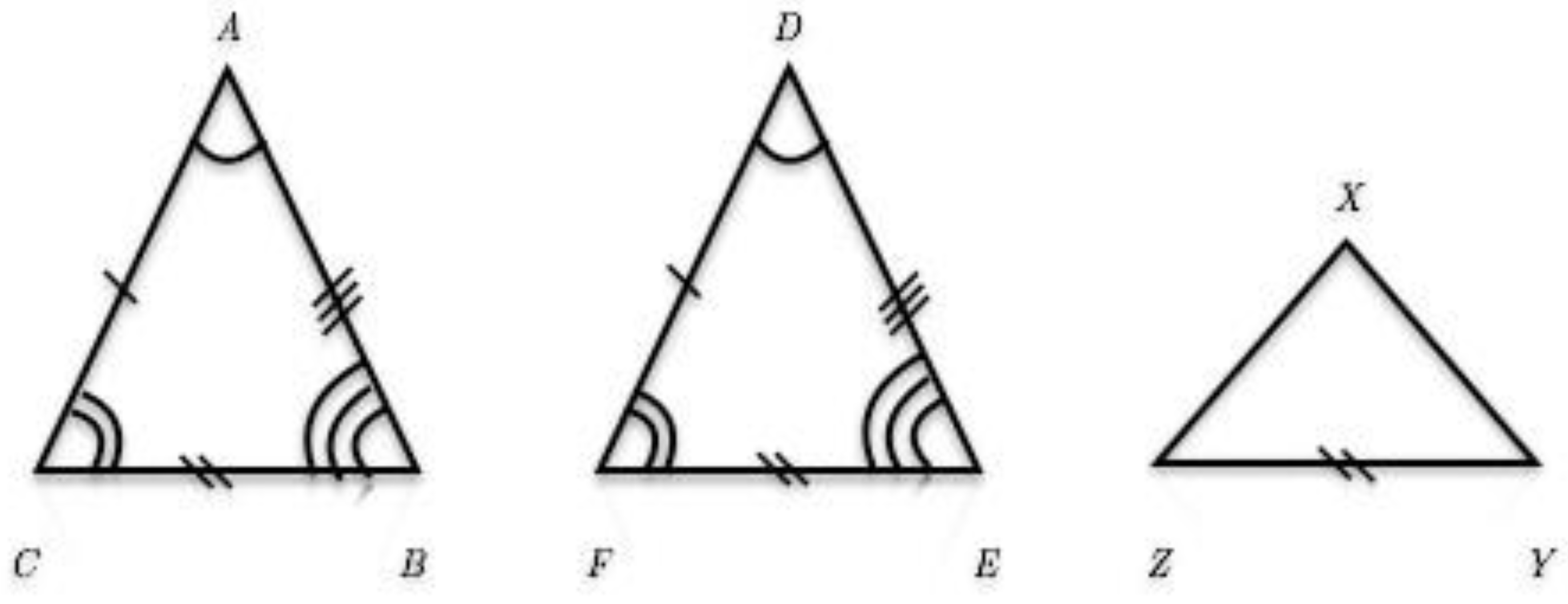
- Here:
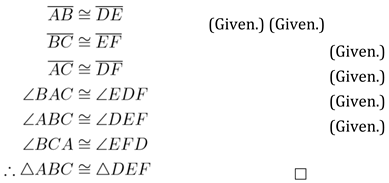
△DEF is simply △ABC, translated horizontally. However:
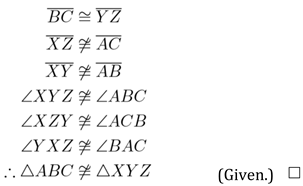
△XY Z is △ABC translated and scaled down vertically.
One can use a more stringent definition of congruence, as shown in the definition below
Definition
(Congruence). Two triangles are congruent if under some correspondence between the vertices, the corresponding sides, and corresponding angles are congruent.[2]
There are four main criteria to establish congruence between two triangles, they are: [SAS],[SSS],[AAS],[ASA]1, where S is a side and A is an angle. Given right angled triangles we can shorten the amount of information necessary, to [LA], [LH],[AH], where L is a leg, H is a hypotenuse and of course A is an acute angle. With equilateral triangles it reduces simply to [L].
2. The Problem
While congruence among triangles is well known, congruence among n-sided polygons (where n > 3) is less so. With polygons of sides more than three, the question of convex and non-convex comes up as the set of conditions necessary to ensure congruence among convex polygons are not necessarily the same for non-convex polygons. This paper aims to focus solely on convex polygons in Euclidean geometry. A definition is used here for further reference:
Definition
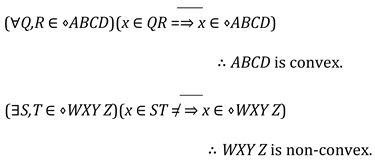
(Convex Shape). A polygon is convex if every line segment joining any two points inside the polygon, also remain contained in the polygon. [4]
Figure 2.
Convexandnon-convexpolygons.
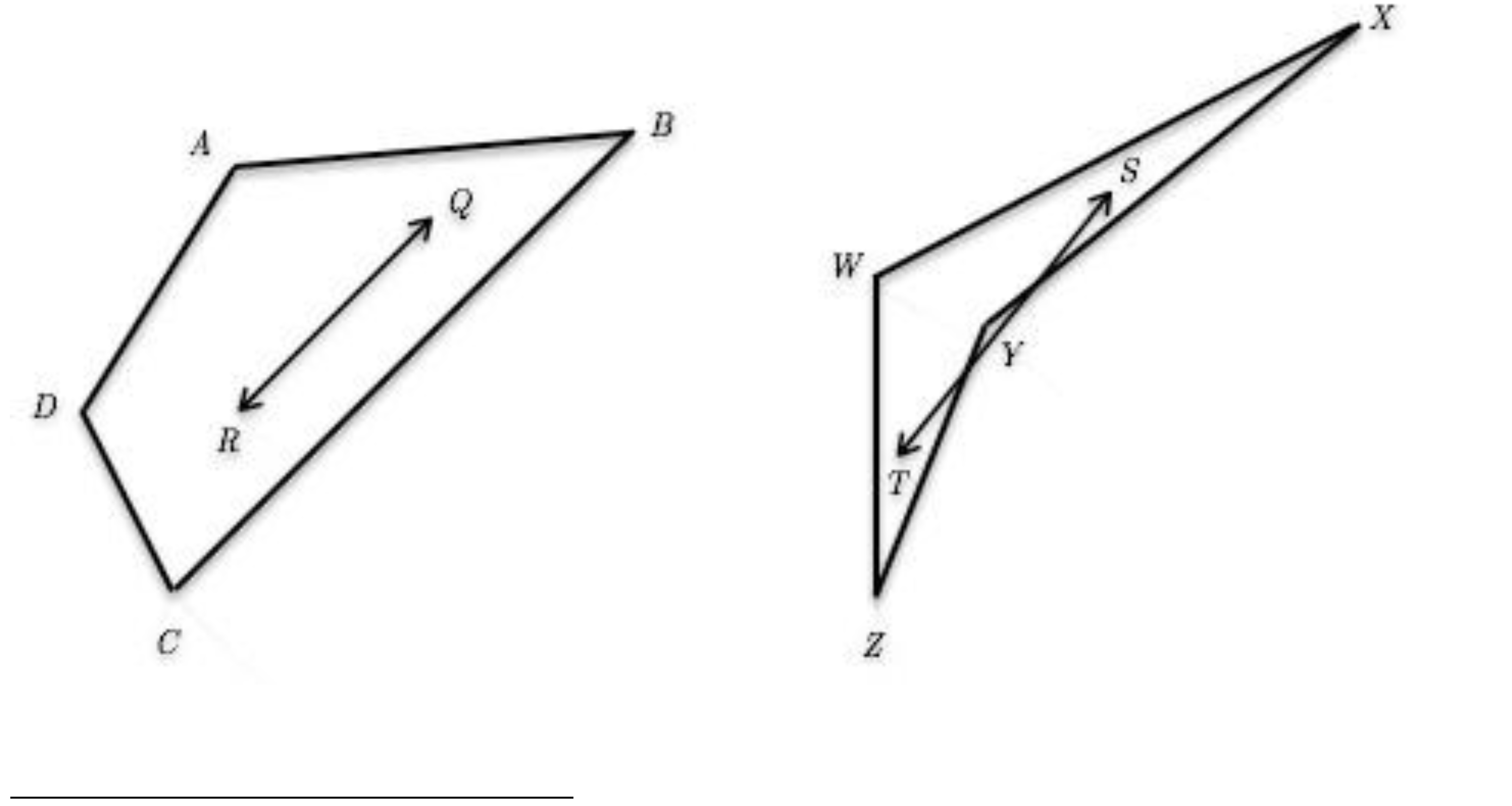
In the figure above ABCD is convex but WXY Z is not.
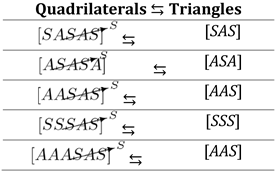
According to [3], there are five cases in which a convex quadrilateral can be congruent in Euclidean geometry. They are [SASAS],[ASASA], [AASAS] and variants, [SSSSA] and variants, and finally [AAASS] and variants. This is assuming there are no bounding criteria. While other criteria may be created, these require the smallest amount of information. The criteria are shown in the table below.

All of the above feature the triangle congruence [SAS]. [SASAS] has [SAS] in it, as does, [ASASA], [AASAS]. [AAASS] is simply [AAASAS] because of the nature of Euclidean Geometry, and [SSSSA] also features an [SAS].
The basic strategy in all these cases is to divide up the quadrilateral into two triangles, by drawing line between any two opposite vertices. If the two triangles that make up a quadrilaterals are congruent to the two triangles that make up another quadrilateral, then the two quadrilaterals are congruent.
When the quadrilateral has been decomposed into two triangles, it is seen that [SAS] is the only way to go about proving that the first triangle is congruent. The [SAS] only works with the external sides and the angles. Furthermore applying [SAS] in any one of the constituent triangles, will yield an [S] which will go on to prove the next triangle to be congruent. Please refer to pg.6 for a demonstration.
Notice that in all these cases the congruence criterion ([SASAS] etc.) not only showed the criterion necessary for congruence but also how to prove congruence. Observe that when proving two triangles congruent by [ASASA], we started on either of the triangles where the [SAS] applied, and we went on to prove that the third side (the diagonal) was congruent, and finally applied [ASA] to prove that the other triangle was congruent as well.
This is true in all congruence criterion listed on the table. Every time one of the quadrilateral congruence criteria are invoked, the [SAS] is replaced to an [S], that [S] is then used to prove the next triangle congruent (using any one of the well established triangle congruence criterion). In fact one might draw a table from this:
Because of this one might inductively conjecture, that the pattern might repeat for higher polygons. In other words, if by simply substituting an [S] to an [SAS] we end up with congruence criterion for quadrilaterals, can we then take congruence criterion for quadrilaterals and expand an [S] to an [SAS] to get congruence criterion for pentagons, and so on?
At this point it is helpful to think of the congruence criteria as a permutation of [S]’s and [A]’s. [SAS] is a particular permutation of [S]’s and [A]’s, that happens to guarantee congruence between two triangles. [AAA] is another permutation that does not guarantee congruence, at least not in Euclidean geometry. Of the eight permutations of length three, there are only four that guarantee congruence among general triangles. For the purpose of this paper, it is helpful, at this point to formally define a congruence criteria. The definition may not be the generally understood definition, but for the scope of this paper, it is sufficient.
Definition
(Congruence criteria). A congruence criteria has two properties. The first is that it is a permutation of the form: [χ1,χ2,χ3 ···χk], where χi ∈ {[S],[A]}, k ∈ N, and there is at least one [S]. The second is that if two npolygons have that particular permutation of sides and angles in common, then they are congruent. Generally speaking k ≤ n.
3. The Hypothesis
A hypothesis can be put forth that we can find out congruence among higher polygons by successively substituting an [S] into an [SAS]. From triangle to quadrilateral requires one expansion of an [S] to [SAS], as does quadrilateral to pentagon. From triangle to an n-sided polygon would thus require n − 3 expansions of any of the [S]’s from any of the four well known triangle congruence criterion. We may state the first hypothesis below, and leave the second as a corollary.
Definition
(Hypothesis-1). Given that a particular congruence criterion between two n-sided polygons is [a1,a2,a3 ···S ···ak−2,ak−1,ak], then a particular congruence criterion between two n+1 sided polygons is [b1,b2,b3 ···SAS ···bk−2,bk−1,bk]. Where, if ai is [S], then bi is also [S] and if ai is [A], then bi is also [A].
The above statement can be proved (somewhat) by intuition. Anytime [SAS] is invoked, it results in a [S] being created (please see the next section for a demonstration). That [S] is used further in proving the next triangle congruent, and so on and so forth. A sort of ”domino” effect is created.
Empirically speaking the hypothesis actually checks out. It turns out that just as [ASA] is a congruence criterion for triangles, [ASASA] is a congruence criterion of quadrilaterals, [ASASASA] is a congruence criterion of pentagons, [ASASASASA] is a congruence criterion for hexagons and so on. Similarly [AAS] is a congruence criterion for triangles, so is [AASAS] for quadrilaterals, [AASASAS] is for pentagons, [AASASASAS] for hexagons and so on and so forth.
4. Proof
A more serious proof is attempted, by a method of induction, followed by a case analysis.
4.1. Hypothesis
The hypothesis is restated here as follows:
Definition
(Hypothesis-1). Given that a particular congruence between two nsided polygon is [a1,a2,a3 ···S ···ak−2,ak−1,ak], then a particular congruence criterion between two n+1 sided polygons is [b1,b2,b3 ···SAS ···bk−2,bk−1,bk]. Where, if ai is [S], then bi is also [S] and if ai is [A], then bi is also [A].
4.2. Base Case
The base case for the hypothesis would be to see if the theorem holds for quadrilaterals. Since the hypothesis only gives us meaningful results with quadrilaterals onwards it only makes sense that our base case would be quadrilaterals.
4.2.1. Proving [ASASA]
Assume a two generalized quadrilaterals ⋄ABCD and ⋄WXY Z, as shown below and a hypothetical diagonal drawn across both.
Observe:
Figure 3.
Proving [ASASA], notice that the diagonals are essential to the proof.
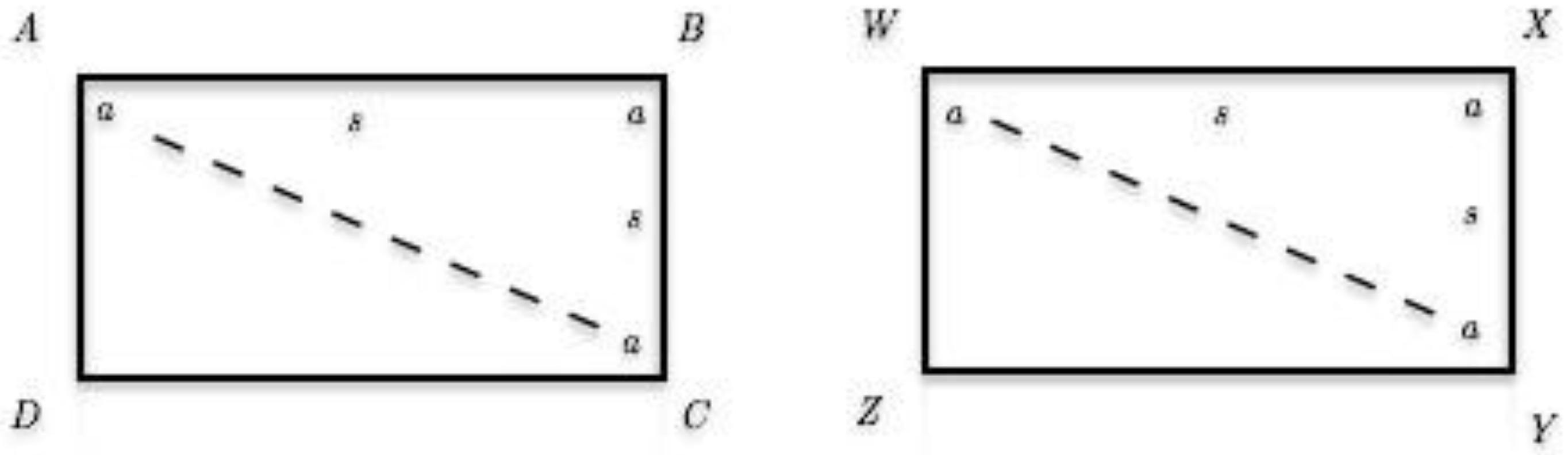
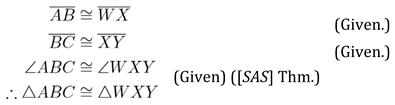
Now with the diagonals and drawn we can proceed as follows. Given that △ABC =∼ △WXY :
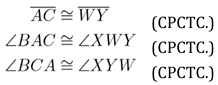
Now observe that by the [ASASA] criterion:
| ∠DAB ∼= ZWX | ([ASASA] Thm.) |
| ∠DCB ∼= ZY X | ([ASASA] Thm.) |
Now we are ready for the final step of the proof:
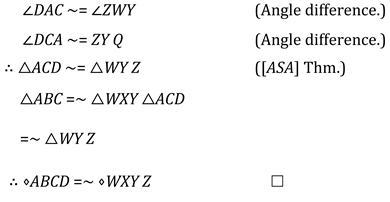
Thus the hypothesis holds true for quadrilaterals. The proof was inspired from [UV A − 1].
4.2.2. Proving [SASAS]
Assume a two generalized quadrilaterals ⋄ABCD and ⋄WXY Z, as shown below and a hypothetical diagonal drawn across both.
Figure 4.
Proving [SASAS], notice that the diagonals are essential to the proof.
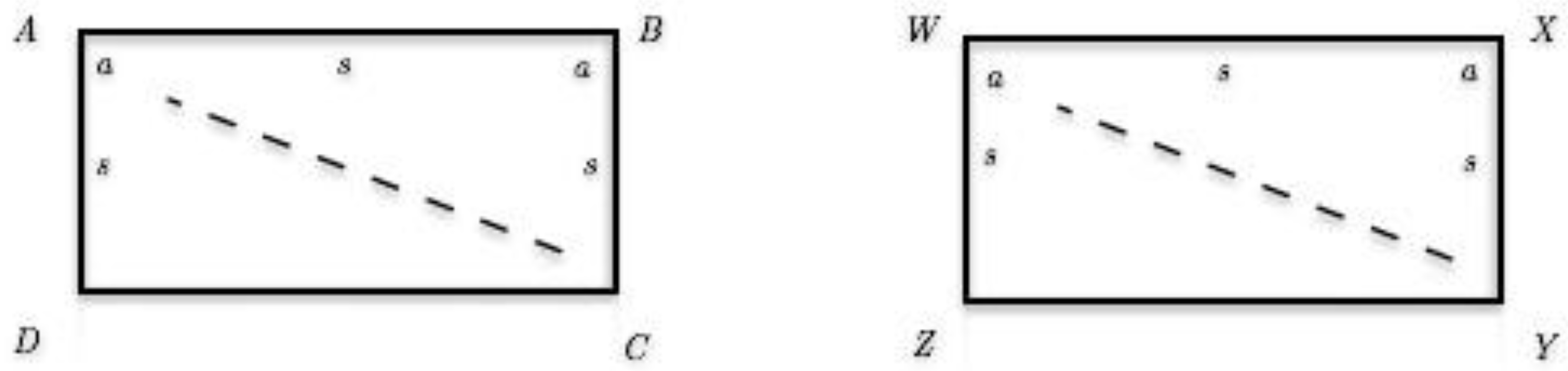
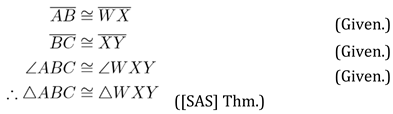
Now with the diagonals and drawn we can proceed as follows.
Given that △ABC =∼ △WXY :
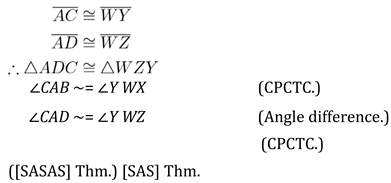
Finally:
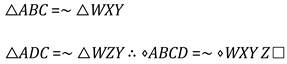
4.2.3. Proving [AASAS]
Assume a two generalized quadrilaterals ⋄ABCD and ⋄WXY Z, as shown below and a hypothetical diagonal drawn across both.
Figure 5.
Proving [SASAS], notice that the diagonals are essential to the proof.
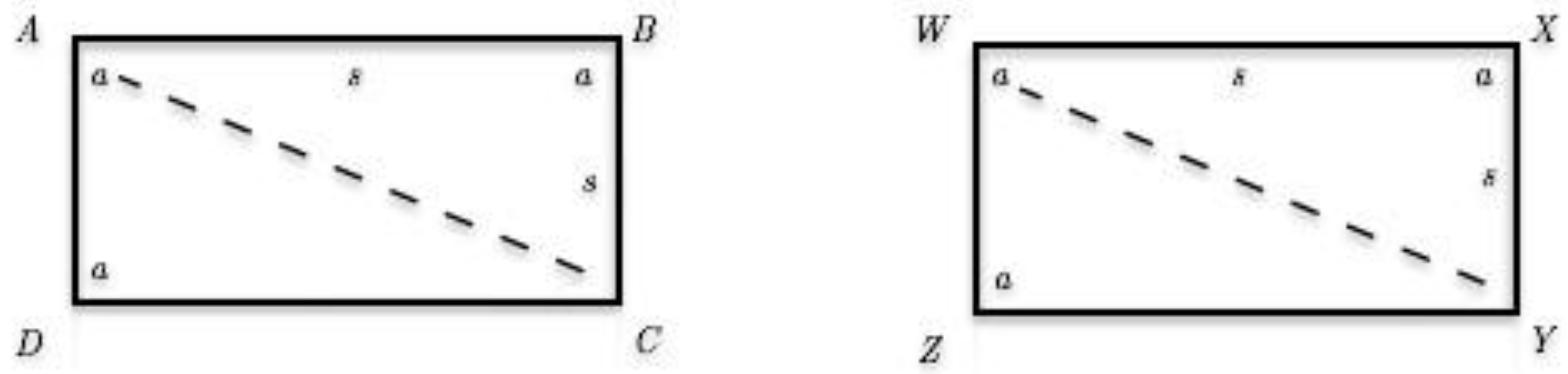
Observe:
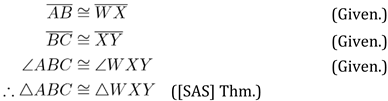
Given that △ABC =∼ △WXY :
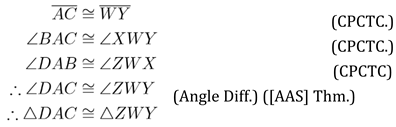
Finally:
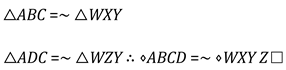
4.2.4. Proving [SSSSA]
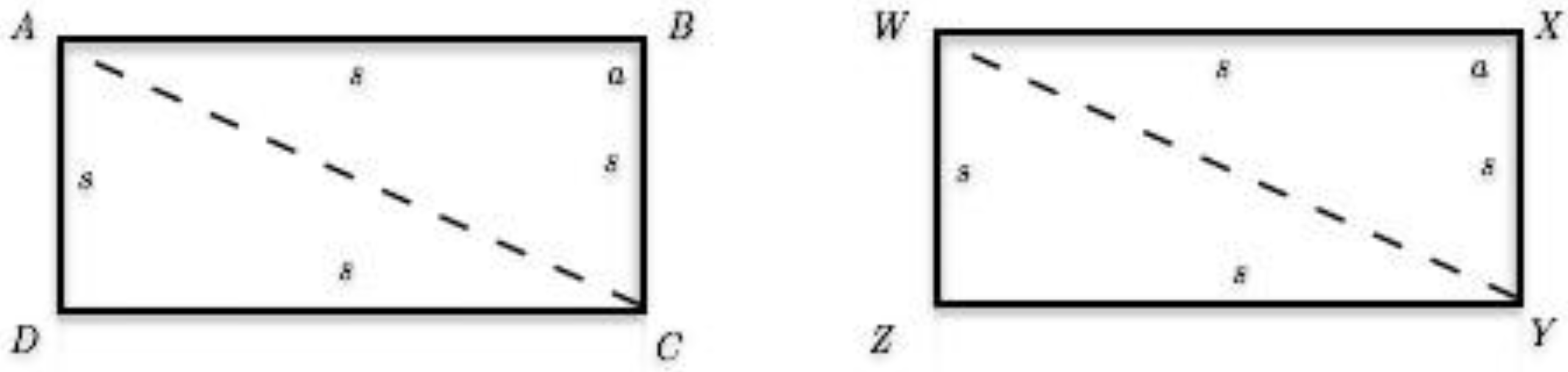
Assume a two generalized quadrilaterals ⋄ABCD and ⋄WXY Z, as shown below and a hypothetical diagonal drawn across both.
Figure 6.
Proving [SSSSA], notice that the diagonals are essential to the proof.
Observe:
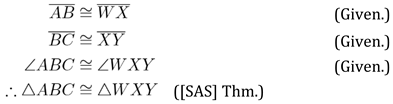
Now observe that:

Finally:
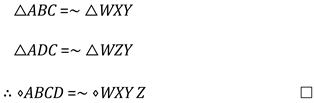
The other variants are proved in a similar way.
4.2.5. Proving [AAASS]
Assume a two generalized quadrilaterals ⋄ABCD and ⋄WXY Z, as shown below and a hypothetical diagonal drawn across both.
Figure 7.
Proving [AAASS], notice that the diagonals are essential to the proof.
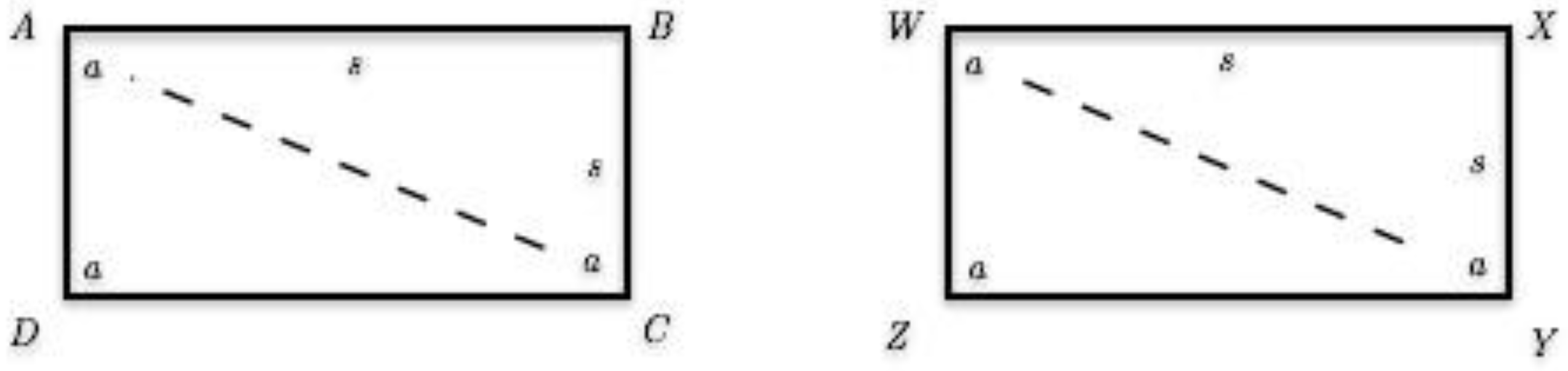
Observe:
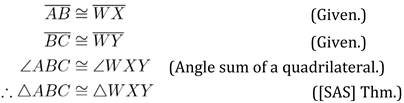
Given that △ABC =∼ △WXY :

Finally:
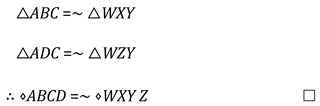
The other variants are proved in a similar way. All the proofs were inspired by [3].
4.3. Inductive Step
In the inductive step will assume that a congruence criterion [2 holds true between two n sided polygons α and β as shown in the next page.a1,a2,a3 ···S ···ak−2,ak−1,ak]
Observe:
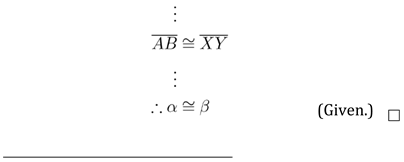
ity they could be congruent by [2While the n-sided polygons are congruent bya1,a2,a3 ···AS ···[aa1k,a−22,a,ak3−···1,aSk···],[aa1k,a−22,a,a3k−···1,aSAork], in actual···ak−even2,a-k−1,ak],
 this will come in use when we do a case-by-case analysis later.
 Figure 8.
Two n-sided polygons congruent by [a1,a2,a3 ···S ···ak−2,ak−1,ak].
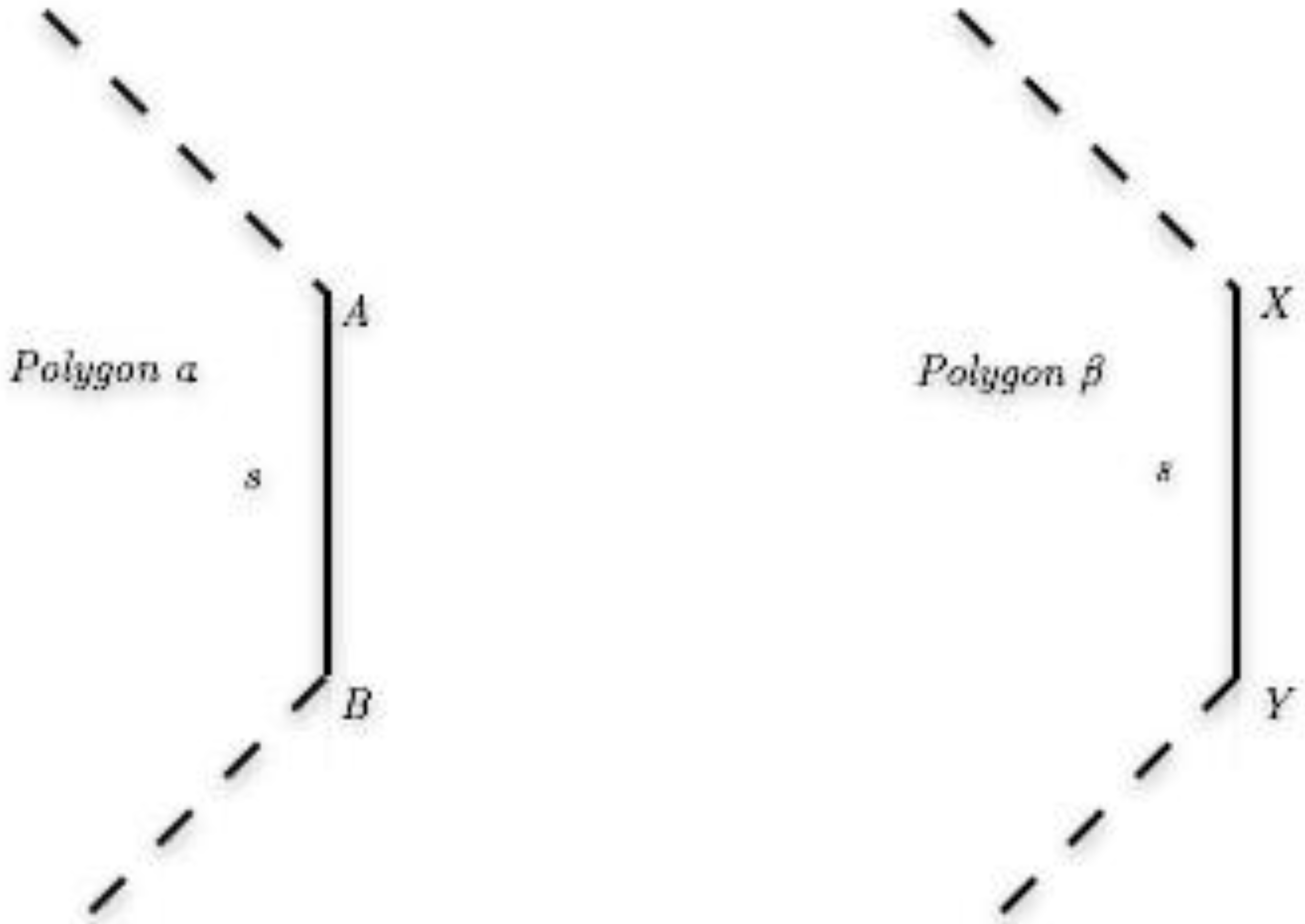
The above is our induction hypothesis. Now assume that two n+1 sided polygons are conjured, named γ and δ. Between them, are common everything that was common between α and β, except a single [···S ···] which has been replaced with an [···SAS ···]. To state it more formally between γ and δ a certain permutation of sides and angles are common, namely [b1,b2,c3 ···S ···bk−2,bk−1,bk], where if ai is A then bi is also A and if ai is S then bi is also S. For example, it could have been the case that [AASAS] was all that was necessary to prove that α and β was congruent, we now have two more polygons, between whom [AASASAS] is common. It remains to be seen whether this will ensure congruence.2
We are now ready to get to the meat of the proof. Observe that:
Figure 9.
Two n + 1 sided polygons congruent by [], where  if ai (from α and β) is A then bi is also A and if ai (from.
if ai (from α and β) is A then bi is also A and if ai (from.
Figure 9.
Two n + 1 sided polygons congruent by [], where if ai (from α and β) is A then bi is also A and if ai (from.
if ai (from α and β) is A then bi is also A and if ai (from.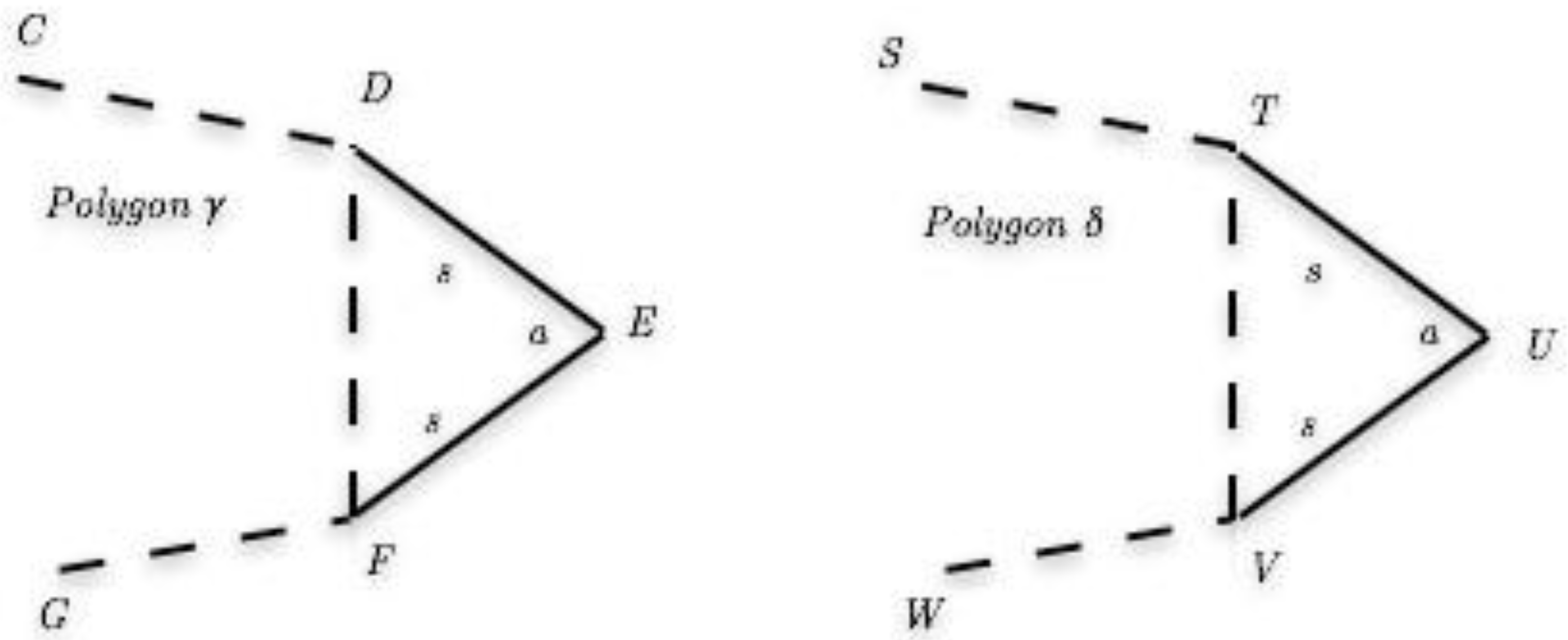
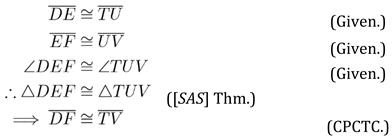
Furthermore:

4.4. Cases
We now approach the final part of the proof which will require us to go through a few cases. Before that observe that sans ,, and , γ and δ are just n-sided polygons.
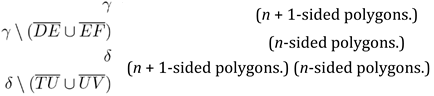
We noted earlier that between γ and δ we have [b1,b2,b3 ···S ···bk−2,bk−1,bk] in common, or to state another way we have everything in common that α and β had in common, with the exception of one S which had been replaced with SAS. It could be the case that γ and δ have, in actuality, [b1,b2,b3 ···ASAS ···bk−2,bk−1,bk], or [b1,b2,b3 ···SSAS ···bk−2,bk−1,bk], or [b1,b2,b3 ···SASA···bk−2,bk−1,bk], or [b1,b2,b3 ···SASS ···bk−2,bk−1,bk], or [b1,b2,b3 ···SSASS ···bk−2,bk−1,bk] or, [b1,b2,b3 ···ASASA···bk−2,bk−1,bk] or, [b1,b2,b3 ···ASASS ···bk−2,bk−1,bk] and even [b1,b2,b3 ···SSASA···bk−2,bk−1,bk].
Symmetry dictates that the case for [b1,b2,b3 ···SSAS ···bk−2,bk−1,bk] is the same as [b1,b2,b3 ···SASS ···bk−2,bk−1,bk], as is [b1,b2,b3 ···ASAS ···bk−2,bk−1,bk] and [b1,b2,b3 ···SASA···bk−2,bk−1,bk] and [b1,b2,b3 ···ASASS ···bk−2,bk−1,bk] and [b1,b2,b3 ···SSASA···bk−2,bk−1,bk]. We are then left with five distinct cases, as listed below:
- [b1,b2,b3 ···ASAS ···bk−2,bk−1,bk].
- [b1,b2,b3 ···SSAS ···bk−2,bk−1,bk].
- [b1,b2,b3 ···ASASA···bk−2,bk−1,bk].
- [b1,b2,b3 ···SSASS ···bk−2,bk−1,bk].
- [b1,b2,b3 ···SSASA···bk−2,bk−1,bk]
In all these cases if ai is S then bi is also S and if ai is A then ai us also A.
- Case 1: Case of [b1,b2,b3 ···ASAS ···bk−2,bk−1,bk]:
Figure 10.
Case of [b1,b2,b3 ···ASAS ···bk−2,bk−1,bk].

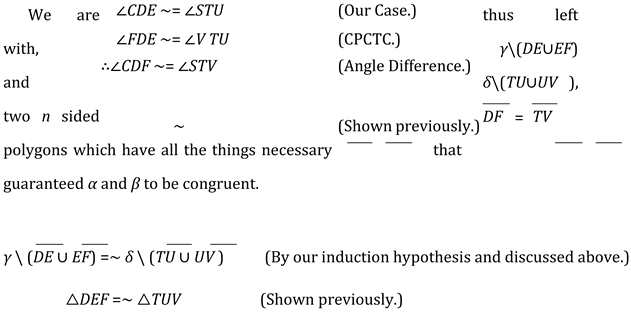
Here observe that:

- Case 2: Case of [b1,b2,b3 ···SSAS ···bk−2,bk−1,bk]:
This is a trivial case. Observe:
Figure 11.
Case of [b1,b2,b3 ···SSAS ···bk−2,bk−1,bk].
- Case 3: Case of [b1,b2,b3 ···ASASA···bk−2,bk−1,bk]:
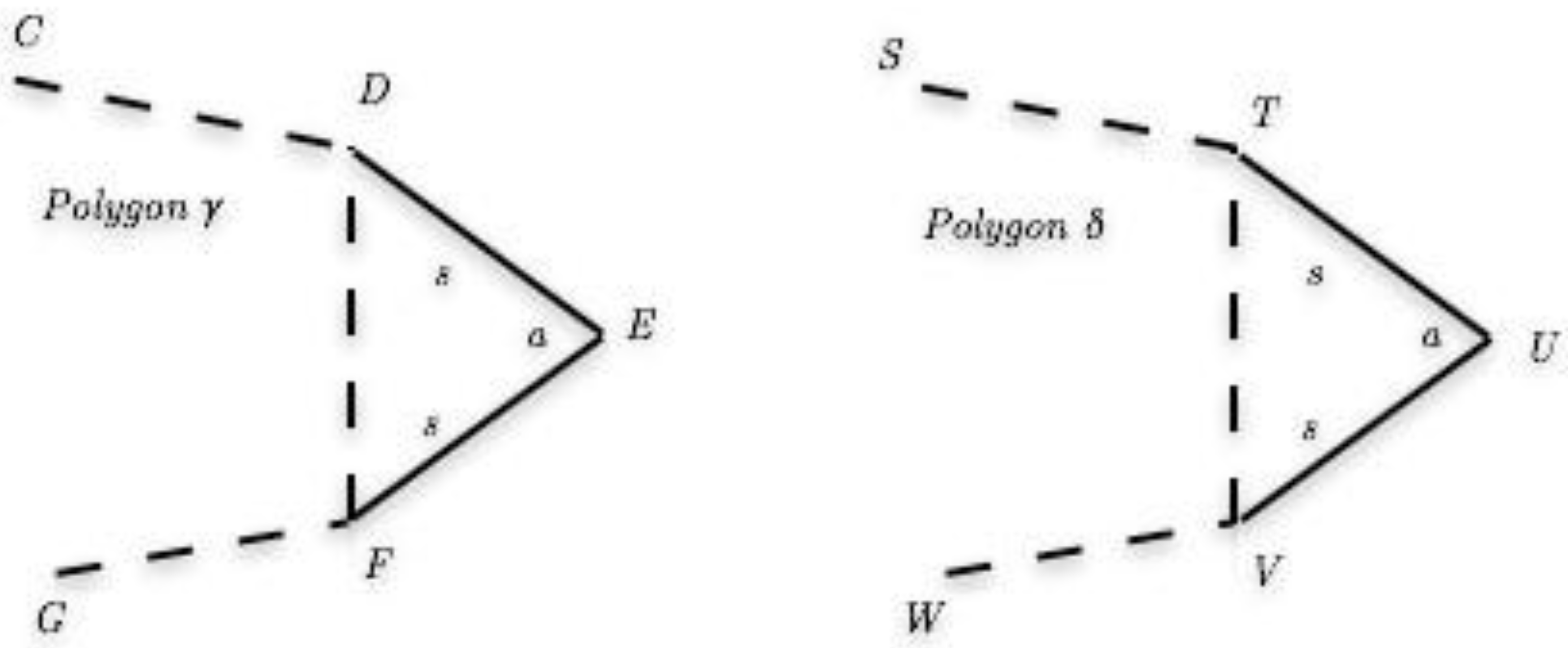
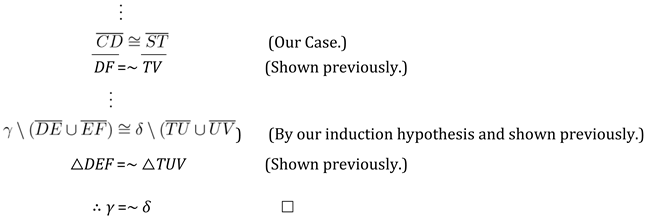
Here observe that:
| ∠CDE ∼= ∠STU | (Our case.) |
| ∠EFT ∼= ∠UV W | (Our case.) |
| ∠FDE ∼= ∠V TU | (CPCTC.) |
| ∴∠FDC ∼= ∠V TS | (Angle Difference.) |
| ∠DFE ∼= ∠TV U | (CPCTC.) |
| ∴∠DFC ∼= ∠TV W | (CPCTC.) |
Figure 12.
Case of [b1,b2,b3 ···ASASA···bk−2,bk−1,bk].
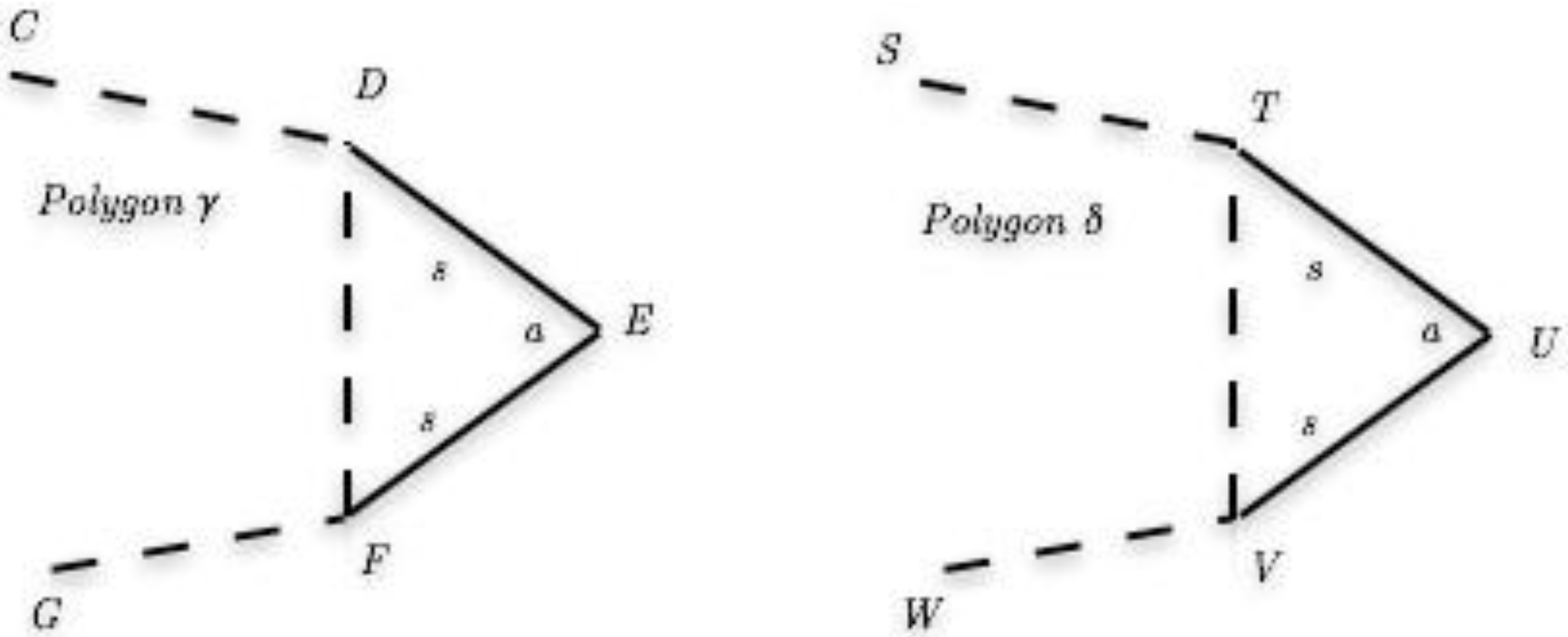
We are thus left with, γ\(∪) and δ\(∪), two n-sided polygons which have all the things necessary that guaranteed α and β to be congruent.

- Case 4: Case of [b1,b2,b3 ···SSASS ···bk−2,bk−1,bk]:
Figure 13.
Case of [b1,b2,b3 ···SSASS ···bk−2,bk−1,bk].
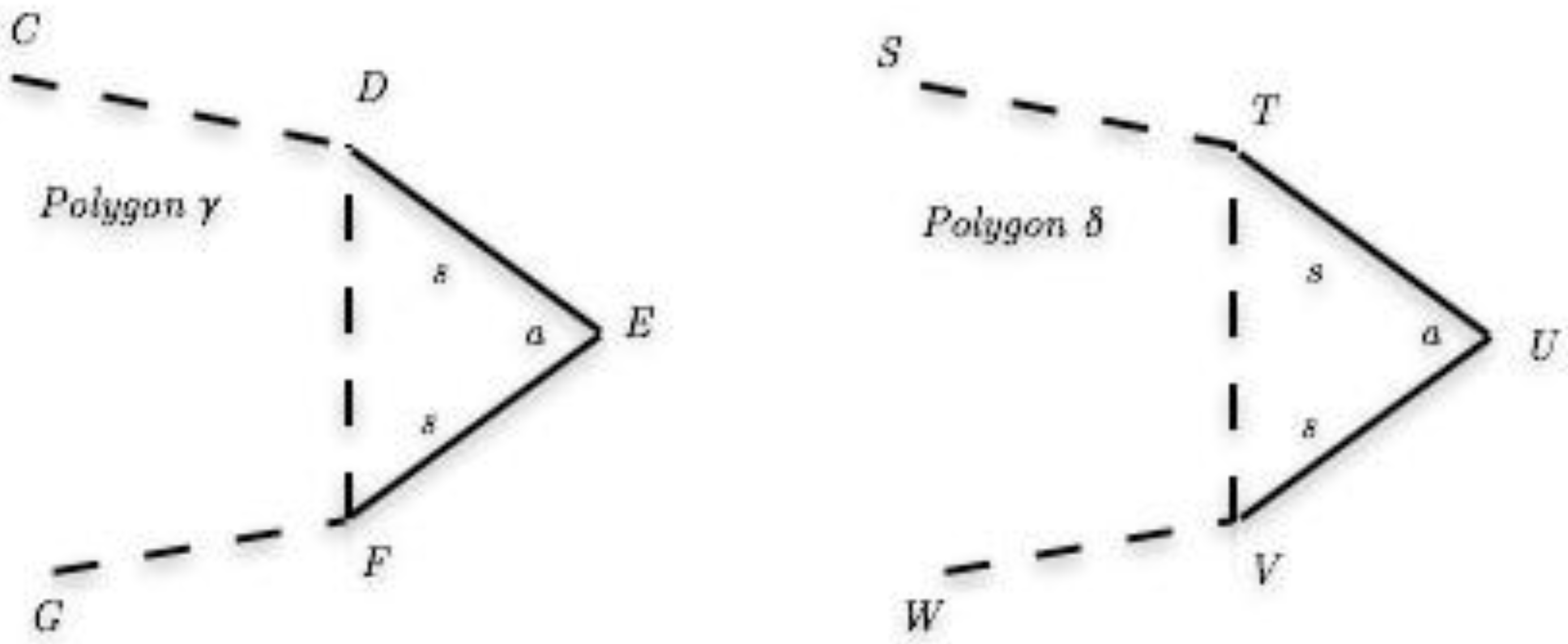
This is a trivial case. Observe:
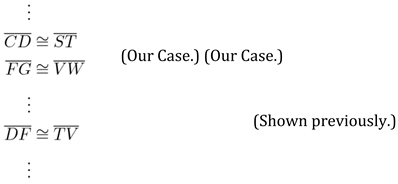
We are thus left with, γ\(∪) and δ\(∪), two n-sided polygons which have all the things necessary that guaranteed α and β to be congruent.

- Case 5: Case of [b1,b2,b3 ···SSASA···bk−2,bk−1,bk]:
Figure 14.
Case of [b1,b2,b3 ···SSASA···bk−2,bk−1,bk].
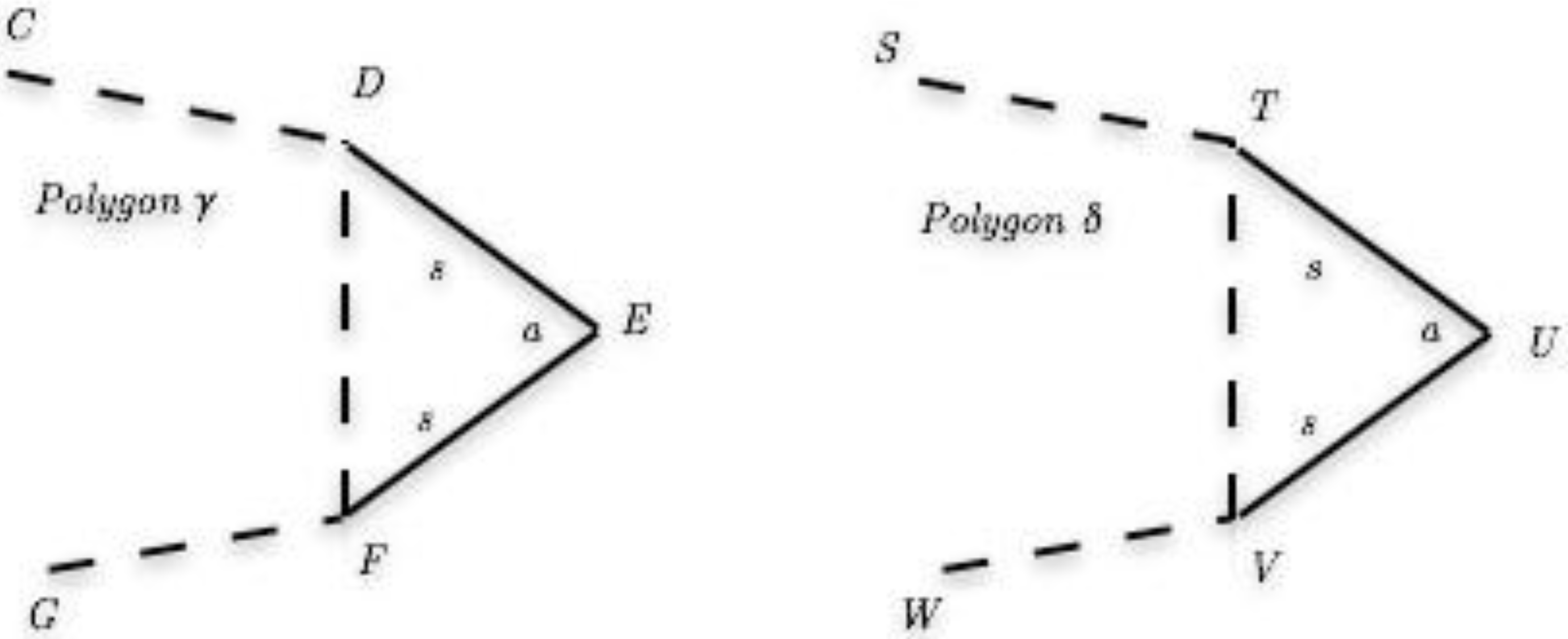
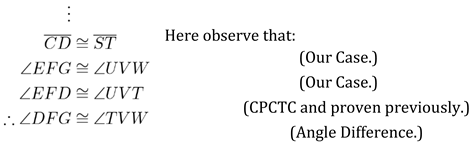
We are thus left with, γ\(∪) and δ\(∪), two n-sided polygons which have all the things necessary that guaranteed α and β to be congruent.

4.5. Corollary
Given that the previous statement is true, an interesting corollary emerges, as stated below:
Definition
(Corollary-1). Given that a particular congruence criterion between triangles is [SSS],[SAS],[ASA] and [AAS], then a particular congruence criterion between two n-sided polygons can be arrived at by replacing an [S] from any of the triangle congruence criteria to an [SAS], n − 3 number of times, where n ∈ N.
It is very easy to prove it. Assuming the hypothesis in the previous section is true, then to go from triangle (an n-sided polygon where n = 3), to a quadrilateral would mean replacing an [···S ···] with an [···SAS ...]. Simple arithmetic then tells us that to go from a triangle to an n-sided polygon requires replacing the [···S ···], n − 3 times. An example is shown below.
Triangle([SAS]) −→ Quadrilateral([SASAS]), 1 replacement −→ Pentagon([SASASAS]) 2 replacements −→ ··· −→ n-sided polygon, n − 3 replacements −→ ···. □
5. Conclusion
Although the algorithm can be used to find congruence criteria between n + 1sided polygons, it may not be all that efficient. If an inefficient congruence criteria is used for two n-sided polygon, an inefficient congruence criteria for two n + 1-sided may be found by this algorithm. For example, [AASS] is an inefficient congruence criteria between two triangles (the last S is redundant). Using the algorithm, we get [AASSAS], which, to be sure is a congruence criteria between quadrilaterals, but the last S is redundant. This is of course ignoring any bounding criteria. Take for example, given two n-sided regular polygons, only an S is needed to ensure congruence. The algorithm is also not exhaustive. It only ensures a congruence criteria is found, in reality there may be many congruence criteria between higher polygons.
References
- Kay, David C, College Geometry: A Discovery Approach. pg. 132. HarperCollins College Puglishers, 1994.
- Kay, David C, College Geometry: A Discovery Approach. pg. 135. HarperCollins College Puglishers, 1994.
- University of Virginia’s College at Wise, 12. Six Easy Pieces: Quadrilateral Congruence Theorems. Mar, 2014. Available online: http://www.mcs.uvawise.edu/msh3e/ resources/geometryBook/12Quadrilaterals.pdf.
- Weisstein, Eric W, Convex Polygon – Wolfram MathWorld. Mar, 2014. Available online: http://mathworld.wolfram.com/ConvexPolygon.html.
| 1 | All congruence criteria are denoted within square brackets (e.g. [SAS]). This is a stylistic choice is intended to aid in clarity throughout the text. Sides and angles are also represented within square brackets (e.g. [S] and [A]) |
| 2 | Notice that between α and β, we have not only the letters in common, but also the values that the letters represent. But between the pairs α,β and γ,δ, only the letters are common. Imagine for example two pairs of triangles. The first pair is common by [SAS] as is the second pair. The first pair has two sides and an angle in common, the values of which are also equal. Between the two pairs, only the letters are common. It may be the case that between the pairs, no side or no angle whatsoever are equal. |
Disclaimer/Publisher’s Note: The statements, opinions and data contained in all publications are solely those of the individual author(s) and contributor(s) and not of MDPI and/or the editor(s). MDPI and/or the editor(s) disclaim responsibility for any injury to people or property resulting from any ideas, methods, instructions or products referred to in the content. |
© 2023 by the authors. Licensee MDPI, Basel, Switzerland. This article is an open access article distributed under the terms and conditions of the Creative Commons Attribution (CC BY) license (http://creativecommons.org/licenses/by/4.0/).
Copyright: This open access article is published under a Creative Commons CC BY 4.0 license, which permit the free download, distribution, and reuse, provided that the author and preprint are cited in any reuse.


