

Submitted:
30 May 2022
Posted:
07 June 2022
You are already at the latest version
Abstract
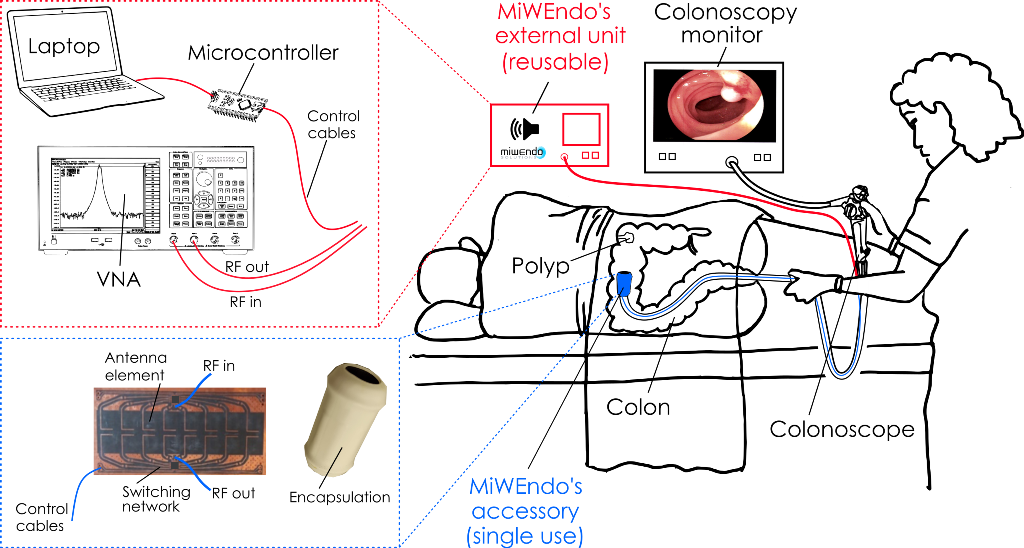
This study assesses the efficacy of a microwave colonoscopy algorithm to detect colorectal cancer precursors or polyps in an ex-vivo human colon model. The algorithm works with a device composed of a cylindrical ring-shaped switchable antenna array, which can be attached to the tip of a conventional colonoscope as an accessory. The accessory is connected to an external processing unit that generates an acoustic signal when a polyp is detected. Nowadays, 22% of polyps go undetected with conventional colonoscopy and the risk of cancer after a negative colonoscopy can be up to 7.9%. Fifteen ex-vivo freshly excised human colons with cancer (n=12) or polyps (n=3) were examined with the microwave-assisted colonoscopy system simulating a real colonoscopy exploration. Successive measurements of the colon were taken with the microwave-based colonoscopy device and processed with a microwave imaging algorithm. After the experiment, the dielectric properties of the specimens were measured with a coaxial probe and finally the samples underwent a pathology analysis. The results show that all the neoplasms were detected with a sensitivity of 100% and specificity of 87.4%.
Keywords:
endoscopes
; medical diagnostic imaging
; microwave antenna arrays
; microwave imaging
; colorectal cancer
Copyright: This open access article is published under a Creative Commons CC BY 4.0 license, which permit the free download, distribution, and reuse, provided that the author and preprint are cited in any reuse.