

Submitted:
28 February 2018
Posted:
02 March 2018
You are already at the latest version
Abstract
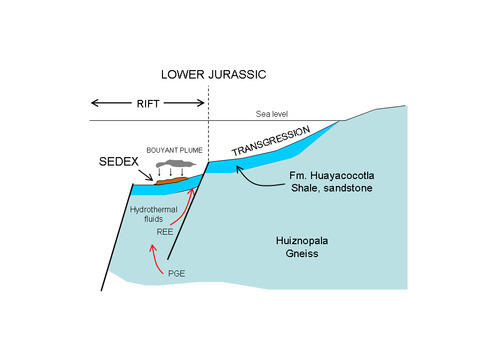
This work shows the preliminary description of the origin of a sedimentary - exhalative outcrop of Jurassic Lower Pliensbachian. The location of this deposit was achieved by applying an examination based in the identification of sedimentary transgressions of heterochronies ages and the identification of a Rift – type mega –structure. According with the methodology, it was carried out a study of the discordant relationships between two types of sediments: continental and marine. According the characterization, it was noted the existence of light rare earths, in values that show positive anomalies in comparison with the distribution of elements in upper continental crust according to the Clarke [1], reflecting so a felsic affinity of the mineral deposit. Also, positive anomalies of platinum and Pd, were determined with marginal contents of Au and Ag; and finally the base metals Zn, Pb and Cu were detected in low contents, which could be due to the presence of altered shale. According to the sedimentary lithology found, which was of siliciclastic type; to the exhalative roots observed during the fieldwork; the presence of quartz minerals such as biotite and muscovite; the presence of minerals of hydrothermal remobilization like chalcopyrite with some base metals, altered shale, as well as sulfur deficiency; this mineral reservoir could be defined as a SEDEX – type.
Keywords:
rare earths
; platinum
; SEDEX ore body
; rift mega structure
; transgression
Copyright: This open access article is published under a Creative Commons CC BY 4.0 license, which permit the free download, distribution, and reuse, provided that the author and preprint are cited in any reuse.