

Submitted:
31 January 2026
Posted:
02 February 2026
Read the latest preprint version here
Abstract
Waste pollution represents an increasingly serious problem affecting the health and well-being of people living in many developing countries. Many studies have examined and recommended waste-reducing solutions, yet environmental culture-based measures remain understudied. This study employs a novel approach that integrates the Culture Tower with the Contingent Valuation Method and a Bayesian model (CVBM) to explore and advance households’ environmental culture associated with waste management. Specifically, descriptive statistics capture respondents’ environmental perceptions and literacy, while the Bayesian model and CVM identify the determinants of households’ willingness to pay (WTP) and estimate WTP for waste treatment service (WTP4WTS), respectively. We found that despite the observed reduction in local waste pollution over time, respondents maintain a persistent concern regarding this issue. Over 13% of the households surveyed expressed dissatisfaction with waste treatment services (WTS), contrasting with nearly 50% of households that reported a neutral perspective. We also found that a significant majority (79.26%) of respondents were willing to pay for WTS, with an average WTP of 60,200 VND (US$2.32) per month. Importantly, the primary predictors of WTP4WTS were found to be the desire for improved waste services, current perceived waste pollution, and the belief that pollution has worsened over time. These findings offer important policy implications for mobilizing untapped household-level resources to foster environmental culture, thereby strengthening financing for better waste treatment services and facilitating the clean and green transformation for sustainable development in Vietnam and beyond in the years to come.
Keywords:
willingness-to-pay (WTP)
; CVBM
; waste management
; households
; WTS
; Vietnam
1. Introduction
Household waste is one of the fastest-growing environmental chal-lenges of our time, especially in developing and transitional economies. As countries transition from low-income to middle- and high-income status, their waste generation and management patterns evolve alongside eco-nomic development. Rising prosperity, rapid urbanization, and population growth drive sharp increases in per capita waste generation, while space for waste treatment and disposal becomes increasingly scarce. Global waste could increase by 70% by 2050, threatening environmental quality, public health, and social well-being (Kaza et al., 2018).
While this global trend poses challenges for all nations, it is particu-larly pressing in transitional contexts where economic growth outpaces institutional and infrastructural capacity. In countries like Vietnam, the rapid shift from a centrally planned to a market-oriented economy has ac-celerated industrialization and urbanization, reshaping consumption hab-its and waste generation patterns. Vietnam now produces approximately 65,000-70,000 tons of solid waste per day, with landfilling still the domi-nant treatment method (Nguyen et al., 2025). Despite government initia-tives promoting waste segregation and circular economy approaches, pub-lic participation and financial contributions to waste services remain low (Gia Chinh, 2023).
Vietnam exemplifies the dual burden faced by transitional societies balancing economic growth and modernization with environmental sustainability. Weak institutional capacity, fragmented governance, and inconsistent policy enforcement continue to hinder effective waste management (Joseph et al., 2022). At the same time, environmental education and public awareness are still evolving. As traditional communal norms emphasizing harmony with nature intersect with modern, market-driven lifestyles, Vietnam’s environmental culture is being reshaped. This coexistence creates a hybrid cultural landscape in which households’ environmental behaviors such as waste sorting and WTP for improved services are influenced by competing value systems and shifting moral priorities. Within this evolving context, households play a pivotal role in promoting environmental sustainability. They are both primary waste generators and key participants in reduction and recycling efforts. Their engagement through waste separation, reduced plastic use, or paying for treatment services is vital for building sustainable waste management systems (Khuc et al., 2023). However, such participation extends beyond financial calculation; it is deeply influenced by cultural, psychological, and contextual factors that shape how individuals perceive and respond to environmental challenges (Bamberg & Möser, 2007).
To fully understand these dynamics, the concept of environmental culture provides a valuable interpretive lens. It captures the shared beliefs, values, and norms that shape how individuals and communities perceive and interact with the natural environment (Chwialkowska et al., 2020), thereby offering deeper insight into the moral and normative dimensions of environmental behavior. Its importance lies in revealing that environmental issues are not merely technical or economic, but fundamentally cultural and behavioral phenomena, where decisions about waste, consumption, and sustainability reflect internalized social values rather than external incentives alone (Dunlap, 2008). In a transitional society like Vietnam, this framework helps explain how evolving cultural orientations mediate environmental action, as traditional collectivist ethics of stewardship increasingly intersect, and sometimes conflict with market-oriented values emphasizing convenience and consumption. These overlapping value systems illuminate why households may simultaneously express pro-environmental intentions yet vary in their willingness to pay or participate. By situating household waste behaviors within this broader value-centered perspective, the study reveals how Vietnam’s modernization process is not only transforming its economy and institutions but also reshaping the cultural foundations of environmental responsibility.
Most studies on household willingness-to-pay (WTP) for waste treatment services focus on economic or demographic factors, whereas cultural and psychological dimensions, leaving the underlying reasons why some households actively engage while others remain disengaged insufficiently understood. Few studies employ value-centered frameworks, such as the mindsponge mechanism (Q. H. Vuong, 2023) to explain how individuals absorb and internalize environmental values through cultural and cognitive filtering. This study, therefore, employs Contingent Valuation Method (Boyle, 2017a) coupled with Bayesian Mindsponge Framework (M. H. Nguyen et al., 2022) to investigate how environmental culture and household environmental perceptions influence willingness-to-pay for improved waste treatment services in Vietnam as a transitional country. By integrating cultural, perceptual, and economic dimensions, it provides insights into the drivers of pro-environmental behavior and offers practical guidance for designing policies that strengthen household engagement and financial participation in Vietnam’s waste management systems.
2. Literature Review
Household participation has become a cornerstone of effective solid waste management, particularly in decentralized and community-based systems. However, participation remains uneven across socio-economic groups and localities, shaped not only by socio-economic factors and institutional trust (He, 2020; Veliverronena & Davidsone, 2025; Rousta et al., 2020) but also rooted in environmental culture, which informs how households perceive responsibilities, evaluateS environmental initiatives, and decide whether to contribute financially or behaviorally to sustainable waste management (Hachana et al., 2025; Janmaimool & Denpaiboon, 2016).
Environmental culture encompasses collective values, beliefs, norms and practices through which communities interpret and engage with the natural environment, shaping how people perceive nature, moral responsibilities, and social expectations surrounding ecological behaviors. It deeply influences households’ environmental perceptions-awareness of risks, civic obligation, institutional trust-and their willingness-to-pay (WTP) for environmental services. When households hold strong pro-environmental beliefs, they perceive pay-for-service initiatives as legitimate rather than burdensome (Geng et al., 2023; Yarnvudhi et al., 2024). In contexts of rapid urbanisation and institutional strain, policy must engage with cultural meaning and moral frameworks to foster durable participation and genuinely sustainable systems.
WTP for improved waste management services remains a critical indicator of financial and moral commitment. The Theory of Planned Behavior (TPB) (Ajzen, 1991) and Value-Belief-Norm (VBN) model (Stern et al., 1999) explain how attitudes, norms, perceived control, and moral obligations shape WTP. When households perceive waste fees as fair and controllable, they are more likely to contribute (J. He et al., 2021; Xu et al., 2025; Vassanadumrongdee & Kittipongvises, 2018). Protection Motivation Theory (PMT) (Rogers, 1975) suggests WTP arises from threat appraisal (perceived risk severity) and coping appraisal (confidence in collective efficacy).
Empirical evidence from developing countries supports these predictions. Afroz & Masud (2011) found that in Kuala Lumpur, education, income, and concern significantly influenced WTP, with households willing to pay MYR 22 (USD 6.89) monthly. Research in Dhaka revealed trust in service providers, moral norms, and perceived difficulties as critical WTP determinants, with mean values of 13 Taka (USD 0.18) monthly (Afroz et al., 2009). These findings underscore that WTP extends beyond economic capacity to encompass cognitive perceptions, moral obligations, and institutional trust.
Recent frameworks embed cognitive processes within cultural contexts. The Mindsponge (Vuong, 2022) conceptualizes individuals as information filters who absorb environmental values based on trust and perceived benefits. The Culture Tower (V. Q. Khuc, 2023) emphasizes that cognitive mechanisms operate within shared cultural structures-social norms, moral codes, collective expectations-shaping how people interpret environmental information. Environmental culture has emerged as a cultural pyramid encompassing four layers: environmental awareness, action, contribution, and innovation. This multidimensional construct reflects collective values and moral frameworks mediating how environmental perceptions internalize into consistent pro-environmental behaviors and financial participation (Vuong, 2016; Khuc et al., 2024).
Social dilemmas in waste separation behavior have been examined through trust and reciprocity. Nguyen et al. (2015) demonstrated in Hanoi that trust in government and service providers was the strongest predictor of waste separation intentions, followed by personal moral norms and perceived difficulties, with 72% of households willing to commit financially. The study revealed that reciprocity preferences-willingness to separate waste if others do likewise—significantly enhanced commitment levels, highlighting the importance of community-based management approaches in overcoming collective action problems.
Traditional models highlight income, education, and gender as primary predictors, yet growing evidence emphasizes non-economic factors such as environmental perception, service satisfaction, and institutional trust (Giovanis et al., 2021; Ali et al., 2025). Financial capacity alone does not guarantee pro-environmental behavior unless environmental responsibility is internalized (Vuong, 2016; Nguyen et al., 2023). Households’ perceptions toward waste significantly influence WTP. Viewing waste accumulation as a threat or perceiving deteriorating service quality increases willingness to contribute (Apio et al., 2024; Jerie et al., 2024; Tassie et al., 2020; Boateng et al., 2019). Behavioral engagement such as waste separation or experiencing sensory cues (odors, visible overflow) signals internalized pro-environmental norms and strengthens WTP (Ma & Jiang, 2022; Zeng et al., 2016).
Institutional trust and satisfaction play pivotal roles: confidence in transparency, consistent service, and effective communication enhances perceived payment efficacy, whereas limited transparency or weak feedback loops reduce motivation to pay (Thi et al., 2024; Lam & Nguyen, 2023; Khong & Huynh, 2022). Participatory programs, clear reporting, and visible service improvements increase both WTP and sustained engagement. Evidence from Malaysia shows households receiving door-to-door collection exhibited higher WTP, suggesting that service satisfaction strengthens willingness to pay for improvements (Afroz et al., 2009).
In Vietnam, environmental culture remains emergent in rural and peri-urban areas experiencing transition. While the New Rural Development movement has promoted civic order and hygiene, coherent environmental culture rooted in shared ecological awareness has yet to take shape. Traditional values of community harmony and resource thrift coexist with rising consumerism, leading to cognitive dissonance between environmental concern and daily practices (Lam & Nguyen, 2023; Thi et al., 2024). Weak environmental culture often results in low participation and free-riding despite moral awareness of pollution (Saracevic & Schlegelmilch, 2021; Czajkowski et al., 2017; Torgler et al., 2009).
Since Doi Moi reform, rapid industrialization and urbanization have intensified waste challenges. Vietnam generates about 69,400 tonnes of solid waste daily, with 37,250 tonnes from urban areas and 32,150 tonnes from rural areas (Viet Nam News, 2025). While urban collection coverage exceeds 97%, rural treatment remains around 80%, revealing service quality and cost recovery disparities (Viet Nam News, 2025). The 2020 Law on Environmental Protection mandates household waste separation and user fees, yet WTP varies greatly.
Empirical studies in Vietnam reveal substantial WTP variation reflecting socio-economic conditions, regional context, and service quality perceptions. In urban areas such as Bien Hoa and My Tho, average monthly WTP was estimated at 14,450 VND and 13,000 VND (Phan et al., 2021), while other studies indicate WTP ranging from 111,000 VND to 155,000 VND per month (Khong & Huynh, 2022). Rural and mountainous households reported lower WTP, ranging from 673 VND/kg to 779 VND/kg, highlighting disparities linked to income and waste sorting experience (Pham et al., 2022; Khong & Huynh, 2022). Perceptions of fairness, transparency, and visible improvements further influence WTP, with higher contributions when residents recognize environmental benefits and trust local authorities (Lam & Nguyen, 2023; Thi et al., 2024).
While determinants of WTP are well-documented, the cultural and perceptual mechanisms that drive household decision-making remain underexplored, particularly in transitional economies like Vietnam. Many existing models treat WTP as purely economic behavior, overlooking the role of environmental culture and cognitive filtering processes in shaping financial participation. This study addresses that gap by integrating environmental culture, perceptions, and behavioral engagement into a unified framework grounded in the mindsponge mechanism. By doing so, it extends WTP research beyond income-based determinants to reveal how cultural internalization of environmental values translates into monetary support for sustainability initiatives.
3. Culture Tower-Based Framework of Environmental Culture Associated with Waste Management
In this study, we adopt Culture Tower (V. Q. Khuc, 2023) to explore the multidimensional interaction between people and waste management systems. The framework emphasizes the role of environmental culture in shaping awareness, behavior, and contribution toward improving local waste management services (Figure 1).
In this framework, Block K refers to an individual’s Knowledge, perceptions, interests, and attitudes toward waste generation and management. This stage reflects the initial level of environmental engagement, where perceptions of waste-related problems such as pollution, improper disposal, and recycling are formed. Heightened awareness and concern about these issues are often associated with greater participation in environmentally responsible actions such as sorting waste at source, reducing household waste, or contributing financially to the improvement of waste services.
Block A stands for Action (“Hanh Dong” in Vietnamese), highlighting the transformation of environmental knowledge and awareness into concrete behavioral practices. While knowledge is essential, it is not sufficient to achieve behavioral change. Actions such as consistent waste separation, participation in community clean-up activities, and cooperation with local waste collection systems reflect higher levels of civic engagement. In this study, Action (Hanh) reflects the habitual and skill-based practices through which individuals contribute to improving waste management performance in their communities.
Block U refers to Utility, capturing the extent to which individuals benefit from effective waste management. When waste is properly managed, residents enjoy cleaner, safer, and healthier living environments. These benefits create positive reinforcement for continued engagement in pro-environmental behavior. In contrast, negative utilization, such as littering or illegal dumping, undermines community well-being and collective environmental responsibility. Therefore, perceived utility acts as a determinant that can either encourage or hinder waste management participation depending on the level of satisfaction and perceived community benefits.
The highest level of engagement is Block C, which represents Contribution. At this stage, individuals move beyond compliance and participation to actively contribute their financial or voluntary resources to community waste management initiatives. Such contributions may include a willingness to pay higher waste collection fees, donate to environmental improvement funds, or participate in co-management programs for local waste infrastructure. Traditionally, municipal waste management has been viewed as a public service financed exclusively by local authorities. However, households’ readiness to contribute indicates a shift toward shared environmental responsibility and collaborative governance. This evolution reflects a mature stage of environmental culture in which collective actions help ease local fiscal constraints and enhance the long-term sustainability of waste management systems.
In summary, the Culture Tower comprises four interrelated dimensions of environmental engagement: Knowledge, Hanhdong (Action), Utility, and Contribution. Knowledge influences action, action affects perceived utility, and utility, in turn, stimulates or constrains contribution. Positive experiences with waste management outcomes reinforce environmental awareness and encourage higher levels of community participation. The adapted KAUC framework provides the conceptual foundation for this study and guides the empirical analysis presented in the following sections.
4. Methods
4.1. Contingent Valuation-Bayesian Model (CVBM) Method
This study introduces the CVBM approach, integrating Contingent Valuation Method (Boyle, 2017a) with Bayesian Mindsponge Framework (BMF) (Nguyen et al., 2022) grounded in Culture Tower theory (Figure 1). The Culture Tower depicts participation in environmental initiatives as evolving from awareness to contribution behavior through Bayesian information-processing mechanisms. BMF conceptualizes individuals as “information sponges” filtering information based on cognitive comfort zones and core cultural values (Vuong & Napier, 2015), enabling analysis of cognitive-behavioral factors influencing payment decisions often overlooked in traditional econometric models.
CVM is widely employed to estimate willingness to pay (WTP) for non-market environmental goods through hypothetical scenarios (Carson, 2012). Integrating CVM with BMF offers an advanced pathway that quantifies WTP while elucidating cognitive–behavioral–utility mechanisms underlying decisions. This enhances both reliability and interpretative depth, providing quantitative evidence and socio-psychological explanations for sustainable waste management policymaking. By incorporating BMF, CVBM explores the “black box” of decision-making, identifying roles of cognitive comfort zones and cultural values in accepting payment scenarios, thus enabling policymakers to understand barriers and levers for transforming WTP into actual contribution behavior.
The CVBM framework (Figure 2) consists of three components: inputs (A), processes (B), and outputs (C). Input data are collected via CV-designed questionnaires. The analytical process employs variables reflecting Culture Tower layers (Knowledge, Action, Utility, Contribution). Bayesian Mindsponge examines WTP decisions while CV estimates WTP amounts, yielding methodological, theoretical, and policy-relevant insights.
The payment card approach was adopted to operationalize WTP quantification, enabling intuitive visualization of contribution levels while mitigating strategic and starting-point biases (Mitchell & Carson, 1989b). It was selected for visual clarity, respondent friendliness, and superior bias reduction versus dichotomous choice or open-ended formats (Boyle, 2017b). Respondents indicating willingness to contribute were presented a payment card to indicate maximum donation amounts. The card construction involved: (1) deriving initial monetary ranges from pilot interviews reflecting realistic capacities; (2) arranging values in ascending order representing feasible payment levels (e.g., 10,000–100,000 VND/month); (3) having respondents select their highest WTP, revealing individual valuation (Alberini et al., 2006; Hanemann, 1994). Within CVBM, payment card data are utilized to estimate contribution probability and jointly analyze cognitive, behavioral, and utility determinants shaping household decisions.
4.2. Study Area
The study was conducted in former Hai Duong Province, now part of Hai Phong City, a key economic area in Vietnam’s Red River Delta (Figure S1). Characterized by rapid industrialization and growing population, Hai Phong faces escalating environmental challenges. Its strategic location and industrial base make it a major economic gateway where industrial, service, and residential activities converge, exerting considerable pressure on waste management systems.
Over the past decade, intensifying pressures in household waste management have emerged. Accelerated urbanization and rising consumption have surged waste generation, exceeding existing collection and treatment capacity, which remains fragmented and technologically limited. Substantial household waste continues traditional landfilling, with many sites operating near or beyond capacity, causing environmental pollution and adverse community impacts (Cong Hoa, 2024; Vinh Quan, 2024). Residents report unpleasant odors, groundwater contamination, and absent mechanisms for waste collection, segregation, and recycling.
Although provincial government introduced policies and community-based models encouraging waste segregation and collection initiatives, implementation remains inconsistent. Weak institutional coordination, incomplete technical guidelines, and limited financial incentives hinder enforcement and participation (Ngan Hanh, 2025). Despite public awareness campaigns, household engagement in waste sorting and recycling remains relatively low, especially in peri-urban and rural areas with uneven infrastructure.
Hai Phong represents a microcosm of Vietnam’s urban waste management challenges where urbanization pace outstrips policy effectiveness and infrastructural capacity. The province provides a representative case to analyze public behavior and perceptions toward waste issues while exploring household WTP for environmental improvements. The field survey was conducted over two months (July–August 2025) employing random sampling with 487 households across 11 communes and wards, ensuring diverse socio-economic and spatial representation.
4.3. Data Collection
The survey process involved four stages. First, extensive literature review identified factors influencing public awareness, behavior, and WTP for waste management, informing the first questionnaire draft. Subsequently, an expert focus group (10+ years experience in environmental economics and CVM) assessed clarity, relevance, logical consistency, and alignment with valuation practices (Khuc, 2022; Khuc et al., 2016, 2025, 2026). Focus group discussions explored participants’ understanding and experience with waste management issues, providing insights into public interpretation of survey items. Feedback refined the questionnaire, ensuring contextual appropriateness, validity, reliability, and structured design aligned with study objectives.
Data collection proceeded in two phases. For phase 1 (Pre-survey), the team visited local authorities to introduce objectives, align plans, and conduct pilot surveys with representative households, assessing questionnaire quality and identifying unclear items. Based on feedback, the questionnaire was finalized with 58 questions across four parts: (A) Public awareness of waste management; (B) Improvement measures and solutions; (C) Demographic information; (D) Participation levels and WTP for sustainable solutions. For phase 2 (Main survey), data were collected via face-to-face interviews and online surveys. Trained collectors conducted interviews based on sample lists from local authorities. Online questionnaires were distributed through Google Forms. Focus group members provided methodological oversight during the main survey. To facilitate coordination, survey-specific Zalo groups were established with five key members (research team, collectors, local officials), enabling daily progress checks, real-time communication, and immediate support. Daily online meetings reviewed progress, exchanged experiences, and addressed issues, maintaining timeline consistency and data reliability.
Sampling focused on households willing to participate with complete responses. Respondents aged 21–60 years represented households, selected for sufficient social awareness, comprehensive understanding of household activities and expenditures, and information technology proficiency advantageous for online surveys. These characteristics enhanced accuracy, reliability, and validity while minimizing response bias.
Following Mitchell & Carson (1989) and Boyle (2017), respondents first answered whether they would pay higher monthly fees for service upgrades. Those answering “yes” received a payment card with 17 predetermined bid values (0 to >1,000 thousand VND/month). Bid values were strategically designed in descending order: >1000, 1000, 900, 800, 700, 600, 500, 400, 300, 200, 160, 120, 100, 80, 40, 20, and 0 thousand VND (Box S1). This non-uniform distribution allowed finer granularity at lower payment levels where most responses cluster while maintaining higher valuation coverage. Respondents selected maximum WTP values, revealing valuation ceilings. This format reduces starting point bias while providing more information than open-ended questions (Boyle, 2017).
4.4. Models
CVBM examines household interactions with waste management through four hierarchical dimensions: Knowledge (K) captures awareness of waste conditions and desire for improvements; Action (A/H) reflects waste sorting behaviors; Utility (U) measures satisfaction with collection services; Contribution (C) examines financial willingness through decisions and amounts. From mindsponge perspective, contribution decisions arise from internal filtering processes mediated by cognitive perceptions and norms. Beyond socioeconomic factors (gender, age, income, education), environmental perceptions and waste behaviors critically shape WTP.
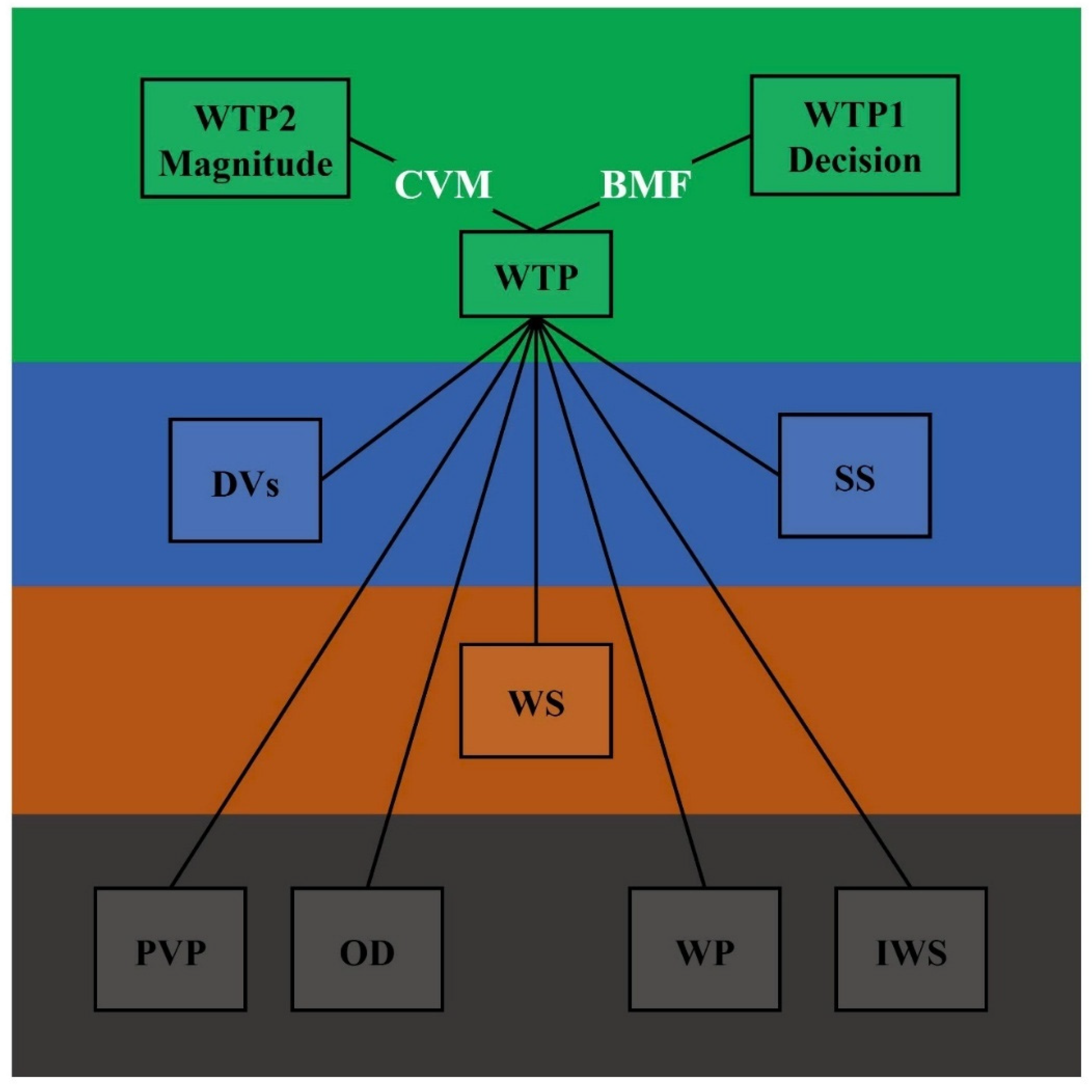
Analysis proceeds through two stages using consistent explanatory variables reflecting households’ knowledge, actions, utility perceptions, and socioeconomic characteristics. Stage one employs Bayesian logit regression examining WTP decisions. Stage two applies Interval Regression estimating WTP amounts, appropriate for payment card data where responses fall within predefined intervals. This two-stage structure captures distinct yet related aspects-initial acceptance and contribution magnitude-maintaining coherence with CVBM perspective within a unified framework (Figure 3).
4.4.1. Bayesian Regression Model
The following model examines determinants of households’ WTP decision for improved waste treatment:
Figure 3.
Structure of the CVBM model.
BMF analytics was applied for several reasons. First, combining logical reasoning strengths of Granular Interaction Thinking Theory (Vuong et al., 2025) with Bayesian inference power offers strong theoretical compatibility. Second, Bayesian inference treats all parameters probabilistically, facilitating parsimonious yet robust predictive models. Moreover, incorporating Markov Chain Monte Carlo (MCMC) technique, Bayesian analysis handles complex model structures. Third, rather than binary p-value thresholds, Bayesian inference provides credible intervals for nuanced interpretations. Detailed Bayesian Model Specification appears in R code commands S1.
Markov chain convergence was assessed using statistical indicators and visual diagnostics. Key metrics: effective sample size (n_eff) and Gelman-Rubin shrink factor (Rhat). n_eff reflects effectively independent samples not autocorrelated during simulation; Rhat measures estimate consistency across chains. n_eff > 1,000 indicates sufficient effective sampling for reliable inference. Rhat close to 1 indicates convergence; Rhat > 1.1 signals non-convergence and mixing issues. Visual examination through trace plots, Gelman-Rubin-Brooks plots, and autocorrelation plots provided further validation.
4.4.2. Interval Regression Model
The following model examines determinants of households’ WTP decision for improved waste treatment:
To estimate households’ WTP for improved waste treatment, we employ interval regression—an extension of censored regression techniques suitable when exact dependent variable values are unobserved but known to lie within intervals. This method fits contingent valuation data from payment cards presenting monetary value ranges. Building upon first-stage Bayesian regression, this model incorporates additional socio-demographic factors (gender, education) alongside environmental perception variables reflecting households’ awareness and assessment of local waste conditions (OdorDetected, WastePollution, PollutionVsPast, ImproveWasteService, WasteSorting, ServiceSatisfaction). This extended specification provides holistic understanding of how economic, social, and perceptual dimensions shape WTP magnitude, offering deeper insights into household environmental-economic behavior.
Formally, consider a series of bid levels 0 = p0 < p1 < p2 < … < pn, on the payment card (with pn potentially approaching infinity). Let WTPiT be respondent i’s reported WTP and WTPiT be their true valuation. Then,
………………………………
We specify the estimation equation as follows:
It is noted that the error term εi follows N (0, σ²), xi and β are the variable and coefficient vectors respectively. Respondent i’s response falls in [li, ui], where li = pk and ui = pk+1 for k in {1, 2, ..., n - 1}. The probability of i’s true WTP being in [li, ui] follows the below equation:
Pr (WTPiT in [li, ui]) = Pr (log li - β’xi ≤ εi ≤ log ui – β’xi)
We obtained the mean of WTP by the following equation:
E (WTP) = exp (β’xi) * exp (σ²/2)
To assess the reliability and robustness of the interval regression estimates, model diagnostics are based on the overall log-likelihood (LL) value and the corresponding model p-value. The log-likelihood indicates the model’s goodness of fit, with higher LL values (less negative) suggesting better model fit to the data. The p-value is used to evaluate the joint statistical significance of the estimated relationships, with p < 0.05 typically indicating that the model’s predictors collectively have a statistically significant effect on WTP. Together, these indicators offer a concise assessment of the adequacy of the interval regression model in explaining variation in willingness-to-pay amounts.
The detailed information of variables used in the CVBM model presented in Table 1, as follows:
5. Results
5.1. Households’ Perceptions of Waste Pollution and Waste Treatment Services
When asked about the current state of household waste pollution, more than half of respondents (56.1%) acknowledged that waste pollution remains a visible issue in their locality, while 43.9% perceived it as not particularly serious (Figure 4a). This indicates that environmental concerns related to waste are still widespread within the community. In terms of environmental quality, the majority of respondents (65.7%) reported that local waste pollution has improved compared with previous years, whereas 25.6% observed no noticeable change and only 8.7% perceived deterioration (Figure 4b).
Regarding perceptions of waste treatment services, the overall assessment appears positive. As shown in Figure 4d, the mean rating of service quality stands at 6.92 on a 10-point scale, indicating a generally satisfactory level of performance. Similarly, the majority of respondents (47.4%) regarded the current service fees as “neutral” and 43.7% considered them “reasonable,” with only a small fraction viewing them as “unreasonable” or “very unreasonable” (Figure 4c). This pattern implies that most households perceive the existing service cost as fair relative to the quality delivered.
When it comes to the perceived causes of local waste pollution, the results show that limited public awareness was identified as the most prominent contributor, cited by 76% of respondents. This is followed by the expansion of production and daily activities (62.6%) and the growing demand for higher living standards (56.7%), both of which indicate rising consumption and waste generation pressures. Household waste (55.6%) and industrial waste (45.6%) were also recognized as key pollution sources, reflecting the combined effects of residential and production sectors. Additionally, nearly half of the respondents pointed to population growth (45.0%) and weak infrastructure and waste management systems (42.5%) as aggravating factors. Further information on the perceived causes of local waste pollution is presented in Table S1.
5.2. Determinants of Households’ Willingness to Pay for Improved Waste Treatment Services (WTP4WTS)
5.2.1. Determinants of WTP4WTS Using Bayesian Model
Table 2 provides detailed analysis of the determinants of households’ willingness to pay (WTP) for improved local waste treatment services. In Bayesian estimation, it is essential to verify the convergence of Markov chains to ensure the reliability of simulated posterior draws. The convergence of the Markov chains was evaluated using two standard diagnostics: the effective sample size (n_eff) and the Gelman shrink factor (Rhat). All estimated parameters satisfy the convergence criteria, with n_eff values well above the minimum threshold (the lowest value being 6,969, well above the threshold of 1,000) and Rhat equal to 1 for every coefficient. These results confirm that the Markov chains mixed well and reached stable equilibrium, satisfying the Markov chain central limit theorem. The trace plots further corroborate this stability, displaying rapid oscillations around constant means without visible drift, indicating that the posterior simulations are robust and reliable for interpretation (Figure 5). Further information on the estimated results of the Bayesian model is presented in Figures S2-7.
5.2.2. Determination of WTP4WTS Using Contingent Valuation and Interval Regression Model
Table 3 reports the estimation results from five separate models, where FM represents the full model containing all variables identified as relevant in the Bayesian model, while RM1–RM4 are restricted models in which different subsets of statistically insignificant variables are excluded. Notably, all five models yield p-values of 0.000, well below the 0.01 threshold, indicating strong statistical significance at the 99% confidence level and confirming the robustness and adequacy of the model specifications. The log-likelihood values are further used to assess model fit, with higher values indicating better performance. Accordingly, the full model (FM) exhibits the highest log-likelihood (–622.6) and is therefore selected as the primary basis for subsequent reporting and interpretation.
As presented in Table 3, the estimation results identify seven statistically significant variables influencing households’ willingness to pay (WTP) for improved waste treatment services. Income and WasteSorting are significant at the 1% level; ImproveWasteService, OdorDetected, and ServiceSatisfaction are significant at the 5% level; while WastePollution and PollutionVsPast are significant at the 10% level. First, regarding environmental perception, the three variables OdorDetected (0.267), WastePollution (0.195), and PollutionVsPast (0.142) all display positive coefficients. This indicates that households perceiving higher levels of pollution, noticing unpleasant odors from waste collection points, or recognizing improvements in local environmental conditions tend to exhibit higher WTP. In other words, perceived environmental discomfort, heightened awareness of environmental risks, and the desire to sustain improvements in environmental quality collectively motivate households to contribute more toward waste treatment enhancement. Next, in terms of practical environmental behavior, the variable WasteSorting (0.359) shows a positive and statistically significant relationship with WTP. Households that actively sort their waste at source demonstrate a higher likelihood of contributing financially, reflecting a stronger sense of environmental responsibility and a greater willingness to support more effective waste management services. Regarding service needs and expectations, the variable ImproveWasteService (0.585) exerts a substantial positive effect, indicating that households perceiving greater needs for service improvement are more willing to pay. This highlights the motivational role of perceived service inadequacy in driving higher financial contribution. Conversely, ServiceSatisfaction (–0.164) has a negative coefficient. This suggests that as households’ satisfaction with the current waste collection and treatment services increases (e.g., from “neutral” to “satisfied”), their WTP declines. This implies that households already content with existing services perceive less necessity for further improvement and therefore express lower willingness to contribute. Finally, the positive coefficient for Income (0.251) indicates that households with higher income levels tend to have higher WTP, consistent with the expected influence of financial capacity on environmental payment decisions. The estimated WTP is 60,161 VND (2.31 USD), indicating that, on average, surveyed households are willing to contribute approximately 60,161 VND to improve the quality of local waste treatment services. Taken together, these findings underscore that households’ economic capacity, responsible behavior, and environmental perceptions play pivotal roles in shaping their willingness to pay for improved waste treatment services, while satisfaction with current service quality tends to diminish the perceived necessity for additional financial contributions. Further information on the estimated results of the interval regression model is presented in Table S2-6.
6. Discussion
In this section, we present in-depth discussions of the key results regarding environmental awareness, waste-sorting behaviors, and contribution commitment presented in previous sections to advance understanding of environmental culture associated with waste management in the study area.
Firstly, descriptive data show that households are increasingly aware of environmental improvements and view existing waste-collection costs as fair. Moderate to high environmental awareness and favorable perceptions suggest recent Vietnamese initiatives are achieving success in raising service visibility and citizen recognition. However, many households observe persistent waste pollution and perceive room for improvement. This growing critical awareness reflects an evolving environmental culture where citizens are becoming informed stakeholders rather than passive service recipients, signaling a broader societal shift toward green transition.
Our findings highlight the multidimensional nature of households’ willingness to pay, revealing that economic capability and environmental culture jointly determine contribution behaviors. Income, waste-sorting behavior, desire for improved services, and odor detection all contribute to higher WTP, indicating that households with greater economic capacity, stronger pro-environmental behaviors, and heightened awareness are more inclined to financially support improvements. Earlier Vietnamese evidence similarly highlights the role of income, education, and environmentally responsible behaviors in shaping WTP (Phan et al., 2021; Nguyen et al., 2023; Khong & Huynh, 2022), suggesting households recognize waste as a potential resource and are culturally primed to support treatment initiatives.
These patterns align with international evidence showing moral norms and trust constitute critical non-economic determinants. In Hanoi’s pilot programs, trust emerged as the strongest predictor of waste separation intentions (Nguyen et al., 2015). Our findings extend this by demonstrating that desire for service improvement and current satisfaction jointly shape financial contribution behaviors, suggesting that building institutional trust and delivering visible improvements are mutually reinforcing strategies. Environmental perception variables highlight the cognitive dimension of environmental culture. Households recognizing deterioration in local conditions tend to exhibit higher WTP, reflecting internalization of environmental responsibility at the community level (Khong & Huynh, 2022; Thi et al., 2024). This aligns with the Culture Tower, where awareness and knowledge gradually translate into participation and contribution. Conversely, higher ServiceSatisfaction reduces WTP, suggesting contentment may dampen perceived urgency to invest further.
The estimated mean WTP of approximately 60,200 VND (US$2.32) per household indicates moderate yet meaningful willingness to invest in improved waste services. Comparative Vietnamese evidence shows WTP varies widely across regions, reflecting differences in income, service quality, and environmental awareness (Khong & Huynh, 2022; Phan et al., 2021). This variation underscores the influence of both economic capacity and exposure to organized waste systems. Notably, estimated WTP exceeds current environmental fees, suggesting local governments have room to mobilize community co-financing and signaling a shift toward internalization of environmental responsibility.
International benchmarking provides additional context. In Malaysia, mean WTP represented 1.7% of household income (Afroz & Masud, 2011) while in Bangladesh it represented 0.12% of income (Afroz et al., 2009). Vietnam’s estimated WTP falls within this regional spectrum, suggesting moderate financial capacity coupled with emerging environmental consciousness characteristic of transitional economies. Within Vietnam’s broader transformation, these findings reflect a society where modernization, environmental awareness, and institutional reform increasingly intersect. Household participation embodies the country’s Four Transformation Pillars including technological innovation, international integration, institutional modernization, and social mobilization.
From a policy perspective, results point to clear opportunities for institutional and fiscal innovation. Local governments appear to have fiscal space to revise service fees or introduce targeted environmental charges, provided such measures accompany visible service improvements and transparent fund management. Participatory mechanisms such as public feedback systems, co-design of local waste plans, and transparent reporting can sustain trust and accountability. These mechanisms also address potential stagnation from perceived satisfaction by drawing attention to improvements that might otherwise go unnoticed. Policy effectiveness depends on aligning financial instruments with behavioral reinforcement, linking fee adjustments to community engagement, waste-separation initiatives, and environmental education.
Lessons from pilot programs in transitional contexts highlight critical success factors. In Rasht, Iran, despite initial success, programs proved unsustainable after pilot funding ceased due to inadequate resources and public participation (Moghadam et al., 2009). Similarly, Hanoi’s JICA-supported 3R program achieved high awareness but failed large-scale replication, with continued participation depending critically on trust consolidation (Nguyen et al., 2015). These experiences indicate that beyond initial infrastructure investments, sustaining behavioral change requires continuous trust-building, visible service improvements, and community ownership mechanisms.
Strategically, scaling up waste management infrastructure at the commune level offers both technical and social advantages. Vietnam’s plan to expand waste treatment plants should integrate household contributions into spatially optimized investment models. A decentralized model serving 5,000-20,000 residents per commune, with facilities processing 8-20 tons of waste per day and investment costs of 1-6 billion VND per commune, appears most feasible. Multi-commune clusters can achieve economies of scale while maintaining local accountability. A joint investment framework combining state funds, community payments, and potentially private partnerships can operationalize co-production principles central to Vietnam’s rural governance.
Methodologically, this study advances the CVBM method by empirically operationalizing environmental culture into quantifiable indicators, linking perception, behavior, and financial contribution. By integrating measures of household awareness, waste-sorting practices, and willingness to pay, the approach enriches traditional WTP analysis, embedding behavioral economics within a culturally relevant framework. The study’s conceptual foundation draws upon the Mindsponge mechanism (Vuong, 2022) and Culture Tower (V. Q. Khuc, 2023), both modeling human cognition as dynamic information-filtering shaped by contextual trust and cultural resonance. Within Mindsponge logic, households selectively absorb or reject environmental information based on perceived core value, gradually internalizing these inputs into belief systems that shape whether pro-environmental attitudes translate into tangible action. The Culture Tower serves as an analytical scaffold linking perception, behavior, and financial engagement, where environmental knowledge informs action, effective action generates perceived utility, and positive utility reinforces contribution-the highest stage of environmental culture maturity.
Beyond methodological contributions, this study underscores the strategic role of environmental culture–based willingness to pay in Vietnam’s evolving waste governance. In the context of administrative consolidation and transition toward a two-tier local government system, post-merger communes benefit from economies of scale enabling centralized or clustered waste treatment facilities. Household willingness to pay functions not merely as revenue but as a mechanism for social mobilization, supporting co-production where local authorities and citizens jointly invest in infrastructure and service improvement. This becomes particularly salient amid intensifying environmental stress, where air pollution increasingly overlaps with severe solid-waste pollution. The observed associations between perceived pollution, odor detection, and higher willingness to pay indicate households internalize environmental degradation as tangible cost and are more inclined to contribute when credible institutional channels exist. Focusing on rural and peri-urban communities in the Red River Delta-Vietnam’s most densely populated region and among those most severely affected by waste accumulation-further elevates this topic’s importance, as effective mobilization can generate disproportionate gains in environmental quality and public health. Finally, the finding that estimated willingness to pay exceeds current environmental service fees suggests existing financing mechanisms under the 2020 Law on Environmental Protection may warrant recalibration to better reflect household capacity, rising environmental awareness, and evolving service expectations.
Our study has some limitations that should be acknowledged. The study primarily captures the knowledge-contribution linkage, while other Culture Tower tiers, particularly action and utility, remain underexplored. Sample size constrains external validity, and future studies should extend the environmental culture index to incorporate institutional trust, community norms, and behavioral consistency over time. Despite these limitations, the findings provide robust evidence that strengthening environmental culture through awareness, participation, and perceived improvement constitutes a critical pathway toward achieving Vietnam’s fourfold transformation agenda and advancing sustainable waste management governance.
7. Conclusion
This study advances understanding of environmental culture-based approaches to addressing waste pollution in Vietnam. Employing the Culture Tower-based Contingent Valuation and Bayesian Model (CVBM) approach, we identify key determinants of households’ willingness to pay (WTP) for improved waste treatment services (WTS). We operationalized environmental culture through measurable indicators linking awareness, behavior, and financial participation, offering practical insights for improving governance and mobilizing community resources. Environmental culture, manifested through awareness, waste-sorting practices, and perceived service improvement, significantly influences WTP. Average WTP of 60,200 VND (US$2.32) per household indicates meaningful co-financing capacity, exceeding current fees and suggesting fiscal space for policy innovation. Desire to improve services, perceived pollution, and belief that pollution has worsened serve as strong WTP predictors. Income, waste-sorting behavior, and environmental degradation detection increase WTP, while service satisfaction reduces perceived urgency. Strong public support suggests pressing need to enhance living environment quality and opportunities for public-private partnerships addressing waste pollution. Findings support policymakers in designing effective financing mechanisms for Vietnam and developing countries. Targeted environmental communication and education are crucial for improving contributions and fostering environmental culture for sustainability. Further research should further explore environmental culture’s concepts, measurements, and policy applications in waste governance, advancing clean transformation toward resilient society in years to come.
Supplementary Materials
The following supporting information can be downloaded at the website of this paper posted on Preprints.org.
Author Contributions
Conceptualization, V.Q.K.; Methodology, V.Q.K., N.D.D.; Validation, V.Q.K.; Formal analysis, V.Q.K., N.D.D.; Resources, V.Q.K.; Data curation, V.Q.K.; Writing—original draft, V.Q.K., N.D.D., T.N., T.V.H.N., T.M.H.N., N.D.L., T.Q.T.T.; Writing—review and editing, V.Q.K., N.D.D., T.N., T.V.H.N., T.M.H.N., N.D.L., T.Q.T.T.; Project administration, V.Q.K. All authors have read and agreed to the published version of the manuscript.
Funding
This research has been done under the research project QG.24.92 “Study on the people’s perceptions and financial contribution to the management and treatment of domestic waste in the Red River Delta Vietnam” of Vietnam National University, Hanoi.
Institutional Review Board Statement
Ethical approval was waived for this study due to the ethics guidelines from the National Guidelines on Biomedical Research Ethics and several established Vietnamese universities (https://fulbright.edu.vn/en/irb/ and https://www.rmit.edu.vn/research/research-ethics-integrity, accessed on 25 October 2025).
Informed Consent Statement
Informed consent was obtained from all subjects involved in the study.
Data Availability Statement
The datasets utilized in the present investigation can be obtained from the corresponding author upon reasonable request.
Acknowledgments
We would like to thank all participants who assisted us with the data collection for this study.
Conflicts of Interest
The authors declare no conflicts of interest.
Abbreviations
The following abbreviations are used in this manuscript:
| BMF | Bayesian Mindsponge Framework |
| CVM | Contingent Valuation Method |
| CVBM | The Culture Tower-based Contingent Valuation and Bayesian Model |
| WTS | Waste treatment services |
| WTP | Willingness to pay |
| WTP4WTS | WTP for waste treatment service |
References
- Afroz, R.; Hanaki, K.; Hasegawa-Kurisu, K. Willingness to pay for waste management improvement in Dhaka city, Bangladesh. Journal of Environmental Management 2009, 90(1), 492–503. [Google Scholar] [CrossRef]
- Afroz, R.; Masud, M.M. Using a contingent valuation approach for improved solid waste management facility: Evidence from Kuala Lumpur, Malaysia. Waste Management 2011, 31(4), 800–808. [Google Scholar] [CrossRef]
- Ajzen, I. The theory of planned behavior. Organizational Behavior and Human Decision Processes 1991, 50(2), 179–211. [Google Scholar] [CrossRef]
- Alberini, A.; Hunt, A.; Markandya, A. Willingness to Pay to Reduce Mortality Risks: Evidence from a Three-Country Contingent Valuation Study. Environmental and Resource Economics 2006, 33, 251–264. [Google Scholar] [CrossRef]
- Ali, S.; Akter, S.; Boros, A.; Temesi, I. Factors Influencing Households’ Willingness to Pay for Advanced Waste Management Services in an Emerging Nation. Urban Science 2025, 9(7), 270. [Google Scholar] [CrossRef]
- Apio, E.; Opio, B.; Acanga, A.; Akello, A.R. Factors influencing willingness to pay for improved solid waste collection services among households in urban cities in Uganda: empirical evidence from Lira City. BMC Public Health 2024, 24, 2150. [Google Scholar] [CrossRef] [PubMed]
- Bamberg, S.; Möser, G. Twenty years after Hines, Hungerford, and Tomera: A new meta-analysis of psycho-social determinants of pro-environmental behaviour. Journal of Environmental Psychology 2007, 27(1), 14–25. [Google Scholar] [CrossRef]
- Boateng, K.S.; Agyei-Baffour, P.; Boateng, D.; Rockson, G.N.K.; Mensah, K.A.; Edusei, A.K. Household Willingness-to-Pay for Improved Solid Waste Management Services in Four Major Metropolitan Cities in Ghana. Journal of Environmental and Public Health 2019. [Google Scholar] [CrossRef] [PubMed]
- Boyle, K.J. (2017a). Contingent Valuation in Practice BT - A Primer on Nonmarket Valuation (P. A. Champ, K.J. Boyle, & T. C. Brown (eds.); pp. 83–131). Springer Netherlands. [CrossRef]
- Boyle, K.J. (2017b). Contingent Valuation in Practice BT - A Primer on Nonmarket Valuation (P. A. Champ, K.J. Boyle, & T. C. Brown (eds.); pp. 83–131). Springer Netherlands. [CrossRef]
- Carson, R.T. Contingent valuation: A practical alternative when prices aren’t available. Journal of Economic Perspectives 2012, 26(4), 27–42. [Google Scholar] [CrossRef]
- Chwialkowska, A.; Bhatti, W.A.; Glowik, M. The influence of cultural values on pro-environmental behavior. Journal of Cleaner Production 2020, 268, 122305. [Google Scholar] [CrossRef]
- Cong Hoa. (2024). Khổ sở vì bãi rác ở Hải Dương quá tải gây ô nhiễm [People struggle as an overfilled garbage dump in Hai Duong causes serious pollution]. Báo Lao Động [Labor Newspaper].
- Czajkowski, M.; Hanley, N.; Nyborg, K. Social Norms, Morals and Self-interest as Determinants of Pro-environment Behaviours: The Case of Household Recycling. Environmental and Resource Economics 2017, 66, 647–670. [Google Scholar] [CrossRef]
- Dunlap, R.E. The New Environmental Paradigm Scale: From Marginality to Worldwide Use. The Journal of Environmental Education 2008, 40(1), 3–18. [Google Scholar] [CrossRef]
- Geng, J.; Yang, N.; Zhang, W.; Yang, L. Public Willingness to Pay for Green Lifestyle in China: A Contingent Valuation Method Based on Integrated Model. Jnt. J. Environ. Res. Public Health 2023, 20(3), 2185. [Google Scholar] [CrossRef]
- Gia Chinh. (2023). Vietnam spends too little on handling waste. Vietnam News.
- Giovanis, E.; Ozdamar, O.; Samuk, S. Health status and willingness-to-pay estimates for the benefits of improved recycling rates: evidence from Great Britain. SN Business & Economics 2021, 1. [Google Scholar] [CrossRef]
- Hachana, R.; Najar, T.; Ivanaj, S. Exploring the Effect of Institutional Trust on the Relationship between Environmental Consciousness and Household Recycling Behavior. Environ Manage 2025, 75(4), 852–866. [Google Scholar] [CrossRef] [PubMed]
- Hanemann, W.M. Valuing the Environment through Contingent Valuation. Journal of Economic Perspectives 1994, 8(4), 19–43. [Google Scholar] [CrossRef]
- He, J.; Yu, Z.; Fukuda, H. Extended Theory of Planned Behavior for Predicting the Willingness to Pay for Municipal Solid Waste Management in Beijing. Sustainability 2021, 13(24), 13902. [Google Scholar] [CrossRef]
- He, X. The role of social trust in public participation in environmental governance: Empirical evidence from households in China. Resources and Environmental Economics 2020, 2(2), 191–206. [Google Scholar] [CrossRef]
- Janmaimool, P.; Denpaiboon, C. Evaluating determinants of rural Villagers’ engagement in conservation and waste management behaviors based on integrated conceptual framework of Pro-environmental behavior. Life Sciences, Society and Policy 2016, 12. [Google Scholar] [CrossRef]
- Jerie, S.; Chireshe, A.; Shabani, T.; Shabani, T. Residents’ willingness to pay for sustainable solid waste management services: a case of Glenview suburb, Harare, Zimbabwe. Smart Construction and Sustainable Cities 2024, 2. [Google Scholar] [CrossRef]
- Joseph, A.M.; Matthys, S.; Belie, N. De. Properties of Concrete with Recycled Aggregates Giving a Second Life to Municipal Solid Waste Incineration Bottom Ash Concrete. Sustainability 2022, 14(8), 4679. [Google Scholar] [CrossRef]
- Kaza, S.; Yao, L.; Bhada-Tata, P. (2018). What a Waste 2.0: A Global Snapshot of Solid Waste Management to 2050. World Bank. [CrossRef]
- Khong, T.D.; Huynh, X.T.D. Households participation in waste management program in Mekong River Delta Vietnam: Parametric and non-parametric approaches. Journal of Social, Humanity, and Education 2022, 2(2), 101–113. [Google Scholar] [CrossRef]
- Khuc, V.Q. (2022). Mindspongeconomics. SSRN. [CrossRef]
- Khuc, V.Q. (2023). Culture Tower. SSRN. [CrossRef]
- Khuc, V.Q.; Doan, D.N.; Nguyen, A.T.; Hoang, K.L.; Le, K.C.; Tran, T.T.; Le, D.H.; Nguyen, T.H.; Tran, T.Q.T.; Doan, P.T. Exploring Youth Tourists’ Perceptions and Willingness to Pay for Improving Community-Based Tourism Associated with Cultural Preservation in Vietnam. Tourism and Hospitality 2025, 6(4), 219. [Google Scholar] [CrossRef]
- Khuc, V.Q.; Doan, N.D.; Hoang, N.K.S. Fostering Sustainable Tourism Associated with Satisfaction and Financial Improvement Using a Novel CPBM Approach: A Case Study of Lac Village, Vietnam. Tourism and Hospitality 2026, 7(1), 1. [Google Scholar] [CrossRef]
- Khuc, V.Q.; Tran, M.; Thinh, N.A.; Lich, H.K.; Dang, T.; Nguyen, T.M.H.; Tran, D.T. Closing nature connectedness to foster environmental culture: investigating urban residents’ utilization and contribution to parks in Vietnam. Discover Sustainability 2024, 5. [Google Scholar] [CrossRef]
- Khuc, Q. Van, Alhassan, M., Loomis, J. B., Tran, T. D., W.Paschke, M. Estimating Urban Households’ Willingness-to-Pay for Upland Forest Restoration in Vietnam. Open Journal of Forestry 2016, 6(3). [CrossRef]
- Khuc, Q. Van, Dang, T., Tran, M., Nguyen, D. T., Nguyen, T., Pham, P., Tran, T. Household-Level Strategies to Tackle Plastic Waste Pollution in a Transitional Country. Urban Science 2023, 7(1), 20. [CrossRef]
- Lam, T.K. T.; Nguyen, T.G. Evaluating Willingness to Pay for E-Waste Recycling in Vietnam. Civil Engineering Journal 2023, 9(10), 1–12. [Google Scholar] [CrossRef]
- Ma, B.; Jiang, Y. Domestic Waste Classification Behavior and Its Deviation from Willingness: Evidence from a Random Household Survey in Beijing. Int. J. Environ. Res. Public Health 2022, 19(22), 14718. [Google Scholar] [CrossRef]
- Mitchell, R.C., & Carson, R.T. (1989a). Using Surveys to Value Public Goods: The Contingent Valuation Method (1st ed.). [CrossRef]
- Mitchell, R.C., & Carson, R.T. (1989b). Using Surveys to Value Public Goods. In Using Surveys to Value Public Goods. [CrossRef]
- Moghadam, M.R.; Mokhtarani, N.; Mokhtarani, B. Municipal solid waste management in Rasht City, Iran. Waste Management 2009, 29(1), 485–489. [Google Scholar] [CrossRef]
- Ngan Hanh. (2025). Vì sao Hải Dương chưa thể phạt vi phạm phân loại rác? [Why can’t Hai Duong start fining people for not sorting their waste yet?]. Báo Hải Phòng [Hai Phong Newspaper].
- Nguyen, A.T.; Tran, M.; Nguyen, T.; Khuc, Q. Using Contingent Valuation Method to Explore the Households’ Participation and Willingness to Pay for Improved Plastic Waste Management in North Vietnam. Contemporary Economic Issues in Asian Countries: Proceeding of CEIAC 2022, Volume 2 2023, 2, 219–237. [Google Scholar] [CrossRef]
- Nguyen, M.H.; La, V.P.; Le, T.T.; Vuong, Q.H. Introduction to Bayesian Mindsponge Framework analytics: An innovative method for social and psychological research. MethodsX 2022, 9, 101808. [Google Scholar] [CrossRef]
- Nguyen, T.T., Kim, T.T.N., & Nguyen, T.N.A. (2025). Enhance private sector participation in solid waste management through public – private partnership. 55–59.
- Nguyen, T.T. P.; Zhu, D.; Le, N.P. Factors influencing waste separation intention of residential households in a developing country: Evidence from Hanoi, Vietnam. Habitat International 2015, 48, 169–176. [Google Scholar] [CrossRef]
- Pham, P.; Luu, D.H., Ngo, T.N.B., Do, T.T., & Khuc, V.Q. (2022). Chi trả tự nguyện cho hoạt động xử lý rác thải sinh hoạt của người dân ở miền Bắc Việt Nam [Voluntary payment for household waste treatment services by residents in Northern Vietnam]. OSF Preprints. [CrossRef]
- Phan, C.C.; Nguyen, T.Q.H.; Nguyen, M.K.; Nguyen, T.L.A.; Nguyen, M.T. Willingness to Pay for Improving Household Solid Waste Management in Vietnam. Applied Environmental Research 2021, 43(2), 1–14. [Google Scholar] [CrossRef]
- Rogers, R.W. A Protection Motivation Theory of Fear Appeals and Attitude Change. J Psychol 1975, 91(1), 93–114. [Google Scholar] [CrossRef] [PubMed]
- Rousta, K.; Zisen, L.; Hellwig, C. Household Waste Sorting Participation in Developing Countries—A Meta-Analysis. Recycling 2020, 5(1), 6. [Google Scholar] [CrossRef]
- Saracevic, S.; Schlegelmilch, B.B. The Impact of Social Norms on Pro-Environmental Behavior: A Systematic Literature Review of The Role of Culture and Self-Construal. Sustainability 2021, 13(9), 5156. [Google Scholar] [CrossRef]
- Stern, P.C.; Dietz, T.; Abel, T.; Guagnano, G.A.; Kalof, L. A Value-Belief-Norm Theory of Support for Social Movements: The Case of Environmentalism. Human Ecology Review 1999, 6(2), 81–97. [Google Scholar]
- Tassie, K.; Endalew, B. Willingness to pay for improved solid waste management services and associated factors among urban households: One and one half bounded contingent valuation study in Bahir Dar city, Ethiopia. Cogent Environmental Science 2020, 6(1). [Google Scholar] [CrossRef]
- Thi, H.H.; Hong, H.N.T.; Thu, T.B.T.; Hoai, T.N.T. Research on households’ willingness to pay for the options of price calculation of household solid waste management services in Hanoi. Environmental Sciences 2024, 66(2), 121–128. [Google Scholar] [CrossRef]
- Torgler, B.; Frey, B.S.; Wilson, C. Environmental and Pro-Social Norms: Evidence on Littering. The B.E. Journal of Economic Analysis & Policy 2009, 9(1). [Google Scholar] [CrossRef]
- Tran, P.M.; Nguyen, T.; Nguyen, H.D.; Thinh, N.A.; Lam, N.D.; Huyen, N.T.; Khuc, V.Q. Improving Green Literacy and Environmental Culture Associated with Youth Participation in the Circular Economy: A Case Study of Vietnam. Urban Science 2024, 8(2), 63. [Google Scholar] [CrossRef]
- Vassanadumrongdee, S.; Kittipongvises, S. Factors influencing source separation intention and willingness to pay for improving waste management in Bangkok, Thailand. Sustainable Environment Research 2018, 28(2), 90–99. [Google Scholar] [CrossRef]
- Veliverronena, L.; Davidsone, A. The Role of Trust and Perceived Social Justice in the Waste Recycling Practices of Households in Latvia. Sustainability 2025, 17(1), 219. [Google Scholar] [CrossRef]
- Viet Nam News. (2025). Trash talk turns serious as Việt Nam’s cities face waste crisis. Viet Nam News.
- Vinh Quan. (2024). Hải Dương: rác sinh hoạt bủa vây cuộc sống người dân huyện Tứ Kỳ [Hai Duong: household waste is surrounding and affecting daily life in Tu Ky District]. Báo Kinh Tế & Đô Thị [Economic & Urban Newspaper].
- Vuong, Q.H. Global Mindset as the Integration of Emerging Socio-Cultural Values Through Mindsponge Processes. Global Mindsets 2018, i, 109–126. [Google Scholar] [CrossRef]
- Vuong, Q.H. (2023). Mindsponge Theory.
- Vuong, Q.H. (2025). Wild Wise Weird: The Kingfisher Story Collection. AISDL.
- Vuong, Q.H.; Napier, N.K. Acculturation and global mindsponge: An emerging market perspective. International Journal of Intercultural Relations 2015, 49, 354–367. [Google Scholar] [CrossRef]
- Vuong, Q.; Nguyen, M.; Ho, M.; La, V. (2025). GITT : Essentials, Uses, and Usage. SSRN. [CrossRef]
- Xu, Z.; Li, Y.; Su, H.; Xu, J. Investigating factors influencing residents’ willingness to pay for marine litter management: the role of value-belief-norm theory. Journal of Coastal Conservation 2025, 29. [Google Scholar] [CrossRef]
- Yarnvudhi, A.; Leksungnoen, N.; Tor-ngern, P.; Premashthira, A. Ecosystem Culture Services Evaluating: A Case Study on Willingness to Pay for Urban Green Area in Bangkok, Thailand. Thai Forest Ecological Research Journal 2024, 8(1). [Google Scholar] [CrossRef]
- Zeng, C.; Niu, D.; Li, H.; Zhou, T.; Zhao, Y. Public perceptions and economic values of source-separated collection of rural solid waste: A pilot study in China. Resources, Conservation & Recycling 2016, 107(C), 166–173. [Google Scholar] [CrossRef]
Figure 1.
Conceptual framework of waste management, adapted from Khuc (2023).
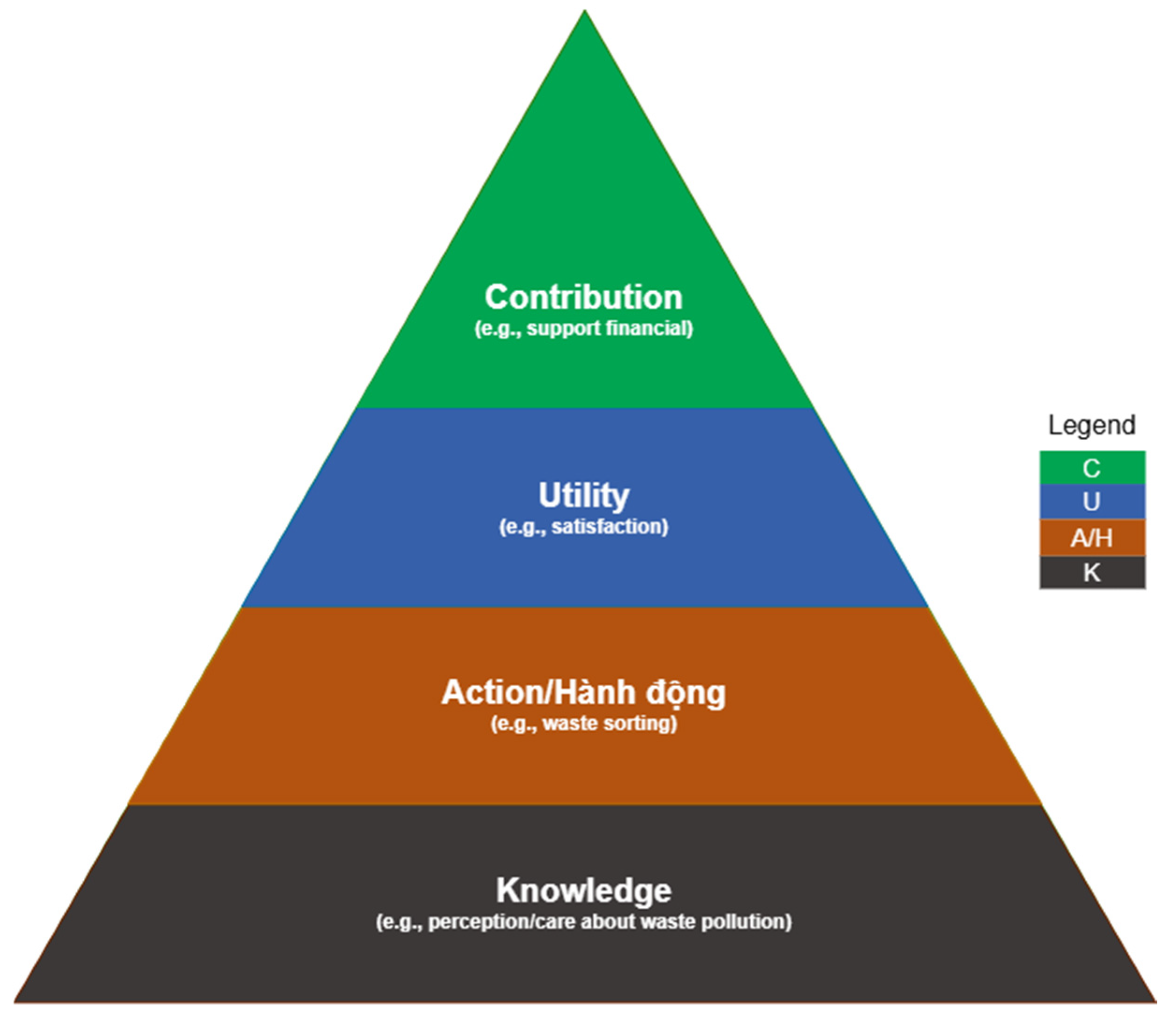
Figure 2.
CVBM framework for waste management.
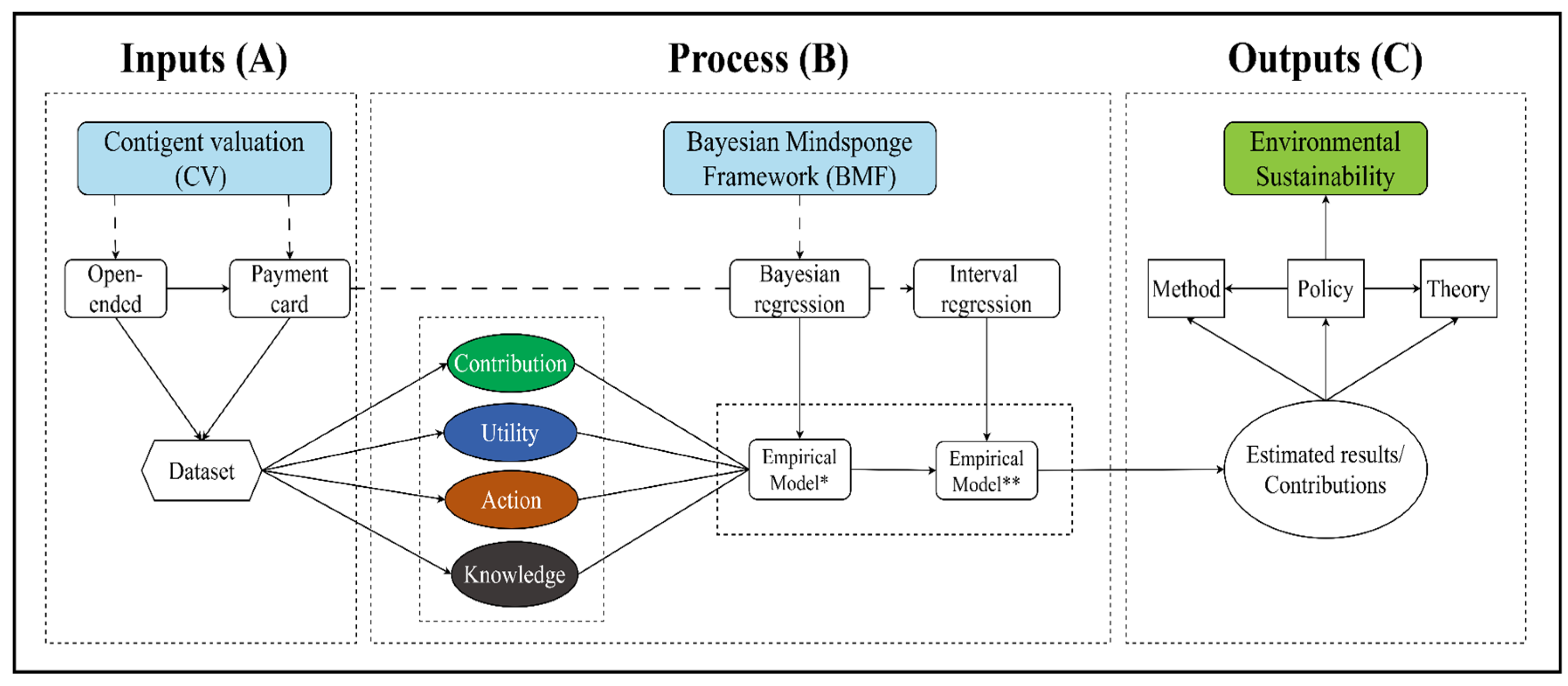
Figure 4.
Household perceptions of waste treatment services: (a) Waste pollution perceived around the household area. (b) Perceived change in pollution compared to the past. (c) Perceived reasonableness of the current waste services fee. (d) Distribution of households’ service quality rating.
Figure 4.
Household perceptions of waste treatment services: (a) Waste pollution perceived around the household area. (b) Perceived change in pollution compared to the past. (c) Perceived reasonableness of the current waste services fee. (d) Distribution of households’ service quality rating.
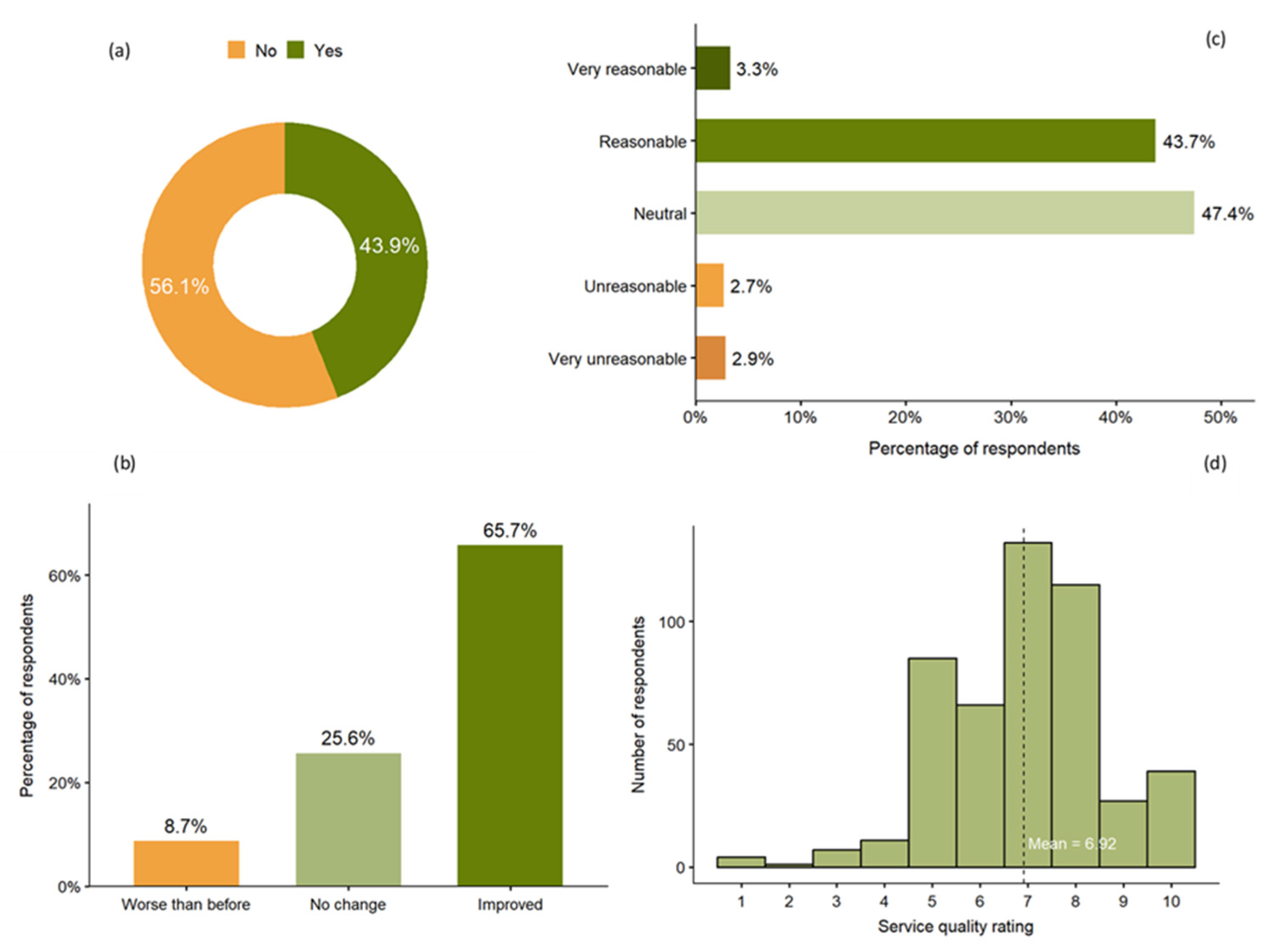
Figure 5.
The MCMC chains for the Bayesian model of households’ WTP participation.
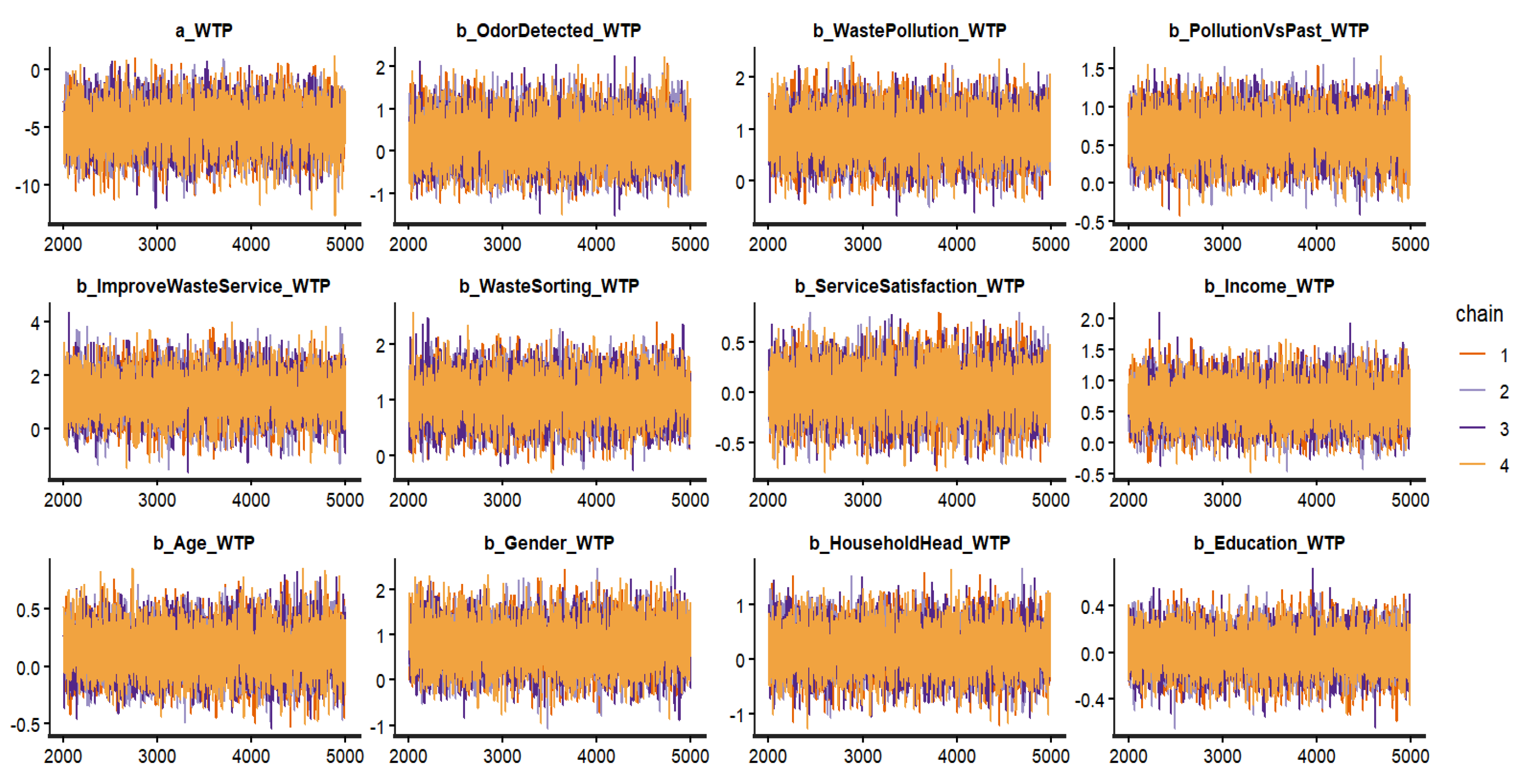

Table 1.
Variable description.
| Variables | Type | Meaning | Category | Code/Interval | Proportion | |
|---|---|---|---|---|---|---|
| Dependent variables | ||||||
| WTP1 | Binary | Whether the respondent is willing to pay (WTP) for improving the quality of local waste management services | No | 0 | 20.74% | |
| Yes | 1 | 79.26% | ||||
| WTP2 | Continuous | Maximum amount the respondent is willing to pay for improving household waste collection and treatment services (thousand VND/month) | Payment interval | 0 - 20 | 27.93% | |
| 20 - 40 | 31.21% | |||||
| 40 - 80 | 14.78% | |||||
| 80 - 100 | 8.62% | |||||
| 100 - 120 | 10.06% | |||||
| 120 - 160 | 2.26% | |||||
| 160 - 200 | 1.23% | |||||
| 200 - 300 | 3.08% | |||||
| 500 - 600 | 0.82% | |||||
| Independent variables | ||||||
| Gender | Binary | Gender of the respondent | Male | 0 | 18.89% | |
| Female | 1 | 81.11% | ||||
| Education | Ordinal | Highest level of education attained by the respondent | Lower secondary or below | 1 | 20.74% | |
| Upper secondary | 2 | 20.33% | ||||
| Technical/College | 3 | 10.68% | ||||
| University | 4 | 44.76% | ||||
| Master’s degree | 5 | 3.29% | ||||
| Doctorate | 6 | 0.21% | ||||
| Age | Ordinal | Age of the respondent | 21 – 30 | 1 | 5.54% | |
| 31 – 40 | 2 | 34.70% | ||||
| 41 – 50 | 3 | 29.36% | ||||
| 51 – 60 | 4 | 18.69% | ||||
| Over 60 | 5 | 11.70% | ||||
| HouseholdHead | Binary | Whether the respondent is the head of the household | No | 0 | 35.73% | |
| Yes | 1 | 64.27% | ||||
| Income |
Continuous | Natural logarithm of total monthly household income (million VND/month) | - | - | - | |
| WastePollution (WP) |
Binary | Whether the respondent perceives household waste pollution as a problem in the locality | No | 0 | 56.06% | |
| Yes | 1 | 43.94% | ||||
| PollutionVsPast (PVP) |
Ordinal | Perceived change in waste pollution compared with previous years | Worse than before | 1 | 8.71% | |
| No change | 2 | 25.59% | ||||
| Improved | 3 | 65.70% | ||||
| ImproveWasteService (IWS) |
Binary | Whether the respondent expresses a desire to improve local waste collection, transportation, and treatment services | No | 0 | 7.19% | |
| Yes | 1 | 92.81% | ||||
| ServiceSatisfaction (SS) |
Ordinal | Level of satisfaction with the current local waste collection services | Very dissatisfied | 1 | 3.90% | |
| Dissatisfied | 2 | 9.86% | ||||
| Neutral | 3 | 50.92% | ||||
| Satisfied | 4 | 31.62% | ||||
| Very satisfied | 5 | 3.70% | ||||
| WasteSorting (WS) |
Binary | Whether the household practices waste separation at source prior to disposal | No | 0 | 34.70% | |
| Yes | 1 | 65.30% | ||||
| OdorDetected (OD) |
Binary | Whether the household perceives unpleasant odors from nearby waste collection or storage sites | No | 0 | 81.93% | |
| Yes | 1 | 18.07% | ||||
Table 2.
Results of Bayesian model of households’ WTP participation.
| Parameters | Mean | SD | n_eff | Rhat |
|---|---|---|---|---|
| a_WTP | -4.93 | 1.83 | 6969 | 1 |
| b_OdorDetected_WTP | 0.27 | 0.52 | 14307 | 1 |
| b_WastePollution_WTP | 0.88 | 0.42 | 13145 | 1 |
| b_PollutionVsPast_WTP | 0.62 | 0.28 | 13070 | 1 |
| b_ImproveWasteService_WTP | 1.26 | 0.74 | 14384 | 1 |
| b_WasteSorting_WTP | 1.03 | 0.38 | 13194 | 1 |
| b_ServiceSatisfaction_WTP | 0.02 | 0.23 | 12527 | 1 |
| b_Income_WTP | 0.64 | 0.31 | 12291 | 1 |
| b_Age_WTP | 0.14 | 0.19 | 11006 | 1 |
| b_Gender_WTP | 0.78 | 0.46 | 12871 | 1 |
| b_HouseholdHead_WTP | 0.2 | 0.4 | 15643 | 1 |
| b_Education_WTP | 0.02 | 0.16 | 12552 | 1 |
Table 3.
Results of interval regression model of WTP4WTS.
| MODELS | Full model | Restricted models | |||
|---|---|---|---|---|---|
| VARIABLES | FM | RM1 | RM2 | RM3 | RM4 |
| OdorDetected (OD) | 0.267** | 0.262** | 0.258** | 0.252** | 0.247** |
| (0.121) | (0.121) | (0.121) | (0.121) | (0.121) | |
| WastePollution (WP) | 0.195* | 0.201* | 0.201* | 0.205* | 0.197* |
| (0.107) | (0.107) | (0.107) | (0.107) | (0.107) | |
| PollutionVsPast (PVP) | 0.142* | 0.137* | 0.138* | 0.139* | 0.135* |
| (0.0774) | (0.0770) | (0.0770) | (0.0771) | (0.0775) | |
| ImproveWasteService (IWS) | 0.585** | 0.582** | 0.578** | 0.588** | 0.582** |
| (0.249) | (0.249) | (0.248) | (0.249) | (0.250) | |
| WasteSorting (WS) | 0.359*** | 0.355*** | 0.352*** | 0.342*** | 0.346*** |
| (0.104) | (0.104) | (0.103) | (0.103) | (0.103) | |
| ServiceSatisfaction (SS) | -0.164** | -0.163** | -0.161** | -0.158** | -0.164** |
| (0.0641) | (0.0641) | (0.0640) | (0.0640) | (0.0642) | |
| Income | 0.251*** | 0.253*** | 0.253*** | 0.252*** | 0.258*** |
| (0.0819) | (0.0818) | (0.0818) | (0.0819) | (0.0822) | |
| Age | -0.00458 | -0.00584 | -0.00638 | -0.00689 | |
| (0.00511) | (0.00462) | (0.00450) | (0.00447) | ||
| Gender | 0.0886 | 0.0952 | 0.106 | ||
| (0.123) | (0.123) | (0.121) | |||
| HouseholdHead | -0.0628 | -0.0548 | |||
| (0.108) | (0.107) | ||||
| Education | 0.0249 | ||||
| (0.0430) | |||||
| Constant | 2.299*** | 2.427*** | 2.405*** | 2.502*** | 2.209*** |
| (0.532) | (0.483) | (0.482) | (0.469) | (0.432) | |
| Sigma | 0.845 | 0.845 | 0.845 | 0.847 | 0.851 |
| Log-likelihood | -622.6 | -622.8 | -622.9 | -623.3 | -624.5 |
| Prob > chi2 | 0.000 | 0.000 | 0.000 | 0.000 | 0.000 |
| Observations | 487 | 487 | 487 | 487 | 487 |
| Estimated E[WTP] | |||||
| In thousand VND | 60.161 | 60.173 | 60.169 | 60.193 | 60.265 |
| In US dollar | 2.31 | 2.31 | 2.31 | 2.32 | 2.32 |
Note: *** p-value < 0.01, ** p-value < 0.05, * p-value < 0.1, t statistics in parentheses. Values in USD are based on an assumed rate of 1 USD = 26,000 VND.
Disclaimer/Publisher’s Note: The statements, opinions and data contained in all publications are solely those of the individual author(s) and contributor(s) and not of MDPI and/or the editor(s). MDPI and/or the editor(s) disclaim responsibility for any injury to people or property resulting from any ideas, methods, instructions or products referred to in the content. |
© 2026 by the authors. Licensee MDPI, Basel, Switzerland. This article is an open access article distributed under the terms and conditions of the Creative Commons Attribution (CC BY) license (http://creativecommons.org/licenses/by/4.0/).
Copyright: This open access article is published under a Creative Commons CC BY 4.0 license, which permit the free download, distribution, and reuse, provided that the author and preprint are cited in any reuse.


