
Preprint
Article

This version is not peer-reviewed.

Changes in PSA-Based Early Detection of Prostate Cancer Over a 12-Year Period: Findings from the German KABOT Study

Submitted:

24 January 2026

Posted:

26 January 2026

You are already at the latest version

Abstract
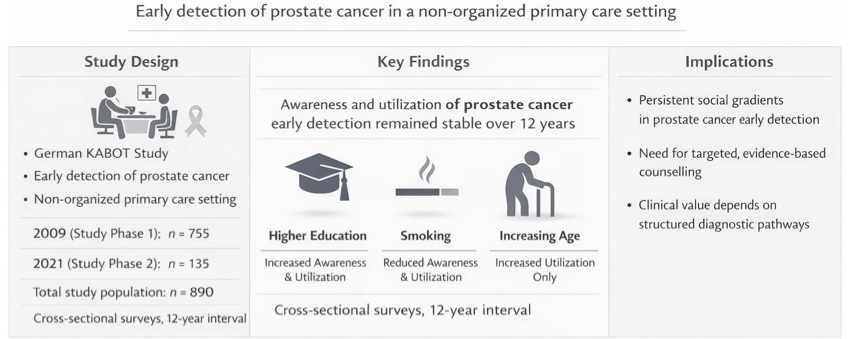
Background: The effectiveness of prostate-specific antigen (PSA) based early detection of prostate cancer remains controversial and implementation dependent. Screening policy changes have substantially altered PSA testing behavior in the United States, yet longitudinal evidence from non-organized European settings is limited. We assessed 12-year changes in awareness and utilization of PSA-based early detection and identified subgroups requiring targeted counseling. Methods: Two cross-sectional survey waves were conducted in 2009 (Study Phase 1) and 2021 (Study Phase 2) among men recruited via general practitioner practices in urban and rural regions of Germany. The survey was developed and reported according to the Consensus-Based Checklist for Reporting of Survey Studies (CROSS). Identical questionnaires were used across phases. Endpoints were awareness of PSA-based early detection and prior PSA testing. Univariable and multivariable logistic regression evaluated independent associations with sociodemographic and behavioral factors; subgroup analyses were performed in men aged 45–69 years. Results: The analytic cohort comprised 890 men (Study Phase 1, n=755; Study Phase 2, n=135). Compared with Study Phase 1, Study Phase 2 participants more frequently were non-smokers (63.0% vs. 48.5%, p< 0.001) and had a university degree (38.5% vs. 30.5%, p=0.002). In multivariable analyses, higher educational attainment (OR 1.71, 95% CI 1.24–2.36), smoking status (OR 0.69, 95% CI 0.48–0.99), and paternity (OR 1.94, 95% CI 1.25–3.01) were independently associated with greater awareness, whereas current smoking was independently associated with lower awareness of PSA-based early detection (OR 0.69, 95% CI 0.48-0.99). Utilization was independently associated with increasing age (OR 1.39, 95% CI 1.29–1.50) and higher educational attainment (OR 1.63, 95% CI 1.19–2.24), while current smoking was independently associated with a lower likelihood of having undergone PSA-based early detection (OR 0.61, 95% CI 0.41–0.91). Study phase was not independently associated with awareness or utilization. Conclusions: Over 12 years, awareness and utilization of PSA-based early detection remained stable in a German non-organized setting. Persistent social gradients underscore the need for targeted, evidence-based counseling, particularly for men with lower educational attainment and smokers.
Keywords: 
;  ;  ;  ;  

1. Introduction

Prostate cancer is the most frequently diagnosed malignancy among men in Germany and the United States, with approximately 65,820 and 268,500 newly diagnosed cases per year, respectively [1,2]. It represents the second leading cause of cancer-related death in men in both countries, accounting for 15,379 deaths annually in Germany and 34,500 in the United States [1,2]. Incidence rates peak in men in their eighth decade of life, whereas prostate cancer mortality is highest among men aged 80 years and older [2,3]. Globally, prostate cancer remains the most common cancer and the fifth leading cause of cancer-related death among men, with an estimated 1.4 million new cases and 375,000 deaths reported worldwide in 2020 [1,2,3].
Marked disparities in prostate cancer incidence and outcomes have been consistently observed. African American men exhibit the highest incidence rates worldwide [4]. A positive family history constitutes another well-established, non-modifiable risk factor [4]. Several potentially modifiable factors have also been associated with prostate cancer incidence, including high alcohol consumption, dietary calcium and milk protein intake, and hormonal influences [4,5,6]. In contrast, higher consumption of tomatoes, increased physical activity, intake of phytoestrogens such as those found in soy products, higher coffee consumption, and greater sexual activity have been discussed as protective factors [7,8,9,10,11]. Notably, current smoking status has repeatedly been associated with a lower reported incidence of prostate cancer [12]. This paradoxical finding has been attributed to lower participation in prostate cancer early detection among smokers rather than a true protective effect. Large population-based data have demonstrated that active smokers are approximately one third less likely to undergo prostate-specific antigen testing compared with non-smokers, even after multivariable adjustment [13]. Importantly, despite lower detection rates, smokers exhibit a significantly increased risk of prostate cancer-specific mortality [14].
Prostate-specific antigen testing was introduced in 1994 as an adjunct to digital rectal examination for the early detection of prostate cancer [15]. Potential harms of PSA-based early detection include complications related to subsequent prostate biopsy as well as the risks and long-term consequences of overtreatment [16]. Although the effectiveness of PSA-based early detection remains controversial, robust evidence supports a reduction in prostate cancer-specific mortality in defined age groups. The European Randomized Study of Screening for Prostate Cancer demonstrated a 27% reduction in cancer-specific mortality after a median follow-up of 21 years, despite substantial non-compliance and contamination in both study arms [17]. Conversely, population-level data from the United States indicate that the discontinuation of routine PSA-based screening has been accompanied by an unfavorable stage migration. While incidence rates among men aged 45 to 74 years remained stable between 2004 and 2010, a significant increase in metastatic prostate cancer was observed from 2010 onward following changes in screening recommendations [18].
In 2012, the United States Preventive Services Task Force recommended against routine PSA-based screening [19]. This position was revised in 2018, endorsing shared decision-making for men aged 55 to 69 years [20]. Subsequent studies from the United States consistently reported a sustained decline in PSA testing following these changes, accompanied by reductions in prostate biopsy rates, prostate cancer incidence, and the use of definitive local therapies [21,22,23]. These findings highlight the sensitivity of early detection practices to guideline recommendations and health policy decisions.
In Germany, early detection of prostate cancer is performed by both urologists and general practitioners and is offered from the age of 45 years. Men with statutory health insurance are entitled to an annual digital rectal examination; however, this examination does not constitute a screening test and has limited sensitivity for early-stage disease [24]. Measurement of PSA levels is not routinely reimbursed and is performed only upon patient request after counseling regarding potential benefits and harms [25]. Consequently, PSA-based early detection in Germany largely depends on individual awareness, physician counseling, and patient-driven decision-making.
The effectiveness of any screening strategy depends not only on its diagnostic performance but also on its implementation within the target population. Beyond age, sex, and ethnicity, several patient-related factors, including educational attainment, income, insurance status, and marital status, have been shown to substantially influence screening behavior [21,22,26,27,28,29,30,31,32,33,34]. Recent epidemiological studies have further demonstrated that PSA testing uptake is closely linked to broader health behaviors and indicators of preventive care engagement, underscoring the complex interplay between sociodemographic factors and early detection practices [35].
In parallel to the ongoing controversy surrounding PSA-based early detection, European urological initiatives have increasingly shifted the focus from test-based screening towards structured, risk-adapted early-detection pathways [36]. These concepts aim to preserve potential mortality benefits while reducing harms through improved pre-biopsy risk stratification, integration of magnetic resonance imaging, and consistent use of active surveillance for low-risk disease [36,37,38]. Within this framework, digital rectal examination is no longer considered a stand-alone screening tool, but rather an adjunctive clinical assessment with limited discriminatory value when used in isolation [37]. Similar to population-based breast cancer screening, the emerging consensus emphasizes that the value of early detection depends less on the screening test itself than on the quality, structure, and governance of the diagnostic pathway in which it is embedded [36].
Identifying population subgroups with limited awareness or reduced utilization of PSA-based early detection is therefore essential for targeted counseling and informed decision-making. The present study evaluates awareness and utilization of PSA-based early detection of prostate cancer over a 12-year period, enabling an assessment of temporal changes in the context of evolving evidence and international guideline recommendations. Of particular interest is whether the decline in PSA testing observed in the United States following the 2012 guideline change is similarly reflected in a German healthcare setting.
In addition to quantifying utilization patterns, this study assesses knowledge and awareness of PSA-based early detection among men considered eligible for testing. Given the lack of comparable longitudinal studies spanning more than a decade, this pilot study aims to provide a data-driven foundation for future large-scale investigations into early detection behavior and targeted counseling strategies.

2. Materials and Methods

2.1. Implementation of the Study

In 2009, an interdisciplinary working group consisting of general practitioners and urologists conducted a cross-sectional survey study to assess attitudes, knowledge, and utilization patterns related to prostate cancer screening and early detection based on prostate-specific antigen testing. A structured questionnaire comprising 20 items was developed, refined, and validated through 12 structured individual interviews to ensure clarity, comprehensibility, and content validity.
Study Phase 1 (SP1) was conducted in 2009. A total of 55 general practitioner practices were randomly selected from a database provided by the regional Association of Statutory Health Insurance Physicians in Berlin and Brandenburg. Each participating practice received 50 questionnaires for distribution to male patients aged 35 years or older who were considered capable of autonomously completing the survey.
Study Phase 2 (SP2) was initiated in October 2021 to evaluate temporal changes over a 12-year interval. This follow-up survey was conducted under the study label “Knowledge and Belief Over Time (KABOT)”. The questionnaire content remained largely identical to SP1, with the addition of two thematic blocks addressing contemporary aspects of prostate cancer early detection. The moderate response rate observed in SP1 of 38.2% raised concerns regarding sample size and representativeness. To address these limitations, the number of contacted general practitioner practices was increased to 150 in SP2.
Practices in SP2 were selected using an updated random sampling approach and were complemented by practices affiliated with the KV RegioMed teaching network, identified using predefined geographic search criteria (general practitioner practices located in or around Cottbus or Bernau within a 5 km radius) [39,40]. A reminder letter was distributed in January 2022. All questionnaires returned by March 31, 2022, were included in the final analysis. Data collection was performed by physicians accredited within the statutory health insurance system, while exclusively private practices were excluded. All surveys were completed anonymously in full compliance with applicable data protection regulations.
Ethical approval was obtained from the Ethics Committee of the Brandenburg State Medical Association (approval number 2021-2126-BO-ff) on August 10, 2021. The study was registered in the German Registry of Clinical Studies (DRKS registration number 00027862) [41].

2.2. Structure of the Questionnaires

Questionnaire development followed the Consensus-Based Checklist for Reporting of Survey Studies (CROSS), with full adherence documented in Table A1 and Table A2 [42]. The patient questionnaire used in SP1 included 11 items addressing sociodemographic characteristics, family history, and vaccination status, as well as nine additional items assessing knowledge, perceptions, and personal utilization of prostate cancer early detection (Appendix A1).
In SP2, one additional item was included to assess participants’ perceptions regarding the potential impact of early detection on cancer-specific mortality (Appendix A2). Pilot testing was performed in both study phases with 12 participants each, resulting in minor adjustments to optimize survey length, internal consistency, clarity, and completeness.
Response rates were calculated at the practice level and refer to practices that actively participated by returning completed patient questionnaires.

2.3. Research Questions and Statistical Methods

The primary objective of this study was to identify factors independently associated with prostate cancer early detection awareness and utilization. For clarity and focus, analyses were restricted to early detection of prostate cancer.
Age was recorded using predefined categorical response options, including a category for participants younger than 35 years, followed by 5-year increments from 35–39 years up to a category of 75 years and older. Smoking status was recorded as non-smoker, former smoker, or current smoker and was dichotomized for regression analyses into “non-smoker or former-smoker” as the reference category versus “current smoker”. Educational attainment was assessed using four categories reflecting the German educational system: basic secondary school qualification, secondary school certificate, higher school certificate, and university degree. For analysis, these were dichotomized into “basic secondary school qualification or secondary school certificate” versus “higher school certificate or university degree”.
Family history of cancer was recorded as “none”, “one case”, or “several cases” and subsequently dichotomized into “no family history of cancer” versus “family history of cancer”. Paternity was categorized as “no children” versus “children”. Employment status options included “jobseeker”, “employed”, “self-employed”, and “pensioner”, and were dichotomized into “jobseeker” versus “employed, self-employed, or pensioner”. Insurance status was recorded as statutory or private health insurance. Study phase (SP1 versus SP2) was included as an independent variable in all analyses.
Two predefined binary endpoints were analyzed: awareness of prostate-specific antigen-based early detection and actual utilization of prostate-specific antigen-based early detection. Univariable logistic regression models were first applied to assess the individual association of each independent variable with the endpoints. Subsequently, multivariable logistic regression models were constructed to identify independent predictors while accounting for potential confounding. Variables were included in the multivariable models based on clinical relevance and statistical significance in univariable analyses, with all dichotomized variables entered using the lower-risk or absence category as the reference group. In case of an incompletely answered questionnaire, available answers were nevertheless considered and appropriately reflected in the analysis.
Comparisons of baseline characteristics between SP1 and SP2 were performed using chi-squared tests for categorical variables and independent-samples t-tests for continuous variables. Effect estimates are reported as odds ratios with corresponding 95% confidence intervals (95% CI). Statistical significance was defined as a two-sided p-value of 0.05 or less. All statistical analyses were conducted using SPSS software version 29.0 (IBM Corp., Armonk, NY, USA).

3. Results

The composition of the study population across both study phases is illustrated in the flow chart shown in Figure 1. The analytic cohort comprised 755 participants in Study Phase 1 (SP1) and 135 participants in Study Phase 2 (SP2) (total n=890) (Table 1).

3.1. Participant Characteristics

Baseline characteristics stratified by study phase are summarized in Table 1. Compared with SP1, SP2 included a higher proportion of non-smokers (63.0% vs. 48.5%, p<0.001) and a higher proportion of participants with a university degree (38.5% vs. 30.5%, p=0.002). Employment status distributions differed between SP1 and SP2 (p<0.001), with a markedly higher share of self-employed participants in SP2 (45.2% vs. 4.9%). Paternity was less frequent in SP2 (80.0% vs. 85.4%, p=0.019). In contrast, differences by study phase were not statistically significant for age distribution (p=0.068), family history of cancer (p=0.102), or insurance status (p=0.344).

3.2. Awareness of PSA-Based Early Detection

Univariable and multivariable logistic regression results for the endpoint “Awareness of PSA-based early detection” are presented in Table 2. In univariable analyses, awareness increased with age (OR 1.063, 95% CI 1.005–1.124; p=0.032) and was higher among participants with higher educational attainment (OR 2.021, 95% CI 1.496–2.730; p<0.001) and among participants with children (OR 2.081, 95% CI 1.414–3.064; p<0.001). Current smoking was significantly associated with lower awareness of PSA-based early detection (OR 0.553, 95% CI 0.397–0.770; p<0.001). Employment status was also associated with awareness (OR 1.829, 95% CI 1.108–3.018; p=0.018). Study phase was not associated with awareness in univariable analysis (OR 1.028, 95% CI 0.699–1.513; p=0.888).
In the multivariable model, higher educational attainment (OR 1.709, 95% CI 1.239–2.357; p=0.001), smoking status (OR 0.688, 95% CI 0.479–0.989; p=0.043), and paternity (OR 1.939, 95% CI 1.249–3.012; p=0.003) remained independently associated with awareness, whereas age (OR 0.990, 95% CI 0.926–1.058; p=0.766) and employment status (OR 1.528, 95% CI 0.888–2.631; p=0.126) were no longer significant after adjustment. Family history of cancer and insurance status were not independently associated with awareness.

3.3. Utilization of PSA-Based Early Detection

Regression results for the endpoint “Already underwent PSA-based early detection” are summarized in Table 3. In univariable analyses, utilization was higher in SP2 than SP1 (OR 1.476, 95% CI 1.022–2.131; p=0.038) and increased with age (OR 1.417, 95% CI 1.327–1.513; p<0.001). Higher educational attainment (OR 1.873, 95% CI 1.422–2.469; p<0.001), paternity (OR 2.646, 95% CI 1.718–4.076; p<0.001), and employment status (OR 2.473, 95% CI 1.402–4.362; p=0.002) were positively associated with utilization, whereas smoking was inversely associated (OR 0.378, 95% CI 0.264–0.541; p<0.001).
In the multivariable model, increasing age (OR 1.391, 95% CI 1.291–1.498; p<0.001) and higher educational attainment (OR 1.632, 95% CI 1.190–2.239; p=0.002) remained positively associated with utilization, while current smoking remained independently associated with reduced utilization of PSA-based early detection (OR 0.608, 95% CI 0.405–0.912; p=0.016). Study phase was no longer significant after adjustment (OR 1.365, 95% CI 0.885–2.105; p=0.160). Paternity and employment status also lost statistical significance in the multivariable model.

3.4. Subgroup Analysis in Men Aged 45–69 Years

Subgroup analyses restricted to men aged 45–69 years are shown in Table 4 and Table 5. For awareness of PSA-based early detection (Table 4), higher educational attainment was associated with awareness in univariable analysis (OR 1.875, 95% CI 1.258–2.794; p=0.002) and remained significant after adjustment (OR 1.717, 95% CI 1.113–2.647; p=0.014). Current smoking was independently associated with lower awareness of PSA-based early detection in both univariable (OR 0.525, 95% CI 0.343–0.804; p=0.003) and multivariable analyses (OR 0.595, 95% CI 0.375–0.945; p=0.028). Study phase was not associated with awareness in this subgroup.
For utilization of PSA-based early detection in men aged 45–69 years (Table 5), age was strongly associated with utilization in univariable analysis (OR 1.528, 95% CI 1.338–1.745; p<0.001) and remained significant in the adjusted model (OR 1.520, 95% CI 1.315–1.757; p<0.001). Higher educational attainment was also independently associated (OR 1.590, 95% CI 1.077–2.347; p=0.020). Current smoking remained associated with a lower likelihood of utilization in the adjusted model, reaching borderline statistical significance (OR 0.627, 95% CI 0.393–1.001; p=0.051). Smoking showed a borderline association after adjustment (OR 0.627, 95% CI 0.393–1.001; p=0.051). Study phase, employment status, family history of cancer, and insurance status were not independently associated with utilization in this subgroup.
Across all multivariable models (Table 2, Table 3, Table 4 and Table 5), study phase, employment status, family history of cancer, and insurance status were not independently associated with either endpoint.

4. Discussion

This longitudinal survey study provides several novel insights into prostate-specific antigen based early detection behavior in a non-organized screening setting over a 12-year period. First, despite substantial changes in international screening recommendations and accumulating evidence on the benefits and harms of PSA-based early detection, utilization patterns in Germany remained remarkably stable over time. Second, stable and pronounced social gradients persisted, with educational attainment and smoking behavior emerging as the most consistent determinants of both awareness and utilization of PSA-based early detection. Third, increasing age was strongly associated with utilization but not with awareness, indicating a widening gap between knowledge and action across the life course. Together, these findings add a longitudinal, population-based perspective to the international literature and highlight persistent structural determinants of early detection behavior.
The absence of a measurable study phase effect contrasts sharply with data from the United States, where the 2012 recommendation of the U.S. Preventive Services Task Force against routine PSA screening was followed by a sustained decline in PSA testing across all age groups [21,22,43,44,45,46,47,48,49]. Several studies have further demonstrated downstream consequences, including reductions in prostate biopsies, prostate cancer incidence, and definitive local therapy [23], accompanied by a subsequent increase in advanced and metastatic disease [18,47]. In particular, Desai et al. reported a significant rise in metastatic prostate cancer among men aged 45–74 years after 2011, whereas incidence rates had remained stable between 2004 and 2010 [18]. In contrast, our data indicate that these international developments did not translate into reduced PSA-based early detection use in Germany. This discrepancy likely reflects fundamental differences in health care organization, reimbursement structures, and the absence of centralized screening policies in Germany, where PSA testing remains largely patient-driven and dependent on individual counseling.
Our findings of stable awareness and utilization of PSA-based early detection over a 12-year period should be interpreted in the context of rapidly evolving European early-detection concepts led by urologic stakeholders [36,37,38]. Recent European initiatives emphasize that PSA testing alone is insufficient to generate population-level value and must be embedded within structured, risk-adapted algorithms incorporating downstream triage tools such as magnetic resonance imaging and defined surveillance strategies [36,38]. This paradigm mirrors the experience from population-based mammography screening, where quality assurance, standardized pathways, and centralized governance were essential to balance benefits and harms despite persistent debate on overdiagnosis [36]. In contrast, the opportunistic nature of PSA testing in Germany may partly explain why evolving evidence and recommendations have not translated into measurable changes in early-detection behavior within the present study.
Educational attainment emerged as the most robust determinant of PSA-based early detection behavior in this study. Higher education was independently associated with both awareness and utilization, in the overall cohort as well as in men aged 45–69 years. These findings are consistent with prior studies demonstrating higher PSA testing rates among men with higher educational levels [28]. At the same time, conflicting evidence exists. Pickles et al. reported higher PSA testing rates among men with lower educational attainment and limited health literacy, attributing this pattern to insufficient understanding of overdiagnosis and overtreatment [32]. Taken together, these findings underscore that educational level does not uniformly translate into more appropriate screening decisions, but rather modulates how information is processed and acted upon. From a public health perspective, our results suggest that men with lower educational attainment represent a key target group for structured, comprehensible counseling that facilitates informed and self-determined decision-making.
Smoking status constituted another consistent determinant of PSA-based early detection behavior. In both the overall cohort and the age-restricted subgroup, smokers showed significantly lower awareness and utilization of PSA-based early detection, with smoking remaining an independent predictor after multivariable adjustment. This finding aligns closely with population-based data from Golijanin et al., who demonstrated that active smoking was associated with approximately one third lower odds of PSA testing among more than 50,000 screening-eligible men [27]. These behavioral patterns also provide a plausible explanation for epidemiological observations linking smoking to a lower reported incidence of prostate cancer during the PSA screening era [12], despite a clearly increased risk of prostate cancer-specific mortality among smokers [14]. Together, these data indicate that reduced engagement in preventive health behavior, rather than biological protection, underlies this association and identifies smokers as a particularly vulnerable group for targeted counseling interventions.
Paternity was associated with higher awareness of PSA-based early detection but did not translate into higher utilization after adjustment. This dissociation may reflect greater general health awareness among men with children, without a corresponding increase in decisive action. Similarly, age showed a strong and independent association with utilization but not with awareness. This pattern suggests that while knowledge about PSA-based early detection remains relatively stable across age groups, actual uptake increases with advancing age. This finding is particularly relevant given robust evidence from the ERSPC demonstrating a reduction in prostate cancer-specific mortality in men aged 50–65 years [17]. It underscores the need to ensure that counseling is not deferred until older age, but rather reaches men at a time when the potential benefit of early detection is greatest.
A range of additional determinants of PSA-based early detection behavior has been described in the literature, including marital status, income, insurance status, and family history of cancer. An overview of selected findings is provided in Table 6.
In contrast to some prior reports [21,22,26,27,28,29,30,31,32,33,34], we did not observe an independent association of family history of cancer or employment status with awareness or utilization of PSA-based early detection. Insurance status was likewise not associated with PSA testing behavior, despite the fact that PSA testing is not routinely reimbursed by statutory health insurance in Germany but is commonly covered by private insurance. These findings suggest that financial coverage alone may not be sufficient to overcome informational and behavioral barriers to early detection.
The strengths of this study include its extended observation period of 12 years, the assessment of both awareness and actual utilization of PSA-based early detection, and the use of consistent methodology across study phases. To our knowledge, no comparable longitudinal survey addressing these aspects over such a time span has been published to date. Several limitations must nevertheless be acknowledged. The most important limitation is the relatively small sample size in Study Phase 2, which coincided with the coronavirus pandemic and may have affected participation. The smaller sample size in Study Phase 2 limits statistical power for detecting modest temporal effects and may increase the risk of type II error in subgroup analyses. Differences in participant characteristics between SP1 and SP2, particularly with respect to smoking behavior, educational attainment, and employment status, raise concerns regarding cohort comparability. In addition, recruitment was limited to patients visiting general practitioner practices, introducing potential selection bias toward individuals with higher health care utilization. The limited number of participating physicians further restricts generalizability, and it remains unclear to what extent participating physicians actively supported early detection and counseling. Finally, the questionnaire did not capture the depth or quality of participants’ knowledge regarding potential harms of PSA-based early detection, precluding a more nuanced assessment of informed decision-making.
In summary, this descriptive and hypothesis-generating pilot study demonstrates persistent social gradients in PSA-based early detection behavior over a 12-year period, despite evolving international evidence and recommendations. Educational attainment and smoking status emerged as the most consistent determinants of both awareness and utilization, while no temporal decline in PSA testing was observed in the German non-organized screening setting. These findings underscore the need for targeted, evidence-based counseling strategies that address structural and behavioral barriers to informed participation in early detection. Future implementation research should focus on linking patient knowledge, screening behavior, and downstream diagnostic quality within structured urologic pathways, in order to better evaluate how early detection strategies translate into clinically meaningful and equitable outcomes.

5. Conclusions

In this 12-year longitudinal survey, utilization of PSA-based early detection of prostate cancer remained stable in a German, non-organized screening setting despite substantial changes in international evidence and screening recommendations. Educational attainment and smoking status consistently emerged as the strongest determinants of both awareness and utilization, whereas increasing age primarily influenced utilization but not awareness.
These findings highlight a persistent gap between knowledge and action and underscore the relevance of social and behavioral determinants for early detection practices. Men with lower educational attainment and active smokers represent key populations for targeted, evidence-based counseling aimed at supporting informed and self-determined decision-making.
As a descriptive and hypothesis-generating pilot study, these results provide a robust foundation for future research integrating patient knowledge, screening behavior, and clinical outcomes, particularly in light of recently demonstrated mortality benefits of PSA-based screening in defined age groups.

Author Contributions

Kay-Patrick Braun: Conceptualization, Methodology, Software, Investigation, Resources, Data curation, Formal analysis, Writing – original draft, Visualization. Torsten Vogel: Methodology, Data curation, Writing – review & editing. Matthias May: Supervision, Writing – original draft, Writing – review & editing. Christian Gilfrich: Writing – review & editing. Markus Herrmann: Writing – review & editing. Anton Kravchuk: Visualization, Writing – review & editing. Julia Maurer: Validation: Writing – review & editing, Supervision. Ingmar Wolff: Validation: Formal analysis, Writing – review & editing, Supervision. All authors critically revised the manuscript for important intellectual content and approved the final version for submission.

Institutional Review Board Statement

This study was approved by the Ethics Committee of the Brandenburg State Medical Association (approval number 2021-2126-BO-ff) on August 10, 2021.

Informed Consent Statement

Participation was voluntary and implied by the return of the completed anonymous questionnaire. Participants were informed about the study objectives, procedures, and data confidentiality.

Data Availability Statement

The data supporting the findings of this study are available from the corresponding authors upon reasonable request.

Clinical Trial Registration

German Registry of Clinical Studies (DRKS), registration number DRKS00027862.

Appendix A

Table A1. Checklist for Reporting Of Survey Studies (CROSS).
Section/topic Item Item description Reported on page #
Title and abstract
Title and abstract 1a State the word “survey” along with a commonly used term in title or abstract to introduce the study’s design. AT2
1b Provide an informative summary in the abstract, covering background, objectives, methods, findings/results, interpretation/discussion, and conclusions. AT2
Introduction
Background 2 Provide a background about the rationale of study, what has been previously done, and why this survey is needed. AT2
Purpose/aim 3 Identify specific purposes, aims, goals, or objectives of the study. AT2
Methods
Study design 4 Specify the study design in the methods section with a commonly used term (e.g., cross-sectional or longitudinal). AT2
5a Describe the questionnaire (e.g., number of sections, number of questions, number and names of instruments used). AT2
Data collection methods 5b Describe all questionnaire instruments that were used in the survey to measure particular concepts. Report target population, reported validity and reliability information, scoring/classification procedure, and reference links (if any). AT2
5c Provide information on pretesting of the questionnaire, if performed (in the article or in an online supplement). Report the method of pretesting, number of times questionnaire was pre-tested, number and demographics of participants used for pretesting, and the level of similarity of demographics between pre-testing participants and sample population. AT2
5d Questionnaire if possible, should be fully provided (in the article, or as appendices or as an online supplement). AT2
Sample characteristics 6a Describe the study population (i.e., background, locations, eligibility criteria for participant inclusion in survey, exclusion criteria). AT2
6b Describe the sampling techniques used (e.g., single stage or multistage sampling, simple random sampling, stratified sampling, cluster sampling, convenience sampling). Specify the locations of sample participants whenever clustered sampling was applied. AT2
6c Provide information on sample size, along with details of sample size calculation. AT2
6d Describe how representative the sample is of the study population (or target population if possible), particularly for population-based surveys. AT2
Survey
administration
7a Provide information on modes of questionnaire administration, including the type and number of contacts, the location where the survey was conducted (e.g., outpatient room or by use of online tools, such as SurveyMonkey). AT2
7b Provide information of survey’s time frame, such as periods of recruitment, exposure, and follow-up days. AT2
7c Provide information on the entry process: AT2
–>For non-web-based surveys, provide approaches to minimize human error in data entry.
–>For web-based surveys, provide approaches to prevent “multiple participation” of participants.
Study preparation 8 Describe any preparation process before conducting the survey (e.g., interviewers’ training process, advertising the survey). AT2
Ethical considerations 9a Provide information on ethical approval for the survey if obtained, including informed consent, institutional review board approval, Helsinki declaration, and good clinical practice [GCP] declaration (as appropriate). AT2
9b Provide information about survey anonymity and confidentiality and describe what mechanisms were used to protect unauthorized access. AT2
Statistical
analysis
10a Describe statistical methods and analytical approach. Report the statistical software that was used for data analysis. AT2
10b Report any modification of variables used in the analysis, along with reference (if available). AT2
10c Report details about how missing data was handled. Include rate of missing items, missing data mechanism (i.e., missing completely at random [MCAR], missing at random [MAR] or missing not at random [MNAR]) and methods used to deal with missing data (e.g., multiple imputation). AT2
10d State how non-response error was addressed. AT2
10e For longitudinal surveys, state how loss to follow-up was addressed. AT2
10f Indicate whether any methods such as weighting of items or propensity scores have been used to adjust for non-representativeness of the sample. AT2
10g Describe any pre-specified subgroup analysis conducted. AT2
Results
Respondent characteristics 11a Report numbers of individuals at each stage of the study. Consider using a flow diagram, if possible. AT2
11b Provide reasons for non-participation at each stage, if possible. AT2
11c Report response rate, present the definition of response rate or the formula used to calculate response rate. AT2
11d Provide information to define how unique visitors are determined. Report number of unique visitors along with relevant proportions (e.g., view proportion, participation proportion, completion proportion). AT2
Descriptive results 12 Provide characteristics of study participants, as well as information on potential confounders and assessed outcomes. AT2
Main findings 13a Give unadjusted estimates and, if applicable, confounder-adjusted estimates along with 95% confidence intervals and p-values. AT2
13b For multivariable analysis, provide information on the model building process, model fit statistics, and model assumptions (as appropriate). AT2
13c Provide details about any pre-specified subgroup analysis performed. If there are considerable amount of missing data, report sensitivity analyses comparing the results of complete cases with that of the imputed dataset (if possible). AT2
Discussion
Limitations 14 Discuss the limitations of the study, considering sources of potential biases and imprecisions, such as non-representativeness of sample, study design, important uncontrolled confounders. AT2
Interpretations 15 Give a cautious overall interpretation of results, based on potential biases and imprecisions and suggest areas for future research. AT2
Generalizability 16 Discuss the external validity of the results. AT2
Other sections
Role of funding source 17 State whether any funding organization has had any roles in the survey’s design, implementation, and analysis. AT2
Conflict of interest 18 Declare any potential conflict of interest. AT2
Acknowledgements 19 Provide names of organizations/persons that are acknowledged along with their contribution to the research. AT2
Legend: AT2, Table A2.
Table A2. Locations of all 19 items of the CROSS checklist within the manuscript.
Section/Topic Item Reported on page # or explanation for non-inclusion
Title and abstract
Title and abstract 1a 1
Title and abstract 1b 3
Introduction
Background 2 5
Purpose/Aim 3 7
Methods
Study design 4 7
Data collection methods 5a 9
Data collection methods 5b 8
Data collection methods 5c 8 and 9
Data collection methods 5d Appendices A1 and A2
Sample characteristics 6a 8
Sample characteristics 6b 8
Sample characteristics 6c The KABOT study fundamentally serves as a hypothesis-generating investigation, thereby lacking precedent studies from other research groups to validate a reliable effect size necessary for biometric sample size calculation. Furthermore, the study employed a highly structured form of cluster sampling in recruiting the study cohort, aiming to motivate the inclusion of approximately 50 patients from all general practitioners within clearly defined regions. This approach, too, posed challenges in conducting a biometric sample size calculation.
Sample characteristics 6d Throughout both study periods, 29 general practitioners in the Berlin (urban) and Brandenburg (rural) region participated, resulting in the distribution of 1450 questionnaires to eligible male patients. The overall response rate was 61.4% (890/1450), with 72.0% in Study Phase 1 (SP1) and 33.8% in Study Phase 2 (SP2). The ethics approval covered this anonymous, non-interventional survey; participation was voluntary and implied by the return of a completed questionnaire. No data were collected from non-responders (n=560). Accordingly, we were unable to compare characteristics of responders and non-responders and cannot formally assess the representativeness of the responding sample.
Survey administration 7a 7 and 8
Survey administration 7b 8
Survey administration 7c The transfer of the entire dataset from the returned questionnaires into the SPSS table used for statistical exploration was independently performed by two members of the research team (KPB and TV). Subsequently, various data entries were identified and cross-checked with patient information in the original questionnaires. This process significantly mitigated the presence of erroneous entries in the final SPSS table utilized for statistical analysis.
Study preparation 8 8 and 9
Ethical considerations 9a 8
Ethical considerations 9b 8
Statistical analysis 10a 10
Statistical analysis 10b No modification of study variables was conducted.
Statistical analysis 10c 10
Statistical analysis 10d 8
Statistical analysis 10e For these analyses, this statement does not apply to the KABOT study.
Statistical analysis 10f For these analyses, this statement does not apply to the KABOT study.
Statistical analysis 10g Sensitivity analyses, in the strict sense, were not conducted in this analysis of the KABOT study. However, the validity of the presented results was examined concerning different age groups and also in relation to the patient's insurance status, which was an identified study objective (pre-specified subgroup analysis)
Results
Respondent characteristics 11a 10 and 22
Respondent characteristics 11b Due to the design of the KABOT study, there are two types of non-responders:
1. The addressed general practitioners, of whom only 29 out of a total of 205 (14.2%) participated in the study despite reminders for their involvement. This is largely attributable to the insufficient density of general practices in the federal state of Brandenburg, where many general practitioners routinely work over 80 hours per week. The extensive workload simply leaves many colleagues with no spare time to support academic research. This observation was undoubtedly exacerbated during Study Phase 2 (SP2) due to the burdens of the COVID-19 pandemic. While 38.2% of the initially addressed general practitioners participated in SP1, this figure dropped to a mere 5.3% in SP2.
2. The non-participation of 38.6% of male patients, on the other hand, falls within the expected range as known from other questionnaire-based studies involving patients. The reasons for this are diverse and have been analyzed in numerous studies on the subject.
Respondent characteristics 11c 9
Respondent characteristics 11d The response to this item has been documented in Figure 1. Here's a brief summary: 1450 questionnaires were distributed by the 29 general practitioners to 1450 male patients, which were subsequently viewed by these patients. Ultimately, out of these initially 1450 patients, 890 patients (61.4%) opted to participate in the study and returned the completed questionnaires.
Descriptive results 12 Table 1
Main findings 13a The descriptive analyses presented in the KABOT study were unadjusted.
Main findings 13b For the analyses presented in the KABOT study, this statement does not apply.
Main findings 13c The handling of non-respondent patients was previously addressed in our response to Item 6d, and the execution of subgroup analyses (as a substitute for sensitivity analyses) was detailed in our response to Item 10g. Among the 890 patients constituting the study group, some of the returned questionnaires were not fully completed for every question (the criterion for questionnaire inclusion was >95% completeness of responses). In Table 1, all missing data in individual questions were labeled as 'not specified,' with missing responses to individual study endpoints ranging between 1 and 12 (equivalent to 0.11% to 1.3%).
Discussion
Limitations 14 15
Interpretations 15 15 and 16
Generalizability 16 12 to 15
Other sections
Role of funding source 17 17
Conflict of interest 18 17
Acknowledgements 19 There are no additional doctors or institutions beyond those listed in the author group who require acknowledgment. A comprehensive acknowledgment was extended to the general practitioners participating over the 12-year study period, as well as to the patients.

Appendix A1. Questionnaire SP1 (Original Questionnaire in German, Translation for Publication)

Preprints 195883 i001
Preprints 195883 i002

Appendix A2. Questionnaire SP2 (Original Questionnaire in German, Translation for Publication)

Preprints 195883 i003
Preprints 195883 i004

References

  1. "Krebs in Deutschland für 2019/2020. 14. Ausgabe. Robert Koch-Institut (Hrsg) und die Gesellschaft der epidemiologischen Krebsregister in Deutschland e.V. (Hrsg). Berlin, 2023." https://www.krebsdaten.de/Krebs/DE/Content/Publikationen/Krebs_in_Deutschland/krebs_in_deutschland_2023.pdf?__blob=publicationFile. (accessed on 11-Jan-2026).
  2. "SEER Cancer Stat Facts: Prostate Cancer. National Cancer Institute. Bethesda, MD." https://seer.cancer.gov/statfacts/html/prost.html. (accessed on 11-Jan-2026).
  3. Sung, H., J. Ferlay, R. L. Siegel, M. Laversanne, I. Soerjomataram, A. Jemal and F. Bray. "Global Cancer Statistics 2020: GLOBOCAN Estimates of Incidence and Mortality Worldwide for 36 Cancers in 185 Countries." CA Cancer J Clin 71 (2021): 209-49. https://www.ncbi.nlm.nih.gov/pubmed/33538338. [CrossRef]
  4. Bostwick, D. G., H. B. Burke, D. Djakiew, S. Euling, S. M. Ho, J. Landolph, H. Morrison, B. Sonawane, T. Shifflett, D. J. Waters, et al. "Human prostate cancer risk factors." Cancer 101 (2004): 2371-490. https://www.ncbi.nlm.nih.gov/pubmed/15495199. [CrossRef]
  5. Dickerman, B. A., S. C. Markt, M. Koskenvuo, E. Pukkala, L. A. Mucci and J. Kaprio. "Alcohol intake, drinking patterns, and prostate cancer risk and mortality: a 30-year prospective cohort study of Finnish twins." Cancer Causes Control 27 (2016): 1049-58. https://www.ncbi.nlm.nih.gov/pubmed/27351919. [CrossRef]
  6. Watling, C. Z., R. K. Kelly, Y. Dunneram, A. Knuppel, C. Piernas, J. A. Schmidt, R. C. Travis, T. J. Key and A. Perez-Cornago. "Associations of intakes of total protein, protein from dairy sources, and dietary calcium with risks of colorectal, breast, and prostate cancer: a prospective analysis in UK Biobank." Br J Cancer 129 (2023): 636-47. https://www.ncbi.nlm.nih.gov/pubmed/37407836. [CrossRef]
  7. Chen, X., Y. Zhao, Z. Tao and K. Wang. "Coffee consumption and risk of prostate cancer: a systematic review and meta-analysis." BMJ Open 11 (2021): e038902. https://www.ncbi.nlm.nih.gov/pubmed/33431520. [CrossRef]
  8. Kim, S. Y., D. M. Yoo, C. Min and H. G. Choi. "Association between Coffee Consumption/Physical Exercise and Gastric, Hepatic, Colon, Breast, Uterine Cervix, Lung, Thyroid, Prostate, and Bladder Cancer." Nutrients 13 (2021): 10.3390/nu13113927. https://www.ncbi.nlm.nih.gov/pubmed/34836181.
  9. Perez-Cornago, A., T. J. Key, N. E. Allen, G. K. Fensom, K. E. Bradbury, R. M. Martin and R. C. Travis. "Prospective investigation of risk factors for prostate cancer in the UK Biobank cohort study." Br J Cancer 117 (2017): 1562-71. https://www.ncbi.nlm.nih.gov/pubmed/28910820. [CrossRef]
  10. Rowles, J. L., 3rd, K. M. Ranard, C. C. Applegate, S. Jeon, R. An and J. W. Erdman, Jr. "Processed and raw tomato consumption and risk of prostate cancer: a systematic review and dose-response meta-analysis." Prostate Cancer Prostatic Dis 21 (2018): 319-36. https://www.ncbi.nlm.nih.gov/pubmed/29317772. [CrossRef]
  11. Zhang, Q., H. Feng, B. Qluwakemi, J. Wang, S. Yao, G. Cheng, H. Xu, H. Qiu, L. Zhu and M. Yuan. "Phytoestrogens and risk of prostate cancer: an updated meta-analysis of epidemiologic studies." Int J Food Sci Nutr 68 (2017): 28-42. https://www.ncbi.nlm.nih.gov/pubmed/27687296. [CrossRef]
  12. Yang, X., H. Chen, S. Zhang, X. Chen, Y. Sheng and J. Pang. "Association of cigarette smoking habits with the risk of prostate cancer: a systematic review and meta-analysis." BMC Public Health 23 (2023): 1150. https://www.ncbi.nlm.nih.gov/pubmed/37316851. [CrossRef]
  13. May, M., O. Maurer, S. Lebentrau and S. Brookman-May. "Lower use of prostate specific antigen testing by cigarette smokers-Another possible explanation for the unfavorable prostate cancer (PCA) specific prognosis in smokers?" Cancer Epidemiol 46 (2017): 34-35. https://www.ncbi.nlm.nih.gov/pubmed/28012442. [CrossRef]
  14. Islami, F., D. M. Moreira, P. Boffetta and S. J. Freedland. "A systematic review and meta-analysis of tobacco use and prostate cancer mortality and incidence in prospective cohort studies." Eur Urol 66 (2014): 1054-64. https://www.ncbi.nlm.nih.gov/pubmed/25242554. [CrossRef]
  15. Oesterling, J. E. "Prostate specific antigen: a critical assessment of the most useful tumor marker for adenocarcinoma of the prostate." J Urol 145 (1991): 907-23. https://www.ncbi.nlm.nih.gov/pubmed/1707989. [CrossRef]
  16. Ilic, D., M. M. Neuberger, M. Djulbegovic and P. Dahm. "Screening for prostate cancer." Cochrane Database Syst Rev 2013 (2013): CD004720. https://www.ncbi.nlm.nih.gov/pubmed/23440794. [CrossRef]
  17. de Vos, A. Meertens, R. Hogenhout, S. Remmers, M. J. Roobol and E. R. S. Group. "A Detailed Evaluation of the Effect of Prostate-specific Antigen-based Screening on Morbidity and Mortality of Prostate Cancer: 21-year Follow-up Results of the Rotterdam Section of the European Randomised Study of Screening for Prostate Cancer." Eur Urol 84 (2023): 426-34. https://www.ncbi.nlm.nih.gov/pubmed/37029074. [CrossRef]
  18. Desai, M. M., G. E. Cacciamani, K. Gill, J. Zhang, L. Liu, A. Abreu and I. S. Gill. "Trends in Incidence of Metastatic Prostate Cancer in the US." JAMA Netw Open 5 (2022): e222246. https://www.ncbi.nlm.nih.gov/pubmed/35285916. [CrossRef]
  19. Moyer, V. A. and U. S. P. S. T. Force. "Screening for prostate cancer: U.S. Preventive Services Task Force recommendation statement." Ann Intern Med 157 (2012): 120-34. https://www.ncbi.nlm.nih.gov/pubmed/22801674. [CrossRef]
  20. Force, U. S. P. S. T., D. C. Grossman, S. J. Curry, D. K. Owens, K. Bibbins-Domingo, A. B. Caughey, K. W. Davidson, C. A. Doubeni, M. Ebell, J. W. Epling, Jr., et al. "Screening for Prostate Cancer: US Preventive Services Task Force Recommendation Statement." JAMA 319 (2018): 1901-13. https://www.ncbi.nlm.nih.gov/pubmed/29801017. [CrossRef]
  21. Cohn, J. A., C. E. Wang, J. C. Lakeman, J. C. Silverstein, C. B. Brendler, K. R. Novakovic, M. S. McGuire and B. T. Helfand. "Primary care physician PSA screening practices before and after the final U.S. Preventive Services Task Force recommendation." Urol Oncol 32 (2014): 41 e23-30. https://www.ncbi.nlm.nih.gov/pubmed/23911680. [CrossRef]
  22. Frendl, D. M., M. M. Epstein, H. Fouayzi, R. Krajenta, B. A. Rybicki and M. H. Sokoloff. "Prostate-specific antigen testing after the US Preventive Services Task Force recommendation: a population-based analysis of electronic health data." Cancer Causes Control 31 (2020): 861-67. https://www.ncbi.nlm.nih.gov/pubmed/32556947. [CrossRef]
  23. Kearns, J. T., S. K. Holt, J. L. Wright, D. W. Lin, P. H. Lange and J. L. Gore. "PSA screening, prostate biopsy, and treatment of prostate cancer in the years surrounding the USPSTF recommendation against prostate cancer screening." Cancer 124 (2018): 2733-39. https://www.ncbi.nlm.nih.gov/pubmed/29781117. [CrossRef]
  24. Halpern, J. A., C. Oromendia, J. E. Shoag, S. Mittal, M. F. Cosiano, K. V. Ballman, A. J. Vickers and J. C. Hu. "Use of Digital Rectal Examination as an Adjunct to Prostate Specific Antigen in the Detection of Clinically Significant Prostate Cancer." J Urol 199 (2018): 947-53. https://www.ncbi.nlm.nih.gov/pubmed/29061540. [CrossRef]
  25. "Leitlinienprogramm Onkologie (Deutsche Krebsgesellschaft, Deutsche Krebshilfe, AWMF): S3-Leitlinie Prostatakarzinom, Langversion 6.2, 2021, AWMF Registernummer: 043/022OL" http://www.leitlinienprogramm-onkologie.de/leitlinien/prostatakarzinom/. (accessed on 11-Jan-2026).
  26. Bailey, J. A., A. J. Morton, J. Jones, C. J. Chapman, S. Oliver, J. R. Morling, H. Patel, A. Banerjea and D. J. Humes. "Sociodemographic variations in the uptake of faecal immunochemical tests in primary care: a retrospective study." Br J Gen Pract 73 (2023): e843-e49. https://www.ncbi.nlm.nih.gov/pubmed/37845084. [CrossRef]
  27. Golijanin, B., V. Bhatt, A. Homer, K. Malshy, A. Ochsner, R. Wales, S. Khaleel, A. Mega, G. Pareek and E. Hyams. ""Shared decision-making" for prostate cancer screening: Is it a marker of quality preventative healthcare?" Cancer Epidemiol 88 (2024): 102492. https://www.ncbi.nlm.nih.gov/pubmed/38056246. [CrossRef]
  28. Johnson, J. A., R. P. Moser, G. L. Ellison and D. N. Martin. "Associations of Prostate-Specific Antigen (PSA) Testing in the US Population: Results from a National Cross-Sectional Survey." J Community Health 46 (2021): 389-98. https://www.ncbi.nlm.nih.gov/pubmed/33064229. [CrossRef]
  29. Littlejohns, T. J., R. C. Travis, T. J. Key and N. E. Allen. "Lifestyle factors and prostate-specific antigen (PSA) testing in UK Biobank: Implications for epidemiological research." Cancer Epidemiol 45 (2016): 40-46. https://www.ncbi.nlm.nih.gov/pubmed/27693812. [CrossRef]
  30. Mondragon Marquez, L. I., D. L. Dominguez Bueso, L. M. Gonzalez Ruiz and J. J. Liu. "Associations between sociodemographic factors and breast, cervical, and colorectal cancer screening in the United States." Cancer Causes Control 34 (2023): 1073-84. https://www.ncbi.nlm.nih.gov/pubmed/37486400. [CrossRef]
  31. Nair-Shalliker, V., A. Bang, M. Weber, D. E. Goldsbury, M. Caruana, J. Emery, E. Banks, K. Canfell, D. L. O'Connell and D. P. Smith. "Factors associated with prostate specific antigen testing in Australians: Analysis of the New South Wales 45 and Up Study." Sci Rep 8 (2018): 4261. https://www.ncbi.nlm.nih.gov/pubmed/29523809. [CrossRef]
  32. Pickles, K., L. D. Scherer, E. Cvejic, J. Hersch, A. Barratt and K. J. McCaffery. "Preferences for More or Less Health Care and Association With Health Literacy of Men Eligible for Prostate-Specific Antigen Screening in Australia." JAMA Netw Open 4 (2021): e2128380. https://www.ncbi.nlm.nih.gov/pubmed/34636915. [CrossRef]
  33. Trinh, Q. D., H. Li, C. P. Meyer, J. Hanske, T. K. Choueiri, G. Reznor, S. R. Lipsitz, A. S. Kibel, P. K. Han, P. L. Nguyen, et al. "Determinants of cancer screening in Asian-Americans." Cancer Causes Control 27 (2016): 989-98. https://www.ncbi.nlm.nih.gov/pubmed/27372292. [CrossRef]
  34. Vogelaar, I., M. van Ballegooijen, D. Schrag, R. Boer, S. J. Winawer, J. D. F. Habbema and A. G. Zauber. "How much can current interventions reduce colorectal cancer mortality in the U.S.?" Cancer 107 (2006): 1624-33. https://acsjournals.onlinelibrary.wiley.com/doi/abs/10.1002/cncr.22115. [CrossRef]
  35. Kohar, A., S. M. Cramb, K. Pickles, D. P. Smith and P. D. Baade. "Changes in prostate specific antigen (PSA) "screening" patterns by geographic region and socio-economic status in Australia: Analysis of medicare data in 50-69 year old men." Cancer Epidemiol 83 (2023): 102338. https://www.ncbi.nlm.nih.gov/pubmed/36841020. [CrossRef]
  36. Carlsson, S. V., A. Krilaviciute, R. Al-Monajjed, P. Seibold, M. Kuczyk, J. E. Gschwend, J. Debus, G. Antoch, L. Schimmoller, H. P. Schlemmer, et al. "Risk-adapted Prostate Cancer Screening Achieves Mammography-like Benefits: Evidence and Implications for Europe." Eur Urol (2025): 10.1016/j.eururo.2025.12.002. https://www.ncbi.nlm.nih.gov/pubmed/41419391.
  37. Albers, P., A. Krilaviciute, P. Seibold, M. de Vrieze, J. Lakes, M. A. Kuczyk, N. N. Harke, J. Debus, C. A. Grott, J. E. Gschwend, et al. "Do We Need Early Detection of Grade Group 2 Prostate Cancer in a Screening Program for Young Men? Results from the PROBASE Screening Trial." Eur Urol Oncol (2025): 10.1016/j.euo.2025.06.007. https://www.ncbi.nlm.nih.gov/pubmed/40640052.
  38. Boschheidgen, M., P. Albers, H. P. Schlemmer, S. Hellms, D. Bonekamp, A. Sauter, B. Hadaschik, A. Krilaviciute, J. P. Radtke, P. Seibold, et al. "Multiparametric Magnetic Resonance Imaging in Prostate Cancer Screening at the Age of 45 Years: Results from the First Screening Round of the PROBASE Trial." Eur Urol 85 (2024): 105-11. https://www.ncbi.nlm.nih.gov/pubmed/37863727. [CrossRef]
  39. "Kassenärztliche Vereinigung Brandenburg: Arztsuche. Available online." https://arztsuche.kvbb.de/ases-kvbb/. (accessed on 11-Jan-2026).
  40. "Kassenärztliche Vereinigung Brandenburg: KV Regiomed Lehrpraxen." https://www.kvbb.de/praxiseinstieg/studium-weiterbildung/kv-regiomed-lehrpraxis. (accessed on 11-Jan-2026).
  41. "Deutsches Register klinischer Studien." https://drks.de/search/de. (accessed on 11-Jan-2026).
  42. Sharma, A., N. T. Minh Duc, T. Luu Lam Thang, N. H. Nam, S. J. Ng, K. S. Abbas, N. T. Huy, A. Marusic, C. L. Paul, J. Kwok, et al. "A Consensus-Based Checklist for Reporting of Survey Studies (CROSS)." J Gen Intern Med 36 (2021): 3179-87. https://www.ncbi.nlm.nih.gov/pubmed/33886027. [CrossRef]
  43. Bretthauer, M., P. Wieszczy, M. Loberg, M. F. Kaminski, T. F. Werner, L. M. Helsingen, Y. Mori, O. Holme, H. O. Adami and M. Kalager. "Estimated Lifetime Gained With Cancer Screening Tests: A Meta-Analysis of Randomized Clinical Trials." JAMA Intern Med 183 (2023): 1196-203. https://www.ncbi.nlm.nih.gov/pubmed/37639247. [CrossRef]
  44. Jemal, A., S. A. Fedewa, J. Ma, R. Siegel, C. C. Lin, O. Brawley and E. M. Ward. "Prostate Cancer Incidence and PSA Testing Patterns in Relation to USPSTF Screening Recommendations." JAMA 314 (2015): 2054-61. https://www.ncbi.nlm.nih.gov/pubmed/26575061. [CrossRef]
  45. Miller, A., J. Yates, M. M. Epstein, J. Fantasia, D. Frendl, A. Afiadata, M. Sokoloff and R. Luckmann. "Impact of 2012 USPSTF Screening PSA Guideline Statement: Changes in Primary Care Provider Practice Patterns and Attitudes." Urol Pract 4 (2017): 126-31. https://www.ncbi.nlm.nih.gov/pubmed/37592666. [CrossRef]
  46. Patel, N. H., J. Bloom, J. Hillelsohn, S. Fullerton, D. Allman, G. Matthews, M. Eshghi and J. L. Phillips. "Prostate Cancer Screening Trends After United States Preventative Services Task Force Guidelines in an Underserved Population." Health Equity 2 (2018): 55-61. https://www.ncbi.nlm.nih.gov/pubmed/29806045. [CrossRef]
  47. Jemal, A., M. B. Culp, J. Ma, F. Islami and S. A. Fedewa. "Prostate Cancer Incidence 5 Years After US Preventive Services Task Force Recommendations Against Screening." J Natl Cancer Inst 113 (2021): 64-71. https://www.ncbi.nlm.nih.gov/pubmed/32432713. [CrossRef]
  48. Logan, C. D., A. K. Mahenthiran, M. R. Siddiqui, D. D. French, M. T. Hudnall, H. D. Patel, A. B. Murphy, J. A. Halpern and D. J. Bentrem. "Disparities in access to robotic technology and perioperative outcomes among patients treated with radical prostatectomy." J Surg Oncol 128 (2023): 375-84. https://www.ncbi.nlm.nih.gov/pubmed/37036165. [CrossRef]
  49. Nemirovsky, D. R., C. Klose, M. Wynne, B. McSweeney, J. Luu, J. Chen, M. Atienza, B. Waddell, B. Taber, S. Haji-Momenian, et al. "Role of Race and Insurance Status in Prostate Cancer Diagnosis-to-Treatment Interval." Clin Genitourin Cancer 21 (2023): e198-e203. https://www.ncbi.nlm.nih.gov/pubmed/36653224. [CrossRef]
Figure 1. Flow chart of the study population. Legend: Flow chart illustrating the recruitment of general practitioner practices and study participants, as well as the number of evaluable questionnaires included in Study Phase 1 (2009) and Study Phase 2 (2021). The figure depicts the sequential selection process and the final analytic cohort used for all statistical analyses.
Preprints 195883 g001
Table 1. Participant characteristics by study phase.
SP1 (n= 755) SP2 (n= 135) Total (n= 890) p-value
n Percentage n Percentage n Percentage
Age <35 29 3.8% 2 1.5% 31 3.5% .068
35–39 38 5.0% 7 5.2% 45 5.1%
40–44 43 5.7% 8 5.9% 51 5.7%
45–49 61 8.1% 7 5.2% 68 7.6%
50–54 86 11.4% 15 11.1% 101 11.3%
55–59 120 15.9% 21 15.6% 141 15.8%
60–64 70 9.3% 15 11.1% 85 9.6%
65–69 126 16.7% 22 16.3% 148 16.6%
70–74 117 15.5% 14 10.4% 131 14.7%
From 75 64 8.5% 21 15.6% 85 9.6%
Not specified 1 0.1% 3 2.2% 4 0.4%
School education Basic Secondary School Qualification 199 26.4% 14 10.4% 213 23.9% .002
Secondary school 276 36.6% 55 40.7% 331 37.2%
Higher school 44 5.8% 8 5.9% 52 5.8%
University degree 230 30.5% 52 38.5% 282 31.7%
Not specified 6 0.8% 6 4.4% 12 1.3%
Employment status Jobseeker 62 8.2% 5 3.7% 67 7.5% <.001
Employed 273 36.2% 7 5.2% 280 31.5%
Self-employed 37 4.9% 61 45.2% 98 11.0%
Pensioner 374 49.5% 58 43.0% 432 48.5%
Not specified 9 1.2% 4 3.0% 13 1.5%
Family cancer history no 395 52.3% 61 45.2% 456 51.2% .102
One case 241 31.9% 43 31.9% 284 31.9%
several cases 106 14.0% 28 20.7% 134 15.1%
Not specified 13 1.7% 3 2.2% 16 1.8%
Children Yes 645 85.4% 108 80.0% 753 84.6% .019
No 98 13.0% 24 17.8% 122 13.7%
Not specified 12 1.6% 3 2.2% 15 1.7%
Smokers Non-smoker 366 48.5% 85 63.0% 451 50.7% <.001
Former smoker 231 30.6% 18 13.3% 249 28.0%
Smoker 155 20.5% 29 21.5% 184 20.7%
Not specified 3 0.4% 3 2.2% 6 0.7%
Insurance status Statutory 700 92.7% 118 87.4% 818 91.9% .344
Private 50 6.6% 13 9.6% 63 7.1%
Not specified 5 0.7% 4 3.0% 9 1.0%
Legend: Baseline sociodemographic and clinical characteristics of study participants stratified by study phase. Data are presented for Study Phase 1 (2009) and Study Phase 2 (2021). Categorical variables are reported as absolute numbers and percentages. Continuous variables are reported as means with standard deviations. Differences between study phases were assessed using chi-squared tests for categorical variables and independent-samples t-tests for continuous variables.
Table 2. Factors associated with awareness of PSA-based early detection.
Influencing factor univariate logistic regression multivariate logistic regression
Odds-ratio 95%-confidence interval p-value Odds-ratio 95%-confidence interval p-value
Study phase 1.028 .699 1.513 .888 1.021 .664 1.571 .924
Age 1.063 1.005 1.124 .032 .990 .926 1.058 .766
School education 2.021 1.496 2.730 <.001 1.709 1.239 2.357 .001
Smoking .553 .397 .770 <.001 .688 .479 .989 .043
Paternity 2.081 1.414 3.064 <.001 1.939 1.249 3.012 .003
Employment status 1.829 1.108 3.018 .018 1.528 .888 2.631 .126
History of cancer in family 1.210 .915 1.599 .182 1.137 .844 1.531 .397
Insurance 1.556 .893 2.711 .119 1.281 .711 2.305 .410
Legend: Univariable and multivariable logistic regression analyses evaluating factors associated with the dichotomous endpoint awareness of prostate-specific antigen based early detection in the overall study population. Study phase (SP1 versus SP2), age (modeled as a continuous variable), educational attainment (basic secondary school qualification or secondary school certificate versus higher school certificate or university degree), smoking status (non-smoker or former smoker versus current smoker), paternity (no children versus children), employment status (jobseeker versus employed, self-employed, or pensioner), family history of cancer (no versus yes), and insurance status (statutory versus private) were included as independent variables. Results are presented as odds ratios with 95% confidence intervals.
Table 3. Factors associated with utilization of PSA-based early detection.
Influencing factor univariate logistic regression multivariate logistic regression
Odds-ratio 95%-confidence interval p-value Odds-ratio 95%-confidence interval p-value
Study phase 1.476 1.022 2.131 .038 1.365 .885 2.105 .160
Age 1.417 1.327 1.513 <.001 1.391 1.291 1.498 <.001
School education 1.873 1.422 2.469 <.001 1.632 1.190 2.239 .002
Smoking .378 .264 .541 <.001 .608 .405 .912 .016
Paternity 2.646 1.718 4.076 <.001 1.327 .793 2.239 .282
Employment status 2.473 1.402 4.362 .002 .981 .525 1.831 .951
History of cancer in family 1.147 .0877 1.498 .316 1.197 .884 1.622 .245
Insurance 1.085 .669 1.761 .741 1.314 .751 2.299 .338
Legend: Univariable and multivariable logistic regression analyses evaluating factors associated with the dichotomous endpoint having already undergone prostate-specific antigen based early detection in the overall study population. Independent variables included study phase (SP1 versus SP2), age (modeled as a continuous variable), educational attainment, smoking status, paternity, employment status, family history of cancer, and insurance status. Results are reported as odds ratios with corresponding 95% confidence intervals.
Table 4. Factors associated with awareness of PSA-based early detection in men aged 45–69 years.
Influencing factor univariate logistic regression multivariate logistic regression
Odds-ratio 95%-confidence interval p-value Odds-ratio 95%-confidence interval p-value
Study phase 1.287 .747 2.217 .363 1.252 .693 2.262 .456
Age .987 .862 1.130 .845 .924 .795 1.075 .308
School education 1.875 1.258 2.794 .002 1.717 1.113 2.647 .014
Smoking .525 .343 .804 .003 .595 .375 .945 .028
Paternity 1.665 .930 2.981 .086 1.707 .891 3.271 .107
Employment status 1.429 .750 2.722 .278 1.311 .664 2.586 .435
History of cancer in family 1.255 .864 1.825 .233 1.113 .747 1.660 .599
Insurance 1.413 .710 2.811 .325 1.025 .495 2.122 .946
Legend: Univariable and multivariable logistic regression analyses evaluating factors associated with awareness of prostate-specific antigen based early detection in the age-restricted subgroup of men aged 45–69 years. Independent variables included study phase, age (continuous), educational attainment, smoking status, paternity, employment status, family history of cancer, and insurance status. Results are presented as odds ratios with 95% confidence intervals.
Table 5. Factors associated with utilization of PSA-based early detection in men aged 45–69 years.
Influencing factor univariate logistic regression multivariate logistic regression
Odds-ratio 95%-confidence interval p-value Odds-ratio 95%-confidence interval p-value
Study phase 1.350 .838 2.175 .217 1.227 .717 2.098 .455
Age 1.528 1.338 1.745 <.001 1.520 1.315 1.757 <.001
School education 1.879 1.322 2.670 <.001 1.590 1.077 2.347 .020
Smoking .469 .307 .716 <.001 .627 .393 1.001 .051
Paternity 1.320 .748 2.330 .338 .934 .484 1.803 .838
Employment status 1.708 .901 3.236 .101 1.073 .543 2.123 .839
History of cancer in family 1.284 .914 1.803 .150 1.382 .949 2.014 .092
Insurance 1.153 .645 2.059 .632 1.136 .594 2.170 .700
Legend: Univariable and multivariable logistic regression analyses evaluating factors associated with having already undergone prostate-specific antigen based early detection in men aged 45–69 years. Independent variables included study phase, age (continuous), educational attainment, smoking status, paternity, employment status, family history of cancer, and insurance status. Results are reported as odds ratios with corresponding 95% confidence intervals.
Table 6. Overview of published evidence on determinants of PSA-based early detection.
Author Study Period Region Number of participants Question Factors with a significant impact on the endpoint
Johnson et al. [28] 2010 and 2015 USA 15,372 Had PSA testing Survey year, Nativity, Region, Age, Education, Martial status, Insurance, Family history, Age, Race/ethnicity
Pickles et al. [32] 2018 Australia 2,993 Preference for health care regarding PSA-based ED Education, Health literacy
Littlejohns et al. [29] 2006-2010 UK 212,039 Had PSA testing Age, Townsend deprivation score, Region, Family history of cancer, Ethnicity, Employment, Lives with a wife or partner, Smoking, Alcohol intake, Standing high, Private healthcare, Vasectomy, Diabetes (self-reported), Heart disease (self-reported), Hypertension (self-reported), Stroke (self-reported)
Golijanin et al. [27] 2020 USA 56,801 Shared decision-making, Talked about PSA, Had PSA testing Age, Racial disparities, Shared decision-making, Smoking, Colonoscopy, Sigmoidoscopy, Stool test, Insurance, Regular exercise, Vaccinating
Cohn et al. [21] 2007 and 2012 USA 112,221 Had PSA testing Survey year, Age, Previous PSA value
Frendl et al. [22] 2000-2014 USA 253,139 Receiving >1 PSA-test per year Time period, Age
Nair-Shalliker et al. [31] 2012-2014 Australia 62,765 Had PSA testing Number of general practitioner consultations, Treatment of Benign prostatic hyperplasia, Age, Household income, Living area, Education, Lives with wife or partner, Insurance, Region of birth, Number of medications, Stool test, Overall health, Quality of life, Psychosocial distress, Family history of cancer, Diabetes, Overweight, Alcohol, Physical activity, Urinary bother, Smoking, Erectile dysfunction
Legend: Summary of selected studies reporting significant determinants of awareness, utilization, or outcomes related to prostate-specific antigen based early detection of prostate cancer. The table provides an overview of study populations, evaluated endpoints, and key associated factors to contextualize the findings of the present study within the existing literature.
Disclaimer/Publisher’s Note: The statements, opinions and data contained in all publications are solely those of the individual author(s) and contributor(s) and not of MDPI and/or the editor(s). MDPI and/or the editor(s) disclaim responsibility for any injury to people or property resulting from any ideas, methods, instructions or products referred to in the content.
Copyright: This open access article is published under a Creative Commons CC BY 4.0 license, which permit the free download, distribution, and reuse, provided that the author and preprint are cited in any reuse.
Prerpints.org logo

Preprints.org is a free preprint server supported by MDPI in Basel, Switzerland.

Subscribe

Disclaimer

Terms of Use

Privacy Policy

Privacy Settings

© 2026 MDPI (Basel, Switzerland) unless otherwise stated