
Submitted:
23 January 2026
Posted:
26 January 2026
You are already at the latest version
Abstract
Background: The next generation (serum-free) rabies vaccine has been under development progress and shown good safety and immunogenicity profiles. A reduced 4-dose vaccine schedule, replacing the previously recommended 5-dose schedule, has been recommended for postexposure prophylaxis (PEP) to prevent human rabies. Methods: A randomized, double-blind, active-controlled phase Ⅰ/Ⅲ clinical trial in participants aged 10-60 years was conducted to evaluate the immunogenicity and safety of Sinovac serum-free rabies vaccine using 4-dose and 5-dose immunization schedules, in comparison with a licensed rabies vaccine in a simulated PEP setting. In the first part (phase Ⅰ), participants received five doses of Sinovac rabies vaccine on days 0, 3, 7, 14, 28 (5-dose schedule; D0, 3, 7, 14, 28) to preliminarily evaluate the safety. In the second part (phase Ⅲ), participants were randomized to four groups in a 1:1:1:1 ratio to receive Sinovac rabies vaccine of two 4-dose schedules (on D0, 3, 7, 14 or D0, 3, 7, 28) and 5-dose schedule, as well as receive the licensed rabies vaccine of 5-dose schedule. Rabies virus neutralizing antibodies (RVNA) titers were tested on days 0, 14, 28, 42, as well as on 3 and 6 months after the last dose. Immune non-inferiority and persistency and safety through to 6 months after the last dose were assessed in the second part. Results: A total of 2040 healthy participants were enrolled, with 40 and 2000 participants in the first and second part, respectively. Non-inferiority of Sinovac rabies vaccine compared with the licensed rabies vaccine was demonstrated, with the 95% lower limit confidence intervals (LLCI) of seroconversion rate differences ≥−5% on D14 and D42 and the geometric mean concentration (GMC) ratio ≥0.67 on D14. In the susceptible participants with RVNA <0.5 IU/mL on D0, the seroconversion rates of all three groups received Sinovac rabies vaccine were 100% by D14, and RVNA of 100% and at least 97.5% participants sustained ≥0.5 IU/mL through 3 and 6 months after the last dose. The safety profiles were similar across all groups, with most adverse reactions in Grade 1. There was no vaccine related serious adverse events reported. Conclusions: Sinovac serum-free rabies vaccine, when administered under the 5-dose or reduced 4-dose schedules, was non-inferior to the licensed rabies vaccine of 5-dose schedule, with no safety concerns identified.
Keywords:
rabies vaccine
; serum-free
; immunogenicity
; safety
; post-exposure prophylaxis
1. Introduction
Rabies remains endemic worldwide, but the disease burden is concentrated primarily in tropical regions of Asia and Africa [1,2]. Most human rabies cases result from dog bites, and the disease is almost always fatal. It is estimated to cause approximately 59,000 deaths annually, with about 45% of these deaths occurring in South Asian Association for Regional Cooperation (SAARC) countries [3]. Rabies therefore continues to impose a substantial public-health burden in Asia, particularly in rural and impoverished communities [4]. Importantly, human rabies is preventable through vaccination as part of pre-exposure prophylaxis (PrEP) or post-exposure prophylaxis (PEP); prevention efforts depend on raising public awareness and improving access to vaccines and rabies immunoglobulin (RIG) in high-risk populations [1,5].
Since Louis Pasteur first developed a human rabies vaccine in the 19th century, rabies vaccines have evolved from early nerve-tissue and avian-embryo preparations to modern, highly purified cell-culture vaccines [6]. Current licensed vaccines are produced in systems such as primary hamster kidney cells, chicken embryo cells, human diploid cells, and Vero cells; these products have well established safety and immunogenicity profiles and are effective at preventing rabies onset and mortality [5,7,8,9,10]. Nevertheless, ensuring a reliable global supply of rabies vaccines remains a persistent challenge [11].
Regulatory authorities and international bodies—including the World Health Organization (WHO) and the European Medicines Agency (EMA)—emphasize minimizing contamination risks in vaccine production by ensuring the safety of raw materials and prioritizing serum-free or animal-component-free culture media [12,13,14]. In line with these recommendations, Sinovac (Chengdu) Biotech Co., Ltd. (hereinafter referred to as “Sinovac”) has developed a serum-free, animal-origin-free Vero cell–based rabies vaccine produced from the serum-free-adapted fixed rabies virus strain rPV-2061. The manufacturing process avoids the introduction of animal- or human-derived materials and excludes antibiotics and preservatives, thereby reducing theoretical risks of contamination from exogenous agents [15].
Both the U.S. Advisory Committee on Immunization Practices (ACIP) and WHO position papers recommend a simplified 4-dose PEP schedule (doses on D0, D3, D7, and a fourth dose between D14 and D28) [5,16]. However, robust clinical trial data directly supporting this abbreviated regimen remain limited. To address this evidence gap, we conducted this Phase I/III clinical trial comparing the immunogenicity and safety of the serum-free Vero cell rabies vaccine, freeze-dried developed by Sinovac with a licensed rabies vaccine, being administered under the standard 5-dose Essen schedule and the ACIP-recommended 4-dose schedule. The primary objective was to demonstrate non-inferiority in immunogenicity, with concurrent evaluation of safety outcomes.
2. Methods
2.1. Study Design
This was a randomized, double-blind, active-controlled phase I/III clinical trial in two sites of Sichuan Province, China, which aimed to assess the immunogenicity and safety of Sinovac rabies vaccine using two different immunization schedules. This study included two parts. Part one (phase I) adopted a single-arm design to evaluate the safety of Sinovac rabies vaccine, whereas part two (phase III) applied a randomized, double-blind, active-controlled design to demonstrate the non-inferiority of immune response for Sinovac rabies vaccine. The study was approved by the Ethics Committees of the Sichuan Centers for Disease Control and Prevention, and was conducted according to the principles of the International Council for Harmonization (ICH), Good Clinical Practice (GCP), Declaration of Helsinki. All participants provided written informed consents prior to study inclusion. This study is registered at ClinicalTrials.gov (registration number: NCT07357545).
2.2. Participants
Healthy participants aged 10 to 60 years, without pregnant or lactating for female participants, were eligible for enrollment. Participants were excluded if they has prior administration of rabies vaccines or rabies passive immunizing agent; history of dog or other mammal bites/scratches (Category II or III exposure) within the past 1 year; history of severe allergic reaction requiring medical intervention from previous vaccinations; axillary temperature >37.2℃; had autoimmune diseases, genetic disease or severe chronic disease; received blood products or immunoglobulins within 3 months; received live attenuated vaccine within 14 days or any other vaccine within 7 days. The comprehensive list of inclusion and exclusion criteria is provided in the online Supplementary Material.
2.3. Interventions
The Sinovac study vaccine was a serum-free rabies vaccine (Vero cell) for human use, freeze-dried, manufactured using the rabies virus fixed strain rPV-2061. The control vaccine was a licensed rabies vaccine (Vero cell) for human use, freeze-dried in China since 2005 (SPEEDA®), produced by Liaoning Chengda Biotechnology. All investigational vaccines met the potency requirements specified in the Chinese Pharmacopoeia (≥2.5 IU per dose using the National Institutes of Health test), and were all administered intramuscularly after reconstitution for the study vaccine (1.0 ml per dose) and the control vaccine (0.5 ml per dose).
Participants in the 5-dose study group and 5-dose control group received a single injection on D0, D3, D7, D14, and D28, per the simulated PEP Essen regimen1; Participants in the 4-dose study group 1 and in the 4-dose study group 2 received a single injection on D0, D3, D7, D14 or D0, D3, D7, D28, per the simulated PEP ACIP11 regimen. All vaccines were in the form of freeze-dried powder. Before use, the control vaccine was reconstituted with 0.5 ml of diluent, while the serum-free rabies vaccine was reconstituted with 1.0 ml of diluent. Vaccines were administered via intramuscular injection into the deltoid muscle of the upper arm.
2.4. Randomization and Blinding
Part one was a single-arm open-label clinical trial. In the second part, participants were randomized into four groups in a 1:1:1:1 ratio: the 5-dose study group, 4-dose study group 1, 4-dose study group 2, and 5-dose control group. This study employed a block randomization method and stratified by sites. Due to differences in immunization schedules in the 4-dose study group 1 and 2, blind status could be maximumly maintained to D28 and D14, respectively. In contrast, the 5-dose study and control groups could remain blinded for the entire study period.
2.5. Immunogenicity Assessments
Blood samples were collected for all participants in part two at the following three timepoints: before the first-dose vaccination (D0), D14 and D42. Additionally, the first 120 participants per group (a total of 480 participants) were selected into the immunogenicity subgroup, whose blood samples were also be collected on D28, as well as at 3 and 6 months post full-course vaccination. Rabies virus neutralizing antibody (RVNA) levels, expressed in IU/mL, were measured by National Institutes for Food and Drug Control (NIFDC) using the Rapid Fluorescent Focus Inhibition Test (RFFIT) [13,14].
2.6. Safety Assessments
Participants in both part one and two were observed for at least 30min after each vaccination for any immediate reactions. Solicited local (e.g., pain, induration, swelling) and systemic adverse events (AE) (e.g., fever, fatigue, headache) were collected within 7 days after each vaccination using diary cards. Unsolicited adverse events were collected within 30 days using diary cards or contact cards. Serious adverse events (SAEs) were recorded up to 6 months after the last-dose vaccination through a combination of participant-initiated reporting and investigator-initiated regular follow-up.
2.7. Statistical Analyses
Immunogenicity objectives were assessed in the per-protocol set (PPS), which comprised all randomized part two participants who received full-course vaccination, had available RVNA results and did not have other events affecting immunogenicity assessment seriously. Safety objectives were assessed for all participants in part one and two who received ≥1 dose vaccination (the safety analysis set, SS).
The co-primary objectives of this trial were to evaluate the immunogenicity non-inferiority of Sinovac rabies vaccine versus the marketed control rabies vaccine (SPEEDA®) in the susceptible population with RVNA <0.5 IU/mL on D0, which were assessed by the proportion of participants achieving RVNA ≥0.5 IU/mL (that is the seroconversion rates) on D14 and D42 and the geometric mean concentration (GMC) on D14. Non-inferiority were demonstrated if the 95% lower limit confidence intervals (LLCI) of seroconversion rate differences are ≥−5% on D14 and D42, and the LLCI of GMC ratios ≥0.67 (2/3) on D14, for all comparison groups (the study groups versus the control group). The sample size calculation was driven by the non-inferiority assessments with at least 90% power and. A stepwise downward testing strategy was applied to control the type I erroring in an alpha level of 2.5% (one-sided hypothesis). The maximum calculated sample size was 385 per group, and accounting for a nearly 20% drop rate and baseline seropositive rate, 500 participants per group (total 2,000 participants) were enrolled. More detailed information about sample size calculation is described in the online Supplementary Material. The secondary objectives included group comparison for seroconversion rate and GMC on D28, and seropositive rate and GMC at 3 and 6 months post full-course vaccination, for the immunogenicity subgroup, as well as the safety assessment of AE and SAE between groups for all participants.
As for seroconversion rate and seropositive rate, the Clopper Pearson method was applied to calculate the 95% CI, and Chi-square or Fisher’s exact test was used to compare the group differences. The Miettinen&Nurminen’s method was used to calculate the seroconversion rate difference and 95% CI for non-inferiority assessment. As for GMC, the one-sample t-tests was used to compare the group differences. GMC ratios and their 95% CIs between comparison groups were calculated using an analysis of covariance model, fitted on log10 transformed GMC as the fixed effect, baseline RVNA titers as covariate, and comparison groups as group. All statistical analyses were performed using the statistical software SAS (version 9.4 or higher).
3. Results
3.1. Participants
From August 26, 2021 to September 21, 2022, a total of 2040 participants were enrolled in this study. In the first part, 40 participants (20 participant aged 10-17 years, and 20 participant aged 18-60 years) were enrolled in the 5-dose study group, of whom 39 (97.5%) completed the trial (1 participant withdrew due to a cat scratch; Flow chart was not shown in this article). In the second part, 2000 participants aged 10-60 years were randomized into four groups (5-dose study group, 5-dose control group, 4-dose study group 1, and 4-dose study group 2; 500 participants in each group), with 1779 (88.95%) completing the trial. The primary reasons for discontinuation were "leaving the study site area" (n=124) (Figure 1). The baseline demographic characteristics of participants across all groups were similar in terms of age, sex, ethnicity, height and weight (Table 1).
A participant randomized to 4-dose study group 1 regimen but actually received the control vaccine during the 2nd-dose vaccination. Abbreviations: D, day; M, month; V, visit.
3.2. Immunogenicity
In the PPS, there were 389, 407, 398, and 394 participants in the 5-dose study group, 4-dose study group 1, 4-dose study group 2, and 5-dose control group, respectively. The seroconversion rates of RVNA on D14, D28 and D42 were 100% for all study groups. The GMC of RVNA reached high levels across all three study groups at D14, with no significant inter-group differences (range: 33.17 IU/mL to 36.36 IU/mL), which is also comparable to the control group (GMC: 37.38 IU/mL). All three study groups met the non-inferiority criterion for seroconversion rate differences on D14 and D42 and GMC ratio on D14 (Table 2). At 14 days after the full-curse vaccination, there were still no significant differences for 4-dose study group 1 (D28), 4-dose study group 2 (D42) and 5-dose study group (D42), when compared to 5-dose control group (D42), with GMC levels of 18.04, 20.97, 21.54 versus 22.81 IU/mL, respectively (Table 2). For the immune persistence, the seropositive rates (RVNA levels ≥0.5 IU/mL) were 100% for all groups at 3 months after full-course vaccination, and still remained high proportions for the three study groups (range: 97.53%-98.91%) at 6 months after full-course vaccination, with no statistically significant difference to the control group (96.47%) (Table 3).
Additionally, within different age groups, the GMC of RVNA on D14, D28, and D42 in the three study groups were comparable to the control group for the participants aged 10-17 years and participants aged 18-60 years. The immunogenicity results showed that in all study groups and the control group, GMCs of the younger age participants (10-17 years) were higher than those in the adults participants (18-60 years) (Supplementary Tables S1 to S3).
3.3. Safety
A total of 1540 participants received at least one dose of Sinovac rabies vaccine, and no major safety concerns were observed in this clinical trial. 581 (37.7%) of 1540 participants reported at least one adverse reaction (AR) within 30 days after vaccination of Sinovac rabies vaccine, and the safety profiles were similar between the study vaccine and the control vaccine. Most ARs were mild to moderate in severity and the incidence of Grade 3 AR occurred only in 6 (0.4%) of 1540 participants. There were only 24 (1.6%) of 1540 participants reported serious adverse events (SAE) within 6 months after the last dose, and no SAE was related to the study vaccine. No death was reported during the clinical trial (Supplementary Table S4).
Solicited ARs accounted for most ARs, which was 489 out of 581 (84.2%). The solicited local and systemic ARs were presented in Figure 2 and Figure 3. For Sinovac rabies vaccine, the most common solicited AR was vaccination site pain (25.5%), which accounted for almost all solicited local ARs (26.0%). The incidences of other solicited local ARs were below 2% (Figure 2). The overall incidence of all solicited systemic AR was lower than solicited local AR (11.9% vs. 26.0%), and the most common solicited systemic AR were headache (3.4%), fatigue (3.3%), and fever (2.9%) (Figure 3). In addition, for all terms of solicited ARs, the incidences for the study vaccine were comparable to the control vaccine, with no significant difference.
Analysis by different age groups showed that in participants aged 10-17 or 18-60 years old, the incidence of AR were comparable between the study group and the control group. There was no significant difference for ARs between these two age groups as well (Supplementary Table S6).
4. Discussion
In this Phase I/III trial, both the conventional 5-dose Essen and the simplified 4-dose PEP schedules recommended by WHO and ACIP were evaluated by Sinovac rabies vaccine, and all schedules elicited rapid and robust immunogenicity responses. By day 14, 100% of participants in all study group achieved RVNA titers ≥ 0.5 IU/mL in susceptible participants, a threshold widely accepted as a correlate of protection against clinical rabies [1,16,17]. The observed early seroconversion demonstrates that the Sinovac serum-free rabies vaccine can induce an accelerated and comparable immune response to the licensed control vaccine, which is consistent with the data from clinical studies of Sanofi Pasteur’ serum-free rabies vaccine [18,19].
Non-inferiority testing results showed that immunogenicity indicators on both D14 and D42 met the pre-specified criteria (-5% for seroconversion rate difference and -0.67 for GMC ratio), comparing with the control rabies vaccine. These results support the immunogenic equivalence of the study vaccine under both the 5-dose Essen schedule and the abbreviated 4-dose ACIP schedule, providing evidence that aligns with the movement toward simplified PEP schedules driven by needs and recommendations [1,16]. Similarly, non-inferiority findings have been reported for other serum-free rabies vaccine in recent clinical trials, lending external validity to our finding [18,19].
A modest difference in GMCs was observed on D42: the 4-dose study group 1 showed slightly lower GMC than the 5-dose control group. This discrepancy is plausibly explained by the longer interval between the nearest vaccination dose and blood sampling timepoint in the 4-dose group 1 (28 days) versus the 5-dose control group (14 days), and by the expected waning of antibody levels over time after vaccination. Importantly, despite this relative difference, absolute RVNA levels remained substantially higher than the protective threshold (13.46 IU/mL [95%CI: 12.31–14.72] in the 4-dose study group 1 on D42). A similar pattern—small timing-related differences in GMCs despite uniformly high seroprotection—has been documented in other immunogenicity studies and should be interpreted in the context of sampling schedule rather than as evidence of clinically meaningful inferiority [20]. These findings indicate that the abbreviated schedule achieves rapidly protective antibody concentrations and that transient differences in GMCs driven by sampling timing do not translate into loss of seroprotection.
The evidence of longer-term persistence of Sinovac rabies vaccine was encouraging: 100% of participants in all three study groups retained seropositive (RVNA titers ≥0.5 IU/mL) through 3 months post-vaccination, and seropositive rates remained at high level (above 97%) at 6 months, which was comparable to the control group. Sustained seroprotection through 6 months supports the use of Sinovac rabies vaccine in PEP programs where a booster schedule is recommended for re-exposure to rabies at 3 months after full-course vaccination [5]. Nevertheless, continued follow-up beyond 6 months and evaluation of anamnestic responses to booster doses would further clarify durability and policy implications.
Safety outcomes of Sinovac rabies vaccine were favourable and comparable across study groups. The overall frequency and severity of AEs and the incidence of SAEs did not differ meaningfully between the study vaccine and the licensed control vaccine, and no new safety signals emerged. These results align with established safety profiles of modern cell-culture rabies vaccines and support the tolerability of the serum-free manufacturing approach [15,18,19].
This clinical trial has certain limitations. First, it was conducted in healthy participants under controlled conditions and therefore does not capture all facets of WHO-recommended PEP management in real-world rabies exposure settings (e.g., variable wound care, timely RIG administration when indicated, immunocompromised hosts, or pediatric populations). Second, some comparisons—particularly those sensitive to the timing of post-vaccination sampling—are influenced by schedule-dependent differences in sampling intervals, which can produce transient GMC differences without indicating decreased protection. Finally, while the non-inferiority findings are reassuring, studies addressing real-world effectiveness, vaccine performance in vulnerable populations (e.g., children, the elderly above 60 years old, immunosuppressed persons), and co-administration with RIG will be crucial to translate these results into programmatic policy, especially in high-burden regions where dog-mediated rabies remains endemic [1,2,4].
5. Conclusions
In summary, Sinovac serum-free rabies vaccine can elicit rapid, robust, and persistent immune responses under both the 5-dose Essen and the ACIP-recommended 4-dose schedules, with a favourable safety profile. These data support the vaccine as a potential alternative for PEP programs, particularly in settings where simplified schedules may improve compliance and logistics.
Supplementary Materials
The following supporting information can be downloaded at the website of this paper posted on Preprints.org.
Funding
This clinical trial was funded by Sinovac (Chengdu) Biotech Co., Ltd..
Data sharing statement
Study information is available at https://clinicaltrials.gov/ (NCT07357545). On request and subject to review, Sinovac will provide the data that support the findings of this clinical trial.
Ethics approval
This study was approved by the Ethics Committee of Sichuan Center for Disease Control and Prevention (reference no., SC-0820211601).
Declaration of competing interest
The authors declare the following financial interests/personal relationships which may be considered as potential competing interests: Xiaoqiang Chang, Yanbei Cai, Kun Chen, Shuo Liu, Lin Huang, and Jing Li are employees of Sinovac (Chengdu) Biotech Co., Ltd.. The other authors have no conflicts of interest to disclose.
Acknowledgments
We thank all participants who participated in this clinical trial, their parents and guardians, and those who conducted the clinical trial, including investigators, nurses, physicians, coordinators, and the clinical research team at Sinovac.
References
- World Health Organization. Rabies (fact sheet). 2024.
- Gan H, Hou X, Wang Y, Xu G, Huang Z, Zhang T, et al. Global burden of rabies in 204 countries and territories, from 1990 to 2019: results from the Global Burden of Disease Study 2019. International journal of infectious diseases : IJID : official publication of the International Society for Infectious Diseases. 2023;126:136-44. [CrossRef]
- Organization. WH. Prevention and Control of Rabies in SAARC Countries. Report of the workshop. 2015.
- Acharya KP, Subedi D, Wilson RT. Rabies control in South Asia requires a One Health approach. One health (Amsterdam, Netherlands). 2021;12:100215. [CrossRef]
- World Health Organization. Rabies vaccines: WHO position paper, April 2018 - Recommendations. Vaccine. 2018;36:5500-3. [CrossRef]
- Pearce JM. Louis Pasteur and rabies: a brief note. Journal of neurology, neurosurgery, and psychiatry. 2002;73:82. [CrossRef]
- Toovey S. Preventing rabies with the Verorab vaccine: 1985-2005 Twenty years of clinical experience. Travel medicine and infectious disease. 2007;5:327-48.
- Plotkin SA. Rabies. Clinical infectious diseases : an official publication of the Infectious Diseases Society of America. 2000;30:4-12.
- Bijok U, Vodopija I, Smerdel S, Thongcharoen P, Nicholson K, Dietrich M, et al. Purified chick embryo cell (PCEC) rabies vaccine for human use: clinical trials. Behring Institute Mitteilungen. 1984:155-64.
- Lin F, Zeng F, Lu L, Lu X, Zen R, Yu Y, et al. The primary hamster kidney cell rabies vaccine: adaptation of viral strain, production of vaccine, and pre- and postexposure treatment. The Journal of infectious diseases. 1983;147:467-73. [CrossRef]
- Organization. WH. Global market study: human rabies vaccine. WHO MI4A global market study. 2020.
- Organization. WH. Guidelines on the replacement or removal of animal tests for the quality control of biological products. 2025.
- Agency. EM. Guideline on the Quality, Non-Clinical and Clinical Aspects of Vaccines Intended for Prophylaxis of Infectious Diseases. 2020.
- Organization. WH. Scientific principles for regulatory risk evaluation on finding an adventitious agent in a marketed vaccine, Annex 2, TRS No 993. 2015.
- Liang Z, Huang L, Cui L, Chen K. Process for preparing rabies vaccine by using serum-free Vero cells and rabies virus rPV-2061. 2020.
- Rupprecht CE, Briggs D, Brown CM, Franka R, Katz SL, Kerr HD, et al. Use of a reduced (4-dose) vaccine schedule for postexposure prophylaxis to prevent human rabies: recommendations of the advisory committee on immunization practices. MMWR Recommendations and reports : Morbidity and mortality weekly report Recommendations and reports. 2010;59:1-9.
- Rao AK, Briggs D, Moore SM, Whitehill F, Campos-Outcalt D, Morgan RL, et al. Use of a Modified Preexposure Prophylaxis Vaccination Schedule to Prevent Human Rabies: Recommendations of the Advisory Committee on Immunization Practices - United States, 2022. MMWR Morbidity and mortality weekly report. 2022;71:619-27. [CrossRef]
- Pineda-Peña AC, Jiang Q, Petit C, Korejwo-Peyramond J, Donazzolo Y, Latreille M, et al. Immunogenicity and Safety of a Purified Vero Rabies Vaccine-Serum Free, Compared With 2 Licensed Vaccines, in a Simulated Rabies Post-Exposure Regimen in Healthy Adults in France: A Randomized, Controlled, Phase 3 Trial. Clinical infectious diseases : an official publication of the Infectious Diseases Society of America. 2024;78:1748-56.
- Chansinghakul D, Tantawichien T, Limkittikul K, Ratanasuwan W, Wang Y, Petit C, et al. Randomized Controlled Trial of the Immunogenicity and Safety of a Serum-Free Purified Vero Rabies Vaccine (PVRV-NG2) Using a Simulated Postexposure Zagreb Regimen With Human Rabies Immunoglobulin in Adults in Thailand. Open forum infectious diseases. 2024;11:ofae633. [CrossRef]
- Hou Q, Liu S, Liu C, Wang X, Shi J, Chen Q, et al. Immunogenicity of 4-dose Essen intramuscular regimen for rabies post-exposure prophylaxis: A multi-center cross-sectional study in China. Travel medicine and infectious disease. 2024;60:102735. [CrossRef]
Figure 1.
Flow chart of Study Participant in Part Two.
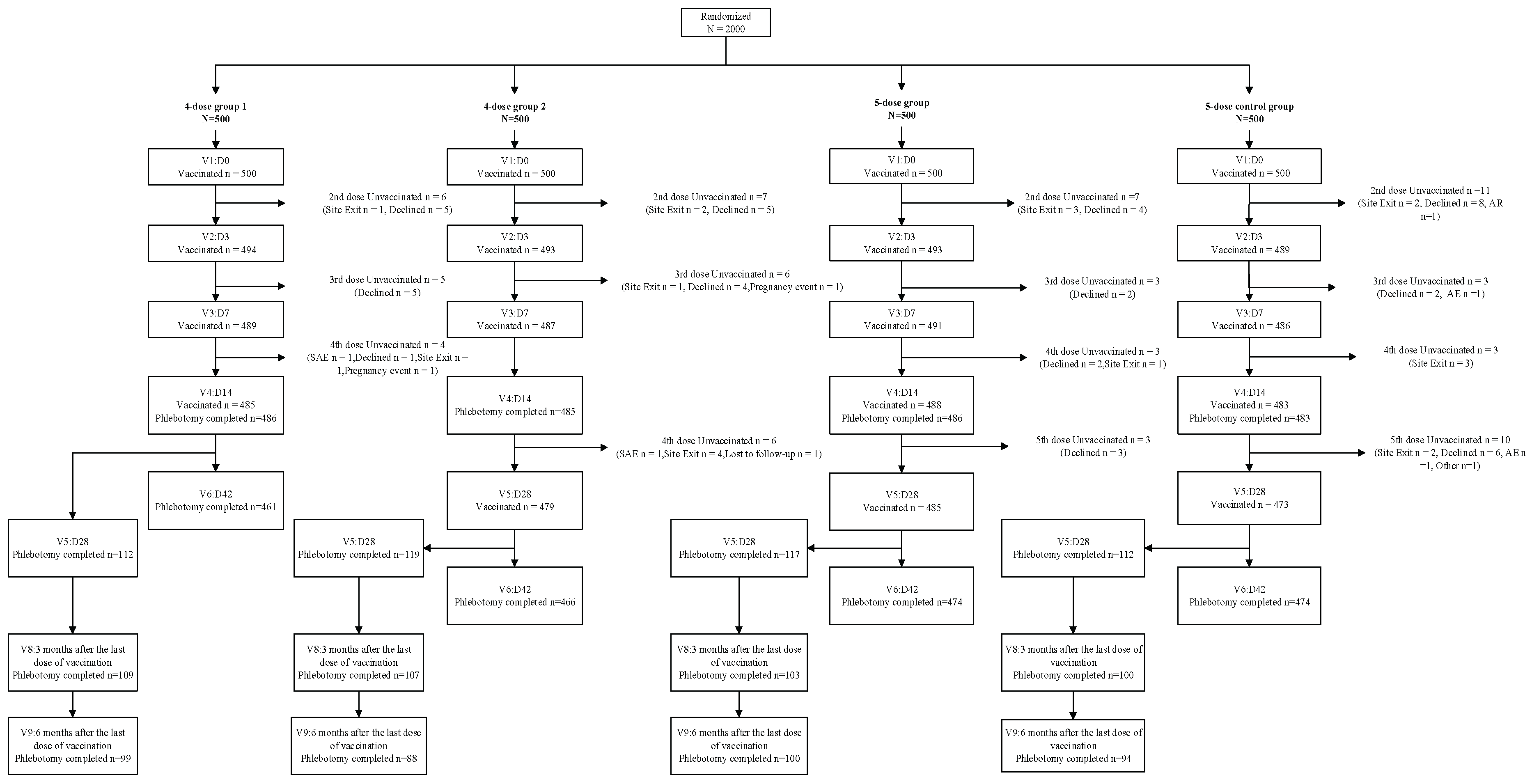
Figure 2.
Incidence of solicited local reactions.
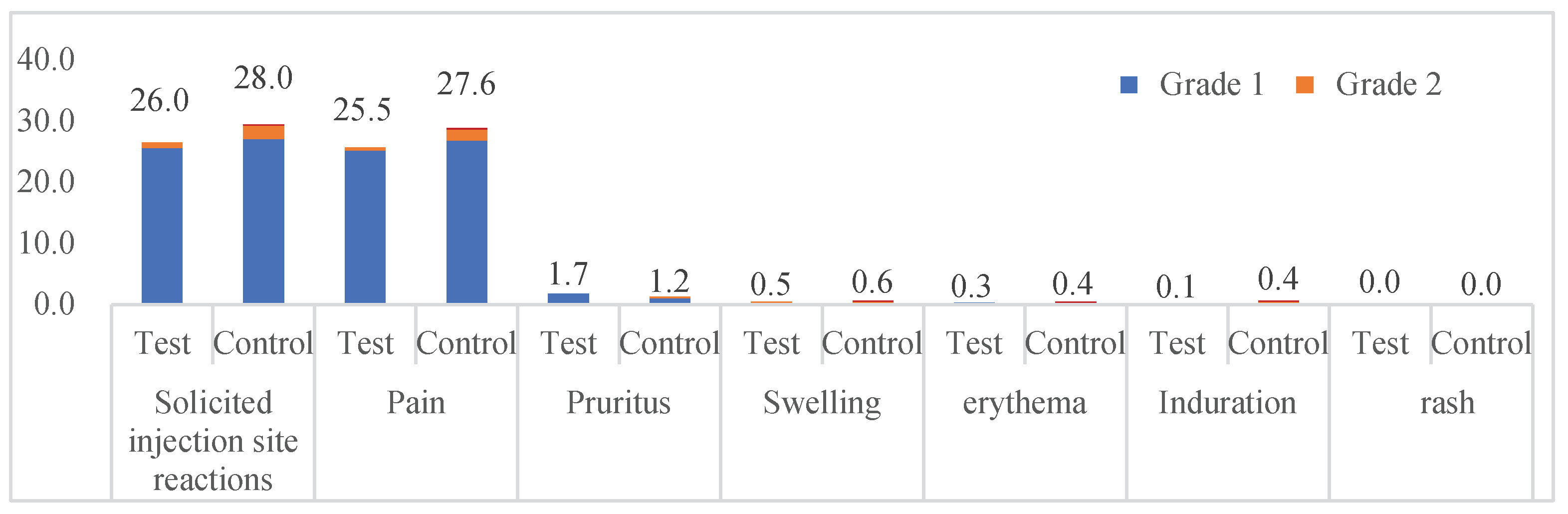
Figure 3.
Incidence of solicited systemic reactions.
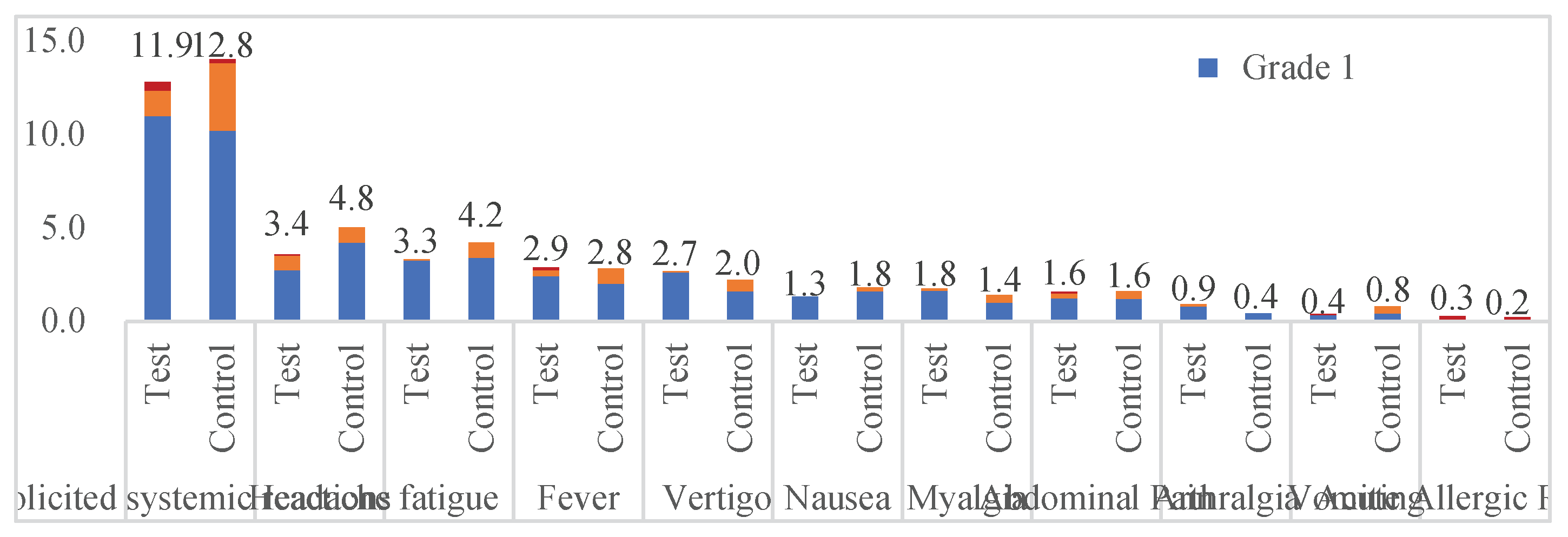

Table 1.
Baseline Demographics of study participants (SS).
| Characteristics | Part one | Part two | |||
|---|---|---|---|---|---|
| 5-dose study group N=40 |
4-dose study group 1 N=500 |
4-dose study group 2 N=500 |
5-dose study group N=500 |
5-dose control group N=500 |
|
| Age, year | |||||
| mean (SD) | 30.63 (16.83) | 40.60 (14.22) | 38.22 (14.97) | 39.66 (14.77) | 40.53 (14.15) |
| Gender, (n) % | |||||
| Male | 20 (50.00) | 186 (37.20) | 183 (36.60) | 202 (40.40) | 172 (34.40) |
| Female | 20 (50.00) | 314 (62.80) | 317 (63.40) | 298 (59.60) | 328 (65.60) |
| Ethnicity, (n) % | |||||
| Han | 40 (100.00) | 498 (99.60) | 499 (99.80) | 498 (99.60) | 499 (99.80) |
| Other | 0 (0.00) | 2 (0.40) | 1 (0.20) | 2 (0.40) | 1 (0.20) |
| Height, cm | |||||
| Mean (SD) | 160.6 (8.4) | 158.2 (8.5) | 158.2 (8.9) | 158.3 (8.9) | 157.6 (8.6) |
| Weight, kg | |||||
| Mean (SD) | 57.43 (10.22) | 60.54 (10.56) | 60.25 (11.74) | 60.66 (11.09) | 60.05 (10.78) |
Table 2.
Immunogenicity summary of RVNA on D14, 28 and 42 in susceptible participants with a baseline RVNA titer <0.5IU/mL (PPS).
Table 2.
Immunogenicity summary of RVNA on D14, 28 and 42 in susceptible participants with a baseline RVNA titer <0.5IU/mL (PPS).
| 4-dose study group 1 | 4-dose study group 2 | 5-dose study group | 5-dose control group | |
|---|---|---|---|---|
| D14(14 days post Dose 1) | ||||
| n | 389 | 407 | 398 | 394 |
| Seroconversion rate, % (95% CI) | 100.00 (99.06, 100.00) | 100.00(99.10,100.00) | 100.00(99.08,100.00) | 100.00(99.07,100.00) |
| Seroconversion rate difference (95%/97.5% CI) | 0.00 (-1.28, 1.26) | 0.00 (-1.22, 1.26) | 0.00 (-0.96, 0.97) | / |
| GMC (95%CI) | 34.71 (32.12, 37.50) | 36.36(33.71,39.22) | 33.17(30.72,35.81) | 37.38(34.62,40.37) |
| GMC ratio (95%/97.5% CI) | 0.93 (0.82, 1.05) | 0.97 (0.86, 1.10) | 0.89 (0.80, 0.99) | / |
| D28(28 days post Dose 1) | ||||
| n | 97 | 105 | 102 | 99 |
| Seroconversion rate, % (95% CI) | 100.00 (96.27, 100.00) | 100.00(96.55,100.00) | 100.00(96.45,100.00) | 100.00(96.34,100.00) |
| GMC (95%CI) | 18.04 (15.49, 21.00) | 16.32(13.95,19.08) | 18.54(15.71,21.89) | 20.42(17.46,23.88) |
| D42(42 days post Dose 1) | ||||
| n | 389 | 407 | 398 | 394 |
| Seroconversion rate, % (95% CI) | 100.00 (99.06, 100.00) | 100.00(99.10,100.00) | 100.00(99.08,100.00) | 100.00(99.07,100.00) |
| Seroconversion rate difference (95%/97.5% CI) | 0.00 (-1.28, 1.26) | 0.00 (-1.22, 1.26) | 0.00 (-0.96, 0.97) | / |
| GMC (95%CI) | 13.46 (12.31, 14.72) | 20.97(19.23,22.86) | 21.54(19.73,23.52) | 22.81(20.93,24.86) |
| D42/D28(14 days post last dose) | ||||
| n | 97 | 407 | 398 | 394 |
| Seroconversion rate, % (95% CI) | 100.00 (96.27, 100.00) | 100.00(99.10,100.00) | 100.00(99.08,100.00) | 100.00(99.07,100.00) |
| GMC (95%CI) | 18.04 (15.49, 21.00) | 20.97(19.23,22.86) | 21.54(19.73,23.52) | 22.81(20.93,24.86) |
RVNA, Rabies virus neutralizing antibody.
Table 3.
Immune persistence of RVNA at 3 and 6 months after full-course vaccination in susceptible participants.
Table 3.
Immune persistence of RVNA at 3 and 6 months after full-course vaccination in susceptible participants.
| 4-dose study group 1 | 4-dose study group 2 | 5-dose study group | 5-dose control group | |
|---|---|---|---|---|
| 3 months after the last dose of vaccination) | ||||
| n | 95 | 100 | 94 | 91 |
| Seropositive rate, % (95% CI) | 100.00 (96.19, 100.00) | 100.00 (96.38, 100.00) | 100.00 (96.15, 100.00) | 100.00 (96.03, 100.00) |
| 6 months after the last dose of vaccination | ||||
| n | 85 | 81 | 92 | 85 |
| Seropositive rate, % (95% CI) | 97.65 (91.76, 99.71) | 97.53 (91.36, 99.70) | 98.91 (94.09, 99.97) | 96.47 (90.03, 99.27) |
RVNA, Rabies virus neutralizing antibody.
Disclaimer/Publisher’s Note: The statements, opinions and data contained in all publications are solely those of the individual author(s) and contributor(s) and not of MDPI and/or the editor(s). MDPI and/or the editor(s) disclaim responsibility for any injury to people or property resulting from any ideas, methods, instructions or products referred to in the content. |
© 2026 by the authors. Licensee MDPI, Basel, Switzerland. This article is an open access article distributed under the terms and conditions of the Creative Commons Attribution (CC BY) license (http://creativecommons.org/licenses/by/4.0/).
Copyright: This open access article is published under a Creative Commons CC BY 4.0 license, which permit the free download, distribution, and reuse, provided that the author and preprint are cited in any reuse.