

Submitted:
10 October 2025
Posted:
11 October 2025
You are already at the latest version
Abstract
Breast cancer remains a significant global health challenge where early detection through screening substantially reduces mortality. This comprehensive review evaluates the role of social media and digital platforms in enhancing breast cancer screening awareness and participation. A systematic literature search encompassing diverse study designs assessed digital interventions’ impact on knowledge, attitudes, and screening uptake among various populations. Findings indicate that digital campaigns, including video-based and interactive social media initiatives, effectively increase awareness and intention to screen while addressing key barriers such as fear, stigma, and socioeconomic disparities. However, concerns about misinformation and content quality underscore the need for accurate, regulated health messaging. Moreover, peer support and community engagement facilitated by digital tools amplify screening promotion. Emerging innovations integrating personalized risk stratification and telehealth support offer promising directions. Ethical and interdisciplinary considerations are paramount for successful implementation. This review highlights the transformative potential of digital platforms in breast cancer screening promotion and underscores areas for future research to optimize their effectiveness and equity.
Keywords:
breast cancer screening
; social media
; digital health interventions
; health awareness
; screening participation
; health communication
; digital platforms
1. Introduction
1.1. Background on Breast Cancer Screening
Breast cancer remains one of the most prevalent and deadly cancers affecting women globally, emphasizing the critical importance of early detection through screening. Early identification via mammography and clinical breast examination has been shown to reduce mortality and improve treatment outcomes (Sun et al., 2025; Alduraidi et al., 2025). Despite significant advancements in screening technology and public health campaigns, participation rates remain heterogeneous across regions and populations. Persistent disparities exist, with lower screening uptake seen in reproductive-age women in Kenya (Abuhay et al., 2025), Arab female populations in the Middle East (Alduraidi et al., 2025), and culturally and linguistically diverse groups in countries such as Australia and India (Richardson-Parry et al., 2023; Jamal et al., 2021). Socioeconomic status, accessibility to healthcare, cultural beliefs, and awareness levels have been identified as major determinants affecting these disparities. Moreover, breast cancer knowledge about risk factors and screening methods often remains insufficient (Alduraidi et al., 2025), contributing to underutilization of screening services and late-stage diagnoses, particularly in underserved populations.
1.2. Emergence of Social Media and Digital Platforms in Health Communication
The rapid proliferation of social media and digital platforms in recent years has significantly transformed the landscapes of health communication and patient education. These channels offer unprecedented opportunities to reach diverse and large populations with tailored health promotion messages (Griffiths et al., 2023; Tso & Parikh, 2020). Evidence suggests that digital campaigns, including video-based interventions and interactive online resources, have enhanced breast cancer knowledge and positively impacted screening attitudes and intentions in various contexts, such as rural India and Singapore (Sinha & Sharma, 2024; Liow et al., 2022). Social media platforms such as Facebook, Twitter, Instagram, and TikTok are increasingly used to disseminate educational content, share personal experiences, and foster peer support around breast cancer awareness and screening (Basch & MacLean, 2019; Plackett et al., 2020). However, these platforms simultaneously face challenges such as misinformation, variable content quality, and engagement disparities among minority and low-income groups (Yang et al., 2025; Rajabi et al., 2021). The effectiveness of social media for behavior change is also influenced by the depth of interaction and the presence of health professionals to moderate content (Griffiths et al., 2023; Scragg et al., 2017). Notably, while digital tools enhance exposure and awareness, their direct impact on screening participation requires further elucidation due to multifactorial influences, including cultural stigma, limited health literacy, and socioeconomic factors (Abuhay et al., 2025; Alduraidi et al., 2025).
Social support structures, such as spousal involvement and community health worker programs, also complement digital health interventions by addressing psychosocial and logistic barriers to screening (Richardson-Parry et al., 2023; Nguyen et al., 2009). Community engagement amplified through social media platforms helps facilitate viral peer-driven promotion of mammography, showing promise in reducing disparities in cancer screening uptake (Southwell et al., 2010).
1.3. Rationale and Objectives
Given the evolving digital health ecosystem, it is vital to comprehensively understand how social media and digital interventions influence breast cancer screening awareness, attitudes, and behaviors. Synthesizing existing literature offers key insights into the potential of these platforms to augment traditional public health strategies and reduce inequities. The present review aims to critically examine the evidence base surrounding digital campaigns, social media messaging quality, and community engagement approaches related to breast cancer screening promotion. Moreover, elucidating barriers and facilitators across sociocultural contexts supports the development of tailored interventions that effectively harness these innovative platforms. Future directions for leveraging personalized risk assessment tools integrated with digital health technologies will be discussed to promote equitable breast cancer screening uptake and improved outcomes globally.
2. Methodology
2.1. Literature Search Strategy
This narrative review was based on a literature search of the Scopus database, which was selected for its comprehensive coverage of peer-reviewed journals across health sciences, digital technology, and social sciences. The search included articles published up to September 2025. Keywords and search terms combined concepts related to breast cancer screening, awareness, participation, social media, digital health interventions, and health communication. Additional references were identified by reviewing the bibliographies of relevant papers to capture studies not indexed in Scopus but pertinent to the review’s objectives. Only articles published in English were included. Priority was given to studies that examined the role of social media and digital platforms in influencing breast cancer screening knowledge, attitudes, or behaviors. Studies focusing exclusively on other cancers, reporting purely biomedical outcomes, or published in non-peer-reviewed sources were excluded (Figure 1).
Given the narrative nature of this review, no formal quality assessment tool or systematic inclusion framework was applied. Instead, emphasis was placed on selecting studies that provided conceptual, methodological, or empirical insights into how digital media interventions affect breast cancer screening awareness and participation. Both quantitative and qualitative studies, as well as review articles, were considered to provide a broad perspective. The selected articles were analyzed and summarized according to their objectives, study design, intervention type, and reported outcomes (Table 1). Findings were narratively synthesized, with themes grouped under awareness and knowledge improvement, attitudinal change, behavioral intention, screening participation, and challenges such as misinformation and inequities. Where relevant, examples of community engagement and innovations such as telehealth integration or personalized risk assessment were highlighted to demonstrate emerging directions. Although the narrative approach does not follow the rigid protocol of a systematic review, these measures were taken to enhance transparency, reduce selection bias, and strengthen the reliability of the synthesized findings.
2.2. Assessment of Intervention and Study Designs
The included studies represented a diverse methodological landscape (Table 1), incorporating designs ranging from cross-sectional surveys and qualitative explorations to randomized controlled trials (RCTs) and mixed-methods approaches. For instance, the quasi-experimental design used by Sinha and Sharma (2024) evaluated video-based interventions to improve knowledge and practices among rural women, while Liow et al. (2022) combined focus group discussions and surveys to investigate attitudes toward risk-based screening in a risk assessment cohort. These varied designs allowed for comprehensive insights into the real-world efficacy, acceptability, and implementation challenges of digital interventions.
To assess quality and reliability, many studies employed validated tools. Yang et al. (2025) utilized the modified DISCERN tool and Global Quality Scores to assess the reliability of mammography-related videos, while Qin et al. (2021) applied multivariable logistic regression with propensity matching to adjust for sociodemographic confounders in evaluating social media’s impact on screening awareness and behavior. Measurement of behavior change encompassed self-reported screening uptake, intention to screen, knowledge improvement, and attitudinal shifts. Studies such as those by Bancrfot et al. (2022) and Plackett et al. (2020) incorporated behavior change techniques taxonomy to identify mechanisms facilitating actual increases in screening.
Risk of bias was considered in RCTs by evaluating aspects such as allocation concealment, blinding, and attrition, while qualitative studies followed standards for thematic analysis and triangulation methods to consolidate findings. Together, the array of intervention and study designs offered a multidimensional perspective on how digital and social media interventions influence breast cancer screening-related outcomes.
2.3. Data Synthesis Approach
The synthesis of data involved thematic grouping and narrative integration, focusing on key outcomes such as awareness enhancement, attitudinal changes, knowledge improvement, and screening participation. Consistent with the scoping review methodology by Sun et al. (2025) and the synthesis approach by Plackett et al. (2020), studies were categorized based on intervention characteristics (e.g., social media campaigns, video education, chatbot tools), target population demographics, and primary outcomes measured.
Quantitative data from surveys and trials assessing screening intention or uptake were tabulated and summarized descriptively, with subgroup analyses where available (e.g., by age, ethnicity, and socioeconomic status). Qualitative data were synthesized through thematic analysis to capture nuanced insights into barriers, facilitators, and user experiences related to digital interventions.
An overarching analytical framework was employed to evaluate the influence of digital platforms across a continuum from knowledge dissemination to behavioral enactment, allowing comparison of effectiveness and identification of gaps in evidence. This approach also facilitated mapping of barriers addressed by digital tools and highlighted the role of social support and community engagement as reported by intervention studies (see Bancroft et al., 2022; Southwell et al., 2010). This comprehensive methodological approach provides a robust foundation for characterizing and evaluating the evolving landscape of digital interventions aimed at improving breast cancer screening awareness and participation globally.
2.4. Impact of Social Media and Digital Interventions on Breast Cancer Screening Awareness and Participation
Social media and digital platforms have emerged as promising tools to enhance breast cancer screening awareness and participation. Video-based interventions, such as the validated Hindi YouTube videos deployed among rural women in Bihar, India, demonstrated statistically significant improvements in knowledge related to risk factors, symptoms, and screening behaviors, with 60% of women increasing breast self-examination (Sinha & Sharma, 2024). Similarly, social media campaigns in predominantly Black church-going women have highlighted the disparity between preferred sources of cancer information and actual utilization, where engaging healthcare providers through digital means increased mammography uptake (Bancroft et al., 2022). Social media use correlates with increased awareness of cancer screening modalities, as noted in US surveys, although this increased awareness does not always translate into actual screening behaviors (Qin et al., 2021).
Large-scale awareness efforts, including national and local digital campaigns, have shown effectiveness in raising knowledge and screening intention. For example, Sun et al. (2025) identified the potential of NLP-powered chatbots and personalized information delivery to facilitate patient education, supporting early detection and personalized care. Plackett et al. (2020) noted that social media breast cancer awareness campaigns increase low- to medium-level engagement, such as likes and shares, with some evidence for increased screening uptake, but emphasized the need for more rigorous evaluation frameworks to understand behavior change fully.
2.5. Barriers to Breast Cancer Screening and Role of Digital Tools in Mitigation
Significant barriers to breast cancer screening include limited knowledge, fear, stigma, and socioeconomic disadvantages. In Kenya, clinical screening uptake remains low, particularly among women from disadvantaged socioeconomic backgrounds (Abuhay et al., 2025). Among Arab women in the MENA region, lack of knowledge and fear of screening outcomes were prominent barriers, despite relatively high awareness (Alduraidi et al., 2025). Jamal et al. (2021) highlighted culturally specific barriers among linguistically and culturally diverse women, which digital platforms can help mitigate by tailoring messaging and improving access.
Social networks and spousal influence remain potent facilitators or barriers. Richardson-Parry et al. (2023) found that peer-based approaches combined with digital tools address inequities effectively by leveraging empowerment and community advocacy. Nguyen et al. (2009) underscored the role of lay health worker outreach coupled with media education in significantly increasing mammography and clinical breast examination rates among Vietnamese-American women. Digital platforms enhance these social network effects by providing readily accessible and individualized interventions to diminish psychosocial and structural barriers.
2.6. Quality and Reliability of Online Breast Cancer Screening Information
The quality of breast cancer screening information available on social media and digital platforms varies considerably. Yang et al. (2025) evaluated mammography-related videos on Douyin, uncovering suboptimal content quality, limited expert involvement, and reliability issues. Similarly, Rajabi et al. (2021) and Basch and MacLean (2019) noted that misinformation and low-quality content are pervasive, which poses challenges for patient education and decision-making.
Accurate and regulated content is essential to support informed choices. Sun et al. (2025) emphasized interdisciplinary collaboration among clinicians, AI technologists, and communication experts to ensure trustworthy and effective digital health messaging. Griffiths et al. (2023) also discussed the emerging concept of a digital health ‘space’ that combines social media and web-based hubs to facilitate communication, support, and reliable dissemination of breast cancer screening information.
2.7. The Role of Peer Support, Community Engagement, and Advocacy in Screening Promotion
Peer support and community engagement amplified through digital media are critical for improving breast cancer screening uptake. Community health worker programs, such as those evaluated by Nguyen et al. (2009) and Kratzke et al. (2010), showed that trained laypersons combined with media education effectively increased screening behavior among minority women. Richardson-Parry et al. (2023) further stressed that incorporating patient advocacy groups and empowerment organizations enhances screening interventions’ reach and equity.
Social network density and community ties are important facilitators of viral marketing for screening promotion. Southwell et al. (2010) demonstrated that higher religious congregation density and residential stability predicted greater peer referral likelihood for mammography, suggesting that community social structures can be harnessed in digital interventions to spread awareness and normalize screening behaviors.
2.8. Future Directions and Innovations in Personalized Digital Breast Cancer Screening
Recent advances point to the integration of multifactorial risk stratification and polygenic risk scores into personalized breast cancer screening supported by digital platforms. Walker et al. (2024) provided Canadian evidence on the feasibility of such risk assessment within population-based screening, highlighting equity challenges among minorities and individuals with low education. Yi et al. (2025) further explored combining interactive digital interventions with stepped telehealth care to reduce cancer-related distress and enhance survivorship outcomes.
Ethical considerations, transparency, and explainability remain central to implementing AI and digital health tools responsibly (Dick et al., 2024; Sun et al., 2025). Interdisciplinary collaboration will be vital to develop supportive infrastructures for risk-based screening predictions and personalized interventions, ensuring broad accessibility and trustworthiness.
Collectively, the literature indicates that social media and digital health platforms hold substantial promise to augment breast cancer screening awareness and participation, particularly when combined with community engagement, peer support, and personalized intervention strategies.
3. Conclusion
This review consolidates evidence demonstrating that social media and digital platforms substantially enhance breast cancer screening awareness and participation by effectively disseminating information and addressing barriers related to knowledge, stigma, and access disparities. Digital interventions manifest as versatile tools capable of reaching diverse populations, especially when integrated with peer support and community engagement strategies. Nonetheless, challenges persist, notably the prevalence of misinformation and variable content quality, highlighting the necessity for regulated, evidence-based health communication. Advancements in personalized digital screening interventions, incorporating multifactorial risk assessment and telehealth support, herald a new frontier in targeted prevention. Ethical considerations and interdisciplinary collaboration emerge as critical to ensuring equitable and effective deployment. Future research should focus on optimizing digital content accuracy, evaluating long-term behavioral outcomes, and developing frameworks that balance innovation with ethical integrity. Together, these insights chart a promising path for leveraging digital technologies to reduce breast cancer burden globally.
Funding Information: This research received an Internal University Research Grant Scheme 2025 – Reference Number : KPJU/KPJRC/GRANT/2024/01(INT2).
Author Contributions
Conceptualization, writing—original draft preparation, [Norhayati Mohd Zain]; writing—review and editing, [Nur Anis Izzati Che Mut].
Institutional Review Board Statement
Not applicable, as this study did not involve humans or animals.
Informed Consent Statement
Not applicable, as this study did not involve humans.
Data Availability Statement
The data used in this study were obtained from the Scopus database. Processed datasets generated and analyzed during the study are available from the database.
Conflicts of Interest
The author declares no conflict of interest.
References
- Sun, M., Reiter, E., Duncan, L. F., & Adam, R. (2025). The role of natural language processing in improving cancer care: A scoping review with narrative synthesis. Artificial Intelligence in Medicine, 168. [CrossRef]
- Alduraidi, H., Tarazi, A., Theeb, L. S., & AlKasaji, M. (2025). Knowledge, Attitudes, and Practices Toward Breast Cancer and Breast Cancer Screening Among Arab Females in the Middle East: A Literature Review. Public Health Nursing, 42(1), 579–588. [CrossRef]
- Padamsee, T. J., Stover, D. G., Tarver, W. L., Washington, C. M., Baltic, R. D., DeGraffinreid, C. R., ... & Nolan, T. S. (2023). Turning the Page on Breast Cancer in Ohio: Lessons learned from implementing a multilevel intervention to reduce breast cancer mortality among Black women. Cancer, 129, 3114–3127. [CrossRef]
- Abuhay, H. W., Alemu, G. G., Aweke, M. N., Fenta, E. T., Mengistu, B., & Mesfin, A. (2025). Clinical breast cancer screening uptake and associated factors among reproductive-age women in Kenya: further analysis of the Kenyan Demographic and Health Survey 2022. PLOS ONE, 20 (4 April). [CrossRef]
- Richardson-Parry, A., Baas, C., Donde, S. S., Ferraiolo, B., Karmo, M., Maravic, Z., ... & Tinianov, S. L. (2023). Interventions to reduce cancer screening inequities: the perspective and role of patients, advocacy groups, and empowerment organizations. International Journal for Equity in Health, 22(1). [CrossRef]
- Jamal, J., MacMillan, F., & McBride, K. (2021). Barriers and facilitators of breast cancer screening amongst culturally and linguistically diverse women in southwestern Sydney: A qualitative explorative study. International Journal of Environmental Research and Public Health, 18(17). [CrossRef]
- Griffiths, M., Scragg, B., Stein-Hodgins, J. R., & Ure, C. (2023). Digital health technologies. In Digital Health (pp. 165–175). [CrossRef]
- Tso, H. H., & Parikh, J. R. (2020). Using Facebook Live to Advocate Breast Cancer Screening. Journal of Digital Imaging, 33(4), 1047–1052. [CrossRef]
- Basch, C. H., & MacLean, S. A. (2019). Breast cancer on Instagram: A descriptive study. International Journal of Preventive Medicine, 10(1). [CrossRef]
- Plackett, R., Kaushal, A., Kassianos, A. P., Cross, A., Lewins, D., Sheringham, J. R., ... & von Wagner, C. (2020). Use of Social Media to Promote Cancer Screening and Early Diagnosis: Scoping Review. Journal of Medical Internet Research, 22(11). [CrossRef]
- Sinha, N., & Sharma, A. (2024). Digital media intervention for breast cancer awareness among rural women: A quasi-experimental study from Bihar, India. Clinical Epidemiology and Global Health, 28. [CrossRef]
- Liow, J. J. K., Lim, Z., Sim, T. M. Y., Ho, P. J., Goh, S. A., Choy, S. D., ... & Hartman, M. B. A. (2022). “It Will Lead You to Make Better Decisions about Your Health”—A Focus Group and Survey Study on Women’s Attitudes towards Risk-Based Breast Cancer Screening and Personalized Risk Assessments. Current Oncology, 29(12), 9181–9198. [CrossRef]
- Yang, H., Zhu, C., Zhou, C., Huang, R., Huang, L., Chen, P., ... & Zhu, C. (2025). Evaluation of Douyin Short Videos on Mammography in China: Quality and Reliability Analysis. JMIR Cancer, 11. [CrossRef]
- Rajabi, R., Abedi, P., Araban, M., & Maraghi, E. (2021). Effects of Education via WhatsApp vs. Compact Disk on Health Literacy and Behavior of Middle-Aged Women about Screening Methods for Breast Cancer. Iranian Journal of Breast Diseases, 14(3), 12–22. [CrossRef]
- Scragg, B., Shaikh, S., Shires, G., Stein-Hodgins, J., Mercer, C. E., Robinson, L., & Wray, J. (2017). An exploration of mammographers’ attitudes towards the use of social media for providing breast screening information to clients. Radiography, 23(3), 249–255. [CrossRef]
- Nguyen, T. T., Le, G. M., Nguyen, T., Le, K., Lai, K., Gildengorin, G. L., ... & McPhee, S. J. (2009). Breast Cancer Screening Among Vietnamese Americans. A Randomized Controlled Trial of Lay Health Worker Outreach. American Journal of Preventive Medicine, 37(4), 306–313. [CrossRef]
- Southwell, B. G., Slater, J. S., Rothman, A. J., Friedenberg, L. M., Allison, T. R., & Nelson, C. L. (2010). The availability of community ties predicts the likelihood of peer referral for mammography: Geographic constraints on viral marketing. Social Science and Medicine, 71(9), 1627–1635. [CrossRef]
- Qin, L., Zhang, X., Wu, A., Miser, J. S., Liu, Y., Hsu, J. C. H. S., et al. (2021). Association between social media use and cancer screening awareness and behavior for people without a cancer diagnosis: Matched cohort study. Journal of Medical Internet Research, 23(8). [CrossRef]
- Bancroft, E. K., Saya, S., Brown, E., Thomas, S. R., Taylor, N., Rothwell, J., & Pope, J. (2022). Examining Associations between Source of Cancer Information and Mammography Behavior among Black Church-Going Women. International Journal of Environmental Research and Public Health, 19(20). [CrossRef]
- Walker, M. J., Blackmore, K. M., Chang, A., Lambert-Côté, L., Turgeon, A., Antoniou, A. C., Bell, K. A., Broeders, M. J. M., Brooks, J. D., & Carver, T. (2024). Implementing Multifactorial Risk Assessment with Polygenic Risk Scores for Personalized Breast Cancer Screening in the Population Setting: Challenges and Opportunities. Cancers, 16(11). [CrossRef]
- Yi, J. C., Ballard, S. A., Walsh, C. A., Friedman, D. N., Ganz, P. A., Jacobs, L. A., Partridge, A. H., Mitchell, S. A., Leisenring, W. M., & Syrjala, K. L. (2025). INteractive survivorship program to improve health care REsources [INSPIRE]: A study protocol testing a digital intervention with stepped care telehealth to improve outcomes for adolescent and young adult survivors. Contemporary Clinical Trials, 148. [CrossRef]
- Dick, K., Humber, J., Ducharme, R., Dingwall-Harvey, A. L. J., Armour, C. M., Hawken, S. J., & Walker, M. C. (2024). The Transformative Potential of AI in Obstetrics and Gynecology. Journal of Obstetrics and Gynaecology Canada, 46(3). [CrossRef]
- Kratzke, C., Garzon, L. S., Lombard, J. R., & Karlowicz, K. A. (2010). Training community health workers: Factors that influence mammography use. Journal of Community Health, 35(6), 683–688. [CrossRef]
Figure 1.
Simplified flow of the literature search and selection process for this narrative review.
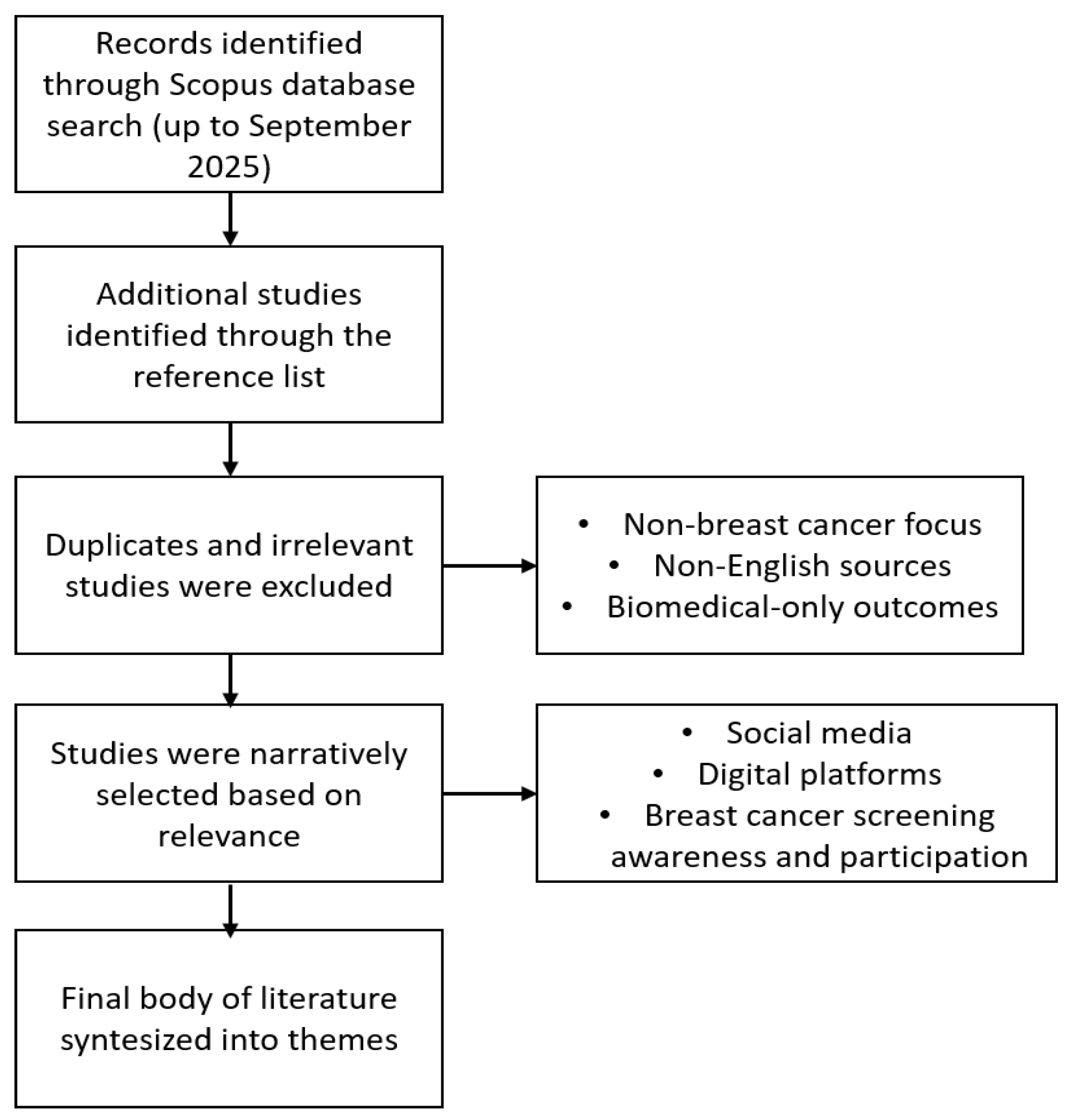

Table 1.
Summary characteristics of included studies.
| Author(s), Year | Study Design | Intervention Type | Population | Outcomes Measured |
| Sinha & Sharma (2024) | Quasi-experimental | Video-based intervention (educational videos) | Rural women | Knowledge improvement, screening practices |
| Liow et al. (2022) | Mixed-methods (FGDs + surveys) | Risk-based screening discussions (digital + group) | Risk-assessment cohort, diverse women | Attitudes toward screening, willingness to participate |
| Yang et al. (2025) | Cross-sectional content evaluation | YouTube mammography videos | Publicly available videos (online users) | Reliability (DISCERN, GQS), content quality |
| Qin et al. (2021) | Observational (with regression & propensity matching) | Social media exposure (screening awareness campaigns) | Women across sociodemographic strata | Awareness, intention to screen, screening behavior |
| Bancroft et al. (2022) | Experimental & behavioral analysis | Social media campaign + behavior change techniques | Community-based populations | Screening uptake, behavior change mechanisms |
| Plackett et al. (2020) | Scoping review / mixed approaches | Social media interventions (Twitter, Facebook, YouTube) | General women, health-seeking populations | Knowledge dissemination, awareness, screening participation |
| Griffiths et al. (2023) | Observational | Instagram and Twitter engagement analysis | General female users, online communities | User engagement, awareness trends |
| Southwell et al. (2010) | Qualitative & survey-based | Online community & peer support forums | Women engaged in online health communities | Social support, community engagement for screening |
Disclaimer/Publisher’s Note: The statements, opinions and data contained in all publications are solely those of the individual author(s) and contributor(s) and not of MDPI and/or the editor(s). MDPI and/or the editor(s) disclaim responsibility for any injury to people or property resulting from any ideas, methods, instructions or products referred to in the content. |
© 2025 by the authors. Licensee MDPI, Basel, Switzerland. This article is an open access article distributed under the terms and conditions of the Creative Commons Attribution (CC BY) license (http://creativecommons.org/licenses/by/4.0/).
Copyright: This open access article is published under a Creative Commons CC BY 4.0 license, which permit the free download, distribution, and reuse, provided that the author and preprint are cited in any reuse.


